02나선 은하 형성 — 원반 별들이 저절로 팔을 만드는 과정
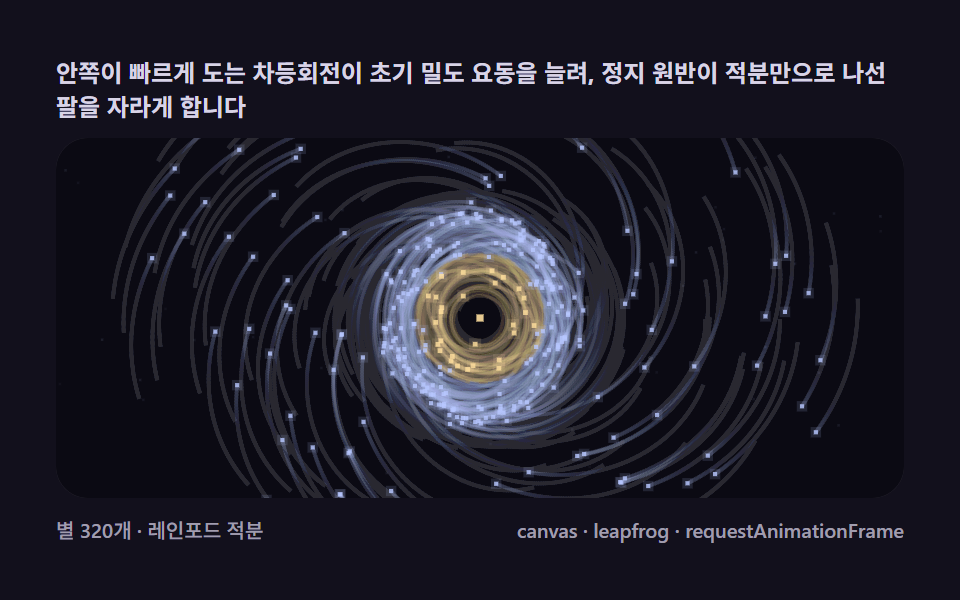
정지된 원반에 원점 중심 인력만 주고 궤도 속도로 돌게 놔두면 안쪽이 빠르게 도는 차등회전이 초기 밀도 요동을 늘려 나선 팔이 저절로 선명해지는데, 077 은하 회오리가 '식으로 그린 나선'이라면 이쪽은 '적분으로 자라는 나선'입니다.
쓰임로딩 씬, 교육 도해
CanvasRenderingContext2DfillRectrequestAnimationFrame
<main class="stage">
<div class="gx is-demo" id="gxRoot">
  <p class="gx__hint">
    <span>안쪽이 빠르게 도는 차등회전이 초기 밀도 요동을 늘려, 정지 원반이 적분만으로 나선팔을 자라게 합니다</span>
  </p>
  <div class="gx__field" id="gxField" role="application" aria-label="나선 팔 형성 실험판" tabindex="0">
    <canvas class="gx__cv" id="gxCv"></canvas>
  </div>
  <div class="gx__bar">
    <span class="gx__meta">별 320개 · 레인포드 적분</span>
    <span class="gx__meta gx__meta--dim">canvas · leapfrog · requestAnimationFrame</span>
  </div>
</div>
</main>
@use "../../../../site/static/demo-tokens" as *;
// 나선 팔 형성(02). @keyframes 를 두지 않는다 —
// 움직임은 전부 캔버스 rAF 루프(중심 질량 + 별 상호 중력 O(N²) 레인포드 적분 → 점 그리기)가 만든다.
// 무대는 편 공통 심우주 팔레트. 파스텔 주색을 --gx-* 로 편 전체(01~09) 공통 규격.
$duration: $dur-loop;
$easing: $ease-spring;
$color: $subject-lilac;
// ── 편 공통 심우주 팔레트(BD9~11 원칙: 편마다 다시 정하지 않는다) ──
$gx-stage: #12101c; // 심우주 자정 — 저채도 짙은 남보라 (파스텔 검사 무관: 저채도·저명도)
@include stage($gx-stage);
$gx-ink: #0b0a13; // 관측창 바닥 — 무대보다 한 톤 어두운 보라검
$gx-glow: #b7c8ff; // 은하 A 별빛 — 파스텔 페리윙클(고명도라 vivid 아님)
$gx-hot: #ffdf9e; // 은하 B 코어 — 파스텔 앰버
$gx-text: #d8d4e6; // 라벨 글자 — 밝은 회보라
.gx {
// 렌더러가 읽는 색 — JS 는 getComputedStyle 로 --gx-* 를 받아 쓴다
--gx-ink: #{$gx-ink};
--gx-glow: #{$gx-glow};
--gx-hot: #{$gx-hot};
--gx-tail: #{$subject-pink};
display: flex; flex-direction: column; gap: $sp-2;
width: 100%; max-width: 424px;
}
.gx__hint {
display: flex; align-items: center; gap: $sp-1; margin: 0;
font-weight: 700; font-size: clamp(10px, 2.8vw, 12px); line-height: 1.35;
color: $gx-text;
}
.gx__field {
position: relative; height: 180px;
border-radius: $r-card; overflow: hidden;
background: $gx-ink;
box-shadow: inset 0 0 0 1px rgba($gx-text, .18);
}
.gx__field:focus-visible { outline: 2px solid $gx-glow; outline-offset: 2px; }
.gx__cv { display: block; width: 100%; height: 100%; }
.gx__bar { display: flex; align-items: baseline; justify-content: space-between; gap: $sp-2; }
.gx__meta { font-size: 10px; font-weight: 500; color: rgba($gx-text, .72); }
.gx__meta--dim { font-size: 10px; }
@media (max-width: 340px) {
.gx { gap: $sp-1; }
.gx__field { height: 100px; }
.gx__meta--dim { display: none; }
}
// reduce — rAF 를 돌리지 않고 궤적이 다 쌓인 한 장만 남는다.
@media (prefers-reduced-motion: reduce) {
.gx.is-still .gx__field { cursor: default !important; }
}html, body {
margin: 0;
overflow: hidden;
}
.stage {
box-sizing: border-box;
min-height: 100vh;
display: grid;
place-items: center;
margin: 0;
background: #12101c;
font-family: -apple-system, "Segoe UI", "Noto Sans KR", sans-serif;
padding: clamp(8px, 4vw, 24px);
}
.gx {
--gx-ink: #0b0a13;
--gx-glow: #b7c8ff;
--gx-hot: #ffdf9e;
--gx-tail: #ff9ebb;
display: flex;
flex-direction: column;
gap: 8px;
width: 100%;
max-width: 424px;
}
.gx__hint {
display: flex;
align-items: center;
gap: 4px;
margin: 0;
font-weight: 700;
font-size: clamp(10px, 2.8vw, 12px);
line-height: 1.35;
color: #d8d4e6;
}
.gx__field {
position: relative;
height: 180px;
border-radius: 16px;
overflow: hidden;
background: #0b0a13;
box-shadow: inset 0 0 0 1px rgba(216, 212, 230, 0.18);
}
.gx__field:focus-visible {
outline: 2px solid #b7c8ff;
outline-offset: 2px;
}
.gx__cv {
display: block;
width: 100%;
height: 100%;
}
.gx__bar {
display: flex;
align-items: baseline;
justify-content: space-between;
gap: 8px;
}
.gx__meta {
font-size: 10px;
font-weight: 500;
color: rgba(216, 212, 230, 0.72);
}
.gx__meta--dim {
font-size: 10px;
}
@media (max-width: 340px) {
.gx {
gap: 4px;
}
.gx__field {
height: 100px;
}
.gx__meta--dim {
display: none;
}
}
@media (prefers-reduced-motion: reduce) {
.gx.is-still .gx__field {
cursor: default !important;
}
}// 나선 팔 형성(02) — 정지 원반이 차등회전으로 팔을 자라게 하는 장면.
// 01 과 같은 전 쌍 O(N²) 뉴턴 중력이되 적분기를 leapfrog(개구리뛰기)로 바꾼다:
// 가속도를 절반 스텝 앞뒤로 대칭 계산해 속도·위치를 번갈아 밀면 에너지가 오래 보존되어
// 원반이 몇 바퀴을 돌아도 인위적으로 부풀지 않는다(변형 "적분기"의 본체).
// 여기에 중심 질량(그리지 않는 핵)을 크게 두고 별 상호 중력을 더하면
// 안쪽이 빠르게 도는 차등회전이 초기 밀도 요동을 감아 올려 나선 팔이 저절로 선명해진다.
(function () {
// ── 변형 상수 블록 — 아래 값 하나만 바꿔 변형을 만든다 ──
var NSTARS = 320; // 원반 별 수
var METHOD = 'leapfrog'; // 'euler' 로 바꾸면 변형 "적분기: 오일러"가 된다
// ────────────────────────────────────────────────────
var root = document.getElementById('gxRoot');
var field = document.getElementById('gxField');
var cv = document.getElementById('gxCv');
var css = getComputedStyle(root);
function tokRGB(name) {
var s = css.getPropertyValue(name).trim();
var hx = s.length === 4
? s.charAt(1) + s.charAt(1) + s.charAt(2) + s.charAt(2) + s.charAt(3) + s.charAt(3)
: s.slice(1);
return [parseInt(hx.slice(0, 2), 16), parseInt(hx.slice(2, 4), 16), parseInt(hx.slice(4, 6), 16)];
}
var C_INK = tokRGB('--gx-ink');
var C_GLOW = tokRGB('--gx-glow');
var C_HOT = tokRGB('--gx-hot');
var C_TAIL = tokRGB('--gx-tail');
var reduce = window.matchMedia('(prefers-reduced-motion: reduce)').matches;
var raf = 0, t0 = -1;
var W = 0, H = 0, dpr = 1;
var chainCv, chainCtx;
var N = 0, X = [], Y = [], VX = [], VY = [], MASS = [];
function fit() {
var r = field.getBoundingClientRect();
W = Math.round(r.width); H = Math.round(r.height);
dpr = Math.min(2, window.devicePixelRatio || 1);
cv.width = W * dpr; cv.height = H * dpr;
cv.style.width = '100%'; cv.style.height = '100%';
chainCv = document.createElement('canvas');
chainCv.width = W * dpr; chainCv.height = H * dpr;
chainCtx = chainCv.getContext('2d');
chainCtx.scale(dpr, dpr);
}
// G·질량은 캔버스 픽셀 단위의 시뮬레이션 값(물리 상수 아님 — 글에서 설명)
var G = 60.0, SOFT2 = 36;
var DT = 1 / 60;
var MHALO = 6200; // 중심 질량(핵+헤일로 합) — 그리지 않는다. 별 상호중력과 함께 가속도에 더해진다
// 가속도 합산 — 중심 질량 인력 + 별끼리의 전 쌍 O(N²). AX/AY 는 재사용 버퍼(가비지 최소화)
var AX = [], AY = [];
function accel() {
var i, j, dx, dy, d2, inv, f;
for (i = 0; i < N; i++) { AX[i] = 0; AY[i] = 0; }
// 중심 질량 — 원점이 아니라 원반 중심을 향한다(원반이 화면 중앙에 있으므로 W/2, H/2)
var cx = W * 0.5, cy = H * 0.5;
for (i = 0; i < N; i++) {
dx = cx - X[i]; dy = cy - Y[i];
d2 = dx * dx + dy * dy + SOFT2;
inv = 1 / Math.sqrt(d2);
f = G * MHALO * inv * inv * inv;
AX[i] += dx * f; AY[i] += dy * f;
}
// 별 상호 중력 — 대칭이라 쌍당 한 번 계산해 양쪽에 반영
for (i = 0; i < N; i++) {
for (j = i + 1; j < N; j++) {
dx = X[j] - X[i]; dy = Y[j] - Y[i];
d2 = dx * dx + dy * dy + SOFT2;
inv = 1 / Math.sqrt(d2);
f = G * MASS[i] * MASS[j] * inv * inv * inv;
AX[i] += dx * f; AY[i] += dy * f;
AX[j] -= dx * f; AY[j] -= dy * f;
}
}
}
function stepEuler() {
// semi-implicit Euler(변형 비교용 — 기본은 leapfrog)
accel();
for (var i = 0; i < N; i++) {
VX[i] += AX[i] * DT; VY[i] += AY[i] * DT;
X[i] += VX[i] * DT; Y[i] += VY[i] * DT;
}
}
var aReady = false;
function stepLeap() {
// leapfrog(속도_verlet) — a(t) 를 재사용해 절반씩 대칭으로 밀어 에너지를 보존한다
if (!aReady) { accel(); aReady = true; }
var h = DT * 0.5;
for (var i = 0; i < N; i++) {
VX[i] += AX[i] * h; VY[i] += AY[i] * h; // v(t+h/2) = v(t) + a(t)·h/2
X[i] += VX[i] * DT; Y[i] += VY[i] * DT; // x(t+h) = x(t) + v(t+h/2)·h
}
accel(); // a(t+h)
for (var i = 0; i < N; i++) {
VX[i] += AX[i] * h; VY[i] += AY[i] * h; // v(t+h) = v(t+h/2) + a(t+h)·h/2
}
}
function step() { if (METHOD === 'leapfrog') stepLeap(); else stepEuler(); }
function mulberry32(seed) {
return function () {
seed |= 0; seed = (seed + 0x6D2B79F5) | 0;
var t = Math.imul(seed ^ (seed >>> 15), 1 | seed);
t = (t + Math.imul(t ^ (t >>> 7), 61 | t)) ^ t;
return ((t ^ (t >>> 14)) >>> 0) / 4294967296;
};
}
function seed() {
// 정지 원반 — 반지름별 원궤도 속도(안쪽이 빠르다 = 차등회전)에 초기 밀도 요동(이빨)을 심는다.
// 요동은 각도 방향 사인파 2개 — 시간이 흐르면 차등회전이 이를 감아 나선으로 만든다.
X = []; Y = []; VX = []; VY = []; MASS = []; N = 0;
var rnd = mulberry32(11);
var cx = W * 0.5, cy = H * 0.5;
var R = Math.min(W, H) * 0.44;
for (var i = 0; i < NSTARS; i++) {
var far = rnd() < 0.50; // 바깥 별 — 원반 밖 넓은 궤도(외곽 궤적 누적)
var r = far
? R * (0.42 + 2.00 * rnd())
: 0.12 * R + R * 0.82 * Math.sqrt(rnd()); // 코어 밀집 + 바깥 얇게
var a = rnd() * Math.PI * 2 + 0.14 * Math.sin(r * 0.16); // 각도에 반지름 결합 사인 요동
var v = Math.sqrt(G * MHALO / Math.max(r, 8)) * (far ? 0.82 : 1.0); // 원궤도 속도 — r 이 작을수록 크다
X.push(cx + Math.cos(a) * r);
Y.push(cy + Math.sin(a) * r * 0.90); // 살짝 눌러 타원 원반(시각적 깊이)
VX.push(-Math.sin(a) * v + (rnd() - 0.5) * 1.5);
VY.push( Math.cos(a) * v * 0.90 + (rnd() - 0.5) * 1.5);
MASS.push(0.5 + rnd() * 0.8);
N++;
}
}
function rgba(c, a) { return 'rgba(' + c[0] + ',' + c[1] + ',' + c[2] + ',' + a + ')'; }
function decay() {
chainCtx.setTransform(1, 0, 0, 1, 0, 0);
chainCtx.globalCompositeOperation = 'destination-out';
chainCtx.fillStyle = 'rgba(0,0,0,0.015)';
chainCtx.fillRect(0, 0, W * dpr, H * dpr);
chainCtx.globalCompositeOperation = 'source-over';
chainCtx.setTransform(dpr, 0, 0, dpr, 0, 0);
}
var prev = null;
function stamp() {
// 잔상 — 이전 프레임과 이어 그리면 궤도 누적으로 팔이 선명해진다
if (prev) {
for (var i = 0; i < N; i++) {
var r = Math.hypot(X[i] - W * 0.5, Y[i] - H * 0.5);
var col = r < Math.min(W, H) * 0.18 ? C_HOT : C_GLOW;
chainCtx.strokeStyle = rgba(col, 0.28);
chainCtx.lineWidth = 1.8;
chainCtx.beginPath();
chainCtx.moveTo(prev[0][i], prev[1][i]);
chainCtx.lineTo(X[i], Y[i]);
chainCtx.stroke();
}
}
if (!prev) { prev = [X.slice(), Y.slice()]; }
else { prev[0] = X.slice(); prev[1] = Y.slice(); }
}
function draw() {
var ctx = cv.getContext('2d');
ctx.setTransform(dpr, 0, 0, dpr, 0, 0);
// 배경 별밭(정적·시드 고정) — 깊이감
ctx.fillStyle = rgb(C_INK);
ctx.fillRect(0, 0, W, H);
var rnd = mulberry32(21);
ctx.fillStyle = rgba(C_GLOW, 0.35);
for (var k = 0; k < 40; k++) {
var bx = rnd() * W, by = rnd() * H;
ctx.globalAlpha = 0.10 + rnd() * 0.20;
ctx.fillRect(bx, by, 1.2, 1.2); // fillRect 점 — 원반이라 arc 점보다 빠르다
}
ctx.globalAlpha = 1;
ctx.drawImage(chainCv, 0, 0, W, H);
// 별 — 바깥 별은 파스텔 페리윙클 사각 점(밀도가 눈에 잘 들어온다), 코어는 파스텔 앰버
var R = Math.min(W, H);
for (var i = 0; i < N; i++) {
var r = Math.hypot(X[i] - W * 0.5, Y[i] - H * 0.5);
var col = r < R * 0.16 ? C_HOT : C_GLOW;
var sz = r < R * 0.16 ? 3.0 : 2.6;
ctx.globalAlpha = 0.85;
ctx.fillStyle = rgba(col, 0.16); // 글로우 겉층
ctx.fillRect(X[i] - sz, Y[i] - sz, sz * 2, sz * 2);
ctx.fillStyle = rgba(col, 0.95); // 코어
ctx.fillRect(X[i] - sz * 0.40, Y[i] - sz * 0.40, sz * 0.80, sz * 0.80);
}
ctx.globalAlpha = 1;
// 중심 질량 위치 표식 — 그리지 않는 핵의 위치(원반 중심)를 앰버 점으로만 알린다
ctx.fillStyle = rgba(C_HOT, 0.9);
ctx.fillRect(W * 0.5 - 1.8, H * 0.5 - 1.8, 3.6, 3.6);
}
function rgb(c) { return 'rgb(' + c[0] + ',' + c[1] + ',' + c[2] + ')'; }
var simSteps = 0;
function frame(now) {
if (t0 < 0) t0 = now;
var loop = ((now - t0) / 1000) % 3.0; // 3초 루프 — 팔이 자라는 초반을 반복 보여준다
var target = Math.floor(loop / DT);
while (simSteps < target) { step(); simSteps++; stamp(); }
if (target < simSteps - 3) { seed(); simSteps = 0; prev = null; chainCtx.clearRect(0, 0, W, H); }
decay();
draw();
raf = requestAnimationFrame(frame);
}
function stillFrame() {
// reduce — 팔이 어느 정도 자란 장면까지 적분한 뒤 한 장을 고정한다
for (var s = 0; s < 240; s++) { step(); stamp(); }
draw();
}
window.addEventListener('resize', function () {
fit(); seed(); simSteps = 0; prev = null; aReady = false;
if (reduce) stillFrame();
});
fit();
seed();
if (reduce) {
stillFrame();
root.classList.add('is-still');
} else {
raf = requestAnimationFrame(frame);
}
})();// GalaxyNbodySpiralArmsForm — vanilla 판(run/322/demo/02-galaxy-nbody-spiral-arms-form/index.html) 의 React 포트.
// 정지 원반이 차등회전으로 팔을 자라게 하는 장면. 01 과 같은 전 쌍 O(N²) 뉴턴 중력이되
// 적분기를 leapfrog(개구리뛰기)로 바꾼다: 가속도를 절반 스텝 앞뒤로 대칭 계산해
// 속도·위치를 번갈아 밀면 에너지가 오래 보존되어 원반이 몇 바퀴을 돌아도 부풀지 않는다.
// 중심 질량(그리지 않는 핵)을 크게 두고 별 상호 중력을 더하면 안쪽이 빠르게 도는
// 차등회전이 초기 밀도 요동을 감아 올려 나선 팔이 저절로 선명해진다.
import { useEffect, useRef, useState } from "react";
import type { CSSProperties } from "react";
import styles from "./GalaxyNbodySpiralArmsForm.module.scss";
export type GalaxyNbodySpiralArmsFormProps = {
duration?: string;
easing?: string;
color?: string;
nstars?: number; // 원반 별 수
method?: "leapfrog" | "euler"; // 적분기 — 'euler' 로 바꾸면 변형 "적분기: 오일러"
};
type Vars = CSSProperties & { "--duration"?: string; "--easing"?: string; "--color"?: string };
type Box<T> = { current: T };
type RGB = [number, number, number];
const FIELD_LABEL = "나선 팔 형성 실험판";
// G·질량은 캔버스 픽셀 단위의 시뮬레이션 값(물리 상수 아님 — 글에서 설명)
const G = 60.0, SOFT2 = 36;
const DT = 1 / 60;
const MHALO = 6200; // 중심 질량(핵+헤일로 합) — 그리지 않는다. 별 상호중력과 함께 가속도에 더해진다
function mulberry32(seed: number): () => number {
let s = seed | 0;
return function (): number {
s = (s + 0x6D2B79F5) | 0;
let t = Math.imul(s ^ (s >>> 15), 1 | s);
t = (t + Math.imul(t ^ (t >>> 7), 61 | t)) ^ t;
return ((t ^ (t >>> 14)) >>> 0) / 4294967296;
};
}
export default function GalaxyNbodySpiralArmsForm({
duration = "2s",
easing = "cubic-bezier(.2, .8, .2, 1)",
color = "#b7c8ff",
nstars = 320,
method = "leapfrog"
}: GalaxyNbodySpiralArmsFormProps) {
const rootRef = useRef<HTMLDivElement | null>(null);
const fieldRef = useRef<HTMLDivElement | null>(null);
const cvRef = useRef<HTMLCanvasElement | null>(null);
const ctxRef = useRef<CanvasRenderingContext2D | null>(null);
const colRef = useRef<{ ink: RGB; glow: RGB; hot: RGB; tail: RGB } | null>(null);
const chainCvRef = useRef<HTMLCanvasElement | null>(null);
const chainCtxRef = useRef<CanvasRenderingContext2D | null>(null);
const nstarsRef = useRef(nstars) as Box<number>;
const methodRef = useRef(method) as Box<string>;
const wRef = useRef(0) as Box<number>;
const hRef = useRef(0) as Box<number>;
const dprRef = useRef(1) as Box<number>;
const rafRef = useRef(0) as Box<number>;
const [still, setStill] = useState(false);
const vars: Vars = { "--duration": duration, "--easing": easing, "--color": color };
function reduced(): boolean {
return window.matchMedia("(prefers-reduced-motion: reduce)").matches;
}
function tokRGB(root: HTMLDivElement, name: string): RGB {
const s = getComputedStyle(root).getPropertyValue(name).trim();
const hx = s.length === 4
? s.charAt(1) + s.charAt(1) + s.charAt(2) + s.charAt(2) + s.charAt(3) + s.charAt(3)
: s.slice(1);
return [parseInt(hx.slice(0, 2), 16), parseInt(hx.slice(2, 4), 16), parseInt(hx.slice(4, 6), 16)];
}
function rgba(c: RGB, a: number): string {
return "rgba(" + c[0] + "," + c[1] + "," + c[2] + "," + a + ")";
}
function rgb(c: RGB): string {
return "rgb(" + c[0] + "," + c[1] + "," + c[2] + ")";
}
type SimM = { N: number; X: number[]; Y: number[]; VX: number[]; VY: number[]; MASS: number[] };
const simRef = useRef({ N: 0, X: [] as number[], Y: [] as number[], VX: [] as number[], VY: [] as number[], MASS: [] as number[] }) as Box<SimM>;
const AXRef = useRef<number[]>([]) as Box<number[]>;
const AYRef = useRef<number[]>([]) as Box<number[]>;
const aReadyRef = useRef(false);
const prevRef = useRef<[number[], number[]] | null>(null);
const simStepsRef = useRef(0) as Box<number>;
function fit(): void {
const field = fieldRef.current;
const cv = cvRef.current;
if (!field || !cv) return;
const r = field.getBoundingClientRect();
const W = Math.round(r.width), H = Math.round(r.height);
const dpr = Math.min(2, window.devicePixelRatio || 1);
wRef.current = W; hRef.current = H; dprRef.current = dpr;
cv.width = W * dpr; cv.height = H * dpr;
cv.style.width = "100%"; cv.style.height = "100%";
ctxRef.current = cv.getContext("2d");
const chainCv = document.createElement("canvas");
chainCv.width = W * dpr; chainCv.height = H * dpr;
const chainCtx = chainCv.getContext("2d");
if (chainCtx) chainCtx.scale(dpr, dpr);
chainCvRef.current = chainCv;
chainCtxRef.current = chainCtx;
}
// 가속도 합산 — 중심 질량 인력 + 별끼리의 전 쌍 O(N²). AX/AY 는 재사용 버퍼(가비지 최소화)
function accel(): void {
const sim = simRef.current;
const AX = AXRef.current, AY = AYRef.current;
const N = sim.N;
const W = wRef.current, H = hRef.current;
let i: number, j: number, dx: number, dy: number, d2: number, inv: number, f: number;
for (i = 0; i < N; i++) { AX[i] = 0; AY[i] = 0; }
// 중심 질량 — 원점이 아니라 원반 중심을 향한다(원반이 화면 중앙에 있으므로 W/2, H/2)
const cx = W * 0.5, cy = H * 0.5;
for (i = 0; i < N; i++) {
dx = cx - sim.X[i]; dy = cy - sim.Y[i];
d2 = dx * dx + dy * dy + SOFT2;
inv = 1 / Math.sqrt(d2);
f = G * MHALO * inv * inv * inv;
AX[i] += dx * f; AY[i] += dy * f;
}
// 별 상호 중력 — 대칭이라 쌍당 한 번 계산해 양쪽에 반영
for (i = 0; i < N; i++) {
for (j = i + 1; j < N; j++) {
dx = sim.X[j] - sim.X[i]; dy = sim.Y[j] - sim.Y[i];
d2 = dx * dx + dy * dy + SOFT2;
inv = 1 / Math.sqrt(d2);
f = G * sim.MASS[i] * sim.MASS[j] * inv * inv * inv;
AX[i] += dx * f; AY[i] += dy * f;
AX[j] -= dx * f; AY[j] -= dy * f;
}
}
}
function stepEuler(): void {
// semi-implicit Euler(변형 비교용 — 기본은 leapfrog)
const sim = simRef.current;
const AX = AXRef.current, AY = AYRef.current;
accel();
for (let i = 0; i < sim.N; i++) {
sim.VX[i] += AX[i] * DT; sim.VY[i] += AY[i] * DT;
sim.X[i] += sim.VX[i] * DT; sim.Y[i] += sim.VY[i] * DT;
}
}
function stepLeap(): void {
// leapfrog(속도_verlet) — a(t) 를 재사용해 절반씩 대칭으로 밀어 에너지를 보존한다
const sim = simRef.current;
const AX = AXRef.current, AY = AYRef.current;
if (!aReadyRef.current) { accel(); aReadyRef.current = true; }
const h = DT * 0.5;
for (let i = 0; i < sim.N; i++) {
sim.VX[i] += AX[i] * h; sim.VY[i] += AY[i] * h; // v(t+h/2) = v(t) + a(t)·h/2
sim.X[i] += sim.VX[i] * DT; sim.Y[i] += sim.VY[i] * DT; // x(t+h) = x(t) + v(t+h/2)·h
}
accel(); // a(t+h)
for (let j = 0; j < sim.N; j++) {
sim.VX[j] += AX[j] * h; sim.VY[j] += AY[j] * h; // v(t+h) = v(t+h/2) + a(t+h)·h/2
}
}
function step(): void {
if (methodRef.current === "leapfrog") stepLeap();
else stepEuler();
}
function seed(): void {
// 정지 원반 — 반지름별 원궤도 속도(안쪽이 빠르다 = 차등회전)에 초기 밀도 요동(이빨)을 심는다.
// 요동은 각도 방향 사인파 — 시간이 흐르면 차등회전이 이를 감아 나선으로 만든다.
const sim = simRef.current;
sim.X = []; sim.Y = []; sim.VX = []; sim.VY = []; sim.MASS = []; sim.N = 0;
const rnd = mulberry32(11);
const W = wRef.current, H = hRef.current;
const cx = W * 0.5, cy = H * 0.5;
const R = Math.min(W, H) * 0.44;
for (let i = 0; i < nstarsRef.current; i++) {
const far = rnd() < 0.50; // 바깥 별 — 원반 밖 넓은 궤도(외곽 궤적 누적)
const r = far
? R * (0.42 + 2.00 * rnd())
: 0.12 * R + R * 0.82 * Math.sqrt(rnd()); // 코어 밀집 + 바깥 얇게
const a = rnd() * Math.PI * 2 + 0.14 * Math.sin(r * 0.16); // 각도에 반지름 결합 사인 요동
const v = Math.sqrt(G * MHALO / Math.max(r, 8)) * (far ? 0.82 : 1.0); // 원궤도 속도 — r 이 작을수록 크다
sim.X.push(cx + Math.cos(a) * r);
sim.Y.push(cy + Math.sin(a) * r * 0.90); // 살짝 눌러 타원 원반(시각적 깊이)
sim.VX.push(-Math.sin(a) * v + (rnd() - 0.5) * 1.5);
sim.VY.push(Math.cos(a) * v * 0.90 + (rnd() - 0.5) * 1.5);
sim.MASS.push(0.5 + rnd() * 0.8);
sim.N++;
}
}
function decay(): void {
const chainCtx = chainCtxRef.current;
const dpr = dprRef.current;
const W = wRef.current, H = hRef.current;
if (!chainCtx) return;
chainCtx.setTransform(1, 0, 0, 1, 0, 0);
chainCtx.globalCompositeOperation = "destination-out";
chainCtx.fillStyle = "rgba(0,0,0,0.015)";
chainCtx.fillRect(0, 0, W * dpr, H * dpr);
chainCtx.globalCompositeOperation = "source-over";
chainCtx.setTransform(dpr, 0, 0, dpr, 0, 0);
}
function stamp(): void {
// 잔상 — 이전 프레임과 이어 그리면 궤도 누적으로 팔이 선명해진다
const chainCtx = chainCtxRef.current;
const col = colRef.current;
const sim = simRef.current;
const prev = prevRef.current;
const W = wRef.current, H = hRef.current;
if (!chainCtx || !col) return;
if (prev) {
for (let i = 0; i < sim.N; i++) {
const r = Math.hypot(sim.X[i] - W * 0.5, sim.Y[i] - H * 0.5);
const c = r < Math.min(W, H) * 0.18 ? col.hot : col.glow;
chainCtx.strokeStyle = rgba(c, 0.28);
chainCtx.lineWidth = 1.8;
chainCtx.beginPath();
chainCtx.moveTo(prev[0][i], prev[1][i]);
chainCtx.lineTo(sim.X[i], sim.Y[i]);
chainCtx.stroke();
}
}
if (!prev) prevRef.current = [sim.X.slice(), sim.Y.slice()];
else { prev[0] = sim.X.slice(); prev[1] = sim.Y.slice(); }
}
function draw(): void {
const ctx = ctxRef.current;
const chainCv = chainCvRef.current;
const col = colRef.current;
const dpr = dprRef.current;
const sim = simRef.current;
const W = wRef.current, H = hRef.current;
if (!ctx || !chainCv || !col) return;
ctx.setTransform(dpr, 0, 0, dpr, 0, 0);
// 배경 별밭(정적·시드 고정) — 깊이감
ctx.fillStyle = rgb(col.ink);
ctx.fillRect(0, 0, W, H);
const rnd = mulberry32(21);
ctx.fillStyle = rgba(col.glow, 0.35);
for (let k = 0; k < 40; k++) {
const bx = rnd() * W, by = rnd() * H;
ctx.globalAlpha = 0.10 + rnd() * 0.20;
ctx.fillRect(bx, by, 1.2, 1.2); // fillRect 점 — 원반이라 arc 점보다 빠르다
}
ctx.globalAlpha = 1;
ctx.drawImage(chainCv, 0, 0, W, H);
// 별 — 바깥 별은 파스텔 페리윙클 사각 점(밀도가 눈에 잘 들어온다), 코어는 파스텔 앰버
const R = Math.min(W, H);
for (let i = 0; i < sim.N; i++) {
const r = Math.hypot(sim.X[i] - W * 0.5, sim.Y[i] - H * 0.5);
const c = r < R * 0.16 ? col.hot : col.glow;
const sz = r < R * 0.16 ? 3.0 : 2.6;
ctx.globalAlpha = 0.85;
ctx.fillStyle = rgba(c, 0.16); // 글로우 겉층
ctx.fillRect(sim.X[i] - sz, sim.Y[i] - sz, sz * 2, sz * 2);
ctx.fillStyle = rgba(c, 0.95); // 코어
ctx.fillRect(sim.X[i] - sz * 0.40, sim.Y[i] - sz * 0.40, sz * 0.80, sz * 0.80);
}
ctx.globalAlpha = 1;
// 중심 질량 위치 표식 — 그리지 않는 핵의 위치(원반 중심)를 앰버 점으로만 알린다
ctx.fillStyle = rgba(col.hot, 0.9);
ctx.fillRect(W * 0.5 - 1.8, H * 0.5 - 1.8, 3.6, 3.6);
}
function stillFrame(): void {
// reduce — 팔이 어느 정도 자란 장면까지 적분한 뒤 한 장을 고정한다
for (let s = 0; s < 240; s++) { step(); stamp(); }
draw();
}
let t0 = -1;
function frame(now: number): void {
if (t0 < 0) t0 = now;
const loop = ((now - t0) / 1000) % 3.0; // 3초 루프 — 팔이 자라는 초반을 반복 보여준다
const target = Math.floor(loop / DT);
while (simStepsRef.current < target) { step(); simStepsRef.current++; stamp(); }
if (target < simStepsRef.current - 3) {
seed(); simStepsRef.current = 0; prevRef.current = null;
const chainCtx = chainCtxRef.current;
if (chainCtx) chainCtx.clearRect(0, 0, wRef.current, hRef.current);
}
decay();
draw();
rafRef.current = requestAnimationFrame(frame);
}
useEffect(() => {
const root = rootRef.current;
if (!root) return;
nstarsRef.current = nstars;
methodRef.current = method;
colRef.current = {
ink: tokRGB(root, "--gx-ink"),
glow: tokRGB(root, "--gx-glow"),
hot: tokRGB(root, "--gx-hot"),
tail: tokRGB(root, "--gx-tail"),
};
fit();
seed();
simStepsRef.current = 0;
prevRef.current = null;
aReadyRef.current = false;
function onResize(): void {
fit(); seed(); simStepsRef.current = 0; prevRef.current = null; aReadyRef.current = false;
if (reduced()) stillFrame();
}
window.addEventListener("resize", onResize);
if (reduced()) {
stillFrame();
setStill(true);
} else {
t0 = -1;
rafRef.current = requestAnimationFrame(frame);
}
return () => {
window.removeEventListener("resize", onResize);
cancelAnimationFrame(rafRef.current);
};
// eslint-disable-next-line react-hooks/exhaustive-deps
}, [nstars, method]);
const rootCls = still ? `${styles.root} ${styles.isStill}` : styles.root;
return (
<main className={styles.stage}>
<div className={rootCls} ref={rootRef} style={vars}>
<p className={styles.hint}>
<span>안쪽이 빠르게 도는 차등회전이 초기 밀도 요동을 늘려, 정지 원반이 적분만으로 나선팔을 자라게 합니다</span>
</p>
<div
className={styles.field}
ref={fieldRef}
role="application"
aria-label={FIELD_LABEL}
tabIndex={0}
>
<canvas className={styles.cv} ref={cvRef}></canvas>
</div>
<div className={styles.bar}>
<span className={styles.meta}>별 320개 · 레인포드 적분</span>
<span className={styles.metaDim}>canvas · leapfrog · requestAnimationFrame</span>
</div>
</div>
</main>
);
}02 나선 은하 형성 — 원반 별들이 저절로 팔을 만드는 과정 — 측정 누적면적 31.31% · 움직인 프레임 23/23GODRICH 원작 · zip 에 SCSS·React 포함 · 은하 충돌 시뮬레이션 9종 — 서로 잡아당기는 별들로 나선팔·조석 꼬리를 만드는 캔버스
이 데모가 속한 글
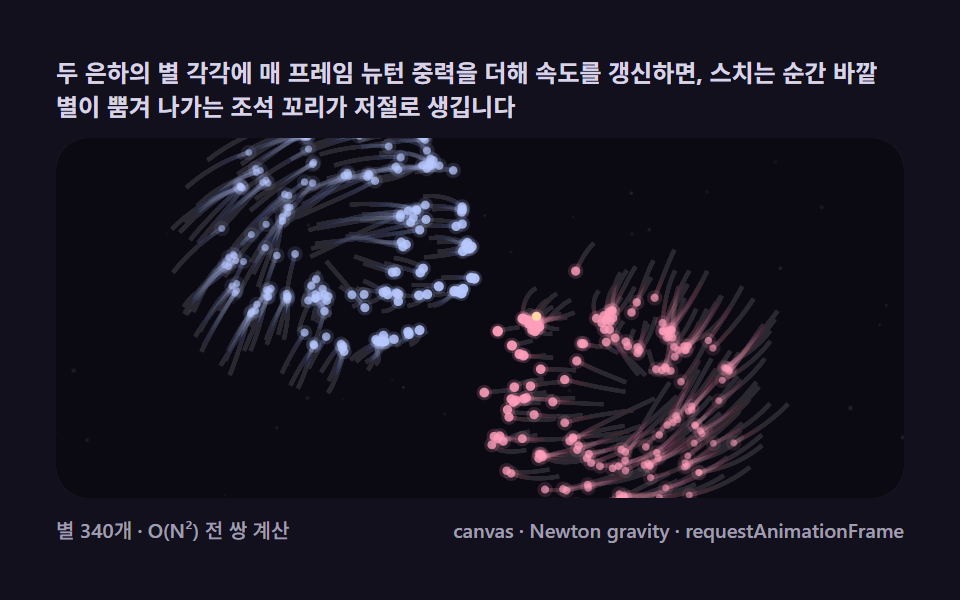 은하 충돌 시뮬레이션 9종 — 서로 잡아당기는 별들로 나선팔·조석 꼬리를 만드는 캔버스은하 충돌 시뮬레이션은 라이브러리·WebGL 없이 별 하나하나에 뉴턴 중력을 매 프레임 적분하면 두 은하가 스치며 조석 꼬리를 남기고 합쳐지는데, 새로고침 없이 눈앞에서 우주 규모의 인력이 이루어지는 장면을 그대로 이 글의 데모 전부 보기