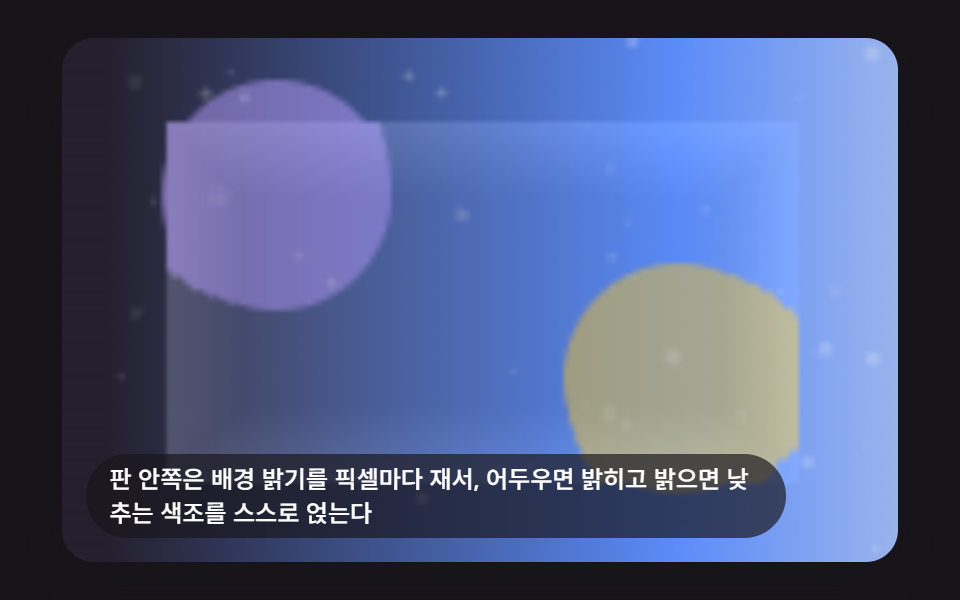
05Glass Whose Tint Adapts to Background Brightness
When the background behind it is bright, the glass tint thins out, and when the background is dark, the tint deepens.
Best forNavigation bar for both dark and light modes
TINT_STRENGTHtriangleWaveboxEdgeSample
<main class="stage">
<div class="lg is-demo" id="lgRoot" tabindex="0">
  <canvas class="lg__canvas" id="lgCanvas" width="480" height="300"></canvas>
  <p class="lg__caption">Inside the panel, each pixel's background brightness is measured and tinted lighter or darker automatically</p>
</div>
</main>
@use "../../../../site/static/demo-tokens" as *;
@include stage($stage-ink);
.lg {
position: relative;
width: min(92vw, calc(160vh - 12.8vw));
aspect-ratio: 480 / 300;
margin: 0 auto;
border-radius: $r-card;
overflow: hidden;
box-shadow: $shadow-raised;
outline: none;
}
.lg__canvas {
display: block;
width: 100%;
height: 100%;
}
.lg__caption {
position: absolute;
left: $sp-3;
bottom: $sp-3;
max-width: 78%;
margin: 0;
padding: $sp-1 $sp-3;
border-radius: $r-pill;
background: rgba(23, 20, 26, .68);
color: $stage-paper;
font-weight: 500;
font-size: 12px;
line-height: 1.4;
pointer-events: none;
}
@media (max-width: 340px) {
.lg__caption { font-size: 10px; padding: $sp-1 $sp-2; }
}
@media (prefers-reduced-motion: reduce) {
.lg { cursor: default; }
}html, body {
margin: 0;
overflow: hidden;
}
.stage {
box-sizing: border-box;
min-height: 100vh;
display: grid;
place-items: center;
margin: 0;
background: #17141a;
font-family: -apple-system, "Segoe UI", "Noto Sans KR", sans-serif;
padding: clamp(8px, 4vw, 24px);
}
.lg {
position: relative;
width: min(92vw, 160vh - 12.8vw);
aspect-ratio: 480/300;
margin: 0 auto;
border-radius: 16px;
overflow: hidden;
box-shadow: 0 14px 24px rgba(23, 20, 26, 0.32);
outline: none;
}
.lg__canvas {
display: block;
width: 100%;
height: 100%;
}
.lg__caption {
position: absolute;
left: 12px;
bottom: 12px;
max-width: 78%;
margin: 0;
padding: 4px 12px;
border-radius: 999px;
background: rgba(23, 20, 26, 0.68);
color: #ffffff;
font-weight: 500;
font-size: 12px;
line-height: 1.4;
pointer-events: none;
}
@media (max-width: 340px) {
.lg__caption {
font-size: 10px;
padding: 4px 8px;
}
}
@media (prefers-reduced-motion: reduce) {
.lg {
cursor: default;
}
}(function () {
// 기법: 판 안쪽 픽셀마다 배경 휘도(0.299R+0.587G+0.114B)를 재고, 중간값(128)과의 차에
// 비례해 밝기를 보정한다(어두운 곳은 밝게, 밝은 곳은 어둡게) — 적응형 색조. 보정 강도는
// 삼각파로 0→최대→0 을 오가며 항상 값이 바뀌게 한다.
var root = document.getElementById('lgRoot');
var canvas = document.getElementById('lgCanvas');
var ctx = canvas.getContext('2d');
var wrap = canvas.parentElement;
function seedRand(seed) {
var s = seed >>> 0;
return function () { s = (s * 1664525 + 1013904223) >>> 0; return s / 4294967296; };
}
var CALC_W = 160, CALC_H = 100;
var SCENE_W = 220;
var scene = document.createElement('canvas');
scene.width = SCENE_W; scene.height = CALC_H;
(function drawScene() {
var pctx = scene.getContext('2d');
var rand = seedRand(421051);
var sky = pctx.createLinearGradient(0, 0, SCENE_W, 0);
sky.addColorStop(0, '#241f2c');
sky.addColorStop(0.5, '#5b8cf8');
sky.addColorStop(1, '#fff2da');
pctx.fillStyle = sky;
pctx.fillRect(0, 0, SCENE_W, CALC_H);
for (var i = 0; i < 3; i += 1) {
pctx.beginPath();
pctx.arc(SCENE_W * (0.15 + i * 0.35), CALC_H * (0.3 + (i % 2) * 0.35), CALC_H * 0.22, 0, Math.PI * 2);
pctx.fillStyle = i === 0 ? '#b9a0ff' : (i === 1 ? '#ffd23f' : '#ff9ebb');
pctx.globalAlpha = 0.5;
pctx.fill();
}
pctx.globalAlpha = 1;
for (var k = 0; k < 48; k += 1) {
var px = rand() * SCENE_W, py = rand() * CALC_H, r = rand() * 1 + 0.3;
pctx.beginPath();
pctx.arc(px, py, r, 0, Math.PI * 2);
pctx.fillStyle = 'rgba(255,255,255,' + (0.08 + rand() * 0.16) + ')';
pctx.fill();
}
}());
var sceneCtx = scene.getContext('2d');
var sceneImg = sceneCtx.getImageData(0, 0, SCENE_W, CALC_H);
var sceneBuf = sceneImg.data;
function sampleScene(sx, sy) {
sx = sx < 0 ? 0 : (sx > SCENE_W - 1 ? SCENE_W - 1 : sx);
sy = sy < 0 ? 0 : (sy > CALC_H - 1 ? CALC_H - 1 : sy);
var i = (Math.round(sy) * SCENE_W + Math.round(sx)) * 4;
return [sceneBuf[i], sceneBuf[i + 1], sceneBuf[i + 2]];
}
var PANEL_X0 = 20, PANEL_Y0 = 16, PANEL_X1 = 140, PANEL_Y1 = 84;
var EDGE_BAND = 14;
var GLASS_EDGE_BEND = 4;
var TINT_STRENGTH = 0.85;
var SCENE_OFFSET_X = (SCENE_W - CALC_W) / 2;
var PAN_AMP = 40;
var PERIOD_MS = 2000;
function boxEdgeSample(x, y, x0, y0, x1, y1, band) {
var dl = x - x0, dr = x1 - x, dt = y - y0, db = y1 - y;
var dmin = Math.min(dl, dr, dt, db);
if (dmin >= band || dmin < 0) return { f: 0, nx: 0, ny: 0 };
var nx = 0, ny = 0;
if (dl < band) nx -= (band - dl);
if (dr < band) nx += (band - dr);
if (dt < band) ny -= (band - dt);
if (db < band) ny += (band - db);
var len = Math.sqrt(nx * nx + ny * ny);
if (len > 0.0001) { nx /= len; ny /= len; }
return { f: Math.max(0, (band - dmin) / band), nx: nx, ny: ny };
}
function panX(t) {
return PAN_AMP * Math.sin(t * 2 * Math.PI / PERIOD_MS);
}
function triangleWave(t, period) {
var p = (t % period) / period;
return p < 0.5 ? p * 2 : (1 - p) * 2;
}
var out = document.createElement('canvas');
out.width = CALC_W; out.height = CALC_H;
var outCtx = out.getContext('2d');
var outImg = outCtx.createImageData(CALC_W, CALC_H);
var outBuf = outImg.data;
function renderFrame(t) {
var pan = panX(t);
var adaptivity = triangleWave(t, PERIOD_MS);
var idx = 0;
for (var y = 0; y < CALC_H; y += 1) {
for (var x = 0; x < CALC_W; x += 1) {
var baseSx = x + SCENE_OFFSET_X + pan;
var rgb;
if (x >= PANEL_X0 && x <= PANEL_X1 && y >= PANEL_Y0 && y <= PANEL_Y1) {
var e = boxEdgeSample(x, y, PANEL_X0, PANEL_Y0, PANEL_X1, PANEL_Y1, EDGE_BAND);
var bendMag = e.f * GLASS_EDGE_BEND;
rgb = sampleScene(baseSx - e.nx * bendMag, y - e.ny * bendMag);
var lum = 0.299 * rgb[0] + 0.587 * rgb[1] + 0.114 * rgb[2];
var delta = (128 - lum) * TINT_STRENGTH * adaptivity * 0.5;
rgb = [rgb[0] + delta, rgb[1] + delta * 0.94, rgb[2] + delta * 0.86];
var shine = e.f * 18;
rgb = [
Math.max(0, Math.min(255, rgb[0] + shine)),
Math.max(0, Math.min(255, rgb[1] + shine)),
Math.max(0, Math.min(255, rgb[2] + shine))
];
} else {
rgb = sampleScene(baseSx, y);
}
outBuf[idx] = rgb[0]; outBuf[idx + 1] = rgb[1]; outBuf[idx + 2] = rgb[2]; outBuf[idx + 3] = 255;
idx += 4;
}
}
}
var cw = 480, ch = 300;
function fit() {
var r = wrap.getBoundingClientRect();
cw = Math.max(1, Math.round(r.width));
ch = Math.max(1, Math.round(r.height));
canvas.width = cw; canvas.height = ch;
draw(lastElapsed);
}
var lastElapsed = 0;
function draw(t) {
lastElapsed = t;
renderFrame(t);
outCtx.putImageData(outImg, 0, 0);
ctx.clearRect(0, 0, cw, ch);
ctx.drawImage(out, 0, 0, CALC_W, CALC_H, 0, 0, cw, ch);
}
var reduce = window.matchMedia('(prefers-reduced-motion: reduce)').matches;
if (reduce) { root.classList.remove('is-demo'); }
var lastTs = null;
var elapsed = 0;
function tick(ts) {
if (lastTs === null) lastTs = ts;
var dt = ts - lastTs;
lastTs = ts;
elapsed += dt;
draw(elapsed);
requestAnimationFrame(tick);
}
fit();
window.addEventListener('resize', fit);
draw(elapsed);
if (!reduce) requestAnimationFrame(tick);
})();// AdaptiveTintLuminance — vanilla 판(run/421/demo/05-liquid-glass-adaptive-tint-luminance/index.html) 의 React 포트.
// 판 안쪽 각 픽셀의 배경 밝기(휘도)를 재서, 어두우면 밝히고 밝으면 낮추는 색조를
// 전역 삼각파(adaptivity)로 세기를 오르내리며 더한다.
import { useEffect, useRef } from "react";
import styles from "./AdaptiveTintLuminance.module.scss";
type Box<T> = { current: T };
type Edge = { f: number; nx: number; ny: number };
const CALC_W = 160, CALC_H = 100;
const SCENE_W = 220;
const PANEL_X0 = 20, PANEL_Y0 = 16, PANEL_X1 = 140, PANEL_Y1 = 84;
const EDGE_BAND = 14;
const GLASS_EDGE_BEND = 4;
const TINT_STRENGTH = 0.85;
const SCENE_OFFSET_X = (SCENE_W - CALC_W) / 2;
const PAN_AMP = 40;
const PERIOD_MS = 2000;
interface State {
ctx: CanvasRenderingContext2D | null;
wrap: HTMLElement | null;
sceneBuf: Uint8ClampedArray | null;
outCtx: CanvasRenderingContext2D | null;
out: HTMLCanvasElement | null;
outImg: ImageData | null;
outBuf: Uint8ClampedArray | null;
cw: number; ch: number;
lastElapsed: number;
lastTs: number | null;
elapsed: number;
raf: number;
reduce: boolean;
}
function seedRand(seed: number): () => number {
let s = seed >>> 0;
return function () { s = (s * 1664525 + 1013904223) >>> 0; return s / 4294967296; };
}
function boxEdgeSample(x: number, y: number, x0: number, y0: number, x1: number, y1: number, band: number): Edge {
const dl = x - x0, dr = x1 - x, dt = y - y0, db = y1 - y;
const dmin = Math.min(dl, dr, dt, db);
if (dmin >= band || dmin < 0) return { f: 0, nx: 0, ny: 0 };
let nx = 0, ny = 0;
if (dl < band) nx -= (band - dl);
if (dr < band) nx += (band - dr);
if (dt < band) ny -= (band - dt);
if (db < band) ny += (band - db);
const len = Math.sqrt(nx * nx + ny * ny);
if (len > 0.0001) { nx /= len; ny /= len; }
return { f: Math.max(0, (band - dmin) / band), nx, ny };
}
function panX(t: number): number {
return PAN_AMP * Math.sin((t * 2 * Math.PI) / PERIOD_MS);
}
function triangleWave(t: number, period: number): number {
const cyc = (t % period) / period;
return cyc < 0.5 ? cyc * 2 : (1 - cyc) * 2;
}
export default function AdaptiveTintLuminance() {
const rootRef = useRef<HTMLDivElement | null>(null);
const canvasRef = useRef<HTMLCanvasElement | null>(null);
const st = useRef({
ctx: null, wrap: null, sceneBuf: null, outCtx: null, out: null, outImg: null, outBuf: null,
cw: 480, ch: 300, lastElapsed: 0, lastTs: null, elapsed: 0, raf: 0, reduce: false,
}) as Box<State>;
function sampleScene(sx: number, sy: number): number[] {
const buf = st.current.sceneBuf!;
const cx = sx < 0 ? 0 : sx > SCENE_W - 1 ? SCENE_W - 1 : sx;
const cy = sy < 0 ? 0 : sy > CALC_H - 1 ? CALC_H - 1 : sy;
const i = (Math.round(cy) * SCENE_W + Math.round(cx)) * 4;
return [buf[i], buf[i + 1], buf[i + 2]];
}
function renderFrame(t: number): void {
const outBuf = st.current.outBuf!;
const pan = panX(t);
const adaptivity = triangleWave(t, PERIOD_MS);
let idx = 0;
for (let y = 0; y < CALC_H; y += 1) {
for (let x = 0; x < CALC_W; x += 1) {
const baseSx = x + SCENE_OFFSET_X + pan;
let rgb: number[];
if (x >= PANEL_X0 && x <= PANEL_X1 && y >= PANEL_Y0 && y <= PANEL_Y1) {
const e = boxEdgeSample(x, y, PANEL_X0, PANEL_Y0, PANEL_X1, PANEL_Y1, EDGE_BAND);
const bendMag = e.f * GLASS_EDGE_BEND;
rgb = sampleScene(baseSx - e.nx * bendMag, y - e.ny * bendMag);
const lum = 0.299 * rgb[0] + 0.587 * rgb[1] + 0.114 * rgb[2];
const delta = (128 - lum) * TINT_STRENGTH * adaptivity * 0.5;
rgb = [rgb[0] + delta, rgb[1] + delta * 0.94, rgb[2] + delta * 0.86];
const shine = e.f * 18;
rgb = [
Math.min(255, Math.max(0, rgb[0] + shine)),
Math.min(255, Math.max(0, rgb[1] + shine)),
Math.min(255, Math.max(0, rgb[2] + shine)),
];
} else {
rgb = sampleScene(baseSx, y);
}
outBuf[idx] = rgb[0]; outBuf[idx + 1] = rgb[1]; outBuf[idx + 2] = rgb[2]; outBuf[idx + 3] = 255;
idx += 4;
}
}
}
function draw(t: number): void {
const s = st.current;
s.lastElapsed = t;
renderFrame(t);
s.outCtx!.putImageData(s.outImg!, 0, 0);
s.ctx!.clearRect(0, 0, s.cw, s.ch);
s.ctx!.drawImage(s.out!, 0, 0, CALC_W, CALC_H, 0, 0, s.cw, s.ch);
}
function fit(): void {
const s = st.current;
const canvas = canvasRef.current;
if (!s.wrap || !canvas) return;
const r = s.wrap.getBoundingClientRect();
s.cw = Math.max(1, Math.round(r.width));
s.ch = Math.max(1, Math.round(r.height));
canvas.width = s.cw; canvas.height = s.ch;
draw(s.lastElapsed);
}
function tick(ts: number): void {
const s = st.current;
if (s.lastTs === null) s.lastTs = ts;
const dt = ts - s.lastTs;
s.lastTs = ts;
s.elapsed += dt;
draw(s.elapsed);
s.raf = requestAnimationFrame(tick);
}
useEffect(() => {
const root = rootRef.current;
const canvas = canvasRef.current;
if (!root || !canvas) return;
const ctx = canvas.getContext("2d");
const wrap = canvas.parentElement;
if (!ctx || !wrap) return;
const scene = document.createElement("canvas");
scene.width = SCENE_W; scene.height = CALC_H;
const pctx = scene.getContext("2d")!;
const rand = seedRand(421051);
const grad = pctx.createLinearGradient(0, 0, SCENE_W, 0);
grad.addColorStop(0, "#241f2c");
grad.addColorStop(0.5, "#5b8cf8");
grad.addColorStop(1, "#fff2da");
pctx.fillStyle = grad;
pctx.fillRect(0, 0, SCENE_W, CALC_H);
const cols = ["#b9a0ff", "#ffd23f", "#ff9ebb"];
for (let i = 0; i < cols.length; i += 1) {
pctx.beginPath();
pctx.arc(SCENE_W * (0.2 + i * 0.3), CALC_H * (0.32 + (i % 2) * 0.32), CALC_H * 0.27, 0, Math.PI * 2);
pctx.fillStyle = cols[i];
pctx.globalAlpha = 0.5;
pctx.fill();
}
pctx.globalAlpha = 1;
for (let k = 0; k < 48; k += 1) {
const px = rand() * SCENE_W, py = rand() * CALC_H, r = rand() * 1 + 0.3;
pctx.beginPath();
pctx.arc(px, py, r, 0, Math.PI * 2);
pctx.fillStyle = "rgba(255,255,255," + (0.08 + rand() * 0.18) + ")";
pctx.fill();
}
const sceneImg = pctx.getImageData(0, 0, SCENE_W, CALC_H);
const out = document.createElement("canvas");
out.width = CALC_W; out.height = CALC_H;
const outCtx = out.getContext("2d")!;
const outImg = outCtx.createImageData(CALC_W, CALC_H);
const s = st.current;
s.ctx = ctx; s.wrap = wrap; s.sceneBuf = sceneImg.data;
s.outCtx = outCtx; s.out = out; s.outImg = outImg; s.outBuf = outImg.data;
s.reduce = window.matchMedia("(prefers-reduced-motion: reduce)").matches;
if (s.reduce) { root.classList.remove("is-demo"); }
fit();
window.addEventListener("resize", fit);
draw(s.elapsed);
if (!s.reduce) s.raf = requestAnimationFrame(tick);
return () => {
window.removeEventListener("resize", fit);
cancelAnimationFrame(st.current.raf);
};
}, []);
return (
<main className={styles.stage}>
<div className={`${styles.lg} is-demo`} ref={rootRef} tabIndex={0}>
<canvas className={styles.lg__canvas} ref={canvasRef} width={480} height={300} />
<p className={styles.lg__caption}>판 안쪽은 배경 밝기를 픽셀마다 재서, 어두우면 밝히고 밝으면 낮추는 색조를 스스로 얹는다</p>
</div>
</main>
);
}05 Glass Whose Tint Adapts to Background Brightness — Measured area 74.724% · moving frames 23/23Original by GODRICH · SCSS and React ship in the zip · Liquid Glass Effect CSS: 9 Refraction Patterns
The post this demo lives in
 Liquid Glass Effect CSS: 9 Refraction PatternsA liquid glass effect css panel bends only its edges. The edge color split in item 03, the elastic snap-back in item 04, See all demos in this post