Seat Selection UI: 9 Scenes That Score Every View
In a seat selection ui, a seat near the stage can still have a poor view, so 02 scores the clearance over heads in front with distance and angle, 03 draws that
Front Row Center Is Not Automatically the Best Seat: Stage Height, Floor Rake and the Heads in Front
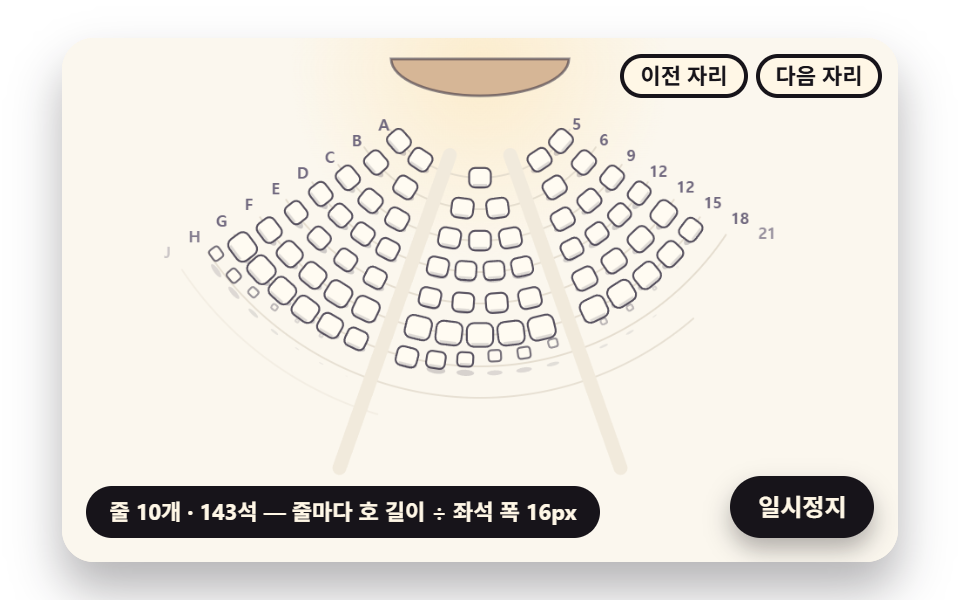 01 seat-fan-hall-arc-layout
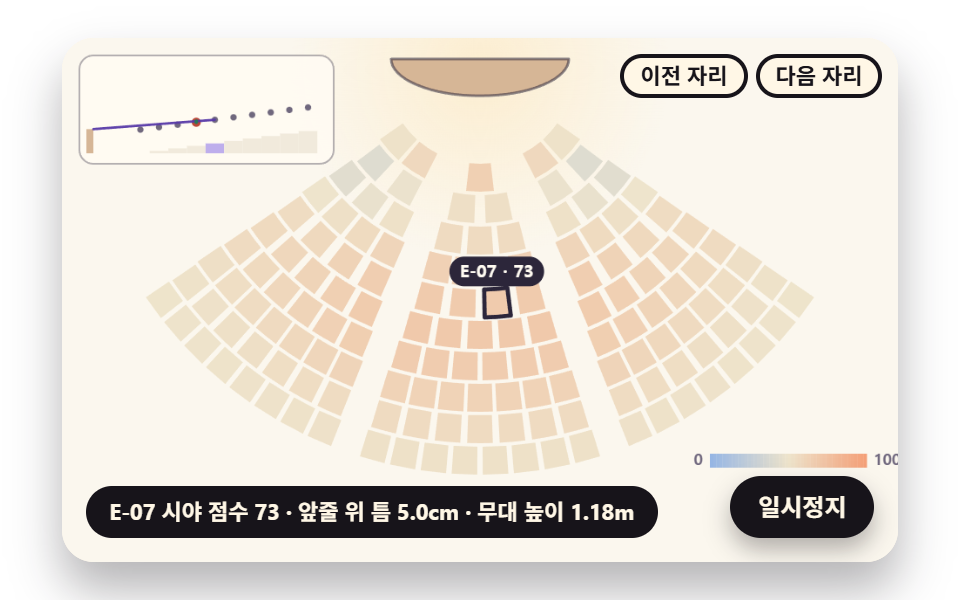 02 seat-sightline-occlusion-score-map
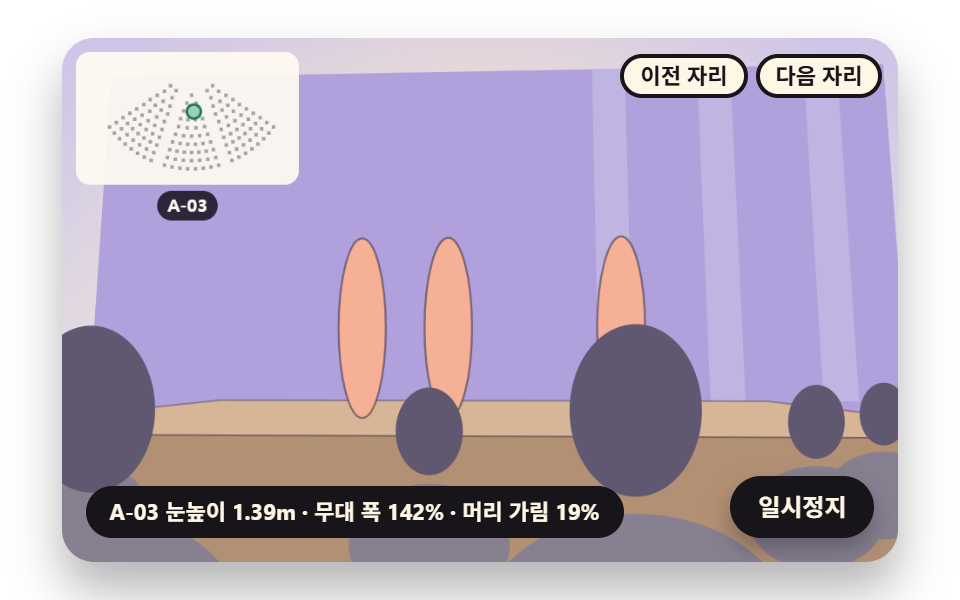 03 seat-stage-view-from-seat-projection
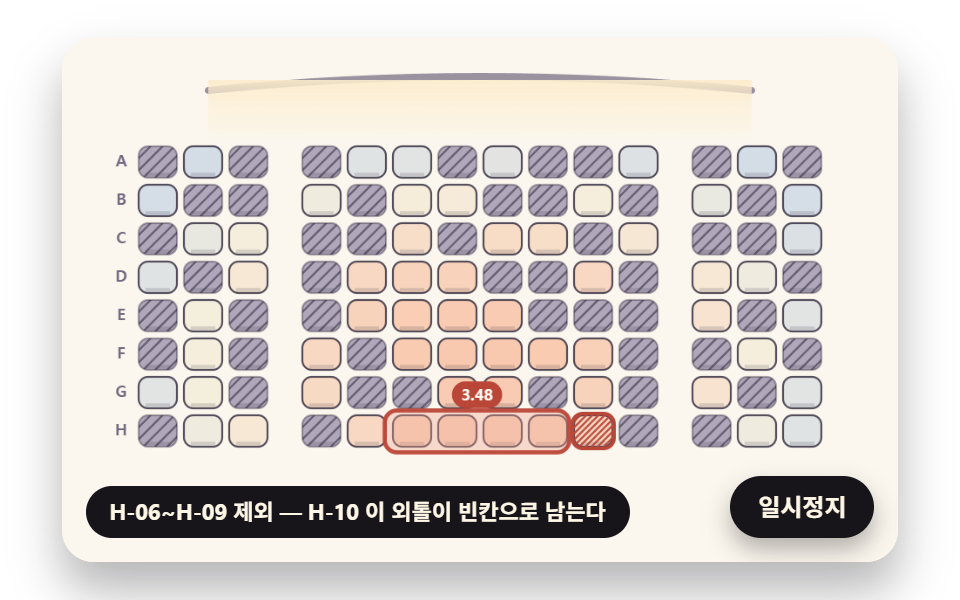 04 seat-group-block-sliding-window
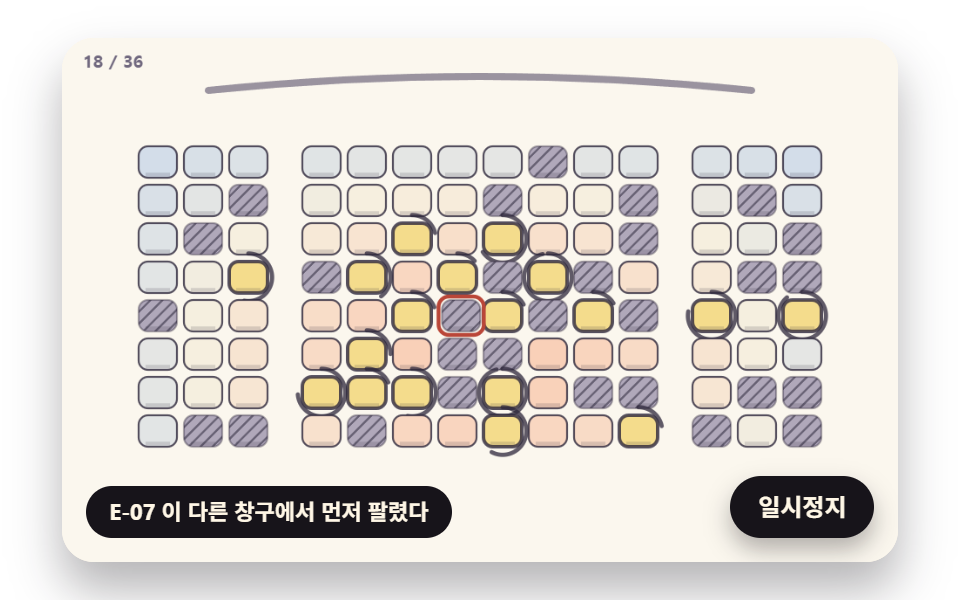 05 seat-live-booking-contention-hold
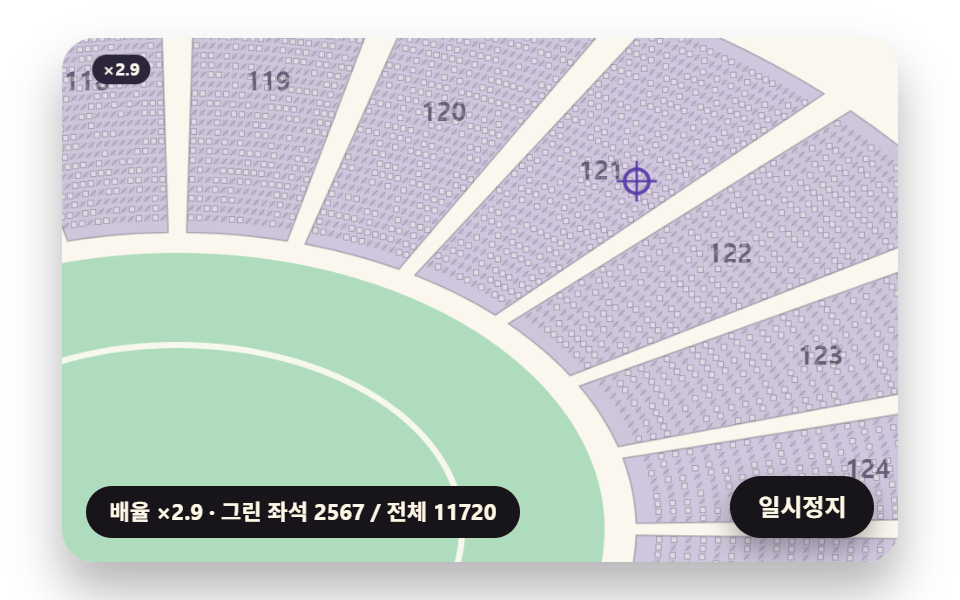 06 seat-stadium-zoom-inertia-detail-split
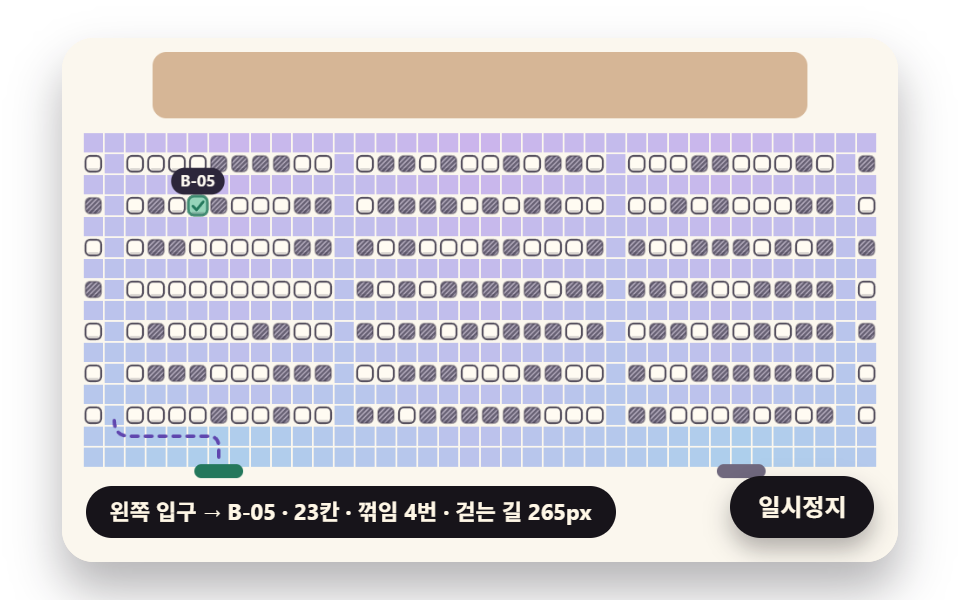 07 seat-entrance-route-aisle-walk
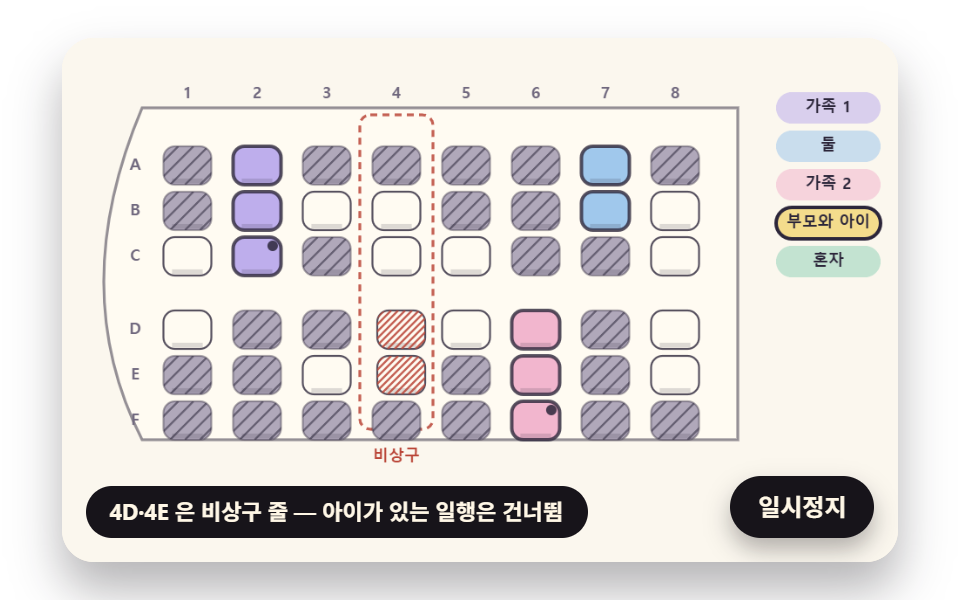 08 seat-flight-cabin-rule-auto-assign
 09 seat-concert-booking-ticket-flip-hero
Auto-plays · click a tile to jump to its section · all nine in one zip
- 01 A Fan-Shaped Hall That Spaces Seats by Arc Length
- 02 A Sightline Score Map That Cools Where Heads in Front Block the View
- 03 The Stage in Perspective from the Seat's Eye Level
- 04 A Group Block Finder That Leaves No Single Empty Seat
- 05 Live Booking That Shakes a Taken Seat and Suggests the Nearest Alternative
- 06 A Stadium Map with Inertia Whose Sections Split into Seats as It Zooms
- 07 A Route That Walks the Aisles from the Entrance to Your Seat
- 08 Automatic Flight Seat Assignment That Weighs Window, Aisle and Exit Row Rules
- 09 A Concert Booking Hero Where a Ticket Flips Out Once a Seat Is Set
When a seat picker stops at a grid painted in two shades, open and sold, what that grid leaves out is the view from each seat. In the hall of 02 (ten rows, each one 0.12 m higher than the row before it, stage at 0.95 m) the row averages come out A 57, B 36 and C 41, and the best row is G, seventh from the stage, at 62. The worst row in the room is not the first one but the one right behind it.
What drags the second row below the first
Row A has nobody in front, so its clearance is counted as the full 12 cm. From row B, the line from the eye to the stage edge clears the eyes of row A by only 2.93 cm, and at that distance the stage width fills about 100° of the view. The score is a sum of five parts weighted 0.3 for clearance, 0.1 for distance, 0.35 for how wide the stage looks, 0.1 for how steeply you look down or up at the stage edge and 0.15 for how far you sit off the axis, and row B loses on the two heaviest parts at once.
What happens when the stage drops to half a meter
At a stage height of 0.50 m the clearance turns negative in every row from B to K (from −9.84 to −3.01 cm), so the sight line of 138 of the 143 seats runs into the head in front, and the average falls to 53. Raise the stage to 1.40 m and the average climbs to 70, the best seat becomes F-06 at 82 and row B clears by 15.69 cm. The same seat E-07 scores 60, 64 and 81 at those three heights.
Seat Selection UI: 9 Scenes — a Fan-Shaped Hall, a Sightline Score Map, the Stage Seen from Your Seat, a Group Block Finder, Live Booking Contention, a Stadium Map with Inertia, a Route from the Entrance, Automatic Flight Seat Assignment and a Concert Booking Hero
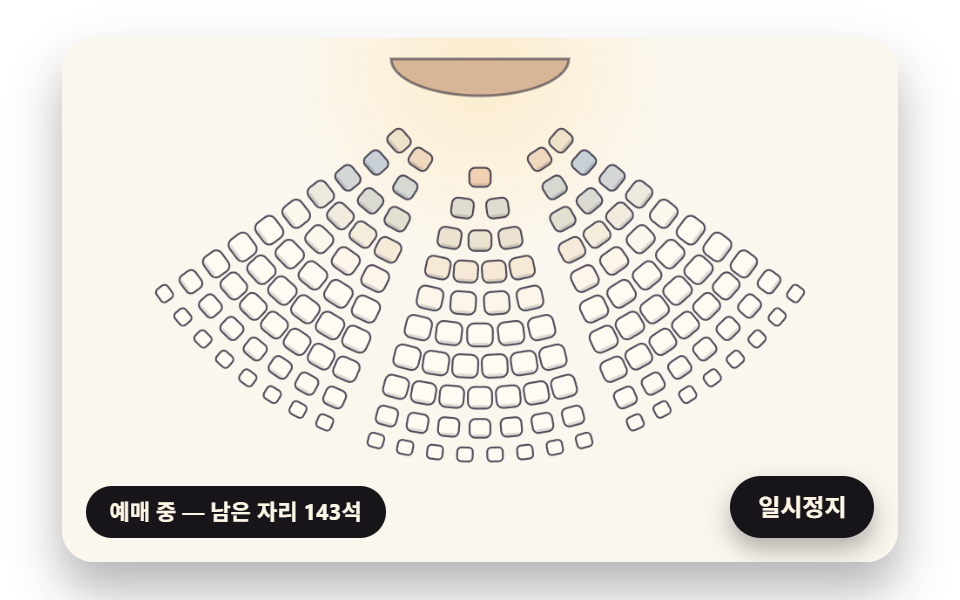
Scenes 01 to 03 read one fan-shaped hall in three layers: place the seats, give each seat a view score, then sit in that seat and look at the stage. Scenes 04 to 08 each take one problem a booking screen actually runs into (group blocks, two buyers at once, a map of ten thousand seats, the walk in, cabin rules). Scene 09 is a hero that strings the work of 01 to 05 into a single 6.6-second flow. Every scene is drawn on one 2D canvas with no outside library or WebGL, and the random numbers come from fixed seeds, so the demo plays out the same way each time it opens.
How much each scene moved on a 480×300 canvas
The render captured 24 frames over two seconds and compared each neighboring pair, which gives 23 differences per scene.
| Scene | Cumulative area | Frames that moved | Mean intensity |
|---|---|---|---|
| 01 Fan-shaped hall | 20.2% | 23/23 | 45.6 |
| 02 Sightline score map | 17.9% | 23/23 | 88.1 |
| 03 Stage from the seat | 63.3% | 23/23 | 69.8 |
| 04 Group block finder | 10.5% | 23/23 | 61.8 |
| 05 Live booking | 15.5% | 22/23 | 81.7 |
| 06 Stadium map | 71.4% | 23/23 | 44.7 |
| 07 Entrance route | 31.3% | 19/23 | 62.7 |
| 08 Cabin auto-assign | 12.5% | 22/23 | 87.6 |
| 09 Booking hero | 34.5% | 23/23 | 57.0 |
Scene 03, where the stage picture fills the whole canvas, and 06, where the map zooms, pass 60%, while 04 and 08, which move only a few dozen seat dots, stay between 10 and 13%. The 19/23 of 07 likely comes from the stretch where the walker has reached its seat and the canvas waits before the next target (even the farthest seat, A-22, is reached at 2.046 s inside a 2.4-second loop). The 22/23 of 05 and 08 appears to come from short pauses between events.
What Does a Seat Reservation UI Actually Have to Compute?
Concerts: how much of the stage one seat can see
A basic seat map ui marks each seat as open or taken and stops there. For a seated show the question a buyer cannot answer from that map is how much of the stage a seat will show, which is why 02 turns the hall into a score map and 03 renders the view from the chosen seat.
Cinemas: how many people can sit side by side
A cinema seat selection ui deals mostly with a different question: can three or four friends sit together without leaving one empty seat stranded between them and the next sold seat. That is the job of 04, and 05 adds the case where somebody else takes the seat while you are still deciding.
Stadiums and cabins: too many seats, or seats with rules
On a stadium map with more than ten thousand seats, choosing what not to draw is the computation (06), and once inside, the buyer needs a path from the gate to the seat (07). Cabin seating has to satisfy sitting together, window or aisle wishes and the no-children-in-the-exit-row rule all at once, so 08 needs an order that places a party, and steps back and re-places when the next party gets stuck. Compare it with dragging a date range in the 9 calendar month views or dropping one pin in the 9 map location pickers: a seat map also computes the shape of what can be picked and how neighboring cells relate.
01A Fan-Shaped Hall That Spaces Seats by Arc Length
Row i sits on a radius of 62 + i × 18 px, and the loop below first cuts the two aisles (14 px divided by the radius, in radians) out of the fan, then divides each remaining span's arc length by SEAT_W 16 px and rounds down, which gives 5 seats in row A up to 24 in row K and 143 across ten rows. Each seat leaves at 0.2 s + row × 110 ms + its place in the row × 12 ms and pops up on a spring with stiffness 260 and damping 14 (damping ratio 0.434, 21.4% overshoot) while its shadow grows wider and fainter the higher it lifts, so the last seat, K-24, leaves at 1.466 s and all 143 have settled by 2.254 s. Interactive seating charts laid out on a rectangular grid cannot follow a curved hall, so for seats that wrap around a stage this function is the first step.
<main class="stage">
<div class="cf is-demo" id="cf">
  <canvas class="cf__canvas" data-role="canvas" width="480" height="300" role="img" aria-label="A fan-shaped hall where each arc widening from the stage gets as many seats as its arc length divided by the seat width, and the seats pop into place row by row from the stage outward."></canvas>
  <div class="cf__pick" role="group" aria-label="Pick a seat (arrow keys work too)">
    <button class="cf__btn" data-role="prev" type="button">Prev seat</button>
    <button class="cf__btn" data-role="next" type="button">Next seat</button>
  </div>
  <p class="cf__status" data-role="status" aria-live="off">Building the hall</p>
  <button class="cf__pause" data-role="pause" type="button" aria-pressed="false">Pause</button>
</div>
</main>
@use "../../../../site/static/demo-tokens" as *;
@include stage($stage-paper);
.cf {
position: relative;
width: min(92vw, calc(160vh - 12.8vw));
aspect-ratio: 480 / 300;
margin: 0 auto;
border-radius: $r-card;
overflow: hidden;
box-shadow: $shadow-raised;
background: $subject-cream;
}
.cf__canvas {
position: absolute;
inset: 0;
display: block;
width: 100%;
height: 100%;
}
.cf__pause {
position: absolute;
right: $sp-3;
bottom: $sp-3;
padding: $sp-1 $sp-3;
border: 2px solid $subject-ink;
border-radius: $r-pill;
background: $subject-ink;
color: $subject-cream;
font-family: inherit;
font-weight: 700;
font-size: 12px;
line-height: 1.6;
cursor: pointer;
box-shadow: $shadow-press;
transition: transform $dur-quick $ease-spring;
}
// 눌린 상태(멈춤) — 바탕과 글자색을 뒤집어 aria-pressed 가 눈에도 보이게
.cf__pause[aria-pressed="true"] {
background: $subject-cream;
color: $subject-ink;
}
.cf__pause:hover {
transform: translateY(-2px);
}
.cf__pause:active {
transform: translateY(1px);
}
.cf__pause:focus-visible {
outline: 3px solid $subject-ink;
outline-offset: 3px;
}
// 상태 줄 — 지금 좌석표에 무슨 일이 일어났는지 글자로. 시연 중에는 aria-live off, 사람이 처음 손대면 polite
.cf__status {
position: absolute;
left: $sp-3;
bottom: $sp-3;
max-width: calc(100% - 120px);
margin: 0;
padding: $sp-1 $sp-3;
border-radius: $r-pill;
background: $subject-ink;
color: $subject-cream;
font-weight: 700;
font-size: 11px;
line-height: 1.6;
white-space: nowrap;
overflow: hidden;
text-overflow: ellipsis;
pointer-events: none;
}
// 자리 고르기 버튼 — 오른쪽 위. 방향키(왼쪽·오른쪽 = 옆 자리, 위·아래 = 앞뒤 줄)도 같은 일을 한다
.cf__pick {
position: absolute;
top: $sp-2;
right: $sp-2;
display: flex;
gap: $sp-1;
}
.cf__btn {
padding: 0 $sp-2;
border: 2px solid $subject-ink;
border-radius: $r-pill;
background: $subject-cream;
color: $subject-ink;
font-family: inherit;
font-weight: 700;
font-size: 11px;
line-height: 1.6;
cursor: pointer;
transition: transform $dur-quick $ease-spring;
}
.cf__btn:hover {
transform: translateY(-2px);
}
.cf__btn:active {
transform: translateY(1px);
}
.cf__btn:focus-visible {
outline: 3px solid $subject-ink;
outline-offset: 2px;
}
@media (max-width: 340px) {
.cf__pause,
.cf__status,
.cf__btn { font-size: 10px; padding: $sp-1 $sp-2; }
.cf__btn { padding: 0 $sp-1; }
}
// 동작 줄이기 — 장면은 스크립트가 최종 배치 한 장으로 멈춘다. 버튼도 떠오르지 않게
@media (prefers-reduced-motion: reduce) {
.cf__pause,
.cf__btn { transition: none !important; }
.cf__pause:hover,
.cf__pause:active,
.cf__btn:hover,
.cf__btn:active { transform: none !important; }
}html, body {
margin: 0;
overflow: hidden;
}
.stage {
box-sizing: border-box;
min-height: 100vh;
display: grid;
place-items: center;
margin: 0;
background: #ffffff;
font-family: -apple-system, "Segoe UI", "Noto Sans KR", sans-serif;
padding: clamp(8px, 4vw, 24px);
}
.cf {
position: relative;
width: min(92vw, 160vh - 12.8vw);
aspect-ratio: 480/300;
margin: 0 auto;
border-radius: 16px;
overflow: hidden;
box-shadow: 0 14px 24px rgba(23, 20, 26, 0.32);
background: #fff7e6;
}
.cf__canvas {
position: absolute;
inset: 0;
display: block;
width: 100%;
height: 100%;
}
.cf__pause {
position: absolute;
right: 12px;
bottom: 12px;
padding: 4px 12px;
border: 2px solid #17141a;
border-radius: 999px;
background: #17141a;
color: #fff7e6;
font-family: inherit;
font-weight: 700;
font-size: 12px;
line-height: 1.6;
cursor: pointer;
box-shadow: 0 6px 12px rgba(23, 20, 26, 0.32);
transition: transform 220ms cubic-bezier(0.2, 0.8, 0.2, 1);
}
.cf__pause[aria-pressed=true] {
background: #fff7e6;
color: #17141a;
}
.cf__pause:hover {
transform: translateY(-2px);
}
.cf__pause:active {
transform: translateY(1px);
}
.cf__pause:focus-visible {
outline: 3px solid #17141a;
outline-offset: 3px;
}
.cf__status {
position: absolute;
left: 12px;
bottom: 12px;
max-width: calc(100% - 120px);
margin: 0;
padding: 4px 12px;
border-radius: 999px;
background: #17141a;
color: #fff7e6;
font-weight: 700;
font-size: 11px;
line-height: 1.6;
white-space: nowrap;
overflow: hidden;
text-overflow: ellipsis;
pointer-events: none;
}
.cf__pick {
position: absolute;
top: 8px;
right: 8px;
display: flex;
gap: 4px;
}
.cf__btn {
padding: 0 8px;
border: 2px solid #17141a;
border-radius: 999px;
background: #fff7e6;
color: #17141a;
font-family: inherit;
font-weight: 700;
font-size: 11px;
line-height: 1.6;
cursor: pointer;
transition: transform 220ms cubic-bezier(0.2, 0.8, 0.2, 1);
}
.cf__btn:hover {
transform: translateY(-2px);
}
.cf__btn:active {
transform: translateY(1px);
}
.cf__btn:focus-visible {
outline: 3px solid #17141a;
outline-offset: 2px;
}
@media (max-width: 340px) {
.cf__pause,
.cf__status,
.cf__btn {
font-size: 10px;
padding: 4px 8px;
}
.cf__btn {
padding: 0 4px;
}
}
@media (prefers-reduced-motion: reduce) {
.cf__pause,
.cf__btn {
transition: none !important;
}
.cf__pause:hover,
.cf__pause:active,
.cf__btn:hover,
.cf__btn:active {
transform: none !important;
}
}(function () {
const root = document.getElementById("cf");
if (!root) return;
// 판 좌표 — 캔버스 안은 늘 480×300. 화면에 보이는 크기와 상관없이 계산은 이 좌표로 한다
const W = 480;
const H = 300;
const TAU = Math.PI * 2;
function clamp(v, lo, hi) { return v < lo ? lo : (v > hi ? hi : v); }
function lerp(a, b, k) { return a + (b - a) * k; }
function smooth(x) { const c = clamp(x, 0, 1); return c * c * (3 - 2 * c); }
// 따라가기 비율 — 1 − e^(−rate·dt). 프레임 시간이 달라도 1초에 같은 만큼 다가간다
function follow(rate, dt) { return 1 - Math.exp(-rate * dt); }
// 1/60초마다 ease 만큼 다가가는 비율을 dt 초로 환산 — 1 − (1 − ease)^(dt × 60)
function easeStep(ease, dt) { return 1 - Math.pow(1 - ease, dt * 60); }
// 시드 고정 난수 — 같은 시드면 같은 시연이 다시 나온다 (32비트 정수 섞기)
function makeRng(seed) {
let s = seed >>> 0;
return function () {
s = (s + 0x6d2b79f5) >>> 0;
let t = s;
t = Math.imul(t ^ (t >>> 15), t | 1);
t ^= t + Math.imul(t ^ (t >>> 7), t | 61);
return ((t ^ (t >>> 14)) >>> 0) / 4294967296;
};
}
// 지수 간격 — 평균 mean 인 도착 간격. u 는 0 이상 1 미만 난수
function expGap(u, mean) { return -Math.log(1 - u) * mean; }
function pad2(n) { return n < 10 ? '0' + n : String(n); }
function makeSpring(x) { return { x: x, v: 0, to: x }; }
const SPRING_SUBSTEP = 1 / 240;
function stepSpring(s, stiffness, damping, dt) {
let left = dt;
while (left > 1e-9) {
const h = Math.min(SPRING_SUBSTEP, left);
s.v += (stiffness * (s.to - s.x) - damping * s.v) * h;
s.x += s.v * h;
left -= h;
}
}
function snapSpring(s, x) { s.x = x; s.v = 0; s.to = x; }
// ── 부채꼴 객석 (화면 좌표) ───────────────────────────────────
// 무대 중심(HALL_CX, HALL_CY)에서 줄 i 의 반지름 r = ROW_R0 + i × ROW_GAP. 각도 0 = 무대에서 똑바로 아래, 왼쪽이 음수
const HALL_CX = 240;
const HALL_CY = 18;
const HALL_ROWS = 10;
const ROW_R0 = 62;
const ROW_GAP = 18;
const FAN_HALF = 0.98;
// 통로 두 줄기의 각도 — 통로 폭 AISLE_W(px)는 줄마다 AISLE_W / r 라디안의 틈이 된다
const AISLE_ANGLES = [-0.34, 0.34];
const AISLE_W = 14;
// 좌석 하나가 호 위에서 차지하는 길이(px)
const SEAT_W = 16;
const ROW_LETTERS = 'ABCDEFGHJKLMNPQRST';
function seatLabel(row, k) { return ROW_LETTERS.charAt(row) + '-' + pad2(k + 1); }
// 줄마다 — 부채꼴 전체 각을 통로 틈으로 끊은 구간마다 호 길이(각 × 반지름)를 좌석 폭으로 나눈 몫이 그 구간 자리 수,
// 자리 중심은 구간 각을 자리 수로 똑같이 나눈 칸의 가운데
function buildHall(rows, r0, gap, seatW, aisleW) {
const seats = [];
const rowStart = [];
const rowCount = [];
const segs = [];
        for (let i = 0; i < rows; i += 1) {
            const r = r0 + i * gap;
            const bounds = [-FAN_HALF];
            for (const a of AISLE_ANGLES) {
                const half = aisleW / 2 / r;
                bounds.push(a - half, a + half);
            }
            bounds.push(FAN_HALF);
            rowStart.push(seats.length);
            let k = 0;
            for (let s = 0; s + 1 < bounds.length; s += 2) {
                const a0 = bounds[s];
                const span = bounds[s + 1] - a0;
                const n = Math.floor(span * r / seatW);
                const seg = [];
                for (let j = 0; j < n; j += 1) {
                    const ang = a0 + (j + 0.5) * span / n;
                    seg.push(seats.length);
                    seats.push({ row: i, k: k, ang: ang, r: r, x: HALL_CX + r * Math.sin(ang), y: HALL_CY + r * Math.cos(ang), label: seatLabel(i, k), seg: segs.length });
                    k += 1;
                }
                segs.push(seg);
            }
            rowCount.push(k);
        }
return { seats: seats, rowStart: rowStart, rowCount: rowCount, segs: segs };
}
const HALL = buildHall(HALL_ROWS, ROW_R0, ROW_GAP, SEAT_W, AISLE_W);
// 옆 자리·앞뒤 줄로 옮기기 — 앞뒤 줄은 각도가 가장 가까운 자리
function hallNeighbor(idx, dk, dr) {
const s = HALL.seats[idx];
if (dr !== 0) {
const row = clamp(s.row + dr, 0, HALL_ROWS - 1);
let best = HALL.rowStart[row];
for (let j = 0; j < HALL.rowCount[row]; j += 1) {
const c = HALL.rowStart[row] + j;
if (Math.abs(HALL.seats[c].ang - s.ang) < Math.abs(HALL.seats[best].ang - s.ang)) {
best = c;
}
}
return best;
}
const k = clamp(s.k + dk, 0, HALL.rowCount[s.row] - 1);
return HALL.rowStart[s.row] + k;
}
function findSeat(label) {
for (let i = 0; i < HALL.seats.length; i += 1) {
if (HALL.seats[i].label === label) {
return i;
}
}
return 0;
}
// ── 시야 (단면, 미터) ────────────────────────────────────────
// 줄 i 는 무대 앞끝에서 rowDist(i) 떨어져 있고 바닥이 i × rake 만큼 높다. 앉은 눈높이는 그 바닥 + EYE_H
const FIRST_ROW_M = 2.4;
const ROW_DEPTH_M = 0.95;
const RAKE_STEP = 0.12;
const EYE_H = 1.15;
const STAGE_H = 0.95;
const STAGE_W_M = 8;
const STAGE_D_M = 5;
// 앞사람 눈 위로 시선이 이만큼(미터) 지나가면 머리에 가리지 않는다고 본다
const C_GOOD = 0.12;
const DIST_NEAR_M = 4;
const DIST_FAR_M = 12;
// 무대 폭이 눈에 차지하는 각 — 이 각을 넘으면 고개를 돌려야 무대 양끝이 보인다
const FOV_OK_DEG = 50;
const FOV_BAD_DEG = 100;
// 무대 앞끝을 내려다보거나 올려다보는 각
const PITCH_OK_DEG = 8;
const PITCH_BAD_DEG = 28;
// 정면에서 벗어난 각(라디안)
const SIDE_OK = 0.25;
const SIDE_BAD = 1.0;
// 점수 무게 — 틈 · 거리 · 무대 폭 · 높낮이 · 옆 각 (합 1)
const SCORE_WEIGHTS = [0.3, 0.1, 0.35, 0.1, 0.15];
function rowDist(i) { return FIRST_ROW_M + i * ROW_DEPTH_M; }
function eyeY(i, rake) { return i * rake + EYE_H; }
// 틈(미터) — 줄 i 의 눈에서 무대 앞끝(높이 stageH)까지 그은 직선이 앞줄 자리(거리 rowDist(i−1))를 지날 때의 높이 − 앞줄 눈높이.
// 직선 높이 = stageH + (내 눈 − stageH) × (앞줄 거리 / 내 거리). 맨 앞줄은 앞사람이 없으므로 C_GOOD 로 친다
function clearance(i, stageH, rake) {
if (i <= 0) {
return C_GOOD;
}
const e = eyeY(i, rake);
const lineAt = stageH + (e - stageH) * (rowDist(i - 1) / rowDist(i));
return lineAt - eyeY(i - 1, rake);
}
function viewOf(row, ang, stageH, rake) {
const d = rowDist(row);
const c = clearance(row, stageH, rake);
const fov = 2 * Math.atan(STAGE_W_M / 2 / d) * 180 / Math.PI;
const pitch = Math.atan2(eyeY(row, rake) - stageH, d) * 180 / Math.PI;
const parts = [
clamp(c / C_GOOD, 0, 1),
1 - smooth((d - DIST_NEAR_M) / (DIST_FAR_M - DIST_NEAR_M)),
1 - smooth((fov - FOV_OK_DEG) / (FOV_BAD_DEG - FOV_OK_DEG)),
1 - smooth((Math.abs(pitch) - PITCH_OK_DEG) / (PITCH_BAD_DEG - PITCH_OK_DEG)),
1 - smooth((Math.abs(ang) - SIDE_OK) / (SIDE_BAD - SIDE_OK))
];
let score = 0;
for (let k = 0; k < parts.length; k += 1) {
score += SCORE_WEIGHTS[k] * parts[k];
}
return { clear: c, fov: fov, pitch: pitch, parts: parts, score: score };
}
function hallScores(stageH, rake) {
return HALL.seats.map(function (s) { return viewOf(s.row, s.ang, stageH, rake).score; });
}
// ── 원근 투영 (미터) ─────────────────────────────────────────
// 무대 앞끝 가운데가 원점. x right, y 위, z 객석 쪽. 자리의 눈 = (ρ sin 각, 눈높이, ρ cos 각), ρ = rowDist(줄)
function v3sub(a, b) { return [a[0] - b[0], a[1] - b[1], a[2] - b[2]]; }
function v3dot(a, b) { return a[0] * b[0] + a[1] * b[1] + a[2] * b[2]; }
function v3cross(a, b) { return [a[1] * b[2] - a[2] * b[1], a[2] * b[0] - a[0] * b[2], a[0] * b[1] - a[1] * b[0]]; }
function v3norm(a) { const l = Math.hypot(a[0], a[1], a[2]) || 1; return [a[0] / l, a[1] / l, a[2] / l]; }
function v3lerp(a, b, k) { return [lerp(a[0], b[0], k), lerp(a[1], b[1], k), lerp(a[2], b[2], k)]; }
const NEAR_M = 0.15;
// 무대 위 이 점을 바라본다 — 배우 가슴 높이쯤
const LOOK_AT = [0, STAGE_H + 1.1, -1.6];
function seatEye(row, ang, rake) {
const rho = rowDist(row);
return [rho * Math.sin(ang), eyeY(row, rake), rho * Math.cos(ang)];
}
function lookAt(eye, target, focal, cx, cy) {
const fwd = v3norm(v3sub(target, eye));
const right = v3norm(v3cross(fwd, [0, 1, 0]));
const up = v3cross(right, fwd);
return { eye: eye, right: right, up: up, fwd: fwd, focal: focal, cx: cx, cy: cy };
}
// 투영 — 카메라 기준 깊이 z 로 나눈다: x' = cx + f·x/z, y' = cy − f·y/z. 깊이가 NEAR_M 보다 가까우면 깊이를 음수로 돌려 버리게 한다
function project(cam, p) {
const rel = v3sub(p, cam.eye);
const z = v3dot(rel, cam.fwd);
if (z < NEAR_M) {
return [0, 0, -1];
}
return [cam.cx + cam.focal * v3dot(rel, cam.right) / z, cam.cy - cam.focal * v3dot(rel, cam.up) / z, z];
}
// 앞줄 머리 — 눈보다 HEAD_UP 위에 중심, 반지름 가로 HEAD_RX · 세로 HEAD_RY (미터)
const HEAD_UP = 0.06;
const HEAD_RX = 0.1;
const HEAD_RY = 0.13;
function headsAhead(cam, row, rake) {
const out = [];
for (const s of HALL.seats) {
if (s.row >= row) {
continue;
}
const e = seatEye(s.row, s.ang, rake);
const p = project(cam, [e[0], e[1] + HEAD_UP, e[2]]);
if (p[2] <= 0) {
continue;
}
out.push({ sx: p[0], sy: p[1], rx: cam.focal * HEAD_RX / p[2], ry: cam.focal * HEAD_RY / p[2], z: p[2] });
}
return out;
}
// 무대 가림 — 무대 앞끝 선과 배우 가슴 높이 선에서 STAGE_SAMPLES 점씩 찍어, 더 가까운 머리 타원 안에 든 점의 비율
const STAGE_SAMPLES = 41;
function stageOcclusion(cam, heads) {
let hidden = 0;
let total = 0;
const lines = [[STAGE_H, 0], [LOOK_AT[1], LOOK_AT[2]]];
for (const ln of lines) {
for (let k = 0; k < STAGE_SAMPLES; k += 1) {
const x = lerp(-STAGE_W_M / 2, STAGE_W_M / 2, k / (STAGE_SAMPLES - 1));
const p = project(cam, [x, ln[0], ln[1]]);
if (p[2] <= 0 || p[0] < 0 || p[0] > W || p[1] < 0 || p[1] > H) {
continue;
}
total += 1;
for (const h of heads) {
if (h.z >= p[2]) {
continue;
}
const dx = (p[0] - h.sx) / h.rx;
const dy = (p[1] - h.sy) / h.ry;
if (dx * dx + dy * dy <= 1) {
hidden += 1;
break;
}
}
}
}
return total ? hidden / total : 0;
}
// ── 영화관 격자 (04 · 05) ────────────────────────────────────
// 줄 CIN_ROWS × 열 CIN_COLS, 통로는 CIN_AISLES 열 앞. 자리 번호 = 줄 × CIN_COLS + 열
const CIN_ROWS = 8;
const CIN_COLS = 14;
const CIN_AISLES = [3, 11];
const CELL_W = 22;
const CELL_H = 18;
const CELL_GAP = 4;
const AISLE_PX = 16;
const GRID_TOP = 62;
// 가장 좋은 줄과 그 앞뒤로 점수가 0 이 되는 줄 수
const BEST_ROW = 5;
const ROW_SPREAD = 6;
function cinX(c) {
let aisles = 0;
for (const a of CIN_AISLES) {
if (c >= a) {
aisles += 1;
}
}
const total = CIN_COLS * (CELL_W + CELL_GAP) - CELL_GAP + CIN_AISLES.length * AISLE_PX;
return (W - total) / 2 + c * (CELL_W + CELL_GAP) + aisles * AISLE_PX;
}
function cinY(r) { return GRID_TOP + r * (CELL_H + CELL_GAP); }
// 격자 점수 — 줄은 BEST_ROW 에서 멀수록 제곱으로, 열은 가운데에서 멀수록 제곱으로 깎는다
function gridScore(r, c) {
const rowK = 1 - Math.pow((r - BEST_ROW) / ROW_SPREAD, 2);
const mid = (CIN_COLS - 1) / 2;
const colK = 1 - 0.7 * Math.pow((c - mid) / mid, 2);
return clamp(rowK, 0, 1) * colK;
}
function gridSegments() {
const out = [];
for (let r = 0; r < CIN_ROWS; r += 1) {
let seg = [];
for (let c = 0; c < CIN_COLS; c += 1) {
if (CIN_AISLES.indexOf(c) >= 0 && seg.length) {
out.push(seg);
seg = [];
}
seg.push(r * CIN_COLS + c);
}
out.push(seg);
}
return out;
}
function gridLabel(id) { return ROW_LETTERS.charAt(Math.floor(id / CIN_COLS)) + '-' + pad2(id % CIN_COLS + 1); }
function findBlocks(segs, free, score, size) {
const out = [];
segs.forEach(function (seg, si) {
for (let s = 0; s + size <= seg.length; s += 1) {
const ids = seg.slice(s, s + size);
if (!ids.every(function (id) { return free[id]; })) {
continue;
}
let sum = 0;
for (const id of ids) {
sum += score[id];
}
let orphan = -1;
const L = s - 1;
if (L >= 0 && free[seg[L]] && (L - 1 < 0 || !free[seg[L - 1]])) {
orphan = seg[L];
}
const R = s + size;
if (R < seg.length && free[seg[R]] && (R + 1 >= seg.length || !free[seg[R + 1]])) {
orphan = seg[R];
}
out.push({ seg: si, start: s, ids: ids, sum: sum, orphan: orphan });
}
});
return out;
}
// 가장 높은 후보 — allowOrphan 이 거짓이면 외톨이 빈칸을 남기는 후보는 건너뛴다. 없으면 −1
function bestBlock(blocks, allowOrphan) {
let best = -1;
blocks.forEach(function (b, i) {
if (!allowOrphan && b.orphan >= 0) {
return;
}
if (best < 0 || b.sum > blocks[best].sum + 1e-9) {
best = i;
}
});
return best;
}
// 좌석 상태 — 색만이 아니라 무늬로도 갈린다. 빈자리 = 연한 바탕 + 진한 테두리, 팔린 자리 = 회색 + 빗금, 잡아 둔 자리 = 버터 + 굵은 테두리, 고른 자리 = 민트 + 체크
const SEAT_FREE = 0;
const SEAT_SOLD = 1;
const SEAT_HELD = 2;
const SEAT_MINE = 3;
// 장면 시계(초)와 상태 줄 글자 — 장면 계산이 고치고, 화면 쪽이 읽어 그린다
let sceneT = 0;
let simStatus = '';
// 파스텔 팔레트 — 크림 바탕 위 라벤더·민트·버터·산호. 팔린 자리·글자는 진한 쪽으로 명도 차를 둔다
const PAPER = [251, 247, 238];
const PAPER_DIM = [241, 234, 220];
const GRID = [226, 218, 204];
const INK = [44, 38, 58];
const INK_SOFT = [112, 104, 126];
const CREAM = [255, 251, 242];
const LAVENDER = [190, 174, 236];
const MINT = [150, 212, 186];
const BUTTER = [244, 220, 140];
const CORAL = [242, 160, 140];
const SKY = [160, 200, 236];
const PINK = [242, 182, 206];
const SOLD = [176, 168, 186];
const MINT_DEEP = [36, 120, 92];
const CORAL_DEEP = [186, 70, 56];
const VIOLET_DEEP = [86, 56, 168];
// 무대 조명 — 따뜻한 미색
const STAGE_LIGHT = [252, 236, 204];
const STAGE_WOOD = [214, 182, 150];
function mix(a, b, k) { return [lerp(a[0], b[0], k), lerp(a[1], b[1], k), lerp(a[2], b[2], k)]; }
// 점수 색 — 0 은 차가운 하늘, 0.5 는 연한 미색, 1 은 따뜻한 살구
const SCORE_COLD = [150, 182, 228];
const SCORE_MID = [238, 228, 204];
const SCORE_WARM = [244, 160, 120];
function scoreColor(v) {
const c = clamp(v, 0, 1);
return c < 0.5 ? mix(SCORE_COLD, SCORE_MID, c * 2) : mix(SCORE_MID, SCORE_WARM, (c - 0.5) * 2);
}
// 점수 0~1 을 화면 글자 0~100 으로
function pct(v) { return Math.round(clamp(v, 0, 1) * 100); }
function rgba(c, a) {
return 'rgba(' + Math.round(clamp(c[0], 0, 255)) + ',' + Math.round(clamp(c[1], 0, 255)) + ',' + Math.round(clamp(c[2], 0, 255)) + ',' + clamp(a, 0, 1).toFixed(3) + ')';
}
const canvasEl = root.querySelector('[data-role="canvas"]');
const pauseEl = root.querySelector('[data-role="pause"]');
const statusEl = root.querySelector('[data-role="status"]');
const ctxRaw = canvasEl ? canvasEl.getContext('2d') : null;
if (!canvasEl || !ctxRaw || !pauseEl) {
return;
}
const cv = canvasEl;
const ctx = ctxRaw;
const pauseBtn = pauseEl;
const FONT_STACK = 'system-ui, -apple-system, "Segoe UI", "Noto Sans KR", sans-serif';
function fitCanvas() {
// 배율은 2 에서 자른다 — 배율 3 기기에서 화소가 2.25배로 늘어 프레임마다 일이 그만큼 커지지 않게
const dpr = Math.min(window.devicePixelRatio || 1, 2);
cv.width = Math.round(W * dpr);
cv.height = Math.round(H * dpr);
ctx.setTransform(dpr, 0, 0, dpr, 0, 0);
}
function clearStage(c) {
ctx.fillStyle = rgba(c, 1);
ctx.fillRect(0, 0, W, H);
}
function label(s, x, y, c, a, px, weight, align) {
ctx.font = weight + ' ' + px + 'px ' + FONT_STACK;
ctx.textAlign = align;
ctx.textBaseline = 'middle';
ctx.fillStyle = rgba(c, a);
ctx.fillText(s, x, y);
}
function roundRectPath(x, y, w, h, r) {
const rr = Math.max(0, Math.min(r, w / 2, h / 2));
ctx.beginPath();
ctx.moveTo(x + rr, y);
ctx.lineTo(x + w - rr, y);
ctx.arcTo(x + w, y, x + w, y + rr, rr);
ctx.lineTo(x + w, y + h - rr);
ctx.arcTo(x + w, y + h, x + w - rr, y + h, rr);
ctx.lineTo(x + rr, y + h);
ctx.arcTo(x, y + h, x, y + h - rr, rr);
ctx.lineTo(x, y + rr);
ctx.arcTo(x, y, x + rr, y, rr);
ctx.closePath();
}
function fillRound(x, y, w, h, r, c, a) {
if (w <= 0.2 || h <= 0.2 || a <= 0) {
return;
}
roundRectPath(x, y, w, h, r);
ctx.fillStyle = rgba(c, a);
ctx.fill();
}
function hatchIn(w, h, spacing, c, a) {
ctx.beginPath();
for (let s = -h; s < w; s += spacing) {
ctx.moveTo(s, h);
ctx.lineTo(s + h, 0);
}
ctx.lineWidth = 1.2;
ctx.strokeStyle = rgba(c, a);
ctx.stroke();
}
function checkIn(w, h, c, a) {
ctx.beginPath();
ctx.moveTo(w * 0.24, h * 0.52);
ctx.lineTo(w * 0.43, h * 0.72);
ctx.lineTo(w * 0.78, h * 0.3);
ctx.lineWidth = Math.max(1.4, Math.min(w, h) * 0.14);
ctx.lineCap = 'round';
ctx.lineJoin = 'round';
ctx.strokeStyle = rgba(c, a);
ctx.stroke();
}
// 자리 하나 — 가운데 (x, y), 폭 w · 높이 h, 회전 rot(라디안), 바탕색 fill. 등받이는 위쪽(무대 반대쪽)에 얇은 띠로
function drawSeat(x, y, w, h, rot, state, fill, a) {
if (a <= 0.01 || w < 0.5) {
return;
}
ctx.save();
ctx.translate(x, y);
ctx.rotate(rot);
ctx.translate(-w / 2, -h / 2);
const base = state === SEAT_SOLD ? SOLD : fill;
roundRectPath(0, 0, w, h, Math.min(w, h) * 0.3);
ctx.fillStyle = rgba(base, a);
ctx.fill();
if (state === SEAT_SOLD) {
ctx.save();
ctx.clip();
hatchIn(w, h, Math.max(2.5, w / 3.2), INK, 0.55 * a);
ctx.restore();
}
roundRectPath(0, 0, w, h, Math.min(w, h) * 0.3);
ctx.lineWidth = state === SEAT_HELD ? 2 : (state === SEAT_MINE ? 1.6 : 1.1);
ctx.strokeStyle = rgba(state === SEAT_MINE ? MINT_DEEP : INK, (state === SEAT_SOLD ? 0.4 : 0.8) * a);
ctx.stroke();
if (state === SEAT_MINE) {
checkIn(w, h, MINT_DEEP, a);
}
// 등받이
if (h >= 8) {
ctx.fillStyle = rgba(INK, 0.16 * a);
ctx.fillRect(w * 0.18, h - Math.max(2, h * 0.16), w * 0.64, Math.max(1.5, h * 0.12));
}
ctx.restore();
}
// 남은 시간 고리 — 자리 둘레에 남은 몫(left 0~1)만큼 시계 방향 호
function holdRing(x, y, r, left, c, a) {
if (left <= 0 || a <= 0) {
return;
}
ctx.beginPath();
ctx.arc(x, y, r, -Math.PI / 2, -Math.PI / 2 + TAU * clamp(left, 0, 1));
ctx.lineWidth = 2.4;
ctx.lineCap = 'round';
ctx.strokeStyle = rgba(c, a);
ctx.stroke();
}
// 무대 — 위쪽 가운데 둥근 띠와 따뜻한 조명 번짐
function drawStageArc(cx, cy, r, glow) {
const g = ctx.createRadialGradient(cx, cy, 4, cx, cy, r * 3.2);
g.addColorStop(0, rgba(STAGE_LIGHT, 0.95 * glow));
g.addColorStop(1, rgba(STAGE_LIGHT, 0));
ctx.fillStyle = g;
ctx.fillRect(0, 0, W, cy + r * 3.2);
ctx.beginPath();
ctx.ellipse(cx, cy - 6, r * 1.5, r * 0.62, 0, 0, Math.PI);
ctx.closePath();
ctx.fillStyle = rgba(STAGE_WOOD, 1);
ctx.fill();
ctx.lineWidth = 1.5;
ctx.strokeStyle = rgba(INK, 0.55);
ctx.stroke();
}
function polyline(pts, c, a, width) {
if (pts.length < 4) {
return;
}
ctx.beginPath();
ctx.moveTo(pts[0], pts[1]);
for (let i = 2; i < pts.length; i += 2) {
ctx.lineTo(pts[i], pts[i + 1]);
}
ctx.lineWidth = width;
ctx.lineJoin = 'round';
ctx.lineCap = 'round';
ctx.strokeStyle = rgba(c, a);
ctx.stroke();
}
// 작은 알약 이름표
function pill(s, x, y, bg, fg, a, px) {
ctx.font = '700 ' + px + 'px ' + FONT_STACK;
const w = ctx.measureText(s).width + px * 1.2;
fillRound(x - w / 2, y - px * 0.85, w, px * 1.7, px * 0.85, bg, a);
label(s, x, y + 0.5, fg, a, px, 700, 'center');
}
// 상태 줄 — 바뀔 때만 글자를 고친다
let shownStatus = '';
function pushStatus() {
if (!statusEl || simStatus === shownStatus) {
return;
}
shownStatus = simStatus;
statusEl.textContent = simStatus;
}
let paused = false;
const reduceQuery = window.matchMedia('(prefers-reduced-motion: reduce)');
// 페이지를 연 채 동작 줄이기 설정을 바꿔도 change 리스너가 이 값을 다시 읽는다
let still = reduceQuery.matches;
// 자동 시연 중인가 — 사람이 처음 손대면 시연 표시를 떼고 상태 줄을 polite 로 켠다
let demo = root.classList.contains('is-demo');
// 리스너는 한 묶음으로 달고 정리할 때 한 번에 뗀다
const off = new AbortController();
function wake() {
if (!demo) {
return;
}
demo = false;
root.classList.remove('is-demo');
if (statusEl) {
statusEl.setAttribute('aria-live', 'polite');
}
}
// 자리 고르기 — 진짜 버튼 두 개(Prev seat·Next seat)와 방향키. left·right = 같은 줄 옆 자리, 위·아래 = 앞뒤 줄의 각도가 가장 가까운 자리.
// 고르면 시연 표시를 떼고(wake) 항목의 onPick 이 장면을 그 자리에 맞춘 뒤, 동작 줄이기 중이어도 곧바로 한 장 다시 그린다
const prevEl = root.querySelector('[data-role="prev"]');
const nextEl = root.querySelector('[data-role="next"]');
let pickIdx = -1;
function movePick(dk, dr) {
pickIdx = pickIdx < 0 ? PICK_START : hallNeighbor(pickIdx, dk, dr);
wake();
onPick(pickIdx);
draw();
pushStatus();
}
if (prevEl) {
prevEl.addEventListener('click', function () { movePick(-1, 0); }, { signal: off.signal });
}
if (nextEl) {
nextEl.addEventListener('click', function () { movePick(1, 0); }, { signal: off.signal });
}
const PICK_KEYS = { ArrowLeft: [-1, 0], ArrowRight: [1, 0], ArrowUp: [0, -1], ArrowDown: [0, 1] };
root.addEventListener('keydown', function (e) {
const m = PICK_KEYS[e.key];
if (!m) {
return;
}
e.preventDefault();
movePick(m[0], m[1]);
}, { signal: off.signal });
// 01 — 부채꼴 객석. buildHall 이 줄마다 호 길이 ÷ SEAT_W 로 자리 수를 정하고, 자리는 무대 쪽 줄부터 ROW_STAGGER_MS 씩 늦게 스프링으로 튀어 올라 앉는다
const SEAT_START_S = 0.2;
// 줄 하나 뒤로 갈 때마다 늦게 출발, 같은 줄 안에서는 왼쪽부터 SEAT_STAGGER_MS 씩
const ROW_STAGGER_MS = 110;
const SEAT_STAGGER_MS = 12;
// 자리 크기 스프링 — 0 에서 1 로, 감쇠가 작아 살짝 넘쳤다가 앉는다
const POP_STIFFNESS = 260;
const POP_DAMPING = 14;
// 튀어 오르는 높이(px) — 크기가 1 에 못 미친 만큼 위로 떠 있다
const POP_LIFT = 14;
const SOLD_AT_S = 1.75;
const SOLD_SEED = 1201;
const SOLD_SHARE = 0.3;
const CHOSEN_AT_S = 2.1;
const PICK_START = findSeat('E-07');
const FOLD_AT_S = 5.2;
const LOOP_S = 6.2;
const STATUS_BUILD = '{r} rows · {n} seats, arc length / {w}px seat width per row';
const STATUS_PICK = '{s} picked, row {r} of the hall, {n} seats in this row';
const pop01 = HALL.seats.map(function () { return makeSpring(0); });
// 팔린 자리 — 시드 고정 난수로 SOLD_SHARE 만큼
const sold01 = (function () {
const rng = makeRng(SOLD_SEED);
return HALL.seats.map(function () { return rng() < SOLD_SHARE; });
})();
let chosen01 = -1;
let manual01 = -1;
function departAt01(i) {
const s = HALL.seats[i];
return SEAT_START_S + s.row * ROW_STAGGER_MS / 1000 + s.k * SEAT_STAGGER_MS / 1000;
}
function reset() {
pop01.forEach(function (p) { snapSpring(p, 0); });
chosen01 = manual01;
}
function update(dt) {
pop01.forEach(function (p, i) {
p.to = sceneT >= departAt01(i) && sceneT < FOLD_AT_S + (HALL_ROWS - 1 - HALL.seats[i].row) * 0.03 ? 1 : 0;
stepSpring(p, POP_STIFFNESS, POP_DAMPING, dt);
});
if (manual01 < 0) {
chosen01 = sceneT >= CHOSEN_AT_S && sceneT < FOLD_AT_S ? PICK_START : -1;
}
statusFor01();
}
function statusFor01() {
if (chosen01 >= 0) {
const s = HALL.seats[chosen01];
simStatus = STATUS_PICK.replace('{s}', s.label).replace('{r}', String(s.row + 1)).replace('{n}', String(HALL.rowCount[s.row]));
}
else {
simStatus = STATUS_BUILD.replace('{r}', String(HALL_ROWS)).replace('{n}', String(HALL.seats.length)).replace('{w}', String(SEAT_W));
}
}
function restPose() {
sceneT = CHOSEN_AT_S + 0.5;
pop01.forEach(function (p) { snapSpring(p, 1); });
if (manual01 < 0) {
chosen01 = PICK_START;
}
statusFor01();
}
// 이 자리의 상태 — 사람이 고른 자리 · 시연이 고른 자리는 체크, 팔린 자리는 SOLD_AT_S 뒤 빗금
function seatState01(i) {
if (i === chosen01) {
return SEAT_MINE;
}
return sold01[i] && sceneT >= SOLD_AT_S + HALL.seats[i].row * 0.02 ? SEAT_SOLD : SEAT_FREE;
}
function onPick(idx) {
manual01 = idx;
chosen01 = idx;
if (still) {
pop01.forEach(function (p) { snapSpring(p, 1); });
}
statusFor01();
}
// 줄 안내선 — 그 줄의 첫 자리가 출발하기 0.15초 전부터 부채꼴 전체 각을 왼쪽에서 오른쪽으로 그어 나간다
function rowGuide01(i) {
const t0 = SEAT_START_S + i * ROW_STAGGER_MS / 1000 - 0.15;
const k = still ? 1 : smooth((sceneT - t0) / 0.3) * (sceneT < FOLD_AT_S ? 1 : 1 - smooth((sceneT - FOLD_AT_S) / 0.4));
if (k <= 0.01) {
return;
}
const r = ROW_R0 + i * ROW_GAP;
// 캔버스 arc 의 각은 +x 축에서 시계 방향 — 아래 방향 기준 각 a 는 π/2 − a
ctx.beginPath();
ctx.arc(HALL_CX, HALL_CY, r, Math.PI / 2 + FAN_HALF, Math.PI / 2 + FAN_HALF - 2 * FAN_HALF * k, true);
ctx.lineWidth = 1;
ctx.strokeStyle = rgba(GRID, 0.9 * k);
ctx.stroke();
// 줄 머리글자와 자리 수
const s0 = HALL.seats[HALL.rowStart[i]];
label(ROW_LETTERS.charAt(i), HALL_CX + (r + 2) * Math.sin(-FAN_HALF - 0.06), HALL_CY + (r + 2) * Math.cos(-FAN_HALF - 0.06), INK_SOFT, k, 9, 800, 'center');
if (s0 && k > 0.6) {
label(String(HALL.rowCount[i]), HALL_CX + (r + 2) * Math.sin(FAN_HALF + 0.07), HALL_CY + (r + 2) * Math.cos(FAN_HALF + 0.07), INK_SOFT, smooth((k - 0.6) / 0.4), 9, 700, 'center');
}
}
function draw() {
clearStage(PAPER);
drawStageArc(HALL_CX, HALL_CY, 34, 1);
for (let i = 0; i < HALL_ROWS; i += 1) {
rowGuide01(i);
}
// 통로 — 두 줄기의 각도를 따라 옅은 띠
for (const a of AISLE_ANGLES) {
ctx.beginPath();
ctx.moveTo(HALL_CX + (ROW_R0 - 10) * Math.sin(a), HALL_CY + (ROW_R0 - 10) * Math.cos(a));
ctx.lineTo(HALL_CX + (ROW_R0 + HALL_ROWS * ROW_GAP) * Math.sin(a), HALL_CY + (ROW_R0 + HALL_ROWS * ROW_GAP) * Math.cos(a));
ctx.lineWidth = AISLE_W - 6;
ctx.lineCap = 'round';
ctx.strokeStyle = rgba(PAPER_DIM, 1);
ctx.stroke();
}
const sw = SEAT_W * 0.78;
const sh = ROW_GAP * 0.62;
HALL.seats.forEach(function (s, i) {
const p = pop01[i].x;
if (p <= 0.01) {
return;
}
const lift = (1 - clamp(p, 0, 1)) * POP_LIFT;
// 정교함 한 겹 — 그림자는 자리가 높이 뜰수록 넓고 옅게, 앉으면 좁고 진하게
ctx.beginPath();
ctx.ellipse(s.x, s.y + sh * 0.35, sw * (0.45 + lift * 0.03) * Math.min(p, 1.2), sh * 0.22 * Math.min(p, 1.2), -s.ang, 0, TAU);
ctx.fillStyle = rgba(INK, clamp(0.22 - lift * 0.012, 0.05, 0.22));
ctx.fill();
const st = seatState01(i);
drawSeat(s.x, s.y - lift, sw * p, sh * p, -s.ang, st, st === SEAT_MINE ? MINT : CREAM, clamp(p * 1.4, 0, 1));
});
if (chosen01 >= 0) {
const s = HALL.seats[chosen01];
ctx.beginPath();
ctx.arc(s.x, s.y, 12, 0, TAU);
ctx.lineWidth = 2;
ctx.strokeStyle = rgba(MINT_DEEP, 0.9);
ctx.stroke();
pill(s.label, s.x, s.y - 20, INK, CREAM, 1, 10);
}
}
// 한 프레임에 넘기는 시간 상한(초) — 탭을 오래 숨겼다 돌아온 첫 프레임에도 50ms 까지만 계산에 넣는다
const DT_MAX = 0.05;
// 장면 시계를 dt 만큼 — 한 바퀴(LOOP_S)를 넘으면 처음 배치로 되돌려 다시 시연한다
function advance(dt) {
sceneT += dt;
if (sceneT >= LOOP_S) {
sceneT -= LOOP_S;
reset();
}
update(dt);
}
let rafId = 0;
let lastTs = -1;
function frame(ts) {
if (still || paused) {
rafId = 0;
return;
}
if (lastTs < 0) {
lastTs = ts;
}
const dt = Math.min((ts - lastTs) / 1000, DT_MAX);
lastTs = ts;
if (dt > 0) {
advance(dt);
}
draw();
pushStatus();
rafId = window.requestAnimationFrame(frame);
}
function startLoop() {
if (rafId) {
return;
}
// 시계 다시 맞추기 — 멈췄던 사이의 시간을 첫 프레임 dt 로 넘기지 않는다
lastTs = -1;
rafId = window.requestAnimationFrame(frame);
}
function stopLoop() {
if (rafId) {
window.cancelAnimationFrame(rafId);
rafId = 0;
}
}
// 동작 줄이기 — 루프를 돌리지 않고 시연이 끝난 최종 배치 한 장만 그린다
function showRest() {
stopLoop();
sceneT = 0;
reset();
restPose();
draw();
pushStatus();
}
function play() {
sceneT = 0;
reset();
draw();
pushStatus();
if (!paused) {
startLoop();
}
}
pauseBtn.addEventListener('click', function () {
paused = !paused;
pauseBtn.setAttribute('aria-pressed', paused ? 'true' : 'false');
wake();
if (paused) {
stopLoop();
}
else if (!still) {
startLoop();
}
}, { signal: off.signal });
// 탭이 숨으면 루프를 멈추고, 돌아오면 시계를 다시 맞춰 시작한다 — 숨은 동안의 몇 초가 한 프레임에 몰리지 않게
document.addEventListener('visibilitychange', function () {
if (document.hidden) {
stopLoop();
}
else if (!paused && !still) {
startLoop();
}
}, { signal: off.signal });
// 설정이 페이지를 연 채 바뀌면 — 켜지면 최종 배치로 멈추고, 꺼지면 시연을 처음부터
reduceQuery.addEventListener('change', function () {
still = reduceQuery.matches;
if (still) {
showRest();
}
else {
play();
}
}, { signal: off.signal });
window.addEventListener('resize', function () {
fitCanvas();
draw();
}, { signal: off.signal });
fitCanvas();
if (still) {
showRest();
}
else {
play();
}
return function () {
stopLoop();
off.abort();
};
})();// FanHallArcSeats - 같은 항목 vanilla 판 index.html 의 React 포트. 같은 계산을 useEffect 안에서 돌린다.
import { useEffect, useRef } from "react";
import styles from "./FanHallArcSeats.module.scss";
const cx = (s: string): string => s.split(" ").map((n) => styles[n] ?? n).join(" ");
export default function FanHallArcSeats() {
const rootRef = useRef<HTMLDivElement | null>(null);
useEffect(() => {
const rootEl = rootRef.current;
if (!rootEl) return;
const root: HTMLElement = rootEl;
type RGB = [number, number, number];
type V3 = [number, number, number];
// 판 좌표 — 캔버스 안은 늘 480×300. 화면에 보이는 크기와 상관없이 계산은 이 좌표로 한다
const W = 480;
const H = 300;
const TAU = Math.PI * 2;
function clamp(v: number, lo: number, hi: number): number { return v < lo ? lo : (v > hi ? hi : v); }
function lerp(a: number, b: number, k: number): number { return a + (b - a) * k; }
function smooth(x: number): number { const c = clamp(x, 0, 1); return c * c * (3 - 2 * c); }
// 따라가기 비율 — 1 − e^(−rate·dt). 프레임 시간이 달라도 1초에 같은 만큼 다가간다
function follow(rate: number, dt: number): number { return 1 - Math.exp(-rate * dt); }
// 1/60초마다 ease 만큼 다가가는 비율을 dt 초로 환산 — 1 − (1 − ease)^(dt × 60)
function easeStep(ease: number, dt: number): number { return 1 - Math.pow(1 - ease, dt * 60); }
// 시드 고정 난수 — 같은 시드면 같은 시연이 다시 나온다 (32비트 정수 섞기)
function makeRng(seed: number): () => number {
let s = seed >>> 0;
return function (): number {
s = (s + 0x6d2b79f5) >>> 0;
let t = s;
t = Math.imul(t ^ (t >>> 15), t | 1);
t ^= t + Math.imul(t ^ (t >>> 7), t | 61);
return ((t ^ (t >>> 14)) >>> 0) / 4294967296;
};
}
// 지수 간격 — 평균 mean 인 도착 간격. u 는 0 이상 1 미만 난수
function expGap(u: number, mean: number): number { return -Math.log(1 - u) * mean; }
function pad2(n: number): string { return n < 10 ? '0' + n : String(n); }
// ── 감쇠 스프링 ──────────────────────────────────────────────
// 가속 = 단단함 × (목표 − 위치) − 감쇠 × 속도. 속도를 먼저 고친 뒤 위치를 옮기는 적분을 1/240초 잔걸음으로 나눠 돌린다
type Spring = { x: number; v: number; to: number };
function makeSpring(x: number): Spring { return { x: x, v: 0, to: x }; }
const SPRING_SUBSTEP = 1 / 240;
function stepSpring(s: Spring, stiffness: number, damping: number, dt: number): void {
let left = dt;
while (left > 1e-9) {
const h = Math.min(SPRING_SUBSTEP, left);
s.v += (stiffness * (s.to - s.x) - damping * s.v) * h;
s.x += s.v * h;
left -= h;
}
}
function snapSpring(s: Spring, x: number): void { s.x = x; s.v = 0; s.to = x; }
// ── 부채꼴 객석 (화면 좌표) ───────────────────────────────────
// 무대 중심(HALL_CX, HALL_CY)에서 줄 i 의 반지름 r = ROW_R0 + i × ROW_GAP. 각도 0 = 무대에서 똑바로 아래, 왼쪽이 음수
const HALL_CX = 240;
const HALL_CY = 18;
const HALL_ROWS = 10;
const ROW_R0 = 62;
const ROW_GAP = 18;
const FAN_HALF = 0.98;
// 통로 두 줄기의 각도 — 통로 폭 AISLE_W(px)는 줄마다 AISLE_W / r 라디안의 틈이 된다
const AISLE_ANGLES = [-0.34, 0.34];
const AISLE_W = 14;
// 좌석 하나가 호 위에서 차지하는 길이(px)
const SEAT_W = 16;
const ROW_LETTERS = 'ABCDEFGHJKLMNPQRST';
type Seat = { row: number; k: number; ang: number; r: number; x: number; y: number; label: string; seg: number };
type Hall = { seats: Seat[]; rowStart: number[]; rowCount: number[]; segs: number[][] };
function seatLabel(row: number, k: number): string { return ROW_LETTERS.charAt(row) + '-' + pad2(k + 1); }
// 줄마다 — 부채꼴 전체 각을 통로 틈으로 끊은 구간마다 호 길이(각 × 반지름)를 좌석 폭으로 나눈 몫이 그 구간 자리 수,
// 자리 중심은 구간 각을 자리 수로 똑같이 나눈 칸의 가운데
function buildHall(rows: number, r0: number, gap: number, seatW: number, aisleW: number): Hall {
const seats: Seat[] = [];
const rowStart: number[] = [];
const rowCount: number[] = [];
const segs: number[][] = [];
for (let i = 0; i < rows; i += 1) {
const r = r0 + i * gap;
const bounds: number[] = [-FAN_HALF];
for (const a of AISLE_ANGLES) { const half = aisleW / 2 / r; bounds.push(a - half, a + half); }
bounds.push(FAN_HALF);
rowStart.push(seats.length);
let k = 0;
for (let s = 0; s + 1 < bounds.length; s += 2) {
const a0 = bounds[s];
const span = bounds[s + 1] - a0;
const n = Math.floor(span * r / seatW);
const seg: number[] = [];
for (let j = 0; j < n; j += 1) {
const ang = a0 + (j + 0.5) * span / n;
seg.push(seats.length);
seats.push({ row: i, k: k, ang: ang, r: r, x: HALL_CX + r * Math.sin(ang), y: HALL_CY + r * Math.cos(ang), label: seatLabel(i, k), seg: segs.length });
k += 1;
}
segs.push(seg);
}
rowCount.push(k);
}
return { seats: seats, rowStart: rowStart, rowCount: rowCount, segs: segs };
}
const HALL = buildHall(HALL_ROWS, ROW_R0, ROW_GAP, SEAT_W, AISLE_W);
// 옆 자리·앞뒤 줄로 옮기기 — 앞뒤 줄은 각도가 가장 가까운 자리
function hallNeighbor(idx: number, dk: number, dr: number): number {
const s = HALL.seats[idx];
if (dr !== 0) {
const row = clamp(s.row + dr, 0, HALL_ROWS - 1);
let best = HALL.rowStart[row];
for (let j = 0; j < HALL.rowCount[row]; j += 1) {
const c = HALL.rowStart[row] + j;
if (Math.abs(HALL.seats[c].ang - s.ang) < Math.abs(HALL.seats[best].ang - s.ang)) { best = c; }
}
return best;
}
const k = clamp(s.k + dk, 0, HALL.rowCount[s.row] - 1);
return HALL.rowStart[s.row] + k;
}
function findSeat(label: string): number {
for (let i = 0; i < HALL.seats.length; i += 1) { if (HALL.seats[i].label === label) { return i; } }
return 0;
}
// ── 시야 (단면, 미터) ────────────────────────────────────────
// 줄 i 는 무대 앞끝에서 rowDist(i) 떨어져 있고 바닥이 i × rake 만큼 높다. 앉은 눈높이는 그 바닥 + EYE_H
const FIRST_ROW_M = 2.4;
const ROW_DEPTH_M = 0.95;
const RAKE_STEP = 0.12;
const EYE_H = 1.15;
const STAGE_H = 0.95;
const STAGE_W_M = 8;
const STAGE_D_M = 5;
// 앞사람 눈 위로 시선이 이만큼(미터) 지나가면 머리에 가리지 않는다고 본다
const C_GOOD = 0.12;
const DIST_NEAR_M = 4;
const DIST_FAR_M = 12;
// 무대 폭이 눈에 차지하는 각 — 이 각을 넘으면 고개를 돌려야 무대 양끝이 보인다
const FOV_OK_DEG = 50;
const FOV_BAD_DEG = 100;
// 무대 앞끝을 내려다보거나 올려다보는 각
const PITCH_OK_DEG = 8;
const PITCH_BAD_DEG = 28;
// 정면에서 벗어난 각(라디안)
const SIDE_OK = 0.25;
const SIDE_BAD = 1.0;
// 점수 무게 — 틈 · 거리 · 무대 폭 · 높낮이 · 옆 각 (합 1)
const SCORE_WEIGHTS = [0.3, 0.1, 0.35, 0.1, 0.15];
function rowDist(i: number): number { return FIRST_ROW_M + i * ROW_DEPTH_M; }
function eyeY(i: number, rake: number): number { return i * rake + EYE_H; }
// 틈(미터) — 줄 i 의 눈에서 무대 앞끝(높이 stageH)까지 그은 직선이 앞줄 자리(거리 rowDist(i−1))를 지날 때의 높이 − 앞줄 눈높이.
// 직선 높이 = stageH + (내 눈 − stageH) × (앞줄 거리 / 내 거리). 맨 앞줄은 앞사람이 없으므로 C_GOOD 로 친다
function clearance(i: number, stageH: number, rake: number): number {
if (i <= 0) { return C_GOOD; }
const e = eyeY(i, rake);
const lineAt = stageH + (e - stageH) * (rowDist(i - 1) / rowDist(i));
return lineAt - eyeY(i - 1, rake);
}
type View = { clear: number; fov: number; pitch: number; parts: number[]; score: number };
function viewOf(row: number, ang: number, stageH: number, rake: number): View {
const d = rowDist(row);
const c = clearance(row, stageH, rake);
const fov = 2 * Math.atan(STAGE_W_M / 2 / d) * 180 / Math.PI;
const pitch = Math.atan2(eyeY(row, rake) - stageH, d) * 180 / Math.PI;
const parts = [
clamp(c / C_GOOD, 0, 1),
1 - smooth((d - DIST_NEAR_M) / (DIST_FAR_M - DIST_NEAR_M)),
1 - smooth((fov - FOV_OK_DEG) / (FOV_BAD_DEG - FOV_OK_DEG)),
1 - smooth((Math.abs(pitch) - PITCH_OK_DEG) / (PITCH_BAD_DEG - PITCH_OK_DEG)),
1 - smooth((Math.abs(ang) - SIDE_OK) / (SIDE_BAD - SIDE_OK))
];
let score = 0;
for (let k = 0; k < parts.length; k += 1) { score += SCORE_WEIGHTS[k] * parts[k]; }
return { clear: c, fov: fov, pitch: pitch, parts: parts, score: score };
}
function hallScores(stageH: number, rake: number): number[] {
return HALL.seats.map(function (s: Seat): number { return viewOf(s.row, s.ang, stageH, rake).score; });
}
// ── 원근 투영 (미터) ─────────────────────────────────────────
// 무대 앞끝 가운데가 원점. x 오른쪽, y 위, z 객석 쪽. 자리의 눈 = (ρ sin 각, 눈높이, ρ cos 각), ρ = rowDist(줄)
function v3sub(a: V3, b: V3): V3 { return [a[0] - b[0], a[1] - b[1], a[2] - b[2]]; }
function v3dot(a: V3, b: V3): number { return a[0] * b[0] + a[1] * b[1] + a[2] * b[2]; }
function v3cross(a: V3, b: V3): V3 { return [a[1] * b[2] - a[2] * b[1], a[2] * b[0] - a[0] * b[2], a[0] * b[1] - a[1] * b[0]]; }
function v3norm(a: V3): V3 { const l = Math.hypot(a[0], a[1], a[2]) || 1; return [a[0] / l, a[1] / l, a[2] / l]; }
function v3lerp(a: V3, b: V3, k: number): V3 { return [lerp(a[0], b[0], k), lerp(a[1], b[1], k), lerp(a[2], b[2], k)]; }
type Cam = { eye: V3; right: V3; up: V3; fwd: V3; focal: number; cx: number; cy: number };
const NEAR_M = 0.15;
// 무대 위 이 점을 바라본다 — 배우 가슴 높이쯤
const LOOK_AT: V3 = [0, STAGE_H + 1.1, -1.6];
function seatEye(row: number, ang: number, rake: number): V3 {
const rho = rowDist(row);
return [rho * Math.sin(ang), eyeY(row, rake), rho * Math.cos(ang)];
}
function lookAt(eye: V3, target: V3, focal: number, cx: number, cy: number): Cam {
const fwd = v3norm(v3sub(target, eye));
const right = v3norm(v3cross(fwd, [0, 1, 0]));
const up = v3cross(right, fwd);
return { eye: eye, right: right, up: up, fwd: fwd, focal: focal, cx: cx, cy: cy };
}
// 투영 — 카메라 기준 깊이 z 로 나눈다: x' = cx + f·x/z, y' = cy − f·y/z. 깊이가 NEAR_M 보다 가까우면 깊이를 음수로 돌려 버리게 한다
function project(cam: Cam, p: V3): V3 {
const rel = v3sub(p, cam.eye);
const z = v3dot(rel, cam.fwd);
if (z < NEAR_M) { return [0, 0, -1]; }
return [cam.cx + cam.focal * v3dot(rel, cam.right) / z, cam.cy - cam.focal * v3dot(rel, cam.up) / z, z];
}
// 앞줄 머리 — 눈보다 HEAD_UP 위에 중심, 반지름 가로 HEAD_RX · 세로 HEAD_RY (미터)
const HEAD_UP = 0.06;
const HEAD_RX = 0.1;
const HEAD_RY = 0.13;
type Head = { sx: number; sy: number; rx: number; ry: number; z: number };
function headsAhead(cam: Cam, row: number, rake: number): Head[] {
const out: Head[] = [];
for (const s of HALL.seats) {
if (s.row >= row) { continue; }
const e = seatEye(s.row, s.ang, rake);
const p = project(cam, [e[0], e[1] + HEAD_UP, e[2]]);
if (p[2] <= 0) { continue; }
out.push({ sx: p[0], sy: p[1], rx: cam.focal * HEAD_RX / p[2], ry: cam.focal * HEAD_RY / p[2], z: p[2] });
}
return out;
}
// 무대 가림 — 무대 앞끝 선과 배우 가슴 높이 선에서 STAGE_SAMPLES 점씩 찍어, 더 가까운 머리 타원 안에 든 점의 비율
const STAGE_SAMPLES = 41;
function stageOcclusion(cam: Cam, heads: Head[]): number {
let hidden = 0;
let total = 0;
const lines: [number, number][] = [[STAGE_H, 0], [LOOK_AT[1], LOOK_AT[2]]];
for (const ln of lines) {
for (let k = 0; k < STAGE_SAMPLES; k += 1) {
const x = lerp(-STAGE_W_M / 2, STAGE_W_M / 2, k / (STAGE_SAMPLES - 1));
const p = project(cam, [x, ln[0], ln[1]]);
if (p[2] <= 0 || p[0] < 0 || p[0] > W || p[1] < 0 || p[1] > H) { continue; }
total += 1;
for (const h of heads) {
if (h.z >= p[2]) { continue; }
const dx = (p[0] - h.sx) / h.rx;
const dy = (p[1] - h.sy) / h.ry;
if (dx * dx + dy * dy <= 1) { hidden += 1; break; }
}
}
}
return total ? hidden / total : 0;
}
// ── 영화관 격자 (04 · 05) ────────────────────────────────────
// 줄 CIN_ROWS × 열 CIN_COLS, 통로는 CIN_AISLES 열 앞. 자리 번호 = 줄 × CIN_COLS + 열
const CIN_ROWS = 8;
const CIN_COLS = 14;
const CIN_AISLES = [3, 11];
const CELL_W = 22;
const CELL_H = 18;
const CELL_GAP = 4;
const AISLE_PX = 16;
const GRID_TOP = 62;
// 가장 좋은 줄과 그 앞뒤로 점수가 0 이 되는 줄 수
const BEST_ROW = 5;
const ROW_SPREAD = 6;
function cinX(c: number): number {
let aisles = 0;
for (const a of CIN_AISLES) { if (c >= a) { aisles += 1; } }
const total = CIN_COLS * (CELL_W + CELL_GAP) - CELL_GAP + CIN_AISLES.length * AISLE_PX;
return (W - total) / 2 + c * (CELL_W + CELL_GAP) + aisles * AISLE_PX;
}
function cinY(r: number): number { return GRID_TOP + r * (CELL_H + CELL_GAP); }
// 격자 점수 — 줄은 BEST_ROW 에서 멀수록 제곱으로, 열은 가운데에서 멀수록 제곱으로 깎는다
function gridScore(r: number, c: number): number {
const rowK = 1 - Math.pow((r - BEST_ROW) / ROW_SPREAD, 2);
const mid = (CIN_COLS - 1) / 2;
const colK = 1 - 0.7 * Math.pow((c - mid) / mid, 2);
return clamp(rowK, 0, 1) * colK;
}
function gridSegments(): number[][] {
const out: number[][] = [];
for (let r = 0; r < CIN_ROWS; r += 1) {
let seg: number[] = [];
for (let c = 0; c < CIN_COLS; c += 1) {
if (CIN_AISLES.indexOf(c) >= 0 && seg.length) { out.push(seg); seg = []; }
seg.push(r * CIN_COLS + c);
}
out.push(seg);
}
return out;
}
function gridLabel(id: number): string { return ROW_LETTERS.charAt(Math.floor(id / CIN_COLS)) + '-' + pad2(id % CIN_COLS + 1); }
// ── 일행 연석 창 ─────────────────────────────────────────────
// 구간(통로·벽 사이 연속 자리)마다 길이 size 인 창을 한 칸씩 밀며, 창 안이 모두 비었으면 후보.
// 외톨이 빈칸 — 창 바로 바깥 자리가 비었는데 그 너머가 팔렸거나 구간 끝이면 그 한 자리는 누구에게도 팔기 어렵다
type Block = { seg: number; start: number; ids: number[]; sum: number; orphan: number };
function findBlocks(segs: number[][], free: boolean[], score: number[], size: number): Block[] {
const out: Block[] = [];
segs.forEach(function (seg: number[], si: number): void {
for (let s = 0; s + size <= seg.length; s += 1) {
const ids = seg.slice(s, s + size);
if (!ids.every(function (id: number): boolean { return free[id]; })) { continue; }
let sum = 0;
for (const id of ids) { sum += score[id]; }
let orphan = -1;
const L = s - 1;
if (L >= 0 && free[seg[L]] && (L - 1 < 0 || !free[seg[L - 1]])) { orphan = seg[L]; }
const R = s + size;
if (R < seg.length && free[seg[R]] && (R + 1 >= seg.length || !free[seg[R + 1]])) { orphan = seg[R]; }
out.push({ seg: si, start: s, ids: ids, sum: sum, orphan: orphan });
}
});
return out;
}
// 가장 높은 후보 — allowOrphan 이 거짓이면 외톨이 빈칸을 남기는 후보는 건너뛴다. 없으면 −1
function bestBlock(blocks: Block[], allowOrphan: boolean): number {
let best = -1;
blocks.forEach(function (b: Block, i: number): void {
if (!allowOrphan && b.orphan >= 0) { return; }
if (best < 0 || b.sum > blocks[best].sum + 1e-9) { best = i; }
});
return best;
}
// 좌석 상태 — 색만이 아니라 무늬로도 갈린다. 빈자리 = 연한 바탕 + 진한 테두리, 팔린 자리 = 회색 + 빗금, 잡아 둔 자리 = 버터 + 굵은 테두리, 고른 자리 = 민트 + 체크
const SEAT_FREE = 0;
const SEAT_SOLD = 1;
const SEAT_HELD = 2;
const SEAT_MINE = 3;
// 장면 시계(초)와 상태 줄 글자 — 장면 계산이 고치고, 화면 쪽이 읽어 그린다
let sceneT = 0;
let simStatus = '';
// 파스텔 팔레트 — 크림 바탕 위 라벤더·민트·버터·산호. 팔린 자리·글자는 진한 쪽으로 명도 차를 둔다
const PAPER: RGB = [251, 247, 238];
const PAPER_DIM: RGB = [241, 234, 220];
const GRID: RGB = [226, 218, 204];
const INK: RGB = [44, 38, 58];
const INK_SOFT: RGB = [112, 104, 126];
const CREAM: RGB = [255, 251, 242];
const LAVENDER: RGB = [190, 174, 236];
const MINT: RGB = [150, 212, 186];
const BUTTER: RGB = [244, 220, 140];
const CORAL: RGB = [242, 160, 140];
const SKY: RGB = [160, 200, 236];
const PINK: RGB = [242, 182, 206];
const SOLD: RGB = [176, 168, 186];
const MINT_DEEP: RGB = [36, 120, 92];
const CORAL_DEEP: RGB = [186, 70, 56];
const VIOLET_DEEP: RGB = [86, 56, 168];
// 무대 조명 — 따뜻한 미색
const STAGE_LIGHT: RGB = [252, 236, 204];
const STAGE_WOOD: RGB = [214, 182, 150];
function mix(a: RGB, b: RGB, k: number): RGB { return [lerp(a[0], b[0], k), lerp(a[1], b[1], k), lerp(a[2], b[2], k)]; }
// 점수 색 — 0 은 차가운 하늘, 0.5 는 연한 미색, 1 은 따뜻한 살구
const SCORE_COLD: RGB = [150, 182, 228];
const SCORE_MID: RGB = [238, 228, 204];
const SCORE_WARM: RGB = [244, 160, 120];
function scoreColor(v: number): RGB {
const c = clamp(v, 0, 1);
return c < 0.5 ? mix(SCORE_COLD, SCORE_MID, c * 2) : mix(SCORE_MID, SCORE_WARM, (c - 0.5) * 2);
}
// 점수 0~1 을 화면 글자 0~100 으로
function pct(v: number): number { return Math.round(clamp(v, 0, 1) * 100); }
function rgba(c: RGB, a: number): string {
return 'rgba(' + Math.round(clamp(c[0], 0, 255)) + ',' + Math.round(clamp(c[1], 0, 255)) + ',' + Math.round(clamp(c[2], 0, 255)) + ',' + clamp(a, 0, 1).toFixed(3) + ')';
}
const canvasEl = root.querySelector('[data-role="canvas"]') as HTMLCanvasElement | null;
const pauseEl = root.querySelector('[data-role="pause"]') as HTMLButtonElement | null;
const statusEl = root.querySelector('[data-role="status"]') as HTMLElement | null;
const ctxRaw = canvasEl ? canvasEl.getContext('2d') : null;
if (!canvasEl || !ctxRaw || !pauseEl) { return; }
const cv: HTMLCanvasElement = canvasEl;
const ctx: CanvasRenderingContext2D = ctxRaw;
const pauseBtn: HTMLButtonElement = pauseEl;
const FONT_STACK = 'system-ui, -apple-system, "Segoe UI", "Noto Sans KR", sans-serif';
function fitCanvas(): void {
// 배율은 2 에서 자른다 — 배율 3 기기에서 화소가 2.25배로 늘어 프레임마다 일이 그만큼 커지지 않게
const dpr = Math.min(window.devicePixelRatio || 1, 2);
cv.width = Math.round(W * dpr);
cv.height = Math.round(H * dpr);
ctx.setTransform(dpr, 0, 0, dpr, 0, 0);
}
function clearStage(c: RGB): void {
ctx.fillStyle = rgba(c, 1);
ctx.fillRect(0, 0, W, H);
}
function label(s: string, x: number, y: number, c: RGB, a: number, px: number, weight: number, align: CanvasTextAlign): void {
ctx.font = weight + ' ' + px + 'px ' + FONT_STACK;
ctx.textAlign = align;
ctx.textBaseline = 'middle';
ctx.fillStyle = rgba(c, a);
ctx.fillText(s, x, y);
}
function roundRectPath(x: number, y: number, w: number, h: number, r: number): void {
const rr = Math.max(0, Math.min(r, w / 2, h / 2));
ctx.beginPath();
ctx.moveTo(x + rr, y);
ctx.lineTo(x + w - rr, y);
ctx.arcTo(x + w, y, x + w, y + rr, rr);
ctx.lineTo(x + w, y + h - rr);
ctx.arcTo(x + w, y + h, x + w - rr, y + h, rr);
ctx.lineTo(x + rr, y + h);
ctx.arcTo(x, y + h, x, y + h - rr, rr);
ctx.lineTo(x, y + rr);
ctx.arcTo(x, y, x + rr, y, rr);
ctx.closePath();
}
function fillRound(x: number, y: number, w: number, h: number, r: number, c: RGB, a: number): void {
if (w <= 0.2 || h <= 0.2 || a <= 0) { return; }
roundRectPath(x, y, w, h, r);
ctx.fillStyle = rgba(c, a);
ctx.fill();
}
function hatchIn(w: number, h: number, spacing: number, c: RGB, a: number): void {
ctx.beginPath();
for (let s = -h; s < w; s += spacing) {
ctx.moveTo(s, h);
ctx.lineTo(s + h, 0);
}
ctx.lineWidth = 1.2;
ctx.strokeStyle = rgba(c, a);
ctx.stroke();
}
function checkIn(w: number, h: number, c: RGB, a: number): void {
ctx.beginPath();
ctx.moveTo(w * 0.24, h * 0.52);
ctx.lineTo(w * 0.43, h * 0.72);
ctx.lineTo(w * 0.78, h * 0.3);
ctx.lineWidth = Math.max(1.4, Math.min(w, h) * 0.14);
ctx.lineCap = 'round';
ctx.lineJoin = 'round';
ctx.strokeStyle = rgba(c, a);
ctx.stroke();
}
// 자리 하나 — 가운데 (x, y), 폭 w · 높이 h, 회전 rot(라디안), 바탕색 fill. 등받이는 위쪽(무대 반대쪽)에 얇은 띠로
function drawSeat(x: number, y: number, w: number, h: number, rot: number, state: number, fill: RGB, a: number): void {
if (a <= 0.01 || w < 0.5) { return; }
ctx.save();
ctx.translate(x, y);
ctx.rotate(rot);
ctx.translate(-w / 2, -h / 2);
const base = state === SEAT_SOLD ? SOLD : fill;
roundRectPath(0, 0, w, h, Math.min(w, h) * 0.3);
ctx.fillStyle = rgba(base, a);
ctx.fill();
if (state === SEAT_SOLD) {
ctx.save();
ctx.clip();
hatchIn(w, h, Math.max(2.5, w / 3.2), INK, 0.55 * a);
ctx.restore();
}
roundRectPath(0, 0, w, h, Math.min(w, h) * 0.3);
ctx.lineWidth = state === SEAT_HELD ? 2 : (state === SEAT_MINE ? 1.6 : 1.1);
ctx.strokeStyle = rgba(state === SEAT_MINE ? MINT_DEEP : INK, (state === SEAT_SOLD ? 0.4 : 0.8) * a);
ctx.stroke();
if (state === SEAT_MINE) { checkIn(w, h, MINT_DEEP, a); }
// 등받이
if (h >= 8) {
ctx.fillStyle = rgba(INK, 0.16 * a);
ctx.fillRect(w * 0.18, h - Math.max(2, h * 0.16), w * 0.64, Math.max(1.5, h * 0.12));
}
ctx.restore();
}
// 남은 시간 고리 — 자리 둘레에 남은 몫(left 0~1)만큼 시계 방향 호
function holdRing(x: number, y: number, r: number, left: number, c: RGB, a: number): void {
if (left <= 0 || a <= 0) { return; }
ctx.beginPath();
ctx.arc(x, y, r, -Math.PI / 2, -Math.PI / 2 + TAU * clamp(left, 0, 1));
ctx.lineWidth = 2.4;
ctx.lineCap = 'round';
ctx.strokeStyle = rgba(c, a);
ctx.stroke();
}
// 무대 — 위쪽 가운데 둥근 띠와 따뜻한 조명 번짐
function drawStageArc(cx: number, cy: number, r: number, glow: number): void {
const g = ctx.createRadialGradient(cx, cy, 4, cx, cy, r * 3.2);
g.addColorStop(0, rgba(STAGE_LIGHT, 0.95 * glow));
g.addColorStop(1, rgba(STAGE_LIGHT, 0));
ctx.fillStyle = g;
ctx.fillRect(0, 0, W, cy + r * 3.2);
ctx.beginPath();
ctx.ellipse(cx, cy - 6, r * 1.5, r * 0.62, 0, 0, Math.PI);
ctx.closePath();
ctx.fillStyle = rgba(STAGE_WOOD, 1);
ctx.fill();
ctx.lineWidth = 1.5;
ctx.strokeStyle = rgba(INK, 0.55);
ctx.stroke();
}
function polyline(pts: number[], c: RGB, a: number, width: number): void {
if (pts.length < 4) { return; }
ctx.beginPath();
ctx.moveTo(pts[0], pts[1]);
for (let i = 2; i < pts.length; i += 2) { ctx.lineTo(pts[i], pts[i + 1]); }
ctx.lineWidth = width;
ctx.lineJoin = 'round';
ctx.lineCap = 'round';
ctx.strokeStyle = rgba(c, a);
ctx.stroke();
}
// 작은 알약 이름표
function pill(s: string, x: number, y: number, bg: RGB, fg: RGB, a: number, px: number): void {
ctx.font = '700 ' + px + 'px ' + FONT_STACK;
const w = ctx.measureText(s).width + px * 1.2;
fillRound(x - w / 2, y - px * 0.85, w, px * 1.7, px * 0.85, bg, a);
label(s, x, y + 0.5, fg, a, px, 700, 'center');
}
// 상태 줄 — 바뀔 때만 글자를 고친다
let shownStatus = '';
function pushStatus(): void {
if (!statusEl || simStatus === shownStatus) { return; }
shownStatus = simStatus;
statusEl.textContent = simStatus;
}
let paused = false;
const reduceQuery = window.matchMedia('(prefers-reduced-motion: reduce)');
// 페이지를 연 채 동작 줄이기 설정을 바꿔도 change 리스너가 이 값을 다시 읽는다
let still = reduceQuery.matches;
// 자동 시연 중인가 — 사람이 처음 손대면 시연 표시를 떼고 상태 줄을 polite 로 켠다
let demo = root.classList.contains('is-demo');
// 리스너는 한 묶음으로 달고 정리할 때 한 번에 뗀다
const off = new AbortController();
function wake(): void {
if (!demo) { return; }
demo = false;
root.classList.remove('is-demo');
if (statusEl) { statusEl.setAttribute('aria-live', 'polite'); }
}
// 자리 고르기 — 진짜 버튼 두 개(이전 자리·다음 자리)와 방향키. 왼쪽·오른쪽 = 같은 줄 옆 자리, 위·아래 = 앞뒤 줄의 각도가 가장 가까운 자리.
// 고르면 시연 표시를 떼고(wake) 항목의 onPick 이 장면을 그 자리에 맞춘 뒤, 동작 줄이기 중이어도 곧바로 한 장 다시 그린다
const prevEl = root.querySelector('[data-role="prev"]') as HTMLButtonElement | null;
const nextEl = root.querySelector('[data-role="next"]') as HTMLButtonElement | null;
let pickIdx = -1;
function movePick(dk: number, dr: number): void {
pickIdx = pickIdx < 0 ? PICK_START : hallNeighbor(pickIdx, dk, dr);
wake();
onPick(pickIdx);
draw();
pushStatus();
}
if (prevEl) { prevEl.addEventListener('click', function (): void { movePick(-1, 0); }, { signal: off.signal }); }
if (nextEl) { nextEl.addEventListener('click', function (): void { movePick(1, 0); }, { signal: off.signal }); }
const PICK_KEYS: { [k: string]: [number, number] } = { ArrowLeft: [-1, 0], ArrowRight: [1, 0], ArrowUp: [0, -1], ArrowDown: [0, 1] };
root.addEventListener('keydown', function (e: KeyboardEvent): void {
const m = PICK_KEYS[e.key];
if (!m) { return; }
e.preventDefault();
movePick(m[0], m[1]);
}, { signal: off.signal });
// 01 — 부채꼴 객석. buildHall 이 줄마다 호 길이 ÷ SEAT_W 로 자리 수를 정하고, 자리는 무대 쪽 줄부터 ROW_STAGGER_MS 씩 늦게 스프링으로 튀어 올라 앉는다
const SEAT_START_S = 0.2;
// 줄 하나 뒤로 갈 때마다 늦게 출발, 같은 줄 안에서는 왼쪽부터 SEAT_STAGGER_MS 씩
const ROW_STAGGER_MS = 110;
const SEAT_STAGGER_MS = 12;
// 자리 크기 스프링 — 0 에서 1 로, 감쇠가 작아 살짝 넘쳤다가 앉는다
const POP_STIFFNESS = 260;
const POP_DAMPING = 14;
// 튀어 오르는 높이(px) — 크기가 1 에 못 미친 만큼 위로 떠 있다
const POP_LIFT = 14;
const SOLD_AT_S = 1.75;
const SOLD_SEED = 1201;
const SOLD_SHARE = 0.3;
const CHOSEN_AT_S = 2.1;
const PICK_START = findSeat('E-07');
const FOLD_AT_S = 5.2;
const LOOP_S = 6.2;
const STATUS_BUILD = '줄 {r}개 · {n}석 — 줄마다 호 길이 ÷ 좌석 폭 {w}px';
const STATUS_PICK = '{s} 선택 — {r}번째 줄, 이 줄 {n}석';
const pop01: Spring[] = HALL.seats.map(function (): Spring { return makeSpring(0); });
// 팔린 자리 — 시드 고정 난수로 SOLD_SHARE 만큼
const sold01: boolean[] = (function (): boolean[] {
const rng = makeRng(SOLD_SEED);
return HALL.seats.map(function (): boolean { return rng() < SOLD_SHARE; });
})();
let chosen01 = -1;
let manual01 = -1;
function departAt01(i: number): number {
const s = HALL.seats[i];
return SEAT_START_S + s.row * ROW_STAGGER_MS / 1000 + s.k * SEAT_STAGGER_MS / 1000;
}
function reset(): void {
pop01.forEach(function (p: Spring): void { snapSpring(p, 0); });
chosen01 = manual01;
}
function update(dt: number): void {
pop01.forEach(function (p: Spring, i: number): void {
p.to = sceneT >= departAt01(i) && sceneT < FOLD_AT_S + (HALL_ROWS - 1 - HALL.seats[i].row) * 0.03 ? 1 : 0;
stepSpring(p, POP_STIFFNESS, POP_DAMPING, dt);
});
if (manual01 < 0) { chosen01 = sceneT >= CHOSEN_AT_S && sceneT < FOLD_AT_S ? PICK_START : -1; }
statusFor01();
}
function statusFor01(): void {
if (chosen01 >= 0) {
const s = HALL.seats[chosen01];
simStatus = STATUS_PICK.replace('{s}', s.label).replace('{r}', String(s.row + 1)).replace('{n}', String(HALL.rowCount[s.row]));
} else {
simStatus = STATUS_BUILD.replace('{r}', String(HALL_ROWS)).replace('{n}', String(HALL.seats.length)).replace('{w}', String(SEAT_W));
}
}
function restPose(): void {
sceneT = CHOSEN_AT_S + 0.5;
pop01.forEach(function (p: Spring): void { snapSpring(p, 1); });
if (manual01 < 0) { chosen01 = PICK_START; }
statusFor01();
}
// 이 자리의 상태 — 사람이 고른 자리 · 시연이 고른 자리는 체크, 팔린 자리는 SOLD_AT_S 뒤 빗금
function seatState01(i: number): number {
if (i === chosen01) { return SEAT_MINE; }
return sold01[i] && sceneT >= SOLD_AT_S + HALL.seats[i].row * 0.02 ? SEAT_SOLD : SEAT_FREE;
}
function onPick(idx: number): void {
manual01 = idx;
chosen01 = idx;
if (still) { pop01.forEach(function (p: Spring): void { snapSpring(p, 1); }); }
statusFor01();
}
// 줄 안내선 — 그 줄의 첫 자리가 출발하기 0.15초 전부터 부채꼴 전체 각을 왼쪽에서 오른쪽으로 그어 나간다
function rowGuide01(i: number): void {
const t0 = SEAT_START_S + i * ROW_STAGGER_MS / 1000 - 0.15;
const k = still ? 1 : smooth((sceneT - t0) / 0.3) * (sceneT < FOLD_AT_S ? 1 : 1 - smooth((sceneT - FOLD_AT_S) / 0.4));
if (k <= 0.01) { return; }
const r = ROW_R0 + i * ROW_GAP;
// 캔버스 arc 의 각은 +x 축에서 시계 방향 — 아래 방향 기준 각 a 는 π/2 − a
ctx.beginPath();
ctx.arc(HALL_CX, HALL_CY, r, Math.PI / 2 + FAN_HALF, Math.PI / 2 + FAN_HALF - 2 * FAN_HALF * k, true);
ctx.lineWidth = 1;
ctx.strokeStyle = rgba(GRID, 0.9 * k);
ctx.stroke();
// 줄 머리글자와 자리 수
const s0 = HALL.seats[HALL.rowStart[i]];
label(ROW_LETTERS.charAt(i), HALL_CX + (r + 2) * Math.sin(-FAN_HALF - 0.06), HALL_CY + (r + 2) * Math.cos(-FAN_HALF - 0.06), INK_SOFT, k, 9, 800, 'center');
if (s0 && k > 0.6) {
label(String(HALL.rowCount[i]), HALL_CX + (r + 2) * Math.sin(FAN_HALF + 0.07), HALL_CY + (r + 2) * Math.cos(FAN_HALF + 0.07), INK_SOFT, smooth((k - 0.6) / 0.4), 9, 700, 'center');
}
}
function draw(): void {
clearStage(PAPER);
drawStageArc(HALL_CX, HALL_CY, 34, 1);
for (let i = 0; i < HALL_ROWS; i += 1) { rowGuide01(i); }
// 통로 — 두 줄기의 각도를 따라 옅은 띠
for (const a of AISLE_ANGLES) {
ctx.beginPath();
ctx.moveTo(HALL_CX + (ROW_R0 - 10) * Math.sin(a), HALL_CY + (ROW_R0 - 10) * Math.cos(a));
ctx.lineTo(HALL_CX + (ROW_R0 + HALL_ROWS * ROW_GAP) * Math.sin(a), HALL_CY + (ROW_R0 + HALL_ROWS * ROW_GAP) * Math.cos(a));
ctx.lineWidth = AISLE_W - 6;
ctx.lineCap = 'round';
ctx.strokeStyle = rgba(PAPER_DIM, 1);
ctx.stroke();
}
const sw = SEAT_W * 0.78;
const sh = ROW_GAP * 0.62;
HALL.seats.forEach(function (s: Seat, i: number): void {
const p = pop01[i].x;
if (p <= 0.01) { return; }
const lift = (1 - clamp(p, 0, 1)) * POP_LIFT;
// 정교함 한 겹 — 그림자는 자리가 높이 뜰수록 넓고 옅게, 앉으면 좁고 진하게
ctx.beginPath();
ctx.ellipse(s.x, s.y + sh * 0.35, sw * (0.45 + lift * 0.03) * Math.min(p, 1.2), sh * 0.22 * Math.min(p, 1.2), -s.ang, 0, TAU);
ctx.fillStyle = rgba(INK, clamp(0.22 - lift * 0.012, 0.05, 0.22));
ctx.fill();
const st = seatState01(i);
drawSeat(s.x, s.y - lift, sw * p, sh * p, -s.ang, st, st === SEAT_MINE ? MINT : CREAM, clamp(p * 1.4, 0, 1));
});
if (chosen01 >= 0) {
const s = HALL.seats[chosen01];
ctx.beginPath();
ctx.arc(s.x, s.y, 12, 0, TAU);
ctx.lineWidth = 2;
ctx.strokeStyle = rgba(MINT_DEEP, 0.9);
ctx.stroke();
pill(s.label, s.x, s.y - 20, INK, CREAM, 1, 10);
}
}
// 한 프레임에 넘기는 시간 상한(초) — 탭을 오래 숨겼다 돌아온 첫 프레임에도 50ms 까지만 계산에 넣는다
const DT_MAX = 0.05;
// 장면 시계를 dt 만큼 — 한 바퀴(LOOP_S)를 넘으면 처음 배치로 되돌려 다시 시연한다
function advance(dt: number): void {
sceneT += dt;
if (sceneT >= LOOP_S) {
sceneT -= LOOP_S;
reset();
}
update(dt);
}
let rafId = 0;
let lastTs = -1;
function frame(ts: number): void {
if (still || paused) { rafId = 0; return; }
if (lastTs < 0) { lastTs = ts; }
const dt = Math.min((ts - lastTs) / 1000, DT_MAX);
lastTs = ts;
if (dt > 0) { advance(dt); }
draw();
pushStatus();
rafId = window.requestAnimationFrame(frame);
}
function startLoop(): void {
if (rafId) { return; }
// 시계 다시 맞추기 — 멈췄던 사이의 시간을 첫 프레임 dt 로 넘기지 않는다
lastTs = -1;
rafId = window.requestAnimationFrame(frame);
}
function stopLoop(): void {
if (rafId) { window.cancelAnimationFrame(rafId); rafId = 0; }
}
// 동작 줄이기 — 루프를 돌리지 않고 시연이 끝난 최종 배치 한 장만 그린다
function showRest(): void {
stopLoop();
sceneT = 0;
reset();
restPose();
draw();
pushStatus();
}
function play(): void {
sceneT = 0;
reset();
draw();
pushStatus();
if (!paused) { startLoop(); }
}
pauseBtn.addEventListener('click', function (): void {
paused = !paused;
pauseBtn.setAttribute('aria-pressed', paused ? 'true' : 'false');
wake();
if (paused) { stopLoop(); } else if (!still) { startLoop(); }
}, { signal: off.signal });
// 탭이 숨으면 루프를 멈추고, 돌아오면 시계를 다시 맞춰 시작한다 — 숨은 동안의 몇 초가 한 프레임에 몰리지 않게
document.addEventListener('visibilitychange', function (): void {
if (document.hidden) { stopLoop(); } else if (!paused && !still) { startLoop(); }
}, { signal: off.signal });
// 설정이 페이지를 연 채 바뀌면 — 켜지면 최종 배치로 멈추고, 꺼지면 시연을 처음부터
reduceQuery.addEventListener('change', function (): void {
still = reduceQuery.matches;
if (still) { showRest(); } else { play(); }
}, { signal: off.signal });
window.addEventListener('resize', function (): void {
fitCanvas();
draw();
}, { signal: off.signal });
fitCanvas();
if (still) { showRest(); } else { play(); }
return function (): void {
stopLoop();
off.abort();
};
}, []);
return (
<div className={cx("cf") + " is-demo"} ref={rootRef}>
<canvas className={cx("cf__canvas")} data-role="canvas" width={480} height={300} role="img" aria-label="무대에서 같은 간격으로 넓어지는 호마다 호 길이를 좌석 폭으로 나눈 만큼 자리가 놓이고, 무대 쪽 줄부터 차례로 튀어 올라 앉는 부채꼴 객석."></canvas>
<div className={cx("cf__pick")} role="group" aria-label="자리 고르기 — 방향키로도 옮길 수 있다">
<button className={cx("cf__btn")} data-role="prev" type="button">{'이전 자리'}</button>
<button className={cx("cf__btn")} data-role="next" type="button">{'다음 자리'}</button>
</div>
<p className={cx("cf__status")} data-role="status" aria-live="off">{'객석을 만드는 중'}</p>
<button className={cx("cf__pause")} data-role="pause" type="button" aria-pressed="false">{'일시정지'}</button>
</div>
);
}01 · A Fan-Shaped Hall That Spaces Seats by Arc Length — Measured area 20.203% · moving frames 23/23Original by GODRICH · SCSS and React ship in the zip · See the password
for (let i = 0; i < rows; i += 1) {
const r = r0 + i * gap;
const bounds = [-FAN_HALF];
for (const a of AISLE_ANGLES) {
const half = aisleW / 2 / r;
bounds.push(a - half, a + half);
}
bounds.push(FAN_HALF);
rowStart.push(seats.length);
let k = 0;
for (let s = 0; s + 1 < bounds.length; s += 2) {
const a0 = bounds[s];
const span = bounds[s + 1] - a0;
const n = Math.floor(span * r / seatW);
const seg = [];
for (let j = 0; j < n; j += 1) {
const ang = a0 + (j + 0.5) * span / n;
seg.push(seats.length);
seats.push({ row: i, k: k, ang: ang, r: r, x: HALL_CX + r * Math.sin(ang), y: HALL_CY + r * Math.cos(ang), label: seatLabel(i, k), seg: segs.length });
k += 1;
}
segs.push(seg);
}
rowCount.push(k);
}
02A Sightline Score Map That Cools Where Heads in Front Block the View
The eye in row i sits at i × RAKE_STEP (0.12 m) + 1.15 m and the stage is 2.4 + i × 0.95 m away, and clearance returns, in meters, how far the line from that eye to the stage edge passes above the eyes of the row ahead. That clearance (12 cm earns full marks) is blended with distance, stage width angle, downward angle and off-axis angle at weights of 0.3, 0.1, 0.35, 0.1 and 0.15, and the score spreads out from the stage at 520 px per second while the stage height swings, so the whole map keeps recoloring between sky blue (0) and apricot (100). On a venue page that explains the views, it can show seat by seat how many centimeters of sight pass over the head in front.
<main class="stage">
<div class="cf is-demo" id="cf">
  <canvas class="cf__canvas" data-role="canvas" width="480" height="300" role="img" aria-label="A fan-shaped seat map colored by a score that blends the clearance over the heads in front with distance and angle, plus a side section of the picked row."></canvas>
  <div class="cf__pick" role="group" aria-label="Pick a seat (arrow keys work too)">
    <button class="cf__btn" data-role="prev" type="button">Prev seat</button>
    <button class="cf__btn" data-role="next" type="button">Next seat</button>
  </div>
  <p class="cf__status" data-role="status" aria-live="off">Scoring the views</p>
  <button class="cf__pause" data-role="pause" type="button" aria-pressed="false">Pause</button>
</div>
</main>
@use "../../../../site/static/demo-tokens" as *;
@include stage($stage-paper);
.cf {
position: relative;
width: min(92vw, calc(160vh - 12.8vw));
aspect-ratio: 480 / 300;
margin: 0 auto;
border-radius: $r-card;
overflow: hidden;
box-shadow: $shadow-raised;
background: $subject-cream;
}
.cf__canvas {
position: absolute;
inset: 0;
display: block;
width: 100%;
height: 100%;
}
.cf__pause {
position: absolute;
right: $sp-3;
bottom: $sp-3;
padding: $sp-1 $sp-3;
border: 2px solid $subject-ink;
border-radius: $r-pill;
background: $subject-ink;
color: $subject-cream;
font-family: inherit;
font-weight: 700;
font-size: 12px;
line-height: 1.6;
cursor: pointer;
box-shadow: $shadow-press;
transition: transform $dur-quick $ease-spring;
}
// 눌린 상태(멈춤) — 바탕과 글자색을 뒤집어 aria-pressed 가 눈에도 보이게
.cf__pause[aria-pressed="true"] {
background: $subject-cream;
color: $subject-ink;
}
.cf__pause:hover {
transform: translateY(-2px);
}
.cf__pause:active {
transform: translateY(1px);
}
.cf__pause:focus-visible {
outline: 3px solid $subject-ink;
outline-offset: 3px;
}
// 상태 줄 — 지금 좌석표에 무슨 일이 일어났는지 글자로. 시연 중에는 aria-live off, 사람이 처음 손대면 polite
.cf__status {
position: absolute;
left: $sp-3;
bottom: $sp-3;
max-width: calc(100% - 120px);
margin: 0;
padding: $sp-1 $sp-3;
border-radius: $r-pill;
background: $subject-ink;
color: $subject-cream;
font-weight: 700;
font-size: 11px;
line-height: 1.6;
white-space: nowrap;
overflow: hidden;
text-overflow: ellipsis;
pointer-events: none;
}
// 자리 고르기 버튼 — 오른쪽 위. 방향키(왼쪽·오른쪽 = 옆 자리, 위·아래 = 앞뒤 줄)도 같은 일을 한다
.cf__pick {
position: absolute;
top: $sp-2;
right: $sp-2;
display: flex;
gap: $sp-1;
}
.cf__btn {
padding: 0 $sp-2;
border: 2px solid $subject-ink;
border-radius: $r-pill;
background: $subject-cream;
color: $subject-ink;
font-family: inherit;
font-weight: 700;
font-size: 11px;
line-height: 1.6;
cursor: pointer;
transition: transform $dur-quick $ease-spring;
}
.cf__btn:hover {
transform: translateY(-2px);
}
.cf__btn:active {
transform: translateY(1px);
}
.cf__btn:focus-visible {
outline: 3px solid $subject-ink;
outline-offset: 2px;
}
@media (max-width: 340px) {
.cf__pause,
.cf__status,
.cf__btn { font-size: 10px; padding: $sp-1 $sp-2; }
.cf__btn { padding: 0 $sp-1; }
}
// 동작 줄이기 — 장면은 스크립트가 최종 배치 한 장으로 멈춘다. 버튼도 떠오르지 않게
@media (prefers-reduced-motion: reduce) {
.cf__pause,
.cf__btn { transition: none !important; }
.cf__pause:hover,
.cf__pause:active,
.cf__btn:hover,
.cf__btn:active { transform: none !important; }
}html, body {
margin: 0;
overflow: hidden;
}
.stage {
box-sizing: border-box;
min-height: 100vh;
display: grid;
place-items: center;
margin: 0;
background: #ffffff;
font-family: -apple-system, "Segoe UI", "Noto Sans KR", sans-serif;
padding: clamp(8px, 4vw, 24px);
}
.cf {
position: relative;
width: min(92vw, 160vh - 12.8vw);
aspect-ratio: 480/300;
margin: 0 auto;
border-radius: 16px;
overflow: hidden;
box-shadow: 0 14px 24px rgba(23, 20, 26, 0.32);
background: #fff7e6;
}
.cf__canvas {
position: absolute;
inset: 0;
display: block;
width: 100%;
height: 100%;
}
.cf__pause {
position: absolute;
right: 12px;
bottom: 12px;
padding: 4px 12px;
border: 2px solid #17141a;
border-radius: 999px;
background: #17141a;
color: #fff7e6;
font-family: inherit;
font-weight: 700;
font-size: 12px;
line-height: 1.6;
cursor: pointer;
box-shadow: 0 6px 12px rgba(23, 20, 26, 0.32);
transition: transform 220ms cubic-bezier(0.2, 0.8, 0.2, 1);
}
.cf__pause[aria-pressed=true] {
background: #fff7e6;
color: #17141a;
}
.cf__pause:hover {
transform: translateY(-2px);
}
.cf__pause:active {
transform: translateY(1px);
}
.cf__pause:focus-visible {
outline: 3px solid #17141a;
outline-offset: 3px;
}
.cf__status {
position: absolute;
left: 12px;
bottom: 12px;
max-width: calc(100% - 120px);
margin: 0;
padding: 4px 12px;
border-radius: 999px;
background: #17141a;
color: #fff7e6;
font-weight: 700;
font-size: 11px;
line-height: 1.6;
white-space: nowrap;
overflow: hidden;
text-overflow: ellipsis;
pointer-events: none;
}
.cf__pick {
position: absolute;
top: 8px;
right: 8px;
display: flex;
gap: 4px;
}
.cf__btn {
padding: 0 8px;
border: 2px solid #17141a;
border-radius: 999px;
background: #fff7e6;
color: #17141a;
font-family: inherit;
font-weight: 700;
font-size: 11px;
line-height: 1.6;
cursor: pointer;
transition: transform 220ms cubic-bezier(0.2, 0.8, 0.2, 1);
}
.cf__btn:hover {
transform: translateY(-2px);
}
.cf__btn:active {
transform: translateY(1px);
}
.cf__btn:focus-visible {
outline: 3px solid #17141a;
outline-offset: 2px;
}
@media (max-width: 340px) {
.cf__pause,
.cf__status,
.cf__btn {
font-size: 10px;
padding: 4px 8px;
}
.cf__btn {
padding: 0 4px;
}
}
@media (prefers-reduced-motion: reduce) {
.cf__pause,
.cf__btn {
transition: none !important;
}
.cf__pause:hover,
.cf__pause:active,
.cf__btn:hover,
.cf__btn:active {
transform: none !important;
}
}(function () {
const root = document.getElementById("cf");
if (!root) return;
// 판 좌표 — 캔버스 안은 늘 480×300. 화면에 보이는 크기와 상관없이 계산은 이 좌표로 한다
const W = 480;
const H = 300;
const TAU = Math.PI * 2;
function clamp(v, lo, hi) { return v < lo ? lo : (v > hi ? hi : v); }
function lerp(a, b, k) { return a + (b - a) * k; }
function smooth(x) { const c = clamp(x, 0, 1); return c * c * (3 - 2 * c); }
// 따라가기 비율 — 1 − e^(−rate·dt). 프레임 시간이 달라도 1초에 같은 만큼 다가간다
function follow(rate, dt) { return 1 - Math.exp(-rate * dt); }
// 1/60초마다 ease 만큼 다가가는 비율을 dt 초로 환산 — 1 − (1 − ease)^(dt × 60)
function easeStep(ease, dt) { return 1 - Math.pow(1 - ease, dt * 60); }
// 시드 고정 난수 — 같은 시드면 같은 시연이 다시 나온다 (32비트 정수 섞기)
function makeRng(seed) {
let s = seed >>> 0;
return function () {
s = (s + 0x6d2b79f5) >>> 0;
let t = s;
t = Math.imul(t ^ (t >>> 15), t | 1);
t ^= t + Math.imul(t ^ (t >>> 7), t | 61);
return ((t ^ (t >>> 14)) >>> 0) / 4294967296;
};
}
// 지수 간격 — 평균 mean 인 도착 간격. u 는 0 이상 1 미만 난수
function expGap(u, mean) { return -Math.log(1 - u) * mean; }
function pad2(n) { return n < 10 ? '0' + n : String(n); }
function makeSpring(x) { return { x: x, v: 0, to: x }; }
const SPRING_SUBSTEP = 1 / 240;
function stepSpring(s, stiffness, damping, dt) {
let left = dt;
while (left > 1e-9) {
const h = Math.min(SPRING_SUBSTEP, left);
s.v += (stiffness * (s.to - s.x) - damping * s.v) * h;
s.x += s.v * h;
left -= h;
}
}
function snapSpring(s, x) { s.x = x; s.v = 0; s.to = x; }
// ── 부채꼴 객석 (화면 좌표) ───────────────────────────────────
// 무대 중심(HALL_CX, HALL_CY)에서 줄 i 의 반지름 r = ROW_R0 + i × ROW_GAP. 각도 0 = 무대에서 똑바로 아래, 왼쪽이 음수
const HALL_CX = 240;
const HALL_CY = 18;
const HALL_ROWS = 10;
const ROW_R0 = 62;
const ROW_GAP = 18;
const FAN_HALF = 0.98;
// 통로 두 줄기의 각도 — 통로 폭 AISLE_W(px)는 줄마다 AISLE_W / r 라디안의 틈이 된다
const AISLE_ANGLES = [-0.34, 0.34];
const AISLE_W = 14;
// 좌석 하나가 호 위에서 차지하는 길이(px)
const SEAT_W = 16;
const ROW_LETTERS = 'ABCDEFGHJKLMNPQRST';
function seatLabel(row, k) { return ROW_LETTERS.charAt(row) + '-' + pad2(k + 1); }
// 줄마다 — 부채꼴 전체 각을 통로 틈으로 끊은 구간마다 호 길이(각 × 반지름)를 좌석 폭으로 나눈 몫이 그 구간 자리 수,
// 자리 중심은 구간 각을 자리 수로 똑같이 나눈 칸의 가운데
function buildHall(rows, r0, gap, seatW, aisleW) {
const seats = [];
const rowStart = [];
const rowCount = [];
const segs = [];
for (let i = 0; i < rows; i += 1) {
const r = r0 + i * gap;
const bounds = [-FAN_HALF];
for (const a of AISLE_ANGLES) {
const half = aisleW / 2 / r;
bounds.push(a - half, a + half);
}
bounds.push(FAN_HALF);
rowStart.push(seats.length);
let k = 0;
for (let s = 0; s + 1 < bounds.length; s += 2) {
const a0 = bounds[s];
const span = bounds[s + 1] - a0;
const n = Math.floor(span * r / seatW);
const seg = [];
for (let j = 0; j < n; j += 1) {
const ang = a0 + (j + 0.5) * span / n;
seg.push(seats.length);
seats.push({ row: i, k: k, ang: ang, r: r, x: HALL_CX + r * Math.sin(ang), y: HALL_CY + r * Math.cos(ang), label: seatLabel(i, k), seg: segs.length });
k += 1;
}
segs.push(seg);
}
rowCount.push(k);
}
return { seats: seats, rowStart: rowStart, rowCount: rowCount, segs: segs };
}
const HALL = buildHall(HALL_ROWS, ROW_R0, ROW_GAP, SEAT_W, AISLE_W);
// 옆 자리·앞뒤 줄로 옮기기 — 앞뒤 줄은 각도가 가장 가까운 자리
function hallNeighbor(idx, dk, dr) {
const s = HALL.seats[idx];
if (dr !== 0) {
const row = clamp(s.row + dr, 0, HALL_ROWS - 1);
let best = HALL.rowStart[row];
for (let j = 0; j < HALL.rowCount[row]; j += 1) {
const c = HALL.rowStart[row] + j;
if (Math.abs(HALL.seats[c].ang - s.ang) < Math.abs(HALL.seats[best].ang - s.ang)) {
best = c;
}
}
return best;
}
const k = clamp(s.k + dk, 0, HALL.rowCount[s.row] - 1);
return HALL.rowStart[s.row] + k;
}
function findSeat(label) {
for (let i = 0; i < HALL.seats.length; i += 1) {
if (HALL.seats[i].label === label) {
return i;
}
}
return 0;
}
// ── 시야 (단면, 미터) ────────────────────────────────────────
// 줄 i 는 무대 앞끝에서 rowDist(i) 떨어져 있고 바닥이 i × rake 만큼 높다. 앉은 눈높이는 그 바닥 + EYE_H
const FIRST_ROW_M = 2.4;
const ROW_DEPTH_M = 0.95;
const RAKE_STEP = 0.12;
const EYE_H = 1.15;
const STAGE_H = 0.95;
const STAGE_W_M = 8;
const STAGE_D_M = 5;
// 앞사람 눈 위로 시선이 이만큼(미터) 지나가면 머리에 가리지 않는다고 본다
const C_GOOD = 0.12;
const DIST_NEAR_M = 4;
const DIST_FAR_M = 12;
// 무대 폭이 눈에 차지하는 각 — 이 각을 넘으면 고개를 돌려야 무대 양끝이 보인다
const FOV_OK_DEG = 50;
const FOV_BAD_DEG = 100;
// 무대 앞끝을 내려다보거나 올려다보는 각
const PITCH_OK_DEG = 8;
const PITCH_BAD_DEG = 28;
// 정면에서 벗어난 각(라디안)
const SIDE_OK = 0.25;
const SIDE_BAD = 1.0;
// 점수 무게 — 틈 · 거리 · 무대 폭 · 높낮이 · 옆 각 (합 1)
const SCORE_WEIGHTS = [0.3, 0.1, 0.35, 0.1, 0.15];
function rowDist(i) { return FIRST_ROW_M + i * ROW_DEPTH_M; }
function eyeY(i, rake) { return i * rake + EYE_H; }
// 틈(미터) — 줄 i 의 눈에서 무대 앞끝(높이 stageH)까지 그은 직선이 앞줄 자리(거리 rowDist(i−1))를 지날 때의 높이 − 앞줄 눈높이.
// 직선 높이 = stageH + (내 눈 − stageH) × (앞줄 거리 / 내 거리). 맨 앞줄은 앞사람이 없으므로 C_GOOD 로 친다
function clearance(i, stageH, rake) {
if (i <= 0) {
return C_GOOD;
}
const e = eyeY(i, rake);
const lineAt = stageH + (e - stageH) * (rowDist(i - 1) / rowDist(i));
return lineAt - eyeY(i - 1, rake);
}
function viewOf(row, ang, stageH, rake) {
const d = rowDist(row);
const c = clearance(row, stageH, rake);
const fov = 2 * Math.atan(STAGE_W_M / 2 / d) * 180 / Math.PI;
const pitch = Math.atan2(eyeY(row, rake) - stageH, d) * 180 / Math.PI;
const parts = [
clamp(c / C_GOOD, 0, 1),
1 - smooth((d - DIST_NEAR_M) / (DIST_FAR_M - DIST_NEAR_M)),
1 - smooth((fov - FOV_OK_DEG) / (FOV_BAD_DEG - FOV_OK_DEG)),
1 - smooth((Math.abs(pitch) - PITCH_OK_DEG) / (PITCH_BAD_DEG - PITCH_OK_DEG)),
1 - smooth((Math.abs(ang) - SIDE_OK) / (SIDE_BAD - SIDE_OK))
];
let score = 0;
for (let k = 0; k < parts.length; k += 1) {
score += SCORE_WEIGHTS[k] * parts[k];
}
return { clear: c, fov: fov, pitch: pitch, parts: parts, score: score };
}
function hallScores(stageH, rake) {
return HALL.seats.map(function (s) { return viewOf(s.row, s.ang, stageH, rake).score; });
}
// ── 원근 투영 (미터) ─────────────────────────────────────────
// 무대 앞끝 가운데가 원점. x right, y 위, z 객석 쪽. 자리의 눈 = (ρ sin 각, 눈높이, ρ cos 각), ρ = rowDist(줄)
function v3sub(a, b) { return [a[0] - b[0], a[1] - b[1], a[2] - b[2]]; }
function v3dot(a, b) { return a[0] * b[0] + a[1] * b[1] + a[2] * b[2]; }
function v3cross(a, b) { return [a[1] * b[2] - a[2] * b[1], a[2] * b[0] - a[0] * b[2], a[0] * b[1] - a[1] * b[0]]; }
function v3norm(a) { const l = Math.hypot(a[0], a[1], a[2]) || 1; return [a[0] / l, a[1] / l, a[2] / l]; }
function v3lerp(a, b, k) { return [lerp(a[0], b[0], k), lerp(a[1], b[1], k), lerp(a[2], b[2], k)]; }
const NEAR_M = 0.15;
// 무대 위 이 점을 바라본다 — 배우 가슴 높이쯤
const LOOK_AT = [0, STAGE_H + 1.1, -1.6];
function seatEye(row, ang, rake) {
const rho = rowDist(row);
return [rho * Math.sin(ang), eyeY(row, rake), rho * Math.cos(ang)];
}
function lookAt(eye, target, focal, cx, cy) {
const fwd = v3norm(v3sub(target, eye));
const right = v3norm(v3cross(fwd, [0, 1, 0]));
const up = v3cross(right, fwd);
return { eye: eye, right: right, up: up, fwd: fwd, focal: focal, cx: cx, cy: cy };
}
// 투영 — 카메라 기준 깊이 z 로 나눈다: x' = cx + f·x/z, y' = cy − f·y/z. 깊이가 NEAR_M 보다 가까우면 깊이를 음수로 돌려 버리게 한다
function project(cam, p) {
const rel = v3sub(p, cam.eye);
const z = v3dot(rel, cam.fwd);
if (z < NEAR_M) {
return [0, 0, -1];
}
return [cam.cx + cam.focal * v3dot(rel, cam.right) / z, cam.cy - cam.focal * v3dot(rel, cam.up) / z, z];
}
// 앞줄 머리 — 눈보다 HEAD_UP 위에 중심, 반지름 가로 HEAD_RX · 세로 HEAD_RY (미터)
const HEAD_UP = 0.06;
const HEAD_RX = 0.1;
const HEAD_RY = 0.13;
function headsAhead(cam, row, rake) {
const out = [];
for (const s of HALL.seats) {
if (s.row >= row) {
continue;
}
const e = seatEye(s.row, s.ang, rake);
const p = project(cam, [e[0], e[1] + HEAD_UP, e[2]]);
if (p[2] <= 0) {
continue;
}
out.push({ sx: p[0], sy: p[1], rx: cam.focal * HEAD_RX / p[2], ry: cam.focal * HEAD_RY / p[2], z: p[2] });
}
return out;
}
// 무대 가림 — 무대 앞끝 선과 배우 가슴 높이 선에서 STAGE_SAMPLES 점씩 찍어, 더 가까운 머리 타원 안에 든 점의 비율
const STAGE_SAMPLES = 41;
function stageOcclusion(cam, heads) {
let hidden = 0;
let total = 0;
const lines = [[STAGE_H, 0], [LOOK_AT[1], LOOK_AT[2]]];
for (const ln of lines) {
for (let k = 0; k < STAGE_SAMPLES; k += 1) {
const x = lerp(-STAGE_W_M / 2, STAGE_W_M / 2, k / (STAGE_SAMPLES - 1));
const p = project(cam, [x, ln[0], ln[1]]);
if (p[2] <= 0 || p[0] < 0 || p[0] > W || p[1] < 0 || p[1] > H) {
continue;
}
total += 1;
for (const h of heads) {
if (h.z >= p[2]) {
continue;
}
const dx = (p[0] - h.sx) / h.rx;
const dy = (p[1] - h.sy) / h.ry;
if (dx * dx + dy * dy <= 1) {
hidden += 1;
break;
}
}
}
}
return total ? hidden / total : 0;
}
// ── 영화관 격자 (04 · 05) ────────────────────────────────────
// 줄 CIN_ROWS × 열 CIN_COLS, 통로는 CIN_AISLES 열 앞. 자리 번호 = 줄 × CIN_COLS + 열
const CIN_ROWS = 8;
const CIN_COLS = 14;
const CIN_AISLES = [3, 11];
const CELL_W = 22;
const CELL_H = 18;
const CELL_GAP = 4;
const AISLE_PX = 16;
const GRID_TOP = 62;
// 가장 좋은 줄과 그 앞뒤로 점수가 0 이 되는 줄 수
const BEST_ROW = 5;
const ROW_SPREAD = 6;
function cinX(c) {
let aisles = 0;
for (const a of CIN_AISLES) {
if (c >= a) {
aisles += 1;
}
}
const total = CIN_COLS * (CELL_W + CELL_GAP) - CELL_GAP + CIN_AISLES.length * AISLE_PX;
return (W - total) / 2 + c * (CELL_W + CELL_GAP) + aisles * AISLE_PX;
}
function cinY(r) { return GRID_TOP + r * (CELL_H + CELL_GAP); }
// 격자 점수 — 줄은 BEST_ROW 에서 멀수록 제곱으로, 열은 가운데에서 멀수록 제곱으로 깎는다
function gridScore(r, c) {
const rowK = 1 - Math.pow((r - BEST_ROW) / ROW_SPREAD, 2);
const mid = (CIN_COLS - 1) / 2;
const colK = 1 - 0.7 * Math.pow((c - mid) / mid, 2);
return clamp(rowK, 0, 1) * colK;
}
function gridSegments() {
const out = [];
for (let r = 0; r < CIN_ROWS; r += 1) {
let seg = [];
for (let c = 0; c < CIN_COLS; c += 1) {
if (CIN_AISLES.indexOf(c) >= 0 && seg.length) {
out.push(seg);
seg = [];
}
seg.push(r * CIN_COLS + c);
}
out.push(seg);
}
return out;
}
function gridLabel(id) { return ROW_LETTERS.charAt(Math.floor(id / CIN_COLS)) + '-' + pad2(id % CIN_COLS + 1); }
function findBlocks(segs, free, score, size) {
const out = [];
segs.forEach(function (seg, si) {
for (let s = 0; s + size <= seg.length; s += 1) {
const ids = seg.slice(s, s + size);
if (!ids.every(function (id) { return free[id]; })) {
continue;
}
let sum = 0;
for (const id of ids) {
sum += score[id];
}
let orphan = -1;
const L = s - 1;
if (L >= 0 && free[seg[L]] && (L - 1 < 0 || !free[seg[L - 1]])) {
orphan = seg[L];
}
const R = s + size;
if (R < seg.length && free[seg[R]] && (R + 1 >= seg.length || !free[seg[R + 1]])) {
orphan = seg[R];
}
out.push({ seg: si, start: s, ids: ids, sum: sum, orphan: orphan });
}
});
return out;
}
// 가장 높은 후보 — allowOrphan 이 거짓이면 외톨이 빈칸을 남기는 후보는 건너뛴다. 없으면 −1
function bestBlock(blocks, allowOrphan) {
let best = -1;
blocks.forEach(function (b, i) {
if (!allowOrphan && b.orphan >= 0) {
return;
}
if (best < 0 || b.sum > blocks[best].sum + 1e-9) {
best = i;
}
});
return best;
}
// 좌석 상태 — 색만이 아니라 무늬로도 갈린다. 빈자리 = 연한 바탕 + 진한 테두리, 팔린 자리 = 회색 + 빗금, 잡아 둔 자리 = 버터 + 굵은 테두리, 고른 자리 = 민트 + 체크
const SEAT_FREE = 0;
const SEAT_SOLD = 1;
const SEAT_HELD = 2;
const SEAT_MINE = 3;
// 장면 시계(초)와 상태 줄 글자 — 장면 계산이 고치고, 화면 쪽이 읽어 그린다
let sceneT = 0;
let simStatus = '';
// 파스텔 팔레트 — 크림 바탕 위 라벤더·민트·버터·산호. 팔린 자리·글자는 진한 쪽으로 명도 차를 둔다
const PAPER = [251, 247, 238];
const PAPER_DIM = [241, 234, 220];
const GRID = [226, 218, 204];
const INK = [44, 38, 58];
const INK_SOFT = [112, 104, 126];
const CREAM = [255, 251, 242];
const LAVENDER = [190, 174, 236];
const MINT = [150, 212, 186];
const BUTTER = [244, 220, 140];
const CORAL = [242, 160, 140];
const SKY = [160, 200, 236];
const PINK = [242, 182, 206];
const SOLD = [176, 168, 186];
const MINT_DEEP = [36, 120, 92];
const CORAL_DEEP = [186, 70, 56];
const VIOLET_DEEP = [86, 56, 168];
// 무대 조명 — 따뜻한 미색
const STAGE_LIGHT = [252, 236, 204];
const STAGE_WOOD = [214, 182, 150];
function mix(a, b, k) { return [lerp(a[0], b[0], k), lerp(a[1], b[1], k), lerp(a[2], b[2], k)]; }
// 점수 색 — 0 은 차가운 하늘, 0.5 는 연한 미색, 1 은 따뜻한 살구
const SCORE_COLD = [150, 182, 228];
const SCORE_MID = [238, 228, 204];
const SCORE_WARM = [244, 160, 120];
function scoreColor(v) {
const c = clamp(v, 0, 1);
return c < 0.5 ? mix(SCORE_COLD, SCORE_MID, c * 2) : mix(SCORE_MID, SCORE_WARM, (c - 0.5) * 2);
}
// 점수 0~1 을 화면 글자 0~100 으로
function pct(v) { return Math.round(clamp(v, 0, 1) * 100); }
function rgba(c, a) {
return 'rgba(' + Math.round(clamp(c[0], 0, 255)) + ',' + Math.round(clamp(c[1], 0, 255)) + ',' + Math.round(clamp(c[2], 0, 255)) + ',' + clamp(a, 0, 1).toFixed(3) + ')';
}
const canvasEl = root.querySelector('[data-role="canvas"]');
const pauseEl = root.querySelector('[data-role="pause"]');
const statusEl = root.querySelector('[data-role="status"]');
const ctxRaw = canvasEl ? canvasEl.getContext('2d') : null;
if (!canvasEl || !ctxRaw || !pauseEl) {
return;
}
const cv = canvasEl;
const ctx = ctxRaw;
const pauseBtn = pauseEl;
const FONT_STACK = 'system-ui, -apple-system, "Segoe UI", "Noto Sans KR", sans-serif';
function fitCanvas() {
// 배율은 2 에서 자른다 — 배율 3 기기에서 화소가 2.25배로 늘어 프레임마다 일이 그만큼 커지지 않게
const dpr = Math.min(window.devicePixelRatio || 1, 2);
cv.width = Math.round(W * dpr);
cv.height = Math.round(H * dpr);
ctx.setTransform(dpr, 0, 0, dpr, 0, 0);
}
function clearStage(c) {
ctx.fillStyle = rgba(c, 1);
ctx.fillRect(0, 0, W, H);
}
function label(s, x, y, c, a, px, weight, align) {
ctx.font = weight + ' ' + px + 'px ' + FONT_STACK;
ctx.textAlign = align;
ctx.textBaseline = 'middle';
ctx.fillStyle = rgba(c, a);
ctx.fillText(s, x, y);
}
function roundRectPath(x, y, w, h, r) {
const rr = Math.max(0, Math.min(r, w / 2, h / 2));
ctx.beginPath();
ctx.moveTo(x + rr, y);
ctx.lineTo(x + w - rr, y);
ctx.arcTo(x + w, y, x + w, y + rr, rr);
ctx.lineTo(x + w, y + h - rr);
ctx.arcTo(x + w, y + h, x + w - rr, y + h, rr);
ctx.lineTo(x + rr, y + h);
ctx.arcTo(x, y + h, x, y + h - rr, rr);
ctx.lineTo(x, y + rr);
ctx.arcTo(x, y, x + rr, y, rr);
ctx.closePath();
}
function fillRound(x, y, w, h, r, c, a) {
if (w <= 0.2 || h <= 0.2 || a <= 0) {
return;
}
roundRectPath(x, y, w, h, r);
ctx.fillStyle = rgba(c, a);
ctx.fill();
}
function hatchIn(w, h, spacing, c, a) {
ctx.beginPath();
for (let s = -h; s < w; s += spacing) {
ctx.moveTo(s, h);
ctx.lineTo(s + h, 0);
}
ctx.lineWidth = 1.2;
ctx.strokeStyle = rgba(c, a);
ctx.stroke();
}
function checkIn(w, h, c, a) {
ctx.beginPath();
ctx.moveTo(w * 0.24, h * 0.52);
ctx.lineTo(w * 0.43, h * 0.72);
ctx.lineTo(w * 0.78, h * 0.3);
ctx.lineWidth = Math.max(1.4, Math.min(w, h) * 0.14);
ctx.lineCap = 'round';
ctx.lineJoin = 'round';
ctx.strokeStyle = rgba(c, a);
ctx.stroke();
}
// 자리 하나 — 가운데 (x, y), 폭 w · 높이 h, 회전 rot(라디안), 바탕색 fill. 등받이는 위쪽(무대 반대쪽)에 얇은 띠로
function drawSeat(x, y, w, h, rot, state, fill, a) {
if (a <= 0.01 || w < 0.5) {
return;
}
ctx.save();
ctx.translate(x, y);
ctx.rotate(rot);
ctx.translate(-w / 2, -h / 2);
const base = state === SEAT_SOLD ? SOLD : fill;
roundRectPath(0, 0, w, h, Math.min(w, h) * 0.3);
ctx.fillStyle = rgba(base, a);
ctx.fill();
if (state === SEAT_SOLD) {
ctx.save();
ctx.clip();
hatchIn(w, h, Math.max(2.5, w / 3.2), INK, 0.55 * a);
ctx.restore();
}
roundRectPath(0, 0, w, h, Math.min(w, h) * 0.3);
ctx.lineWidth = state === SEAT_HELD ? 2 : (state === SEAT_MINE ? 1.6 : 1.1);
ctx.strokeStyle = rgba(state === SEAT_MINE ? MINT_DEEP : INK, (state === SEAT_SOLD ? 0.4 : 0.8) * a);
ctx.stroke();
if (state === SEAT_MINE) {
checkIn(w, h, MINT_DEEP, a);
}
// 등받이
if (h >= 8) {
ctx.fillStyle = rgba(INK, 0.16 * a);
ctx.fillRect(w * 0.18, h - Math.max(2, h * 0.16), w * 0.64, Math.max(1.5, h * 0.12));
}
ctx.restore();
}
// 남은 시간 고리 — 자리 둘레에 남은 몫(left 0~1)만큼 시계 방향 호
function holdRing(x, y, r, left, c, a) {
if (left <= 0 || a <= 0) {
return;
}
ctx.beginPath();
ctx.arc(x, y, r, -Math.PI / 2, -Math.PI / 2 + TAU * clamp(left, 0, 1));
ctx.lineWidth = 2.4;
ctx.lineCap = 'round';
ctx.strokeStyle = rgba(c, a);
ctx.stroke();
}
// 무대 — 위쪽 가운데 둥근 띠와 따뜻한 조명 번짐
function drawStageArc(cx, cy, r, glow) {
const g = ctx.createRadialGradient(cx, cy, 4, cx, cy, r * 3.2);
g.addColorStop(0, rgba(STAGE_LIGHT, 0.95 * glow));
g.addColorStop(1, rgba(STAGE_LIGHT, 0));
ctx.fillStyle = g;
ctx.fillRect(0, 0, W, cy + r * 3.2);
ctx.beginPath();
ctx.ellipse(cx, cy - 6, r * 1.5, r * 0.62, 0, 0, Math.PI);
ctx.closePath();
ctx.fillStyle = rgba(STAGE_WOOD, 1);
ctx.fill();
ctx.lineWidth = 1.5;
ctx.strokeStyle = rgba(INK, 0.55);
ctx.stroke();
}
function polyline(pts, c, a, width) {
if (pts.length < 4) {
return;
}
ctx.beginPath();
ctx.moveTo(pts[0], pts[1]);
for (let i = 2; i < pts.length; i += 2) {
ctx.lineTo(pts[i], pts[i + 1]);
}
ctx.lineWidth = width;
ctx.lineJoin = 'round';
ctx.lineCap = 'round';
ctx.strokeStyle = rgba(c, a);
ctx.stroke();
}
// 작은 알약 이름표
function pill(s, x, y, bg, fg, a, px) {
ctx.font = '700 ' + px + 'px ' + FONT_STACK;
const w = ctx.measureText(s).width + px * 1.2;
fillRound(x - w / 2, y - px * 0.85, w, px * 1.7, px * 0.85, bg, a);
label(s, x, y + 0.5, fg, a, px, 700, 'center');
}
// 상태 줄 — 바뀔 때만 글자를 고친다
let shownStatus = '';
function pushStatus() {
if (!statusEl || simStatus === shownStatus) {
return;
}
shownStatus = simStatus;
statusEl.textContent = simStatus;
}
let paused = false;
const reduceQuery = window.matchMedia('(prefers-reduced-motion: reduce)');
// 페이지를 연 채 동작 줄이기 설정을 바꿔도 change 리스너가 이 값을 다시 읽는다
let still = reduceQuery.matches;
// 자동 시연 중인가 — 사람이 처음 손대면 시연 표시를 떼고 상태 줄을 polite 로 켠다
let demo = root.classList.contains('is-demo');
// 리스너는 한 묶음으로 달고 정리할 때 한 번에 뗀다
const off = new AbortController();
function wake() {
if (!demo) {
return;
}
demo = false;
root.classList.remove('is-demo');
if (statusEl) {
statusEl.setAttribute('aria-live', 'polite');
}
}
// 자리 고르기 — 진짜 버튼 두 개(Prev seat·Next seat)와 방향키. left·right = 같은 줄 옆 자리, 위·아래 = 앞뒤 줄의 각도가 가장 가까운 자리.
// 고르면 시연 표시를 떼고(wake) 항목의 onPick 이 장면을 그 자리에 맞춘 뒤, 동작 줄이기 중이어도 곧바로 한 장 다시 그린다
const prevEl = root.querySelector('[data-role="prev"]');
const nextEl = root.querySelector('[data-role="next"]');
let pickIdx = -1;
function movePick(dk, dr) {
pickIdx = pickIdx < 0 ? PICK_START : hallNeighbor(pickIdx, dk, dr);
wake();
onPick(pickIdx);
draw();
pushStatus();
}
if (prevEl) {
prevEl.addEventListener('click', function () { movePick(-1, 0); }, { signal: off.signal });
}
if (nextEl) {
nextEl.addEventListener('click', function () { movePick(1, 0); }, { signal: off.signal });
}
const PICK_KEYS = { ArrowLeft: [-1, 0], ArrowRight: [1, 0], ArrowUp: [0, -1], ArrowDown: [0, 1] };
root.addEventListener('keydown', function (e) {
const m = PICK_KEYS[e.key];
if (!m) {
return;
}
e.preventDefault();
movePick(m[0], m[1]);
}, { signal: off.signal });
// 02 — 시야 점수 지도. 자리마다 viewOf 가 앞줄 위 틈·거리·무대 폭 각·높낮이 각·옆 각을 0~1 로 바꿔 SCORE_WEIGHTS 로 더하고,
// 무대 높이가 STAGE_SWING 만큼 오르내리면 틈이 바뀌어 지도 전체가 다시 물든다
const STAGE_START_S = 0.2;
const STAGE_SWING = 0.45;
const STAGE_PERIOD_S = 2.4;
// 점수 계산이 무대 쪽에서 바깥으로 퍼져 나가는 빠르기(px/초)
const SWEEP_PX_S = 520;
// 칠한 색이 새 점수를 따라가는 비율(1/초)
const COLOR_FOLLOW_RATE = 14;
const PICK_START = findSeat('E-07');
const LOOP_S = 7.2;
const STATUS_SCORE = '{s} view score {p} · clearance over the row ahead {c}cm · stage height {h}m';
let stageH02 = STAGE_H;
let manual02 = -1;
let focus02 = PICK_START;
const shown02 = HALL.seats.map(function () { return 0.5; });
const target02 = hallScores(STAGE_H, RAKE_STEP);
function stageAt02(t) {
return t < STAGE_START_S ? STAGE_H : STAGE_H + STAGE_SWING * Math.sin(TAU * (t - STAGE_START_S) / STAGE_PERIOD_S);
}
// 퍼짐 — 무대 중심에서 그 자리까지 거리(px)가 아직 닿지 않았으면 0, 닿으면 1
function reach02(i) {
return smooth((sceneT * SWEEP_PX_S - (HALL.seats[i].r - ROW_R0 + 20)) / 60);
}
function reset() {
stageH02 = STAGE_H;
for (let i = 0; i < shown02.length; i += 1) {
shown02[i] = 0.5;
}
focus02 = manual02 >= 0 ? manual02 : PICK_START;
}
function recolor02(dt, snap) {
const sc = hallScores(stageH02, RAKE_STEP);
const k = snap ? 1 : follow(COLOR_FOLLOW_RATE, dt);
for (let i = 0; i < sc.length; i += 1) {
target02[i] = sc[i];
const want = snap ? sc[i] : lerp(0.5, sc[i], reach02(i));
shown02[i] = lerp(shown02[i], want, k);
}
}
function statusFor02() {
const s = HALL.seats[focus02];
const v = viewOf(s.row, s.ang, stageH02, RAKE_STEP);
simStatus = STATUS_SCORE.replace('{s}', s.label).replace('{p}', String(pct(v.score))).replace('{c}', (v.clear * 100).toFixed(1)).replace('{h}', stageH02.toFixed(2));
}
function update(dt) {
stageH02 = stageAt02(sceneT);
recolor02(dt, false);
statusFor02();
}
function restPose() {
sceneT = 3;
stageH02 = STAGE_H;
recolor02(0, true);
statusFor02();
}
function onPick(idx) {
manual02 = idx;
focus02 = idx;
if (still) {
recolor02(0, true);
}
statusFor02();
}
// 자리 칸 — 줄 반지름 ± ROW_GAP/2, 각 ± 좌석 폭/2 의 고리 조각을 점수 색으로 칠한다
function sector02(s, c) {
const r0 = s.r - ROW_GAP / 2 + 1;
const r1 = s.r + ROW_GAP / 2 - 1;
const half = (SEAT_W / 2 - 0.9) / s.r;
// 화면 각 = π/2 − 아래 기준 각
const a0 = Math.PI / 2 - s.ang - half;
const a1 = Math.PI / 2 - s.ang + half;
ctx.beginPath();
ctx.arc(HALL_CX, HALL_CY, r1, a0, a1);
ctx.arc(HALL_CX, HALL_CY, r0, a1, a0, true);
ctx.closePath();
ctx.fillStyle = rgba(c, 1);
ctx.fill();
}
// 옆에서 본 단면 — 줄마다 바닥 계단, 앉은 눈 점, 고른 줄의 눈에서 무대 앞끝까지 시선, 앞줄 눈 위의 틈
const SEC_X = 10;
const SEC_Y = 10;
const SEC_W = 146;
const SEC_H = 62;
function section02() {
fillRound(SEC_X, SEC_Y, SEC_W, SEC_H, 8, CREAM, 0.94);
roundRectPath(SEC_X, SEC_Y, SEC_W, SEC_H, 8);
ctx.lineWidth = 1;
ctx.strokeStyle = rgba(INK, 0.35);
ctx.stroke();
const maxD = rowDist(HALL_ROWS - 1) + 0.6;
const maxY = eyeY(HALL_ROWS - 1, 0.3) + 0.4;
const px = function (d) { return SEC_X + 8 + d / maxD * (SEC_W - 16); };
const py = function (y) { return SEC_Y + SEC_H - 6 - y / maxY * (SEC_H - 12); };
// 무대
ctx.fillStyle = rgba(STAGE_WOOD, 1);
ctx.fillRect(SEC_X + 4, py(stageH02), px(0) - SEC_X - 4, py(0) - py(stageH02));
const row = HALL.seats[focus02].row;
for (let i = 0; i < HALL_ROWS; i += 1) {
const x0 = px(rowDist(i) - ROW_DEPTH_M / 2);
const x1 = px(rowDist(i) + ROW_DEPTH_M / 2);
ctx.fillStyle = rgba(i === row ? LAVENDER : PAPER_DIM, 1);
ctx.fillRect(x0, py(i * RAKE_STEP), x1 - x0, py(0) - py(i * RAKE_STEP));
ctx.beginPath();
ctx.arc(px(rowDist(i)), py(eyeY(i, RAKE_STEP)), i === row - 1 ? 2.6 : 1.8, 0, TAU);
ctx.fillStyle = rgba(i === row - 1 ? CORAL_DEEP : INK_SOFT, 1);
ctx.fill();
}
const ex = px(rowDist(row));
const ey = py(eyeY(row, RAKE_STEP));
polyline([ex, ey, px(0), py(stageH02)], VIOLET_DEEP, 0.95, 1.4);
if (row > 0) {
const c = clearance(row, stageH02, RAKE_STEP);
const ax = px(rowDist(row - 1));
const lineY = py(eyeY(row - 1, RAKE_STEP) + c);
polyline([ax, py(eyeY(row - 1, RAKE_STEP)), ax, lineY], c < 0 ? CORAL_DEEP : MINT_DEEP, 1, 2);
}
}
function legend02() {
const x = 372;
const y = 238;
for (let k = 0; k < 50; k += 1) {
ctx.fillStyle = rgba(scoreColor(k / 49), 1);
ctx.fillRect(x + k * 1.8, y, 2, 8);
}
label('0', x - 4, y + 4, INK_SOFT, 1, 9, 700, 'right');
label('100', x + 94, y + 4, INK_SOFT, 1, 9, 700, 'left');
}
function draw() {
clearStage(PAPER);
drawStageArc(HALL_CX, HALL_CY, 34, 0.6 + 0.4 * clamp((stageH02 - STAGE_H + STAGE_SWING) / (2 * STAGE_SWING), 0, 1));
HALL.seats.forEach(function (s, i) { sector02(s, scoreColor(shown02[i])); });
// 고른 자리 — 테두리와 점수
const f = HALL.seats[focus02];
ctx.save();
sector02(f, scoreColor(shown02[focus02]));
ctx.lineWidth = 2.4;
ctx.strokeStyle = rgba(INK, 1);
ctx.stroke();
ctx.restore();
pill(f.label + ' · ' + pct(target02[focus02]), f.x, f.y - 18, INK, CREAM, 1, 10);
section02();
legend02();
}
// 한 프레임에 넘기는 시간 상한(초) — 탭을 오래 숨겼다 돌아온 첫 프레임에도 50ms 까지만 계산에 넣는다
const DT_MAX = 0.05;
// 장면 시계를 dt 만큼 — 한 바퀴(LOOP_S)를 넘으면 처음 배치로 되돌려 다시 시연한다
function advance(dt) {
sceneT += dt;
if (sceneT >= LOOP_S) {
sceneT -= LOOP_S;
reset();
}
update(dt);
}
let rafId = 0;
let lastTs = -1;
function frame(ts) {
if (still || paused) {
rafId = 0;
return;
}
if (lastTs < 0) {
lastTs = ts;
}
const dt = Math.min((ts - lastTs) / 1000, DT_MAX);
lastTs = ts;
if (dt > 0) {
advance(dt);
}
draw();
pushStatus();
rafId = window.requestAnimationFrame(frame);
}
function startLoop() {
if (rafId) {
return;
}
// 시계 다시 맞추기 — 멈췄던 사이의 시간을 첫 프레임 dt 로 넘기지 않는다
lastTs = -1;
rafId = window.requestAnimationFrame(frame);
}
function stopLoop() {
if (rafId) {
window.cancelAnimationFrame(rafId);
rafId = 0;
}
}
// 동작 줄이기 — 루프를 돌리지 않고 시연이 끝난 최종 배치 한 장만 그린다
function showRest() {
stopLoop();
sceneT = 0;
reset();
restPose();
draw();
pushStatus();
}
function play() {
sceneT = 0;
reset();
draw();
pushStatus();
if (!paused) {
startLoop();
}
}
pauseBtn.addEventListener('click', function () {
paused = !paused;
pauseBtn.setAttribute('aria-pressed', paused ? 'true' : 'false');
wake();
if (paused) {
stopLoop();
}
else if (!still) {
startLoop();
}
}, { signal: off.signal });
// 탭이 숨으면 루프를 멈추고, 돌아오면 시계를 다시 맞춰 시작한다 — 숨은 동안의 몇 초가 한 프레임에 몰리지 않게
document.addEventListener('visibilitychange', function () {
if (document.hidden) {
stopLoop();
}
else if (!paused && !still) {
startLoop();
}
}, { signal: off.signal });
// 설정이 페이지를 연 채 바뀌면 — 켜지면 최종 배치로 멈추고, 꺼지면 시연을 처음부터
reduceQuery.addEventListener('change', function () {
still = reduceQuery.matches;
if (still) {
showRest();
}
else {
play();
}
}, { signal: off.signal });
window.addEventListener('resize', function () {
fitCanvas();
draw();
}, { signal: off.signal });
fitCanvas();
if (still) {
showRest();
}
else {
play();
}
return function () {
stopLoop();
off.abort();
};
})();// SightlineScoreMap - 같은 항목 vanilla 판 index.html 의 React 포트. 같은 계산을 useEffect 안에서 돌린다.
import { useEffect, useRef } from "react";
import styles from "./SightlineScoreMap.module.scss";
const cx = (s: string): string => s.split(" ").map((n) => styles[n] ?? n).join(" ");
export default function SightlineScoreMap() {
const rootRef = useRef<HTMLDivElement | null>(null);
useEffect(() => {
const rootEl = rootRef.current;
if (!rootEl) return;
const root: HTMLElement = rootEl;
type RGB = [number, number, number];
type V3 = [number, number, number];
// 판 좌표 — 캔버스 안은 늘 480×300. 화면에 보이는 크기와 상관없이 계산은 이 좌표로 한다
const W = 480;
const H = 300;
const TAU = Math.PI * 2;
function clamp(v: number, lo: number, hi: number): number { return v < lo ? lo : (v > hi ? hi : v); }
function lerp(a: number, b: number, k: number): number { return a + (b - a) * k; }
function smooth(x: number): number { const c = clamp(x, 0, 1); return c * c * (3 - 2 * c); }
// 따라가기 비율 — 1 − e^(−rate·dt). 프레임 시간이 달라도 1초에 같은 만큼 다가간다
function follow(rate: number, dt: number): number { return 1 - Math.exp(-rate * dt); }
// 1/60초마다 ease 만큼 다가가는 비율을 dt 초로 환산 — 1 − (1 − ease)^(dt × 60)
function easeStep(ease: number, dt: number): number { return 1 - Math.pow(1 - ease, dt * 60); }
// 시드 고정 난수 — 같은 시드면 같은 시연이 다시 나온다 (32비트 정수 섞기)
function makeRng(seed: number): () => number {
let s = seed >>> 0;
return function (): number {
s = (s + 0x6d2b79f5) >>> 0;
let t = s;
t = Math.imul(t ^ (t >>> 15), t | 1);
t ^= t + Math.imul(t ^ (t >>> 7), t | 61);
return ((t ^ (t >>> 14)) >>> 0) / 4294967296;
};
}
// 지수 간격 — 평균 mean 인 도착 간격. u 는 0 이상 1 미만 난수
function expGap(u: number, mean: number): number { return -Math.log(1 - u) * mean; }
function pad2(n: number): string { return n < 10 ? '0' + n : String(n); }
// ── 감쇠 스프링 ──────────────────────────────────────────────
// 가속 = 단단함 × (목표 − 위치) − 감쇠 × 속도. 속도를 먼저 고친 뒤 위치를 옮기는 적분을 1/240초 잔걸음으로 나눠 돌린다
type Spring = { x: number; v: number; to: number };
function makeSpring(x: number): Spring { return { x: x, v: 0, to: x }; }
const SPRING_SUBSTEP = 1 / 240;
function stepSpring(s: Spring, stiffness: number, damping: number, dt: number): void {
let left = dt;
while (left > 1e-9) {
const h = Math.min(SPRING_SUBSTEP, left);
s.v += (stiffness * (s.to - s.x) - damping * s.v) * h;
s.x += s.v * h;
left -= h;
}
}
function snapSpring(s: Spring, x: number): void { s.x = x; s.v = 0; s.to = x; }
// ── 부채꼴 객석 (화면 좌표) ───────────────────────────────────
// 무대 중심(HALL_CX, HALL_CY)에서 줄 i 의 반지름 r = ROW_R0 + i × ROW_GAP. 각도 0 = 무대에서 똑바로 아래, 왼쪽이 음수
const HALL_CX = 240;
const HALL_CY = 18;
const HALL_ROWS = 10;
const ROW_R0 = 62;
const ROW_GAP = 18;
const FAN_HALF = 0.98;
// 통로 두 줄기의 각도 — 통로 폭 AISLE_W(px)는 줄마다 AISLE_W / r 라디안의 틈이 된다
const AISLE_ANGLES = [-0.34, 0.34];
const AISLE_W = 14;
// 좌석 하나가 호 위에서 차지하는 길이(px)
const SEAT_W = 16;
const ROW_LETTERS = 'ABCDEFGHJKLMNPQRST';
type Seat = { row: number; k: number; ang: number; r: number; x: number; y: number; label: string; seg: number };
type Hall = { seats: Seat[]; rowStart: number[]; rowCount: number[]; segs: number[][] };
function seatLabel(row: number, k: number): string { return ROW_LETTERS.charAt(row) + '-' + pad2(k + 1); }
// 줄마다 — 부채꼴 전체 각을 통로 틈으로 끊은 구간마다 호 길이(각 × 반지름)를 좌석 폭으로 나눈 몫이 그 구간 자리 수,
// 자리 중심은 구간 각을 자리 수로 똑같이 나눈 칸의 가운데
function buildHall(rows: number, r0: number, gap: number, seatW: number, aisleW: number): Hall {
const seats: Seat[] = [];
const rowStart: number[] = [];
const rowCount: number[] = [];
const segs: number[][] = [];
for (let i = 0; i < rows; i += 1) {
const r = r0 + i * gap;
const bounds: number[] = [-FAN_HALF];
for (const a of AISLE_ANGLES) { const half = aisleW / 2 / r; bounds.push(a - half, a + half); }
bounds.push(FAN_HALF);
rowStart.push(seats.length);
let k = 0;
for (let s = 0; s + 1 < bounds.length; s += 2) {
const a0 = bounds[s];
const span = bounds[s + 1] - a0;
const n = Math.floor(span * r / seatW);
const seg: number[] = [];
for (let j = 0; j < n; j += 1) {
const ang = a0 + (j + 0.5) * span / n;
seg.push(seats.length);
seats.push({ row: i, k: k, ang: ang, r: r, x: HALL_CX + r * Math.sin(ang), y: HALL_CY + r * Math.cos(ang), label: seatLabel(i, k), seg: segs.length });
k += 1;
}
segs.push(seg);
}
rowCount.push(k);
}
return { seats: seats, rowStart: rowStart, rowCount: rowCount, segs: segs };
}
const HALL = buildHall(HALL_ROWS, ROW_R0, ROW_GAP, SEAT_W, AISLE_W);
// 옆 자리·앞뒤 줄로 옮기기 — 앞뒤 줄은 각도가 가장 가까운 자리
function hallNeighbor(idx: number, dk: number, dr: number): number {
const s = HALL.seats[idx];
if (dr !== 0) {
const row = clamp(s.row + dr, 0, HALL_ROWS - 1);
let best = HALL.rowStart[row];
for (let j = 0; j < HALL.rowCount[row]; j += 1) {
const c = HALL.rowStart[row] + j;
if (Math.abs(HALL.seats[c].ang - s.ang) < Math.abs(HALL.seats[best].ang - s.ang)) { best = c; }
}
return best;
}
const k = clamp(s.k + dk, 0, HALL.rowCount[s.row] - 1);
return HALL.rowStart[s.row] + k;
}
function findSeat(label: string): number {
for (let i = 0; i < HALL.seats.length; i += 1) { if (HALL.seats[i].label === label) { return i; } }
return 0;
}
// ── 시야 (단면, 미터) ────────────────────────────────────────
// 줄 i 는 무대 앞끝에서 rowDist(i) 떨어져 있고 바닥이 i × rake 만큼 높다. 앉은 눈높이는 그 바닥 + EYE_H
const FIRST_ROW_M = 2.4;
const ROW_DEPTH_M = 0.95;
const RAKE_STEP = 0.12;
const EYE_H = 1.15;
const STAGE_H = 0.95;
const STAGE_W_M = 8;
const STAGE_D_M = 5;
// 앞사람 눈 위로 시선이 이만큼(미터) 지나가면 머리에 가리지 않는다고 본다
const C_GOOD = 0.12;
const DIST_NEAR_M = 4;
const DIST_FAR_M = 12;
// 무대 폭이 눈에 차지하는 각 — 이 각을 넘으면 고개를 돌려야 무대 양끝이 보인다
const FOV_OK_DEG = 50;
const FOV_BAD_DEG = 100;
// 무대 앞끝을 내려다보거나 올려다보는 각
const PITCH_OK_DEG = 8;
const PITCH_BAD_DEG = 28;
// 정면에서 벗어난 각(라디안)
const SIDE_OK = 0.25;
const SIDE_BAD = 1.0;
// 점수 무게 — 틈 · 거리 · 무대 폭 · 높낮이 · 옆 각 (합 1)
const SCORE_WEIGHTS = [0.3, 0.1, 0.35, 0.1, 0.15];
function rowDist(i: number): number { return FIRST_ROW_M + i * ROW_DEPTH_M; }
function eyeY(i: number, rake: number): number { return i * rake + EYE_H; }
// 틈(미터) — 줄 i 의 눈에서 무대 앞끝(높이 stageH)까지 그은 직선이 앞줄 자리(거리 rowDist(i−1))를 지날 때의 높이 − 앞줄 눈높이.
// 직선 높이 = stageH + (내 눈 − stageH) × (앞줄 거리 / 내 거리). 맨 앞줄은 앞사람이 없으므로 C_GOOD 로 친다
function clearance(i: number, stageH: number, rake: number): number {
if (i <= 0) { return C_GOOD; }
const e = eyeY(i, rake);
const lineAt = stageH + (e - stageH) * (rowDist(i - 1) / rowDist(i));
return lineAt - eyeY(i - 1, rake);
}
type View = { clear: number; fov: number; pitch: number; parts: number[]; score: number };
function viewOf(row: number, ang: number, stageH: number, rake: number): View {
const d = rowDist(row);
const c = clearance(row, stageH, rake);
const fov = 2 * Math.atan(STAGE_W_M / 2 / d) * 180 / Math.PI;
const pitch = Math.atan2(eyeY(row, rake) - stageH, d) * 180 / Math.PI;
const parts = [
clamp(c / C_GOOD, 0, 1),
1 - smooth((d - DIST_NEAR_M) / (DIST_FAR_M - DIST_NEAR_M)),
1 - smooth((fov - FOV_OK_DEG) / (FOV_BAD_DEG - FOV_OK_DEG)),
1 - smooth((Math.abs(pitch) - PITCH_OK_DEG) / (PITCH_BAD_DEG - PITCH_OK_DEG)),
1 - smooth((Math.abs(ang) - SIDE_OK) / (SIDE_BAD - SIDE_OK))
];
let score = 0;
for (let k = 0; k < parts.length; k += 1) { score += SCORE_WEIGHTS[k] * parts[k]; }
return { clear: c, fov: fov, pitch: pitch, parts: parts, score: score };
}
function hallScores(stageH: number, rake: number): number[] {
return HALL.seats.map(function (s: Seat): number { return viewOf(s.row, s.ang, stageH, rake).score; });
}
// ── 원근 투영 (미터) ─────────────────────────────────────────
// 무대 앞끝 가운데가 원점. x 오른쪽, y 위, z 객석 쪽. 자리의 눈 = (ρ sin 각, 눈높이, ρ cos 각), ρ = rowDist(줄)
function v3sub(a: V3, b: V3): V3 { return [a[0] - b[0], a[1] - b[1], a[2] - b[2]]; }
function v3dot(a: V3, b: V3): number { return a[0] * b[0] + a[1] * b[1] + a[2] * b[2]; }
function v3cross(a: V3, b: V3): V3 { return [a[1] * b[2] - a[2] * b[1], a[2] * b[0] - a[0] * b[2], a[0] * b[1] - a[1] * b[0]]; }
function v3norm(a: V3): V3 { const l = Math.hypot(a[0], a[1], a[2]) || 1; return [a[0] / l, a[1] / l, a[2] / l]; }
function v3lerp(a: V3, b: V3, k: number): V3 { return [lerp(a[0], b[0], k), lerp(a[1], b[1], k), lerp(a[2], b[2], k)]; }
type Cam = { eye: V3; right: V3; up: V3; fwd: V3; focal: number; cx: number; cy: number };
const NEAR_M = 0.15;
// 무대 위 이 점을 바라본다 — 배우 가슴 높이쯤
const LOOK_AT: V3 = [0, STAGE_H + 1.1, -1.6];
function seatEye(row: number, ang: number, rake: number): V3 {
const rho = rowDist(row);
return [rho * Math.sin(ang), eyeY(row, rake), rho * Math.cos(ang)];
}
function lookAt(eye: V3, target: V3, focal: number, cx: number, cy: number): Cam {
const fwd = v3norm(v3sub(target, eye));
const right = v3norm(v3cross(fwd, [0, 1, 0]));
const up = v3cross(right, fwd);
return { eye: eye, right: right, up: up, fwd: fwd, focal: focal, cx: cx, cy: cy };
}
// 투영 — 카메라 기준 깊이 z 로 나눈다: x' = cx + f·x/z, y' = cy − f·y/z. 깊이가 NEAR_M 보다 가까우면 깊이를 음수로 돌려 버리게 한다
function project(cam: Cam, p: V3): V3 {
const rel = v3sub(p, cam.eye);
const z = v3dot(rel, cam.fwd);
if (z < NEAR_M) { return [0, 0, -1]; }
return [cam.cx + cam.focal * v3dot(rel, cam.right) / z, cam.cy - cam.focal * v3dot(rel, cam.up) / z, z];
}
// 앞줄 머리 — 눈보다 HEAD_UP 위에 중심, 반지름 가로 HEAD_RX · 세로 HEAD_RY (미터)
const HEAD_UP = 0.06;
const HEAD_RX = 0.1;
const HEAD_RY = 0.13;
type Head = { sx: number; sy: number; rx: number; ry: number; z: number };
function headsAhead(cam: Cam, row: number, rake: number): Head[] {
const out: Head[] = [];
for (const s of HALL.seats) {
if (s.row >= row) { continue; }
const e = seatEye(s.row, s.ang, rake);
const p = project(cam, [e[0], e[1] + HEAD_UP, e[2]]);
if (p[2] <= 0) { continue; }
out.push({ sx: p[0], sy: p[1], rx: cam.focal * HEAD_RX / p[2], ry: cam.focal * HEAD_RY / p[2], z: p[2] });
}
return out;
}
// 무대 가림 — 무대 앞끝 선과 배우 가슴 높이 선에서 STAGE_SAMPLES 점씩 찍어, 더 가까운 머리 타원 안에 든 점의 비율
const STAGE_SAMPLES = 41;
function stageOcclusion(cam: Cam, heads: Head[]): number {
let hidden = 0;
let total = 0;
const lines: [number, number][] = [[STAGE_H, 0], [LOOK_AT[1], LOOK_AT[2]]];
for (const ln of lines) {
for (let k = 0; k < STAGE_SAMPLES; k += 1) {
const x = lerp(-STAGE_W_M / 2, STAGE_W_M / 2, k / (STAGE_SAMPLES - 1));
const p = project(cam, [x, ln[0], ln[1]]);
if (p[2] <= 0 || p[0] < 0 || p[0] > W || p[1] < 0 || p[1] > H) { continue; }
total += 1;
for (const h of heads) {
if (h.z >= p[2]) { continue; }
const dx = (p[0] - h.sx) / h.rx;
const dy = (p[1] - h.sy) / h.ry;
if (dx * dx + dy * dy <= 1) { hidden += 1; break; }
}
}
}
return total ? hidden / total : 0;
}
// ── 영화관 격자 (04 · 05) ────────────────────────────────────
// 줄 CIN_ROWS × 열 CIN_COLS, 통로는 CIN_AISLES 열 앞. 자리 번호 = 줄 × CIN_COLS + 열
const CIN_ROWS = 8;
const CIN_COLS = 14;
const CIN_AISLES = [3, 11];
const CELL_W = 22;
const CELL_H = 18;
const CELL_GAP = 4;
const AISLE_PX = 16;
const GRID_TOP = 62;
// 가장 좋은 줄과 그 앞뒤로 점수가 0 이 되는 줄 수
const BEST_ROW = 5;
const ROW_SPREAD = 6;
function cinX(c: number): number {
let aisles = 0;
for (const a of CIN_AISLES) { if (c >= a) { aisles += 1; } }
const total = CIN_COLS * (CELL_W + CELL_GAP) - CELL_GAP + CIN_AISLES.length * AISLE_PX;
return (W - total) / 2 + c * (CELL_W + CELL_GAP) + aisles * AISLE_PX;
}
function cinY(r: number): number { return GRID_TOP + r * (CELL_H + CELL_GAP); }
// 격자 점수 — 줄은 BEST_ROW 에서 멀수록 제곱으로, 열은 가운데에서 멀수록 제곱으로 깎는다
function gridScore(r: number, c: number): number {
const rowK = 1 - Math.pow((r - BEST_ROW) / ROW_SPREAD, 2);
const mid = (CIN_COLS - 1) / 2;
const colK = 1 - 0.7 * Math.pow((c - mid) / mid, 2);
return clamp(rowK, 0, 1) * colK;
}
function gridSegments(): number[][] {
const out: number[][] = [];
for (let r = 0; r < CIN_ROWS; r += 1) {
let seg: number[] = [];
for (let c = 0; c < CIN_COLS; c += 1) {
if (CIN_AISLES.indexOf(c) >= 0 && seg.length) { out.push(seg); seg = []; }
seg.push(r * CIN_COLS + c);
}
out.push(seg);
}
return out;
}
function gridLabel(id: number): string { return ROW_LETTERS.charAt(Math.floor(id / CIN_COLS)) + '-' + pad2(id % CIN_COLS + 1); }
// ── 일행 연석 창 ─────────────────────────────────────────────
// 구간(통로·벽 사이 연속 자리)마다 길이 size 인 창을 한 칸씩 밀며, 창 안이 모두 비었으면 후보.
// 외톨이 빈칸 — 창 바로 바깥 자리가 비었는데 그 너머가 팔렸거나 구간 끝이면 그 한 자리는 누구에게도 팔기 어렵다
type Block = { seg: number; start: number; ids: number[]; sum: number; orphan: number };
function findBlocks(segs: number[][], free: boolean[], score: number[], size: number): Block[] {
const out: Block[] = [];
segs.forEach(function (seg: number[], si: number): void {
for (let s = 0; s + size <= seg.length; s += 1) {
const ids = seg.slice(s, s + size);
if (!ids.every(function (id: number): boolean { return free[id]; })) { continue; }
let sum = 0;
for (const id of ids) { sum += score[id]; }
let orphan = -1;
const L = s - 1;
if (L >= 0 && free[seg[L]] && (L - 1 < 0 || !free[seg[L - 1]])) { orphan = seg[L]; }
const R = s + size;
if (R < seg.length && free[seg[R]] && (R + 1 >= seg.length || !free[seg[R + 1]])) { orphan = seg[R]; }
out.push({ seg: si, start: s, ids: ids, sum: sum, orphan: orphan });
}
});
return out;
}
// 가장 높은 후보 — allowOrphan 이 거짓이면 외톨이 빈칸을 남기는 후보는 건너뛴다. 없으면 −1
function bestBlock(blocks: Block[], allowOrphan: boolean): number {
let best = -1;
blocks.forEach(function (b: Block, i: number): void {
if (!allowOrphan && b.orphan >= 0) { return; }
if (best < 0 || b.sum > blocks[best].sum + 1e-9) { best = i; }
});
return best;
}
// 좌석 상태 — 색만이 아니라 무늬로도 갈린다. 빈자리 = 연한 바탕 + 진한 테두리, 팔린 자리 = 회색 + 빗금, 잡아 둔 자리 = 버터 + 굵은 테두리, 고른 자리 = 민트 + 체크
const SEAT_FREE = 0;
const SEAT_SOLD = 1;
const SEAT_HELD = 2;
const SEAT_MINE = 3;
// 장면 시계(초)와 상태 줄 글자 — 장면 계산이 고치고, 화면 쪽이 읽어 그린다
let sceneT = 0;
let simStatus = '';
// 파스텔 팔레트 — 크림 바탕 위 라벤더·민트·버터·산호. 팔린 자리·글자는 진한 쪽으로 명도 차를 둔다
const PAPER: RGB = [251, 247, 238];
const PAPER_DIM: RGB = [241, 234, 220];
const GRID: RGB = [226, 218, 204];
const INK: RGB = [44, 38, 58];
const INK_SOFT: RGB = [112, 104, 126];
const CREAM: RGB = [255, 251, 242];
const LAVENDER: RGB = [190, 174, 236];
const MINT: RGB = [150, 212, 186];
const BUTTER: RGB = [244, 220, 140];
const CORAL: RGB = [242, 160, 140];
const SKY: RGB = [160, 200, 236];
const PINK: RGB = [242, 182, 206];
const SOLD: RGB = [176, 168, 186];
const MINT_DEEP: RGB = [36, 120, 92];
const CORAL_DEEP: RGB = [186, 70, 56];
const VIOLET_DEEP: RGB = [86, 56, 168];
// 무대 조명 — 따뜻한 미색
const STAGE_LIGHT: RGB = [252, 236, 204];
const STAGE_WOOD: RGB = [214, 182, 150];
function mix(a: RGB, b: RGB, k: number): RGB { return [lerp(a[0], b[0], k), lerp(a[1], b[1], k), lerp(a[2], b[2], k)]; }
// 점수 색 — 0 은 차가운 하늘, 0.5 는 연한 미색, 1 은 따뜻한 살구
const SCORE_COLD: RGB = [150, 182, 228];
const SCORE_MID: RGB = [238, 228, 204];
const SCORE_WARM: RGB = [244, 160, 120];
function scoreColor(v: number): RGB {
const c = clamp(v, 0, 1);
return c < 0.5 ? mix(SCORE_COLD, SCORE_MID, c * 2) : mix(SCORE_MID, SCORE_WARM, (c - 0.5) * 2);
}
// 점수 0~1 을 화면 글자 0~100 으로
function pct(v: number): number { return Math.round(clamp(v, 0, 1) * 100); }
function rgba(c: RGB, a: number): string {
return 'rgba(' + Math.round(clamp(c[0], 0, 255)) + ',' + Math.round(clamp(c[1], 0, 255)) + ',' + Math.round(clamp(c[2], 0, 255)) + ',' + clamp(a, 0, 1).toFixed(3) + ')';
}
const canvasEl = root.querySelector('[data-role="canvas"]') as HTMLCanvasElement | null;
const pauseEl = root.querySelector('[data-role="pause"]') as HTMLButtonElement | null;
const statusEl = root.querySelector('[data-role="status"]') as HTMLElement | null;
const ctxRaw = canvasEl ? canvasEl.getContext('2d') : null;
if (!canvasEl || !ctxRaw || !pauseEl) { return; }
const cv: HTMLCanvasElement = canvasEl;
const ctx: CanvasRenderingContext2D = ctxRaw;
const pauseBtn: HTMLButtonElement = pauseEl;
const FONT_STACK = 'system-ui, -apple-system, "Segoe UI", "Noto Sans KR", sans-serif';
function fitCanvas(): void {
// 배율은 2 에서 자른다 — 배율 3 기기에서 화소가 2.25배로 늘어 프레임마다 일이 그만큼 커지지 않게
const dpr = Math.min(window.devicePixelRatio || 1, 2);
cv.width = Math.round(W * dpr);
cv.height = Math.round(H * dpr);
ctx.setTransform(dpr, 0, 0, dpr, 0, 0);
}
function clearStage(c: RGB): void {
ctx.fillStyle = rgba(c, 1);
ctx.fillRect(0, 0, W, H);
}
function label(s: string, x: number, y: number, c: RGB, a: number, px: number, weight: number, align: CanvasTextAlign): void {
ctx.font = weight + ' ' + px + 'px ' + FONT_STACK;
ctx.textAlign = align;
ctx.textBaseline = 'middle';
ctx.fillStyle = rgba(c, a);
ctx.fillText(s, x, y);
}
function roundRectPath(x: number, y: number, w: number, h: number, r: number): void {
const rr = Math.max(0, Math.min(r, w / 2, h / 2));
ctx.beginPath();
ctx.moveTo(x + rr, y);
ctx.lineTo(x + w - rr, y);
ctx.arcTo(x + w, y, x + w, y + rr, rr);
ctx.lineTo(x + w, y + h - rr);
ctx.arcTo(x + w, y + h, x + w - rr, y + h, rr);
ctx.lineTo(x + rr, y + h);
ctx.arcTo(x, y + h, x, y + h - rr, rr);
ctx.lineTo(x, y + rr);
ctx.arcTo(x, y, x + rr, y, rr);
ctx.closePath();
}
function fillRound(x: number, y: number, w: number, h: number, r: number, c: RGB, a: number): void {
if (w <= 0.2 || h <= 0.2 || a <= 0) { return; }
roundRectPath(x, y, w, h, r);
ctx.fillStyle = rgba(c, a);
ctx.fill();
}
function hatchIn(w: number, h: number, spacing: number, c: RGB, a: number): void {
ctx.beginPath();
for (let s = -h; s < w; s += spacing) {
ctx.moveTo(s, h);
ctx.lineTo(s + h, 0);
}
ctx.lineWidth = 1.2;
ctx.strokeStyle = rgba(c, a);
ctx.stroke();
}
function checkIn(w: number, h: number, c: RGB, a: number): void {
ctx.beginPath();
ctx.moveTo(w * 0.24, h * 0.52);
ctx.lineTo(w * 0.43, h * 0.72);
ctx.lineTo(w * 0.78, h * 0.3);
ctx.lineWidth = Math.max(1.4, Math.min(w, h) * 0.14);
ctx.lineCap = 'round';
ctx.lineJoin = 'round';
ctx.strokeStyle = rgba(c, a);
ctx.stroke();
}
// 자리 하나 — 가운데 (x, y), 폭 w · 높이 h, 회전 rot(라디안), 바탕색 fill. 등받이는 위쪽(무대 반대쪽)에 얇은 띠로
function drawSeat(x: number, y: number, w: number, h: number, rot: number, state: number, fill: RGB, a: number): void {
if (a <= 0.01 || w < 0.5) { return; }
ctx.save();
ctx.translate(x, y);
ctx.rotate(rot);
ctx.translate(-w / 2, -h / 2);
const base = state === SEAT_SOLD ? SOLD : fill;
roundRectPath(0, 0, w, h, Math.min(w, h) * 0.3);
ctx.fillStyle = rgba(base, a);
ctx.fill();
if (state === SEAT_SOLD) {
ctx.save();
ctx.clip();
hatchIn(w, h, Math.max(2.5, w / 3.2), INK, 0.55 * a);
ctx.restore();
}
roundRectPath(0, 0, w, h, Math.min(w, h) * 0.3);
ctx.lineWidth = state === SEAT_HELD ? 2 : (state === SEAT_MINE ? 1.6 : 1.1);
ctx.strokeStyle = rgba(state === SEAT_MINE ? MINT_DEEP : INK, (state === SEAT_SOLD ? 0.4 : 0.8) * a);
ctx.stroke();
if (state === SEAT_MINE) { checkIn(w, h, MINT_DEEP, a); }
// 등받이
if (h >= 8) {
ctx.fillStyle = rgba(INK, 0.16 * a);
ctx.fillRect(w * 0.18, h - Math.max(2, h * 0.16), w * 0.64, Math.max(1.5, h * 0.12));
}
ctx.restore();
}
// 남은 시간 고리 — 자리 둘레에 남은 몫(left 0~1)만큼 시계 방향 호
function holdRing(x: number, y: number, r: number, left: number, c: RGB, a: number): void {
if (left <= 0 || a <= 0) { return; }
ctx.beginPath();
ctx.arc(x, y, r, -Math.PI / 2, -Math.PI / 2 + TAU * clamp(left, 0, 1));
ctx.lineWidth = 2.4;
ctx.lineCap = 'round';
ctx.strokeStyle = rgba(c, a);
ctx.stroke();
}
// 무대 — 위쪽 가운데 둥근 띠와 따뜻한 조명 번짐
function drawStageArc(cx: number, cy: number, r: number, glow: number): void {
const g = ctx.createRadialGradient(cx, cy, 4, cx, cy, r * 3.2);
g.addColorStop(0, rgba(STAGE_LIGHT, 0.95 * glow));
g.addColorStop(1, rgba(STAGE_LIGHT, 0));
ctx.fillStyle = g;
ctx.fillRect(0, 0, W, cy + r * 3.2);
ctx.beginPath();
ctx.ellipse(cx, cy - 6, r * 1.5, r * 0.62, 0, 0, Math.PI);
ctx.closePath();
ctx.fillStyle = rgba(STAGE_WOOD, 1);
ctx.fill();
ctx.lineWidth = 1.5;
ctx.strokeStyle = rgba(INK, 0.55);
ctx.stroke();
}
function polyline(pts: number[], c: RGB, a: number, width: number): void {
if (pts.length < 4) { return; }
ctx.beginPath();
ctx.moveTo(pts[0], pts[1]);
for (let i = 2; i < pts.length; i += 2) { ctx.lineTo(pts[i], pts[i + 1]); }
ctx.lineWidth = width;
ctx.lineJoin = 'round';
ctx.lineCap = 'round';
ctx.strokeStyle = rgba(c, a);
ctx.stroke();
}
// 작은 알약 이름표
function pill(s: string, x: number, y: number, bg: RGB, fg: RGB, a: number, px: number): void {
ctx.font = '700 ' + px + 'px ' + FONT_STACK;
const w = ctx.measureText(s).width + px * 1.2;
fillRound(x - w / 2, y - px * 0.85, w, px * 1.7, px * 0.85, bg, a);
label(s, x, y + 0.5, fg, a, px, 700, 'center');
}
// 상태 줄 — 바뀔 때만 글자를 고친다
let shownStatus = '';
function pushStatus(): void {
if (!statusEl || simStatus === shownStatus) { return; }
shownStatus = simStatus;
statusEl.textContent = simStatus;
}
let paused = false;
const reduceQuery = window.matchMedia('(prefers-reduced-motion: reduce)');
// 페이지를 연 채 동작 줄이기 설정을 바꿔도 change 리스너가 이 값을 다시 읽는다
let still = reduceQuery.matches;
// 자동 시연 중인가 — 사람이 처음 손대면 시연 표시를 떼고 상태 줄을 polite 로 켠다
let demo = root.classList.contains('is-demo');
// 리스너는 한 묶음으로 달고 정리할 때 한 번에 뗀다
const off = new AbortController();
function wake(): void {
if (!demo) { return; }
demo = false;
root.classList.remove('is-demo');
if (statusEl) { statusEl.setAttribute('aria-live', 'polite'); }
}
// 자리 고르기 — 진짜 버튼 두 개(이전 자리·다음 자리)와 방향키. 왼쪽·오른쪽 = 같은 줄 옆 자리, 위·아래 = 앞뒤 줄의 각도가 가장 가까운 자리.
// 고르면 시연 표시를 떼고(wake) 항목의 onPick 이 장면을 그 자리에 맞춘 뒤, 동작 줄이기 중이어도 곧바로 한 장 다시 그린다
const prevEl = root.querySelector('[data-role="prev"]') as HTMLButtonElement | null;
const nextEl = root.querySelector('[data-role="next"]') as HTMLButtonElement | null;
let pickIdx = -1;
function movePick(dk: number, dr: number): void {
pickIdx = pickIdx < 0 ? PICK_START : hallNeighbor(pickIdx, dk, dr);
wake();
onPick(pickIdx);
draw();
pushStatus();
}
if (prevEl) { prevEl.addEventListener('click', function (): void { movePick(-1, 0); }, { signal: off.signal }); }
if (nextEl) { nextEl.addEventListener('click', function (): void { movePick(1, 0); }, { signal: off.signal }); }
const PICK_KEYS: { [k: string]: [number, number] } = { ArrowLeft: [-1, 0], ArrowRight: [1, 0], ArrowUp: [0, -1], ArrowDown: [0, 1] };
root.addEventListener('keydown', function (e: KeyboardEvent): void {
const m = PICK_KEYS[e.key];
if (!m) { return; }
e.preventDefault();
movePick(m[0], m[1]);
}, { signal: off.signal });
// 02 — 시야 점수 지도. 자리마다 viewOf 가 앞줄 위 틈·거리·무대 폭 각·높낮이 각·옆 각을 0~1 로 바꿔 SCORE_WEIGHTS 로 더하고,
// 무대 높이가 STAGE_SWING 만큼 오르내리면 틈이 바뀌어 지도 전체가 다시 물든다
const STAGE_START_S = 0.2;
const STAGE_SWING = 0.45;
const STAGE_PERIOD_S = 2.4;
// 점수 계산이 무대 쪽에서 바깥으로 퍼져 나가는 빠르기(px/초)
const SWEEP_PX_S = 520;
// 칠한 색이 새 점수를 따라가는 비율(1/초)
const COLOR_FOLLOW_RATE = 14;
const PICK_START = findSeat('E-07');
const LOOP_S = 7.2;
const STATUS_SCORE = '{s} 시야 점수 {p} · 앞줄 위 틈 {c}cm · 무대 높이 {h}m';
let stageH02 = STAGE_H;
let manual02 = -1;
let focus02 = PICK_START;
const shown02: number[] = HALL.seats.map(function (): number { return 0.5; });
const target02: number[] = hallScores(STAGE_H, RAKE_STEP);
function stageAt02(t: number): number {
return t < STAGE_START_S ? STAGE_H : STAGE_H + STAGE_SWING * Math.sin(TAU * (t - STAGE_START_S) / STAGE_PERIOD_S);
}
// 퍼짐 — 무대 중심에서 그 자리까지 거리(px)가 아직 닿지 않았으면 0, 닿으면 1
function reach02(i: number): number {
return smooth((sceneT * SWEEP_PX_S - (HALL.seats[i].r - ROW_R0 + 20)) / 60);
}
function reset(): void {
stageH02 = STAGE_H;
for (let i = 0; i < shown02.length; i += 1) { shown02[i] = 0.5; }
focus02 = manual02 >= 0 ? manual02 : PICK_START;
}
function recolor02(dt: number, snap: boolean): void {
const sc = hallScores(stageH02, RAKE_STEP);
const k = snap ? 1 : follow(COLOR_FOLLOW_RATE, dt);
for (let i = 0; i < sc.length; i += 1) {
target02[i] = sc[i];
const want = snap ? sc[i] : lerp(0.5, sc[i], reach02(i));
shown02[i] = lerp(shown02[i], want, k);
}
}
function statusFor02(): void {
const s = HALL.seats[focus02];
const v = viewOf(s.row, s.ang, stageH02, RAKE_STEP);
simStatus = STATUS_SCORE.replace('{s}', s.label).replace('{p}', String(pct(v.score))).replace('{c}', (v.clear * 100).toFixed(1)).replace('{h}', stageH02.toFixed(2));
}
function update(dt: number): void {
stageH02 = stageAt02(sceneT);
recolor02(dt, false);
statusFor02();
}
function restPose(): void {
sceneT = 3;
stageH02 = STAGE_H;
recolor02(0, true);
statusFor02();
}
function onPick(idx: number): void {
manual02 = idx;
focus02 = idx;
if (still) { recolor02(0, true); }
statusFor02();
}
// 자리 칸 — 줄 반지름 ± ROW_GAP/2, 각 ± 좌석 폭/2 의 고리 조각을 점수 색으로 칠한다
function sector02(s: Seat, c: RGB): void {
const r0 = s.r - ROW_GAP / 2 + 1;
const r1 = s.r + ROW_GAP / 2 - 1;
const half = (SEAT_W / 2 - 0.9) / s.r;
// 화면 각 = π/2 − 아래 기준 각
const a0 = Math.PI / 2 - s.ang - half;
const a1 = Math.PI / 2 - s.ang + half;
ctx.beginPath();
ctx.arc(HALL_CX, HALL_CY, r1, a0, a1);
ctx.arc(HALL_CX, HALL_CY, r0, a1, a0, true);
ctx.closePath();
ctx.fillStyle = rgba(c, 1);
ctx.fill();
}
// 옆에서 본 단면 — 줄마다 바닥 계단, 앉은 눈 점, 고른 줄의 눈에서 무대 앞끝까지 시선, 앞줄 눈 위의 틈
const SEC_X = 10;
const SEC_Y = 10;
const SEC_W = 146;
const SEC_H = 62;
function section02(): void {
fillRound(SEC_X, SEC_Y, SEC_W, SEC_H, 8, CREAM, 0.94);
roundRectPath(SEC_X, SEC_Y, SEC_W, SEC_H, 8);
ctx.lineWidth = 1;
ctx.strokeStyle = rgba(INK, 0.35);
ctx.stroke();
const maxD = rowDist(HALL_ROWS - 1) + 0.6;
const maxY = eyeY(HALL_ROWS - 1, 0.3) + 0.4;
const px = function (d: number): number { return SEC_X + 8 + d / maxD * (SEC_W - 16); };
const py = function (y: number): number { return SEC_Y + SEC_H - 6 - y / maxY * (SEC_H - 12); };
// 무대
ctx.fillStyle = rgba(STAGE_WOOD, 1);
ctx.fillRect(SEC_X + 4, py(stageH02), px(0) - SEC_X - 4, py(0) - py(stageH02));
const row = HALL.seats[focus02].row;
for (let i = 0; i < HALL_ROWS; i += 1) {
const x0 = px(rowDist(i) - ROW_DEPTH_M / 2);
const x1 = px(rowDist(i) + ROW_DEPTH_M / 2);
ctx.fillStyle = rgba(i === row ? LAVENDER : PAPER_DIM, 1);
ctx.fillRect(x0, py(i * RAKE_STEP), x1 - x0, py(0) - py(i * RAKE_STEP));
ctx.beginPath();
ctx.arc(px(rowDist(i)), py(eyeY(i, RAKE_STEP)), i === row - 1 ? 2.6 : 1.8, 0, TAU);
ctx.fillStyle = rgba(i === row - 1 ? CORAL_DEEP : INK_SOFT, 1);
ctx.fill();
}
const ex = px(rowDist(row));
const ey = py(eyeY(row, RAKE_STEP));
polyline([ex, ey, px(0), py(stageH02)], VIOLET_DEEP, 0.95, 1.4);
if (row > 0) {
const c = clearance(row, stageH02, RAKE_STEP);
const ax = px(rowDist(row - 1));
const lineY = py(eyeY(row - 1, RAKE_STEP) + c);
polyline([ax, py(eyeY(row - 1, RAKE_STEP)), ax, lineY], c < 0 ? CORAL_DEEP : MINT_DEEP, 1, 2);
}
}
function legend02(): void {
const x = 372;
const y = 238;
for (let k = 0; k < 50; k += 1) {
ctx.fillStyle = rgba(scoreColor(k / 49), 1);
ctx.fillRect(x + k * 1.8, y, 2, 8);
}
label('0', x - 4, y + 4, INK_SOFT, 1, 9, 700, 'right');
label('100', x + 94, y + 4, INK_SOFT, 1, 9, 700, 'left');
}
function draw(): void {
clearStage(PAPER);
drawStageArc(HALL_CX, HALL_CY, 34, 0.6 + 0.4 * clamp((stageH02 - STAGE_H + STAGE_SWING) / (2 * STAGE_SWING), 0, 1));
HALL.seats.forEach(function (s: Seat, i: number): void { sector02(s, scoreColor(shown02[i])); });
// 고른 자리 — 테두리와 점수
const f = HALL.seats[focus02];
ctx.save();
sector02(f, scoreColor(shown02[focus02]));
ctx.lineWidth = 2.4;
ctx.strokeStyle = rgba(INK, 1);
ctx.stroke();
ctx.restore();
pill(f.label + ' · ' + pct(target02[focus02]), f.x, f.y - 18, INK, CREAM, 1, 10);
section02();
legend02();
}
// 한 프레임에 넘기는 시간 상한(초) — 탭을 오래 숨겼다 돌아온 첫 프레임에도 50ms 까지만 계산에 넣는다
const DT_MAX = 0.05;
// 장면 시계를 dt 만큼 — 한 바퀴(LOOP_S)를 넘으면 처음 배치로 되돌려 다시 시연한다
function advance(dt: number): void {
sceneT += dt;
if (sceneT >= LOOP_S) {
sceneT -= LOOP_S;
reset();
}
update(dt);
}
let rafId = 0;
let lastTs = -1;
function frame(ts: number): void {
if (still || paused) { rafId = 0; return; }
if (lastTs < 0) { lastTs = ts; }
const dt = Math.min((ts - lastTs) / 1000, DT_MAX);
lastTs = ts;
if (dt > 0) { advance(dt); }
draw();
pushStatus();
rafId = window.requestAnimationFrame(frame);
}
function startLoop(): void {
if (rafId) { return; }
// 시계 다시 맞추기 — 멈췄던 사이의 시간을 첫 프레임 dt 로 넘기지 않는다
lastTs = -1;
rafId = window.requestAnimationFrame(frame);
}
function stopLoop(): void {
if (rafId) { window.cancelAnimationFrame(rafId); rafId = 0; }
}
// 동작 줄이기 — 루프를 돌리지 않고 시연이 끝난 최종 배치 한 장만 그린다
function showRest(): void {
stopLoop();
sceneT = 0;
reset();
restPose();
draw();
pushStatus();
}
function play(): void {
sceneT = 0;
reset();
draw();
pushStatus();
if (!paused) { startLoop(); }
}
pauseBtn.addEventListener('click', function (): void {
paused = !paused;
pauseBtn.setAttribute('aria-pressed', paused ? 'true' : 'false');
wake();
if (paused) { stopLoop(); } else if (!still) { startLoop(); }
}, { signal: off.signal });
// 탭이 숨으면 루프를 멈추고, 돌아오면 시계를 다시 맞춰 시작한다 — 숨은 동안의 몇 초가 한 프레임에 몰리지 않게
document.addEventListener('visibilitychange', function (): void {
if (document.hidden) { stopLoop(); } else if (!paused && !still) { startLoop(); }
}, { signal: off.signal });
// 설정이 페이지를 연 채 바뀌면 — 켜지면 최종 배치로 멈추고, 꺼지면 시연을 처음부터
reduceQuery.addEventListener('change', function (): void {
still = reduceQuery.matches;
if (still) { showRest(); } else { play(); }
}, { signal: off.signal });
window.addEventListener('resize', function (): void {
fitCanvas();
draw();
}, { signal: off.signal });
fitCanvas();
if (still) { showRest(); } else { play(); }
return function (): void {
stopLoop();
off.abort();
};
}, []);
return (
<div className={cx("cf") + " is-demo"} ref={rootRef}>
<canvas className={cx("cf__canvas")} data-role="canvas" width={480} height={300} role="img" aria-label="앞줄 머리 위로 시선이 지나가는 틈과 거리·각도를 합친 점수로 자리마다 색을 칠한 부채꼴 객석 지도와, 고른 줄의 옆에서 본 단면."></canvas>
<div className={cx("cf__pick")} role="group" aria-label="자리 고르기 — 방향키로도 옮길 수 있다">
<button className={cx("cf__btn")} data-role="prev" type="button">{'이전 자리'}</button>
<button className={cx("cf__btn")} data-role="next" type="button">{'다음 자리'}</button>
</div>
<p className={cx("cf__status")} data-role="status" aria-live="off">{'시야 점수를 계산하는 중'}</p>
<button className={cx("cf__pause")} data-role="pause" type="button" aria-pressed="false">{'일시정지'}</button>
</div>
);
}02 · A Sightline Score Map That Cools Where Heads in Front Block the View — Measured area 17.908% · moving frames 23/23Original by GODRICH · SCSS and React ship in the zip · See the password
    // clearance (meters): height where the line from row i's eye to the stage edge (height stageH) passes the row ahead (distance rowDist(i−1)), minus the eye height of that row.
    // line height = stageH + (my eye − stageH) × (row-ahead distance / my distance). The front row has nobody ahead, so it counts as C_GOOD
    function clearance(i, stageH, rake) {
        if (i <= 0) {
            return C_GOOD;
        }
        const e = eyeY(i, rake);
        const lineAt = stageH + (e - stageH) * (rowDist(i - 1) / rowDist(i));
        return lineAt - eyeY(i - 1, rake);
    }
03The Stage in Perspective from the Seat's Eye Level
The camera sits at the seat's eye and looks at (0, 2.05, −1.6), project divides by camera depth with a focal length of 360, and the back curtain, the stage top and front, three swaying actors and every head and shoulder ahead go into one list that is drawn far to near, so the nearer heads paint over the stage. The tour goes A-03, E-07, K-13 and G-02 with a 0.7-second glide between seats, and the share of the stage line hidden by heads reads 0% at A-03, 39% at E-07, 49% at K-13 and 32% at G-02. A-03 sees no heads at all, but its stage front spans 261% of the screen width, which is the front-row trade-off in a single frame.
<main class="stage">
<div class="cf is-demo" id="cf">
  <canvas class="cf__canvas" data-role="canvas" width="480" height="300" role="img" aria-label="The stage and the heads in front drawn in perspective from the eye height of the picked seat. As the camera glides to the next seat, the stage size and the blocked share change."></canvas>
  <div class="cf__pick" role="group" aria-label="Pick a seat (arrow keys work too)">
    <button class="cf__btn" data-role="prev" type="button">Prev seat</button>
    <button class="cf__btn" data-role="next" type="button">Next seat</button>
  </div>
  <p class="cf__status" data-role="status" aria-live="off">The stage from your seat</p>
  <button class="cf__pause" data-role="pause" type="button" aria-pressed="false">Pause</button>
</div>
</main>
@use "../../../../site/static/demo-tokens" as *;
@include stage($stage-paper);
.cf {
position: relative;
width: min(92vw, calc(160vh - 12.8vw));
aspect-ratio: 480 / 300;
margin: 0 auto;
border-radius: $r-card;
overflow: hidden;
box-shadow: $shadow-raised;
background: $subject-cream;
}
.cf__canvas {
position: absolute;
inset: 0;
display: block;
width: 100%;
height: 100%;
}
.cf__pause {
position: absolute;
right: $sp-3;
bottom: $sp-3;
padding: $sp-1 $sp-3;
border: 2px solid $subject-ink;
border-radius: $r-pill;
background: $subject-ink;
color: $subject-cream;
font-family: inherit;
font-weight: 700;
font-size: 12px;
line-height: 1.6;
cursor: pointer;
box-shadow: $shadow-press;
transition: transform $dur-quick $ease-spring;
}
// 눌린 상태(멈춤) — 바탕과 글자색을 뒤집어 aria-pressed 가 눈에도 보이게
.cf__pause[aria-pressed="true"] {
background: $subject-cream;
color: $subject-ink;
}
.cf__pause:hover {
transform: translateY(-2px);
}
.cf__pause:active {
transform: translateY(1px);
}
.cf__pause:focus-visible {
outline: 3px solid $subject-ink;
outline-offset: 3px;
}
// 상태 줄 — 지금 좌석표에 무슨 일이 일어났는지 글자로. 시연 중에는 aria-live off, 사람이 처음 손대면 polite
.cf__status {
position: absolute;
left: $sp-3;
bottom: $sp-3;
max-width: calc(100% - 120px);
margin: 0;
padding: $sp-1 $sp-3;
border-radius: $r-pill;
background: $subject-ink;
color: $subject-cream;
font-weight: 700;
font-size: 11px;
line-height: 1.6;
white-space: nowrap;
overflow: hidden;
text-overflow: ellipsis;
pointer-events: none;
}
// 자리 고르기 버튼 — 오른쪽 위. 방향키(왼쪽·오른쪽 = 옆 자리, 위·아래 = 앞뒤 줄)도 같은 일을 한다
.cf__pick {
position: absolute;
top: $sp-2;
right: $sp-2;
display: flex;
gap: $sp-1;
}
.cf__btn {
padding: 0 $sp-2;
border: 2px solid $subject-ink;
border-radius: $r-pill;
background: $subject-cream;
color: $subject-ink;
font-family: inherit;
font-weight: 700;
font-size: 11px;
line-height: 1.6;
cursor: pointer;
transition: transform $dur-quick $ease-spring;
}
.cf__btn:hover {
transform: translateY(-2px);
}
.cf__btn:active {
transform: translateY(1px);
}
.cf__btn:focus-visible {
outline: 3px solid $subject-ink;
outline-offset: 2px;
}
@media (max-width: 340px) {
.cf__pause,
.cf__status,
.cf__btn { font-size: 10px; padding: $sp-1 $sp-2; }
.cf__btn { padding: 0 $sp-1; }
}
// 동작 줄이기 — 장면은 스크립트가 최종 배치 한 장으로 멈춘다. 버튼도 떠오르지 않게
@media (prefers-reduced-motion: reduce) {
.cf__pause,
.cf__btn { transition: none !important; }
.cf__pause:hover,
.cf__pause:active,
.cf__btn:hover,
.cf__btn:active { transform: none !important; }
}html, body {
margin: 0;
overflow: hidden;
}
.stage {
box-sizing: border-box;
min-height: 100vh;
display: grid;
place-items: center;
margin: 0;
background: #ffffff;
font-family: -apple-system, "Segoe UI", "Noto Sans KR", sans-serif;
padding: clamp(8px, 4vw, 24px);
}
.cf {
position: relative;
width: min(92vw, 160vh - 12.8vw);
aspect-ratio: 480/300;
margin: 0 auto;
border-radius: 16px;
overflow: hidden;
box-shadow: 0 14px 24px rgba(23, 20, 26, 0.32);
background: #fff7e6;
}
.cf__canvas {
position: absolute;
inset: 0;
display: block;
width: 100%;
height: 100%;
}
.cf__pause {
position: absolute;
right: 12px;
bottom: 12px;
padding: 4px 12px;
border: 2px solid #17141a;
border-radius: 999px;
background: #17141a;
color: #fff7e6;
font-family: inherit;
font-weight: 700;
font-size: 12px;
line-height: 1.6;
cursor: pointer;
box-shadow: 0 6px 12px rgba(23, 20, 26, 0.32);
transition: transform 220ms cubic-bezier(0.2, 0.8, 0.2, 1);
}
.cf__pause[aria-pressed=true] {
background: #fff7e6;
color: #17141a;
}
.cf__pause:hover {
transform: translateY(-2px);
}
.cf__pause:active {
transform: translateY(1px);
}
.cf__pause:focus-visible {
outline: 3px solid #17141a;
outline-offset: 3px;
}
.cf__status {
position: absolute;
left: 12px;
bottom: 12px;
max-width: calc(100% - 120px);
margin: 0;
padding: 4px 12px;
border-radius: 999px;
background: #17141a;
color: #fff7e6;
font-weight: 700;
font-size: 11px;
line-height: 1.6;
white-space: nowrap;
overflow: hidden;
text-overflow: ellipsis;
pointer-events: none;
}
.cf__pick {
position: absolute;
top: 8px;
right: 8px;
display: flex;
gap: 4px;
}
.cf__btn {
padding: 0 8px;
border: 2px solid #17141a;
border-radius: 999px;
background: #fff7e6;
color: #17141a;
font-family: inherit;
font-weight: 700;
font-size: 11px;
line-height: 1.6;
cursor: pointer;
transition: transform 220ms cubic-bezier(0.2, 0.8, 0.2, 1);
}
.cf__btn:hover {
transform: translateY(-2px);
}
.cf__btn:active {
transform: translateY(1px);
}
.cf__btn:focus-visible {
outline: 3px solid #17141a;
outline-offset: 2px;
}
@media (max-width: 340px) {
.cf__pause,
.cf__status,
.cf__btn {
font-size: 10px;
padding: 4px 8px;
}
.cf__btn {
padding: 0 4px;
}
}
@media (prefers-reduced-motion: reduce) {
.cf__pause,
.cf__btn {
transition: none !important;
}
.cf__pause:hover,
.cf__pause:active,
.cf__btn:hover,
.cf__btn:active {
transform: none !important;
}
}(function () {
const root = document.getElementById("cf");
if (!root) return;
// 판 좌표 — 캔버스 안은 늘 480×300. 화면에 보이는 크기와 상관없이 계산은 이 좌표로 한다
const W = 480;
const H = 300;
const TAU = Math.PI * 2;
function clamp(v, lo, hi) { return v < lo ? lo : (v > hi ? hi : v); }
function lerp(a, b, k) { return a + (b - a) * k; }
function smooth(x) { const c = clamp(x, 0, 1); return c * c * (3 - 2 * c); }
// 따라가기 비율 — 1 − e^(−rate·dt). 프레임 시간이 달라도 1초에 같은 만큼 다가간다
function follow(rate, dt) { return 1 - Math.exp(-rate * dt); }
// 1/60초마다 ease 만큼 다가가는 비율을 dt 초로 환산 — 1 − (1 − ease)^(dt × 60)
function easeStep(ease, dt) { return 1 - Math.pow(1 - ease, dt * 60); }
// 시드 고정 난수 — 같은 시드면 같은 시연이 다시 나온다 (32비트 정수 섞기)
function makeRng(seed) {
let s = seed >>> 0;
return function () {
s = (s + 0x6d2b79f5) >>> 0;
let t = s;
t = Math.imul(t ^ (t >>> 15), t | 1);
t ^= t + Math.imul(t ^ (t >>> 7), t | 61);
return ((t ^ (t >>> 14)) >>> 0) / 4294967296;
};
}
// 지수 간격 — 평균 mean 인 도착 간격. u 는 0 이상 1 미만 난수
function expGap(u, mean) { return -Math.log(1 - u) * mean; }
function pad2(n) { return n < 10 ? '0' + n : String(n); }
function makeSpring(x) { return { x: x, v: 0, to: x }; }
const SPRING_SUBSTEP = 1 / 240;
function stepSpring(s, stiffness, damping, dt) {
let left = dt;
while (left > 1e-9) {
const h = Math.min(SPRING_SUBSTEP, left);
s.v += (stiffness * (s.to - s.x) - damping * s.v) * h;
s.x += s.v * h;
left -= h;
}
}
function snapSpring(s, x) { s.x = x; s.v = 0; s.to = x; }
// ── 부채꼴 객석 (화면 좌표) ───────────────────────────────────
// 무대 중심(HALL_CX, HALL_CY)에서 줄 i 의 반지름 r = ROW_R0 + i × ROW_GAP. 각도 0 = 무대에서 똑바로 아래, 왼쪽이 음수
const HALL_CX = 240;
const HALL_CY = 18;
const HALL_ROWS = 10;
const ROW_R0 = 62;
const ROW_GAP = 18;
const FAN_HALF = 0.98;
// 통로 두 줄기의 각도 — 통로 폭 AISLE_W(px)는 줄마다 AISLE_W / r 라디안의 틈이 된다
const AISLE_ANGLES = [-0.34, 0.34];
const AISLE_W = 14;
// 좌석 하나가 호 위에서 차지하는 길이(px)
const SEAT_W = 16;
const ROW_LETTERS = 'ABCDEFGHJKLMNPQRST';
function seatLabel(row, k) { return ROW_LETTERS.charAt(row) + '-' + pad2(k + 1); }
// 줄마다 — 부채꼴 전체 각을 통로 틈으로 끊은 구간마다 호 길이(각 × 반지름)를 좌석 폭으로 나눈 몫이 그 구간 자리 수,
// 자리 중심은 구간 각을 자리 수로 똑같이 나눈 칸의 가운데
function buildHall(rows, r0, gap, seatW, aisleW) {
const seats = [];
const rowStart = [];
const rowCount = [];
const segs = [];
for (let i = 0; i < rows; i += 1) {
const r = r0 + i * gap;
const bounds = [-FAN_HALF];
for (const a of AISLE_ANGLES) {
const half = aisleW / 2 / r;
bounds.push(a - half, a + half);
}
bounds.push(FAN_HALF);
rowStart.push(seats.length);
let k = 0;
for (let s = 0; s + 1 < bounds.length; s += 2) {
const a0 = bounds[s];
const span = bounds[s + 1] - a0;
const n = Math.floor(span * r / seatW);
const seg = [];
for (let j = 0; j < n; j += 1) {
const ang = a0 + (j + 0.5) * span / n;
seg.push(seats.length);
seats.push({ row: i, k: k, ang: ang, r: r, x: HALL_CX + r * Math.sin(ang), y: HALL_CY + r * Math.cos(ang), label: seatLabel(i, k), seg: segs.length });
k += 1;
}
segs.push(seg);
}
rowCount.push(k);
}
return { seats: seats, rowStart: rowStart, rowCount: rowCount, segs: segs };
}
const HALL = buildHall(HALL_ROWS, ROW_R0, ROW_GAP, SEAT_W, AISLE_W);
// 옆 자리·앞뒤 줄로 옮기기 — 앞뒤 줄은 각도가 가장 가까운 자리
function hallNeighbor(idx, dk, dr) {
const s = HALL.seats[idx];
if (dr !== 0) {
const row = clamp(s.row + dr, 0, HALL_ROWS - 1);
let best = HALL.rowStart[row];
for (let j = 0; j < HALL.rowCount[row]; j += 1) {
const c = HALL.rowStart[row] + j;
if (Math.abs(HALL.seats[c].ang - s.ang) < Math.abs(HALL.seats[best].ang - s.ang)) {
best = c;
}
}
return best;
}
const k = clamp(s.k + dk, 0, HALL.rowCount[s.row] - 1);
return HALL.rowStart[s.row] + k;
}
function findSeat(label) {
for (let i = 0; i < HALL.seats.length; i += 1) {
if (HALL.seats[i].label === label) {
return i;
}
}
return 0;
}
// ── 시야 (단면, 미터) ────────────────────────────────────────
// 줄 i 는 무대 앞끝에서 rowDist(i) 떨어져 있고 바닥이 i × rake 만큼 높다. 앉은 눈높이는 그 바닥 + EYE_H
const FIRST_ROW_M = 2.4;
const ROW_DEPTH_M = 0.95;
const RAKE_STEP = 0.12;
const EYE_H = 1.15;
const STAGE_H = 0.95;
const STAGE_W_M = 8;
const STAGE_D_M = 5;
// 앞사람 눈 위로 시선이 이만큼(미터) 지나가면 머리에 가리지 않는다고 본다
const C_GOOD = 0.12;
const DIST_NEAR_M = 4;
const DIST_FAR_M = 12;
// 무대 폭이 눈에 차지하는 각 — 이 각을 넘으면 고개를 돌려야 무대 양끝이 보인다
const FOV_OK_DEG = 50;
const FOV_BAD_DEG = 100;
// 무대 앞끝을 내려다보거나 올려다보는 각
const PITCH_OK_DEG = 8;
const PITCH_BAD_DEG = 28;
// 정면에서 벗어난 각(라디안)
const SIDE_OK = 0.25;
const SIDE_BAD = 1.0;
// 점수 무게 — 틈 · 거리 · 무대 폭 · 높낮이 · 옆 각 (합 1)
const SCORE_WEIGHTS = [0.3, 0.1, 0.35, 0.1, 0.15];
function rowDist(i) { return FIRST_ROW_M + i * ROW_DEPTH_M; }
function eyeY(i, rake) { return i * rake + EYE_H; }
// 틈(미터) — 줄 i 의 눈에서 무대 앞끝(높이 stageH)까지 그은 직선이 앞줄 자리(거리 rowDist(i−1))를 지날 때의 높이 − 앞줄 눈높이.
// 직선 높이 = stageH + (내 눈 − stageH) × (앞줄 거리 / 내 거리). 맨 앞줄은 앞사람이 없으므로 C_GOOD 로 친다
function clearance(i, stageH, rake) {
if (i <= 0) {
return C_GOOD;
}
const e = eyeY(i, rake);
const lineAt = stageH + (e - stageH) * (rowDist(i - 1) / rowDist(i));
return lineAt - eyeY(i - 1, rake);
}
function viewOf(row, ang, stageH, rake) {
const d = rowDist(row);
const c = clearance(row, stageH, rake);
const fov = 2 * Math.atan(STAGE_W_M / 2 / d) * 180 / Math.PI;
const pitch = Math.atan2(eyeY(row, rake) - stageH, d) * 180 / Math.PI;
const parts = [
clamp(c / C_GOOD, 0, 1),
1 - smooth((d - DIST_NEAR_M) / (DIST_FAR_M - DIST_NEAR_M)),
1 - smooth((fov - FOV_OK_DEG) / (FOV_BAD_DEG - FOV_OK_DEG)),
1 - smooth((Math.abs(pitch) - PITCH_OK_DEG) / (PITCH_BAD_DEG - PITCH_OK_DEG)),
1 - smooth((Math.abs(ang) - SIDE_OK) / (SIDE_BAD - SIDE_OK))
];
let score = 0;
for (let k = 0; k < parts.length; k += 1) {
score += SCORE_WEIGHTS[k] * parts[k];
}
return { clear: c, fov: fov, pitch: pitch, parts: parts, score: score };
}
function hallScores(stageH, rake) {
return HALL.seats.map(function (s) { return viewOf(s.row, s.ang, stageH, rake).score; });
}
// ── 원근 투영 (미터) ─────────────────────────────────────────
// 무대 앞끝 가운데가 원점. x right, y 위, z 객석 쪽. 자리의 눈 = (ρ sin 각, 눈높이, ρ cos 각), ρ = rowDist(줄)
function v3sub(a, b) { return [a[0] - b[0], a[1] - b[1], a[2] - b[2]]; }
function v3dot(a, b) { return a[0] * b[0] + a[1] * b[1] + a[2] * b[2]; }
function v3cross(a, b) { return [a[1] * b[2] - a[2] * b[1], a[2] * b[0] - a[0] * b[2], a[0] * b[1] - a[1] * b[0]]; }
function v3norm(a) { const l = Math.hypot(a[0], a[1], a[2]) || 1; return [a[0] / l, a[1] / l, a[2] / l]; }
function v3lerp(a, b, k) { return [lerp(a[0], b[0], k), lerp(a[1], b[1], k), lerp(a[2], b[2], k)]; }
const NEAR_M = 0.15;
// 무대 위 이 점을 바라본다 — 배우 가슴 높이쯤
const LOOK_AT = [0, STAGE_H + 1.1, -1.6];
function seatEye(row, ang, rake) {
const rho = rowDist(row);
return [rho * Math.sin(ang), eyeY(row, rake), rho * Math.cos(ang)];
}
function lookAt(eye, target, focal, cx, cy) {
const fwd = v3norm(v3sub(target, eye));
const right = v3norm(v3cross(fwd, [0, 1, 0]));
const up = v3cross(right, fwd);
return { eye: eye, right: right, up: up, fwd: fwd, focal: focal, cx: cx, cy: cy };
}
// 투영 — 카메라 기준 깊이 z 로 나눈다: x' = cx + f·x/z, y' = cy − f·y/z. 깊이가 NEAR_M 보다 가까우면 깊이를 음수로 돌려 버리게 한다
function project(cam, p) {
const rel = v3sub(p, cam.eye);
const z = v3dot(rel, cam.fwd);
if (z < NEAR_M) {
return [0, 0, -1];
}
return [cam.cx + cam.focal * v3dot(rel, cam.right) / z, cam.cy - cam.focal * v3dot(rel, cam.up) / z, z];
}
// 앞줄 머리 — 눈보다 HEAD_UP 위에 중심, 반지름 가로 HEAD_RX · 세로 HEAD_RY (미터)
const HEAD_UP = 0.06;
const HEAD_RX = 0.1;
const HEAD_RY = 0.13;
function headsAhead(cam, row, rake) {
const out = [];
for (const s of HALL.seats) {
if (s.row >= row) {
continue;
}
const e = seatEye(s.row, s.ang, rake);
const p = project(cam, [e[0], e[1] + HEAD_UP, e[2]]);
if (p[2] <= 0) {
continue;
}
out.push({ sx: p[0], sy: p[1], rx: cam.focal * HEAD_RX / p[2], ry: cam.focal * HEAD_RY / p[2], z: p[2] });
}
return out;
}
// 무대 가림 — 무대 앞끝 선과 배우 가슴 높이 선에서 STAGE_SAMPLES 점씩 찍어, 더 가까운 머리 타원 안에 든 점의 비율
const STAGE_SAMPLES = 41;
function stageOcclusion(cam, heads) {
let hidden = 0;
let total = 0;
const lines = [[STAGE_H, 0], [LOOK_AT[1], LOOK_AT[2]]];
for (const ln of lines) {
for (let k = 0; k < STAGE_SAMPLES; k += 1) {
const x = lerp(-STAGE_W_M / 2, STAGE_W_M / 2, k / (STAGE_SAMPLES - 1));
const p = project(cam, [x, ln[0], ln[1]]);
if (p[2] <= 0 || p[0] < 0 || p[0] > W || p[1] < 0 || p[1] > H) {
continue;
}
total += 1;
for (const h of heads) {
if (h.z >= p[2]) {
continue;
}
const dx = (p[0] - h.sx) / h.rx;
const dy = (p[1] - h.sy) / h.ry;
if (dx * dx + dy * dy <= 1) {
hidden += 1;
break;
}
}
}
}
return total ? hidden / total : 0;
}
// ── 영화관 격자 (04 · 05) ────────────────────────────────────
// 줄 CIN_ROWS × 열 CIN_COLS, 통로는 CIN_AISLES 열 앞. 자리 번호 = 줄 × CIN_COLS + 열
const CIN_ROWS = 8;
const CIN_COLS = 14;
const CIN_AISLES = [3, 11];
const CELL_W = 22;
const CELL_H = 18;
const CELL_GAP = 4;
const AISLE_PX = 16;
const GRID_TOP = 62;
// 가장 좋은 줄과 그 앞뒤로 점수가 0 이 되는 줄 수
const BEST_ROW = 5;
const ROW_SPREAD = 6;
function cinX(c) {
let aisles = 0;
for (const a of CIN_AISLES) {
if (c >= a) {
aisles += 1;
}
}
const total = CIN_COLS * (CELL_W + CELL_GAP) - CELL_GAP + CIN_AISLES.length * AISLE_PX;
return (W - total) / 2 + c * (CELL_W + CELL_GAP) + aisles * AISLE_PX;
}
function cinY(r) { return GRID_TOP + r * (CELL_H + CELL_GAP); }
// 격자 점수 — 줄은 BEST_ROW 에서 멀수록 제곱으로, 열은 가운데에서 멀수록 제곱으로 깎는다
function gridScore(r, c) {
const rowK = 1 - Math.pow((r - BEST_ROW) / ROW_SPREAD, 2);
const mid = (CIN_COLS - 1) / 2;
const colK = 1 - 0.7 * Math.pow((c - mid) / mid, 2);
return clamp(rowK, 0, 1) * colK;
}
function gridSegments() {
const out = [];
for (let r = 0; r < CIN_ROWS; r += 1) {
let seg = [];
for (let c = 0; c < CIN_COLS; c += 1) {
if (CIN_AISLES.indexOf(c) >= 0 && seg.length) {
out.push(seg);
seg = [];
}
seg.push(r * CIN_COLS + c);
}
out.push(seg);
}
return out;
}
function gridLabel(id) { return ROW_LETTERS.charAt(Math.floor(id / CIN_COLS)) + '-' + pad2(id % CIN_COLS + 1); }
function findBlocks(segs, free, score, size) {
const out = [];
segs.forEach(function (seg, si) {
for (let s = 0; s + size <= seg.length; s += 1) {
const ids = seg.slice(s, s + size);
if (!ids.every(function (id) { return free[id]; })) {
continue;
}
let sum = 0;
for (const id of ids) {
sum += score[id];
}
let orphan = -1;
const L = s - 1;
if (L >= 0 && free[seg[L]] && (L - 1 < 0 || !free[seg[L - 1]])) {
orphan = seg[L];
}
const R = s + size;
if (R < seg.length && free[seg[R]] && (R + 1 >= seg.length || !free[seg[R + 1]])) {
orphan = seg[R];
}
out.push({ seg: si, start: s, ids: ids, sum: sum, orphan: orphan });
}
});
return out;
}
// 가장 높은 후보 — allowOrphan 이 거짓이면 외톨이 빈칸을 남기는 후보는 건너뛴다. 없으면 −1
function bestBlock(blocks, allowOrphan) {
let best = -1;
blocks.forEach(function (b, i) {
if (!allowOrphan && b.orphan >= 0) {
return;
}
if (best < 0 || b.sum > blocks[best].sum + 1e-9) {
best = i;
}
});
return best;
}
// 좌석 상태 — 색만이 아니라 무늬로도 갈린다. 빈자리 = 연한 바탕 + 진한 테두리, 팔린 자리 = 회색 + 빗금, 잡아 둔 자리 = 버터 + 굵은 테두리, 고른 자리 = 민트 + 체크
const SEAT_FREE = 0;
const SEAT_SOLD = 1;
const SEAT_HELD = 2;
const SEAT_MINE = 3;
// 장면 시계(초)와 상태 줄 글자 — 장면 계산이 고치고, 화면 쪽이 읽어 그린다
let sceneT = 0;
let simStatus = '';
// 파스텔 팔레트 — 크림 바탕 위 라벤더·민트·버터·산호. 팔린 자리·글자는 진한 쪽으로 명도 차를 둔다
const PAPER = [251, 247, 238];
const PAPER_DIM = [241, 234, 220];
const GRID = [226, 218, 204];
const INK = [44, 38, 58];
const INK_SOFT = [112, 104, 126];
const CREAM = [255, 251, 242];
const LAVENDER = [190, 174, 236];
const MINT = [150, 212, 186];
const BUTTER = [244, 220, 140];
const CORAL = [242, 160, 140];
const SKY = [160, 200, 236];
const PINK = [242, 182, 206];
const SOLD = [176, 168, 186];
const MINT_DEEP = [36, 120, 92];
const CORAL_DEEP = [186, 70, 56];
const VIOLET_DEEP = [86, 56, 168];
// 무대 조명 — 따뜻한 미색
const STAGE_LIGHT = [252, 236, 204];
const STAGE_WOOD = [214, 182, 150];
function mix(a, b, k) { return [lerp(a[0], b[0], k), lerp(a[1], b[1], k), lerp(a[2], b[2], k)]; }
// 점수 색 — 0 은 차가운 하늘, 0.5 는 연한 미색, 1 은 따뜻한 살구
const SCORE_COLD = [150, 182, 228];
const SCORE_MID = [238, 228, 204];
const SCORE_WARM = [244, 160, 120];
function scoreColor(v) {
const c = clamp(v, 0, 1);
return c < 0.5 ? mix(SCORE_COLD, SCORE_MID, c * 2) : mix(SCORE_MID, SCORE_WARM, (c - 0.5) * 2);
}
// 점수 0~1 을 화면 글자 0~100 으로
function pct(v) { return Math.round(clamp(v, 0, 1) * 100); }
function rgba(c, a) {
return 'rgba(' + Math.round(clamp(c[0], 0, 255)) + ',' + Math.round(clamp(c[1], 0, 255)) + ',' + Math.round(clamp(c[2], 0, 255)) + ',' + clamp(a, 0, 1).toFixed(3) + ')';
}
const canvasEl = root.querySelector('[data-role="canvas"]');
const pauseEl = root.querySelector('[data-role="pause"]');
const statusEl = root.querySelector('[data-role="status"]');
const ctxRaw = canvasEl ? canvasEl.getContext('2d') : null;
if (!canvasEl || !ctxRaw || !pauseEl) {
return;
}
const cv = canvasEl;
const ctx = ctxRaw;
const pauseBtn = pauseEl;
const FONT_STACK = 'system-ui, -apple-system, "Segoe UI", "Noto Sans KR", sans-serif';
function fitCanvas() {
// 배율은 2 에서 자른다 — 배율 3 기기에서 화소가 2.25배로 늘어 프레임마다 일이 그만큼 커지지 않게
const dpr = Math.min(window.devicePixelRatio || 1, 2);
cv.width = Math.round(W * dpr);
cv.height = Math.round(H * dpr);
ctx.setTransform(dpr, 0, 0, dpr, 0, 0);
}
function clearStage(c) {
ctx.fillStyle = rgba(c, 1);
ctx.fillRect(0, 0, W, H);
}
function label(s, x, y, c, a, px, weight, align) {
ctx.font = weight + ' ' + px + 'px ' + FONT_STACK;
ctx.textAlign = align;
ctx.textBaseline = 'middle';
ctx.fillStyle = rgba(c, a);
ctx.fillText(s, x, y);
}
function roundRectPath(x, y, w, h, r) {
const rr = Math.max(0, Math.min(r, w / 2, h / 2));
ctx.beginPath();
ctx.moveTo(x + rr, y);
ctx.lineTo(x + w - rr, y);
ctx.arcTo(x + w, y, x + w, y + rr, rr);
ctx.lineTo(x + w, y + h - rr);
ctx.arcTo(x + w, y + h, x + w - rr, y + h, rr);
ctx.lineTo(x + rr, y + h);
ctx.arcTo(x, y + h, x, y + h - rr, rr);
ctx.lineTo(x, y + rr);
ctx.arcTo(x, y, x + rr, y, rr);
ctx.closePath();
}
function fillRound(x, y, w, h, r, c, a) {
if (w <= 0.2 || h <= 0.2 || a <= 0) {
return;
}
roundRectPath(x, y, w, h, r);
ctx.fillStyle = rgba(c, a);
ctx.fill();
}
function hatchIn(w, h, spacing, c, a) {
ctx.beginPath();
for (let s = -h; s < w; s += spacing) {
ctx.moveTo(s, h);
ctx.lineTo(s + h, 0);
}
ctx.lineWidth = 1.2;
ctx.strokeStyle = rgba(c, a);
ctx.stroke();
}
function checkIn(w, h, c, a) {
ctx.beginPath();
ctx.moveTo(w * 0.24, h * 0.52);
ctx.lineTo(w * 0.43, h * 0.72);
ctx.lineTo(w * 0.78, h * 0.3);
ctx.lineWidth = Math.max(1.4, Math.min(w, h) * 0.14);
ctx.lineCap = 'round';
ctx.lineJoin = 'round';
ctx.strokeStyle = rgba(c, a);
ctx.stroke();
}
// 자리 하나 — 가운데 (x, y), 폭 w · 높이 h, 회전 rot(라디안), 바탕색 fill. 등받이는 위쪽(무대 반대쪽)에 얇은 띠로
function drawSeat(x, y, w, h, rot, state, fill, a) {
if (a <= 0.01 || w < 0.5) {
return;
}
ctx.save();
ctx.translate(x, y);
ctx.rotate(rot);
ctx.translate(-w / 2, -h / 2);
const base = state === SEAT_SOLD ? SOLD : fill;
roundRectPath(0, 0, w, h, Math.min(w, h) * 0.3);
ctx.fillStyle = rgba(base, a);
ctx.fill();
if (state === SEAT_SOLD) {
ctx.save();
ctx.clip();
hatchIn(w, h, Math.max(2.5, w / 3.2), INK, 0.55 * a);
ctx.restore();
}
roundRectPath(0, 0, w, h, Math.min(w, h) * 0.3);
ctx.lineWidth = state === SEAT_HELD ? 2 : (state === SEAT_MINE ? 1.6 : 1.1);
ctx.strokeStyle = rgba(state === SEAT_MINE ? MINT_DEEP : INK, (state === SEAT_SOLD ? 0.4 : 0.8) * a);
ctx.stroke();
if (state === SEAT_MINE) {
checkIn(w, h, MINT_DEEP, a);
}
// 등받이
if (h >= 8) {
ctx.fillStyle = rgba(INK, 0.16 * a);
ctx.fillRect(w * 0.18, h - Math.max(2, h * 0.16), w * 0.64, Math.max(1.5, h * 0.12));
}
ctx.restore();
}
// 남은 시간 고리 — 자리 둘레에 남은 몫(left 0~1)만큼 시계 방향 호
function holdRing(x, y, r, left, c, a) {
if (left <= 0 || a <= 0) {
return;
}
ctx.beginPath();
ctx.arc(x, y, r, -Math.PI / 2, -Math.PI / 2 + TAU * clamp(left, 0, 1));
ctx.lineWidth = 2.4;
ctx.lineCap = 'round';
ctx.strokeStyle = rgba(c, a);
ctx.stroke();
}
// 무대 — 위쪽 가운데 둥근 띠와 따뜻한 조명 번짐
function drawStageArc(cx, cy, r, glow) {
const g = ctx.createRadialGradient(cx, cy, 4, cx, cy, r * 3.2);
g.addColorStop(0, rgba(STAGE_LIGHT, 0.95 * glow));
g.addColorStop(1, rgba(STAGE_LIGHT, 0));
ctx.fillStyle = g;
ctx.fillRect(0, 0, W, cy + r * 3.2);
ctx.beginPath();
ctx.ellipse(cx, cy - 6, r * 1.5, r * 0.62, 0, 0, Math.PI);
ctx.closePath();
ctx.fillStyle = rgba(STAGE_WOOD, 1);
ctx.fill();
ctx.lineWidth = 1.5;
ctx.strokeStyle = rgba(INK, 0.55);
ctx.stroke();
}
function polyline(pts, c, a, width) {
if (pts.length < 4) {
return;
}
ctx.beginPath();
ctx.moveTo(pts[0], pts[1]);
for (let i = 2; i < pts.length; i += 2) {
ctx.lineTo(pts[i], pts[i + 1]);
}
ctx.lineWidth = width;
ctx.lineJoin = 'round';
ctx.lineCap = 'round';
ctx.strokeStyle = rgba(c, a);
ctx.stroke();
}
// 작은 알약 이름표
function pill(s, x, y, bg, fg, a, px) {
ctx.font = '700 ' + px + 'px ' + FONT_STACK;
const w = ctx.measureText(s).width + px * 1.2;
fillRound(x - w / 2, y - px * 0.85, w, px * 1.7, px * 0.85, bg, a);
label(s, x, y + 0.5, fg, a, px, 700, 'center');
}
// 상태 줄 — 바뀔 때만 글자를 고친다
let shownStatus = '';
function pushStatus() {
if (!statusEl || simStatus === shownStatus) {
return;
}
shownStatus = simStatus;
statusEl.textContent = simStatus;
}
let paused = false;
const reduceQuery = window.matchMedia('(prefers-reduced-motion: reduce)');
// 페이지를 연 채 동작 줄이기 설정을 바꿔도 change 리스너가 이 값을 다시 읽는다
let still = reduceQuery.matches;
// 자동 시연 중인가 — 사람이 처음 손대면 시연 표시를 떼고 상태 줄을 polite 로 켠다
let demo = root.classList.contains('is-demo');
// 리스너는 한 묶음으로 달고 정리할 때 한 번에 뗀다
const off = new AbortController();
function wake() {
if (!demo) {
return;
}
demo = false;
root.classList.remove('is-demo');
if (statusEl) {
statusEl.setAttribute('aria-live', 'polite');
}
}
// 자리 고르기 — 진짜 버튼 두 개(Prev seat·Next seat)와 방향키. left·right = 같은 줄 옆 자리, 위·아래 = 앞뒤 줄의 각도가 가장 가까운 자리.
// 고르면 시연 표시를 떼고(wake) 항목의 onPick 이 장면을 그 자리에 맞춘 뒤, 동작 줄이기 중이어도 곧바로 한 장 다시 그린다
const prevEl = root.querySelector('[data-role="prev"]');
const nextEl = root.querySelector('[data-role="next"]');
let pickIdx = -1;
function movePick(dk, dr) {
pickIdx = pickIdx < 0 ? PICK_START : hallNeighbor(pickIdx, dk, dr);
wake();
onPick(pickIdx);
draw();
pushStatus();
}
if (prevEl) {
prevEl.addEventListener('click', function () { movePick(-1, 0); }, { signal: off.signal });
}
if (nextEl) {
nextEl.addEventListener('click', function () { movePick(1, 0); }, { signal: off.signal });
}
const PICK_KEYS = { ArrowLeft: [-1, 0], ArrowRight: [1, 0], ArrowUp: [0, -1], ArrowDown: [0, 1] };
root.addEventListener('keydown', function (e) {
const m = PICK_KEYS[e.key];
if (!m) {
return;
}
e.preventDefault();
movePick(m[0], m[1]);
}, { signal: off.signal });
// 03 — The stage from your seat. 카메라 = 그 자리의 앉은 눈(seatEye), 무대 위 LOOK_AT 을 바라본다. 무대 상자·배우·앞줄 머리를 project 로 옮기고
// 깊이가 먼 것부터 그려 겹침을 맞춘다. 카메라는 TOUR 의 다음 자리로 GLIDE_S 동안 미끄러진다
const FOCAL = 360;
const TOUR = ['A-03', 'E-07', 'K-13', 'G-02'].map(findSeat);
const TOUR_START_S = 0.2;
const GLIDE_S = 0.7;
const HOLD_S = 0.35;
const PICK_START = TOUR[1];
const LOOP_S = TOUR_START_S + TOUR.length * (GLIDE_S + HOLD_S);
const STATUS_VIEW = '{s} eye {e}m · stage {w}% wide · heads block {o}%';
// 배우 셋 — 무대 위 x 위치(미터)와 키
const ACTORS = [-1.7, 0, 1.6];
const ACTOR_H = 1.7;
// 배우가 좌우로 천천히 오가는 폭(미터)과 빠르기 — 무대 위 움직임이 앞줄 머리 뒤로 숨었다 나온다
const ACTOR_SWAY_M = 0.6;
const ACTOR_SWAY_HZ = 0.45;
function actorX(k) { return ACTORS[k] + ACTOR_SWAY_M * Math.sin(TAU * ACTOR_SWAY_HZ * sceneT + k * 2.1); }
let eye03 = seatEye(HALL.seats[TOUR[0]].row, HALL.seats[TOUR[0]].ang, RAKE_STEP);
let from03 = TOUR[0];
let to03 = TOUR[0];
let glide03 = 1;
let manual03 = -1;
let manualFrom03 = eye03;
let manualT03 = 1;
function seatEyeOf(i) { const s = HALL.seats[i]; return seatEye(s.row, s.ang, RAKE_STEP); }
function camOf(eye) { return lookAt(eye, LOOK_AT, FOCAL, W / 2, H / 2); }
// 지금 카메라 거리 ρ 보다 0.3m 넘게 앞선 줄만 앞줄 머리로 친다 — 미끄러지는 사이에도 끊기지 않게
function rowsAheadOf(eye) {
const rho = Math.hypot(eye[0], eye[2]);
let n = 0;
for (let i = 0; i < HALL_ROWS; i += 1) {
if (rowDist(i) < rho - 0.3) {
n = i + 1;
}
}
return n;
}
// 무대 앞끝 폭이 화면 폭에서 차지하는 몫(%) — 양끝을 투영해 잰다(화면 밖이면 100 을 넘는다)
function stageWidthPct(cam) {
const a = project(cam, [-STAGE_W_M / 2, STAGE_H, 0]);
const b = project(cam, [STAGE_W_M / 2, STAGE_H, 0]);
return Math.round(Math.abs(b[0] - a[0]) / W * 100);
}
function tourAt(t) {
const u = t - TOUR_START_S;
if (u < 0) {
return [TOUR[0], TOUR[0], 1];
}
const seg = Math.floor(u / (GLIDE_S + HOLD_S));
const local = u - seg * (GLIDE_S + HOLD_S);
const a = TOUR[seg % TOUR.length];
const b = TOUR[(seg + 1) % TOUR.length];
return [a, b, smooth(local / GLIDE_S)];
}
function reset() {
if (manual03 < 0) {
glide03 = 1;
from03 = TOUR[0];
to03 = TOUR[0];
eye03 = seatEyeOf(TOUR[0]);
}
}
function statusFor03() {
const cam = camOf(eye03);
const occ = stageOcclusion(cam, headsAhead(cam, rowsAheadOf(eye03), RAKE_STEP));
const s = HALL.seats[glide03 < 0.5 ? from03 : to03];
simStatus = STATUS_VIEW.replace('{s}', s.label).replace('{e}', eye03[1].toFixed(2)).replace('{w}', String(stageWidthPct(cam))).replace('{o}', String(Math.round(occ * 100)));
}
function update(dt) {
if (manual03 >= 0) {
manualT03 = Math.min(1, manualT03 + dt / GLIDE_S);
eye03 = v3lerp(manualFrom03, seatEyeOf(manual03), smooth(manualT03));
from03 = manual03;
to03 = manual03;
glide03 = 1;
}
else {
const tr = tourAt(sceneT);
from03 = tr[0];
to03 = tr[1];
glide03 = tr[2];
eye03 = v3lerp(seatEyeOf(from03), seatEyeOf(to03), glide03);
}
statusFor03();
}
function restPose() {
const i = manual03 >= 0 ? manual03 : PICK_START;
eye03 = seatEyeOf(i);
from03 = i;
to03 = i;
glide03 = 1;
statusFor03();
}
function onPick(idx) {
manualFrom03 = eye03;
manual03 = idx;
// 멈춘 동안(Pause·동작 줄이기)에는 루프가 없으니 미끄러지지 않고 바로 그 자리로
manualT03 = still || paused ? 1 : 0;
if (still || paused) {
eye03 = seatEyeOf(idx);
from03 = idx;
to03 = idx;
glide03 = 1;
}
statusFor03();
}
const WALL = [206, 196, 232];
const CURTAIN = [176, 160, 220];
const WOOD_FRONT = [178, 144, 116];
const HEAD = [96, 88, 112];
const ACTOR = [246, 176, 150];
function quad(cam, pts, c, a, line) {
const pp = pts.map(function (p) { return project(cam, p); });
if (pp.some(function (p) { return p[2] <= 0; })) {
return null;
}
let z = 0;
for (const p of pp) {
z += p[2];
}
return {
z: z / pp.length,
paint: function () {
ctx.beginPath();
ctx.moveTo(pp[0][0], pp[0][1]);
for (let k = 1; k < pp.length; k += 1) {
ctx.lineTo(pp[k][0], pp[k][1]);
}
ctx.closePath();
ctx.fillStyle = rgba(c, a);
ctx.fill();
if (line) {
ctx.lineWidth = 1;
ctx.strokeStyle = rgba(INK, 0.35);
ctx.stroke();
}
}
};
}
function sceneList03(cam) {
const out = [];
const hw = STAGE_W_M / 2;
const push = function (d) { if (d) {
out.push(d);
} };
// 뒷벽(막) · 무대 윗면 · 무대 앞면 — 앞면은 윗면보다 가까우므로 나중에 그려진다
push(quad(cam, [[-hw - 2, 0, -STAGE_D_M], [hw + 2, 0, -STAGE_D_M], [hw + 2, 6, -STAGE_D_M], [-hw - 2, 6, -STAGE_D_M]], CURTAIN, 1, false));
push(quad(cam, [[-hw, STAGE_H, 0], [hw, STAGE_H, 0], [hw, STAGE_H, -STAGE_D_M], [-hw, STAGE_H, -STAGE_D_M]], STAGE_WOOD, 1, true));
push(quad(cam, [[-hw, 0, 0], [hw, 0, 0], [hw, STAGE_H, 0], [-hw, STAGE_H, 0]], WOOD_FRONT, 1, true));
// 막 주름 — 뒷벽 위 세로 띠
for (let k = -6; k <= 6; k += 2) {
push(quad(cam, [[k * 0.8, STAGE_H, -STAGE_D_M + 0.02], [k * 0.8 + 0.5, STAGE_H, -STAGE_D_M + 0.02], [k * 0.8 + 0.5, 6, -STAGE_D_M + 0.02], [k * 0.8, 6, -STAGE_D_M + 0.02]], WALL, 0.55, false));
}
// 배우 — 무대 위에 선 타원 기둥
for (let ak = 0; ak < ACTORS.length; ak += 1) {
const ax = actorX(ak);
const foot = project(cam, [ax, STAGE_H, LOOK_AT[2]]);
const top = project(cam, [ax, STAGE_H + ACTOR_H, LOOK_AT[2]]);
if (foot[2] <= 0) {
continue;
}
out.push({
z: foot[2],
paint: function () {
const rw = cam.focal * 0.22 / foot[2];
ctx.beginPath();
ctx.ellipse(foot[0], (foot[1] + top[1]) / 2, rw, Math.abs(foot[1] - top[1]) / 2, 0, 0, TAU);
ctx.fillStyle = rgba(ACTOR, 1);
ctx.fill();
ctx.lineWidth = 1.2;
ctx.strokeStyle = rgba(INK, 0.5);
ctx.stroke();
}
});
}
// 앞줄 머리와 어깨
for (const h of headsAhead(cam, rowsAheadOf(cam.eye), RAKE_STEP)) {
if (h.sx < -h.rx * 3 || h.sx > W + h.rx * 3 || h.sy - h.ry > H) {
continue;
}
out.push({
z: h.z,
paint: function () {
ctx.beginPath();
ctx.ellipse(h.sx, h.sy + h.ry * 2.6, h.rx * 2.4, h.ry * 1.4, 0, 0, TAU);
ctx.fillStyle = rgba(mix(HEAD, PAPER, 0.25), 1);
ctx.fill();
ctx.beginPath();
ctx.ellipse(h.sx, h.sy, h.rx, h.ry, 0, 0, TAU);
ctx.fillStyle = rgba(HEAD, 1);
ctx.fill();
}
});
}
return out;
}
function miniMap03() {
const k = 0.26;
const ox = 12 - (HALL_CX - 240) * k;
fillRound(8, 8, 128, 76, 8, CREAM, 0.92);
for (const s of HALL.seats) {
ctx.fillStyle = rgba(INK_SOFT, 0.6);
ctx.fillRect(ox + s.x * k - 1, 12 + s.y * k - 1, 2, 2);
}
const rho = Math.hypot(eye03[0], eye03[2]);
const ang = Math.atan2(eye03[0], eye03[2]);
const r = ROW_R0 + (rho - FIRST_ROW_M) / ROW_DEPTH_M * ROW_GAP;
ctx.beginPath();
ctx.arc(ox + (HALL_CX + r * Math.sin(ang)) * k, 12 + (HALL_CY + r * Math.cos(ang)) * k, 4, 0, TAU);
ctx.fillStyle = rgba(MINT, 1);
ctx.fill();
ctx.lineWidth = 1.5;
ctx.strokeStyle = rgba(MINT_DEEP, 1);
ctx.stroke();
}
function draw() {
const cam = camOf(eye03);
// 벽과 바닥 — 지평선(눈높이)을 기준으로 위는 벽, 아래는 바닥
const g = ctx.createLinearGradient(0, 0, 0, H);
g.addColorStop(0, rgba(WALL, 1));
g.addColorStop(1, rgba(PAPER_DIM, 1));
ctx.fillStyle = g;
ctx.fillRect(0, 0, W, H);
// 무대 조명 번짐
const c = project(cam, [0, STAGE_H + 1.2, LOOK_AT[2]]);
if (c[2] > 0) {
const rg = ctx.createRadialGradient(c[0], c[1], 4, c[0], c[1], cam.focal * 4 / c[2]);
rg.addColorStop(0, rgba(STAGE_LIGHT, 0.95));
rg.addColorStop(1, rgba(STAGE_LIGHT, 0));
ctx.fillStyle = rg;
ctx.fillRect(0, 0, W, H);
}
// 먼 것부터 그리기 — 깊이가 큰 것부터 칠하면 가까운 머리가 무대를 덮는다
const list = sceneList03(cam);
list.sort(function (a, b) { return b.z - a.z; });
for (const d of list) {
d.paint();
}
miniMap03();
const s = HALL.seats[glide03 < 0.5 ? from03 : to03];
pill(s.label, 72, 96, INK, CREAM, 1, 10);
}
// 한 프레임에 넘기는 시간 상한(초) — 탭을 오래 숨겼다 돌아온 첫 프레임에도 50ms 까지만 계산에 넣는다
const DT_MAX = 0.05;
// 장면 시계를 dt 만큼 — 한 바퀴(LOOP_S)를 넘으면 처음 배치로 되돌려 다시 시연한다
function advance(dt) {
sceneT += dt;
if (sceneT >= LOOP_S) {
sceneT -= LOOP_S;
reset();
}
update(dt);
}
let rafId = 0;
let lastTs = -1;
function frame(ts) {
if (still || paused) {
rafId = 0;
return;
}
if (lastTs < 0) {
lastTs = ts;
}
const dt = Math.min((ts - lastTs) / 1000, DT_MAX);
lastTs = ts;
if (dt > 0) {
advance(dt);
}
draw();
pushStatus();
rafId = window.requestAnimationFrame(frame);
}
function startLoop() {
if (rafId) {
return;
}
// 시계 다시 맞추기 — 멈췄던 사이의 시간을 첫 프레임 dt 로 넘기지 않는다
lastTs = -1;
rafId = window.requestAnimationFrame(frame);
}
function stopLoop() {
if (rafId) {
window.cancelAnimationFrame(rafId);
rafId = 0;
}
}
// 동작 줄이기 — 루프를 돌리지 않고 시연이 끝난 최종 배치 한 장만 그린다
function showRest() {
stopLoop();
sceneT = 0;
reset();
restPose();
draw();
pushStatus();
}
function play() {
sceneT = 0;
reset();
draw();
pushStatus();
if (!paused) {
startLoop();
}
}
pauseBtn.addEventListener('click', function () {
paused = !paused;
pauseBtn.setAttribute('aria-pressed', paused ? 'true' : 'false');
wake();
if (paused) {
stopLoop();
}
else if (!still) {
startLoop();
}
}, { signal: off.signal });
// 탭이 숨으면 루프를 멈추고, 돌아오면 시계를 다시 맞춰 시작한다 — 숨은 동안의 몇 초가 한 프레임에 몰리지 않게
document.addEventListener('visibilitychange', function () {
if (document.hidden) {
stopLoop();
}
else if (!paused && !still) {
startLoop();
}
}, { signal: off.signal });
// 설정이 페이지를 연 채 바뀌면 — 켜지면 최종 배치로 멈추고, 꺼지면 시연을 처음부터
reduceQuery.addEventListener('change', function () {
still = reduceQuery.matches;
if (still) {
showRest();
}
else {
play();
}
}, { signal: off.signal });
window.addEventListener('resize', function () {
fitCanvas();
draw();
}, { signal: off.signal });
fitCanvas();
if (still) {
showRest();
}
else {
play();
}
return function () {
stopLoop();
off.abort();
};
})();// SeatViewProjection - 같은 항목 vanilla 판 index.html 의 React 포트. 같은 계산을 useEffect 안에서 돌린다.
import { useEffect, useRef } from "react";
import styles from "./SeatViewProjection.module.scss";
const cx = (s: string): string => s.split(" ").map((n) => styles[n] ?? n).join(" ");
export default function SeatViewProjection() {
const rootRef = useRef<HTMLDivElement | null>(null);
useEffect(() => {
const rootEl = rootRef.current;
if (!rootEl) return;
const root: HTMLElement = rootEl;
type RGB = [number, number, number];
type V3 = [number, number, number];
// 판 좌표 — 캔버스 안은 늘 480×300. 화면에 보이는 크기와 상관없이 계산은 이 좌표로 한다
const W = 480;
const H = 300;
const TAU = Math.PI * 2;
function clamp(v: number, lo: number, hi: number): number { return v < lo ? lo : (v > hi ? hi : v); }
function lerp(a: number, b: number, k: number): number { return a + (b - a) * k; }
function smooth(x: number): number { const c = clamp(x, 0, 1); return c * c * (3 - 2 * c); }
// 따라가기 비율 — 1 − e^(−rate·dt). 프레임 시간이 달라도 1초에 같은 만큼 다가간다
function follow(rate: number, dt: number): number { return 1 - Math.exp(-rate * dt); }
// 1/60초마다 ease 만큼 다가가는 비율을 dt 초로 환산 — 1 − (1 − ease)^(dt × 60)
function easeStep(ease: number, dt: number): number { return 1 - Math.pow(1 - ease, dt * 60); }
// 시드 고정 난수 — 같은 시드면 같은 시연이 다시 나온다 (32비트 정수 섞기)
function makeRng(seed: number): () => number {
let s = seed >>> 0;
return function (): number {
s = (s + 0x6d2b79f5) >>> 0;
let t = s;
t = Math.imul(t ^ (t >>> 15), t | 1);
t ^= t + Math.imul(t ^ (t >>> 7), t | 61);
return ((t ^ (t >>> 14)) >>> 0) / 4294967296;
};
}
// 지수 간격 — 평균 mean 인 도착 간격. u 는 0 이상 1 미만 난수
function expGap(u: number, mean: number): number { return -Math.log(1 - u) * mean; }
function pad2(n: number): string { return n < 10 ? '0' + n : String(n); }
// ── 감쇠 스프링 ──────────────────────────────────────────────
// 가속 = 단단함 × (목표 − 위치) − 감쇠 × 속도. 속도를 먼저 고친 뒤 위치를 옮기는 적분을 1/240초 잔걸음으로 나눠 돌린다
type Spring = { x: number; v: number; to: number };
function makeSpring(x: number): Spring { return { x: x, v: 0, to: x }; }
const SPRING_SUBSTEP = 1 / 240;
function stepSpring(s: Spring, stiffness: number, damping: number, dt: number): void {
let left = dt;
while (left > 1e-9) {
const h = Math.min(SPRING_SUBSTEP, left);
s.v += (stiffness * (s.to - s.x) - damping * s.v) * h;
s.x += s.v * h;
left -= h;
}
}
function snapSpring(s: Spring, x: number): void { s.x = x; s.v = 0; s.to = x; }
// ── 부채꼴 객석 (화면 좌표) ───────────────────────────────────
// 무대 중심(HALL_CX, HALL_CY)에서 줄 i 의 반지름 r = ROW_R0 + i × ROW_GAP. 각도 0 = 무대에서 똑바로 아래, 왼쪽이 음수
const HALL_CX = 240;
const HALL_CY = 18;
const HALL_ROWS = 10;
const ROW_R0 = 62;
const ROW_GAP = 18;
const FAN_HALF = 0.98;
// 통로 두 줄기의 각도 — 통로 폭 AISLE_W(px)는 줄마다 AISLE_W / r 라디안의 틈이 된다
const AISLE_ANGLES = [-0.34, 0.34];
const AISLE_W = 14;
// 좌석 하나가 호 위에서 차지하는 길이(px)
const SEAT_W = 16;
const ROW_LETTERS = 'ABCDEFGHJKLMNPQRST';
type Seat = { row: number; k: number; ang: number; r: number; x: number; y: number; label: string; seg: number };
type Hall = { seats: Seat[]; rowStart: number[]; rowCount: number[]; segs: number[][] };
function seatLabel(row: number, k: number): string { return ROW_LETTERS.charAt(row) + '-' + pad2(k + 1); }
// 줄마다 — 부채꼴 전체 각을 통로 틈으로 끊은 구간마다 호 길이(각 × 반지름)를 좌석 폭으로 나눈 몫이 그 구간 자리 수,
// 자리 중심은 구간 각을 자리 수로 똑같이 나눈 칸의 가운데
function buildHall(rows: number, r0: number, gap: number, seatW: number, aisleW: number): Hall {
const seats: Seat[] = [];
const rowStart: number[] = [];
const rowCount: number[] = [];
const segs: number[][] = [];
for (let i = 0; i < rows; i += 1) {
const r = r0 + i * gap;
const bounds: number[] = [-FAN_HALF];
for (const a of AISLE_ANGLES) { const half = aisleW / 2 / r; bounds.push(a - half, a + half); }
bounds.push(FAN_HALF);
rowStart.push(seats.length);
let k = 0;
for (let s = 0; s + 1 < bounds.length; s += 2) {
const a0 = bounds[s];
const span = bounds[s + 1] - a0;
const n = Math.floor(span * r / seatW);
const seg: number[] = [];
for (let j = 0; j < n; j += 1) {
const ang = a0 + (j + 0.5) * span / n;
seg.push(seats.length);
seats.push({ row: i, k: k, ang: ang, r: r, x: HALL_CX + r * Math.sin(ang), y: HALL_CY + r * Math.cos(ang), label: seatLabel(i, k), seg: segs.length });
k += 1;
}
segs.push(seg);
}
rowCount.push(k);
}
return { seats: seats, rowStart: rowStart, rowCount: rowCount, segs: segs };
}
const HALL = buildHall(HALL_ROWS, ROW_R0, ROW_GAP, SEAT_W, AISLE_W);
// 옆 자리·앞뒤 줄로 옮기기 — 앞뒤 줄은 각도가 가장 가까운 자리
function hallNeighbor(idx: number, dk: number, dr: number): number {
const s = HALL.seats[idx];
if (dr !== 0) {
const row = clamp(s.row + dr, 0, HALL_ROWS - 1);
let best = HALL.rowStart[row];
for (let j = 0; j < HALL.rowCount[row]; j += 1) {
const c = HALL.rowStart[row] + j;
if (Math.abs(HALL.seats[c].ang - s.ang) < Math.abs(HALL.seats[best].ang - s.ang)) { best = c; }
}
return best;
}
const k = clamp(s.k + dk, 0, HALL.rowCount[s.row] - 1);
return HALL.rowStart[s.row] + k;
}
function findSeat(label: string): number {
for (let i = 0; i < HALL.seats.length; i += 1) { if (HALL.seats[i].label === label) { return i; } }
return 0;
}
// ── 시야 (단면, 미터) ────────────────────────────────────────
// 줄 i 는 무대 앞끝에서 rowDist(i) 떨어져 있고 바닥이 i × rake 만큼 높다. 앉은 눈높이는 그 바닥 + EYE_H
const FIRST_ROW_M = 2.4;
const ROW_DEPTH_M = 0.95;
const RAKE_STEP = 0.12;
const EYE_H = 1.15;
const STAGE_H = 0.95;
const STAGE_W_M = 8;
const STAGE_D_M = 5;
// 앞사람 눈 위로 시선이 이만큼(미터) 지나가면 머리에 가리지 않는다고 본다
const C_GOOD = 0.12;
const DIST_NEAR_M = 4;
const DIST_FAR_M = 12;
// 무대 폭이 눈에 차지하는 각 — 이 각을 넘으면 고개를 돌려야 무대 양끝이 보인다
const FOV_OK_DEG = 50;
const FOV_BAD_DEG = 100;
// 무대 앞끝을 내려다보거나 올려다보는 각
const PITCH_OK_DEG = 8;
const PITCH_BAD_DEG = 28;
// 정면에서 벗어난 각(라디안)
const SIDE_OK = 0.25;
const SIDE_BAD = 1.0;
// 점수 무게 — 틈 · 거리 · 무대 폭 · 높낮이 · 옆 각 (합 1)
const SCORE_WEIGHTS = [0.3, 0.1, 0.35, 0.1, 0.15];
function rowDist(i: number): number { return FIRST_ROW_M + i * ROW_DEPTH_M; }
function eyeY(i: number, rake: number): number { return i * rake + EYE_H; }
// 틈(미터) — 줄 i 의 눈에서 무대 앞끝(높이 stageH)까지 그은 직선이 앞줄 자리(거리 rowDist(i−1))를 지날 때의 높이 − 앞줄 눈높이.
// 직선 높이 = stageH + (내 눈 − stageH) × (앞줄 거리 / 내 거리). 맨 앞줄은 앞사람이 없으므로 C_GOOD 로 친다
function clearance(i: number, stageH: number, rake: number): number {
if (i <= 0) { return C_GOOD; }
const e = eyeY(i, rake);
const lineAt = stageH + (e - stageH) * (rowDist(i - 1) / rowDist(i));
return lineAt - eyeY(i - 1, rake);
}
type View = { clear: number; fov: number; pitch: number; parts: number[]; score: number };
function viewOf(row: number, ang: number, stageH: number, rake: number): View {
const d = rowDist(row);
const c = clearance(row, stageH, rake);
const fov = 2 * Math.atan(STAGE_W_M / 2 / d) * 180 / Math.PI;
const pitch = Math.atan2(eyeY(row, rake) - stageH, d) * 180 / Math.PI;
const parts = [
clamp(c / C_GOOD, 0, 1),
1 - smooth((d - DIST_NEAR_M) / (DIST_FAR_M - DIST_NEAR_M)),
1 - smooth((fov - FOV_OK_DEG) / (FOV_BAD_DEG - FOV_OK_DEG)),
1 - smooth((Math.abs(pitch) - PITCH_OK_DEG) / (PITCH_BAD_DEG - PITCH_OK_DEG)),
1 - smooth((Math.abs(ang) - SIDE_OK) / (SIDE_BAD - SIDE_OK))
];
let score = 0;
for (let k = 0; k < parts.length; k += 1) { score += SCORE_WEIGHTS[k] * parts[k]; }
return { clear: c, fov: fov, pitch: pitch, parts: parts, score: score };
}
function hallScores(stageH: number, rake: number): number[] {
return HALL.seats.map(function (s: Seat): number { return viewOf(s.row, s.ang, stageH, rake).score; });
}
// ── 원근 투영 (미터) ─────────────────────────────────────────
// 무대 앞끝 가운데가 원점. x 오른쪽, y 위, z 객석 쪽. 자리의 눈 = (ρ sin 각, 눈높이, ρ cos 각), ρ = rowDist(줄)
function v3sub(a: V3, b: V3): V3 { return [a[0] - b[0], a[1] - b[1], a[2] - b[2]]; }
function v3dot(a: V3, b: V3): number { return a[0] * b[0] + a[1] * b[1] + a[2] * b[2]; }
function v3cross(a: V3, b: V3): V3 { return [a[1] * b[2] - a[2] * b[1], a[2] * b[0] - a[0] * b[2], a[0] * b[1] - a[1] * b[0]]; }
function v3norm(a: V3): V3 { const l = Math.hypot(a[0], a[1], a[2]) || 1; return [a[0] / l, a[1] / l, a[2] / l]; }
function v3lerp(a: V3, b: V3, k: number): V3 { return [lerp(a[0], b[0], k), lerp(a[1], b[1], k), lerp(a[2], b[2], k)]; }
type Cam = { eye: V3; right: V3; up: V3; fwd: V3; focal: number; cx: number; cy: number };
const NEAR_M = 0.15;
// 무대 위 이 점을 바라본다 — 배우 가슴 높이쯤
const LOOK_AT: V3 = [0, STAGE_H + 1.1, -1.6];
function seatEye(row: number, ang: number, rake: number): V3 {
const rho = rowDist(row);
return [rho * Math.sin(ang), eyeY(row, rake), rho * Math.cos(ang)];
}
function lookAt(eye: V3, target: V3, focal: number, cx: number, cy: number): Cam {
const fwd = v3norm(v3sub(target, eye));
const right = v3norm(v3cross(fwd, [0, 1, 0]));
const up = v3cross(right, fwd);
return { eye: eye, right: right, up: up, fwd: fwd, focal: focal, cx: cx, cy: cy };
}
// 투영 — 카메라 기준 깊이 z 로 나눈다: x' = cx + f·x/z, y' = cy − f·y/z. 깊이가 NEAR_M 보다 가까우면 깊이를 음수로 돌려 버리게 한다
function project(cam: Cam, p: V3): V3 {
const rel = v3sub(p, cam.eye);
const z = v3dot(rel, cam.fwd);
if (z < NEAR_M) { return [0, 0, -1]; }
return [cam.cx + cam.focal * v3dot(rel, cam.right) / z, cam.cy - cam.focal * v3dot(rel, cam.up) / z, z];
}
// 앞줄 머리 — 눈보다 HEAD_UP 위에 중심, 반지름 가로 HEAD_RX · 세로 HEAD_RY (미터)
const HEAD_UP = 0.06;
const HEAD_RX = 0.1;
const HEAD_RY = 0.13;
type Head = { sx: number; sy: number; rx: number; ry: number; z: number };
function headsAhead(cam: Cam, row: number, rake: number): Head[] {
const out: Head[] = [];
for (const s of HALL.seats) {
if (s.row >= row) { continue; }
const e = seatEye(s.row, s.ang, rake);
const p = project(cam, [e[0], e[1] + HEAD_UP, e[2]]);
if (p[2] <= 0) { continue; }
out.push({ sx: p[0], sy: p[1], rx: cam.focal * HEAD_RX / p[2], ry: cam.focal * HEAD_RY / p[2], z: p[2] });
}
return out;
}
// 무대 가림 — 무대 앞끝 선과 배우 가슴 높이 선에서 STAGE_SAMPLES 점씩 찍어, 더 가까운 머리 타원 안에 든 점의 비율
const STAGE_SAMPLES = 41;
function stageOcclusion(cam: Cam, heads: Head[]): number {
let hidden = 0;
let total = 0;
const lines: [number, number][] = [[STAGE_H, 0], [LOOK_AT[1], LOOK_AT[2]]];
for (const ln of lines) {
for (let k = 0; k < STAGE_SAMPLES; k += 1) {
const x = lerp(-STAGE_W_M / 2, STAGE_W_M / 2, k / (STAGE_SAMPLES - 1));
const p = project(cam, [x, ln[0], ln[1]]);
if (p[2] <= 0 || p[0] < 0 || p[0] > W || p[1] < 0 || p[1] > H) { continue; }
total += 1;
for (const h of heads) {
if (h.z >= p[2]) { continue; }
const dx = (p[0] - h.sx) / h.rx;
const dy = (p[1] - h.sy) / h.ry;
if (dx * dx + dy * dy <= 1) { hidden += 1; break; }
}
}
}
return total ? hidden / total : 0;
}
// ── 영화관 격자 (04 · 05) ────────────────────────────────────
// 줄 CIN_ROWS × 열 CIN_COLS, 통로는 CIN_AISLES 열 앞. 자리 번호 = 줄 × CIN_COLS + 열
const CIN_ROWS = 8;
const CIN_COLS = 14;
const CIN_AISLES = [3, 11];
const CELL_W = 22;
const CELL_H = 18;
const CELL_GAP = 4;
const AISLE_PX = 16;
const GRID_TOP = 62;
// 가장 좋은 줄과 그 앞뒤로 점수가 0 이 되는 줄 수
const BEST_ROW = 5;
const ROW_SPREAD = 6;
function cinX(c: number): number {
let aisles = 0;
for (const a of CIN_AISLES) { if (c >= a) { aisles += 1; } }
const total = CIN_COLS * (CELL_W + CELL_GAP) - CELL_GAP + CIN_AISLES.length * AISLE_PX;
return (W - total) / 2 + c * (CELL_W + CELL_GAP) + aisles * AISLE_PX;
}
function cinY(r: number): number { return GRID_TOP + r * (CELL_H + CELL_GAP); }
// 격자 점수 — 줄은 BEST_ROW 에서 멀수록 제곱으로, 열은 가운데에서 멀수록 제곱으로 깎는다
function gridScore(r: number, c: number): number {
const rowK = 1 - Math.pow((r - BEST_ROW) / ROW_SPREAD, 2);
const mid = (CIN_COLS - 1) / 2;
const colK = 1 - 0.7 * Math.pow((c - mid) / mid, 2);
return clamp(rowK, 0, 1) * colK;
}
function gridSegments(): number[][] {
const out: number[][] = [];
for (let r = 0; r < CIN_ROWS; r += 1) {
let seg: number[] = [];
for (let c = 0; c < CIN_COLS; c += 1) {
if (CIN_AISLES.indexOf(c) >= 0 && seg.length) { out.push(seg); seg = []; }
seg.push(r * CIN_COLS + c);
}
out.push(seg);
}
return out;
}
function gridLabel(id: number): string { return ROW_LETTERS.charAt(Math.floor(id / CIN_COLS)) + '-' + pad2(id % CIN_COLS + 1); }
// ── 일행 연석 창 ─────────────────────────────────────────────
// 구간(통로·벽 사이 연속 자리)마다 길이 size 인 창을 한 칸씩 밀며, 창 안이 모두 비었으면 후보.
// 외톨이 빈칸 — 창 바로 바깥 자리가 비었는데 그 너머가 팔렸거나 구간 끝이면 그 한 자리는 누구에게도 팔기 어렵다
type Block = { seg: number; start: number; ids: number[]; sum: number; orphan: number };
function findBlocks(segs: number[][], free: boolean[], score: number[], size: number): Block[] {
const out: Block[] = [];
segs.forEach(function (seg: number[], si: number): void {
for (let s = 0; s + size <= seg.length; s += 1) {
const ids = seg.slice(s, s + size);
if (!ids.every(function (id: number): boolean { return free[id]; })) { continue; }
let sum = 0;
for (const id of ids) { sum += score[id]; }
let orphan = -1;
const L = s - 1;
if (L >= 0 && free[seg[L]] && (L - 1 < 0 || !free[seg[L - 1]])) { orphan = seg[L]; }
const R = s + size;
if (R < seg.length && free[seg[R]] && (R + 1 >= seg.length || !free[seg[R + 1]])) { orphan = seg[R]; }
out.push({ seg: si, start: s, ids: ids, sum: sum, orphan: orphan });
}
});
return out;
}
// 가장 높은 후보 — allowOrphan 이 거짓이면 외톨이 빈칸을 남기는 후보는 건너뛴다. 없으면 −1
function bestBlock(blocks: Block[], allowOrphan: boolean): number {
let best = -1;
blocks.forEach(function (b: Block, i: number): void {
if (!allowOrphan && b.orphan >= 0) { return; }
if (best < 0 || b.sum > blocks[best].sum + 1e-9) { best = i; }
});
return best;
}
// 좌석 상태 — 색만이 아니라 무늬로도 갈린다. 빈자리 = 연한 바탕 + 진한 테두리, 팔린 자리 = 회색 + 빗금, 잡아 둔 자리 = 버터 + 굵은 테두리, 고른 자리 = 민트 + 체크
const SEAT_FREE = 0;
const SEAT_SOLD = 1;
const SEAT_HELD = 2;
const SEAT_MINE = 3;
// 장면 시계(초)와 상태 줄 글자 — 장면 계산이 고치고, 화면 쪽이 읽어 그린다
let sceneT = 0;
let simStatus = '';
// 파스텔 팔레트 — 크림 바탕 위 라벤더·민트·버터·산호. 팔린 자리·글자는 진한 쪽으로 명도 차를 둔다
const PAPER: RGB = [251, 247, 238];
const PAPER_DIM: RGB = [241, 234, 220];
const GRID: RGB = [226, 218, 204];
const INK: RGB = [44, 38, 58];
const INK_SOFT: RGB = [112, 104, 126];
const CREAM: RGB = [255, 251, 242];
const LAVENDER: RGB = [190, 174, 236];
const MINT: RGB = [150, 212, 186];
const BUTTER: RGB = [244, 220, 140];
const CORAL: RGB = [242, 160, 140];
const SKY: RGB = [160, 200, 236];
const PINK: RGB = [242, 182, 206];
const SOLD: RGB = [176, 168, 186];
const MINT_DEEP: RGB = [36, 120, 92];
const CORAL_DEEP: RGB = [186, 70, 56];
const VIOLET_DEEP: RGB = [86, 56, 168];
// 무대 조명 — 따뜻한 미색
const STAGE_LIGHT: RGB = [252, 236, 204];
const STAGE_WOOD: RGB = [214, 182, 150];
function mix(a: RGB, b: RGB, k: number): RGB { return [lerp(a[0], b[0], k), lerp(a[1], b[1], k), lerp(a[2], b[2], k)]; }
// 점수 색 — 0 은 차가운 하늘, 0.5 는 연한 미색, 1 은 따뜻한 살구
const SCORE_COLD: RGB = [150, 182, 228];
const SCORE_MID: RGB = [238, 228, 204];
const SCORE_WARM: RGB = [244, 160, 120];
function scoreColor(v: number): RGB {
const c = clamp(v, 0, 1);
return c < 0.5 ? mix(SCORE_COLD, SCORE_MID, c * 2) : mix(SCORE_MID, SCORE_WARM, (c - 0.5) * 2);
}
// 점수 0~1 을 화면 글자 0~100 으로
function pct(v: number): number { return Math.round(clamp(v, 0, 1) * 100); }
function rgba(c: RGB, a: number): string {
return 'rgba(' + Math.round(clamp(c[0], 0, 255)) + ',' + Math.round(clamp(c[1], 0, 255)) + ',' + Math.round(clamp(c[2], 0, 255)) + ',' + clamp(a, 0, 1).toFixed(3) + ')';
}
const canvasEl = root.querySelector('[data-role="canvas"]') as HTMLCanvasElement | null;
const pauseEl = root.querySelector('[data-role="pause"]') as HTMLButtonElement | null;
const statusEl = root.querySelector('[data-role="status"]') as HTMLElement | null;
const ctxRaw = canvasEl ? canvasEl.getContext('2d') : null;
if (!canvasEl || !ctxRaw || !pauseEl) { return; }
const cv: HTMLCanvasElement = canvasEl;
const ctx: CanvasRenderingContext2D = ctxRaw;
const pauseBtn: HTMLButtonElement = pauseEl;
const FONT_STACK = 'system-ui, -apple-system, "Segoe UI", "Noto Sans KR", sans-serif';
function fitCanvas(): void {
// 배율은 2 에서 자른다 — 배율 3 기기에서 화소가 2.25배로 늘어 프레임마다 일이 그만큼 커지지 않게
const dpr = Math.min(window.devicePixelRatio || 1, 2);
cv.width = Math.round(W * dpr);
cv.height = Math.round(H * dpr);
ctx.setTransform(dpr, 0, 0, dpr, 0, 0);
}
function clearStage(c: RGB): void {
ctx.fillStyle = rgba(c, 1);
ctx.fillRect(0, 0, W, H);
}
function label(s: string, x: number, y: number, c: RGB, a: number, px: number, weight: number, align: CanvasTextAlign): void {
ctx.font = weight + ' ' + px + 'px ' + FONT_STACK;
ctx.textAlign = align;
ctx.textBaseline = 'middle';
ctx.fillStyle = rgba(c, a);
ctx.fillText(s, x, y);
}
function roundRectPath(x: number, y: number, w: number, h: number, r: number): void {
const rr = Math.max(0, Math.min(r, w / 2, h / 2));
ctx.beginPath();
ctx.moveTo(x + rr, y);
ctx.lineTo(x + w - rr, y);
ctx.arcTo(x + w, y, x + w, y + rr, rr);
ctx.lineTo(x + w, y + h - rr);
ctx.arcTo(x + w, y + h, x + w - rr, y + h, rr);
ctx.lineTo(x + rr, y + h);
ctx.arcTo(x, y + h, x, y + h - rr, rr);
ctx.lineTo(x, y + rr);
ctx.arcTo(x, y, x + rr, y, rr);
ctx.closePath();
}
function fillRound(x: number, y: number, w: number, h: number, r: number, c: RGB, a: number): void {
if (w <= 0.2 || h <= 0.2 || a <= 0) { return; }
roundRectPath(x, y, w, h, r);
ctx.fillStyle = rgba(c, a);
ctx.fill();
}
function hatchIn(w: number, h: number, spacing: number, c: RGB, a: number): void {
ctx.beginPath();
for (let s = -h; s < w; s += spacing) {
ctx.moveTo(s, h);
ctx.lineTo(s + h, 0);
}
ctx.lineWidth = 1.2;
ctx.strokeStyle = rgba(c, a);
ctx.stroke();
}
function checkIn(w: number, h: number, c: RGB, a: number): void {
ctx.beginPath();
ctx.moveTo(w * 0.24, h * 0.52);
ctx.lineTo(w * 0.43, h * 0.72);
ctx.lineTo(w * 0.78, h * 0.3);
ctx.lineWidth = Math.max(1.4, Math.min(w, h) * 0.14);
ctx.lineCap = 'round';
ctx.lineJoin = 'round';
ctx.strokeStyle = rgba(c, a);
ctx.stroke();
}
// 자리 하나 — 가운데 (x, y), 폭 w · 높이 h, 회전 rot(라디안), 바탕색 fill. 등받이는 위쪽(무대 반대쪽)에 얇은 띠로
function drawSeat(x: number, y: number, w: number, h: number, rot: number, state: number, fill: RGB, a: number): void {
if (a <= 0.01 || w < 0.5) { return; }
ctx.save();
ctx.translate(x, y);
ctx.rotate(rot);
ctx.translate(-w / 2, -h / 2);
const base = state === SEAT_SOLD ? SOLD : fill;
roundRectPath(0, 0, w, h, Math.min(w, h) * 0.3);
ctx.fillStyle = rgba(base, a);
ctx.fill();
if (state === SEAT_SOLD) {
ctx.save();
ctx.clip();
hatchIn(w, h, Math.max(2.5, w / 3.2), INK, 0.55 * a);
ctx.restore();
}
roundRectPath(0, 0, w, h, Math.min(w, h) * 0.3);
ctx.lineWidth = state === SEAT_HELD ? 2 : (state === SEAT_MINE ? 1.6 : 1.1);
ctx.strokeStyle = rgba(state === SEAT_MINE ? MINT_DEEP : INK, (state === SEAT_SOLD ? 0.4 : 0.8) * a);
ctx.stroke();
if (state === SEAT_MINE) { checkIn(w, h, MINT_DEEP, a); }
// 등받이
if (h >= 8) {
ctx.fillStyle = rgba(INK, 0.16 * a);
ctx.fillRect(w * 0.18, h - Math.max(2, h * 0.16), w * 0.64, Math.max(1.5, h * 0.12));
}
ctx.restore();
}
// 남은 시간 고리 — 자리 둘레에 남은 몫(left 0~1)만큼 시계 방향 호
function holdRing(x: number, y: number, r: number, left: number, c: RGB, a: number): void {
if (left <= 0 || a <= 0) { return; }
ctx.beginPath();
ctx.arc(x, y, r, -Math.PI / 2, -Math.PI / 2 + TAU * clamp(left, 0, 1));
ctx.lineWidth = 2.4;
ctx.lineCap = 'round';
ctx.strokeStyle = rgba(c, a);
ctx.stroke();
}
// 무대 — 위쪽 가운데 둥근 띠와 따뜻한 조명 번짐
function drawStageArc(cx: number, cy: number, r: number, glow: number): void {
const g = ctx.createRadialGradient(cx, cy, 4, cx, cy, r * 3.2);
g.addColorStop(0, rgba(STAGE_LIGHT, 0.95 * glow));
g.addColorStop(1, rgba(STAGE_LIGHT, 0));
ctx.fillStyle = g;
ctx.fillRect(0, 0, W, cy + r * 3.2);
ctx.beginPath();
ctx.ellipse(cx, cy - 6, r * 1.5, r * 0.62, 0, 0, Math.PI);
ctx.closePath();
ctx.fillStyle = rgba(STAGE_WOOD, 1);
ctx.fill();
ctx.lineWidth = 1.5;
ctx.strokeStyle = rgba(INK, 0.55);
ctx.stroke();
}
function polyline(pts: number[], c: RGB, a: number, width: number): void {
if (pts.length < 4) { return; }
ctx.beginPath();
ctx.moveTo(pts[0], pts[1]);
for (let i = 2; i < pts.length; i += 2) { ctx.lineTo(pts[i], pts[i + 1]); }
ctx.lineWidth = width;
ctx.lineJoin = 'round';
ctx.lineCap = 'round';
ctx.strokeStyle = rgba(c, a);
ctx.stroke();
}
// 작은 알약 이름표
function pill(s: string, x: number, y: number, bg: RGB, fg: RGB, a: number, px: number): void {
ctx.font = '700 ' + px + 'px ' + FONT_STACK;
const w = ctx.measureText(s).width + px * 1.2;
fillRound(x - w / 2, y - px * 0.85, w, px * 1.7, px * 0.85, bg, a);
label(s, x, y + 0.5, fg, a, px, 700, 'center');
}
// 상태 줄 — 바뀔 때만 글자를 고친다
let shownStatus = '';
function pushStatus(): void {
if (!statusEl || simStatus === shownStatus) { return; }
shownStatus = simStatus;
statusEl.textContent = simStatus;
}
let paused = false;
const reduceQuery = window.matchMedia('(prefers-reduced-motion: reduce)');
// 페이지를 연 채 동작 줄이기 설정을 바꿔도 change 리스너가 이 값을 다시 읽는다
let still = reduceQuery.matches;
// 자동 시연 중인가 — 사람이 처음 손대면 시연 표시를 떼고 상태 줄을 polite 로 켠다
let demo = root.classList.contains('is-demo');
// 리스너는 한 묶음으로 달고 정리할 때 한 번에 뗀다
const off = new AbortController();
function wake(): void {
if (!demo) { return; }
demo = false;
root.classList.remove('is-demo');
if (statusEl) { statusEl.setAttribute('aria-live', 'polite'); }
}
// 자리 고르기 — 진짜 버튼 두 개(이전 자리·다음 자리)와 방향키. 왼쪽·오른쪽 = 같은 줄 옆 자리, 위·아래 = 앞뒤 줄의 각도가 가장 가까운 자리.
// 고르면 시연 표시를 떼고(wake) 항목의 onPick 이 장면을 그 자리에 맞춘 뒤, 동작 줄이기 중이어도 곧바로 한 장 다시 그린다
const prevEl = root.querySelector('[data-role="prev"]') as HTMLButtonElement | null;
const nextEl = root.querySelector('[data-role="next"]') as HTMLButtonElement | null;
let pickIdx = -1;
function movePick(dk: number, dr: number): void {
pickIdx = pickIdx < 0 ? PICK_START : hallNeighbor(pickIdx, dk, dr);
wake();
onPick(pickIdx);
draw();
pushStatus();
}
if (prevEl) { prevEl.addEventListener('click', function (): void { movePick(-1, 0); }, { signal: off.signal }); }
if (nextEl) { nextEl.addEventListener('click', function (): void { movePick(1, 0); }, { signal: off.signal }); }
const PICK_KEYS: { [k: string]: [number, number] } = { ArrowLeft: [-1, 0], ArrowRight: [1, 0], ArrowUp: [0, -1], ArrowDown: [0, 1] };
root.addEventListener('keydown', function (e: KeyboardEvent): void {
const m = PICK_KEYS[e.key];
if (!m) { return; }
e.preventDefault();
movePick(m[0], m[1]);
}, { signal: off.signal });
// 03 — 자리에서 본 무대. 카메라 = 그 자리의 앉은 눈(seatEye), 무대 위 LOOK_AT 을 바라본다. 무대 상자·배우·앞줄 머리를 project 로 옮기고
// 깊이가 먼 것부터 그려 겹침을 맞춘다. 카메라는 TOUR 의 다음 자리로 GLIDE_S 동안 미끄러진다
const FOCAL = 360;
const TOUR = ['A-03', 'E-07', 'K-13', 'G-02'].map(findSeat);
const TOUR_START_S = 0.2;
const GLIDE_S = 0.7;
const HOLD_S = 0.35;
const PICK_START = TOUR[1];
const LOOP_S = TOUR_START_S + TOUR.length * (GLIDE_S + HOLD_S);
const STATUS_VIEW = '{s} 눈높이 {e}m · 무대 폭 {w}% · 머리 가림 {o}%';
// 배우 셋 — 무대 위 x 위치(미터)와 키
const ACTORS = [-1.7, 0, 1.6];
const ACTOR_H = 1.7;
// 배우가 좌우로 천천히 오가는 폭(미터)과 빠르기 — 무대 위 움직임이 앞줄 머리 뒤로 숨었다 나온다
const ACTOR_SWAY_M = 0.6;
const ACTOR_SWAY_HZ = 0.45;
function actorX(k: number): number { return ACTORS[k] + ACTOR_SWAY_M * Math.sin(TAU * ACTOR_SWAY_HZ * sceneT + k * 2.1); }
let eye03: V3 = seatEye(HALL.seats[TOUR[0]].row, HALL.seats[TOUR[0]].ang, RAKE_STEP);
let from03 = TOUR[0];
let to03 = TOUR[0];
let glide03 = 1;
let manual03 = -1;
let manualFrom03: V3 = eye03;
let manualT03 = 1;
function seatEyeOf(i: number): V3 { const s = HALL.seats[i]; return seatEye(s.row, s.ang, RAKE_STEP); }
function camOf(eye: V3): Cam { return lookAt(eye, LOOK_AT, FOCAL, W / 2, H / 2); }
// 지금 카메라 거리 ρ 보다 0.3m 넘게 앞선 줄만 앞줄 머리로 친다 — 미끄러지는 사이에도 끊기지 않게
function rowsAheadOf(eye: V3): number {
const rho = Math.hypot(eye[0], eye[2]);
let n = 0;
for (let i = 0; i < HALL_ROWS; i += 1) { if (rowDist(i) < rho - 0.3) { n = i + 1; } }
return n;
}
// 무대 앞끝 폭이 화면 폭에서 차지하는 몫(%) — 양끝을 투영해 잰다(화면 밖이면 100 을 넘는다)
function stageWidthPct(cam: Cam): number {
const a = project(cam, [-STAGE_W_M / 2, STAGE_H, 0]);
const b = project(cam, [STAGE_W_M / 2, STAGE_H, 0]);
return Math.round(Math.abs(b[0] - a[0]) / W * 100);
}
function tourAt(t: number): [number, number, number] {
const u = t - TOUR_START_S;
if (u < 0) { return [TOUR[0], TOUR[0], 1]; }
const seg = Math.floor(u / (GLIDE_S + HOLD_S));
const local = u - seg * (GLIDE_S + HOLD_S);
const a = TOUR[seg % TOUR.length];
const b = TOUR[(seg + 1) % TOUR.length];
return [a, b, smooth(local / GLIDE_S)];
}
function reset(): void {
if (manual03 < 0) { glide03 = 1; from03 = TOUR[0]; to03 = TOUR[0]; eye03 = seatEyeOf(TOUR[0]); }
}
function statusFor03(): void {
const cam = camOf(eye03);
const occ = stageOcclusion(cam, headsAhead(cam, rowsAheadOf(eye03), RAKE_STEP));
const s = HALL.seats[glide03 < 0.5 ? from03 : to03];
simStatus = STATUS_VIEW.replace('{s}', s.label).replace('{e}', eye03[1].toFixed(2)).replace('{w}', String(stageWidthPct(cam))).replace('{o}', String(Math.round(occ * 100)));
}
function update(dt: number): void {
if (manual03 >= 0) {
manualT03 = Math.min(1, manualT03 + dt / GLIDE_S);
eye03 = v3lerp(manualFrom03, seatEyeOf(manual03), smooth(manualT03));
from03 = manual03;
to03 = manual03;
glide03 = 1;
} else {
const tr = tourAt(sceneT);
from03 = tr[0];
to03 = tr[1];
glide03 = tr[2];
eye03 = v3lerp(seatEyeOf(from03), seatEyeOf(to03), glide03);
}
statusFor03();
}
function restPose(): void {
const i = manual03 >= 0 ? manual03 : PICK_START;
eye03 = seatEyeOf(i);
from03 = i;
to03 = i;
glide03 = 1;
statusFor03();
}
function onPick(idx: number): void {
manualFrom03 = eye03;
manual03 = idx;
// 멈춘 동안(일시정지·동작 줄이기)에는 루프가 없으니 미끄러지지 않고 바로 그 자리로
manualT03 = still || paused ? 1 : 0;
if (still || paused) { eye03 = seatEyeOf(idx); from03 = idx; to03 = idx; glide03 = 1; }
statusFor03();
}
// 그릴 것 하나 — 깊이(카메라 앞 거리)와 그리는 함수. 먼 것부터 그리기 위해 깊이로 줄 세운다
type Drawable = { z: number; paint: () => void };
const WALL: RGB = [206, 196, 232];
const CURTAIN: RGB = [176, 160, 220];
const WOOD_FRONT: RGB = [178, 144, 116];
const HEAD: RGB = [96, 88, 112];
const ACTOR: RGB = [246, 176, 150];
function quad(cam: Cam, pts: V3[], c: RGB, a: number, line: boolean): Drawable | null {
const pp = pts.map(function (p: V3): V3 { return project(cam, p); });
if (pp.some(function (p: V3): boolean { return p[2] <= 0; })) { return null; }
let z = 0;
for (const p of pp) { z += p[2]; }
return {
z: z / pp.length,
paint: function (): void {
ctx.beginPath();
ctx.moveTo(pp[0][0], pp[0][1]);
for (let k = 1; k < pp.length; k += 1) { ctx.lineTo(pp[k][0], pp[k][1]); }
ctx.closePath();
ctx.fillStyle = rgba(c, a);
ctx.fill();
if (line) { ctx.lineWidth = 1; ctx.strokeStyle = rgba(INK, 0.35); ctx.stroke(); }
}
};
}
function sceneList03(cam: Cam): Drawable[] {
const out: Drawable[] = [];
const hw = STAGE_W_M / 2;
const push = function (d: Drawable | null): void { if (d) { out.push(d); } };
// 뒷벽(막) · 무대 윗면 · 무대 앞면 — 앞면은 윗면보다 가까우므로 나중에 그려진다
push(quad(cam, [[-hw - 2, 0, -STAGE_D_M], [hw + 2, 0, -STAGE_D_M], [hw + 2, 6, -STAGE_D_M], [-hw - 2, 6, -STAGE_D_M]], CURTAIN, 1, false));
push(quad(cam, [[-hw, STAGE_H, 0], [hw, STAGE_H, 0], [hw, STAGE_H, -STAGE_D_M], [-hw, STAGE_H, -STAGE_D_M]], STAGE_WOOD, 1, true));
push(quad(cam, [[-hw, 0, 0], [hw, 0, 0], [hw, STAGE_H, 0], [-hw, STAGE_H, 0]], WOOD_FRONT, 1, true));
// 막 주름 — 뒷벽 위 세로 띠
for (let k = -6; k <= 6; k += 2) {
push(quad(cam, [[k * 0.8, STAGE_H, -STAGE_D_M + 0.02], [k * 0.8 + 0.5, STAGE_H, -STAGE_D_M + 0.02], [k * 0.8 + 0.5, 6, -STAGE_D_M + 0.02], [k * 0.8, 6, -STAGE_D_M + 0.02]], WALL, 0.55, false));
}
// 배우 — 무대 위에 선 타원 기둥
for (let ak = 0; ak < ACTORS.length; ak += 1) {
const ax = actorX(ak);
const foot = project(cam, [ax, STAGE_H, LOOK_AT[2]]);
const top = project(cam, [ax, STAGE_H + ACTOR_H, LOOK_AT[2]]);
if (foot[2] <= 0) { continue; }
out.push({
z: foot[2],
paint: function (): void {
const rw = cam.focal * 0.22 / foot[2];
ctx.beginPath();
ctx.ellipse(foot[0], (foot[1] + top[1]) / 2, rw, Math.abs(foot[1] - top[1]) / 2, 0, 0, TAU);
ctx.fillStyle = rgba(ACTOR, 1);
ctx.fill();
ctx.lineWidth = 1.2;
ctx.strokeStyle = rgba(INK, 0.5);
ctx.stroke();
}
});
}
// 앞줄 머리와 어깨
for (const h of headsAhead(cam, rowsAheadOf(cam.eye), RAKE_STEP)) {
if (h.sx < -h.rx * 3 || h.sx > W + h.rx * 3 || h.sy - h.ry > H) { continue; }
out.push({
z: h.z,
paint: function (): void {
ctx.beginPath();
ctx.ellipse(h.sx, h.sy + h.ry * 2.6, h.rx * 2.4, h.ry * 1.4, 0, 0, TAU);
ctx.fillStyle = rgba(mix(HEAD, PAPER, 0.25), 1);
ctx.fill();
ctx.beginPath();
ctx.ellipse(h.sx, h.sy, h.rx, h.ry, 0, 0, TAU);
ctx.fillStyle = rgba(HEAD, 1);
ctx.fill();
}
});
}
return out;
}
function miniMap03(): void {
const k = 0.26;
const ox = 12 - (HALL_CX - 240) * k;
fillRound(8, 8, 128, 76, 8, CREAM, 0.92);
for (const s of HALL.seats) {
ctx.fillStyle = rgba(INK_SOFT, 0.6);
ctx.fillRect(ox + s.x * k - 1, 12 + s.y * k - 1, 2, 2);
}
const rho = Math.hypot(eye03[0], eye03[2]);
const ang = Math.atan2(eye03[0], eye03[2]);
const r = ROW_R0 + (rho - FIRST_ROW_M) / ROW_DEPTH_M * ROW_GAP;
ctx.beginPath();
ctx.arc(ox + (HALL_CX + r * Math.sin(ang)) * k, 12 + (HALL_CY + r * Math.cos(ang)) * k, 4, 0, TAU);
ctx.fillStyle = rgba(MINT, 1);
ctx.fill();
ctx.lineWidth = 1.5;
ctx.strokeStyle = rgba(MINT_DEEP, 1);
ctx.stroke();
}
function draw(): void {
const cam = camOf(eye03);
// 벽과 바닥 — 지평선(눈높이)을 기준으로 위는 벽, 아래는 바닥
const g = ctx.createLinearGradient(0, 0, 0, H);
g.addColorStop(0, rgba(WALL, 1));
g.addColorStop(1, rgba(PAPER_DIM, 1));
ctx.fillStyle = g;
ctx.fillRect(0, 0, W, H);
// 무대 조명 번짐
const c = project(cam, [0, STAGE_H + 1.2, LOOK_AT[2]]);
if (c[2] > 0) {
const rg = ctx.createRadialGradient(c[0], c[1], 4, c[0], c[1], cam.focal * 4 / c[2]);
rg.addColorStop(0, rgba(STAGE_LIGHT, 0.95));
rg.addColorStop(1, rgba(STAGE_LIGHT, 0));
ctx.fillStyle = rg;
ctx.fillRect(0, 0, W, H);
}
// 먼 것부터 그리기 — 깊이가 큰 것부터 칠하면 가까운 머리가 무대를 덮는다
const list = sceneList03(cam);
list.sort(function (a: Drawable, b: Drawable): number { return b.z - a.z; });
for (const d of list) { d.paint(); }
miniMap03();
const s = HALL.seats[glide03 < 0.5 ? from03 : to03];
pill(s.label, 72, 96, INK, CREAM, 1, 10);
}
// 한 프레임에 넘기는 시간 상한(초) — 탭을 오래 숨겼다 돌아온 첫 프레임에도 50ms 까지만 계산에 넣는다
const DT_MAX = 0.05;
// 장면 시계를 dt 만큼 — 한 바퀴(LOOP_S)를 넘으면 처음 배치로 되돌려 다시 시연한다
function advance(dt: number): void {
sceneT += dt;
if (sceneT >= LOOP_S) {
sceneT -= LOOP_S;
reset();
}
update(dt);
}
let rafId = 0;
let lastTs = -1;
function frame(ts: number): void {
if (still || paused) { rafId = 0; return; }
if (lastTs < 0) { lastTs = ts; }
const dt = Math.min((ts - lastTs) / 1000, DT_MAX);
lastTs = ts;
if (dt > 0) { advance(dt); }
draw();
pushStatus();
rafId = window.requestAnimationFrame(frame);
}
function startLoop(): void {
if (rafId) { return; }
// 시계 다시 맞추기 — 멈췄던 사이의 시간을 첫 프레임 dt 로 넘기지 않는다
lastTs = -1;
rafId = window.requestAnimationFrame(frame);
}
function stopLoop(): void {
if (rafId) { window.cancelAnimationFrame(rafId); rafId = 0; }
}
// 동작 줄이기 — 루프를 돌리지 않고 시연이 끝난 최종 배치 한 장만 그린다
function showRest(): void {
stopLoop();
sceneT = 0;
reset();
restPose();
draw();
pushStatus();
}
function play(): void {
sceneT = 0;
reset();
draw();
pushStatus();
if (!paused) { startLoop(); }
}
pauseBtn.addEventListener('click', function (): void {
paused = !paused;
pauseBtn.setAttribute('aria-pressed', paused ? 'true' : 'false');
wake();
if (paused) { stopLoop(); } else if (!still) { startLoop(); }
}, { signal: off.signal });
// 탭이 숨으면 루프를 멈추고, 돌아오면 시계를 다시 맞춰 시작한다 — 숨은 동안의 몇 초가 한 프레임에 몰리지 않게
document.addEventListener('visibilitychange', function (): void {
if (document.hidden) { stopLoop(); } else if (!paused && !still) { startLoop(); }
}, { signal: off.signal });
// 설정이 페이지를 연 채 바뀌면 — 켜지면 최종 배치로 멈추고, 꺼지면 시연을 처음부터
reduceQuery.addEventListener('change', function (): void {
still = reduceQuery.matches;
if (still) { showRest(); } else { play(); }
}, { signal: off.signal });
window.addEventListener('resize', function (): void {
fitCanvas();
draw();
}, { signal: off.signal });
fitCanvas();
if (still) { showRest(); } else { play(); }
return function (): void {
stopLoop();
off.abort();
};
}, []);
return (
<div className={cx("cf") + " is-demo"} ref={rootRef}>
<canvas className={cx("cf__canvas")} data-role="canvas" width={480} height={300} role="img" aria-label="고른 자리의 눈높이에서 원근으로 그린 무대와 앞줄 머리들. 카메라가 다음 자리로 옮겨 가면 무대 크기와 가림이 바뀐다."></canvas>
<div className={cx("cf__pick")} role="group" aria-label="자리 고르기 — 방향키로도 옮길 수 있다">
<button className={cx("cf__btn")} data-role="prev" type="button">{'이전 자리'}</button>
<button className={cx("cf__btn")} data-role="next" type="button">{'다음 자리'}</button>
</div>
<p className={cx("cf__status")} data-role="status" aria-live="off">{'자리에서 본 무대'}</p>
<button className={cx("cf__pause")} data-role="pause" type="button" aria-pressed="false">{'일시정지'}</button>
</div>
);
}03 · The Stage in Perspective from the Seat's Eye Level — Measured area 63.324% · moving frames 23/23Original by GODRICH · SCSS and React ship in the zip · See the password
        // stage light glow
        const c = project(cam, [0, STAGE_H + 1.2, LOOK_AT[2]]);
        if (c[2] > 0) {
            const rg = ctx.createRadialGradient(c[0], c[1], 4, c[0], c[1], cam.focal * 4 / c[2]);
            rg.addColorStop(0, rgba(STAGE_LIGHT, 0.95));
            rg.addColorStop(1, rgba(STAGE_LIGHT, 0));
            ctx.fillStyle = rg;
            ctx.fillRect(0, 0, W, H);
        }
        // draw far to near: painting the deepest items first lets the nearer heads cover the stage
        const list = sceneList03(cam);
        list.sort(function (a, b) { return b.z - a.z; });
        for (const d of list) {
            d.paint();
        }
        miniMap03();
04A Group Block Finder That Leaves No Single Empty Seat
This scene is a cinema grid of 8 rows by 14 columns with 61 open seats, and findBlocks slides a window of GROUP_SIZE 4 one seat at a time along each segment between aisles, keeping windows whose seats are all open and flagging the seat just outside when it would be left alone. Six candidates turn up, each held for 160 ms under a spring-driven window that turns coral when it strands a seat, and the top two by score (F-06 to F-09 at 3.917 and F-07 to F-10 at 3.851) both drop out, so E-05 to E-08 at 3.744 wins.
<main class="stage">
<div class="cf is-demo" id="cf">
  <canvas class="cf__canvas" data-role="canvas" width="480" height="300" role="img" aria-label="On a cinema seat map, a window as long as the party slides along each row over open seats, crosses out candidates that strand one empty seat with hatching, and stops on the best block."></canvas>
  <p class="cf__status" data-role="status" aria-live="off">Scanning group blocks</p>
  <button class="cf__pause" data-role="pause" type="button" aria-pressed="false">Pause</button>
</div>
</main>
@use "../../../../site/static/demo-tokens" as *;
@include stage($stage-paper);
.cf {
position: relative;
width: min(92vw, calc(160vh - 12.8vw));
aspect-ratio: 480 / 300;
margin: 0 auto;
border-radius: $r-card;
overflow: hidden;
box-shadow: $shadow-raised;
background: $subject-cream;
}
.cf__canvas {
position: absolute;
inset: 0;
display: block;
width: 100%;
height: 100%;
}
.cf__pause {
position: absolute;
right: $sp-3;
bottom: $sp-3;
padding: $sp-1 $sp-3;
border: 2px solid $subject-ink;
border-radius: $r-pill;
background: $subject-ink;
color: $subject-cream;
font-family: inherit;
font-weight: 700;
font-size: 12px;
line-height: 1.6;
cursor: pointer;
box-shadow: $shadow-press;
transition: transform $dur-quick $ease-spring;
}
// 눌린 상태(멈춤) — 바탕과 글자색을 뒤집어 aria-pressed 가 눈에도 보이게
.cf__pause[aria-pressed="true"] {
background: $subject-cream;
color: $subject-ink;
}
.cf__pause:hover {
transform: translateY(-2px);
}
.cf__pause:active {
transform: translateY(1px);
}
.cf__pause:focus-visible {
outline: 3px solid $subject-ink;
outline-offset: 3px;
}
// 상태 줄 — 지금 좌석표에 무슨 일이 일어났는지 글자로. 시연 중에는 aria-live off, 사람이 처음 손대면 polite
.cf__status {
position: absolute;
left: $sp-3;
bottom: $sp-3;
max-width: calc(100% - 120px);
margin: 0;
padding: $sp-1 $sp-3;
border-radius: $r-pill;
background: $subject-ink;
color: $subject-cream;
font-weight: 700;
font-size: 11px;
line-height: 1.6;
white-space: nowrap;
overflow: hidden;
text-overflow: ellipsis;
pointer-events: none;
}
// 자리 고르기 버튼 — 오른쪽 위. 방향키(왼쪽·오른쪽 = 옆 자리, 위·아래 = 앞뒤 줄)도 같은 일을 한다
.cf__pick {
position: absolute;
top: $sp-2;
right: $sp-2;
display: flex;
gap: $sp-1;
}
.cf__btn {
padding: 0 $sp-2;
border: 2px solid $subject-ink;
border-radius: $r-pill;
background: $subject-cream;
color: $subject-ink;
font-family: inherit;
font-weight: 700;
font-size: 11px;
line-height: 1.6;
cursor: pointer;
transition: transform $dur-quick $ease-spring;
}
.cf__btn:hover {
transform: translateY(-2px);
}
.cf__btn:active {
transform: translateY(1px);
}
.cf__btn:focus-visible {
outline: 3px solid $subject-ink;
outline-offset: 2px;
}
@media (max-width: 340px) {
.cf__pause,
.cf__status,
.cf__btn { font-size: 10px; padding: $sp-1 $sp-2; }
.cf__btn { padding: 0 $sp-1; }
}
// 동작 줄이기 — 장면은 스크립트가 최종 배치 한 장으로 멈춘다. 버튼도 떠오르지 않게
@media (prefers-reduced-motion: reduce) {
.cf__pause,
.cf__btn { transition: none !important; }
.cf__pause:hover,
.cf__pause:active,
.cf__btn:hover,
.cf__btn:active { transform: none !important; }
}html, body {
margin: 0;
overflow: hidden;
}
.stage {
box-sizing: border-box;
min-height: 100vh;
display: grid;
place-items: center;
margin: 0;
background: #ffffff;
font-family: -apple-system, "Segoe UI", "Noto Sans KR", sans-serif;
padding: clamp(8px, 4vw, 24px);
}
.cf {
position: relative;
width: min(92vw, 160vh - 12.8vw);
aspect-ratio: 480/300;
margin: 0 auto;
border-radius: 16px;
overflow: hidden;
box-shadow: 0 14px 24px rgba(23, 20, 26, 0.32);
background: #fff7e6;
}
.cf__canvas {
position: absolute;
inset: 0;
display: block;
width: 100%;
height: 100%;
}
.cf__pause {
position: absolute;
right: 12px;
bottom: 12px;
padding: 4px 12px;
border: 2px solid #17141a;
border-radius: 999px;
background: #17141a;
color: #fff7e6;
font-family: inherit;
font-weight: 700;
font-size: 12px;
line-height: 1.6;
cursor: pointer;
box-shadow: 0 6px 12px rgba(23, 20, 26, 0.32);
transition: transform 220ms cubic-bezier(0.2, 0.8, 0.2, 1);
}
.cf__pause[aria-pressed=true] {
background: #fff7e6;
color: #17141a;
}
.cf__pause:hover {
transform: translateY(-2px);
}
.cf__pause:active {
transform: translateY(1px);
}
.cf__pause:focus-visible {
outline: 3px solid #17141a;
outline-offset: 3px;
}
.cf__status {
position: absolute;
left: 12px;
bottom: 12px;
max-width: calc(100% - 120px);
margin: 0;
padding: 4px 12px;
border-radius: 999px;
background: #17141a;
color: #fff7e6;
font-weight: 700;
font-size: 11px;
line-height: 1.6;
white-space: nowrap;
overflow: hidden;
text-overflow: ellipsis;
pointer-events: none;
}
.cf__pick {
position: absolute;
top: 8px;
right: 8px;
display: flex;
gap: 4px;
}
.cf__btn {
padding: 0 8px;
border: 2px solid #17141a;
border-radius: 999px;
background: #fff7e6;
color: #17141a;
font-family: inherit;
font-weight: 700;
font-size: 11px;
line-height: 1.6;
cursor: pointer;
transition: transform 220ms cubic-bezier(0.2, 0.8, 0.2, 1);
}
.cf__btn:hover {
transform: translateY(-2px);
}
.cf__btn:active {
transform: translateY(1px);
}
.cf__btn:focus-visible {
outline: 3px solid #17141a;
outline-offset: 2px;
}
@media (max-width: 340px) {
.cf__pause,
.cf__status,
.cf__btn {
font-size: 10px;
padding: 4px 8px;
}
.cf__btn {
padding: 0 4px;
}
}
@media (prefers-reduced-motion: reduce) {
.cf__pause,
.cf__btn {
transition: none !important;
}
.cf__pause:hover,
.cf__pause:active,
.cf__btn:hover,
.cf__btn:active {
transform: none !important;
}
}(function () {
const root = document.getElementById("cf");
if (!root) return;
// 판 좌표 — 캔버스 안은 늘 480×300. 화면에 보이는 크기와 상관없이 계산은 이 좌표로 한다
const W = 480;
const H = 300;
const TAU = Math.PI * 2;
function clamp(v, lo, hi) { return v < lo ? lo : (v > hi ? hi : v); }
function lerp(a, b, k) { return a + (b - a) * k; }
function smooth(x) { const c = clamp(x, 0, 1); return c * c * (3 - 2 * c); }
// 따라가기 비율 — 1 − e^(−rate·dt). 프레임 시간이 달라도 1초에 같은 만큼 다가간다
function follow(rate, dt) { return 1 - Math.exp(-rate * dt); }
// 1/60초마다 ease 만큼 다가가는 비율을 dt 초로 환산 — 1 − (1 − ease)^(dt × 60)
function easeStep(ease, dt) { return 1 - Math.pow(1 - ease, dt * 60); }
// 시드 고정 난수 — 같은 시드면 같은 시연이 다시 나온다 (32비트 정수 섞기)
function makeRng(seed) {
let s = seed >>> 0;
return function () {
s = (s + 0x6d2b79f5) >>> 0;
let t = s;
t = Math.imul(t ^ (t >>> 15), t | 1);
t ^= t + Math.imul(t ^ (t >>> 7), t | 61);
return ((t ^ (t >>> 14)) >>> 0) / 4294967296;
};
}
// 지수 간격 — 평균 mean 인 도착 간격. u 는 0 이상 1 미만 난수
function expGap(u, mean) { return -Math.log(1 - u) * mean; }
function pad2(n) { return n < 10 ? '0' + n : String(n); }
function makeSpring(x) { return { x: x, v: 0, to: x }; }
const SPRING_SUBSTEP = 1 / 240;
function stepSpring(s, stiffness, damping, dt) {
let left = dt;
while (left > 1e-9) {
const h = Math.min(SPRING_SUBSTEP, left);
s.v += (stiffness * (s.to - s.x) - damping * s.v) * h;
s.x += s.v * h;
left -= h;
}
}
function snapSpring(s, x) { s.x = x; s.v = 0; s.to = x; }
// ── 부채꼴 객석 (화면 좌표) ───────────────────────────────────
// 무대 중심(HALL_CX, HALL_CY)에서 줄 i 의 반지름 r = ROW_R0 + i × ROW_GAP. 각도 0 = 무대에서 똑바로 아래, 왼쪽이 음수
const HALL_CX = 240;
const HALL_CY = 18;
const HALL_ROWS = 10;
const ROW_R0 = 62;
const ROW_GAP = 18;
const FAN_HALF = 0.98;
// 통로 두 줄기의 각도 — 통로 폭 AISLE_W(px)는 줄마다 AISLE_W / r 라디안의 틈이 된다
const AISLE_ANGLES = [-0.34, 0.34];
const AISLE_W = 14;
// 좌석 하나가 호 위에서 차지하는 길이(px)
const SEAT_W = 16;
const ROW_LETTERS = 'ABCDEFGHJKLMNPQRST';
function seatLabel(row, k) { return ROW_LETTERS.charAt(row) + '-' + pad2(k + 1); }
// 줄마다 — 부채꼴 전체 각을 통로 틈으로 끊은 구간마다 호 길이(각 × 반지름)를 좌석 폭으로 나눈 몫이 그 구간 자리 수,
// 자리 중심은 구간 각을 자리 수로 똑같이 나눈 칸의 가운데
function buildHall(rows, r0, gap, seatW, aisleW) {
const seats = [];
const rowStart = [];
const rowCount = [];
const segs = [];
for (let i = 0; i < rows; i += 1) {
const r = r0 + i * gap;
const bounds = [-FAN_HALF];
for (const a of AISLE_ANGLES) {
const half = aisleW / 2 / r;
bounds.push(a - half, a + half);
}
bounds.push(FAN_HALF);
rowStart.push(seats.length);
let k = 0;
for (let s = 0; s + 1 < bounds.length; s += 2) {
const a0 = bounds[s];
const span = bounds[s + 1] - a0;
const n = Math.floor(span * r / seatW);
const seg = [];
for (let j = 0; j < n; j += 1) {
const ang = a0 + (j + 0.5) * span / n;
seg.push(seats.length);
seats.push({ row: i, k: k, ang: ang, r: r, x: HALL_CX + r * Math.sin(ang), y: HALL_CY + r * Math.cos(ang), label: seatLabel(i, k), seg: segs.length });
k += 1;
}
segs.push(seg);
}
rowCount.push(k);
}
return { seats: seats, rowStart: rowStart, rowCount: rowCount, segs: segs };
}
const HALL = buildHall(HALL_ROWS, ROW_R0, ROW_GAP, SEAT_W, AISLE_W);
// 옆 자리·앞뒤 줄로 옮기기 — 앞뒤 줄은 각도가 가장 가까운 자리
function hallNeighbor(idx, dk, dr) {
const s = HALL.seats[idx];
if (dr !== 0) {
const row = clamp(s.row + dr, 0, HALL_ROWS - 1);
let best = HALL.rowStart[row];
for (let j = 0; j < HALL.rowCount[row]; j += 1) {
const c = HALL.rowStart[row] + j;
if (Math.abs(HALL.seats[c].ang - s.ang) < Math.abs(HALL.seats[best].ang - s.ang)) {
best = c;
}
}
return best;
}
const k = clamp(s.k + dk, 0, HALL.rowCount[s.row] - 1);
return HALL.rowStart[s.row] + k;
}
function findSeat(label) {
for (let i = 0; i < HALL.seats.length; i += 1) {
if (HALL.seats[i].label === label) {
return i;
}
}
return 0;
}
// ── 시야 (단면, 미터) ────────────────────────────────────────
// 줄 i 는 무대 앞끝에서 rowDist(i) 떨어져 있고 바닥이 i × rake 만큼 높다. 앉은 눈높이는 그 바닥 + EYE_H
const FIRST_ROW_M = 2.4;
const ROW_DEPTH_M = 0.95;
const RAKE_STEP = 0.12;
const EYE_H = 1.15;
const STAGE_H = 0.95;
const STAGE_W_M = 8;
const STAGE_D_M = 5;
// 앞사람 눈 위로 시선이 이만큼(미터) 지나가면 머리에 가리지 않는다고 본다
const C_GOOD = 0.12;
const DIST_NEAR_M = 4;
const DIST_FAR_M = 12;
// 무대 폭이 눈에 차지하는 각 — 이 각을 넘으면 고개를 돌려야 무대 양끝이 보인다
const FOV_OK_DEG = 50;
const FOV_BAD_DEG = 100;
// 무대 앞끝을 내려다보거나 올려다보는 각
const PITCH_OK_DEG = 8;
const PITCH_BAD_DEG = 28;
// 정면에서 벗어난 각(라디안)
const SIDE_OK = 0.25;
const SIDE_BAD = 1.0;
// 점수 무게 — 틈 · 거리 · 무대 폭 · 높낮이 · 옆 각 (합 1)
const SCORE_WEIGHTS = [0.3, 0.1, 0.35, 0.1, 0.15];
function rowDist(i) { return FIRST_ROW_M + i * ROW_DEPTH_M; }
function eyeY(i, rake) { return i * rake + EYE_H; }
// 틈(미터) — 줄 i 의 눈에서 무대 앞끝(높이 stageH)까지 그은 직선이 앞줄 자리(거리 rowDist(i−1))를 지날 때의 높이 − 앞줄 눈높이.
// 직선 높이 = stageH + (내 눈 − stageH) × (앞줄 거리 / 내 거리). 맨 앞줄은 앞사람이 없으므로 C_GOOD 로 친다
function clearance(i, stageH, rake) {
if (i <= 0) {
return C_GOOD;
}
const e = eyeY(i, rake);
const lineAt = stageH + (e - stageH) * (rowDist(i - 1) / rowDist(i));
return lineAt - eyeY(i - 1, rake);
}
function viewOf(row, ang, stageH, rake) {
const d = rowDist(row);
const c = clearance(row, stageH, rake);
const fov = 2 * Math.atan(STAGE_W_M / 2 / d) * 180 / Math.PI;
const pitch = Math.atan2(eyeY(row, rake) - stageH, d) * 180 / Math.PI;
const parts = [
clamp(c / C_GOOD, 0, 1),
1 - smooth((d - DIST_NEAR_M) / (DIST_FAR_M - DIST_NEAR_M)),
1 - smooth((fov - FOV_OK_DEG) / (FOV_BAD_DEG - FOV_OK_DEG)),
1 - smooth((Math.abs(pitch) - PITCH_OK_DEG) / (PITCH_BAD_DEG - PITCH_OK_DEG)),
1 - smooth((Math.abs(ang) - SIDE_OK) / (SIDE_BAD - SIDE_OK))
];
let score = 0;
for (let k = 0; k < parts.length; k += 1) {
score += SCORE_WEIGHTS[k] * parts[k];
}
return { clear: c, fov: fov, pitch: pitch, parts: parts, score: score };
}
function hallScores(stageH, rake) {
return HALL.seats.map(function (s) { return viewOf(s.row, s.ang, stageH, rake).score; });
}
// ── 원근 투영 (미터) ─────────────────────────────────────────
// 무대 앞끝 가운데가 원점. x right, y 위, z 객석 쪽. 자리의 눈 = (ρ sin 각, 눈높이, ρ cos 각), ρ = rowDist(줄)
function v3sub(a, b) { return [a[0] - b[0], a[1] - b[1], a[2] - b[2]]; }
function v3dot(a, b) { return a[0] * b[0] + a[1] * b[1] + a[2] * b[2]; }
function v3cross(a, b) { return [a[1] * b[2] - a[2] * b[1], a[2] * b[0] - a[0] * b[2], a[0] * b[1] - a[1] * b[0]]; }
function v3norm(a) { const l = Math.hypot(a[0], a[1], a[2]) || 1; return [a[0] / l, a[1] / l, a[2] / l]; }
function v3lerp(a, b, k) { return [lerp(a[0], b[0], k), lerp(a[1], b[1], k), lerp(a[2], b[2], k)]; }
const NEAR_M = 0.15;
// 무대 위 이 점을 바라본다 — 배우 가슴 높이쯤
const LOOK_AT = [0, STAGE_H + 1.1, -1.6];
function seatEye(row, ang, rake) {
const rho = rowDist(row);
return [rho * Math.sin(ang), eyeY(row, rake), rho * Math.cos(ang)];
}
function lookAt(eye, target, focal, cx, cy) {
const fwd = v3norm(v3sub(target, eye));
const right = v3norm(v3cross(fwd, [0, 1, 0]));
const up = v3cross(right, fwd);
return { eye: eye, right: right, up: up, fwd: fwd, focal: focal, cx: cx, cy: cy };
}
// 투영 — 카메라 기준 깊이 z 로 나눈다: x' = cx + f·x/z, y' = cy − f·y/z. 깊이가 NEAR_M 보다 가까우면 깊이를 음수로 돌려 버리게 한다
function project(cam, p) {
const rel = v3sub(p, cam.eye);
const z = v3dot(rel, cam.fwd);
if (z < NEAR_M) {
return [0, 0, -1];
}
return [cam.cx + cam.focal * v3dot(rel, cam.right) / z, cam.cy - cam.focal * v3dot(rel, cam.up) / z, z];
}
// 앞줄 머리 — 눈보다 HEAD_UP 위에 중심, 반지름 가로 HEAD_RX · 세로 HEAD_RY (미터)
const HEAD_UP = 0.06;
const HEAD_RX = 0.1;
const HEAD_RY = 0.13;
function headsAhead(cam, row, rake) {
const out = [];
for (const s of HALL.seats) {
if (s.row >= row) {
continue;
}
const e = seatEye(s.row, s.ang, rake);
const p = project(cam, [e[0], e[1] + HEAD_UP, e[2]]);
if (p[2] <= 0) {
continue;
}
out.push({ sx: p[0], sy: p[1], rx: cam.focal * HEAD_RX / p[2], ry: cam.focal * HEAD_RY / p[2], z: p[2] });
}
return out;
}
// 무대 가림 — 무대 앞끝 선과 배우 가슴 높이 선에서 STAGE_SAMPLES 점씩 찍어, 더 가까운 머리 타원 안에 든 점의 비율
const STAGE_SAMPLES = 41;
function stageOcclusion(cam, heads) {
let hidden = 0;
let total = 0;
const lines = [[STAGE_H, 0], [LOOK_AT[1], LOOK_AT[2]]];
for (const ln of lines) {
for (let k = 0; k < STAGE_SAMPLES; k += 1) {
const x = lerp(-STAGE_W_M / 2, STAGE_W_M / 2, k / (STAGE_SAMPLES - 1));
const p = project(cam, [x, ln[0], ln[1]]);
if (p[2] <= 0 || p[0] < 0 || p[0] > W || p[1] < 0 || p[1] > H) {
continue;
}
total += 1;
for (const h of heads) {
if (h.z >= p[2]) {
continue;
}
const dx = (p[0] - h.sx) / h.rx;
const dy = (p[1] - h.sy) / h.ry;
if (dx * dx + dy * dy <= 1) {
hidden += 1;
break;
}
}
}
}
return total ? hidden / total : 0;
}
// ── 영화관 격자 (04 · 05) ────────────────────────────────────
// 줄 CIN_ROWS × 열 CIN_COLS, 통로는 CIN_AISLES 열 앞. 자리 번호 = 줄 × CIN_COLS + 열
const CIN_ROWS = 8;
const CIN_COLS = 14;
const CIN_AISLES = [3, 11];
const CELL_W = 22;
const CELL_H = 18;
const CELL_GAP = 4;
const AISLE_PX = 16;
const GRID_TOP = 62;
// 가장 좋은 줄과 그 앞뒤로 점수가 0 이 되는 줄 수
const BEST_ROW = 5;
const ROW_SPREAD = 6;
function cinX(c) {
let aisles = 0;
for (const a of CIN_AISLES) {
if (c >= a) {
aisles += 1;
}
}
const total = CIN_COLS * (CELL_W + CELL_GAP) - CELL_GAP + CIN_AISLES.length * AISLE_PX;
return (W - total) / 2 + c * (CELL_W + CELL_GAP) + aisles * AISLE_PX;
}
function cinY(r) { return GRID_TOP + r * (CELL_H + CELL_GAP); }
// 격자 점수 — 줄은 BEST_ROW 에서 멀수록 제곱으로, 열은 가운데에서 멀수록 제곱으로 깎는다
function gridScore(r, c) {
const rowK = 1 - Math.pow((r - BEST_ROW) / ROW_SPREAD, 2);
const mid = (CIN_COLS - 1) / 2;
const colK = 1 - 0.7 * Math.pow((c - mid) / mid, 2);
return clamp(rowK, 0, 1) * colK;
}
function gridSegments() {
const out = [];
for (let r = 0; r < CIN_ROWS; r += 1) {
let seg = [];
for (let c = 0; c < CIN_COLS; c += 1) {
if (CIN_AISLES.indexOf(c) >= 0 && seg.length) {
out.push(seg);
seg = [];
}
seg.push(r * CIN_COLS + c);
}
out.push(seg);
}
return out;
}
function gridLabel(id) { return ROW_LETTERS.charAt(Math.floor(id / CIN_COLS)) + '-' + pad2(id % CIN_COLS + 1); }
function findBlocks(segs, free, score, size) {
const out = [];
        segs.forEach(function (seg, si) {
            for (let s = 0; s + size <= seg.length; s += 1) {
                const ids = seg.slice(s, s + size);
                if (!ids.every(function (id) { return free[id]; })) {
                    continue;
                }
                let sum = 0;
                for (const id of ids) {
                    sum += score[id];
                }
                let orphan = -1;
                const L = s - 1;
                if (L >= 0 && free[seg[L]] && (L - 1 < 0 || !free[seg[L - 1]])) {
                    orphan = seg[L];
                }
                const R = s + size;
                if (R < seg.length && free[seg[R]] && (R + 1 >= seg.length || !free[seg[R + 1]])) {
                    orphan = seg[R];
                }
                out.push({ seg: si, start: s, ids: ids, sum: sum, orphan: orphan });
            }
        });
return out;
}
// 가장 높은 후보 — allowOrphan 이 거짓이면 외톨이 빈칸을 남기는 후보는 건너뛴다. 없으면 −1
function bestBlock(blocks, allowOrphan) {
let best = -1;
blocks.forEach(function (b, i) {
if (!allowOrphan && b.orphan >= 0) {
return;
}
if (best < 0 || b.sum > blocks[best].sum + 1e-9) {
best = i;
}
});
return best;
}
// 좌석 상태 — 색만이 아니라 무늬로도 갈린다. 빈자리 = 연한 바탕 + 진한 테두리, 팔린 자리 = 회색 + 빗금, 잡아 둔 자리 = 버터 + 굵은 테두리, 고른 자리 = 민트 + 체크
const SEAT_FREE = 0;
const SEAT_SOLD = 1;
const SEAT_HELD = 2;
const SEAT_MINE = 3;
// 장면 시계(초)와 상태 줄 글자 — 장면 계산이 고치고, 화면 쪽이 읽어 그린다
let sceneT = 0;
let simStatus = '';
// 파스텔 팔레트 — 크림 바탕 위 라벤더·민트·버터·산호. 팔린 자리·글자는 진한 쪽으로 명도 차를 둔다
const PAPER = [251, 247, 238];
const PAPER_DIM = [241, 234, 220];
const GRID = [226, 218, 204];
const INK = [44, 38, 58];
const INK_SOFT = [112, 104, 126];
const CREAM = [255, 251, 242];
const LAVENDER = [190, 174, 236];
const MINT = [150, 212, 186];
const BUTTER = [244, 220, 140];
const CORAL = [242, 160, 140];
const SKY = [160, 200, 236];
const PINK = [242, 182, 206];
const SOLD = [176, 168, 186];
const MINT_DEEP = [36, 120, 92];
const CORAL_DEEP = [186, 70, 56];
const VIOLET_DEEP = [86, 56, 168];
// 무대 조명 — 따뜻한 미색
const STAGE_LIGHT = [252, 236, 204];
const STAGE_WOOD = [214, 182, 150];
function mix(a, b, k) { return [lerp(a[0], b[0], k), lerp(a[1], b[1], k), lerp(a[2], b[2], k)]; }
// 점수 색 — 0 은 차가운 하늘, 0.5 는 연한 미색, 1 은 따뜻한 살구
const SCORE_COLD = [150, 182, 228];
const SCORE_MID = [238, 228, 204];
const SCORE_WARM = [244, 160, 120];
function scoreColor(v) {
const c = clamp(v, 0, 1);
return c < 0.5 ? mix(SCORE_COLD, SCORE_MID, c * 2) : mix(SCORE_MID, SCORE_WARM, (c - 0.5) * 2);
}
// 점수 0~1 을 화면 글자 0~100 으로
function pct(v) { return Math.round(clamp(v, 0, 1) * 100); }
function rgba(c, a) {
return 'rgba(' + Math.round(clamp(c[0], 0, 255)) + ',' + Math.round(clamp(c[1], 0, 255)) + ',' + Math.round(clamp(c[2], 0, 255)) + ',' + clamp(a, 0, 1).toFixed(3) + ')';
}
const canvasEl = root.querySelector('[data-role="canvas"]');
const pauseEl = root.querySelector('[data-role="pause"]');
const statusEl = root.querySelector('[data-role="status"]');
const ctxRaw = canvasEl ? canvasEl.getContext('2d') : null;
if (!canvasEl || !ctxRaw || !pauseEl) {
return;
}
const cv = canvasEl;
const ctx = ctxRaw;
const pauseBtn = pauseEl;
const FONT_STACK = 'system-ui, -apple-system, "Segoe UI", "Noto Sans KR", sans-serif';
function fitCanvas() {
// 배율은 2 에서 자른다 — 배율 3 기기에서 화소가 2.25배로 늘어 프레임마다 일이 그만큼 커지지 않게
const dpr = Math.min(window.devicePixelRatio || 1, 2);
cv.width = Math.round(W * dpr);
cv.height = Math.round(H * dpr);
ctx.setTransform(dpr, 0, 0, dpr, 0, 0);
}
function clearStage(c) {
ctx.fillStyle = rgba(c, 1);
ctx.fillRect(0, 0, W, H);
}
function label(s, x, y, c, a, px, weight, align) {
ctx.font = weight + ' ' + px + 'px ' + FONT_STACK;
ctx.textAlign = align;
ctx.textBaseline = 'middle';
ctx.fillStyle = rgba(c, a);
ctx.fillText(s, x, y);
}
function roundRectPath(x, y, w, h, r) {
const rr = Math.max(0, Math.min(r, w / 2, h / 2));
ctx.beginPath();
ctx.moveTo(x + rr, y);
ctx.lineTo(x + w - rr, y);
ctx.arcTo(x + w, y, x + w, y + rr, rr);
ctx.lineTo(x + w, y + h - rr);
ctx.arcTo(x + w, y + h, x + w - rr, y + h, rr);
ctx.lineTo(x + rr, y + h);
ctx.arcTo(x, y + h, x, y + h - rr, rr);
ctx.lineTo(x, y + rr);
ctx.arcTo(x, y, x + rr, y, rr);
ctx.closePath();
}
function fillRound(x, y, w, h, r, c, a) {
if (w <= 0.2 || h <= 0.2 || a <= 0) {
return;
}
roundRectPath(x, y, w, h, r);
ctx.fillStyle = rgba(c, a);
ctx.fill();
}
function hatchIn(w, h, spacing, c, a) {
ctx.beginPath();
for (let s = -h; s < w; s += spacing) {
ctx.moveTo(s, h);
ctx.lineTo(s + h, 0);
}
ctx.lineWidth = 1.2;
ctx.strokeStyle = rgba(c, a);
ctx.stroke();
}
function checkIn(w, h, c, a) {
ctx.beginPath();
ctx.moveTo(w * 0.24, h * 0.52);
ctx.lineTo(w * 0.43, h * 0.72);
ctx.lineTo(w * 0.78, h * 0.3);
ctx.lineWidth = Math.max(1.4, Math.min(w, h) * 0.14);
ctx.lineCap = 'round';
ctx.lineJoin = 'round';
ctx.strokeStyle = rgba(c, a);
ctx.stroke();
}
// 자리 하나 — 가운데 (x, y), 폭 w · 높이 h, 회전 rot(라디안), 바탕색 fill. 등받이는 위쪽(무대 반대쪽)에 얇은 띠로
function drawSeat(x, y, w, h, rot, state, fill, a) {
if (a <= 0.01 || w < 0.5) {
return;
}
ctx.save();
ctx.translate(x, y);
ctx.rotate(rot);
ctx.translate(-w / 2, -h / 2);
const base = state === SEAT_SOLD ? SOLD : fill;
roundRectPath(0, 0, w, h, Math.min(w, h) * 0.3);
ctx.fillStyle = rgba(base, a);
ctx.fill();
if (state === SEAT_SOLD) {
ctx.save();
ctx.clip();
hatchIn(w, h, Math.max(2.5, w / 3.2), INK, 0.55 * a);
ctx.restore();
}
roundRectPath(0, 0, w, h, Math.min(w, h) * 0.3);
ctx.lineWidth = state === SEAT_HELD ? 2 : (state === SEAT_MINE ? 1.6 : 1.1);
ctx.strokeStyle = rgba(state === SEAT_MINE ? MINT_DEEP : INK, (state === SEAT_SOLD ? 0.4 : 0.8) * a);
ctx.stroke();
if (state === SEAT_MINE) {
checkIn(w, h, MINT_DEEP, a);
}
// 등받이
if (h >= 8) {
ctx.fillStyle = rgba(INK, 0.16 * a);
ctx.fillRect(w * 0.18, h - Math.max(2, h * 0.16), w * 0.64, Math.max(1.5, h * 0.12));
}
ctx.restore();
}
// 남은 시간 고리 — 자리 둘레에 남은 몫(left 0~1)만큼 시계 방향 호
function holdRing(x, y, r, left, c, a) {
if (left <= 0 || a <= 0) {
return;
}
ctx.beginPath();
ctx.arc(x, y, r, -Math.PI / 2, -Math.PI / 2 + TAU * clamp(left, 0, 1));
ctx.lineWidth = 2.4;
ctx.lineCap = 'round';
ctx.strokeStyle = rgba(c, a);
ctx.stroke();
}
// 무대 — 위쪽 가운데 둥근 띠와 따뜻한 조명 번짐
function drawStageArc(cx, cy, r, glow) {
const g = ctx.createRadialGradient(cx, cy, 4, cx, cy, r * 3.2);
g.addColorStop(0, rgba(STAGE_LIGHT, 0.95 * glow));
g.addColorStop(1, rgba(STAGE_LIGHT, 0));
ctx.fillStyle = g;
ctx.fillRect(0, 0, W, cy + r * 3.2);
ctx.beginPath();
ctx.ellipse(cx, cy - 6, r * 1.5, r * 0.62, 0, 0, Math.PI);
ctx.closePath();
ctx.fillStyle = rgba(STAGE_WOOD, 1);
ctx.fill();
ctx.lineWidth = 1.5;
ctx.strokeStyle = rgba(INK, 0.55);
ctx.stroke();
}
function polyline(pts, c, a, width) {
if (pts.length < 4) {
return;
}
ctx.beginPath();
ctx.moveTo(pts[0], pts[1]);
for (let i = 2; i < pts.length; i += 2) {
ctx.lineTo(pts[i], pts[i + 1]);
}
ctx.lineWidth = width;
ctx.lineJoin = 'round';
ctx.lineCap = 'round';
ctx.strokeStyle = rgba(c, a);
ctx.stroke();
}
// 작은 알약 이름표
function pill(s, x, y, bg, fg, a, px) {
ctx.font = '700 ' + px + 'px ' + FONT_STACK;
const w = ctx.measureText(s).width + px * 1.2;
fillRound(x - w / 2, y - px * 0.85, w, px * 1.7, px * 0.85, bg, a);
label(s, x, y + 0.5, fg, a, px, 700, 'center');
}
// 상태 줄 — 바뀔 때만 글자를 고친다
let shownStatus = '';
function pushStatus() {
if (!statusEl || simStatus === shownStatus) {
return;
}
shownStatus = simStatus;
statusEl.textContent = simStatus;
}
let paused = false;
const reduceQuery = window.matchMedia('(prefers-reduced-motion: reduce)');
// 페이지를 연 채 동작 줄이기 설정을 바꿔도 change 리스너가 이 값을 다시 읽는다
let still = reduceQuery.matches;
// 자동 시연 중인가 — 사람이 처음 손대면 시연 표시를 떼고 상태 줄을 polite 로 켠다
let demo = root.classList.contains('is-demo');
// 리스너는 한 묶음으로 달고 정리할 때 한 번에 뗀다
const off = new AbortController();
function wake() {
if (!demo) {
return;
}
demo = false;
root.classList.remove('is-demo');
if (statusEl) {
statusEl.setAttribute('aria-live', 'polite');
}
}
// 04 — 일행 연석. 길이 GROUP_SIZE 인 창을 구간마다 한 칸씩 밀며(findBlocks) 빈자리만 든 창의 점수 합을 재고,
// 창 바로 바깥에 외톨이 빈칸 하나를 남기는 후보는 지운 뒤(bestBlock) 가장 높은 묶음에 멈춘다
const GROUP_SIZE = 4;
// 팔린 자리 지도 — 줄마다 14칸, x = 팔림 · o = 빈자리 (통로는 CIN_AISLES 열 앞)
const SOLD_MAP = [
'xoxxooxoxxoxox',
'oxxoxooxxoxoxo',
'xooxxoxooxoxxo',
'oxoxoooxxoxoox',
'xoxxooooxxxoxo',
'xoxoxoooooxxox',
'ooxoxxooxoxoxo',
'xooxooooooxxoo'
];
const SCAN_START_S = 0.2;
// 후보 하나에 머무는 시간
const CAND_MS = 160;
// 창 위치 스프링(칸 단위)
const WINDOW_STIFFNESS = 520;
const WINDOW_DAMPING = 34;
const PICK_STIFFNESS = 300;
const PICK_DAMPING = 13;
const LOOP_S = 6.4;
const STATUS_SCAN = 'Candidate {i}/{n} · {a} to {b} score total {s}';
const STATUS_ORPHAN = '{a} to {b} dropped: {o} would be left as a lone empty seat';
const STATUS_DONE = 'Block for {g}: {a} to {b} · score total {s}. Top candidate {c} to {d} ({t}) dropped for a lone empty seat';
const STATUS_DONE_PLAIN = 'Block for {g}: {a} to {b} · score total {s}';
const STATUS_NONE = 'No open block for {g} side by side';
const segs04 = gridSegments();
const free04 = [];
const score04 = [];
for (let r = 0; r < CIN_ROWS; r += 1) {
for (let c = 0; c < CIN_COLS; c += 1) {
free04.push(SOLD_MAP[r].charAt(c) !== 'x');
score04.push(gridScore(r, c));
}
}
const blocks04 = findBlocks(segs04, free04, score04, GROUP_SIZE);
const best04 = bestBlock(blocks04, false);
const bestRaw04 = bestBlock(blocks04, true);
const scanEnd04 = SCAN_START_S + blocks04.length * CAND_MS / 1000;
const winX04 = makeSpring(0);
const winY04 = makeSpring(0);
const pick04 = makeSpring(0);
let cand04 = -1;
// 창 left 위 모서리(px) — 후보의 첫 자리 칸
function blockX04(i) { return blocks04.length ? cinX(blocks04[i].ids[0] % CIN_COLS) : cinX(0); }
function blockY04(i) { return blocks04.length ? cinY(Math.floor(blocks04[i].ids[0] / CIN_COLS)) : cinY(0); }
function r2s(v) { return (Math.round(v * 100) / 100).toFixed(2); }
function blockText(b) { return [gridLabel(b.ids[0]), gridLabel(b.ids[b.ids.length - 1])]; }
function reset() {
cand04 = -1;
snapSpring(winX04, blockX04(0));
snapSpring(winY04, blockY04(0));
snapSpring(pick04, 0);
}
function statusFor04() {
if (cand04 >= 0 && cand04 < blocks04.length) {
const b = blocks04[cand04];
const t = blockText(b);
simStatus = b.orphan >= 0 ? STATUS_ORPHAN.replace('{a}', t[0]).replace('{b}', t[1]).replace('{o}', gridLabel(b.orphan))
: STATUS_SCAN.replace('{i}', String(cand04 + 1)).replace('{n}', String(blocks04.length)).replace('{a}', t[0]).replace('{b}', t[1]).replace('{s}', r2s(b.sum));
return;
}
if (best04 < 0) {
simStatus = STATUS_NONE.replace('{g}', String(GROUP_SIZE));
return;
}
const b = blocks04[best04];
const t = blockText(b);
if (bestRaw04 !== best04) {
const raw = blocks04[bestRaw04];
const u = blockText(raw);
simStatus = STATUS_DONE.replace('{g}', String(GROUP_SIZE)).replace('{a}', t[0]).replace('{b}', t[1]).replace('{s}', r2s(b.sum)).replace('{c}', u[0]).replace('{d}', u[1]).replace('{t}', r2s(raw.sum));
}
else {
simStatus = STATUS_DONE_PLAIN.replace('{g}', String(GROUP_SIZE)).replace('{a}', t[0]).replace('{b}', t[1]).replace('{s}', r2s(b.sum));
}
}
function update(dt) {
const u = sceneT - SCAN_START_S;
cand04 = u < 0 ? -1 : (sceneT < scanEnd04 ? Math.floor(u / (CAND_MS / 1000)) : blocks04.length);
const target = cand04 >= 0 && cand04 < blocks04.length ? cand04 : (best04 >= 0 ? best04 : 0);
winX04.to = blockX04(target);
winY04.to = blockY04(target);
stepSpring(winX04, WINDOW_STIFFNESS, WINDOW_DAMPING, dt);
stepSpring(winY04, WINDOW_STIFFNESS, WINDOW_DAMPING, dt);
pick04.to = sceneT >= scanEnd04 && best04 >= 0 ? 1 : 0;
stepSpring(pick04, PICK_STIFFNESS, PICK_DAMPING, dt);
statusFor04();
}
function restPose() {
sceneT = scanEnd04 + 1;
cand04 = blocks04.length;
snapSpring(winX04, blockX04(best04 >= 0 ? best04 : 0));
snapSpring(winY04, blockY04(best04 >= 0 ? best04 : 0));
snapSpring(pick04, best04 >= 0 ? 1 : 0);
statusFor04();
}
// 스크린 — 좌석표 위쪽의 얕은 호
function screenArc() {
ctx.beginPath();
ctx.moveTo(84, 30);
ctx.quadraticCurveTo(240, 14, 396, 30);
ctx.lineWidth = 4;
ctx.lineCap = 'round';
ctx.strokeStyle = rgba(INK_SOFT, 0.7);
ctx.stroke();
const g = ctx.createLinearGradient(0, 24, 0, 60);
g.addColorStop(0, rgba(STAGE_LIGHT, 0.9));
g.addColorStop(1, rgba(STAGE_LIGHT, 0));
ctx.fillStyle = g;
ctx.fillRect(84, 24, 312, 36);
}
function rowLetters() {
for (let r = 0; r < CIN_ROWS; r += 1) {
label(ROW_LETTERS.charAt(r), cinX(0) - 10, cinY(r) + CELL_H / 2, INK_SOFT, 1, 9, 800, 'center');
}
}
function draw() {
clearStage(PAPER);
screenArc();
rowLetters();
const chosen = sceneT >= scanEnd04 && best04 >= 0 ? blocks04[best04].ids : [];
const scanning = cand04 >= 0 && cand04 < blocks04.length ? blocks04[cand04] : null;
for (let id = 0; id < CIN_ROWS * CIN_COLS; id += 1) {
const r = Math.floor(id / CIN_COLS);
const c = id % CIN_COLS;
const x = cinX(c);
const y = cinY(r);
const mine = chosen.indexOf(id) >= 0;
if (mine) {
continue;
}
// 빈자리는 점수 색을 옅게 깔아 어디가 좋은 자리인지 보이게
const fill = free04[id] ? mix(CREAM, scoreColor(score04[id]), 0.55) : SOLD;
drawSeat(x + CELL_W / 2, y + CELL_H / 2, CELL_W, CELL_H, 0, free04[id] ? SEAT_FREE : SEAT_SOLD, fill, 1);
}
// 훑는 창 — 스프링으로 따라오는 테두리. 지금 후보가 외톨이 빈칸을 남기면 그 칸에 산호 빗금과 이름표
if (scanning || sceneT < scanEnd04 + 0.4) {
const wx = winX04.x - 3;
const wy = winY04.x - 3;
const ww = GROUP_SIZE * (CELL_W + CELL_GAP) - CELL_GAP + 6;
const bad = scanning !== null && scanning.orphan >= 0;
fillRound(wx, wy, ww, CELL_H + 6, 7, bad ? CORAL : LAVENDER, 0.35);
roundRectPath(wx, wy, ww, CELL_H + 6, 7);
ctx.lineWidth = 2.4;
ctx.strokeStyle = rgba(bad ? CORAL_DEEP : VIOLET_DEEP, 0.95);
ctx.stroke();
if (scanning) {
pill((Math.round(scanning.sum * 100) / 100).toFixed(2), wx + ww / 2, wy - 9, bad ? CORAL_DEEP : VIOLET_DEEP, CREAM, 1, 9);
}
if (scanning && scanning.orphan >= 0) {
const ox = cinX(scanning.orphan % CIN_COLS);
const oy = cinY(Math.floor(scanning.orphan / CIN_COLS));
ctx.save();
roundRectPath(ox, oy, CELL_W, CELL_H, 5);
ctx.clip();
ctx.translate(ox, oy);
hatchIn(CELL_W, CELL_H, 3.5, CORAL_DEEP, 0.9);
ctx.restore();
roundRectPath(ox - 1, oy - 1, CELL_W + 2, CELL_H + 2, 6);
ctx.lineWidth = 2;
ctx.strokeStyle = rgba(CORAL_DEEP, 1);
ctx.stroke();
}
}
// 고른 연석 — 스프링으로 커지며 체크
const p = pick04.x;
chosen.forEach(function (id, k) {
const x = cinX(id % CIN_COLS) + CELL_W / 2;
const y = cinY(Math.floor(id / CIN_COLS)) + CELL_H / 2;
const s = clamp(p - k * 0.04, 0, 1.3);
ctx.beginPath();
ctx.ellipse(x, y + CELL_H * 0.55, CELL_W * 0.5 * s, 3 * s, 0, 0, TAU);
ctx.fillStyle = rgba(INK, 0.16 * clamp(s, 0, 1));
ctx.fill();
drawSeat(x, y - (s - 1) * 6, CELL_W * s, CELL_H * s, 0, SEAT_MINE, MINT, 1);
});
// 최고 후보였지만 제외된 묶음 — 끝난 뒤 점선으로 남긴다
if (sceneT >= scanEnd04 && bestRaw04 >= 0 && bestRaw04 !== best04) {
const b = blocks04[bestRaw04];
const x = cinX(b.ids[0] % CIN_COLS) - 3;
const y = cinY(Math.floor(b.ids[0] / CIN_COLS)) - 3;
ctx.save();
ctx.setLineDash([4, 3]);
roundRectPath(x, y, GROUP_SIZE * (CELL_W + CELL_GAP) - CELL_GAP + 6, CELL_H + 6, 7);
ctx.lineWidth = 2;
ctx.strokeStyle = rgba(CORAL_DEEP, 0.9);
ctx.stroke();
ctx.restore();
}
}
// 한 프레임에 넘기는 시간 상한(초) — 탭을 오래 숨겼다 돌아온 첫 프레임에도 50ms 까지만 계산에 넣는다
const DT_MAX = 0.05;
// 장면 시계를 dt 만큼 — 한 바퀴(LOOP_S)를 넘으면 처음 배치로 되돌려 다시 시연한다
function advance(dt) {
sceneT += dt;
if (sceneT >= LOOP_S) {
sceneT -= LOOP_S;
reset();
}
update(dt);
}
let rafId = 0;
let lastTs = -1;
function frame(ts) {
if (still || paused) {
rafId = 0;
return;
}
if (lastTs < 0) {
lastTs = ts;
}
const dt = Math.min((ts - lastTs) / 1000, DT_MAX);
lastTs = ts;
if (dt > 0) {
advance(dt);
}
draw();
pushStatus();
rafId = window.requestAnimationFrame(frame);
}
function startLoop() {
if (rafId) {
return;
}
// 시계 다시 맞추기 — 멈췄던 사이의 시간을 첫 프레임 dt 로 넘기지 않는다
lastTs = -1;
rafId = window.requestAnimationFrame(frame);
}
function stopLoop() {
if (rafId) {
window.cancelAnimationFrame(rafId);
rafId = 0;
}
}
// 동작 줄이기 — 루프를 돌리지 않고 시연이 끝난 최종 배치 한 장만 그린다
function showRest() {
stopLoop();
sceneT = 0;
reset();
restPose();
draw();
pushStatus();
}
function play() {
sceneT = 0;
reset();
draw();
pushStatus();
if (!paused) {
startLoop();
}
}
pauseBtn.addEventListener('click', function () {
paused = !paused;
pauseBtn.setAttribute('aria-pressed', paused ? 'true' : 'false');
wake();
if (paused) {
stopLoop();
}
else if (!still) {
startLoop();
}
}, { signal: off.signal });
// 탭이 숨으면 루프를 멈추고, 돌아오면 시계를 다시 맞춰 시작한다 — 숨은 동안의 몇 초가 한 프레임에 몰리지 않게
document.addEventListener('visibilitychange', function () {
if (document.hidden) {
stopLoop();
}
else if (!paused && !still) {
startLoop();
}
}, { signal: off.signal });
// 설정이 페이지를 연 채 바뀌면 — 켜지면 최종 배치로 멈추고, 꺼지면 시연을 처음부터
reduceQuery.addEventListener('change', function () {
still = reduceQuery.matches;
if (still) {
showRest();
}
else {
play();
}
}, { signal: off.signal });
window.addEventListener('resize', function () {
fitCanvas();
draw();
}, { signal: off.signal });
fitCanvas();
if (still) {
showRest();
}
else {
play();
}
return function () {
stopLoop();
off.abort();
};
})();// GroupBlockWindow - 같은 항목 vanilla 판 index.html 의 React 포트. 같은 계산을 useEffect 안에서 돌린다.
import { useEffect, useRef } from "react";
import styles from "./GroupBlockWindow.module.scss";
const cx = (s: string): string => s.split(" ").map((n) => styles[n] ?? n).join(" ");
export default function GroupBlockWindow() {
const rootRef = useRef<HTMLDivElement | null>(null);
useEffect(() => {
const rootEl = rootRef.current;
if (!rootEl) return;
const root: HTMLElement = rootEl;
type RGB = [number, number, number];
type V3 = [number, number, number];
// 판 좌표 — 캔버스 안은 늘 480×300. 화면에 보이는 크기와 상관없이 계산은 이 좌표로 한다
const W = 480;
const H = 300;
const TAU = Math.PI * 2;
function clamp(v: number, lo: number, hi: number): number { return v < lo ? lo : (v > hi ? hi : v); }
function lerp(a: number, b: number, k: number): number { return a + (b - a) * k; }
function smooth(x: number): number { const c = clamp(x, 0, 1); return c * c * (3 - 2 * c); }
// 따라가기 비율 — 1 − e^(−rate·dt). 프레임 시간이 달라도 1초에 같은 만큼 다가간다
function follow(rate: number, dt: number): number { return 1 - Math.exp(-rate * dt); }
// 1/60초마다 ease 만큼 다가가는 비율을 dt 초로 환산 — 1 − (1 − ease)^(dt × 60)
function easeStep(ease: number, dt: number): number { return 1 - Math.pow(1 - ease, dt * 60); }
// 시드 고정 난수 — 같은 시드면 같은 시연이 다시 나온다 (32비트 정수 섞기)
function makeRng(seed: number): () => number {
let s = seed >>> 0;
return function (): number {
s = (s + 0x6d2b79f5) >>> 0;
let t = s;
t = Math.imul(t ^ (t >>> 15), t | 1);
t ^= t + Math.imul(t ^ (t >>> 7), t | 61);
return ((t ^ (t >>> 14)) >>> 0) / 4294967296;
};
}
// 지수 간격 — 평균 mean 인 도착 간격. u 는 0 이상 1 미만 난수
function expGap(u: number, mean: number): number { return -Math.log(1 - u) * mean; }
function pad2(n: number): string { return n < 10 ? '0' + n : String(n); }
// ── 감쇠 스프링 ──────────────────────────────────────────────
// 가속 = 단단함 × (목표 − 위치) − 감쇠 × 속도. 속도를 먼저 고친 뒤 위치를 옮기는 적분을 1/240초 잔걸음으로 나눠 돌린다
type Spring = { x: number; v: number; to: number };
function makeSpring(x: number): Spring { return { x: x, v: 0, to: x }; }
const SPRING_SUBSTEP = 1 / 240;
function stepSpring(s: Spring, stiffness: number, damping: number, dt: number): void {
let left = dt;
while (left > 1e-9) {
const h = Math.min(SPRING_SUBSTEP, left);
s.v += (stiffness * (s.to - s.x) - damping * s.v) * h;
s.x += s.v * h;
left -= h;
}
}
function snapSpring(s: Spring, x: number): void { s.x = x; s.v = 0; s.to = x; }
// ── 부채꼴 객석 (화면 좌표) ───────────────────────────────────
// 무대 중심(HALL_CX, HALL_CY)에서 줄 i 의 반지름 r = ROW_R0 + i × ROW_GAP. 각도 0 = 무대에서 똑바로 아래, 왼쪽이 음수
const HALL_CX = 240;
const HALL_CY = 18;
const HALL_ROWS = 10;
const ROW_R0 = 62;
const ROW_GAP = 18;
const FAN_HALF = 0.98;
// 통로 두 줄기의 각도 — 통로 폭 AISLE_W(px)는 줄마다 AISLE_W / r 라디안의 틈이 된다
const AISLE_ANGLES = [-0.34, 0.34];
const AISLE_W = 14;
// 좌석 하나가 호 위에서 차지하는 길이(px)
const SEAT_W = 16;
const ROW_LETTERS = 'ABCDEFGHJKLMNPQRST';
type Seat = { row: number; k: number; ang: number; r: number; x: number; y: number; label: string; seg: number };
type Hall = { seats: Seat[]; rowStart: number[]; rowCount: number[]; segs: number[][] };
function seatLabel(row: number, k: number): string { return ROW_LETTERS.charAt(row) + '-' + pad2(k + 1); }
// 줄마다 — 부채꼴 전체 각을 통로 틈으로 끊은 구간마다 호 길이(각 × 반지름)를 좌석 폭으로 나눈 몫이 그 구간 자리 수,
// 자리 중심은 구간 각을 자리 수로 똑같이 나눈 칸의 가운데
function buildHall(rows: number, r0: number, gap: number, seatW: number, aisleW: number): Hall {
const seats: Seat[] = [];
const rowStart: number[] = [];
const rowCount: number[] = [];
const segs: number[][] = [];
for (let i = 0; i < rows; i += 1) {
const r = r0 + i * gap;
const bounds: number[] = [-FAN_HALF];
for (const a of AISLE_ANGLES) { const half = aisleW / 2 / r; bounds.push(a - half, a + half); }
bounds.push(FAN_HALF);
rowStart.push(seats.length);
let k = 0;
for (let s = 0; s + 1 < bounds.length; s += 2) {
const a0 = bounds[s];
const span = bounds[s + 1] - a0;
const n = Math.floor(span * r / seatW);
const seg: number[] = [];
for (let j = 0; j < n; j += 1) {
const ang = a0 + (j + 0.5) * span / n;
seg.push(seats.length);
seats.push({ row: i, k: k, ang: ang, r: r, x: HALL_CX + r * Math.sin(ang), y: HALL_CY + r * Math.cos(ang), label: seatLabel(i, k), seg: segs.length });
k += 1;
}
segs.push(seg);
}
rowCount.push(k);
}
return { seats: seats, rowStart: rowStart, rowCount: rowCount, segs: segs };
}
const HALL = buildHall(HALL_ROWS, ROW_R0, ROW_GAP, SEAT_W, AISLE_W);
// 옆 자리·앞뒤 줄로 옮기기 — 앞뒤 줄은 각도가 가장 가까운 자리
function hallNeighbor(idx: number, dk: number, dr: number): number {
const s = HALL.seats[idx];
if (dr !== 0) {
const row = clamp(s.row + dr, 0, HALL_ROWS - 1);
let best = HALL.rowStart[row];
for (let j = 0; j < HALL.rowCount[row]; j += 1) {
const c = HALL.rowStart[row] + j;
if (Math.abs(HALL.seats[c].ang - s.ang) < Math.abs(HALL.seats[best].ang - s.ang)) { best = c; }
}
return best;
}
const k = clamp(s.k + dk, 0, HALL.rowCount[s.row] - 1);
return HALL.rowStart[s.row] + k;
}
function findSeat(label: string): number {
for (let i = 0; i < HALL.seats.length; i += 1) { if (HALL.seats[i].label === label) { return i; } }
return 0;
}
// ── 시야 (단면, 미터) ────────────────────────────────────────
// 줄 i 는 무대 앞끝에서 rowDist(i) 떨어져 있고 바닥이 i × rake 만큼 높다. 앉은 눈높이는 그 바닥 + EYE_H
const FIRST_ROW_M = 2.4;
const ROW_DEPTH_M = 0.95;
const RAKE_STEP = 0.12;
const EYE_H = 1.15;
const STAGE_H = 0.95;
const STAGE_W_M = 8;
const STAGE_D_M = 5;
// 앞사람 눈 위로 시선이 이만큼(미터) 지나가면 머리에 가리지 않는다고 본다
const C_GOOD = 0.12;
const DIST_NEAR_M = 4;
const DIST_FAR_M = 12;
// 무대 폭이 눈에 차지하는 각 — 이 각을 넘으면 고개를 돌려야 무대 양끝이 보인다
const FOV_OK_DEG = 50;
const FOV_BAD_DEG = 100;
// 무대 앞끝을 내려다보거나 올려다보는 각
const PITCH_OK_DEG = 8;
const PITCH_BAD_DEG = 28;
// 정면에서 벗어난 각(라디안)
const SIDE_OK = 0.25;
const SIDE_BAD = 1.0;
// 점수 무게 — 틈 · 거리 · 무대 폭 · 높낮이 · 옆 각 (합 1)
const SCORE_WEIGHTS = [0.3, 0.1, 0.35, 0.1, 0.15];
function rowDist(i: number): number { return FIRST_ROW_M + i * ROW_DEPTH_M; }
function eyeY(i: number, rake: number): number { return i * rake + EYE_H; }
// 틈(미터) — 줄 i 의 눈에서 무대 앞끝(높이 stageH)까지 그은 직선이 앞줄 자리(거리 rowDist(i−1))를 지날 때의 높이 − 앞줄 눈높이.
// 직선 높이 = stageH + (내 눈 − stageH) × (앞줄 거리 / 내 거리). 맨 앞줄은 앞사람이 없으므로 C_GOOD 로 친다
function clearance(i: number, stageH: number, rake: number): number {
if (i <= 0) { return C_GOOD; }
const e = eyeY(i, rake);
const lineAt = stageH + (e - stageH) * (rowDist(i - 1) / rowDist(i));
return lineAt - eyeY(i - 1, rake);
}
type View = { clear: number; fov: number; pitch: number; parts: number[]; score: number };
function viewOf(row: number, ang: number, stageH: number, rake: number): View {
const d = rowDist(row);
const c = clearance(row, stageH, rake);
const fov = 2 * Math.atan(STAGE_W_M / 2 / d) * 180 / Math.PI;
const pitch = Math.atan2(eyeY(row, rake) - stageH, d) * 180 / Math.PI;
const parts = [
clamp(c / C_GOOD, 0, 1),
1 - smooth((d - DIST_NEAR_M) / (DIST_FAR_M - DIST_NEAR_M)),
1 - smooth((fov - FOV_OK_DEG) / (FOV_BAD_DEG - FOV_OK_DEG)),
1 - smooth((Math.abs(pitch) - PITCH_OK_DEG) / (PITCH_BAD_DEG - PITCH_OK_DEG)),
1 - smooth((Math.abs(ang) - SIDE_OK) / (SIDE_BAD - SIDE_OK))
];
let score = 0;
for (let k = 0; k < parts.length; k += 1) { score += SCORE_WEIGHTS[k] * parts[k]; }
return { clear: c, fov: fov, pitch: pitch, parts: parts, score: score };
}
function hallScores(stageH: number, rake: number): number[] {
return HALL.seats.map(function (s: Seat): number { return viewOf(s.row, s.ang, stageH, rake).score; });
}
// ── 원근 투영 (미터) ─────────────────────────────────────────
// 무대 앞끝 가운데가 원점. x 오른쪽, y 위, z 객석 쪽. 자리의 눈 = (ρ sin 각, 눈높이, ρ cos 각), ρ = rowDist(줄)
function v3sub(a: V3, b: V3): V3 { return [a[0] - b[0], a[1] - b[1], a[2] - b[2]]; }
function v3dot(a: V3, b: V3): number { return a[0] * b[0] + a[1] * b[1] + a[2] * b[2]; }
function v3cross(a: V3, b: V3): V3 { return [a[1] * b[2] - a[2] * b[1], a[2] * b[0] - a[0] * b[2], a[0] * b[1] - a[1] * b[0]]; }
function v3norm(a: V3): V3 { const l = Math.hypot(a[0], a[1], a[2]) || 1; return [a[0] / l, a[1] / l, a[2] / l]; }
function v3lerp(a: V3, b: V3, k: number): V3 { return [lerp(a[0], b[0], k), lerp(a[1], b[1], k), lerp(a[2], b[2], k)]; }
type Cam = { eye: V3; right: V3; up: V3; fwd: V3; focal: number; cx: number; cy: number };
const NEAR_M = 0.15;
// 무대 위 이 점을 바라본다 — 배우 가슴 높이쯤
const LOOK_AT: V3 = [0, STAGE_H + 1.1, -1.6];
function seatEye(row: number, ang: number, rake: number): V3 {
const rho = rowDist(row);
return [rho * Math.sin(ang), eyeY(row, rake), rho * Math.cos(ang)];
}
function lookAt(eye: V3, target: V3, focal: number, cx: number, cy: number): Cam {
const fwd = v3norm(v3sub(target, eye));
const right = v3norm(v3cross(fwd, [0, 1, 0]));
const up = v3cross(right, fwd);
return { eye: eye, right: right, up: up, fwd: fwd, focal: focal, cx: cx, cy: cy };
}
// 투영 — 카메라 기준 깊이 z 로 나눈다: x' = cx + f·x/z, y' = cy − f·y/z. 깊이가 NEAR_M 보다 가까우면 깊이를 음수로 돌려 버리게 한다
function project(cam: Cam, p: V3): V3 {
const rel = v3sub(p, cam.eye);
const z = v3dot(rel, cam.fwd);
if (z < NEAR_M) { return [0, 0, -1]; }
return [cam.cx + cam.focal * v3dot(rel, cam.right) / z, cam.cy - cam.focal * v3dot(rel, cam.up) / z, z];
}
// 앞줄 머리 — 눈보다 HEAD_UP 위에 중심, 반지름 가로 HEAD_RX · 세로 HEAD_RY (미터)
const HEAD_UP = 0.06;
const HEAD_RX = 0.1;
const HEAD_RY = 0.13;
type Head = { sx: number; sy: number; rx: number; ry: number; z: number };
function headsAhead(cam: Cam, row: number, rake: number): Head[] {
const out: Head[] = [];
for (const s of HALL.seats) {
if (s.row >= row) { continue; }
const e = seatEye(s.row, s.ang, rake);
const p = project(cam, [e[0], e[1] + HEAD_UP, e[2]]);
if (p[2] <= 0) { continue; }
out.push({ sx: p[0], sy: p[1], rx: cam.focal * HEAD_RX / p[2], ry: cam.focal * HEAD_RY / p[2], z: p[2] });
}
return out;
}
// 무대 가림 — 무대 앞끝 선과 배우 가슴 높이 선에서 STAGE_SAMPLES 점씩 찍어, 더 가까운 머리 타원 안에 든 점의 비율
const STAGE_SAMPLES = 41;
function stageOcclusion(cam: Cam, heads: Head[]): number {
let hidden = 0;
let total = 0;
const lines: [number, number][] = [[STAGE_H, 0], [LOOK_AT[1], LOOK_AT[2]]];
for (const ln of lines) {
for (let k = 0; k < STAGE_SAMPLES; k += 1) {
const x = lerp(-STAGE_W_M / 2, STAGE_W_M / 2, k / (STAGE_SAMPLES - 1));
const p = project(cam, [x, ln[0], ln[1]]);
if (p[2] <= 0 || p[0] < 0 || p[0] > W || p[1] < 0 || p[1] > H) { continue; }
total += 1;
for (const h of heads) {
if (h.z >= p[2]) { continue; }
const dx = (p[0] - h.sx) / h.rx;
const dy = (p[1] - h.sy) / h.ry;
if (dx * dx + dy * dy <= 1) { hidden += 1; break; }
}
}
}
return total ? hidden / total : 0;
}
// ── 영화관 격자 (04 · 05) ────────────────────────────────────
// 줄 CIN_ROWS × 열 CIN_COLS, 통로는 CIN_AISLES 열 앞. 자리 번호 = 줄 × CIN_COLS + 열
const CIN_ROWS = 8;
const CIN_COLS = 14;
const CIN_AISLES = [3, 11];
const CELL_W = 22;
const CELL_H = 18;
const CELL_GAP = 4;
const AISLE_PX = 16;
const GRID_TOP = 62;
// 가장 좋은 줄과 그 앞뒤로 점수가 0 이 되는 줄 수
const BEST_ROW = 5;
const ROW_SPREAD = 6;
function cinX(c: number): number {
let aisles = 0;
for (const a of CIN_AISLES) { if (c >= a) { aisles += 1; } }
const total = CIN_COLS * (CELL_W + CELL_GAP) - CELL_GAP + CIN_AISLES.length * AISLE_PX;
return (W - total) / 2 + c * (CELL_W + CELL_GAP) + aisles * AISLE_PX;
}
function cinY(r: number): number { return GRID_TOP + r * (CELL_H + CELL_GAP); }
// 격자 점수 — 줄은 BEST_ROW 에서 멀수록 제곱으로, 열은 가운데에서 멀수록 제곱으로 깎는다
function gridScore(r: number, c: number): number {
const rowK = 1 - Math.pow((r - BEST_ROW) / ROW_SPREAD, 2);
const mid = (CIN_COLS - 1) / 2;
const colK = 1 - 0.7 * Math.pow((c - mid) / mid, 2);
return clamp(rowK, 0, 1) * colK;
}
function gridSegments(): number[][] {
const out: number[][] = [];
for (let r = 0; r < CIN_ROWS; r += 1) {
let seg: number[] = [];
for (let c = 0; c < CIN_COLS; c += 1) {
if (CIN_AISLES.indexOf(c) >= 0 && seg.length) { out.push(seg); seg = []; }
seg.push(r * CIN_COLS + c);
}
out.push(seg);
}
return out;
}
function gridLabel(id: number): string { return ROW_LETTERS.charAt(Math.floor(id / CIN_COLS)) + '-' + pad2(id % CIN_COLS + 1); }
// ── 일행 연석 창 ─────────────────────────────────────────────
// 구간(통로·벽 사이 연속 자리)마다 길이 size 인 창을 한 칸씩 밀며, 창 안이 모두 비었으면 후보.
// 외톨이 빈칸 — 창 바로 바깥 자리가 비었는데 그 너머가 팔렸거나 구간 끝이면 그 한 자리는 누구에게도 팔기 어렵다
type Block = { seg: number; start: number; ids: number[]; sum: number; orphan: number };
function findBlocks(segs: number[][], free: boolean[], score: number[], size: number): Block[] {
const out: Block[] = [];
segs.forEach(function (seg: number[], si: number): void {
for (let s = 0; s + size <= seg.length; s += 1) {
const ids = seg.slice(s, s + size);
if (!ids.every(function (id: number): boolean { return free[id]; })) { continue; }
let sum = 0;
for (const id of ids) { sum += score[id]; }
let orphan = -1;
const L = s - 1;
if (L >= 0 && free[seg[L]] && (L - 1 < 0 || !free[seg[L - 1]])) { orphan = seg[L]; }
const R = s + size;
if (R < seg.length && free[seg[R]] && (R + 1 >= seg.length || !free[seg[R + 1]])) { orphan = seg[R]; }
out.push({ seg: si, start: s, ids: ids, sum: sum, orphan: orphan });
}
});
return out;
}
// 가장 높은 후보 — allowOrphan 이 거짓이면 외톨이 빈칸을 남기는 후보는 건너뛴다. 없으면 −1
function bestBlock(blocks: Block[], allowOrphan: boolean): number {
let best = -1;
blocks.forEach(function (b: Block, i: number): void {
if (!allowOrphan && b.orphan >= 0) { return; }
if (best < 0 || b.sum > blocks[best].sum + 1e-9) { best = i; }
});
return best;
}
// 좌석 상태 — 색만이 아니라 무늬로도 갈린다. 빈자리 = 연한 바탕 + 진한 테두리, 팔린 자리 = 회색 + 빗금, 잡아 둔 자리 = 버터 + 굵은 테두리, 고른 자리 = 민트 + 체크
const SEAT_FREE = 0;
const SEAT_SOLD = 1;
const SEAT_HELD = 2;
const SEAT_MINE = 3;
// 장면 시계(초)와 상태 줄 글자 — 장면 계산이 고치고, 화면 쪽이 읽어 그린다
let sceneT = 0;
let simStatus = '';
// 파스텔 팔레트 — 크림 바탕 위 라벤더·민트·버터·산호. 팔린 자리·글자는 진한 쪽으로 명도 차를 둔다
const PAPER: RGB = [251, 247, 238];
const PAPER_DIM: RGB = [241, 234, 220];
const GRID: RGB = [226, 218, 204];
const INK: RGB = [44, 38, 58];
const INK_SOFT: RGB = [112, 104, 126];
const CREAM: RGB = [255, 251, 242];
const LAVENDER: RGB = [190, 174, 236];
const MINT: RGB = [150, 212, 186];
const BUTTER: RGB = [244, 220, 140];
const CORAL: RGB = [242, 160, 140];
const SKY: RGB = [160, 200, 236];
const PINK: RGB = [242, 182, 206];
const SOLD: RGB = [176, 168, 186];
const MINT_DEEP: RGB = [36, 120, 92];
const CORAL_DEEP: RGB = [186, 70, 56];
const VIOLET_DEEP: RGB = [86, 56, 168];
// 무대 조명 — 따뜻한 미색
const STAGE_LIGHT: RGB = [252, 236, 204];
const STAGE_WOOD: RGB = [214, 182, 150];
function mix(a: RGB, b: RGB, k: number): RGB { return [lerp(a[0], b[0], k), lerp(a[1], b[1], k), lerp(a[2], b[2], k)]; }
// 점수 색 — 0 은 차가운 하늘, 0.5 는 연한 미색, 1 은 따뜻한 살구
const SCORE_COLD: RGB = [150, 182, 228];
const SCORE_MID: RGB = [238, 228, 204];
const SCORE_WARM: RGB = [244, 160, 120];
function scoreColor(v: number): RGB {
const c = clamp(v, 0, 1);
return c < 0.5 ? mix(SCORE_COLD, SCORE_MID, c * 2) : mix(SCORE_MID, SCORE_WARM, (c - 0.5) * 2);
}
// 점수 0~1 을 화면 글자 0~100 으로
function pct(v: number): number { return Math.round(clamp(v, 0, 1) * 100); }
function rgba(c: RGB, a: number): string {
return 'rgba(' + Math.round(clamp(c[0], 0, 255)) + ',' + Math.round(clamp(c[1], 0, 255)) + ',' + Math.round(clamp(c[2], 0, 255)) + ',' + clamp(a, 0, 1).toFixed(3) + ')';
}
const canvasEl = root.querySelector('[data-role="canvas"]') as HTMLCanvasElement | null;
const pauseEl = root.querySelector('[data-role="pause"]') as HTMLButtonElement | null;
const statusEl = root.querySelector('[data-role="status"]') as HTMLElement | null;
const ctxRaw = canvasEl ? canvasEl.getContext('2d') : null;
if (!canvasEl || !ctxRaw || !pauseEl) { return; }
const cv: HTMLCanvasElement = canvasEl;
const ctx: CanvasRenderingContext2D = ctxRaw;
const pauseBtn: HTMLButtonElement = pauseEl;
const FONT_STACK = 'system-ui, -apple-system, "Segoe UI", "Noto Sans KR", sans-serif';
function fitCanvas(): void {
// 배율은 2 에서 자른다 — 배율 3 기기에서 화소가 2.25배로 늘어 프레임마다 일이 그만큼 커지지 않게
const dpr = Math.min(window.devicePixelRatio || 1, 2);
cv.width = Math.round(W * dpr);
cv.height = Math.round(H * dpr);
ctx.setTransform(dpr, 0, 0, dpr, 0, 0);
}
function clearStage(c: RGB): void {
ctx.fillStyle = rgba(c, 1);
ctx.fillRect(0, 0, W, H);
}
function label(s: string, x: number, y: number, c: RGB, a: number, px: number, weight: number, align: CanvasTextAlign): void {
ctx.font = weight + ' ' + px + 'px ' + FONT_STACK;
ctx.textAlign = align;
ctx.textBaseline = 'middle';
ctx.fillStyle = rgba(c, a);
ctx.fillText(s, x, y);
}
function roundRectPath(x: number, y: number, w: number, h: number, r: number): void {
const rr = Math.max(0, Math.min(r, w / 2, h / 2));
ctx.beginPath();
ctx.moveTo(x + rr, y);
ctx.lineTo(x + w - rr, y);
ctx.arcTo(x + w, y, x + w, y + rr, rr);
ctx.lineTo(x + w, y + h - rr);
ctx.arcTo(x + w, y + h, x + w - rr, y + h, rr);
ctx.lineTo(x + rr, y + h);
ctx.arcTo(x, y + h, x, y + h - rr, rr);
ctx.lineTo(x, y + rr);
ctx.arcTo(x, y, x + rr, y, rr);
ctx.closePath();
}
function fillRound(x: number, y: number, w: number, h: number, r: number, c: RGB, a: number): void {
if (w <= 0.2 || h <= 0.2 || a <= 0) { return; }
roundRectPath(x, y, w, h, r);
ctx.fillStyle = rgba(c, a);
ctx.fill();
}
function hatchIn(w: number, h: number, spacing: number, c: RGB, a: number): void {
ctx.beginPath();
for (let s = -h; s < w; s += spacing) {
ctx.moveTo(s, h);
ctx.lineTo(s + h, 0);
}
ctx.lineWidth = 1.2;
ctx.strokeStyle = rgba(c, a);
ctx.stroke();
}
function checkIn(w: number, h: number, c: RGB, a: number): void {
ctx.beginPath();
ctx.moveTo(w * 0.24, h * 0.52);
ctx.lineTo(w * 0.43, h * 0.72);
ctx.lineTo(w * 0.78, h * 0.3);
ctx.lineWidth = Math.max(1.4, Math.min(w, h) * 0.14);
ctx.lineCap = 'round';
ctx.lineJoin = 'round';
ctx.strokeStyle = rgba(c, a);
ctx.stroke();
}
// 자리 하나 — 가운데 (x, y), 폭 w · 높이 h, 회전 rot(라디안), 바탕색 fill. 등받이는 위쪽(무대 반대쪽)에 얇은 띠로
function drawSeat(x: number, y: number, w: number, h: number, rot: number, state: number, fill: RGB, a: number): void {
if (a <= 0.01 || w < 0.5) { return; }
ctx.save();
ctx.translate(x, y);
ctx.rotate(rot);
ctx.translate(-w / 2, -h / 2);
const base = state === SEAT_SOLD ? SOLD : fill;
roundRectPath(0, 0, w, h, Math.min(w, h) * 0.3);
ctx.fillStyle = rgba(base, a);
ctx.fill();
if (state === SEAT_SOLD) {
ctx.save();
ctx.clip();
hatchIn(w, h, Math.max(2.5, w / 3.2), INK, 0.55 * a);
ctx.restore();
}
roundRectPath(0, 0, w, h, Math.min(w, h) * 0.3);
ctx.lineWidth = state === SEAT_HELD ? 2 : (state === SEAT_MINE ? 1.6 : 1.1);
ctx.strokeStyle = rgba(state === SEAT_MINE ? MINT_DEEP : INK, (state === SEAT_SOLD ? 0.4 : 0.8) * a);
ctx.stroke();
if (state === SEAT_MINE) { checkIn(w, h, MINT_DEEP, a); }
// 등받이
if (h >= 8) {
ctx.fillStyle = rgba(INK, 0.16 * a);
ctx.fillRect(w * 0.18, h - Math.max(2, h * 0.16), w * 0.64, Math.max(1.5, h * 0.12));
}
ctx.restore();
}
// 남은 시간 고리 — 자리 둘레에 남은 몫(left 0~1)만큼 시계 방향 호
function holdRing(x: number, y: number, r: number, left: number, c: RGB, a: number): void {
if (left <= 0 || a <= 0) { return; }
ctx.beginPath();
ctx.arc(x, y, r, -Math.PI / 2, -Math.PI / 2 + TAU * clamp(left, 0, 1));
ctx.lineWidth = 2.4;
ctx.lineCap = 'round';
ctx.strokeStyle = rgba(c, a);
ctx.stroke();
}
// 무대 — 위쪽 가운데 둥근 띠와 따뜻한 조명 번짐
function drawStageArc(cx: number, cy: number, r: number, glow: number): void {
const g = ctx.createRadialGradient(cx, cy, 4, cx, cy, r * 3.2);
g.addColorStop(0, rgba(STAGE_LIGHT, 0.95 * glow));
g.addColorStop(1, rgba(STAGE_LIGHT, 0));
ctx.fillStyle = g;
ctx.fillRect(0, 0, W, cy + r * 3.2);
ctx.beginPath();
ctx.ellipse(cx, cy - 6, r * 1.5, r * 0.62, 0, 0, Math.PI);
ctx.closePath();
ctx.fillStyle = rgba(STAGE_WOOD, 1);
ctx.fill();
ctx.lineWidth = 1.5;
ctx.strokeStyle = rgba(INK, 0.55);
ctx.stroke();
}
function polyline(pts: number[], c: RGB, a: number, width: number): void {
if (pts.length < 4) { return; }
ctx.beginPath();
ctx.moveTo(pts[0], pts[1]);
for (let i = 2; i < pts.length; i += 2) { ctx.lineTo(pts[i], pts[i + 1]); }
ctx.lineWidth = width;
ctx.lineJoin = 'round';
ctx.lineCap = 'round';
ctx.strokeStyle = rgba(c, a);
ctx.stroke();
}
// 작은 알약 이름표
function pill(s: string, x: number, y: number, bg: RGB, fg: RGB, a: number, px: number): void {
ctx.font = '700 ' + px + 'px ' + FONT_STACK;
const w = ctx.measureText(s).width + px * 1.2;
fillRound(x - w / 2, y - px * 0.85, w, px * 1.7, px * 0.85, bg, a);
label(s, x, y + 0.5, fg, a, px, 700, 'center');
}
// 상태 줄 — 바뀔 때만 글자를 고친다
let shownStatus = '';
function pushStatus(): void {
if (!statusEl || simStatus === shownStatus) { return; }
shownStatus = simStatus;
statusEl.textContent = simStatus;
}
let paused = false;
const reduceQuery = window.matchMedia('(prefers-reduced-motion: reduce)');
// 페이지를 연 채 동작 줄이기 설정을 바꿔도 change 리스너가 이 값을 다시 읽는다
let still = reduceQuery.matches;
// 자동 시연 중인가 — 사람이 처음 손대면 시연 표시를 떼고 상태 줄을 polite 로 켠다
let demo = root.classList.contains('is-demo');
// 리스너는 한 묶음으로 달고 정리할 때 한 번에 뗀다
const off = new AbortController();
function wake(): void {
if (!demo) { return; }
demo = false;
root.classList.remove('is-demo');
if (statusEl) { statusEl.setAttribute('aria-live', 'polite'); }
}
// 04 — 일행 연석. 길이 GROUP_SIZE 인 창을 구간마다 한 칸씩 밀며(findBlocks) 빈자리만 든 창의 점수 합을 재고,
// 창 바로 바깥에 외톨이 빈칸 하나를 남기는 후보는 지운 뒤(bestBlock) 가장 높은 묶음에 멈춘다
const GROUP_SIZE = 4;
// 팔린 자리 지도 — 줄마다 14칸, x = 팔림 · o = 빈자리 (통로는 CIN_AISLES 열 앞)
const SOLD_MAP = [
'xoxxooxoxxoxox',
'oxxoxooxxoxoxo',
'xooxxoxooxoxxo',
'oxoxoooxxoxoox',
'xoxxooooxxxoxo',
'xoxoxoooooxxox',
'ooxoxxooxoxoxo',
'xooxooooooxxoo'
];
const SCAN_START_S = 0.2;
// 후보 하나에 머무는 시간
const CAND_MS = 160;
// 창 위치 스프링(칸 단위)
const WINDOW_STIFFNESS = 520;
const WINDOW_DAMPING = 34;
const PICK_STIFFNESS = 300;
const PICK_DAMPING = 13;
const LOOP_S = 6.4;
const STATUS_SCAN = '후보 {i}/{n} · {a}~{b} 점수 합 {s}';
const STATUS_ORPHAN = '{a}~{b} 제외 — {o} 이 외톨이 빈칸으로 남는다';
const STATUS_DONE = '{g}명 연석 {a}~{b} · 점수 합 {s} — 최고 후보 {c}~{d}({t})는 외톨이 빈칸 때문에 제외';
const STATUS_DONE_PLAIN = '{g}명 연석 {a}~{b} · 점수 합 {s}';
const STATUS_NONE = '{g}명이 붙어 앉을 빈자리 묶음 없음';
const segs04 = gridSegments();
const free04: boolean[] = [];
const score04: number[] = [];
for (let r = 0; r < CIN_ROWS; r += 1) {
for (let c = 0; c < CIN_COLS; c += 1) {
free04.push(SOLD_MAP[r].charAt(c) !== 'x');
score04.push(gridScore(r, c));
}
}
const blocks04 = findBlocks(segs04, free04, score04, GROUP_SIZE);
const best04 = bestBlock(blocks04, false);
const bestRaw04 = bestBlock(blocks04, true);
const scanEnd04 = SCAN_START_S + blocks04.length * CAND_MS / 1000;
const winX04: Spring = makeSpring(0);
const winY04: Spring = makeSpring(0);
const pick04: Spring = makeSpring(0);
let cand04 = -1;
// 창 왼쪽 위 모서리(px) — 후보의 첫 자리 칸
function blockX04(i: number): number { return blocks04.length ? cinX(blocks04[i].ids[0] % CIN_COLS) : cinX(0); }
function blockY04(i: number): number { return blocks04.length ? cinY(Math.floor(blocks04[i].ids[0] / CIN_COLS)) : cinY(0); }
function r2s(v: number): string { return (Math.round(v * 100) / 100).toFixed(2); }
function blockText(b: Block): [string, string] { return [gridLabel(b.ids[0]), gridLabel(b.ids[b.ids.length - 1])]; }
function reset(): void {
cand04 = -1;
snapSpring(winX04, blockX04(0));
snapSpring(winY04, blockY04(0));
snapSpring(pick04, 0);
}
function statusFor04(): void {
if (cand04 >= 0 && cand04 < blocks04.length) {
const b = blocks04[cand04];
const t = blockText(b);
simStatus = b.orphan >= 0 ? STATUS_ORPHAN.replace('{a}', t[0]).replace('{b}', t[1]).replace('{o}', gridLabel(b.orphan))
: STATUS_SCAN.replace('{i}', String(cand04 + 1)).replace('{n}', String(blocks04.length)).replace('{a}', t[0]).replace('{b}', t[1]).replace('{s}', r2s(b.sum));
return;
}
if (best04 < 0) { simStatus = STATUS_NONE.replace('{g}', String(GROUP_SIZE)); return; }
const b = blocks04[best04];
const t = blockText(b);
if (bestRaw04 !== best04) {
const raw = blocks04[bestRaw04];
const u = blockText(raw);
simStatus = STATUS_DONE.replace('{g}', String(GROUP_SIZE)).replace('{a}', t[0]).replace('{b}', t[1]).replace('{s}', r2s(b.sum)).replace('{c}', u[0]).replace('{d}', u[1]).replace('{t}', r2s(raw.sum));
} else {
simStatus = STATUS_DONE_PLAIN.replace('{g}', String(GROUP_SIZE)).replace('{a}', t[0]).replace('{b}', t[1]).replace('{s}', r2s(b.sum));
}
}
function update(dt: number): void {
const u = sceneT - SCAN_START_S;
cand04 = u < 0 ? -1 : (sceneT < scanEnd04 ? Math.floor(u / (CAND_MS / 1000)) : blocks04.length);
const target = cand04 >= 0 && cand04 < blocks04.length ? cand04 : (best04 >= 0 ? best04 : 0);
winX04.to = blockX04(target);
winY04.to = blockY04(target);
stepSpring(winX04, WINDOW_STIFFNESS, WINDOW_DAMPING, dt);
stepSpring(winY04, WINDOW_STIFFNESS, WINDOW_DAMPING, dt);
pick04.to = sceneT >= scanEnd04 && best04 >= 0 ? 1 : 0;
stepSpring(pick04, PICK_STIFFNESS, PICK_DAMPING, dt);
statusFor04();
}
function restPose(): void {
sceneT = scanEnd04 + 1;
cand04 = blocks04.length;
snapSpring(winX04, blockX04(best04 >= 0 ? best04 : 0));
snapSpring(winY04, blockY04(best04 >= 0 ? best04 : 0));
snapSpring(pick04, best04 >= 0 ? 1 : 0);
statusFor04();
}
// 스크린 — 좌석표 위쪽의 얕은 호
function screenArc(): void {
ctx.beginPath();
ctx.moveTo(84, 30);
ctx.quadraticCurveTo(240, 14, 396, 30);
ctx.lineWidth = 4;
ctx.lineCap = 'round';
ctx.strokeStyle = rgba(INK_SOFT, 0.7);
ctx.stroke();
const g = ctx.createLinearGradient(0, 24, 0, 60);
g.addColorStop(0, rgba(STAGE_LIGHT, 0.9));
g.addColorStop(1, rgba(STAGE_LIGHT, 0));
ctx.fillStyle = g;
ctx.fillRect(84, 24, 312, 36);
}
function rowLetters(): void {
for (let r = 0; r < CIN_ROWS; r += 1) { label(ROW_LETTERS.charAt(r), cinX(0) - 10, cinY(r) + CELL_H / 2, INK_SOFT, 1, 9, 800, 'center'); }
}
function draw(): void {
clearStage(PAPER);
screenArc();
rowLetters();
const chosen = sceneT >= scanEnd04 && best04 >= 0 ? blocks04[best04].ids : [];
const scanning = cand04 >= 0 && cand04 < blocks04.length ? blocks04[cand04] : null;
for (let id = 0; id < CIN_ROWS * CIN_COLS; id += 1) {
const r = Math.floor(id / CIN_COLS);
const c = id % CIN_COLS;
const x = cinX(c);
const y = cinY(r);
const mine = chosen.indexOf(id) >= 0;
if (mine) { continue; }
// 빈자리는 점수 색을 옅게 깔아 어디가 좋은 자리인지 보이게
const fill = free04[id] ? mix(CREAM, scoreColor(score04[id]), 0.55) : SOLD;
drawSeat(x + CELL_W / 2, y + CELL_H / 2, CELL_W, CELL_H, 0, free04[id] ? SEAT_FREE : SEAT_SOLD, fill, 1);
}
// 훑는 창 — 스프링으로 따라오는 테두리. 지금 후보가 외톨이 빈칸을 남기면 그 칸에 산호 빗금과 이름표
if (scanning || sceneT < scanEnd04 + 0.4) {
const wx = winX04.x - 3;
const wy = winY04.x - 3;
const ww = GROUP_SIZE * (CELL_W + CELL_GAP) - CELL_GAP + 6;
const bad = scanning !== null && scanning.orphan >= 0;
fillRound(wx, wy, ww, CELL_H + 6, 7, bad ? CORAL : LAVENDER, 0.35);
roundRectPath(wx, wy, ww, CELL_H + 6, 7);
ctx.lineWidth = 2.4;
ctx.strokeStyle = rgba(bad ? CORAL_DEEP : VIOLET_DEEP, 0.95);
ctx.stroke();
if (scanning) { pill((Math.round(scanning.sum * 100) / 100).toFixed(2), wx + ww / 2, wy - 9, bad ? CORAL_DEEP : VIOLET_DEEP, CREAM, 1, 9); }
if (scanning && scanning.orphan >= 0) {
const ox = cinX(scanning.orphan % CIN_COLS);
const oy = cinY(Math.floor(scanning.orphan / CIN_COLS));
ctx.save();
roundRectPath(ox, oy, CELL_W, CELL_H, 5);
ctx.clip();
ctx.translate(ox, oy);
hatchIn(CELL_W, CELL_H, 3.5, CORAL_DEEP, 0.9);
ctx.restore();
roundRectPath(ox - 1, oy - 1, CELL_W + 2, CELL_H + 2, 6);
ctx.lineWidth = 2;
ctx.strokeStyle = rgba(CORAL_DEEP, 1);
ctx.stroke();
}
}
// 고른 연석 — 스프링으로 커지며 체크
const p = pick04.x;
chosen.forEach(function (id: number, k: number): void {
const x = cinX(id % CIN_COLS) + CELL_W / 2;
const y = cinY(Math.floor(id / CIN_COLS)) + CELL_H / 2;
const s = clamp(p - k * 0.04, 0, 1.3);
ctx.beginPath();
ctx.ellipse(x, y + CELL_H * 0.55, CELL_W * 0.5 * s, 3 * s, 0, 0, TAU);
ctx.fillStyle = rgba(INK, 0.16 * clamp(s, 0, 1));
ctx.fill();
drawSeat(x, y - (s - 1) * 6, CELL_W * s, CELL_H * s, 0, SEAT_MINE, MINT, 1);
});
// 최고 후보였지만 제외된 묶음 — 끝난 뒤 점선으로 남긴다
if (sceneT >= scanEnd04 && bestRaw04 >= 0 && bestRaw04 !== best04) {
const b = blocks04[bestRaw04];
const x = cinX(b.ids[0] % CIN_COLS) - 3;
const y = cinY(Math.floor(b.ids[0] / CIN_COLS)) - 3;
ctx.save();
ctx.setLineDash([4, 3]);
roundRectPath(x, y, GROUP_SIZE * (CELL_W + CELL_GAP) - CELL_GAP + 6, CELL_H + 6, 7);
ctx.lineWidth = 2;
ctx.strokeStyle = rgba(CORAL_DEEP, 0.9);
ctx.stroke();
ctx.restore();
}
}
// 한 프레임에 넘기는 시간 상한(초) — 탭을 오래 숨겼다 돌아온 첫 프레임에도 50ms 까지만 계산에 넣는다
const DT_MAX = 0.05;
// 장면 시계를 dt 만큼 — 한 바퀴(LOOP_S)를 넘으면 처음 배치로 되돌려 다시 시연한다
function advance(dt: number): void {
sceneT += dt;
if (sceneT >= LOOP_S) {
sceneT -= LOOP_S;
reset();
}
update(dt);
}
let rafId = 0;
let lastTs = -1;
function frame(ts: number): void {
if (still || paused) { rafId = 0; return; }
if (lastTs < 0) { lastTs = ts; }
const dt = Math.min((ts - lastTs) / 1000, DT_MAX);
lastTs = ts;
if (dt > 0) { advance(dt); }
draw();
pushStatus();
rafId = window.requestAnimationFrame(frame);
}
function startLoop(): void {
if (rafId) { return; }
// 시계 다시 맞추기 — 멈췄던 사이의 시간을 첫 프레임 dt 로 넘기지 않는다
lastTs = -1;
rafId = window.requestAnimationFrame(frame);
}
function stopLoop(): void {
if (rafId) { window.cancelAnimationFrame(rafId); rafId = 0; }
}
// 동작 줄이기 — 루프를 돌리지 않고 시연이 끝난 최종 배치 한 장만 그린다
function showRest(): void {
stopLoop();
sceneT = 0;
reset();
restPose();
draw();
pushStatus();
}
function play(): void {
sceneT = 0;
reset();
draw();
pushStatus();
if (!paused) { startLoop(); }
}
pauseBtn.addEventListener('click', function (): void {
paused = !paused;
pauseBtn.setAttribute('aria-pressed', paused ? 'true' : 'false');
wake();
if (paused) { stopLoop(); } else if (!still) { startLoop(); }
}, { signal: off.signal });
// 탭이 숨으면 루프를 멈추고, 돌아오면 시계를 다시 맞춰 시작한다 — 숨은 동안의 몇 초가 한 프레임에 몰리지 않게
document.addEventListener('visibilitychange', function (): void {
if (document.hidden) { stopLoop(); } else if (!paused && !still) { startLoop(); }
}, { signal: off.signal });
// 설정이 페이지를 연 채 바뀌면 — 켜지면 최종 배치로 멈추고, 꺼지면 시연을 처음부터
reduceQuery.addEventListener('change', function (): void {
still = reduceQuery.matches;
if (still) { showRest(); } else { play(); }
}, { signal: off.signal });
window.addEventListener('resize', function (): void {
fitCanvas();
draw();
}, { signal: off.signal });
fitCanvas();
if (still) { showRest(); } else { play(); }
return function (): void {
stopLoop();
off.abort();
};
}, []);
return (
<div className={cx("cf") + " is-demo"} ref={rootRef}>
<canvas className={cx("cf__canvas")} data-role="canvas" width={480} height={300} role="img" aria-label="영화관 좌석표에서 일행 수만큼 긴 창이 줄마다 미끄러지며 빈자리 묶음을 훑고, 외톨이 빈칸을 남기는 후보는 빗금으로 지운 뒤 가장 높은 묶음에 멈춘다."></canvas>
<p className={cx("cf__status")} data-role="status" aria-live="off">{'연석 후보를 훑는 중'}</p>
<button className={cx("cf__pause")} data-role="pause" type="button" aria-pressed="false">{'일시정지'}</button>
</div>
);
}04 · A Group Block Finder That Leaves No Single Empty Seat — Measured area 10.482% · moving frames 23/23Original by GODRICH · SCSS and React ship in the zip · See the password
segs.forEach(function (seg, si) {
for (let s = 0; s + size <= seg.length; s += 1) {
const ids = seg.slice(s, s + size);
if (!ids.every(function (id) { return free[id]; })) {
continue;
}
let sum = 0;
for (const id of ids) {
sum += score[id];
}
let orphan = -1;
const L = s - 1;
if (L >= 0 && free[seg[L]] && (L - 1 < 0 || !free[seg[L - 1]])) {
orphan = seg[L];
}
const R = s + size;
if (R < seg.length && free[seg[R]] && (R + 1 >= seg.length || !free[seg[R + 1]])) {
orphan = seg[R];
}
out.push({ seg: si, start: s, ids: ids, sum: sum, orphan: orphan });
}
});
05Live Booking That Shakes a Taken Seat and Suggests the Nearest Alternative
planBooking works out the whole run up front: 28 seats sold at the start, then 36 rival buyers arriving at random exponential gaps set to a 70 ms mean (in this seed the first arrives at 0.35 s and the last at 2.513 s), each grabbing an open seat with a chance proportional to its score cubed and paying 900 ms later. The demo's own buyer holds the best open seat, E-07, at 0.3 s, but at 1.0 s a payment from another counter lands first (15 other buyers have held seats by then), so the loop below shakes the ring by 7 × e^(−t/0.12) × sin(2π·9·t) px and, 0.45 s later, moves the hold to D-06, the seat with the lowest grid distance + 3 × (1 − score).
<main class="stage">
<div class="cf is-demo" id="cf">
  <canvas class="cf__canvas" data-role="canvas" width="480" height="300" role="img" aria-label="A cinema seat map where other buyers fill high-scoring seats first while the countdown ring on the held seat shrinks, and when that seat sells first it shakes and a nearby alternative lights up."></canvas>
  <p class="cf__status" data-role="status" aria-live="off">Booking open</p>
  <button class="cf__pause" data-role="pause" type="button" aria-pressed="false">Pause</button>
</div>
</main>
@use "../../../../site/static/demo-tokens" as *;
@include stage($stage-paper);
.cf {
position: relative;
width: min(92vw, calc(160vh - 12.8vw));
aspect-ratio: 480 / 300;
margin: 0 auto;
border-radius: $r-card;
overflow: hidden;
box-shadow: $shadow-raised;
background: $subject-cream;
}
.cf__canvas {
position: absolute;
inset: 0;
display: block;
width: 100%;
height: 100%;
}
.cf__pause {
position: absolute;
right: $sp-3;
bottom: $sp-3;
padding: $sp-1 $sp-3;
border: 2px solid $subject-ink;
border-radius: $r-pill;
background: $subject-ink;
color: $subject-cream;
font-family: inherit;
font-weight: 700;
font-size: 12px;
line-height: 1.6;
cursor: pointer;
box-shadow: $shadow-press;
transition: transform $dur-quick $ease-spring;
}
// 눌린 상태(멈춤) — 바탕과 글자색을 뒤집어 aria-pressed 가 눈에도 보이게
.cf__pause[aria-pressed="true"] {
background: $subject-cream;
color: $subject-ink;
}
.cf__pause:hover {
transform: translateY(-2px);
}
.cf__pause:active {
transform: translateY(1px);
}
.cf__pause:focus-visible {
outline: 3px solid $subject-ink;
outline-offset: 3px;
}
// 상태 줄 — 지금 좌석표에 무슨 일이 일어났는지 글자로. 시연 중에는 aria-live off, 사람이 처음 손대면 polite
.cf__status {
position: absolute;
left: $sp-3;
bottom: $sp-3;
max-width: calc(100% - 120px);
margin: 0;
padding: $sp-1 $sp-3;
border-radius: $r-pill;
background: $subject-ink;
color: $subject-cream;
font-weight: 700;
font-size: 11px;
line-height: 1.6;
white-space: nowrap;
overflow: hidden;
text-overflow: ellipsis;
pointer-events: none;
}
// 자리 고르기 버튼 — 오른쪽 위. 방향키(왼쪽·오른쪽 = 옆 자리, 위·아래 = 앞뒤 줄)도 같은 일을 한다
.cf__pick {
position: absolute;
top: $sp-2;
right: $sp-2;
display: flex;
gap: $sp-1;
}
.cf__btn {
padding: 0 $sp-2;
border: 2px solid $subject-ink;
border-radius: $r-pill;
background: $subject-cream;
color: $subject-ink;
font-family: inherit;
font-weight: 700;
font-size: 11px;
line-height: 1.6;
cursor: pointer;
transition: transform $dur-quick $ease-spring;
}
.cf__btn:hover {
transform: translateY(-2px);
}
.cf__btn:active {
transform: translateY(1px);
}
.cf__btn:focus-visible {
outline: 3px solid $subject-ink;
outline-offset: 2px;
}
@media (max-width: 340px) {
.cf__pause,
.cf__status,
.cf__btn { font-size: 10px; padding: $sp-1 $sp-2; }
.cf__btn { padding: 0 $sp-1; }
}
// 동작 줄이기 — 장면은 스크립트가 최종 배치 한 장으로 멈춘다. 버튼도 떠오르지 않게
@media (prefers-reduced-motion: reduce) {
.cf__pause,
.cf__btn { transition: none !important; }
.cf__pause:hover,
.cf__pause:active,
.cf__btn:hover,
.cf__btn:active { transform: none !important; }
}html, body {
margin: 0;
overflow: hidden;
}
.stage {
box-sizing: border-box;
min-height: 100vh;
display: grid;
place-items: center;
margin: 0;
background: #ffffff;
font-family: -apple-system, "Segoe UI", "Noto Sans KR", sans-serif;
padding: clamp(8px, 4vw, 24px);
}
.cf {
position: relative;
width: min(92vw, 160vh - 12.8vw);
aspect-ratio: 480/300;
margin: 0 auto;
border-radius: 16px;
overflow: hidden;
box-shadow: 0 14px 24px rgba(23, 20, 26, 0.32);
background: #fff7e6;
}
.cf__canvas {
position: absolute;
inset: 0;
display: block;
width: 100%;
height: 100%;
}
.cf__pause {
position: absolute;
right: 12px;
bottom: 12px;
padding: 4px 12px;
border: 2px solid #17141a;
border-radius: 999px;
background: #17141a;
color: #fff7e6;
font-family: inherit;
font-weight: 700;
font-size: 12px;
line-height: 1.6;
cursor: pointer;
box-shadow: 0 6px 12px rgba(23, 20, 26, 0.32);
transition: transform 220ms cubic-bezier(0.2, 0.8, 0.2, 1);
}
.cf__pause[aria-pressed=true] {
background: #fff7e6;
color: #17141a;
}
.cf__pause:hover {
transform: translateY(-2px);
}
.cf__pause:active {
transform: translateY(1px);
}
.cf__pause:focus-visible {
outline: 3px solid #17141a;
outline-offset: 3px;
}
.cf__status {
position: absolute;
left: 12px;
bottom: 12px;
max-width: calc(100% - 120px);
margin: 0;
padding: 4px 12px;
border-radius: 999px;
background: #17141a;
color: #fff7e6;
font-weight: 700;
font-size: 11px;
line-height: 1.6;
white-space: nowrap;
overflow: hidden;
text-overflow: ellipsis;
pointer-events: none;
}
.cf__pick {
position: absolute;
top: 8px;
right: 8px;
display: flex;
gap: 4px;
}
.cf__btn {
padding: 0 8px;
border: 2px solid #17141a;
border-radius: 999px;
background: #fff7e6;
color: #17141a;
font-family: inherit;
font-weight: 700;
font-size: 11px;
line-height: 1.6;
cursor: pointer;
transition: transform 220ms cubic-bezier(0.2, 0.8, 0.2, 1);
}
.cf__btn:hover {
transform: translateY(-2px);
}
.cf__btn:active {
transform: translateY(1px);
}
.cf__btn:focus-visible {
outline: 3px solid #17141a;
outline-offset: 2px;
}
@media (max-width: 340px) {
.cf__pause,
.cf__status,
.cf__btn {
font-size: 10px;
padding: 4px 8px;
}
.cf__btn {
padding: 0 4px;
}
}
@media (prefers-reduced-motion: reduce) {
.cf__pause,
.cf__btn {
transition: none !important;
}
.cf__pause:hover,
.cf__pause:active,
.cf__btn:hover,
.cf__btn:active {
transform: none !important;
}
}(function () {
const root = document.getElementById("cf");
if (!root) return;
// 판 좌표 — 캔버스 안은 늘 480×300. 화면에 보이는 크기와 상관없이 계산은 이 좌표로 한다
const W = 480;
const H = 300;
const TAU = Math.PI * 2;
function clamp(v, lo, hi) { return v < lo ? lo : (v > hi ? hi : v); }
function lerp(a, b, k) { return a + (b - a) * k; }
function smooth(x) { const c = clamp(x, 0, 1); return c * c * (3 - 2 * c); }
// 따라가기 비율 — 1 − e^(−rate·dt). 프레임 시간이 달라도 1초에 같은 만큼 다가간다
function follow(rate, dt) { return 1 - Math.exp(-rate * dt); }
// 1/60초마다 ease 만큼 다가가는 비율을 dt 초로 환산 — 1 − (1 − ease)^(dt × 60)
function easeStep(ease, dt) { return 1 - Math.pow(1 - ease, dt * 60); }
// 시드 고정 난수 — 같은 시드면 같은 시연이 다시 나온다 (32비트 정수 섞기)
function makeRng(seed) {
let s = seed >>> 0;
return function () {
s = (s + 0x6d2b79f5) >>> 0;
let t = s;
t = Math.imul(t ^ (t >>> 15), t | 1);
t ^= t + Math.imul(t ^ (t >>> 7), t | 61);
return ((t ^ (t >>> 14)) >>> 0) / 4294967296;
};
}
// 지수 간격 — 평균 mean 인 도착 간격. u 는 0 이상 1 미만 난수
function expGap(u, mean) { return -Math.log(1 - u) * mean; }
function pad2(n) { return n < 10 ? '0' + n : String(n); }
function makeSpring(x) { return { x: x, v: 0, to: x }; }
const SPRING_SUBSTEP = 1 / 240;
function stepSpring(s, stiffness, damping, dt) {
let left = dt;
while (left > 1e-9) {
const h = Math.min(SPRING_SUBSTEP, left);
s.v += (stiffness * (s.to - s.x) - damping * s.v) * h;
s.x += s.v * h;
left -= h;
}
}
function snapSpring(s, x) { s.x = x; s.v = 0; s.to = x; }
// ── 부채꼴 객석 (화면 좌표) ───────────────────────────────────
// 무대 중심(HALL_CX, HALL_CY)에서 줄 i 의 반지름 r = ROW_R0 + i × ROW_GAP. 각도 0 = 무대에서 똑바로 아래, 왼쪽이 음수
const HALL_CX = 240;
const HALL_CY = 18;
const HALL_ROWS = 10;
const ROW_R0 = 62;
const ROW_GAP = 18;
const FAN_HALF = 0.98;
// 통로 두 줄기의 각도 — 통로 폭 AISLE_W(px)는 줄마다 AISLE_W / r 라디안의 틈이 된다
const AISLE_ANGLES = [-0.34, 0.34];
const AISLE_W = 14;
// 좌석 하나가 호 위에서 차지하는 길이(px)
const SEAT_W = 16;
const ROW_LETTERS = 'ABCDEFGHJKLMNPQRST';
function seatLabel(row, k) { return ROW_LETTERS.charAt(row) + '-' + pad2(k + 1); }
// 줄마다 — 부채꼴 전체 각을 통로 틈으로 끊은 구간마다 호 길이(각 × 반지름)를 좌석 폭으로 나눈 몫이 그 구간 자리 수,
// 자리 중심은 구간 각을 자리 수로 똑같이 나눈 칸의 가운데
function buildHall(rows, r0, gap, seatW, aisleW) {
const seats = [];
const rowStart = [];
const rowCount = [];
const segs = [];
for (let i = 0; i < rows; i += 1) {
const r = r0 + i * gap;
const bounds = [-FAN_HALF];
for (const a of AISLE_ANGLES) {
const half = aisleW / 2 / r;
bounds.push(a - half, a + half);
}
bounds.push(FAN_HALF);
rowStart.push(seats.length);
let k = 0;
for (let s = 0; s + 1 < bounds.length; s += 2) {
const a0 = bounds[s];
const span = bounds[s + 1] - a0;
const n = Math.floor(span * r / seatW);
const seg = [];
for (let j = 0; j < n; j += 1) {
const ang = a0 + (j + 0.5) * span / n;
seg.push(seats.length);
seats.push({ row: i, k: k, ang: ang, r: r, x: HALL_CX + r * Math.sin(ang), y: HALL_CY + r * Math.cos(ang), label: seatLabel(i, k), seg: segs.length });
k += 1;
}
segs.push(seg);
}
rowCount.push(k);
}
return { seats: seats, rowStart: rowStart, rowCount: rowCount, segs: segs };
}
const HALL = buildHall(HALL_ROWS, ROW_R0, ROW_GAP, SEAT_W, AISLE_W);
// 옆 자리·앞뒤 줄로 옮기기 — 앞뒤 줄은 각도가 가장 가까운 자리
function hallNeighbor(idx, dk, dr) {
const s = HALL.seats[idx];
if (dr !== 0) {
const row = clamp(s.row + dr, 0, HALL_ROWS - 1);
let best = HALL.rowStart[row];
for (let j = 0; j < HALL.rowCount[row]; j += 1) {
const c = HALL.rowStart[row] + j;
if (Math.abs(HALL.seats[c].ang - s.ang) < Math.abs(HALL.seats[best].ang - s.ang)) {
best = c;
}
}
return best;
}
const k = clamp(s.k + dk, 0, HALL.rowCount[s.row] - 1);
return HALL.rowStart[s.row] + k;
}
function findSeat(label) {
for (let i = 0; i < HALL.seats.length; i += 1) {
if (HALL.seats[i].label === label) {
return i;
}
}
return 0;
}
// ── 시야 (단면, 미터) ────────────────────────────────────────
// 줄 i 는 무대 앞끝에서 rowDist(i) 떨어져 있고 바닥이 i × rake 만큼 높다. 앉은 눈높이는 그 바닥 + EYE_H
const FIRST_ROW_M = 2.4;
const ROW_DEPTH_M = 0.95;
const RAKE_STEP = 0.12;
const EYE_H = 1.15;
const STAGE_H = 0.95;
const STAGE_W_M = 8;
const STAGE_D_M = 5;
// 앞사람 눈 위로 시선이 이만큼(미터) 지나가면 머리에 가리지 않는다고 본다
const C_GOOD = 0.12;
const DIST_NEAR_M = 4;
const DIST_FAR_M = 12;
// 무대 폭이 눈에 차지하는 각 — 이 각을 넘으면 고개를 돌려야 무대 양끝이 보인다
const FOV_OK_DEG = 50;
const FOV_BAD_DEG = 100;
// 무대 앞끝을 내려다보거나 올려다보는 각
const PITCH_OK_DEG = 8;
const PITCH_BAD_DEG = 28;
// 정면에서 벗어난 각(라디안)
const SIDE_OK = 0.25;
const SIDE_BAD = 1.0;
// 점수 무게 — 틈 · 거리 · 무대 폭 · 높낮이 · 옆 각 (합 1)
const SCORE_WEIGHTS = [0.3, 0.1, 0.35, 0.1, 0.15];
function rowDist(i) { return FIRST_ROW_M + i * ROW_DEPTH_M; }
function eyeY(i, rake) { return i * rake + EYE_H; }
// 틈(미터) — 줄 i 의 눈에서 무대 앞끝(높이 stageH)까지 그은 직선이 앞줄 자리(거리 rowDist(i−1))를 지날 때의 높이 − 앞줄 눈높이.
// 직선 높이 = stageH + (내 눈 − stageH) × (앞줄 거리 / 내 거리). 맨 앞줄은 앞사람이 없으므로 C_GOOD 로 친다
function clearance(i, stageH, rake) {
if (i <= 0) {
return C_GOOD;
}
const e = eyeY(i, rake);
const lineAt = stageH + (e - stageH) * (rowDist(i - 1) / rowDist(i));
return lineAt - eyeY(i - 1, rake);
}
function viewOf(row, ang, stageH, rake) {
const d = rowDist(row);
const c = clearance(row, stageH, rake);
const fov = 2 * Math.atan(STAGE_W_M / 2 / d) * 180 / Math.PI;
const pitch = Math.atan2(eyeY(row, rake) - stageH, d) * 180 / Math.PI;
const parts = [
clamp(c / C_GOOD, 0, 1),
1 - smooth((d - DIST_NEAR_M) / (DIST_FAR_M - DIST_NEAR_M)),
1 - smooth((fov - FOV_OK_DEG) / (FOV_BAD_DEG - FOV_OK_DEG)),
1 - smooth((Math.abs(pitch) - PITCH_OK_DEG) / (PITCH_BAD_DEG - PITCH_OK_DEG)),
1 - smooth((Math.abs(ang) - SIDE_OK) / (SIDE_BAD - SIDE_OK))
];
let score = 0;
for (let k = 0; k < parts.length; k += 1) {
score += SCORE_WEIGHTS[k] * parts[k];
}
return { clear: c, fov: fov, pitch: pitch, parts: parts, score: score };
}
function hallScores(stageH, rake) {
return HALL.seats.map(function (s) { return viewOf(s.row, s.ang, stageH, rake).score; });
}
// ── 원근 투영 (미터) ─────────────────────────────────────────
// 무대 앞끝 가운데가 원점. x right, y 위, z 객석 쪽. 자리의 눈 = (ρ sin 각, 눈높이, ρ cos 각), ρ = rowDist(줄)
function v3sub(a, b) { return [a[0] - b[0], a[1] - b[1], a[2] - b[2]]; }
function v3dot(a, b) { return a[0] * b[0] + a[1] * b[1] + a[2] * b[2]; }
function v3cross(a, b) { return [a[1] * b[2] - a[2] * b[1], a[2] * b[0] - a[0] * b[2], a[0] * b[1] - a[1] * b[0]]; }
function v3norm(a) { const l = Math.hypot(a[0], a[1], a[2]) || 1; return [a[0] / l, a[1] / l, a[2] / l]; }
function v3lerp(a, b, k) { return [lerp(a[0], b[0], k), lerp(a[1], b[1], k), lerp(a[2], b[2], k)]; }
const NEAR_M = 0.15;
// 무대 위 이 점을 바라본다 — 배우 가슴 높이쯤
const LOOK_AT = [0, STAGE_H + 1.1, -1.6];
function seatEye(row, ang, rake) {
const rho = rowDist(row);
return [rho * Math.sin(ang), eyeY(row, rake), rho * Math.cos(ang)];
}
function lookAt(eye, target, focal, cx, cy) {
const fwd = v3norm(v3sub(target, eye));
const right = v3norm(v3cross(fwd, [0, 1, 0]));
const up = v3cross(right, fwd);
return { eye: eye, right: right, up: up, fwd: fwd, focal: focal, cx: cx, cy: cy };
}
// 투영 — 카메라 기준 깊이 z 로 나눈다: x' = cx + f·x/z, y' = cy − f·y/z. 깊이가 NEAR_M 보다 가까우면 깊이를 음수로 돌려 버리게 한다
function project(cam, p) {
const rel = v3sub(p, cam.eye);
const z = v3dot(rel, cam.fwd);
if (z < NEAR_M) {
return [0, 0, -1];
}
return [cam.cx + cam.focal * v3dot(rel, cam.right) / z, cam.cy - cam.focal * v3dot(rel, cam.up) / z, z];
}
// 앞줄 머리 — 눈보다 HEAD_UP 위에 중심, 반지름 가로 HEAD_RX · 세로 HEAD_RY (미터)
const HEAD_UP = 0.06;
const HEAD_RX = 0.1;
const HEAD_RY = 0.13;
function headsAhead(cam, row, rake) {
const out = [];
for (const s of HALL.seats) {
if (s.row >= row) {
continue;
}
const e = seatEye(s.row, s.ang, rake);
const p = project(cam, [e[0], e[1] + HEAD_UP, e[2]]);
if (p[2] <= 0) {
continue;
}
out.push({ sx: p[0], sy: p[1], rx: cam.focal * HEAD_RX / p[2], ry: cam.focal * HEAD_RY / p[2], z: p[2] });
}
return out;
}
// 무대 가림 — 무대 앞끝 선과 배우 가슴 높이 선에서 STAGE_SAMPLES 점씩 찍어, 더 가까운 머리 타원 안에 든 점의 비율
const STAGE_SAMPLES = 41;
function stageOcclusion(cam, heads) {
let hidden = 0;
let total = 0;
const lines = [[STAGE_H, 0], [LOOK_AT[1], LOOK_AT[2]]];
for (const ln of lines) {
for (let k = 0; k < STAGE_SAMPLES; k += 1) {
const x = lerp(-STAGE_W_M / 2, STAGE_W_M / 2, k / (STAGE_SAMPLES - 1));
const p = project(cam, [x, ln[0], ln[1]]);
if (p[2] <= 0 || p[0] < 0 || p[0] > W || p[1] < 0 || p[1] > H) {
continue;
}
total += 1;
for (const h of heads) {
if (h.z >= p[2]) {
continue;
}
const dx = (p[0] - h.sx) / h.rx;
const dy = (p[1] - h.sy) / h.ry;
if (dx * dx + dy * dy <= 1) {
hidden += 1;
break;
}
}
}
}
return total ? hidden / total : 0;
}
// ── 영화관 격자 (04 · 05) ────────────────────────────────────
// 줄 CIN_ROWS × 열 CIN_COLS, 통로는 CIN_AISLES 열 앞. 자리 번호 = 줄 × CIN_COLS + 열
const CIN_ROWS = 8;
const CIN_COLS = 14;
const CIN_AISLES = [3, 11];
const CELL_W = 22;
const CELL_H = 18;
const CELL_GAP = 4;
const AISLE_PX = 16;
const GRID_TOP = 62;
// 가장 좋은 줄과 그 앞뒤로 점수가 0 이 되는 줄 수
const BEST_ROW = 5;
const ROW_SPREAD = 6;
function cinX(c) {
let aisles = 0;
for (const a of CIN_AISLES) {
if (c >= a) {
aisles += 1;
}
}
const total = CIN_COLS * (CELL_W + CELL_GAP) - CELL_GAP + CIN_AISLES.length * AISLE_PX;
return (W - total) / 2 + c * (CELL_W + CELL_GAP) + aisles * AISLE_PX;
}
function cinY(r) { return GRID_TOP + r * (CELL_H + CELL_GAP); }
// 격자 점수 — 줄은 BEST_ROW 에서 멀수록 제곱으로, 열은 가운데에서 멀수록 제곱으로 깎는다
function gridScore(r, c) {
const rowK = 1 - Math.pow((r - BEST_ROW) / ROW_SPREAD, 2);
const mid = (CIN_COLS - 1) / 2;
const colK = 1 - 0.7 * Math.pow((c - mid) / mid, 2);
return clamp(rowK, 0, 1) * colK;
}
function gridSegments() {
const out = [];
for (let r = 0; r < CIN_ROWS; r += 1) {
let seg = [];
for (let c = 0; c < CIN_COLS; c += 1) {
if (CIN_AISLES.indexOf(c) >= 0 && seg.length) {
out.push(seg);
seg = [];
}
seg.push(r * CIN_COLS + c);
}
out.push(seg);
}
return out;
}
function gridLabel(id) { return ROW_LETTERS.charAt(Math.floor(id / CIN_COLS)) + '-' + pad2(id % CIN_COLS + 1); }
function findBlocks(segs, free, score, size) {
const out = [];
segs.forEach(function (seg, si) {
for (let s = 0; s + size <= seg.length; s += 1) {
const ids = seg.slice(s, s + size);
if (!ids.every(function (id) { return free[id]; })) {
continue;
}
let sum = 0;
for (const id of ids) {
sum += score[id];
}
let orphan = -1;
const L = s - 1;
if (L >= 0 && free[seg[L]] && (L - 1 < 0 || !free[seg[L - 1]])) {
orphan = seg[L];
}
const R = s + size;
if (R < seg.length && free[seg[R]] && (R + 1 >= seg.length || !free[seg[R + 1]])) {
orphan = seg[R];
}
out.push({ seg: si, start: s, ids: ids, sum: sum, orphan: orphan });
}
});
return out;
}
// 가장 높은 후보 — allowOrphan 이 거짓이면 외톨이 빈칸을 남기는 후보는 건너뛴다. 없으면 −1
function bestBlock(blocks, allowOrphan) {
let best = -1;
blocks.forEach(function (b, i) {
if (!allowOrphan && b.orphan >= 0) {
return;
}
if (best < 0 || b.sum > blocks[best].sum + 1e-9) {
best = i;
}
});
return best;
}
// 좌석 상태 — 색만이 아니라 무늬로도 갈린다. 빈자리 = 연한 바탕 + 진한 테두리, 팔린 자리 = 회색 + 빗금, 잡아 둔 자리 = 버터 + 굵은 테두리, 고른 자리 = 민트 + 체크
const SEAT_FREE = 0;
const SEAT_SOLD = 1;
const SEAT_HELD = 2;
const SEAT_MINE = 3;
// 장면 시계(초)와 상태 줄 글자 — 장면 계산이 고치고, 화면 쪽이 읽어 그린다
let sceneT = 0;
let simStatus = '';
// 파스텔 팔레트 — 크림 바탕 위 라벤더·민트·버터·산호. 팔린 자리·글자는 진한 쪽으로 명도 차를 둔다
const PAPER = [251, 247, 238];
const PAPER_DIM = [241, 234, 220];
const GRID = [226, 218, 204];
const INK = [44, 38, 58];
const INK_SOFT = [112, 104, 126];
const CREAM = [255, 251, 242];
const LAVENDER = [190, 174, 236];
const MINT = [150, 212, 186];
const BUTTER = [244, 220, 140];
const CORAL = [242, 160, 140];
const SKY = [160, 200, 236];
const PINK = [242, 182, 206];
const SOLD = [176, 168, 186];
const MINT_DEEP = [36, 120, 92];
const CORAL_DEEP = [186, 70, 56];
const VIOLET_DEEP = [86, 56, 168];
// 무대 조명 — 따뜻한 미색
const STAGE_LIGHT = [252, 236, 204];
const STAGE_WOOD = [214, 182, 150];
function mix(a, b, k) { return [lerp(a[0], b[0], k), lerp(a[1], b[1], k), lerp(a[2], b[2], k)]; }
// 점수 색 — 0 은 차가운 하늘, 0.5 는 연한 미색, 1 은 따뜻한 살구
const SCORE_COLD = [150, 182, 228];
const SCORE_MID = [238, 228, 204];
const SCORE_WARM = [244, 160, 120];
function scoreColor(v) {
const c = clamp(v, 0, 1);
return c < 0.5 ? mix(SCORE_COLD, SCORE_MID, c * 2) : mix(SCORE_MID, SCORE_WARM, (c - 0.5) * 2);
}
// 점수 0~1 을 화면 글자 0~100 으로
function pct(v) { return Math.round(clamp(v, 0, 1) * 100); }
function rgba(c, a) {
return 'rgba(' + Math.round(clamp(c[0], 0, 255)) + ',' + Math.round(clamp(c[1], 0, 255)) + ',' + Math.round(clamp(c[2], 0, 255)) + ',' + clamp(a, 0, 1).toFixed(3) + ')';
}
const canvasEl = root.querySelector('[data-role="canvas"]');
const pauseEl = root.querySelector('[data-role="pause"]');
const statusEl = root.querySelector('[data-role="status"]');
const ctxRaw = canvasEl ? canvasEl.getContext('2d') : null;
if (!canvasEl || !ctxRaw || !pauseEl) {
return;
}
const cv = canvasEl;
const ctx = ctxRaw;
const pauseBtn = pauseEl;
const FONT_STACK = 'system-ui, -apple-system, "Segoe UI", "Noto Sans KR", sans-serif';
function fitCanvas() {
// 배율은 2 에서 자른다 — 배율 3 기기에서 화소가 2.25배로 늘어 프레임마다 일이 그만큼 커지지 않게
const dpr = Math.min(window.devicePixelRatio || 1, 2);
cv.width = Math.round(W * dpr);
cv.height = Math.round(H * dpr);
ctx.setTransform(dpr, 0, 0, dpr, 0, 0);
}
function clearStage(c) {
ctx.fillStyle = rgba(c, 1);
ctx.fillRect(0, 0, W, H);
}
function label(s, x, y, c, a, px, weight, align) {
ctx.font = weight + ' ' + px + 'px ' + FONT_STACK;
ctx.textAlign = align;
ctx.textBaseline = 'middle';
ctx.fillStyle = rgba(c, a);
ctx.fillText(s, x, y);
}
function roundRectPath(x, y, w, h, r) {
const rr = Math.max(0, Math.min(r, w / 2, h / 2));
ctx.beginPath();
ctx.moveTo(x + rr, y);
ctx.lineTo(x + w - rr, y);
ctx.arcTo(x + w, y, x + w, y + rr, rr);
ctx.lineTo(x + w, y + h - rr);
ctx.arcTo(x + w, y + h, x + w - rr, y + h, rr);
ctx.lineTo(x + rr, y + h);
ctx.arcTo(x, y + h, x, y + h - rr, rr);
ctx.lineTo(x, y + rr);
ctx.arcTo(x, y, x + rr, y, rr);
ctx.closePath();
}
function fillRound(x, y, w, h, r, c, a) {
if (w <= 0.2 || h <= 0.2 || a <= 0) {
return;
}
roundRectPath(x, y, w, h, r);
ctx.fillStyle = rgba(c, a);
ctx.fill();
}
function hatchIn(w, h, spacing, c, a) {
ctx.beginPath();
for (let s = -h; s < w; s += spacing) {
ctx.moveTo(s, h);
ctx.lineTo(s + h, 0);
}
ctx.lineWidth = 1.2;
ctx.strokeStyle = rgba(c, a);
ctx.stroke();
}
function checkIn(w, h, c, a) {
ctx.beginPath();
ctx.moveTo(w * 0.24, h * 0.52);
ctx.lineTo(w * 0.43, h * 0.72);
ctx.lineTo(w * 0.78, h * 0.3);
ctx.lineWidth = Math.max(1.4, Math.min(w, h) * 0.14);
ctx.lineCap = 'round';
ctx.lineJoin = 'round';
ctx.strokeStyle = rgba(c, a);
ctx.stroke();
}
// 자리 하나 — 가운데 (x, y), 폭 w · 높이 h, 회전 rot(라디안), 바탕색 fill. 등받이는 위쪽(무대 반대쪽)에 얇은 띠로
function drawSeat(x, y, w, h, rot, state, fill, a) {
if (a <= 0.01 || w < 0.5) {
return;
}
ctx.save();
ctx.translate(x, y);
ctx.rotate(rot);
ctx.translate(-w / 2, -h / 2);
const base = state === SEAT_SOLD ? SOLD : fill;
roundRectPath(0, 0, w, h, Math.min(w, h) * 0.3);
ctx.fillStyle = rgba(base, a);
ctx.fill();
if (state === SEAT_SOLD) {
ctx.save();
ctx.clip();
hatchIn(w, h, Math.max(2.5, w / 3.2), INK, 0.55 * a);
ctx.restore();
}
roundRectPath(0, 0, w, h, Math.min(w, h) * 0.3);
ctx.lineWidth = state === SEAT_HELD ? 2 : (state === SEAT_MINE ? 1.6 : 1.1);
ctx.strokeStyle = rgba(state === SEAT_MINE ? MINT_DEEP : INK, (state === SEAT_SOLD ? 0.4 : 0.8) * a);
ctx.stroke();
if (state === SEAT_MINE) {
checkIn(w, h, MINT_DEEP, a);
}
// 등받이
if (h >= 8) {
ctx.fillStyle = rgba(INK, 0.16 * a);
ctx.fillRect(w * 0.18, h - Math.max(2, h * 0.16), w * 0.64, Math.max(1.5, h * 0.12));
}
ctx.restore();
}
// 남은 시간 고리 — 자리 둘레에 남은 몫(left 0~1)만큼 시계 방향 호
function holdRing(x, y, r, left, c, a) {
if (left <= 0 || a <= 0) {
return;
}
ctx.beginPath();
ctx.arc(x, y, r, -Math.PI / 2, -Math.PI / 2 + TAU * clamp(left, 0, 1));
ctx.lineWidth = 2.4;
ctx.lineCap = 'round';
ctx.strokeStyle = rgba(c, a);
ctx.stroke();
}
// 무대 — 위쪽 가운데 둥근 띠와 따뜻한 조명 번짐
function drawStageArc(cx, cy, r, glow) {
const g = ctx.createRadialGradient(cx, cy, 4, cx, cy, r * 3.2);
g.addColorStop(0, rgba(STAGE_LIGHT, 0.95 * glow));
g.addColorStop(1, rgba(STAGE_LIGHT, 0));
ctx.fillStyle = g;
ctx.fillRect(0, 0, W, cy + r * 3.2);
ctx.beginPath();
ctx.ellipse(cx, cy - 6, r * 1.5, r * 0.62, 0, 0, Math.PI);
ctx.closePath();
ctx.fillStyle = rgba(STAGE_WOOD, 1);
ctx.fill();
ctx.lineWidth = 1.5;
ctx.strokeStyle = rgba(INK, 0.55);
ctx.stroke();
}
function polyline(pts, c, a, width) {
if (pts.length < 4) {
return;
}
ctx.beginPath();
ctx.moveTo(pts[0], pts[1]);
for (let i = 2; i < pts.length; i += 2) {
ctx.lineTo(pts[i], pts[i + 1]);
}
ctx.lineWidth = width;
ctx.lineJoin = 'round';
ctx.lineCap = 'round';
ctx.strokeStyle = rgba(c, a);
ctx.stroke();
}
// 작은 알약 이름표
function pill(s, x, y, bg, fg, a, px) {
ctx.font = '700 ' + px + 'px ' + FONT_STACK;
const w = ctx.measureText(s).width + px * 1.2;
fillRound(x - w / 2, y - px * 0.85, w, px * 1.7, px * 0.85, bg, a);
label(s, x, y + 0.5, fg, a, px, 700, 'center');
}
// 상태 줄 — 바뀔 때만 글자를 고친다
let shownStatus = '';
function pushStatus() {
if (!statusEl || simStatus === shownStatus) {
return;
}
shownStatus = simStatus;
statusEl.textContent = simStatus;
}
let paused = false;
const reduceQuery = window.matchMedia('(prefers-reduced-motion: reduce)');
// 페이지를 연 채 동작 줄이기 설정을 바꿔도 change 리스너가 이 값을 다시 읽는다
let still = reduceQuery.matches;
// 자동 시연 중인가 — 사람이 처음 손대면 시연 표시를 떼고 상태 줄을 polite 로 켠다
let demo = root.classList.contains('is-demo');
// 리스너는 한 묶음으로 달고 정리할 때 한 번에 뗀다
const off = new AbortController();
function wake() {
if (!demo) {
return;
}
demo = false;
root.classList.remove('is-demo');
if (statusEl) {
statusEl.setAttribute('aria-live', 'polite');
}
}
// 05 — 실시간 예매. 다른 구매자는 평균 ARRIVAL_MEAN_MS 간격(지수 분포, 시드 고정)으로 와서 빈자리 가운데 점수^PICK_POWER 에 비례한 확률로 하나를 잡고,
// HOLD_MS 뒤에 결제를 마친다. 내가 잡은 자리가 CONFLICT_AT_S 에 다른 창구에서 먼저 팔리면 감쇠 흔들림 뒤 거리 + 점수로 고른 가장 가까운 대안을 다시 잡는다
const BOOK_SEED = 4840;
const INIT_SOLD_SHARE = 0.18;
const ARRIVAL_MEAN_MS = 70;
const RIVALS = 36;
const PICK_POWER = 3;
const HOLD_MS = 900;
const ME_AT_S = 0.3;
const MY_HOLD_MS = 4000;
const CONFLICT_AT_S = 1.0;
// 흔들림 — 폭 SHAKE_PX 에서 e^(−t / SHAKE_DECAY_S) 로 줄어드는 SHAKE_HZ 사인
const SHAKE_PX = 7;
const SHAKE_DECAY_S = 0.12;
const SHAKE_HZ = 9;
const SHAKE_S = 0.45;
// 대안 비용 = 칸 거리 + ALT_SCORE_W × (1 − 점수)
const ALT_SCORE_W = 3;
const LOOP_S = 5.2;
const STATUS_OPEN = 'Booking open: {n} seats free';
const STATUS_HOLD = '{s} on hold · {t}s left';
const STATUS_LOST = '{s} was sold first through another channel';
const STATUS_ALT = 'Alternative {s} on hold: {d} seats from {a}, score {p}';
const EV_HOLD = 0;
const EV_SOLD = 1;
const score05 = [];
for (let r = 0; r < CIN_ROWS; r += 1) {
for (let c = 0; c < CIN_COLS; c += 1) {
score05.push(gridScore(r, c));
}
}
function cellDist(a, b) {
return Math.hypot(a % CIN_COLS - b % CIN_COLS, Math.floor(a / CIN_COLS) - Math.floor(b / CIN_COLS));
}
function planBooking() {
const rng = makeRng(BOOK_SEED);
const n = CIN_ROWS * CIN_COLS;
const initSold = [];
for (let i = 0; i < n; i += 1) {
initSold.push(rng() < INIT_SOLD_SHARE);
}
const taken = initSold.slice();
const events = [];
const arrivals = [];
let t = 0.15;
let me = -1;
let alt = -1;
let altCost = 0;
let heldAtConflict = 0;
// 나를 포함한 시각 순서로 — 구매자 도착 사이사이에 내 잡기·충돌·대안을 끼운다
const pendingSold = [];
const fixed = [[ME_AT_S, 0], [CONFLICT_AT_S, 1], [CONFLICT_AT_S + SHAKE_S, 2]];
let fi = 0;
for (let k = 0; k < RIVALS; k += 1) {
t += expGap(rng(), ARRIVAL_MEAN_MS / 1000);
while (fi < fixed.length && fixed[fi][0] <= t) {
const kind = fixed[fi][1];
if (kind === 0) {
let best = -1;
for (let i = 0; i < n; i += 1) {
if (!taken[i] && (best < 0 || score05[i] > score05[best])) {
best = i;
}
}
me = best;
taken[me] = true;
}
else if (kind === 1) {
events.push({ t: CONFLICT_AT_S, id: me, kind: EV_SOLD });
heldAtConflict = events.filter(function (e) { return e.kind === EV_HOLD; }).length;
}
else {
for (let i = 0; i < n; i += 1) {
if (taken[i]) {
continue;
}
const cost = cellDist(i, me) + ALT_SCORE_W * (1 - score05[i]);
if (alt < 0 || cost < altCost) {
alt = i;
altCost = cost;
}
}
taken[alt] = true;
}
fi += 1;
}
let sum = 0;
for (let i = 0; i < n; i += 1) {
if (!taken[i]) {
sum += Math.pow(score05[i], PICK_POWER);
}
}
let u = rng() * sum;
let pick = -1;
for (let i = 0; i < n; i += 1) {
if (taken[i]) {
continue;
}
u -= Math.pow(score05[i], PICK_POWER);
pick = i;
if (u <= 0) {
break;
}
}
if (pick < 0) {
break;
}
taken[pick] = true;
arrivals.push(t);
events.push({ t: t, id: pick, kind: EV_HOLD });
pendingSold.push({ t: t + HOLD_MS / 1000, id: pick, kind: EV_SOLD });
}
const all = events.concat(pendingSold);
all.sort(function (a, b) { return a.t - b.t; });
return { initSold: initSold, events: all, me: me, alt: alt, altCost: altCost, heldAtConflict: heldAtConflict, arrivals: arrivals };
}
const plan05 = planBooking();
// 지금 시각의 자리 상태와 잡은 시각
const state05 = plan05.initSold.map(function (s) { return s ? SEAT_SOLD : SEAT_FREE; });
const heldAt05 = plan05.initSold.map(function () { return -1; });
let evi05 = 0;
let myShake05 = 0;
const altPop05 = makeSpring(0);
function reset() {
plan05.initSold.forEach(function (s, i) { state05[i] = s ? SEAT_SOLD : SEAT_FREE; heldAt05[i] = -1; });
evi05 = 0;
myShake05 = 0;
snapSpring(altPop05, 0);
}
function myLabel05() { return gridLabel(sceneT >= CONFLICT_AT_S + SHAKE_S ? plan05.alt : plan05.me); }
function statusFor05() {
if (sceneT < ME_AT_S) {
simStatus = STATUS_OPEN.replace('{n}', String(state05.filter(function (s) { return s === SEAT_FREE; }).length));
}
else if (sceneT < CONFLICT_AT_S) {
simStatus = STATUS_HOLD.replace('{s}', gridLabel(plan05.me)).replace('{t}', ((MY_HOLD_MS / 1000) - (sceneT - ME_AT_S)).toFixed(1));
}
else if (sceneT < CONFLICT_AT_S + SHAKE_S) {
simStatus = STATUS_LOST.replace('{s}', gridLabel(plan05.me));
}
else {
simStatus = STATUS_ALT.replace('{s}', gridLabel(plan05.alt)).replace('{a}', gridLabel(plan05.me)).replace('{d}', cellDist(plan05.alt, plan05.me).toFixed(1)).replace('{p}', String(pct(score05[plan05.alt])));
}
}
function update(dt) {
        while (evi05 < plan05.events.length && plan05.events[evi05].t <= sceneT) {
            const e = plan05.events[evi05];
            if (e.kind === EV_HOLD) {
                state05[e.id] = SEAT_HELD;
                heldAt05[e.id] = e.t;
            }
            else {
                state05[e.id] = SEAT_SOLD;
            }
            evi05 += 1;
        }
        const u = sceneT - CONFLICT_AT_S;
        myShake05 = u >= 0 && u < SHAKE_S ? SHAKE_PX * Math.exp(-u / SHAKE_DECAY_S) * Math.sin(TAU * SHAKE_HZ * u) : 0;
        altPop05.to = sceneT >= CONFLICT_AT_S + SHAKE_S ? 1 : 0;
        stepSpring(altPop05, 320, 14, dt);
statusFor05();
}
function restPose() {
sceneT = CONFLICT_AT_S + SHAKE_S + 1;
update(0);
snapSpring(altPop05, 1);
statusFor05();
}
function screenArc05() {
ctx.beginPath();
ctx.moveTo(84, 30);
ctx.quadraticCurveTo(240, 14, 396, 30);
ctx.lineWidth = 4;
ctx.lineCap = 'round';
ctx.strokeStyle = rgba(INK_SOFT, 0.7);
ctx.stroke();
}
function cellCenter05(id) {
return [cinX(id % CIN_COLS) + CELL_W / 2, cinY(Math.floor(id / CIN_COLS)) + CELL_H / 2];
}
function draw() {
clearStage(PAPER);
screenArc05();
const me = plan05.me;
const alt = plan05.alt;
const mineNow = sceneT >= CONFLICT_AT_S + SHAKE_S ? alt : (sceneT >= ME_AT_S && sceneT < CONFLICT_AT_S ? me : -1);
for (let id = 0; id < CIN_ROWS * CIN_COLS; id += 1) {
const p = cellCenter05(id);
let st = state05[id];
let dx = 0;
if (id === mineNow) {
st = SEAT_MINE;
}
if (id === me && sceneT >= CONFLICT_AT_S) {
dx = myShake05;
}
if (id === alt && sceneT < CONFLICT_AT_S + SHAKE_S) {
st = SEAT_FREE;
}
const fill = st === SEAT_HELD ? BUTTER : (st === SEAT_MINE ? MINT : mix(CREAM, scoreColor(score05[id]), 0.5));
const s = id === alt && st === SEAT_MINE ? clamp(altPop05.x, 0, 1.3) : 1;
drawSeat(p[0] + dx, p[1], CELL_W * s, CELL_H * s, 0, st, fill, 1);
// 다른 구매자가 잡아 둔 자리 — 결제까지 남은 몫만큼 고리
if (state05[id] === SEAT_HELD && heldAt05[id] >= 0) {
holdRing(p[0], p[1], CELL_W * 0.62, 1 - (sceneT - heldAt05[id]) / (HOLD_MS / 1000), INK, 0.75);
}
}
// 내 자리 — 남은 시간 고리(보라)
if (mineNow >= 0) {
const p = cellCenter05(mineNow);
const since = mineNow === me ? ME_AT_S : CONFLICT_AT_S + SHAKE_S;
holdRing(p[0], p[1], CELL_W * 0.72, 1 - (sceneT - since) / (MY_HOLD_MS / 1000), VIOLET_DEEP, 1);
pill(gridLabel(mineNow), p[0], p[1] - 20, VIOLET_DEEP, CREAM, 1, 9);
}
// 충돌 — 먼저 팔린 내 자리에 산호 테두리, 흔들리는 동안 이름표
if (sceneT >= CONFLICT_AT_S) {
const p = cellCenter05(me);
const fade = 1 - smooth((sceneT - CONFLICT_AT_S - SHAKE_S - 0.6) / 0.5);
if (fade > 0.01) {
roundRectPath(p[0] - CELL_W / 2 - 2 + myShake05, p[1] - CELL_H / 2 - 2, CELL_W + 4, CELL_H + 4, 6);
ctx.lineWidth = 2.2;
ctx.strokeStyle = rgba(CORAL_DEEP, fade);
ctx.stroke();
}
// 대안으로 건너가는 선 — 대안이 잡힌 뒤 잠깐
if (sceneT >= CONFLICT_AT_S + SHAKE_S) {
const q = cellCenter05(alt);
const k = smooth((sceneT - CONFLICT_AT_S - SHAKE_S) / 0.3);
ctx.save();
ctx.setLineDash([3, 3]);
polyline([p[0], p[1], lerp(p[0], q[0], k), lerp(p[1], q[1], k)], VIOLET_DEEP, 0.8 * fade + 0.2, 1.6);
ctx.restore();
}
}
// 위쪽 줄 — 지금까지 도착한 구매자 수
let came = 0;
for (const a of plan05.arrivals) {
if (a <= sceneT) {
came += 1;
}
}
label(String(came) + ' / ' + plan05.arrivals.length, 12, 14, INK_SOFT, 1, 10, 800, 'left');
}
// 한 프레임에 넘기는 시간 상한(초) — 탭을 오래 숨겼다 돌아온 첫 프레임에도 50ms 까지만 계산에 넣는다
const DT_MAX = 0.05;
// 장면 시계를 dt 만큼 — 한 바퀴(LOOP_S)를 넘으면 처음 배치로 되돌려 다시 시연한다
function advance(dt) {
sceneT += dt;
if (sceneT >= LOOP_S) {
sceneT -= LOOP_S;
reset();
}
update(dt);
}
let rafId = 0;
let lastTs = -1;
function frame(ts) {
if (still || paused) {
rafId = 0;
return;
}
if (lastTs < 0) {
lastTs = ts;
}
const dt = Math.min((ts - lastTs) / 1000, DT_MAX);
lastTs = ts;
if (dt > 0) {
advance(dt);
}
draw();
pushStatus();
rafId = window.requestAnimationFrame(frame);
}
function startLoop() {
if (rafId) {
return;
}
// 시계 다시 맞추기 — 멈췄던 사이의 시간을 첫 프레임 dt 로 넘기지 않는다
lastTs = -1;
rafId = window.requestAnimationFrame(frame);
}
function stopLoop() {
if (rafId) {
window.cancelAnimationFrame(rafId);
rafId = 0;
}
}
// 동작 줄이기 — 루프를 돌리지 않고 시연이 끝난 최종 배치 한 장만 그린다
function showRest() {
stopLoop();
sceneT = 0;
reset();
restPose();
draw();
pushStatus();
}
function play() {
sceneT = 0;
reset();
draw();
pushStatus();
if (!paused) {
startLoop();
}
}
pauseBtn.addEventListener('click', function () {
paused = !paused;
pauseBtn.setAttribute('aria-pressed', paused ? 'true' : 'false');
wake();
if (paused) {
stopLoop();
}
else if (!still) {
startLoop();
}
}, { signal: off.signal });
// 탭이 숨으면 루프를 멈추고, 돌아오면 시계를 다시 맞춰 시작한다 — 숨은 동안의 몇 초가 한 프레임에 몰리지 않게
document.addEventListener('visibilitychange', function () {
if (document.hidden) {
stopLoop();
}
else if (!paused && !still) {
startLoop();
}
}, { signal: off.signal });
// 설정이 페이지를 연 채 바뀌면 — 켜지면 최종 배치로 멈추고, 꺼지면 시연을 처음부터
reduceQuery.addEventListener('change', function () {
still = reduceQuery.matches;
if (still) {
showRest();
}
else {
play();
}
}, { signal: off.signal });
window.addEventListener('resize', function () {
fitCanvas();
draw();
}, { signal: off.signal });
fitCanvas();
if (still) {
showRest();
}
else {
play();
}
return function () {
stopLoop();
off.abort();
};
})();// LiveBookingHold - 같은 항목 vanilla 판 index.html 의 React 포트. 같은 계산을 useEffect 안에서 돌린다.
import { useEffect, useRef } from "react";
import styles from "./LiveBookingHold.module.scss";
const cx = (s: string): string => s.split(" ").map((n) => styles[n] ?? n).join(" ");
export default function LiveBookingHold() {
const rootRef = useRef<HTMLDivElement | null>(null);
useEffect(() => {
const rootEl = rootRef.current;
if (!rootEl) return;
const root: HTMLElement = rootEl;
type RGB = [number, number, number];
type V3 = [number, number, number];
// 판 좌표 — 캔버스 안은 늘 480×300. 화면에 보이는 크기와 상관없이 계산은 이 좌표로 한다
const W = 480;
const H = 300;
const TAU = Math.PI * 2;
function clamp(v: number, lo: number, hi: number): number { return v < lo ? lo : (v > hi ? hi : v); }
function lerp(a: number, b: number, k: number): number { return a + (b - a) * k; }
function smooth(x: number): number { const c = clamp(x, 0, 1); return c * c * (3 - 2 * c); }
// 따라가기 비율 — 1 − e^(−rate·dt). 프레임 시간이 달라도 1초에 같은 만큼 다가간다
function follow(rate: number, dt: number): number { return 1 - Math.exp(-rate * dt); }
// 1/60초마다 ease 만큼 다가가는 비율을 dt 초로 환산 — 1 − (1 − ease)^(dt × 60)
function easeStep(ease: number, dt: number): number { return 1 - Math.pow(1 - ease, dt * 60); }
// 시드 고정 난수 — 같은 시드면 같은 시연이 다시 나온다 (32비트 정수 섞기)
function makeRng(seed: number): () => number {
let s = seed >>> 0;
return function (): number {
s = (s + 0x6d2b79f5) >>> 0;
let t = s;
t = Math.imul(t ^ (t >>> 15), t | 1);
t ^= t + Math.imul(t ^ (t >>> 7), t | 61);
return ((t ^ (t >>> 14)) >>> 0) / 4294967296;
};
}
// 지수 간격 — 평균 mean 인 도착 간격. u 는 0 이상 1 미만 난수
function expGap(u: number, mean: number): number { return -Math.log(1 - u) * mean; }
function pad2(n: number): string { return n < 10 ? '0' + n : String(n); }
// ── 감쇠 스프링 ──────────────────────────────────────────────
// 가속 = 단단함 × (목표 − 위치) − 감쇠 × 속도. 속도를 먼저 고친 뒤 위치를 옮기는 적분을 1/240초 잔걸음으로 나눠 돌린다
type Spring = { x: number; v: number; to: number };
function makeSpring(x: number): Spring { return { x: x, v: 0, to: x }; }
const SPRING_SUBSTEP = 1 / 240;
function stepSpring(s: Spring, stiffness: number, damping: number, dt: number): void {
let left = dt;
while (left > 1e-9) {
const h = Math.min(SPRING_SUBSTEP, left);
s.v += (stiffness * (s.to - s.x) - damping * s.v) * h;
s.x += s.v * h;
left -= h;
}
}
function snapSpring(s: Spring, x: number): void { s.x = x; s.v = 0; s.to = x; }
// ── 부채꼴 객석 (화면 좌표) ───────────────────────────────────
// 무대 중심(HALL_CX, HALL_CY)에서 줄 i 의 반지름 r = ROW_R0 + i × ROW_GAP. 각도 0 = 무대에서 똑바로 아래, 왼쪽이 음수
const HALL_CX = 240;
const HALL_CY = 18;
const HALL_ROWS = 10;
const ROW_R0 = 62;
const ROW_GAP = 18;
const FAN_HALF = 0.98;
// 통로 두 줄기의 각도 — 통로 폭 AISLE_W(px)는 줄마다 AISLE_W / r 라디안의 틈이 된다
const AISLE_ANGLES = [-0.34, 0.34];
const AISLE_W = 14;
// 좌석 하나가 호 위에서 차지하는 길이(px)
const SEAT_W = 16;
const ROW_LETTERS = 'ABCDEFGHJKLMNPQRST';
type Seat = { row: number; k: number; ang: number; r: number; x: number; y: number; label: string; seg: number };
type Hall = { seats: Seat[]; rowStart: number[]; rowCount: number[]; segs: number[][] };
function seatLabel(row: number, k: number): string { return ROW_LETTERS.charAt(row) + '-' + pad2(k + 1); }
// 줄마다 — 부채꼴 전체 각을 통로 틈으로 끊은 구간마다 호 길이(각 × 반지름)를 좌석 폭으로 나눈 몫이 그 구간 자리 수,
// 자리 중심은 구간 각을 자리 수로 똑같이 나눈 칸의 가운데
function buildHall(rows: number, r0: number, gap: number, seatW: number, aisleW: number): Hall {
const seats: Seat[] = [];
const rowStart: number[] = [];
const rowCount: number[] = [];
const segs: number[][] = [];
for (let i = 0; i < rows; i += 1) {
const r = r0 + i * gap;
const bounds: number[] = [-FAN_HALF];
for (const a of AISLE_ANGLES) { const half = aisleW / 2 / r; bounds.push(a - half, a + half); }
bounds.push(FAN_HALF);
rowStart.push(seats.length);
let k = 0;
for (let s = 0; s + 1 < bounds.length; s += 2) {
const a0 = bounds[s];
const span = bounds[s + 1] - a0;
const n = Math.floor(span * r / seatW);
const seg: number[] = [];
for (let j = 0; j < n; j += 1) {
const ang = a0 + (j + 0.5) * span / n;
seg.push(seats.length);
seats.push({ row: i, k: k, ang: ang, r: r, x: HALL_CX + r * Math.sin(ang), y: HALL_CY + r * Math.cos(ang), label: seatLabel(i, k), seg: segs.length });
k += 1;
}
segs.push(seg);
}
rowCount.push(k);
}
return { seats: seats, rowStart: rowStart, rowCount: rowCount, segs: segs };
}
const HALL = buildHall(HALL_ROWS, ROW_R0, ROW_GAP, SEAT_W, AISLE_W);
// 옆 자리·앞뒤 줄로 옮기기 — 앞뒤 줄은 각도가 가장 가까운 자리
function hallNeighbor(idx: number, dk: number, dr: number): number {
const s = HALL.seats[idx];
if (dr !== 0) {
const row = clamp(s.row + dr, 0, HALL_ROWS - 1);
let best = HALL.rowStart[row];
for (let j = 0; j < HALL.rowCount[row]; j += 1) {
const c = HALL.rowStart[row] + j;
if (Math.abs(HALL.seats[c].ang - s.ang) < Math.abs(HALL.seats[best].ang - s.ang)) { best = c; }
}
return best;
}
const k = clamp(s.k + dk, 0, HALL.rowCount[s.row] - 1);
return HALL.rowStart[s.row] + k;
}
function findSeat(label: string): number {
for (let i = 0; i < HALL.seats.length; i += 1) { if (HALL.seats[i].label === label) { return i; } }
return 0;
}
// ── 시야 (단면, 미터) ────────────────────────────────────────
// 줄 i 는 무대 앞끝에서 rowDist(i) 떨어져 있고 바닥이 i × rake 만큼 높다. 앉은 눈높이는 그 바닥 + EYE_H
const FIRST_ROW_M = 2.4;
const ROW_DEPTH_M = 0.95;
const RAKE_STEP = 0.12;
const EYE_H = 1.15;
const STAGE_H = 0.95;
const STAGE_W_M = 8;
const STAGE_D_M = 5;
// 앞사람 눈 위로 시선이 이만큼(미터) 지나가면 머리에 가리지 않는다고 본다
const C_GOOD = 0.12;
const DIST_NEAR_M = 4;
const DIST_FAR_M = 12;
// 무대 폭이 눈에 차지하는 각 — 이 각을 넘으면 고개를 돌려야 무대 양끝이 보인다
const FOV_OK_DEG = 50;
const FOV_BAD_DEG = 100;
// 무대 앞끝을 내려다보거나 올려다보는 각
const PITCH_OK_DEG = 8;
const PITCH_BAD_DEG = 28;
// 정면에서 벗어난 각(라디안)
const SIDE_OK = 0.25;
const SIDE_BAD = 1.0;
// 점수 무게 — 틈 · 거리 · 무대 폭 · 높낮이 · 옆 각 (합 1)
const SCORE_WEIGHTS = [0.3, 0.1, 0.35, 0.1, 0.15];
function rowDist(i: number): number { return FIRST_ROW_M + i * ROW_DEPTH_M; }
function eyeY(i: number, rake: number): number { return i * rake + EYE_H; }
// 틈(미터) — 줄 i 의 눈에서 무대 앞끝(높이 stageH)까지 그은 직선이 앞줄 자리(거리 rowDist(i−1))를 지날 때의 높이 − 앞줄 눈높이.
// 직선 높이 = stageH + (내 눈 − stageH) × (앞줄 거리 / 내 거리). 맨 앞줄은 앞사람이 없으므로 C_GOOD 로 친다
function clearance(i: number, stageH: number, rake: number): number {
if (i <= 0) { return C_GOOD; }
const e = eyeY(i, rake);
const lineAt = stageH + (e - stageH) * (rowDist(i - 1) / rowDist(i));
return lineAt - eyeY(i - 1, rake);
}
type View = { clear: number; fov: number; pitch: number; parts: number[]; score: number };
function viewOf(row: number, ang: number, stageH: number, rake: number): View {
const d = rowDist(row);
const c = clearance(row, stageH, rake);
const fov = 2 * Math.atan(STAGE_W_M / 2 / d) * 180 / Math.PI;
const pitch = Math.atan2(eyeY(row, rake) - stageH, d) * 180 / Math.PI;
const parts = [
clamp(c / C_GOOD, 0, 1),
1 - smooth((d - DIST_NEAR_M) / (DIST_FAR_M - DIST_NEAR_M)),
1 - smooth((fov - FOV_OK_DEG) / (FOV_BAD_DEG - FOV_OK_DEG)),
1 - smooth((Math.abs(pitch) - PITCH_OK_DEG) / (PITCH_BAD_DEG - PITCH_OK_DEG)),
1 - smooth((Math.abs(ang) - SIDE_OK) / (SIDE_BAD - SIDE_OK))
];
let score = 0;
for (let k = 0; k < parts.length; k += 1) { score += SCORE_WEIGHTS[k] * parts[k]; }
return { clear: c, fov: fov, pitch: pitch, parts: parts, score: score };
}
function hallScores(stageH: number, rake: number): number[] {
return HALL.seats.map(function (s: Seat): number { return viewOf(s.row, s.ang, stageH, rake).score; });
}
// ── 원근 투영 (미터) ─────────────────────────────────────────
// 무대 앞끝 가운데가 원점. x 오른쪽, y 위, z 객석 쪽. 자리의 눈 = (ρ sin 각, 눈높이, ρ cos 각), ρ = rowDist(줄)
function v3sub(a: V3, b: V3): V3 { return [a[0] - b[0], a[1] - b[1], a[2] - b[2]]; }
function v3dot(a: V3, b: V3): number { return a[0] * b[0] + a[1] * b[1] + a[2] * b[2]; }
function v3cross(a: V3, b: V3): V3 { return [a[1] * b[2] - a[2] * b[1], a[2] * b[0] - a[0] * b[2], a[0] * b[1] - a[1] * b[0]]; }
function v3norm(a: V3): V3 { const l = Math.hypot(a[0], a[1], a[2]) || 1; return [a[0] / l, a[1] / l, a[2] / l]; }
function v3lerp(a: V3, b: V3, k: number): V3 { return [lerp(a[0], b[0], k), lerp(a[1], b[1], k), lerp(a[2], b[2], k)]; }
type Cam = { eye: V3; right: V3; up: V3; fwd: V3; focal: number; cx: number; cy: number };
const NEAR_M = 0.15;
// 무대 위 이 점을 바라본다 — 배우 가슴 높이쯤
const LOOK_AT: V3 = [0, STAGE_H + 1.1, -1.6];
function seatEye(row: number, ang: number, rake: number): V3 {
const rho = rowDist(row);
return [rho * Math.sin(ang), eyeY(row, rake), rho * Math.cos(ang)];
}
function lookAt(eye: V3, target: V3, focal: number, cx: number, cy: number): Cam {
const fwd = v3norm(v3sub(target, eye));
const right = v3norm(v3cross(fwd, [0, 1, 0]));
const up = v3cross(right, fwd);
return { eye: eye, right: right, up: up, fwd: fwd, focal: focal, cx: cx, cy: cy };
}
// 투영 — 카메라 기준 깊이 z 로 나눈다: x' = cx + f·x/z, y' = cy − f·y/z. 깊이가 NEAR_M 보다 가까우면 깊이를 음수로 돌려 버리게 한다
function project(cam: Cam, p: V3): V3 {
const rel = v3sub(p, cam.eye);
const z = v3dot(rel, cam.fwd);
if (z < NEAR_M) { return [0, 0, -1]; }
return [cam.cx + cam.focal * v3dot(rel, cam.right) / z, cam.cy - cam.focal * v3dot(rel, cam.up) / z, z];
}
// 앞줄 머리 — 눈보다 HEAD_UP 위에 중심, 반지름 가로 HEAD_RX · 세로 HEAD_RY (미터)
const HEAD_UP = 0.06;
const HEAD_RX = 0.1;
const HEAD_RY = 0.13;
type Head = { sx: number; sy: number; rx: number; ry: number; z: number };
function headsAhead(cam: Cam, row: number, rake: number): Head[] {
const out: Head[] = [];
for (const s of HALL.seats) {
if (s.row >= row) { continue; }
const e = seatEye(s.row, s.ang, rake);
const p = project(cam, [e[0], e[1] + HEAD_UP, e[2]]);
if (p[2] <= 0) { continue; }
out.push({ sx: p[0], sy: p[1], rx: cam.focal * HEAD_RX / p[2], ry: cam.focal * HEAD_RY / p[2], z: p[2] });
}
return out;
}
// 무대 가림 — 무대 앞끝 선과 배우 가슴 높이 선에서 STAGE_SAMPLES 점씩 찍어, 더 가까운 머리 타원 안에 든 점의 비율
const STAGE_SAMPLES = 41;
function stageOcclusion(cam: Cam, heads: Head[]): number {
let hidden = 0;
let total = 0;
const lines: [number, number][] = [[STAGE_H, 0], [LOOK_AT[1], LOOK_AT[2]]];
for (const ln of lines) {
for (let k = 0; k < STAGE_SAMPLES; k += 1) {
const x = lerp(-STAGE_W_M / 2, STAGE_W_M / 2, k / (STAGE_SAMPLES - 1));
const p = project(cam, [x, ln[0], ln[1]]);
if (p[2] <= 0 || p[0] < 0 || p[0] > W || p[1] < 0 || p[1] > H) { continue; }
total += 1;
for (const h of heads) {
if (h.z >= p[2]) { continue; }
const dx = (p[0] - h.sx) / h.rx;
const dy = (p[1] - h.sy) / h.ry;
if (dx * dx + dy * dy <= 1) { hidden += 1; break; }
}
}
}
return total ? hidden / total : 0;
}
// ── 영화관 격자 (04 · 05) ────────────────────────────────────
// 줄 CIN_ROWS × 열 CIN_COLS, 통로는 CIN_AISLES 열 앞. 자리 번호 = 줄 × CIN_COLS + 열
const CIN_ROWS = 8;
const CIN_COLS = 14;
const CIN_AISLES = [3, 11];
const CELL_W = 22;
const CELL_H = 18;
const CELL_GAP = 4;
const AISLE_PX = 16;
const GRID_TOP = 62;
// 가장 좋은 줄과 그 앞뒤로 점수가 0 이 되는 줄 수
const BEST_ROW = 5;
const ROW_SPREAD = 6;
function cinX(c: number): number {
let aisles = 0;
for (const a of CIN_AISLES) { if (c >= a) { aisles += 1; } }
const total = CIN_COLS * (CELL_W + CELL_GAP) - CELL_GAP + CIN_AISLES.length * AISLE_PX;
return (W - total) / 2 + c * (CELL_W + CELL_GAP) + aisles * AISLE_PX;
}
function cinY(r: number): number { return GRID_TOP + r * (CELL_H + CELL_GAP); }
// 격자 점수 — 줄은 BEST_ROW 에서 멀수록 제곱으로, 열은 가운데에서 멀수록 제곱으로 깎는다
function gridScore(r: number, c: number): number {
const rowK = 1 - Math.pow((r - BEST_ROW) / ROW_SPREAD, 2);
const mid = (CIN_COLS - 1) / 2;
const colK = 1 - 0.7 * Math.pow((c - mid) / mid, 2);
return clamp(rowK, 0, 1) * colK;
}
function gridSegments(): number[][] {
const out: number[][] = [];
for (let r = 0; r < CIN_ROWS; r += 1) {
let seg: number[] = [];
for (let c = 0; c < CIN_COLS; c += 1) {
if (CIN_AISLES.indexOf(c) >= 0 && seg.length) { out.push(seg); seg = []; }
seg.push(r * CIN_COLS + c);
}
out.push(seg);
}
return out;
}
function gridLabel(id: number): string { return ROW_LETTERS.charAt(Math.floor(id / CIN_COLS)) + '-' + pad2(id % CIN_COLS + 1); }
// ── 일행 연석 창 ─────────────────────────────────────────────
// 구간(통로·벽 사이 연속 자리)마다 길이 size 인 창을 한 칸씩 밀며, 창 안이 모두 비었으면 후보.
// 외톨이 빈칸 — 창 바로 바깥 자리가 비었는데 그 너머가 팔렸거나 구간 끝이면 그 한 자리는 누구에게도 팔기 어렵다
type Block = { seg: number; start: number; ids: number[]; sum: number; orphan: number };
function findBlocks(segs: number[][], free: boolean[], score: number[], size: number): Block[] {
const out: Block[] = [];
segs.forEach(function (seg: number[], si: number): void {
for (let s = 0; s + size <= seg.length; s += 1) {
const ids = seg.slice(s, s + size);
if (!ids.every(function (id: number): boolean { return free[id]; })) { continue; }
let sum = 0;
for (const id of ids) { sum += score[id]; }
let orphan = -1;
const L = s - 1;
if (L >= 0 && free[seg[L]] && (L - 1 < 0 || !free[seg[L - 1]])) { orphan = seg[L]; }
const R = s + size;
if (R < seg.length && free[seg[R]] && (R + 1 >= seg.length || !free[seg[R + 1]])) { orphan = seg[R]; }
out.push({ seg: si, start: s, ids: ids, sum: sum, orphan: orphan });
}
});
return out;
}
// 가장 높은 후보 — allowOrphan 이 거짓이면 외톨이 빈칸을 남기는 후보는 건너뛴다. 없으면 −1
function bestBlock(blocks: Block[], allowOrphan: boolean): number {
let best = -1;
blocks.forEach(function (b: Block, i: number): void {
if (!allowOrphan && b.orphan >= 0) { return; }
if (best < 0 || b.sum > blocks[best].sum + 1e-9) { best = i; }
});
return best;
}
// 좌석 상태 — 색만이 아니라 무늬로도 갈린다. 빈자리 = 연한 바탕 + 진한 테두리, 팔린 자리 = 회색 + 빗금, 잡아 둔 자리 = 버터 + 굵은 테두리, 고른 자리 = 민트 + 체크
const SEAT_FREE = 0;
const SEAT_SOLD = 1;
const SEAT_HELD = 2;
const SEAT_MINE = 3;
// 장면 시계(초)와 상태 줄 글자 — 장면 계산이 고치고, 화면 쪽이 읽어 그린다
let sceneT = 0;
let simStatus = '';
// 파스텔 팔레트 — 크림 바탕 위 라벤더·민트·버터·산호. 팔린 자리·글자는 진한 쪽으로 명도 차를 둔다
const PAPER: RGB = [251, 247, 238];
const PAPER_DIM: RGB = [241, 234, 220];
const GRID: RGB = [226, 218, 204];
const INK: RGB = [44, 38, 58];
const INK_SOFT: RGB = [112, 104, 126];
const CREAM: RGB = [255, 251, 242];
const LAVENDER: RGB = [190, 174, 236];
const MINT: RGB = [150, 212, 186];
const BUTTER: RGB = [244, 220, 140];
const CORAL: RGB = [242, 160, 140];
const SKY: RGB = [160, 200, 236];
const PINK: RGB = [242, 182, 206];
const SOLD: RGB = [176, 168, 186];
const MINT_DEEP: RGB = [36, 120, 92];
const CORAL_DEEP: RGB = [186, 70, 56];
const VIOLET_DEEP: RGB = [86, 56, 168];
// 무대 조명 — 따뜻한 미색
const STAGE_LIGHT: RGB = [252, 236, 204];
const STAGE_WOOD: RGB = [214, 182, 150];
function mix(a: RGB, b: RGB, k: number): RGB { return [lerp(a[0], b[0], k), lerp(a[1], b[1], k), lerp(a[2], b[2], k)]; }
// 점수 색 — 0 은 차가운 하늘, 0.5 는 연한 미색, 1 은 따뜻한 살구
const SCORE_COLD: RGB = [150, 182, 228];
const SCORE_MID: RGB = [238, 228, 204];
const SCORE_WARM: RGB = [244, 160, 120];
function scoreColor(v: number): RGB {
const c = clamp(v, 0, 1);
return c < 0.5 ? mix(SCORE_COLD, SCORE_MID, c * 2) : mix(SCORE_MID, SCORE_WARM, (c - 0.5) * 2);
}
// 점수 0~1 을 화면 글자 0~100 으로
function pct(v: number): number { return Math.round(clamp(v, 0, 1) * 100); }
function rgba(c: RGB, a: number): string {
return 'rgba(' + Math.round(clamp(c[0], 0, 255)) + ',' + Math.round(clamp(c[1], 0, 255)) + ',' + Math.round(clamp(c[2], 0, 255)) + ',' + clamp(a, 0, 1).toFixed(3) + ')';
}
const canvasEl = root.querySelector('[data-role="canvas"]') as HTMLCanvasElement | null;
const pauseEl = root.querySelector('[data-role="pause"]') as HTMLButtonElement | null;
const statusEl = root.querySelector('[data-role="status"]') as HTMLElement | null;
const ctxRaw = canvasEl ? canvasEl.getContext('2d') : null;
if (!canvasEl || !ctxRaw || !pauseEl) { return; }
const cv: HTMLCanvasElement = canvasEl;
const ctx: CanvasRenderingContext2D = ctxRaw;
const pauseBtn: HTMLButtonElement = pauseEl;
const FONT_STACK = 'system-ui, -apple-system, "Segoe UI", "Noto Sans KR", sans-serif';
function fitCanvas(): void {
// 배율은 2 에서 자른다 — 배율 3 기기에서 화소가 2.25배로 늘어 프레임마다 일이 그만큼 커지지 않게
const dpr = Math.min(window.devicePixelRatio || 1, 2);
cv.width = Math.round(W * dpr);
cv.height = Math.round(H * dpr);
ctx.setTransform(dpr, 0, 0, dpr, 0, 0);
}
function clearStage(c: RGB): void {
ctx.fillStyle = rgba(c, 1);
ctx.fillRect(0, 0, W, H);
}
function label(s: string, x: number, y: number, c: RGB, a: number, px: number, weight: number, align: CanvasTextAlign): void {
ctx.font = weight + ' ' + px + 'px ' + FONT_STACK;
ctx.textAlign = align;
ctx.textBaseline = 'middle';
ctx.fillStyle = rgba(c, a);
ctx.fillText(s, x, y);
}
function roundRectPath(x: number, y: number, w: number, h: number, r: number): void {
const rr = Math.max(0, Math.min(r, w / 2, h / 2));
ctx.beginPath();
ctx.moveTo(x + rr, y);
ctx.lineTo(x + w - rr, y);
ctx.arcTo(x + w, y, x + w, y + rr, rr);
ctx.lineTo(x + w, y + h - rr);
ctx.arcTo(x + w, y + h, x + w - rr, y + h, rr);
ctx.lineTo(x + rr, y + h);
ctx.arcTo(x, y + h, x, y + h - rr, rr);
ctx.lineTo(x, y + rr);
ctx.arcTo(x, y, x + rr, y, rr);
ctx.closePath();
}
function fillRound(x: number, y: number, w: number, h: number, r: number, c: RGB, a: number): void {
if (w <= 0.2 || h <= 0.2 || a <= 0) { return; }
roundRectPath(x, y, w, h, r);
ctx.fillStyle = rgba(c, a);
ctx.fill();
}
function hatchIn(w: number, h: number, spacing: number, c: RGB, a: number): void {
ctx.beginPath();
for (let s = -h; s < w; s += spacing) {
ctx.moveTo(s, h);
ctx.lineTo(s + h, 0);
}
ctx.lineWidth = 1.2;
ctx.strokeStyle = rgba(c, a);
ctx.stroke();
}
function checkIn(w: number, h: number, c: RGB, a: number): void {
ctx.beginPath();
ctx.moveTo(w * 0.24, h * 0.52);
ctx.lineTo(w * 0.43, h * 0.72);
ctx.lineTo(w * 0.78, h * 0.3);
ctx.lineWidth = Math.max(1.4, Math.min(w, h) * 0.14);
ctx.lineCap = 'round';
ctx.lineJoin = 'round';
ctx.strokeStyle = rgba(c, a);
ctx.stroke();
}
// 자리 하나 — 가운데 (x, y), 폭 w · 높이 h, 회전 rot(라디안), 바탕색 fill. 등받이는 위쪽(무대 반대쪽)에 얇은 띠로
function drawSeat(x: number, y: number, w: number, h: number, rot: number, state: number, fill: RGB, a: number): void {
if (a <= 0.01 || w < 0.5) { return; }
ctx.save();
ctx.translate(x, y);
ctx.rotate(rot);
ctx.translate(-w / 2, -h / 2);
const base = state === SEAT_SOLD ? SOLD : fill;
roundRectPath(0, 0, w, h, Math.min(w, h) * 0.3);
ctx.fillStyle = rgba(base, a);
ctx.fill();
if (state === SEAT_SOLD) {
ctx.save();
ctx.clip();
hatchIn(w, h, Math.max(2.5, w / 3.2), INK, 0.55 * a);
ctx.restore();
}
roundRectPath(0, 0, w, h, Math.min(w, h) * 0.3);
ctx.lineWidth = state === SEAT_HELD ? 2 : (state === SEAT_MINE ? 1.6 : 1.1);
ctx.strokeStyle = rgba(state === SEAT_MINE ? MINT_DEEP : INK, (state === SEAT_SOLD ? 0.4 : 0.8) * a);
ctx.stroke();
if (state === SEAT_MINE) { checkIn(w, h, MINT_DEEP, a); }
// 등받이
if (h >= 8) {
ctx.fillStyle = rgba(INK, 0.16 * a);
ctx.fillRect(w * 0.18, h - Math.max(2, h * 0.16), w * 0.64, Math.max(1.5, h * 0.12));
}
ctx.restore();
}
// 남은 시간 고리 — 자리 둘레에 남은 몫(left 0~1)만큼 시계 방향 호
function holdRing(x: number, y: number, r: number, left: number, c: RGB, a: number): void {
if (left <= 0 || a <= 0) { return; }
ctx.beginPath();
ctx.arc(x, y, r, -Math.PI / 2, -Math.PI / 2 + TAU * clamp(left, 0, 1));
ctx.lineWidth = 2.4;
ctx.lineCap = 'round';
ctx.strokeStyle = rgba(c, a);
ctx.stroke();
}
// 무대 — 위쪽 가운데 둥근 띠와 따뜻한 조명 번짐
function drawStageArc(cx: number, cy: number, r: number, glow: number): void {
const g = ctx.createRadialGradient(cx, cy, 4, cx, cy, r * 3.2);
g.addColorStop(0, rgba(STAGE_LIGHT, 0.95 * glow));
g.addColorStop(1, rgba(STAGE_LIGHT, 0));
ctx.fillStyle = g;
ctx.fillRect(0, 0, W, cy + r * 3.2);
ctx.beginPath();
ctx.ellipse(cx, cy - 6, r * 1.5, r * 0.62, 0, 0, Math.PI);
ctx.closePath();
ctx.fillStyle = rgba(STAGE_WOOD, 1);
ctx.fill();
ctx.lineWidth = 1.5;
ctx.strokeStyle = rgba(INK, 0.55);
ctx.stroke();
}
function polyline(pts: number[], c: RGB, a: number, width: number): void {
if (pts.length < 4) { return; }
ctx.beginPath();
ctx.moveTo(pts[0], pts[1]);
for (let i = 2; i < pts.length; i += 2) { ctx.lineTo(pts[i], pts[i + 1]); }
ctx.lineWidth = width;
ctx.lineJoin = 'round';
ctx.lineCap = 'round';
ctx.strokeStyle = rgba(c, a);
ctx.stroke();
}
// 작은 알약 이름표
function pill(s: string, x: number, y: number, bg: RGB, fg: RGB, a: number, px: number): void {
ctx.font = '700 ' + px + 'px ' + FONT_STACK;
const w = ctx.measureText(s).width + px * 1.2;
fillRound(x - w / 2, y - px * 0.85, w, px * 1.7, px * 0.85, bg, a);
label(s, x, y + 0.5, fg, a, px, 700, 'center');
}
// 상태 줄 — 바뀔 때만 글자를 고친다
let shownStatus = '';
function pushStatus(): void {
if (!statusEl || simStatus === shownStatus) { return; }
shownStatus = simStatus;
statusEl.textContent = simStatus;
}
let paused = false;
const reduceQuery = window.matchMedia('(prefers-reduced-motion: reduce)');
// 페이지를 연 채 동작 줄이기 설정을 바꿔도 change 리스너가 이 값을 다시 읽는다
let still = reduceQuery.matches;
// 자동 시연 중인가 — 사람이 처음 손대면 시연 표시를 떼고 상태 줄을 polite 로 켠다
let demo = root.classList.contains('is-demo');
// 리스너는 한 묶음으로 달고 정리할 때 한 번에 뗀다
const off = new AbortController();
function wake(): void {
if (!demo) { return; }
demo = false;
root.classList.remove('is-demo');
if (statusEl) { statusEl.setAttribute('aria-live', 'polite'); }
}
// 05 — 실시간 예매. 다른 구매자는 평균 ARRIVAL_MEAN_MS 간격(지수 분포, 시드 고정)으로 와서 빈자리 가운데 점수^PICK_POWER 에 비례한 확률로 하나를 잡고,
// HOLD_MS 뒤에 결제를 마친다. 내가 잡은 자리가 CONFLICT_AT_S 에 다른 창구에서 먼저 팔리면 감쇠 흔들림 뒤 거리 + 점수로 고른 가장 가까운 대안을 다시 잡는다
const BOOK_SEED = 4840;
const INIT_SOLD_SHARE = 0.18;
const ARRIVAL_MEAN_MS = 70;
const RIVALS = 36;
const PICK_POWER = 3;
const HOLD_MS = 900;
const ME_AT_S = 0.3;
const MY_HOLD_MS = 4000;
const CONFLICT_AT_S = 1.0;
// 흔들림 — 폭 SHAKE_PX 에서 e^(−t / SHAKE_DECAY_S) 로 줄어드는 SHAKE_HZ 사인
const SHAKE_PX = 7;
const SHAKE_DECAY_S = 0.12;
const SHAKE_HZ = 9;
const SHAKE_S = 0.45;
// 대안 비용 = 칸 거리 + ALT_SCORE_W × (1 − 점수)
const ALT_SCORE_W = 3;
const LOOP_S = 5.2;
const STATUS_OPEN = '예매 열림 — 빈자리 {n}석';
const STATUS_HOLD = '{s} 잡아 둠 · 남은 시간 {t}초';
const STATUS_LOST = '{s} 이 다른 창구에서 먼저 팔렸다';
const STATUS_ALT = '대안 {s} 잡아 둠 — {a} 에서 {d}칸, 점수 {p}';
type Evt = { t: number; id: number; kind: number };
const EV_HOLD = 0;
const EV_SOLD = 1;
const score05: number[] = [];
for (let r = 0; r < CIN_ROWS; r += 1) { for (let c = 0; c < CIN_COLS; c += 1) { score05.push(gridScore(r, c)); } }
function cellDist(a: number, b: number): number {
return Math.hypot(a % CIN_COLS - b % CIN_COLS, Math.floor(a / CIN_COLS) - Math.floor(b / CIN_COLS));
}
// 시연 전체를 미리 계산한다 — 같은 시드면 같은 사건 목록
type Plan = { initSold: boolean[]; events: Evt[]; me: number; alt: number; altCost: number; heldAtConflict: number; arrivals: number[] };
function planBooking(): Plan {
const rng = makeRng(BOOK_SEED);
const n = CIN_ROWS * CIN_COLS;
const initSold: boolean[] = [];
for (let i = 0; i < n; i += 1) { initSold.push(rng() < INIT_SOLD_SHARE); }
const taken = initSold.slice();
const events: Evt[] = [];
const arrivals: number[] = [];
let t = 0.15;
let me = -1;
let alt = -1;
let altCost = 0;
let heldAtConflict = 0;
// 나를 포함한 시각 순서로 — 구매자 도착 사이사이에 내 잡기·충돌·대안을 끼운다
const pendingSold: Evt[] = [];
const fixed: [number, number][] = [[ME_AT_S, 0], [CONFLICT_AT_S, 1], [CONFLICT_AT_S + SHAKE_S, 2]];
let fi = 0;
for (let k = 0; k < RIVALS; k += 1) {
t += expGap(rng(), ARRIVAL_MEAN_MS / 1000);
while (fi < fixed.length && fixed[fi][0] <= t) {
const kind = fixed[fi][1];
if (kind === 0) {
let best = -1;
for (let i = 0; i < n; i += 1) { if (!taken[i] && (best < 0 || score05[i] > score05[best])) { best = i; } }
me = best;
taken[me] = true;
} else if (kind === 1) {
events.push({ t: CONFLICT_AT_S, id: me, kind: EV_SOLD });
heldAtConflict = events.filter(function (e: Evt): boolean { return e.kind === EV_HOLD; }).length;
} else {
for (let i = 0; i < n; i += 1) {
if (taken[i]) { continue; }
const cost = cellDist(i, me) + ALT_SCORE_W * (1 - score05[i]);
if (alt < 0 || cost < altCost) { alt = i; altCost = cost; }
}
taken[alt] = true;
}
fi += 1;
}
let sum = 0;
for (let i = 0; i < n; i += 1) { if (!taken[i]) { sum += Math.pow(score05[i], PICK_POWER); } }
let u = rng() * sum;
let pick = -1;
for (let i = 0; i < n; i += 1) {
if (taken[i]) { continue; }
u -= Math.pow(score05[i], PICK_POWER);
pick = i;
if (u <= 0) { break; }
}
if (pick < 0) { break; }
taken[pick] = true;
arrivals.push(t);
events.push({ t: t, id: pick, kind: EV_HOLD });
pendingSold.push({ t: t + HOLD_MS / 1000, id: pick, kind: EV_SOLD });
}
const all = events.concat(pendingSold);
all.sort(function (a: Evt, b: Evt): number { return a.t - b.t; });
return { initSold: initSold, events: all, me: me, alt: alt, altCost: altCost, heldAtConflict: heldAtConflict, arrivals: arrivals };
}
const plan05 = planBooking();
// 지금 시각의 자리 상태와 잡은 시각
const state05: number[] = plan05.initSold.map(function (s: boolean): number { return s ? SEAT_SOLD : SEAT_FREE; });
const heldAt05: number[] = plan05.initSold.map(function (): number { return -1; });
let evi05 = 0;
let myShake05 = 0;
const altPop05: Spring = makeSpring(0);
function reset(): void {
plan05.initSold.forEach(function (s: boolean, i: number): void { state05[i] = s ? SEAT_SOLD : SEAT_FREE; heldAt05[i] = -1; });
evi05 = 0;
myShake05 = 0;
snapSpring(altPop05, 0);
}
function myLabel05(): string { return gridLabel(sceneT >= CONFLICT_AT_S + SHAKE_S ? plan05.alt : plan05.me); }
function statusFor05(): void {
if (sceneT < ME_AT_S) {
simStatus = STATUS_OPEN.replace('{n}', String(state05.filter(function (s: number): boolean { return s === SEAT_FREE; }).length));
} else if (sceneT < CONFLICT_AT_S) {
simStatus = STATUS_HOLD.replace('{s}', gridLabel(plan05.me)).replace('{t}', ((MY_HOLD_MS / 1000) - (sceneT - ME_AT_S)).toFixed(1));
} else if (sceneT < CONFLICT_AT_S + SHAKE_S) {
simStatus = STATUS_LOST.replace('{s}', gridLabel(plan05.me));
} else {
simStatus = STATUS_ALT.replace('{s}', gridLabel(plan05.alt)).replace('{a}', gridLabel(plan05.me)).replace('{d}', cellDist(plan05.alt, plan05.me).toFixed(1)).replace('{p}', String(pct(score05[plan05.alt])));
}
}
function update(dt: number): void {
while (evi05 < plan05.events.length && plan05.events[evi05].t <= sceneT) {
const e = plan05.events[evi05];
if (e.kind === EV_HOLD) { state05[e.id] = SEAT_HELD; heldAt05[e.id] = e.t; } else { state05[e.id] = SEAT_SOLD; }
evi05 += 1;
}
const u = sceneT - CONFLICT_AT_S;
myShake05 = u >= 0 && u < SHAKE_S ? SHAKE_PX * Math.exp(-u / SHAKE_DECAY_S) * Math.sin(TAU * SHAKE_HZ * u) : 0;
altPop05.to = sceneT >= CONFLICT_AT_S + SHAKE_S ? 1 : 0;
stepSpring(altPop05, 320, 14, dt);
statusFor05();
}
function restPose(): void {
sceneT = CONFLICT_AT_S + SHAKE_S + 1;
update(0);
snapSpring(altPop05, 1);
statusFor05();
}
function screenArc05(): void {
ctx.beginPath();
ctx.moveTo(84, 30);
ctx.quadraticCurveTo(240, 14, 396, 30);
ctx.lineWidth = 4;
ctx.lineCap = 'round';
ctx.strokeStyle = rgba(INK_SOFT, 0.7);
ctx.stroke();
}
function cellCenter05(id: number): [number, number] {
return [cinX(id % CIN_COLS) + CELL_W / 2, cinY(Math.floor(id / CIN_COLS)) + CELL_H / 2];
}
function draw(): void {
clearStage(PAPER);
screenArc05();
const me = plan05.me;
const alt = plan05.alt;
const mineNow = sceneT >= CONFLICT_AT_S + SHAKE_S ? alt : (sceneT >= ME_AT_S && sceneT < CONFLICT_AT_S ? me : -1);
for (let id = 0; id < CIN_ROWS * CIN_COLS; id += 1) {
const p = cellCenter05(id);
let st = state05[id];
let dx = 0;
if (id === mineNow) { st = SEAT_MINE; }
if (id === me && sceneT >= CONFLICT_AT_S) { dx = myShake05; }
if (id === alt && sceneT < CONFLICT_AT_S + SHAKE_S) { st = SEAT_FREE; }
const fill = st === SEAT_HELD ? BUTTER : (st === SEAT_MINE ? MINT : mix(CREAM, scoreColor(score05[id]), 0.5));
const s = id === alt && st === SEAT_MINE ? clamp(altPop05.x, 0, 1.3) : 1;
drawSeat(p[0] + dx, p[1], CELL_W * s, CELL_H * s, 0, st, fill, 1);
// 다른 구매자가 잡아 둔 자리 — 결제까지 남은 몫만큼 고리
if (state05[id] === SEAT_HELD && heldAt05[id] >= 0) {
holdRing(p[0], p[1], CELL_W * 0.62, 1 - (sceneT - heldAt05[id]) / (HOLD_MS / 1000), INK, 0.75);
}
}
// 내 자리 — 남은 시간 고리(보라)
if (mineNow >= 0) {
const p = cellCenter05(mineNow);
const since = mineNow === me ? ME_AT_S : CONFLICT_AT_S + SHAKE_S;
holdRing(p[0], p[1], CELL_W * 0.72, 1 - (sceneT - since) / (MY_HOLD_MS / 1000), VIOLET_DEEP, 1);
pill(gridLabel(mineNow), p[0], p[1] - 20, VIOLET_DEEP, CREAM, 1, 9);
}
// 충돌 — 먼저 팔린 내 자리에 산호 테두리, 흔들리는 동안 이름표
if (sceneT >= CONFLICT_AT_S) {
const p = cellCenter05(me);
const fade = 1 - smooth((sceneT - CONFLICT_AT_S - SHAKE_S - 0.6) / 0.5);
if (fade > 0.01) {
roundRectPath(p[0] - CELL_W / 2 - 2 + myShake05, p[1] - CELL_H / 2 - 2, CELL_W + 4, CELL_H + 4, 6);
ctx.lineWidth = 2.2;
ctx.strokeStyle = rgba(CORAL_DEEP, fade);
ctx.stroke();
}
// 대안으로 건너가는 선 — 대안이 잡힌 뒤 잠깐
if (sceneT >= CONFLICT_AT_S + SHAKE_S) {
const q = cellCenter05(alt);
const k = smooth((sceneT - CONFLICT_AT_S - SHAKE_S) / 0.3);
ctx.save();
ctx.setLineDash([3, 3]);
polyline([p[0], p[1], lerp(p[0], q[0], k), lerp(p[1], q[1], k)], VIOLET_DEEP, 0.8 * fade + 0.2, 1.6);
ctx.restore();
}
}
// 위쪽 줄 — 지금까지 도착한 구매자 수
let came = 0;
for (const a of plan05.arrivals) { if (a <= sceneT) { came += 1; } }
label(String(came) + ' / ' + plan05.arrivals.length, 12, 14, INK_SOFT, 1, 10, 800, 'left');
}
// 한 프레임에 넘기는 시간 상한(초) — 탭을 오래 숨겼다 돌아온 첫 프레임에도 50ms 까지만 계산에 넣는다
const DT_MAX = 0.05;
// 장면 시계를 dt 만큼 — 한 바퀴(LOOP_S)를 넘으면 처음 배치로 되돌려 다시 시연한다
function advance(dt: number): void {
sceneT += dt;
if (sceneT >= LOOP_S) {
sceneT -= LOOP_S;
reset();
}
update(dt);
}
let rafId = 0;
let lastTs = -1;
function frame(ts: number): void {
if (still || paused) { rafId = 0; return; }
if (lastTs < 0) { lastTs = ts; }
const dt = Math.min((ts - lastTs) / 1000, DT_MAX);
lastTs = ts;
if (dt > 0) { advance(dt); }
draw();
pushStatus();
rafId = window.requestAnimationFrame(frame);
}
function startLoop(): void {
if (rafId) { return; }
// 시계 다시 맞추기 — 멈췄던 사이의 시간을 첫 프레임 dt 로 넘기지 않는다
lastTs = -1;
rafId = window.requestAnimationFrame(frame);
}
function stopLoop(): void {
if (rafId) { window.cancelAnimationFrame(rafId); rafId = 0; }
}
// 동작 줄이기 — 루프를 돌리지 않고 시연이 끝난 최종 배치 한 장만 그린다
function showRest(): void {
stopLoop();
sceneT = 0;
reset();
restPose();
draw();
pushStatus();
}
function play(): void {
sceneT = 0;
reset();
draw();
pushStatus();
if (!paused) { startLoop(); }
}
pauseBtn.addEventListener('click', function (): void {
paused = !paused;
pauseBtn.setAttribute('aria-pressed', paused ? 'true' : 'false');
wake();
if (paused) { stopLoop(); } else if (!still) { startLoop(); }
}, { signal: off.signal });
// 탭이 숨으면 루프를 멈추고, 돌아오면 시계를 다시 맞춰 시작한다 — 숨은 동안의 몇 초가 한 프레임에 몰리지 않게
document.addEventListener('visibilitychange', function (): void {
if (document.hidden) { stopLoop(); } else if (!paused && !still) { startLoop(); }
}, { signal: off.signal });
// 설정이 페이지를 연 채 바뀌면 — 켜지면 최종 배치로 멈추고, 꺼지면 시연을 처음부터
reduceQuery.addEventListener('change', function (): void {
still = reduceQuery.matches;
if (still) { showRest(); } else { play(); }
}, { signal: off.signal });
window.addEventListener('resize', function (): void {
fitCanvas();
draw();
}, { signal: off.signal });
fitCanvas();
if (still) { showRest(); } else { play(); }
return function (): void {
stopLoop();
off.abort();
};
}, []);
return (
<div className={cx("cf") + " is-demo"} ref={rootRef}>
<canvas className={cx("cf__canvas")} data-role="canvas" width={480} height={300} role="img" aria-label="다른 구매자들이 점수 높은 자리부터 채우는 사이 잡아 둔 자리의 남은 시간 고리가 줄고, 같은 자리가 먼저 팔리자 흔들린 뒤 가까운 대안이 반짝이는 영화관 좌석표."></canvas>
<p className={cx("cf__status")} data-role="status" aria-live="off">{'예매 열림'}</p>
<button className={cx("cf__pause")} data-role="pause" type="button" aria-pressed="false">{'일시정지'}</button>
</div>
);
}05 · Live Booking That Shakes a Taken Seat and Suggests the Nearest Alternative — Measured area 15.514% · moving frames 22/23Original by GODRICH · SCSS and React ship in the zip · See the password
while (evi05 < plan05.events.length && plan05.events[evi05].t <= sceneT) {
const e = plan05.events[evi05];
if (e.kind === EV_HOLD) {
state05[e.id] = SEAT_HELD;
heldAt05[e.id] = e.t;
}
else {
state05[e.id] = SEAT_SOLD;
}
evi05 += 1;
}
const u = sceneT - CONFLICT_AT_S;
myShake05 = u >= 0 && u < SHAKE_S ? SHAKE_PX * Math.exp(-u / SHAKE_DECAY_S) * Math.sin(TAU * SHAKE_HZ * u) : 0;
altPop05.to = sceneT >= CONFLICT_AT_S + SHAKE_S ? 1 : 0;
stepSpring(altPop05, 320, 14, dt);
06A Stadium Map with Inertia Whose Sections Split into Seats as It Zooms
The map holds 11,720 seats in 24 sections, and every 1/60 s the zoom moves the log of the scale 0.06 of the way toward ×7, so it slows as it nears ×7 (×1.46 at 0.25 s, ×3.77 at 0.5 s, ×6.35 at 1.0 s), while zoomAbout keeps the anchor at (330, 82) fixed on screen. Between ×2.2 and ×4, crossed in 196 ms (from 0.338 to 0.533 s), the section polygons fade out as the seats fade in, and a fling of (−300, 150) px/s at 1.35 s loses 8% of its speed every 1/60 s and comes to rest at 2.375 s after about 69 px. forVisibleSeats throws out whole sections by their bounding boxes before it looks at single seats.
<main class="stage">
<div class="cf is-demo" id="cf">
  <canvas class="cf__canvas" data-role="canvas" width="480" height="300" role="img" aria-label="An oval stadium map zooms in while holding one point in place; past a scale threshold the section blocks split into rows and seats, and the map keeps gliding after release until friction stops it."></canvas>
  <p class="cf__status" data-role="status" aria-live="off">Whole stadium</p>
  <button class="cf__pause" data-role="pause" type="button" aria-pressed="false">Pause</button>
</div>
</main>
@use "../../../../site/static/demo-tokens" as *;
@include stage($stage-paper);
.cf {
position: relative;
width: min(92vw, calc(160vh - 12.8vw));
aspect-ratio: 480 / 300;
margin: 0 auto;
border-radius: $r-card;
overflow: hidden;
box-shadow: $shadow-raised;
background: $subject-cream;
}
.cf__canvas {
position: absolute;
inset: 0;
display: block;
width: 100%;
height: 100%;
}
.cf__pause {
position: absolute;
right: $sp-3;
bottom: $sp-3;
padding: $sp-1 $sp-3;
border: 2px solid $subject-ink;
border-radius: $r-pill;
background: $subject-ink;
color: $subject-cream;
font-family: inherit;
font-weight: 700;
font-size: 12px;
line-height: 1.6;
cursor: pointer;
box-shadow: $shadow-press;
transition: transform $dur-quick $ease-spring;
}
// 눌린 상태(멈춤) — 바탕과 글자색을 뒤집어 aria-pressed 가 눈에도 보이게
.cf__pause[aria-pressed="true"] {
background: $subject-cream;
color: $subject-ink;
}
.cf__pause:hover {
transform: translateY(-2px);
}
.cf__pause:active {
transform: translateY(1px);
}
.cf__pause:focus-visible {
outline: 3px solid $subject-ink;
outline-offset: 3px;
}
// 상태 줄 — 지금 좌석표에 무슨 일이 일어났는지 글자로. 시연 중에는 aria-live off, 사람이 처음 손대면 polite
.cf__status {
position: absolute;
left: $sp-3;
bottom: $sp-3;
max-width: calc(100% - 120px);
margin: 0;
padding: $sp-1 $sp-3;
border-radius: $r-pill;
background: $subject-ink;
color: $subject-cream;
font-weight: 700;
font-size: 11px;
line-height: 1.6;
white-space: nowrap;
overflow: hidden;
text-overflow: ellipsis;
pointer-events: none;
}
// 자리 고르기 버튼 — 오른쪽 위. 방향키(왼쪽·오른쪽 = 옆 자리, 위·아래 = 앞뒤 줄)도 같은 일을 한다
.cf__pick {
position: absolute;
top: $sp-2;
right: $sp-2;
display: flex;
gap: $sp-1;
}
.cf__btn {
padding: 0 $sp-2;
border: 2px solid $subject-ink;
border-radius: $r-pill;
background: $subject-cream;
color: $subject-ink;
font-family: inherit;
font-weight: 700;
font-size: 11px;
line-height: 1.6;
cursor: pointer;
transition: transform $dur-quick $ease-spring;
}
.cf__btn:hover {
transform: translateY(-2px);
}
.cf__btn:active {
transform: translateY(1px);
}
.cf__btn:focus-visible {
outline: 3px solid $subject-ink;
outline-offset: 2px;
}
@media (max-width: 340px) {
.cf__pause,
.cf__status,
.cf__btn { font-size: 10px; padding: $sp-1 $sp-2; }
.cf__btn { padding: 0 $sp-1; }
}
// 동작 줄이기 — 장면은 스크립트가 최종 배치 한 장으로 멈춘다. 버튼도 떠오르지 않게
@media (prefers-reduced-motion: reduce) {
.cf__pause,
.cf__btn { transition: none !important; }
.cf__pause:hover,
.cf__pause:active,
.cf__btn:hover,
.cf__btn:active { transform: none !important; }
}html, body {
margin: 0;
overflow: hidden;
}
.stage {
box-sizing: border-box;
min-height: 100vh;
display: grid;
place-items: center;
margin: 0;
background: #ffffff;
font-family: -apple-system, "Segoe UI", "Noto Sans KR", sans-serif;
padding: clamp(8px, 4vw, 24px);
}
.cf {
position: relative;
width: min(92vw, 160vh - 12.8vw);
aspect-ratio: 480/300;
margin: 0 auto;
border-radius: 16px;
overflow: hidden;
box-shadow: 0 14px 24px rgba(23, 20, 26, 0.32);
background: #fff7e6;
}
.cf__canvas {
position: absolute;
inset: 0;
display: block;
width: 100%;
height: 100%;
}
.cf__pause {
position: absolute;
right: 12px;
bottom: 12px;
padding: 4px 12px;
border: 2px solid #17141a;
border-radius: 999px;
background: #17141a;
color: #fff7e6;
font-family: inherit;
font-weight: 700;
font-size: 12px;
line-height: 1.6;
cursor: pointer;
box-shadow: 0 6px 12px rgba(23, 20, 26, 0.32);
transition: transform 220ms cubic-bezier(0.2, 0.8, 0.2, 1);
}
.cf__pause[aria-pressed=true] {
background: #fff7e6;
color: #17141a;
}
.cf__pause:hover {
transform: translateY(-2px);
}
.cf__pause:active {
transform: translateY(1px);
}
.cf__pause:focus-visible {
outline: 3px solid #17141a;
outline-offset: 3px;
}
.cf__status {
position: absolute;
left: 12px;
bottom: 12px;
max-width: calc(100% - 120px);
margin: 0;
padding: 4px 12px;
border-radius: 999px;
background: #17141a;
color: #fff7e6;
font-weight: 700;
font-size: 11px;
line-height: 1.6;
white-space: nowrap;
overflow: hidden;
text-overflow: ellipsis;
pointer-events: none;
}
.cf__pick {
position: absolute;
top: 8px;
right: 8px;
display: flex;
gap: 4px;
}
.cf__btn {
padding: 0 8px;
border: 2px solid #17141a;
border-radius: 999px;
background: #fff7e6;
color: #17141a;
font-family: inherit;
font-weight: 700;
font-size: 11px;
line-height: 1.6;
cursor: pointer;
transition: transform 220ms cubic-bezier(0.2, 0.8, 0.2, 1);
}
.cf__btn:hover {
transform: translateY(-2px);
}
.cf__btn:active {
transform: translateY(1px);
}
.cf__btn:focus-visible {
outline: 3px solid #17141a;
outline-offset: 2px;
}
@media (max-width: 340px) {
.cf__pause,
.cf__status,
.cf__btn {
font-size: 10px;
padding: 4px 8px;
}
.cf__btn {
padding: 0 4px;
}
}
@media (prefers-reduced-motion: reduce) {
.cf__pause,
.cf__btn {
transition: none !important;
}
.cf__pause:hover,
.cf__pause:active,
.cf__btn:hover,
.cf__btn:active {
transform: none !important;
}
}(function () {
const root = document.getElementById("cf");
if (!root) return;
// 판 좌표 — 캔버스 안은 늘 480×300. 화면에 보이는 크기와 상관없이 계산은 이 좌표로 한다
const W = 480;
const H = 300;
const TAU = Math.PI * 2;
function clamp(v, lo, hi) { return v < lo ? lo : (v > hi ? hi : v); }
function lerp(a, b, k) { return a + (b - a) * k; }
function smooth(x) { const c = clamp(x, 0, 1); return c * c * (3 - 2 * c); }
// 따라가기 비율 — 1 − e^(−rate·dt). 프레임 시간이 달라도 1초에 같은 만큼 다가간다
function follow(rate, dt) { return 1 - Math.exp(-rate * dt); }
// 1/60초마다 ease 만큼 다가가는 비율을 dt 초로 환산 — 1 − (1 − ease)^(dt × 60)
function easeStep(ease, dt) { return 1 - Math.pow(1 - ease, dt * 60); }
// 시드 고정 난수 — 같은 시드면 같은 시연이 다시 나온다 (32비트 정수 섞기)
function makeRng(seed) {
let s = seed >>> 0;
return function () {
s = (s + 0x6d2b79f5) >>> 0;
let t = s;
t = Math.imul(t ^ (t >>> 15), t | 1);
t ^= t + Math.imul(t ^ (t >>> 7), t | 61);
return ((t ^ (t >>> 14)) >>> 0) / 4294967296;
};
}
// 지수 간격 — 평균 mean 인 도착 간격. u 는 0 이상 1 미만 난수
function expGap(u, mean) { return -Math.log(1 - u) * mean; }
function pad2(n) { return n < 10 ? '0' + n : String(n); }
function makeSpring(x) { return { x: x, v: 0, to: x }; }
const SPRING_SUBSTEP = 1 / 240;
function stepSpring(s, stiffness, damping, dt) {
let left = dt;
while (left > 1e-9) {
const h = Math.min(SPRING_SUBSTEP, left);
s.v += (stiffness * (s.to - s.x) - damping * s.v) * h;
s.x += s.v * h;
left -= h;
}
}
function snapSpring(s, x) { s.x = x; s.v = 0; s.to = x; }
// ── 부채꼴 객석 (화면 좌표) ───────────────────────────────────
// 무대 중심(HALL_CX, HALL_CY)에서 줄 i 의 반지름 r = ROW_R0 + i × ROW_GAP. 각도 0 = 무대에서 똑바로 아래, 왼쪽이 음수
const HALL_CX = 240;
const HALL_CY = 18;
const HALL_ROWS = 10;
const ROW_R0 = 62;
const ROW_GAP = 18;
const FAN_HALF = 0.98;
// 통로 두 줄기의 각도 — 통로 폭 AISLE_W(px)는 줄마다 AISLE_W / r 라디안의 틈이 된다
const AISLE_ANGLES = [-0.34, 0.34];
const AISLE_W = 14;
// 좌석 하나가 호 위에서 차지하는 길이(px)
const SEAT_W = 16;
const ROW_LETTERS = 'ABCDEFGHJKLMNPQRST';
function seatLabel(row, k) { return ROW_LETTERS.charAt(row) + '-' + pad2(k + 1); }
// 줄마다 — 부채꼴 전체 각을 통로 틈으로 끊은 구간마다 호 길이(각 × 반지름)를 좌석 폭으로 나눈 몫이 그 구간 자리 수,
// 자리 중심은 구간 각을 자리 수로 똑같이 나눈 칸의 가운데
function buildHall(rows, r0, gap, seatW, aisleW) {
const seats = [];
const rowStart = [];
const rowCount = [];
const segs = [];
for (let i = 0; i < rows; i += 1) {
const r = r0 + i * gap;
const bounds = [-FAN_HALF];
for (const a of AISLE_ANGLES) {
const half = aisleW / 2 / r;
bounds.push(a - half, a + half);
}
bounds.push(FAN_HALF);
rowStart.push(seats.length);
let k = 0;
for (let s = 0; s + 1 < bounds.length; s += 2) {
const a0 = bounds[s];
const span = bounds[s + 1] - a0;
const n = Math.floor(span * r / seatW);
const seg = [];
for (let j = 0; j < n; j += 1) {
const ang = a0 + (j + 0.5) * span / n;
seg.push(seats.length);
seats.push({ row: i, k: k, ang: ang, r: r, x: HALL_CX + r * Math.sin(ang), y: HALL_CY + r * Math.cos(ang), label: seatLabel(i, k), seg: segs.length });
k += 1;
}
segs.push(seg);
}
rowCount.push(k);
}
return { seats: seats, rowStart: rowStart, rowCount: rowCount, segs: segs };
}
const HALL = buildHall(HALL_ROWS, ROW_R0, ROW_GAP, SEAT_W, AISLE_W);
// 옆 자리·앞뒤 줄로 옮기기 — 앞뒤 줄은 각도가 가장 가까운 자리
function hallNeighbor(idx, dk, dr) {
const s = HALL.seats[idx];
if (dr !== 0) {
const row = clamp(s.row + dr, 0, HALL_ROWS - 1);
let best = HALL.rowStart[row];
for (let j = 0; j < HALL.rowCount[row]; j += 1) {
const c = HALL.rowStart[row] + j;
if (Math.abs(HALL.seats[c].ang - s.ang) < Math.abs(HALL.seats[best].ang - s.ang)) {
best = c;
}
}
return best;
}
const k = clamp(s.k + dk, 0, HALL.rowCount[s.row] - 1);
return HALL.rowStart[s.row] + k;
}
function findSeat(label) {
for (let i = 0; i < HALL.seats.length; i += 1) {
if (HALL.seats[i].label === label) {
return i;
}
}
return 0;
}
// ── 시야 (단면, 미터) ────────────────────────────────────────
// 줄 i 는 무대 앞끝에서 rowDist(i) 떨어져 있고 바닥이 i × rake 만큼 높다. 앉은 눈높이는 그 바닥 + EYE_H
const FIRST_ROW_M = 2.4;
const ROW_DEPTH_M = 0.95;
const RAKE_STEP = 0.12;
const EYE_H = 1.15;
const STAGE_H = 0.95;
const STAGE_W_M = 8;
const STAGE_D_M = 5;
// 앞사람 눈 위로 시선이 이만큼(미터) 지나가면 머리에 가리지 않는다고 본다
const C_GOOD = 0.12;
const DIST_NEAR_M = 4;
const DIST_FAR_M = 12;
// 무대 폭이 눈에 차지하는 각 — 이 각을 넘으면 고개를 돌려야 무대 양끝이 보인다
const FOV_OK_DEG = 50;
const FOV_BAD_DEG = 100;
// 무대 앞끝을 내려다보거나 올려다보는 각
const PITCH_OK_DEG = 8;
const PITCH_BAD_DEG = 28;
// 정면에서 벗어난 각(라디안)
const SIDE_OK = 0.25;
const SIDE_BAD = 1.0;
// 점수 무게 — 틈 · 거리 · 무대 폭 · 높낮이 · 옆 각 (합 1)
const SCORE_WEIGHTS = [0.3, 0.1, 0.35, 0.1, 0.15];
function rowDist(i) { return FIRST_ROW_M + i * ROW_DEPTH_M; }
function eyeY(i, rake) { return i * rake + EYE_H; }
// 틈(미터) — 줄 i 의 눈에서 무대 앞끝(높이 stageH)까지 그은 직선이 앞줄 자리(거리 rowDist(i−1))를 지날 때의 높이 − 앞줄 눈높이.
// 직선 높이 = stageH + (내 눈 − stageH) × (앞줄 거리 / 내 거리). 맨 앞줄은 앞사람이 없으므로 C_GOOD 로 친다
function clearance(i, stageH, rake) {
if (i <= 0) {
return C_GOOD;
}
const e = eyeY(i, rake);
const lineAt = stageH + (e - stageH) * (rowDist(i - 1) / rowDist(i));
return lineAt - eyeY(i - 1, rake);
}
function viewOf(row, ang, stageH, rake) {
const d = rowDist(row);
const c = clearance(row, stageH, rake);
const fov = 2 * Math.atan(STAGE_W_M / 2 / d) * 180 / Math.PI;
const pitch = Math.atan2(eyeY(row, rake) - stageH, d) * 180 / Math.PI;
const parts = [
clamp(c / C_GOOD, 0, 1),
1 - smooth((d - DIST_NEAR_M) / (DIST_FAR_M - DIST_NEAR_M)),
1 - smooth((fov - FOV_OK_DEG) / (FOV_BAD_DEG - FOV_OK_DEG)),
1 - smooth((Math.abs(pitch) - PITCH_OK_DEG) / (PITCH_BAD_DEG - PITCH_OK_DEG)),
1 - smooth((Math.abs(ang) - SIDE_OK) / (SIDE_BAD - SIDE_OK))
];
let score = 0;
for (let k = 0; k < parts.length; k += 1) {
score += SCORE_WEIGHTS[k] * parts[k];
}
return { clear: c, fov: fov, pitch: pitch, parts: parts, score: score };
}
function hallScores(stageH, rake) {
return HALL.seats.map(function (s) { return viewOf(s.row, s.ang, stageH, rake).score; });
}
// ── 원근 투영 (미터) ─────────────────────────────────────────
// 무대 앞끝 가운데가 원점. x right, y 위, z 객석 쪽. 자리의 눈 = (ρ sin 각, 눈높이, ρ cos 각), ρ = rowDist(줄)
function v3sub(a, b) { return [a[0] - b[0], a[1] - b[1], a[2] - b[2]]; }
function v3dot(a, b) { return a[0] * b[0] + a[1] * b[1] + a[2] * b[2]; }
function v3cross(a, b) { return [a[1] * b[2] - a[2] * b[1], a[2] * b[0] - a[0] * b[2], a[0] * b[1] - a[1] * b[0]]; }
function v3norm(a) { const l = Math.hypot(a[0], a[1], a[2]) || 1; return [a[0] / l, a[1] / l, a[2] / l]; }
function v3lerp(a, b, k) { return [lerp(a[0], b[0], k), lerp(a[1], b[1], k), lerp(a[2], b[2], k)]; }
const NEAR_M = 0.15;
// 무대 위 이 점을 바라본다 — 배우 가슴 높이쯤
const LOOK_AT = [0, STAGE_H + 1.1, -1.6];
function seatEye(row, ang, rake) {
const rho = rowDist(row);
return [rho * Math.sin(ang), eyeY(row, rake), rho * Math.cos(ang)];
}
function lookAt(eye, target, focal, cx, cy) {
const fwd = v3norm(v3sub(target, eye));
const right = v3norm(v3cross(fwd, [0, 1, 0]));
const up = v3cross(right, fwd);
return { eye: eye, right: right, up: up, fwd: fwd, focal: focal, cx: cx, cy: cy };
}
// 투영 — 카메라 기준 깊이 z 로 나눈다: x' = cx + f·x/z, y' = cy − f·y/z. 깊이가 NEAR_M 보다 가까우면 깊이를 음수로 돌려 버리게 한다
function project(cam, p) {
const rel = v3sub(p, cam.eye);
const z = v3dot(rel, cam.fwd);
if (z < NEAR_M) {
return [0, 0, -1];
}
return [cam.cx + cam.focal * v3dot(rel, cam.right) / z, cam.cy - cam.focal * v3dot(rel, cam.up) / z, z];
}
// 앞줄 머리 — 눈보다 HEAD_UP 위에 중심, 반지름 가로 HEAD_RX · 세로 HEAD_RY (미터)
const HEAD_UP = 0.06;
const HEAD_RX = 0.1;
const HEAD_RY = 0.13;
function headsAhead(cam, row, rake) {
const out = [];
for (const s of HALL.seats) {
if (s.row >= row) {
continue;
}
const e = seatEye(s.row, s.ang, rake);
const p = project(cam, [e[0], e[1] + HEAD_UP, e[2]]);
if (p[2] <= 0) {
continue;
}
out.push({ sx: p[0], sy: p[1], rx: cam.focal * HEAD_RX / p[2], ry: cam.focal * HEAD_RY / p[2], z: p[2] });
}
return out;
}
// 무대 가림 — 무대 앞끝 선과 배우 가슴 높이 선에서 STAGE_SAMPLES 점씩 찍어, 더 가까운 머리 타원 안에 든 점의 비율
const STAGE_SAMPLES = 41;
function stageOcclusion(cam, heads) {
let hidden = 0;
let total = 0;
const lines = [[STAGE_H, 0], [LOOK_AT[1], LOOK_AT[2]]];
for (const ln of lines) {
for (let k = 0; k < STAGE_SAMPLES; k += 1) {
const x = lerp(-STAGE_W_M / 2, STAGE_W_M / 2, k / (STAGE_SAMPLES - 1));
const p = project(cam, [x, ln[0], ln[1]]);
if (p[2] <= 0 || p[0] < 0 || p[0] > W || p[1] < 0 || p[1] > H) {
continue;
}
total += 1;
for (const h of heads) {
if (h.z >= p[2]) {
continue;
}
const dx = (p[0] - h.sx) / h.rx;
const dy = (p[1] - h.sy) / h.ry;
if (dx * dx + dy * dy <= 1) {
hidden += 1;
break;
}
}
}
}
return total ? hidden / total : 0;
}
// ── 영화관 격자 (04 · 05) ────────────────────────────────────
// 줄 CIN_ROWS × 열 CIN_COLS, 통로는 CIN_AISLES 열 앞. 자리 번호 = 줄 × CIN_COLS + 열
const CIN_ROWS = 8;
const CIN_COLS = 14;
const CIN_AISLES = [3, 11];
const CELL_W = 22;
const CELL_H = 18;
const CELL_GAP = 4;
const AISLE_PX = 16;
const GRID_TOP = 62;
// 가장 좋은 줄과 그 앞뒤로 점수가 0 이 되는 줄 수
const BEST_ROW = 5;
const ROW_SPREAD = 6;
function cinX(c) {
let aisles = 0;
for (const a of CIN_AISLES) {
if (c >= a) {
aisles += 1;
}
}
const total = CIN_COLS * (CELL_W + CELL_GAP) - CELL_GAP + CIN_AISLES.length * AISLE_PX;
return (W - total) / 2 + c * (CELL_W + CELL_GAP) + aisles * AISLE_PX;
}
function cinY(r) { return GRID_TOP + r * (CELL_H + CELL_GAP); }
// 격자 점수 — 줄은 BEST_ROW 에서 멀수록 제곱으로, 열은 가운데에서 멀수록 제곱으로 깎는다
function gridScore(r, c) {
const rowK = 1 - Math.pow((r - BEST_ROW) / ROW_SPREAD, 2);
const mid = (CIN_COLS - 1) / 2;
const colK = 1 - 0.7 * Math.pow((c - mid) / mid, 2);
return clamp(rowK, 0, 1) * colK;
}
function gridSegments() {
const out = [];
for (let r = 0; r < CIN_ROWS; r += 1) {
let seg = [];
for (let c = 0; c < CIN_COLS; c += 1) {
if (CIN_AISLES.indexOf(c) >= 0 && seg.length) {
out.push(seg);
seg = [];
}
seg.push(r * CIN_COLS + c);
}
out.push(seg);
}
return out;
}
function gridLabel(id) { return ROW_LETTERS.charAt(Math.floor(id / CIN_COLS)) + '-' + pad2(id % CIN_COLS + 1); }
function findBlocks(segs, free, score, size) {
const out = [];
segs.forEach(function (seg, si) {
for (let s = 0; s + size <= seg.length; s += 1) {
const ids = seg.slice(s, s + size);
if (!ids.every(function (id) { return free[id]; })) {
continue;
}
let sum = 0;
for (const id of ids) {
sum += score[id];
}
let orphan = -1;
const L = s - 1;
if (L >= 0 && free[seg[L]] && (L - 1 < 0 || !free[seg[L - 1]])) {
orphan = seg[L];
}
const R = s + size;
if (R < seg.length && free[seg[R]] && (R + 1 >= seg.length || !free[seg[R + 1]])) {
orphan = seg[R];
}
out.push({ seg: si, start: s, ids: ids, sum: sum, orphan: orphan });
}
});
return out;
}
// 가장 높은 후보 — allowOrphan 이 거짓이면 외톨이 빈칸을 남기는 후보는 건너뛴다. 없으면 −1
function bestBlock(blocks, allowOrphan) {
let best = -1;
blocks.forEach(function (b, i) {
if (!allowOrphan && b.orphan >= 0) {
return;
}
if (best < 0 || b.sum > blocks[best].sum + 1e-9) {
best = i;
}
});
return best;
}
// 좌석 상태 — 색만이 아니라 무늬로도 갈린다. 빈자리 = 연한 바탕 + 진한 테두리, 팔린 자리 = 회색 + 빗금, 잡아 둔 자리 = 버터 + 굵은 테두리, 고른 자리 = 민트 + 체크
const SEAT_FREE = 0;
const SEAT_SOLD = 1;
const SEAT_HELD = 2;
const SEAT_MINE = 3;
// 장면 시계(초)와 상태 줄 글자 — 장면 계산이 고치고, 화면 쪽이 읽어 그린다
let sceneT = 0;
let simStatus = '';
// 파스텔 팔레트 — 크림 바탕 위 라벤더·민트·버터·산호. 팔린 자리·글자는 진한 쪽으로 명도 차를 둔다
const PAPER = [251, 247, 238];
const PAPER_DIM = [241, 234, 220];
const GRID = [226, 218, 204];
const INK = [44, 38, 58];
const INK_SOFT = [112, 104, 126];
const CREAM = [255, 251, 242];
const LAVENDER = [190, 174, 236];
const MINT = [150, 212, 186];
const BUTTER = [244, 220, 140];
const CORAL = [242, 160, 140];
const SKY = [160, 200, 236];
const PINK = [242, 182, 206];
const SOLD = [176, 168, 186];
const MINT_DEEP = [36, 120, 92];
const CORAL_DEEP = [186, 70, 56];
const VIOLET_DEEP = [86, 56, 168];
// 무대 조명 — 따뜻한 미색
const STAGE_LIGHT = [252, 236, 204];
const STAGE_WOOD = [214, 182, 150];
function mix(a, b, k) { return [lerp(a[0], b[0], k), lerp(a[1], b[1], k), lerp(a[2], b[2], k)]; }
// 점수 색 — 0 은 차가운 하늘, 0.5 는 연한 미색, 1 은 따뜻한 살구
const SCORE_COLD = [150, 182, 228];
const SCORE_MID = [238, 228, 204];
const SCORE_WARM = [244, 160, 120];
function scoreColor(v) {
const c = clamp(v, 0, 1);
return c < 0.5 ? mix(SCORE_COLD, SCORE_MID, c * 2) : mix(SCORE_MID, SCORE_WARM, (c - 0.5) * 2);
}
// 점수 0~1 을 화면 글자 0~100 으로
function pct(v) { return Math.round(clamp(v, 0, 1) * 100); }
function rgba(c, a) {
return 'rgba(' + Math.round(clamp(c[0], 0, 255)) + ',' + Math.round(clamp(c[1], 0, 255)) + ',' + Math.round(clamp(c[2], 0, 255)) + ',' + clamp(a, 0, 1).toFixed(3) + ')';
}
const canvasEl = root.querySelector('[data-role="canvas"]');
const pauseEl = root.querySelector('[data-role="pause"]');
const statusEl = root.querySelector('[data-role="status"]');
const ctxRaw = canvasEl ? canvasEl.getContext('2d') : null;
if (!canvasEl || !ctxRaw || !pauseEl) {
return;
}
const cv = canvasEl;
const ctx = ctxRaw;
const pauseBtn = pauseEl;
const FONT_STACK = 'system-ui, -apple-system, "Segoe UI", "Noto Sans KR", sans-serif';
function fitCanvas() {
// 배율은 2 에서 자른다 — 배율 3 기기에서 화소가 2.25배로 늘어 프레임마다 일이 그만큼 커지지 않게
const dpr = Math.min(window.devicePixelRatio || 1, 2);
cv.width = Math.round(W * dpr);
cv.height = Math.round(H * dpr);
ctx.setTransform(dpr, 0, 0, dpr, 0, 0);
}
function clearStage(c) {
ctx.fillStyle = rgba(c, 1);
ctx.fillRect(0, 0, W, H);
}
function label(s, x, y, c, a, px, weight, align) {
ctx.font = weight + ' ' + px + 'px ' + FONT_STACK;
ctx.textAlign = align;
ctx.textBaseline = 'middle';
ctx.fillStyle = rgba(c, a);
ctx.fillText(s, x, y);
}
function roundRectPath(x, y, w, h, r) {
const rr = Math.max(0, Math.min(r, w / 2, h / 2));
ctx.beginPath();
ctx.moveTo(x + rr, y);
ctx.lineTo(x + w - rr, y);
ctx.arcTo(x + w, y, x + w, y + rr, rr);
ctx.lineTo(x + w, y + h - rr);
ctx.arcTo(x + w, y + h, x + w - rr, y + h, rr);
ctx.lineTo(x + rr, y + h);
ctx.arcTo(x, y + h, x, y + h - rr, rr);
ctx.lineTo(x, y + rr);
ctx.arcTo(x, y, x + rr, y, rr);
ctx.closePath();
}
function fillRound(x, y, w, h, r, c, a) {
if (w <= 0.2 || h <= 0.2 || a <= 0) {
return;
}
roundRectPath(x, y, w, h, r);
ctx.fillStyle = rgba(c, a);
ctx.fill();
}
function hatchIn(w, h, spacing, c, a) {
ctx.beginPath();
for (let s = -h; s < w; s += spacing) {
ctx.moveTo(s, h);
ctx.lineTo(s + h, 0);
}
ctx.lineWidth = 1.2;
ctx.strokeStyle = rgba(c, a);
ctx.stroke();
}
function checkIn(w, h, c, a) {
ctx.beginPath();
ctx.moveTo(w * 0.24, h * 0.52);
ctx.lineTo(w * 0.43, h * 0.72);
ctx.lineTo(w * 0.78, h * 0.3);
ctx.lineWidth = Math.max(1.4, Math.min(w, h) * 0.14);
ctx.lineCap = 'round';
ctx.lineJoin = 'round';
ctx.strokeStyle = rgba(c, a);
ctx.stroke();
}
// 자리 하나 — 가운데 (x, y), 폭 w · 높이 h, 회전 rot(라디안), 바탕색 fill. 등받이는 위쪽(무대 반대쪽)에 얇은 띠로
function drawSeat(x, y, w, h, rot, state, fill, a) {
if (a <= 0.01 || w < 0.5) {
return;
}
ctx.save();
ctx.translate(x, y);
ctx.rotate(rot);
ctx.translate(-w / 2, -h / 2);
const base = state === SEAT_SOLD ? SOLD : fill;
roundRectPath(0, 0, w, h, Math.min(w, h) * 0.3);
ctx.fillStyle = rgba(base, a);
ctx.fill();
if (state === SEAT_SOLD) {
ctx.save();
ctx.clip();
hatchIn(w, h, Math.max(2.5, w / 3.2), INK, 0.55 * a);
ctx.restore();
}
roundRectPath(0, 0, w, h, Math.min(w, h) * 0.3);
ctx.lineWidth = state === SEAT_HELD ? 2 : (state === SEAT_MINE ? 1.6 : 1.1);
ctx.strokeStyle = rgba(state === SEAT_MINE ? MINT_DEEP : INK, (state === SEAT_SOLD ? 0.4 : 0.8) * a);
ctx.stroke();
if (state === SEAT_MINE) {
checkIn(w, h, MINT_DEEP, a);
}
// 등받이
if (h >= 8) {
ctx.fillStyle = rgba(INK, 0.16 * a);
ctx.fillRect(w * 0.18, h - Math.max(2, h * 0.16), w * 0.64, Math.max(1.5, h * 0.12));
}
ctx.restore();
}
// 남은 시간 고리 — 자리 둘레에 남은 몫(left 0~1)만큼 시계 방향 호
function holdRing(x, y, r, left, c, a) {
if (left <= 0 || a <= 0) {
return;
}
ctx.beginPath();
ctx.arc(x, y, r, -Math.PI / 2, -Math.PI / 2 + TAU * clamp(left, 0, 1));
ctx.lineWidth = 2.4;
ctx.lineCap = 'round';
ctx.strokeStyle = rgba(c, a);
ctx.stroke();
}
// 무대 — 위쪽 가운데 둥근 띠와 따뜻한 조명 번짐
function drawStageArc(cx, cy, r, glow) {
const g = ctx.createRadialGradient(cx, cy, 4, cx, cy, r * 3.2);
g.addColorStop(0, rgba(STAGE_LIGHT, 0.95 * glow));
g.addColorStop(1, rgba(STAGE_LIGHT, 0));
ctx.fillStyle = g;
ctx.fillRect(0, 0, W, cy + r * 3.2);
ctx.beginPath();
ctx.ellipse(cx, cy - 6, r * 1.5, r * 0.62, 0, 0, Math.PI);
ctx.closePath();
ctx.fillStyle = rgba(STAGE_WOOD, 1);
ctx.fill();
ctx.lineWidth = 1.5;
ctx.strokeStyle = rgba(INK, 0.55);
ctx.stroke();
}
function polyline(pts, c, a, width) {
if (pts.length < 4) {
return;
}
ctx.beginPath();
ctx.moveTo(pts[0], pts[1]);
for (let i = 2; i < pts.length; i += 2) {
ctx.lineTo(pts[i], pts[i + 1]);
}
ctx.lineWidth = width;
ctx.lineJoin = 'round';
ctx.lineCap = 'round';
ctx.strokeStyle = rgba(c, a);
ctx.stroke();
}
// 작은 알약 이름표
function pill(s, x, y, bg, fg, a, px) {
ctx.font = '700 ' + px + 'px ' + FONT_STACK;
const w = ctx.measureText(s).width + px * 1.2;
fillRound(x - w / 2, y - px * 0.85, w, px * 1.7, px * 0.85, bg, a);
label(s, x, y + 0.5, fg, a, px, 700, 'center');
}
// 상태 줄 — 바뀔 때만 글자를 고친다
let shownStatus = '';
function pushStatus() {
if (!statusEl || simStatus === shownStatus) {
return;
}
shownStatus = simStatus;
statusEl.textContent = simStatus;
}
let paused = false;
const reduceQuery = window.matchMedia('(prefers-reduced-motion: reduce)');
// 페이지를 연 채 동작 줄이기 설정을 바꿔도 change 리스너가 이 값을 다시 읽는다
let still = reduceQuery.matches;
// 자동 시연 중인가 — 사람이 처음 손대면 시연 표시를 떼고 상태 줄을 polite 로 켠다
let demo = root.classList.contains('is-demo');
// 리스너는 한 묶음으로 달고 정리할 때 한 번에 뗀다
const off = new AbortController();
function wake() {
if (!demo) {
return;
}
demo = false;
root.classList.remove('is-demo');
if (statusEl) {
statusEl.setAttribute('aria-live', 'polite');
}
}
// 06 — 관성 경기장 지도. 화면 = 오프셋 + 배율 × 지도 좌표. 확대는 기준점(ANCHOR)이 화면의 같은 자리에 남도록 오프셋을 함께 고치고,
// 놓은 뒤 이동은 1/60초마다 FRICTION 을 곱해 줄어든다. 배율이 SPLIT_FROM ~ SPLIT_TO 를 지나면 구역 사각형이 줄·자리로 갈라진다
const SECTIONS = 24;
const SECT_GAP = 0.02;
const R_IN = 58;
const R_OUT = 118;
// 가로로 늘린 비율 — 타원 경기장
const STRETCH = 1.55;
const SECT_ROWS = 30;
// 줄 위 자리 간격(지도 단위)
const SEAT_PITCH = 1.5;
const MAP_SEED = 606;
const SOLD_SHARE06 = 0.52;
const ZOOM_IN_AT_S = 0.2;
const ZOOM_MAX = 7;
const ZOOM_EASE = 0.06;
const ANCHOR = [330, 82];
const FLING_AT_S = 1.35;
const FLING_V = [-300, 150];
const FRICTION = 0.92;
const ZOOM_OUT_AT_S = 3.6;
const SPLIT_FROM = 2.2;
const SPLIT_TO = 4.0;
const HOME = [W / 2, H / 2];
const LOOP_S = 5.6;
const STATUS_MAP = 'Zoom ×{s} · seats drawn {a} / total {b}';
// 자리 지도 좌표는 한 줄짜리 배열 두 개에 — 1만 석을 객체 1만 개로 만들지 않는다
const seatX06 = [];
const seatY06 = [];
const seatSold06 = [];
const sections06 = [];
function ellipsePoint(rho, th) { return [rho * Math.cos(th) * STRETCH, rho * Math.sin(th)]; }
(function buildStadium() {
const rng = makeRng(MAP_SEED);
const span = TAU / SECTIONS;
for (let s = 0; s < SECTIONS; s += 1) {
const a0 = s * span + SECT_GAP;
const a1 = (s + 1) * span - SECT_GAP;
const first = seatX06.length;
let minX = Infinity;
let minY = Infinity;
let maxX = -Infinity;
let maxY = -Infinity;
for (let r = 0; r < SECT_ROWS; r += 1) {
const rho = R_IN + 2 + (r + 0.5) * (R_OUT - R_IN - 4) / SECT_ROWS;
const mid = (a0 + a1) / 2;
// 그 줄의 호 길이 — 타원이라 각도마다 늘어난 정도가 다르다
const len = (a1 - a0) * rho * Math.hypot(STRETCH * Math.sin(mid), Math.cos(mid));
const n = Math.floor(len / SEAT_PITCH);
for (let j = 0; j < n; j += 1) {
const p = ellipsePoint(rho, a0 + (j + 0.5) * (a1 - a0) / n);
seatX06.push(p[0]);
seatY06.push(p[1]);
seatSold06.push(rng() < SOLD_SHARE06);
minX = Math.min(minX, p[0]);
minY = Math.min(minY, p[1]);
maxX = Math.max(maxX, p[0]);
maxY = Math.max(maxY, p[1]);
}
}
sections06.push({ a0: a0, a1: a1, first: first, count: seatX06.length - first, box: [minX, minY, maxX, maxY] });
}
})();
const TOTAL_SEATS = seatX06.length;
let scale06 = 1;
let ox06 = HOME[0];
let oy06 = HOME[1];
let vx06 = 0;
let vy06 = 0;
let flung06 = false;
let drawn06 = 0;
// 배율은 로그 눈금으로 다가간다 — ×1→×2 와 ×3.5→×7 이 같은 시간이 걸려 확대가 일정한 빠르기로 느껴진다
function logToward(s, target, k) { return Math.exp(lerp(Math.log(s), Math.log(target), k)); }
function split06() { return smooth((scale06 - SPLIT_FROM) / (SPLIT_TO - SPLIT_FROM)); }
// 기준점 고정 확대 — 새 오프셋 = 기준점 − (기준점 − 오프셋) × 새 배율 / 옛 배율
function zoomAbout(ax, ay, next) {
ox06 = ax - (ax - ox06) * next / scale06;
oy06 = ay - (ay - oy06) * next / scale06;
scale06 = next;
}
// 화면에 걸친 구역만 훑고, 그 안에서도 화면 밖 자리는 건너뛴다. 돌려주는 값 = 넘겨준 자리 수
function forVisibleSeats(s, ox, oy, cull, cb) {
let n = 0;
const pad = SEAT_PITCH * s;
for (const sec of sections06) {
if (cull) {
const x0 = ox + sec.box[0] * s - pad;
const y0 = oy + sec.box[1] * s - pad;
const x1 = ox + sec.box[2] * s + pad;
const y1 = oy + sec.box[3] * s + pad;
if (x1 < 0 || y1 < 0 || x0 > W || y0 > H) {
continue;
}
}
for (let i = sec.first; i < sec.first + sec.count; i += 1) {
const x = ox + seatX06[i] * s;
const y = oy + seatY06[i] * s;
if (cull && (x < -pad || y < -pad || x > W + pad || y > H + pad)) {
continue;
}
n += 1;
cb(i, x, y);
}
}
return n;
}
function reset() {
scale06 = 1;
ox06 = HOME[0];
oy06 = HOME[1];
vx06 = 0;
vy06 = 0;
flung06 = false;
}
function statusFor06() {
simStatus = STATUS_MAP.replace('{s}', scale06.toFixed(1)).replace('{a}', String(drawn06)).replace('{b}', String(TOTAL_SEATS));
}
function countDrawn06() {
drawn06 = split06() > 0.01 ? forVisibleSeats(scale06, ox06, oy06, true, function () { }) : 0;
}
function update(dt) {
if (sceneT >= ZOOM_IN_AT_S && sceneT < ZOOM_OUT_AT_S) {
zoomAbout(ANCHOR[0], ANCHOR[1], logToward(scale06, ZOOM_MAX, easeStep(ZOOM_EASE, dt)));
}
else if (sceneT >= ZOOM_OUT_AT_S) {
zoomAbout(W / 2, H / 2, logToward(scale06, 1, easeStep(ZOOM_EASE, dt)));
// 다 작아질 즈음 오프셋을 제자리로
const k = follow(6 * smooth((2 - scale06) / 1), dt);
ox06 = lerp(ox06, HOME[0], k);
oy06 = lerp(oy06, HOME[1], k);
}
if (sceneT >= FLING_AT_S && !flung06) {
vx06 = FLING_V[0];
vy06 = FLING_V[1];
flung06 = true;
}
ox06 += vx06 * dt;
oy06 += vy06 * dt;
const f = Math.pow(FRICTION, dt * 60);
vx06 *= f;
vy06 *= f;
if (Math.hypot(vx06, vy06) < 2) {
vx06 = 0;
vy06 = 0;
}
countDrawn06();
statusFor06();
}
function restPose() {
reset();
zoomAbout(ANCHOR[0], ANCHOR[1], ZOOM_MAX);
countDrawn06();
statusFor06();
}
const FIELD = [176, 220, 190];
const freeShare06 = sections06.map(function (sec) {
let f = 0;
for (let i = sec.first; i < sec.first + sec.count; i += 1) {
if (!seatSold06[i]) {
f += 1;
}
}
return f / sec.count;
});
// 구역 덩어리 — 안쪽·바깥 타원 호를 6점씩 이어 닫은 다각형
function sectionPath(sec) {
ctx.beginPath();
for (let k = 0; k <= 6; k += 1) {
const p = ellipsePoint(R_OUT, lerp(sec.a0, sec.a1, k / 6));
if (k === 0) {
ctx.moveTo(ox06 + p[0] * scale06, oy06 + p[1] * scale06);
}
else {
ctx.lineTo(ox06 + p[0] * scale06, oy06 + p[1] * scale06);
}
}
for (let k = 6; k >= 0; k -= 1) {
const p = ellipsePoint(R_IN, lerp(sec.a0, sec.a1, k / 6));
ctx.lineTo(ox06 + p[0] * scale06, oy06 + p[1] * scale06);
}
ctx.closePath();
}
function draw() {
clearStage(PAPER);
const k = split06();
// 경기장 바닥
ctx.beginPath();
ctx.ellipse(ox06, oy06, (R_IN - 4) * STRETCH * scale06, (R_IN - 4) * scale06, 0, 0, TAU);
ctx.fillStyle = rgba(FIELD, 1);
ctx.fill();
ctx.beginPath();
ctx.ellipse(ox06, oy06, (R_IN - 22) * STRETCH * scale06, (R_IN - 22) * scale06, 0, 0, TAU);
ctx.lineWidth = Math.max(1, 1.2 * scale06);
ctx.strokeStyle = rgba(CREAM, 0.9);
ctx.stroke();
// 낮은 배율 — 구역 사각형만 (자리 1만 개를 그리지 않는다)
if (k < 0.99) {
sections06.forEach(function (sec, si) {
sectionPath(sec);
ctx.fillStyle = rgba(mix(SOLD, LAVENDER, freeShare06[si]), 1 - k);
ctx.fill();
ctx.lineWidth = 1;
ctx.strokeStyle = rgba(INK, 0.4 * (1 - k));
ctx.stroke();
const mid = ellipsePoint((R_IN + R_OUT) / 2, (sec.a0 + sec.a1) / 2);
label(String(si + 101), ox06 + mid[0] * scale06, oy06 + mid[1] * scale06, INK, 1 - k, 9 + Math.min(scale06, 3) * 2, 800, 'center');
});
}
// 높은 배율 — 화면에 걸친 자리만, 빈자리·팔린 자리를 각각 한 경로로 모아 한 번에 칠한다
if (k > 0.01) {
const size = SEAT_PITCH * scale06 * 0.72;
const freePath = new Path2D();
const soldPath = new Path2D();
const slash = new Path2D();
drawn06 = forVisibleSeats(scale06, ox06, oy06, true, function (i, x, y) {
if (seatSold06[i]) {
soldPath.rect(x - size / 2, y - size / 2, size, size);
slash.moveTo(x - size / 2, y + size / 2);
slash.lineTo(x + size / 2, y - size / 2);
}
else {
freePath.rect(x - size / 2, y - size / 2, size, size);
}
});
ctx.globalAlpha = k;
ctx.fillStyle = rgba(CREAM, 1);
ctx.fill(freePath);
ctx.lineWidth = Math.max(0.6, size * 0.12);
ctx.strokeStyle = rgba(INK, 0.75);
ctx.stroke(freePath);
ctx.fillStyle = rgba(SOLD, 1);
ctx.fill(soldPath);
ctx.strokeStyle = rgba(INK, 0.6);
ctx.stroke(slash);
ctx.globalAlpha = 1;
}
// 기준점 — 확대하는 동안 화면의 같은 자리에 남는 점
if (sceneT >= ZOOM_IN_AT_S && sceneT < FLING_AT_S) {
ctx.beginPath();
ctx.arc(ANCHOR[0], ANCHOR[1], 7, 0, TAU);
ctx.lineWidth = 2;
ctx.strokeStyle = rgba(VIOLET_DEEP, 0.9);
ctx.stroke();
polyline([ANCHOR[0] - 11, ANCHOR[1], ANCHOR[0] + 11, ANCHOR[1]], VIOLET_DEEP, 0.9, 1.4);
polyline([ANCHOR[0], ANCHOR[1] - 11, ANCHOR[0], ANCHOR[1] + 11], VIOLET_DEEP, 0.9, 1.4);
}
pill('×' + scale06.toFixed(1), 34, 18, INK, CREAM, 1, 10);
}
// 한 프레임에 넘기는 시간 상한(초) — 탭을 오래 숨겼다 돌아온 첫 프레임에도 50ms 까지만 계산에 넣는다
const DT_MAX = 0.05;
// 장면 시계를 dt 만큼 — 한 바퀴(LOOP_S)를 넘으면 처음 배치로 되돌려 다시 시연한다
function advance(dt) {
sceneT += dt;
if (sceneT >= LOOP_S) {
sceneT -= LOOP_S;
reset();
}
update(dt);
}
let rafId = 0;
let lastTs = -1;
function frame(ts) {
if (still || paused) {
rafId = 0;
return;
}
if (lastTs < 0) {
lastTs = ts;
}
const dt = Math.min((ts - lastTs) / 1000, DT_MAX);
lastTs = ts;
if (dt > 0) {
advance(dt);
}
draw();
pushStatus();
rafId = window.requestAnimationFrame(frame);
}
function startLoop() {
if (rafId) {
return;
}
// 시계 다시 맞추기 — 멈췄던 사이의 시간을 첫 프레임 dt 로 넘기지 않는다
lastTs = -1;
rafId = window.requestAnimationFrame(frame);
}
function stopLoop() {
if (rafId) {
window.cancelAnimationFrame(rafId);
rafId = 0;
}
}
// 동작 줄이기 — 루프를 돌리지 않고 시연이 끝난 최종 배치 한 장만 그린다
function showRest() {
stopLoop();
sceneT = 0;
reset();
restPose();
draw();
pushStatus();
}
function play() {
sceneT = 0;
reset();
draw();
pushStatus();
if (!paused) {
startLoop();
}
}
pauseBtn.addEventListener('click', function () {
paused = !paused;
pauseBtn.setAttribute('aria-pressed', paused ? 'true' : 'false');
wake();
if (paused) {
stopLoop();
}
else if (!still) {
startLoop();
}
}, { signal: off.signal });
// 탭이 숨으면 루프를 멈추고, 돌아오면 시계를 다시 맞춰 시작한다 — 숨은 동안의 몇 초가 한 프레임에 몰리지 않게
document.addEventListener('visibilitychange', function () {
if (document.hidden) {
stopLoop();
}
else if (!paused && !still) {
startLoop();
}
}, { signal: off.signal });
// 설정이 페이지를 연 채 바뀌면 — 켜지면 최종 배치로 멈추고, 꺼지면 시연을 처음부터
reduceQuery.addEventListener('change', function () {
still = reduceQuery.matches;
if (still) {
showRest();
}
else {
play();
}
}, { signal: off.signal });
window.addEventListener('resize', function () {
fitCanvas();
draw();
}, { signal: off.signal });
fitCanvas();
if (still) {
showRest();
}
else {
play();
}
return function () {
stopLoop();
off.abort();
};
})();// StadiumZoomSplit - 같은 항목 vanilla 판 index.html 의 React 포트. 같은 계산을 useEffect 안에서 돌린다.
import { useEffect, useRef } from "react";
import styles from "./StadiumZoomSplit.module.scss";
const cx = (s: string): string => s.split(" ").map((n) => styles[n] ?? n).join(" ");
export default function StadiumZoomSplit() {
const rootRef = useRef<HTMLDivElement | null>(null);
useEffect(() => {
const rootEl = rootRef.current;
if (!rootEl) return;
const root: HTMLElement = rootEl;
type RGB = [number, number, number];
type V3 = [number, number, number];
// 판 좌표 — 캔버스 안은 늘 480×300. 화면에 보이는 크기와 상관없이 계산은 이 좌표로 한다
const W = 480;
const H = 300;
const TAU = Math.PI * 2;
function clamp(v: number, lo: number, hi: number): number { return v < lo ? lo : (v > hi ? hi : v); }
function lerp(a: number, b: number, k: number): number { return a + (b - a) * k; }
function smooth(x: number): number { const c = clamp(x, 0, 1); return c * c * (3 - 2 * c); }
// 따라가기 비율 — 1 − e^(−rate·dt). 프레임 시간이 달라도 1초에 같은 만큼 다가간다
function follow(rate: number, dt: number): number { return 1 - Math.exp(-rate * dt); }
// 1/60초마다 ease 만큼 다가가는 비율을 dt 초로 환산 — 1 − (1 − ease)^(dt × 60)
function easeStep(ease: number, dt: number): number { return 1 - Math.pow(1 - ease, dt * 60); }
// 시드 고정 난수 — 같은 시드면 같은 시연이 다시 나온다 (32비트 정수 섞기)
function makeRng(seed: number): () => number {
let s = seed >>> 0;
return function (): number {
s = (s + 0x6d2b79f5) >>> 0;
let t = s;
t = Math.imul(t ^ (t >>> 15), t | 1);
t ^= t + Math.imul(t ^ (t >>> 7), t | 61);
return ((t ^ (t >>> 14)) >>> 0) / 4294967296;
};
}
// 지수 간격 — 평균 mean 인 도착 간격. u 는 0 이상 1 미만 난수
function expGap(u: number, mean: number): number { return -Math.log(1 - u) * mean; }
function pad2(n: number): string { return n < 10 ? '0' + n : String(n); }
// ── 감쇠 스프링 ──────────────────────────────────────────────
// 가속 = 단단함 × (목표 − 위치) − 감쇠 × 속도. 속도를 먼저 고친 뒤 위치를 옮기는 적분을 1/240초 잔걸음으로 나눠 돌린다
type Spring = { x: number; v: number; to: number };
function makeSpring(x: number): Spring { return { x: x, v: 0, to: x }; }
const SPRING_SUBSTEP = 1 / 240;
function stepSpring(s: Spring, stiffness: number, damping: number, dt: number): void {
let left = dt;
while (left > 1e-9) {
const h = Math.min(SPRING_SUBSTEP, left);
s.v += (stiffness * (s.to - s.x) - damping * s.v) * h;
s.x += s.v * h;
left -= h;
}
}
function snapSpring(s: Spring, x: number): void { s.x = x; s.v = 0; s.to = x; }
// ── 부채꼴 객석 (화면 좌표) ───────────────────────────────────
// 무대 중심(HALL_CX, HALL_CY)에서 줄 i 의 반지름 r = ROW_R0 + i × ROW_GAP. 각도 0 = 무대에서 똑바로 아래, 왼쪽이 음수
const HALL_CX = 240;
const HALL_CY = 18;
const HALL_ROWS = 10;
const ROW_R0 = 62;
const ROW_GAP = 18;
const FAN_HALF = 0.98;
// 통로 두 줄기의 각도 — 통로 폭 AISLE_W(px)는 줄마다 AISLE_W / r 라디안의 틈이 된다
const AISLE_ANGLES = [-0.34, 0.34];
const AISLE_W = 14;
// 좌석 하나가 호 위에서 차지하는 길이(px)
const SEAT_W = 16;
const ROW_LETTERS = 'ABCDEFGHJKLMNPQRST';
type Seat = { row: number; k: number; ang: number; r: number; x: number; y: number; label: string; seg: number };
type Hall = { seats: Seat[]; rowStart: number[]; rowCount: number[]; segs: number[][] };
function seatLabel(row: number, k: number): string { return ROW_LETTERS.charAt(row) + '-' + pad2(k + 1); }
// 줄마다 — 부채꼴 전체 각을 통로 틈으로 끊은 구간마다 호 길이(각 × 반지름)를 좌석 폭으로 나눈 몫이 그 구간 자리 수,
// 자리 중심은 구간 각을 자리 수로 똑같이 나눈 칸의 가운데
function buildHall(rows: number, r0: number, gap: number, seatW: number, aisleW: number): Hall {
const seats: Seat[] = [];
const rowStart: number[] = [];
const rowCount: number[] = [];
const segs: number[][] = [];
for (let i = 0; i < rows; i += 1) {
const r = r0 + i * gap;
const bounds: number[] = [-FAN_HALF];
for (const a of AISLE_ANGLES) { const half = aisleW / 2 / r; bounds.push(a - half, a + half); }
bounds.push(FAN_HALF);
rowStart.push(seats.length);
let k = 0;
for (let s = 0; s + 1 < bounds.length; s += 2) {
const a0 = bounds[s];
const span = bounds[s + 1] - a0;
const n = Math.floor(span * r / seatW);
const seg: number[] = [];
for (let j = 0; j < n; j += 1) {
const ang = a0 + (j + 0.5) * span / n;
seg.push(seats.length);
seats.push({ row: i, k: k, ang: ang, r: r, x: HALL_CX + r * Math.sin(ang), y: HALL_CY + r * Math.cos(ang), label: seatLabel(i, k), seg: segs.length });
k += 1;
}
segs.push(seg);
}
rowCount.push(k);
}
return { seats: seats, rowStart: rowStart, rowCount: rowCount, segs: segs };
}
const HALL = buildHall(HALL_ROWS, ROW_R0, ROW_GAP, SEAT_W, AISLE_W);
// 옆 자리·앞뒤 줄로 옮기기 — 앞뒤 줄은 각도가 가장 가까운 자리
function hallNeighbor(idx: number, dk: number, dr: number): number {
const s = HALL.seats[idx];
if (dr !== 0) {
const row = clamp(s.row + dr, 0, HALL_ROWS - 1);
let best = HALL.rowStart[row];
for (let j = 0; j < HALL.rowCount[row]; j += 1) {
const c = HALL.rowStart[row] + j;
if (Math.abs(HALL.seats[c].ang - s.ang) < Math.abs(HALL.seats[best].ang - s.ang)) { best = c; }
}
return best;
}
const k = clamp(s.k + dk, 0, HALL.rowCount[s.row] - 1);
return HALL.rowStart[s.row] + k;
}
function findSeat(label: string): number {
for (let i = 0; i < HALL.seats.length; i += 1) { if (HALL.seats[i].label === label) { return i; } }
return 0;
}
// ── 시야 (단면, 미터) ────────────────────────────────────────
// 줄 i 는 무대 앞끝에서 rowDist(i) 떨어져 있고 바닥이 i × rake 만큼 높다. 앉은 눈높이는 그 바닥 + EYE_H
const FIRST_ROW_M = 2.4;
const ROW_DEPTH_M = 0.95;
const RAKE_STEP = 0.12;
const EYE_H = 1.15;
const STAGE_H = 0.95;
const STAGE_W_M = 8;
const STAGE_D_M = 5;
// 앞사람 눈 위로 시선이 이만큼(미터) 지나가면 머리에 가리지 않는다고 본다
const C_GOOD = 0.12;
const DIST_NEAR_M = 4;
const DIST_FAR_M = 12;
// 무대 폭이 눈에 차지하는 각 — 이 각을 넘으면 고개를 돌려야 무대 양끝이 보인다
const FOV_OK_DEG = 50;
const FOV_BAD_DEG = 100;
// 무대 앞끝을 내려다보거나 올려다보는 각
const PITCH_OK_DEG = 8;
const PITCH_BAD_DEG = 28;
// 정면에서 벗어난 각(라디안)
const SIDE_OK = 0.25;
const SIDE_BAD = 1.0;
// 점수 무게 — 틈 · 거리 · 무대 폭 · 높낮이 · 옆 각 (합 1)
const SCORE_WEIGHTS = [0.3, 0.1, 0.35, 0.1, 0.15];
function rowDist(i: number): number { return FIRST_ROW_M + i * ROW_DEPTH_M; }
function eyeY(i: number, rake: number): number { return i * rake + EYE_H; }
// 틈(미터) — 줄 i 의 눈에서 무대 앞끝(높이 stageH)까지 그은 직선이 앞줄 자리(거리 rowDist(i−1))를 지날 때의 높이 − 앞줄 눈높이.
// 직선 높이 = stageH + (내 눈 − stageH) × (앞줄 거리 / 내 거리). 맨 앞줄은 앞사람이 없으므로 C_GOOD 로 친다
function clearance(i: number, stageH: number, rake: number): number {
if (i <= 0) { return C_GOOD; }
const e = eyeY(i, rake);
const lineAt = stageH + (e - stageH) * (rowDist(i - 1) / rowDist(i));
return lineAt - eyeY(i - 1, rake);
}
type View = { clear: number; fov: number; pitch: number; parts: number[]; score: number };
function viewOf(row: number, ang: number, stageH: number, rake: number): View {
const d = rowDist(row);
const c = clearance(row, stageH, rake);
const fov = 2 * Math.atan(STAGE_W_M / 2 / d) * 180 / Math.PI;
const pitch = Math.atan2(eyeY(row, rake) - stageH, d) * 180 / Math.PI;
const parts = [
clamp(c / C_GOOD, 0, 1),
1 - smooth((d - DIST_NEAR_M) / (DIST_FAR_M - DIST_NEAR_M)),
1 - smooth((fov - FOV_OK_DEG) / (FOV_BAD_DEG - FOV_OK_DEG)),
1 - smooth((Math.abs(pitch) - PITCH_OK_DEG) / (PITCH_BAD_DEG - PITCH_OK_DEG)),
1 - smooth((Math.abs(ang) - SIDE_OK) / (SIDE_BAD - SIDE_OK))
];
let score = 0;
for (let k = 0; k < parts.length; k += 1) { score += SCORE_WEIGHTS[k] * parts[k]; }
return { clear: c, fov: fov, pitch: pitch, parts: parts, score: score };
}
function hallScores(stageH: number, rake: number): number[] {
return HALL.seats.map(function (s: Seat): number { return viewOf(s.row, s.ang, stageH, rake).score; });
}
// ── 원근 투영 (미터) ─────────────────────────────────────────
// 무대 앞끝 가운데가 원점. x 오른쪽, y 위, z 객석 쪽. 자리의 눈 = (ρ sin 각, 눈높이, ρ cos 각), ρ = rowDist(줄)
function v3sub(a: V3, b: V3): V3 { return [a[0] - b[0], a[1] - b[1], a[2] - b[2]]; }
function v3dot(a: V3, b: V3): number { return a[0] * b[0] + a[1] * b[1] + a[2] * b[2]; }
function v3cross(a: V3, b: V3): V3 { return [a[1] * b[2] - a[2] * b[1], a[2] * b[0] - a[0] * b[2], a[0] * b[1] - a[1] * b[0]]; }
function v3norm(a: V3): V3 { const l = Math.hypot(a[0], a[1], a[2]) || 1; return [a[0] / l, a[1] / l, a[2] / l]; }
function v3lerp(a: V3, b: V3, k: number): V3 { return [lerp(a[0], b[0], k), lerp(a[1], b[1], k), lerp(a[2], b[2], k)]; }
type Cam = { eye: V3; right: V3; up: V3; fwd: V3; focal: number; cx: number; cy: number };
const NEAR_M = 0.15;
// 무대 위 이 점을 바라본다 — 배우 가슴 높이쯤
const LOOK_AT: V3 = [0, STAGE_H + 1.1, -1.6];
function seatEye(row: number, ang: number, rake: number): V3 {
const rho = rowDist(row);
return [rho * Math.sin(ang), eyeY(row, rake), rho * Math.cos(ang)];
}
function lookAt(eye: V3, target: V3, focal: number, cx: number, cy: number): Cam {
const fwd = v3norm(v3sub(target, eye));
const right = v3norm(v3cross(fwd, [0, 1, 0]));
const up = v3cross(right, fwd);
return { eye: eye, right: right, up: up, fwd: fwd, focal: focal, cx: cx, cy: cy };
}
// 투영 — 카메라 기준 깊이 z 로 나눈다: x' = cx + f·x/z, y' = cy − f·y/z. 깊이가 NEAR_M 보다 가까우면 깊이를 음수로 돌려 버리게 한다
function project(cam: Cam, p: V3): V3 {
const rel = v3sub(p, cam.eye);
const z = v3dot(rel, cam.fwd);
if (z < NEAR_M) { return [0, 0, -1]; }
return [cam.cx + cam.focal * v3dot(rel, cam.right) / z, cam.cy - cam.focal * v3dot(rel, cam.up) / z, z];
}
// 앞줄 머리 — 눈보다 HEAD_UP 위에 중심, 반지름 가로 HEAD_RX · 세로 HEAD_RY (미터)
const HEAD_UP = 0.06;
const HEAD_RX = 0.1;
const HEAD_RY = 0.13;
type Head = { sx: number; sy: number; rx: number; ry: number; z: number };
function headsAhead(cam: Cam, row: number, rake: number): Head[] {
const out: Head[] = [];
for (const s of HALL.seats) {
if (s.row >= row) { continue; }
const e = seatEye(s.row, s.ang, rake);
const p = project(cam, [e[0], e[1] + HEAD_UP, e[2]]);
if (p[2] <= 0) { continue; }
out.push({ sx: p[0], sy: p[1], rx: cam.focal * HEAD_RX / p[2], ry: cam.focal * HEAD_RY / p[2], z: p[2] });
}
return out;
}
// 무대 가림 — 무대 앞끝 선과 배우 가슴 높이 선에서 STAGE_SAMPLES 점씩 찍어, 더 가까운 머리 타원 안에 든 점의 비율
const STAGE_SAMPLES = 41;
function stageOcclusion(cam: Cam, heads: Head[]): number {
let hidden = 0;
let total = 0;
const lines: [number, number][] = [[STAGE_H, 0], [LOOK_AT[1], LOOK_AT[2]]];
for (const ln of lines) {
for (let k = 0; k < STAGE_SAMPLES; k += 1) {
const x = lerp(-STAGE_W_M / 2, STAGE_W_M / 2, k / (STAGE_SAMPLES - 1));
const p = project(cam, [x, ln[0], ln[1]]);
if (p[2] <= 0 || p[0] < 0 || p[0] > W || p[1] < 0 || p[1] > H) { continue; }
total += 1;
for (const h of heads) {
if (h.z >= p[2]) { continue; }
const dx = (p[0] - h.sx) / h.rx;
const dy = (p[1] - h.sy) / h.ry;
if (dx * dx + dy * dy <= 1) { hidden += 1; break; }
}
}
}
return total ? hidden / total : 0;
}
// ── 영화관 격자 (04 · 05) ────────────────────────────────────
// 줄 CIN_ROWS × 열 CIN_COLS, 통로는 CIN_AISLES 열 앞. 자리 번호 = 줄 × CIN_COLS + 열
const CIN_ROWS = 8;
const CIN_COLS = 14;
const CIN_AISLES = [3, 11];
const CELL_W = 22;
const CELL_H = 18;
const CELL_GAP = 4;
const AISLE_PX = 16;
const GRID_TOP = 62;
// 가장 좋은 줄과 그 앞뒤로 점수가 0 이 되는 줄 수
const BEST_ROW = 5;
const ROW_SPREAD = 6;
function cinX(c: number): number {
let aisles = 0;
for (const a of CIN_AISLES) { if (c >= a) { aisles += 1; } }
const total = CIN_COLS * (CELL_W + CELL_GAP) - CELL_GAP + CIN_AISLES.length * AISLE_PX;
return (W - total) / 2 + c * (CELL_W + CELL_GAP) + aisles * AISLE_PX;
}
function cinY(r: number): number { return GRID_TOP + r * (CELL_H + CELL_GAP); }
// 격자 점수 — 줄은 BEST_ROW 에서 멀수록 제곱으로, 열은 가운데에서 멀수록 제곱으로 깎는다
function gridScore(r: number, c: number): number {
const rowK = 1 - Math.pow((r - BEST_ROW) / ROW_SPREAD, 2);
const mid = (CIN_COLS - 1) / 2;
const colK = 1 - 0.7 * Math.pow((c - mid) / mid, 2);
return clamp(rowK, 0, 1) * colK;
}
function gridSegments(): number[][] {
const out: number[][] = [];
for (let r = 0; r < CIN_ROWS; r += 1) {
let seg: number[] = [];
for (let c = 0; c < CIN_COLS; c += 1) {
if (CIN_AISLES.indexOf(c) >= 0 && seg.length) { out.push(seg); seg = []; }
seg.push(r * CIN_COLS + c);
}
out.push(seg);
}
return out;
}
function gridLabel(id: number): string { return ROW_LETTERS.charAt(Math.floor(id / CIN_COLS)) + '-' + pad2(id % CIN_COLS + 1); }
// ── 일행 연석 창 ─────────────────────────────────────────────
// 구간(통로·벽 사이 연속 자리)마다 길이 size 인 창을 한 칸씩 밀며, 창 안이 모두 비었으면 후보.
// 외톨이 빈칸 — 창 바로 바깥 자리가 비었는데 그 너머가 팔렸거나 구간 끝이면 그 한 자리는 누구에게도 팔기 어렵다
type Block = { seg: number; start: number; ids: number[]; sum: number; orphan: number };
function findBlocks(segs: number[][], free: boolean[], score: number[], size: number): Block[] {
const out: Block[] = [];
segs.forEach(function (seg: number[], si: number): void {
for (let s = 0; s + size <= seg.length; s += 1) {
const ids = seg.slice(s, s + size);
if (!ids.every(function (id: number): boolean { return free[id]; })) { continue; }
let sum = 0;
for (const id of ids) { sum += score[id]; }
let orphan = -1;
const L = s - 1;
if (L >= 0 && free[seg[L]] && (L - 1 < 0 || !free[seg[L - 1]])) { orphan = seg[L]; }
const R = s + size;
if (R < seg.length && free[seg[R]] && (R + 1 >= seg.length || !free[seg[R + 1]])) { orphan = seg[R]; }
out.push({ seg: si, start: s, ids: ids, sum: sum, orphan: orphan });
}
});
return out;
}
// 가장 높은 후보 — allowOrphan 이 거짓이면 외톨이 빈칸을 남기는 후보는 건너뛴다. 없으면 −1
function bestBlock(blocks: Block[], allowOrphan: boolean): number {
let best = -1;
blocks.forEach(function (b: Block, i: number): void {
if (!allowOrphan && b.orphan >= 0) { return; }
if (best < 0 || b.sum > blocks[best].sum + 1e-9) { best = i; }
});
return best;
}
// 좌석 상태 — 색만이 아니라 무늬로도 갈린다. 빈자리 = 연한 바탕 + 진한 테두리, 팔린 자리 = 회색 + 빗금, 잡아 둔 자리 = 버터 + 굵은 테두리, 고른 자리 = 민트 + 체크
const SEAT_FREE = 0;
const SEAT_SOLD = 1;
const SEAT_HELD = 2;
const SEAT_MINE = 3;
// 장면 시계(초)와 상태 줄 글자 — 장면 계산이 고치고, 화면 쪽이 읽어 그린다
let sceneT = 0;
let simStatus = '';
// 파스텔 팔레트 — 크림 바탕 위 라벤더·민트·버터·산호. 팔린 자리·글자는 진한 쪽으로 명도 차를 둔다
const PAPER: RGB = [251, 247, 238];
const PAPER_DIM: RGB = [241, 234, 220];
const GRID: RGB = [226, 218, 204];
const INK: RGB = [44, 38, 58];
const INK_SOFT: RGB = [112, 104, 126];
const CREAM: RGB = [255, 251, 242];
const LAVENDER: RGB = [190, 174, 236];
const MINT: RGB = [150, 212, 186];
const BUTTER: RGB = [244, 220, 140];
const CORAL: RGB = [242, 160, 140];
const SKY: RGB = [160, 200, 236];
const PINK: RGB = [242, 182, 206];
const SOLD: RGB = [176, 168, 186];
const MINT_DEEP: RGB = [36, 120, 92];
const CORAL_DEEP: RGB = [186, 70, 56];
const VIOLET_DEEP: RGB = [86, 56, 168];
// 무대 조명 — 따뜻한 미색
const STAGE_LIGHT: RGB = [252, 236, 204];
const STAGE_WOOD: RGB = [214, 182, 150];
function mix(a: RGB, b: RGB, k: number): RGB { return [lerp(a[0], b[0], k), lerp(a[1], b[1], k), lerp(a[2], b[2], k)]; }
// 점수 색 — 0 은 차가운 하늘, 0.5 는 연한 미색, 1 은 따뜻한 살구
const SCORE_COLD: RGB = [150, 182, 228];
const SCORE_MID: RGB = [238, 228, 204];
const SCORE_WARM: RGB = [244, 160, 120];
function scoreColor(v: number): RGB {
const c = clamp(v, 0, 1);
return c < 0.5 ? mix(SCORE_COLD, SCORE_MID, c * 2) : mix(SCORE_MID, SCORE_WARM, (c - 0.5) * 2);
}
// 점수 0~1 을 화면 글자 0~100 으로
function pct(v: number): number { return Math.round(clamp(v, 0, 1) * 100); }
function rgba(c: RGB, a: number): string {
return 'rgba(' + Math.round(clamp(c[0], 0, 255)) + ',' + Math.round(clamp(c[1], 0, 255)) + ',' + Math.round(clamp(c[2], 0, 255)) + ',' + clamp(a, 0, 1).toFixed(3) + ')';
}
const canvasEl = root.querySelector('[data-role="canvas"]') as HTMLCanvasElement | null;
const pauseEl = root.querySelector('[data-role="pause"]') as HTMLButtonElement | null;
const statusEl = root.querySelector('[data-role="status"]') as HTMLElement | null;
const ctxRaw = canvasEl ? canvasEl.getContext('2d') : null;
if (!canvasEl || !ctxRaw || !pauseEl) { return; }
const cv: HTMLCanvasElement = canvasEl;
const ctx: CanvasRenderingContext2D = ctxRaw;
const pauseBtn: HTMLButtonElement = pauseEl;
const FONT_STACK = 'system-ui, -apple-system, "Segoe UI", "Noto Sans KR", sans-serif';
function fitCanvas(): void {
// 배율은 2 에서 자른다 — 배율 3 기기에서 화소가 2.25배로 늘어 프레임마다 일이 그만큼 커지지 않게
const dpr = Math.min(window.devicePixelRatio || 1, 2);
cv.width = Math.round(W * dpr);
cv.height = Math.round(H * dpr);
ctx.setTransform(dpr, 0, 0, dpr, 0, 0);
}
function clearStage(c: RGB): void {
ctx.fillStyle = rgba(c, 1);
ctx.fillRect(0, 0, W, H);
}
function label(s: string, x: number, y: number, c: RGB, a: number, px: number, weight: number, align: CanvasTextAlign): void {
ctx.font = weight + ' ' + px + 'px ' + FONT_STACK;
ctx.textAlign = align;
ctx.textBaseline = 'middle';
ctx.fillStyle = rgba(c, a);
ctx.fillText(s, x, y);
}
function roundRectPath(x: number, y: number, w: number, h: number, r: number): void {
const rr = Math.max(0, Math.min(r, w / 2, h / 2));
ctx.beginPath();
ctx.moveTo(x + rr, y);
ctx.lineTo(x + w - rr, y);
ctx.arcTo(x + w, y, x + w, y + rr, rr);
ctx.lineTo(x + w, y + h - rr);
ctx.arcTo(x + w, y + h, x + w - rr, y + h, rr);
ctx.lineTo(x + rr, y + h);
ctx.arcTo(x, y + h, x, y + h - rr, rr);
ctx.lineTo(x, y + rr);
ctx.arcTo(x, y, x + rr, y, rr);
ctx.closePath();
}
function fillRound(x: number, y: number, w: number, h: number, r: number, c: RGB, a: number): void {
if (w <= 0.2 || h <= 0.2 || a <= 0) { return; }
roundRectPath(x, y, w, h, r);
ctx.fillStyle = rgba(c, a);
ctx.fill();
}
function hatchIn(w: number, h: number, spacing: number, c: RGB, a: number): void {
ctx.beginPath();
for (let s = -h; s < w; s += spacing) {
ctx.moveTo(s, h);
ctx.lineTo(s + h, 0);
}
ctx.lineWidth = 1.2;
ctx.strokeStyle = rgba(c, a);
ctx.stroke();
}
function checkIn(w: number, h: number, c: RGB, a: number): void {
ctx.beginPath();
ctx.moveTo(w * 0.24, h * 0.52);
ctx.lineTo(w * 0.43, h * 0.72);
ctx.lineTo(w * 0.78, h * 0.3);
ctx.lineWidth = Math.max(1.4, Math.min(w, h) * 0.14);
ctx.lineCap = 'round';
ctx.lineJoin = 'round';
ctx.strokeStyle = rgba(c, a);
ctx.stroke();
}
// 자리 하나 — 가운데 (x, y), 폭 w · 높이 h, 회전 rot(라디안), 바탕색 fill. 등받이는 위쪽(무대 반대쪽)에 얇은 띠로
function drawSeat(x: number, y: number, w: number, h: number, rot: number, state: number, fill: RGB, a: number): void {
if (a <= 0.01 || w < 0.5) { return; }
ctx.save();
ctx.translate(x, y);
ctx.rotate(rot);
ctx.translate(-w / 2, -h / 2);
const base = state === SEAT_SOLD ? SOLD : fill;
roundRectPath(0, 0, w, h, Math.min(w, h) * 0.3);
ctx.fillStyle = rgba(base, a);
ctx.fill();
if (state === SEAT_SOLD) {
ctx.save();
ctx.clip();
hatchIn(w, h, Math.max(2.5, w / 3.2), INK, 0.55 * a);
ctx.restore();
}
roundRectPath(0, 0, w, h, Math.min(w, h) * 0.3);
ctx.lineWidth = state === SEAT_HELD ? 2 : (state === SEAT_MINE ? 1.6 : 1.1);
ctx.strokeStyle = rgba(state === SEAT_MINE ? MINT_DEEP : INK, (state === SEAT_SOLD ? 0.4 : 0.8) * a);
ctx.stroke();
if (state === SEAT_MINE) { checkIn(w, h, MINT_DEEP, a); }
// 등받이
if (h >= 8) {
ctx.fillStyle = rgba(INK, 0.16 * a);
ctx.fillRect(w * 0.18, h - Math.max(2, h * 0.16), w * 0.64, Math.max(1.5, h * 0.12));
}
ctx.restore();
}
// 남은 시간 고리 — 자리 둘레에 남은 몫(left 0~1)만큼 시계 방향 호
function holdRing(x: number, y: number, r: number, left: number, c: RGB, a: number): void {
if (left <= 0 || a <= 0) { return; }
ctx.beginPath();
ctx.arc(x, y, r, -Math.PI / 2, -Math.PI / 2 + TAU * clamp(left, 0, 1));
ctx.lineWidth = 2.4;
ctx.lineCap = 'round';
ctx.strokeStyle = rgba(c, a);
ctx.stroke();
}
// 무대 — 위쪽 가운데 둥근 띠와 따뜻한 조명 번짐
function drawStageArc(cx: number, cy: number, r: number, glow: number): void {
const g = ctx.createRadialGradient(cx, cy, 4, cx, cy, r * 3.2);
g.addColorStop(0, rgba(STAGE_LIGHT, 0.95 * glow));
g.addColorStop(1, rgba(STAGE_LIGHT, 0));
ctx.fillStyle = g;
ctx.fillRect(0, 0, W, cy + r * 3.2);
ctx.beginPath();
ctx.ellipse(cx, cy - 6, r * 1.5, r * 0.62, 0, 0, Math.PI);
ctx.closePath();
ctx.fillStyle = rgba(STAGE_WOOD, 1);
ctx.fill();
ctx.lineWidth = 1.5;
ctx.strokeStyle = rgba(INK, 0.55);
ctx.stroke();
}
function polyline(pts: number[], c: RGB, a: number, width: number): void {
if (pts.length < 4) { return; }
ctx.beginPath();
ctx.moveTo(pts[0], pts[1]);
for (let i = 2; i < pts.length; i += 2) { ctx.lineTo(pts[i], pts[i + 1]); }
ctx.lineWidth = width;
ctx.lineJoin = 'round';
ctx.lineCap = 'round';
ctx.strokeStyle = rgba(c, a);
ctx.stroke();
}
// 작은 알약 이름표
function pill(s: string, x: number, y: number, bg: RGB, fg: RGB, a: number, px: number): void {
ctx.font = '700 ' + px + 'px ' + FONT_STACK;
const w = ctx.measureText(s).width + px * 1.2;
fillRound(x - w / 2, y - px * 0.85, w, px * 1.7, px * 0.85, bg, a);
label(s, x, y + 0.5, fg, a, px, 700, 'center');
}
// 상태 줄 — 바뀔 때만 글자를 고친다
let shownStatus = '';
function pushStatus(): void {
if (!statusEl || simStatus === shownStatus) { return; }
shownStatus = simStatus;
statusEl.textContent = simStatus;
}
let paused = false;
const reduceQuery = window.matchMedia('(prefers-reduced-motion: reduce)');
// 페이지를 연 채 동작 줄이기 설정을 바꿔도 change 리스너가 이 값을 다시 읽는다
let still = reduceQuery.matches;
// 자동 시연 중인가 — 사람이 처음 손대면 시연 표시를 떼고 상태 줄을 polite 로 켠다
let demo = root.classList.contains('is-demo');
// 리스너는 한 묶음으로 달고 정리할 때 한 번에 뗀다
const off = new AbortController();
function wake(): void {
if (!demo) { return; }
demo = false;
root.classList.remove('is-demo');
if (statusEl) { statusEl.setAttribute('aria-live', 'polite'); }
}
// 06 — 관성 경기장 지도. 화면 = 오프셋 + 배율 × 지도 좌표. 확대는 기준점(ANCHOR)이 화면의 같은 자리에 남도록 오프셋을 함께 고치고,
// 놓은 뒤 이동은 1/60초마다 FRICTION 을 곱해 줄어든다. 배율이 SPLIT_FROM ~ SPLIT_TO 를 지나면 구역 사각형이 줄·자리로 갈라진다
const SECTIONS = 24;
const SECT_GAP = 0.02;
const R_IN = 58;
const R_OUT = 118;
// 가로로 늘린 비율 — 타원 경기장
const STRETCH = 1.55;
const SECT_ROWS = 30;
// 줄 위 자리 간격(지도 단위)
const SEAT_PITCH = 1.5;
const MAP_SEED = 606;
const SOLD_SHARE06 = 0.52;
const ZOOM_IN_AT_S = 0.2;
const ZOOM_MAX = 7;
const ZOOM_EASE = 0.06;
const ANCHOR: [number, number] = [330, 82];
const FLING_AT_S = 1.35;
const FLING_V: [number, number] = [-300, 150];
const FRICTION = 0.92;
const ZOOM_OUT_AT_S = 3.6;
const SPLIT_FROM = 2.2;
const SPLIT_TO = 4.0;
const HOME: [number, number] = [W / 2, H / 2];
const LOOP_S = 5.6;
const STATUS_MAP = '배율 ×{s} · 그린 좌석 {a} / 전체 {b}';
type Section = { a0: number; a1: number; first: number; count: number; box: [number, number, number, number] };
// 자리 지도 좌표는 한 줄짜리 배열 두 개에 — 1만 석을 객체 1만 개로 만들지 않는다
const seatX06: number[] = [];
const seatY06: number[] = [];
const seatSold06: boolean[] = [];
const sections06: Section[] = [];
function ellipsePoint(rho: number, th: number): [number, number] { return [rho * Math.cos(th) * STRETCH, rho * Math.sin(th)]; }
(function buildStadium(): void {
const rng = makeRng(MAP_SEED);
const span = TAU / SECTIONS;
for (let s = 0; s < SECTIONS; s += 1) {
const a0 = s * span + SECT_GAP;
const a1 = (s + 1) * span - SECT_GAP;
const first = seatX06.length;
let minX = Infinity;
let minY = Infinity;
let maxX = -Infinity;
let maxY = -Infinity;
for (let r = 0; r < SECT_ROWS; r += 1) {
const rho = R_IN + 2 + (r + 0.5) * (R_OUT - R_IN - 4) / SECT_ROWS;
const mid = (a0 + a1) / 2;
// 그 줄의 호 길이 — 타원이라 각도마다 늘어난 정도가 다르다
const len = (a1 - a0) * rho * Math.hypot(STRETCH * Math.sin(mid), Math.cos(mid));
const n = Math.floor(len / SEAT_PITCH);
for (let j = 0; j < n; j += 1) {
const p = ellipsePoint(rho, a0 + (j + 0.5) * (a1 - a0) / n);
seatX06.push(p[0]);
seatY06.push(p[1]);
seatSold06.push(rng() < SOLD_SHARE06);
minX = Math.min(minX, p[0]); minY = Math.min(minY, p[1]);
maxX = Math.max(maxX, p[0]); maxY = Math.max(maxY, p[1]);
}
}
sections06.push({ a0: a0, a1: a1, first: first, count: seatX06.length - first, box: [minX, minY, maxX, maxY] });
}
})();
const TOTAL_SEATS = seatX06.length;
let scale06 = 1;
let ox06 = HOME[0];
let oy06 = HOME[1];
let vx06 = 0;
let vy06 = 0;
let flung06 = false;
let drawn06 = 0;
// 배율은 로그 눈금으로 다가간다 — ×1→×2 와 ×3.5→×7 이 같은 시간이 걸려 확대가 일정한 빠르기로 느껴진다
function logToward(s: number, target: number, k: number): number { return Math.exp(lerp(Math.log(s), Math.log(target), k)); }
function split06(): number { return smooth((scale06 - SPLIT_FROM) / (SPLIT_TO - SPLIT_FROM)); }
// 기준점 고정 확대 — 새 오프셋 = 기준점 − (기준점 − 오프셋) × 새 배율 / 옛 배율
function zoomAbout(ax: number, ay: number, next: number): void {
ox06 = ax - (ax - ox06) * next / scale06;
oy06 = ay - (ay - oy06) * next / scale06;
scale06 = next;
}
// 화면에 걸친 구역만 훑고, 그 안에서도 화면 밖 자리는 건너뛴다. 돌려주는 값 = 넘겨준 자리 수
function forVisibleSeats(s: number, ox: number, oy: number, cull: boolean, cb: (i: number, x: number, y: number) => void): number {
let n = 0;
const pad = SEAT_PITCH * s;
for (const sec of sections06) {
if (cull) {
const x0 = ox + sec.box[0] * s - pad;
const y0 = oy + sec.box[1] * s - pad;
const x1 = ox + sec.box[2] * s + pad;
const y1 = oy + sec.box[3] * s + pad;
if (x1 < 0 || y1 < 0 || x0 > W || y0 > H) { continue; }
}
for (let i = sec.first; i < sec.first + sec.count; i += 1) {
const x = ox + seatX06[i] * s;
const y = oy + seatY06[i] * s;
if (cull && (x < -pad || y < -pad || x > W + pad || y > H + pad)) { continue; }
n += 1;
cb(i, x, y);
}
}
return n;
}
function reset(): void {
scale06 = 1;
ox06 = HOME[0];
oy06 = HOME[1];
vx06 = 0;
vy06 = 0;
flung06 = false;
}
function statusFor06(): void {
simStatus = STATUS_MAP.replace('{s}', scale06.toFixed(1)).replace('{a}', String(drawn06)).replace('{b}', String(TOTAL_SEATS));
}
function countDrawn06(): void {
drawn06 = split06() > 0.01 ? forVisibleSeats(scale06, ox06, oy06, true, function (): void { /* 세기만 */ }) : 0;
}
function update(dt: number): void {
if (sceneT >= ZOOM_IN_AT_S && sceneT < ZOOM_OUT_AT_S) {
zoomAbout(ANCHOR[0], ANCHOR[1], logToward(scale06, ZOOM_MAX, easeStep(ZOOM_EASE, dt)));
} else if (sceneT >= ZOOM_OUT_AT_S) {
zoomAbout(W / 2, H / 2, logToward(scale06, 1, easeStep(ZOOM_EASE, dt)));
// 다 작아질 즈음 오프셋을 제자리로
const k = follow(6 * smooth((2 - scale06) / 1), dt);
ox06 = lerp(ox06, HOME[0], k);
oy06 = lerp(oy06, HOME[1], k);
}
if (sceneT >= FLING_AT_S && !flung06) { vx06 = FLING_V[0]; vy06 = FLING_V[1]; flung06 = true; }
ox06 += vx06 * dt;
oy06 += vy06 * dt;
const f = Math.pow(FRICTION, dt * 60);
vx06 *= f;
vy06 *= f;
if (Math.hypot(vx06, vy06) < 2) { vx06 = 0; vy06 = 0; }
countDrawn06();
statusFor06();
}
function restPose(): void {
reset();
zoomAbout(ANCHOR[0], ANCHOR[1], ZOOM_MAX);
countDrawn06();
statusFor06();
}
const FIELD: RGB = [176, 220, 190];
const freeShare06: number[] = sections06.map(function (sec: Section): number {
let f = 0;
for (let i = sec.first; i < sec.first + sec.count; i += 1) { if (!seatSold06[i]) { f += 1; } }
return f / sec.count;
});
// 구역 덩어리 — 안쪽·바깥 타원 호를 6점씩 이어 닫은 다각형
function sectionPath(sec: Section): void {
ctx.beginPath();
for (let k = 0; k <= 6; k += 1) {
const p = ellipsePoint(R_OUT, lerp(sec.a0, sec.a1, k / 6));
if (k === 0) { ctx.moveTo(ox06 + p[0] * scale06, oy06 + p[1] * scale06); } else { ctx.lineTo(ox06 + p[0] * scale06, oy06 + p[1] * scale06); }
}
for (let k = 6; k >= 0; k -= 1) {
const p = ellipsePoint(R_IN, lerp(sec.a0, sec.a1, k / 6));
ctx.lineTo(ox06 + p[0] * scale06, oy06 + p[1] * scale06);
}
ctx.closePath();
}
function draw(): void {
clearStage(PAPER);
const k = split06();
// 경기장 바닥
ctx.beginPath();
ctx.ellipse(ox06, oy06, (R_IN - 4) * STRETCH * scale06, (R_IN - 4) * scale06, 0, 0, TAU);
ctx.fillStyle = rgba(FIELD, 1);
ctx.fill();
ctx.beginPath();
ctx.ellipse(ox06, oy06, (R_IN - 22) * STRETCH * scale06, (R_IN - 22) * scale06, 0, 0, TAU);
ctx.lineWidth = Math.max(1, 1.2 * scale06);
ctx.strokeStyle = rgba(CREAM, 0.9);
ctx.stroke();
// 낮은 배율 — 구역 사각형만 (자리 1만 개를 그리지 않는다)
if (k < 0.99) {
sections06.forEach(function (sec: Section, si: number): void {
sectionPath(sec);
ctx.fillStyle = rgba(mix(SOLD, LAVENDER, freeShare06[si]), 1 - k);
ctx.fill();
ctx.lineWidth = 1;
ctx.strokeStyle = rgba(INK, 0.4 * (1 - k));
ctx.stroke();
const mid = ellipsePoint((R_IN + R_OUT) / 2, (sec.a0 + sec.a1) / 2);
label(String(si + 101), ox06 + mid[0] * scale06, oy06 + mid[1] * scale06, INK, 1 - k, 9 + Math.min(scale06, 3) * 2, 800, 'center');
});
}
// 높은 배율 — 화면에 걸친 자리만, 빈자리·팔린 자리를 각각 한 경로로 모아 한 번에 칠한다
if (k > 0.01) {
const size = SEAT_PITCH * scale06 * 0.72;
const freePath = new Path2D();
const soldPath = new Path2D();
const slash = new Path2D();
drawn06 = forVisibleSeats(scale06, ox06, oy06, true, function (i: number, x: number, y: number): void {
if (seatSold06[i]) {
soldPath.rect(x - size / 2, y - size / 2, size, size);
slash.moveTo(x - size / 2, y + size / 2);
slash.lineTo(x + size / 2, y - size / 2);
} else {
freePath.rect(x - size / 2, y - size / 2, size, size);
}
});
ctx.globalAlpha = k;
ctx.fillStyle = rgba(CREAM, 1);
ctx.fill(freePath);
ctx.lineWidth = Math.max(0.6, size * 0.12);
ctx.strokeStyle = rgba(INK, 0.75);
ctx.stroke(freePath);
ctx.fillStyle = rgba(SOLD, 1);
ctx.fill(soldPath);
ctx.strokeStyle = rgba(INK, 0.6);
ctx.stroke(slash);
ctx.globalAlpha = 1;
}
// 기준점 — 확대하는 동안 화면의 같은 자리에 남는 점
if (sceneT >= ZOOM_IN_AT_S && sceneT < FLING_AT_S) {
ctx.beginPath();
ctx.arc(ANCHOR[0], ANCHOR[1], 7, 0, TAU);
ctx.lineWidth = 2;
ctx.strokeStyle = rgba(VIOLET_DEEP, 0.9);
ctx.stroke();
polyline([ANCHOR[0] - 11, ANCHOR[1], ANCHOR[0] + 11, ANCHOR[1]], VIOLET_DEEP, 0.9, 1.4);
polyline([ANCHOR[0], ANCHOR[1] - 11, ANCHOR[0], ANCHOR[1] + 11], VIOLET_DEEP, 0.9, 1.4);
}
pill('×' + scale06.toFixed(1), 34, 18, INK, CREAM, 1, 10);
}
// 한 프레임에 넘기는 시간 상한(초) — 탭을 오래 숨겼다 돌아온 첫 프레임에도 50ms 까지만 계산에 넣는다
const DT_MAX = 0.05;
// 장면 시계를 dt 만큼 — 한 바퀴(LOOP_S)를 넘으면 처음 배치로 되돌려 다시 시연한다
function advance(dt: number): void {
sceneT += dt;
if (sceneT >= LOOP_S) {
sceneT -= LOOP_S;
reset();
}
update(dt);
}
let rafId = 0;
let lastTs = -1;
function frame(ts: number): void {
if (still || paused) { rafId = 0; return; }
if (lastTs < 0) { lastTs = ts; }
const dt = Math.min((ts - lastTs) / 1000, DT_MAX);
lastTs = ts;
if (dt > 0) { advance(dt); }
draw();
pushStatus();
rafId = window.requestAnimationFrame(frame);
}
function startLoop(): void {
if (rafId) { return; }
// 시계 다시 맞추기 — 멈췄던 사이의 시간을 첫 프레임 dt 로 넘기지 않는다
lastTs = -1;
rafId = window.requestAnimationFrame(frame);
}
function stopLoop(): void {
if (rafId) { window.cancelAnimationFrame(rafId); rafId = 0; }
}
// 동작 줄이기 — 루프를 돌리지 않고 시연이 끝난 최종 배치 한 장만 그린다
function showRest(): void {
stopLoop();
sceneT = 0;
reset();
restPose();
draw();
pushStatus();
}
function play(): void {
sceneT = 0;
reset();
draw();
pushStatus();
if (!paused) { startLoop(); }
}
pauseBtn.addEventListener('click', function (): void {
paused = !paused;
pauseBtn.setAttribute('aria-pressed', paused ? 'true' : 'false');
wake();
if (paused) { stopLoop(); } else if (!still) { startLoop(); }
}, { signal: off.signal });
// 탭이 숨으면 루프를 멈추고, 돌아오면 시계를 다시 맞춰 시작한다 — 숨은 동안의 몇 초가 한 프레임에 몰리지 않게
document.addEventListener('visibilitychange', function (): void {
if (document.hidden) { stopLoop(); } else if (!paused && !still) { startLoop(); }
}, { signal: off.signal });
// 설정이 페이지를 연 채 바뀌면 — 켜지면 최종 배치로 멈추고, 꺼지면 시연을 처음부터
reduceQuery.addEventListener('change', function (): void {
still = reduceQuery.matches;
if (still) { showRest(); } else { play(); }
}, { signal: off.signal });
window.addEventListener('resize', function (): void {
fitCanvas();
draw();
}, { signal: off.signal });
fitCanvas();
if (still) { showRest(); } else { play(); }
return function (): void {
stopLoop();
off.abort();
};
}, []);
return (
<div className={cx("cf") + " is-demo"} ref={rootRef}>
<canvas className={cx("cf__canvas")} data-role="canvas" width={480} height={300} role="img" aria-label="타원 경기장 지도가 한 점을 붙잡은 채 확대되고, 배율이 문턱을 넘자 구역 덩어리가 줄과 자리로 갈라지며 놓은 뒤에도 미끄러지다 멈춘다."></canvas>
<p className={cx("cf__status")} data-role="status" aria-live="off">{'경기장 전체'}</p>
<button className={cx("cf__pause")} data-role="pause" type="button" aria-pressed="false">{'일시정지'}</button>
</div>
);
}06 · A Stadium Map with Inertia Whose Sections Split into Seats as It Zooms — Measured area 71.413% · moving frames 23/23Original by GODRICH · SCSS and React ship in the zip · See the password
    // zoom about a fixed anchor: new offset = anchor − (anchor − offset) × new scale / old scale
    function zoomAbout(ax, ay, next) {
        ox06 = ax - (ax - ox06) * next / scale06;
        oy06 = ay - (ay - oy06) * next / scale06;
        scale06 = next;
    }
    function forVisibleSeats(s, ox, oy, cull, cb) {
        let n = 0;
        const pad = SEAT_PITCH * s;
        for (const sec of sections06) {
            if (cull) {
                const x0 = ox + sec.box[0] * s - pad;
                const y0 = oy + sec.box[1] * s - pad;
                const x1 = ox + sec.box[2] * s + pad;
                const y1 = oy + sec.box[3] * s + pad;
                if (x1 < 0 || y1 < 0 || x0 > W || y0 > H) {
                    continue;
                }
            }
            for (let i = sec.first; i < sec.first + sec.count; i += 1) {
                const x = ox + seatX06[i] * s;
                const y = oy + seatY06[i] * s;
                if (cull && (x < -pad || y < -pad || x > W + pad || y > H + pad)) {
                    continue;
                }
                n += 1;
                cb(i, x, y);
            }
        }
        return n;
    }
07A Route That Walks the Aisles from the Entrance to Your Seat
The floor is a 38 by 18 grid of 12 px cells with 370 walkable cells, and breadthFirst starts from both entrances at distance 0, hands each dequeued cell's four neighbors distance + 1 and lets a seat cell be entered only from the cell right in front of it on the stage side. For B-05 the route is 23 cells with 4 turns from the left entrance, and rounding each corner with a 9 px quadratic curve brings it to 265 px instead of the 276 px the cells add up to. The walker covers 230 px per second, 11.5 px every 0.05 s, leaving a thick mint trail behind and a violet dashed line ahead.
<main class="stage">
<div class="cf is-demo" id="cf">
  <canvas class="cf__canvas" data-role="canvas" width="480" height="300" role="img" aria-label="A search wave spreads from the entrance over the aisle cells, and a dot walks at a steady speed along the shortest route, with its corners rounded, to the seat."></canvas>
  <p class="cf__status" data-role="status" aria-live="off">Finding the route</p>
  <button class="cf__pause" data-role="pause" type="button" aria-pressed="false">Pause</button>
</div>
</main>
@use "../../../../site/static/demo-tokens" as *;
@include stage($stage-paper);
.cf {
position: relative;
width: min(92vw, calc(160vh - 12.8vw));
aspect-ratio: 480 / 300;
margin: 0 auto;
border-radius: $r-card;
overflow: hidden;
box-shadow: $shadow-raised;
background: $subject-cream;
}
.cf__canvas {
position: absolute;
inset: 0;
display: block;
width: 100%;
height: 100%;
}
.cf__pause {
position: absolute;
right: $sp-3;
bottom: $sp-3;
padding: $sp-1 $sp-3;
border: 2px solid $subject-ink;
border-radius: $r-pill;
background: $subject-ink;
color: $subject-cream;
font-family: inherit;
font-weight: 700;
font-size: 12px;
line-height: 1.6;
cursor: pointer;
box-shadow: $shadow-press;
transition: transform $dur-quick $ease-spring;
}
// 눌린 상태(멈춤) — 바탕과 글자색을 뒤집어 aria-pressed 가 눈에도 보이게
.cf__pause[aria-pressed="true"] {
background: $subject-cream;
color: $subject-ink;
}
.cf__pause:hover {
transform: translateY(-2px);
}
.cf__pause:active {
transform: translateY(1px);
}
.cf__pause:focus-visible {
outline: 3px solid $subject-ink;
outline-offset: 3px;
}
// 상태 줄 — 지금 좌석표에 무슨 일이 일어났는지 글자로. 시연 중에는 aria-live off, 사람이 처음 손대면 polite
.cf__status {
position: absolute;
left: $sp-3;
bottom: $sp-3;
max-width: calc(100% - 120px);
margin: 0;
padding: $sp-1 $sp-3;
border-radius: $r-pill;
background: $subject-ink;
color: $subject-cream;
font-weight: 700;
font-size: 11px;
line-height: 1.6;
white-space: nowrap;
overflow: hidden;
text-overflow: ellipsis;
pointer-events: none;
}
// 자리 고르기 버튼 — 오른쪽 위. 방향키(왼쪽·오른쪽 = 옆 자리, 위·아래 = 앞뒤 줄)도 같은 일을 한다
.cf__pick {
position: absolute;
top: $sp-2;
right: $sp-2;
display: flex;
gap: $sp-1;
}
.cf__btn {
padding: 0 $sp-2;
border: 2px solid $subject-ink;
border-radius: $r-pill;
background: $subject-cream;
color: $subject-ink;
font-family: inherit;
font-weight: 700;
font-size: 11px;
line-height: 1.6;
cursor: pointer;
transition: transform $dur-quick $ease-spring;
}
.cf__btn:hover {
transform: translateY(-2px);
}
.cf__btn:active {
transform: translateY(1px);
}
.cf__btn:focus-visible {
outline: 3px solid $subject-ink;
outline-offset: 2px;
}
@media (max-width: 340px) {
.cf__pause,
.cf__status,
.cf__btn { font-size: 10px; padding: $sp-1 $sp-2; }
.cf__btn { padding: 0 $sp-1; }
}
// 동작 줄이기 — 장면은 스크립트가 최종 배치 한 장으로 멈춘다. 버튼도 떠오르지 않게
@media (prefers-reduced-motion: reduce) {
.cf__pause,
.cf__btn { transition: none !important; }
.cf__pause:hover,
.cf__pause:active,
.cf__btn:hover,
.cf__btn:active { transform: none !important; }
}html, body {
margin: 0;
overflow: hidden;
}
.stage {
box-sizing: border-box;
min-height: 100vh;
display: grid;
place-items: center;
margin: 0;
background: #ffffff;
font-family: -apple-system, "Segoe UI", "Noto Sans KR", sans-serif;
padding: clamp(8px, 4vw, 24px);
}
.cf {
position: relative;
width: min(92vw, 160vh - 12.8vw);
aspect-ratio: 480/300;
margin: 0 auto;
border-radius: 16px;
overflow: hidden;
box-shadow: 0 14px 24px rgba(23, 20, 26, 0.32);
background: #fff7e6;
}
.cf__canvas {
position: absolute;
inset: 0;
display: block;
width: 100%;
height: 100%;
}
.cf__pause {
position: absolute;
right: 12px;
bottom: 12px;
padding: 4px 12px;
border: 2px solid #17141a;
border-radius: 999px;
background: #17141a;
color: #fff7e6;
font-family: inherit;
font-weight: 700;
font-size: 12px;
line-height: 1.6;
cursor: pointer;
box-shadow: 0 6px 12px rgba(23, 20, 26, 0.32);
transition: transform 220ms cubic-bezier(0.2, 0.8, 0.2, 1);
}
.cf__pause[aria-pressed=true] {
background: #fff7e6;
color: #17141a;
}
.cf__pause:hover {
transform: translateY(-2px);
}
.cf__pause:active {
transform: translateY(1px);
}
.cf__pause:focus-visible {
outline: 3px solid #17141a;
outline-offset: 3px;
}
.cf__status {
position: absolute;
left: 12px;
bottom: 12px;
max-width: calc(100% - 120px);
margin: 0;
padding: 4px 12px;
border-radius: 999px;
background: #17141a;
color: #fff7e6;
font-weight: 700;
font-size: 11px;
line-height: 1.6;
white-space: nowrap;
overflow: hidden;
text-overflow: ellipsis;
pointer-events: none;
}
.cf__pick {
position: absolute;
top: 8px;
right: 8px;
display: flex;
gap: 4px;
}
.cf__btn {
padding: 0 8px;
border: 2px solid #17141a;
border-radius: 999px;
background: #fff7e6;
color: #17141a;
font-family: inherit;
font-weight: 700;
font-size: 11px;
line-height: 1.6;
cursor: pointer;
transition: transform 220ms cubic-bezier(0.2, 0.8, 0.2, 1);
}
.cf__btn:hover {
transform: translateY(-2px);
}
.cf__btn:active {
transform: translateY(1px);
}
.cf__btn:focus-visible {
outline: 3px solid #17141a;
outline-offset: 2px;
}
@media (max-width: 340px) {
.cf__pause,
.cf__status,
.cf__btn {
font-size: 10px;
padding: 4px 8px;
}
.cf__btn {
padding: 0 4px;
}
}
@media (prefers-reduced-motion: reduce) {
.cf__pause,
.cf__btn {
transition: none !important;
}
.cf__pause:hover,
.cf__pause:active,
.cf__btn:hover,
.cf__btn:active {
transform: none !important;
}
}(function () {
const root = document.getElementById("cf");
if (!root) return;
// 판 좌표 — 캔버스 안은 늘 480×300. 화면에 보이는 크기와 상관없이 계산은 이 좌표로 한다
const W = 480;
const H = 300;
const TAU = Math.PI * 2;
function clamp(v, lo, hi) { return v < lo ? lo : (v > hi ? hi : v); }
function lerp(a, b, k) { return a + (b - a) * k; }
function smooth(x) { const c = clamp(x, 0, 1); return c * c * (3 - 2 * c); }
// 따라가기 비율 — 1 − e^(−rate·dt). 프레임 시간이 달라도 1초에 같은 만큼 다가간다
function follow(rate, dt) { return 1 - Math.exp(-rate * dt); }
// 1/60초마다 ease 만큼 다가가는 비율을 dt 초로 환산 — 1 − (1 − ease)^(dt × 60)
function easeStep(ease, dt) { return 1 - Math.pow(1 - ease, dt * 60); }
// 시드 고정 난수 — 같은 시드면 같은 시연이 다시 나온다 (32비트 정수 섞기)
function makeRng(seed) {
let s = seed >>> 0;
return function () {
s = (s + 0x6d2b79f5) >>> 0;
let t = s;
t = Math.imul(t ^ (t >>> 15), t | 1);
t ^= t + Math.imul(t ^ (t >>> 7), t | 61);
return ((t ^ (t >>> 14)) >>> 0) / 4294967296;
};
}
// 지수 간격 — 평균 mean 인 도착 간격. u 는 0 이상 1 미만 난수
function expGap(u, mean) { return -Math.log(1 - u) * mean; }
function pad2(n) { return n < 10 ? '0' + n : String(n); }
function makeSpring(x) { return { x: x, v: 0, to: x }; }
const SPRING_SUBSTEP = 1 / 240;
function stepSpring(s, stiffness, damping, dt) {
let left = dt;
while (left > 1e-9) {
const h = Math.min(SPRING_SUBSTEP, left);
s.v += (stiffness * (s.to - s.x) - damping * s.v) * h;
s.x += s.v * h;
left -= h;
}
}
function snapSpring(s, x) { s.x = x; s.v = 0; s.to = x; }
// ── 부채꼴 객석 (화면 좌표) ───────────────────────────────────
// 무대 중심(HALL_CX, HALL_CY)에서 줄 i 의 반지름 r = ROW_R0 + i × ROW_GAP. 각도 0 = 무대에서 똑바로 아래, 왼쪽이 음수
const HALL_CX = 240;
const HALL_CY = 18;
const HALL_ROWS = 10;
const ROW_R0 = 62;
const ROW_GAP = 18;
const FAN_HALF = 0.98;
// 통로 두 줄기의 각도 — 통로 폭 AISLE_W(px)는 줄마다 AISLE_W / r 라디안의 틈이 된다
const AISLE_ANGLES = [-0.34, 0.34];
const AISLE_W = 14;
// 좌석 하나가 호 위에서 차지하는 길이(px)
const SEAT_W = 16;
const ROW_LETTERS = 'ABCDEFGHJKLMNPQRST';
function seatLabel(row, k) { return ROW_LETTERS.charAt(row) + '-' + pad2(k + 1); }
// 줄마다 — 부채꼴 전체 각을 통로 틈으로 끊은 구간마다 호 길이(각 × 반지름)를 좌석 폭으로 나눈 몫이 그 구간 자리 수,
// 자리 중심은 구간 각을 자리 수로 똑같이 나눈 칸의 가운데
function buildHall(rows, r0, gap, seatW, aisleW) {
const seats = [];
const rowStart = [];
const rowCount = [];
const segs = [];
for (let i = 0; i < rows; i += 1) {
const r = r0 + i * gap;
const bounds = [-FAN_HALF];
for (const a of AISLE_ANGLES) {
const half = aisleW / 2 / r;
bounds.push(a - half, a + half);
}
bounds.push(FAN_HALF);
rowStart.push(seats.length);
let k = 0;
for (let s = 0; s + 1 < bounds.length; s += 2) {
const a0 = bounds[s];
const span = bounds[s + 1] - a0;
const n = Math.floor(span * r / seatW);
const seg = [];
for (let j = 0; j < n; j += 1) {
const ang = a0 + (j + 0.5) * span / n;
seg.push(seats.length);
seats.push({ row: i, k: k, ang: ang, r: r, x: HALL_CX + r * Math.sin(ang), y: HALL_CY + r * Math.cos(ang), label: seatLabel(i, k), seg: segs.length });
k += 1;
}
segs.push(seg);
}
rowCount.push(k);
}
return { seats: seats, rowStart: rowStart, rowCount: rowCount, segs: segs };
}
const HALL = buildHall(HALL_ROWS, ROW_R0, ROW_GAP, SEAT_W, AISLE_W);
// 옆 자리·앞뒤 줄로 옮기기 — 앞뒤 줄은 각도가 가장 가까운 자리
function hallNeighbor(idx, dk, dr) {
const s = HALL.seats[idx];
if (dr !== 0) {
const row = clamp(s.row + dr, 0, HALL_ROWS - 1);
let best = HALL.rowStart[row];
for (let j = 0; j < HALL.rowCount[row]; j += 1) {
const c = HALL.rowStart[row] + j;
if (Math.abs(HALL.seats[c].ang - s.ang) < Math.abs(HALL.seats[best].ang - s.ang)) {
best = c;
}
}
return best;
}
const k = clamp(s.k + dk, 0, HALL.rowCount[s.row] - 1);
return HALL.rowStart[s.row] + k;
}
function findSeat(label) {
for (let i = 0; i < HALL.seats.length; i += 1) {
if (HALL.seats[i].label === label) {
return i;
}
}
return 0;
}
// ── 시야 (단면, 미터) ────────────────────────────────────────
// 줄 i 는 무대 앞끝에서 rowDist(i) 떨어져 있고 바닥이 i × rake 만큼 높다. 앉은 눈높이는 그 바닥 + EYE_H
const FIRST_ROW_M = 2.4;
const ROW_DEPTH_M = 0.95;
const RAKE_STEP = 0.12;
const EYE_H = 1.15;
const STAGE_H = 0.95;
const STAGE_W_M = 8;
const STAGE_D_M = 5;
// 앞사람 눈 위로 시선이 이만큼(미터) 지나가면 머리에 가리지 않는다고 본다
const C_GOOD = 0.12;
const DIST_NEAR_M = 4;
const DIST_FAR_M = 12;
// 무대 폭이 눈에 차지하는 각 — 이 각을 넘으면 고개를 돌려야 무대 양끝이 보인다
const FOV_OK_DEG = 50;
const FOV_BAD_DEG = 100;
// 무대 앞끝을 내려다보거나 올려다보는 각
const PITCH_OK_DEG = 8;
const PITCH_BAD_DEG = 28;
// 정면에서 벗어난 각(라디안)
const SIDE_OK = 0.25;
const SIDE_BAD = 1.0;
// 점수 무게 — 틈 · 거리 · 무대 폭 · 높낮이 · 옆 각 (합 1)
const SCORE_WEIGHTS = [0.3, 0.1, 0.35, 0.1, 0.15];
function rowDist(i) { return FIRST_ROW_M + i * ROW_DEPTH_M; }
function eyeY(i, rake) { return i * rake + EYE_H; }
// 틈(미터) — 줄 i 의 눈에서 무대 앞끝(높이 stageH)까지 그은 직선이 앞줄 자리(거리 rowDist(i−1))를 지날 때의 높이 − 앞줄 눈높이.
// 직선 높이 = stageH + (내 눈 − stageH) × (앞줄 거리 / 내 거리). 맨 앞줄은 앞사람이 없으므로 C_GOOD 로 친다
function clearance(i, stageH, rake) {
if (i <= 0) {
return C_GOOD;
}
const e = eyeY(i, rake);
const lineAt = stageH + (e - stageH) * (rowDist(i - 1) / rowDist(i));
return lineAt - eyeY(i - 1, rake);
}
function viewOf(row, ang, stageH, rake) {
const d = rowDist(row);
const c = clearance(row, stageH, rake);
const fov = 2 * Math.atan(STAGE_W_M / 2 / d) * 180 / Math.PI;
const pitch = Math.atan2(eyeY(row, rake) - stageH, d) * 180 / Math.PI;
const parts = [
clamp(c / C_GOOD, 0, 1),
1 - smooth((d - DIST_NEAR_M) / (DIST_FAR_M - DIST_NEAR_M)),
1 - smooth((fov - FOV_OK_DEG) / (FOV_BAD_DEG - FOV_OK_DEG)),
1 - smooth((Math.abs(pitch) - PITCH_OK_DEG) / (PITCH_BAD_DEG - PITCH_OK_DEG)),
1 - smooth((Math.abs(ang) - SIDE_OK) / (SIDE_BAD - SIDE_OK))
];
let score = 0;
for (let k = 0; k < parts.length; k += 1) {
score += SCORE_WEIGHTS[k] * parts[k];
}
return { clear: c, fov: fov, pitch: pitch, parts: parts, score: score };
}
function hallScores(stageH, rake) {
return HALL.seats.map(function (s) { return viewOf(s.row, s.ang, stageH, rake).score; });
}
// ── 원근 투영 (미터) ─────────────────────────────────────────
// 무대 앞끝 가운데가 원점. x right, y 위, z 객석 쪽. 자리의 눈 = (ρ sin 각, 눈높이, ρ cos 각), ρ = rowDist(줄)
function v3sub(a, b) { return [a[0] - b[0], a[1] - b[1], a[2] - b[2]]; }
function v3dot(a, b) { return a[0] * b[0] + a[1] * b[1] + a[2] * b[2]; }
function v3cross(a, b) { return [a[1] * b[2] - a[2] * b[1], a[2] * b[0] - a[0] * b[2], a[0] * b[1] - a[1] * b[0]]; }
function v3norm(a) { const l = Math.hypot(a[0], a[1], a[2]) || 1; return [a[0] / l, a[1] / l, a[2] / l]; }
function v3lerp(a, b, k) { return [lerp(a[0], b[0], k), lerp(a[1], b[1], k), lerp(a[2], b[2], k)]; }
const NEAR_M = 0.15;
// 무대 위 이 점을 바라본다 — 배우 가슴 높이쯤
const LOOK_AT = [0, STAGE_H + 1.1, -1.6];
function seatEye(row, ang, rake) {
const rho = rowDist(row);
return [rho * Math.sin(ang), eyeY(row, rake), rho * Math.cos(ang)];
}
function lookAt(eye, target, focal, cx, cy) {
const fwd = v3norm(v3sub(target, eye));
const right = v3norm(v3cross(fwd, [0, 1, 0]));
const up = v3cross(right, fwd);
return { eye: eye, right: right, up: up, fwd: fwd, focal: focal, cx: cx, cy: cy };
}
// 투영 — 카메라 기준 깊이 z 로 나눈다: x' = cx + f·x/z, y' = cy − f·y/z. 깊이가 NEAR_M 보다 가까우면 깊이를 음수로 돌려 버리게 한다
function project(cam, p) {
const rel = v3sub(p, cam.eye);
const z = v3dot(rel, cam.fwd);
if (z < NEAR_M) {
return [0, 0, -1];
}
return [cam.cx + cam.focal * v3dot(rel, cam.right) / z, cam.cy - cam.focal * v3dot(rel, cam.up) / z, z];
}
// 앞줄 머리 — 눈보다 HEAD_UP 위에 중심, 반지름 가로 HEAD_RX · 세로 HEAD_RY (미터)
const HEAD_UP = 0.06;
const HEAD_RX = 0.1;
const HEAD_RY = 0.13;
function headsAhead(cam, row, rake) {
const out = [];
for (const s of HALL.seats) {
if (s.row >= row) {
continue;
}
const e = seatEye(s.row, s.ang, rake);
const p = project(cam, [e[0], e[1] + HEAD_UP, e[2]]);
if (p[2] <= 0) {
continue;
}
out.push({ sx: p[0], sy: p[1], rx: cam.focal * HEAD_RX / p[2], ry: cam.focal * HEAD_RY / p[2], z: p[2] });
}
return out;
}
// 무대 가림 — 무대 앞끝 선과 배우 가슴 높이 선에서 STAGE_SAMPLES 점씩 찍어, 더 가까운 머리 타원 안에 든 점의 비율
const STAGE_SAMPLES = 41;
function stageOcclusion(cam, heads) {
let hidden = 0;
let total = 0;
const lines = [[STAGE_H, 0], [LOOK_AT[1], LOOK_AT[2]]];
for (const ln of lines) {
for (let k = 0; k < STAGE_SAMPLES; k += 1) {
const x = lerp(-STAGE_W_M / 2, STAGE_W_M / 2, k / (STAGE_SAMPLES - 1));
const p = project(cam, [x, ln[0], ln[1]]);
if (p[2] <= 0 || p[0] < 0 || p[0] > W || p[1] < 0 || p[1] > H) {
continue;
}
total += 1;
for (const h of heads) {
if (h.z >= p[2]) {
continue;
}
const dx = (p[0] - h.sx) / h.rx;
const dy = (p[1] - h.sy) / h.ry;
if (dx * dx + dy * dy <= 1) {
hidden += 1;
break;
}
}
}
}
return total ? hidden / total : 0;
}
// ── 영화관 격자 (04 · 05) ────────────────────────────────────
// 줄 CIN_ROWS × 열 CIN_COLS, 통로는 CIN_AISLES 열 앞. 자리 번호 = 줄 × CIN_COLS + 열
const CIN_ROWS = 8;
const CIN_COLS = 14;
const CIN_AISLES = [3, 11];
const CELL_W = 22;
const CELL_H = 18;
const CELL_GAP = 4;
const AISLE_PX = 16;
const GRID_TOP = 62;
// 가장 좋은 줄과 그 앞뒤로 점수가 0 이 되는 줄 수
const BEST_ROW = 5;
const ROW_SPREAD = 6;
function cinX(c) {
let aisles = 0;
for (const a of CIN_AISLES) {
if (c >= a) {
aisles += 1;
}
}
const total = CIN_COLS * (CELL_W + CELL_GAP) - CELL_GAP + CIN_AISLES.length * AISLE_PX;
return (W - total) / 2 + c * (CELL_W + CELL_GAP) + aisles * AISLE_PX;
}
function cinY(r) { return GRID_TOP + r * (CELL_H + CELL_GAP); }
// 격자 점수 — 줄은 BEST_ROW 에서 멀수록 제곱으로, 열은 가운데에서 멀수록 제곱으로 깎는다
function gridScore(r, c) {
const rowK = 1 - Math.pow((r - BEST_ROW) / ROW_SPREAD, 2);
const mid = (CIN_COLS - 1) / 2;
const colK = 1 - 0.7 * Math.pow((c - mid) / mid, 2);
return clamp(rowK, 0, 1) * colK;
}
function gridSegments() {
const out = [];
for (let r = 0; r < CIN_ROWS; r += 1) {
let seg = [];
for (let c = 0; c < CIN_COLS; c += 1) {
if (CIN_AISLES.indexOf(c) >= 0 && seg.length) {
out.push(seg);
seg = [];
}
seg.push(r * CIN_COLS + c);
}
out.push(seg);
}
return out;
}
function gridLabel(id) { return ROW_LETTERS.charAt(Math.floor(id / CIN_COLS)) + '-' + pad2(id % CIN_COLS + 1); }
function findBlocks(segs, free, score, size) {
const out = [];
segs.forEach(function (seg, si) {
for (let s = 0; s + size <= seg.length; s += 1) {
const ids = seg.slice(s, s + size);
if (!ids.every(function (id) { return free[id]; })) {
continue;
}
let sum = 0;
for (const id of ids) {
sum += score[id];
}
let orphan = -1;
const L = s - 1;
if (L >= 0 && free[seg[L]] && (L - 1 < 0 || !free[seg[L - 1]])) {
orphan = seg[L];
}
const R = s + size;
if (R < seg.length && free[seg[R]] && (R + 1 >= seg.length || !free[seg[R + 1]])) {
orphan = seg[R];
}
out.push({ seg: si, start: s, ids: ids, sum: sum, orphan: orphan });
}
});
return out;
}
// 가장 높은 후보 — allowOrphan 이 거짓이면 외톨이 빈칸을 남기는 후보는 건너뛴다. 없으면 −1
function bestBlock(blocks, allowOrphan) {
let best = -1;
blocks.forEach(function (b, i) {
if (!allowOrphan && b.orphan >= 0) {
return;
}
if (best < 0 || b.sum > blocks[best].sum + 1e-9) {
best = i;
}
});
return best;
}
// 좌석 상태 — 색만이 아니라 무늬로도 갈린다. 빈자리 = 연한 바탕 + 진한 테두리, 팔린 자리 = 회색 + 빗금, 잡아 둔 자리 = 버터 + 굵은 테두리, 고른 자리 = 민트 + 체크
const SEAT_FREE = 0;
const SEAT_SOLD = 1;
const SEAT_HELD = 2;
const SEAT_MINE = 3;
// 장면 시계(초)와 상태 줄 글자 — 장면 계산이 고치고, 화면 쪽이 읽어 그린다
let sceneT = 0;
let simStatus = '';
// 파스텔 팔레트 — 크림 바탕 위 라벤더·민트·버터·산호. 팔린 자리·글자는 진한 쪽으로 명도 차를 둔다
const PAPER = [251, 247, 238];
const PAPER_DIM = [241, 234, 220];
const GRID = [226, 218, 204];
const INK = [44, 38, 58];
const INK_SOFT = [112, 104, 126];
const CREAM = [255, 251, 242];
const LAVENDER = [190, 174, 236];
const MINT = [150, 212, 186];
const BUTTER = [244, 220, 140];
const CORAL = [242, 160, 140];
const SKY = [160, 200, 236];
const PINK = [242, 182, 206];
const SOLD = [176, 168, 186];
const MINT_DEEP = [36, 120, 92];
const CORAL_DEEP = [186, 70, 56];
const VIOLET_DEEP = [86, 56, 168];
// 무대 조명 — 따뜻한 미색
const STAGE_LIGHT = [252, 236, 204];
const STAGE_WOOD = [214, 182, 150];
function mix(a, b, k) { return [lerp(a[0], b[0], k), lerp(a[1], b[1], k), lerp(a[2], b[2], k)]; }
// 점수 색 — 0 은 차가운 하늘, 0.5 는 연한 미색, 1 은 따뜻한 살구
const SCORE_COLD = [150, 182, 228];
const SCORE_MID = [238, 228, 204];
const SCORE_WARM = [244, 160, 120];
function scoreColor(v) {
const c = clamp(v, 0, 1);
return c < 0.5 ? mix(SCORE_COLD, SCORE_MID, c * 2) : mix(SCORE_MID, SCORE_WARM, (c - 0.5) * 2);
}
// 점수 0~1 을 화면 글자 0~100 으로
function pct(v) { return Math.round(clamp(v, 0, 1) * 100); }
function rgba(c, a) {
return 'rgba(' + Math.round(clamp(c[0], 0, 255)) + ',' + Math.round(clamp(c[1], 0, 255)) + ',' + Math.round(clamp(c[2], 0, 255)) + ',' + clamp(a, 0, 1).toFixed(3) + ')';
}
const canvasEl = root.querySelector('[data-role="canvas"]');
const pauseEl = root.querySelector('[data-role="pause"]');
const statusEl = root.querySelector('[data-role="status"]');
const ctxRaw = canvasEl ? canvasEl.getContext('2d') : null;
if (!canvasEl || !ctxRaw || !pauseEl) {
return;
}
const cv = canvasEl;
const ctx = ctxRaw;
const pauseBtn = pauseEl;
const FONT_STACK = 'system-ui, -apple-system, "Segoe UI", "Noto Sans KR", sans-serif';
function fitCanvas() {
// 배율은 2 에서 자른다 — 배율 3 기기에서 화소가 2.25배로 늘어 프레임마다 일이 그만큼 커지지 않게
const dpr = Math.min(window.devicePixelRatio || 1, 2);
cv.width = Math.round(W * dpr);
cv.height = Math.round(H * dpr);
ctx.setTransform(dpr, 0, 0, dpr, 0, 0);
}
function clearStage(c) {
ctx.fillStyle = rgba(c, 1);
ctx.fillRect(0, 0, W, H);
}
function label(s, x, y, c, a, px, weight, align) {
ctx.font = weight + ' ' + px + 'px ' + FONT_STACK;
ctx.textAlign = align;
ctx.textBaseline = 'middle';
ctx.fillStyle = rgba(c, a);
ctx.fillText(s, x, y);
}
function roundRectPath(x, y, w, h, r) {
const rr = Math.max(0, Math.min(r, w / 2, h / 2));
ctx.beginPath();
ctx.moveTo(x + rr, y);
ctx.lineTo(x + w - rr, y);
ctx.arcTo(x + w, y, x + w, y + rr, rr);
ctx.lineTo(x + w, y + h - rr);
ctx.arcTo(x + w, y + h, x + w - rr, y + h, rr);
ctx.lineTo(x + rr, y + h);
ctx.arcTo(x, y + h, x, y + h - rr, rr);
ctx.lineTo(x, y + rr);
ctx.arcTo(x, y, x + rr, y, rr);
ctx.closePath();
}
function fillRound(x, y, w, h, r, c, a) {
if (w <= 0.2 || h <= 0.2 || a <= 0) {
return;
}
roundRectPath(x, y, w, h, r);
ctx.fillStyle = rgba(c, a);
ctx.fill();
}
function hatchIn(w, h, spacing, c, a) {
ctx.beginPath();
for (let s = -h; s < w; s += spacing) {
ctx.moveTo(s, h);
ctx.lineTo(s + h, 0);
}
ctx.lineWidth = 1.2;
ctx.strokeStyle = rgba(c, a);
ctx.stroke();
}
function checkIn(w, h, c, a) {
ctx.beginPath();
ctx.moveTo(w * 0.24, h * 0.52);
ctx.lineTo(w * 0.43, h * 0.72);
ctx.lineTo(w * 0.78, h * 0.3);
ctx.lineWidth = Math.max(1.4, Math.min(w, h) * 0.14);
ctx.lineCap = 'round';
ctx.lineJoin = 'round';
ctx.strokeStyle = rgba(c, a);
ctx.stroke();
}
// 자리 하나 — 가운데 (x, y), 폭 w · 높이 h, 회전 rot(라디안), 바탕색 fill. 등받이는 위쪽(무대 반대쪽)에 얇은 띠로
function drawSeat(x, y, w, h, rot, state, fill, a) {
if (a <= 0.01 || w < 0.5) {
return;
}
ctx.save();
ctx.translate(x, y);
ctx.rotate(rot);
ctx.translate(-w / 2, -h / 2);
const base = state === SEAT_SOLD ? SOLD : fill;
roundRectPath(0, 0, w, h, Math.min(w, h) * 0.3);
ctx.fillStyle = rgba(base, a);
ctx.fill();
if (state === SEAT_SOLD) {
ctx.save();
ctx.clip();
hatchIn(w, h, Math.max(2.5, w / 3.2), INK, 0.55 * a);
ctx.restore();
}
roundRectPath(0, 0, w, h, Math.min(w, h) * 0.3);
ctx.lineWidth = state === SEAT_HELD ? 2 : (state === SEAT_MINE ? 1.6 : 1.1);
ctx.strokeStyle = rgba(state === SEAT_MINE ? MINT_DEEP : INK, (state === SEAT_SOLD ? 0.4 : 0.8) * a);
ctx.stroke();
if (state === SEAT_MINE) {
checkIn(w, h, MINT_DEEP, a);
}
// 등받이
if (h >= 8) {
ctx.fillStyle = rgba(INK, 0.16 * a);
ctx.fillRect(w * 0.18, h - Math.max(2, h * 0.16), w * 0.64, Math.max(1.5, h * 0.12));
}
ctx.restore();
}
// 남은 시간 고리 — 자리 둘레에 남은 몫(left 0~1)만큼 시계 방향 호
function holdRing(x, y, r, left, c, a) {
if (left <= 0 || a <= 0) {
return;
}
ctx.beginPath();
ctx.arc(x, y, r, -Math.PI / 2, -Math.PI / 2 + TAU * clamp(left, 0, 1));
ctx.lineWidth = 2.4;
ctx.lineCap = 'round';
ctx.strokeStyle = rgba(c, a);
ctx.stroke();
}
// 무대 — 위쪽 가운데 둥근 띠와 따뜻한 조명 번짐
function drawStageArc(cx, cy, r, glow) {
const g = ctx.createRadialGradient(cx, cy, 4, cx, cy, r * 3.2);
g.addColorStop(0, rgba(STAGE_LIGHT, 0.95 * glow));
g.addColorStop(1, rgba(STAGE_LIGHT, 0));
ctx.fillStyle = g;
ctx.fillRect(0, 0, W, cy + r * 3.2);
ctx.beginPath();
ctx.ellipse(cx, cy - 6, r * 1.5, r * 0.62, 0, 0, Math.PI);
ctx.closePath();
ctx.fillStyle = rgba(STAGE_WOOD, 1);
ctx.fill();
ctx.lineWidth = 1.5;
ctx.strokeStyle = rgba(INK, 0.55);
ctx.stroke();
}
function polyline(pts, c, a, width) {
if (pts.length < 4) {
return;
}
ctx.beginPath();
ctx.moveTo(pts[0], pts[1]);
for (let i = 2; i < pts.length; i += 2) {
ctx.lineTo(pts[i], pts[i + 1]);
}
ctx.lineWidth = width;
ctx.lineJoin = 'round';
ctx.lineCap = 'round';
ctx.strokeStyle = rgba(c, a);
ctx.stroke();
}
// 작은 알약 이름표
function pill(s, x, y, bg, fg, a, px) {
ctx.font = '700 ' + px + 'px ' + FONT_STACK;
const w = ctx.measureText(s).width + px * 1.2;
fillRound(x - w / 2, y - px * 0.85, w, px * 1.7, px * 0.85, bg, a);
label(s, x, y + 0.5, fg, a, px, 700, 'center');
}
// 상태 줄 — 바뀔 때만 글자를 고친다
let shownStatus = '';
function pushStatus() {
if (!statusEl || simStatus === shownStatus) {
return;
}
shownStatus = simStatus;
statusEl.textContent = simStatus;
}
let paused = false;
const reduceQuery = window.matchMedia('(prefers-reduced-motion: reduce)');
// 페이지를 연 채 동작 줄이기 설정을 바꿔도 change 리스너가 이 값을 다시 읽는다
let still = reduceQuery.matches;
// 자동 시연 중인가 — 사람이 처음 손대면 시연 표시를 떼고 상태 줄을 polite 로 켠다
let demo = root.classList.contains('is-demo');
// 리스너는 한 묶음으로 달고 정리할 때 한 번에 뗀다
const off = new AbortController();
function wake() {
if (!demo) {
return;
}
demo = false;
root.classList.remove('is-demo');
if (statusEl) {
statusEl.setAttribute('aria-live', 'polite');
}
}
// 07 — 입구에서 자리까지. 객석 바닥을 칸 격자로 바꾸고(자리 줄 = 막힘, 통로·줄 앞 발 Pair 곳 = 걸을 수 있음) 입구에서 너비 우선으로 퍼지며
// 칸마다 거리를 매긴 뒤 목표에서 거꾸로 거리가 하나씩 줄어드는 이웃을 따라 가장 짧은 길을 얻는다. 꺾이는 곳은 CORNER_R 로 둥글리고 누적 길이 표로 같은 빠르기로 걷는다
const CELL = 12;
const G_COLS = 38;
const G_ROWS = 18;
const G_LEFT = (W - G_COLS * CELL) / 2;
const G_TOP = 30;
// 세로 통로 열 — 이 열은 자리 줄에서도 걸을 수 있다
const AISLE_COLS = [1, 12, 25, 36];
const SEAT_ROWS = [3, 5, 7, 9, 11, 13, 15];
const STAGE_ROWS = 2;
const ENTRANCES = [[G_ROWS - 1, 6], [G_ROWS - 1, 31]];
const TARGETS = ['B-05', 'E-17', 'G-30', 'A-22'];
const WAVE_START_S = 0.2;
// 퍼짐 빠르기 — 1초에 이만큼의 거리(칸 수)까지 칠한다
const WAVE_CELLS_S = 70;
const PATH_DRAW_S = 0.3;
const WALK_PX_S = 230;
const CORNER_R = 9;
// 한 목표에 한 바퀴 — 가장 먼 목표(A-22)가 2.05초에 닿으므로 그 뒤 0.35초 쉬고 다음 목표로
const LOOP_S = 2.4;
const STATUS_ROUTE = '{e} entrance to {s} · {n} cells · {k} turns · walked path {m}px';
const STATUS_SEARCH = 'Spreading breadth first from the {e} entrance · cells checked {n}';
const ROUTE_SOLD_SEED = 77;
function isSeatCell(r, c) { return SEAT_ROWS.indexOf(r) >= 0 && AISLE_COLS.indexOf(c) < 0; }
function walkable(r, c) {
if (r < STAGE_ROWS || r >= G_ROWS || c < 0 || c >= G_COLS) {
return false;
}
return !isSeatCell(r, c);
}
// 자리 이름 — 자리 줄 순서가 글자, 그 줄에서 왼쪽부터 센 자리 순서가 번호
function routeLabelToCell(lbl) {
const row = SEAT_ROWS[ROW_LETTERS.indexOf(lbl.charAt(0))];
const num = parseInt(lbl.slice(2), 10);
let k = 0;
for (let c = 0; c < G_COLS; c += 1) {
if (isSeatCell(row, c)) {
k += 1;
if (k === num) {
return [row, c];
}
}
}
return [row, 2];
}
// 너비 우선 — 입구 칸들에서 동시에 출발(거리 0). 큐에서 꺼낸 칸의 네 이웃 중 처음 닿은 칸에 거리 + 1
function breadthFirst(goalR, goalC) {
const n = G_ROWS * G_COLS;
const dist = new Array(n).fill(-1);
const from = new Array(n).fill(-1);
const queue = [];
for (const e of ENTRANCES) {
const id = e[0] * G_COLS + e[1];
dist[id] = 0;
queue.push(id);
}
// 목표 자리 칸 자체는 막힘이지만 마지막 한 걸음으로 들어갈 수 있게 연다
const goal = goalR * G_COLS + goalC;
let head = 0;
const DIRS = [[-1, 0], [0, 1], [1, 0], [0, -1]];
while (head < queue.length) {
const id = queue[head];
head += 1;
if (id === goal) {
continue;
}
const r = Math.floor(id / G_COLS);
const c = id % G_COLS;
for (const d of DIRS) {
const rr = r + d[0];
const cc = c + d[1];
const nid = rr * G_COLS + cc;
if (rr < 0 || cc < 0 || rr >= G_ROWS || cc >= G_COLS || dist[nid] >= 0) {
continue;
}
// 자리 줄로는 그 자리의 바로 앞 칸(무대 쪽)에서만 들어간다
if (nid === goal ? d[0] !== 1 : !walkable(rr, cc)) {
continue;
}
dist[nid] = dist[id] + 1;
from[nid] = id;
queue.push(nid);
}
}
const cells = [];
for (let id = goal; id >= 0; id = from[id]) {
cells.unshift(id);
}
const startId = cells[0];
const entrance = ENTRANCES.findIndex(function (e) { return e[0] * G_COLS + e[1] === startId; });
const rp = roundRoute(cells);
return { dist: dist, order: queue, cells: cells, entrance: entrance, corners: rp[2], pts: rp[0], cum: rp[1] };
}
function cellXY(id) { return [G_LEFT + (id % G_COLS + 0.5) * CELL, G_TOP + (Math.floor(id / G_COLS) + 0.5) * CELL]; }
// 모서리 둥글리기 — 칸 중심을 이은 선에서 방향이 바뀌는 점마다 앞뒤 CORNER_R 지점을 2차 곡선(조절점 = 꺾인 점)으로 잇는다.
// 곡선은 8토막 선으로 펴서 누적 길이 표 cum 을 만든다 — 걷는 점은 이 표에서 거리로 위치를 찾는다
function roundRoute(cells) {
const c = cells.map(cellXY);
const keep = [c[0]];
for (let i = 1; i + 1 < c.length; i += 1) {
const d1x = Math.sign(c[i][0] - c[i - 1][0]);
const d1y = Math.sign(c[i][1] - c[i - 1][1]);
const d2x = Math.sign(c[i + 1][0] - c[i][0]);
const d2y = Math.sign(c[i + 1][1] - c[i][1]);
if (d1x !== d2x || d1y !== d2y) {
keep.push(c[i]);
}
}
keep.push(c[c.length - 1]);
const pts = [keep[0][0], keep[0][1]];
for (let i = 1; i + 1 < keep.length; i += 1) {
const p = keep[i];
const a = keep[i - 1];
const b = keep[i + 1];
const la = Math.hypot(p[0] - a[0], p[1] - a[1]);
const lb = Math.hypot(b[0] - p[0], b[1] - p[1]);
const r = Math.min(CORNER_R, la / 2, lb / 2);
const s = [p[0] + (a[0] - p[0]) / la * r, p[1] + (a[1] - p[1]) / la * r];
const e = [p[0] + (b[0] - p[0]) / lb * r, p[1] + (b[1] - p[1]) / lb * r];
for (let k = 0; k <= 8; k += 1) {
const t = k / 8;
const u = 1 - t;
pts.push(u * u * s[0] + 2 * u * t * p[0] + t * t * e[0], u * u * s[1] + 2 * u * t * p[1] + t * t * e[1]);
}
}
pts.push(keep[keep.length - 1][0], keep[keep.length - 1][1]);
const cum = [0];
for (let i = 2; i < pts.length; i += 2) {
cum.push(cum[cum.length - 1] + Math.hypot(pts[i] - pts[i - 2], pts[i + 1] - pts[i - 1]));
}
return [pts, cum, keep.length - 2];
}
// 누적 길이 표에서 거리 d 의 점 — 이진 탐색으로 토막을 찾고 그 안에서 직선 보간
function pointAt(pts, cum, d) {
const dd = clamp(d, 0, cum[cum.length - 1]);
let lo = 0;
let hi = cum.length - 1;
while (hi - lo > 1) {
const m = (lo + hi) >> 1;
if (cum[m] <= dd) {
lo = m;
}
else {
hi = m;
}
}
const seg = cum[hi] - cum[lo];
const k = seg > 0 ? (dd - cum[lo]) / seg : 0;
return [lerp(pts[lo * 2], pts[hi * 2], k), lerp(pts[lo * 2 + 1], pts[hi * 2 + 1], k)];
}
const routes07 = TARGETS.map(function (t) { const g = routeLabelToCell(t); return breadthFirst(g[0], g[1]); });
const sold07 = (function () {
const rng = makeRng(ROUTE_SOLD_SEED);
const o = [];
for (let i = 0; i < G_ROWS * G_COLS; i += 1) {
o.push(rng() < 0.45);
}
return o;
})();
let target07 = -1;
function route07() { return routes07[Math.max(0, target07) % routes07.length]; }
function maxDist07() { const r = route07(); return r.dist[r.cells[r.cells.length - 1]]; }
function waveEnd07() { return WAVE_START_S + maxDist07() / WAVE_CELLS_S; }
function walkStart07() { return waveEnd07() + PATH_DRAW_S; }
function walked07() { return clamp((sceneT - walkStart07()) * WALK_PX_S, 0, route07().cum[route07().cum.length - 1]); }
function reset() { target07 += 1; }
function statusFor07() {
const r = route07();
const eName = r.entrance === 0 ? 'left' : 'right';
if (sceneT < waveEnd07()) {
const reach = (sceneT - WAVE_START_S) * WAVE_CELLS_S;
const n = r.dist.filter(function (d) { return d >= 0 && d <= reach; }).length;
simStatus = STATUS_SEARCH.replace('{e}', eName).replace('{n}', String(n));
}
else {
simStatus = STATUS_ROUTE.replace('{e}', eName).replace('{s}', TARGETS[Math.max(0, target07) % TARGETS.length]).replace('{n}', String(r.cells.length - 1))
.replace('{k}', String(r.corners)).replace('{m}', String(Math.round(r.cum[r.cum.length - 1])));
}
}
function update(dt) { statusFor07(); }
function restPose() {
sceneT = walkStart07() + route07().cum[route07().cum.length - 1] / WALK_PX_S + 0.5;
statusFor07();
}
function draw() {
clearStage(PAPER);
const r = route07();
const goal = r.cells[r.cells.length - 1];
// 무대
fillRound(G_LEFT + 40, G_TOP - 22, G_COLS * CELL - 80, STAGE_ROWS * CELL + 14, 8, STAGE_WOOD, 1);
const reach = (sceneT - WAVE_START_S) * WAVE_CELLS_S;
const maxD = maxDist07();
for (let id = 0; id < G_ROWS * G_COLS; id += 1) {
const row = Math.floor(id / G_COLS);
const col = id % G_COLS;
if (row < STAGE_ROWS) {
continue;
}
const x = G_LEFT + col * CELL;
const y = G_TOP + row * CELL;
if (isSeatCell(row, col)) {
if (id === goal) {
continue;
}
drawSeat(x + CELL / 2, y + CELL / 2, CELL - 3, CELL - 3, 0, sold07[id] ? SEAT_SOLD : SEAT_FREE, CREAM, 1);
continue;
}
// 탐색 물결 — 입구에서 거리가 지금 닿은 데까지인 칸을 거리 색으로. 물결 머리 칸은 진하게
const d = r.dist[id];
if (d >= 0 && d <= reach) {
const head = clamp(1 - (reach - d) / 6, 0, 1);
const c = mix(mix(SKY, LAVENDER, d / Math.max(1, maxD)), VIOLET_DEEP, head * 0.45);
ctx.fillStyle = rgba(c, sceneT < walkStart07() ? 0.85 : 0.45);
ctx.fillRect(x + 0.5, y + 0.5, CELL - 1, CELL - 1);
}
else {
ctx.fillStyle = rgba(PAPER_DIM, 1);
ctx.fillRect(x + 0.5, y + 0.5, CELL - 1, CELL - 1);
}
}
// 입구
ENTRANCES.forEach(function (e, k) {
const p = cellXY(e[0] * G_COLS + e[1]);
fillRound(p[0] - 14, p[1] + 4, 28, 8, 4, k === r.entrance ? MINT_DEEP : INK_SOFT, 1);
});
// 목표 자리
const gp = cellXY(goal);
drawSeat(gp[0], gp[1], CELL - 1, CELL - 1, 0, SEAT_MINE, MINT, 1);
pill(TARGETS[Math.max(0, target07) % TARGETS.length], gp[0], gp[1] - 14, INK, CREAM, 1, 9);
// 길 — 앞에서부터 그려 나가고, 걸어온 몫은 굵고 옅은 자취, 남은 몫은 가는 점선
const total = r.cum[r.cum.length - 1];
const drawn = clamp((sceneT - waveEnd07()) / PATH_DRAW_S, 0, 1) * total;
if (drawn > 0) {
const walked = walked07();
const ahead = [];
const behind = [];
for (let i = 0; i < r.cum.length; i += 1) {
if (r.cum[i] > drawn) {
break;
}
if (r.cum[i] <= walked) {
behind.push(r.pts[i * 2], r.pts[i * 2 + 1]);
}
if (r.cum[i] >= walked) {
ahead.push(r.pts[i * 2], r.pts[i * 2 + 1]);
}
}
const w = pointAt(r.pts, r.cum, walked);
behind.push(w[0], w[1]);
ahead.unshift(w[0], w[1]);
polyline(behind, MINT, 0.85, 5);
ctx.save();
ctx.setLineDash([4, 4]);
polyline(ahead, VIOLET_DEEP, 0.9, 2);
ctx.restore();
if (sceneT >= walkStart07()) {
ctx.beginPath();
ctx.arc(w[0], w[1], 5.5, 0, TAU);
ctx.fillStyle = rgba(VIOLET_DEEP, 1);
ctx.fill();
ctx.lineWidth = 2;
ctx.strokeStyle = rgba(CREAM, 1);
ctx.stroke();
}
}
}
// 한 프레임에 넘기는 시간 상한(초) — 탭을 오래 숨겼다 돌아온 첫 프레임에도 50ms 까지만 계산에 넣는다
const DT_MAX = 0.05;
// 장면 시계를 dt 만큼 — 한 바퀴(LOOP_S)를 넘으면 처음 배치로 되돌려 다시 시연한다
function advance(dt) {
sceneT += dt;
if (sceneT >= LOOP_S) {
sceneT -= LOOP_S;
reset();
}
update(dt);
}
let rafId = 0;
let lastTs = -1;
function frame(ts) {
if (still || paused) {
rafId = 0;
return;
}
if (lastTs < 0) {
lastTs = ts;
}
const dt = Math.min((ts - lastTs) / 1000, DT_MAX);
lastTs = ts;
if (dt > 0) {
advance(dt);
}
draw();
pushStatus();
rafId = window.requestAnimationFrame(frame);
}
function startLoop() {
if (rafId) {
return;
}
// 시계 다시 맞추기 — 멈췄던 사이의 시간을 첫 프레임 dt 로 넘기지 않는다
lastTs = -1;
rafId = window.requestAnimationFrame(frame);
}
function stopLoop() {
if (rafId) {
window.cancelAnimationFrame(rafId);
rafId = 0;
}
}
// 동작 줄이기 — 루프를 돌리지 않고 시연이 끝난 최종 배치 한 장만 그린다
function showRest() {
stopLoop();
sceneT = 0;
reset();
restPose();
draw();
pushStatus();
}
function play() {
sceneT = 0;
reset();
draw();
pushStatus();
if (!paused) {
startLoop();
}
}
pauseBtn.addEventListener('click', function () {
paused = !paused;
pauseBtn.setAttribute('aria-pressed', paused ? 'true' : 'false');
wake();
if (paused) {
stopLoop();
}
else if (!still) {
startLoop();
}
}, { signal: off.signal });
// 탭이 숨으면 루프를 멈추고, 돌아오면 시계를 다시 맞춰 시작한다 — 숨은 동안의 몇 초가 한 프레임에 몰리지 않게
document.addEventListener('visibilitychange', function () {
if (document.hidden) {
stopLoop();
}
else if (!paused && !still) {
startLoop();
}
}, { signal: off.signal });
// 설정이 페이지를 연 채 바뀌면 — 켜지면 최종 배치로 멈추고, 꺼지면 시연을 처음부터
reduceQuery.addEventListener('change', function () {
still = reduceQuery.matches;
if (still) {
showRest();
}
else {
play();
}
}, { signal: off.signal });
window.addEventListener('resize', function () {
fitCanvas();
draw();
}, { signal: off.signal });
fitCanvas();
if (still) {
showRest();
}
else {
play();
}
return function () {
stopLoop();
off.abort();
};
})();// EntranceRouteWalk - 같은 항목 vanilla 판 index.html 의 React 포트. 같은 계산을 useEffect 안에서 돌린다.
import { useEffect, useRef } from "react";
import styles from "./EntranceRouteWalk.module.scss";
const cx = (s: string): string => s.split(" ").map((n) => styles[n] ?? n).join(" ");
export default function EntranceRouteWalk() {
const rootRef = useRef<HTMLDivElement | null>(null);
useEffect(() => {
const rootEl = rootRef.current;
if (!rootEl) return;
const root: HTMLElement = rootEl;
type RGB = [number, number, number];
type V3 = [number, number, number];
// 판 좌표 — 캔버스 안은 늘 480×300. 화면에 보이는 크기와 상관없이 계산은 이 좌표로 한다
const W = 480;
const H = 300;
const TAU = Math.PI * 2;
function clamp(v: number, lo: number, hi: number): number { return v < lo ? lo : (v > hi ? hi : v); }
function lerp(a: number, b: number, k: number): number { return a + (b - a) * k; }
function smooth(x: number): number { const c = clamp(x, 0, 1); return c * c * (3 - 2 * c); }
// 따라가기 비율 — 1 − e^(−rate·dt). 프레임 시간이 달라도 1초에 같은 만큼 다가간다
function follow(rate: number, dt: number): number { return 1 - Math.exp(-rate * dt); }
// 1/60초마다 ease 만큼 다가가는 비율을 dt 초로 환산 — 1 − (1 − ease)^(dt × 60)
function easeStep(ease: number, dt: number): number { return 1 - Math.pow(1 - ease, dt * 60); }
// 시드 고정 난수 — 같은 시드면 같은 시연이 다시 나온다 (32비트 정수 섞기)
function makeRng(seed: number): () => number {
let s = seed >>> 0;
return function (): number {
s = (s + 0x6d2b79f5) >>> 0;
let t = s;
t = Math.imul(t ^ (t >>> 15), t | 1);
t ^= t + Math.imul(t ^ (t >>> 7), t | 61);
return ((t ^ (t >>> 14)) >>> 0) / 4294967296;
};
}
// 지수 간격 — 평균 mean 인 도착 간격. u 는 0 이상 1 미만 난수
function expGap(u: number, mean: number): number { return -Math.log(1 - u) * mean; }
function pad2(n: number): string { return n < 10 ? '0' + n : String(n); }
// ── 감쇠 스프링 ──────────────────────────────────────────────
// 가속 = 단단함 × (목표 − 위치) − 감쇠 × 속도. 속도를 먼저 고친 뒤 위치를 옮기는 적분을 1/240초 잔걸음으로 나눠 돌린다
type Spring = { x: number; v: number; to: number };
function makeSpring(x: number): Spring { return { x: x, v: 0, to: x }; }
const SPRING_SUBSTEP = 1 / 240;
function stepSpring(s: Spring, stiffness: number, damping: number, dt: number): void {
let left = dt;
while (left > 1e-9) {
const h = Math.min(SPRING_SUBSTEP, left);
s.v += (stiffness * (s.to - s.x) - damping * s.v) * h;
s.x += s.v * h;
left -= h;
}
}
function snapSpring(s: Spring, x: number): void { s.x = x; s.v = 0; s.to = x; }
// ── 부채꼴 객석 (화면 좌표) ───────────────────────────────────
// 무대 중심(HALL_CX, HALL_CY)에서 줄 i 의 반지름 r = ROW_R0 + i × ROW_GAP. 각도 0 = 무대에서 똑바로 아래, 왼쪽이 음수
const HALL_CX = 240;
const HALL_CY = 18;
const HALL_ROWS = 10;
const ROW_R0 = 62;
const ROW_GAP = 18;
const FAN_HALF = 0.98;
// 통로 두 줄기의 각도 — 통로 폭 AISLE_W(px)는 줄마다 AISLE_W / r 라디안의 틈이 된다
const AISLE_ANGLES = [-0.34, 0.34];
const AISLE_W = 14;
// 좌석 하나가 호 위에서 차지하는 길이(px)
const SEAT_W = 16;
const ROW_LETTERS = 'ABCDEFGHJKLMNPQRST';
type Seat = { row: number; k: number; ang: number; r: number; x: number; y: number; label: string; seg: number };
type Hall = { seats: Seat[]; rowStart: number[]; rowCount: number[]; segs: number[][] };
function seatLabel(row: number, k: number): string { return ROW_LETTERS.charAt(row) + '-' + pad2(k + 1); }
// 줄마다 — 부채꼴 전체 각을 통로 틈으로 끊은 구간마다 호 길이(각 × 반지름)를 좌석 폭으로 나눈 몫이 그 구간 자리 수,
// 자리 중심은 구간 각을 자리 수로 똑같이 나눈 칸의 가운데
function buildHall(rows: number, r0: number, gap: number, seatW: number, aisleW: number): Hall {
const seats: Seat[] = [];
const rowStart: number[] = [];
const rowCount: number[] = [];
const segs: number[][] = [];
for (let i = 0; i < rows; i += 1) {
const r = r0 + i * gap;
const bounds: number[] = [-FAN_HALF];
for (const a of AISLE_ANGLES) { const half = aisleW / 2 / r; bounds.push(a - half, a + half); }
bounds.push(FAN_HALF);
rowStart.push(seats.length);
let k = 0;
for (let s = 0; s + 1 < bounds.length; s += 2) {
const a0 = bounds[s];
const span = bounds[s + 1] - a0;
const n = Math.floor(span * r / seatW);
const seg: number[] = [];
for (let j = 0; j < n; j += 1) {
const ang = a0 + (j + 0.5) * span / n;
seg.push(seats.length);
seats.push({ row: i, k: k, ang: ang, r: r, x: HALL_CX + r * Math.sin(ang), y: HALL_CY + r * Math.cos(ang), label: seatLabel(i, k), seg: segs.length });
k += 1;
}
segs.push(seg);
}
rowCount.push(k);
}
return { seats: seats, rowStart: rowStart, rowCount: rowCount, segs: segs };
}
const HALL = buildHall(HALL_ROWS, ROW_R0, ROW_GAP, SEAT_W, AISLE_W);
// 옆 자리·앞뒤 줄로 옮기기 — 앞뒤 줄은 각도가 가장 가까운 자리
function hallNeighbor(idx: number, dk: number, dr: number): number {
const s = HALL.seats[idx];
if (dr !== 0) {
const row = clamp(s.row + dr, 0, HALL_ROWS - 1);
let best = HALL.rowStart[row];
for (let j = 0; j < HALL.rowCount[row]; j += 1) {
const c = HALL.rowStart[row] + j;
if (Math.abs(HALL.seats[c].ang - s.ang) < Math.abs(HALL.seats[best].ang - s.ang)) { best = c; }
}
return best;
}
const k = clamp(s.k + dk, 0, HALL.rowCount[s.row] - 1);
return HALL.rowStart[s.row] + k;
}
function findSeat(label: string): number {
for (let i = 0; i < HALL.seats.length; i += 1) { if (HALL.seats[i].label === label) { return i; } }
return 0;
}
// ── 시야 (단면, 미터) ────────────────────────────────────────
// 줄 i 는 무대 앞끝에서 rowDist(i) 떨어져 있고 바닥이 i × rake 만큼 높다. 앉은 눈높이는 그 바닥 + EYE_H
const FIRST_ROW_M = 2.4;
const ROW_DEPTH_M = 0.95;
const RAKE_STEP = 0.12;
const EYE_H = 1.15;
const STAGE_H = 0.95;
const STAGE_W_M = 8;
const STAGE_D_M = 5;
// 앞사람 눈 위로 시선이 이만큼(미터) 지나가면 머리에 가리지 않는다고 본다
const C_GOOD = 0.12;
const DIST_NEAR_M = 4;
const DIST_FAR_M = 12;
// 무대 폭이 눈에 차지하는 각 — 이 각을 넘으면 고개를 돌려야 무대 양끝이 보인다
const FOV_OK_DEG = 50;
const FOV_BAD_DEG = 100;
// 무대 앞끝을 내려다보거나 올려다보는 각
const PITCH_OK_DEG = 8;
const PITCH_BAD_DEG = 28;
// 정면에서 벗어난 각(라디안)
const SIDE_OK = 0.25;
const SIDE_BAD = 1.0;
// 점수 무게 — 틈 · 거리 · 무대 폭 · 높낮이 · 옆 각 (합 1)
const SCORE_WEIGHTS = [0.3, 0.1, 0.35, 0.1, 0.15];
function rowDist(i: number): number { return FIRST_ROW_M + i * ROW_DEPTH_M; }
function eyeY(i: number, rake: number): number { return i * rake + EYE_H; }
// 틈(미터) — 줄 i 의 눈에서 무대 앞끝(높이 stageH)까지 그은 직선이 앞줄 자리(거리 rowDist(i−1))를 지날 때의 높이 − 앞줄 눈높이.
// 직선 높이 = stageH + (내 눈 − stageH) × (앞줄 거리 / 내 거리). 맨 앞줄은 앞사람이 없으므로 C_GOOD 로 친다
function clearance(i: number, stageH: number, rake: number): number {
if (i <= 0) { return C_GOOD; }
const e = eyeY(i, rake);
const lineAt = stageH + (e - stageH) * (rowDist(i - 1) / rowDist(i));
return lineAt - eyeY(i - 1, rake);
}
type View = { clear: number; fov: number; pitch: number; parts: number[]; score: number };
function viewOf(row: number, ang: number, stageH: number, rake: number): View {
const d = rowDist(row);
const c = clearance(row, stageH, rake);
const fov = 2 * Math.atan(STAGE_W_M / 2 / d) * 180 / Math.PI;
const pitch = Math.atan2(eyeY(row, rake) - stageH, d) * 180 / Math.PI;
const parts = [
clamp(c / C_GOOD, 0, 1),
1 - smooth((d - DIST_NEAR_M) / (DIST_FAR_M - DIST_NEAR_M)),
1 - smooth((fov - FOV_OK_DEG) / (FOV_BAD_DEG - FOV_OK_DEG)),
1 - smooth((Math.abs(pitch) - PITCH_OK_DEG) / (PITCH_BAD_DEG - PITCH_OK_DEG)),
1 - smooth((Math.abs(ang) - SIDE_OK) / (SIDE_BAD - SIDE_OK))
];
let score = 0;
for (let k = 0; k < parts.length; k += 1) { score += SCORE_WEIGHTS[k] * parts[k]; }
return { clear: c, fov: fov, pitch: pitch, parts: parts, score: score };
}
function hallScores(stageH: number, rake: number): number[] {
return HALL.seats.map(function (s: Seat): number { return viewOf(s.row, s.ang, stageH, rake).score; });
}
// ── 원근 투영 (미터) ─────────────────────────────────────────
// 무대 앞끝 가운데가 원점. x 오른쪽, y 위, z 객석 쪽. 자리의 눈 = (ρ sin 각, 눈높이, ρ cos 각), ρ = rowDist(줄)
function v3sub(a: V3, b: V3): V3 { return [a[0] - b[0], a[1] - b[1], a[2] - b[2]]; }
function v3dot(a: V3, b: V3): number { return a[0] * b[0] + a[1] * b[1] + a[2] * b[2]; }
function v3cross(a: V3, b: V3): V3 { return [a[1] * b[2] - a[2] * b[1], a[2] * b[0] - a[0] * b[2], a[0] * b[1] - a[1] * b[0]]; }
function v3norm(a: V3): V3 { const l = Math.hypot(a[0], a[1], a[2]) || 1; return [a[0] / l, a[1] / l, a[2] / l]; }
function v3lerp(a: V3, b: V3, k: number): V3 { return [lerp(a[0], b[0], k), lerp(a[1], b[1], k), lerp(a[2], b[2], k)]; }
type Cam = { eye: V3; right: V3; up: V3; fwd: V3; focal: number; cx: number; cy: number };
const NEAR_M = 0.15;
// 무대 위 이 점을 바라본다 — 배우 가슴 높이쯤
const LOOK_AT: V3 = [0, STAGE_H + 1.1, -1.6];
function seatEye(row: number, ang: number, rake: number): V3 {
const rho = rowDist(row);
return [rho * Math.sin(ang), eyeY(row, rake), rho * Math.cos(ang)];
}
function lookAt(eye: V3, target: V3, focal: number, cx: number, cy: number): Cam {
const fwd = v3norm(v3sub(target, eye));
const right = v3norm(v3cross(fwd, [0, 1, 0]));
const up = v3cross(right, fwd);
return { eye: eye, right: right, up: up, fwd: fwd, focal: focal, cx: cx, cy: cy };
}
// 투영 — 카메라 기준 깊이 z 로 나눈다: x' = cx + f·x/z, y' = cy − f·y/z. 깊이가 NEAR_M 보다 가까우면 깊이를 음수로 돌려 버리게 한다
function project(cam: Cam, p: V3): V3 {
const rel = v3sub(p, cam.eye);
const z = v3dot(rel, cam.fwd);
if (z < NEAR_M) { return [0, 0, -1]; }
return [cam.cx + cam.focal * v3dot(rel, cam.right) / z, cam.cy - cam.focal * v3dot(rel, cam.up) / z, z];
}
// 앞줄 머리 — 눈보다 HEAD_UP 위에 중심, 반지름 가로 HEAD_RX · 세로 HEAD_RY (미터)
const HEAD_UP = 0.06;
const HEAD_RX = 0.1;
const HEAD_RY = 0.13;
type Head = { sx: number; sy: number; rx: number; ry: number; z: number };
function headsAhead(cam: Cam, row: number, rake: number): Head[] {
const out: Head[] = [];
for (const s of HALL.seats) {
if (s.row >= row) { continue; }
const e = seatEye(s.row, s.ang, rake);
const p = project(cam, [e[0], e[1] + HEAD_UP, e[2]]);
if (p[2] <= 0) { continue; }
out.push({ sx: p[0], sy: p[1], rx: cam.focal * HEAD_RX / p[2], ry: cam.focal * HEAD_RY / p[2], z: p[2] });
}
return out;
}
// 무대 가림 — 무대 앞끝 선과 배우 가슴 높이 선에서 STAGE_SAMPLES 점씩 찍어, 더 가까운 머리 타원 안에 든 점의 비율
const STAGE_SAMPLES = 41;
function stageOcclusion(cam: Cam, heads: Head[]): number {
let hidden = 0;
let total = 0;
const lines: [number, number][] = [[STAGE_H, 0], [LOOK_AT[1], LOOK_AT[2]]];
for (const ln of lines) {
for (let k = 0; k < STAGE_SAMPLES; k += 1) {
const x = lerp(-STAGE_W_M / 2, STAGE_W_M / 2, k / (STAGE_SAMPLES - 1));
const p = project(cam, [x, ln[0], ln[1]]);
if (p[2] <= 0 || p[0] < 0 || p[0] > W || p[1] < 0 || p[1] > H) { continue; }
total += 1;
for (const h of heads) {
if (h.z >= p[2]) { continue; }
const dx = (p[0] - h.sx) / h.rx;
const dy = (p[1] - h.sy) / h.ry;
if (dx * dx + dy * dy <= 1) { hidden += 1; break; }
}
}
}
return total ? hidden / total : 0;
}
// ── 영화관 격자 (04 · 05) ────────────────────────────────────
// 줄 CIN_ROWS × 열 CIN_COLS, 통로는 CIN_AISLES 열 앞. 자리 번호 = 줄 × CIN_COLS + 열
const CIN_ROWS = 8;
const CIN_COLS = 14;
const CIN_AISLES = [3, 11];
const CELL_W = 22;
const CELL_H = 18;
const CELL_GAP = 4;
const AISLE_PX = 16;
const GRID_TOP = 62;
// 가장 좋은 줄과 그 앞뒤로 점수가 0 이 되는 줄 수
const BEST_ROW = 5;
const ROW_SPREAD = 6;
function cinX(c: number): number {
let aisles = 0;
for (const a of CIN_AISLES) { if (c >= a) { aisles += 1; } }
const total = CIN_COLS * (CELL_W + CELL_GAP) - CELL_GAP + CIN_AISLES.length * AISLE_PX;
return (W - total) / 2 + c * (CELL_W + CELL_GAP) + aisles * AISLE_PX;
}
function cinY(r: number): number { return GRID_TOP + r * (CELL_H + CELL_GAP); }
// 격자 점수 — 줄은 BEST_ROW 에서 멀수록 제곱으로, 열은 가운데에서 멀수록 제곱으로 깎는다
function gridScore(r: number, c: number): number {
const rowK = 1 - Math.pow((r - BEST_ROW) / ROW_SPREAD, 2);
const mid = (CIN_COLS - 1) / 2;
const colK = 1 - 0.7 * Math.pow((c - mid) / mid, 2);
return clamp(rowK, 0, 1) * colK;
}
function gridSegments(): number[][] {
const out: number[][] = [];
for (let r = 0; r < CIN_ROWS; r += 1) {
let seg: number[] = [];
for (let c = 0; c < CIN_COLS; c += 1) {
if (CIN_AISLES.indexOf(c) >= 0 && seg.length) { out.push(seg); seg = []; }
seg.push(r * CIN_COLS + c);
}
out.push(seg);
}
return out;
}
function gridLabel(id: number): string { return ROW_LETTERS.charAt(Math.floor(id / CIN_COLS)) + '-' + pad2(id % CIN_COLS + 1); }
// ── 일행 연석 창 ─────────────────────────────────────────────
// 구간(통로·벽 사이 연속 자리)마다 길이 size 인 창을 한 칸씩 밀며, 창 안이 모두 비었으면 후보.
// 외톨이 빈칸 — 창 바로 바깥 자리가 비었는데 그 너머가 팔렸거나 구간 끝이면 그 한 자리는 누구에게도 팔기 어렵다
type Block = { seg: number; start: number; ids: number[]; sum: number; orphan: number };
function findBlocks(segs: number[][], free: boolean[], score: number[], size: number): Block[] {
const out: Block[] = [];
segs.forEach(function (seg: number[], si: number): void {
for (let s = 0; s + size <= seg.length; s += 1) {
const ids = seg.slice(s, s + size);
if (!ids.every(function (id: number): boolean { return free[id]; })) { continue; }
let sum = 0;
for (const id of ids) { sum += score[id]; }
let orphan = -1;
const L = s - 1;
if (L >= 0 && free[seg[L]] && (L - 1 < 0 || !free[seg[L - 1]])) { orphan = seg[L]; }
const R = s + size;
if (R < seg.length && free[seg[R]] && (R + 1 >= seg.length || !free[seg[R + 1]])) { orphan = seg[R]; }
out.push({ seg: si, start: s, ids: ids, sum: sum, orphan: orphan });
}
});
return out;
}
// 가장 높은 후보 — allowOrphan 이 거짓이면 외톨이 빈칸을 남기는 후보는 건너뛴다. 없으면 −1
function bestBlock(blocks: Block[], allowOrphan: boolean): number {
let best = -1;
blocks.forEach(function (b: Block, i: number): void {
if (!allowOrphan && b.orphan >= 0) { return; }
if (best < 0 || b.sum > blocks[best].sum + 1e-9) { best = i; }
});
return best;
}
// 좌석 상태 — 색만이 아니라 무늬로도 갈린다. 빈자리 = 연한 바탕 + 진한 테두리, 팔린 자리 = 회색 + 빗금, 잡아 둔 자리 = 버터 + 굵은 테두리, 고른 자리 = 민트 + 체크
const SEAT_FREE = 0;
const SEAT_SOLD = 1;
const SEAT_HELD = 2;
const SEAT_MINE = 3;
// 장면 시계(초)와 상태 줄 글자 — 장면 계산이 고치고, 화면 쪽이 읽어 그린다
let sceneT = 0;
let simStatus = '';
// 파스텔 팔레트 — 크림 바탕 위 라벤더·민트·버터·산호. 팔린 자리·글자는 진한 쪽으로 명도 차를 둔다
const PAPER: RGB = [251, 247, 238];
const PAPER_DIM: RGB = [241, 234, 220];
const GRID: RGB = [226, 218, 204];
const INK: RGB = [44, 38, 58];
const INK_SOFT: RGB = [112, 104, 126];
const CREAM: RGB = [255, 251, 242];
const LAVENDER: RGB = [190, 174, 236];
const MINT: RGB = [150, 212, 186];
const BUTTER: RGB = [244, 220, 140];
const CORAL: RGB = [242, 160, 140];
const SKY: RGB = [160, 200, 236];
const PINK: RGB = [242, 182, 206];
const SOLD: RGB = [176, 168, 186];
const MINT_DEEP: RGB = [36, 120, 92];
const CORAL_DEEP: RGB = [186, 70, 56];
const VIOLET_DEEP: RGB = [86, 56, 168];
// 무대 조명 — 따뜻한 미색
const STAGE_LIGHT: RGB = [252, 236, 204];
const STAGE_WOOD: RGB = [214, 182, 150];
function mix(a: RGB, b: RGB, k: number): RGB { return [lerp(a[0], b[0], k), lerp(a[1], b[1], k), lerp(a[2], b[2], k)]; }
// 점수 색 — 0 은 차가운 하늘, 0.5 는 연한 미색, 1 은 따뜻한 살구
const SCORE_COLD: RGB = [150, 182, 228];
const SCORE_MID: RGB = [238, 228, 204];
const SCORE_WARM: RGB = [244, 160, 120];
function scoreColor(v: number): RGB {
const c = clamp(v, 0, 1);
return c < 0.5 ? mix(SCORE_COLD, SCORE_MID, c * 2) : mix(SCORE_MID, SCORE_WARM, (c - 0.5) * 2);
}
// 점수 0~1 을 화면 글자 0~100 으로
function pct(v: number): number { return Math.round(clamp(v, 0, 1) * 100); }
function rgba(c: RGB, a: number): string {
return 'rgba(' + Math.round(clamp(c[0], 0, 255)) + ',' + Math.round(clamp(c[1], 0, 255)) + ',' + Math.round(clamp(c[2], 0, 255)) + ',' + clamp(a, 0, 1).toFixed(3) + ')';
}
const canvasEl = root.querySelector('[data-role="canvas"]') as HTMLCanvasElement | null;
const pauseEl = root.querySelector('[data-role="pause"]') as HTMLButtonElement | null;
const statusEl = root.querySelector('[data-role="status"]') as HTMLElement | null;
const ctxRaw = canvasEl ? canvasEl.getContext('2d') : null;
if (!canvasEl || !ctxRaw || !pauseEl) { return; }
const cv: HTMLCanvasElement = canvasEl;
const ctx: CanvasRenderingContext2D = ctxRaw;
const pauseBtn: HTMLButtonElement = pauseEl;
const FONT_STACK = 'system-ui, -apple-system, "Segoe UI", "Noto Sans KR", sans-serif';
function fitCanvas(): void {
// 배율은 2 에서 자른다 — 배율 3 기기에서 화소가 2.25배로 늘어 프레임마다 일이 그만큼 커지지 않게
const dpr = Math.min(window.devicePixelRatio || 1, 2);
cv.width = Math.round(W * dpr);
cv.height = Math.round(H * dpr);
ctx.setTransform(dpr, 0, 0, dpr, 0, 0);
}
function clearStage(c: RGB): void {
ctx.fillStyle = rgba(c, 1);
ctx.fillRect(0, 0, W, H);
}
function label(s: string, x: number, y: number, c: RGB, a: number, px: number, weight: number, align: CanvasTextAlign): void {
ctx.font = weight + ' ' + px + 'px ' + FONT_STACK;
ctx.textAlign = align;
ctx.textBaseline = 'middle';
ctx.fillStyle = rgba(c, a);
ctx.fillText(s, x, y);
}
function roundRectPath(x: number, y: number, w: number, h: number, r: number): void {
const rr = Math.max(0, Math.min(r, w / 2, h / 2));
ctx.beginPath();
ctx.moveTo(x + rr, y);
ctx.lineTo(x + w - rr, y);
ctx.arcTo(x + w, y, x + w, y + rr, rr);
ctx.lineTo(x + w, y + h - rr);
ctx.arcTo(x + w, y + h, x + w - rr, y + h, rr);
ctx.lineTo(x + rr, y + h);
ctx.arcTo(x, y + h, x, y + h - rr, rr);
ctx.lineTo(x, y + rr);
ctx.arcTo(x, y, x + rr, y, rr);
ctx.closePath();
}
function fillRound(x: number, y: number, w: number, h: number, r: number, c: RGB, a: number): void {
if (w <= 0.2 || h <= 0.2 || a <= 0) { return; }
roundRectPath(x, y, w, h, r);
ctx.fillStyle = rgba(c, a);
ctx.fill();
}
function hatchIn(w: number, h: number, spacing: number, c: RGB, a: number): void {
ctx.beginPath();
for (let s = -h; s < w; s += spacing) {
ctx.moveTo(s, h);
ctx.lineTo(s + h, 0);
}
ctx.lineWidth = 1.2;
ctx.strokeStyle = rgba(c, a);
ctx.stroke();
}
function checkIn(w: number, h: number, c: RGB, a: number): void {
ctx.beginPath();
ctx.moveTo(w * 0.24, h * 0.52);
ctx.lineTo(w * 0.43, h * 0.72);
ctx.lineTo(w * 0.78, h * 0.3);
ctx.lineWidth = Math.max(1.4, Math.min(w, h) * 0.14);
ctx.lineCap = 'round';
ctx.lineJoin = 'round';
ctx.strokeStyle = rgba(c, a);
ctx.stroke();
}
// 자리 하나 — 가운데 (x, y), 폭 w · 높이 h, 회전 rot(라디안), 바탕색 fill. 등받이는 위쪽(무대 반대쪽)에 얇은 띠로
function drawSeat(x: number, y: number, w: number, h: number, rot: number, state: number, fill: RGB, a: number): void {
if (a <= 0.01 || w < 0.5) { return; }
ctx.save();
ctx.translate(x, y);
ctx.rotate(rot);
ctx.translate(-w / 2, -h / 2);
const base = state === SEAT_SOLD ? SOLD : fill;
roundRectPath(0, 0, w, h, Math.min(w, h) * 0.3);
ctx.fillStyle = rgba(base, a);
ctx.fill();
if (state === SEAT_SOLD) {
ctx.save();
ctx.clip();
hatchIn(w, h, Math.max(2.5, w / 3.2), INK, 0.55 * a);
ctx.restore();
}
roundRectPath(0, 0, w, h, Math.min(w, h) * 0.3);
ctx.lineWidth = state === SEAT_HELD ? 2 : (state === SEAT_MINE ? 1.6 : 1.1);
ctx.strokeStyle = rgba(state === SEAT_MINE ? MINT_DEEP : INK, (state === SEAT_SOLD ? 0.4 : 0.8) * a);
ctx.stroke();
if (state === SEAT_MINE) { checkIn(w, h, MINT_DEEP, a); }
// 등받이
if (h >= 8) {
ctx.fillStyle = rgba(INK, 0.16 * a);
ctx.fillRect(w * 0.18, h - Math.max(2, h * 0.16), w * 0.64, Math.max(1.5, h * 0.12));
}
ctx.restore();
}
// 남은 시간 고리 — 자리 둘레에 남은 몫(left 0~1)만큼 시계 방향 호
function holdRing(x: number, y: number, r: number, left: number, c: RGB, a: number): void {
if (left <= 0 || a <= 0) { return; }
ctx.beginPath();
ctx.arc(x, y, r, -Math.PI / 2, -Math.PI / 2 + TAU * clamp(left, 0, 1));
ctx.lineWidth = 2.4;
ctx.lineCap = 'round';
ctx.strokeStyle = rgba(c, a);
ctx.stroke();
}
// 무대 — 위쪽 가운데 둥근 띠와 따뜻한 조명 번짐
function drawStageArc(cx: number, cy: number, r: number, glow: number): void {
const g = ctx.createRadialGradient(cx, cy, 4, cx, cy, r * 3.2);
g.addColorStop(0, rgba(STAGE_LIGHT, 0.95 * glow));
g.addColorStop(1, rgba(STAGE_LIGHT, 0));
ctx.fillStyle = g;
ctx.fillRect(0, 0, W, cy + r * 3.2);
ctx.beginPath();
ctx.ellipse(cx, cy - 6, r * 1.5, r * 0.62, 0, 0, Math.PI);
ctx.closePath();
ctx.fillStyle = rgba(STAGE_WOOD, 1);
ctx.fill();
ctx.lineWidth = 1.5;
ctx.strokeStyle = rgba(INK, 0.55);
ctx.stroke();
}
function polyline(pts: number[], c: RGB, a: number, width: number): void {
if (pts.length < 4) { return; }
ctx.beginPath();
ctx.moveTo(pts[0], pts[1]);
for (let i = 2; i < pts.length; i += 2) { ctx.lineTo(pts[i], pts[i + 1]); }
ctx.lineWidth = width;
ctx.lineJoin = 'round';
ctx.lineCap = 'round';
ctx.strokeStyle = rgba(c, a);
ctx.stroke();
}
// 작은 알약 이름표
function pill(s: string, x: number, y: number, bg: RGB, fg: RGB, a: number, px: number): void {
ctx.font = '700 ' + px + 'px ' + FONT_STACK;
const w = ctx.measureText(s).width + px * 1.2;
fillRound(x - w / 2, y - px * 0.85, w, px * 1.7, px * 0.85, bg, a);
label(s, x, y + 0.5, fg, a, px, 700, 'center');
}
// 상태 줄 — 바뀔 때만 글자를 고친다
let shownStatus = '';
function pushStatus(): void {
if (!statusEl || simStatus === shownStatus) { return; }
shownStatus = simStatus;
statusEl.textContent = simStatus;
}
let paused = false;
const reduceQuery = window.matchMedia('(prefers-reduced-motion: reduce)');
// 페이지를 연 채 동작 줄이기 설정을 바꿔도 change 리스너가 이 값을 다시 읽는다
let still = reduceQuery.matches;
// 자동 시연 중인가 — 사람이 처음 손대면 시연 표시를 떼고 상태 줄을 polite 로 켠다
let demo = root.classList.contains('is-demo');
// 리스너는 한 묶음으로 달고 정리할 때 한 번에 뗀다
const off = new AbortController();
function wake(): void {
if (!demo) { return; }
demo = false;
root.classList.remove('is-demo');
if (statusEl) { statusEl.setAttribute('aria-live', 'polite'); }
}
// 07 — 입구에서 자리까지. 객석 바닥을 칸 격자로 바꾸고(자리 줄 = 막힘, 통로·줄 앞 발 둘 곳 = 걸을 수 있음) 입구에서 너비 우선으로 퍼지며
// 칸마다 거리를 매긴 뒤 목표에서 거꾸로 거리가 하나씩 줄어드는 이웃을 따라 가장 짧은 길을 얻는다. 꺾이는 곳은 CORNER_R 로 둥글리고 누적 길이 표로 같은 빠르기로 걷는다
const CELL = 12;
const G_COLS = 38;
const G_ROWS = 18;
const G_LEFT = (W - G_COLS * CELL) / 2;
const G_TOP = 30;
// 세로 통로 열 — 이 열은 자리 줄에서도 걸을 수 있다
const AISLE_COLS = [1, 12, 25, 36];
const SEAT_ROWS = [3, 5, 7, 9, 11, 13, 15];
const STAGE_ROWS = 2;
const ENTRANCES: [number, number][] = [[G_ROWS - 1, 6], [G_ROWS - 1, 31]];
const TARGETS = ['B-05', 'E-17', 'G-30', 'A-22'];
const WAVE_START_S = 0.2;
// 퍼짐 빠르기 — 1초에 이만큼의 거리(칸 수)까지 칠한다
const WAVE_CELLS_S = 70;
const PATH_DRAW_S = 0.3;
const WALK_PX_S = 230;
const CORNER_R = 9;
// 한 목표에 한 바퀴 — 가장 먼 목표(A-22)가 2.05초에 닿으므로 그 뒤 0.35초 쉬고 다음 목표로
const LOOP_S = 2.4;
const STATUS_ROUTE = '{e} 입구 → {s} · {n}칸 · 꺾임 {k}번 · 걷는 길 {m}px';
const STATUS_SEARCH = '{e} 입구에서 너비 우선으로 퍼지는 중 · 살핀 칸 {n}';
const ROUTE_SOLD_SEED = 77;
function isSeatCell(r: number, c: number): boolean { return SEAT_ROWS.indexOf(r) >= 0 && AISLE_COLS.indexOf(c) < 0; }
function walkable(r: number, c: number): boolean {
if (r < STAGE_ROWS || r >= G_ROWS || c < 0 || c >= G_COLS) { return false; }
return !isSeatCell(r, c);
}
// 자리 이름 — 자리 줄 순서가 글자, 그 줄에서 왼쪽부터 센 자리 순서가 번호
function routeLabelToCell(lbl: string): [number, number] {
const row = SEAT_ROWS[ROW_LETTERS.indexOf(lbl.charAt(0))];
const num = parseInt(lbl.slice(2), 10);
let k = 0;
for (let c = 0; c < G_COLS; c += 1) { if (isSeatCell(row, c)) { k += 1; if (k === num) { return [row, c]; } } }
return [row, 2];
}
type Route = { dist: number[]; order: number[]; cells: number[]; entrance: number; corners: number; pts: number[]; cum: number[] };
// 너비 우선 — 입구 칸들에서 동시에 출발(거리 0). 큐에서 꺼낸 칸의 네 이웃 중 처음 닿은 칸에 거리 + 1
function breadthFirst(goalR: number, goalC: number): Route {
const n = G_ROWS * G_COLS;
const dist: number[] = new Array(n).fill(-1);
const from: number[] = new Array(n).fill(-1);
const queue: number[] = [];
for (const e of ENTRANCES) { const id = e[0] * G_COLS + e[1]; dist[id] = 0; queue.push(id); }
// 목표 자리 칸 자체는 막힘이지만 마지막 한 걸음으로 들어갈 수 있게 연다
const goal = goalR * G_COLS + goalC;
let head = 0;
const DIRS = [[-1, 0], [0, 1], [1, 0], [0, -1]];
while (head < queue.length) {
const id = queue[head];
head += 1;
if (id === goal) { continue; }
const r = Math.floor(id / G_COLS);
const c = id % G_COLS;
for (const d of DIRS) {
const rr = r + d[0];
const cc = c + d[1];
const nid = rr * G_COLS + cc;
if (rr < 0 || cc < 0 || rr >= G_ROWS || cc >= G_COLS || dist[nid] >= 0) { continue; }
// 자리 줄로는 그 자리의 바로 앞 칸(무대 쪽)에서만 들어간다
if (nid === goal ? d[0] !== 1 : !walkable(rr, cc)) { continue; }
dist[nid] = dist[id] + 1;
from[nid] = id;
queue.push(nid);
}
}
const cells: number[] = [];
for (let id = goal; id >= 0; id = from[id]) { cells.unshift(id); }
const startId = cells[0];
const entrance = ENTRANCES.findIndex(function (e: [number, number]): boolean { return e[0] * G_COLS + e[1] === startId; });
const rp = roundRoute(cells);
return { dist: dist, order: queue, cells: cells, entrance: entrance, corners: rp[2], pts: rp[0], cum: rp[1] };
}
function cellXY(id: number): [number, number] { return [G_LEFT + (id % G_COLS + 0.5) * CELL, G_TOP + (Math.floor(id / G_COLS) + 0.5) * CELL]; }
// 모서리 둥글리기 — 칸 중심을 이은 선에서 방향이 바뀌는 점마다 앞뒤 CORNER_R 지점을 2차 곡선(조절점 = 꺾인 점)으로 잇는다.
// 곡선은 8토막 선으로 펴서 누적 길이 표 cum 을 만든다 — 걷는 점은 이 표에서 거리로 위치를 찾는다
function roundRoute(cells: number[]): [number[], number[], number] {
const c: [number, number][] = cells.map(cellXY);
const keep: [number, number][] = [c[0]];
for (let i = 1; i + 1 < c.length; i += 1) {
const d1x = Math.sign(c[i][0] - c[i - 1][0]);
const d1y = Math.sign(c[i][1] - c[i - 1][1]);
const d2x = Math.sign(c[i + 1][0] - c[i][0]);
const d2y = Math.sign(c[i + 1][1] - c[i][1]);
if (d1x !== d2x || d1y !== d2y) { keep.push(c[i]); }
}
keep.push(c[c.length - 1]);
const pts: number[] = [keep[0][0], keep[0][1]];
for (let i = 1; i + 1 < keep.length; i += 1) {
const p = keep[i];
const a = keep[i - 1];
const b = keep[i + 1];
const la = Math.hypot(p[0] - a[0], p[1] - a[1]);
const lb = Math.hypot(b[0] - p[0], b[1] - p[1]);
const r = Math.min(CORNER_R, la / 2, lb / 2);
const s: [number, number] = [p[0] + (a[0] - p[0]) / la * r, p[1] + (a[1] - p[1]) / la * r];
const e: [number, number] = [p[0] + (b[0] - p[0]) / lb * r, p[1] + (b[1] - p[1]) / lb * r];
for (let k = 0; k <= 8; k += 1) {
const t = k / 8;
const u = 1 - t;
pts.push(u * u * s[0] + 2 * u * t * p[0] + t * t * e[0], u * u * s[1] + 2 * u * t * p[1] + t * t * e[1]);
}
}
pts.push(keep[keep.length - 1][0], keep[keep.length - 1][1]);
const cum: number[] = [0];
for (let i = 2; i < pts.length; i += 2) { cum.push(cum[cum.length - 1] + Math.hypot(pts[i] - pts[i - 2], pts[i + 1] - pts[i - 1])); }
return [pts, cum, keep.length - 2];
}
// 누적 길이 표에서 거리 d 의 점 — 이진 탐색으로 토막을 찾고 그 안에서 직선 보간
function pointAt(pts: number[], cum: number[], d: number): [number, number] {
const dd = clamp(d, 0, cum[cum.length - 1]);
let lo = 0;
let hi = cum.length - 1;
while (hi - lo > 1) { const m = (lo + hi) >> 1; if (cum[m] <= dd) { lo = m; } else { hi = m; } }
const seg = cum[hi] - cum[lo];
const k = seg > 0 ? (dd - cum[lo]) / seg : 0;
return [lerp(pts[lo * 2], pts[hi * 2], k), lerp(pts[lo * 2 + 1], pts[hi * 2 + 1], k)];
}
const routes07: Route[] = TARGETS.map(function (t: string): Route { const g = routeLabelToCell(t); return breadthFirst(g[0], g[1]); });
const sold07: boolean[] = (function (): boolean[] {
const rng = makeRng(ROUTE_SOLD_SEED);
const o: boolean[] = [];
for (let i = 0; i < G_ROWS * G_COLS; i += 1) { o.push(rng() < 0.45); }
return o;
})();
let target07 = -1;
function route07(): Route { return routes07[Math.max(0, target07) % routes07.length]; }
function maxDist07(): number { const r = route07(); return r.dist[r.cells[r.cells.length - 1]]; }
function waveEnd07(): number { return WAVE_START_S + maxDist07() / WAVE_CELLS_S; }
function walkStart07(): number { return waveEnd07() + PATH_DRAW_S; }
function walked07(): number { return clamp((sceneT - walkStart07()) * WALK_PX_S, 0, route07().cum[route07().cum.length - 1]); }
function reset(): void { target07 += 1; }
function statusFor07(): void {
const r = route07();
const eName = r.entrance === 0 ? '왼쪽' : '오른쪽';
if (sceneT < waveEnd07()) {
const reach = (sceneT - WAVE_START_S) * WAVE_CELLS_S;
const n = r.dist.filter(function (d: number): boolean { return d >= 0 && d <= reach; }).length;
simStatus = STATUS_SEARCH.replace('{e}', eName).replace('{n}', String(n));
} else {
simStatus = STATUS_ROUTE.replace('{e}', eName).replace('{s}', TARGETS[Math.max(0, target07) % TARGETS.length]).replace('{n}', String(r.cells.length - 1))
.replace('{k}', String(r.corners)).replace('{m}', String(Math.round(r.cum[r.cum.length - 1])));
}
}
function update(dt: number): void { statusFor07(); }
function restPose(): void {
sceneT = walkStart07() + route07().cum[route07().cum.length - 1] / WALK_PX_S + 0.5;
statusFor07();
}
function draw(): void {
clearStage(PAPER);
const r = route07();
const goal = r.cells[r.cells.length - 1];
// 무대
fillRound(G_LEFT + 40, G_TOP - 22, G_COLS * CELL - 80, STAGE_ROWS * CELL + 14, 8, STAGE_WOOD, 1);
const reach = (sceneT - WAVE_START_S) * WAVE_CELLS_S;
const maxD = maxDist07();
for (let id = 0; id < G_ROWS * G_COLS; id += 1) {
const row = Math.floor(id / G_COLS);
const col = id % G_COLS;
if (row < STAGE_ROWS) { continue; }
const x = G_LEFT + col * CELL;
const y = G_TOP + row * CELL;
if (isSeatCell(row, col)) {
if (id === goal) { continue; }
drawSeat(x + CELL / 2, y + CELL / 2, CELL - 3, CELL - 3, 0, sold07[id] ? SEAT_SOLD : SEAT_FREE, CREAM, 1);
continue;
}
// 탐색 물결 — 입구에서 거리가 지금 닿은 데까지인 칸을 거리 색으로. 물결 머리 칸은 진하게
const d = r.dist[id];
if (d >= 0 && d <= reach) {
const head = clamp(1 - (reach - d) / 6, 0, 1);
const c = mix(mix(SKY, LAVENDER, d / Math.max(1, maxD)), VIOLET_DEEP, head * 0.45);
ctx.fillStyle = rgba(c, sceneT < walkStart07() ? 0.85 : 0.45);
ctx.fillRect(x + 0.5, y + 0.5, CELL - 1, CELL - 1);
} else {
ctx.fillStyle = rgba(PAPER_DIM, 1);
ctx.fillRect(x + 0.5, y + 0.5, CELL - 1, CELL - 1);
}
}
// 입구
ENTRANCES.forEach(function (e: [number, number], k: number): void {
const p = cellXY(e[0] * G_COLS + e[1]);
fillRound(p[0] - 14, p[1] + 4, 28, 8, 4, k === r.entrance ? MINT_DEEP : INK_SOFT, 1);
});
// 목표 자리
const gp = cellXY(goal);
drawSeat(gp[0], gp[1], CELL - 1, CELL - 1, 0, SEAT_MINE, MINT, 1);
pill(TARGETS[Math.max(0, target07) % TARGETS.length], gp[0], gp[1] - 14, INK, CREAM, 1, 9);
// 길 — 앞에서부터 그려 나가고, 걸어온 몫은 굵고 옅은 자취, 남은 몫은 가는 점선
const total = r.cum[r.cum.length - 1];
const drawn = clamp((sceneT - waveEnd07()) / PATH_DRAW_S, 0, 1) * total;
if (drawn > 0) {
const walked = walked07();
const ahead: number[] = [];
const behind: number[] = [];
for (let i = 0; i < r.cum.length; i += 1) {
if (r.cum[i] > drawn) { break; }
if (r.cum[i] <= walked) { behind.push(r.pts[i * 2], r.pts[i * 2 + 1]); }
if (r.cum[i] >= walked) { ahead.push(r.pts[i * 2], r.pts[i * 2 + 1]); }
}
const w = pointAt(r.pts, r.cum, walked);
behind.push(w[0], w[1]);
ahead.unshift(w[0], w[1]);
polyline(behind, MINT, 0.85, 5);
ctx.save();
ctx.setLineDash([4, 4]);
polyline(ahead, VIOLET_DEEP, 0.9, 2);
ctx.restore();
if (sceneT >= walkStart07()) {
ctx.beginPath();
ctx.arc(w[0], w[1], 5.5, 0, TAU);
ctx.fillStyle = rgba(VIOLET_DEEP, 1);
ctx.fill();
ctx.lineWidth = 2;
ctx.strokeStyle = rgba(CREAM, 1);
ctx.stroke();
}
}
}
// 한 프레임에 넘기는 시간 상한(초) — 탭을 오래 숨겼다 돌아온 첫 프레임에도 50ms 까지만 계산에 넣는다
const DT_MAX = 0.05;
// 장면 시계를 dt 만큼 — 한 바퀴(LOOP_S)를 넘으면 처음 배치로 되돌려 다시 시연한다
function advance(dt: number): void {
sceneT += dt;
if (sceneT >= LOOP_S) {
sceneT -= LOOP_S;
reset();
}
update(dt);
}
let rafId = 0;
let lastTs = -1;
function frame(ts: number): void {
if (still || paused) { rafId = 0; return; }
if (lastTs < 0) { lastTs = ts; }
const dt = Math.min((ts - lastTs) / 1000, DT_MAX);
lastTs = ts;
if (dt > 0) { advance(dt); }
draw();
pushStatus();
rafId = window.requestAnimationFrame(frame);
}
function startLoop(): void {
if (rafId) { return; }
// 시계 다시 맞추기 — 멈췄던 사이의 시간을 첫 프레임 dt 로 넘기지 않는다
lastTs = -1;
rafId = window.requestAnimationFrame(frame);
}
function stopLoop(): void {
if (rafId) { window.cancelAnimationFrame(rafId); rafId = 0; }
}
// 동작 줄이기 — 루프를 돌리지 않고 시연이 끝난 최종 배치 한 장만 그린다
function showRest(): void {
stopLoop();
sceneT = 0;
reset();
restPose();
draw();
pushStatus();
}
function play(): void {
sceneT = 0;
reset();
draw();
pushStatus();
if (!paused) { startLoop(); }
}
pauseBtn.addEventListener('click', function (): void {
paused = !paused;
pauseBtn.setAttribute('aria-pressed', paused ? 'true' : 'false');
wake();
if (paused) { stopLoop(); } else if (!still) { startLoop(); }
}, { signal: off.signal });
// 탭이 숨으면 루프를 멈추고, 돌아오면 시계를 다시 맞춰 시작한다 — 숨은 동안의 몇 초가 한 프레임에 몰리지 않게
document.addEventListener('visibilitychange', function (): void {
if (document.hidden) { stopLoop(); } else if (!paused && !still) { startLoop(); }
}, { signal: off.signal });
// 설정이 페이지를 연 채 바뀌면 — 켜지면 최종 배치로 멈추고, 꺼지면 시연을 처음부터
reduceQuery.addEventListener('change', function (): void {
still = reduceQuery.matches;
if (still) { showRest(); } else { play(); }
}, { signal: off.signal });
window.addEventListener('resize', function (): void {
fitCanvas();
draw();
}, { signal: off.signal });
fitCanvas();
if (still) { showRest(); } else { play(); }
return function (): void {
stopLoop();
off.abort();
};
}, []);
return (
<div className={cx("cf") + " is-demo"} ref={rootRef}>
<canvas className={cx("cf__canvas")} data-role="canvas" width={480} height={300} role="img" aria-label="입구에서 퍼져 나가는 탐색 물결이 통로 칸을 칠하고, 찾은 가장 짧은 길의 모서리를 둥글린 선 위로 점 하나가 같은 빠르기로 자리까지 걸어간다."></canvas>
<p className={cx("cf__status")} data-role="status" aria-live="off">{'길을 찾는 중'}</p>
<button className={cx("cf__pause")} data-role="pause" type="button" aria-pressed="false">{'일시정지'}</button>
</div>
);
}07 · A Route That Walks the Aisles from the Entrance to Your Seat — Measured area 31.31% · moving frames 19/23Original by GODRICH · SCSS and React ship in the zip · See the password
        while (head < queue.length) {
            const id = queue[head];
            head += 1;
            if (id === goal) {
                continue;
            }
            const r = Math.floor(id / G_COLS);
            const c = id % G_COLS;
            for (const d of DIRS) {
                const rr = r + d[0];
                const cc = c + d[1];
                const nid = rr * G_COLS + cc;
                if (rr < 0 || cc < 0 || rr >= G_ROWS || cc >= G_COLS || dist[nid] >= 0) {
                    continue;
                }
                // a seat row is entered only from the cell right in front of the seat (stage side)
                if (nid === goal ? d[0] !== 1 : !walkable(rr, cc)) {
                    continue;
                }
                dist[nid] = dist[id] + 1;
                from[nid] = id;
                queue.push(nid);
            }
        }
08Automatic Flight Seat Assignment That Weighs Window, Aisle and Exit Row Rules
Five parties need seats in an 8-row cabin laid out A B C | D E F: family 1 (three with a child, window), a pair (window), family 2 (three with a child, window), a parent with a child (two, aisle) and one solo traveler (aisle). placeParties places a candidate, and when the next party cannot fit it takes those seats back and moves on to the next candidate, while any party with a child skips row 4, the exit row. The run ends with 6 placements tried, 1 step back (the pair gives up 6E and 6F and moves to 7A and 7B so family 2 fits) and 2 exit-row skips, at one step every 170 ms.
<main class="stage">
<div class="cf is-demo" id="cf">
  <canvas class="cf__canvas" data-role="canvas" width="480" height="300" role="img" aria-label="An aircraft cabin seat map seats each party in turn, steps back one placement when it gets stuck and tries again, and confirms everyone with no child in the exit row."></canvas>
  <p class="cf__status" data-role="status" aria-live="off">Trying seat placements</p>
  <button class="cf__pause" data-role="pause" type="button" aria-pressed="false">Pause</button>
</div>
</main>
@use "../../../../site/static/demo-tokens" as *;
@include stage($stage-paper);
.cf {
position: relative;
width: min(92vw, calc(160vh - 12.8vw));
aspect-ratio: 480 / 300;
margin: 0 auto;
border-radius: $r-card;
overflow: hidden;
box-shadow: $shadow-raised;
background: $subject-cream;
}
.cf__canvas {
position: absolute;
inset: 0;
display: block;
width: 100%;
height: 100%;
}
.cf__pause {
position: absolute;
right: $sp-3;
bottom: $sp-3;
padding: $sp-1 $sp-3;
border: 2px solid $subject-ink;
border-radius: $r-pill;
background: $subject-ink;
color: $subject-cream;
font-family: inherit;
font-weight: 700;
font-size: 12px;
line-height: 1.6;
cursor: pointer;
box-shadow: $shadow-press;
transition: transform $dur-quick $ease-spring;
}
// 눌린 상태(멈춤) — 바탕과 글자색을 뒤집어 aria-pressed 가 눈에도 보이게
.cf__pause[aria-pressed="true"] {
background: $subject-cream;
color: $subject-ink;
}
.cf__pause:hover {
transform: translateY(-2px);
}
.cf__pause:active {
transform: translateY(1px);
}
.cf__pause:focus-visible {
outline: 3px solid $subject-ink;
outline-offset: 3px;
}
// 상태 줄 — 지금 좌석표에 무슨 일이 일어났는지 글자로. 시연 중에는 aria-live off, 사람이 처음 손대면 polite
.cf__status {
position: absolute;
left: $sp-3;
bottom: $sp-3;
max-width: calc(100% - 120px);
margin: 0;
padding: $sp-1 $sp-3;
border-radius: $r-pill;
background: $subject-ink;
color: $subject-cream;
font-weight: 700;
font-size: 11px;
line-height: 1.6;
white-space: nowrap;
overflow: hidden;
text-overflow: ellipsis;
pointer-events: none;
}
// 자리 고르기 버튼 — 오른쪽 위. 방향키(왼쪽·오른쪽 = 옆 자리, 위·아래 = 앞뒤 줄)도 같은 일을 한다
.cf__pick {
position: absolute;
top: $sp-2;
right: $sp-2;
display: flex;
gap: $sp-1;
}
.cf__btn {
padding: 0 $sp-2;
border: 2px solid $subject-ink;
border-radius: $r-pill;
background: $subject-cream;
color: $subject-ink;
font-family: inherit;
font-weight: 700;
font-size: 11px;
line-height: 1.6;
cursor: pointer;
transition: transform $dur-quick $ease-spring;
}
.cf__btn:hover {
transform: translateY(-2px);
}
.cf__btn:active {
transform: translateY(1px);
}
.cf__btn:focus-visible {
outline: 3px solid $subject-ink;
outline-offset: 2px;
}
@media (max-width: 340px) {
.cf__pause,
.cf__status,
.cf__btn { font-size: 10px; padding: $sp-1 $sp-2; }
.cf__btn { padding: 0 $sp-1; }
}
// 동작 줄이기 — 장면은 스크립트가 최종 배치 한 장으로 멈춘다. 버튼도 떠오르지 않게
@media (prefers-reduced-motion: reduce) {
.cf__pause,
.cf__btn { transition: none !important; }
.cf__pause:hover,
.cf__pause:active,
.cf__btn:hover,
.cf__btn:active { transform: none !important; }
}html, body {
margin: 0;
overflow: hidden;
}
.stage {
box-sizing: border-box;
min-height: 100vh;
display: grid;
place-items: center;
margin: 0;
background: #ffffff;
font-family: -apple-system, "Segoe UI", "Noto Sans KR", sans-serif;
padding: clamp(8px, 4vw, 24px);
}
.cf {
position: relative;
width: min(92vw, 160vh - 12.8vw);
aspect-ratio: 480/300;
margin: 0 auto;
border-radius: 16px;
overflow: hidden;
box-shadow: 0 14px 24px rgba(23, 20, 26, 0.32);
background: #fff7e6;
}
.cf__canvas {
position: absolute;
inset: 0;
display: block;
width: 100%;
height: 100%;
}
.cf__pause {
position: absolute;
right: 12px;
bottom: 12px;
padding: 4px 12px;
border: 2px solid #17141a;
border-radius: 999px;
background: #17141a;
color: #fff7e6;
font-family: inherit;
font-weight: 700;
font-size: 12px;
line-height: 1.6;
cursor: pointer;
box-shadow: 0 6px 12px rgba(23, 20, 26, 0.32);
transition: transform 220ms cubic-bezier(0.2, 0.8, 0.2, 1);
}
.cf__pause[aria-pressed=true] {
background: #fff7e6;
color: #17141a;
}
.cf__pause:hover {
transform: translateY(-2px);
}
.cf__pause:active {
transform: translateY(1px);
}
.cf__pause:focus-visible {
outline: 3px solid #17141a;
outline-offset: 3px;
}
.cf__status {
position: absolute;
left: 12px;
bottom: 12px;
max-width: calc(100% - 120px);
margin: 0;
padding: 4px 12px;
border-radius: 999px;
background: #17141a;
color: #fff7e6;
font-weight: 700;
font-size: 11px;
line-height: 1.6;
white-space: nowrap;
overflow: hidden;
text-overflow: ellipsis;
pointer-events: none;
}
.cf__pick {
position: absolute;
top: 8px;
right: 8px;
display: flex;
gap: 4px;
}
.cf__btn {
padding: 0 8px;
border: 2px solid #17141a;
border-radius: 999px;
background: #fff7e6;
color: #17141a;
font-family: inherit;
font-weight: 700;
font-size: 11px;
line-height: 1.6;
cursor: pointer;
transition: transform 220ms cubic-bezier(0.2, 0.8, 0.2, 1);
}
.cf__btn:hover {
transform: translateY(-2px);
}
.cf__btn:active {
transform: translateY(1px);
}
.cf__btn:focus-visible {
outline: 3px solid #17141a;
outline-offset: 2px;
}
@media (max-width: 340px) {
.cf__pause,
.cf__status,
.cf__btn {
font-size: 10px;
padding: 4px 8px;
}
.cf__btn {
padding: 0 4px;
}
}
@media (prefers-reduced-motion: reduce) {
.cf__pause,
.cf__btn {
transition: none !important;
}
.cf__pause:hover,
.cf__pause:active,
.cf__btn:hover,
.cf__btn:active {
transform: none !important;
}
}(function () {
const root = document.getElementById("cf");
if (!root) return;
// 판 좌표 — 캔버스 안은 늘 480×300. 화면에 보이는 크기와 상관없이 계산은 이 좌표로 한다
const W = 480;
const H = 300;
const TAU = Math.PI * 2;
function clamp(v, lo, hi) { return v < lo ? lo : (v > hi ? hi : v); }
function lerp(a, b, k) { return a + (b - a) * k; }
function smooth(x) { const c = clamp(x, 0, 1); return c * c * (3 - 2 * c); }
// 따라가기 비율 — 1 − e^(−rate·dt). 프레임 시간이 달라도 1초에 같은 만큼 다가간다
function follow(rate, dt) { return 1 - Math.exp(-rate * dt); }
// 1/60초마다 ease 만큼 다가가는 비율을 dt 초로 환산 — 1 − (1 − ease)^(dt × 60)
function easeStep(ease, dt) { return 1 - Math.pow(1 - ease, dt * 60); }
// 시드 고정 난수 — 같은 시드면 같은 시연이 다시 나온다 (32비트 정수 섞기)
function makeRng(seed) {
let s = seed >>> 0;
return function () {
s = (s + 0x6d2b79f5) >>> 0;
let t = s;
t = Math.imul(t ^ (t >>> 15), t | 1);
t ^= t + Math.imul(t ^ (t >>> 7), t | 61);
return ((t ^ (t >>> 14)) >>> 0) / 4294967296;
};
}
// 지수 간격 — 평균 mean 인 도착 간격. u 는 0 이상 1 미만 난수
function expGap(u, mean) { return -Math.log(1 - u) * mean; }
function pad2(n) { return n < 10 ? '0' + n : String(n); }
function makeSpring(x) { return { x: x, v: 0, to: x }; }
const SPRING_SUBSTEP = 1 / 240;
function stepSpring(s, stiffness, damping, dt) {
let left = dt;
while (left > 1e-9) {
const h = Math.min(SPRING_SUBSTEP, left);
s.v += (stiffness * (s.to - s.x) - damping * s.v) * h;
s.x += s.v * h;
left -= h;
}
}
function snapSpring(s, x) { s.x = x; s.v = 0; s.to = x; }
// ── 부채꼴 객석 (화면 좌표) ───────────────────────────────────
// 무대 중심(HALL_CX, HALL_CY)에서 줄 i 의 반지름 r = ROW_R0 + i × ROW_GAP. 각도 0 = 무대에서 똑바로 아래, 왼쪽이 음수
const HALL_CX = 240;
const HALL_CY = 18;
const HALL_ROWS = 10;
const ROW_R0 = 62;
const ROW_GAP = 18;
const FAN_HALF = 0.98;
// 통로 두 줄기의 각도 — 통로 폭 AISLE_W(px)는 줄마다 AISLE_W / r 라디안의 틈이 된다
const AISLE_ANGLES = [-0.34, 0.34];
const AISLE_W = 14;
// 좌석 하나가 호 위에서 차지하는 길이(px)
const SEAT_W = 16;
const ROW_LETTERS = 'ABCDEFGHJKLMNPQRST';
function seatLabel(row, k) { return ROW_LETTERS.charAt(row) + '-' + pad2(k + 1); }
// 줄마다 — 부채꼴 전체 각을 통로 틈으로 끊은 구간마다 호 길이(각 × 반지름)를 좌석 폭으로 나눈 몫이 그 구간 자리 수,
// 자리 중심은 구간 각을 자리 수로 똑같이 나눈 칸의 가운데
function buildHall(rows, r0, gap, seatW, aisleW) {
const seats = [];
const rowStart = [];
const rowCount = [];
const segs = [];
for (let i = 0; i < rows; i += 1) {
const r = r0 + i * gap;
const bounds = [-FAN_HALF];
for (const a of AISLE_ANGLES) {
const half = aisleW / 2 / r;
bounds.push(a - half, a + half);
}
bounds.push(FAN_HALF);
rowStart.push(seats.length);
let k = 0;
for (let s = 0; s + 1 < bounds.length; s += 2) {
const a0 = bounds[s];
const span = bounds[s + 1] - a0;
const n = Math.floor(span * r / seatW);
const seg = [];
for (let j = 0; j < n; j += 1) {
const ang = a0 + (j + 0.5) * span / n;
seg.push(seats.length);
seats.push({ row: i, k: k, ang: ang, r: r, x: HALL_CX + r * Math.sin(ang), y: HALL_CY + r * Math.cos(ang), label: seatLabel(i, k), seg: segs.length });
k += 1;
}
segs.push(seg);
}
rowCount.push(k);
}
return { seats: seats, rowStart: rowStart, rowCount: rowCount, segs: segs };
}
const HALL = buildHall(HALL_ROWS, ROW_R0, ROW_GAP, SEAT_W, AISLE_W);
// 옆 자리·앞뒤 줄로 옮기기 — 앞뒤 줄은 각도가 가장 가까운 자리
function hallNeighbor(idx, dk, dr) {
const s = HALL.seats[idx];
if (dr !== 0) {
const row = clamp(s.row + dr, 0, HALL_ROWS - 1);
let best = HALL.rowStart[row];
for (let j = 0; j < HALL.rowCount[row]; j += 1) {
const c = HALL.rowStart[row] + j;
if (Math.abs(HALL.seats[c].ang - s.ang) < Math.abs(HALL.seats[best].ang - s.ang)) {
best = c;
}
}
return best;
}
const k = clamp(s.k + dk, 0, HALL.rowCount[s.row] - 1);
return HALL.rowStart[s.row] + k;
}
function findSeat(label) {
for (let i = 0; i < HALL.seats.length; i += 1) {
if (HALL.seats[i].label === label) {
return i;
}
}
return 0;
}
// ── 시야 (단면, 미터) ────────────────────────────────────────
// 줄 i 는 무대 앞끝에서 rowDist(i) 떨어져 있고 바닥이 i × rake 만큼 높다. 앉은 눈높이는 그 바닥 + EYE_H
const FIRST_ROW_M = 2.4;
const ROW_DEPTH_M = 0.95;
const RAKE_STEP = 0.12;
const EYE_H = 1.15;
const STAGE_H = 0.95;
const STAGE_W_M = 8;
const STAGE_D_M = 5;
// 앞사람 눈 위로 시선이 이만큼(미터) 지나가면 머리에 가리지 않는다고 본다
const C_GOOD = 0.12;
const DIST_NEAR_M = 4;
const DIST_FAR_M = 12;
// 무대 폭이 눈에 차지하는 각 — 이 각을 넘으면 고개를 돌려야 무대 양끝이 보인다
const FOV_OK_DEG = 50;
const FOV_BAD_DEG = 100;
// 무대 앞끝을 내려다보거나 올려다보는 각
const PITCH_OK_DEG = 8;
const PITCH_BAD_DEG = 28;
// 정면에서 벗어난 각(라디안)
const SIDE_OK = 0.25;
const SIDE_BAD = 1.0;
// 점수 무게 — 틈 · 거리 · 무대 폭 · 높낮이 · 옆 각 (합 1)
const SCORE_WEIGHTS = [0.3, 0.1, 0.35, 0.1, 0.15];
function rowDist(i) { return FIRST_ROW_M + i * ROW_DEPTH_M; }
function eyeY(i, rake) { return i * rake + EYE_H; }
// 틈(미터) — 줄 i 의 눈에서 무대 앞끝(높이 stageH)까지 그은 직선이 앞줄 자리(거리 rowDist(i−1))를 지날 때의 높이 − 앞줄 눈높이.
// 직선 높이 = stageH + (내 눈 − stageH) × (앞줄 거리 / 내 거리). 맨 앞줄은 앞사람이 없으므로 C_GOOD 로 친다
function clearance(i, stageH, rake) {
if (i <= 0) {
return C_GOOD;
}
const e = eyeY(i, rake);
const lineAt = stageH + (e - stageH) * (rowDist(i - 1) / rowDist(i));
return lineAt - eyeY(i - 1, rake);
}
function viewOf(row, ang, stageH, rake) {
const d = rowDist(row);
const c = clearance(row, stageH, rake);
const fov = 2 * Math.atan(STAGE_W_M / 2 / d) * 180 / Math.PI;
const pitch = Math.atan2(eyeY(row, rake) - stageH, d) * 180 / Math.PI;
const parts = [
clamp(c / C_GOOD, 0, 1),
1 - smooth((d - DIST_NEAR_M) / (DIST_FAR_M - DIST_NEAR_M)),
1 - smooth((fov - FOV_OK_DEG) / (FOV_BAD_DEG - FOV_OK_DEG)),
1 - smooth((Math.abs(pitch) - PITCH_OK_DEG) / (PITCH_BAD_DEG - PITCH_OK_DEG)),
1 - smooth((Math.abs(ang) - SIDE_OK) / (SIDE_BAD - SIDE_OK))
];
let score = 0;
for (let k = 0; k < parts.length; k += 1) {
score += SCORE_WEIGHTS[k] * parts[k];
}
return { clear: c, fov: fov, pitch: pitch, parts: parts, score: score };
}
function hallScores(stageH, rake) {
return HALL.seats.map(function (s) { return viewOf(s.row, s.ang, stageH, rake).score; });
}
// ── 원근 투영 (미터) ─────────────────────────────────────────
// 무대 앞끝 가운데가 원점. x right, y 위, z 객석 쪽. 자리의 눈 = (ρ sin 각, 눈높이, ρ cos 각), ρ = rowDist(줄)
function v3sub(a, b) { return [a[0] - b[0], a[1] - b[1], a[2] - b[2]]; }
function v3dot(a, b) { return a[0] * b[0] + a[1] * b[1] + a[2] * b[2]; }
function v3cross(a, b) { return [a[1] * b[2] - a[2] * b[1], a[2] * b[0] - a[0] * b[2], a[0] * b[1] - a[1] * b[0]]; }
function v3norm(a) { const l = Math.hypot(a[0], a[1], a[2]) || 1; return [a[0] / l, a[1] / l, a[2] / l]; }
function v3lerp(a, b, k) { return [lerp(a[0], b[0], k), lerp(a[1], b[1], k), lerp(a[2], b[2], k)]; }
const NEAR_M = 0.15;
// 무대 위 이 점을 바라본다 — 배우 가슴 높이쯤
const LOOK_AT = [0, STAGE_H + 1.1, -1.6];
function seatEye(row, ang, rake) {
const rho = rowDist(row);
return [rho * Math.sin(ang), eyeY(row, rake), rho * Math.cos(ang)];
}
function lookAt(eye, target, focal, cx, cy) {
const fwd = v3norm(v3sub(target, eye));
const right = v3norm(v3cross(fwd, [0, 1, 0]));
const up = v3cross(right, fwd);
return { eye: eye, right: right, up: up, fwd: fwd, focal: focal, cx: cx, cy: cy };
}
// 투영 — 카메라 기준 깊이 z 로 나눈다: x' = cx + f·x/z, y' = cy − f·y/z. 깊이가 NEAR_M 보다 가까우면 깊이를 음수로 돌려 버리게 한다
function project(cam, p) {
const rel = v3sub(p, cam.eye);
const z = v3dot(rel, cam.fwd);
if (z < NEAR_M) {
return [0, 0, -1];
}
return [cam.cx + cam.focal * v3dot(rel, cam.right) / z, cam.cy - cam.focal * v3dot(rel, cam.up) / z, z];
}
// 앞줄 머리 — 눈보다 HEAD_UP 위에 중심, 반지름 가로 HEAD_RX · 세로 HEAD_RY (미터)
const HEAD_UP = 0.06;
const HEAD_RX = 0.1;
const HEAD_RY = 0.13;
function headsAhead(cam, row, rake) {
const out = [];
for (const s of HALL.seats) {
if (s.row >= row) {
continue;
}
const e = seatEye(s.row, s.ang, rake);
const p = project(cam, [e[0], e[1] + HEAD_UP, e[2]]);
if (p[2] <= 0) {
continue;
}
out.push({ sx: p[0], sy: p[1], rx: cam.focal * HEAD_RX / p[2], ry: cam.focal * HEAD_RY / p[2], z: p[2] });
}
return out;
}
// 무대 가림 — 무대 앞끝 선과 배우 가슴 높이 선에서 STAGE_SAMPLES 점씩 찍어, 더 가까운 머리 타원 안에 든 점의 비율
const STAGE_SAMPLES = 41;
function stageOcclusion(cam, heads) {
let hidden = 0;
let total = 0;
const lines = [[STAGE_H, 0], [LOOK_AT[1], LOOK_AT[2]]];
for (const ln of lines) {
for (let k = 0; k < STAGE_SAMPLES; k += 1) {
const x = lerp(-STAGE_W_M / 2, STAGE_W_M / 2, k / (STAGE_SAMPLES - 1));
const p = project(cam, [x, ln[0], ln[1]]);
if (p[2] <= 0 || p[0] < 0 || p[0] > W || p[1] < 0 || p[1] > H) {
continue;
}
total += 1;
for (const h of heads) {
if (h.z >= p[2]) {
continue;
}
const dx = (p[0] - h.sx) / h.rx;
const dy = (p[1] - h.sy) / h.ry;
if (dx * dx + dy * dy <= 1) {
hidden += 1;
break;
}
}
}
}
return total ? hidden / total : 0;
}
// ── 영화관 격자 (04 · 05) ────────────────────────────────────
// 줄 CIN_ROWS × 열 CIN_COLS, 통로는 CIN_AISLES 열 앞. 자리 번호 = 줄 × CIN_COLS + 열
const CIN_ROWS = 8;
const CIN_COLS = 14;
const CIN_AISLES = [3, 11];
const CELL_W = 22;
const CELL_H = 18;
const CELL_GAP = 4;
const AISLE_PX = 16;
const GRID_TOP = 62;
// 가장 좋은 줄과 그 앞뒤로 점수가 0 이 되는 줄 수
const BEST_ROW = 5;
const ROW_SPREAD = 6;
function cinX(c) {
let aisles = 0;
for (const a of CIN_AISLES) {
if (c >= a) {
aisles += 1;
}
}
const total = CIN_COLS * (CELL_W + CELL_GAP) - CELL_GAP + CIN_AISLES.length * AISLE_PX;
return (W - total) / 2 + c * (CELL_W + CELL_GAP) + aisles * AISLE_PX;
}
function cinY(r) { return GRID_TOP + r * (CELL_H + CELL_GAP); }
// 격자 점수 — 줄은 BEST_ROW 에서 멀수록 제곱으로, 열은 가운데에서 멀수록 제곱으로 깎는다
function gridScore(r, c) {
const rowK = 1 - Math.pow((r - BEST_ROW) / ROW_SPREAD, 2);
const mid = (CIN_COLS - 1) / 2;
const colK = 1 - 0.7 * Math.pow((c - mid) / mid, 2);
return clamp(rowK, 0, 1) * colK;
}
function gridSegments() {
const out = [];
for (let r = 0; r < CIN_ROWS; r += 1) {
let seg = [];
for (let c = 0; c < CIN_COLS; c += 1) {
if (CIN_AISLES.indexOf(c) >= 0 && seg.length) {
out.push(seg);
seg = [];
}
seg.push(r * CIN_COLS + c);
}
out.push(seg);
}
return out;
}
function gridLabel(id) { return ROW_LETTERS.charAt(Math.floor(id / CIN_COLS)) + '-' + pad2(id % CIN_COLS + 1); }
function findBlocks(segs, free, score, size) {
const out = [];
segs.forEach(function (seg, si) {
for (let s = 0; s + size <= seg.length; s += 1) {
const ids = seg.slice(s, s + size);
if (!ids.every(function (id) { return free[id]; })) {
continue;
}
let sum = 0;
for (const id of ids) {
sum += score[id];
}
let orphan = -1;
const L = s - 1;
if (L >= 0 && free[seg[L]] && (L - 1 < 0 || !free[seg[L - 1]])) {
orphan = seg[L];
}
const R = s + size;
if (R < seg.length && free[seg[R]] && (R + 1 >= seg.length || !free[seg[R + 1]])) {
orphan = seg[R];
}
out.push({ seg: si, start: s, ids: ids, sum: sum, orphan: orphan });
}
});
return out;
}
// 가장 높은 후보 — allowOrphan 이 거짓이면 외톨이 빈칸을 남기는 후보는 건너뛴다. 없으면 −1
function bestBlock(blocks, allowOrphan) {
let best = -1;
blocks.forEach(function (b, i) {
if (!allowOrphan && b.orphan >= 0) {
return;
}
if (best < 0 || b.sum > blocks[best].sum + 1e-9) {
best = i;
}
});
return best;
}
// 좌석 상태 — 색만이 아니라 무늬로도 갈린다. 빈자리 = 연한 바탕 + 진한 테두리, 팔린 자리 = 회색 + 빗금, 잡아 둔 자리 = 버터 + 굵은 테두리, 고른 자리 = 민트 + 체크
const SEAT_FREE = 0;
const SEAT_SOLD = 1;
const SEAT_HELD = 2;
const SEAT_MINE = 3;
// 장면 시계(초)와 상태 줄 글자 — 장면 계산이 고치고, 화면 쪽이 읽어 그린다
let sceneT = 0;
let simStatus = '';
// 파스텔 팔레트 — 크림 바탕 위 라벤더·민트·버터·산호. 팔린 자리·글자는 진한 쪽으로 명도 차를 둔다
const PAPER = [251, 247, 238];
const PAPER_DIM = [241, 234, 220];
const GRID = [226, 218, 204];
const INK = [44, 38, 58];
const INK_SOFT = [112, 104, 126];
const CREAM = [255, 251, 242];
const LAVENDER = [190, 174, 236];
const MINT = [150, 212, 186];
const BUTTER = [244, 220, 140];
const CORAL = [242, 160, 140];
const SKY = [160, 200, 236];
const PINK = [242, 182, 206];
const SOLD = [176, 168, 186];
const MINT_DEEP = [36, 120, 92];
const CORAL_DEEP = [186, 70, 56];
const VIOLET_DEEP = [86, 56, 168];
// 무대 조명 — 따뜻한 미색
const STAGE_LIGHT = [252, 236, 204];
const STAGE_WOOD = [214, 182, 150];
function mix(a, b, k) { return [lerp(a[0], b[0], k), lerp(a[1], b[1], k), lerp(a[2], b[2], k)]; }
// 점수 색 — 0 은 차가운 하늘, 0.5 는 연한 미색, 1 은 따뜻한 살구
const SCORE_COLD = [150, 182, 228];
const SCORE_MID = [238, 228, 204];
const SCORE_WARM = [244, 160, 120];
function scoreColor(v) {
const c = clamp(v, 0, 1);
return c < 0.5 ? mix(SCORE_COLD, SCORE_MID, c * 2) : mix(SCORE_MID, SCORE_WARM, (c - 0.5) * 2);
}
// 점수 0~1 을 화면 글자 0~100 으로
function pct(v) { return Math.round(clamp(v, 0, 1) * 100); }
function rgba(c, a) {
return 'rgba(' + Math.round(clamp(c[0], 0, 255)) + ',' + Math.round(clamp(c[1], 0, 255)) + ',' + Math.round(clamp(c[2], 0, 255)) + ',' + clamp(a, 0, 1).toFixed(3) + ')';
}
const canvasEl = root.querySelector('[data-role="canvas"]');
const pauseEl = root.querySelector('[data-role="pause"]');
const statusEl = root.querySelector('[data-role="status"]');
const ctxRaw = canvasEl ? canvasEl.getContext('2d') : null;
if (!canvasEl || !ctxRaw || !pauseEl) {
return;
}
const cv = canvasEl;
const ctx = ctxRaw;
const pauseBtn = pauseEl;
const FONT_STACK = 'system-ui, -apple-system, "Segoe UI", "Noto Sans KR", sans-serif';
function fitCanvas() {
// 배율은 2 에서 자른다 — 배율 3 기기에서 화소가 2.25배로 늘어 프레임마다 일이 그만큼 커지지 않게
const dpr = Math.min(window.devicePixelRatio || 1, 2);
cv.width = Math.round(W * dpr);
cv.height = Math.round(H * dpr);
ctx.setTransform(dpr, 0, 0, dpr, 0, 0);
}
function clearStage(c) {
ctx.fillStyle = rgba(c, 1);
ctx.fillRect(0, 0, W, H);
}
function label(s, x, y, c, a, px, weight, align) {
ctx.font = weight + ' ' + px + 'px ' + FONT_STACK;
ctx.textAlign = align;
ctx.textBaseline = 'middle';
ctx.fillStyle = rgba(c, a);
ctx.fillText(s, x, y);
}
function roundRectPath(x, y, w, h, r) {
const rr = Math.max(0, Math.min(r, w / 2, h / 2));
ctx.beginPath();
ctx.moveTo(x + rr, y);
ctx.lineTo(x + w - rr, y);
ctx.arcTo(x + w, y, x + w, y + rr, rr);
ctx.lineTo(x + w, y + h - rr);
ctx.arcTo(x + w, y + h, x + w - rr, y + h, rr);
ctx.lineTo(x + rr, y + h);
ctx.arcTo(x, y + h, x, y + h - rr, rr);
ctx.lineTo(x, y + rr);
ctx.arcTo(x, y, x + rr, y, rr);
ctx.closePath();
}
function fillRound(x, y, w, h, r, c, a) {
if (w <= 0.2 || h <= 0.2 || a <= 0) {
return;
}
roundRectPath(x, y, w, h, r);
ctx.fillStyle = rgba(c, a);
ctx.fill();
}
function hatchIn(w, h, spacing, c, a) {
ctx.beginPath();
for (let s = -h; s < w; s += spacing) {
ctx.moveTo(s, h);
ctx.lineTo(s + h, 0);
}
ctx.lineWidth = 1.2;
ctx.strokeStyle = rgba(c, a);
ctx.stroke();
}
function checkIn(w, h, c, a) {
ctx.beginPath();
ctx.moveTo(w * 0.24, h * 0.52);
ctx.lineTo(w * 0.43, h * 0.72);
ctx.lineTo(w * 0.78, h * 0.3);
ctx.lineWidth = Math.max(1.4, Math.min(w, h) * 0.14);
ctx.lineCap = 'round';
ctx.lineJoin = 'round';
ctx.strokeStyle = rgba(c, a);
ctx.stroke();
}
// 자리 하나 — 가운데 (x, y), 폭 w · 높이 h, 회전 rot(라디안), 바탕색 fill. 등받이는 위쪽(무대 반대쪽)에 얇은 띠로
function drawSeat(x, y, w, h, rot, state, fill, a) {
if (a <= 0.01 || w < 0.5) {
return;
}
ctx.save();
ctx.translate(x, y);
ctx.rotate(rot);
ctx.translate(-w / 2, -h / 2);
const base = state === SEAT_SOLD ? SOLD : fill;
roundRectPath(0, 0, w, h, Math.min(w, h) * 0.3);
ctx.fillStyle = rgba(base, a);
ctx.fill();
if (state === SEAT_SOLD) {
ctx.save();
ctx.clip();
hatchIn(w, h, Math.max(2.5, w / 3.2), INK, 0.55 * a);
ctx.restore();
}
roundRectPath(0, 0, w, h, Math.min(w, h) * 0.3);
ctx.lineWidth = state === SEAT_HELD ? 2 : (state === SEAT_MINE ? 1.6 : 1.1);
ctx.strokeStyle = rgba(state === SEAT_MINE ? MINT_DEEP : INK, (state === SEAT_SOLD ? 0.4 : 0.8) * a);
ctx.stroke();
if (state === SEAT_MINE) {
checkIn(w, h, MINT_DEEP, a);
}
// 등받이
if (h >= 8) {
ctx.fillStyle = rgba(INK, 0.16 * a);
ctx.fillRect(w * 0.18, h - Math.max(2, h * 0.16), w * 0.64, Math.max(1.5, h * 0.12));
}
ctx.restore();
}
// 남은 시간 고리 — 자리 둘레에 남은 몫(left 0~1)만큼 시계 방향 호
function holdRing(x, y, r, left, c, a) {
if (left <= 0 || a <= 0) {
return;
}
ctx.beginPath();
ctx.arc(x, y, r, -Math.PI / 2, -Math.PI / 2 + TAU * clamp(left, 0, 1));
ctx.lineWidth = 2.4;
ctx.lineCap = 'round';
ctx.strokeStyle = rgba(c, a);
ctx.stroke();
}
// 무대 — 위쪽 가운데 둥근 띠와 따뜻한 조명 번짐
function drawStageArc(cx, cy, r, glow) {
const g = ctx.createRadialGradient(cx, cy, 4, cx, cy, r * 3.2);
g.addColorStop(0, rgba(STAGE_LIGHT, 0.95 * glow));
g.addColorStop(1, rgba(STAGE_LIGHT, 0));
ctx.fillStyle = g;
ctx.fillRect(0, 0, W, cy + r * 3.2);
ctx.beginPath();
ctx.ellipse(cx, cy - 6, r * 1.5, r * 0.62, 0, 0, Math.PI);
ctx.closePath();
ctx.fillStyle = rgba(STAGE_WOOD, 1);
ctx.fill();
ctx.lineWidth = 1.5;
ctx.strokeStyle = rgba(INK, 0.55);
ctx.stroke();
}
function polyline(pts, c, a, width) {
if (pts.length < 4) {
return;
}
ctx.beginPath();
ctx.moveTo(pts[0], pts[1]);
for (let i = 2; i < pts.length; i += 2) {
ctx.lineTo(pts[i], pts[i + 1]);
}
ctx.lineWidth = width;
ctx.lineJoin = 'round';
ctx.lineCap = 'round';
ctx.strokeStyle = rgba(c, a);
ctx.stroke();
}
// 작은 알약 이름표
function pill(s, x, y, bg, fg, a, px) {
ctx.font = '700 ' + px + 'px ' + FONT_STACK;
const w = ctx.measureText(s).width + px * 1.2;
fillRound(x - w / 2, y - px * 0.85, w, px * 1.7, px * 0.85, bg, a);
label(s, x, y + 0.5, fg, a, px, 700, 'center');
}
// 상태 줄 — 바뀔 때만 글자를 고친다
let shownStatus = '';
function pushStatus() {
if (!statusEl || simStatus === shownStatus) {
return;
}
shownStatus = simStatus;
statusEl.textContent = simStatus;
}
let paused = false;
const reduceQuery = window.matchMedia('(prefers-reduced-motion: reduce)');
// 페이지를 연 채 동작 줄이기 설정을 바꿔도 change 리스너가 이 값을 다시 읽는다
let still = reduceQuery.matches;
// 자동 시연 중인가 — 사람이 처음 손대면 시연 표시를 떼고 상태 줄을 polite 로 켠다
let demo = root.classList.contains('is-demo');
// 리스너는 한 묶음으로 달고 정리할 때 한 번에 뗀다
const off = new AbortController();
function wake() {
if (!demo) {
return;
}
demo = false;
root.classList.remove('is-demo');
if (statusEl) {
statusEl.setAttribute('aria-live', 'polite');
}
}
// 08 — 비행기 좌석 자동 배정. 일행을 차례로 놓되, 붙어 앉을 수 있는 같은 쪽 연속 칸만 후보로 삼고(창가·통로 선호 순 → 앞줄 순),
// 아이가 있는 일행은 EXIT 줄(EXIT_ROW)을 건너뛴다. 다음 일행을 놓을 후보가 하나도 없으면 바로 앞 일행을 거두고 그 일행의 다음 후보로 다시 놓는다
const CAB_ROWS = 8;
const CAB_SEATS = 'ABCDEF';
const EXIT_ROW = 4;
// 이미 팔린 자리 — 줄마다 6칸(A B C | D E F), x = 팔림 · o = 빈자리
const CABIN_MAP = [
'xxooxx',
'oooxxx',
'xoxxox',
'xoooox',
'xxooxx',
'xxxooo',
'ooxxxx',
'xoooox'
];
// pref — 0 창가(A·F), 1 통로(C·D)
const PREF_WINDOW = 0;
const PREF_AISLE = 1;
const PARTIES = [
{ name: 'Family 1', size: 3, child: true, pref: PREF_WINDOW },
{ name: 'Pair', size: 2, child: false, pref: PREF_WINDOW },
{ name: 'Family 2', size: 3, child: true, pref: PREF_WINDOW },
{ name: 'Parent+kid', size: 2, child: true, pref: PREF_AISLE },
{ name: 'Solo', size: 1, child: false, pref: PREF_AISLE }
];
const STEP_MS = 170;
const STEP_START_S = 0.25;
const LOOP_S = 3.1;
const EV_TRY = 0;
const EV_UNDO = 1;
const EV_RULE = 2;
const EV_FAIL = 3;
const EV_DONE = 4;
const STATUS_TRY = '{g}: trying {s}';
const STATUS_UNDO = '{g}: {s} taken back, next candidate';
const STATUS_RULE = '{s} is the exit row, skipped for parties with a child';
const STATUS_FAIL = '{g} has no place left, stepping back one placement';
const STATUS_DONE = 'All confirmed: {a} placements tried · {b} step back';
function cabId(row, s) { return row * 6 + s; }
function cabLabel(id) { return String(Math.floor(id / 6) + 1) + CAB_SEATS.charAt(id % 6); }
function seatsText(ids) { return ids.map(cabLabel).join('·'); }
// 후보 — 같은 쪽(ABC 또는 DEF) 안의 연속 빈칸. 선호 칸(창가 A·F 또는 통로 C·D)을 품은 것이 먼저, 그다음 앞줄
function candidates(p, taken) {
const out = [];
for (let r = 0; r < CAB_ROWS; r += 1) {
for (const side of [0, 3]) {
for (let s = side; s + p.size <= side + 3; s += 1) {
const ids = [];
for (let k = 0; k < p.size; k += 1) {
ids.push(cabId(r, s + k));
}
if (ids.some(function (id) { return taken[id]; })) {
continue;
}
const want = p.pref === PREF_WINDOW ? [0, 5] : [2, 3];
const hit = ids.some(function (id) { return want.indexOf(id % 6) >= 0; });
out.push([(hit ? 0 : 100) + r, ids]);
}
}
}
out.sort(function (a, b) { return a[0] - b[0]; });
return out.map(function (o) { return o[1]; });
}
// 놓아 보고, 막히면 되돌아가 다시 놓기 — 일행 g 의 후보를 차례로 놓아 보고 다음 일행이 성공하면 끝, 아니면 거둔다
function placeParties() {
const taken = [];
for (let r = 0; r < CAB_ROWS; r += 1) {
for (let s = 0; s < 6; s += 1) {
taken.push(CABIN_MAP[r].charAt(s) === 'x');
}
}
const steps = [];
function place(g) {
if (g >= PARTIES.length) {
steps.push({ kind: EV_DONE, party: -1, seats: [] });
return true;
}
const p = PARTIES[g];
            for (const ids of candidates(p, taken)) {
                if (p.child && Math.floor(ids[0] / 6) + 1 === EXIT_ROW) {
                    steps.push({ kind: EV_RULE, party: g, seats: ids });
                    continue;
                }
                steps.push({ kind: EV_TRY, party: g, seats: ids });
                for (const id of ids) {
                    taken[id] = true;
                }
                if (place(g + 1)) {
                    return true;
                }
                for (const id of ids) {
                    taken[id] = false;
                }
                steps.push({ kind: EV_UNDO, party: g, seats: ids });
            }
steps.push({ kind: EV_FAIL, party: g, seats: [] });
return false;
}
place(0);
return steps;
}
const steps08 = placeParties();
// 자리마다 지금 앉힌 일행(−1 = 없음)
const owner08 = new Array(CAB_ROWS * 6).fill(-1);
let step08 = -1;
let stepAt08 = 0;
function applyUpTo(k) {
owner08.fill(-1);
for (let i = 0; i <= k && i < steps08.length; i += 1) {
const e = steps08[i];
if (e.kind === EV_TRY) {
for (const id of e.seats) {
owner08[id] = e.party;
}
}
if (e.kind === EV_UNDO) {
for (const id of e.seats) {
owner08[id] = -1;
}
}
}
}
function reset() { step08 = -1; owner08.fill(-1); }
function statusFor08() {
if (step08 < 0) {
simStatus = STATUS_TRY.replace('{g}', PARTIES[0].name).replace('{s}', '-');
return;
}
const e = steps08[Math.min(step08, steps08.length - 1)];
const g = e.party >= 0 ? PARTIES[e.party].name : '';
if (e.kind === EV_TRY) {
simStatus = STATUS_TRY.replace('{g}', g).replace('{s}', seatsText(e.seats));
}
else if (e.kind === EV_UNDO) {
simStatus = STATUS_UNDO.replace('{g}', g).replace('{s}', seatsText(e.seats));
}
else if (e.kind === EV_RULE) {
simStatus = STATUS_RULE.replace('{s}', seatsText(e.seats));
}
else if (e.kind === EV_FAIL) {
simStatus = STATUS_FAIL.replace('{g}', g);
}
else {
const tries = steps08.filter(function (x) { return x.kind === EV_TRY; }).length;
const undos = steps08.filter(function (x) { return x.kind === EV_UNDO; }).length;
simStatus = STATUS_DONE.replace('{a}', String(tries)).replace('{b}', String(undos));
}
}
function update(dt) {
const k = Math.floor((sceneT - STEP_START_S) / (STEP_MS / 1000));
const next = clamp(k, -1, steps08.length - 1);
if (next !== step08) {
step08 = next;
stepAt08 = sceneT;
applyUpTo(step08);
}
statusFor08();
}
function restPose() {
sceneT = STEP_START_S + steps08.length * STEP_MS / 1000 + 0.5;
step08 = steps08.length - 1;
stepAt08 = sceneT - 1;
applyUpTo(step08);
statusFor08();
}
const PARTY_COLORS = [LAVENDER, SKY, PINK, BUTTER, MINT];
const CAB_X0 = 72;
const CAB_DX = 40;
const CAB_Y0 = 62;
const CAB_DY = 26;
const CAB_AISLE_PX = 16;
const SEAT_PX_W = 32;
const SEAT_PX_H = 22;
function cabXY(id) {
const r = Math.floor(id / 6);
const s = id % 6;
return [CAB_X0 + r * CAB_DX, CAB_Y0 + s * CAB_DY + (s >= 3 ? CAB_AISLE_PX : 0)];
}
// 객실 — 동체 윤곽(앞이 left)과 EXIT 줄 표시
function fuselage() {
ctx.beginPath();
ctx.moveTo(CAB_X0 - 26, CAB_Y0 - 22);
ctx.lineTo(CAB_X0 + CAB_ROWS * CAB_DX - 4, CAB_Y0 - 22);
ctx.lineTo(CAB_X0 + CAB_ROWS * CAB_DX - 4, CAB_Y0 + 6 * CAB_DY + CAB_AISLE_PX - 4);
ctx.lineTo(CAB_X0 - 26, CAB_Y0 + 6 * CAB_DY + CAB_AISLE_PX - 4);
ctx.quadraticCurveTo(CAB_X0 - 70, CAB_Y0 + 3 * CAB_DY + 4, CAB_X0 - 26, CAB_Y0 - 22);
ctx.closePath();
ctx.fillStyle = rgba(CREAM, 1);
ctx.fill();
ctx.lineWidth = 1.6;
ctx.strokeStyle = rgba(INK, 0.5);
ctx.stroke();
const ex = CAB_X0 + (EXIT_ROW - 1) * CAB_DX;
ctx.save();
ctx.setLineDash([4, 3]);
roundRectPath(ex - SEAT_PX_W / 2 - 5, CAB_Y0 - 18, SEAT_PX_W + 10, 6 * CAB_DY + CAB_AISLE_PX + 8, 6);
ctx.lineWidth = 1.6;
ctx.strokeStyle = rgba(CORAL_DEEP, 0.85);
ctx.stroke();
ctx.restore();
label(EXIT_LABEL, ex, CAB_Y0 + 6 * CAB_DY + CAB_AISLE_PX + 6, CORAL_DEEP, 1, 9, 800, 'center');
for (let r = 0; r < CAB_ROWS; r += 1) {
label(String(r + 1), CAB_X0 + r * CAB_DX, CAB_Y0 - 30, INK_SOFT, 1, 9, 800, 'center');
}
for (let s = 0; s < 6; s += 1) {
label(CAB_SEATS.charAt(s), CAB_X0 - 30, cabXY(s)[1] + SEAT_PX_H / 2, INK_SOFT, 1, 9, 800, 'center');
}
}
const EXIT_LABEL = 'EXIT';
function legend08() {
const cur = step08 >= 0 ? steps08[Math.min(step08, steps08.length - 1)] : null;
PARTIES.forEach(function (p, g) {
const x = 440;
const y = 40 + g * 22;
const on = cur !== null && cur.party === g;
fillRound(x - 30, y - 9, 60, 18, 9, PARTY_COLORS[g], on ? 1 : 0.55);
if (on) {
roundRectPath(x - 30, y - 9, 60, 18, 9);
ctx.lineWidth = 2;
ctx.strokeStyle = rgba(cur !== null && cur.kind === EV_FAIL ? CORAL_DEEP : INK, 1);
ctx.stroke();
}
label(p.name, x, y, INK, 1, 9, 700, 'center');
});
}
function draw() {
clearStage(PAPER);
fuselage();
const cur = step08 >= 0 ? steps08[Math.min(step08, steps08.length - 1)] : null;
const age = sceneT - stepAt08;
const done = cur !== null && cur.kind === EV_DONE;
for (let id = 0; id < CAB_ROWS * 6; id += 1) {
const p = cabXY(id);
const sold = CABIN_MAP[Math.floor(id / 6)].charAt(id % 6) === 'x';
const o = owner08[id];
let state = sold ? SEAT_SOLD : SEAT_FREE;
let fill = CREAM;
if (o >= 0) {
state = done ? SEAT_MINE : SEAT_HELD;
fill = PARTY_COLORS[o];
}
const hot = cur !== null && cur.seats.indexOf(id) >= 0;
// 지금 단계의 칸은 스프링처럼 한 번 튄다 — 놓을 때 커졌다 줄고, 거둘 때·건너뛸 때는 옆으로 떨린다
let s = 1;
let dx = 0;
// 확정 — 줄 순서로 0.05초씩 늦게 한 번 튀어 오르며 체크가 찍힌다
if (done && o >= 0) {
const a2 = Math.max(0, age - Math.floor(id / 6) * 0.05);
s = 1 + 0.22 * Math.exp(-a2 * 7) * Math.sin(a2 * 22);
}
if (hot && cur !== null && cur.kind === EV_TRY) {
s = 1 + 0.25 * Math.exp(-age * 9) * Math.cos(age * 30);
}
if (hot && cur !== null && (cur.kind === EV_UNDO || cur.kind === EV_RULE)) {
dx = 4 * Math.exp(-age * 10) * Math.sin(age * 55);
}
drawSeat(p[0] + dx, p[1] + SEAT_PX_H / 2, SEAT_PX_W * 0.86 * s, SEAT_PX_H * s, 0, state, fill, 1);
if (hot && cur !== null && (cur.kind === EV_UNDO || cur.kind === EV_RULE)) {
// 거둔 칸·규칙에 걸린 칸 — 빨강 대신 산호 빗금
ctx.save();
ctx.translate(p[0] - SEAT_PX_W * 0.43 + dx, p[1]);
roundRectPath(0, 0, SEAT_PX_W * 0.86, SEAT_PX_H, 6);
ctx.clip();
hatchIn(SEAT_PX_W * 0.86, SEAT_PX_H, 4, CORAL_DEEP, 0.9 * clamp(1 - age * 2, 0.35, 1));
ctx.restore();
}
// 아이 자리 — 일행의 마지막 자리에 작은 점
if (o >= 0 && PARTIES[o].child) {
const ids = owner08.map(function (v, i) { return v === o ? i : -1; }).filter(function (i) { return i >= 0; });
if (ids[ids.length - 1] === id) {
ctx.beginPath();
ctx.arc(p[0] + SEAT_PX_W * 0.28, p[1] + 5, 3, 0, TAU);
ctx.fillStyle = rgba(INK, 0.85);
ctx.fill();
}
}
}
legend08();
}
// 한 프레임에 넘기는 시간 상한(초) — 탭을 오래 숨겼다 돌아온 첫 프레임에도 50ms 까지만 계산에 넣는다
const DT_MAX = 0.05;
// 장면 시계를 dt 만큼 — 한 바퀴(LOOP_S)를 넘으면 처음 배치로 되돌려 다시 시연한다
function advance(dt) {
sceneT += dt;
if (sceneT >= LOOP_S) {
sceneT -= LOOP_S;
reset();
}
update(dt);
}
let rafId = 0;
let lastTs = -1;
function frame(ts) {
if (still || paused) {
rafId = 0;
return;
}
if (lastTs < 0) {
lastTs = ts;
}
const dt = Math.min((ts - lastTs) / 1000, DT_MAX);
lastTs = ts;
if (dt > 0) {
advance(dt);
}
draw();
pushStatus();
rafId = window.requestAnimationFrame(frame);
}
function startLoop() {
if (rafId) {
return;
}
// 시계 다시 맞추기 — 멈췄던 사이의 시간을 첫 프레임 dt 로 넘기지 않는다
lastTs = -1;
rafId = window.requestAnimationFrame(frame);
}
function stopLoop() {
if (rafId) {
window.cancelAnimationFrame(rafId);
rafId = 0;
}
}
// 동작 줄이기 — 루프를 돌리지 않고 시연이 끝난 최종 배치 한 장만 그린다
function showRest() {
stopLoop();
sceneT = 0;
reset();
restPose();
draw();
pushStatus();
}
function play() {
sceneT = 0;
reset();
draw();
pushStatus();
if (!paused) {
startLoop();
}
}
pauseBtn.addEventListener('click', function () {
paused = !paused;
pauseBtn.setAttribute('aria-pressed', paused ? 'true' : 'false');
wake();
if (paused) {
stopLoop();
}
else if (!still) {
startLoop();
}
}, { signal: off.signal });
// 탭이 숨으면 루프를 멈추고, 돌아오면 시계를 다시 맞춰 시작한다 — 숨은 동안의 몇 초가 한 프레임에 몰리지 않게
document.addEventListener('visibilitychange', function () {
if (document.hidden) {
stopLoop();
}
else if (!paused && !still) {
startLoop();
}
}, { signal: off.signal });
// 설정이 페이지를 연 채 바뀌면 — 켜지면 최종 배치로 멈추고, 꺼지면 시연을 처음부터
reduceQuery.addEventListener('change', function () {
still = reduceQuery.matches;
if (still) {
showRest();
}
else {
play();
}
}, { signal: off.signal });
window.addEventListener('resize', function () {
fitCanvas();
draw();
}, { signal: off.signal });
fitCanvas();
if (still) {
showRest();
}
else {
play();
}
return function () {
stopLoop();
off.abort();
};
})();// CabinAutoAssign - 같은 항목 vanilla 판 index.html 의 React 포트. 같은 계산을 useEffect 안에서 돌린다.
import { useEffect, useRef } from "react";
import styles from "./CabinAutoAssign.module.scss";
const cx = (s: string): string => s.split(" ").map((n) => styles[n] ?? n).join(" ");
export default function CabinAutoAssign() {
const rootRef = useRef<HTMLDivElement | null>(null);
useEffect(() => {
const rootEl = rootRef.current;
if (!rootEl) return;
const root: HTMLElement = rootEl;
type RGB = [number, number, number];
type V3 = [number, number, number];
// 판 좌표 — 캔버스 안은 늘 480×300. 화면에 보이는 크기와 상관없이 계산은 이 좌표로 한다
const W = 480;
const H = 300;
const TAU = Math.PI * 2;
function clamp(v: number, lo: number, hi: number): number { return v < lo ? lo : (v > hi ? hi : v); }
function lerp(a: number, b: number, k: number): number { return a + (b - a) * k; }
function smooth(x: number): number { const c = clamp(x, 0, 1); return c * c * (3 - 2 * c); }
// 따라가기 비율 — 1 − e^(−rate·dt). 프레임 시간이 달라도 1초에 같은 만큼 다가간다
function follow(rate: number, dt: number): number { return 1 - Math.exp(-rate * dt); }
// 1/60초마다 ease 만큼 다가가는 비율을 dt 초로 환산 — 1 − (1 − ease)^(dt × 60)
function easeStep(ease: number, dt: number): number { return 1 - Math.pow(1 - ease, dt * 60); }
// 시드 고정 난수 — 같은 시드면 같은 시연이 다시 나온다 (32비트 정수 섞기)
function makeRng(seed: number): () => number {
let s = seed >>> 0;
return function (): number {
s = (s + 0x6d2b79f5) >>> 0;
let t = s;
t = Math.imul(t ^ (t >>> 15), t | 1);
t ^= t + Math.imul(t ^ (t >>> 7), t | 61);
return ((t ^ (t >>> 14)) >>> 0) / 4294967296;
};
}
// 지수 간격 — 평균 mean 인 도착 간격. u 는 0 이상 1 미만 난수
function expGap(u: number, mean: number): number { return -Math.log(1 - u) * mean; }
function pad2(n: number): string { return n < 10 ? '0' + n : String(n); }
// ── 감쇠 스프링 ──────────────────────────────────────────────
// 가속 = 단단함 × (목표 − 위치) − 감쇠 × 속도. 속도를 먼저 고친 뒤 위치를 옮기는 적분을 1/240초 잔걸음으로 나눠 돌린다
type Spring = { x: number; v: number; to: number };
function makeSpring(x: number): Spring { return { x: x, v: 0, to: x }; }
const SPRING_SUBSTEP = 1 / 240;
function stepSpring(s: Spring, stiffness: number, damping: number, dt: number): void {
let left = dt;
while (left > 1e-9) {
const h = Math.min(SPRING_SUBSTEP, left);
s.v += (stiffness * (s.to - s.x) - damping * s.v) * h;
s.x += s.v * h;
left -= h;
}
}
function snapSpring(s: Spring, x: number): void { s.x = x; s.v = 0; s.to = x; }
// ── 부채꼴 객석 (화면 좌표) ───────────────────────────────────
// 무대 중심(HALL_CX, HALL_CY)에서 줄 i 의 반지름 r = ROW_R0 + i × ROW_GAP. 각도 0 = 무대에서 똑바로 아래, 왼쪽이 음수
const HALL_CX = 240;
const HALL_CY = 18;
const HALL_ROWS = 10;
const ROW_R0 = 62;
const ROW_GAP = 18;
const FAN_HALF = 0.98;
// 통로 두 줄기의 각도 — 통로 폭 AISLE_W(px)는 줄마다 AISLE_W / r 라디안의 틈이 된다
const AISLE_ANGLES = [-0.34, 0.34];
const AISLE_W = 14;
// 좌석 하나가 호 위에서 차지하는 길이(px)
const SEAT_W = 16;
const ROW_LETTERS = 'ABCDEFGHJKLMNPQRST';
type Seat = { row: number; k: number; ang: number; r: number; x: number; y: number; label: string; seg: number };
type Hall = { seats: Seat[]; rowStart: number[]; rowCount: number[]; segs: number[][] };
function seatLabel(row: number, k: number): string { return ROW_LETTERS.charAt(row) + '-' + pad2(k + 1); }
// 줄마다 — 부채꼴 전체 각을 통로 틈으로 끊은 구간마다 호 길이(각 × 반지름)를 좌석 폭으로 나눈 몫이 그 구간 자리 수,
// 자리 중심은 구간 각을 자리 수로 똑같이 나눈 칸의 가운데
function buildHall(rows: number, r0: number, gap: number, seatW: number, aisleW: number): Hall {
const seats: Seat[] = [];
const rowStart: number[] = [];
const rowCount: number[] = [];
const segs: number[][] = [];
for (let i = 0; i < rows; i += 1) {
const r = r0 + i * gap;
const bounds: number[] = [-FAN_HALF];
for (const a of AISLE_ANGLES) { const half = aisleW / 2 / r; bounds.push(a - half, a + half); }
bounds.push(FAN_HALF);
rowStart.push(seats.length);
let k = 0;
for (let s = 0; s + 1 < bounds.length; s += 2) {
const a0 = bounds[s];
const span = bounds[s + 1] - a0;
const n = Math.floor(span * r / seatW);
const seg: number[] = [];
for (let j = 0; j < n; j += 1) {
const ang = a0 + (j + 0.5) * span / n;
seg.push(seats.length);
seats.push({ row: i, k: k, ang: ang, r: r, x: HALL_CX + r * Math.sin(ang), y: HALL_CY + r * Math.cos(ang), label: seatLabel(i, k), seg: segs.length });
k += 1;
}
segs.push(seg);
}
rowCount.push(k);
}
return { seats: seats, rowStart: rowStart, rowCount: rowCount, segs: segs };
}
const HALL = buildHall(HALL_ROWS, ROW_R0, ROW_GAP, SEAT_W, AISLE_W);
// 옆 자리·앞뒤 줄로 옮기기 — 앞뒤 줄은 각도가 가장 가까운 자리
function hallNeighbor(idx: number, dk: number, dr: number): number {
const s = HALL.seats[idx];
if (dr !== 0) {
const row = clamp(s.row + dr, 0, HALL_ROWS - 1);
let best = HALL.rowStart[row];
for (let j = 0; j < HALL.rowCount[row]; j += 1) {
const c = HALL.rowStart[row] + j;
if (Math.abs(HALL.seats[c].ang - s.ang) < Math.abs(HALL.seats[best].ang - s.ang)) { best = c; }
}
return best;
}
const k = clamp(s.k + dk, 0, HALL.rowCount[s.row] - 1);
return HALL.rowStart[s.row] + k;
}
function findSeat(label: string): number {
for (let i = 0; i < HALL.seats.length; i += 1) { if (HALL.seats[i].label === label) { return i; } }
return 0;
}
// ── 시야 (단면, 미터) ────────────────────────────────────────
// 줄 i 는 무대 앞끝에서 rowDist(i) 떨어져 있고 바닥이 i × rake 만큼 높다. 앉은 눈높이는 그 바닥 + EYE_H
const FIRST_ROW_M = 2.4;
const ROW_DEPTH_M = 0.95;
const RAKE_STEP = 0.12;
const EYE_H = 1.15;
const STAGE_H = 0.95;
const STAGE_W_M = 8;
const STAGE_D_M = 5;
// 앞사람 눈 위로 시선이 이만큼(미터) 지나가면 머리에 가리지 않는다고 본다
const C_GOOD = 0.12;
const DIST_NEAR_M = 4;
const DIST_FAR_M = 12;
// 무대 폭이 눈에 차지하는 각 — 이 각을 넘으면 고개를 돌려야 무대 양끝이 보인다
const FOV_OK_DEG = 50;
const FOV_BAD_DEG = 100;
// 무대 앞끝을 내려다보거나 올려다보는 각
const PITCH_OK_DEG = 8;
const PITCH_BAD_DEG = 28;
// 정면에서 벗어난 각(라디안)
const SIDE_OK = 0.25;
const SIDE_BAD = 1.0;
// 점수 무게 — 틈 · 거리 · 무대 폭 · 높낮이 · 옆 각 (합 1)
const SCORE_WEIGHTS = [0.3, 0.1, 0.35, 0.1, 0.15];
function rowDist(i: number): number { return FIRST_ROW_M + i * ROW_DEPTH_M; }
function eyeY(i: number, rake: number): number { return i * rake + EYE_H; }
// 틈(미터) — 줄 i 의 눈에서 무대 앞끝(높이 stageH)까지 그은 직선이 앞줄 자리(거리 rowDist(i−1))를 지날 때의 높이 − 앞줄 눈높이.
// 직선 높이 = stageH + (내 눈 − stageH) × (앞줄 거리 / 내 거리). 맨 앞줄은 앞사람이 없으므로 C_GOOD 로 친다
function clearance(i: number, stageH: number, rake: number): number {
if (i <= 0) { return C_GOOD; }
const e = eyeY(i, rake);
const lineAt = stageH + (e - stageH) * (rowDist(i - 1) / rowDist(i));
return lineAt - eyeY(i - 1, rake);
}
type View = { clear: number; fov: number; pitch: number; parts: number[]; score: number };
function viewOf(row: number, ang: number, stageH: number, rake: number): View {
const d = rowDist(row);
const c = clearance(row, stageH, rake);
const fov = 2 * Math.atan(STAGE_W_M / 2 / d) * 180 / Math.PI;
const pitch = Math.atan2(eyeY(row, rake) - stageH, d) * 180 / Math.PI;
const parts = [
clamp(c / C_GOOD, 0, 1),
1 - smooth((d - DIST_NEAR_M) / (DIST_FAR_M - DIST_NEAR_M)),
1 - smooth((fov - FOV_OK_DEG) / (FOV_BAD_DEG - FOV_OK_DEG)),
1 - smooth((Math.abs(pitch) - PITCH_OK_DEG) / (PITCH_BAD_DEG - PITCH_OK_DEG)),
1 - smooth((Math.abs(ang) - SIDE_OK) / (SIDE_BAD - SIDE_OK))
];
let score = 0;
for (let k = 0; k < parts.length; k += 1) { score += SCORE_WEIGHTS[k] * parts[k]; }
return { clear: c, fov: fov, pitch: pitch, parts: parts, score: score };
}
function hallScores(stageH: number, rake: number): number[] {
return HALL.seats.map(function (s: Seat): number { return viewOf(s.row, s.ang, stageH, rake).score; });
}
// ── 원근 투영 (미터) ─────────────────────────────────────────
// 무대 앞끝 가운데가 원점. x 오른쪽, y 위, z 객석 쪽. 자리의 눈 = (ρ sin 각, 눈높이, ρ cos 각), ρ = rowDist(줄)
function v3sub(a: V3, b: V3): V3 { return [a[0] - b[0], a[1] - b[1], a[2] - b[2]]; }
function v3dot(a: V3, b: V3): number { return a[0] * b[0] + a[1] * b[1] + a[2] * b[2]; }
function v3cross(a: V3, b: V3): V3 { return [a[1] * b[2] - a[2] * b[1], a[2] * b[0] - a[0] * b[2], a[0] * b[1] - a[1] * b[0]]; }
function v3norm(a: V3): V3 { const l = Math.hypot(a[0], a[1], a[2]) || 1; return [a[0] / l, a[1] / l, a[2] / l]; }
function v3lerp(a: V3, b: V3, k: number): V3 { return [lerp(a[0], b[0], k), lerp(a[1], b[1], k), lerp(a[2], b[2], k)]; }
type Cam = { eye: V3; right: V3; up: V3; fwd: V3; focal: number; cx: number; cy: number };
const NEAR_M = 0.15;
// 무대 위 이 점을 바라본다 — 배우 가슴 높이쯤
const LOOK_AT: V3 = [0, STAGE_H + 1.1, -1.6];
function seatEye(row: number, ang: number, rake: number): V3 {
const rho = rowDist(row);
return [rho * Math.sin(ang), eyeY(row, rake), rho * Math.cos(ang)];
}
function lookAt(eye: V3, target: V3, focal: number, cx: number, cy: number): Cam {
const fwd = v3norm(v3sub(target, eye));
const right = v3norm(v3cross(fwd, [0, 1, 0]));
const up = v3cross(right, fwd);
return { eye: eye, right: right, up: up, fwd: fwd, focal: focal, cx: cx, cy: cy };
}
// 투영 — 카메라 기준 깊이 z 로 나눈다: x' = cx + f·x/z, y' = cy − f·y/z. 깊이가 NEAR_M 보다 가까우면 깊이를 음수로 돌려 버리게 한다
function project(cam: Cam, p: V3): V3 {
const rel = v3sub(p, cam.eye);
const z = v3dot(rel, cam.fwd);
if (z < NEAR_M) { return [0, 0, -1]; }
return [cam.cx + cam.focal * v3dot(rel, cam.right) / z, cam.cy - cam.focal * v3dot(rel, cam.up) / z, z];
}
// 앞줄 머리 — 눈보다 HEAD_UP 위에 중심, 반지름 가로 HEAD_RX · 세로 HEAD_RY (미터)
const HEAD_UP = 0.06;
const HEAD_RX = 0.1;
const HEAD_RY = 0.13;
type Head = { sx: number; sy: number; rx: number; ry: number; z: number };
function headsAhead(cam: Cam, row: number, rake: number): Head[] {
const out: Head[] = [];
for (const s of HALL.seats) {
if (s.row >= row) { continue; }
const e = seatEye(s.row, s.ang, rake);
const p = project(cam, [e[0], e[1] + HEAD_UP, e[2]]);
if (p[2] <= 0) { continue; }
out.push({ sx: p[0], sy: p[1], rx: cam.focal * HEAD_RX / p[2], ry: cam.focal * HEAD_RY / p[2], z: p[2] });
}
return out;
}
// 무대 가림 — 무대 앞끝 선과 배우 가슴 높이 선에서 STAGE_SAMPLES 점씩 찍어, 더 가까운 머리 타원 안에 든 점의 비율
const STAGE_SAMPLES = 41;
function stageOcclusion(cam: Cam, heads: Head[]): number {
let hidden = 0;
let total = 0;
const lines: [number, number][] = [[STAGE_H, 0], [LOOK_AT[1], LOOK_AT[2]]];
for (const ln of lines) {
for (let k = 0; k < STAGE_SAMPLES; k += 1) {
const x = lerp(-STAGE_W_M / 2, STAGE_W_M / 2, k / (STAGE_SAMPLES - 1));
const p = project(cam, [x, ln[0], ln[1]]);
if (p[2] <= 0 || p[0] < 0 || p[0] > W || p[1] < 0 || p[1] > H) { continue; }
total += 1;
for (const h of heads) {
if (h.z >= p[2]) { continue; }
const dx = (p[0] - h.sx) / h.rx;
const dy = (p[1] - h.sy) / h.ry;
if (dx * dx + dy * dy <= 1) { hidden += 1; break; }
}
}
}
return total ? hidden / total : 0;
}
// ── 영화관 격자 (04 · 05) ────────────────────────────────────
// 줄 CIN_ROWS × 열 CIN_COLS, 통로는 CIN_AISLES 열 앞. 자리 번호 = 줄 × CIN_COLS + 열
const CIN_ROWS = 8;
const CIN_COLS = 14;
const CIN_AISLES = [3, 11];
const CELL_W = 22;
const CELL_H = 18;
const CELL_GAP = 4;
const AISLE_PX = 16;
const GRID_TOP = 62;
// 가장 좋은 줄과 그 앞뒤로 점수가 0 이 되는 줄 수
const BEST_ROW = 5;
const ROW_SPREAD = 6;
function cinX(c: number): number {
let aisles = 0;
for (const a of CIN_AISLES) { if (c >= a) { aisles += 1; } }
const total = CIN_COLS * (CELL_W + CELL_GAP) - CELL_GAP + CIN_AISLES.length * AISLE_PX;
return (W - total) / 2 + c * (CELL_W + CELL_GAP) + aisles * AISLE_PX;
}
function cinY(r: number): number { return GRID_TOP + r * (CELL_H + CELL_GAP); }
// 격자 점수 — 줄은 BEST_ROW 에서 멀수록 제곱으로, 열은 가운데에서 멀수록 제곱으로 깎는다
function gridScore(r: number, c: number): number {
const rowK = 1 - Math.pow((r - BEST_ROW) / ROW_SPREAD, 2);
const mid = (CIN_COLS - 1) / 2;
const colK = 1 - 0.7 * Math.pow((c - mid) / mid, 2);
return clamp(rowK, 0, 1) * colK;
}
function gridSegments(): number[][] {
const out: number[][] = [];
for (let r = 0; r < CIN_ROWS; r += 1) {
let seg: number[] = [];
for (let c = 0; c < CIN_COLS; c += 1) {
if (CIN_AISLES.indexOf(c) >= 0 && seg.length) { out.push(seg); seg = []; }
seg.push(r * CIN_COLS + c);
}
out.push(seg);
}
return out;
}
function gridLabel(id: number): string { return ROW_LETTERS.charAt(Math.floor(id / CIN_COLS)) + '-' + pad2(id % CIN_COLS + 1); }
// ── 일행 연석 창 ─────────────────────────────────────────────
// 구간(통로·벽 사이 연속 자리)마다 길이 size 인 창을 한 칸씩 밀며, 창 안이 모두 비었으면 후보.
// 외톨이 빈칸 — 창 바로 바깥 자리가 비었는데 그 너머가 팔렸거나 구간 끝이면 그 한 자리는 누구에게도 팔기 어렵다
type Block = { seg: number; start: number; ids: number[]; sum: number; orphan: number };
function findBlocks(segs: number[][], free: boolean[], score: number[], size: number): Block[] {
const out: Block[] = [];
segs.forEach(function (seg: number[], si: number): void {
for (let s = 0; s + size <= seg.length; s += 1) {
const ids = seg.slice(s, s + size);
if (!ids.every(function (id: number): boolean { return free[id]; })) { continue; }
let sum = 0;
for (const id of ids) { sum += score[id]; }
let orphan = -1;
const L = s - 1;
if (L >= 0 && free[seg[L]] && (L - 1 < 0 || !free[seg[L - 1]])) { orphan = seg[L]; }
const R = s + size;
if (R < seg.length && free[seg[R]] && (R + 1 >= seg.length || !free[seg[R + 1]])) { orphan = seg[R]; }
out.push({ seg: si, start: s, ids: ids, sum: sum, orphan: orphan });
}
});
return out;
}
// 가장 높은 후보 — allowOrphan 이 거짓이면 외톨이 빈칸을 남기는 후보는 건너뛴다. 없으면 −1
function bestBlock(blocks: Block[], allowOrphan: boolean): number {
let best = -1;
blocks.forEach(function (b: Block, i: number): void {
if (!allowOrphan && b.orphan >= 0) { return; }
if (best < 0 || b.sum > blocks[best].sum + 1e-9) { best = i; }
});
return best;
}
// 좌석 상태 — 색만이 아니라 무늬로도 갈린다. 빈자리 = 연한 바탕 + 진한 테두리, 팔린 자리 = 회색 + 빗금, 잡아 둔 자리 = 버터 + 굵은 테두리, 고른 자리 = 민트 + 체크
const SEAT_FREE = 0;
const SEAT_SOLD = 1;
const SEAT_HELD = 2;
const SEAT_MINE = 3;
// 장면 시계(초)와 상태 줄 글자 — 장면 계산이 고치고, 화면 쪽이 읽어 그린다
let sceneT = 0;
let simStatus = '';
// 파스텔 팔레트 — 크림 바탕 위 라벤더·민트·버터·산호. 팔린 자리·글자는 진한 쪽으로 명도 차를 둔다
const PAPER: RGB = [251, 247, 238];
const PAPER_DIM: RGB = [241, 234, 220];
const GRID: RGB = [226, 218, 204];
const INK: RGB = [44, 38, 58];
const INK_SOFT: RGB = [112, 104, 126];
const CREAM: RGB = [255, 251, 242];
const LAVENDER: RGB = [190, 174, 236];
const MINT: RGB = [150, 212, 186];
const BUTTER: RGB = [244, 220, 140];
const CORAL: RGB = [242, 160, 140];
const SKY: RGB = [160, 200, 236];
const PINK: RGB = [242, 182, 206];
const SOLD: RGB = [176, 168, 186];
const MINT_DEEP: RGB = [36, 120, 92];
const CORAL_DEEP: RGB = [186, 70, 56];
const VIOLET_DEEP: RGB = [86, 56, 168];
// 무대 조명 — 따뜻한 미색
const STAGE_LIGHT: RGB = [252, 236, 204];
const STAGE_WOOD: RGB = [214, 182, 150];
function mix(a: RGB, b: RGB, k: number): RGB { return [lerp(a[0], b[0], k), lerp(a[1], b[1], k), lerp(a[2], b[2], k)]; }
// 점수 색 — 0 은 차가운 하늘, 0.5 는 연한 미색, 1 은 따뜻한 살구
const SCORE_COLD: RGB = [150, 182, 228];
const SCORE_MID: RGB = [238, 228, 204];
const SCORE_WARM: RGB = [244, 160, 120];
function scoreColor(v: number): RGB {
const c = clamp(v, 0, 1);
return c < 0.5 ? mix(SCORE_COLD, SCORE_MID, c * 2) : mix(SCORE_MID, SCORE_WARM, (c - 0.5) * 2);
}
// 점수 0~1 을 화면 글자 0~100 으로
function pct(v: number): number { return Math.round(clamp(v, 0, 1) * 100); }
function rgba(c: RGB, a: number): string {
return 'rgba(' + Math.round(clamp(c[0], 0, 255)) + ',' + Math.round(clamp(c[1], 0, 255)) + ',' + Math.round(clamp(c[2], 0, 255)) + ',' + clamp(a, 0, 1).toFixed(3) + ')';
}
const canvasEl = root.querySelector('[data-role="canvas"]') as HTMLCanvasElement | null;
const pauseEl = root.querySelector('[data-role="pause"]') as HTMLButtonElement | null;
const statusEl = root.querySelector('[data-role="status"]') as HTMLElement | null;
const ctxRaw = canvasEl ? canvasEl.getContext('2d') : null;
if (!canvasEl || !ctxRaw || !pauseEl) { return; }
const cv: HTMLCanvasElement = canvasEl;
const ctx: CanvasRenderingContext2D = ctxRaw;
const pauseBtn: HTMLButtonElement = pauseEl;
const FONT_STACK = 'system-ui, -apple-system, "Segoe UI", "Noto Sans KR", sans-serif';
function fitCanvas(): void {
// 배율은 2 에서 자른다 — 배율 3 기기에서 화소가 2.25배로 늘어 프레임마다 일이 그만큼 커지지 않게
const dpr = Math.min(window.devicePixelRatio || 1, 2);
cv.width = Math.round(W * dpr);
cv.height = Math.round(H * dpr);
ctx.setTransform(dpr, 0, 0, dpr, 0, 0);
}
function clearStage(c: RGB): void {
ctx.fillStyle = rgba(c, 1);
ctx.fillRect(0, 0, W, H);
}
function label(s: string, x: number, y: number, c: RGB, a: number, px: number, weight: number, align: CanvasTextAlign): void {
ctx.font = weight + ' ' + px + 'px ' + FONT_STACK;
ctx.textAlign = align;
ctx.textBaseline = 'middle';
ctx.fillStyle = rgba(c, a);
ctx.fillText(s, x, y);
}
function roundRectPath(x: number, y: number, w: number, h: number, r: number): void {
const rr = Math.max(0, Math.min(r, w / 2, h / 2));
ctx.beginPath();
ctx.moveTo(x + rr, y);
ctx.lineTo(x + w - rr, y);
ctx.arcTo(x + w, y, x + w, y + rr, rr);
ctx.lineTo(x + w, y + h - rr);
ctx.arcTo(x + w, y + h, x + w - rr, y + h, rr);
ctx.lineTo(x + rr, y + h);
ctx.arcTo(x, y + h, x, y + h - rr, rr);
ctx.lineTo(x, y + rr);
ctx.arcTo(x, y, x + rr, y, rr);
ctx.closePath();
}
function fillRound(x: number, y: number, w: number, h: number, r: number, c: RGB, a: number): void {
if (w <= 0.2 || h <= 0.2 || a <= 0) { return; }
roundRectPath(x, y, w, h, r);
ctx.fillStyle = rgba(c, a);
ctx.fill();
}
function hatchIn(w: number, h: number, spacing: number, c: RGB, a: number): void {
ctx.beginPath();
for (let s = -h; s < w; s += spacing) {
ctx.moveTo(s, h);
ctx.lineTo(s + h, 0);
}
ctx.lineWidth = 1.2;
ctx.strokeStyle = rgba(c, a);
ctx.stroke();
}
function checkIn(w: number, h: number, c: RGB, a: number): void {
ctx.beginPath();
ctx.moveTo(w * 0.24, h * 0.52);
ctx.lineTo(w * 0.43, h * 0.72);
ctx.lineTo(w * 0.78, h * 0.3);
ctx.lineWidth = Math.max(1.4, Math.min(w, h) * 0.14);
ctx.lineCap = 'round';
ctx.lineJoin = 'round';
ctx.strokeStyle = rgba(c, a);
ctx.stroke();
}
// 자리 하나 — 가운데 (x, y), 폭 w · 높이 h, 회전 rot(라디안), 바탕색 fill. 등받이는 위쪽(무대 반대쪽)에 얇은 띠로
function drawSeat(x: number, y: number, w: number, h: number, rot: number, state: number, fill: RGB, a: number): void {
if (a <= 0.01 || w < 0.5) { return; }
ctx.save();
ctx.translate(x, y);
ctx.rotate(rot);
ctx.translate(-w / 2, -h / 2);
const base = state === SEAT_SOLD ? SOLD : fill;
roundRectPath(0, 0, w, h, Math.min(w, h) * 0.3);
ctx.fillStyle = rgba(base, a);
ctx.fill();
if (state === SEAT_SOLD) {
ctx.save();
ctx.clip();
hatchIn(w, h, Math.max(2.5, w / 3.2), INK, 0.55 * a);
ctx.restore();
}
roundRectPath(0, 0, w, h, Math.min(w, h) * 0.3);
ctx.lineWidth = state === SEAT_HELD ? 2 : (state === SEAT_MINE ? 1.6 : 1.1);
ctx.strokeStyle = rgba(state === SEAT_MINE ? MINT_DEEP : INK, (state === SEAT_SOLD ? 0.4 : 0.8) * a);
ctx.stroke();
if (state === SEAT_MINE) { checkIn(w, h, MINT_DEEP, a); }
// 등받이
if (h >= 8) {
ctx.fillStyle = rgba(INK, 0.16 * a);
ctx.fillRect(w * 0.18, h - Math.max(2, h * 0.16), w * 0.64, Math.max(1.5, h * 0.12));
}
ctx.restore();
}
// 남은 시간 고리 — 자리 둘레에 남은 몫(left 0~1)만큼 시계 방향 호
function holdRing(x: number, y: number, r: number, left: number, c: RGB, a: number): void {
if (left <= 0 || a <= 0) { return; }
ctx.beginPath();
ctx.arc(x, y, r, -Math.PI / 2, -Math.PI / 2 + TAU * clamp(left, 0, 1));
ctx.lineWidth = 2.4;
ctx.lineCap = 'round';
ctx.strokeStyle = rgba(c, a);
ctx.stroke();
}
// 무대 — 위쪽 가운데 둥근 띠와 따뜻한 조명 번짐
function drawStageArc(cx: number, cy: number, r: number, glow: number): void {
const g = ctx.createRadialGradient(cx, cy, 4, cx, cy, r * 3.2);
g.addColorStop(0, rgba(STAGE_LIGHT, 0.95 * glow));
g.addColorStop(1, rgba(STAGE_LIGHT, 0));
ctx.fillStyle = g;
ctx.fillRect(0, 0, W, cy + r * 3.2);
ctx.beginPath();
ctx.ellipse(cx, cy - 6, r * 1.5, r * 0.62, 0, 0, Math.PI);
ctx.closePath();
ctx.fillStyle = rgba(STAGE_WOOD, 1);
ctx.fill();
ctx.lineWidth = 1.5;
ctx.strokeStyle = rgba(INK, 0.55);
ctx.stroke();
}
function polyline(pts: number[], c: RGB, a: number, width: number): void {
if (pts.length < 4) { return; }
ctx.beginPath();
ctx.moveTo(pts[0], pts[1]);
for (let i = 2; i < pts.length; i += 2) { ctx.lineTo(pts[i], pts[i + 1]); }
ctx.lineWidth = width;
ctx.lineJoin = 'round';
ctx.lineCap = 'round';
ctx.strokeStyle = rgba(c, a);
ctx.stroke();
}
// 작은 알약 이름표
function pill(s: string, x: number, y: number, bg: RGB, fg: RGB, a: number, px: number): void {
ctx.font = '700 ' + px + 'px ' + FONT_STACK;
const w = ctx.measureText(s).width + px * 1.2;
fillRound(x - w / 2, y - px * 0.85, w, px * 1.7, px * 0.85, bg, a);
label(s, x, y + 0.5, fg, a, px, 700, 'center');
}
// 상태 줄 — 바뀔 때만 글자를 고친다
let shownStatus = '';
function pushStatus(): void {
if (!statusEl || simStatus === shownStatus) { return; }
shownStatus = simStatus;
statusEl.textContent = simStatus;
}
let paused = false;
const reduceQuery = window.matchMedia('(prefers-reduced-motion: reduce)');
// 페이지를 연 채 동작 줄이기 설정을 바꿔도 change 리스너가 이 값을 다시 읽는다
let still = reduceQuery.matches;
// 자동 시연 중인가 — 사람이 처음 손대면 시연 표시를 떼고 상태 줄을 polite 로 켠다
let demo = root.classList.contains('is-demo');
// 리스너는 한 묶음으로 달고 정리할 때 한 번에 뗀다
const off = new AbortController();
function wake(): void {
if (!demo) { return; }
demo = false;
root.classList.remove('is-demo');
if (statusEl) { statusEl.setAttribute('aria-live', 'polite'); }
}
// 08 — 비행기 좌석 자동 배정. 일행을 차례로 놓되, 붙어 앉을 수 있는 같은 쪽 연속 칸만 후보로 삼고(창가·통로 선호 순 → 앞줄 순),
// 아이가 있는 일행은 비상구 줄(EXIT_ROW)을 건너뛴다. 다음 일행을 놓을 후보가 하나도 없으면 바로 앞 일행을 거두고 그 일행의 다음 후보로 다시 놓는다
const CAB_ROWS = 8;
const CAB_SEATS = 'ABCDEF';
const EXIT_ROW = 4;
// 이미 팔린 자리 — 줄마다 6칸(A B C | D E F), x = 팔림 · o = 빈자리
const CABIN_MAP = [
'xxooxx',
'oooxxx',
'xoxxox',
'xoooox',
'xxooxx',
'xxxooo',
'ooxxxx',
'xoooox'
];
type Party = { name: string; size: number; child: boolean; pref: number };
// pref — 0 창가(A·F), 1 통로(C·D)
const PREF_WINDOW = 0;
const PREF_AISLE = 1;
const PARTIES: Party[] = [
{ name: '가족 1', size: 3, child: true, pref: PREF_WINDOW },
{ name: '둘', size: 2, child: false, pref: PREF_WINDOW },
{ name: '가족 2', size: 3, child: true, pref: PREF_WINDOW },
{ name: '부모와 아이', size: 2, child: true, pref: PREF_AISLE },
{ name: '혼자', size: 1, child: false, pref: PREF_AISLE }
];
const STEP_MS = 170;
const STEP_START_S = 0.25;
const LOOP_S = 3.1;
const EV_TRY = 0;
const EV_UNDO = 1;
const EV_RULE = 2;
const EV_FAIL = 3;
const EV_DONE = 4;
type Step = { kind: number; party: number; seats: number[] };
const STATUS_TRY = '{g} — {s} 에 놓아 봄';
const STATUS_UNDO = '{g} — {s} 거둠, 다음 후보로';
const STATUS_RULE = '{s} 은 비상구 줄 — 아이가 있는 일행은 건너뜀';
const STATUS_FAIL = '{g} 놓을 자리 없음 → 한 단계 되돌아감';
const STATUS_DONE = '모두 확정 — 놓아 본 횟수 {a} · 되돌아간 횟수 {b}';
function cabId(row: number, s: number): number { return row * 6 + s; }
function cabLabel(id: number): string { return String(Math.floor(id / 6) + 1) + CAB_SEATS.charAt(id % 6); }
function seatsText(ids: number[]): string { return ids.map(cabLabel).join('·'); }
// 후보 — 같은 쪽(ABC 또는 DEF) 안의 연속 빈칸. 선호 칸(창가 A·F 또는 통로 C·D)을 품은 것이 먼저, 그다음 앞줄
function candidates(p: Party, taken: boolean[]): number[][] {
const out: [number, number[]][] = [];
for (let r = 0; r < CAB_ROWS; r += 1) {
for (const side of [0, 3]) {
for (let s = side; s + p.size <= side + 3; s += 1) {
const ids: number[] = [];
for (let k = 0; k < p.size; k += 1) { ids.push(cabId(r, s + k)); }
if (ids.some(function (id: number): boolean { return taken[id]; })) { continue; }
const want = p.pref === PREF_WINDOW ? [0, 5] : [2, 3];
const hit = ids.some(function (id: number): boolean { return want.indexOf(id % 6) >= 0; });
out.push([(hit ? 0 : 100) + r, ids]);
}
}
}
out.sort(function (a: [number, number[]], b: [number, number[]]): number { return a[0] - b[0]; });
return out.map(function (o: [number, number[]]): number[] { return o[1]; });
}
// 놓아 보고, 막히면 되돌아가 다시 놓기 — 일행 g 의 후보를 차례로 놓아 보고 다음 일행이 성공하면 끝, 아니면 거둔다
function placeParties(): Step[] {
const taken: boolean[] = [];
for (let r = 0; r < CAB_ROWS; r += 1) { for (let s = 0; s < 6; s += 1) { taken.push(CABIN_MAP[r].charAt(s) === 'x'); } }
const steps: Step[] = [];
function place(g: number): boolean {
if (g >= PARTIES.length) { steps.push({ kind: EV_DONE, party: -1, seats: [] }); return true; }
const p = PARTIES[g];
for (const ids of candidates(p, taken)) {
if (p.child && Math.floor(ids[0] / 6) + 1 === EXIT_ROW) { steps.push({ kind: EV_RULE, party: g, seats: ids }); continue; }
steps.push({ kind: EV_TRY, party: g, seats: ids });
for (const id of ids) { taken[id] = true; }
if (place(g + 1)) { return true; }
for (const id of ids) { taken[id] = false; }
steps.push({ kind: EV_UNDO, party: g, seats: ids });
}
steps.push({ kind: EV_FAIL, party: g, seats: [] });
return false;
}
place(0);
return steps;
}
const steps08 = placeParties();
// 자리마다 지금 앉힌 일행(−1 = 없음)
const owner08: number[] = new Array(CAB_ROWS * 6).fill(-1);
let step08 = -1;
let stepAt08 = 0;
function applyUpTo(k: number): void {
owner08.fill(-1);
for (let i = 0; i <= k && i < steps08.length; i += 1) {
const e = steps08[i];
if (e.kind === EV_TRY) { for (const id of e.seats) { owner08[id] = e.party; } }
if (e.kind === EV_UNDO) { for (const id of e.seats) { owner08[id] = -1; } }
}
}
function reset(): void { step08 = -1; owner08.fill(-1); }
function statusFor08(): void {
if (step08 < 0) { simStatus = STATUS_TRY.replace('{g}', PARTIES[0].name).replace('{s}', '-'); return; }
const e = steps08[Math.min(step08, steps08.length - 1)];
const g = e.party >= 0 ? PARTIES[e.party].name : '';
if (e.kind === EV_TRY) { simStatus = STATUS_TRY.replace('{g}', g).replace('{s}', seatsText(e.seats)); }
else if (e.kind === EV_UNDO) { simStatus = STATUS_UNDO.replace('{g}', g).replace('{s}', seatsText(e.seats)); }
else if (e.kind === EV_RULE) { simStatus = STATUS_RULE.replace('{s}', seatsText(e.seats)); }
else if (e.kind === EV_FAIL) { simStatus = STATUS_FAIL.replace('{g}', g); }
else {
const tries = steps08.filter(function (x: Step): boolean { return x.kind === EV_TRY; }).length;
const undos = steps08.filter(function (x: Step): boolean { return x.kind === EV_UNDO; }).length;
simStatus = STATUS_DONE.replace('{a}', String(tries)).replace('{b}', String(undos));
}
}
function update(dt: number): void {
const k = Math.floor((sceneT - STEP_START_S) / (STEP_MS / 1000));
const next = clamp(k, -1, steps08.length - 1);
if (next !== step08) { step08 = next; stepAt08 = sceneT; applyUpTo(step08); }
statusFor08();
}
function restPose(): void {
sceneT = STEP_START_S + steps08.length * STEP_MS / 1000 + 0.5;
step08 = steps08.length - 1;
stepAt08 = sceneT - 1;
applyUpTo(step08);
statusFor08();
}
const PARTY_COLORS: RGB[] = [LAVENDER, SKY, PINK, BUTTER, MINT];
const CAB_X0 = 72;
const CAB_DX = 40;
const CAB_Y0 = 62;
const CAB_DY = 26;
const CAB_AISLE_PX = 16;
const SEAT_PX_W = 32;
const SEAT_PX_H = 22;
function cabXY(id: number): [number, number] {
const r = Math.floor(id / 6);
const s = id % 6;
return [CAB_X0 + r * CAB_DX, CAB_Y0 + s * CAB_DY + (s >= 3 ? CAB_AISLE_PX : 0)];
}
// 객실 — 동체 윤곽(앞이 왼쪽)과 비상구 줄 표시
function fuselage(): void {
ctx.beginPath();
ctx.moveTo(CAB_X0 - 26, CAB_Y0 - 22);
ctx.lineTo(CAB_X0 + CAB_ROWS * CAB_DX - 4, CAB_Y0 - 22);
ctx.lineTo(CAB_X0 + CAB_ROWS * CAB_DX - 4, CAB_Y0 + 6 * CAB_DY + CAB_AISLE_PX - 4);
ctx.lineTo(CAB_X0 - 26, CAB_Y0 + 6 * CAB_DY + CAB_AISLE_PX - 4);
ctx.quadraticCurveTo(CAB_X0 - 70, CAB_Y0 + 3 * CAB_DY + 4, CAB_X0 - 26, CAB_Y0 - 22);
ctx.closePath();
ctx.fillStyle = rgba(CREAM, 1);
ctx.fill();
ctx.lineWidth = 1.6;
ctx.strokeStyle = rgba(INK, 0.5);
ctx.stroke();
const ex = CAB_X0 + (EXIT_ROW - 1) * CAB_DX;
ctx.save();
ctx.setLineDash([4, 3]);
roundRectPath(ex - SEAT_PX_W / 2 - 5, CAB_Y0 - 18, SEAT_PX_W + 10, 6 * CAB_DY + CAB_AISLE_PX + 8, 6);
ctx.lineWidth = 1.6;
ctx.strokeStyle = rgba(CORAL_DEEP, 0.85);
ctx.stroke();
ctx.restore();
label(EXIT_LABEL, ex, CAB_Y0 + 6 * CAB_DY + CAB_AISLE_PX + 6, CORAL_DEEP, 1, 9, 800, 'center');
for (let r = 0; r < CAB_ROWS; r += 1) { label(String(r + 1), CAB_X0 + r * CAB_DX, CAB_Y0 - 30, INK_SOFT, 1, 9, 800, 'center'); }
for (let s = 0; s < 6; s += 1) { label(CAB_SEATS.charAt(s), CAB_X0 - 30, cabXY(s)[1] + SEAT_PX_H / 2, INK_SOFT, 1, 9, 800, 'center'); }
}
const EXIT_LABEL = '비상구';
function legend08(): void {
const cur = step08 >= 0 ? steps08[Math.min(step08, steps08.length - 1)] : null;
PARTIES.forEach(function (p: Party, g: number): void {
const x = 440;
const y = 40 + g * 22;
const on = cur !== null && cur.party === g;
fillRound(x - 30, y - 9, 60, 18, 9, PARTY_COLORS[g], on ? 1 : 0.55);
if (on) { roundRectPath(x - 30, y - 9, 60, 18, 9); ctx.lineWidth = 2; ctx.strokeStyle = rgba(cur !== null && cur.kind === EV_FAIL ? CORAL_DEEP : INK, 1); ctx.stroke(); }
label(p.name, x, y, INK, 1, 9, 700, 'center');
});
}
function draw(): void {
clearStage(PAPER);
fuselage();
const cur = step08 >= 0 ? steps08[Math.min(step08, steps08.length - 1)] : null;
const age = sceneT - stepAt08;
const done = cur !== null && cur.kind === EV_DONE;
for (let id = 0; id < CAB_ROWS * 6; id += 1) {
const p = cabXY(id);
const sold = CABIN_MAP[Math.floor(id / 6)].charAt(id % 6) === 'x';
const o = owner08[id];
let state = sold ? SEAT_SOLD : SEAT_FREE;
let fill = CREAM;
if (o >= 0) { state = done ? SEAT_MINE : SEAT_HELD; fill = PARTY_COLORS[o]; }
const hot = cur !== null && cur.seats.indexOf(id) >= 0;
// 지금 단계의 칸은 스프링처럼 한 번 튄다 — 놓을 때 커졌다 줄고, 거둘 때·건너뛸 때는 옆으로 떨린다
let s = 1;
let dx = 0;
// 확정 — 줄 순서로 0.05초씩 늦게 한 번 튀어 오르며 체크가 찍힌다
if (done && o >= 0) { const a2 = Math.max(0, age - Math.floor(id / 6) * 0.05); s = 1 + 0.22 * Math.exp(-a2 * 7) * Math.sin(a2 * 22); }
if (hot && cur !== null && cur.kind === EV_TRY) { s = 1 + 0.25 * Math.exp(-age * 9) * Math.cos(age * 30); }
if (hot && cur !== null && (cur.kind === EV_UNDO || cur.kind === EV_RULE)) { dx = 4 * Math.exp(-age * 10) * Math.sin(age * 55); }
drawSeat(p[0] + dx, p[1] + SEAT_PX_H / 2, SEAT_PX_W * 0.86 * s, SEAT_PX_H * s, 0, state, fill, 1);
if (hot && cur !== null && (cur.kind === EV_UNDO || cur.kind === EV_RULE)) {
// 거둔 칸·규칙에 걸린 칸 — 빨강 대신 산호 빗금
ctx.save();
ctx.translate(p[0] - SEAT_PX_W * 0.43 + dx, p[1]);
roundRectPath(0, 0, SEAT_PX_W * 0.86, SEAT_PX_H, 6);
ctx.clip();
hatchIn(SEAT_PX_W * 0.86, SEAT_PX_H, 4, CORAL_DEEP, 0.9 * clamp(1 - age * 2, 0.35, 1));
ctx.restore();
}
// 아이 자리 — 일행의 마지막 자리에 작은 점
if (o >= 0 && PARTIES[o].child) {
const ids = owner08.map(function (v: number, i: number): number { return v === o ? i : -1; }).filter(function (i: number): boolean { return i >= 0; });
if (ids[ids.length - 1] === id) {
ctx.beginPath();
ctx.arc(p[0] + SEAT_PX_W * 0.28, p[1] + 5, 3, 0, TAU);
ctx.fillStyle = rgba(INK, 0.85);
ctx.fill();
}
}
}
legend08();
}
// 한 프레임에 넘기는 시간 상한(초) — 탭을 오래 숨겼다 돌아온 첫 프레임에도 50ms 까지만 계산에 넣는다
const DT_MAX = 0.05;
// 장면 시계를 dt 만큼 — 한 바퀴(LOOP_S)를 넘으면 처음 배치로 되돌려 다시 시연한다
function advance(dt: number): void {
sceneT += dt;
if (sceneT >= LOOP_S) {
sceneT -= LOOP_S;
reset();
}
update(dt);
}
let rafId = 0;
let lastTs = -1;
function frame(ts: number): void {
if (still || paused) { rafId = 0; return; }
if (lastTs < 0) { lastTs = ts; }
const dt = Math.min((ts - lastTs) / 1000, DT_MAX);
lastTs = ts;
if (dt > 0) { advance(dt); }
draw();
pushStatus();
rafId = window.requestAnimationFrame(frame);
}
function startLoop(): void {
if (rafId) { return; }
// 시계 다시 맞추기 — 멈췄던 사이의 시간을 첫 프레임 dt 로 넘기지 않는다
lastTs = -1;
rafId = window.requestAnimationFrame(frame);
}
function stopLoop(): void {
if (rafId) { window.cancelAnimationFrame(rafId); rafId = 0; }
}
// 동작 줄이기 — 루프를 돌리지 않고 시연이 끝난 최종 배치 한 장만 그린다
function showRest(): void {
stopLoop();
sceneT = 0;
reset();
restPose();
draw();
pushStatus();
}
function play(): void {
sceneT = 0;
reset();
draw();
pushStatus();
if (!paused) { startLoop(); }
}
pauseBtn.addEventListener('click', function (): void {
paused = !paused;
pauseBtn.setAttribute('aria-pressed', paused ? 'true' : 'false');
wake();
if (paused) { stopLoop(); } else if (!still) { startLoop(); }
}, { signal: off.signal });
// 탭이 숨으면 루프를 멈추고, 돌아오면 시계를 다시 맞춰 시작한다 — 숨은 동안의 몇 초가 한 프레임에 몰리지 않게
document.addEventListener('visibilitychange', function (): void {
if (document.hidden) { stopLoop(); } else if (!paused && !still) { startLoop(); }
}, { signal: off.signal });
// 설정이 페이지를 연 채 바뀌면 — 켜지면 최종 배치로 멈추고, 꺼지면 시연을 처음부터
reduceQuery.addEventListener('change', function (): void {
still = reduceQuery.matches;
if (still) { showRest(); } else { play(); }
}, { signal: off.signal });
window.addEventListener('resize', function (): void {
fitCanvas();
draw();
}, { signal: off.signal });
fitCanvas();
if (still) { showRest(); } else { play(); }
return function (): void {
stopLoop();
off.abort();
};
}, []);
return (
<div className={cx("cf") + " is-demo"} ref={rootRef}>
<canvas className={cx("cf__canvas")} data-role="canvas" width={480} height={300} role="img" aria-label="비행기 객실 좌석표에 일행을 차례로 앉혀 보다가 막히면 한 단계 되돌아가 다시 놓고, 비상구 줄에는 아이를 앉히지 않은 채 모두 확정한다."></canvas>
<p className={cx("cf__status")} data-role="status" aria-live="off">{'자리를 놓아 보는 중'}</p>
<button className={cx("cf__pause")} data-role="pause" type="button" aria-pressed="false">{'일시정지'}</button>
</div>
);
}08 · Automatic Flight Seat Assignment That Weighs Window, Aisle and Exit Row Rules — Measured area 12.541% · moving frames 22/23Original by GODRICH · SCSS and React ship in the zip · See the password
for (const ids of candidates(p, taken)) {
if (p.child && Math.floor(ids[0] / 6) + 1 === EXIT_ROW) {
steps.push({ kind: EV_RULE, party: g, seats: ids });
continue;
}
steps.push({ kind: EV_TRY, party: g, seats: ids });
for (const id of ids) {
taken[id] = true;
}
if (place(g + 1)) {
return true;
}
for (const id of ids) {
taken[id] = false;
}
steps.push({ kind: EV_UNDO, party: g, seats: ids });
}
09A Concert Booking Hero Where a Ticket Flips Out Once a Seat Is Set
The hero chains the earlier scenes: the hall of 01 builds from 0.1 s, the score shades of 02 spread from 0.3 s, 64 seats sell between 0.5 and 1.0 s, and at 1.05 s findBlocks for a party of two picks G-10 and G-11 (68 points each) out of 36 candidates. A small preview window shows that view at 1.15 s, the ticket rises on a spring at 1.35 s, and from 1.6 s it turns a full 2π in 0.8 s with its width set by |cos| and its face darkening while it lies edge-on, with Seat assigned on the back and Booking confirmed on the front.
<main class="stage">
<div class="cf is-demo" id="cf">
  <canvas class="cf__canvas" data-role="canvas" width="480" height="300" role="img" aria-label="A fan-shaped hall appears and is colored by view score, seats fill and a group block is chosen, then a stage preview opens and a ticket springs out and flips once."></canvas>
  <p class="cf__status" data-role="status" aria-live="off">Concert booking</p>
  <button class="cf__pause" data-role="pause" type="button" aria-pressed="false">Pause</button>
</div>
</main>
@use "../../../../site/static/demo-tokens" as *;
@include stage($stage-paper);
.cf {
position: relative;
width: min(92vw, calc(160vh - 12.8vw));
aspect-ratio: 480 / 300;
margin: 0 auto;
border-radius: $r-card;
overflow: hidden;
box-shadow: $shadow-raised;
background: $subject-cream;
}
.cf__canvas {
position: absolute;
inset: 0;
display: block;
width: 100%;
height: 100%;
}
.cf__pause {
position: absolute;
right: $sp-3;
bottom: $sp-3;
padding: $sp-1 $sp-3;
border: 2px solid $subject-ink;
border-radius: $r-pill;
background: $subject-ink;
color: $subject-cream;
font-family: inherit;
font-weight: 700;
font-size: 12px;
line-height: 1.6;
cursor: pointer;
box-shadow: $shadow-press;
transition: transform $dur-quick $ease-spring;
}
// 눌린 상태(멈춤) — 바탕과 글자색을 뒤집어 aria-pressed 가 눈에도 보이게
.cf__pause[aria-pressed="true"] {
background: $subject-cream;
color: $subject-ink;
}
.cf__pause:hover {
transform: translateY(-2px);
}
.cf__pause:active {
transform: translateY(1px);
}
.cf__pause:focus-visible {
outline: 3px solid $subject-ink;
outline-offset: 3px;
}
// 상태 줄 — 지금 좌석표에 무슨 일이 일어났는지 글자로. 시연 중에는 aria-live off, 사람이 처음 손대면 polite
.cf__status {
position: absolute;
left: $sp-3;
bottom: $sp-3;
max-width: calc(100% - 120px);
margin: 0;
padding: $sp-1 $sp-3;
border-radius: $r-pill;
background: $subject-ink;
color: $subject-cream;
font-weight: 700;
font-size: 11px;
line-height: 1.6;
white-space: nowrap;
overflow: hidden;
text-overflow: ellipsis;
pointer-events: none;
}
// 자리 고르기 버튼 — 오른쪽 위. 방향키(왼쪽·오른쪽 = 옆 자리, 위·아래 = 앞뒤 줄)도 같은 일을 한다
.cf__pick {
position: absolute;
top: $sp-2;
right: $sp-2;
display: flex;
gap: $sp-1;
}
.cf__btn {
padding: 0 $sp-2;
border: 2px solid $subject-ink;
border-radius: $r-pill;
background: $subject-cream;
color: $subject-ink;
font-family: inherit;
font-weight: 700;
font-size: 11px;
line-height: 1.6;
cursor: pointer;
transition: transform $dur-quick $ease-spring;
}
.cf__btn:hover {
transform: translateY(-2px);
}
.cf__btn:active {
transform: translateY(1px);
}
.cf__btn:focus-visible {
outline: 3px solid $subject-ink;
outline-offset: 2px;
}
@media (max-width: 340px) {
.cf__pause,
.cf__status,
.cf__btn { font-size: 10px; padding: $sp-1 $sp-2; }
.cf__btn { padding: 0 $sp-1; }
}
// 동작 줄이기 — 장면은 스크립트가 최종 배치 한 장으로 멈춘다. 버튼도 떠오르지 않게
@media (prefers-reduced-motion: reduce) {
.cf__pause,
.cf__btn { transition: none !important; }
.cf__pause:hover,
.cf__pause:active,
.cf__btn:hover,
.cf__btn:active { transform: none !important; }
}html, body {
margin: 0;
overflow: hidden;
}
.stage {
box-sizing: border-box;
min-height: 100vh;
display: grid;
place-items: center;
margin: 0;
background: #ffffff;
font-family: -apple-system, "Segoe UI", "Noto Sans KR", sans-serif;
padding: clamp(8px, 4vw, 24px);
}
.cf {
position: relative;
width: min(92vw, 160vh - 12.8vw);
aspect-ratio: 480/300;
margin: 0 auto;
border-radius: 16px;
overflow: hidden;
box-shadow: 0 14px 24px rgba(23, 20, 26, 0.32);
background: #fff7e6;
}
.cf__canvas {
position: absolute;
inset: 0;
display: block;
width: 100%;
height: 100%;
}
.cf__pause {
position: absolute;
right: 12px;
bottom: 12px;
padding: 4px 12px;
border: 2px solid #17141a;
border-radius: 999px;
background: #17141a;
color: #fff7e6;
font-family: inherit;
font-weight: 700;
font-size: 12px;
line-height: 1.6;
cursor: pointer;
box-shadow: 0 6px 12px rgba(23, 20, 26, 0.32);
transition: transform 220ms cubic-bezier(0.2, 0.8, 0.2, 1);
}
.cf__pause[aria-pressed=true] {
background: #fff7e6;
color: #17141a;
}
.cf__pause:hover {
transform: translateY(-2px);
}
.cf__pause:active {
transform: translateY(1px);
}
.cf__pause:focus-visible {
outline: 3px solid #17141a;
outline-offset: 3px;
}
.cf__status {
position: absolute;
left: 12px;
bottom: 12px;
max-width: calc(100% - 120px);
margin: 0;
padding: 4px 12px;
border-radius: 999px;
background: #17141a;
color: #fff7e6;
font-weight: 700;
font-size: 11px;
line-height: 1.6;
white-space: nowrap;
overflow: hidden;
text-overflow: ellipsis;
pointer-events: none;
}
.cf__pick {
position: absolute;
top: 8px;
right: 8px;
display: flex;
gap: 4px;
}
.cf__btn {
padding: 0 8px;
border: 2px solid #17141a;
border-radius: 999px;
background: #fff7e6;
color: #17141a;
font-family: inherit;
font-weight: 700;
font-size: 11px;
line-height: 1.6;
cursor: pointer;
transition: transform 220ms cubic-bezier(0.2, 0.8, 0.2, 1);
}
.cf__btn:hover {
transform: translateY(-2px);
}
.cf__btn:active {
transform: translateY(1px);
}
.cf__btn:focus-visible {
outline: 3px solid #17141a;
outline-offset: 2px;
}
@media (max-width: 340px) {
.cf__pause,
.cf__status,
.cf__btn {
font-size: 10px;
padding: 4px 8px;
}
.cf__btn {
padding: 0 4px;
}
}
@media (prefers-reduced-motion: reduce) {
.cf__pause,
.cf__btn {
transition: none !important;
}
.cf__pause:hover,
.cf__pause:active,
.cf__btn:hover,
.cf__btn:active {
transform: none !important;
}
}(function () {
const root = document.getElementById("cf");
if (!root) return;
// 판 좌표 — 캔버스 안은 늘 480×300. 화면에 보이는 크기와 상관없이 계산은 이 좌표로 한다
const W = 480;
const H = 300;
const TAU = Math.PI * 2;
function clamp(v, lo, hi) { return v < lo ? lo : (v > hi ? hi : v); }
function lerp(a, b, k) { return a + (b - a) * k; }
function smooth(x) { const c = clamp(x, 0, 1); return c * c * (3 - 2 * c); }
// 따라가기 비율 — 1 − e^(−rate·dt). 프레임 시간이 달라도 1초에 같은 만큼 다가간다
function follow(rate, dt) { return 1 - Math.exp(-rate * dt); }
// 1/60초마다 ease 만큼 다가가는 비율을 dt 초로 환산 — 1 − (1 − ease)^(dt × 60)
function easeStep(ease, dt) { return 1 - Math.pow(1 - ease, dt * 60); }
// 시드 고정 난수 — 같은 시드면 같은 시연이 다시 나온다 (32비트 정수 섞기)
function makeRng(seed) {
let s = seed >>> 0;
return function () {
s = (s + 0x6d2b79f5) >>> 0;
let t = s;
t = Math.imul(t ^ (t >>> 15), t | 1);
t ^= t + Math.imul(t ^ (t >>> 7), t | 61);
return ((t ^ (t >>> 14)) >>> 0) / 4294967296;
};
}
// 지수 간격 — 평균 mean 인 도착 간격. u 는 0 이상 1 미만 난수
function expGap(u, mean) { return -Math.log(1 - u) * mean; }
function pad2(n) { return n < 10 ? '0' + n : String(n); }
function makeSpring(x) { return { x: x, v: 0, to: x }; }
const SPRING_SUBSTEP = 1 / 240;
function stepSpring(s, stiffness, damping, dt) {
let left = dt;
while (left > 1e-9) {
const h = Math.min(SPRING_SUBSTEP, left);
s.v += (stiffness * (s.to - s.x) - damping * s.v) * h;
s.x += s.v * h;
left -= h;
}
}
function snapSpring(s, x) { s.x = x; s.v = 0; s.to = x; }
// ── 부채꼴 객석 (화면 좌표) ───────────────────────────────────
// 무대 중심(HALL_CX, HALL_CY)에서 줄 i 의 반지름 r = ROW_R0 + i × ROW_GAP. 각도 0 = 무대에서 똑바로 아래, 왼쪽이 음수
const HALL_CX = 240;
const HALL_CY = 18;
const HALL_ROWS = 10;
const ROW_R0 = 62;
const ROW_GAP = 18;
const FAN_HALF = 0.98;
// 통로 두 줄기의 각도 — 통로 폭 AISLE_W(px)는 줄마다 AISLE_W / r 라디안의 틈이 된다
const AISLE_ANGLES = [-0.34, 0.34];
const AISLE_W = 14;
// 좌석 하나가 호 위에서 차지하는 길이(px)
const SEAT_W = 16;
const ROW_LETTERS = 'ABCDEFGHJKLMNPQRST';
function seatLabel(row, k) { return ROW_LETTERS.charAt(row) + '-' + pad2(k + 1); }
// 줄마다 — 부채꼴 전체 각을 통로 틈으로 끊은 구간마다 호 길이(각 × 반지름)를 좌석 폭으로 나눈 몫이 그 구간 자리 수,
// 자리 중심은 구간 각을 자리 수로 똑같이 나눈 칸의 가운데
function buildHall(rows, r0, gap, seatW, aisleW) {
const seats = [];
const rowStart = [];
const rowCount = [];
const segs = [];
for (let i = 0; i < rows; i += 1) {
const r = r0 + i * gap;
const bounds = [-FAN_HALF];
for (const a of AISLE_ANGLES) {
const half = aisleW / 2 / r;
bounds.push(a - half, a + half);
}
bounds.push(FAN_HALF);
rowStart.push(seats.length);
let k = 0;
for (let s = 0; s + 1 < bounds.length; s += 2) {
const a0 = bounds[s];
const span = bounds[s + 1] - a0;
const n = Math.floor(span * r / seatW);
const seg = [];
for (let j = 0; j < n; j += 1) {
const ang = a0 + (j + 0.5) * span / n;
seg.push(seats.length);
seats.push({ row: i, k: k, ang: ang, r: r, x: HALL_CX + r * Math.sin(ang), y: HALL_CY + r * Math.cos(ang), label: seatLabel(i, k), seg: segs.length });
k += 1;
}
segs.push(seg);
}
rowCount.push(k);
}
return { seats: seats, rowStart: rowStart, rowCount: rowCount, segs: segs };
}
const HALL = buildHall(HALL_ROWS, ROW_R0, ROW_GAP, SEAT_W, AISLE_W);
// 옆 자리·앞뒤 줄로 옮기기 — 앞뒤 줄은 각도가 가장 가까운 자리
function hallNeighbor(idx, dk, dr) {
const s = HALL.seats[idx];
if (dr !== 0) {
const row = clamp(s.row + dr, 0, HALL_ROWS - 1);
let best = HALL.rowStart[row];
for (let j = 0; j < HALL.rowCount[row]; j += 1) {
const c = HALL.rowStart[row] + j;
if (Math.abs(HALL.seats[c].ang - s.ang) < Math.abs(HALL.seats[best].ang - s.ang)) {
best = c;
}
}
return best;
}
const k = clamp(s.k + dk, 0, HALL.rowCount[s.row] - 1);
return HALL.rowStart[s.row] + k;
}
function findSeat(label) {
for (let i = 0; i < HALL.seats.length; i += 1) {
if (HALL.seats[i].label === label) {
return i;
}
}
return 0;
}
// ── 시야 (단면, 미터) ────────────────────────────────────────
// 줄 i 는 무대 앞끝에서 rowDist(i) 떨어져 있고 바닥이 i × rake 만큼 높다. 앉은 눈높이는 그 바닥 + EYE_H
const FIRST_ROW_M = 2.4;
const ROW_DEPTH_M = 0.95;
const RAKE_STEP = 0.12;
const EYE_H = 1.15;
const STAGE_H = 0.95;
const STAGE_W_M = 8;
const STAGE_D_M = 5;
// 앞사람 눈 위로 시선이 이만큼(미터) 지나가면 머리에 가리지 않는다고 본다
const C_GOOD = 0.12;
const DIST_NEAR_M = 4;
const DIST_FAR_M = 12;
// 무대 폭이 눈에 차지하는 각 — 이 각을 넘으면 고개를 돌려야 무대 양끝이 보인다
const FOV_OK_DEG = 50;
const FOV_BAD_DEG = 100;
// 무대 앞끝을 내려다보거나 올려다보는 각
const PITCH_OK_DEG = 8;
const PITCH_BAD_DEG = 28;
// 정면에서 벗어난 각(라디안)
const SIDE_OK = 0.25;
const SIDE_BAD = 1.0;
// 점수 무게 — 틈 · 거리 · 무대 폭 · 높낮이 · 옆 각 (합 1)
const SCORE_WEIGHTS = [0.3, 0.1, 0.35, 0.1, 0.15];
function rowDist(i) { return FIRST_ROW_M + i * ROW_DEPTH_M; }
function eyeY(i, rake) { return i * rake + EYE_H; }
// 틈(미터) — 줄 i 의 눈에서 무대 앞끝(높이 stageH)까지 그은 직선이 앞줄 자리(거리 rowDist(i−1))를 지날 때의 높이 − 앞줄 눈높이.
// 직선 높이 = stageH + (내 눈 − stageH) × (앞줄 거리 / 내 거리). 맨 앞줄은 앞사람이 없으므로 C_GOOD 로 친다
function clearance(i, stageH, rake) {
if (i <= 0) {
return C_GOOD;
}
const e = eyeY(i, rake);
const lineAt = stageH + (e - stageH) * (rowDist(i - 1) / rowDist(i));
return lineAt - eyeY(i - 1, rake);
}
function viewOf(row, ang, stageH, rake) {
const d = rowDist(row);
const c = clearance(row, stageH, rake);
const fov = 2 * Math.atan(STAGE_W_M / 2 / d) * 180 / Math.PI;
const pitch = Math.atan2(eyeY(row, rake) - stageH, d) * 180 / Math.PI;
const parts = [
clamp(c / C_GOOD, 0, 1),
1 - smooth((d - DIST_NEAR_M) / (DIST_FAR_M - DIST_NEAR_M)),
1 - smooth((fov - FOV_OK_DEG) / (FOV_BAD_DEG - FOV_OK_DEG)),
1 - smooth((Math.abs(pitch) - PITCH_OK_DEG) / (PITCH_BAD_DEG - PITCH_OK_DEG)),
1 - smooth((Math.abs(ang) - SIDE_OK) / (SIDE_BAD - SIDE_OK))
];
let score = 0;
for (let k = 0; k < parts.length; k += 1) {
score += SCORE_WEIGHTS[k] * parts[k];
}
return { clear: c, fov: fov, pitch: pitch, parts: parts, score: score };
}
function hallScores(stageH, rake) {
return HALL.seats.map(function (s) { return viewOf(s.row, s.ang, stageH, rake).score; });
}
// ── 원근 투영 (미터) ─────────────────────────────────────────
// 무대 앞끝 가운데가 원점. x right, y 위, z 객석 쪽. 자리의 눈 = (ρ sin 각, 눈높이, ρ cos 각), ρ = rowDist(줄)
function v3sub(a, b) { return [a[0] - b[0], a[1] - b[1], a[2] - b[2]]; }
function v3dot(a, b) { return a[0] * b[0] + a[1] * b[1] + a[2] * b[2]; }
function v3cross(a, b) { return [a[1] * b[2] - a[2] * b[1], a[2] * b[0] - a[0] * b[2], a[0] * b[1] - a[1] * b[0]]; }
function v3norm(a) { const l = Math.hypot(a[0], a[1], a[2]) || 1; return [a[0] / l, a[1] / l, a[2] / l]; }
function v3lerp(a, b, k) { return [lerp(a[0], b[0], k), lerp(a[1], b[1], k), lerp(a[2], b[2], k)]; }
const NEAR_M = 0.15;
// 무대 위 이 점을 바라본다 — 배우 가슴 높이쯤
const LOOK_AT = [0, STAGE_H + 1.1, -1.6];
function seatEye(row, ang, rake) {
const rho = rowDist(row);
return [rho * Math.sin(ang), eyeY(row, rake), rho * Math.cos(ang)];
}
function lookAt(eye, target, focal, cx, cy) {
const fwd = v3norm(v3sub(target, eye));
const right = v3norm(v3cross(fwd, [0, 1, 0]));
const up = v3cross(right, fwd);
return { eye: eye, right: right, up: up, fwd: fwd, focal: focal, cx: cx, cy: cy };
}
// 투영 — 카메라 기준 깊이 z 로 나눈다: x' = cx + f·x/z, y' = cy − f·y/z. 깊이가 NEAR_M 보다 가까우면 깊이를 음수로 돌려 버리게 한다
function project(cam, p) {
const rel = v3sub(p, cam.eye);
const z = v3dot(rel, cam.fwd);
if (z < NEAR_M) {
return [0, 0, -1];
}
return [cam.cx + cam.focal * v3dot(rel, cam.right) / z, cam.cy - cam.focal * v3dot(rel, cam.up) / z, z];
}
// 앞줄 머리 — 눈보다 HEAD_UP 위에 중심, 반지름 가로 HEAD_RX · 세로 HEAD_RY (미터)
const HEAD_UP = 0.06;
const HEAD_RX = 0.1;
const HEAD_RY = 0.13;
function headsAhead(cam, row, rake) {
const out = [];
for (const s of HALL.seats) {
if (s.row >= row) {
continue;
}
const e = seatEye(s.row, s.ang, rake);
const p = project(cam, [e[0], e[1] + HEAD_UP, e[2]]);
if (p[2] <= 0) {
continue;
}
out.push({ sx: p[0], sy: p[1], rx: cam.focal * HEAD_RX / p[2], ry: cam.focal * HEAD_RY / p[2], z: p[2] });
}
return out;
}
// 무대 가림 — 무대 앞끝 선과 배우 가슴 높이 선에서 STAGE_SAMPLES 점씩 찍어, 더 가까운 머리 타원 안에 든 점의 비율
const STAGE_SAMPLES = 41;
function stageOcclusion(cam, heads) {
let hidden = 0;
let total = 0;
const lines = [[STAGE_H, 0], [LOOK_AT[1], LOOK_AT[2]]];
for (const ln of lines) {
for (let k = 0; k < STAGE_SAMPLES; k += 1) {
const x = lerp(-STAGE_W_M / 2, STAGE_W_M / 2, k / (STAGE_SAMPLES - 1));
const p = project(cam, [x, ln[0], ln[1]]);
if (p[2] <= 0 || p[0] < 0 || p[0] > W || p[1] < 0 || p[1] > H) {
continue;
}
total += 1;
for (const h of heads) {
if (h.z >= p[2]) {
continue;
}
const dx = (p[0] - h.sx) / h.rx;
const dy = (p[1] - h.sy) / h.ry;
if (dx * dx + dy * dy <= 1) {
hidden += 1;
break;
}
}
}
}
return total ? hidden / total : 0;
}
// ── 영화관 격자 (04 · 05) ────────────────────────────────────
// 줄 CIN_ROWS × 열 CIN_COLS, 통로는 CIN_AISLES 열 앞. 자리 번호 = 줄 × CIN_COLS + 열
const CIN_ROWS = 8;
const CIN_COLS = 14;
const CIN_AISLES = [3, 11];
const CELL_W = 22;
const CELL_H = 18;
const CELL_GAP = 4;
const AISLE_PX = 16;
const GRID_TOP = 62;
// 가장 좋은 줄과 그 앞뒤로 점수가 0 이 되는 줄 수
const BEST_ROW = 5;
const ROW_SPREAD = 6;
function cinX(c) {
let aisles = 0;
for (const a of CIN_AISLES) {
if (c >= a) {
aisles += 1;
}
}
const total = CIN_COLS * (CELL_W + CELL_GAP) - CELL_GAP + CIN_AISLES.length * AISLE_PX;
return (W - total) / 2 + c * (CELL_W + CELL_GAP) + aisles * AISLE_PX;
}
function cinY(r) { return GRID_TOP + r * (CELL_H + CELL_GAP); }
// 격자 점수 — 줄은 BEST_ROW 에서 멀수록 제곱으로, 열은 가운데에서 멀수록 제곱으로 깎는다
function gridScore(r, c) {
const rowK = 1 - Math.pow((r - BEST_ROW) / ROW_SPREAD, 2);
const mid = (CIN_COLS - 1) / 2;
const colK = 1 - 0.7 * Math.pow((c - mid) / mid, 2);
return clamp(rowK, 0, 1) * colK;
}
function gridSegments() {
const out = [];
for (let r = 0; r < CIN_ROWS; r += 1) {
let seg = [];
for (let c = 0; c < CIN_COLS; c += 1) {
if (CIN_AISLES.indexOf(c) >= 0 && seg.length) {
out.push(seg);
seg = [];
}
seg.push(r * CIN_COLS + c);
}
out.push(seg);
}
return out;
}
function gridLabel(id) { return ROW_LETTERS.charAt(Math.floor(id / CIN_COLS)) + '-' + pad2(id % CIN_COLS + 1); }
function findBlocks(segs, free, score, size) {
const out = [];
segs.forEach(function (seg, si) {
for (let s = 0; s + size <= seg.length; s += 1) {
const ids = seg.slice(s, s + size);
if (!ids.every(function (id) { return free[id]; })) {
continue;
}
let sum = 0;
for (const id of ids) {
sum += score[id];
}
let orphan = -1;
const L = s - 1;
if (L >= 0 && free[seg[L]] && (L - 1 < 0 || !free[seg[L - 1]])) {
orphan = seg[L];
}
const R = s + size;
if (R < seg.length && free[seg[R]] && (R + 1 >= seg.length || !free[seg[R + 1]])) {
orphan = seg[R];
}
out.push({ seg: si, start: s, ids: ids, sum: sum, orphan: orphan });
}
});
return out;
}
// 가장 높은 후보 — allowOrphan 이 거짓이면 외톨이 빈칸을 남기는 후보는 건너뛴다. 없으면 −1
function bestBlock(blocks, allowOrphan) {
let best = -1;
blocks.forEach(function (b, i) {
if (!allowOrphan && b.orphan >= 0) {
return;
}
if (best < 0 || b.sum > blocks[best].sum + 1e-9) {
best = i;
}
});
return best;
}
// 좌석 상태 — 색만이 아니라 무늬로도 갈린다. 빈자리 = 연한 바탕 + 진한 테두리, 팔린 자리 = 회색 + 빗금, 잡아 둔 자리 = 버터 + 굵은 테두리, 고른 자리 = 민트 + 체크
const SEAT_FREE = 0;
const SEAT_SOLD = 1;
const SEAT_HELD = 2;
const SEAT_MINE = 3;
// 장면 시계(초)와 상태 줄 글자 — 장면 계산이 고치고, 화면 쪽이 읽어 그린다
let sceneT = 0;
let simStatus = '';
// 파스텔 팔레트 — 크림 바탕 위 라벤더·민트·버터·산호. 팔린 자리·글자는 진한 쪽으로 명도 차를 둔다
const PAPER = [251, 247, 238];
const PAPER_DIM = [241, 234, 220];
const GRID = [226, 218, 204];
const INK = [44, 38, 58];
const INK_SOFT = [112, 104, 126];
const CREAM = [255, 251, 242];
const LAVENDER = [190, 174, 236];
const MINT = [150, 212, 186];
const BUTTER = [244, 220, 140];
const CORAL = [242, 160, 140];
const SKY = [160, 200, 236];
const PINK = [242, 182, 206];
const SOLD = [176, 168, 186];
const MINT_DEEP = [36, 120, 92];
const CORAL_DEEP = [186, 70, 56];
const VIOLET_DEEP = [86, 56, 168];
// 무대 조명 — 따뜻한 미색
const STAGE_LIGHT = [252, 236, 204];
const STAGE_WOOD = [214, 182, 150];
function mix(a, b, k) { return [lerp(a[0], b[0], k), lerp(a[1], b[1], k), lerp(a[2], b[2], k)]; }
// 점수 색 — 0 은 차가운 하늘, 0.5 는 연한 미색, 1 은 따뜻한 살구
const SCORE_COLD = [150, 182, 228];
const SCORE_MID = [238, 228, 204];
const SCORE_WARM = [244, 160, 120];
function scoreColor(v) {
const c = clamp(v, 0, 1);
return c < 0.5 ? mix(SCORE_COLD, SCORE_MID, c * 2) : mix(SCORE_MID, SCORE_WARM, (c - 0.5) * 2);
}
// 점수 0~1 을 화면 글자 0~100 으로
function pct(v) { return Math.round(clamp(v, 0, 1) * 100); }
function rgba(c, a) {
return 'rgba(' + Math.round(clamp(c[0], 0, 255)) + ',' + Math.round(clamp(c[1], 0, 255)) + ',' + Math.round(clamp(c[2], 0, 255)) + ',' + clamp(a, 0, 1).toFixed(3) + ')';
}
const canvasEl = root.querySelector('[data-role="canvas"]');
const pauseEl = root.querySelector('[data-role="pause"]');
const statusEl = root.querySelector('[data-role="status"]');
const ctxRaw = canvasEl ? canvasEl.getContext('2d') : null;
if (!canvasEl || !ctxRaw || !pauseEl) {
return;
}
const cv = canvasEl;
const ctx = ctxRaw;
const pauseBtn = pauseEl;
const FONT_STACK = 'system-ui, -apple-system, "Segoe UI", "Noto Sans KR", sans-serif';
function fitCanvas() {
// 배율은 2 에서 자른다 — 배율 3 기기에서 화소가 2.25배로 늘어 프레임마다 일이 그만큼 커지지 않게
const dpr = Math.min(window.devicePixelRatio || 1, 2);
cv.width = Math.round(W * dpr);
cv.height = Math.round(H * dpr);
ctx.setTransform(dpr, 0, 0, dpr, 0, 0);
}
function clearStage(c) {
ctx.fillStyle = rgba(c, 1);
ctx.fillRect(0, 0, W, H);
}
function label(s, x, y, c, a, px, weight, align) {
ctx.font = weight + ' ' + px + 'px ' + FONT_STACK;
ctx.textAlign = align;
ctx.textBaseline = 'middle';
ctx.fillStyle = rgba(c, a);
ctx.fillText(s, x, y);
}
function roundRectPath(x, y, w, h, r) {
const rr = Math.max(0, Math.min(r, w / 2, h / 2));
ctx.beginPath();
ctx.moveTo(x + rr, y);
ctx.lineTo(x + w - rr, y);
ctx.arcTo(x + w, y, x + w, y + rr, rr);
ctx.lineTo(x + w, y + h - rr);
ctx.arcTo(x + w, y + h, x + w - rr, y + h, rr);
ctx.lineTo(x + rr, y + h);
ctx.arcTo(x, y + h, x, y + h - rr, rr);
ctx.lineTo(x, y + rr);
ctx.arcTo(x, y, x + rr, y, rr);
ctx.closePath();
}
function fillRound(x, y, w, h, r, c, a) {
if (w <= 0.2 || h <= 0.2 || a <= 0) {
return;
}
roundRectPath(x, y, w, h, r);
ctx.fillStyle = rgba(c, a);
ctx.fill();
}
function hatchIn(w, h, spacing, c, a) {
ctx.beginPath();
for (let s = -h; s < w; s += spacing) {
ctx.moveTo(s, h);
ctx.lineTo(s + h, 0);
}
ctx.lineWidth = 1.2;
ctx.strokeStyle = rgba(c, a);
ctx.stroke();
}
function checkIn(w, h, c, a) {
ctx.beginPath();
ctx.moveTo(w * 0.24, h * 0.52);
ctx.lineTo(w * 0.43, h * 0.72);
ctx.lineTo(w * 0.78, h * 0.3);
ctx.lineWidth = Math.max(1.4, Math.min(w, h) * 0.14);
ctx.lineCap = 'round';
ctx.lineJoin = 'round';
ctx.strokeStyle = rgba(c, a);
ctx.stroke();
}
// 자리 하나 — 가운데 (x, y), 폭 w · 높이 h, 회전 rot(라디안), 바탕색 fill. 등받이는 위쪽(무대 반대쪽)에 얇은 띠로
function drawSeat(x, y, w, h, rot, state, fill, a) {
if (a <= 0.01 || w < 0.5) {
return;
}
ctx.save();
ctx.translate(x, y);
ctx.rotate(rot);
ctx.translate(-w / 2, -h / 2);
const base = state === SEAT_SOLD ? SOLD : fill;
roundRectPath(0, 0, w, h, Math.min(w, h) * 0.3);
ctx.fillStyle = rgba(base, a);
ctx.fill();
if (state === SEAT_SOLD) {
ctx.save();
ctx.clip();
hatchIn(w, h, Math.max(2.5, w / 3.2), INK, 0.55 * a);
ctx.restore();
}
roundRectPath(0, 0, w, h, Math.min(w, h) * 0.3);
ctx.lineWidth = state === SEAT_HELD ? 2 : (state === SEAT_MINE ? 1.6 : 1.1);
ctx.strokeStyle = rgba(state === SEAT_MINE ? MINT_DEEP : INK, (state === SEAT_SOLD ? 0.4 : 0.8) * a);
ctx.stroke();
if (state === SEAT_MINE) {
checkIn(w, h, MINT_DEEP, a);
}
// 등받이
if (h >= 8) {
ctx.fillStyle = rgba(INK, 0.16 * a);
ctx.fillRect(w * 0.18, h - Math.max(2, h * 0.16), w * 0.64, Math.max(1.5, h * 0.12));
}
ctx.restore();
}
// 남은 시간 고리 — 자리 둘레에 남은 몫(left 0~1)만큼 시계 방향 호
function holdRing(x, y, r, left, c, a) {
if (left <= 0 || a <= 0) {
return;
}
ctx.beginPath();
ctx.arc(x, y, r, -Math.PI / 2, -Math.PI / 2 + TAU * clamp(left, 0, 1));
ctx.lineWidth = 2.4;
ctx.lineCap = 'round';
ctx.strokeStyle = rgba(c, a);
ctx.stroke();
}
// 무대 — 위쪽 가운데 둥근 띠와 따뜻한 조명 번짐
function drawStageArc(cx, cy, r, glow) {
const g = ctx.createRadialGradient(cx, cy, 4, cx, cy, r * 3.2);
g.addColorStop(0, rgba(STAGE_LIGHT, 0.95 * glow));
g.addColorStop(1, rgba(STAGE_LIGHT, 0));
ctx.fillStyle = g;
ctx.fillRect(0, 0, W, cy + r * 3.2);
ctx.beginPath();
ctx.ellipse(cx, cy - 6, r * 1.5, r * 0.62, 0, 0, Math.PI);
ctx.closePath();
ctx.fillStyle = rgba(STAGE_WOOD, 1);
ctx.fill();
ctx.lineWidth = 1.5;
ctx.strokeStyle = rgba(INK, 0.55);
ctx.stroke();
}
function polyline(pts, c, a, width) {
if (pts.length < 4) {
return;
}
ctx.beginPath();
ctx.moveTo(pts[0], pts[1]);
for (let i = 2; i < pts.length; i += 2) {
ctx.lineTo(pts[i], pts[i + 1]);
}
ctx.lineWidth = width;
ctx.lineJoin = 'round';
ctx.lineCap = 'round';
ctx.strokeStyle = rgba(c, a);
ctx.stroke();
}
// 작은 알약 이름표
function pill(s, x, y, bg, fg, a, px) {
ctx.font = '700 ' + px + 'px ' + FONT_STACK;
const w = ctx.measureText(s).width + px * 1.2;
fillRound(x - w / 2, y - px * 0.85, w, px * 1.7, px * 0.85, bg, a);
label(s, x, y + 0.5, fg, a, px, 700, 'center');
}
// 상태 줄 — 바뀔 때만 글자를 고친다
let shownStatus = '';
function pushStatus() {
if (!statusEl || simStatus === shownStatus) {
return;
}
shownStatus = simStatus;
statusEl.textContent = simStatus;
}
let paused = false;
const reduceQuery = window.matchMedia('(prefers-reduced-motion: reduce)');
// 페이지를 연 채 동작 줄이기 설정을 바꿔도 change 리스너가 이 값을 다시 읽는다
let still = reduceQuery.matches;
// 자동 시연 중인가 — 사람이 처음 손대면 시연 표시를 떼고 상태 줄을 polite 로 켠다
let demo = root.classList.contains('is-demo');
// 리스너는 한 묶음으로 달고 정리할 때 한 번에 뗀다
const off = new AbortController();
function wake() {
if (!demo) {
return;
}
demo = false;
root.classList.remove('is-demo');
if (statusEl) {
statusEl.setAttribute('aria-live', 'polite');
}
}
// 09 — Concert booking 첫 화면. 01 의 부채꼴 객석이 튀어 올라 앉고 → 02 의 viewOf 점수로 물들고 → 05 처럼 점수^FILL_POWER 무게로 다른 구매자가 자리를 채우고 →
// 04 의 findBlocks 로 외톨이 빈칸 없는 PARTY_SIZE 명 연석을 고르고 → 03 의 투영으로 그 The stage from your seat 미리보기를 연 뒤 → 표가 스프링으로 튀어나와 한 바퀴 뒤집힌다
const POP_START_S = 0.1;
const HERO_ROW_STAGGER_MS = 30;
const HERO_POP_STIFFNESS = 260;
const HERO_POP_DAMPING = 15;
const COLOR_START_S = 0.3;
const HERO_SWEEP_PX_S = 520;
const FILL_START_S = 0.5;
const FILL_END_S = 1.0;
const FILL_SHARE = 0.45;
const FILL_POWER = 3;
const HERO_SEED = 909;
const PARTY_SIZE = 2;
const BLOCK_AT_S = 1.05;
const PREVIEW_AT_S = 1.15;
const TICKET_AT_S = 1.35;
const FLIP_AT_S = 1.6;
const FLIP_S = 0.8;
const TICKET_STIFFNESS = 180;
const TICKET_DAMPING = 14;
const LOOP_S = 6.6;
const STATUS_HERO_FILL = 'Booking: {n} seats left';
const STATUS_HERO_PICK = '{a} and {b} confirmed side by side · view score {p}';
const heroScore = hallScores(STAGE_H, RAKE_STEP);
// 다른 구매자가 고르는 순서 — 빈자리 가운데 점수^FILL_POWER 에 비례한 확률로 하나씩
const fillOrder09 = (function () {
const rng = makeRng(HERO_SEED);
const left = HALL.seats.map(function (_, i) { return i; });
const out = [];
const n = Math.round(HALL.seats.length * FILL_SHARE);
while (out.length < n) {
let sum = 0;
for (const i of left) {
sum += Math.pow(heroScore[i], FILL_POWER);
}
let u = rng() * sum;
let k = 0;
for (; k < left.length - 1; k += 1) {
u -= Math.pow(heroScore[left[k]], FILL_POWER);
if (u <= 0) {
break;
}
}
out.push(left[k]);
left.splice(k, 1);
}
return out;
})();
const soldAt09 = HALL.seats.map(function () { return Infinity; });
fillOrder09.forEach(function (id, k) { soldAt09[id] = lerp(FILL_START_S, FILL_END_S, k / fillOrder09.length); });
const heroFree = soldAt09.map(function (t) { return !isFinite(t); });
const heroBlocks = findBlocks(HALL.segs, heroFree, heroScore, PARTY_SIZE);
const heroBest = bestBlock(heroBlocks, false);
const heroSeats = heroBest >= 0 ? heroBlocks[heroBest].ids : [];
const heroPop = HALL.seats.map(function () { return makeSpring(0); });
const ticketY = makeSpring(1);
const previewS = makeSpring(0);
let flip09 = 0;
function heroDepart(i) { return POP_START_S + HALL.seats[i].row * HERO_ROW_STAGGER_MS / 1000; }
function heroColorK(i) { return smooth(((sceneT - COLOR_START_S) * HERO_SWEEP_PX_S - (HALL.seats[i].r - ROW_R0)) / 60); }
function reset() {
heroPop.forEach(function (p) { snapSpring(p, 0); });
snapSpring(ticketY, 1);
snapSpring(previewS, 0);
flip09 = 0;
}
function statusFor09() {
if (sceneT >= BLOCK_AT_S && heroSeats.length) {
let s = 0;
for (const id of heroSeats) {
s += heroScore[id];
}
simStatus = STATUS_HERO_PICK.replace('{a}', HALL.seats[heroSeats[0]].label).replace('{b}', HALL.seats[heroSeats[heroSeats.length - 1]].label).replace('{p}', String(pct(s / heroSeats.length)));
}
else {
let n = 0;
for (let i = 0; i < soldAt09.length; i += 1) {
if (soldAt09[i] > sceneT) {
n += 1;
}
}
simStatus = STATUS_HERO_FILL.replace('{n}', String(n));
}
}
function update(dt) {
heroPop.forEach(function (p, i) {
p.to = sceneT >= heroDepart(i) && sceneT < LOOP_S - 0.6 ? 1 : 0;
stepSpring(p, HERO_POP_STIFFNESS, HERO_POP_DAMPING, dt);
});
previewS.to = sceneT >= PREVIEW_AT_S && sceneT < LOOP_S - 0.8 ? 1 : 0;
stepSpring(previewS, 240, 18, dt);
ticketY.to = sceneT >= TICKET_AT_S && sceneT < LOOP_S - 0.8 ? 0 : 1;
stepSpring(ticketY, TICKET_STIFFNESS, TICKET_DAMPING, dt);
// 한 바퀴 — 0 → 2π, 앞뒤를 smooth 로 눌러 천천히 시작해 천천히 멈춘다
flip09 = TAU * smooth((sceneT - FLIP_AT_S) / FLIP_S);
statusFor09();
}
function restPose() {
sceneT = FLIP_AT_S + FLIP_S + 0.5;
heroPop.forEach(function (p) { snapSpring(p, 1); });
snapSpring(previewS, 1);
snapSpring(ticketY, 0);
flip09 = TAU;
statusFor09();
}
const PV_X = 10;
const PV_Y = 150;
const PV_W = 156;
const PV_H = 98;
const PV_HEAD = [96, 88, 112];
const PV_WALL = [206, 196, 232];
const TICKET_W = 176;
const TICKET_H = 84;
const TICKET_CX = 360;
const TICKET_CY = 170;
const TICKET_TITLE = 'Booking confirmed';
const TICKET_BACK = 'Seat assigned';
// 미리보기 — 고른 연석 첫 자리의 눈에서 03 과 같은 투영으로 무대·배우·앞줄 머리를 그리고 먼 것부터 칠한다
function preview09(k) {
if (k <= 0.02 || !heroSeats.length) {
return;
}
const s = HALL.seats[heroSeats[0]];
const cx = PV_X + PV_W / 2;
const cy = PV_Y + PV_H / 2;
ctx.save();
ctx.translate(cx, cy);
ctx.scale(k, k);
ctx.translate(-cx, -cy);
ctx.fillStyle = rgba(INK, 0.18);
roundRectPath(PV_X + 3, PV_Y + 5, PV_W, PV_H, 10);
ctx.fill();
roundRectPath(PV_X, PV_Y, PV_W, PV_H, 10);
ctx.save();
ctx.clip();
const g = ctx.createLinearGradient(0, PV_Y, 0, PV_Y + PV_H);
g.addColorStop(0, rgba(PV_WALL, 1));
g.addColorStop(1, rgba(PAPER_DIM, 1));
ctx.fillStyle = g;
ctx.fillRect(PV_X, PV_Y, PV_W, PV_H);
const cam = lookAt(seatEye(s.row, s.ang, RAKE_STEP), LOOK_AT, 120, cx, cy);
const hw = STAGE_W_M / 2;
const shapes = [];
const addQuad = function (ps, c) {
const pp = ps.map(function (p) { return project(cam, p); });
if (pp.some(function (p) { return p[2] <= 0; })) {
return;
}
shapes.push({ z: (pp[0][2] + pp[1][2] + pp[2][2] + pp[3][2]) / 4, pts: [pp[0][0], pp[0][1], pp[1][0], pp[1][1], pp[2][0], pp[2][1], pp[3][0], pp[3][1]], c: c, ellipse: false });
};
addQuad([[-hw - 2, 0, -STAGE_D_M], [hw + 2, 0, -STAGE_D_M], [hw + 2, 6, -STAGE_D_M], [-hw - 2, 6, -STAGE_D_M]], [176, 160, 220]);
addQuad([[-hw, STAGE_H, 0], [hw, STAGE_H, 0], [hw, STAGE_H, -STAGE_D_M], [-hw, STAGE_H, -STAGE_D_M]], STAGE_WOOD);
addQuad([[-hw, 0, 0], [hw, 0, 0], [hw, STAGE_H, 0], [-hw, STAGE_H, 0]], [178, 144, 116]);
for (const ax of [-1.7, 0, 1.6]) {
const f = project(cam, [ax, STAGE_H, LOOK_AT[2]]);
const t = project(cam, [ax, STAGE_H + 1.7, LOOK_AT[2]]);
if (f[2] > 0) {
shapes.push({ z: f[2], pts: [f[0], (f[1] + t[1]) / 2, cam.focal * 0.22 / f[2], Math.abs(f[1] - t[1]) / 2], c: [246, 176, 150], ellipse: true });
}
}
for (const h of headsAhead(cam, s.row, RAKE_STEP)) {
shapes.push({ z: h.z, pts: [h.sx, h.sy, h.rx, h.ry], c: PV_HEAD, ellipse: true });
}
shapes.sort(function (a, b) { return b.z - a.z; });
for (const sh of shapes) {
ctx.beginPath();
if (sh.ellipse) {
ctx.ellipse(sh.pts[0], sh.pts[1], Math.max(0.5, sh.pts[2]), Math.max(0.5, sh.pts[3]), 0, 0, TAU);
}
else {
ctx.moveTo(sh.pts[0], sh.pts[1]);
for (let i = 2; i < 8; i += 2) {
ctx.lineTo(sh.pts[i], sh.pts[i + 1]);
}
ctx.closePath();
}
ctx.fillStyle = rgba(sh.c, 1);
ctx.fill();
}
ctx.restore();
roundRectPath(PV_X, PV_Y, PV_W, PV_H, 10);
ctx.lineWidth = 2;
ctx.strokeStyle = rgba(INK, 0.8);
ctx.stroke();
pill(s.label, PV_X + 30, PV_Y + 14, INK, CREAM, 1, 9);
ctx.restore();
}
// 표 — 폭을 |cos 회전각| 로 눌러 뒤집히는 모습을 만든다. cos 가 음수인 동안은 뒷면
function ticket09() {
const y = TICKET_CY + ticketY.x * 230;
if (y > H + TICKET_H) {
return;
}
const c = Math.cos(flip09);
const w = TICKET_W * Math.max(0.02, Math.abs(c));
ctx.save();
ctx.translate(TICKET_CX, y);
ctx.fillStyle = rgba(INK, 0.2);
ctx.beginPath();
ctx.ellipse(0, TICKET_H / 2 + 10, w * 0.5, 6, 0, 0, TAU);
ctx.fill();
// 정교함 한 겹 — 옆으로 누운 동안(|cos| 작을 때) 면이 어두워져 빛을 비스듬히 받는 것처럼
const face = c >= 0 ? CREAM : LAVENDER;
fillRound(-w / 2, -TICKET_H / 2, w, TICKET_H, 10, mix(face, SOLD, 0.45 * (1 - Math.abs(c))), 1);
roundRectPath(-w / 2, -TICKET_H / 2, w, TICKET_H, 10);
ctx.lineWidth = 2;
ctx.strokeStyle = rgba(INK, 0.85);
ctx.stroke();
if (Math.abs(c) > 0.3) {
ctx.scale(Math.abs(c), 1);
if (c >= 0) {
label(TICKET_TITLE, -TICKET_W / 2 + 12, -TICKET_H / 2 + 16, INK_SOFT, 1, 10, 700, 'left');
const lbl = heroSeats.map(function (id) { return HALL.seats[id].label; }).join(' · ');
label(lbl, -TICKET_W / 2 + 12, 4, INK, 1, 17, 800, 'left');
for (let k = 0; k < 18; k += 1) {
ctx.fillStyle = rgba(INK, k % 3 === 0 ? 0.9 : 0.5);
ctx.fillRect(-TICKET_W / 2 + 12 + k * 6, TICKET_H / 2 - 20, k % 2 ? 2 : 3, 12);
}
ctx.beginPath();
ctx.arc(TICKET_W / 2 - 20, 0, 12, 0, TAU);
ctx.fillStyle = rgba(MINT, 1);
ctx.fill();
ctx.translate(TICKET_W / 2 - 32, -12);
checkIn(24, 24, MINT_DEEP, 1);
}
else {
for (let k = -6; k < 8; k += 1) {
ctx.beginPath();
ctx.moveTo(k * 12, -TICKET_H / 2 + 6);
ctx.lineTo(k * 12 + 30, TICKET_H / 2 - 6);
ctx.lineWidth = 3;
ctx.strokeStyle = rgba(VIOLET_DEEP, 0.25);
ctx.stroke();
}
label(TICKET_BACK, 0, 0, VIOLET_DEEP, 1, 14, 800, 'center');
}
}
ctx.restore();
}
function draw() {
clearStage(PAPER);
drawStageArc(HALL_CX, HALL_CY, 34, 1);
const sw = SEAT_W * 0.78;
const sh = ROW_GAP * 0.62;
const chosen = sceneT >= BLOCK_AT_S;
HALL.seats.forEach(function (s, i) {
const p = heroPop[i].x;
if (p <= 0.01) {
return;
}
const mine = chosen && heroSeats.indexOf(i) >= 0;
const st = mine ? SEAT_MINE : (soldAt09[i] <= sceneT ? SEAT_SOLD : SEAT_FREE);
const fill = mine ? MINT : mix(CREAM, scoreColor(heroScore[i]), heroColorK(i));
const lift = (1 - clamp(p, 0, 1)) * 12;
drawSeat(s.x, s.y - lift, sw * p * (mine ? 1.15 : 1), sh * p * (mine ? 1.15 : 1), -s.ang, st, fill, clamp(p * 1.4, 0, 1));
});
// 연석이 정해진 순간 — 두 자리를 감싸는 고리가 퍼진다
if (chosen && heroSeats.length) {
const a = HALL.seats[heroSeats[0]];
const b = HALL.seats[heroSeats[heroSeats.length - 1]];
const age = sceneT - BLOCK_AT_S;
const r = 14 + age * 60;
const al = clamp(1 - age / 0.7, 0, 1);
if (al > 0) {
ctx.beginPath();
ctx.ellipse((a.x + b.x) / 2, (a.y + b.y) / 2, r + Math.abs(b.x - a.x) / 2, r * 0.8, 0, 0, TAU);
ctx.lineWidth = 2.5;
ctx.strokeStyle = rgba(MINT_DEEP, al);
ctx.stroke();
}
}
preview09(clamp(previewS.x, 0, 1.2));
ticket09();
}
// 한 프레임에 넘기는 시간 상한(초) — 탭을 오래 숨겼다 돌아온 첫 프레임에도 50ms 까지만 계산에 넣는다
const DT_MAX = 0.05;
// 장면 시계를 dt 만큼 — 한 바퀴(LOOP_S)를 넘으면 처음 배치로 되돌려 다시 시연한다
function advance(dt) {
sceneT += dt;
if (sceneT >= LOOP_S) {
sceneT -= LOOP_S;
reset();
}
update(dt);
}
let rafId = 0;
let lastTs = -1;
function frame(ts) {
if (still || paused) {
rafId = 0;
return;
}
if (lastTs < 0) {
lastTs = ts;
}
const dt = Math.min((ts - lastTs) / 1000, DT_MAX);
lastTs = ts;
if (dt > 0) {
advance(dt);
}
draw();
pushStatus();
rafId = window.requestAnimationFrame(frame);
}
function startLoop() {
if (rafId) {
return;
}
// 시계 다시 맞추기 — 멈췄던 사이의 시간을 첫 프레임 dt 로 넘기지 않는다
lastTs = -1;
rafId = window.requestAnimationFrame(frame);
}
function stopLoop() {
if (rafId) {
window.cancelAnimationFrame(rafId);
rafId = 0;
}
}
// 동작 줄이기 — 루프를 돌리지 않고 시연이 끝난 최종 배치 한 장만 그린다
function showRest() {
stopLoop();
sceneT = 0;
reset();
restPose();
draw();
pushStatus();
}
function play() {
sceneT = 0;
reset();
draw();
pushStatus();
if (!paused) {
startLoop();
}
}
pauseBtn.addEventListener('click', function () {
paused = !paused;
pauseBtn.setAttribute('aria-pressed', paused ? 'true' : 'false');
wake();
if (paused) {
stopLoop();
}
else if (!still) {
startLoop();
}
}, { signal: off.signal });
// 탭이 숨으면 루프를 멈추고, 돌아오면 시계를 다시 맞춰 시작한다 — 숨은 동안의 몇 초가 한 프레임에 몰리지 않게
document.addEventListener('visibilitychange', function () {
if (document.hidden) {
stopLoop();
}
else if (!paused && !still) {
startLoop();
}
}, { signal: off.signal });
// 설정이 페이지를 연 채 바뀌면 — 켜지면 최종 배치로 멈추고, 꺼지면 시연을 처음부터
reduceQuery.addEventListener('change', function () {
still = reduceQuery.matches;
if (still) {
showRest();
}
else {
play();
}
}, { signal: off.signal });
window.addEventListener('resize', function () {
fitCanvas();
draw();
}, { signal: off.signal });
fitCanvas();
if (still) {
showRest();
}
else {
play();
}
return function () {
stopLoop();
off.abort();
};
})();// ConcertBookingHero - 같은 항목 vanilla 판 index.html 의 React 포트. 같은 계산을 useEffect 안에서 돌린다.
import { useEffect, useRef } from "react";
import styles from "./ConcertBookingHero.module.scss";
const cx = (s: string): string => s.split(" ").map((n) => styles[n] ?? n).join(" ");
export default function ConcertBookingHero() {
const rootRef = useRef<HTMLDivElement | null>(null);
useEffect(() => {
const rootEl = rootRef.current;
if (!rootEl) return;
const root: HTMLElement = rootEl;
type RGB = [number, number, number];
type V3 = [number, number, number];
// 판 좌표 — 캔버스 안은 늘 480×300. 화면에 보이는 크기와 상관없이 계산은 이 좌표로 한다
const W = 480;
const H = 300;
const TAU = Math.PI * 2;
function clamp(v: number, lo: number, hi: number): number { return v < lo ? lo : (v > hi ? hi : v); }
function lerp(a: number, b: number, k: number): number { return a + (b - a) * k; }
function smooth(x: number): number { const c = clamp(x, 0, 1); return c * c * (3 - 2 * c); }
// 따라가기 비율 — 1 − e^(−rate·dt). 프레임 시간이 달라도 1초에 같은 만큼 다가간다
function follow(rate: number, dt: number): number { return 1 - Math.exp(-rate * dt); }
// 1/60초마다 ease 만큼 다가가는 비율을 dt 초로 환산 — 1 − (1 − ease)^(dt × 60)
function easeStep(ease: number, dt: number): number { return 1 - Math.pow(1 - ease, dt * 60); }
// 시드 고정 난수 — 같은 시드면 같은 시연이 다시 나온다 (32비트 정수 섞기)
function makeRng(seed: number): () => number {
let s = seed >>> 0;
return function (): number {
s = (s + 0x6d2b79f5) >>> 0;
let t = s;
t = Math.imul(t ^ (t >>> 15), t | 1);
t ^= t + Math.imul(t ^ (t >>> 7), t | 61);
return ((t ^ (t >>> 14)) >>> 0) / 4294967296;
};
}
// 지수 간격 — 평균 mean 인 도착 간격. u 는 0 이상 1 미만 난수
function expGap(u: number, mean: number): number { return -Math.log(1 - u) * mean; }
function pad2(n: number): string { return n < 10 ? '0' + n : String(n); }
// ── 감쇠 스프링 ──────────────────────────────────────────────
// 가속 = 단단함 × (목표 − 위치) − 감쇠 × 속도. 속도를 먼저 고친 뒤 위치를 옮기는 적분을 1/240초 잔걸음으로 나눠 돌린다
type Spring = { x: number; v: number; to: number };
function makeSpring(x: number): Spring { return { x: x, v: 0, to: x }; }
const SPRING_SUBSTEP = 1 / 240;
function stepSpring(s: Spring, stiffness: number, damping: number, dt: number): void {
let left = dt;
while (left > 1e-9) {
const h = Math.min(SPRING_SUBSTEP, left);
s.v += (stiffness * (s.to - s.x) - damping * s.v) * h;
s.x += s.v * h;
left -= h;
}
}
function snapSpring(s: Spring, x: number): void { s.x = x; s.v = 0; s.to = x; }
// ── 부채꼴 객석 (화면 좌표) ───────────────────────────────────
// 무대 중심(HALL_CX, HALL_CY)에서 줄 i 의 반지름 r = ROW_R0 + i × ROW_GAP. 각도 0 = 무대에서 똑바로 아래, 왼쪽이 음수
const HALL_CX = 240;
const HALL_CY = 18;
const HALL_ROWS = 10;
const ROW_R0 = 62;
const ROW_GAP = 18;
const FAN_HALF = 0.98;
// 통로 두 줄기의 각도 — 통로 폭 AISLE_W(px)는 줄마다 AISLE_W / r 라디안의 틈이 된다
const AISLE_ANGLES = [-0.34, 0.34];
const AISLE_W = 14;
// 좌석 하나가 호 위에서 차지하는 길이(px)
const SEAT_W = 16;
const ROW_LETTERS = 'ABCDEFGHJKLMNPQRST';
type Seat = { row: number; k: number; ang: number; r: number; x: number; y: number; label: string; seg: number };
type Hall = { seats: Seat[]; rowStart: number[]; rowCount: number[]; segs: number[][] };
function seatLabel(row: number, k: number): string { return ROW_LETTERS.charAt(row) + '-' + pad2(k + 1); }
// 줄마다 — 부채꼴 전체 각을 통로 틈으로 끊은 구간마다 호 길이(각 × 반지름)를 좌석 폭으로 나눈 몫이 그 구간 자리 수,
// 자리 중심은 구간 각을 자리 수로 똑같이 나눈 칸의 가운데
function buildHall(rows: number, r0: number, gap: number, seatW: number, aisleW: number): Hall {
const seats: Seat[] = [];
const rowStart: number[] = [];
const rowCount: number[] = [];
const segs: number[][] = [];
for (let i = 0; i < rows; i += 1) {
const r = r0 + i * gap;
const bounds: number[] = [-FAN_HALF];
for (const a of AISLE_ANGLES) { const half = aisleW / 2 / r; bounds.push(a - half, a + half); }
bounds.push(FAN_HALF);
rowStart.push(seats.length);
let k = 0;
for (let s = 0; s + 1 < bounds.length; s += 2) {
const a0 = bounds[s];
const span = bounds[s + 1] - a0;
const n = Math.floor(span * r / seatW);
const seg: number[] = [];
for (let j = 0; j < n; j += 1) {
const ang = a0 + (j + 0.5) * span / n;
seg.push(seats.length);
seats.push({ row: i, k: k, ang: ang, r: r, x: HALL_CX + r * Math.sin(ang), y: HALL_CY + r * Math.cos(ang), label: seatLabel(i, k), seg: segs.length });
k += 1;
}
segs.push(seg);
}
rowCount.push(k);
}
return { seats: seats, rowStart: rowStart, rowCount: rowCount, segs: segs };
}
const HALL = buildHall(HALL_ROWS, ROW_R0, ROW_GAP, SEAT_W, AISLE_W);
// 옆 자리·앞뒤 줄로 옮기기 — 앞뒤 줄은 각도가 가장 가까운 자리
function hallNeighbor(idx: number, dk: number, dr: number): number {
const s = HALL.seats[idx];
if (dr !== 0) {
const row = clamp(s.row + dr, 0, HALL_ROWS - 1);
let best = HALL.rowStart[row];
for (let j = 0; j < HALL.rowCount[row]; j += 1) {
const c = HALL.rowStart[row] + j;
if (Math.abs(HALL.seats[c].ang - s.ang) < Math.abs(HALL.seats[best].ang - s.ang)) { best = c; }
}
return best;
}
const k = clamp(s.k + dk, 0, HALL.rowCount[s.row] - 1);
return HALL.rowStart[s.row] + k;
}
function findSeat(label: string): number {
for (let i = 0; i < HALL.seats.length; i += 1) { if (HALL.seats[i].label === label) { return i; } }
return 0;
}
// ── 시야 (단면, 미터) ────────────────────────────────────────
// 줄 i 는 무대 앞끝에서 rowDist(i) 떨어져 있고 바닥이 i × rake 만큼 높다. 앉은 눈높이는 그 바닥 + EYE_H
const FIRST_ROW_M = 2.4;
const ROW_DEPTH_M = 0.95;
const RAKE_STEP = 0.12;
const EYE_H = 1.15;
const STAGE_H = 0.95;
const STAGE_W_M = 8;
const STAGE_D_M = 5;
// 앞사람 눈 위로 시선이 이만큼(미터) 지나가면 머리에 가리지 않는다고 본다
const C_GOOD = 0.12;
const DIST_NEAR_M = 4;
const DIST_FAR_M = 12;
// 무대 폭이 눈에 차지하는 각 — 이 각을 넘으면 고개를 돌려야 무대 양끝이 보인다
const FOV_OK_DEG = 50;
const FOV_BAD_DEG = 100;
// 무대 앞끝을 내려다보거나 올려다보는 각
const PITCH_OK_DEG = 8;
const PITCH_BAD_DEG = 28;
// 정면에서 벗어난 각(라디안)
const SIDE_OK = 0.25;
const SIDE_BAD = 1.0;
// 점수 무게 — 틈 · 거리 · 무대 폭 · 높낮이 · 옆 각 (합 1)
const SCORE_WEIGHTS = [0.3, 0.1, 0.35, 0.1, 0.15];
function rowDist(i: number): number { return FIRST_ROW_M + i * ROW_DEPTH_M; }
function eyeY(i: number, rake: number): number { return i * rake + EYE_H; }
// 틈(미터) — 줄 i 의 눈에서 무대 앞끝(높이 stageH)까지 그은 직선이 앞줄 자리(거리 rowDist(i−1))를 지날 때의 높이 − 앞줄 눈높이.
// 직선 높이 = stageH + (내 눈 − stageH) × (앞줄 거리 / 내 거리). 맨 앞줄은 앞사람이 없으므로 C_GOOD 로 친다
function clearance(i: number, stageH: number, rake: number): number {
if (i <= 0) { return C_GOOD; }
const e = eyeY(i, rake);
const lineAt = stageH + (e - stageH) * (rowDist(i - 1) / rowDist(i));
return lineAt - eyeY(i - 1, rake);
}
type View = { clear: number; fov: number; pitch: number; parts: number[]; score: number };
function viewOf(row: number, ang: number, stageH: number, rake: number): View {
const d = rowDist(row);
const c = clearance(row, stageH, rake);
const fov = 2 * Math.atan(STAGE_W_M / 2 / d) * 180 / Math.PI;
const pitch = Math.atan2(eyeY(row, rake) - stageH, d) * 180 / Math.PI;
const parts = [
clamp(c / C_GOOD, 0, 1),
1 - smooth((d - DIST_NEAR_M) / (DIST_FAR_M - DIST_NEAR_M)),
1 - smooth((fov - FOV_OK_DEG) / (FOV_BAD_DEG - FOV_OK_DEG)),
1 - smooth((Math.abs(pitch) - PITCH_OK_DEG) / (PITCH_BAD_DEG - PITCH_OK_DEG)),
1 - smooth((Math.abs(ang) - SIDE_OK) / (SIDE_BAD - SIDE_OK))
];
let score = 0;
for (let k = 0; k < parts.length; k += 1) { score += SCORE_WEIGHTS[k] * parts[k]; }
return { clear: c, fov: fov, pitch: pitch, parts: parts, score: score };
}
function hallScores(stageH: number, rake: number): number[] {
return HALL.seats.map(function (s: Seat): number { return viewOf(s.row, s.ang, stageH, rake).score; });
}
// ── 원근 투영 (미터) ─────────────────────────────────────────
// 무대 앞끝 가운데가 원점. x 오른쪽, y 위, z 객석 쪽. 자리의 눈 = (ρ sin 각, 눈높이, ρ cos 각), ρ = rowDist(줄)
function v3sub(a: V3, b: V3): V3 { return [a[0] - b[0], a[1] - b[1], a[2] - b[2]]; }
function v3dot(a: V3, b: V3): number { return a[0] * b[0] + a[1] * b[1] + a[2] * b[2]; }
function v3cross(a: V3, b: V3): V3 { return [a[1] * b[2] - a[2] * b[1], a[2] * b[0] - a[0] * b[2], a[0] * b[1] - a[1] * b[0]]; }
function v3norm(a: V3): V3 { const l = Math.hypot(a[0], a[1], a[2]) || 1; return [a[0] / l, a[1] / l, a[2] / l]; }
function v3lerp(a: V3, b: V3, k: number): V3 { return [lerp(a[0], b[0], k), lerp(a[1], b[1], k), lerp(a[2], b[2], k)]; }
type Cam = { eye: V3; right: V3; up: V3; fwd: V3; focal: number; cx: number; cy: number };
const NEAR_M = 0.15;
// 무대 위 이 점을 바라본다 — 배우 가슴 높이쯤
const LOOK_AT: V3 = [0, STAGE_H + 1.1, -1.6];
function seatEye(row: number, ang: number, rake: number): V3 {
const rho = rowDist(row);
return [rho * Math.sin(ang), eyeY(row, rake), rho * Math.cos(ang)];
}
function lookAt(eye: V3, target: V3, focal: number, cx: number, cy: number): Cam {
const fwd = v3norm(v3sub(target, eye));
const right = v3norm(v3cross(fwd, [0, 1, 0]));
const up = v3cross(right, fwd);
return { eye: eye, right: right, up: up, fwd: fwd, focal: focal, cx: cx, cy: cy };
}
// 투영 — 카메라 기준 깊이 z 로 나눈다: x' = cx + f·x/z, y' = cy − f·y/z. 깊이가 NEAR_M 보다 가까우면 깊이를 음수로 돌려 버리게 한다
function project(cam: Cam, p: V3): V3 {
const rel = v3sub(p, cam.eye);
const z = v3dot(rel, cam.fwd);
if (z < NEAR_M) { return [0, 0, -1]; }
return [cam.cx + cam.focal * v3dot(rel, cam.right) / z, cam.cy - cam.focal * v3dot(rel, cam.up) / z, z];
}
// 앞줄 머리 — 눈보다 HEAD_UP 위에 중심, 반지름 가로 HEAD_RX · 세로 HEAD_RY (미터)
const HEAD_UP = 0.06;
const HEAD_RX = 0.1;
const HEAD_RY = 0.13;
type Head = { sx: number; sy: number; rx: number; ry: number; z: number };
function headsAhead(cam: Cam, row: number, rake: number): Head[] {
const out: Head[] = [];
for (const s of HALL.seats) {
if (s.row >= row) { continue; }
const e = seatEye(s.row, s.ang, rake);
const p = project(cam, [e[0], e[1] + HEAD_UP, e[2]]);
if (p[2] <= 0) { continue; }
out.push({ sx: p[0], sy: p[1], rx: cam.focal * HEAD_RX / p[2], ry: cam.focal * HEAD_RY / p[2], z: p[2] });
}
return out;
}
// 무대 가림 — 무대 앞끝 선과 배우 가슴 높이 선에서 STAGE_SAMPLES 점씩 찍어, 더 가까운 머리 타원 안에 든 점의 비율
const STAGE_SAMPLES = 41;
function stageOcclusion(cam: Cam, heads: Head[]): number {
let hidden = 0;
let total = 0;
const lines: [number, number][] = [[STAGE_H, 0], [LOOK_AT[1], LOOK_AT[2]]];
for (const ln of lines) {
for (let k = 0; k < STAGE_SAMPLES; k += 1) {
const x = lerp(-STAGE_W_M / 2, STAGE_W_M / 2, k / (STAGE_SAMPLES - 1));
const p = project(cam, [x, ln[0], ln[1]]);
if (p[2] <= 0 || p[0] < 0 || p[0] > W || p[1] < 0 || p[1] > H) { continue; }
total += 1;
for (const h of heads) {
if (h.z >= p[2]) { continue; }
const dx = (p[0] - h.sx) / h.rx;
const dy = (p[1] - h.sy) / h.ry;
if (dx * dx + dy * dy <= 1) { hidden += 1; break; }
}
}
}
return total ? hidden / total : 0;
}
// ── 영화관 격자 (04 · 05) ────────────────────────────────────
// 줄 CIN_ROWS × 열 CIN_COLS, 통로는 CIN_AISLES 열 앞. 자리 번호 = 줄 × CIN_COLS + 열
const CIN_ROWS = 8;
const CIN_COLS = 14;
const CIN_AISLES = [3, 11];
const CELL_W = 22;
const CELL_H = 18;
const CELL_GAP = 4;
const AISLE_PX = 16;
const GRID_TOP = 62;
// 가장 좋은 줄과 그 앞뒤로 점수가 0 이 되는 줄 수
const BEST_ROW = 5;
const ROW_SPREAD = 6;
function cinX(c: number): number {
let aisles = 0;
for (const a of CIN_AISLES) { if (c >= a) { aisles += 1; } }
const total = CIN_COLS * (CELL_W + CELL_GAP) - CELL_GAP + CIN_AISLES.length * AISLE_PX;
return (W - total) / 2 + c * (CELL_W + CELL_GAP) + aisles * AISLE_PX;
}
function cinY(r: number): number { return GRID_TOP + r * (CELL_H + CELL_GAP); }
// 격자 점수 — 줄은 BEST_ROW 에서 멀수록 제곱으로, 열은 가운데에서 멀수록 제곱으로 깎는다
function gridScore(r: number, c: number): number {
const rowK = 1 - Math.pow((r - BEST_ROW) / ROW_SPREAD, 2);
const mid = (CIN_COLS - 1) / 2;
const colK = 1 - 0.7 * Math.pow((c - mid) / mid, 2);
return clamp(rowK, 0, 1) * colK;
}
function gridSegments(): number[][] {
const out: number[][] = [];
for (let r = 0; r < CIN_ROWS; r += 1) {
let seg: number[] = [];
for (let c = 0; c < CIN_COLS; c += 1) {
if (CIN_AISLES.indexOf(c) >= 0 && seg.length) { out.push(seg); seg = []; }
seg.push(r * CIN_COLS + c);
}
out.push(seg);
}
return out;
}
function gridLabel(id: number): string { return ROW_LETTERS.charAt(Math.floor(id / CIN_COLS)) + '-' + pad2(id % CIN_COLS + 1); }
// ── 일행 연석 창 ─────────────────────────────────────────────
// 구간(통로·벽 사이 연속 자리)마다 길이 size 인 창을 한 칸씩 밀며, 창 안이 모두 비었으면 후보.
// 외톨이 빈칸 — 창 바로 바깥 자리가 비었는데 그 너머가 팔렸거나 구간 끝이면 그 한 자리는 누구에게도 팔기 어렵다
type Block = { seg: number; start: number; ids: number[]; sum: number; orphan: number };
function findBlocks(segs: number[][], free: boolean[], score: number[], size: number): Block[] {
const out: Block[] = [];
segs.forEach(function (seg: number[], si: number): void {
for (let s = 0; s + size <= seg.length; s += 1) {
const ids = seg.slice(s, s + size);
if (!ids.every(function (id: number): boolean { return free[id]; })) { continue; }
let sum = 0;
for (const id of ids) { sum += score[id]; }
let orphan = -1;
const L = s - 1;
if (L >= 0 && free[seg[L]] && (L - 1 < 0 || !free[seg[L - 1]])) { orphan = seg[L]; }
const R = s + size;
if (R < seg.length && free[seg[R]] && (R + 1 >= seg.length || !free[seg[R + 1]])) { orphan = seg[R]; }
out.push({ seg: si, start: s, ids: ids, sum: sum, orphan: orphan });
}
});
return out;
}
// 가장 높은 후보 — allowOrphan 이 거짓이면 외톨이 빈칸을 남기는 후보는 건너뛴다. 없으면 −1
function bestBlock(blocks: Block[], allowOrphan: boolean): number {
let best = -1;
blocks.forEach(function (b: Block, i: number): void {
if (!allowOrphan && b.orphan >= 0) { return; }
if (best < 0 || b.sum > blocks[best].sum + 1e-9) { best = i; }
});
return best;
}
// 좌석 상태 — 색만이 아니라 무늬로도 갈린다. 빈자리 = 연한 바탕 + 진한 테두리, 팔린 자리 = 회색 + 빗금, 잡아 둔 자리 = 버터 + 굵은 테두리, 고른 자리 = 민트 + 체크
const SEAT_FREE = 0;
const SEAT_SOLD = 1;
const SEAT_HELD = 2;
const SEAT_MINE = 3;
// 장면 시계(초)와 상태 줄 글자 — 장면 계산이 고치고, 화면 쪽이 읽어 그린다
let sceneT = 0;
let simStatus = '';
// 파스텔 팔레트 — 크림 바탕 위 라벤더·민트·버터·산호. 팔린 자리·글자는 진한 쪽으로 명도 차를 둔다
const PAPER: RGB = [251, 247, 238];
const PAPER_DIM: RGB = [241, 234, 220];
const GRID: RGB = [226, 218, 204];
const INK: RGB = [44, 38, 58];
const INK_SOFT: RGB = [112, 104, 126];
const CREAM: RGB = [255, 251, 242];
const LAVENDER: RGB = [190, 174, 236];
const MINT: RGB = [150, 212, 186];
const BUTTER: RGB = [244, 220, 140];
const CORAL: RGB = [242, 160, 140];
const SKY: RGB = [160, 200, 236];
const PINK: RGB = [242, 182, 206];
const SOLD: RGB = [176, 168, 186];
const MINT_DEEP: RGB = [36, 120, 92];
const CORAL_DEEP: RGB = [186, 70, 56];
const VIOLET_DEEP: RGB = [86, 56, 168];
// 무대 조명 — 따뜻한 미색
const STAGE_LIGHT: RGB = [252, 236, 204];
const STAGE_WOOD: RGB = [214, 182, 150];
function mix(a: RGB, b: RGB, k: number): RGB { return [lerp(a[0], b[0], k), lerp(a[1], b[1], k), lerp(a[2], b[2], k)]; }
// 점수 색 — 0 은 차가운 하늘, 0.5 는 연한 미색, 1 은 따뜻한 살구
const SCORE_COLD: RGB = [150, 182, 228];
const SCORE_MID: RGB = [238, 228, 204];
const SCORE_WARM: RGB = [244, 160, 120];
function scoreColor(v: number): RGB {
const c = clamp(v, 0, 1);
return c < 0.5 ? mix(SCORE_COLD, SCORE_MID, c * 2) : mix(SCORE_MID, SCORE_WARM, (c - 0.5) * 2);
}
// 점수 0~1 을 화면 글자 0~100 으로
function pct(v: number): number { return Math.round(clamp(v, 0, 1) * 100); }
function rgba(c: RGB, a: number): string {
return 'rgba(' + Math.round(clamp(c[0], 0, 255)) + ',' + Math.round(clamp(c[1], 0, 255)) + ',' + Math.round(clamp(c[2], 0, 255)) + ',' + clamp(a, 0, 1).toFixed(3) + ')';
}
const canvasEl = root.querySelector('[data-role="canvas"]') as HTMLCanvasElement | null;
const pauseEl = root.querySelector('[data-role="pause"]') as HTMLButtonElement | null;
const statusEl = root.querySelector('[data-role="status"]') as HTMLElement | null;
const ctxRaw = canvasEl ? canvasEl.getContext('2d') : null;
if (!canvasEl || !ctxRaw || !pauseEl) { return; }
const cv: HTMLCanvasElement = canvasEl;
const ctx: CanvasRenderingContext2D = ctxRaw;
const pauseBtn: HTMLButtonElement = pauseEl;
const FONT_STACK = 'system-ui, -apple-system, "Segoe UI", "Noto Sans KR", sans-serif';
function fitCanvas(): void {
// 배율은 2 에서 자른다 — 배율 3 기기에서 화소가 2.25배로 늘어 프레임마다 일이 그만큼 커지지 않게
const dpr = Math.min(window.devicePixelRatio || 1, 2);
cv.width = Math.round(W * dpr);
cv.height = Math.round(H * dpr);
ctx.setTransform(dpr, 0, 0, dpr, 0, 0);
}
function clearStage(c: RGB): void {
ctx.fillStyle = rgba(c, 1);
ctx.fillRect(0, 0, W, H);
}
function label(s: string, x: number, y: number, c: RGB, a: number, px: number, weight: number, align: CanvasTextAlign): void {
ctx.font = weight + ' ' + px + 'px ' + FONT_STACK;
ctx.textAlign = align;
ctx.textBaseline = 'middle';
ctx.fillStyle = rgba(c, a);
ctx.fillText(s, x, y);
}
function roundRectPath(x: number, y: number, w: number, h: number, r: number): void {
const rr = Math.max(0, Math.min(r, w / 2, h / 2));
ctx.beginPath();
ctx.moveTo(x + rr, y);
ctx.lineTo(x + w - rr, y);
ctx.arcTo(x + w, y, x + w, y + rr, rr);
ctx.lineTo(x + w, y + h - rr);
ctx.arcTo(x + w, y + h, x + w - rr, y + h, rr);
ctx.lineTo(x + rr, y + h);
ctx.arcTo(x, y + h, x, y + h - rr, rr);
ctx.lineTo(x, y + rr);
ctx.arcTo(x, y, x + rr, y, rr);
ctx.closePath();
}
function fillRound(x: number, y: number, w: number, h: number, r: number, c: RGB, a: number): void {
if (w <= 0.2 || h <= 0.2 || a <= 0) { return; }
roundRectPath(x, y, w, h, r);
ctx.fillStyle = rgba(c, a);
ctx.fill();
}
function hatchIn(w: number, h: number, spacing: number, c: RGB, a: number): void {
ctx.beginPath();
for (let s = -h; s < w; s += spacing) {
ctx.moveTo(s, h);
ctx.lineTo(s + h, 0);
}
ctx.lineWidth = 1.2;
ctx.strokeStyle = rgba(c, a);
ctx.stroke();
}
function checkIn(w: number, h: number, c: RGB, a: number): void {
ctx.beginPath();
ctx.moveTo(w * 0.24, h * 0.52);
ctx.lineTo(w * 0.43, h * 0.72);
ctx.lineTo(w * 0.78, h * 0.3);
ctx.lineWidth = Math.max(1.4, Math.min(w, h) * 0.14);
ctx.lineCap = 'round';
ctx.lineJoin = 'round';
ctx.strokeStyle = rgba(c, a);
ctx.stroke();
}
// 자리 하나 — 가운데 (x, y), 폭 w · 높이 h, 회전 rot(라디안), 바탕색 fill. 등받이는 위쪽(무대 반대쪽)에 얇은 띠로
function drawSeat(x: number, y: number, w: number, h: number, rot: number, state: number, fill: RGB, a: number): void {
if (a <= 0.01 || w < 0.5) { return; }
ctx.save();
ctx.translate(x, y);
ctx.rotate(rot);
ctx.translate(-w / 2, -h / 2);
const base = state === SEAT_SOLD ? SOLD : fill;
roundRectPath(0, 0, w, h, Math.min(w, h) * 0.3);
ctx.fillStyle = rgba(base, a);
ctx.fill();
if (state === SEAT_SOLD) {
ctx.save();
ctx.clip();
hatchIn(w, h, Math.max(2.5, w / 3.2), INK, 0.55 * a);
ctx.restore();
}
roundRectPath(0, 0, w, h, Math.min(w, h) * 0.3);
ctx.lineWidth = state === SEAT_HELD ? 2 : (state === SEAT_MINE ? 1.6 : 1.1);
ctx.strokeStyle = rgba(state === SEAT_MINE ? MINT_DEEP : INK, (state === SEAT_SOLD ? 0.4 : 0.8) * a);
ctx.stroke();
if (state === SEAT_MINE) { checkIn(w, h, MINT_DEEP, a); }
// 등받이
if (h >= 8) {
ctx.fillStyle = rgba(INK, 0.16 * a);
ctx.fillRect(w * 0.18, h - Math.max(2, h * 0.16), w * 0.64, Math.max(1.5, h * 0.12));
}
ctx.restore();
}
// 남은 시간 고리 — 자리 둘레에 남은 몫(left 0~1)만큼 시계 방향 호
function holdRing(x: number, y: number, r: number, left: number, c: RGB, a: number): void {
if (left <= 0 || a <= 0) { return; }
ctx.beginPath();
ctx.arc(x, y, r, -Math.PI / 2, -Math.PI / 2 + TAU * clamp(left, 0, 1));
ctx.lineWidth = 2.4;
ctx.lineCap = 'round';
ctx.strokeStyle = rgba(c, a);
ctx.stroke();
}
// 무대 — 위쪽 가운데 둥근 띠와 따뜻한 조명 번짐
function drawStageArc(cx: number, cy: number, r: number, glow: number): void {
const g = ctx.createRadialGradient(cx, cy, 4, cx, cy, r * 3.2);
g.addColorStop(0, rgba(STAGE_LIGHT, 0.95 * glow));
g.addColorStop(1, rgba(STAGE_LIGHT, 0));
ctx.fillStyle = g;
ctx.fillRect(0, 0, W, cy + r * 3.2);
ctx.beginPath();
ctx.ellipse(cx, cy - 6, r * 1.5, r * 0.62, 0, 0, Math.PI);
ctx.closePath();
ctx.fillStyle = rgba(STAGE_WOOD, 1);
ctx.fill();
ctx.lineWidth = 1.5;
ctx.strokeStyle = rgba(INK, 0.55);
ctx.stroke();
}
function polyline(pts: number[], c: RGB, a: number, width: number): void {
if (pts.length < 4) { return; }
ctx.beginPath();
ctx.moveTo(pts[0], pts[1]);
for (let i = 2; i < pts.length; i += 2) { ctx.lineTo(pts[i], pts[i + 1]); }
ctx.lineWidth = width;
ctx.lineJoin = 'round';
ctx.lineCap = 'round';
ctx.strokeStyle = rgba(c, a);
ctx.stroke();
}
// 작은 알약 이름표
function pill(s: string, x: number, y: number, bg: RGB, fg: RGB, a: number, px: number): void {
ctx.font = '700 ' + px + 'px ' + FONT_STACK;
const w = ctx.measureText(s).width + px * 1.2;
fillRound(x - w / 2, y - px * 0.85, w, px * 1.7, px * 0.85, bg, a);
label(s, x, y + 0.5, fg, a, px, 700, 'center');
}
// 상태 줄 — 바뀔 때만 글자를 고친다
let shownStatus = '';
function pushStatus(): void {
if (!statusEl || simStatus === shownStatus) { return; }
shownStatus = simStatus;
statusEl.textContent = simStatus;
}
let paused = false;
const reduceQuery = window.matchMedia('(prefers-reduced-motion: reduce)');
// 페이지를 연 채 동작 줄이기 설정을 바꿔도 change 리스너가 이 값을 다시 읽는다
let still = reduceQuery.matches;
// 자동 시연 중인가 — 사람이 처음 손대면 시연 표시를 떼고 상태 줄을 polite 로 켠다
let demo = root.classList.contains('is-demo');
// 리스너는 한 묶음으로 달고 정리할 때 한 번에 뗀다
const off = new AbortController();
function wake(): void {
if (!demo) { return; }
demo = false;
root.classList.remove('is-demo');
if (statusEl) { statusEl.setAttribute('aria-live', 'polite'); }
}
// 09 — 공연 예매 첫 화면. 01 의 부채꼴 객석이 튀어 올라 앉고 → 02 의 viewOf 점수로 물들고 → 05 처럼 점수^FILL_POWER 무게로 다른 구매자가 자리를 채우고 →
// 04 의 findBlocks 로 외톨이 빈칸 없는 PARTY_SIZE 명 연석을 고르고 → 03 의 투영으로 그 자리에서 본 무대 미리보기를 연 뒤 → 표가 스프링으로 튀어나와 한 바퀴 뒤집힌다
const POP_START_S = 0.1;
const HERO_ROW_STAGGER_MS = 30;
const HERO_POP_STIFFNESS = 260;
const HERO_POP_DAMPING = 15;
const COLOR_START_S = 0.3;
const HERO_SWEEP_PX_S = 520;
const FILL_START_S = 0.5;
const FILL_END_S = 1.0;
const FILL_SHARE = 0.45;
const FILL_POWER = 3;
const HERO_SEED = 909;
const PARTY_SIZE = 2;
const BLOCK_AT_S = 1.05;
const PREVIEW_AT_S = 1.15;
const TICKET_AT_S = 1.35;
const FLIP_AT_S = 1.6;
const FLIP_S = 0.8;
const TICKET_STIFFNESS = 180;
const TICKET_DAMPING = 14;
const LOOP_S = 6.6;
const STATUS_HERO_FILL = '예매 중 — 남은 자리 {n}석';
const STATUS_HERO_PICK = '{a}·{b} 연석 확정 · 시야 점수 {p}';
const heroScore: number[] = hallScores(STAGE_H, RAKE_STEP);
// 다른 구매자가 고르는 순서 — 빈자리 가운데 점수^FILL_POWER 에 비례한 확률로 하나씩
const fillOrder09: number[] = (function (): number[] {
const rng = makeRng(HERO_SEED);
const left = HALL.seats.map(function (_: Seat, i: number): number { return i; });
const out: number[] = [];
const n = Math.round(HALL.seats.length * FILL_SHARE);
while (out.length < n) {
let sum = 0;
for (const i of left) { sum += Math.pow(heroScore[i], FILL_POWER); }
let u = rng() * sum;
let k = 0;
for (; k < left.length - 1; k += 1) { u -= Math.pow(heroScore[left[k]], FILL_POWER); if (u <= 0) { break; } }
out.push(left[k]);
left.splice(k, 1);
}
return out;
})();
const soldAt09: number[] = HALL.seats.map(function (): number { return Infinity; });
fillOrder09.forEach(function (id: number, k: number): void { soldAt09[id] = lerp(FILL_START_S, FILL_END_S, k / fillOrder09.length); });
const heroFree: boolean[] = soldAt09.map(function (t: number): boolean { return !isFinite(t); });
const heroBlocks = findBlocks(HALL.segs, heroFree, heroScore, PARTY_SIZE);
const heroBest = bestBlock(heroBlocks, false);
const heroSeats: number[] = heroBest >= 0 ? heroBlocks[heroBest].ids : [];
const heroPop: Spring[] = HALL.seats.map(function (): Spring { return makeSpring(0); });
const ticketY: Spring = makeSpring(1);
const previewS: Spring = makeSpring(0);
let flip09 = 0;
function heroDepart(i: number): number { return POP_START_S + HALL.seats[i].row * HERO_ROW_STAGGER_MS / 1000; }
function heroColorK(i: number): number { return smooth(((sceneT - COLOR_START_S) * HERO_SWEEP_PX_S - (HALL.seats[i].r - ROW_R0)) / 60); }
function reset(): void {
heroPop.forEach(function (p: Spring): void { snapSpring(p, 0); });
snapSpring(ticketY, 1);
snapSpring(previewS, 0);
flip09 = 0;
}
function statusFor09(): void {
if (sceneT >= BLOCK_AT_S && heroSeats.length) {
let s = 0;
for (const id of heroSeats) { s += heroScore[id]; }
simStatus = STATUS_HERO_PICK.replace('{a}', HALL.seats[heroSeats[0]].label).replace('{b}', HALL.seats[heroSeats[heroSeats.length - 1]].label).replace('{p}', String(pct(s / heroSeats.length)));
} else {
let n = 0;
for (let i = 0; i < soldAt09.length; i += 1) { if (soldAt09[i] > sceneT) { n += 1; } }
simStatus = STATUS_HERO_FILL.replace('{n}', String(n));
}
}
function update(dt: number): void {
heroPop.forEach(function (p: Spring, i: number): void {
p.to = sceneT >= heroDepart(i) && sceneT < LOOP_S - 0.6 ? 1 : 0;
stepSpring(p, HERO_POP_STIFFNESS, HERO_POP_DAMPING, dt);
});
previewS.to = sceneT >= PREVIEW_AT_S && sceneT < LOOP_S - 0.8 ? 1 : 0;
stepSpring(previewS, 240, 18, dt);
ticketY.to = sceneT >= TICKET_AT_S && sceneT < LOOP_S - 0.8 ? 0 : 1;
stepSpring(ticketY, TICKET_STIFFNESS, TICKET_DAMPING, dt);
// 한 바퀴 — 0 → 2π, 앞뒤를 smooth 로 눌러 천천히 시작해 천천히 멈춘다
flip09 = TAU * smooth((sceneT - FLIP_AT_S) / FLIP_S);
statusFor09();
}
function restPose(): void {
sceneT = FLIP_AT_S + FLIP_S + 0.5;
heroPop.forEach(function (p: Spring): void { snapSpring(p, 1); });
snapSpring(previewS, 1);
snapSpring(ticketY, 0);
flip09 = TAU;
statusFor09();
}
const PV_X = 10;
const PV_Y = 150;
const PV_W = 156;
const PV_H = 98;
const PV_HEAD: RGB = [96, 88, 112];
const PV_WALL: RGB = [206, 196, 232];
const TICKET_W = 176;
const TICKET_H = 84;
const TICKET_CX = 360;
const TICKET_CY = 170;
const TICKET_TITLE = '공연 예매 확인';
const TICKET_BACK = '좌석 지정';
type Shape = { z: number; pts: number[]; c: RGB; ellipse: boolean };
// 미리보기 — 고른 연석 첫 자리의 눈에서 03 과 같은 투영으로 무대·배우·앞줄 머리를 그리고 먼 것부터 칠한다
function preview09(k: number): void {
if (k <= 0.02 || !heroSeats.length) { return; }
const s = HALL.seats[heroSeats[0]];
const cx = PV_X + PV_W / 2;
const cy = PV_Y + PV_H / 2;
ctx.save();
ctx.translate(cx, cy);
ctx.scale(k, k);
ctx.translate(-cx, -cy);
ctx.fillStyle = rgba(INK, 0.18);
roundRectPath(PV_X + 3, PV_Y + 5, PV_W, PV_H, 10);
ctx.fill();
roundRectPath(PV_X, PV_Y, PV_W, PV_H, 10);
ctx.save();
ctx.clip();
const g = ctx.createLinearGradient(0, PV_Y, 0, PV_Y + PV_H);
g.addColorStop(0, rgba(PV_WALL, 1));
g.addColorStop(1, rgba(PAPER_DIM, 1));
ctx.fillStyle = g;
ctx.fillRect(PV_X, PV_Y, PV_W, PV_H);
const cam = lookAt(seatEye(s.row, s.ang, RAKE_STEP), LOOK_AT, 120, cx, cy);
const hw = STAGE_W_M / 2;
const shapes: Shape[] = [];
const addQuad = function (ps: V3[], c: RGB): void {
const pp = ps.map(function (p: V3): V3 { return project(cam, p); });
if (pp.some(function (p: V3): boolean { return p[2] <= 0; })) { return; }
shapes.push({ z: (pp[0][2] + pp[1][2] + pp[2][2] + pp[3][2]) / 4, pts: [pp[0][0], pp[0][1], pp[1][0], pp[1][1], pp[2][0], pp[2][1], pp[3][0], pp[3][1]], c: c, ellipse: false });
};
addQuad([[-hw - 2, 0, -STAGE_D_M], [hw + 2, 0, -STAGE_D_M], [hw + 2, 6, -STAGE_D_M], [-hw - 2, 6, -STAGE_D_M]], [176, 160, 220]);
addQuad([[-hw, STAGE_H, 0], [hw, STAGE_H, 0], [hw, STAGE_H, -STAGE_D_M], [-hw, STAGE_H, -STAGE_D_M]], STAGE_WOOD);
addQuad([[-hw, 0, 0], [hw, 0, 0], [hw, STAGE_H, 0], [-hw, STAGE_H, 0]], [178, 144, 116]);
for (const ax of [-1.7, 0, 1.6]) {
const f = project(cam, [ax, STAGE_H, LOOK_AT[2]]);
const t = project(cam, [ax, STAGE_H + 1.7, LOOK_AT[2]]);
if (f[2] > 0) { shapes.push({ z: f[2], pts: [f[0], (f[1] + t[1]) / 2, cam.focal * 0.22 / f[2], Math.abs(f[1] - t[1]) / 2], c: [246, 176, 150], ellipse: true }); }
}
for (const h of headsAhead(cam, s.row, RAKE_STEP)) { shapes.push({ z: h.z, pts: [h.sx, h.sy, h.rx, h.ry], c: PV_HEAD, ellipse: true }); }
shapes.sort(function (a: Shape, b: Shape): number { return b.z - a.z; });
for (const sh of shapes) {
ctx.beginPath();
if (sh.ellipse) { ctx.ellipse(sh.pts[0], sh.pts[1], Math.max(0.5, sh.pts[2]), Math.max(0.5, sh.pts[3]), 0, 0, TAU); }
else { ctx.moveTo(sh.pts[0], sh.pts[1]); for (let i = 2; i < 8; i += 2) { ctx.lineTo(sh.pts[i], sh.pts[i + 1]); } ctx.closePath(); }
ctx.fillStyle = rgba(sh.c, 1);
ctx.fill();
}
ctx.restore();
roundRectPath(PV_X, PV_Y, PV_W, PV_H, 10);
ctx.lineWidth = 2;
ctx.strokeStyle = rgba(INK, 0.8);
ctx.stroke();
pill(s.label, PV_X + 30, PV_Y + 14, INK, CREAM, 1, 9);
ctx.restore();
}
// 표 — 폭을 |cos 회전각| 로 눌러 뒤집히는 모습을 만든다. cos 가 음수인 동안은 뒷면
function ticket09(): void {
const y = TICKET_CY + ticketY.x * 230;
if (y > H + TICKET_H) { return; }
const c = Math.cos(flip09);
const w = TICKET_W * Math.max(0.02, Math.abs(c));
ctx.save();
ctx.translate(TICKET_CX, y);
ctx.fillStyle = rgba(INK, 0.2);
ctx.beginPath();
ctx.ellipse(0, TICKET_H / 2 + 10, w * 0.5, 6, 0, 0, TAU);
ctx.fill();
// 정교함 한 겹 — 옆으로 누운 동안(|cos| 작을 때) 면이 어두워져 빛을 비스듬히 받는 것처럼
const face = c >= 0 ? CREAM : LAVENDER;
fillRound(-w / 2, -TICKET_H / 2, w, TICKET_H, 10, mix(face, SOLD, 0.45 * (1 - Math.abs(c))), 1);
roundRectPath(-w / 2, -TICKET_H / 2, w, TICKET_H, 10);
ctx.lineWidth = 2;
ctx.strokeStyle = rgba(INK, 0.85);
ctx.stroke();
if (Math.abs(c) > 0.3) {
ctx.scale(Math.abs(c), 1);
if (c >= 0) {
label(TICKET_TITLE, -TICKET_W / 2 + 12, -TICKET_H / 2 + 16, INK_SOFT, 1, 10, 700, 'left');
const lbl = heroSeats.map(function (id: number): string { return HALL.seats[id].label; }).join(' · ');
label(lbl, -TICKET_W / 2 + 12, 4, INK, 1, 17, 800, 'left');
for (let k = 0; k < 18; k += 1) {
ctx.fillStyle = rgba(INK, k % 3 === 0 ? 0.9 : 0.5);
ctx.fillRect(-TICKET_W / 2 + 12 + k * 6, TICKET_H / 2 - 20, k % 2 ? 2 : 3, 12);
}
ctx.beginPath();
ctx.arc(TICKET_W / 2 - 20, 0, 12, 0, TAU);
ctx.fillStyle = rgba(MINT, 1);
ctx.fill();
ctx.translate(TICKET_W / 2 - 32, -12);
checkIn(24, 24, MINT_DEEP, 1);
} else {
for (let k = -6; k < 8; k += 1) {
ctx.beginPath();
ctx.moveTo(k * 12, -TICKET_H / 2 + 6);
ctx.lineTo(k * 12 + 30, TICKET_H / 2 - 6);
ctx.lineWidth = 3;
ctx.strokeStyle = rgba(VIOLET_DEEP, 0.25);
ctx.stroke();
}
label(TICKET_BACK, 0, 0, VIOLET_DEEP, 1, 14, 800, 'center');
}
}
ctx.restore();
}
function draw(): void {
clearStage(PAPER);
drawStageArc(HALL_CX, HALL_CY, 34, 1);
const sw = SEAT_W * 0.78;
const sh = ROW_GAP * 0.62;
const chosen = sceneT >= BLOCK_AT_S;
HALL.seats.forEach(function (s: Seat, i: number): void {
const p = heroPop[i].x;
if (p <= 0.01) { return; }
const mine = chosen && heroSeats.indexOf(i) >= 0;
const st = mine ? SEAT_MINE : (soldAt09[i] <= sceneT ? SEAT_SOLD : SEAT_FREE);
const fill = mine ? MINT : mix(CREAM, scoreColor(heroScore[i]), heroColorK(i));
const lift = (1 - clamp(p, 0, 1)) * 12;
drawSeat(s.x, s.y - lift, sw * p * (mine ? 1.15 : 1), sh * p * (mine ? 1.15 : 1), -s.ang, st, fill, clamp(p * 1.4, 0, 1));
});
// 연석이 정해진 순간 — 두 자리를 감싸는 고리가 퍼진다
if (chosen && heroSeats.length) {
const a = HALL.seats[heroSeats[0]];
const b = HALL.seats[heroSeats[heroSeats.length - 1]];
const age = sceneT - BLOCK_AT_S;
const r = 14 + age * 60;
const al = clamp(1 - age / 0.7, 0, 1);
if (al > 0) {
ctx.beginPath();
ctx.ellipse((a.x + b.x) / 2, (a.y + b.y) / 2, r + Math.abs(b.x - a.x) / 2, r * 0.8, 0, 0, TAU);
ctx.lineWidth = 2.5;
ctx.strokeStyle = rgba(MINT_DEEP, al);
ctx.stroke();
}
}
preview09(clamp(previewS.x, 0, 1.2));
ticket09();
}
// 한 프레임에 넘기는 시간 상한(초) — 탭을 오래 숨겼다 돌아온 첫 프레임에도 50ms 까지만 계산에 넣는다
const DT_MAX = 0.05;
// 장면 시계를 dt 만큼 — 한 바퀴(LOOP_S)를 넘으면 처음 배치로 되돌려 다시 시연한다
function advance(dt: number): void {
sceneT += dt;
if (sceneT >= LOOP_S) {
sceneT -= LOOP_S;
reset();
}
update(dt);
}
let rafId = 0;
let lastTs = -1;
function frame(ts: number): void {
if (still || paused) { rafId = 0; return; }
if (lastTs < 0) { lastTs = ts; }
const dt = Math.min((ts - lastTs) / 1000, DT_MAX);
lastTs = ts;
if (dt > 0) { advance(dt); }
draw();
pushStatus();
rafId = window.requestAnimationFrame(frame);
}
function startLoop(): void {
if (rafId) { return; }
// 시계 다시 맞추기 — 멈췄던 사이의 시간을 첫 프레임 dt 로 넘기지 않는다
lastTs = -1;
rafId = window.requestAnimationFrame(frame);
}
function stopLoop(): void {
if (rafId) { window.cancelAnimationFrame(rafId); rafId = 0; }
}
// 동작 줄이기 — 루프를 돌리지 않고 시연이 끝난 최종 배치 한 장만 그린다
function showRest(): void {
stopLoop();
sceneT = 0;
reset();
restPose();
draw();
pushStatus();
}
function play(): void {
sceneT = 0;
reset();
draw();
pushStatus();
if (!paused) { startLoop(); }
}
pauseBtn.addEventListener('click', function (): void {
paused = !paused;
pauseBtn.setAttribute('aria-pressed', paused ? 'true' : 'false');
wake();
if (paused) { stopLoop(); } else if (!still) { startLoop(); }
}, { signal: off.signal });
// 탭이 숨으면 루프를 멈추고, 돌아오면 시계를 다시 맞춰 시작한다 — 숨은 동안의 몇 초가 한 프레임에 몰리지 않게
document.addEventListener('visibilitychange', function (): void {
if (document.hidden) { stopLoop(); } else if (!paused && !still) { startLoop(); }
}, { signal: off.signal });
// 설정이 페이지를 연 채 바뀌면 — 켜지면 최종 배치로 멈추고, 꺼지면 시연을 처음부터
reduceQuery.addEventListener('change', function (): void {
still = reduceQuery.matches;
if (still) { showRest(); } else { play(); }
}, { signal: off.signal });
window.addEventListener('resize', function (): void {
fitCanvas();
draw();
}, { signal: off.signal });
fitCanvas();
if (still) { showRest(); } else { play(); }
return function (): void {
stopLoop();
off.abort();
};
}, []);
return (
<div className={cx("cf") + " is-demo"} ref={rootRef}>
<canvas className={cx("cf__canvas")} data-role="canvas" width={480} height={300} role="img" aria-label="부채꼴 객석이 생기고 시야 점수로 물든 뒤 자리가 채워지고 연석이 정해지면, 무대 미리보기가 열리고 표가 튀어나와 한 바퀴 뒤집힌다."></canvas>
<p className={cx("cf__status")} data-role="status" aria-live="off">{'공연 예매'}</p>
<button className={cx("cf__pause")} data-role="pause" type="button" aria-pressed="false">{'일시정지'}</button>
</div>
);
}09 · A Concert Booking Hero Where a Ticket Flips Out Once a Seat Is Set — Measured area 34.492% · moving frames 23/23Original by GODRICH · SCSS and React ship in the zip · See the password
        const c = Math.cos(flip09);
        const w = TICKET_W * Math.max(0.02, Math.abs(c));
        ctx.save();
        ctx.translate(TICKET_CX, y);
        ctx.fillStyle = rgba(INK, 0.2);
        ctx.beginPath();
        ctx.ellipse(0, TICKET_H / 2 + 10, w * 0.5, 6, 0, 0, TAU);
        ctx.fill();
        // one layer of finesse: while the ticket lies edge-on (small |cos|) its face darkens as if catching light at a slant
        const face = c >= 0 ? CREAM : LAVENDER;
        fillRound(-w / 2, -TICKET_H / 2, w, TICKET_H, 10, mix(face, SOLD, 0.45 * (1 - Math.abs(c))), 1);
        roundRectPath(-w / 2, -TICKET_H / 2, w, TICKET_H, 10);
        ctx.lineWidth = 2;
        ctx.strokeStyle = rgba(INK, 0.85);
        ctx.stroke();
Seats in Polar Coordinates, Views Measured Against the Row Ahead, Groups Found with a Sliding Window — the Math Behind a Seat Map
Why the aisles are cut out before the seats are counted
buildHall removes the aisle width from the angle first and only then divides what is left, so no seat can straddle an aisle. Each of the three spans in a row is floored on its own, which is why row E ends up with 12 seats like row D even though its arc is longer: the remainders of the three spans are dropped separately.
One clearance worked out by hand
Take row E (i = 4). Its eye is 4 × 0.12 + 1.15 = 1.63 m high and 2.4 + 4 × 0.95 = 6.2 m from the stage, and row D sits 5.25 m away with eyes at 1.51 m. The line from 1.63 m down to the 0.95 m stage edge is at 0.95 + 0.68 × (5.25 / 6.2) = 1.5258 m when it passes row D, so it clears those eyes by 1.58 cm, the figure 02 reports for E-07 when the stage stands at 0.95 m.
Zoom watches the anchor, a block watches the seat next to it
zoomAbout solves for the offset that keeps one screen point over the same map point: new offset = anchor − (anchor − offset) × new scale / old scale, which is why the anchor drifts 0 px during the whole zoom. findBlocks does not stop at the inside of the window; it checks the seat right outside each end, and a seat that is open while the one beyond it is sold or missing is the lone gap the window would leave behind.
Where a Seat Map Breaks: Redraws That Stall at Ten Thousand Seats, Two Buyers Holding the Same Seat and Group Picks That Strand One Empty Seat
A seat that looks open may already be sold
In 05, E-07 is drawn as the buyer's own seat with a violet ring, yet at 1.0 s a payment that started at another counter finishes first and the seat is gone; by that moment 15 other buyers have held seats. The screen reports it with a shake that starts at 7 px and decays to 3.04 px at 0.1 s, 1.32 px at 0.2 s and 0.57 px at 0.3 s, then offers D-06, one row ahead and one seat over, whose cost of 1.85 is its distance of √2 ≈ 1.414 seats plus 3 × 0.144 for the missing score. A seat drawn as open only means it was open at the last update the screen received.
When the highest-scoring block strands one seat
Row F in 04 has five open seats in the middle (F-06 to F-10). A four-seat window fits inside twice and those two windows hold the top two sums, but either one strands a single seat, so both are thrown out, and three of the six candidates, H-06 to H-09 among them, drop for the same reason. 04 calls bestBlock twice, once forbidding lone gaps and once allowing them, and when the two answers differ it leaves the allowed winner on screen as a coral dashed outline. To run that comparison yourself by flipping the second argument of bestBlock in the index.html of folder 04, unlock the zip with the password 74ar6jn4 and open that file. Taking the top block as it stands leaves F-10 on its own, a seat only a solo buyer can fill.
Redrawing ten thousand seats every frame
Drawing all 11,720 seats of 06 one by one at low zoom means 11,720 rectangles, while the 24 section polygons are enough at that scale. At high zoom forVisibleSeats skips every section whose bounding box is off screen, handing over 1,792 seats at ×3.77 and only 742 to 799 at ×7 (6.3 to 6.8% of the total). The heaviest moment is the split band where sections and seats are drawn together, 2,567 seats at ×2.9, so 06 collects open seats, sold seats and hatching into one Path2D each and fills just three paths.
Not by Color Alone: Seat Patterns, Spoken Seat Numbers and Reduced Motion for Accessibility
What is left when the seat colors are removed
In the shared drawSeat that 01, 04, 05, 07, 08 and 09 call, an open seat has a light fill and a dark 1.1 px border, a sold seat is gray with 45° hatching, a held seat is butter yellow with a 2 px border and your own seat is mint with a check mark. Seen in grayscale, the border, the hatching and the check still tell the four states apart, and 06, which does not use drawSeat, follows the same rule by hatching its sold seats with a separate path.
Choosing a seat from the keyboard in 01, 02 and 03
The three fan-hall scenes put real <button> elements, Prev seat and Next seat, in a role="group", and the arrow keys move as well: left and right go to the next seat in the row, up and down jump to the seat in the row ahead or behind whose angle is closest (hallNeighbor). Pressing Enter lands on E-07, and the status line names the seat it moved to. When 03 is paused or reduced motion is on, picking a seat jumps the view straight there instead of gliding.
Reduced motion and the pause button
All nine scenes listen to prefers-reduced-motion, including its change event, and when it turns on they stop the loop and draw one final frame with every seat settled. Scenes 01, 02 and 03 redraw at once when a seat is picked in that state. The pause button reports its state through aria-pressed, and the status line starts as aria-live="off" and switches to polite only after the first input, so the self-running demo does not talk over the page.
A Steeper Rake, a Larger Party, a Faster Zoom — One Number That Changes the Booking Screen
| Variant | Value changed | What changes |
|---|---|---|
| Steeper rake | 02 RAKE_STEP 0.12 → 0.3 |
Row E clearance 1.58 → 8.55 cm, average 56 → 68, best seat G-07 (68) → F-06 (81), back row looking down at 6.67° → 14.83° |
| Larger party | 04 GROUP_SIZE 4 → 6 |
Candidates 6 → 1, lone-gap rejections 3 → 0, pick E-05 to E-08 → H-05 to H-10 |
| Faster zoom | 06 ZOOM_EASE 0.06 → 0.3 |
Reaching 95% of ×7 takes 1.221 → 0.375 s, the band where sections split into seats lasts 196 → 33 ms |
With a 0.3 m rake the row E eye rises to 2.35 m, the line reaches 0.95 + 1.4 × 0.8468 = 2.1355 m over row D, and subtracting the 2.05 m eyes there leaves 8.55 cm. In 03 the share hidden by heads drops from 39 to 24% at E-07, 49 to 34% at K-13 and 32 to 27% at G-02, but the back row now looks down at the stage at a sharper angle. A party of six finds only one run of six open seats, which pushes the pick back to row H with a sum of 5.08. At a zoom rate of 0.3 the split band passes in two frames and the sections snap into seats, so keep it near 0.06 if the split itself is the point.
Frequently Asked Questions About Building a Seat Selection Screen
How do I fit the sightline scores in this seat booking ui design to my own hall?
The shared code near the top of each index.html holds the measurements: FIRST_ROW_M (2.4 m to the first row), ROW_DEPTH_M (0.95 m per row), RAKE_STEP, EYE_H (1.15 m), STAGE_H, C_GOOD for the clearance that earns full marks and SCORE_WEIGHTS for the five weights. The layout itself comes from ROW_R0, ROW_GAP, SEAT_W and AISLE_W passed to buildHall.
What would I change to connect 05 to a real booking server?
planBooking builds a time-sorted list of hold and sale events in advance, and the loop in the code above applies every event whose time has passed. Feed that list from server messages instead, and let the server decide who gets a contested seat; the screen only shows the outcome and runs the shake and the D-06 style suggestion when its own hold is refused.
Does the 11,720-seat map stall on a phone?
06 visits only the sections that touch the screen, skips off-screen seats inside them and fills all seats of one state with a single Path2D. The canvas multiplies its pixels by the device pixel ratio up to 2 at most, and drawing coordinates stay at 480×300 through setTransform. When the tab is hidden the loop stops, and it starts again when the tab comes back.
You might also like
 Pickers9 Segmented Control UI Patterns — Copy-Paste
 Pickers9 Date Range Picker UI Patterns — Copy-Paste
 Pickers9 time picker ui patterns, from a point to a span
 PickersCustom Color Picker: 9 JS Parts, No Library
 PickersCSS Range Slider: 9 Physics-Grade Custom Sliders
 PickersStar Rating UI: 9 Interactive Rating Patterns
 PickersDate Picker UI: 9 Popover & Calendar Patterns
 PickersDifficulty Selector UI — 9 Computed Patterns
 Pickers9 Select Dropdown Design Patterns That Really Open
 Pickers9 Map UI Design Patterns — Click-to-Drop Pickers