Sudoku: 9 Scenes, Candidates to Unique Boards
Sudoku is not guessing. 01 strikes candidates one bit per cell, 03 backtracks from the fewest-candidate cell, and 04 counts solutions after every hole it digs
Sudoku Is Not a Game of Trying Digits in Blanks but a Calculation Where You Strike the Numbers Already Seen in the Row, Column and 3x3 Box and Solve From the Candidates That Remain: Building a Sudoku Game Starts by Choosing What Value Holds the Candidates
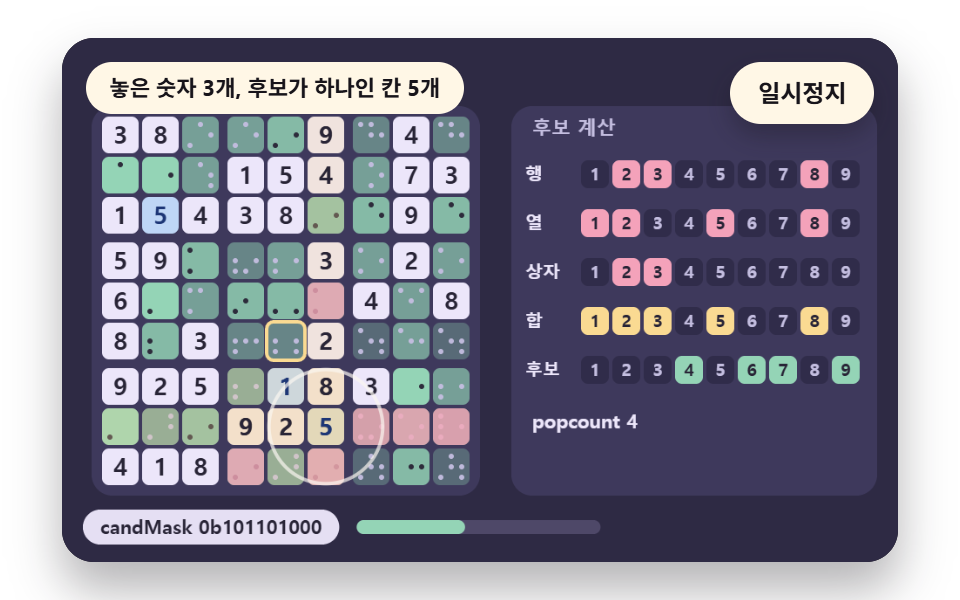 01 sd-candidate-bitmask-map
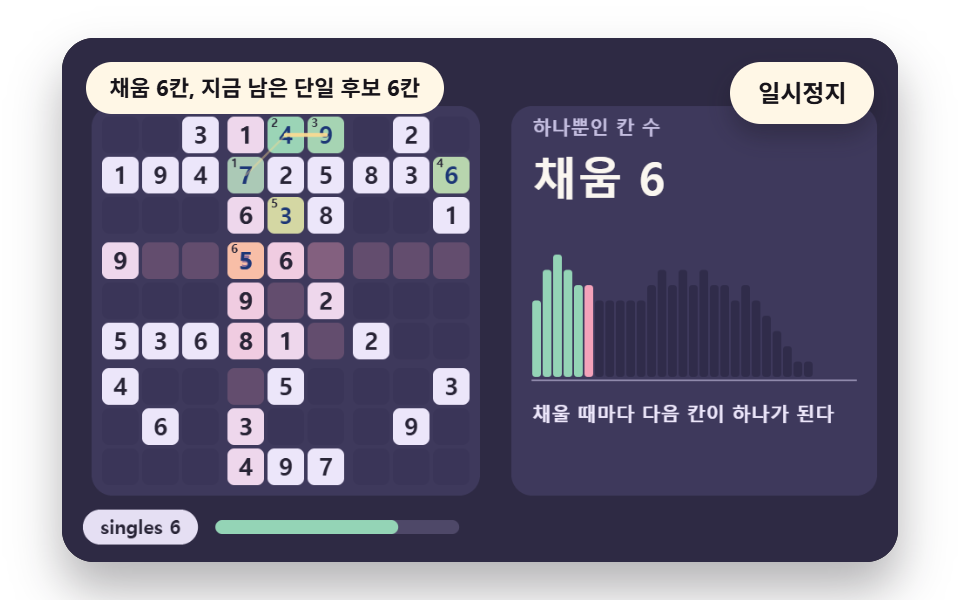 02 sd-single-fill-cascade
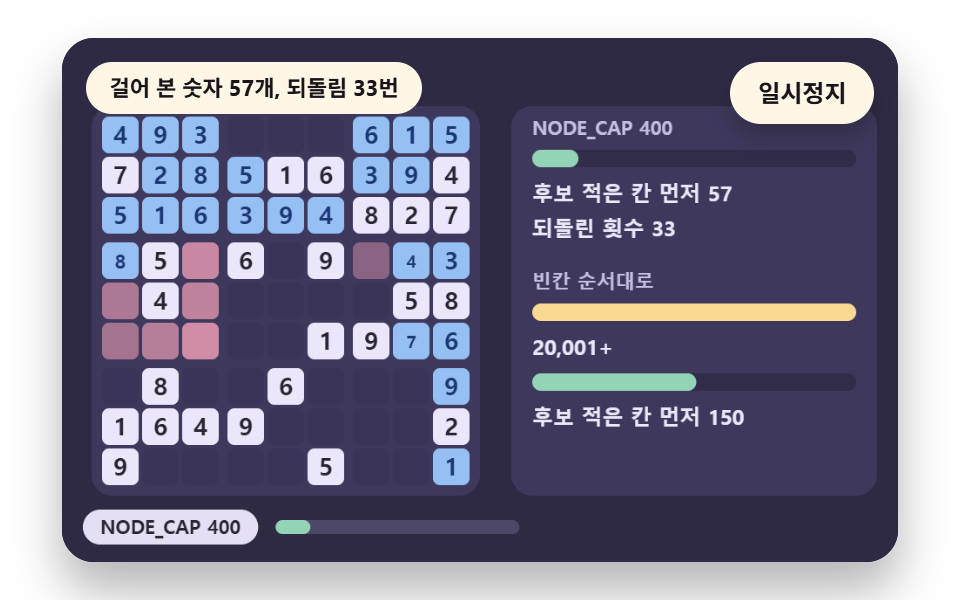 03 sd-fewest-first-backtrack
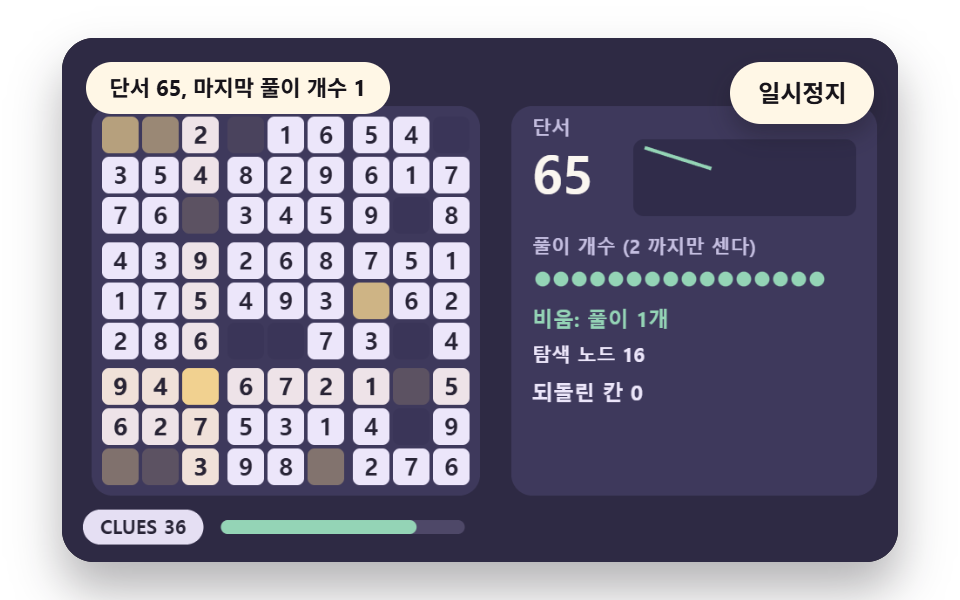 04 sd-unique-dig-count
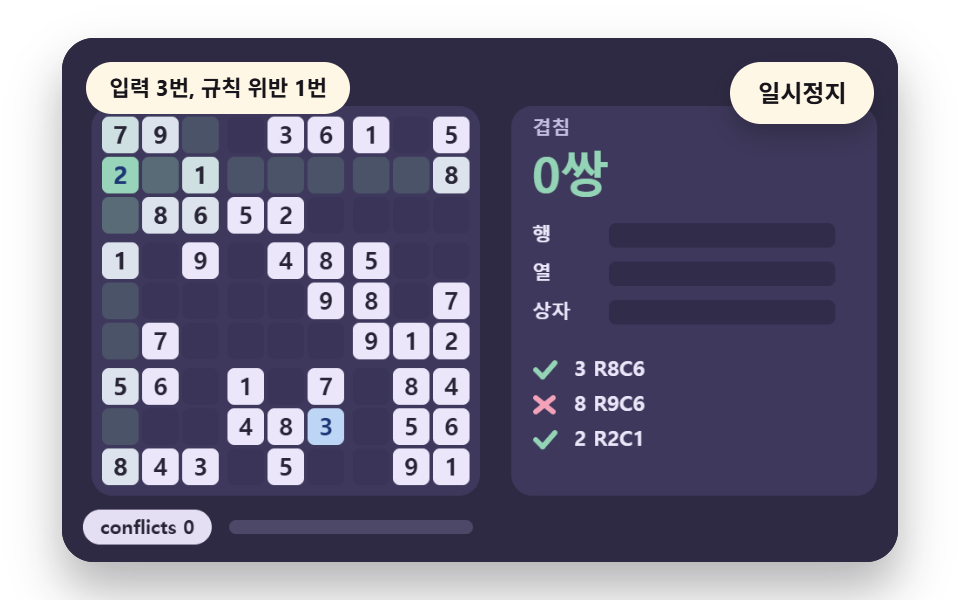 05 sd-conflict-peer-mark
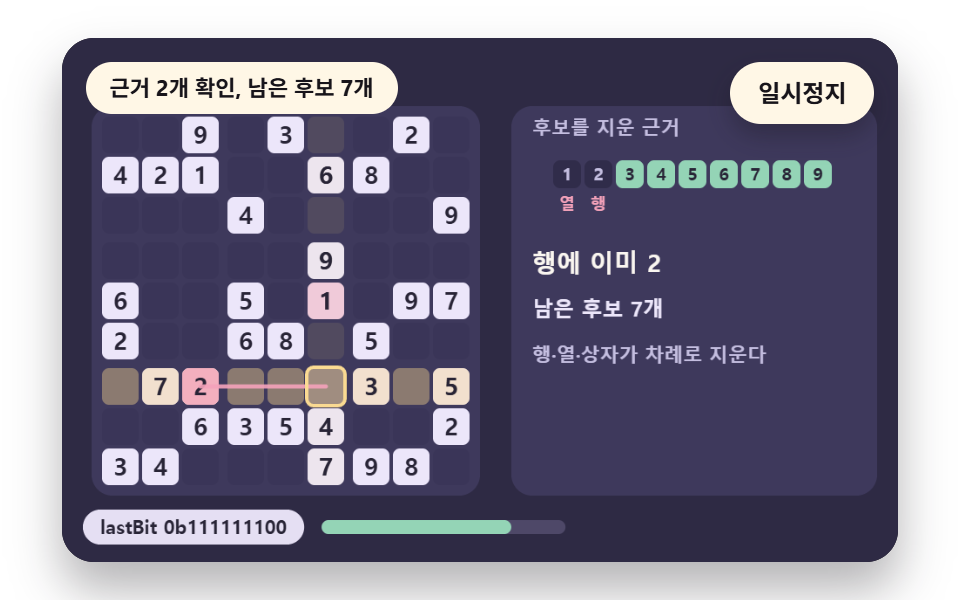 06 sd-hint-reason-trace
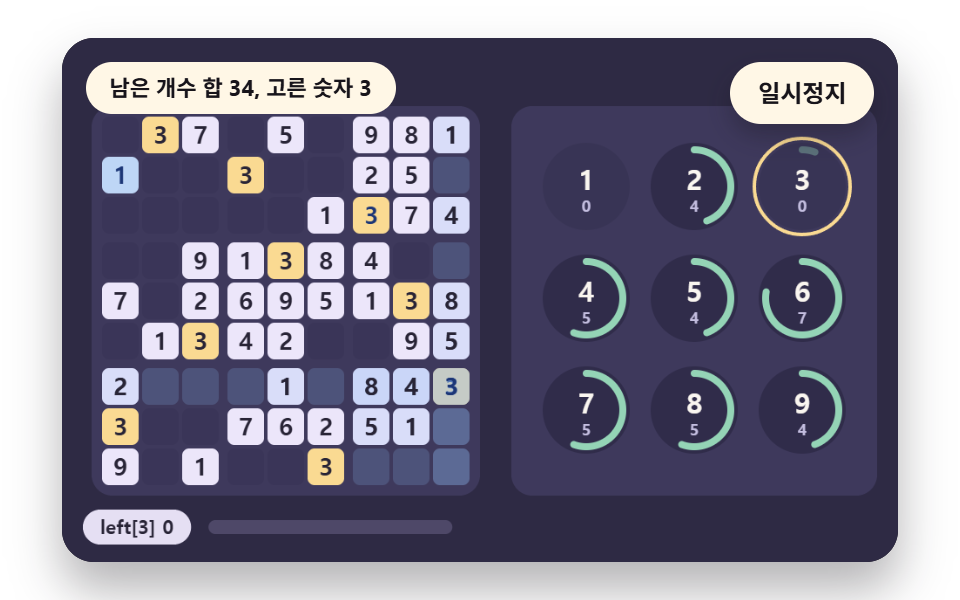 07 sd-digit-left-ring
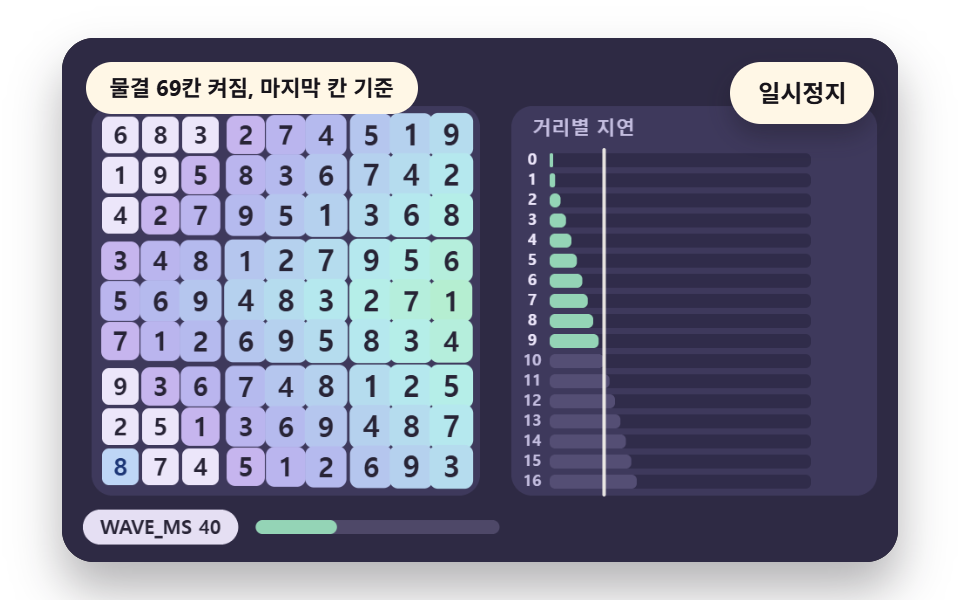 08 sd-solved-wave-flourish
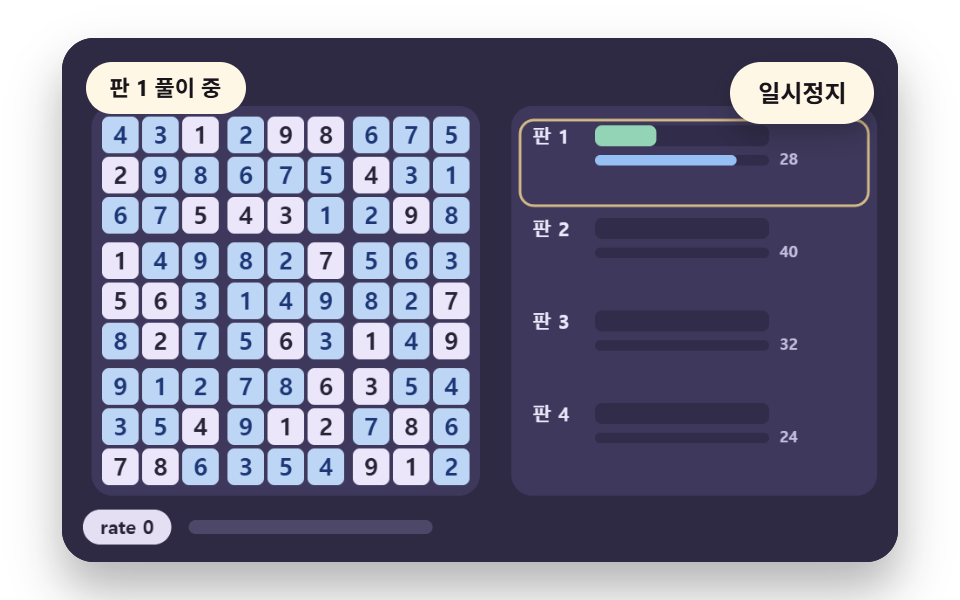 09 sd-difficulty-score-bar
Auto-plays · click a tile to jump to its section · all nine in one zip
- 01 A Candidate Elimination Map Striking Bits per Cell
- 02 A Chain Where Filling a Single Candidate Unlocks the Next
- 03 A Backtrack Starting From the Fewest-Candidate Cell
- 04 Making a Board by Digging While Counting Solutions
- 05 A Conflict Marker for Repeated Digits in a Line or Box
- 06 A Hint That Shows Why: Which Line Struck the Candidates
- 07 A Keypad Whose Rings Shrink With Digits Left
- 08 A Completion Wave Spreading With a Delay per Cell
- 09 A Difficulty Score Bar Measured by Techniques Needed
The nine scenes run on one board model, and each scene reads a different value off it. Candidates are not stored per cell but computed from the board array on demand, so the moment a digit changes, the candidates change with it. If you want a sudoku solver you can read in one sitting, this is its shape: an 81-number array, one candidate rule and a canvas.
A candidate is one nine-bit number
The board is an 81-number array where 0 is a blank, and digit d is written as bit d minus 1. The full set ALL is 511, so a candidate set is a single integer and popcount, which counts the lit bits, gives how many candidates remain.
The same board comes back without random numbers
Boards are dug out of a finished grid shuffled by an integer hash hash2(a, b), so one seed gives one board. Time is one scene clock divided into fixed 1/60 second steps.
    const ALL = 511;
    function bit(d) { return 1 << (d - 1); }
    function popcount(m) {
        let c = 0;
        let v = m;
        while (v) {
            v &= v - 1;
            c += 1;
        }
        return c;
    }
Sudoku in JavaScript: 9 Scenes — a Candidate Elimination Map, a Chain of Single-Candidate Fills, a Fewest-First Backtrack, a Dig That Keeps One Solution, a Duplicate Marker, a Hint That Shows Its Reason, a Remaining Count per Digit, a Completion Wave and a Difficulty Score
Area, frames and intensity from the latest render
The table lists each scene's cumulative area, its moving frames out of 23 and its mean intensity from the latest render.
| Scene | Area | Moving frames | Intensity |
|---|---|---|---|
| 01 Candidate map | 21.3% | 23/23 | 46.1 |
| 02 Single-candidate chain | 24.6% | 23/23 | 40.3 |
| 03 Fewest-first backtrack | 12.4% | 21/23 | 96.7 |
| 04 Dig for one solution | 20.9% | 21/23 | 29.7 |
| 05 Duplicate marker | 17.1% | 14/23 | 42.8 |
| 06 Hint with reasons | 8.2% | 9/23 | 58.9 |
| 07 Remaining-count rings | 20.8% | 18/23 | 53.9 |
| 08 Completion wave | 31.9% | 17/23 | 92.5 |
| 09 Difficulty score | 20.4% | 21/23 | 123.8 |
Scene 08 covers the widest area at 31.9% and 06 the narrowest at 8.2%. Moving frames reach 23 of 23 in 01 and 02 and fall to 9 in 06, and mean intensity is highest in 09 at 123.8 and lowest in 04 at 29.7.
01A Candidate Elimination Map Striking Bits per Cell
Each cell holds 1 to 9 as one nine-bit value, and the bits of digits already placed in its row, column and box are ORed together and struck from it, which suits filling and clearing pencil notes automatically. A cell is mint with one candidate and takes the background shade with seven or more.
<main class="stage">
<div class="vj is-demo" id="vj">
  <div class="vj__pad" data-role="pad" tabindex="0" role="application" aria-label="Sudoku stage: arrow keys move the cell, digit keys 1 to 9 enter a number, Delete clears, H gives a hint, N starts a new board, R restarts, Enter or Space pauses">
    <canvas class="vj__canvas" data-role="canvas" width="480" height="300" role="img" aria-label="A 9×9 sudoku board on a dark plum background, with the remaining candidates of each blank cell dotted in nine slots. Cells with fewer candidates are a brighter mint. As eight digits are placed in turn, the cells that lose candidates in the same row, column and box flush red later the farther they are from the placed cell. The right panel shows the 9-bit lines of digits used by row, column and box for one comparison cell, their OR, and the candidates left. The gauge below shows the constant name and its current value, and under reduced motion only one board with the digits already filled in is drawn"></canvas>
  </div>
  <p class="vj__status" data-role="status" aria-live="off">Sudoku scene</p>
  <div class="vj__ctrl">
    <button class="vj__pause" data-role="pause" type="button" aria-pressed="false">Pause</button>
  </div>
  <p class="vj__done" data-role="done" role="status" aria-live="polite"></p>
</div>
</main>
@use "../../../../site/static/demo-tokens" as *;
@include stage($stage-paper);
.vj {
position: relative;
width: min(92vw, calc(160vh - 12.8vw));
aspect-ratio: 480 / 300;
margin: 0 auto;
border-radius: $r-card;
overflow: hidden;
box-shadow: $shadow-raised;
background: $subject-ink;
}
// 무대 상자 — 눌러서 한 번 깨뜨리는 곳(touch-action: none 은 이 상자에만). 무대 밖 터치는 페이지 스크롤 그대로
.vj__pad {
position: absolute;
inset: 0;
border-radius: inherit;
outline: none;
touch-action: none;
cursor: pointer;
}
// 바깥 .vj 가 넘침을 자르므로 포커스 테두리는 안쪽으로 들인다
.vj__pad:focus-visible {
outline: 3px solid $subject-cream;
outline-offset: -3px;
}
.vj__canvas {
position: absolute;
inset: 0;
display: block;
width: 100%;
height: 100%;
}
.vj__ctrl {
position: absolute;
right: $sp-3;
top: $sp-3;
display: flex;
gap: $sp-2;
}
.vj__pause {
padding: $sp-1 $sp-3;
border: 2px solid $subject-cream;
border-radius: $r-pill;
background: $subject-cream;
color: $subject-ink;
font-family: inherit;
font-weight: 700;
font-size: 12px;
line-height: 1.6;
cursor: pointer;
box-shadow: $shadow-press;
transition: transform $dur-quick $ease-spring;
}
// 스크린리더에만 읽히는 낭독 문장 — 모드가 바뀔 때만 쓴다
.vj__done {
position: absolute;
width: 1px;
height: 1px;
margin: 0;
overflow: hidden;
clip-path: inset(50%);
white-space: nowrap;
}
// 눌린 상태(멈춤) — 바탕과 글자색을 뒤집어 aria-pressed 가 눈에도 보이게
.vj__pause[aria-pressed="true"] {
background: $subject-ink;
color: $subject-cream;
}
.vj__pause:hover {
transform: translateY(-2px);
}
.vj__pause:active {
transform: translateY(1px);
}
.vj__pause:focus-visible {
outline: 3px solid $subject-cream;
outline-offset: 3px;
}
// 상태 줄 — 지금 장면의 수치를 글자로. 화면에만 있고 aria-live 는 늘 off
.vj__status {
position: absolute;
left: $sp-3;
top: $sp-3;
max-width: calc(100% - 100px);
margin: 0;
padding: $sp-1 $sp-3;
border-radius: $r-pill;
background: $subject-cream;
color: $subject-ink;
font-weight: 700;
font-size: 11px;
line-height: 1.6;
white-space: nowrap;
overflow: hidden;
text-overflow: ellipsis;
pointer-events: none;
}
@media (max-width: 340px) {
.vj__pause,
.vj__status { font-size: 10px; padding: 0 $sp-2; }
}
// 움직임 줄이기 — 장면은 스크립트가 글리치 없는 원문 한 장으로 멈춘다. 버튼도 떠오르지 않게
@media (prefers-reduced-motion: reduce) {
.vj__pause { transition: none !important; }
.vj__pause:hover,
.vj__pause:active { transform: none !important; }
}html, body {
margin: 0;
overflow: hidden;
}
.stage {
box-sizing: border-box;
min-height: 100vh;
display: grid;
place-items: center;
margin: 0;
background: #ffffff;
font-family: -apple-system, "Segoe UI", "Noto Sans KR", sans-serif;
padding: clamp(8px, 4vw, 24px);
}
.vj {
position: relative;
width: min(92vw, 160vh - 12.8vw);
aspect-ratio: 480/300;
margin: 0 auto;
border-radius: 16px;
overflow: hidden;
box-shadow: 0 14px 24px rgba(23, 20, 26, 0.32);
background: #17141a;
}
.vj__pad {
position: absolute;
inset: 0;
border-radius: inherit;
outline: none;
touch-action: none;
cursor: pointer;
}
.vj__pad:focus-visible {
outline: 3px solid #fff7e6;
outline-offset: -3px;
}
.vj__canvas {
position: absolute;
inset: 0;
display: block;
width: 100%;
height: 100%;
}
.vj__ctrl {
position: absolute;
right: 12px;
top: 12px;
display: flex;
gap: 8px;
}
.vj__pause {
padding: 4px 12px;
border: 2px solid #fff7e6;
border-radius: 999px;
background: #fff7e6;
color: #17141a;
font-family: inherit;
font-weight: 700;
font-size: 12px;
line-height: 1.6;
cursor: pointer;
box-shadow: 0 6px 12px rgba(23, 20, 26, 0.32);
transition: transform 220ms cubic-bezier(0.2, 0.8, 0.2, 1);
}
.vj__done {
position: absolute;
width: 1px;
height: 1px;
margin: 0;
overflow: hidden;
clip-path: inset(50%);
white-space: nowrap;
}
.vj__pause[aria-pressed=true] {
background: #17141a;
color: #fff7e6;
}
.vj__pause:hover {
transform: translateY(-2px);
}
.vj__pause:active {
transform: translateY(1px);
}
.vj__pause:focus-visible {
outline: 3px solid #fff7e6;
outline-offset: 3px;
}
.vj__status {
position: absolute;
left: 12px;
top: 12px;
max-width: calc(100% - 100px);
margin: 0;
padding: 4px 12px;
border-radius: 999px;
background: #fff7e6;
color: #17141a;
font-weight: 700;
font-size: 11px;
line-height: 1.6;
white-space: nowrap;
overflow: hidden;
text-overflow: ellipsis;
pointer-events: none;
}
@media (max-width: 340px) {
.vj__pause,
.vj__status {
font-size: 10px;
padding: 0 8px;
}
}
@media (prefers-reduced-motion: reduce) {
.vj__pause {
transition: none !important;
}
.vj__pause:hover,
.vj__pause:active {
transform: none !important;
}
}(function () {
const root = document.getElementById("vj");
if (!root) return;
// 무대 좌표 — 캔버스 안 계산은 늘 480×300. 화면에 보이는 크기와 상관없다
const W = 480;
const H = 300;
const TAU = Math.PI * 2;
function clamp(v, lo, hi) { return v < lo ? lo : (v > hi ? hi : v); }
function lerp(a, b, k) { return a + (b - a) * k; }
function easeOut(k) { const u = 1 - clamp(k, 0, 1); return 1 - u * u * u; }
// 파스텔 팔레트 — 바탕은 짙은 자두색, 타일은 연한 색 위에 짙은 잉크 숫자
const INK = [40, 36, 54];
const PAPER = [250, 246, 240];
const ROSE = [244, 162, 186];
const MINT = [148, 212, 182];
const SKY = [150, 192, 244];
const SUN = [250, 218, 146];
const NEU = [236, 230, 250];
const BGC = [46, 42, 68];
const PANEL = [62, 57, 92];
const DIM = [196, 190, 224];
function rgba(c, a) {
return 'rgba(' + Math.round(clamp(c[0], 0, 255)) + ',' + Math.round(clamp(c[1], 0, 255)) + ',' + Math.round(clamp(c[2], 0, 255)) + ',' + clamp(a, 0, 1).toFixed(3) + ')';
}
function hsl(h, s, l) {
const a = s * Math.min(l, 1 - l);
const f = function (n) {
const k = (n + h / 30) % 12;
return l - a * Math.max(-1, Math.min(k - 3, Math.min(9 - k, 1)));
};
return [Math.round(f(0) * 255), Math.round(f(8) * 255), Math.round(f(4) * 255)];
}
// 정수 해시 — 같은 (a, b) 에는 늘 같은 0 이상 1 미만 값. 난수 함수는 쓰지 않는다
function hash2(a, b) {
let h = (Math.imul(a | 0, 374761393) + Math.imul(b | 0, 668265263)) | 0;
h = Math.imul(h ^ (h >>> 13), 1274126177);
h = h ^ (h >>> 16);
return (h >>> 0) / 4294967296;
}
// 2차원 값 잡음 — 정수 격자점마다 해시 값이 있고 그 사이를 부드럽게 잇는다
function noise2(x, y, seed) {
const xi = Math.floor(x);
const yi = Math.floor(y);
const fx = x - xi;
const fy = y - yi;
const ux = fx * fx * (3 - 2 * fx);
const uy = fy * fy * (3 - 2 * fy);
const s = seed * 131;
return lerp(lerp(hash2(xi + s, yi), hash2(xi + 1 + s, yi), ux), lerp(hash2(xi + s, yi + 1), hash2(xi + 1 + s, yi + 1), ux), uy);
}
// 장면 시계(초)·판 반복 번호·시간표 — 시간표는 (시각, 할 일) 목록이고 시각이 지나면 한 번씩 부른다
let sceneT = 0;
let lap = 0;
let script = [];
let evAt = 0;
// 문구 틀의 {a}·{b}·{c} 자리에 값을 끼운다 — 화면 문구는 늘 틀 한 줄이고 로케일 사전이 통째로 바꾼다
function fill(s, a, b, c) {
return s.split('{a}').join(a).split('{b}').join(b === undefined ? '' : b).split('{c}').join(c === undefined ? '' : c);
}
function r1(v) { return String(Math.round(v * 10) / 10); }
function group(v) {
// 천 단위 점 — 로케일 함수에 기대지 않는다
const s = String(Math.round(v));
let o = '';
for (let i = 0; i < s.length; i += 1) {
if (i > 0 && (s.length - i) % 3 === 0) {
o += ',';
}
o += s.charAt(i);
}
return o;
}
// ── 스도쿠 모델 — 판은 81칸 숫자 배열(0 은 빈칸). 후보는 9비트 한 수: 숫자 d 는 (d-1) 번째 비트
const ALL = 511;
function bit(d) { return 1 << (d - 1); }
function popcount(m) {
let c = 0;
let v = m;
while (v) {
v &= v - 1;
c += 1;
}
return c;
}
// 가장 낮은 비트 하나가 가리키는 숫자
function lowDigit(m) { return 32 - Math.clz32(m & -m); }
function bin9(m) {
let s = '';
for (let d = 9; d >= 1; d -= 1) {
s += (m & bit(d)) ? '1' : '0';
}
return s;
}
function rowOf(i) { return Math.floor(i / 9); }
function colOf(i) { return i % 9; }
function boxOf(i) { return Math.floor(i / 27) * 3 + Math.floor((i % 9) / 3); }
// 묶음 27개 — 줄 9 · 세로줄 9 · Box 9. 칸의 이웃은 같은 묶음 세 곳의 다른 칸 20개
const UNITS = [];
const PEERS = [];
for (let k = 0; k < 27; k += 1) {
UNITS.push([]);
}
for (let i = 0; i < 81; i += 1) {
UNITS[rowOf(i)].push(i);
UNITS[9 + colOf(i)].push(i);
UNITS[18 + boxOf(i)].push(i);
}
for (let i = 0; i < 81; i += 1) {
const ps = [];
for (let j = 0; j < 81; j += 1) {
if (j !== i && (rowOf(j) === rowOf(i) || colOf(j) === colOf(i) || boxOf(j) === boxOf(i))) {
ps.push(j);
}
}
PEERS.push(ps);
}
// 묶음 종류 kind: 0 줄 · 1 세로줄 · 2 Box
function unitIndex(kind, i) { return kind === 0 ? rowOf(i) : (kind === 1 ? 9 + colOf(i) : 18 + boxOf(i)); }
function sharedKind(i, j) {
if (rowOf(i) === rowOf(j)) {
return 0;
}
if (colOf(i) === colOf(j)) {
return 1;
}
return boxOf(i) === boxOf(j) ? 2 : -1;
}
// 칸 i 가 속한 kind 묶음에서 i 를 뺀 칸들이 이미 쓴 숫자의 비트 OR(OR)
function usedMask(b, i, kind) {
const u = UNITS[unitIndex(kind, i)];
let m = 0;
for (let k = 0; k < 9; k += 1) {
if (u[k] !== i && b[u[k]] !== 0) {
m |= bit(b[u[k]]);
}
}
return m;
}
// Left = 9비트 전체에서 세 묶음이 쓴 비트를 뺀 것. 채워진 칸의 후보는 0
function candMask(b, i) {
if (b[i] !== 0) {
return 0;
}
return ALL & ~(usedMask(b, i, 0) | usedMask(b, i, 1) | usedMask(b, i, 2));
}
function filledOf(b) {
let c = 0;
for (let i = 0; i < 81; i += 1) {
if (b[i] !== 0) {
c += 1;
}
}
return c;
}
function perm(n, seed) {
const a = [];
for (let i = 0; i < n; i += 1) {
a.push(i);
}
for (let i = n - 1; i > 0; i -= 1) {
const j = Math.floor(hash2(i, seed) * (i + 1));
const t = a[i];
a[i] = a[j];
a[j] = t;
}
return a;
}
// 완성판 — 기본 무늬를 숫자·줄·Box 묶음 순서로 섞는다. 같은 씨앗이면 같은 판
function fullBoard(seed) {
const dp = perm(9, seed * 7 + 1);
const bp = perm(3, seed * 7 + 2);
const sp = perm(3, seed * 7 + 3);
const rows = [];
const cols = [];
for (let k = 0; k < 3; k += 1) {
const rp = perm(3, seed * 13 + k * 5 + 4);
const cp = perm(3, seed * 13 + k * 5 + 9);
for (let j = 0; j < 3; j += 1) {
rows.push(bp[k] * 3 + rp[j]);
cols.push(sp[k] * 3 + cp[j]);
}
}
const b = [];
for (let r = 0; r < 9; r += 1) {
for (let c = 0; c < 9; c += 1) {
b.push(dp[(3 * (rows[r] % 3) + Math.floor(rows[r] / 3) + cols[c]) % 9] + 1);
}
}
return b;
}
function search(start, limit, cap, plain, wantTrace) {
const b = start.slice();
const rm = [0, 0, 0, 0, 0, 0, 0, 0, 0];
const cm = [0, 0, 0, 0, 0, 0, 0, 0, 0];
const xm = [0, 0, 0, 0, 0, 0, 0, 0, 0];
for (let i = 0; i < 81; i += 1) {
if (b[i] !== 0) {
rm[rowOf(i)] |= bit(b[i]);
cm[colOf(i)] |= bit(b[i]);
xm[boxOf(i)] |= bit(b[i]);
}
}
const r = { count: 0, nodes: 0, dead: 0, branch: 0, capHit: false, first: [], trace: [] };
function rec() {
let best = -1;
let bm = 0;
let bc = 10;
for (let i = 0; i < 81; i += 1) {
if (b[i] !== 0) {
continue;
}
const m = ALL & ~(rm[rowOf(i)] | cm[colOf(i)] | xm[boxOf(i)]);
const pc = popcount(m);
if (plain) {
best = i;
bm = m;
bc = pc;
break;
}
if (pc < bc) {
best = i;
bm = m;
bc = pc;
if (pc <= 1) {
break;
}
}
}
if (best < 0) {
r.count += 1;
if (r.count === 1) {
r.first = b.slice();
}
return;
}
if (bc === 0) {
r.dead += 1;
return;
}
if (bc > 1) {
r.branch += 1;
}
let mm = bm;
while (mm) {
const lo = mm & -mm;
mm ^= lo;
const d = 32 - Math.clz32(lo);
r.nodes += 1;
if (r.nodes > cap) {
r.capHit = true;
return;
}
b[best] = d;
rm[rowOf(best)] |= lo;
cm[colOf(best)] |= lo;
xm[boxOf(best)] |= lo;
if (wantTrace) {
r.trace.push((best << 4) | d);
}
rec();
if (r.count >= limit || r.capHit) {
return;
}
b[best] = 0;
rm[rowOf(best)] &= ~lo;
cm[colOf(best)] &= ~lo;
xm[boxOf(best)] &= ~lo;
if (wantTrace) {
r.trace.push((1 << 16) | (best << 4) | d);
}
}
}
rec();
return r;
}
function singlesFill(start) {
const b = start.slice();
const order = [];
const digits = [];
const avail = [];
for (;;) {
let first = -1;
let n = 0;
for (let i = 0; i < 81; i += 1) {
if (b[i] === 0 && popcount(candMask(b, i)) === 1) {
if (first < 0) {
first = i;
}
n += 1;
}
}
if (first < 0) {
break;
}
const d = lowDigit(candMask(b, first));
b[first] = d;
order.push(first);
digits.push(d);
avail.push(n);
}
let solved = true;
for (let i = 0; i < 81; i += 1) {
if (b[i] === 0) {
solved = false;
}
}
return { order: order, digits: digits, avail: avail, solved: solved, board: b };
}
function digBoard(sol, seed, target, singlesOnly) {
const puz = sol.slice();
const order = perm(81, seed * 31 + 5);
const steps = [];
let clues = 81;
for (let k = 0; k < 81; k += 1) {
if (clues <= target) {
break;
}
const c = order[k];
const d = puz[c];
puz[c] = 0;
const s = search(puz, 2, 6000, false, false);
const cnt = s.capHit ? 2 : Math.min(2, s.count);
const ok = cnt === 1 && (!singlesOnly || singlesFill(puz).solved);
steps.push({ cell: c, cnt: cnt, ok: ok, nodes: s.nodes });
if (ok) {
clues -= 1;
}
else {
puz[c] = d;
}
}
return { puz: puz, steps: steps, clues: clues };
}
// 놓은 숫자가 겹치는 쌍 — [칸, 칸, 묶음 종류]
function conflicts(b) {
const out = [];
for (let i = 0; i < 81; i += 1) {
if (b[i] === 0) {
continue;
}
for (let k = 0; k < 20; k += 1) {
const p = PEERS[i][k];
if (p > i && b[p] === b[i]) {
out.push([i, p, sharedKind(i, p)]);
}
}
}
return out;
}
// ── 판 상태 — 장면이 아니라 판이 들고 있는 것. 화면은 이 값을 읽어 그린다
const BX = 22;
const BY = 44;
const CS = 23;
const GAP = 3;
const PX = 258;
const PW = 210;
let g = [];
let giv = [];
let sol = [];
let pt = [];
let cur = 40;
let solvedT = -1;
let lastCell = -1;
let rip = { i: -1, t: -9, list: [], d: 0 };
let selDigit = 0;
let still = false;
let hintHook = null;
function cellX(i) { const c = colOf(i); return BX + c * CS + Math.floor(c / 3) * GAP; }
function cellY(i) { const r = rowOf(i); return BY + r * CS + Math.floor(r / 3) * GAP; }
function cellCx(i) { return cellX(i) + CS / 2; }
function cellCy(i) { return cellY(i) + CS / 2; }
function cellAt(x, y) {
let c = -1;
let r = -1;
for (let k = 0; k < 9; k += 1) {
const x0 = BX + k * CS + Math.floor(k / 3) * GAP;
const y0 = BY + k * CS + Math.floor(k / 3) * GAP;
if (x >= x0 && x < x0 + CS) {
c = k;
}
if (y >= y0 && y < y0 + CS) {
r = k;
}
}
return c < 0 || r < 0 ? -1 : r * 9 + c;
}
function setBoard(puz, solution) {
g = puz.slice();
sol = solution.slice();
giv = [];
pt = [];
for (let i = 0; i < 81; i += 1) {
giv.push(puz[i] !== 0);
pt.push(-9);
}
solvedT = -1;
lastCell = -1;
rip = { i: -1, t: -9, list: [], d: 0 };
}
function solvedNow() { return filledOf(g) === 81 && conflicts(g).length === 0; }
function checkSolved() {
if (solvedNow()) {
if (solvedT < 0) {
solvedT = sceneT;
}
}
else {
solvedT = -1;
}
}
// 숫자를 놓는다 — 놓기 전에 그 숫자가 후보에 있던 이웃 칸을 기억해 두면 소거가 번지는 모습을 그릴 수 있다
function putDigit(i, d) {
if (giv[i] || d < 1 || d > 9) {
return false;
}
const list = [];
for (let k = 0; k < 20; k += 1) {
const p = PEERS[i][k];
if (g[p] === 0 && (candMask(g, p) & bit(d)) !== 0) {
list.push(p);
}
}
g[i] = d;
pt[i] = sceneT;
rip = { i: i, t: sceneT, list: list, d: d };
lastCell = i;
checkSolved();
return true;
}
function clearDigit(i) {
if (giv[i] || g[i] === 0) {
return;
}
g[i] = 0;
pt[i] = -9;
checkSolved();
}
function mix(a, b, k) { return [lerp(a[0], b[0], k), lerp(a[1], b[1], k), lerp(a[2], b[2], k)]; }
// ── 그리기 도구
const canvasEl = root.querySelector('[data-role="canvas"]');
const padEl = root.querySelector('[data-role="pad"]');
const pauseEl = root.querySelector('[data-role="pause"]');
const statusEl = root.querySelector('[data-role="status"]');
const doneEl = root.querySelector('[data-role="done"]');
const ctxRaw = canvasEl ? canvasEl.getContext('2d') : null;
if (!canvasEl || !ctxRaw || !pauseEl || !padEl || !doneEl) {
return;
}
const cv = canvasEl;
const ctx = ctxRaw;
const pauseBtn = pauseEl;
const doneP = doneEl;
const pad = padEl;
// 외부 웹폰트는 부르지 않는다 — 기기에 있는 글꼴 목록만
const UI_FONT = 'system-ui, -apple-system, "Segoe UI", "Noto Sans KR", sans-serif';
let dpr = 1;
function fitCanvas() {
// 배율은 2 에서 자른다 — 계산은 늘 480×300 이고 화면 배율만 이 값
dpr = Math.min(window.devicePixelRatio || 1, 2);
cv.width = Math.round(W * dpr);
cv.height = Math.round(H * dpr);
ctx.setTransform(dpr, 0, 0, dpr, 0, 0);
}
function box(x, y, w, h, r, c, a) {
if (w <= 0.2 || h <= 0.2 || a <= 0) {
return;
}
ctx.beginPath();
ctx.roundRect(x, y, w, h, Math.max(0, Math.min(r, w / 2, h / 2)));
ctx.fillStyle = rgba(c, a);
ctx.fill();
}
function disc(x, y, r, c, a) {
ctx.beginPath();
ctx.arc(x, y, r, 0, TAU);
ctx.fillStyle = rgba(c, a);
ctx.fill();
}
function seg(x1, y1, x2, y2, c, a, w) {
ctx.beginPath();
ctx.moveTo(x1, y1);
ctx.lineTo(x2, y2);
ctx.strokeStyle = rgba(c, a);
ctx.lineWidth = w;
ctx.lineCap = 'round';
ctx.stroke();
}
function text(s, x, y, c, px, weight, align) {
ctx.font = weight + ' ' + px + 'px ' + UI_FONT;
ctx.textAlign = align;
ctx.textBaseline = 'middle';
ctx.fillStyle = rgba(c, 1);
ctx.fillText(s, x, y);
}
function panel(x, y, w, h) { box(x, y, w, h, 12, PANEL, 1); }
// 아래쪽 눈금 — 상수 이름과 지금 값 · 크기 막대
function hud(name, val, frac) {
const label = name + ' ' + val;
ctx.font = '700 11px ' + UI_FONT;
const w = ctx.measureText(label).width + 20;
const x = 12;
const y = H - 30;
box(x, y, w, 20, 10, NEU, 0.96);
text(label, x + w / 2, y + 10.5, INK, 11, 700, 'center');
const mx = x + w + 10;
box(mx, y + 6, 140, 8, 4, [78, 72, 104], 1);
box(mx, y + 6, 140 * clamp(frac, 0, 1), 8, 4, MINT, 1);
}
// ── 판 그리기 — 칸 색은 장면이 정하고, 숫자는 판이 그린다
const EMPTY = [58, 53, 88];
const PLACED = [190, 214, 246];
const PLACED_INK = [28, 54, 118];
function ring(x, y, w, h, r, c, a, lw) {
ctx.beginPath();
ctx.roundRect(x, y, w, h, r);
ctx.strokeStyle = rgba(c, a);
ctx.lineWidth = lw;
ctx.stroke();
}
function drawBoard(fillOf, extra) {
const s = 9 * CS + 2 * GAP;
box(BX - 5, BY - 5, s + 10, s + 10, 12, PANEL, 1);
for (let i = 0; i < 81; i += 1) {
const x = cellX(i);
const y = cellY(i);
let f = fillOf(i);
if (f === null) {
f = g[i] === 0 ? EMPTY : (giv[i] ? NEU : PLACED);
}
box(x + 1, y + 1, CS - 2, CS - 2, 4, f, 1);
if (g[i] !== 0) {
const a = still ? 99 : sceneT - pt[i];
const k = a < 0.3 ? 0.7 + 0.3 * easeOut(a / 0.3) : 1;
text(String(g[i]), x + CS / 2, y + CS / 2 + 1, giv[i] ? INK : PLACED_INK, Math.round(14 * k), giv[i] ? 800 : 700, 'center');
}
else if (extra !== null) {
extra(i, x, y);
}
}
if (!demo) {
ring(cellX(cur) + 0.5, cellY(cur) + 0.5, CS - 1, CS - 1, 4, PAPER, 1, 2);
}
}
// 묶음 하나를 옅게 물들인다
function tintUnit(u, c, a) {
for (let k = 0; k < 9; k += 1) {
const i = UNITS[u][k];
box(cellX(i) + 1, cellY(i) + 1, CS - 2, CS - 2, 4, c, a);
// 물들임이 숫자를 흐리지 않도록 숫자를 다시 얹는다
if (g[i] !== 0) {
text(String(g[i]), cellCx(i), cellCy(i) + 1, giv[i] ? INK : PLACED_INK, 14, giv[i] ? 800 : 700, 'center');
}
}
}
// Left 비트 줄 — 숫자 1~9 칸 아홉 개, 켜진 비트만 밝다
function bitRow(x, y, m, on, off) {
for (let d = 1; d <= 9; d += 1) {
const lit = (m & bit(d)) !== 0;
const bx = x + (d - 1) * 18;
box(bx, y, 16, 16, 4, lit ? on : off, 1);
text(String(d), bx + 8, y + 8.5, lit ? INK : DIM, 10, 700, 'center');
}
}
// ── 상태 줄·낭독 문장
const SPK_FILL = '{b} of {a} cells are filled';
const SPK_DONE = 'Board complete, all {a} cells are filled';
function speakBoard() {
return solvedNow() ? fill(SPK_DONE, '81') : fill(SPK_FILL, '81', String(filledOf(g)));
}
// 낭독 모드 — 완성이면 1000, 손으로 하는 중이면 100 + 채운 칸 수, 자동 시연이면 장면이 정한 단계
function modeBase(sceneMode) {
if (solvedNow()) {
return 1000;
}
return manual ? 100 + filledOf(g) : sceneMode;
}
// 방금 놓은 칸의 줄·세로줄·Box 세 묶음을 한 번 물들였다 서서히 빼는 번짐 — 숫자 하나가 어디까지 영향을 주는지 보인다
function unitPulse(c, a, dur) {
if (rip.i < 0 || still) {
return;
}
const k = (sceneT - rip.t) / dur;
if (k < 0 || k >= 1) {
return;
}
for (let kind = 0; kind < 3; kind += 1) {
tintUnit(unitIndex(kind, rip.i), c, a * (1 - k));
}
}
let shownStatus = '';
function pushStatus(s) {
if (!statusEl || s === shownStatus) {
return;
}
shownStatus = s;
statusEl.textContent = s;
}
let paused = false;
const reduceQuery = window.matchMedia('(prefers-reduced-motion: reduce)');
// 페이지를 연 채 움직임 줄이기 설정을 바꿔도 change 리스너가 다시 읽는다
still = reduceQuery.matches;
// 자동 시연 표시 — 사람이 처음 손대면 떼고, 그 뒤부터 모드가 바뀔 때만 낭독 문장을 쓴다
let demo = root.classList.contains('is-demo');
const off = new AbortController();
// 사람이 직접 조작하는 중이면 시간표는 멈추고 계산만 흐른다
let manual = false;
function wake() {
if (!demo) {
return;
}
demo = false;
root.classList.remove('is-demo');
}
function takeOver() {
if (manual) {
return;
}
manual = true;
wake();
}
// 낭독 문장 — 화면 상태 줄(aria-live off)과 따로, 모드가 바뀔 때와 사람이 조작했을 때만 role=status 에 쓴다
let lastMode = -9;
function say() {
doneP.textContent = speakText();
lastMode = still ? -2 : modeId();
}
function advance(dt) {
sceneT += dt;
if (!manual) {
while (evAt < script.length && script[evAt].t <= sceneT) {
const ev = script[evAt];
evAt += 1;
ev.f();
}
if (sceneT >= LAP_S) {
lap += 1;
begin();
return;
}
}
update(dt);
}
function begin() {
sceneT = 0;
evAt = 0;
script = [];
build();
}
// 고정 걸음 + 걸음 수 상한 — 프레임 간격이 흔들려도 같은 계산, 탭이 멈췄다 돌아와도 한 번에 몰리지 않는다
const STEP_S = 1 / 60;
const DT_MAX = 0.05;
let acc = 0;
function showNow() {
draw();
pushStatus(statusText());
if (!demo) {
const m = still ? -2 : modeId();
if (m !== lastMode) {
say();
}
}
}
let rafId = 0;
let lastTs = -1;
function frame(ts) {
if (still || paused) {
rafId = 0;
return;
}
if (lastTs < 0) {
lastTs = ts;
}
const dt = Math.min((ts - lastTs) / 1000, DT_MAX);
lastTs = ts;
acc += dt;
while (acc >= STEP_S) {
advance(STEP_S);
acc -= STEP_S;
}
showNow();
rafId = window.requestAnimationFrame(frame);
}
function startLoop() {
if (rafId) {
return;
}
// 멈췄던 사이의 시간을 첫 프레임 dt 로 넘기지 않는다
lastTs = -1;
acc = 0;
rafId = window.requestAnimationFrame(frame);
}
function stopLoop() {
if (rafId) {
window.cancelAnimationFrame(rafId);
rafId = 0;
}
}
// 움직임 줄이기 — 루프 없이 시간표의 REST_S 초까지를 한 번에 치른 판 한 장. 타일은 보간 없이 바로 제자리
function showRest() {
stopLoop();
lap = 0;
begin();
while (evAt < script.length && script[evAt].t <= REST_S) {
const ev = script[evAt];
evAt += 1;
sceneT = ev.t;
ev.f();
}
sceneT = REST_S;
update(0);
showNow();
}
function play() {
begin();
showNow();
if (!paused) {
startLoop();
}
}
// 사람이 조작한 뒤 — 멈춘 채이거나 움직임 줄이기이면 보간을 건너뛰어 바로 보이게 한다. 조작 직후는 낭독 문장도 쓴다
function afterInput(speak) {
if (paused || still) {
sceneT += 1;
}
update(0);
showNow();
if (speak) {
say();
}
}
function togglePause() {
paused = !paused;
pauseBtn.setAttribute('aria-pressed', paused ? 'true' : 'false');
wake();
if (paused) {
stopLoop();
}
else if (!still) {
startLoop();
}
say();
}
function restart() {
manual = false;
lap = 0;
begin();
update(0);
showNow();
say();
}
// 새 판 — 씨앗이 달라진 판으로 시간표를 처음부터. 손으로 하던 중이어도 자동 시연으로 돌아간다
function newBoard() {
manual = false;
lap += 1;
begin();
update(0);
showNow();
say();
}
function moveCur(dx, dy) {
takeOver();
cur = clamp(rowOf(cur) + dy, 0, 8) * 9 + clamp(colOf(cur) + dx, 0, 8);
afterInput(true);
}
// 힌트 기본 — 고른 빈칸에 정답 숫자를 놓는다. 장면이 hintHook 을 걸어 두면 그쪽이 먼저
function hintDefault() {
if (!giv[cur] && g[cur] === 0) {
putDigit(cur, sol[cur]);
}
}
function toCanvas(e) {
const r = cv.getBoundingClientRect();
return [(e.clientX - r.left) * W / r.width, (e.clientY - r.top) * H / r.height];
}
pauseBtn.addEventListener('click', togglePause, { signal: off.signal });
// 키보드 — 무대에 포커스가 있을 때만. 방향키 = 칸 이동, 1~9 = 숫자 입력, Delete·Backspace·0 = 지우기, H = 힌트,
// N = 새 판, R = 처음부터, Enter·Space = Pause
pad.addEventListener('keydown', function (e) {
if (e.altKey || e.ctrlKey || e.metaKey) {
return;
}
const k = e.key;
if (k === 'Enter' || k === ' ' || k === 'p' || k === 'P') {
e.preventDefault();
togglePause();
}
else if (k === 'r' || k === 'R') {
restart();
}
else if (k === 'n' || k === 'N') {
e.preventDefault();
newBoard();
}
else if (k === 'ArrowLeft') {
e.preventDefault();
moveCur(-1, 0);
}
else if (k === 'ArrowRight') {
e.preventDefault();
moveCur(1, 0);
}
else if (k === 'ArrowUp') {
e.preventDefault();
moveCur(0, -1);
}
else if (k === 'ArrowDown') {
e.preventDefault();
moveCur(0, 1);
}
else if (k.length === 1 && k >= '1' && k <= '9') {
e.preventDefault();
takeOver();
selDigit = Number(k);
putDigit(cur, selDigit);
afterInput(true);
}
else if (k === 'Delete' || k === 'Backspace' || k === '0') {
e.preventDefault();
takeOver();
clearDigit(cur);
afterInput(true);
}
else if (k === 'h' || k === 'H') {
e.preventDefault();
takeOver();
if (hintHook !== null) {
hintHook();
}
else {
hintDefault();
}
afterInput(true);
}
}, { signal: off.signal });
// 포인터 — 마우스·터치·펜을 한 이벤트로. 누르는 순간부터 놓을 때까지 무대가 포인터를 붙잡는다
let ptrDown = false;
pad.addEventListener('pointerdown', function (e) {
takeOver();
ptrDown = true;
try {
pad.setPointerCapture(e.pointerId);
}
catch (err) {
ptrDown = true;
}
const p = toCanvas(e);
const c = cellAt(p[0], p[1]);
if (c >= 0) {
cur = c;
}
onPtr(0, p[0], p[1]);
afterInput(false);
}, { signal: off.signal });
pad.addEventListener('pointermove', function (e) {
if (!ptrDown) {
return;
}
const p = toCanvas(e);
const c = cellAt(p[0], p[1]);
if (c >= 0) {
cur = c;
}
onPtr(1, p[0], p[1]);
afterInput(false);
}, { signal: off.signal });
function ptrEnd(e) {
if (!ptrDown) {
return;
}
ptrDown = false;
const p = toCanvas(e);
onPtr(2, p[0], p[1]);
afterInput(true);
}
pad.addEventListener('pointerup', ptrEnd, { signal: off.signal });
pad.addEventListener('pointercancel', ptrEnd, { signal: off.signal });
// 탭이 숨으면 멈추고, 돌아오면 시계를 다시 맞춰 시작
document.addEventListener('visibilitychange', function () {
if (document.hidden) {
stopLoop();
}
else if (!paused && !still) {
startLoop();
}
}, { signal: off.signal });
// 설정이 바뀌면 — 켜지면 판 한 장, 꺼지면 다시 움직인다
reduceQuery.addEventListener('change', function () {
still = reduceQuery.matches;
if (still) {
showRest();
}
else {
lap = 0;
play();
}
}, { signal: off.signal });
window.addEventListener('resize', function () {
fitCanvas();
showNow();
}, { signal: off.signal });
// 01 — 칸마다 후보를 9비트 한 수로 들고, 같은 줄·세로줄·상자의 사용 숫자 비트를 OR 로 모아 뺀다. 숫자를 놓으면 후보가 줄어드는 칸이 번지고 칸 색은 남은 Left 수로 정해진다
const CLUES_01 = 34;
const PLACE_GAP = 0.5;
const RIPPLE_S = 0.9;
const PLACES = 8;
let LAP_S = 7.2;
let REST_S = 5.6;
let focus = -1;
let plan = [];
let placedN = 0;
const SPK_PUT = 'Digit placed {a}, {b} neighbor cells lost a candidate';
// 후보가 적을수록 밝은 민트, 많을수록 어두운 바탕
function depthFill(pc) {
return mix(MINT, EMPTY, clamp((pc - 1) / 6, 0, 1));
}
function dropOf(f) {
const tmp = g.slice();
for (let k = 0; k < plan.length; k += 1) {
tmp[plan[k]] = sol[plan[k]];
}
return popcount(candMask(g, f)) - popcount(candMask(tmp, f));
}
function placeAt(k) {
return function () {
if (putDigit(plan[k], sol[plan[k]])) {
placedN += 1;
}
};
}
function build() {
placedN = 0;
const s = fullBoard(11 + lap * 3);
const d = digBoard(s, 21 + lap, CLUES_01, false);
setBoard(d.puz, s);
const empties = [];
const order = perm(81, 5 + lap);
for (let k = 0; k < 81; k += 1) {
if (g[order[k]] === 0 && empties.length < PLACES) {
empties.push(order[k]);
}
}
plan = empties;
// 시연이 바꿀 후보가 가장 많이 줄어드는 빈칸을 비교 칸으로 삼는다
let best = -1;
let bd2 = -1;
for (let i = 0; i < 81; i += 1) {
if (g[i] !== 0 || plan.indexOf(i) >= 0) {
continue;
}
const dr = dropOf(i);
if (dr > bd2) {
bd2 = dr;
best = i;
}
}
focus = best;
for (let k = 0; k < PLACES; k += 1) {
script.push({ t: 0.3 + k * PLACE_GAP, f: placeAt(k) });
}
}
function update(dt) { if (dt < 0) {
return;
} }
function singlesCount() {
let n = 0;
for (let i = 0; i < 81; i += 1) {
if (g[i] === 0 && popcount(candMask(g, i)) === 1) {
n += 1;
}
}
return n;
}
function draw() {
ctx.fillStyle = rgba(BGC, 1);
ctx.fillRect(0, 0, W, H);
drawBoard(function (i) {
if (g[i] !== 0) {
return null;
}
return depthFill(popcount(candMask(g, i)));
}, function (i, x, y) {
const m = candMask(g, i);
const dark = popcount(m) <= 2;
for (let d = 1; d <= 9; d += 1) {
if ((m & bit(d)) !== 0) {
disc(x + CS / 2 + (((d - 1) % 3) - 1) * 6, y + CS / 2 + (Math.floor((d - 1) / 3) - 1) * 6, 1.5, dark ? INK : DIM, 0.95);
}
}
});
unitPulse(SUN, 0.3, RIPPLE_S);
// 번지는 소거 — 놓은 칸에서 멀수록 늦게 붉은 막이 켜졌다 꺼진다
if (rip.i >= 0 && !still) {
for (let k = 0; k < rip.list.length; k += 1) {
const j = rip.list[k];
const dist = Math.abs(rowOf(j) - rowOf(rip.i)) + Math.abs(colOf(j) - colOf(rip.i));
const p = (sceneT - rip.t - dist * 0.03) / RIPPLE_S;
if (p >= 0 && p < 1) {
box(cellX(j) + 1, cellY(j) + 1, CS - 2, CS - 2, 4, ROSE, 0.75 * (1 - p));
}
}
const rk = (sceneT - rip.t) / RIPPLE_S;
if (rk >= 0 && rk < 1) {
ctx.beginPath();
ctx.arc(cellCx(rip.i), cellCy(rip.i), lerp(CS * 0.5, CS * 3.2, easeOut(rk)), 0, TAU);
ctx.strokeStyle = rgba(PAPER, 0.8 * (1 - rk));
ctx.lineWidth = 2;
ctx.stroke();
}
}
if (focus >= 0 && g[focus] === 0) {
ring(cellX(focus) + 0.5, cellY(focus) + 0.5, CS - 1, CS - 1, 4, SUN, 1, 2);
}
panel(PX, BY - 5, PW, 223);
const f = focus >= 0 ? focus : 0;
const rm = usedMask(g, f, 0);
const cm = usedMask(g, f, 1);
const xm = usedMask(g, f, 2);
const um = rm | cm | xm;
const cand = ALL & ~um;
text('Candidate math', PX + 12, BY + 8, DIM, 11, 700, 'left');
const rows = [['Row', rm, ROSE], ['Col', cm, ROSE], ['Box', xm, ROSE], ['OR', um, SUN], ['Left', cand, MINT]];
for (let k = 0; k < 5; k += 1) {
const y = BY + 26 + k * 28;
text(rows[k][0], PX + 8, y + 8.5, NEU, 10, 700, 'left');
bitRow(PX + 40, y, rows[k][1], rows[k][2], [48, 44, 74]);
}
text('popcount ' + popcount(cand), PX + 12, BY + 26 + 5 * 28 + 10, NEU, 11, 700, 'left');
hud('candMask', '0b' + bin9(cand), popcount(cand) / 9);
}
function statusText() {
return fill('{a} digits placed, {b} cells with one candidate', String(placedN), String(singlesCount()));
}
function modeId() { return modeBase(Math.min(3, Math.floor(placedN / 3))); }
function speakText() {
const m = rip.i >= 0 ? fill(SPK_PUT, String(rip.d), String(rip.list.length)) + '. ' : '';
return m + speakBoard();
}
function onPtr(kind, x, y) { if (kind < 0 || x < 0 || y < 0) {
return;
} }
fitCanvas();
if (still) {
showRest();
}
else {
play();
}
return function () {
stopLoop();
off.abort();
};
})();// CandidateBitmaskMap - 같은 항목 vanilla index.html 의 React 판. 같은 계산을 useEffect 안에서 돌린다
import { useEffect, useRef } from "react";
import styles from "./CandidateBitmaskMap.module.scss";
const cx = (s: string): string => s.split(" ").map((n) => styles[n] ?? n).join(" ");
export default function CandidateBitmaskMap() {
const rootRef = useRef<HTMLDivElement | null>(null);
useEffect(() => {
const rootEl = rootRef.current;
if (!rootEl) return;
const root: HTMLElement = rootEl;
type RGB = [number, number, number];
// 무대 좌표 — 캔버스 안 계산은 늘 480×300. 화면에 보이는 크기와 상관없다
const W = 480;
const H = 300;
const TAU = Math.PI * 2;
function clamp(v: number, lo: number, hi: number): number { return v < lo ? lo : (v > hi ? hi : v); }
function lerp(a: number, b: number, k: number): number { return a + (b - a) * k; }
function easeOut(k: number): number { const u = 1 - clamp(k, 0, 1); return 1 - u * u * u; }
// 파스텔 팔레트 — 바탕은 짙은 자두색, 타일은 연한 색 위에 짙은 잉크 숫자
const INK: RGB = [40, 36, 54];
const PAPER: RGB = [250, 246, 240];
const ROSE: RGB = [244, 162, 186];
const MINT: RGB = [148, 212, 182];
const SKY: RGB = [150, 192, 244];
const SUN: RGB = [250, 218, 146];
const NEU: RGB = [236, 230, 250];
const BGC: RGB = [46, 42, 68];
const PANEL: RGB = [62, 57, 92];
const DIM: RGB = [196, 190, 224];
function rgba(c: RGB, a: number): string {
return 'rgba(' + Math.round(clamp(c[0], 0, 255)) + ',' + Math.round(clamp(c[1], 0, 255)) + ',' + Math.round(clamp(c[2], 0, 255)) + ',' + clamp(a, 0, 1).toFixed(3) + ')';
}
function hsl(h: number, s: number, l: number): RGB {
const a = s * Math.min(l, 1 - l);
const f = function (n: number): number {
const k = (n + h / 30) % 12;
return l - a * Math.max(-1, Math.min(k - 3, Math.min(9 - k, 1)));
};
return [Math.round(f(0) * 255), Math.round(f(8) * 255), Math.round(f(4) * 255)];
}
// 정수 해시 — 같은 (a, b) 에는 늘 같은 0 이상 1 미만 값. 난수 함수는 쓰지 않는다
function hash2(a: number, b: number): number {
let h = (Math.imul(a | 0, 374761393) + Math.imul(b | 0, 668265263)) | 0;
h = Math.imul(h ^ (h >>> 13), 1274126177);
h = h ^ (h >>> 16);
return (h >>> 0) / 4294967296;
}
// 2차원 값 잡음 — 정수 격자점마다 해시 값이 있고 그 사이를 부드럽게 잇는다
function noise2(x: number, y: number, seed: number): number {
const xi = Math.floor(x);
const yi = Math.floor(y);
const fx = x - xi;
const fy = y - yi;
const ux = fx * fx * (3 - 2 * fx);
const uy = fy * fy * (3 - 2 * fy);
const s = seed * 131;
return lerp(lerp(hash2(xi + s, yi), hash2(xi + 1 + s, yi), ux), lerp(hash2(xi + s, yi + 1), hash2(xi + 1 + s, yi + 1), ux), uy);
}
// 장면 시계(초)·판 반복 번호·시간표 — 시간표는 (시각, 할 일) 목록이고 시각이 지나면 한 번씩 부른다
let sceneT = 0;
let lap = 0;
type Ev = { t: number; f: () => void };
let script: Ev[] = [];
let evAt = 0;
// 문구 틀의 {a}·{b}·{c} 자리에 값을 끼운다 — 화면 문구는 늘 틀 한 줄이고 로케일 사전이 통째로 바꾼다
function fill(s: string, a: string, b?: string, c?: string): string {
return s.split('{a}').join(a).split('{b}').join(b === undefined ? '' : b).split('{c}').join(c === undefined ? '' : c);
}
function r1(v: number): string { return String(Math.round(v * 10) / 10); }
function group(v: number): string {
// 천 단위 점 — 로케일 함수에 기대지 않는다
const s = String(Math.round(v));
let o = '';
for (let i = 0; i < s.length; i += 1) {
if (i > 0 && (s.length - i) % 3 === 0) { o += ','; }
o += s.charAt(i);
}
return o;
}
// ── 스도쿠 모델 — 판은 81칸 숫자 배열(0 은 빈칸). 후보는 9비트 한 수: 숫자 d 는 (d-1) 번째 비트
const ALL = 511;
function bit(d: number): number { return 1 << (d - 1); }
function popcount(m: number): number {
let c = 0;
let v = m;
while (v) { v &= v - 1; c += 1; }
return c;
}
// 가장 낮은 비트 하나가 가리키는 숫자
function lowDigit(m: number): number { return 32 - Math.clz32(m & -m); }
function bin9(m: number): string {
let s = '';
for (let d = 9; d >= 1; d -= 1) { s += (m & bit(d)) ? '1' : '0'; }
return s;
}
function rowOf(i: number): number { return Math.floor(i / 9); }
function colOf(i: number): number { return i % 9; }
function boxOf(i: number): number { return Math.floor(i / 27) * 3 + Math.floor((i % 9) / 3); }
// 묶음 27개 — 줄 9 · 세로줄 9 · 상자 9. 칸의 이웃은 같은 묶음 세 곳의 다른 칸 20개
const UNITS: number[][] = [];
const PEERS: number[][] = [];
for (let k = 0; k < 27; k += 1) { UNITS.push([]); }
for (let i = 0; i < 81; i += 1) {
UNITS[rowOf(i)].push(i);
UNITS[9 + colOf(i)].push(i);
UNITS[18 + boxOf(i)].push(i);
}
for (let i = 0; i < 81; i += 1) {
const ps: number[] = [];
for (let j = 0; j < 81; j += 1) {
if (j !== i && (rowOf(j) === rowOf(i) || colOf(j) === colOf(i) || boxOf(j) === boxOf(i))) { ps.push(j); }
}
PEERS.push(ps);
}
// 묶음 종류 kind: 0 줄 · 1 세로줄 · 2 상자
function unitIndex(kind: number, i: number): number { return kind === 0 ? rowOf(i) : (kind === 1 ? 9 + colOf(i) : 18 + boxOf(i)); }
function sharedKind(i: number, j: number): number {
if (rowOf(i) === rowOf(j)) { return 0; }
if (colOf(i) === colOf(j)) { return 1; }
return boxOf(i) === boxOf(j) ? 2 : -1;
}
// 칸 i 가 속한 kind 묶음에서 i 를 뺀 칸들이 이미 쓴 숫자의 비트 합(OR)
function usedMask(b: number[], i: number, kind: number): number {
const u = UNITS[unitIndex(kind, i)];
let m = 0;
for (let k = 0; k < 9; k += 1) { if (u[k] !== i && b[u[k]] !== 0) { m |= bit(b[u[k]]); } }
return m;
}
// 후보 = 9비트 전체에서 세 묶음이 쓴 비트를 뺀 것. 채워진 칸의 후보는 0
function candMask(b: number[], i: number): number {
if (b[i] !== 0) { return 0; }
return ALL & ~(usedMask(b, i, 0) | usedMask(b, i, 1) | usedMask(b, i, 2));
}
function filledOf(b: number[]): number {
let c = 0;
for (let i = 0; i < 81; i += 1) { if (b[i] !== 0) { c += 1; } }
return c;
}
function perm(n: number, seed: number): number[] {
const a: number[] = [];
for (let i = 0; i < n; i += 1) { a.push(i); }
for (let i = n - 1; i > 0; i -= 1) {
const j = Math.floor(hash2(i, seed) * (i + 1));
const t = a[i];
a[i] = a[j];
a[j] = t;
}
return a;
}
// 완성판 — 기본 무늬를 숫자·줄·상자 묶음 순서로 섞는다. 같은 씨앗이면 같은 판
function fullBoard(seed: number): number[] {
const dp = perm(9, seed * 7 + 1);
const bp = perm(3, seed * 7 + 2);
const sp = perm(3, seed * 7 + 3);
const rows: number[] = [];
const cols: number[] = [];
for (let k = 0; k < 3; k += 1) {
const rp = perm(3, seed * 13 + k * 5 + 4);
const cp = perm(3, seed * 13 + k * 5 + 9);
for (let j = 0; j < 3; j += 1) {
rows.push(bp[k] * 3 + rp[j]);
cols.push(sp[k] * 3 + cp[j]);
}
}
const b: number[] = [];
for (let r = 0; r < 9; r += 1) {
for (let c = 0; c < 9; c += 1) {
b.push(dp[(3 * (rows[r] % 3) + Math.floor(rows[r] / 3) + cols[c]) % 9] + 1);
}
}
return b;
}
// 풀이 탐색 — 가장 후보가 적은 칸(plain 이면 앞쪽 빈칸)부터 숫자를 걸고, 막히면 되돌린다.
// count 가 limit 에 닿으면 멈추고(풀이 개수는 limit 까지만 센다), 걸어 본 숫자가 cap 을 넘으면 멈춘다.
// trace 에는 (종류 << 16) | (칸 << 4) | 숫자 — 종류 0 은 걸기, 1 은 되돌리기
type Srch = { count: number; nodes: number; dead: number; branch: number; capHit: boolean; first: number[]; trace: number[] };
function search(start: number[], limit: number, cap: number, plain: boolean, wantTrace: boolean): Srch {
const b = start.slice();
const rm: number[] = [0, 0, 0, 0, 0, 0, 0, 0, 0];
const cm: number[] = [0, 0, 0, 0, 0, 0, 0, 0, 0];
const xm: number[] = [0, 0, 0, 0, 0, 0, 0, 0, 0];
for (let i = 0; i < 81; i += 1) {
if (b[i] !== 0) {
rm[rowOf(i)] |= bit(b[i]);
cm[colOf(i)] |= bit(b[i]);
xm[boxOf(i)] |= bit(b[i]);
}
}
const r: Srch = { count: 0, nodes: 0, dead: 0, branch: 0, capHit: false, first: [], trace: [] };
function rec(): void {
let best = -1;
let bm = 0;
let bc = 10;
for (let i = 0; i < 81; i += 1) {
if (b[i] !== 0) { continue; }
const m = ALL & ~(rm[rowOf(i)] | cm[colOf(i)] | xm[boxOf(i)]);
const pc = popcount(m);
if (plain) { best = i; bm = m; bc = pc; break; }
if (pc < bc) { best = i; bm = m; bc = pc; if (pc <= 1) { break; } }
}
if (best < 0) {
r.count += 1;
if (r.count === 1) { r.first = b.slice(); }
return;
}
if (bc === 0) { r.dead += 1; return; }
if (bc > 1) { r.branch += 1; }
let mm = bm;
while (mm) {
const lo = mm & -mm;
mm ^= lo;
const d = 32 - Math.clz32(lo);
r.nodes += 1;
if (r.nodes > cap) { r.capHit = true; return; }
b[best] = d;
rm[rowOf(best)] |= lo;
cm[colOf(best)] |= lo;
xm[boxOf(best)] |= lo;
if (wantTrace) { r.trace.push((best << 4) | d); }
rec();
if (r.count >= limit || r.capHit) { return; }
b[best] = 0;
rm[rowOf(best)] &= ~lo;
cm[colOf(best)] &= ~lo;
xm[boxOf(best)] &= ~lo;
if (wantTrace) { r.trace.push((1 << 16) | (best << 4) | d); }
}
}
rec();
return r;
}
// 하나뿐인 후보 채우기 — 후보가 하나인 칸(번호가 가장 앞선 칸)을 채우고 다시 센다. 더 없으면 멈춘다
type Singles = { order: number[]; digits: number[]; avail: number[]; solved: boolean; board: number[] };
function singlesFill(start: number[]): Singles {
const b = start.slice();
const order: number[] = [];
const digits: number[] = [];
const avail: number[] = [];
for (;;) {
let first = -1;
let n = 0;
for (let i = 0; i < 81; i += 1) {
if (b[i] === 0 && popcount(candMask(b, i)) === 1) {
if (first < 0) { first = i; }
n += 1;
}
}
if (first < 0) { break; }
const d = lowDigit(candMask(b, first));
b[first] = d;
order.push(first);
digits.push(d);
avail.push(n);
}
let solved = true;
for (let i = 0; i < 81; i += 1) { if (b[i] === 0) { solved = false; } }
return { order: order, digits: digits, avail: avail, solved: solved, board: b };
}
// 구멍 파기 — 완성판에서 칸을 해시 순서로 하나씩 비우고 풀이 개수를 2 까지만 센다.
// 하나뿐이면 비운 채로 두고, 둘 이상이면 되돌린다. singlesOnly 이면 하나뿐인 후보만으로 풀리는 판만 남긴다
type DigStep = { cell: number; cnt: number; ok: boolean; nodes: number };
type Dug = { puz: number[]; steps: DigStep[]; clues: number };
function digBoard(sol: number[], seed: number, target: number, singlesOnly: boolean): Dug {
const puz = sol.slice();
const order = perm(81, seed * 31 + 5);
const steps: DigStep[] = [];
let clues = 81;
for (let k = 0; k < 81; k += 1) {
if (clues <= target) { break; }
const c = order[k];
const d = puz[c];
puz[c] = 0;
const s = search(puz, 2, 6000, false, false);
const cnt = s.capHit ? 2 : Math.min(2, s.count);
const ok = cnt === 1 && (!singlesOnly || singlesFill(puz).solved);
steps.push({ cell: c, cnt: cnt, ok: ok, nodes: s.nodes });
if (ok) { clues -= 1; } else { puz[c] = d; }
}
return { puz: puz, steps: steps, clues: clues };
}
// 놓은 숫자가 겹치는 쌍 — [칸, 칸, 묶음 종류]
function conflicts(b: number[]): number[][] {
const out: number[][] = [];
for (let i = 0; i < 81; i += 1) {
if (b[i] === 0) { continue; }
for (let k = 0; k < 20; k += 1) {
const p = PEERS[i][k];
if (p > i && b[p] === b[i]) { out.push([i, p, sharedKind(i, p)]); }
}
}
return out;
}
// ── 판 상태 — 장면이 아니라 판이 들고 있는 것. 화면은 이 값을 읽어 그린다
const BX = 22;
const BY = 44;
const CS = 23;
const GAP = 3;
const PX = 258;
const PW = 210;
let g: number[] = [];
let giv: boolean[] = [];
let sol: number[] = [];
let pt: number[] = [];
let cur = 40;
let solvedT = -1;
let lastCell = -1;
type Rip = { i: number; t: number; list: number[]; d: number };
let rip: Rip = { i: -1, t: -9, list: [], d: 0 };
let selDigit = 0;
let still = false;
let hintHook = null as (() => void) | null;
function cellX(i: number): number { const c = colOf(i); return BX + c * CS + Math.floor(c / 3) * GAP; }
function cellY(i: number): number { const r = rowOf(i); return BY + r * CS + Math.floor(r / 3) * GAP; }
function cellCx(i: number): number { return cellX(i) + CS / 2; }
function cellCy(i: number): number { return cellY(i) + CS / 2; }
function cellAt(x: number, y: number): number {
let c = -1;
let r = -1;
for (let k = 0; k < 9; k += 1) {
const x0 = BX + k * CS + Math.floor(k / 3) * GAP;
const y0 = BY + k * CS + Math.floor(k / 3) * GAP;
if (x >= x0 && x < x0 + CS) { c = k; }
if (y >= y0 && y < y0 + CS) { r = k; }
}
return c < 0 || r < 0 ? -1 : r * 9 + c;
}
function setBoard(puz: number[], solution: number[]): void {
g = puz.slice();
sol = solution.slice();
giv = [];
pt = [];
for (let i = 0; i < 81; i += 1) { giv.push(puz[i] !== 0); pt.push(-9); }
solvedT = -1;
lastCell = -1;
rip = { i: -1, t: -9, list: [], d: 0 };
}
function solvedNow(): boolean { return filledOf(g) === 81 && conflicts(g).length === 0; }
function checkSolved(): void {
if (solvedNow()) { if (solvedT < 0) { solvedT = sceneT; } } else { solvedT = -1; }
}
// 숫자를 놓는다 — 놓기 전에 그 숫자가 후보에 있던 이웃 칸을 기억해 두면 소거가 번지는 모습을 그릴 수 있다
function putDigit(i: number, d: number): boolean {
if (giv[i] || d < 1 || d > 9) { return false; }
const list: number[] = [];
for (let k = 0; k < 20; k += 1) {
const p = PEERS[i][k];
if (g[p] === 0 && (candMask(g, p) & bit(d)) !== 0) { list.push(p); }
}
g[i] = d;
pt[i] = sceneT;
rip = { i: i, t: sceneT, list: list, d: d };
lastCell = i;
checkSolved();
return true;
}
function clearDigit(i: number): void {
if (giv[i] || g[i] === 0) { return; }
g[i] = 0;
pt[i] = -9;
checkSolved();
}
function mix(a: RGB, b: RGB, k: number): RGB { return [lerp(a[0], b[0], k), lerp(a[1], b[1], k), lerp(a[2], b[2], k)]; }
// ── 그리기 도구
const canvasEl = root.querySelector('[data-role="canvas"]') as HTMLCanvasElement | null;
const padEl = root.querySelector('[data-role="pad"]') as HTMLElement | null;
const pauseEl = root.querySelector('[data-role="pause"]') as HTMLButtonElement | null;
const statusEl = root.querySelector('[data-role="status"]') as HTMLElement | null;
const doneEl = root.querySelector('[data-role="done"]') as HTMLElement | null;
const ctxRaw = canvasEl ? canvasEl.getContext('2d') : null;
if (!canvasEl || !ctxRaw || !pauseEl || !padEl || !doneEl) { return; }
const cv: HTMLCanvasElement = canvasEl;
const ctx: CanvasRenderingContext2D = ctxRaw;
const pauseBtn: HTMLButtonElement = pauseEl;
const doneP: HTMLElement = doneEl;
const pad: HTMLElement = padEl;
// 외부 웹폰트는 부르지 않는다 — 기기에 있는 글꼴 목록만
const UI_FONT = 'system-ui, -apple-system, "Segoe UI", "Noto Sans KR", sans-serif';
let dpr = 1;
function fitCanvas(): void {
// 배율은 2 에서 자른다 — 계산은 늘 480×300 이고 화면 배율만 이 값
dpr = Math.min(window.devicePixelRatio || 1, 2);
cv.width = Math.round(W * dpr);
cv.height = Math.round(H * dpr);
ctx.setTransform(dpr, 0, 0, dpr, 0, 0);
}
function box(x: number, y: number, w: number, h: number, r: number, c: RGB, a: number): void {
if (w <= 0.2 || h <= 0.2 || a <= 0) { return; }
ctx.beginPath();
ctx.roundRect(x, y, w, h, Math.max(0, Math.min(r, w / 2, h / 2)));
ctx.fillStyle = rgba(c, a);
ctx.fill();
}
function disc(x: number, y: number, r: number, c: RGB, a: number): void {
ctx.beginPath();
ctx.arc(x, y, r, 0, TAU);
ctx.fillStyle = rgba(c, a);
ctx.fill();
}
function seg(x1: number, y1: number, x2: number, y2: number, c: RGB, a: number, w: number): void {
ctx.beginPath();
ctx.moveTo(x1, y1);
ctx.lineTo(x2, y2);
ctx.strokeStyle = rgba(c, a);
ctx.lineWidth = w;
ctx.lineCap = 'round';
ctx.stroke();
}
function text(s: string, x: number, y: number, c: RGB, px: number, weight: number, align: CanvasTextAlign): void {
ctx.font = weight + ' ' + px + 'px ' + UI_FONT;
ctx.textAlign = align;
ctx.textBaseline = 'middle';
ctx.fillStyle = rgba(c, 1);
ctx.fillText(s, x, y);
}
function panel(x: number, y: number, w: number, h: number): void { box(x, y, w, h, 12, PANEL, 1); }
// 아래쪽 눈금 — 상수 이름과 지금 값 · 크기 막대
function hud(name: string, val: string, frac: number): void {
const label = name + ' ' + val;
ctx.font = '700 11px ' + UI_FONT;
const w = ctx.measureText(label).width + 20;
const x = 12;
const y = H - 30;
box(x, y, w, 20, 10, NEU, 0.96);
text(label, x + w / 2, y + 10.5, INK, 11, 700, 'center');
const mx = x + w + 10;
box(mx, y + 6, 140, 8, 4, [78, 72, 104], 1);
box(mx, y + 6, 140 * clamp(frac, 0, 1), 8, 4, MINT, 1);
}
// ── 판 그리기 — 칸 색은 장면이 정하고, 숫자는 판이 그린다
const EMPTY: RGB = [58, 53, 88];
const PLACED: RGB = [190, 214, 246];
const PLACED_INK: RGB = [28, 54, 118];
function ring(x: number, y: number, w: number, h: number, r: number, c: RGB, a: number, lw: number): void {
ctx.beginPath();
ctx.roundRect(x, y, w, h, r);
ctx.strokeStyle = rgba(c, a);
ctx.lineWidth = lw;
ctx.stroke();
}
function drawBoard(fillOf: (i: number) => RGB | null, extra: ((i: number, x: number, y: number) => void) | null): void {
const s = 9 * CS + 2 * GAP;
box(BX - 5, BY - 5, s + 10, s + 10, 12, PANEL, 1);
for (let i = 0; i < 81; i += 1) {
const x = cellX(i);
const y = cellY(i);
let f: RGB | null = fillOf(i);
if (f === null) { f = g[i] === 0 ? EMPTY : (giv[i] ? NEU : PLACED); }
box(x + 1, y + 1, CS - 2, CS - 2, 4, f, 1);
if (g[i] !== 0) {
const a = still ? 99 : sceneT - pt[i];
const k = a < 0.3 ? 0.7 + 0.3 * easeOut(a / 0.3) : 1;
text(String(g[i]), x + CS / 2, y + CS / 2 + 1, giv[i] ? INK : PLACED_INK, Math.round(14 * k), giv[i] ? 800 : 700, 'center');
} else if (extra !== null) {
extra(i, x, y);
}
}
if (!demo) { ring(cellX(cur) + 0.5, cellY(cur) + 0.5, CS - 1, CS - 1, 4, PAPER, 1, 2); }
}
// 묶음 하나를 옅게 물들인다
function tintUnit(u: number, c: RGB, a: number): void {
for (let k = 0; k < 9; k += 1) {
const i = UNITS[u][k];
box(cellX(i) + 1, cellY(i) + 1, CS - 2, CS - 2, 4, c, a);
// 물들임이 숫자를 흐리지 않도록 숫자를 다시 얹는다
if (g[i] !== 0) { text(String(g[i]), cellCx(i), cellCy(i) + 1, giv[i] ? INK : PLACED_INK, 14, giv[i] ? 800 : 700, 'center'); }
}
}
// 후보 비트 줄 — 숫자 1~9 칸 아홉 개, 켜진 비트만 밝다
function bitRow(x: number, y: number, m: number, on: RGB, off: RGB): void {
for (let d = 1; d <= 9; d += 1) {
const lit = (m & bit(d)) !== 0;
const bx = x + (d - 1) * 18;
box(bx, y, 16, 16, 4, lit ? on : off, 1);
text(String(d), bx + 8, y + 8.5, lit ? INK : DIM, 10, 700, 'center');
}
}
// ── 상태 줄·낭독 문장
const SPK_FILL = '{a}칸 중 {b}칸이 채워져 있다';
const SPK_DONE = '판 완성, {a}칸이 모두 채워졌다';
function speakBoard(): string {
return solvedNow() ? fill(SPK_DONE, '81') : fill(SPK_FILL, '81', String(filledOf(g)));
}
// 낭독 모드 — 완성이면 1000, 손으로 하는 중이면 100 + 채운 칸 수, 자동 시연이면 장면이 정한 단계
function modeBase(sceneMode: number): number {
if (solvedNow()) { return 1000; }
return manual ? 100 + filledOf(g) : sceneMode;
}
// 방금 놓은 칸의 줄·세로줄·상자 세 묶음을 한 번 물들였다 서서히 빼는 번짐 — 숫자 하나가 어디까지 영향을 주는지 보인다
function unitPulse(c: RGB, a: number, dur: number): void {
if (rip.i < 0 || still) { return; }
const k = (sceneT - rip.t) / dur;
if (k < 0 || k >= 1) { return; }
for (let kind = 0; kind < 3; kind += 1) { tintUnit(unitIndex(kind, rip.i), c, a * (1 - k)); }
}
let shownStatus = '';
function pushStatus(s: string): void {
if (!statusEl || s === shownStatus) { return; }
shownStatus = s;
statusEl.textContent = s;
}
let paused = false;
const reduceQuery = window.matchMedia('(prefers-reduced-motion: reduce)');
// 페이지를 연 채 움직임 줄이기 설정을 바꿔도 change 리스너가 다시 읽는다
still = reduceQuery.matches;
// 자동 시연 표시 — 사람이 처음 손대면 떼고, 그 뒤부터 모드가 바뀔 때만 낭독 문장을 쓴다
let demo = root.classList.contains('is-demo');
const off = new AbortController();
// 사람이 직접 조작하는 중이면 시간표는 멈추고 계산만 흐른다
let manual = false;
function wake(): void {
if (!demo) { return; }
demo = false;
root.classList.remove('is-demo');
}
function takeOver(): void {
if (manual) { return; }
manual = true;
wake();
}
// 낭독 문장 — 화면 상태 줄(aria-live off)과 따로, 모드가 바뀔 때와 사람이 조작했을 때만 role=status 에 쓴다
let lastMode = -9;
function say(): void {
doneP.textContent = speakText();
lastMode = still ? -2 : modeId();
}
function advance(dt: number): void {
sceneT += dt;
if (!manual) {
while (evAt < script.length && script[evAt].t <= sceneT) {
const ev = script[evAt];
evAt += 1;
ev.f();
}
if (sceneT >= LAP_S) { lap += 1; begin(); return; }
}
update(dt);
}
function begin(): void {
sceneT = 0;
evAt = 0;
script = [];
build();
}
// 고정 걸음 + 걸음 수 상한 — 프레임 간격이 흔들려도 같은 계산, 탭이 멈췄다 돌아와도 한 번에 몰리지 않는다
const STEP_S = 1 / 60;
const DT_MAX = 0.05;
let acc = 0;
function showNow(): void {
draw();
pushStatus(statusText());
if (!demo) {
const m = still ? -2 : modeId();
if (m !== lastMode) { say(); }
}
}
let rafId = 0;
let lastTs = -1;
function frame(ts: number): void {
if (still || paused) { rafId = 0; return; }
if (lastTs < 0) { lastTs = ts; }
const dt = Math.min((ts - lastTs) / 1000, DT_MAX);
lastTs = ts;
acc += dt;
while (acc >= STEP_S) {
advance(STEP_S);
acc -= STEP_S;
}
showNow();
rafId = window.requestAnimationFrame(frame);
}
function startLoop(): void {
if (rafId) { return; }
// 멈췄던 사이의 시간을 첫 프레임 dt 로 넘기지 않는다
lastTs = -1;
acc = 0;
rafId = window.requestAnimationFrame(frame);
}
function stopLoop(): void {
if (rafId) { window.cancelAnimationFrame(rafId); rafId = 0; }
}
// 움직임 줄이기 — 루프 없이 시간표의 REST_S 초까지를 한 번에 치른 판 한 장. 타일은 보간 없이 바로 제자리
function showRest(): void {
stopLoop();
lap = 0;
begin();
while (evAt < script.length && script[evAt].t <= REST_S) {
const ev = script[evAt];
evAt += 1;
sceneT = ev.t;
ev.f();
}
sceneT = REST_S;
update(0);
showNow();
}
function play(): void {
begin();
showNow();
if (!paused) { startLoop(); }
}
// 사람이 조작한 뒤 — 멈춘 채이거나 움직임 줄이기이면 보간을 건너뛰어 바로 보이게 한다. 조작 직후는 낭독 문장도 쓴다
function afterInput(speak: boolean): void {
if (paused || still) { sceneT += 1; }
update(0);
showNow();
if (speak) { say(); }
}
function togglePause(): void {
paused = !paused;
pauseBtn.setAttribute('aria-pressed', paused ? 'true' : 'false');
wake();
if (paused) { stopLoop(); } else if (!still) { startLoop(); }
say();
}
function restart(): void {
manual = false;
lap = 0;
begin();
update(0);
showNow();
say();
}
// 새 판 — 씨앗이 달라진 판으로 시간표를 처음부터. 손으로 하던 중이어도 자동 시연으로 돌아간다
function newBoard(): void {
manual = false;
lap += 1;
begin();
update(0);
showNow();
say();
}
function moveCur(dx: number, dy: number): void {
takeOver();
cur = clamp(rowOf(cur) + dy, 0, 8) * 9 + clamp(colOf(cur) + dx, 0, 8);
afterInput(true);
}
// 힌트 기본 — 고른 빈칸에 정답 숫자를 놓는다. 장면이 hintHook 을 걸어 두면 그쪽이 먼저
function hintDefault(): void {
if (!giv[cur] && g[cur] === 0) { putDigit(cur, sol[cur]); }
}
function toCanvas(e: PointerEvent): number[] {
const r = cv.getBoundingClientRect();
return [(e.clientX - r.left) * W / r.width, (e.clientY - r.top) * H / r.height];
}
pauseBtn.addEventListener('click', togglePause, { signal: off.signal });
// 키보드 — 무대에 포커스가 있을 때만. 방향키 = 칸 이동, 1~9 = 숫자 입력, Delete·Backspace·0 = 지우기, H = 힌트,
// N = 새 판, R = 처음부터, Enter·Space = 일시정지
pad.addEventListener('keydown', function (e: KeyboardEvent): void {
if (e.altKey || e.ctrlKey || e.metaKey) { return; }
const k = e.key;
if (k === 'Enter' || k === ' ' || k === 'p' || k === 'P') {
e.preventDefault();
togglePause();
} else if (k === 'r' || k === 'R') {
restart();
} else if (k === 'n' || k === 'N') {
e.preventDefault();
newBoard();
} else if (k === 'ArrowLeft') {
e.preventDefault();
moveCur(-1, 0);
} else if (k === 'ArrowRight') {
e.preventDefault();
moveCur(1, 0);
} else if (k === 'ArrowUp') {
e.preventDefault();
moveCur(0, -1);
} else if (k === 'ArrowDown') {
e.preventDefault();
moveCur(0, 1);
} else if (k.length === 1 && k >= '1' && k <= '9') {
e.preventDefault();
takeOver();
selDigit = Number(k);
putDigit(cur, selDigit);
afterInput(true);
} else if (k === 'Delete' || k === 'Backspace' || k === '0') {
e.preventDefault();
takeOver();
clearDigit(cur);
afterInput(true);
} else if (k === 'h' || k === 'H') {
e.preventDefault();
takeOver();
if (hintHook !== null) { hintHook(); } else { hintDefault(); }
afterInput(true);
}
}, { signal: off.signal });
// 포인터 — 마우스·터치·펜을 한 이벤트로. 누르는 순간부터 놓을 때까지 무대가 포인터를 붙잡는다
let ptrDown = false;
pad.addEventListener('pointerdown', function (e: PointerEvent): void {
takeOver();
ptrDown = true;
try { pad.setPointerCapture(e.pointerId); } catch (err) { ptrDown = true; }
const p = toCanvas(e);
const c = cellAt(p[0], p[1]);
if (c >= 0) { cur = c; }
onPtr(0, p[0], p[1]);
afterInput(false);
}, { signal: off.signal });
pad.addEventListener('pointermove', function (e: PointerEvent): void {
if (!ptrDown) { return; }
const p = toCanvas(e);
const c = cellAt(p[0], p[1]);
if (c >= 0) { cur = c; }
onPtr(1, p[0], p[1]);
afterInput(false);
}, { signal: off.signal });
function ptrEnd(e: PointerEvent): void {
if (!ptrDown) { return; }
ptrDown = false;
const p = toCanvas(e);
onPtr(2, p[0], p[1]);
afterInput(true);
}
pad.addEventListener('pointerup', ptrEnd, { signal: off.signal });
pad.addEventListener('pointercancel', ptrEnd, { signal: off.signal });
// 탭이 숨으면 멈추고, 돌아오면 시계를 다시 맞춰 시작
document.addEventListener('visibilitychange', function (): void {
if (document.hidden) { stopLoop(); } else if (!paused && !still) { startLoop(); }
}, { signal: off.signal });
// 설정이 바뀌면 — 켜지면 판 한 장, 꺼지면 다시 움직인다
reduceQuery.addEventListener('change', function (): void {
still = reduceQuery.matches;
if (still) { showRest(); } else { lap = 0; play(); }
}, { signal: off.signal });
window.addEventListener('resize', function (): void {
fitCanvas();
showNow();
}, { signal: off.signal });
// 01 — 칸마다 후보를 9비트 한 수로 들고, 같은 줄·세로줄·상자의 사용 숫자 비트를 OR 로 모아 뺀다. 숫자를 놓으면 후보가 줄어드는 칸이 번지고 칸 색은 남은 후보 수로 정해진다
const CLUES_01 = 34;
const PLACE_GAP = 0.5;
const RIPPLE_S = 0.9;
const PLACES = 8;
let LAP_S = 7.2;
let REST_S = 5.6;
let focus = -1;
let plan: number[] = [];
let placedN = 0;
const SPK_PUT = '놓은 숫자 {a}, 후보가 줄어든 이웃 {b}칸';
// 후보가 적을수록 밝은 민트, 많을수록 어두운 바탕
function depthFill(pc: number): RGB {
return mix(MINT, EMPTY, clamp((pc - 1) / 6, 0, 1));
}
function dropOf(f: number): number {
const tmp = g.slice();
for (let k = 0; k < plan.length; k += 1) { tmp[plan[k]] = sol[plan[k]]; }
return popcount(candMask(g, f)) - popcount(candMask(tmp, f));
}
function placeAt(k: number): () => void {
return function (): void {
if (putDigit(plan[k], sol[plan[k]])) { placedN += 1; }
};
}
function build(): void {
placedN = 0;
const s = fullBoard(11 + lap * 3);
const d = digBoard(s, 21 + lap, CLUES_01, false);
setBoard(d.puz, s);
const empties: number[] = [];
const order = perm(81, 5 + lap);
for (let k = 0; k < 81; k += 1) { if (g[order[k]] === 0 && empties.length < PLACES) { empties.push(order[k]); } }
plan = empties;
// 시연이 바꿀 후보가 가장 많이 줄어드는 빈칸을 비교 칸으로 삼는다
let best = -1;
let bd2 = -1;
for (let i = 0; i < 81; i += 1) {
if (g[i] !== 0 || plan.indexOf(i) >= 0) { continue; }
const dr = dropOf(i);
if (dr > bd2) { bd2 = dr; best = i; }
}
focus = best;
for (let k = 0; k < PLACES; k += 1) { script.push({ t: 0.3 + k * PLACE_GAP, f: placeAt(k) }); }
}
function update(dt: number): void { if (dt < 0) { return; } }
function singlesCount(): number {
let n = 0;
for (let i = 0; i < 81; i += 1) { if (g[i] === 0 && popcount(candMask(g, i)) === 1) { n += 1; } }
return n;
}
function draw(): void {
ctx.fillStyle = rgba(BGC, 1);
ctx.fillRect(0, 0, W, H);
drawBoard(function (i: number): RGB | null {
if (g[i] !== 0) { return null; }
return depthFill(popcount(candMask(g, i)));
}, function (i: number, x: number, y: number): void {
const m = candMask(g, i);
const dark = popcount(m) <= 2;
for (let d = 1; d <= 9; d += 1) {
if ((m & bit(d)) !== 0) { disc(x + CS / 2 + (((d - 1) % 3) - 1) * 6, y + CS / 2 + (Math.floor((d - 1) / 3) - 1) * 6, 1.5, dark ? INK : DIM, 0.95); }
}
});
unitPulse(SUN, 0.3, RIPPLE_S);
// 번지는 소거 — 놓은 칸에서 멀수록 늦게 붉은 막이 켜졌다 꺼진다
if (rip.i >= 0 && !still) {
for (let k = 0; k < rip.list.length; k += 1) {
const j = rip.list[k];
const dist = Math.abs(rowOf(j) - rowOf(rip.i)) + Math.abs(colOf(j) - colOf(rip.i));
const p = (sceneT - rip.t - dist * 0.03) / RIPPLE_S;
if (p >= 0 && p < 1) { box(cellX(j) + 1, cellY(j) + 1, CS - 2, CS - 2, 4, ROSE, 0.75 * (1 - p)); }
}
const rk = (sceneT - rip.t) / RIPPLE_S;
if (rk >= 0 && rk < 1) {
ctx.beginPath();
ctx.arc(cellCx(rip.i), cellCy(rip.i), lerp(CS * 0.5, CS * 3.2, easeOut(rk)), 0, TAU);
ctx.strokeStyle = rgba(PAPER, 0.8 * (1 - rk));
ctx.lineWidth = 2;
ctx.stroke();
}
}
if (focus >= 0 && g[focus] === 0) { ring(cellX(focus) + 0.5, cellY(focus) + 0.5, CS - 1, CS - 1, 4, SUN, 1, 2); }
panel(PX, BY - 5, PW, 223);
const f = focus >= 0 ? focus : 0;
const rm = usedMask(g, f, 0);
const cm = usedMask(g, f, 1);
const xm = usedMask(g, f, 2);
const um = rm | cm | xm;
const cand = ALL & ~um;
text('후보 계산', PX + 12, BY + 8, DIM, 11, 700, 'left');
const rows: [string, number, RGB][] = [['행', rm, ROSE], ['열', cm, ROSE], ['상자', xm, ROSE], ['합', um, SUN], ['후보', cand, MINT]];
for (let k = 0; k < 5; k += 1) {
const y = BY + 26 + k * 28;
text(rows[k][0], PX + 8, y + 8.5, NEU, 10, 700, 'left');
bitRow(PX + 40, y, rows[k][1], rows[k][2], [48, 44, 74]);
}
text('popcount ' + popcount(cand), PX + 12, BY + 26 + 5 * 28 + 10, NEU, 11, 700, 'left');
hud('candMask', '0b' + bin9(cand), popcount(cand) / 9);
}
function statusText(): string {
return fill('놓은 숫자 {a}개, 후보가 하나인 칸 {b}개', String(placedN), String(singlesCount()));
}
function modeId(): number { return modeBase(Math.min(3, Math.floor(placedN / 3))); }
function speakText(): string {
const m = rip.i >= 0 ? fill(SPK_PUT, String(rip.d), String(rip.list.length)) + '. ' : '';
return m + speakBoard();
}
function onPtr(kind: number, x: number, y: number): void { if (kind < 0 || x < 0 || y < 0) { return; } }
fitCanvas();
if (still) { showRest(); } else { play(); }
return function (): void {
stopLoop();
off.abort();
};
}, []);
return (
<div className={cx("vj") + " is-demo"} ref={rootRef}>
<div className={cx("vj__pad")} data-role="pad" tabIndex={0} role="application" aria-label={'스도쿠 시연 무대 — 방향키로 칸 이동, 1부터 9 숫자키로 입력, Delete 로 지우기, H 로 힌트, N 으로 새 판, R 로 처음부터, Enter 또는 Space 로 일시정지'}>
<canvas className={cx("vj__canvas")} data-role="canvas" width={480} height={300} role="img" aria-label={'어두운 자두색 바탕에 9×9 스도쿠 판이 있고 빈칸마다 남은 후보가 작은 점 아홉 자리로 찍힌다. 후보가 적은 칸일수록 밝은 민트색이다. 숫자 여덟 개가 차례로 놓이면 같은 줄·세로줄·상자의 후보가 줄어드는 칸이 놓인 칸에서 멀수록 늦게 붉게 번진다. 오른쪽 패널에는 비교 칸 하나의 행·열·상자가 쓴 숫자의 9비트 줄과 그 합, 남은 후보 줄이 나온다. 아래 눈금은 상수 이름과 지금 값을 보이고, 움직임 줄이기에서는 숫자가 바로 채워진 판 한 장만 그려진다'}></canvas>
</div>
<p className={cx("vj__status")} data-role="status" aria-live="off">{'스도쿠 장면'}</p>
<div className={cx("vj__ctrl")}>
<button className={cx("vj__pause")} data-role="pause" type="button" aria-pressed="false">{'일시정지'}</button>
</div>
<p className={cx("vj__done")} data-role="done" role="status" aria-live="polite"></p>
</div>
);
}01 · A Candidate Elimination Map Striking Bits per Cell — Measured area 21.349% · moving frames 23/23Original by GODRICH · SCSS and React ship in the zip · See the password
    // OR of the bits of digits already used by the other cells in the kind unit that holds cell i
    function usedMask(b, i, kind) {
        const u = UNITS[unitIndex(kind, i)];
        let m = 0;
        for (let k = 0; k < 9; k += 1) {
            if (u[k] !== i && b[u[k]] !== 0) {
                m |= bit(b[u[k]]);
            }
        }
        return m;
    }
    // candidates = all nine bits minus the bits used by the three units; a filled cell has 0
    function candMask(b, i) {
        if (b[i] !== 0) {
            return 0;
        }
        return ALL & ~(usedMask(b, i, 0) | usedMask(b, i, 1) | usedMask(b, i, 2));
    }
A node run of these functions matched all 188 blank cells on four boards against candidates counted as sets with no mismatch, and on the first board placing the 8 cells the demo fills takes the blanks from 47 to 39 and the average candidates per blank from 3.15 to 2.28.
02A Chain Where Filling a Single Candidate Unlocks the Next
A cell left with exactly one candidate is filled and the candidates are counted again, which suits pointing a stuck player to the next cell.
<main class="stage">
<div class="vj is-demo" id="vj">
  <div class="vj__pad" data-role="pad" tabindex="0" role="application" aria-label="Sudoku stage: arrow keys move the cell, digit keys 1 to 9 enter a number, Delete clears, H gives a hint, N starts a new board, R restarts, Enter or Space pauses">
    <canvas class="vj__canvas" data-role="canvas" width="480" height="300" role="img" aria-label="On a 9×9 board with few clues, the cells that have exactly one candidate are filled in turn. Each filled cell gets its fill-order number in a corner, neighbors in sequence are joined by lines, and the colour shifts from mint to sky blue. The right panel shows the filled count and a stack of bars for how many single-candidate cells existed at each fill; when nothing more can be filled, the cells with the fewest candidates get a flickering red ring and Stuck appears. The gauge below shows the constant name and its current value, and under reduced motion only one board with the digits already filled in is drawn"></canvas>
  </div>
  <p class="vj__status" data-role="status" aria-live="off">Sudoku scene</p>
  <div class="vj__ctrl">
    <button class="vj__pause" data-role="pause" type="button" aria-pressed="false">Pause</button>
  </div>
  <p class="vj__done" data-role="done" role="status" aria-live="polite"></p>
</div>
</main>
@use "../../../../site/static/demo-tokens" as *;
@include stage($stage-paper);
.vj {
position: relative;
width: min(92vw, calc(160vh - 12.8vw));
aspect-ratio: 480 / 300;
margin: 0 auto;
border-radius: $r-card;
overflow: hidden;
box-shadow: $shadow-raised;
background: $subject-ink;
}
// 무대 상자 — 눌러서 한 번 깨뜨리는 곳(touch-action: none 은 이 상자에만). 무대 밖 터치는 페이지 스크롤 그대로
.vj__pad {
position: absolute;
inset: 0;
border-radius: inherit;
outline: none;
touch-action: none;
cursor: pointer;
}
// 바깥 .vj 가 넘침을 자르므로 포커스 테두리는 안쪽으로 들인다
.vj__pad:focus-visible {
outline: 3px solid $subject-cream;
outline-offset: -3px;
}
.vj__canvas {
position: absolute;
inset: 0;
display: block;
width: 100%;
height: 100%;
}
.vj__ctrl {
position: absolute;
right: $sp-3;
top: $sp-3;
display: flex;
gap: $sp-2;
}
.vj__pause {
padding: $sp-1 $sp-3;
border: 2px solid $subject-cream;
border-radius: $r-pill;
background: $subject-cream;
color: $subject-ink;
font-family: inherit;
font-weight: 700;
font-size: 12px;
line-height: 1.6;
cursor: pointer;
box-shadow: $shadow-press;
transition: transform $dur-quick $ease-spring;
}
// 스크린리더에만 읽히는 낭독 문장 — 모드가 바뀔 때만 쓴다
.vj__done {
position: absolute;
width: 1px;
height: 1px;
margin: 0;
overflow: hidden;
clip-path: inset(50%);
white-space: nowrap;
}
// 눌린 상태(멈춤) — 바탕과 글자색을 뒤집어 aria-pressed 가 눈에도 보이게
.vj__pause[aria-pressed="true"] {
background: $subject-ink;
color: $subject-cream;
}
.vj__pause:hover {
transform: translateY(-2px);
}
.vj__pause:active {
transform: translateY(1px);
}
.vj__pause:focus-visible {
outline: 3px solid $subject-cream;
outline-offset: 3px;
}
// 상태 줄 — 지금 장면의 수치를 글자로. 화면에만 있고 aria-live 는 늘 off
.vj__status {
position: absolute;
left: $sp-3;
top: $sp-3;
max-width: calc(100% - 100px);
margin: 0;
padding: $sp-1 $sp-3;
border-radius: $r-pill;
background: $subject-cream;
color: $subject-ink;
font-weight: 700;
font-size: 11px;
line-height: 1.6;
white-space: nowrap;
overflow: hidden;
text-overflow: ellipsis;
pointer-events: none;
}
@media (max-width: 340px) {
.vj__pause,
.vj__status { font-size: 10px; padding: 0 $sp-2; }
}
// 움직임 줄이기 — 장면은 스크립트가 글리치 없는 원문 한 장으로 멈춘다. 버튼도 떠오르지 않게
@media (prefers-reduced-motion: reduce) {
.vj__pause { transition: none !important; }
.vj__pause:hover,
.vj__pause:active { transform: none !important; }
}html, body {
margin: 0;
overflow: hidden;
}
.stage {
box-sizing: border-box;
min-height: 100vh;
display: grid;
place-items: center;
margin: 0;
background: #ffffff;
font-family: -apple-system, "Segoe UI", "Noto Sans KR", sans-serif;
padding: clamp(8px, 4vw, 24px);
}
.vj {
position: relative;
width: min(92vw, 160vh - 12.8vw);
aspect-ratio: 480/300;
margin: 0 auto;
border-radius: 16px;
overflow: hidden;
box-shadow: 0 14px 24px rgba(23, 20, 26, 0.32);
background: #17141a;
}
.vj__pad {
position: absolute;
inset: 0;
border-radius: inherit;
outline: none;
touch-action: none;
cursor: pointer;
}
.vj__pad:focus-visible {
outline: 3px solid #fff7e6;
outline-offset: -3px;
}
.vj__canvas {
position: absolute;
inset: 0;
display: block;
width: 100%;
height: 100%;
}
.vj__ctrl {
position: absolute;
right: 12px;
top: 12px;
display: flex;
gap: 8px;
}
.vj__pause {
padding: 4px 12px;
border: 2px solid #fff7e6;
border-radius: 999px;
background: #fff7e6;
color: #17141a;
font-family: inherit;
font-weight: 700;
font-size: 12px;
line-height: 1.6;
cursor: pointer;
box-shadow: 0 6px 12px rgba(23, 20, 26, 0.32);
transition: transform 220ms cubic-bezier(0.2, 0.8, 0.2, 1);
}
.vj__done {
position: absolute;
width: 1px;
height: 1px;
margin: 0;
overflow: hidden;
clip-path: inset(50%);
white-space: nowrap;
}
.vj__pause[aria-pressed=true] {
background: #17141a;
color: #fff7e6;
}
.vj__pause:hover {
transform: translateY(-2px);
}
.vj__pause:active {
transform: translateY(1px);
}
.vj__pause:focus-visible {
outline: 3px solid #fff7e6;
outline-offset: 3px;
}
.vj__status {
position: absolute;
left: 12px;
top: 12px;
max-width: calc(100% - 100px);
margin: 0;
padding: 4px 12px;
border-radius: 999px;
background: #fff7e6;
color: #17141a;
font-weight: 700;
font-size: 11px;
line-height: 1.6;
white-space: nowrap;
overflow: hidden;
text-overflow: ellipsis;
pointer-events: none;
}
@media (max-width: 340px) {
.vj__pause,
.vj__status {
font-size: 10px;
padding: 0 8px;
}
}
@media (prefers-reduced-motion: reduce) {
.vj__pause {
transition: none !important;
}
.vj__pause:hover,
.vj__pause:active {
transform: none !important;
}
}(function () {
const root = document.getElementById("vj");
if (!root) return;
// 무대 좌표 — 캔버스 안 계산은 늘 480×300. 화면에 보이는 크기와 상관없다
const W = 480;
const H = 300;
const TAU = Math.PI * 2;
function clamp(v, lo, hi) { return v < lo ? lo : (v > hi ? hi : v); }
function lerp(a, b, k) { return a + (b - a) * k; }
function easeOut(k) { const u = 1 - clamp(k, 0, 1); return 1 - u * u * u; }
// 파스텔 팔레트 — 바탕은 짙은 자두색, 타일은 연한 색 위에 짙은 잉크 숫자
const INK = [40, 36, 54];
const PAPER = [250, 246, 240];
const ROSE = [244, 162, 186];
const MINT = [148, 212, 182];
const SKY = [150, 192, 244];
const SUN = [250, 218, 146];
const NEU = [236, 230, 250];
const BGC = [46, 42, 68];
const PANEL = [62, 57, 92];
const DIM = [196, 190, 224];
function rgba(c, a) {
return 'rgba(' + Math.round(clamp(c[0], 0, 255)) + ',' + Math.round(clamp(c[1], 0, 255)) + ',' + Math.round(clamp(c[2], 0, 255)) + ',' + clamp(a, 0, 1).toFixed(3) + ')';
}
function hsl(h, s, l) {
const a = s * Math.min(l, 1 - l);
const f = function (n) {
const k = (n + h / 30) % 12;
return l - a * Math.max(-1, Math.min(k - 3, Math.min(9 - k, 1)));
};
return [Math.round(f(0) * 255), Math.round(f(8) * 255), Math.round(f(4) * 255)];
}
// 정수 해시 — 같은 (a, b) 에는 늘 같은 0 이상 1 미만 값. 난수 함수는 쓰지 않는다
function hash2(a, b) {
let h = (Math.imul(a | 0, 374761393) + Math.imul(b | 0, 668265263)) | 0;
h = Math.imul(h ^ (h >>> 13), 1274126177);
h = h ^ (h >>> 16);
return (h >>> 0) / 4294967296;
}
// 2차원 값 잡음 — 정수 격자점마다 해시 값이 있고 그 사이를 부드럽게 잇는다
function noise2(x, y, seed) {
const xi = Math.floor(x);
const yi = Math.floor(y);
const fx = x - xi;
const fy = y - yi;
const ux = fx * fx * (3 - 2 * fx);
const uy = fy * fy * (3 - 2 * fy);
const s = seed * 131;
return lerp(lerp(hash2(xi + s, yi), hash2(xi + 1 + s, yi), ux), lerp(hash2(xi + s, yi + 1), hash2(xi + 1 + s, yi + 1), ux), uy);
}
// 장면 시계(초)·판 반복 번호·시간표 — 시간표는 (시각, 할 일) 목록이고 시각이 지나면 한 번씩 부른다
let sceneT = 0;
let lap = 0;
let script = [];
let evAt = 0;
// 문구 틀의 {a}·{b}·{c} 자리에 값을 끼운다 — 화면 문구는 늘 틀 한 줄이고 로케일 사전이 통째로 바꾼다
function fill(s, a, b, c) {
return s.split('{a}').join(a).split('{b}').join(b === undefined ? '' : b).split('{c}').join(c === undefined ? '' : c);
}
function r1(v) { return String(Math.round(v * 10) / 10); }
function group(v) {
// 천 단위 점 — 로케일 함수에 기대지 않는다
const s = String(Math.round(v));
let o = '';
for (let i = 0; i < s.length; i += 1) {
if (i > 0 && (s.length - i) % 3 === 0) {
o += ',';
}
o += s.charAt(i);
}
return o;
}
// ── 스도쿠 모델 — 판은 81칸 숫자 배열(0 은 빈칸). 후보는 9비트 한 수: 숫자 d 는 (d-1) 번째 비트
const ALL = 511;
function bit(d) { return 1 << (d - 1); }
function popcount(m) {
let c = 0;
let v = m;
while (v) {
v &= v - 1;
c += 1;
}
return c;
}
// 가장 낮은 비트 하나가 가리키는 숫자
function lowDigit(m) { return 32 - Math.clz32(m & -m); }
function bin9(m) {
let s = '';
for (let d = 9; d >= 1; d -= 1) {
s += (m & bit(d)) ? '1' : '0';
}
return s;
}
function rowOf(i) { return Math.floor(i / 9); }
function colOf(i) { return i % 9; }
function boxOf(i) { return Math.floor(i / 27) * 3 + Math.floor((i % 9) / 3); }
// 묶음 27개 — 줄 9 · 세로줄 9 · Box 9. 칸의 이웃은 같은 묶음 세 곳의 다른 칸 20개
const UNITS = [];
const PEERS = [];
for (let k = 0; k < 27; k += 1) {
UNITS.push([]);
}
for (let i = 0; i < 81; i += 1) {
UNITS[rowOf(i)].push(i);
UNITS[9 + colOf(i)].push(i);
UNITS[18 + boxOf(i)].push(i);
}
for (let i = 0; i < 81; i += 1) {
const ps = [];
for (let j = 0; j < 81; j += 1) {
if (j !== i && (rowOf(j) === rowOf(i) || colOf(j) === colOf(i) || boxOf(j) === boxOf(i))) {
ps.push(j);
}
}
PEERS.push(ps);
}
// 묶음 종류 kind: 0 줄 · 1 세로줄 · 2 Box
function unitIndex(kind, i) { return kind === 0 ? rowOf(i) : (kind === 1 ? 9 + colOf(i) : 18 + boxOf(i)); }
function sharedKind(i, j) {
if (rowOf(i) === rowOf(j)) {
return 0;
}
if (colOf(i) === colOf(j)) {
return 1;
}
return boxOf(i) === boxOf(j) ? 2 : -1;
}
// 칸 i 가 속한 kind 묶음에서 i 를 뺀 칸들이 이미 쓴 숫자의 비트 OR(OR)
function usedMask(b, i, kind) {
const u = UNITS[unitIndex(kind, i)];
let m = 0;
for (let k = 0; k < 9; k += 1) {
if (u[k] !== i && b[u[k]] !== 0) {
m |= bit(b[u[k]]);
}
}
return m;
}
// Left = 9비트 전체에서 세 묶음이 쓴 비트를 뺀 것. 채워진 칸의 후보는 0
function candMask(b, i) {
if (b[i] !== 0) {
return 0;
}
return ALL & ~(usedMask(b, i, 0) | usedMask(b, i, 1) | usedMask(b, i, 2));
}
function filledOf(b) {
let c = 0;
for (let i = 0; i < 81; i += 1) {
if (b[i] !== 0) {
c += 1;
}
}
return c;
}
function perm(n, seed) {
const a = [];
for (let i = 0; i < n; i += 1) {
a.push(i);
}
for (let i = n - 1; i > 0; i -= 1) {
const j = Math.floor(hash2(i, seed) * (i + 1));
const t = a[i];
a[i] = a[j];
a[j] = t;
}
return a;
}
// 완성판 — 기본 무늬를 숫자·줄·Box 묶음 순서로 섞는다. 같은 씨앗이면 같은 판
function fullBoard(seed) {
const dp = perm(9, seed * 7 + 1);
const bp = perm(3, seed * 7 + 2);
const sp = perm(3, seed * 7 + 3);
const rows = [];
const cols = [];
for (let k = 0; k < 3; k += 1) {
const rp = perm(3, seed * 13 + k * 5 + 4);
const cp = perm(3, seed * 13 + k * 5 + 9);
for (let j = 0; j < 3; j += 1) {
rows.push(bp[k] * 3 + rp[j]);
cols.push(sp[k] * 3 + cp[j]);
}
}
const b = [];
for (let r = 0; r < 9; r += 1) {
for (let c = 0; c < 9; c += 1) {
b.push(dp[(3 * (rows[r] % 3) + Math.floor(rows[r] / 3) + cols[c]) % 9] + 1);
}
}
return b;
}
function search(start, limit, cap, plain, wantTrace) {
const b = start.slice();
const rm = [0, 0, 0, 0, 0, 0, 0, 0, 0];
const cm = [0, 0, 0, 0, 0, 0, 0, 0, 0];
const xm = [0, 0, 0, 0, 0, 0, 0, 0, 0];
for (let i = 0; i < 81; i += 1) {
if (b[i] !== 0) {
rm[rowOf(i)] |= bit(b[i]);
cm[colOf(i)] |= bit(b[i]);
xm[boxOf(i)] |= bit(b[i]);
}
}
const r = { count: 0, nodes: 0, dead: 0, branch: 0, capHit: false, first: [], trace: [] };
function rec() {
let best = -1;
let bm = 0;
let bc = 10;
for (let i = 0; i < 81; i += 1) {
if (b[i] !== 0) {
continue;
}
const m = ALL & ~(rm[rowOf(i)] | cm[colOf(i)] | xm[boxOf(i)]);
const pc = popcount(m);
if (plain) {
best = i;
bm = m;
bc = pc;
break;
}
if (pc < bc) {
best = i;
bm = m;
bc = pc;
if (pc <= 1) {
break;
}
}
}
if (best < 0) {
r.count += 1;
if (r.count === 1) {
r.first = b.slice();
}
return;
}
if (bc === 0) {
r.dead += 1;
return;
}
if (bc > 1) {
r.branch += 1;
}
let mm = bm;
while (mm) {
const lo = mm & -mm;
mm ^= lo;
const d = 32 - Math.clz32(lo);
r.nodes += 1;
if (r.nodes > cap) {
r.capHit = true;
return;
}
b[best] = d;
rm[rowOf(best)] |= lo;
cm[colOf(best)] |= lo;
xm[boxOf(best)] |= lo;
if (wantTrace) {
r.trace.push((best << 4) | d);
}
rec();
if (r.count >= limit || r.capHit) {
return;
}
b[best] = 0;
rm[rowOf(best)] &= ~lo;
cm[colOf(best)] &= ~lo;
xm[boxOf(best)] &= ~lo;
if (wantTrace) {
r.trace.push((1 << 16) | (best << 4) | d);
}
}
}
rec();
return r;
}
    function singlesFill(start) {
        const b = start.slice();
        const order = [];
        const digits = [];
        const avail = [];
        for (;;) {
            let first = -1;
            let n = 0;
            for (let i = 0; i < 81; i += 1) {
                if (b[i] === 0 && popcount(candMask(b, i)) === 1) {
                    if (first < 0) {
                        first = i;
                    }
                    n += 1;
                }
            }
            if (first < 0) {
                break;
            }
            const d = lowDigit(candMask(b, first));
            b[first] = d;
            order.push(first);
            digits.push(d);
            avail.push(n);
        }
let solved = true;
for (let i = 0; i < 81; i += 1) {
if (b[i] === 0) {
solved = false;
}
}
return { order: order, digits: digits, avail: avail, solved: solved, board: b };
}
function digBoard(sol, seed, target, singlesOnly) {
const puz = sol.slice();
const order = perm(81, seed * 31 + 5);
const steps = [];
let clues = 81;
for (let k = 0; k < 81; k += 1) {
if (clues <= target) {
break;
}
const c = order[k];
const d = puz[c];
puz[c] = 0;
const s = search(puz, 2, 6000, false, false);
const cnt = s.capHit ? 2 : Math.min(2, s.count);
const ok = cnt === 1 && (!singlesOnly || singlesFill(puz).solved);
steps.push({ cell: c, cnt: cnt, ok: ok, nodes: s.nodes });
if (ok) {
clues -= 1;
}
else {
puz[c] = d;
}
}
return { puz: puz, steps: steps, clues: clues };
}
// 놓은 숫자가 겹치는 쌍 — [칸, 칸, 묶음 종류]
function conflicts(b) {
const out = [];
for (let i = 0; i < 81; i += 1) {
if (b[i] === 0) {
continue;
}
for (let k = 0; k < 20; k += 1) {
const p = PEERS[i][k];
if (p > i && b[p] === b[i]) {
out.push([i, p, sharedKind(i, p)]);
}
}
}
return out;
}
// ── 판 상태 — 장면이 아니라 판이 들고 있는 것. 화면은 이 값을 읽어 그린다
const BX = 22;
const BY = 44;
const CS = 23;
const GAP = 3;
const PX = 258;
const PW = 210;
let g = [];
let giv = [];
let sol = [];
let pt = [];
let cur = 40;
let solvedT = -1;
let lastCell = -1;
let rip = { i: -1, t: -9, list: [], d: 0 };
let selDigit = 0;
let still = false;
let hintHook = null;
function cellX(i) { const c = colOf(i); return BX + c * CS + Math.floor(c / 3) * GAP; }
function cellY(i) { const r = rowOf(i); return BY + r * CS + Math.floor(r / 3) * GAP; }
function cellCx(i) { return cellX(i) + CS / 2; }
function cellCy(i) { return cellY(i) + CS / 2; }
function cellAt(x, y) {
let c = -1;
let r = -1;
for (let k = 0; k < 9; k += 1) {
const x0 = BX + k * CS + Math.floor(k / 3) * GAP;
const y0 = BY + k * CS + Math.floor(k / 3) * GAP;
if (x >= x0 && x < x0 + CS) {
c = k;
}
if (y >= y0 && y < y0 + CS) {
r = k;
}
}
return c < 0 || r < 0 ? -1 : r * 9 + c;
}
function setBoard(puz, solution) {
g = puz.slice();
sol = solution.slice();
giv = [];
pt = [];
for (let i = 0; i < 81; i += 1) {
giv.push(puz[i] !== 0);
pt.push(-9);
}
solvedT = -1;
lastCell = -1;
rip = { i: -1, t: -9, list: [], d: 0 };
}
function solvedNow() { return filledOf(g) === 81 && conflicts(g).length === 0; }
function checkSolved() {
if (solvedNow()) {
if (solvedT < 0) {
solvedT = sceneT;
}
}
else {
solvedT = -1;
}
}
// 숫자를 놓는다 — 놓기 전에 그 숫자가 후보에 있던 이웃 칸을 기억해 두면 소거가 번지는 모습을 그릴 수 있다
function putDigit(i, d) {
if (giv[i] || d < 1 || d > 9) {
return false;
}
const list = [];
for (let k = 0; k < 20; k += 1) {
const p = PEERS[i][k];
if (g[p] === 0 && (candMask(g, p) & bit(d)) !== 0) {
list.push(p);
}
}
g[i] = d;
pt[i] = sceneT;
rip = { i: i, t: sceneT, list: list, d: d };
lastCell = i;
checkSolved();
return true;
}
function clearDigit(i) {
if (giv[i] || g[i] === 0) {
return;
}
g[i] = 0;
pt[i] = -9;
checkSolved();
}
function mix(a, b, k) { return [lerp(a[0], b[0], k), lerp(a[1], b[1], k), lerp(a[2], b[2], k)]; }
// ── 그리기 도구
const canvasEl = root.querySelector('[data-role="canvas"]');
const padEl = root.querySelector('[data-role="pad"]');
const pauseEl = root.querySelector('[data-role="pause"]');
const statusEl = root.querySelector('[data-role="status"]');
const doneEl = root.querySelector('[data-role="done"]');
const ctxRaw = canvasEl ? canvasEl.getContext('2d') : null;
if (!canvasEl || !ctxRaw || !pauseEl || !padEl || !doneEl) {
return;
}
const cv = canvasEl;
const ctx = ctxRaw;
const pauseBtn = pauseEl;
const doneP = doneEl;
const pad = padEl;
// 외부 웹폰트는 부르지 않는다 — 기기에 있는 글꼴 목록만
const UI_FONT = 'system-ui, -apple-system, "Segoe UI", "Noto Sans KR", sans-serif';
let dpr = 1;
function fitCanvas() {
// 배율은 2 에서 자른다 — 계산은 늘 480×300 이고 화면 배율만 이 값
dpr = Math.min(window.devicePixelRatio || 1, 2);
cv.width = Math.round(W * dpr);
cv.height = Math.round(H * dpr);
ctx.setTransform(dpr, 0, 0, dpr, 0, 0);
}
function box(x, y, w, h, r, c, a) {
if (w <= 0.2 || h <= 0.2 || a <= 0) {
return;
}
ctx.beginPath();
ctx.roundRect(x, y, w, h, Math.max(0, Math.min(r, w / 2, h / 2)));
ctx.fillStyle = rgba(c, a);
ctx.fill();
}
function disc(x, y, r, c, a) {
ctx.beginPath();
ctx.arc(x, y, r, 0, TAU);
ctx.fillStyle = rgba(c, a);
ctx.fill();
}
function seg(x1, y1, x2, y2, c, a, w) {
ctx.beginPath();
ctx.moveTo(x1, y1);
ctx.lineTo(x2, y2);
ctx.strokeStyle = rgba(c, a);
ctx.lineWidth = w;
ctx.lineCap = 'round';
ctx.stroke();
}
function text(s, x, y, c, px, weight, align) {
ctx.font = weight + ' ' + px + 'px ' + UI_FONT;
ctx.textAlign = align;
ctx.textBaseline = 'middle';
ctx.fillStyle = rgba(c, 1);
ctx.fillText(s, x, y);
}
function panel(x, y, w, h) { box(x, y, w, h, 12, PANEL, 1); }
// 아래쪽 눈금 — 상수 이름과 지금 값 · 크기 막대
function hud(name, val, frac) {
const label = name + ' ' + val;
ctx.font = '700 11px ' + UI_FONT;
const w = ctx.measureText(label).width + 20;
const x = 12;
const y = H - 30;
box(x, y, w, 20, 10, NEU, 0.96);
text(label, x + w / 2, y + 10.5, INK, 11, 700, 'center');
const mx = x + w + 10;
box(mx, y + 6, 140, 8, 4, [78, 72, 104], 1);
box(mx, y + 6, 140 * clamp(frac, 0, 1), 8, 4, MINT, 1);
}
// ── 판 그리기 — 칸 색은 장면이 정하고, 숫자는 판이 그린다
const EMPTY = [58, 53, 88];
const PLACED = [190, 214, 246];
const PLACED_INK = [28, 54, 118];
function ring(x, y, w, h, r, c, a, lw) {
ctx.beginPath();
ctx.roundRect(x, y, w, h, r);
ctx.strokeStyle = rgba(c, a);
ctx.lineWidth = lw;
ctx.stroke();
}
function drawBoard(fillOf, extra) {
const s = 9 * CS + 2 * GAP;
box(BX - 5, BY - 5, s + 10, s + 10, 12, PANEL, 1);
for (let i = 0; i < 81; i += 1) {
const x = cellX(i);
const y = cellY(i);
let f = fillOf(i);
if (f === null) {
f = g[i] === 0 ? EMPTY : (giv[i] ? NEU : PLACED);
}
box(x + 1, y + 1, CS - 2, CS - 2, 4, f, 1);
if (g[i] !== 0) {
const a = still ? 99 : sceneT - pt[i];
const k = a < 0.3 ? 0.7 + 0.3 * easeOut(a / 0.3) : 1;
text(String(g[i]), x + CS / 2, y + CS / 2 + 1, giv[i] ? INK : PLACED_INK, Math.round(14 * k), giv[i] ? 800 : 700, 'center');
}
else if (extra !== null) {
extra(i, x, y);
}
}
if (!demo) {
ring(cellX(cur) + 0.5, cellY(cur) + 0.5, CS - 1, CS - 1, 4, PAPER, 1, 2);
}
}
// 묶음 하나를 옅게 물들인다
function tintUnit(u, c, a) {
for (let k = 0; k < 9; k += 1) {
const i = UNITS[u][k];
box(cellX(i) + 1, cellY(i) + 1, CS - 2, CS - 2, 4, c, a);
// 물들임이 숫자를 흐리지 않도록 숫자를 다시 얹는다
if (g[i] !== 0) {
text(String(g[i]), cellCx(i), cellCy(i) + 1, giv[i] ? INK : PLACED_INK, 14, giv[i] ? 800 : 700, 'center');
}
}
}
// Left 비트 줄 — 숫자 1~9 칸 아홉 개, 켜진 비트만 밝다
function bitRow(x, y, m, on, off) {
for (let d = 1; d <= 9; d += 1) {
const lit = (m & bit(d)) !== 0;
const bx = x + (d - 1) * 18;
box(bx, y, 16, 16, 4, lit ? on : off, 1);
text(String(d), bx + 8, y + 8.5, lit ? INK : DIM, 10, 700, 'center');
}
}
// ── 상태 줄·낭독 문장
const SPK_FILL = '{b} of {a} cells are filled';
const SPK_DONE = 'Board complete, all {a} cells are filled';
function speakBoard() {
return solvedNow() ? fill(SPK_DONE, '81') : fill(SPK_FILL, '81', String(filledOf(g)));
}
// 낭독 모드 — 완성이면 1000, 손으로 하는 중이면 100 + 채운 칸 수, 자동 시연이면 장면이 정한 단계
function modeBase(sceneMode) {
if (solvedNow()) {
return 1000;
}
return manual ? 100 + filledOf(g) : sceneMode;
}
// 방금 놓은 칸의 줄·세로줄·Box 세 묶음을 한 번 물들였다 서서히 빼는 번짐 — 숫자 하나가 어디까지 영향을 주는지 보인다
function unitPulse(c, a, dur) {
if (rip.i < 0 || still) {
return;
}
const k = (sceneT - rip.t) / dur;
if (k < 0 || k >= 1) {
return;
}
for (let kind = 0; kind < 3; kind += 1) {
tintUnit(unitIndex(kind, rip.i), c, a * (1 - k));
}
}
let shownStatus = '';
function pushStatus(s) {
if (!statusEl || s === shownStatus) {
return;
}
shownStatus = s;
statusEl.textContent = s;
}
let paused = false;
const reduceQuery = window.matchMedia('(prefers-reduced-motion: reduce)');
// 페이지를 연 채 움직임 줄이기 설정을 바꿔도 change 리스너가 다시 읽는다
still = reduceQuery.matches;
// 자동 시연 표시 — 사람이 처음 손대면 떼고, 그 뒤부터 모드가 바뀔 때만 낭독 문장을 쓴다
let demo = root.classList.contains('is-demo');
const off = new AbortController();
// 사람이 직접 조작하는 중이면 시간표는 멈추고 계산만 흐른다
let manual = false;
function wake() {
if (!demo) {
return;
}
demo = false;
root.classList.remove('is-demo');
}
function takeOver() {
if (manual) {
return;
}
manual = true;
wake();
}
// 낭독 문장 — 화면 상태 줄(aria-live off)과 따로, 모드가 바뀔 때와 사람이 조작했을 때만 role=status 에 쓴다
let lastMode = -9;
function say() {
doneP.textContent = speakText();
lastMode = still ? -2 : modeId();
}
function advance(dt) {
sceneT += dt;
if (!manual) {
while (evAt < script.length && script[evAt].t <= sceneT) {
const ev = script[evAt];
evAt += 1;
ev.f();
}
if (sceneT >= LAP_S) {
lap += 1;
begin();
return;
}
}
update(dt);
}
function begin() {
sceneT = 0;
evAt = 0;
script = [];
build();
}
// 고정 걸음 + 걸음 수 상한 — 프레임 간격이 흔들려도 같은 계산, 탭이 멈췄다 돌아와도 한 번에 몰리지 않는다
const STEP_S = 1 / 60;
const DT_MAX = 0.05;
let acc = 0;
function showNow() {
draw();
pushStatus(statusText());
if (!demo) {
const m = still ? -2 : modeId();
if (m !== lastMode) {
say();
}
}
}
let rafId = 0;
let lastTs = -1;
function frame(ts) {
if (still || paused) {
rafId = 0;
return;
}
if (lastTs < 0) {
lastTs = ts;
}
const dt = Math.min((ts - lastTs) / 1000, DT_MAX);
lastTs = ts;
acc += dt;
while (acc >= STEP_S) {
advance(STEP_S);
acc -= STEP_S;
}
showNow();
rafId = window.requestAnimationFrame(frame);
}
function startLoop() {
if (rafId) {
return;
}
// 멈췄던 사이의 시간을 첫 프레임 dt 로 넘기지 않는다
lastTs = -1;
acc = 0;
rafId = window.requestAnimationFrame(frame);
}
function stopLoop() {
if (rafId) {
window.cancelAnimationFrame(rafId);
rafId = 0;
}
}
// 움직임 줄이기 — 루프 없이 시간표의 REST_S 초까지를 한 번에 치른 판 한 장. 타일은 보간 없이 바로 제자리
function showRest() {
stopLoop();
lap = 0;
begin();
while (evAt < script.length && script[evAt].t <= REST_S) {
const ev = script[evAt];
evAt += 1;
sceneT = ev.t;
ev.f();
}
sceneT = REST_S;
update(0);
showNow();
}
function play() {
begin();
showNow();
if (!paused) {
startLoop();
}
}
// 사람이 조작한 뒤 — 멈춘 채이거나 움직임 줄이기이면 보간을 건너뛰어 바로 보이게 한다. 조작 직후는 낭독 문장도 쓴다
function afterInput(speak) {
if (paused || still) {
sceneT += 1;
}
update(0);
showNow();
if (speak) {
say();
}
}
function togglePause() {
paused = !paused;
pauseBtn.setAttribute('aria-pressed', paused ? 'true' : 'false');
wake();
if (paused) {
stopLoop();
}
else if (!still) {
startLoop();
}
say();
}
function restart() {
manual = false;
lap = 0;
begin();
update(0);
showNow();
say();
}
// 새 판 — 씨앗이 달라진 판으로 시간표를 처음부터. 손으로 하던 중이어도 자동 시연으로 돌아간다
function newBoard() {
manual = false;
lap += 1;
begin();
update(0);
showNow();
say();
}
function moveCur(dx, dy) {
takeOver();
cur = clamp(rowOf(cur) + dy, 0, 8) * 9 + clamp(colOf(cur) + dx, 0, 8);
afterInput(true);
}
// 힌트 기본 — 고른 빈칸에 정답 숫자를 놓는다. 장면이 hintHook 을 걸어 두면 그쪽이 먼저
function hintDefault() {
if (!giv[cur] && g[cur] === 0) {
putDigit(cur, sol[cur]);
}
}
function toCanvas(e) {
const r = cv.getBoundingClientRect();
return [(e.clientX - r.left) * W / r.width, (e.clientY - r.top) * H / r.height];
}
pauseBtn.addEventListener('click', togglePause, { signal: off.signal });
// 키보드 — 무대에 포커스가 있을 때만. 방향키 = 칸 이동, 1~9 = 숫자 입력, Delete·Backspace·0 = 지우기, H = 힌트,
// N = 새 판, R = 처음부터, Enter·Space = Pause
pad.addEventListener('keydown', function (e) {
if (e.altKey || e.ctrlKey || e.metaKey) {
return;
}
const k = e.key;
if (k === 'Enter' || k === ' ' || k === 'p' || k === 'P') {
e.preventDefault();
togglePause();
}
else if (k === 'r' || k === 'R') {
restart();
}
else if (k === 'n' || k === 'N') {
e.preventDefault();
newBoard();
}
else if (k === 'ArrowLeft') {
e.preventDefault();
moveCur(-1, 0);
}
else if (k === 'ArrowRight') {
e.preventDefault();
moveCur(1, 0);
}
else if (k === 'ArrowUp') {
e.preventDefault();
moveCur(0, -1);
}
else if (k === 'ArrowDown') {
e.preventDefault();
moveCur(0, 1);
}
else if (k.length === 1 && k >= '1' && k <= '9') {
e.preventDefault();
takeOver();
selDigit = Number(k);
putDigit(cur, selDigit);
afterInput(true);
}
else if (k === 'Delete' || k === 'Backspace' || k === '0') {
e.preventDefault();
takeOver();
clearDigit(cur);
afterInput(true);
}
else if (k === 'h' || k === 'H') {
e.preventDefault();
takeOver();
if (hintHook !== null) {
hintHook();
}
else {
hintDefault();
}
afterInput(true);
}
}, { signal: off.signal });
// 포인터 — 마우스·터치·펜을 한 이벤트로. 누르는 순간부터 놓을 때까지 무대가 포인터를 붙잡는다
let ptrDown = false;
pad.addEventListener('pointerdown', function (e) {
takeOver();
ptrDown = true;
try {
pad.setPointerCapture(e.pointerId);
}
catch (err) {
ptrDown = true;
}
const p = toCanvas(e);
const c = cellAt(p[0], p[1]);
if (c >= 0) {
cur = c;
}
onPtr(0, p[0], p[1]);
afterInput(false);
}, { signal: off.signal });
pad.addEventListener('pointermove', function (e) {
if (!ptrDown) {
return;
}
const p = toCanvas(e);
const c = cellAt(p[0], p[1]);
if (c >= 0) {
cur = c;
}
onPtr(1, p[0], p[1]);
afterInput(false);
}, { signal: off.signal });
function ptrEnd(e) {
if (!ptrDown) {
return;
}
ptrDown = false;
const p = toCanvas(e);
onPtr(2, p[0], p[1]);
afterInput(true);
}
pad.addEventListener('pointerup', ptrEnd, { signal: off.signal });
pad.addEventListener('pointercancel', ptrEnd, { signal: off.signal });
// 탭이 숨으면 멈추고, 돌아오면 시계를 다시 맞춰 시작
document.addEventListener('visibilitychange', function () {
if (document.hidden) {
stopLoop();
}
else if (!paused && !still) {
startLoop();
}
}, { signal: off.signal });
// 설정이 바뀌면 — 켜지면 판 한 장, 꺼지면 다시 움직인다
reduceQuery.addEventListener('change', function () {
still = reduceQuery.matches;
if (still) {
showRest();
}
else {
lap = 0;
play();
}
}, { signal: off.signal });
window.addEventListener('resize', function () {
fitCanvas();
showNow();
}, { signal: off.signal });
// 02 — 후보가 하나만 남은 칸을 채우면 이웃 칸의 후보가 줄어 다음 칸이 하나만 남는다. 채운 순서를 번호와 선으로 잇고, 더 채울 칸이 없으면 막힘 표시
const CLUES_02 = 32;
const SEEDS_02 = [19, 37, 5, 10];
const FILL_GAP = 0.12;
const GLOW_S = 0.8;
let LAP_S = 8;
let REST_S = 5;
let chain = { order: [], digits: [], avail: [], solved: false, board: [] };
let chainShown = 0;
let stuckT = 99;
let orderOf = [];
const SPK_CHAIN = 'Filled {a} cells that had a single candidate';
function fillAt(k) {
return function () {
if (putDigit(chain.order[k], chain.digits[k])) {
chainShown += 1;
}
};
}
function build() {
chainShown = 0;
const seed = SEEDS_02[lap % SEEDS_02.length];
const s = fullBoard(seed);
const d = digBoard(s, seed + 40, CLUES_02, false);
setBoard(d.puz, s);
chain = singlesFill(d.puz);
orderOf = [];
for (let i = 0; i < 81; i += 1) {
orderOf.push(-1);
}
for (let k = 0; k < chain.order.length; k += 1) {
orderOf[chain.order[k]] = k;
}
const gap = Math.min(FILL_GAP, 4.6 / Math.max(1, chain.order.length));
for (let k = 0; k < chain.order.length; k += 1) {
script.push({ t: 0.3 + k * gap, f: fillAt(k) });
}
stuckT = 0.3 + chain.order.length * gap + 0.2;
LAP_S = stuckT + 2.6;
REST_S = stuckT + 0.6;
}
function update(dt) { if (dt < 0) {
return;
} }
function isStuck() { return !chain.solved && chainShown >= chain.order.length && sceneT >= stuckT; }
function draw() {
ctx.fillStyle = rgba(BGC, 1);
ctx.fillRect(0, 0, W, H);
const n = Math.max(1, chain.order.length);
drawBoard(function (i) {
if (g[i] !== 0 && !giv[i] && orderOf[i] >= 0) {
// 방금 채운 칸은 노란 빛에서 제 색으로 가라앉는다
const base = mix(MINT, SKY, orderOf[i] / n);
const age = still ? 99 : sceneT - pt[i];
return age < GLOW_S ? mix(SUN, base, easeOut(age / GLOW_S)) : base;
}
return null;
}, null);
unitPulse(ROSE, 0.22, GLOW_S);
// 채운 순서의 선 — 앞에 채운 칸과 이웃이면 이어서 그린다
for (let k = 1; k < chainShown && k < chain.order.length; k += 1) {
const a = chain.order[k - 1];
const b = chain.order[k];
if (sharedKind(a, b) >= 0 && Math.max(Math.abs(rowOf(a) - rowOf(b)), Math.abs(colOf(a) - colOf(b))) <= 3) {
const recent = k >= chainShown - 4;
seg(cellCx(a), cellCy(a), cellCx(b), cellCy(b), SUN, recent ? 0.95 : 0.4, recent ? 2.2 : 1.2);
}
}
// 번호 — 채운 칸 모서리에 순서
for (let k = 0; k < chainShown && k < chain.order.length; k += 1) {
const i = chain.order[k];
text(String(k + 1), cellX(i) + 3, cellY(i) + 5, INK, 7, 700, 'left');
}
if (isStuck()) {
let min = 10;
for (let i = 0; i < 81; i += 1) {
if (g[i] === 0) {
min = Math.min(min, popcount(candMask(g, i)));
}
}
const pulse = 0.55 + 0.45 * Math.sin((sceneT - stuckT) * 5);
for (let i = 0; i < 81; i += 1) {
if (g[i] === 0 && popcount(candMask(g, i)) === min) {
ring(cellX(i) + 0.5, cellY(i) + 0.5, CS - 1, CS - 1, 4, ROSE, pulse, 2);
}
}
}
panel(PX, BY - 5, PW, 223);
text('Single-candidate cells', PX + 12, BY + 8, DIM, 11, 700, 'left');
text(fill('Filled {a}', String(chainShown)), PX + 12, BY + 38, PAPER, 26, 800, 'left');
// 막대 — 채울 때마다 그 시점에 후보가 하나뿐이던 칸 수
const bw = Math.max(2, Math.min(9, Math.floor(186 / n) - 1));
let top = 1;
for (let k = 0; k < chain.avail.length; k += 1) {
top = Math.max(top, chain.avail[k]);
}
for (let k = 0; k < chain.avail.length; k += 1) {
const x = PX + 12 + k * (bw + 1);
const h = Math.max(2, 70 * chain.avail[k] / top);
const on = k < chainShown;
box(x, BY + 150 - h, bw, h, 2, on ? (k === chainShown - 1 ? ROSE : MINT) : [48, 44, 74], 1);
}
seg(PX + 12, BY + 152, PX + PW - 12, BY + 152, DIM, 0.6, 1);
if (isStuck()) {
text('Stuck: only cells with 2 or more left', PX + 12, BY + 172, ROSE, 11, 700, 'left');
}
else if (chain.solved && chainShown >= chain.order.length) {
text('Solved to the end', PX + 12, BY + 172, MINT, 11, 700, 'left');
}
else {
text('Each fill leaves the next cell with one', PX + 12, BY + 172, NEU, 11, 700, 'left');
}
const now = chainShown > 0 && chainShown <= chain.avail.length ? chain.avail[chainShown - 1] : 0;
hud('singles', String(now), now / Math.max(1, top));
}
function statusText() {
return fill('Filled {a}, single-candidate cells now {b}', String(chainShown), String(chainShown > 0 && chainShown <= chain.avail.length ? chain.avail[chainShown - 1] : 0));
}
function modeId() { return modeBase(isStuck() ? 2 : (chainShown > 0 ? 1 : 0)); }
function speakText() {
return fill(SPK_CHAIN, String(chainShown)) + (isStuck() ? '. No more cell could be filled so it stopped' : '') + '. ' + speakBoard();
}
function onPtr(kind, x, y) { if (kind < 0 || x < 0 || y < 0) {
return;
} }
fitCanvas();
if (still) {
showRest();
}
else {
play();
}
return function () {
stopLoop();
off.abort();
};
})();// SingleFillCascade - 같은 항목 vanilla index.html 의 React 판. 같은 계산을 useEffect 안에서 돌린다
import { useEffect, useRef } from "react";
import styles from "./SingleFillCascade.module.scss";
const cx = (s: string): string => s.split(" ").map((n) => styles[n] ?? n).join(" ");
export default function SingleFillCascade() {
const rootRef = useRef<HTMLDivElement | null>(null);
useEffect(() => {
const rootEl = rootRef.current;
if (!rootEl) return;
const root: HTMLElement = rootEl;
type RGB = [number, number, number];
// 무대 좌표 — 캔버스 안 계산은 늘 480×300. 화면에 보이는 크기와 상관없다
const W = 480;
const H = 300;
const TAU = Math.PI * 2;
function clamp(v: number, lo: number, hi: number): number { return v < lo ? lo : (v > hi ? hi : v); }
function lerp(a: number, b: number, k: number): number { return a + (b - a) * k; }
function easeOut(k: number): number { const u = 1 - clamp(k, 0, 1); return 1 - u * u * u; }
// 파스텔 팔레트 — 바탕은 짙은 자두색, 타일은 연한 색 위에 짙은 잉크 숫자
const INK: RGB = [40, 36, 54];
const PAPER: RGB = [250, 246, 240];
const ROSE: RGB = [244, 162, 186];
const MINT: RGB = [148, 212, 182];
const SKY: RGB = [150, 192, 244];
const SUN: RGB = [250, 218, 146];
const NEU: RGB = [236, 230, 250];
const BGC: RGB = [46, 42, 68];
const PANEL: RGB = [62, 57, 92];
const DIM: RGB = [196, 190, 224];
function rgba(c: RGB, a: number): string {
return 'rgba(' + Math.round(clamp(c[0], 0, 255)) + ',' + Math.round(clamp(c[1], 0, 255)) + ',' + Math.round(clamp(c[2], 0, 255)) + ',' + clamp(a, 0, 1).toFixed(3) + ')';
}
function hsl(h: number, s: number, l: number): RGB {
const a = s * Math.min(l, 1 - l);
const f = function (n: number): number {
const k = (n + h / 30) % 12;
return l - a * Math.max(-1, Math.min(k - 3, Math.min(9 - k, 1)));
};
return [Math.round(f(0) * 255), Math.round(f(8) * 255), Math.round(f(4) * 255)];
}
// 정수 해시 — 같은 (a, b) 에는 늘 같은 0 이상 1 미만 값. 난수 함수는 쓰지 않는다
function hash2(a: number, b: number): number {
let h = (Math.imul(a | 0, 374761393) + Math.imul(b | 0, 668265263)) | 0;
h = Math.imul(h ^ (h >>> 13), 1274126177);
h = h ^ (h >>> 16);
return (h >>> 0) / 4294967296;
}
// 2차원 값 잡음 — 정수 격자점마다 해시 값이 있고 그 사이를 부드럽게 잇는다
function noise2(x: number, y: number, seed: number): number {
const xi = Math.floor(x);
const yi = Math.floor(y);
const fx = x - xi;
const fy = y - yi;
const ux = fx * fx * (3 - 2 * fx);
const uy = fy * fy * (3 - 2 * fy);
const s = seed * 131;
return lerp(lerp(hash2(xi + s, yi), hash2(xi + 1 + s, yi), ux), lerp(hash2(xi + s, yi + 1), hash2(xi + 1 + s, yi + 1), ux), uy);
}
// 장면 시계(초)·판 반복 번호·시간표 — 시간표는 (시각, 할 일) 목록이고 시각이 지나면 한 번씩 부른다
let sceneT = 0;
let lap = 0;
type Ev = { t: number; f: () => void };
let script: Ev[] = [];
let evAt = 0;
// 문구 틀의 {a}·{b}·{c} 자리에 값을 끼운다 — 화면 문구는 늘 틀 한 줄이고 로케일 사전이 통째로 바꾼다
function fill(s: string, a: string, b?: string, c?: string): string {
return s.split('{a}').join(a).split('{b}').join(b === undefined ? '' : b).split('{c}').join(c === undefined ? '' : c);
}
function r1(v: number): string { return String(Math.round(v * 10) / 10); }
function group(v: number): string {
// 천 단위 점 — 로케일 함수에 기대지 않는다
const s = String(Math.round(v));
let o = '';
for (let i = 0; i < s.length; i += 1) {
if (i > 0 && (s.length - i) % 3 === 0) { o += ','; }
o += s.charAt(i);
}
return o;
}
// ── 스도쿠 모델 — 판은 81칸 숫자 배열(0 은 빈칸). 후보는 9비트 한 수: 숫자 d 는 (d-1) 번째 비트
const ALL = 511;
function bit(d: number): number { return 1 << (d - 1); }
function popcount(m: number): number {
let c = 0;
let v = m;
while (v) { v &= v - 1; c += 1; }
return c;
}
// 가장 낮은 비트 하나가 가리키는 숫자
function lowDigit(m: number): number { return 32 - Math.clz32(m & -m); }
function bin9(m: number): string {
let s = '';
for (let d = 9; d >= 1; d -= 1) { s += (m & bit(d)) ? '1' : '0'; }
return s;
}
function rowOf(i: number): number { return Math.floor(i / 9); }
function colOf(i: number): number { return i % 9; }
function boxOf(i: number): number { return Math.floor(i / 27) * 3 + Math.floor((i % 9) / 3); }
// 묶음 27개 — 줄 9 · 세로줄 9 · 상자 9. 칸의 이웃은 같은 묶음 세 곳의 다른 칸 20개
const UNITS: number[][] = [];
const PEERS: number[][] = [];
for (let k = 0; k < 27; k += 1) { UNITS.push([]); }
for (let i = 0; i < 81; i += 1) {
UNITS[rowOf(i)].push(i);
UNITS[9 + colOf(i)].push(i);
UNITS[18 + boxOf(i)].push(i);
}
for (let i = 0; i < 81; i += 1) {
const ps: number[] = [];
for (let j = 0; j < 81; j += 1) {
if (j !== i && (rowOf(j) === rowOf(i) || colOf(j) === colOf(i) || boxOf(j) === boxOf(i))) { ps.push(j); }
}
PEERS.push(ps);
}
// 묶음 종류 kind: 0 줄 · 1 세로줄 · 2 상자
function unitIndex(kind: number, i: number): number { return kind === 0 ? rowOf(i) : (kind === 1 ? 9 + colOf(i) : 18 + boxOf(i)); }
function sharedKind(i: number, j: number): number {
if (rowOf(i) === rowOf(j)) { return 0; }
if (colOf(i) === colOf(j)) { return 1; }
return boxOf(i) === boxOf(j) ? 2 : -1;
}
// 칸 i 가 속한 kind 묶음에서 i 를 뺀 칸들이 이미 쓴 숫자의 비트 합(OR)
function usedMask(b: number[], i: number, kind: number): number {
const u = UNITS[unitIndex(kind, i)];
let m = 0;
for (let k = 0; k < 9; k += 1) { if (u[k] !== i && b[u[k]] !== 0) { m |= bit(b[u[k]]); } }
return m;
}
// 후보 = 9비트 전체에서 세 묶음이 쓴 비트를 뺀 것. 채워진 칸의 후보는 0
function candMask(b: number[], i: number): number {
if (b[i] !== 0) { return 0; }
return ALL & ~(usedMask(b, i, 0) | usedMask(b, i, 1) | usedMask(b, i, 2));
}
function filledOf(b: number[]): number {
let c = 0;
for (let i = 0; i < 81; i += 1) { if (b[i] !== 0) { c += 1; } }
return c;
}
function perm(n: number, seed: number): number[] {
const a: number[] = [];
for (let i = 0; i < n; i += 1) { a.push(i); }
for (let i = n - 1; i > 0; i -= 1) {
const j = Math.floor(hash2(i, seed) * (i + 1));
const t = a[i];
a[i] = a[j];
a[j] = t;
}
return a;
}
// 완성판 — 기본 무늬를 숫자·줄·상자 묶음 순서로 섞는다. 같은 씨앗이면 같은 판
function fullBoard(seed: number): number[] {
const dp = perm(9, seed * 7 + 1);
const bp = perm(3, seed * 7 + 2);
const sp = perm(3, seed * 7 + 3);
const rows: number[] = [];
const cols: number[] = [];
for (let k = 0; k < 3; k += 1) {
const rp = perm(3, seed * 13 + k * 5 + 4);
const cp = perm(3, seed * 13 + k * 5 + 9);
for (let j = 0; j < 3; j += 1) {
rows.push(bp[k] * 3 + rp[j]);
cols.push(sp[k] * 3 + cp[j]);
}
}
const b: number[] = [];
for (let r = 0; r < 9; r += 1) {
for (let c = 0; c < 9; c += 1) {
b.push(dp[(3 * (rows[r] % 3) + Math.floor(rows[r] / 3) + cols[c]) % 9] + 1);
}
}
return b;
}
// 풀이 탐색 — 가장 후보가 적은 칸(plain 이면 앞쪽 빈칸)부터 숫자를 걸고, 막히면 되돌린다.
// count 가 limit 에 닿으면 멈추고(풀이 개수는 limit 까지만 센다), 걸어 본 숫자가 cap 을 넘으면 멈춘다.
// trace 에는 (종류 << 16) | (칸 << 4) | 숫자 — 종류 0 은 걸기, 1 은 되돌리기
type Srch = { count: number; nodes: number; dead: number; branch: number; capHit: boolean; first: number[]; trace: number[] };
function search(start: number[], limit: number, cap: number, plain: boolean, wantTrace: boolean): Srch {
const b = start.slice();
const rm: number[] = [0, 0, 0, 0, 0, 0, 0, 0, 0];
const cm: number[] = [0, 0, 0, 0, 0, 0, 0, 0, 0];
const xm: number[] = [0, 0, 0, 0, 0, 0, 0, 0, 0];
for (let i = 0; i < 81; i += 1) {
if (b[i] !== 0) {
rm[rowOf(i)] |= bit(b[i]);
cm[colOf(i)] |= bit(b[i]);
xm[boxOf(i)] |= bit(b[i]);
}
}
const r: Srch = { count: 0, nodes: 0, dead: 0, branch: 0, capHit: false, first: [], trace: [] };
function rec(): void {
let best = -1;
let bm = 0;
let bc = 10;
for (let i = 0; i < 81; i += 1) {
if (b[i] !== 0) { continue; }
const m = ALL & ~(rm[rowOf(i)] | cm[colOf(i)] | xm[boxOf(i)]);
const pc = popcount(m);
if (plain) { best = i; bm = m; bc = pc; break; }
if (pc < bc) { best = i; bm = m; bc = pc; if (pc <= 1) { break; } }
}
if (best < 0) {
r.count += 1;
if (r.count === 1) { r.first = b.slice(); }
return;
}
if (bc === 0) { r.dead += 1; return; }
if (bc > 1) { r.branch += 1; }
let mm = bm;
while (mm) {
const lo = mm & -mm;
mm ^= lo;
const d = 32 - Math.clz32(lo);
r.nodes += 1;
if (r.nodes > cap) { r.capHit = true; return; }
b[best] = d;
rm[rowOf(best)] |= lo;
cm[colOf(best)] |= lo;
xm[boxOf(best)] |= lo;
if (wantTrace) { r.trace.push((best << 4) | d); }
rec();
if (r.count >= limit || r.capHit) { return; }
b[best] = 0;
rm[rowOf(best)] &= ~lo;
cm[colOf(best)] &= ~lo;
xm[boxOf(best)] &= ~lo;
if (wantTrace) { r.trace.push((1 << 16) | (best << 4) | d); }
}
}
rec();
return r;
}
// 하나뿐인 후보 채우기 — 후보가 하나인 칸(번호가 가장 앞선 칸)을 채우고 다시 센다. 더 없으면 멈춘다
type Singles = { order: number[]; digits: number[]; avail: number[]; solved: boolean; board: number[] };
function singlesFill(start: number[]): Singles {
const b = start.slice();
const order: number[] = [];
const digits: number[] = [];
const avail: number[] = [];
for (;;) {
let first = -1;
let n = 0;
for (let i = 0; i < 81; i += 1) {
if (b[i] === 0 && popcount(candMask(b, i)) === 1) {
if (first < 0) { first = i; }
n += 1;
}
}
if (first < 0) { break; }
const d = lowDigit(candMask(b, first));
b[first] = d;
order.push(first);
digits.push(d);
avail.push(n);
}
let solved = true;
for (let i = 0; i < 81; i += 1) { if (b[i] === 0) { solved = false; } }
return { order: order, digits: digits, avail: avail, solved: solved, board: b };
}
// 구멍 파기 — 완성판에서 칸을 해시 순서로 하나씩 비우고 풀이 개수를 2 까지만 센다.
// 하나뿐이면 비운 채로 두고, 둘 이상이면 되돌린다. singlesOnly 이면 하나뿐인 후보만으로 풀리는 판만 남긴다
type DigStep = { cell: number; cnt: number; ok: boolean; nodes: number };
type Dug = { puz: number[]; steps: DigStep[]; clues: number };
function digBoard(sol: number[], seed: number, target: number, singlesOnly: boolean): Dug {
const puz = sol.slice();
const order = perm(81, seed * 31 + 5);
const steps: DigStep[] = [];
let clues = 81;
for (let k = 0; k < 81; k += 1) {
if (clues <= target) { break; }
const c = order[k];
const d = puz[c];
puz[c] = 0;
const s = search(puz, 2, 6000, false, false);
const cnt = s.capHit ? 2 : Math.min(2, s.count);
const ok = cnt === 1 && (!singlesOnly || singlesFill(puz).solved);
steps.push({ cell: c, cnt: cnt, ok: ok, nodes: s.nodes });
if (ok) { clues -= 1; } else { puz[c] = d; }
}
return { puz: puz, steps: steps, clues: clues };
}
// 놓은 숫자가 겹치는 쌍 — [칸, 칸, 묶음 종류]
function conflicts(b: number[]): number[][] {
const out: number[][] = [];
for (let i = 0; i < 81; i += 1) {
if (b[i] === 0) { continue; }
for (let k = 0; k < 20; k += 1) {
const p = PEERS[i][k];
if (p > i && b[p] === b[i]) { out.push([i, p, sharedKind(i, p)]); }
}
}
return out;
}
// ── 판 상태 — 장면이 아니라 판이 들고 있는 것. 화면은 이 값을 읽어 그린다
const BX = 22;
const BY = 44;
const CS = 23;
const GAP = 3;
const PX = 258;
const PW = 210;
let g: number[] = [];
let giv: boolean[] = [];
let sol: number[] = [];
let pt: number[] = [];
let cur = 40;
let solvedT = -1;
let lastCell = -1;
type Rip = { i: number; t: number; list: number[]; d: number };
let rip: Rip = { i: -1, t: -9, list: [], d: 0 };
let selDigit = 0;
let still = false;
let hintHook = null as (() => void) | null;
function cellX(i: number): number { const c = colOf(i); return BX + c * CS + Math.floor(c / 3) * GAP; }
function cellY(i: number): number { const r = rowOf(i); return BY + r * CS + Math.floor(r / 3) * GAP; }
function cellCx(i: number): number { return cellX(i) + CS / 2; }
function cellCy(i: number): number { return cellY(i) + CS / 2; }
function cellAt(x: number, y: number): number {
let c = -1;
let r = -1;
for (let k = 0; k < 9; k += 1) {
const x0 = BX + k * CS + Math.floor(k / 3) * GAP;
const y0 = BY + k * CS + Math.floor(k / 3) * GAP;
if (x >= x0 && x < x0 + CS) { c = k; }
if (y >= y0 && y < y0 + CS) { r = k; }
}
return c < 0 || r < 0 ? -1 : r * 9 + c;
}
function setBoard(puz: number[], solution: number[]): void {
g = puz.slice();
sol = solution.slice();
giv = [];
pt = [];
for (let i = 0; i < 81; i += 1) { giv.push(puz[i] !== 0); pt.push(-9); }
solvedT = -1;
lastCell = -1;
rip = { i: -1, t: -9, list: [], d: 0 };
}
function solvedNow(): boolean { return filledOf(g) === 81 && conflicts(g).length === 0; }
function checkSolved(): void {
if (solvedNow()) { if (solvedT < 0) { solvedT = sceneT; } } else { solvedT = -1; }
}
// 숫자를 놓는다 — 놓기 전에 그 숫자가 후보에 있던 이웃 칸을 기억해 두면 소거가 번지는 모습을 그릴 수 있다
function putDigit(i: number, d: number): boolean {
if (giv[i] || d < 1 || d > 9) { return false; }
const list: number[] = [];
for (let k = 0; k < 20; k += 1) {
const p = PEERS[i][k];
if (g[p] === 0 && (candMask(g, p) & bit(d)) !== 0) { list.push(p); }
}
g[i] = d;
pt[i] = sceneT;
rip = { i: i, t: sceneT, list: list, d: d };
lastCell = i;
checkSolved();
return true;
}
function clearDigit(i: number): void {
if (giv[i] || g[i] === 0) { return; }
g[i] = 0;
pt[i] = -9;
checkSolved();
}
function mix(a: RGB, b: RGB, k: number): RGB { return [lerp(a[0], b[0], k), lerp(a[1], b[1], k), lerp(a[2], b[2], k)]; }
// ── 그리기 도구
const canvasEl = root.querySelector('[data-role="canvas"]') as HTMLCanvasElement | null;
const padEl = root.querySelector('[data-role="pad"]') as HTMLElement | null;
const pauseEl = root.querySelector('[data-role="pause"]') as HTMLButtonElement | null;
const statusEl = root.querySelector('[data-role="status"]') as HTMLElement | null;
const doneEl = root.querySelector('[data-role="done"]') as HTMLElement | null;
const ctxRaw = canvasEl ? canvasEl.getContext('2d') : null;
if (!canvasEl || !ctxRaw || !pauseEl || !padEl || !doneEl) { return; }
const cv: HTMLCanvasElement = canvasEl;
const ctx: CanvasRenderingContext2D = ctxRaw;
const pauseBtn: HTMLButtonElement = pauseEl;
const doneP: HTMLElement = doneEl;
const pad: HTMLElement = padEl;
// 외부 웹폰트는 부르지 않는다 — 기기에 있는 글꼴 목록만
const UI_FONT = 'system-ui, -apple-system, "Segoe UI", "Noto Sans KR", sans-serif';
let dpr = 1;
function fitCanvas(): void {
// 배율은 2 에서 자른다 — 계산은 늘 480×300 이고 화면 배율만 이 값
dpr = Math.min(window.devicePixelRatio || 1, 2);
cv.width = Math.round(W * dpr);
cv.height = Math.round(H * dpr);
ctx.setTransform(dpr, 0, 0, dpr, 0, 0);
}
function box(x: number, y: number, w: number, h: number, r: number, c: RGB, a: number): void {
if (w <= 0.2 || h <= 0.2 || a <= 0) { return; }
ctx.beginPath();
ctx.roundRect(x, y, w, h, Math.max(0, Math.min(r, w / 2, h / 2)));
ctx.fillStyle = rgba(c, a);
ctx.fill();
}
function disc(x: number, y: number, r: number, c: RGB, a: number): void {
ctx.beginPath();
ctx.arc(x, y, r, 0, TAU);
ctx.fillStyle = rgba(c, a);
ctx.fill();
}
function seg(x1: number, y1: number, x2: number, y2: number, c: RGB, a: number, w: number): void {
ctx.beginPath();
ctx.moveTo(x1, y1);
ctx.lineTo(x2, y2);
ctx.strokeStyle = rgba(c, a);
ctx.lineWidth = w;
ctx.lineCap = 'round';
ctx.stroke();
}
function text(s: string, x: number, y: number, c: RGB, px: number, weight: number, align: CanvasTextAlign): void {
ctx.font = weight + ' ' + px + 'px ' + UI_FONT;
ctx.textAlign = align;
ctx.textBaseline = 'middle';
ctx.fillStyle = rgba(c, 1);
ctx.fillText(s, x, y);
}
function panel(x: number, y: number, w: number, h: number): void { box(x, y, w, h, 12, PANEL, 1); }
// 아래쪽 눈금 — 상수 이름과 지금 값 · 크기 막대
function hud(name: string, val: string, frac: number): void {
const label = name + ' ' + val;
ctx.font = '700 11px ' + UI_FONT;
const w = ctx.measureText(label).width + 20;
const x = 12;
const y = H - 30;
box(x, y, w, 20, 10, NEU, 0.96);
text(label, x + w / 2, y + 10.5, INK, 11, 700, 'center');
const mx = x + w + 10;
box(mx, y + 6, 140, 8, 4, [78, 72, 104], 1);
box(mx, y + 6, 140 * clamp(frac, 0, 1), 8, 4, MINT, 1);
}
// ── 판 그리기 — 칸 색은 장면이 정하고, 숫자는 판이 그린다
const EMPTY: RGB = [58, 53, 88];
const PLACED: RGB = [190, 214, 246];
const PLACED_INK: RGB = [28, 54, 118];
function ring(x: number, y: number, w: number, h: number, r: number, c: RGB, a: number, lw: number): void {
ctx.beginPath();
ctx.roundRect(x, y, w, h, r);
ctx.strokeStyle = rgba(c, a);
ctx.lineWidth = lw;
ctx.stroke();
}
function drawBoard(fillOf: (i: number) => RGB | null, extra: ((i: number, x: number, y: number) => void) | null): void {
const s = 9 * CS + 2 * GAP;
box(BX - 5, BY - 5, s + 10, s + 10, 12, PANEL, 1);
for (let i = 0; i < 81; i += 1) {
const x = cellX(i);
const y = cellY(i);
let f: RGB | null = fillOf(i);
if (f === null) { f = g[i] === 0 ? EMPTY : (giv[i] ? NEU : PLACED); }
box(x + 1, y + 1, CS - 2, CS - 2, 4, f, 1);
if (g[i] !== 0) {
const a = still ? 99 : sceneT - pt[i];
const k = a < 0.3 ? 0.7 + 0.3 * easeOut(a / 0.3) : 1;
text(String(g[i]), x + CS / 2, y + CS / 2 + 1, giv[i] ? INK : PLACED_INK, Math.round(14 * k), giv[i] ? 800 : 700, 'center');
} else if (extra !== null) {
extra(i, x, y);
}
}
if (!demo) { ring(cellX(cur) + 0.5, cellY(cur) + 0.5, CS - 1, CS - 1, 4, PAPER, 1, 2); }
}
// 묶음 하나를 옅게 물들인다
function tintUnit(u: number, c: RGB, a: number): void {
for (let k = 0; k < 9; k += 1) {
const i = UNITS[u][k];
box(cellX(i) + 1, cellY(i) + 1, CS - 2, CS - 2, 4, c, a);
// 물들임이 숫자를 흐리지 않도록 숫자를 다시 얹는다
if (g[i] !== 0) { text(String(g[i]), cellCx(i), cellCy(i) + 1, giv[i] ? INK : PLACED_INK, 14, giv[i] ? 800 : 700, 'center'); }
}
}
// 후보 비트 줄 — 숫자 1~9 칸 아홉 개, 켜진 비트만 밝다
function bitRow(x: number, y: number, m: number, on: RGB, off: RGB): void {
for (let d = 1; d <= 9; d += 1) {
const lit = (m & bit(d)) !== 0;
const bx = x + (d - 1) * 18;
box(bx, y, 16, 16, 4, lit ? on : off, 1);
text(String(d), bx + 8, y + 8.5, lit ? INK : DIM, 10, 700, 'center');
}
}
// ── 상태 줄·낭독 문장
const SPK_FILL = '{a}칸 중 {b}칸이 채워져 있다';
const SPK_DONE = '판 완성, {a}칸이 모두 채워졌다';
function speakBoard(): string {
return solvedNow() ? fill(SPK_DONE, '81') : fill(SPK_FILL, '81', String(filledOf(g)));
}
// 낭독 모드 — 완성이면 1000, 손으로 하는 중이면 100 + 채운 칸 수, 자동 시연이면 장면이 정한 단계
function modeBase(sceneMode: number): number {
if (solvedNow()) { return 1000; }
return manual ? 100 + filledOf(g) : sceneMode;
}
// 방금 놓은 칸의 줄·세로줄·상자 세 묶음을 한 번 물들였다 서서히 빼는 번짐 — 숫자 하나가 어디까지 영향을 주는지 보인다
function unitPulse(c: RGB, a: number, dur: number): void {
if (rip.i < 0 || still) { return; }
const k = (sceneT - rip.t) / dur;
if (k < 0 || k >= 1) { return; }
for (let kind = 0; kind < 3; kind += 1) { tintUnit(unitIndex(kind, rip.i), c, a * (1 - k)); }
}
let shownStatus = '';
function pushStatus(s: string): void {
if (!statusEl || s === shownStatus) { return; }
shownStatus = s;
statusEl.textContent = s;
}
let paused = false;
const reduceQuery = window.matchMedia('(prefers-reduced-motion: reduce)');
// 페이지를 연 채 움직임 줄이기 설정을 바꿔도 change 리스너가 다시 읽는다
still = reduceQuery.matches;
// 자동 시연 표시 — 사람이 처음 손대면 떼고, 그 뒤부터 모드가 바뀔 때만 낭독 문장을 쓴다
let demo = root.classList.contains('is-demo');
const off = new AbortController();
// 사람이 직접 조작하는 중이면 시간표는 멈추고 계산만 흐른다
let manual = false;
function wake(): void {
if (!demo) { return; }
demo = false;
root.classList.remove('is-demo');
}
function takeOver(): void {
if (manual) { return; }
manual = true;
wake();
}
// 낭독 문장 — 화면 상태 줄(aria-live off)과 따로, 모드가 바뀔 때와 사람이 조작했을 때만 role=status 에 쓴다
let lastMode = -9;
function say(): void {
doneP.textContent = speakText();
lastMode = still ? -2 : modeId();
}
function advance(dt: number): void {
sceneT += dt;
if (!manual) {
while (evAt < script.length && script[evAt].t <= sceneT) {
const ev = script[evAt];
evAt += 1;
ev.f();
}
if (sceneT >= LAP_S) { lap += 1; begin(); return; }
}
update(dt);
}
function begin(): void {
sceneT = 0;
evAt = 0;
script = [];
build();
}
// 고정 걸음 + 걸음 수 상한 — 프레임 간격이 흔들려도 같은 계산, 탭이 멈췄다 돌아와도 한 번에 몰리지 않는다
const STEP_S = 1 / 60;
const DT_MAX = 0.05;
let acc = 0;
function showNow(): void {
draw();
pushStatus(statusText());
if (!demo) {
const m = still ? -2 : modeId();
if (m !== lastMode) { say(); }
}
}
let rafId = 0;
let lastTs = -1;
function frame(ts: number): void {
if (still || paused) { rafId = 0; return; }
if (lastTs < 0) { lastTs = ts; }
const dt = Math.min((ts - lastTs) / 1000, DT_MAX);
lastTs = ts;
acc += dt;
while (acc >= STEP_S) {
advance(STEP_S);
acc -= STEP_S;
}
showNow();
rafId = window.requestAnimationFrame(frame);
}
function startLoop(): void {
if (rafId) { return; }
// 멈췄던 사이의 시간을 첫 프레임 dt 로 넘기지 않는다
lastTs = -1;
acc = 0;
rafId = window.requestAnimationFrame(frame);
}
function stopLoop(): void {
if (rafId) { window.cancelAnimationFrame(rafId); rafId = 0; }
}
// 움직임 줄이기 — 루프 없이 시간표의 REST_S 초까지를 한 번에 치른 판 한 장. 타일은 보간 없이 바로 제자리
function showRest(): void {
stopLoop();
lap = 0;
begin();
while (evAt < script.length && script[evAt].t <= REST_S) {
const ev = script[evAt];
evAt += 1;
sceneT = ev.t;
ev.f();
}
sceneT = REST_S;
update(0);
showNow();
}
function play(): void {
begin();
showNow();
if (!paused) { startLoop(); }
}
// 사람이 조작한 뒤 — 멈춘 채이거나 움직임 줄이기이면 보간을 건너뛰어 바로 보이게 한다. 조작 직후는 낭독 문장도 쓴다
function afterInput(speak: boolean): void {
if (paused || still) { sceneT += 1; }
update(0);
showNow();
if (speak) { say(); }
}
function togglePause(): void {
paused = !paused;
pauseBtn.setAttribute('aria-pressed', paused ? 'true' : 'false');
wake();
if (paused) { stopLoop(); } else if (!still) { startLoop(); }
say();
}
function restart(): void {
manual = false;
lap = 0;
begin();
update(0);
showNow();
say();
}
// 새 판 — 씨앗이 달라진 판으로 시간표를 처음부터. 손으로 하던 중이어도 자동 시연으로 돌아간다
function newBoard(): void {
manual = false;
lap += 1;
begin();
update(0);
showNow();
say();
}
function moveCur(dx: number, dy: number): void {
takeOver();
cur = clamp(rowOf(cur) + dy, 0, 8) * 9 + clamp(colOf(cur) + dx, 0, 8);
afterInput(true);
}
// 힌트 기본 — 고른 빈칸에 정답 숫자를 놓는다. 장면이 hintHook 을 걸어 두면 그쪽이 먼저
function hintDefault(): void {
if (!giv[cur] && g[cur] === 0) { putDigit(cur, sol[cur]); }
}
function toCanvas(e: PointerEvent): number[] {
const r = cv.getBoundingClientRect();
return [(e.clientX - r.left) * W / r.width, (e.clientY - r.top) * H / r.height];
}
pauseBtn.addEventListener('click', togglePause, { signal: off.signal });
// 키보드 — 무대에 포커스가 있을 때만. 방향키 = 칸 이동, 1~9 = 숫자 입력, Delete·Backspace·0 = 지우기, H = 힌트,
// N = 새 판, R = 처음부터, Enter·Space = 일시정지
pad.addEventListener('keydown', function (e: KeyboardEvent): void {
if (e.altKey || e.ctrlKey || e.metaKey) { return; }
const k = e.key;
if (k === 'Enter' || k === ' ' || k === 'p' || k === 'P') {
e.preventDefault();
togglePause();
} else if (k === 'r' || k === 'R') {
restart();
} else if (k === 'n' || k === 'N') {
e.preventDefault();
newBoard();
} else if (k === 'ArrowLeft') {
e.preventDefault();
moveCur(-1, 0);
} else if (k === 'ArrowRight') {
e.preventDefault();
moveCur(1, 0);
} else if (k === 'ArrowUp') {
e.preventDefault();
moveCur(0, -1);
} else if (k === 'ArrowDown') {
e.preventDefault();
moveCur(0, 1);
} else if (k.length === 1 && k >= '1' && k <= '9') {
e.preventDefault();
takeOver();
selDigit = Number(k);
putDigit(cur, selDigit);
afterInput(true);
} else if (k === 'Delete' || k === 'Backspace' || k === '0') {
e.preventDefault();
takeOver();
clearDigit(cur);
afterInput(true);
} else if (k === 'h' || k === 'H') {
e.preventDefault();
takeOver();
if (hintHook !== null) { hintHook(); } else { hintDefault(); }
afterInput(true);
}
}, { signal: off.signal });
// 포인터 — 마우스·터치·펜을 한 이벤트로. 누르는 순간부터 놓을 때까지 무대가 포인터를 붙잡는다
let ptrDown = false;
pad.addEventListener('pointerdown', function (e: PointerEvent): void {
takeOver();
ptrDown = true;
try { pad.setPointerCapture(e.pointerId); } catch (err) { ptrDown = true; }
const p = toCanvas(e);
const c = cellAt(p[0], p[1]);
if (c >= 0) { cur = c; }
onPtr(0, p[0], p[1]);
afterInput(false);
}, { signal: off.signal });
pad.addEventListener('pointermove', function (e: PointerEvent): void {
if (!ptrDown) { return; }
const p = toCanvas(e);
const c = cellAt(p[0], p[1]);
if (c >= 0) { cur = c; }
onPtr(1, p[0], p[1]);
afterInput(false);
}, { signal: off.signal });
function ptrEnd(e: PointerEvent): void {
if (!ptrDown) { return; }
ptrDown = false;
const p = toCanvas(e);
onPtr(2, p[0], p[1]);
afterInput(true);
}
pad.addEventListener('pointerup', ptrEnd, { signal: off.signal });
pad.addEventListener('pointercancel', ptrEnd, { signal: off.signal });
// 탭이 숨으면 멈추고, 돌아오면 시계를 다시 맞춰 시작
document.addEventListener('visibilitychange', function (): void {
if (document.hidden) { stopLoop(); } else if (!paused && !still) { startLoop(); }
}, { signal: off.signal });
// 설정이 바뀌면 — 켜지면 판 한 장, 꺼지면 다시 움직인다
reduceQuery.addEventListener('change', function (): void {
still = reduceQuery.matches;
if (still) { showRest(); } else { lap = 0; play(); }
}, { signal: off.signal });
window.addEventListener('resize', function (): void {
fitCanvas();
showNow();
}, { signal: off.signal });
// 02 — 후보가 하나만 남은 칸을 채우면 이웃 칸의 후보가 줄어 다음 칸이 하나만 남는다. 채운 순서를 번호와 선으로 잇고, 더 채울 칸이 없으면 막힘 표시
const CLUES_02 = 32;
const SEEDS_02 = [19, 37, 5, 10];
const FILL_GAP = 0.12;
const GLOW_S = 0.8;
let LAP_S = 8;
let REST_S = 5;
let chain: Singles = { order: [], digits: [], avail: [], solved: false, board: [] };
let chainShown = 0;
let stuckT = 99;
let orderOf: number[] = [];
const SPK_CHAIN = '하나뿐인 후보를 {a}칸 채웠다';
function fillAt(k: number): () => void {
return function (): void {
if (putDigit(chain.order[k], chain.digits[k])) { chainShown += 1; }
};
}
function build(): void {
chainShown = 0;
const seed = SEEDS_02[lap % SEEDS_02.length];
const s = fullBoard(seed);
const d = digBoard(s, seed + 40, CLUES_02, false);
setBoard(d.puz, s);
chain = singlesFill(d.puz);
orderOf = [];
for (let i = 0; i < 81; i += 1) { orderOf.push(-1); }
for (let k = 0; k < chain.order.length; k += 1) { orderOf[chain.order[k]] = k; }
const gap = Math.min(FILL_GAP, 4.6 / Math.max(1, chain.order.length));
for (let k = 0; k < chain.order.length; k += 1) { script.push({ t: 0.3 + k * gap, f: fillAt(k) }); }
stuckT = 0.3 + chain.order.length * gap + 0.2;
LAP_S = stuckT + 2.6;
REST_S = stuckT + 0.6;
}
function update(dt: number): void { if (dt < 0) { return; } }
function isStuck(): boolean { return !chain.solved && chainShown >= chain.order.length && sceneT >= stuckT; }
function draw(): void {
ctx.fillStyle = rgba(BGC, 1);
ctx.fillRect(0, 0, W, H);
const n = Math.max(1, chain.order.length);
drawBoard(function (i: number): RGB | null {
if (g[i] !== 0 && !giv[i] && orderOf[i] >= 0) {
// 방금 채운 칸은 노란 빛에서 제 색으로 가라앉는다
const base = mix(MINT, SKY, orderOf[i] / n);
const age = still ? 99 : sceneT - pt[i];
return age < GLOW_S ? mix(SUN, base, easeOut(age / GLOW_S)) : base;
}
return null;
}, null);
unitPulse(ROSE, 0.22, GLOW_S);
// 채운 순서의 선 — 앞에 채운 칸과 이웃이면 이어서 그린다
for (let k = 1; k < chainShown && k < chain.order.length; k += 1) {
const a = chain.order[k - 1];
const b = chain.order[k];
if (sharedKind(a, b) >= 0 && Math.max(Math.abs(rowOf(a) - rowOf(b)), Math.abs(colOf(a) - colOf(b))) <= 3) {
const recent = k >= chainShown - 4;
seg(cellCx(a), cellCy(a), cellCx(b), cellCy(b), SUN, recent ? 0.95 : 0.4, recent ? 2.2 : 1.2);
}
}
// 번호 — 채운 칸 모서리에 순서
for (let k = 0; k < chainShown && k < chain.order.length; k += 1) {
const i = chain.order[k];
text(String(k + 1), cellX(i) + 3, cellY(i) + 5, INK, 7, 700, 'left');
}
if (isStuck()) {
let min = 10;
for (let i = 0; i < 81; i += 1) { if (g[i] === 0) { min = Math.min(min, popcount(candMask(g, i))); } }
const pulse = 0.55 + 0.45 * Math.sin((sceneT - stuckT) * 5);
for (let i = 0; i < 81; i += 1) {
if (g[i] === 0 && popcount(candMask(g, i)) === min) { ring(cellX(i) + 0.5, cellY(i) + 0.5, CS - 1, CS - 1, 4, ROSE, pulse, 2); }
}
}
panel(PX, BY - 5, PW, 223);
text('하나뿐인 칸 수', PX + 12, BY + 8, DIM, 11, 700, 'left');
text(fill('채움 {a}', String(chainShown)), PX + 12, BY + 38, PAPER, 26, 800, 'left');
// 막대 — 채울 때마다 그 시점에 후보가 하나뿐이던 칸 수
const bw = Math.max(2, Math.min(9, Math.floor(186 / n) - 1));
let top = 1;
for (let k = 0; k < chain.avail.length; k += 1) { top = Math.max(top, chain.avail[k]); }
for (let k = 0; k < chain.avail.length; k += 1) {
const x = PX + 12 + k * (bw + 1);
const h = Math.max(2, 70 * chain.avail[k] / top);
const on = k < chainShown;
box(x, BY + 150 - h, bw, h, 2, on ? (k === chainShown - 1 ? ROSE : MINT) : [48, 44, 74], 1);
}
seg(PX + 12, BY + 152, PX + PW - 12, BY + 152, DIM, 0.6, 1);
if (isStuck()) { text('막힘: 후보가 둘 이상인 칸만 남음', PX + 12, BY + 172, ROSE, 11, 700, 'left'); }
else if (chain.solved && chainShown >= chain.order.length) { text('끝까지 풀림', PX + 12, BY + 172, MINT, 11, 700, 'left'); }
else { text('채울 때마다 다음 칸이 하나가 된다', PX + 12, BY + 172, NEU, 11, 700, 'left'); }
const now = chainShown > 0 && chainShown <= chain.avail.length ? chain.avail[chainShown - 1] : 0;
hud('singles', String(now), now / Math.max(1, top));
}
function statusText(): string {
return fill('채움 {a}칸, 지금 남은 단일 후보 {b}칸', String(chainShown), String(chainShown > 0 && chainShown <= chain.avail.length ? chain.avail[chainShown - 1] : 0));
}
function modeId(): number { return modeBase(isStuck() ? 2 : (chainShown > 0 ? 1 : 0)); }
function speakText(): string {
return fill(SPK_CHAIN, String(chainShown)) + (isStuck() ? '. 더 채울 칸이 없어 멈췄다' : '') + '. ' + speakBoard();
}
function onPtr(kind: number, x: number, y: number): void { if (kind < 0 || x < 0 || y < 0) { return; } }
fitCanvas();
if (still) { showRest(); } else { play(); }
return function (): void {
stopLoop();
off.abort();
};
}, []);
return (
<div className={cx("vj") + " is-demo"} ref={rootRef}>
<div className={cx("vj__pad")} data-role="pad" tabIndex={0} role="application" aria-label={'스도쿠 시연 무대 — 방향키로 칸 이동, 1부터 9 숫자키로 입력, Delete 로 지우기, H 로 힌트, N 으로 새 판, R 로 처음부터, Enter 또는 Space 로 일시정지'}>
<canvas className={cx("vj__canvas")} data-role="canvas" width={480} height={300} role="img" aria-label={'단서가 적은 9×9 스도쿠 판에서 후보가 하나뿐인 칸이 차례로 채워진다. 채운 칸마다 모서리에 채운 순서 번호가 붙고 앞뒤로 이웃한 칸은 선으로 이어지며 색이 민트에서 하늘색으로 변한다. 오른쪽 패널에는 채운 칸 수와 채울 때마다 그 시점의 하나뿐인 칸 수 막대가 쌓이고, 더 채울 칸이 없으면 후보가 가장 적은 칸에 붉은 테가 깜빡이며 막힘이라고 표시된다. 아래 눈금은 상수 이름과 지금 값을 보이고, 움직임 줄이기에서는 숫자가 바로 채워진 판 한 장만 그려진다'}></canvas>
</div>
<p className={cx("vj__status")} data-role="status" aria-live="off">{'스도쿠 장면'}</p>
<div className={cx("vj__ctrl")}>
<button className={cx("vj__pause")} data-role="pause" type="button" aria-pressed="false">{'일시정지'}</button>
</div>
<p className={cx("vj__done")} data-role="done" role="status" aria-live="polite"></p>
</div>
);
}02 · A Chain Where Filling a Single Candidate Unlocks the Next — Measured area 24.627% · moving frames 23/23Original by GODRICH · SCSS and React ship in the zip · See the password
function singlesFill(start) {
const b = start.slice();
const order = [];
const digits = [];
const avail = [];
for (;;) {
let first = -1;
let n = 0;
for (let i = 0; i < 81; i += 1) {
if (b[i] === 0 && popcount(candMask(b, i)) === 1) {
if (first < 0) {
first = i;
}
n += 1;
}
}
if (first < 0) {
break;
}
const d = lowDigit(candMask(b, first));
b[first] = d;
order.push(first);
digits.push(d);
avail.push(n);
}
On four boards with 32 clues the chain filled 27, 20, 19 and 17 cells, all equal to the answer, yet every board stopped short of a full solve and the fewest-candidate cell gets a pulsing rose ring once the chain stalls.
03A Backtrack Starting From the Fewest-Candidate Cell
When single candidates run out, the search commits a digit in the cell with the fewest candidates and backs out when stuck, which suits solving a hard board whose route is not visible. Committed digits are counted and cut off at NODE_CAP 400.
<main class="stage">
<div class="vj is-demo" id="vj">
  <div class="vj__pad" data-role="pad" tabindex="0" role="application" aria-label="Sudoku stage: arrow keys move the cell, digit keys 1 to 9 enter a number, Delete clears, H gives a hint, N starts a new board, R restarts, Enter or Space pauses">
    <canvas class="vj__canvas" data-role="canvas" width="480" height="300" role="img" aria-label="On a hard 9×9 board with 24 clues, the search commits digits starting from the cell with the fewest candidates and backs out when stuck. Committed digits appear in sky blue and cells cleared by an undo glow red briefly. The right panel fills a NODE_CAP 400 gauge with the digits tried, and shows the undo count and the node counts of the fewest-first solve and the blank-order solve as log bars side by side. Reaching the cap shows a stop mark. The gauge below shows the constant name and its current value, and under reduced motion only one board with the digits already filled in is drawn"></canvas>
  </div>
  <p class="vj__status" data-role="status" aria-live="off">Sudoku scene</p>
  <div class="vj__ctrl">
    <button class="vj__pause" data-role="pause" type="button" aria-pressed="false">Pause</button>
  </div>
  <p class="vj__done" data-role="done" role="status" aria-live="polite"></p>
</div>
</main>
@use "../../../../site/static/demo-tokens" as *;
@include stage($stage-paper);
.vj {
position: relative;
width: min(92vw, calc(160vh - 12.8vw));
aspect-ratio: 480 / 300;
margin: 0 auto;
border-radius: $r-card;
overflow: hidden;
box-shadow: $shadow-raised;
background: $subject-ink;
}
// 무대 상자 — 눌러서 한 번 깨뜨리는 곳(touch-action: none 은 이 상자에만). 무대 밖 터치는 페이지 스크롤 그대로
.vj__pad {
position: absolute;
inset: 0;
border-radius: inherit;
outline: none;
touch-action: none;
cursor: pointer;
}
// 바깥 .vj 가 넘침을 자르므로 포커스 테두리는 안쪽으로 들인다
.vj__pad:focus-visible {
outline: 3px solid $subject-cream;
outline-offset: -3px;
}
.vj__canvas {
position: absolute;
inset: 0;
display: block;
width: 100%;
height: 100%;
}
.vj__ctrl {
position: absolute;
right: $sp-3;
top: $sp-3;
display: flex;
gap: $sp-2;
}
.vj__pause {
padding: $sp-1 $sp-3;
border: 2px solid $subject-cream;
border-radius: $r-pill;
background: $subject-cream;
color: $subject-ink;
font-family: inherit;
font-weight: 700;
font-size: 12px;
line-height: 1.6;
cursor: pointer;
box-shadow: $shadow-press;
transition: transform $dur-quick $ease-spring;
}
// 스크린리더에만 읽히는 낭독 문장 — 모드가 바뀔 때만 쓴다
.vj__done {
position: absolute;
width: 1px;
height: 1px;
margin: 0;
overflow: hidden;
clip-path: inset(50%);
white-space: nowrap;
}
// 눌린 상태(멈춤) — 바탕과 글자색을 뒤집어 aria-pressed 가 눈에도 보이게
.vj__pause[aria-pressed="true"] {
background: $subject-ink;
color: $subject-cream;
}
.vj__pause:hover {
transform: translateY(-2px);
}
.vj__pause:active {
transform: translateY(1px);
}
.vj__pause:focus-visible {
outline: 3px solid $subject-cream;
outline-offset: 3px;
}
// 상태 줄 — 지금 장면의 수치를 글자로. 화면에만 있고 aria-live 는 늘 off
.vj__status {
position: absolute;
left: $sp-3;
top: $sp-3;
max-width: calc(100% - 100px);
margin: 0;
padding: $sp-1 $sp-3;
border-radius: $r-pill;
background: $subject-cream;
color: $subject-ink;
font-weight: 700;
font-size: 11px;
line-height: 1.6;
white-space: nowrap;
overflow: hidden;
text-overflow: ellipsis;
pointer-events: none;
}
@media (max-width: 340px) {
.vj__pause,
.vj__status { font-size: 10px; padding: 0 $sp-2; }
}
// 움직임 줄이기 — 장면은 스크립트가 글리치 없는 원문 한 장으로 멈춘다. 버튼도 떠오르지 않게
@media (prefers-reduced-motion: reduce) {
.vj__pause { transition: none !important; }
.vj__pause:hover,
.vj__pause:active { transform: none !important; }
}html, body {
margin: 0;
overflow: hidden;
}
.stage {
box-sizing: border-box;
min-height: 100vh;
display: grid;
place-items: center;
margin: 0;
background: #ffffff;
font-family: -apple-system, "Segoe UI", "Noto Sans KR", sans-serif;
padding: clamp(8px, 4vw, 24px);
}
.vj {
position: relative;
width: min(92vw, 160vh - 12.8vw);
aspect-ratio: 480/300;
margin: 0 auto;
border-radius: 16px;
overflow: hidden;
box-shadow: 0 14px 24px rgba(23, 20, 26, 0.32);
background: #17141a;
}
.vj__pad {
position: absolute;
inset: 0;
border-radius: inherit;
outline: none;
touch-action: none;
cursor: pointer;
}
.vj__pad:focus-visible {
outline: 3px solid #fff7e6;
outline-offset: -3px;
}
.vj__canvas {
position: absolute;
inset: 0;
display: block;
width: 100%;
height: 100%;
}
.vj__ctrl {
position: absolute;
right: 12px;
top: 12px;
display: flex;
gap: 8px;
}
.vj__pause {
padding: 4px 12px;
border: 2px solid #fff7e6;
border-radius: 999px;
background: #fff7e6;
color: #17141a;
font-family: inherit;
font-weight: 700;
font-size: 12px;
line-height: 1.6;
cursor: pointer;
box-shadow: 0 6px 12px rgba(23, 20, 26, 0.32);
transition: transform 220ms cubic-bezier(0.2, 0.8, 0.2, 1);
}
.vj__done {
position: absolute;
width: 1px;
height: 1px;
margin: 0;
overflow: hidden;
clip-path: inset(50%);
white-space: nowrap;
}
.vj__pause[aria-pressed=true] {
background: #17141a;
color: #fff7e6;
}
.vj__pause:hover {
transform: translateY(-2px);
}
.vj__pause:active {
transform: translateY(1px);
}
.vj__pause:focus-visible {
outline: 3px solid #fff7e6;
outline-offset: 3px;
}
.vj__status {
position: absolute;
left: 12px;
top: 12px;
max-width: calc(100% - 100px);
margin: 0;
padding: 4px 12px;
border-radius: 999px;
background: #fff7e6;
color: #17141a;
font-weight: 700;
font-size: 11px;
line-height: 1.6;
white-space: nowrap;
overflow: hidden;
text-overflow: ellipsis;
pointer-events: none;
}
@media (max-width: 340px) {
.vj__pause,
.vj__status {
font-size: 10px;
padding: 0 8px;
}
}
@media (prefers-reduced-motion: reduce) {
.vj__pause {
transition: none !important;
}
.vj__pause:hover,
.vj__pause:active {
transform: none !important;
}
}(function () {
const root = document.getElementById("vj");
if (!root) return;
// 무대 좌표 — 캔버스 안 계산은 늘 480×300. 화면에 보이는 크기와 상관없다
const W = 480;
const H = 300;
const TAU = Math.PI * 2;
function clamp(v, lo, hi) { return v < lo ? lo : (v > hi ? hi : v); }
function lerp(a, b, k) { return a + (b - a) * k; }
function easeOut(k) { const u = 1 - clamp(k, 0, 1); return 1 - u * u * u; }
// 파스텔 팔레트 — 바탕은 짙은 자두색, 타일은 연한 색 위에 짙은 잉크 숫자
const INK = [40, 36, 54];
const PAPER = [250, 246, 240];
const ROSE = [244, 162, 186];
const MINT = [148, 212, 182];
const SKY = [150, 192, 244];
const SUN = [250, 218, 146];
const NEU = [236, 230, 250];
const BGC = [46, 42, 68];
const PANEL = [62, 57, 92];
const DIM = [196, 190, 224];
function rgba(c, a) {
return 'rgba(' + Math.round(clamp(c[0], 0, 255)) + ',' + Math.round(clamp(c[1], 0, 255)) + ',' + Math.round(clamp(c[2], 0, 255)) + ',' + clamp(a, 0, 1).toFixed(3) + ')';
}
function hsl(h, s, l) {
const a = s * Math.min(l, 1 - l);
const f = function (n) {
const k = (n + h / 30) % 12;
return l - a * Math.max(-1, Math.min(k - 3, Math.min(9 - k, 1)));
};
return [Math.round(f(0) * 255), Math.round(f(8) * 255), Math.round(f(4) * 255)];
}
// 정수 해시 — 같은 (a, b) 에는 늘 같은 0 이상 1 미만 값. 난수 함수는 쓰지 않는다
function hash2(a, b) {
let h = (Math.imul(a | 0, 374761393) + Math.imul(b | 0, 668265263)) | 0;
h = Math.imul(h ^ (h >>> 13), 1274126177);
h = h ^ (h >>> 16);
return (h >>> 0) / 4294967296;
}
// 2차원 값 잡음 — 정수 격자점마다 해시 값이 있고 그 사이를 부드럽게 잇는다
function noise2(x, y, seed) {
const xi = Math.floor(x);
const yi = Math.floor(y);
const fx = x - xi;
const fy = y - yi;
const ux = fx * fx * (3 - 2 * fx);
const uy = fy * fy * (3 - 2 * fy);
const s = seed * 131;
return lerp(lerp(hash2(xi + s, yi), hash2(xi + 1 + s, yi), ux), lerp(hash2(xi + s, yi + 1), hash2(xi + 1 + s, yi + 1), ux), uy);
}
// 장면 시계(초)·판 반복 번호·시간표 — 시간표는 (시각, 할 일) 목록이고 시각이 지나면 한 번씩 부른다
let sceneT = 0;
let lap = 0;
let script = [];
let evAt = 0;
// 문구 틀의 {a}·{b}·{c} 자리에 값을 끼운다 — 화면 문구는 늘 틀 한 줄이고 로케일 사전이 통째로 바꾼다
function fill(s, a, b, c) {
return s.split('{a}').join(a).split('{b}').join(b === undefined ? '' : b).split('{c}').join(c === undefined ? '' : c);
}
function r1(v) { return String(Math.round(v * 10) / 10); }
function group(v) {
// 천 단위 점 — 로케일 함수에 기대지 않는다
const s = String(Math.round(v));
let o = '';
for (let i = 0; i < s.length; i += 1) {
if (i > 0 && (s.length - i) % 3 === 0) {
o += ',';
}
o += s.charAt(i);
}
return o;
}
// ── 스도쿠 모델 — 판은 81칸 숫자 배열(0 은 빈칸). 후보는 9비트 한 수: 숫자 d 는 (d-1) 번째 비트
const ALL = 511;
function bit(d) { return 1 << (d - 1); }
function popcount(m) {
let c = 0;
let v = m;
while (v) {
v &= v - 1;
c += 1;
}
return c;
}
// 가장 낮은 비트 하나가 가리키는 숫자
function lowDigit(m) { return 32 - Math.clz32(m & -m); }
function bin9(m) {
let s = '';
for (let d = 9; d >= 1; d -= 1) {
s += (m & bit(d)) ? '1' : '0';
}
return s;
}
function rowOf(i) { return Math.floor(i / 9); }
function colOf(i) { return i % 9; }
function boxOf(i) { return Math.floor(i / 27) * 3 + Math.floor((i % 9) / 3); }
// 묶음 27개 — 줄 9 · 세로줄 9 · Box 9. 칸의 이웃은 같은 묶음 세 곳의 다른 칸 20개
const UNITS = [];
const PEERS = [];
for (let k = 0; k < 27; k += 1) {
UNITS.push([]);
}
for (let i = 0; i < 81; i += 1) {
UNITS[rowOf(i)].push(i);
UNITS[9 + colOf(i)].push(i);
UNITS[18 + boxOf(i)].push(i);
}
for (let i = 0; i < 81; i += 1) {
const ps = [];
for (let j = 0; j < 81; j += 1) {
if (j !== i && (rowOf(j) === rowOf(i) || colOf(j) === colOf(i) || boxOf(j) === boxOf(i))) {
ps.push(j);
}
}
PEERS.push(ps);
}
// 묶음 종류 kind: 0 줄 · 1 세로줄 · 2 Box
function unitIndex(kind, i) { return kind === 0 ? rowOf(i) : (kind === 1 ? 9 + colOf(i) : 18 + boxOf(i)); }
function sharedKind(i, j) {
if (rowOf(i) === rowOf(j)) {
return 0;
}
if (colOf(i) === colOf(j)) {
return 1;
}
return boxOf(i) === boxOf(j) ? 2 : -1;
}
// 칸 i 가 속한 kind 묶음에서 i 를 뺀 칸들이 이미 쓴 숫자의 비트 OR(OR)
function usedMask(b, i, kind) {
const u = UNITS[unitIndex(kind, i)];
let m = 0;
for (let k = 0; k < 9; k += 1) {
if (u[k] !== i && b[u[k]] !== 0) {
m |= bit(b[u[k]]);
}
}
return m;
}
// Left = 9비트 전체에서 세 묶음이 쓴 비트를 뺀 것. 채워진 칸의 후보는 0
function candMask(b, i) {
if (b[i] !== 0) {
return 0;
}
return ALL & ~(usedMask(b, i, 0) | usedMask(b, i, 1) | usedMask(b, i, 2));
}
function filledOf(b) {
let c = 0;
for (let i = 0; i < 81; i += 1) {
if (b[i] !== 0) {
c += 1;
}
}
return c;
}
function perm(n, seed) {
const a = [];
for (let i = 0; i < n; i += 1) {
a.push(i);
}
for (let i = n - 1; i > 0; i -= 1) {
const j = Math.floor(hash2(i, seed) * (i + 1));
const t = a[i];
a[i] = a[j];
a[j] = t;
}
return a;
}
// 완성판 — 기본 무늬를 숫자·줄·Box 묶음 순서로 섞는다. 같은 씨앗이면 같은 판
function fullBoard(seed) {
const dp = perm(9, seed * 7 + 1);
const bp = perm(3, seed * 7 + 2);
const sp = perm(3, seed * 7 + 3);
const rows = [];
const cols = [];
for (let k = 0; k < 3; k += 1) {
const rp = perm(3, seed * 13 + k * 5 + 4);
const cp = perm(3, seed * 13 + k * 5 + 9);
for (let j = 0; j < 3; j += 1) {
rows.push(bp[k] * 3 + rp[j]);
cols.push(sp[k] * 3 + cp[j]);
}
}
const b = [];
for (let r = 0; r < 9; r += 1) {
for (let c = 0; c < 9; c += 1) {
b.push(dp[(3 * (rows[r] % 3) + Math.floor(rows[r] / 3) + cols[c]) % 9] + 1);
}
}
return b;
}
function search(start, limit, cap, plain, wantTrace) {
const b = start.slice();
const rm = [0, 0, 0, 0, 0, 0, 0, 0, 0];
const cm = [0, 0, 0, 0, 0, 0, 0, 0, 0];
const xm = [0, 0, 0, 0, 0, 0, 0, 0, 0];
for (let i = 0; i < 81; i += 1) {
if (b[i] !== 0) {
rm[rowOf(i)] |= bit(b[i]);
cm[colOf(i)] |= bit(b[i]);
xm[boxOf(i)] |= bit(b[i]);
}
}
const r = { count: 0, nodes: 0, dead: 0, branch: 0, capHit: false, first: [], trace: [] };
function rec() {
let best = -1;
let bm = 0;
let bc = 10;
for (let i = 0; i < 81; i += 1) {
if (b[i] !== 0) {
continue;
}
const m = ALL & ~(rm[rowOf(i)] | cm[colOf(i)] | xm[boxOf(i)]);
const pc = popcount(m);
if (plain) {
best = i;
bm = m;
bc = pc;
break;
}
if (pc < bc) {
best = i;
bm = m;
bc = pc;
if (pc <= 1) {
break;
}
}
}
if (best < 0) {
r.count += 1;
if (r.count === 1) {
r.first = b.slice();
}
return;
}
if (bc === 0) {
r.dead += 1;
return;
}
if (bc > 1) {
r.branch += 1;
}
            let mm = bm;
            while (mm) {
                const lo = mm & -mm;
                mm ^= lo;
                const d = 32 - Math.clz32(lo);
                r.nodes += 1;
                if (r.nodes > cap) {
                    r.capHit = true;
                    return;
                }
                b[best] = d;
                rm[rowOf(best)] |= lo;
                cm[colOf(best)] |= lo;
                xm[boxOf(best)] |= lo;
                if (wantTrace) {
                    r.trace.push((best << 4) | d);
                }
                rec();
if (r.count >= limit || r.capHit) {
return;
}
b[best] = 0;
rm[rowOf(best)] &= ~lo;
cm[colOf(best)] &= ~lo;
xm[boxOf(best)] &= ~lo;
if (wantTrace) {
r.trace.push((1 << 16) | (best << 4) | d);
}
}
}
rec();
return r;
}
function singlesFill(start) {
const b = start.slice();
const order = [];
const digits = [];
const avail = [];
for (;;) {
let first = -1;
let n = 0;
for (let i = 0; i < 81; i += 1) {
if (b[i] === 0 && popcount(candMask(b, i)) === 1) {
if (first < 0) {
first = i;
}
n += 1;
}
}
if (first < 0) {
break;
}
const d = lowDigit(candMask(b, first));
b[first] = d;
order.push(first);
digits.push(d);
avail.push(n);
}
let solved = true;
for (let i = 0; i < 81; i += 1) {
if (b[i] === 0) {
solved = false;
}
}
return { order: order, digits: digits, avail: avail, solved: solved, board: b };
}
function digBoard(sol, seed, target, singlesOnly) {
const puz = sol.slice();
const order = perm(81, seed * 31 + 5);
const steps = [];
let clues = 81;
for (let k = 0; k < 81; k += 1) {
if (clues <= target) {
break;
}
const c = order[k];
const d = puz[c];
puz[c] = 0;
const s = search(puz, 2, 6000, false, false);
const cnt = s.capHit ? 2 : Math.min(2, s.count);
const ok = cnt === 1 && (!singlesOnly || singlesFill(puz).solved);
steps.push({ cell: c, cnt: cnt, ok: ok, nodes: s.nodes });
if (ok) {
clues -= 1;
}
else {
puz[c] = d;
}
}
return { puz: puz, steps: steps, clues: clues };
}
// 놓은 숫자가 겹치는 쌍 — [칸, 칸, 묶음 종류]
function conflicts(b) {
const out = [];
for (let i = 0; i < 81; i += 1) {
if (b[i] === 0) {
continue;
}
for (let k = 0; k < 20; k += 1) {
const p = PEERS[i][k];
if (p > i && b[p] === b[i]) {
out.push([i, p, sharedKind(i, p)]);
}
}
}
return out;
}
// ── 판 상태 — 장면이 아니라 판이 들고 있는 것. 화면은 이 값을 읽어 그린다
const BX = 22;
const BY = 44;
const CS = 23;
const GAP = 3;
const PX = 258;
const PW = 210;
let g = [];
let giv = [];
let sol = [];
let pt = [];
let cur = 40;
let solvedT = -1;
let lastCell = -1;
let rip = { i: -1, t: -9, list: [], d: 0 };
let selDigit = 0;
let still = false;
let hintHook = null;
function cellX(i) { const c = colOf(i); return BX + c * CS + Math.floor(c / 3) * GAP; }
function cellY(i) { const r = rowOf(i); return BY + r * CS + Math.floor(r / 3) * GAP; }
function cellCx(i) { return cellX(i) + CS / 2; }
function cellCy(i) { return cellY(i) + CS / 2; }
function cellAt(x, y) {
let c = -1;
let r = -1;
for (let k = 0; k < 9; k += 1) {
const x0 = BX + k * CS + Math.floor(k / 3) * GAP;
const y0 = BY + k * CS + Math.floor(k / 3) * GAP;
if (x >= x0 && x < x0 + CS) {
c = k;
}
if (y >= y0 && y < y0 + CS) {
r = k;
}
}
return c < 0 || r < 0 ? -1 : r * 9 + c;
}
function setBoard(puz, solution) {
g = puz.slice();
sol = solution.slice();
giv = [];
pt = [];
for (let i = 0; i < 81; i += 1) {
giv.push(puz[i] !== 0);
pt.push(-9);
}
solvedT = -1;
lastCell = -1;
rip = { i: -1, t: -9, list: [], d: 0 };
}
function solvedNow() { return filledOf(g) === 81 && conflicts(g).length === 0; }
function checkSolved() {
if (solvedNow()) {
if (solvedT < 0) {
solvedT = sceneT;
}
}
else {
solvedT = -1;
}
}
// 숫자를 놓는다 — 놓기 전에 그 숫자가 후보에 있던 이웃 칸을 기억해 두면 소거가 번지는 모습을 그릴 수 있다
function putDigit(i, d) {
if (giv[i] || d < 1 || d > 9) {
return false;
}
const list = [];
for (let k = 0; k < 20; k += 1) {
const p = PEERS[i][k];
if (g[p] === 0 && (candMask(g, p) & bit(d)) !== 0) {
list.push(p);
}
}
g[i] = d;
pt[i] = sceneT;
rip = { i: i, t: sceneT, list: list, d: d };
lastCell = i;
checkSolved();
return true;
}
function clearDigit(i) {
if (giv[i] || g[i] === 0) {
return;
}
g[i] = 0;
pt[i] = -9;
checkSolved();
}
function mix(a, b, k) { return [lerp(a[0], b[0], k), lerp(a[1], b[1], k), lerp(a[2], b[2], k)]; }
// ── 그리기 도구
const canvasEl = root.querySelector('[data-role="canvas"]');
const padEl = root.querySelector('[data-role="pad"]');
const pauseEl = root.querySelector('[data-role="pause"]');
const statusEl = root.querySelector('[data-role="status"]');
const doneEl = root.querySelector('[data-role="done"]');
const ctxRaw = canvasEl ? canvasEl.getContext('2d') : null;
if (!canvasEl || !ctxRaw || !pauseEl || !padEl || !doneEl) {
return;
}
const cv = canvasEl;
const ctx = ctxRaw;
const pauseBtn = pauseEl;
const doneP = doneEl;
const pad = padEl;
// 외부 웹폰트는 부르지 않는다 — 기기에 있는 글꼴 목록만
const UI_FONT = 'system-ui, -apple-system, "Segoe UI", "Noto Sans KR", sans-serif';
let dpr = 1;
function fitCanvas() {
// 배율은 2 에서 자른다 — 계산은 늘 480×300 이고 화면 배율만 이 값
dpr = Math.min(window.devicePixelRatio || 1, 2);
cv.width = Math.round(W * dpr);
cv.height = Math.round(H * dpr);
ctx.setTransform(dpr, 0, 0, dpr, 0, 0);
}
function box(x, y, w, h, r, c, a) {
if (w <= 0.2 || h <= 0.2 || a <= 0) {
return;
}
ctx.beginPath();
ctx.roundRect(x, y, w, h, Math.max(0, Math.min(r, w / 2, h / 2)));
ctx.fillStyle = rgba(c, a);
ctx.fill();
}
function disc(x, y, r, c, a) {
ctx.beginPath();
ctx.arc(x, y, r, 0, TAU);
ctx.fillStyle = rgba(c, a);
ctx.fill();
}
function seg(x1, y1, x2, y2, c, a, w) {
ctx.beginPath();
ctx.moveTo(x1, y1);
ctx.lineTo(x2, y2);
ctx.strokeStyle = rgba(c, a);
ctx.lineWidth = w;
ctx.lineCap = 'round';
ctx.stroke();
}
function text(s, x, y, c, px, weight, align) {
ctx.font = weight + ' ' + px + 'px ' + UI_FONT;
ctx.textAlign = align;
ctx.textBaseline = 'middle';
ctx.fillStyle = rgba(c, 1);
ctx.fillText(s, x, y);
}
function panel(x, y, w, h) { box(x, y, w, h, 12, PANEL, 1); }
// 아래쪽 눈금 — 상수 이름과 지금 값 · 크기 막대
function hud(name, val, frac) {
const label = name + ' ' + val;
ctx.font = '700 11px ' + UI_FONT;
const w = ctx.measureText(label).width + 20;
const x = 12;
const y = H - 30;
box(x, y, w, 20, 10, NEU, 0.96);
text(label, x + w / 2, y + 10.5, INK, 11, 700, 'center');
const mx = x + w + 10;
box(mx, y + 6, 140, 8, 4, [78, 72, 104], 1);
box(mx, y + 6, 140 * clamp(frac, 0, 1), 8, 4, MINT, 1);
}
// ── 판 그리기 — 칸 색은 장면이 정하고, 숫자는 판이 그린다
const EMPTY = [58, 53, 88];
const PLACED = [190, 214, 246];
const PLACED_INK = [28, 54, 118];
function ring(x, y, w, h, r, c, a, lw) {
ctx.beginPath();
ctx.roundRect(x, y, w, h, r);
ctx.strokeStyle = rgba(c, a);
ctx.lineWidth = lw;
ctx.stroke();
}
function drawBoard(fillOf, extra) {
const s = 9 * CS + 2 * GAP;
box(BX - 5, BY - 5, s + 10, s + 10, 12, PANEL, 1);
for (let i = 0; i < 81; i += 1) {
const x = cellX(i);
const y = cellY(i);
let f = fillOf(i);
if (f === null) {
f = g[i] === 0 ? EMPTY : (giv[i] ? NEU : PLACED);
}
box(x + 1, y + 1, CS - 2, CS - 2, 4, f, 1);
if (g[i] !== 0) {
const a = still ? 99 : sceneT - pt[i];
const k = a < 0.3 ? 0.7 + 0.3 * easeOut(a / 0.3) : 1;
text(String(g[i]), x + CS / 2, y + CS / 2 + 1, giv[i] ? INK : PLACED_INK, Math.round(14 * k), giv[i] ? 800 : 700, 'center');
}
else if (extra !== null) {
extra(i, x, y);
}
}
if (!demo) {
ring(cellX(cur) + 0.5, cellY(cur) + 0.5, CS - 1, CS - 1, 4, PAPER, 1, 2);
}
}
// 묶음 하나를 옅게 물들인다
function tintUnit(u, c, a) {
for (let k = 0; k < 9; k += 1) {
const i = UNITS[u][k];
box(cellX(i) + 1, cellY(i) + 1, CS - 2, CS - 2, 4, c, a);
// 물들임이 숫자를 흐리지 않도록 숫자를 다시 얹는다
if (g[i] !== 0) {
text(String(g[i]), cellCx(i), cellCy(i) + 1, giv[i] ? INK : PLACED_INK, 14, giv[i] ? 800 : 700, 'center');
}
}
}
// Left 비트 줄 — 숫자 1~9 칸 아홉 개, 켜진 비트만 밝다
function bitRow(x, y, m, on, off) {
for (let d = 1; d <= 9; d += 1) {
const lit = (m & bit(d)) !== 0;
const bx = x + (d - 1) * 18;
box(bx, y, 16, 16, 4, lit ? on : off, 1);
text(String(d), bx + 8, y + 8.5, lit ? INK : DIM, 10, 700, 'center');
}
}
// ── 상태 줄·낭독 문장
const SPK_FILL = '{b} of {a} cells are filled';
const SPK_DONE = 'Board complete, all {a} cells are filled';
function speakBoard() {
return solvedNow() ? fill(SPK_DONE, '81') : fill(SPK_FILL, '81', String(filledOf(g)));
}
// 낭독 모드 — 완성이면 1000, 손으로 하는 중이면 100 + 채운 칸 수, 자동 시연이면 장면이 정한 단계
function modeBase(sceneMode) {
if (solvedNow()) {
return 1000;
}
return manual ? 100 + filledOf(g) : sceneMode;
}
// 방금 놓은 칸의 줄·세로줄·Box 세 묶음을 한 번 물들였다 서서히 빼는 번짐 — 숫자 하나가 어디까지 영향을 주는지 보인다
function unitPulse(c, a, dur) {
if (rip.i < 0 || still) {
return;
}
const k = (sceneT - rip.t) / dur;
if (k < 0 || k >= 1) {
return;
}
for (let kind = 0; kind < 3; kind += 1) {
tintUnit(unitIndex(kind, rip.i), c, a * (1 - k));
}
}
let shownStatus = '';
function pushStatus(s) {
if (!statusEl || s === shownStatus) {
return;
}
shownStatus = s;
statusEl.textContent = s;
}
let paused = false;
const reduceQuery = window.matchMedia('(prefers-reduced-motion: reduce)');
// 페이지를 연 채 움직임 줄이기 설정을 바꿔도 change 리스너가 다시 읽는다
still = reduceQuery.matches;
// 자동 시연 표시 — 사람이 처음 손대면 떼고, 그 뒤부터 모드가 바뀔 때만 낭독 문장을 쓴다
let demo = root.classList.contains('is-demo');
const off = new AbortController();
// 사람이 직접 조작하는 중이면 시간표는 멈추고 계산만 흐른다
let manual = false;
function wake() {
if (!demo) {
return;
}
demo = false;
root.classList.remove('is-demo');
}
function takeOver() {
if (manual) {
return;
}
manual = true;
wake();
}
// 낭독 문장 — 화면 상태 줄(aria-live off)과 따로, 모드가 바뀔 때와 사람이 조작했을 때만 role=status 에 쓴다
let lastMode = -9;
function say() {
doneP.textContent = speakText();
lastMode = still ? -2 : modeId();
}
function advance(dt) {
sceneT += dt;
if (!manual) {
while (evAt < script.length && script[evAt].t <= sceneT) {
const ev = script[evAt];
evAt += 1;
ev.f();
}
if (sceneT >= LAP_S) {
lap += 1;
begin();
return;
}
}
update(dt);
}
function begin() {
sceneT = 0;
evAt = 0;
script = [];
build();
}
// 고정 걸음 + 걸음 수 상한 — 프레임 간격이 흔들려도 같은 계산, 탭이 멈췄다 돌아와도 한 번에 몰리지 않는다
const STEP_S = 1 / 60;
const DT_MAX = 0.05;
let acc = 0;
function showNow() {
draw();
pushStatus(statusText());
if (!demo) {
const m = still ? -2 : modeId();
if (m !== lastMode) {
say();
}
}
}
let rafId = 0;
let lastTs = -1;
function frame(ts) {
if (still || paused) {
rafId = 0;
return;
}
if (lastTs < 0) {
lastTs = ts;
}
const dt = Math.min((ts - lastTs) / 1000, DT_MAX);
lastTs = ts;
acc += dt;
while (acc >= STEP_S) {
advance(STEP_S);
acc -= STEP_S;
}
showNow();
rafId = window.requestAnimationFrame(frame);
}
function startLoop() {
if (rafId) {
return;
}
// 멈췄던 사이의 시간을 첫 프레임 dt 로 넘기지 않는다
lastTs = -1;
acc = 0;
rafId = window.requestAnimationFrame(frame);
}
function stopLoop() {
if (rafId) {
window.cancelAnimationFrame(rafId);
rafId = 0;
}
}
// 움직임 줄이기 — 루프 없이 시간표의 REST_S 초까지를 한 번에 치른 판 한 장. 타일은 보간 없이 바로 제자리
function showRest() {
stopLoop();
lap = 0;
begin();
while (evAt < script.length && script[evAt].t <= REST_S) {
const ev = script[evAt];
evAt += 1;
sceneT = ev.t;
ev.f();
}
sceneT = REST_S;
update(0);
showNow();
}
function play() {
begin();
showNow();
if (!paused) {
startLoop();
}
}
// 사람이 조작한 뒤 — 멈춘 채이거나 움직임 줄이기이면 보간을 건너뛰어 바로 보이게 한다. 조작 직후는 낭독 문장도 쓴다
function afterInput(speak) {
if (paused || still) {
sceneT += 1;
}
update(0);
showNow();
if (speak) {
say();
}
}
function togglePause() {
paused = !paused;
pauseBtn.setAttribute('aria-pressed', paused ? 'true' : 'false');
wake();
if (paused) {
stopLoop();
}
else if (!still) {
startLoop();
}
say();
}
function restart() {
manual = false;
lap = 0;
begin();
update(0);
showNow();
say();
}
// 새 판 — 씨앗이 달라진 판으로 시간표를 처음부터. 손으로 하던 중이어도 자동 시연으로 돌아간다
function newBoard() {
manual = false;
lap += 1;
begin();
update(0);
showNow();
say();
}
function moveCur(dx, dy) {
takeOver();
cur = clamp(rowOf(cur) + dy, 0, 8) * 9 + clamp(colOf(cur) + dx, 0, 8);
afterInput(true);
}
// 힌트 기본 — 고른 빈칸에 정답 숫자를 놓는다. 장면이 hintHook 을 걸어 두면 그쪽이 먼저
function hintDefault() {
if (!giv[cur] && g[cur] === 0) {
putDigit(cur, sol[cur]);
}
}
function toCanvas(e) {
const r = cv.getBoundingClientRect();
return [(e.clientX - r.left) * W / r.width, (e.clientY - r.top) * H / r.height];
}
pauseBtn.addEventListener('click', togglePause, { signal: off.signal });
// 키보드 — 무대에 포커스가 있을 때만. 방향키 = 칸 이동, 1~9 = 숫자 입력, Delete·Backspace·0 = 지우기, H = 힌트,
// N = 새 판, R = 처음부터, Enter·Space = Pause
pad.addEventListener('keydown', function (e) {
if (e.altKey || e.ctrlKey || e.metaKey) {
return;
}
const k = e.key;
if (k === 'Enter' || k === ' ' || k === 'p' || k === 'P') {
e.preventDefault();
togglePause();
}
else if (k === 'r' || k === 'R') {
restart();
}
else if (k === 'n' || k === 'N') {
e.preventDefault();
newBoard();
}
else if (k === 'ArrowLeft') {
e.preventDefault();
moveCur(-1, 0);
}
else if (k === 'ArrowRight') {
e.preventDefault();
moveCur(1, 0);
}
else if (k === 'ArrowUp') {
e.preventDefault();
moveCur(0, -1);
}
else if (k === 'ArrowDown') {
e.preventDefault();
moveCur(0, 1);
}
else if (k.length === 1 && k >= '1' && k <= '9') {
e.preventDefault();
takeOver();
selDigit = Number(k);
putDigit(cur, selDigit);
afterInput(true);
}
else if (k === 'Delete' || k === 'Backspace' || k === '0') {
e.preventDefault();
takeOver();
clearDigit(cur);
afterInput(true);
}
else if (k === 'h' || k === 'H') {
e.preventDefault();
takeOver();
if (hintHook !== null) {
hintHook();
}
else {
hintDefault();
}
afterInput(true);
}
}, { signal: off.signal });
// 포인터 — 마우스·터치·펜을 한 이벤트로. 누르는 순간부터 놓을 때까지 무대가 포인터를 붙잡는다
let ptrDown = false;
pad.addEventListener('pointerdown', function (e) {
takeOver();
ptrDown = true;
try {
pad.setPointerCapture(e.pointerId);
}
catch (err) {
ptrDown = true;
}
const p = toCanvas(e);
const c = cellAt(p[0], p[1]);
if (c >= 0) {
cur = c;
}
onPtr(0, p[0], p[1]);
afterInput(false);
}, { signal: off.signal });
pad.addEventListener('pointermove', function (e) {
if (!ptrDown) {
return;
}
const p = toCanvas(e);
const c = cellAt(p[0], p[1]);
if (c >= 0) {
cur = c;
}
onPtr(1, p[0], p[1]);
afterInput(false);
}, { signal: off.signal });
function ptrEnd(e) {
if (!ptrDown) {
return;
}
ptrDown = false;
const p = toCanvas(e);
onPtr(2, p[0], p[1]);
afterInput(true);
}
pad.addEventListener('pointerup', ptrEnd, { signal: off.signal });
pad.addEventListener('pointercancel', ptrEnd, { signal: off.signal });
// 탭이 숨으면 멈추고, 돌아오면 시계를 다시 맞춰 시작
document.addEventListener('visibilitychange', function () {
if (document.hidden) {
stopLoop();
}
else if (!paused && !still) {
startLoop();
}
}, { signal: off.signal });
// 설정이 바뀌면 — 켜지면 판 한 장, 꺼지면 다시 움직인다
reduceQuery.addEventListener('change', function () {
still = reduceQuery.matches;
if (still) {
showRest();
}
else {
lap = 0;
play();
}
}, { signal: off.signal });
window.addEventListener('resize', function () {
fitCanvas();
showNow();
}, { signal: off.signal });
// 03 — 하나뿐인 후보로 풀리지 않으면 후보가 가장 적은 칸에 숫자를 걸고 이어 가다 막히면 되돌린다. 걸린 숫자를 세어 NODE_CAP 에서 끊고, 앞쪽 빈칸부터 푸는 순서의 노드 수를 옆에 둔다
const NODE_CAP = 400;
const PLAIN_CAP = 20000;
const CLUES_03 = 24;
const SEARCH_S = 4.2;
const SEEDS_03 = [1, 5, 23, 17];
let LAP_S = 7;
let REST_S = 5.1;
let fs = { count: 0, nodes: 0, dead: 0, branch: 0, capHit: false, first: [], trace: [] };
let plainNodes = 0;
let plainCapHit = false;
let tpos = 0;
let placedLive = 0;
let undoLive = 0;
let undoT = [];
let startPuz = [];
function build() {
tpos = 0;
placedLive = 0;
undoLive = 0;
undoT = [];
for (let i = 0; i < 81; i += 1) {
undoT.push(-9);
}
const seed = SEEDS_03[lap % SEEDS_03.length];
const s = fullBoard(seed);
const d = digBoard(s, seed + 40, CLUES_03, false);
setBoard(d.puz, s);
startPuz = d.puz.slice();
fs = search(startPuz, 1, NODE_CAP, false, true);
const pl = search(startPuz, 1, PLAIN_CAP, true, false);
plainNodes = pl.nodes;
plainCapHit = pl.capHit;
}
// 시간표 대신 진행도로 되짚기를 재생한다 — 보인 걸음 수는 시계에서 곧바로 나온다
function update(dt) {
if (dt < 0) {
return;
}
const want = Math.floor(clamp((sceneT - 0.5) / SEARCH_S, 0, 1) * fs.trace.length);
while (tpos < want) {
const ev = fs.trace[tpos];
tpos += 1;
const cell = (ev >> 4) & 4095;
const dg = ev & 15;
if ((ev >> 16) === 0) {
g[cell] = dg;
pt[cell] = sceneT;
placedLive += 1;
}
else {
g[cell] = 0;
pt[cell] = -9;
undoT[cell] = sceneT;
undoLive += 1;
}
}
if (tpos >= fs.trace.length && fs.trace.length > 0) {
checkSolved();
}
}
function logBar(n) { return Math.log(n + 1) / Math.log(PLAIN_CAP + 1); }
function draw() {
ctx.fillStyle = rgba(BGC, 1);
ctx.fillRect(0, 0, W, H);
drawBoard(function (i) {
if (g[i] !== 0 && !giv[i]) {
return SKY;
}
const u = still ? 99 : sceneT - undoT[i];
if (g[i] === 0 && u >= 0 && u < 0.35) {
return mix(ROSE, EMPTY, u / 0.35);
}
return null;
}, null);
panel(PX, BY - 5, PW, 223);
text('NODE_CAP ' + NODE_CAP, PX + 12, BY + 8, DIM, 11, 700, 'left');
box(PX + 12, BY + 20, PW - 24, 10, 5, [48, 44, 74], 1);
box(PX + 12, BY + 20, (PW - 24) * clamp(placedLive / NODE_CAP, 0, 1), 10, 5, placedLive >= NODE_CAP ? ROSE : MINT, 1);
text(fill('Fewest first {a}', String(placedLive)), PX + 12, BY + 46, NEU, 12, 700, 'left');
text(fill('Undos {a}', String(undoLive)), PX + 12, BY + 66, NEU, 12, 700, 'left');
text('Blank order', PX + 12, BY + 96, DIM, 11, 700, 'left');
const full = PW - 24;
box(PX + 12, BY + 108, full, 10, 5, [48, 44, 74], 1);
box(PX + 12, BY + 108, full * logBar(plainNodes), 10, 5, SUN, 1);
text(group(plainNodes) + (plainCapHit ? '+' : ''), PX + 12, BY + 134, NEU, 12, 700, 'left');
const first = Math.max(1, fs.nodes);
box(PX + 12, BY + 148, full, 10, 5, [48, 44, 74], 1);
box(PX + 12, BY + 148, full * logBar(Math.min(fs.nodes, NODE_CAP)), 10, 5, MINT, 1);
text(fill('Fewest first {a}', String(first)), PX + 12, BY + 174, NEU, 12, 700, 'left');
const doneAll = tpos >= fs.trace.length && fs.trace.length > 0;
if (doneAll) {
if (fs.capHit) {
text('NODE_CAP reached, stopped', PX + 12, BY + 200, ROSE, 12, 800, 'left');
}
else if (fs.count > 0) {
text('Solution found', PX + 12, BY + 200, MINT, 12, 800, 'left');
}
}
hud('NODE_CAP', String(NODE_CAP), placedLive / NODE_CAP);
}
function statusText() {
return fill('{a} digits tried, {b} undos', String(placedLive), String(undoLive));
}
function modeId() {
const doneAll = tpos >= fs.trace.length && fs.trace.length > 0;
return modeBase(doneAll ? 3 : (tpos > 0 ? 1 : 0));
}
function speakText() {
const doneAll = tpos >= fs.trace.length && fs.trace.length > 0;
const m = doneAll ? (fs.capHit ? 'Stopped at NODE_CAP' : 'The backtrack found the solution') + '. ' : '';
return m + fill('{a} digits tried, {b} undos', String(placedLive), String(undoLive)) + '. ' + speakBoard();
}
function onPtr(kind, x, y) { if (kind < 0 || x < 0 || y < 0) {
return;
} }
fitCanvas();
if (still) {
showRest();
}
else {
play();
}
return function () {
stopLoop();
off.abort();
};
})();// FewestFirstBacktrack - 같은 항목 vanilla index.html 의 React 판. 같은 계산을 useEffect 안에서 돌린다
import { useEffect, useRef } from "react";
import styles from "./FewestFirstBacktrack.module.scss";
const cx = (s: string): string => s.split(" ").map((n) => styles[n] ?? n).join(" ");
export default function FewestFirstBacktrack() {
const rootRef = useRef<HTMLDivElement | null>(null);
useEffect(() => {
const rootEl = rootRef.current;
if (!rootEl) return;
const root: HTMLElement = rootEl;
type RGB = [number, number, number];
// 무대 좌표 — 캔버스 안 계산은 늘 480×300. 화면에 보이는 크기와 상관없다
const W = 480;
const H = 300;
const TAU = Math.PI * 2;
function clamp(v: number, lo: number, hi: number): number { return v < lo ? lo : (v > hi ? hi : v); }
function lerp(a: number, b: number, k: number): number { return a + (b - a) * k; }
function easeOut(k: number): number { const u = 1 - clamp(k, 0, 1); return 1 - u * u * u; }
// 파스텔 팔레트 — 바탕은 짙은 자두색, 타일은 연한 색 위에 짙은 잉크 숫자
const INK: RGB = [40, 36, 54];
const PAPER: RGB = [250, 246, 240];
const ROSE: RGB = [244, 162, 186];
const MINT: RGB = [148, 212, 182];
const SKY: RGB = [150, 192, 244];
const SUN: RGB = [250, 218, 146];
const NEU: RGB = [236, 230, 250];
const BGC: RGB = [46, 42, 68];
const PANEL: RGB = [62, 57, 92];
const DIM: RGB = [196, 190, 224];
function rgba(c: RGB, a: number): string {
return 'rgba(' + Math.round(clamp(c[0], 0, 255)) + ',' + Math.round(clamp(c[1], 0, 255)) + ',' + Math.round(clamp(c[2], 0, 255)) + ',' + clamp(a, 0, 1).toFixed(3) + ')';
}
function hsl(h: number, s: number, l: number): RGB {
const a = s * Math.min(l, 1 - l);
const f = function (n: number): number {
const k = (n + h / 30) % 12;
return l - a * Math.max(-1, Math.min(k - 3, Math.min(9 - k, 1)));
};
return [Math.round(f(0) * 255), Math.round(f(8) * 255), Math.round(f(4) * 255)];
}
// 정수 해시 — 같은 (a, b) 에는 늘 같은 0 이상 1 미만 값. 난수 함수는 쓰지 않는다
function hash2(a: number, b: number): number {
let h = (Math.imul(a | 0, 374761393) + Math.imul(b | 0, 668265263)) | 0;
h = Math.imul(h ^ (h >>> 13), 1274126177);
h = h ^ (h >>> 16);
return (h >>> 0) / 4294967296;
}
// 2차원 값 잡음 — 정수 격자점마다 해시 값이 있고 그 사이를 부드럽게 잇는다
function noise2(x: number, y: number, seed: number): number {
const xi = Math.floor(x);
const yi = Math.floor(y);
const fx = x - xi;
const fy = y - yi;
const ux = fx * fx * (3 - 2 * fx);
const uy = fy * fy * (3 - 2 * fy);
const s = seed * 131;
return lerp(lerp(hash2(xi + s, yi), hash2(xi + 1 + s, yi), ux), lerp(hash2(xi + s, yi + 1), hash2(xi + 1 + s, yi + 1), ux), uy);
}
// 장면 시계(초)·판 반복 번호·시간표 — 시간표는 (시각, 할 일) 목록이고 시각이 지나면 한 번씩 부른다
let sceneT = 0;
let lap = 0;
type Ev = { t: number; f: () => void };
let script: Ev[] = [];
let evAt = 0;
// 문구 틀의 {a}·{b}·{c} 자리에 값을 끼운다 — 화면 문구는 늘 틀 한 줄이고 로케일 사전이 통째로 바꾼다
function fill(s: string, a: string, b?: string, c?: string): string {
return s.split('{a}').join(a).split('{b}').join(b === undefined ? '' : b).split('{c}').join(c === undefined ? '' : c);
}
function r1(v: number): string { return String(Math.round(v * 10) / 10); }
function group(v: number): string {
// 천 단위 점 — 로케일 함수에 기대지 않는다
const s = String(Math.round(v));
let o = '';
for (let i = 0; i < s.length; i += 1) {
if (i > 0 && (s.length - i) % 3 === 0) { o += ','; }
o += s.charAt(i);
}
return o;
}
// ── 스도쿠 모델 — 판은 81칸 숫자 배열(0 은 빈칸). 후보는 9비트 한 수: 숫자 d 는 (d-1) 번째 비트
const ALL = 511;
function bit(d: number): number { return 1 << (d - 1); }
function popcount(m: number): number {
let c = 0;
let v = m;
while (v) { v &= v - 1; c += 1; }
return c;
}
// 가장 낮은 비트 하나가 가리키는 숫자
function lowDigit(m: number): number { return 32 - Math.clz32(m & -m); }
function bin9(m: number): string {
let s = '';
for (let d = 9; d >= 1; d -= 1) { s += (m & bit(d)) ? '1' : '0'; }
return s;
}
function rowOf(i: number): number { return Math.floor(i / 9); }
function colOf(i: number): number { return i % 9; }
function boxOf(i: number): number { return Math.floor(i / 27) * 3 + Math.floor((i % 9) / 3); }
// 묶음 27개 — 줄 9 · 세로줄 9 · 상자 9. 칸의 이웃은 같은 묶음 세 곳의 다른 칸 20개
const UNITS: number[][] = [];
const PEERS: number[][] = [];
for (let k = 0; k < 27; k += 1) { UNITS.push([]); }
for (let i = 0; i < 81; i += 1) {
UNITS[rowOf(i)].push(i);
UNITS[9 + colOf(i)].push(i);
UNITS[18 + boxOf(i)].push(i);
}
for (let i = 0; i < 81; i += 1) {
const ps: number[] = [];
for (let j = 0; j < 81; j += 1) {
if (j !== i && (rowOf(j) === rowOf(i) || colOf(j) === colOf(i) || boxOf(j) === boxOf(i))) { ps.push(j); }
}
PEERS.push(ps);
}
// 묶음 종류 kind: 0 줄 · 1 세로줄 · 2 상자
function unitIndex(kind: number, i: number): number { return kind === 0 ? rowOf(i) : (kind === 1 ? 9 + colOf(i) : 18 + boxOf(i)); }
function sharedKind(i: number, j: number): number {
if (rowOf(i) === rowOf(j)) { return 0; }
if (colOf(i) === colOf(j)) { return 1; }
return boxOf(i) === boxOf(j) ? 2 : -1;
}
// 칸 i 가 속한 kind 묶음에서 i 를 뺀 칸들이 이미 쓴 숫자의 비트 합(OR)
function usedMask(b: number[], i: number, kind: number): number {
const u = UNITS[unitIndex(kind, i)];
let m = 0;
for (let k = 0; k < 9; k += 1) { if (u[k] !== i && b[u[k]] !== 0) { m |= bit(b[u[k]]); } }
return m;
}
// 후보 = 9비트 전체에서 세 묶음이 쓴 비트를 뺀 것. 채워진 칸의 후보는 0
function candMask(b: number[], i: number): number {
if (b[i] !== 0) { return 0; }
return ALL & ~(usedMask(b, i, 0) | usedMask(b, i, 1) | usedMask(b, i, 2));
}
function filledOf(b: number[]): number {
let c = 0;
for (let i = 0; i < 81; i += 1) { if (b[i] !== 0) { c += 1; } }
return c;
}
function perm(n: number, seed: number): number[] {
const a: number[] = [];
for (let i = 0; i < n; i += 1) { a.push(i); }
for (let i = n - 1; i > 0; i -= 1) {
const j = Math.floor(hash2(i, seed) * (i + 1));
const t = a[i];
a[i] = a[j];
a[j] = t;
}
return a;
}
// 완성판 — 기본 무늬를 숫자·줄·상자 묶음 순서로 섞는다. 같은 씨앗이면 같은 판
function fullBoard(seed: number): number[] {
const dp = perm(9, seed * 7 + 1);
const bp = perm(3, seed * 7 + 2);
const sp = perm(3, seed * 7 + 3);
const rows: number[] = [];
const cols: number[] = [];
for (let k = 0; k < 3; k += 1) {
const rp = perm(3, seed * 13 + k * 5 + 4);
const cp = perm(3, seed * 13 + k * 5 + 9);
for (let j = 0; j < 3; j += 1) {
rows.push(bp[k] * 3 + rp[j]);
cols.push(sp[k] * 3 + cp[j]);
}
}
const b: number[] = [];
for (let r = 0; r < 9; r += 1) {
for (let c = 0; c < 9; c += 1) {
b.push(dp[(3 * (rows[r] % 3) + Math.floor(rows[r] / 3) + cols[c]) % 9] + 1);
}
}
return b;
}
// 풀이 탐색 — 가장 후보가 적은 칸(plain 이면 앞쪽 빈칸)부터 숫자를 걸고, 막히면 되돌린다.
// count 가 limit 에 닿으면 멈추고(풀이 개수는 limit 까지만 센다), 걸어 본 숫자가 cap 을 넘으면 멈춘다.
// trace 에는 (종류 << 16) | (칸 << 4) | 숫자 — 종류 0 은 걸기, 1 은 되돌리기
type Srch = { count: number; nodes: number; dead: number; branch: number; capHit: boolean; first: number[]; trace: number[] };
function search(start: number[], limit: number, cap: number, plain: boolean, wantTrace: boolean): Srch {
const b = start.slice();
const rm: number[] = [0, 0, 0, 0, 0, 0, 0, 0, 0];
const cm: number[] = [0, 0, 0, 0, 0, 0, 0, 0, 0];
const xm: number[] = [0, 0, 0, 0, 0, 0, 0, 0, 0];
for (let i = 0; i < 81; i += 1) {
if (b[i] !== 0) {
rm[rowOf(i)] |= bit(b[i]);
cm[colOf(i)] |= bit(b[i]);
xm[boxOf(i)] |= bit(b[i]);
}
}
const r: Srch = { count: 0, nodes: 0, dead: 0, branch: 0, capHit: false, first: [], trace: [] };
function rec(): void {
let best = -1;
let bm = 0;
let bc = 10;
for (let i = 0; i < 81; i += 1) {
if (b[i] !== 0) { continue; }
const m = ALL & ~(rm[rowOf(i)] | cm[colOf(i)] | xm[boxOf(i)]);
const pc = popcount(m);
if (plain) { best = i; bm = m; bc = pc; break; }
if (pc < bc) { best = i; bm = m; bc = pc; if (pc <= 1) { break; } }
}
if (best < 0) {
r.count += 1;
if (r.count === 1) { r.first = b.slice(); }
return;
}
if (bc === 0) { r.dead += 1; return; }
if (bc > 1) { r.branch += 1; }
let mm = bm;
while (mm) {
const lo = mm & -mm;
mm ^= lo;
const d = 32 - Math.clz32(lo);
r.nodes += 1;
if (r.nodes > cap) { r.capHit = true; return; }
b[best] = d;
rm[rowOf(best)] |= lo;
cm[colOf(best)] |= lo;
xm[boxOf(best)] |= lo;
if (wantTrace) { r.trace.push((best << 4) | d); }
rec();
if (r.count >= limit || r.capHit) { return; }
b[best] = 0;
rm[rowOf(best)] &= ~lo;
cm[colOf(best)] &= ~lo;
xm[boxOf(best)] &= ~lo;
if (wantTrace) { r.trace.push((1 << 16) | (best << 4) | d); }
}
}
rec();
return r;
}
// 하나뿐인 후보 채우기 — 후보가 하나인 칸(번호가 가장 앞선 칸)을 채우고 다시 센다. 더 없으면 멈춘다
type Singles = { order: number[]; digits: number[]; avail: number[]; solved: boolean; board: number[] };
function singlesFill(start: number[]): Singles {
const b = start.slice();
const order: number[] = [];
const digits: number[] = [];
const avail: number[] = [];
for (;;) {
let first = -1;
let n = 0;
for (let i = 0; i < 81; i += 1) {
if (b[i] === 0 && popcount(candMask(b, i)) === 1) {
if (first < 0) { first = i; }
n += 1;
}
}
if (first < 0) { break; }
const d = lowDigit(candMask(b, first));
b[first] = d;
order.push(first);
digits.push(d);
avail.push(n);
}
let solved = true;
for (let i = 0; i < 81; i += 1) { if (b[i] === 0) { solved = false; } }
return { order: order, digits: digits, avail: avail, solved: solved, board: b };
}
// 구멍 파기 — 완성판에서 칸을 해시 순서로 하나씩 비우고 풀이 개수를 2 까지만 센다.
// 하나뿐이면 비운 채로 두고, 둘 이상이면 되돌린다. singlesOnly 이면 하나뿐인 후보만으로 풀리는 판만 남긴다
type DigStep = { cell: number; cnt: number; ok: boolean; nodes: number };
type Dug = { puz: number[]; steps: DigStep[]; clues: number };
function digBoard(sol: number[], seed: number, target: number, singlesOnly: boolean): Dug {
const puz = sol.slice();
const order = perm(81, seed * 31 + 5);
const steps: DigStep[] = [];
let clues = 81;
for (let k = 0; k < 81; k += 1) {
if (clues <= target) { break; }
const c = order[k];
const d = puz[c];
puz[c] = 0;
const s = search(puz, 2, 6000, false, false);
const cnt = s.capHit ? 2 : Math.min(2, s.count);
const ok = cnt === 1 && (!singlesOnly || singlesFill(puz).solved);
steps.push({ cell: c, cnt: cnt, ok: ok, nodes: s.nodes });
if (ok) { clues -= 1; } else { puz[c] = d; }
}
return { puz: puz, steps: steps, clues: clues };
}
// 놓은 숫자가 겹치는 쌍 — [칸, 칸, 묶음 종류]
function conflicts(b: number[]): number[][] {
const out: number[][] = [];
for (let i = 0; i < 81; i += 1) {
if (b[i] === 0) { continue; }
for (let k = 0; k < 20; k += 1) {
const p = PEERS[i][k];
if (p > i && b[p] === b[i]) { out.push([i, p, sharedKind(i, p)]); }
}
}
return out;
}
// ── 판 상태 — 장면이 아니라 판이 들고 있는 것. 화면은 이 값을 읽어 그린다
const BX = 22;
const BY = 44;
const CS = 23;
const GAP = 3;
const PX = 258;
const PW = 210;
let g: number[] = [];
let giv: boolean[] = [];
let sol: number[] = [];
let pt: number[] = [];
let cur = 40;
let solvedT = -1;
let lastCell = -1;
type Rip = { i: number; t: number; list: number[]; d: number };
let rip: Rip = { i: -1, t: -9, list: [], d: 0 };
let selDigit = 0;
let still = false;
let hintHook = null as (() => void) | null;
function cellX(i: number): number { const c = colOf(i); return BX + c * CS + Math.floor(c / 3) * GAP; }
function cellY(i: number): number { const r = rowOf(i); return BY + r * CS + Math.floor(r / 3) * GAP; }
function cellCx(i: number): number { return cellX(i) + CS / 2; }
function cellCy(i: number): number { return cellY(i) + CS / 2; }
function cellAt(x: number, y: number): number {
let c = -1;
let r = -1;
for (let k = 0; k < 9; k += 1) {
const x0 = BX + k * CS + Math.floor(k / 3) * GAP;
const y0 = BY + k * CS + Math.floor(k / 3) * GAP;
if (x >= x0 && x < x0 + CS) { c = k; }
if (y >= y0 && y < y0 + CS) { r = k; }
}
return c < 0 || r < 0 ? -1 : r * 9 + c;
}
function setBoard(puz: number[], solution: number[]): void {
g = puz.slice();
sol = solution.slice();
giv = [];
pt = [];
for (let i = 0; i < 81; i += 1) { giv.push(puz[i] !== 0); pt.push(-9); }
solvedT = -1;
lastCell = -1;
rip = { i: -1, t: -9, list: [], d: 0 };
}
function solvedNow(): boolean { return filledOf(g) === 81 && conflicts(g).length === 0; }
function checkSolved(): void {
if (solvedNow()) { if (solvedT < 0) { solvedT = sceneT; } } else { solvedT = -1; }
}
// 숫자를 놓는다 — 놓기 전에 그 숫자가 후보에 있던 이웃 칸을 기억해 두면 소거가 번지는 모습을 그릴 수 있다
function putDigit(i: number, d: number): boolean {
if (giv[i] || d < 1 || d > 9) { return false; }
const list: number[] = [];
for (let k = 0; k < 20; k += 1) {
const p = PEERS[i][k];
if (g[p] === 0 && (candMask(g, p) & bit(d)) !== 0) { list.push(p); }
}
g[i] = d;
pt[i] = sceneT;
rip = { i: i, t: sceneT, list: list, d: d };
lastCell = i;
checkSolved();
return true;
}
function clearDigit(i: number): void {
if (giv[i] || g[i] === 0) { return; }
g[i] = 0;
pt[i] = -9;
checkSolved();
}
function mix(a: RGB, b: RGB, k: number): RGB { return [lerp(a[0], b[0], k), lerp(a[1], b[1], k), lerp(a[2], b[2], k)]; }
// ── 그리기 도구
const canvasEl = root.querySelector('[data-role="canvas"]') as HTMLCanvasElement | null;
const padEl = root.querySelector('[data-role="pad"]') as HTMLElement | null;
const pauseEl = root.querySelector('[data-role="pause"]') as HTMLButtonElement | null;
const statusEl = root.querySelector('[data-role="status"]') as HTMLElement | null;
const doneEl = root.querySelector('[data-role="done"]') as HTMLElement | null;
const ctxRaw = canvasEl ? canvasEl.getContext('2d') : null;
if (!canvasEl || !ctxRaw || !pauseEl || !padEl || !doneEl) { return; }
const cv: HTMLCanvasElement = canvasEl;
const ctx: CanvasRenderingContext2D = ctxRaw;
const pauseBtn: HTMLButtonElement = pauseEl;
const doneP: HTMLElement = doneEl;
const pad: HTMLElement = padEl;
// 외부 웹폰트는 부르지 않는다 — 기기에 있는 글꼴 목록만
const UI_FONT = 'system-ui, -apple-system, "Segoe UI", "Noto Sans KR", sans-serif';
let dpr = 1;
function fitCanvas(): void {
// 배율은 2 에서 자른다 — 계산은 늘 480×300 이고 화면 배율만 이 값
dpr = Math.min(window.devicePixelRatio || 1, 2);
cv.width = Math.round(W * dpr);
cv.height = Math.round(H * dpr);
ctx.setTransform(dpr, 0, 0, dpr, 0, 0);
}
function box(x: number, y: number, w: number, h: number, r: number, c: RGB, a: number): void {
if (w <= 0.2 || h <= 0.2 || a <= 0) { return; }
ctx.beginPath();
ctx.roundRect(x, y, w, h, Math.max(0, Math.min(r, w / 2, h / 2)));
ctx.fillStyle = rgba(c, a);
ctx.fill();
}
function disc(x: number, y: number, r: number, c: RGB, a: number): void {
ctx.beginPath();
ctx.arc(x, y, r, 0, TAU);
ctx.fillStyle = rgba(c, a);
ctx.fill();
}
function seg(x1: number, y1: number, x2: number, y2: number, c: RGB, a: number, w: number): void {
ctx.beginPath();
ctx.moveTo(x1, y1);
ctx.lineTo(x2, y2);
ctx.strokeStyle = rgba(c, a);
ctx.lineWidth = w;
ctx.lineCap = 'round';
ctx.stroke();
}
function text(s: string, x: number, y: number, c: RGB, px: number, weight: number, align: CanvasTextAlign): void {
ctx.font = weight + ' ' + px + 'px ' + UI_FONT;
ctx.textAlign = align;
ctx.textBaseline = 'middle';
ctx.fillStyle = rgba(c, 1);
ctx.fillText(s, x, y);
}
function panel(x: number, y: number, w: number, h: number): void { box(x, y, w, h, 12, PANEL, 1); }
// 아래쪽 눈금 — 상수 이름과 지금 값 · 크기 막대
function hud(name: string, val: string, frac: number): void {
const label = name + ' ' + val;
ctx.font = '700 11px ' + UI_FONT;
const w = ctx.measureText(label).width + 20;
const x = 12;
const y = H - 30;
box(x, y, w, 20, 10, NEU, 0.96);
text(label, x + w / 2, y + 10.5, INK, 11, 700, 'center');
const mx = x + w + 10;
box(mx, y + 6, 140, 8, 4, [78, 72, 104], 1);
box(mx, y + 6, 140 * clamp(frac, 0, 1), 8, 4, MINT, 1);
}
// ── 판 그리기 — 칸 색은 장면이 정하고, 숫자는 판이 그린다
const EMPTY: RGB = [58, 53, 88];
const PLACED: RGB = [190, 214, 246];
const PLACED_INK: RGB = [28, 54, 118];
function ring(x: number, y: number, w: number, h: number, r: number, c: RGB, a: number, lw: number): void {
ctx.beginPath();
ctx.roundRect(x, y, w, h, r);
ctx.strokeStyle = rgba(c, a);
ctx.lineWidth = lw;
ctx.stroke();
}
function drawBoard(fillOf: (i: number) => RGB | null, extra: ((i: number, x: number, y: number) => void) | null): void {
const s = 9 * CS + 2 * GAP;
box(BX - 5, BY - 5, s + 10, s + 10, 12, PANEL, 1);
for (let i = 0; i < 81; i += 1) {
const x = cellX(i);
const y = cellY(i);
let f: RGB | null = fillOf(i);
if (f === null) { f = g[i] === 0 ? EMPTY : (giv[i] ? NEU : PLACED); }
box(x + 1, y + 1, CS - 2, CS - 2, 4, f, 1);
if (g[i] !== 0) {
const a = still ? 99 : sceneT - pt[i];
const k = a < 0.3 ? 0.7 + 0.3 * easeOut(a / 0.3) : 1;
text(String(g[i]), x + CS / 2, y + CS / 2 + 1, giv[i] ? INK : PLACED_INK, Math.round(14 * k), giv[i] ? 800 : 700, 'center');
} else if (extra !== null) {
extra(i, x, y);
}
}
if (!demo) { ring(cellX(cur) + 0.5, cellY(cur) + 0.5, CS - 1, CS - 1, 4, PAPER, 1, 2); }
}
// 묶음 하나를 옅게 물들인다
function tintUnit(u: number, c: RGB, a: number): void {
for (let k = 0; k < 9; k += 1) {
const i = UNITS[u][k];
box(cellX(i) + 1, cellY(i) + 1, CS - 2, CS - 2, 4, c, a);
// 물들임이 숫자를 흐리지 않도록 숫자를 다시 얹는다
if (g[i] !== 0) { text(String(g[i]), cellCx(i), cellCy(i) + 1, giv[i] ? INK : PLACED_INK, 14, giv[i] ? 800 : 700, 'center'); }
}
}
// 후보 비트 줄 — 숫자 1~9 칸 아홉 개, 켜진 비트만 밝다
function bitRow(x: number, y: number, m: number, on: RGB, off: RGB): void {
for (let d = 1; d <= 9; d += 1) {
const lit = (m & bit(d)) !== 0;
const bx = x + (d - 1) * 18;
box(bx, y, 16, 16, 4, lit ? on : off, 1);
text(String(d), bx + 8, y + 8.5, lit ? INK : DIM, 10, 700, 'center');
}
}
// ── 상태 줄·낭독 문장
const SPK_FILL = '{a}칸 중 {b}칸이 채워져 있다';
const SPK_DONE = '판 완성, {a}칸이 모두 채워졌다';
function speakBoard(): string {
return solvedNow() ? fill(SPK_DONE, '81') : fill(SPK_FILL, '81', String(filledOf(g)));
}
// 낭독 모드 — 완성이면 1000, 손으로 하는 중이면 100 + 채운 칸 수, 자동 시연이면 장면이 정한 단계
function modeBase(sceneMode: number): number {
if (solvedNow()) { return 1000; }
return manual ? 100 + filledOf(g) : sceneMode;
}
// 방금 놓은 칸의 줄·세로줄·상자 세 묶음을 한 번 물들였다 서서히 빼는 번짐 — 숫자 하나가 어디까지 영향을 주는지 보인다
function unitPulse(c: RGB, a: number, dur: number): void {
if (rip.i < 0 || still) { return; }
const k = (sceneT - rip.t) / dur;
if (k < 0 || k >= 1) { return; }
for (let kind = 0; kind < 3; kind += 1) { tintUnit(unitIndex(kind, rip.i), c, a * (1 - k)); }
}
let shownStatus = '';
function pushStatus(s: string): void {
if (!statusEl || s === shownStatus) { return; }
shownStatus = s;
statusEl.textContent = s;
}
let paused = false;
const reduceQuery = window.matchMedia('(prefers-reduced-motion: reduce)');
// 페이지를 연 채 움직임 줄이기 설정을 바꿔도 change 리스너가 다시 읽는다
still = reduceQuery.matches;
// 자동 시연 표시 — 사람이 처음 손대면 떼고, 그 뒤부터 모드가 바뀔 때만 낭독 문장을 쓴다
let demo = root.classList.contains('is-demo');
const off = new AbortController();
// 사람이 직접 조작하는 중이면 시간표는 멈추고 계산만 흐른다
let manual = false;
function wake(): void {
if (!demo) { return; }
demo = false;
root.classList.remove('is-demo');
}
function takeOver(): void {
if (manual) { return; }
manual = true;
wake();
}
// 낭독 문장 — 화면 상태 줄(aria-live off)과 따로, 모드가 바뀔 때와 사람이 조작했을 때만 role=status 에 쓴다
let lastMode = -9;
function say(): void {
doneP.textContent = speakText();
lastMode = still ? -2 : modeId();
}
function advance(dt: number): void {
sceneT += dt;
if (!manual) {
while (evAt < script.length && script[evAt].t <= sceneT) {
const ev = script[evAt];
evAt += 1;
ev.f();
}
if (sceneT >= LAP_S) { lap += 1; begin(); return; }
}
update(dt);
}
function begin(): void {
sceneT = 0;
evAt = 0;
script = [];
build();
}
// 고정 걸음 + 걸음 수 상한 — 프레임 간격이 흔들려도 같은 계산, 탭이 멈췄다 돌아와도 한 번에 몰리지 않는다
const STEP_S = 1 / 60;
const DT_MAX = 0.05;
let acc = 0;
function showNow(): void {
draw();
pushStatus(statusText());
if (!demo) {
const m = still ? -2 : modeId();
if (m !== lastMode) { say(); }
}
}
let rafId = 0;
let lastTs = -1;
function frame(ts: number): void {
if (still || paused) { rafId = 0; return; }
if (lastTs < 0) { lastTs = ts; }
const dt = Math.min((ts - lastTs) / 1000, DT_MAX);
lastTs = ts;
acc += dt;
while (acc >= STEP_S) {
advance(STEP_S);
acc -= STEP_S;
}
showNow();
rafId = window.requestAnimationFrame(frame);
}
function startLoop(): void {
if (rafId) { return; }
// 멈췄던 사이의 시간을 첫 프레임 dt 로 넘기지 않는다
lastTs = -1;
acc = 0;
rafId = window.requestAnimationFrame(frame);
}
function stopLoop(): void {
if (rafId) { window.cancelAnimationFrame(rafId); rafId = 0; }
}
// 움직임 줄이기 — 루프 없이 시간표의 REST_S 초까지를 한 번에 치른 판 한 장. 타일은 보간 없이 바로 제자리
function showRest(): void {
stopLoop();
lap = 0;
begin();
while (evAt < script.length && script[evAt].t <= REST_S) {
const ev = script[evAt];
evAt += 1;
sceneT = ev.t;
ev.f();
}
sceneT = REST_S;
update(0);
showNow();
}
function play(): void {
begin();
showNow();
if (!paused) { startLoop(); }
}
// 사람이 조작한 뒤 — 멈춘 채이거나 움직임 줄이기이면 보간을 건너뛰어 바로 보이게 한다. 조작 직후는 낭독 문장도 쓴다
function afterInput(speak: boolean): void {
if (paused || still) { sceneT += 1; }
update(0);
showNow();
if (speak) { say(); }
}
function togglePause(): void {
paused = !paused;
pauseBtn.setAttribute('aria-pressed', paused ? 'true' : 'false');
wake();
if (paused) { stopLoop(); } else if (!still) { startLoop(); }
say();
}
function restart(): void {
manual = false;
lap = 0;
begin();
update(0);
showNow();
say();
}
// 새 판 — 씨앗이 달라진 판으로 시간표를 처음부터. 손으로 하던 중이어도 자동 시연으로 돌아간다
function newBoard(): void {
manual = false;
lap += 1;
begin();
update(0);
showNow();
say();
}
function moveCur(dx: number, dy: number): void {
takeOver();
cur = clamp(rowOf(cur) + dy, 0, 8) * 9 + clamp(colOf(cur) + dx, 0, 8);
afterInput(true);
}
// 힌트 기본 — 고른 빈칸에 정답 숫자를 놓는다. 장면이 hintHook 을 걸어 두면 그쪽이 먼저
function hintDefault(): void {
if (!giv[cur] && g[cur] === 0) { putDigit(cur, sol[cur]); }
}
function toCanvas(e: PointerEvent): number[] {
const r = cv.getBoundingClientRect();
return [(e.clientX - r.left) * W / r.width, (e.clientY - r.top) * H / r.height];
}
pauseBtn.addEventListener('click', togglePause, { signal: off.signal });
// 키보드 — 무대에 포커스가 있을 때만. 방향키 = 칸 이동, 1~9 = 숫자 입력, Delete·Backspace·0 = 지우기, H = 힌트,
// N = 새 판, R = 처음부터, Enter·Space = 일시정지
pad.addEventListener('keydown', function (e: KeyboardEvent): void {
if (e.altKey || e.ctrlKey || e.metaKey) { return; }
const k = e.key;
if (k === 'Enter' || k === ' ' || k === 'p' || k === 'P') {
e.preventDefault();
togglePause();
} else if (k === 'r' || k === 'R') {
restart();
} else if (k === 'n' || k === 'N') {
e.preventDefault();
newBoard();
} else if (k === 'ArrowLeft') {
e.preventDefault();
moveCur(-1, 0);
} else if (k === 'ArrowRight') {
e.preventDefault();
moveCur(1, 0);
} else if (k === 'ArrowUp') {
e.preventDefault();
moveCur(0, -1);
} else if (k === 'ArrowDown') {
e.preventDefault();
moveCur(0, 1);
} else if (k.length === 1 && k >= '1' && k <= '9') {
e.preventDefault();
takeOver();
selDigit = Number(k);
putDigit(cur, selDigit);
afterInput(true);
} else if (k === 'Delete' || k === 'Backspace' || k === '0') {
e.preventDefault();
takeOver();
clearDigit(cur);
afterInput(true);
} else if (k === 'h' || k === 'H') {
e.preventDefault();
takeOver();
if (hintHook !== null) { hintHook(); } else { hintDefault(); }
afterInput(true);
}
}, { signal: off.signal });
// 포인터 — 마우스·터치·펜을 한 이벤트로. 누르는 순간부터 놓을 때까지 무대가 포인터를 붙잡는다
let ptrDown = false;
pad.addEventListener('pointerdown', function (e: PointerEvent): void {
takeOver();
ptrDown = true;
try { pad.setPointerCapture(e.pointerId); } catch (err) { ptrDown = true; }
const p = toCanvas(e);
const c = cellAt(p[0], p[1]);
if (c >= 0) { cur = c; }
onPtr(0, p[0], p[1]);
afterInput(false);
}, { signal: off.signal });
pad.addEventListener('pointermove', function (e: PointerEvent): void {
if (!ptrDown) { return; }
const p = toCanvas(e);
const c = cellAt(p[0], p[1]);
if (c >= 0) { cur = c; }
onPtr(1, p[0], p[1]);
afterInput(false);
}, { signal: off.signal });
function ptrEnd(e: PointerEvent): void {
if (!ptrDown) { return; }
ptrDown = false;
const p = toCanvas(e);
onPtr(2, p[0], p[1]);
afterInput(true);
}
pad.addEventListener('pointerup', ptrEnd, { signal: off.signal });
pad.addEventListener('pointercancel', ptrEnd, { signal: off.signal });
// 탭이 숨으면 멈추고, 돌아오면 시계를 다시 맞춰 시작
document.addEventListener('visibilitychange', function (): void {
if (document.hidden) { stopLoop(); } else if (!paused && !still) { startLoop(); }
}, { signal: off.signal });
// 설정이 바뀌면 — 켜지면 판 한 장, 꺼지면 다시 움직인다
reduceQuery.addEventListener('change', function (): void {
still = reduceQuery.matches;
if (still) { showRest(); } else { lap = 0; play(); }
}, { signal: off.signal });
window.addEventListener('resize', function (): void {
fitCanvas();
showNow();
}, { signal: off.signal });
// 03 — 하나뿐인 후보로 풀리지 않으면 후보가 가장 적은 칸에 숫자를 걸고 이어 가다 막히면 되돌린다. 걸린 숫자를 세어 NODE_CAP 에서 끊고, 앞쪽 빈칸부터 푸는 순서의 노드 수를 옆에 둔다
const NODE_CAP = 400;
const PLAIN_CAP = 20000;
const CLUES_03 = 24;
const SEARCH_S = 4.2;
const SEEDS_03 = [1, 5, 23, 17];
let LAP_S = 7;
let REST_S = 5.1;
let fs: Srch = { count: 0, nodes: 0, dead: 0, branch: 0, capHit: false, first: [], trace: [] };
let plainNodes = 0;
let plainCapHit = false;
let tpos = 0;
let placedLive = 0;
let undoLive = 0;
let undoT: number[] = [];
let startPuz: number[] = [];
function build(): void {
tpos = 0;
placedLive = 0;
undoLive = 0;
undoT = [];
for (let i = 0; i < 81; i += 1) { undoT.push(-9); }
const seed = SEEDS_03[lap % SEEDS_03.length];
const s = fullBoard(seed);
const d = digBoard(s, seed + 40, CLUES_03, false);
setBoard(d.puz, s);
startPuz = d.puz.slice();
fs = search(startPuz, 1, NODE_CAP, false, true);
const pl = search(startPuz, 1, PLAIN_CAP, true, false);
plainNodes = pl.nodes;
plainCapHit = pl.capHit;
}
// 시간표 대신 진행도로 되짚기를 재생한다 — 보인 걸음 수는 시계에서 곧바로 나온다
function update(dt: number): void {
if (dt < 0) { return; }
const want = Math.floor(clamp((sceneT - 0.5) / SEARCH_S, 0, 1) * fs.trace.length);
while (tpos < want) {
const ev = fs.trace[tpos];
tpos += 1;
const cell = (ev >> 4) & 4095;
const dg = ev & 15;
if ((ev >> 16) === 0) {
g[cell] = dg;
pt[cell] = sceneT;
placedLive += 1;
} else {
g[cell] = 0;
pt[cell] = -9;
undoT[cell] = sceneT;
undoLive += 1;
}
}
if (tpos >= fs.trace.length && fs.trace.length > 0) { checkSolved(); }
}
function logBar(n: number): number { return Math.log(n + 1) / Math.log(PLAIN_CAP + 1); }
function draw(): void {
ctx.fillStyle = rgba(BGC, 1);
ctx.fillRect(0, 0, W, H);
drawBoard(function (i: number): RGB | null {
if (g[i] !== 0 && !giv[i]) { return SKY; }
const u = still ? 99 : sceneT - undoT[i];
if (g[i] === 0 && u >= 0 && u < 0.35) { return mix(ROSE, EMPTY, u / 0.35); }
return null;
}, null);
panel(PX, BY - 5, PW, 223);
text('NODE_CAP ' + NODE_CAP, PX + 12, BY + 8, DIM, 11, 700, 'left');
box(PX + 12, BY + 20, PW - 24, 10, 5, [48, 44, 74], 1);
box(PX + 12, BY + 20, (PW - 24) * clamp(placedLive / NODE_CAP, 0, 1), 10, 5, placedLive >= NODE_CAP ? ROSE : MINT, 1);
text(fill('후보 적은 칸 먼저 {a}', String(placedLive)), PX + 12, BY + 46, NEU, 12, 700, 'left');
text(fill('되돌린 횟수 {a}', String(undoLive)), PX + 12, BY + 66, NEU, 12, 700, 'left');
text('빈칸 순서대로', PX + 12, BY + 96, DIM, 11, 700, 'left');
const full = PW - 24;
box(PX + 12, BY + 108, full, 10, 5, [48, 44, 74], 1);
box(PX + 12, BY + 108, full * logBar(plainNodes), 10, 5, SUN, 1);
text(group(plainNodes) + (plainCapHit ? '+' : ''), PX + 12, BY + 134, NEU, 12, 700, 'left');
const first = Math.max(1, fs.nodes);
box(PX + 12, BY + 148, full, 10, 5, [48, 44, 74], 1);
box(PX + 12, BY + 148, full * logBar(Math.min(fs.nodes, NODE_CAP)), 10, 5, MINT, 1);
text(fill('후보 적은 칸 먼저 {a}', String(first)), PX + 12, BY + 174, NEU, 12, 700, 'left');
const doneAll = tpos >= fs.trace.length && fs.trace.length > 0;
if (doneAll) {
if (fs.capHit) { text('NODE_CAP 도달, 멈춤', PX + 12, BY + 200, ROSE, 12, 800, 'left'); }
else if (fs.count > 0) { text('풀이 찾음', PX + 12, BY + 200, MINT, 12, 800, 'left'); }
}
hud('NODE_CAP', String(NODE_CAP), placedLive / NODE_CAP);
}
function statusText(): string {
return fill('걸어 본 숫자 {a}개, 되돌림 {b}번', String(placedLive), String(undoLive));
}
function modeId(): number {
const doneAll = tpos >= fs.trace.length && fs.trace.length > 0;
return modeBase(doneAll ? 3 : (tpos > 0 ? 1 : 0));
}
function speakText(): string {
const doneAll = tpos >= fs.trace.length && fs.trace.length > 0;
const m = doneAll ? (fs.capHit ? 'NODE_CAP 에서 멈췄다' : '되짚기로 풀이를 찾았다') + '. ' : '';
return m + fill('걸어 본 숫자 {a}개, 되돌림 {b}번', String(placedLive), String(undoLive)) + '. ' + speakBoard();
}
function onPtr(kind: number, x: number, y: number): void { if (kind < 0 || x < 0 || y < 0) { return; } }
fitCanvas();
if (still) { showRest(); } else { play(); }
return function (): void {
stopLoop();
off.abort();
};
}, []);
return (
<div className={cx("vj") + " is-demo"} ref={rootRef}>
<div className={cx("vj__pad")} data-role="pad" tabIndex={0} role="application" aria-label={'스도쿠 시연 무대 — 방향키로 칸 이동, 1부터 9 숫자키로 입력, Delete 로 지우기, H 로 힌트, N 으로 새 판, R 로 처음부터, Enter 또는 Space 로 일시정지'}>
<canvas className={cx("vj__canvas")} data-role="canvas" width={480} height={300} role="img" aria-label={'단서 24개의 어려운 9×9 판에서 후보가 가장 적은 칸부터 숫자를 걸고 막히면 되돌린다. 걸린 숫자는 하늘색으로 나타나고 되돌려 지워진 칸은 붉게 잠깐 빛난다. 오른쪽 패널에는 NODE_CAP 400 눈금에 걸어 본 숫자 수가 차오르고, 되돌린 횟수와 후보 적은 칸 먼저 푼 노드 수, 빈칸 순서대로 푼 노드 수가 로그 막대로 나란히 나온다. 한도에 닿으면 멈춤이 표시된다. 아래 눈금은 상수 이름과 지금 값을 보이고, 움직임 줄이기에서는 숫자가 바로 채워진 판 한 장만 그려진다'}></canvas>
</div>
<p className={cx("vj__status")} data-role="status" aria-live="off">{'스도쿠 장면'}</p>
<div className={cx("vj__ctrl")}>
<button className={cx("vj__pause")} data-role="pause" type="button" aria-pressed="false">{'일시정지'}</button>
</div>
<p className={cx("vj__done")} data-role="done" role="status" aria-live="polite"></p>
</div>
);
}03 · A Backtrack Starting From the Fewest-Candidate Cell — Measured area 12.417% · moving frames 21/23Original by GODRICH · SCSS and React ship in the zip · See the password
let mm = bm;
while (mm) {
const lo = mm & -mm;
mm ^= lo;
const d = 32 - Math.clz32(lo);
r.nodes += 1;
if (r.nodes > cap) {
r.capHit = true;
return;
}
b[best] = d;
rm[rowOf(best)] |= lo;
cm[colOf(best)] |= lo;
xm[boxOf(best)] |= lo;
if (wantTrace) {
r.trace.push((best << 4) | d);
}
rec();
A node run on four boards with 24 to 25 clues solved them in 150, 167, 173 and 244 nodes by fewest-first order, while the plain blank order hit the 20,000 cap on all four and stopped at 20,001 nodes.
04Making a Board by Digging While Counting Solutions
The dig empties one cell at a time from a finished board and counts solutions only up to 2, keeping the blank on one and putting the digit back on two, which suits producing new boards that have one solution.
<main class="stage">
<div class="vj is-demo" id="vj">
  <div class="vj__pad" data-role="pad" tabindex="0" role="application" aria-label="Sudoku stage: arrow keys move the cell, digit keys 1 to 9 enter a number, Delete clears, H gives a hint, N starts a new board, R restarts, Enter or Space pauses">
    <canvas class="vj__canvas" data-role="canvas" width="480" height="300" role="img" aria-label="From a finished 9×9 board, cells are emptied one at a time in hash order. After each blank, solutions are counted only up to 2: with one the blank stays, with two or more the digit is put back and the cell keeps a red ring. The right panel shows a big clue count falling from 81 to CLUES 36 with a line chart, recent result dots (mint for blanked, rose for put back), the last search node count and restored cell count, and ends by saying the solution is unique. The gauge below shows the constant name and its current value, and under reduced motion only one board with the digits already filled in is drawn"></canvas>
  </div>
  <p class="vj__status" data-role="status" aria-live="off">Sudoku scene</p>
  <div class="vj__ctrl">
    <button class="vj__pause" data-role="pause" type="button" aria-pressed="false">Pause</button>
  </div>
  <p class="vj__done" data-role="done" role="status" aria-live="polite"></p>
</div>
</main>
@use "../../../../site/static/demo-tokens" as *;
@include stage($stage-paper);
.vj {
position: relative;
width: min(92vw, calc(160vh - 12.8vw));
aspect-ratio: 480 / 300;
margin: 0 auto;
border-radius: $r-card;
overflow: hidden;
box-shadow: $shadow-raised;
background: $subject-ink;
}
// 무대 상자 — 눌러서 한 번 깨뜨리는 곳(touch-action: none 은 이 상자에만). 무대 밖 터치는 페이지 스크롤 그대로
.vj__pad {
position: absolute;
inset: 0;
border-radius: inherit;
outline: none;
touch-action: none;
cursor: pointer;
}
// 바깥 .vj 가 넘침을 자르므로 포커스 테두리는 안쪽으로 들인다
.vj__pad:focus-visible {
outline: 3px solid $subject-cream;
outline-offset: -3px;
}
.vj__canvas {
position: absolute;
inset: 0;
display: block;
width: 100%;
height: 100%;
}
.vj__ctrl {
position: absolute;
right: $sp-3;
top: $sp-3;
display: flex;
gap: $sp-2;
}
.vj__pause {
padding: $sp-1 $sp-3;
border: 2px solid $subject-cream;
border-radius: $r-pill;
background: $subject-cream;
color: $subject-ink;
font-family: inherit;
font-weight: 700;
font-size: 12px;
line-height: 1.6;
cursor: pointer;
box-shadow: $shadow-press;
transition: transform $dur-quick $ease-spring;
}
// 스크린리더에만 읽히는 낭독 문장 — 모드가 바뀔 때만 쓴다
.vj__done {
position: absolute;
width: 1px;
height: 1px;
margin: 0;
overflow: hidden;
clip-path: inset(50%);
white-space: nowrap;
}
// 눌린 상태(멈춤) — 바탕과 글자색을 뒤집어 aria-pressed 가 눈에도 보이게
.vj__pause[aria-pressed="true"] {
background: $subject-ink;
color: $subject-cream;
}
.vj__pause:hover {
transform: translateY(-2px);
}
.vj__pause:active {
transform: translateY(1px);
}
.vj__pause:focus-visible {
outline: 3px solid $subject-cream;
outline-offset: 3px;
}
// 상태 줄 — 지금 장면의 수치를 글자로. 화면에만 있고 aria-live 는 늘 off
.vj__status {
position: absolute;
left: $sp-3;
top: $sp-3;
max-width: calc(100% - 100px);
margin: 0;
padding: $sp-1 $sp-3;
border-radius: $r-pill;
background: $subject-cream;
color: $subject-ink;
font-weight: 700;
font-size: 11px;
line-height: 1.6;
white-space: nowrap;
overflow: hidden;
text-overflow: ellipsis;
pointer-events: none;
}
@media (max-width: 340px) {
.vj__pause,
.vj__status { font-size: 10px; padding: 0 $sp-2; }
}
// 움직임 줄이기 — 장면은 스크립트가 글리치 없는 원문 한 장으로 멈춘다. 버튼도 떠오르지 않게
@media (prefers-reduced-motion: reduce) {
.vj__pause { transition: none !important; }
.vj__pause:hover,
.vj__pause:active { transform: none !important; }
}html, body {
margin: 0;
overflow: hidden;
}
.stage {
box-sizing: border-box;
min-height: 100vh;
display: grid;
place-items: center;
margin: 0;
background: #ffffff;
font-family: -apple-system, "Segoe UI", "Noto Sans KR", sans-serif;
padding: clamp(8px, 4vw, 24px);
}
.vj {
position: relative;
width: min(92vw, 160vh - 12.8vw);
aspect-ratio: 480/300;
margin: 0 auto;
border-radius: 16px;
overflow: hidden;
box-shadow: 0 14px 24px rgba(23, 20, 26, 0.32);
background: #17141a;
}
.vj__pad {
position: absolute;
inset: 0;
border-radius: inherit;
outline: none;
touch-action: none;
cursor: pointer;
}
.vj__pad:focus-visible {
outline: 3px solid #fff7e6;
outline-offset: -3px;
}
.vj__canvas {
position: absolute;
inset: 0;
display: block;
width: 100%;
height: 100%;
}
.vj__ctrl {
position: absolute;
right: 12px;
top: 12px;
display: flex;
gap: 8px;
}
.vj__pause {
padding: 4px 12px;
border: 2px solid #fff7e6;
border-radius: 999px;
background: #fff7e6;
color: #17141a;
font-family: inherit;
font-weight: 700;
font-size: 12px;
line-height: 1.6;
cursor: pointer;
box-shadow: 0 6px 12px rgba(23, 20, 26, 0.32);
transition: transform 220ms cubic-bezier(0.2, 0.8, 0.2, 1);
}
.vj__done {
position: absolute;
width: 1px;
height: 1px;
margin: 0;
overflow: hidden;
clip-path: inset(50%);
white-space: nowrap;
}
.vj__pause[aria-pressed=true] {
background: #17141a;
color: #fff7e6;
}
.vj__pause:hover {
transform: translateY(-2px);
}
.vj__pause:active {
transform: translateY(1px);
}
.vj__pause:focus-visible {
outline: 3px solid #fff7e6;
outline-offset: 3px;
}
.vj__status {
position: absolute;
left: 12px;
top: 12px;
max-width: calc(100% - 100px);
margin: 0;
padding: 4px 12px;
border-radius: 999px;
background: #fff7e6;
color: #17141a;
font-weight: 700;
font-size: 11px;
line-height: 1.6;
white-space: nowrap;
overflow: hidden;
text-overflow: ellipsis;
pointer-events: none;
}
@media (max-width: 340px) {
.vj__pause,
.vj__status {
font-size: 10px;
padding: 0 8px;
}
}
@media (prefers-reduced-motion: reduce) {
.vj__pause {
transition: none !important;
}
.vj__pause:hover,
.vj__pause:active {
transform: none !important;
}
}(function () {
const root = document.getElementById("vj");
if (!root) return;
// 무대 좌표 — 캔버스 안 계산은 늘 480×300. 화면에 보이는 크기와 상관없다
const W = 480;
const H = 300;
const TAU = Math.PI * 2;
function clamp(v, lo, hi) { return v < lo ? lo : (v > hi ? hi : v); }
function lerp(a, b, k) { return a + (b - a) * k; }
function easeOut(k) { const u = 1 - clamp(k, 0, 1); return 1 - u * u * u; }
// 파스텔 팔레트 — 바탕은 짙은 자두색, 타일은 연한 색 위에 짙은 잉크 숫자
const INK = [40, 36, 54];
const PAPER = [250, 246, 240];
const ROSE = [244, 162, 186];
const MINT = [148, 212, 182];
const SKY = [150, 192, 244];
const SUN = [250, 218, 146];
const NEU = [236, 230, 250];
const BGC = [46, 42, 68];
const PANEL = [62, 57, 92];
const DIM = [196, 190, 224];
function rgba(c, a) {
return 'rgba(' + Math.round(clamp(c[0], 0, 255)) + ',' + Math.round(clamp(c[1], 0, 255)) + ',' + Math.round(clamp(c[2], 0, 255)) + ',' + clamp(a, 0, 1).toFixed(3) + ')';
}
function hsl(h, s, l) {
const a = s * Math.min(l, 1 - l);
const f = function (n) {
const k = (n + h / 30) % 12;
return l - a * Math.max(-1, Math.min(k - 3, Math.min(9 - k, 1)));
};
return [Math.round(f(0) * 255), Math.round(f(8) * 255), Math.round(f(4) * 255)];
}
// 정수 해시 — 같은 (a, b) 에는 늘 같은 0 이상 1 미만 값. 난수 함수는 쓰지 않는다
function hash2(a, b) {
let h = (Math.imul(a | 0, 374761393) + Math.imul(b | 0, 668265263)) | 0;
h = Math.imul(h ^ (h >>> 13), 1274126177);
h = h ^ (h >>> 16);
return (h >>> 0) / 4294967296;
}
// 2차원 값 잡음 — 정수 격자점마다 해시 값이 있고 그 사이를 부드럽게 잇는다
function noise2(x, y, seed) {
const xi = Math.floor(x);
const yi = Math.floor(y);
const fx = x - xi;
const fy = y - yi;
const ux = fx * fx * (3 - 2 * fx);
const uy = fy * fy * (3 - 2 * fy);
const s = seed * 131;
return lerp(lerp(hash2(xi + s, yi), hash2(xi + 1 + s, yi), ux), lerp(hash2(xi + s, yi + 1), hash2(xi + 1 + s, yi + 1), ux), uy);
}
// 장면 시계(초)·판 반복 번호·시간표 — 시간표는 (시각, 할 일) 목록이고 시각이 지나면 한 번씩 부른다
let sceneT = 0;
let lap = 0;
let script = [];
let evAt = 0;
// 문구 틀의 {a}·{b}·{c} 자리에 값을 끼운다 — 화면 문구는 늘 틀 한 줄이고 로케일 사전이 통째로 바꾼다
function fill(s, a, b, c) {
return s.split('{a}').join(a).split('{b}').join(b === undefined ? '' : b).split('{c}').join(c === undefined ? '' : c);
}
function r1(v) { return String(Math.round(v * 10) / 10); }
function group(v) {
// 천 단위 점 — 로케일 함수에 기대지 않는다
const s = String(Math.round(v));
let o = '';
for (let i = 0; i < s.length; i += 1) {
if (i > 0 && (s.length - i) % 3 === 0) {
o += ',';
}
o += s.charAt(i);
}
return o;
}
// ── 스도쿠 모델 — 판은 81칸 숫자 배열(0 은 빈칸). 후보는 9비트 한 수: 숫자 d 는 (d-1) 번째 비트
const ALL = 511;
function bit(d) { return 1 << (d - 1); }
function popcount(m) {
let c = 0;
let v = m;
while (v) {
v &= v - 1;
c += 1;
}
return c;
}
// 가장 낮은 비트 하나가 가리키는 숫자
function lowDigit(m) { return 32 - Math.clz32(m & -m); }
function bin9(m) {
let s = '';
for (let d = 9; d >= 1; d -= 1) {
s += (m & bit(d)) ? '1' : '0';
}
return s;
}
function rowOf(i) { return Math.floor(i / 9); }
function colOf(i) { return i % 9; }
function boxOf(i) { return Math.floor(i / 27) * 3 + Math.floor((i % 9) / 3); }
// 묶음 27개 — 줄 9 · 세로줄 9 · Box 9. 칸의 이웃은 같은 묶음 세 곳의 다른 칸 20개
const UNITS = [];
const PEERS = [];
for (let k = 0; k < 27; k += 1) {
UNITS.push([]);
}
for (let i = 0; i < 81; i += 1) {
UNITS[rowOf(i)].push(i);
UNITS[9 + colOf(i)].push(i);
UNITS[18 + boxOf(i)].push(i);
}
for (let i = 0; i < 81; i += 1) {
const ps = [];
for (let j = 0; j < 81; j += 1) {
if (j !== i && (rowOf(j) === rowOf(i) || colOf(j) === colOf(i) || boxOf(j) === boxOf(i))) {
ps.push(j);
}
}
PEERS.push(ps);
}
// 묶음 종류 kind: 0 줄 · 1 세로줄 · 2 Box
function unitIndex(kind, i) { return kind === 0 ? rowOf(i) : (kind === 1 ? 9 + colOf(i) : 18 + boxOf(i)); }
function sharedKind(i, j) {
if (rowOf(i) === rowOf(j)) {
return 0;
}
if (colOf(i) === colOf(j)) {
return 1;
}
return boxOf(i) === boxOf(j) ? 2 : -1;
}
// 칸 i 가 속한 kind 묶음에서 i 를 뺀 칸들이 이미 쓴 숫자의 비트 OR(OR)
function usedMask(b, i, kind) {
const u = UNITS[unitIndex(kind, i)];
let m = 0;
for (let k = 0; k < 9; k += 1) {
if (u[k] !== i && b[u[k]] !== 0) {
m |= bit(b[u[k]]);
}
}
return m;
}
// Left = 9비트 전체에서 세 묶음이 쓴 비트를 뺀 것. 채워진 칸의 후보는 0
function candMask(b, i) {
if (b[i] !== 0) {
return 0;
}
return ALL & ~(usedMask(b, i, 0) | usedMask(b, i, 1) | usedMask(b, i, 2));
}
function filledOf(b) {
let c = 0;
for (let i = 0; i < 81; i += 1) {
if (b[i] !== 0) {
c += 1;
}
}
return c;
}
function perm(n, seed) {
const a = [];
for (let i = 0; i < n; i += 1) {
a.push(i);
}
for (let i = n - 1; i > 0; i -= 1) {
const j = Math.floor(hash2(i, seed) * (i + 1));
const t = a[i];
a[i] = a[j];
a[j] = t;
}
return a;
}
// 완성판 — 기본 무늬를 숫자·줄·Box 묶음 순서로 섞는다. 같은 씨앗이면 같은 판
function fullBoard(seed) {
const dp = perm(9, seed * 7 + 1);
const bp = perm(3, seed * 7 + 2);
const sp = perm(3, seed * 7 + 3);
const rows = [];
const cols = [];
for (let k = 0; k < 3; k += 1) {
const rp = perm(3, seed * 13 + k * 5 + 4);
const cp = perm(3, seed * 13 + k * 5 + 9);
for (let j = 0; j < 3; j += 1) {
rows.push(bp[k] * 3 + rp[j]);
cols.push(sp[k] * 3 + cp[j]);
}
}
const b = [];
for (let r = 0; r < 9; r += 1) {
for (let c = 0; c < 9; c += 1) {
b.push(dp[(3 * (rows[r] % 3) + Math.floor(rows[r] / 3) + cols[c]) % 9] + 1);
}
}
return b;
}
function search(start, limit, cap, plain, wantTrace) {
const b = start.slice();
const rm = [0, 0, 0, 0, 0, 0, 0, 0, 0];
const cm = [0, 0, 0, 0, 0, 0, 0, 0, 0];
const xm = [0, 0, 0, 0, 0, 0, 0, 0, 0];
for (let i = 0; i < 81; i += 1) {
if (b[i] !== 0) {
rm[rowOf(i)] |= bit(b[i]);
cm[colOf(i)] |= bit(b[i]);
xm[boxOf(i)] |= bit(b[i]);
}
}
const r = { count: 0, nodes: 0, dead: 0, branch: 0, capHit: false, first: [], trace: [] };
function rec() {
let best = -1;
let bm = 0;
let bc = 10;
for (let i = 0; i < 81; i += 1) {
if (b[i] !== 0) {
continue;
}
const m = ALL & ~(rm[rowOf(i)] | cm[colOf(i)] | xm[boxOf(i)]);
const pc = popcount(m);
if (plain) {
best = i;
bm = m;
bc = pc;
break;
}
if (pc < bc) {
best = i;
bm = m;
bc = pc;
if (pc <= 1) {
break;
}
}
}
if (best < 0) {
r.count += 1;
if (r.count === 1) {
r.first = b.slice();
}
return;
}
if (bc === 0) {
r.dead += 1;
return;
}
if (bc > 1) {
r.branch += 1;
}
let mm = bm;
while (mm) {
const lo = mm & -mm;
mm ^= lo;
const d = 32 - Math.clz32(lo);
r.nodes += 1;
if (r.nodes > cap) {
r.capHit = true;
return;
}
b[best] = d;
rm[rowOf(best)] |= lo;
cm[colOf(best)] |= lo;
xm[boxOf(best)] |= lo;
if (wantTrace) {
r.trace.push((best << 4) | d);
}
rec();
if (r.count >= limit || r.capHit) {
return;
}
b[best] = 0;
rm[rowOf(best)] &= ~lo;
cm[colOf(best)] &= ~lo;
xm[boxOf(best)] &= ~lo;
if (wantTrace) {
r.trace.push((1 << 16) | (best << 4) | d);
}
}
}
rec();
return r;
}
function singlesFill(start) {
const b = start.slice();
const order = [];
const digits = [];
const avail = [];
for (;;) {
let first = -1;
let n = 0;
for (let i = 0; i < 81; i += 1) {
if (b[i] === 0 && popcount(candMask(b, i)) === 1) {
if (first < 0) {
first = i;
}
n += 1;
}
}
if (first < 0) {
break;
}
const d = lowDigit(candMask(b, first));
b[first] = d;
order.push(first);
digits.push(d);
avail.push(n);
}
let solved = true;
for (let i = 0; i < 81; i += 1) {
if (b[i] === 0) {
solved = false;
}
}
return { order: order, digits: digits, avail: avail, solved: solved, board: b };
}
    function digBoard(sol, seed, target, singlesOnly) {
        const puz = sol.slice();
        const order = perm(81, seed * 31 + 5);
        const steps = [];
        let clues = 81;
        for (let k = 0; k < 81; k += 1) {
            if (clues <= target) {
                break;
            }
            const c = order[k];
            const d = puz[c];
            puz[c] = 0;
            const s = search(puz, 2, 6000, false, false);
            const cnt = s.capHit ? 2 : Math.min(2, s.count);
            const ok = cnt === 1 && (!singlesOnly || singlesFill(puz).solved);
            steps.push({ cell: c, cnt: cnt, ok: ok, nodes: s.nodes });
            if (ok) {
                clues -= 1;
            }
            else {
                puz[c] = d;
            }
        }
        return { puz: puz, steps: steps, clues: clues };
    }
// 놓은 숫자가 겹치는 쌍 — [칸, 칸, 묶음 종류]
function conflicts(b) {
const out = [];
for (let i = 0; i < 81; i += 1) {
if (b[i] === 0) {
continue;
}
for (let k = 0; k < 20; k += 1) {
const p = PEERS[i][k];
if (p > i && b[p] === b[i]) {
out.push([i, p, sharedKind(i, p)]);
}
}
}
return out;
}
// ── 판 상태 — 장면이 아니라 판이 들고 있는 것. 화면은 이 값을 읽어 그린다
const BX = 22;
const BY = 44;
const CS = 23;
const GAP = 3;
const PX = 258;
const PW = 210;
let g = [];
let giv = [];
let sol = [];
let pt = [];
let cur = 40;
let solvedT = -1;
let lastCell = -1;
let rip = { i: -1, t: -9, list: [], d: 0 };
let selDigit = 0;
let still = false;
let hintHook = null;
function cellX(i) { const c = colOf(i); return BX + c * CS + Math.floor(c / 3) * GAP; }
function cellY(i) { const r = rowOf(i); return BY + r * CS + Math.floor(r / 3) * GAP; }
function cellCx(i) { return cellX(i) + CS / 2; }
function cellCy(i) { return cellY(i) + CS / 2; }
function cellAt(x, y) {
let c = -1;
let r = -1;
for (let k = 0; k < 9; k += 1) {
const x0 = BX + k * CS + Math.floor(k / 3) * GAP;
const y0 = BY + k * CS + Math.floor(k / 3) * GAP;
if (x >= x0 && x < x0 + CS) {
c = k;
}
if (y >= y0 && y < y0 + CS) {
r = k;
}
}
return c < 0 || r < 0 ? -1 : r * 9 + c;
}
function setBoard(puz, solution) {
g = puz.slice();
sol = solution.slice();
giv = [];
pt = [];
for (let i = 0; i < 81; i += 1) {
giv.push(puz[i] !== 0);
pt.push(-9);
}
solvedT = -1;
lastCell = -1;
rip = { i: -1, t: -9, list: [], d: 0 };
}
function solvedNow() { return filledOf(g) === 81 && conflicts(g).length === 0; }
function checkSolved() {
if (solvedNow()) {
if (solvedT < 0) {
solvedT = sceneT;
}
}
else {
solvedT = -1;
}
}
// 숫자를 놓는다 — 놓기 전에 그 숫자가 후보에 있던 이웃 칸을 기억해 두면 소거가 번지는 모습을 그릴 수 있다
function putDigit(i, d) {
if (giv[i] || d < 1 || d > 9) {
return false;
}
const list = [];
for (let k = 0; k < 20; k += 1) {
const p = PEERS[i][k];
if (g[p] === 0 && (candMask(g, p) & bit(d)) !== 0) {
list.push(p);
}
}
g[i] = d;
pt[i] = sceneT;
rip = { i: i, t: sceneT, list: list, d: d };
lastCell = i;
checkSolved();
return true;
}
function clearDigit(i) {
if (giv[i] || g[i] === 0) {
return;
}
g[i] = 0;
pt[i] = -9;
checkSolved();
}
function mix(a, b, k) { return [lerp(a[0], b[0], k), lerp(a[1], b[1], k), lerp(a[2], b[2], k)]; }
// ── 그리기 도구
const canvasEl = root.querySelector('[data-role="canvas"]');
const padEl = root.querySelector('[data-role="pad"]');
const pauseEl = root.querySelector('[data-role="pause"]');
const statusEl = root.querySelector('[data-role="status"]');
const doneEl = root.querySelector('[data-role="done"]');
const ctxRaw = canvasEl ? canvasEl.getContext('2d') : null;
if (!canvasEl || !ctxRaw || !pauseEl || !padEl || !doneEl) {
return;
}
const cv = canvasEl;
const ctx = ctxRaw;
const pauseBtn = pauseEl;
const doneP = doneEl;
const pad = padEl;
// 외부 웹폰트는 부르지 않는다 — 기기에 있는 글꼴 목록만
const UI_FONT = 'system-ui, -apple-system, "Segoe UI", "Noto Sans KR", sans-serif';
let dpr = 1;
function fitCanvas() {
// 배율은 2 에서 자른다 — 계산은 늘 480×300 이고 화면 배율만 이 값
dpr = Math.min(window.devicePixelRatio || 1, 2);
cv.width = Math.round(W * dpr);
cv.height = Math.round(H * dpr);
ctx.setTransform(dpr, 0, 0, dpr, 0, 0);
}
function box(x, y, w, h, r, c, a) {
if (w <= 0.2 || h <= 0.2 || a <= 0) {
return;
}
ctx.beginPath();
ctx.roundRect(x, y, w, h, Math.max(0, Math.min(r, w / 2, h / 2)));
ctx.fillStyle = rgba(c, a);
ctx.fill();
}
function disc(x, y, r, c, a) {
ctx.beginPath();
ctx.arc(x, y, r, 0, TAU);
ctx.fillStyle = rgba(c, a);
ctx.fill();
}
function seg(x1, y1, x2, y2, c, a, w) {
ctx.beginPath();
ctx.moveTo(x1, y1);
ctx.lineTo(x2, y2);
ctx.strokeStyle = rgba(c, a);
ctx.lineWidth = w;
ctx.lineCap = 'round';
ctx.stroke();
}
function text(s, x, y, c, px, weight, align) {
ctx.font = weight + ' ' + px + 'px ' + UI_FONT;
ctx.textAlign = align;
ctx.textBaseline = 'middle';
ctx.fillStyle = rgba(c, 1);
ctx.fillText(s, x, y);
}
function panel(x, y, w, h) { box(x, y, w, h, 12, PANEL, 1); }
// 아래쪽 눈금 — 상수 이름과 지금 값 · 크기 막대
function hud(name, val, frac) {
const label = name + ' ' + val;
ctx.font = '700 11px ' + UI_FONT;
const w = ctx.measureText(label).width + 20;
const x = 12;
const y = H - 30;
box(x, y, w, 20, 10, NEU, 0.96);
text(label, x + w / 2, y + 10.5, INK, 11, 700, 'center');
const mx = x + w + 10;
box(mx, y + 6, 140, 8, 4, [78, 72, 104], 1);
box(mx, y + 6, 140 * clamp(frac, 0, 1), 8, 4, MINT, 1);
}
// ── 판 그리기 — 칸 색은 장면이 정하고, 숫자는 판이 그린다
const EMPTY = [58, 53, 88];
const PLACED = [190, 214, 246];
const PLACED_INK = [28, 54, 118];
function ring(x, y, w, h, r, c, a, lw) {
ctx.beginPath();
ctx.roundRect(x, y, w, h, r);
ctx.strokeStyle = rgba(c, a);
ctx.lineWidth = lw;
ctx.stroke();
}
function drawBoard(fillOf, extra) {
const s = 9 * CS + 2 * GAP;
box(BX - 5, BY - 5, s + 10, s + 10, 12, PANEL, 1);
for (let i = 0; i < 81; i += 1) {
const x = cellX(i);
const y = cellY(i);
let f = fillOf(i);
if (f === null) {
f = g[i] === 0 ? EMPTY : (giv[i] ? NEU : PLACED);
}
box(x + 1, y + 1, CS - 2, CS - 2, 4, f, 1);
if (g[i] !== 0) {
const a = still ? 99 : sceneT - pt[i];
const k = a < 0.3 ? 0.7 + 0.3 * easeOut(a / 0.3) : 1;
text(String(g[i]), x + CS / 2, y + CS / 2 + 1, giv[i] ? INK : PLACED_INK, Math.round(14 * k), giv[i] ? 800 : 700, 'center');
}
else if (extra !== null) {
extra(i, x, y);
}
}
if (!demo) {
ring(cellX(cur) + 0.5, cellY(cur) + 0.5, CS - 1, CS - 1, 4, PAPER, 1, 2);
}
}
// 묶음 하나를 옅게 물들인다
function tintUnit(u, c, a) {
for (let k = 0; k < 9; k += 1) {
const i = UNITS[u][k];
box(cellX(i) + 1, cellY(i) + 1, CS - 2, CS - 2, 4, c, a);
// 물들임이 숫자를 흐리지 않도록 숫자를 다시 얹는다
if (g[i] !== 0) {
text(String(g[i]), cellCx(i), cellCy(i) + 1, giv[i] ? INK : PLACED_INK, 14, giv[i] ? 800 : 700, 'center');
}
}
}
// Left 비트 줄 — 숫자 1~9 칸 아홉 개, 켜진 비트만 밝다
function bitRow(x, y, m, on, off) {
for (let d = 1; d <= 9; d += 1) {
const lit = (m & bit(d)) !== 0;
const bx = x + (d - 1) * 18;
box(bx, y, 16, 16, 4, lit ? on : off, 1);
text(String(d), bx + 8, y + 8.5, lit ? INK : DIM, 10, 700, 'center');
}
}
// ── 상태 줄·낭독 문장
const SPK_FILL = '{b} of {a} cells are filled';
const SPK_DONE = 'Board complete, all {a} cells are filled';
function speakBoard() {
return solvedNow() ? fill(SPK_DONE, '81') : fill(SPK_FILL, '81', String(filledOf(g)));
}
// 낭독 모드 — 완성이면 1000, 손으로 하는 중이면 100 + 채운 칸 수, 자동 시연이면 장면이 정한 단계
function modeBase(sceneMode) {
if (solvedNow()) {
return 1000;
}
return manual ? 100 + filledOf(g) : sceneMode;
}
// 방금 놓은 칸의 줄·세로줄·Box 세 묶음을 한 번 물들였다 서서히 빼는 번짐 — 숫자 하나가 어디까지 영향을 주는지 보인다
function unitPulse(c, a, dur) {
if (rip.i < 0 || still) {
return;
}
const k = (sceneT - rip.t) / dur;
if (k < 0 || k >= 1) {
return;
}
for (let kind = 0; kind < 3; kind += 1) {
tintUnit(unitIndex(kind, rip.i), c, a * (1 - k));
}
}
let shownStatus = '';
function pushStatus(s) {
if (!statusEl || s === shownStatus) {
return;
}
shownStatus = s;
statusEl.textContent = s;
}
let paused = false;
const reduceQuery = window.matchMedia('(prefers-reduced-motion: reduce)');
// 페이지를 연 채 움직임 줄이기 설정을 바꿔도 change 리스너가 다시 읽는다
still = reduceQuery.matches;
// 자동 시연 표시 — 사람이 처음 손대면 떼고, 그 뒤부터 모드가 바뀔 때만 낭독 문장을 쓴다
let demo = root.classList.contains('is-demo');
const off = new AbortController();
// 사람이 직접 조작하는 중이면 시간표는 멈추고 계산만 흐른다
let manual = false;
function wake() {
if (!demo) {
return;
}
demo = false;
root.classList.remove('is-demo');
}
function takeOver() {
if (manual) {
return;
}
manual = true;
wake();
}
// 낭독 문장 — 화면 상태 줄(aria-live off)과 따로, 모드가 바뀔 때와 사람이 조작했을 때만 role=status 에 쓴다
let lastMode = -9;
function say() {
doneP.textContent = speakText();
lastMode = still ? -2 : modeId();
}
function advance(dt) {
sceneT += dt;
if (!manual) {
while (evAt < script.length && script[evAt].t <= sceneT) {
const ev = script[evAt];
evAt += 1;
ev.f();
}
if (sceneT >= LAP_S) {
lap += 1;
begin();
return;
}
}
update(dt);
}
function begin() {
sceneT = 0;
evAt = 0;
script = [];
build();
}
// 고정 걸음 + 걸음 수 상한 — 프레임 간격이 흔들려도 같은 계산, 탭이 멈췄다 돌아와도 한 번에 몰리지 않는다
const STEP_S = 1 / 60;
const DT_MAX = 0.05;
let acc = 0;
function showNow() {
draw();
pushStatus(statusText());
if (!demo) {
const m = still ? -2 : modeId();
if (m !== lastMode) {
say();
}
}
}
let rafId = 0;
let lastTs = -1;
function frame(ts) {
if (still || paused) {
rafId = 0;
return;
}
if (lastTs < 0) {
lastTs = ts;
}
const dt = Math.min((ts - lastTs) / 1000, DT_MAX);
lastTs = ts;
acc += dt;
while (acc >= STEP_S) {
advance(STEP_S);
acc -= STEP_S;
}
showNow();
rafId = window.requestAnimationFrame(frame);
}
function startLoop() {
if (rafId) {
return;
}
// 멈췄던 사이의 시간을 첫 프레임 dt 로 넘기지 않는다
lastTs = -1;
acc = 0;
rafId = window.requestAnimationFrame(frame);
}
function stopLoop() {
if (rafId) {
window.cancelAnimationFrame(rafId);
rafId = 0;
}
}
// 움직임 줄이기 — 루프 없이 시간표의 REST_S 초까지를 한 번에 치른 판 한 장. 타일은 보간 없이 바로 제자리
function showRest() {
stopLoop();
lap = 0;
begin();
while (evAt < script.length && script[evAt].t <= REST_S) {
const ev = script[evAt];
evAt += 1;
sceneT = ev.t;
ev.f();
}
sceneT = REST_S;
update(0);
showNow();
}
function play() {
begin();
showNow();
if (!paused) {
startLoop();
}
}
// 사람이 조작한 뒤 — 멈춘 채이거나 움직임 줄이기이면 보간을 건너뛰어 바로 보이게 한다. 조작 직후는 낭독 문장도 쓴다
function afterInput(speak) {
if (paused || still) {
sceneT += 1;
}
update(0);
showNow();
if (speak) {
say();
}
}
function togglePause() {
paused = !paused;
pauseBtn.setAttribute('aria-pressed', paused ? 'true' : 'false');
wake();
if (paused) {
stopLoop();
}
else if (!still) {
startLoop();
}
say();
}
function restart() {
manual = false;
lap = 0;
begin();
update(0);
showNow();
say();
}
// 새 판 — 씨앗이 달라진 판으로 시간표를 처음부터. 손으로 하던 중이어도 자동 시연으로 돌아간다
function newBoard() {
manual = false;
lap += 1;
begin();
update(0);
showNow();
say();
}
function moveCur(dx, dy) {
takeOver();
cur = clamp(rowOf(cur) + dy, 0, 8) * 9 + clamp(colOf(cur) + dx, 0, 8);
afterInput(true);
}
// 힌트 기본 — 고른 빈칸에 정답 숫자를 놓는다. 장면이 hintHook 을 걸어 두면 그쪽이 먼저
function hintDefault() {
if (!giv[cur] && g[cur] === 0) {
putDigit(cur, sol[cur]);
}
}
function toCanvas(e) {
const r = cv.getBoundingClientRect();
return [(e.clientX - r.left) * W / r.width, (e.clientY - r.top) * H / r.height];
}
pauseBtn.addEventListener('click', togglePause, { signal: off.signal });
// 키보드 — 무대에 포커스가 있을 때만. 방향키 = 칸 이동, 1~9 = 숫자 입력, Delete·Backspace·0 = 지우기, H = 힌트,
// N = 새 판, R = 처음부터, Enter·Space = Pause
pad.addEventListener('keydown', function (e) {
if (e.altKey || e.ctrlKey || e.metaKey) {
return;
}
const k = e.key;
if (k === 'Enter' || k === ' ' || k === 'p' || k === 'P') {
e.preventDefault();
togglePause();
}
else if (k === 'r' || k === 'R') {
restart();
}
else if (k === 'n' || k === 'N') {
e.preventDefault();
newBoard();
}
else if (k === 'ArrowLeft') {
e.preventDefault();
moveCur(-1, 0);
}
else if (k === 'ArrowRight') {
e.preventDefault();
moveCur(1, 0);
}
else if (k === 'ArrowUp') {
e.preventDefault();
moveCur(0, -1);
}
else if (k === 'ArrowDown') {
e.preventDefault();
moveCur(0, 1);
}
else if (k.length === 1 && k >= '1' && k <= '9') {
e.preventDefault();
takeOver();
selDigit = Number(k);
putDigit(cur, selDigit);
afterInput(true);
}
else if (k === 'Delete' || k === 'Backspace' || k === '0') {
e.preventDefault();
takeOver();
clearDigit(cur);
afterInput(true);
}
else if (k === 'h' || k === 'H') {
e.preventDefault();
takeOver();
if (hintHook !== null) {
hintHook();
}
else {
hintDefault();
}
afterInput(true);
}
}, { signal: off.signal });
// 포인터 — 마우스·터치·펜을 한 이벤트로. 누르는 순간부터 놓을 때까지 무대가 포인터를 붙잡는다
let ptrDown = false;
pad.addEventListener('pointerdown', function (e) {
takeOver();
ptrDown = true;
try {
pad.setPointerCapture(e.pointerId);
}
catch (err) {
ptrDown = true;
}
const p = toCanvas(e);
const c = cellAt(p[0], p[1]);
if (c >= 0) {
cur = c;
}
onPtr(0, p[0], p[1]);
afterInput(false);
}, { signal: off.signal });
pad.addEventListener('pointermove', function (e) {
if (!ptrDown) {
return;
}
const p = toCanvas(e);
const c = cellAt(p[0], p[1]);
if (c >= 0) {
cur = c;
}
onPtr(1, p[0], p[1]);
afterInput(false);
}, { signal: off.signal });
function ptrEnd(e) {
if (!ptrDown) {
return;
}
ptrDown = false;
const p = toCanvas(e);
onPtr(2, p[0], p[1]);
afterInput(true);
}
pad.addEventListener('pointerup', ptrEnd, { signal: off.signal });
pad.addEventListener('pointercancel', ptrEnd, { signal: off.signal });
// 탭이 숨으면 멈추고, 돌아오면 시계를 다시 맞춰 시작
document.addEventListener('visibilitychange', function () {
if (document.hidden) {
stopLoop();
}
else if (!paused && !still) {
startLoop();
}
}, { signal: off.signal });
// 설정이 바뀌면 — 켜지면 판 한 장, 꺼지면 다시 움직인다
reduceQuery.addEventListener('change', function () {
still = reduceQuery.matches;
if (still) {
showRest();
}
else {
lap = 0;
play();
}
}, { signal: off.signal });
window.addEventListener('resize', function () {
fitCanvas();
showNow();
}, { signal: off.signal });
// 04 — 완성판에서 칸을 하나씩 비우고 풀이 개수를 2 까지만 센다. 하나면 비운 채로 두고 둘이면 되돌린다. 비운 순서와 되돌린 칸을 표시해 Clues 수가 줄어드는 모습을 보인다
const CLUES = 36;
const SEEDS_04 = [4, 9, 15, 22];
let LAP_S = 8;
let REST_S = 6;
let dug = { puz: [], steps: [], clues: 81 };
let gapS = 0.1;
let stepShown = 0;
let clueNow = 81;
let restored = 0;
let lastCnt = 1;
let lastNodes = 0;
let restT = [];
let dugAt = [];
let clueHist = [];
let uniqueFinal = 0;
// 풀이 개수를 세는 동안 그 칸의 줄·세로줄·상자를 훑는 표시
let scanCell = -1;
let scanT = -9;
let scanOk = true;
const SCAN_S = 0.6;
function stepAt(k) {
return function () {
const st = dug.steps[k];
stepShown = k + 1;
lastCnt = st.cnt;
lastNodes = st.nodes;
scanCell = st.cell;
scanT = sceneT;
scanOk = st.ok;
if (st.ok) {
g[st.cell] = 0;
giv[st.cell] = false;
pt[st.cell] = -9;
clueNow -= 1;
dugAt[st.cell] = sceneT;
}
else {
restored += 1;
restT[st.cell] = sceneT;
}
clueHist.push(clueNow);
if (k === dug.steps.length - 1) {
uniqueFinal = search(g, 2, 6000, false, false).count;
}
};
}
function build() {
stepShown = 0;
clueNow = 81;
restored = 0;
lastCnt = 1;
lastNodes = 0;
uniqueFinal = 0;
scanCell = -1;
scanT = -9;
clueHist = [];
restT = [];
dugAt = [];
for (let i = 0; i < 81; i += 1) {
restT.push(-9);
dugAt.push(-9);
}
const seed = SEEDS_04[lap % SEEDS_04.length];
const s = fullBoard(seed);
dug = digBoard(s, seed + 60, CLUES, false);
setBoard(s, s);
gapS = clamp(5.2 / Math.max(1, dug.steps.length), 0.04, 0.12);
for (let k = 0; k < dug.steps.length; k += 1) {
script.push({ t: 0.4 + k * gapS, f: stepAt(k) });
}
const end = 0.4 + dug.steps.length * gapS;
LAP_S = end + 2.4;
REST_S = end + 0.3;
}
function update(dt) { if (dt < 0) {
return;
} }
function draw() {
ctx.fillStyle = rgba(BGC, 1);
ctx.fillRect(0, 0, W, H);
drawBoard(function (i) {
const a = still ? 99 : sceneT - dugAt[i];
if (g[i] === 0 && a >= 0 && a < 0.8) {
return mix(SUN, EMPTY, a / 0.8);
}
return null;
}, null);
const sk = (sceneT - scanT) / SCAN_S;
if (scanCell >= 0 && !still && sk >= 0 && sk < 1) {
for (let kind = 0; kind < 3; kind += 1) {
tintUnit(unitIndex(kind, scanCell), scanOk ? SUN : ROSE, 0.2 * (1 - sk));
}
}
// 되돌린 칸 — 비우려다 풀이가 둘이 되어 제자리로 돌아간 칸에 붉은 테가 남는다
for (let i = 0; i < 81; i += 1) {
const a = sceneT - restT[i];
if (restT[i] > -9 && g[i] !== 0) {
ring(cellX(i) + 1, cellY(i) + 1, CS - 2, CS - 2, 4, ROSE, still ? 0.6 : Math.max(0.35, 1 - a / 1.5), 2);
}
}
panel(PX, BY - 5, PW, 223);
text('Clues', PX + 12, BY + 8, DIM, 11, 700, 'left');
text(String(clueNow), PX + 12, BY + 36, PAPER, 30, 800, 'left');
// Clues 수가 줄어드는 꺾은선
const x0 = PX + 70;
const w0 = PW - 82;
box(x0, BY + 14, w0, 44, 6, [48, 44, 74], 1);
ctx.beginPath();
const total = Math.max(1, dug.steps.length);
for (let k = 0; k < clueHist.length; k += 1) {
const x = x0 + 4 + (w0 - 8) * (k + 1) / total;
const y = BY + 18 + 36 * (81 - clueHist[k]) / (81 - CLUES);
if (k === 0) {
ctx.moveTo(x, y);
}
else {
ctx.lineTo(x, y);
}
}
ctx.strokeStyle = rgba(MINT, 1);
ctx.lineWidth = 2;
ctx.lineJoin = 'round';
ctx.stroke();
// 최근 풀이 개수 결과 점 — 1 은 민트(비움), 2 는 장미(되돌림)
text('Solutions (counted up to 2)', PX + 12, BY + 76, DIM, 11, 700, 'left');
const from = Math.max(0, stepShown - 18);
for (let k = from; k < stepShown; k += 1) {
const x = PX + 18 + (k - from) * 10.5;
disc(x, BY + 94, 4.2, dug.steps[k].ok ? MINT : ROSE, 1);
}
if (stepShown > 0) {
text(lastCnt === 1 ? fill('Blanked: {a} solution', '1') : 'Put back: 2 or more solutions', PX + 12, BY + 118, lastCnt === 1 ? MINT : ROSE, 12, 800, 'left');
text(fill('Search nodes {a}', String(lastNodes)), PX + 12, BY + 138, NEU, 11, 700, 'left');
}
text(fill('Restored cells {a}', String(restored)), PX + 12, BY + 160, NEU, 12, 700, 'left');
if (stepShown >= dug.steps.length && dug.steps.length > 0) {
text(uniqueFinal === 1 ? 'Done: exactly one solution' : 'Not a single solution', PX + 12, BY + 190, uniqueFinal === 1 ? MINT : ROSE, 12, 800, 'left');
}
hud('CLUES', String(CLUES), clueNow / 81);
}
function statusText() {
return fill('Clues {a}, last solution count {b}', String(clueNow), String(lastCnt));
}
function modeId() { return modeBase(stepShown >= dug.steps.length ? 3 : (stepShown > 0 ? 1 : 0)); }
function speakText() {
return fill('{a} clues, {b} cells put back', String(clueNow), String(restored)) + '. ' + speakBoard();
}
function onPtr(kind, x, y) { if (kind < 0 || x < 0 || y < 0) {
return;
} }
fitCanvas();
if (still) {
showRest();
}
else {
play();
}
return function () {
stopLoop();
off.abort();
};
})();// UniqueDigCount - 같은 항목 vanilla index.html 의 React 판. 같은 계산을 useEffect 안에서 돌린다
import { useEffect, useRef } from "react";
import styles from "./UniqueDigCount.module.scss";
const cx = (s: string): string => s.split(" ").map((n) => styles[n] ?? n).join(" ");
export default function UniqueDigCount() {
const rootRef = useRef<HTMLDivElement | null>(null);
useEffect(() => {
const rootEl = rootRef.current;
if (!rootEl) return;
const root: HTMLElement = rootEl;
type RGB = [number, number, number];
// 무대 좌표 — 캔버스 안 계산은 늘 480×300. 화면에 보이는 크기와 상관없다
const W = 480;
const H = 300;
const TAU = Math.PI * 2;
function clamp(v: number, lo: number, hi: number): number { return v < lo ? lo : (v > hi ? hi : v); }
function lerp(a: number, b: number, k: number): number { return a + (b - a) * k; }
function easeOut(k: number): number { const u = 1 - clamp(k, 0, 1); return 1 - u * u * u; }
// 파스텔 팔레트 — 바탕은 짙은 자두색, 타일은 연한 색 위에 짙은 잉크 숫자
const INK: RGB = [40, 36, 54];
const PAPER: RGB = [250, 246, 240];
const ROSE: RGB = [244, 162, 186];
const MINT: RGB = [148, 212, 182];
const SKY: RGB = [150, 192, 244];
const SUN: RGB = [250, 218, 146];
const NEU: RGB = [236, 230, 250];
const BGC: RGB = [46, 42, 68];
const PANEL: RGB = [62, 57, 92];
const DIM: RGB = [196, 190, 224];
function rgba(c: RGB, a: number): string {
return 'rgba(' + Math.round(clamp(c[0], 0, 255)) + ',' + Math.round(clamp(c[1], 0, 255)) + ',' + Math.round(clamp(c[2], 0, 255)) + ',' + clamp(a, 0, 1).toFixed(3) + ')';
}
function hsl(h: number, s: number, l: number): RGB {
const a = s * Math.min(l, 1 - l);
const f = function (n: number): number {
const k = (n + h / 30) % 12;
return l - a * Math.max(-1, Math.min(k - 3, Math.min(9 - k, 1)));
};
return [Math.round(f(0) * 255), Math.round(f(8) * 255), Math.round(f(4) * 255)];
}
// 정수 해시 — 같은 (a, b) 에는 늘 같은 0 이상 1 미만 값. 난수 함수는 쓰지 않는다
function hash2(a: number, b: number): number {
let h = (Math.imul(a | 0, 374761393) + Math.imul(b | 0, 668265263)) | 0;
h = Math.imul(h ^ (h >>> 13), 1274126177);
h = h ^ (h >>> 16);
return (h >>> 0) / 4294967296;
}
// 2차원 값 잡음 — 정수 격자점마다 해시 값이 있고 그 사이를 부드럽게 잇는다
function noise2(x: number, y: number, seed: number): number {
const xi = Math.floor(x);
const yi = Math.floor(y);
const fx = x - xi;
const fy = y - yi;
const ux = fx * fx * (3 - 2 * fx);
const uy = fy * fy * (3 - 2 * fy);
const s = seed * 131;
return lerp(lerp(hash2(xi + s, yi), hash2(xi + 1 + s, yi), ux), lerp(hash2(xi + s, yi + 1), hash2(xi + 1 + s, yi + 1), ux), uy);
}
// 장면 시계(초)·판 반복 번호·시간표 — 시간표는 (시각, 할 일) 목록이고 시각이 지나면 한 번씩 부른다
let sceneT = 0;
let lap = 0;
type Ev = { t: number; f: () => void };
let script: Ev[] = [];
let evAt = 0;
// 문구 틀의 {a}·{b}·{c} 자리에 값을 끼운다 — 화면 문구는 늘 틀 한 줄이고 로케일 사전이 통째로 바꾼다
function fill(s: string, a: string, b?: string, c?: string): string {
return s.split('{a}').join(a).split('{b}').join(b === undefined ? '' : b).split('{c}').join(c === undefined ? '' : c);
}
function r1(v: number): string { return String(Math.round(v * 10) / 10); }
function group(v: number): string {
// 천 단위 점 — 로케일 함수에 기대지 않는다
const s = String(Math.round(v));
let o = '';
for (let i = 0; i < s.length; i += 1) {
if (i > 0 && (s.length - i) % 3 === 0) { o += ','; }
o += s.charAt(i);
}
return o;
}
// ── 스도쿠 모델 — 판은 81칸 숫자 배열(0 은 빈칸). 후보는 9비트 한 수: 숫자 d 는 (d-1) 번째 비트
const ALL = 511;
function bit(d: number): number { return 1 << (d - 1); }
function popcount(m: number): number {
let c = 0;
let v = m;
while (v) { v &= v - 1; c += 1; }
return c;
}
// 가장 낮은 비트 하나가 가리키는 숫자
function lowDigit(m: number): number { return 32 - Math.clz32(m & -m); }
function bin9(m: number): string {
let s = '';
for (let d = 9; d >= 1; d -= 1) { s += (m & bit(d)) ? '1' : '0'; }
return s;
}
function rowOf(i: number): number { return Math.floor(i / 9); }
function colOf(i: number): number { return i % 9; }
function boxOf(i: number): number { return Math.floor(i / 27) * 3 + Math.floor((i % 9) / 3); }
// 묶음 27개 — 줄 9 · 세로줄 9 · 상자 9. 칸의 이웃은 같은 묶음 세 곳의 다른 칸 20개
const UNITS: number[][] = [];
const PEERS: number[][] = [];
for (let k = 0; k < 27; k += 1) { UNITS.push([]); }
for (let i = 0; i < 81; i += 1) {
UNITS[rowOf(i)].push(i);
UNITS[9 + colOf(i)].push(i);
UNITS[18 + boxOf(i)].push(i);
}
for (let i = 0; i < 81; i += 1) {
const ps: number[] = [];
for (let j = 0; j < 81; j += 1) {
if (j !== i && (rowOf(j) === rowOf(i) || colOf(j) === colOf(i) || boxOf(j) === boxOf(i))) { ps.push(j); }
}
PEERS.push(ps);
}
// 묶음 종류 kind: 0 줄 · 1 세로줄 · 2 상자
function unitIndex(kind: number, i: number): number { return kind === 0 ? rowOf(i) : (kind === 1 ? 9 + colOf(i) : 18 + boxOf(i)); }
function sharedKind(i: number, j: number): number {
if (rowOf(i) === rowOf(j)) { return 0; }
if (colOf(i) === colOf(j)) { return 1; }
return boxOf(i) === boxOf(j) ? 2 : -1;
}
// 칸 i 가 속한 kind 묶음에서 i 를 뺀 칸들이 이미 쓴 숫자의 비트 합(OR)
function usedMask(b: number[], i: number, kind: number): number {
const u = UNITS[unitIndex(kind, i)];
let m = 0;
for (let k = 0; k < 9; k += 1) { if (u[k] !== i && b[u[k]] !== 0) { m |= bit(b[u[k]]); } }
return m;
}
// 후보 = 9비트 전체에서 세 묶음이 쓴 비트를 뺀 것. 채워진 칸의 후보는 0
function candMask(b: number[], i: number): number {
if (b[i] !== 0) { return 0; }
return ALL & ~(usedMask(b, i, 0) | usedMask(b, i, 1) | usedMask(b, i, 2));
}
function filledOf(b: number[]): number {
let c = 0;
for (let i = 0; i < 81; i += 1) { if (b[i] !== 0) { c += 1; } }
return c;
}
function perm(n: number, seed: number): number[] {
const a: number[] = [];
for (let i = 0; i < n; i += 1) { a.push(i); }
for (let i = n - 1; i > 0; i -= 1) {
const j = Math.floor(hash2(i, seed) * (i + 1));
const t = a[i];
a[i] = a[j];
a[j] = t;
}
return a;
}
// 완성판 — 기본 무늬를 숫자·줄·상자 묶음 순서로 섞는다. 같은 씨앗이면 같은 판
function fullBoard(seed: number): number[] {
const dp = perm(9, seed * 7 + 1);
const bp = perm(3, seed * 7 + 2);
const sp = perm(3, seed * 7 + 3);
const rows: number[] = [];
const cols: number[] = [];
for (let k = 0; k < 3; k += 1) {
const rp = perm(3, seed * 13 + k * 5 + 4);
const cp = perm(3, seed * 13 + k * 5 + 9);
for (let j = 0; j < 3; j += 1) {
rows.push(bp[k] * 3 + rp[j]);
cols.push(sp[k] * 3 + cp[j]);
}
}
const b: number[] = [];
for (let r = 0; r < 9; r += 1) {
for (let c = 0; c < 9; c += 1) {
b.push(dp[(3 * (rows[r] % 3) + Math.floor(rows[r] / 3) + cols[c]) % 9] + 1);
}
}
return b;
}
// 풀이 탐색 — 가장 후보가 적은 칸(plain 이면 앞쪽 빈칸)부터 숫자를 걸고, 막히면 되돌린다.
// count 가 limit 에 닿으면 멈추고(풀이 개수는 limit 까지만 센다), 걸어 본 숫자가 cap 을 넘으면 멈춘다.
// trace 에는 (종류 << 16) | (칸 << 4) | 숫자 — 종류 0 은 걸기, 1 은 되돌리기
type Srch = { count: number; nodes: number; dead: number; branch: number; capHit: boolean; first: number[]; trace: number[] };
function search(start: number[], limit: number, cap: number, plain: boolean, wantTrace: boolean): Srch {
const b = start.slice();
const rm: number[] = [0, 0, 0, 0, 0, 0, 0, 0, 0];
const cm: number[] = [0, 0, 0, 0, 0, 0, 0, 0, 0];
const xm: number[] = [0, 0, 0, 0, 0, 0, 0, 0, 0];
for (let i = 0; i < 81; i += 1) {
if (b[i] !== 0) {
rm[rowOf(i)] |= bit(b[i]);
cm[colOf(i)] |= bit(b[i]);
xm[boxOf(i)] |= bit(b[i]);
}
}
const r: Srch = { count: 0, nodes: 0, dead: 0, branch: 0, capHit: false, first: [], trace: [] };
function rec(): void {
let best = -1;
let bm = 0;
let bc = 10;
for (let i = 0; i < 81; i += 1) {
if (b[i] !== 0) { continue; }
const m = ALL & ~(rm[rowOf(i)] | cm[colOf(i)] | xm[boxOf(i)]);
const pc = popcount(m);
if (plain) { best = i; bm = m; bc = pc; break; }
if (pc < bc) { best = i; bm = m; bc = pc; if (pc <= 1) { break; } }
}
if (best < 0) {
r.count += 1;
if (r.count === 1) { r.first = b.slice(); }
return;
}
if (bc === 0) { r.dead += 1; return; }
if (bc > 1) { r.branch += 1; }
let mm = bm;
while (mm) {
const lo = mm & -mm;
mm ^= lo;
const d = 32 - Math.clz32(lo);
r.nodes += 1;
if (r.nodes > cap) { r.capHit = true; return; }
b[best] = d;
rm[rowOf(best)] |= lo;
cm[colOf(best)] |= lo;
xm[boxOf(best)] |= lo;
if (wantTrace) { r.trace.push((best << 4) | d); }
rec();
if (r.count >= limit || r.capHit) { return; }
b[best] = 0;
rm[rowOf(best)] &= ~lo;
cm[colOf(best)] &= ~lo;
xm[boxOf(best)] &= ~lo;
if (wantTrace) { r.trace.push((1 << 16) | (best << 4) | d); }
}
}
rec();
return r;
}
// 하나뿐인 후보 채우기 — 후보가 하나인 칸(번호가 가장 앞선 칸)을 채우고 다시 센다. 더 없으면 멈춘다
type Singles = { order: number[]; digits: number[]; avail: number[]; solved: boolean; board: number[] };
function singlesFill(start: number[]): Singles {
const b = start.slice();
const order: number[] = [];
const digits: number[] = [];
const avail: number[] = [];
for (;;) {
let first = -1;
let n = 0;
for (let i = 0; i < 81; i += 1) {
if (b[i] === 0 && popcount(candMask(b, i)) === 1) {
if (first < 0) { first = i; }
n += 1;
}
}
if (first < 0) { break; }
const d = lowDigit(candMask(b, first));
b[first] = d;
order.push(first);
digits.push(d);
avail.push(n);
}
let solved = true;
for (let i = 0; i < 81; i += 1) { if (b[i] === 0) { solved = false; } }
return { order: order, digits: digits, avail: avail, solved: solved, board: b };
}
// 구멍 파기 — 완성판에서 칸을 해시 순서로 하나씩 비우고 풀이 개수를 2 까지만 센다.
// 하나뿐이면 비운 채로 두고, 둘 이상이면 되돌린다. singlesOnly 이면 하나뿐인 후보만으로 풀리는 판만 남긴다
type DigStep = { cell: number; cnt: number; ok: boolean; nodes: number };
type Dug = { puz: number[]; steps: DigStep[]; clues: number };
function digBoard(sol: number[], seed: number, target: number, singlesOnly: boolean): Dug {
const puz = sol.slice();
const order = perm(81, seed * 31 + 5);
const steps: DigStep[] = [];
let clues = 81;
for (let k = 0; k < 81; k += 1) {
if (clues <= target) { break; }
const c = order[k];
const d = puz[c];
puz[c] = 0;
const s = search(puz, 2, 6000, false, false);
const cnt = s.capHit ? 2 : Math.min(2, s.count);
const ok = cnt === 1 && (!singlesOnly || singlesFill(puz).solved);
steps.push({ cell: c, cnt: cnt, ok: ok, nodes: s.nodes });
if (ok) { clues -= 1; } else { puz[c] = d; }
}
return { puz: puz, steps: steps, clues: clues };
}
// 놓은 숫자가 겹치는 쌍 — [칸, 칸, 묶음 종류]
function conflicts(b: number[]): number[][] {
const out: number[][] = [];
for (let i = 0; i < 81; i += 1) {
if (b[i] === 0) { continue; }
for (let k = 0; k < 20; k += 1) {
const p = PEERS[i][k];
if (p > i && b[p] === b[i]) { out.push([i, p, sharedKind(i, p)]); }
}
}
return out;
}
// ── 판 상태 — 장면이 아니라 판이 들고 있는 것. 화면은 이 값을 읽어 그린다
const BX = 22;
const BY = 44;
const CS = 23;
const GAP = 3;
const PX = 258;
const PW = 210;
let g: number[] = [];
let giv: boolean[] = [];
let sol: number[] = [];
let pt: number[] = [];
let cur = 40;
let solvedT = -1;
let lastCell = -1;
type Rip = { i: number; t: number; list: number[]; d: number };
let rip: Rip = { i: -1, t: -9, list: [], d: 0 };
let selDigit = 0;
let still = false;
let hintHook = null as (() => void) | null;
function cellX(i: number): number { const c = colOf(i); return BX + c * CS + Math.floor(c / 3) * GAP; }
function cellY(i: number): number { const r = rowOf(i); return BY + r * CS + Math.floor(r / 3) * GAP; }
function cellCx(i: number): number { return cellX(i) + CS / 2; }
function cellCy(i: number): number { return cellY(i) + CS / 2; }
function cellAt(x: number, y: number): number {
let c = -1;
let r = -1;
for (let k = 0; k < 9; k += 1) {
const x0 = BX + k * CS + Math.floor(k / 3) * GAP;
const y0 = BY + k * CS + Math.floor(k / 3) * GAP;
if (x >= x0 && x < x0 + CS) { c = k; }
if (y >= y0 && y < y0 + CS) { r = k; }
}
return c < 0 || r < 0 ? -1 : r * 9 + c;
}
function setBoard(puz: number[], solution: number[]): void {
g = puz.slice();
sol = solution.slice();
giv = [];
pt = [];
for (let i = 0; i < 81; i += 1) { giv.push(puz[i] !== 0); pt.push(-9); }
solvedT = -1;
lastCell = -1;
rip = { i: -1, t: -9, list: [], d: 0 };
}
function solvedNow(): boolean { return filledOf(g) === 81 && conflicts(g).length === 0; }
function checkSolved(): void {
if (solvedNow()) { if (solvedT < 0) { solvedT = sceneT; } } else { solvedT = -1; }
}
// 숫자를 놓는다 — 놓기 전에 그 숫자가 후보에 있던 이웃 칸을 기억해 두면 소거가 번지는 모습을 그릴 수 있다
function putDigit(i: number, d: number): boolean {
if (giv[i] || d < 1 || d > 9) { return false; }
const list: number[] = [];
for (let k = 0; k < 20; k += 1) {
const p = PEERS[i][k];
if (g[p] === 0 && (candMask(g, p) & bit(d)) !== 0) { list.push(p); }
}
g[i] = d;
pt[i] = sceneT;
rip = { i: i, t: sceneT, list: list, d: d };
lastCell = i;
checkSolved();
return true;
}
function clearDigit(i: number): void {
if (giv[i] || g[i] === 0) { return; }
g[i] = 0;
pt[i] = -9;
checkSolved();
}
function mix(a: RGB, b: RGB, k: number): RGB { return [lerp(a[0], b[0], k), lerp(a[1], b[1], k), lerp(a[2], b[2], k)]; }
// ── 그리기 도구
const canvasEl = root.querySelector('[data-role="canvas"]') as HTMLCanvasElement | null;
const padEl = root.querySelector('[data-role="pad"]') as HTMLElement | null;
const pauseEl = root.querySelector('[data-role="pause"]') as HTMLButtonElement | null;
const statusEl = root.querySelector('[data-role="status"]') as HTMLElement | null;
const doneEl = root.querySelector('[data-role="done"]') as HTMLElement | null;
const ctxRaw = canvasEl ? canvasEl.getContext('2d') : null;
if (!canvasEl || !ctxRaw || !pauseEl || !padEl || !doneEl) { return; }
const cv: HTMLCanvasElement = canvasEl;
const ctx: CanvasRenderingContext2D = ctxRaw;
const pauseBtn: HTMLButtonElement = pauseEl;
const doneP: HTMLElement = doneEl;
const pad: HTMLElement = padEl;
// 외부 웹폰트는 부르지 않는다 — 기기에 있는 글꼴 목록만
const UI_FONT = 'system-ui, -apple-system, "Segoe UI", "Noto Sans KR", sans-serif';
let dpr = 1;
function fitCanvas(): void {
// 배율은 2 에서 자른다 — 계산은 늘 480×300 이고 화면 배율만 이 값
dpr = Math.min(window.devicePixelRatio || 1, 2);
cv.width = Math.round(W * dpr);
cv.height = Math.round(H * dpr);
ctx.setTransform(dpr, 0, 0, dpr, 0, 0);
}
function box(x: number, y: number, w: number, h: number, r: number, c: RGB, a: number): void {
if (w <= 0.2 || h <= 0.2 || a <= 0) { return; }
ctx.beginPath();
ctx.roundRect(x, y, w, h, Math.max(0, Math.min(r, w / 2, h / 2)));
ctx.fillStyle = rgba(c, a);
ctx.fill();
}
function disc(x: number, y: number, r: number, c: RGB, a: number): void {
ctx.beginPath();
ctx.arc(x, y, r, 0, TAU);
ctx.fillStyle = rgba(c, a);
ctx.fill();
}
function seg(x1: number, y1: number, x2: number, y2: number, c: RGB, a: number, w: number): void {
ctx.beginPath();
ctx.moveTo(x1, y1);
ctx.lineTo(x2, y2);
ctx.strokeStyle = rgba(c, a);
ctx.lineWidth = w;
ctx.lineCap = 'round';
ctx.stroke();
}
function text(s: string, x: number, y: number, c: RGB, px: number, weight: number, align: CanvasTextAlign): void {
ctx.font = weight + ' ' + px + 'px ' + UI_FONT;
ctx.textAlign = align;
ctx.textBaseline = 'middle';
ctx.fillStyle = rgba(c, 1);
ctx.fillText(s, x, y);
}
function panel(x: number, y: number, w: number, h: number): void { box(x, y, w, h, 12, PANEL, 1); }
// 아래쪽 눈금 — 상수 이름과 지금 값 · 크기 막대
function hud(name: string, val: string, frac: number): void {
const label = name + ' ' + val;
ctx.font = '700 11px ' + UI_FONT;
const w = ctx.measureText(label).width + 20;
const x = 12;
const y = H - 30;
box(x, y, w, 20, 10, NEU, 0.96);
text(label, x + w / 2, y + 10.5, INK, 11, 700, 'center');
const mx = x + w + 10;
box(mx, y + 6, 140, 8, 4, [78, 72, 104], 1);
box(mx, y + 6, 140 * clamp(frac, 0, 1), 8, 4, MINT, 1);
}
// ── 판 그리기 — 칸 색은 장면이 정하고, 숫자는 판이 그린다
const EMPTY: RGB = [58, 53, 88];
const PLACED: RGB = [190, 214, 246];
const PLACED_INK: RGB = [28, 54, 118];
function ring(x: number, y: number, w: number, h: number, r: number, c: RGB, a: number, lw: number): void {
ctx.beginPath();
ctx.roundRect(x, y, w, h, r);
ctx.strokeStyle = rgba(c, a);
ctx.lineWidth = lw;
ctx.stroke();
}
function drawBoard(fillOf: (i: number) => RGB | null, extra: ((i: number, x: number, y: number) => void) | null): void {
const s = 9 * CS + 2 * GAP;
box(BX - 5, BY - 5, s + 10, s + 10, 12, PANEL, 1);
for (let i = 0; i < 81; i += 1) {
const x = cellX(i);
const y = cellY(i);
let f: RGB | null = fillOf(i);
if (f === null) { f = g[i] === 0 ? EMPTY : (giv[i] ? NEU : PLACED); }
box(x + 1, y + 1, CS - 2, CS - 2, 4, f, 1);
if (g[i] !== 0) {
const a = still ? 99 : sceneT - pt[i];
const k = a < 0.3 ? 0.7 + 0.3 * easeOut(a / 0.3) : 1;
text(String(g[i]), x + CS / 2, y + CS / 2 + 1, giv[i] ? INK : PLACED_INK, Math.round(14 * k), giv[i] ? 800 : 700, 'center');
} else if (extra !== null) {
extra(i, x, y);
}
}
if (!demo) { ring(cellX(cur) + 0.5, cellY(cur) + 0.5, CS - 1, CS - 1, 4, PAPER, 1, 2); }
}
// 묶음 하나를 옅게 물들인다
function tintUnit(u: number, c: RGB, a: number): void {
for (let k = 0; k < 9; k += 1) {
const i = UNITS[u][k];
box(cellX(i) + 1, cellY(i) + 1, CS - 2, CS - 2, 4, c, a);
// 물들임이 숫자를 흐리지 않도록 숫자를 다시 얹는다
if (g[i] !== 0) { text(String(g[i]), cellCx(i), cellCy(i) + 1, giv[i] ? INK : PLACED_INK, 14, giv[i] ? 800 : 700, 'center'); }
}
}
// 후보 비트 줄 — 숫자 1~9 칸 아홉 개, 켜진 비트만 밝다
function bitRow(x: number, y: number, m: number, on: RGB, off: RGB): void {
for (let d = 1; d <= 9; d += 1) {
const lit = (m & bit(d)) !== 0;
const bx = x + (d - 1) * 18;
box(bx, y, 16, 16, 4, lit ? on : off, 1);
text(String(d), bx + 8, y + 8.5, lit ? INK : DIM, 10, 700, 'center');
}
}
// ── 상태 줄·낭독 문장
const SPK_FILL = '{a}칸 중 {b}칸이 채워져 있다';
const SPK_DONE = '판 완성, {a}칸이 모두 채워졌다';
function speakBoard(): string {
return solvedNow() ? fill(SPK_DONE, '81') : fill(SPK_FILL, '81', String(filledOf(g)));
}
// 낭독 모드 — 완성이면 1000, 손으로 하는 중이면 100 + 채운 칸 수, 자동 시연이면 장면이 정한 단계
function modeBase(sceneMode: number): number {
if (solvedNow()) { return 1000; }
return manual ? 100 + filledOf(g) : sceneMode;
}
// 방금 놓은 칸의 줄·세로줄·상자 세 묶음을 한 번 물들였다 서서히 빼는 번짐 — 숫자 하나가 어디까지 영향을 주는지 보인다
function unitPulse(c: RGB, a: number, dur: number): void {
if (rip.i < 0 || still) { return; }
const k = (sceneT - rip.t) / dur;
if (k < 0 || k >= 1) { return; }
for (let kind = 0; kind < 3; kind += 1) { tintUnit(unitIndex(kind, rip.i), c, a * (1 - k)); }
}
let shownStatus = '';
function pushStatus(s: string): void {
if (!statusEl || s === shownStatus) { return; }
shownStatus = s;
statusEl.textContent = s;
}
let paused = false;
const reduceQuery = window.matchMedia('(prefers-reduced-motion: reduce)');
// 페이지를 연 채 움직임 줄이기 설정을 바꿔도 change 리스너가 다시 읽는다
still = reduceQuery.matches;
// 자동 시연 표시 — 사람이 처음 손대면 떼고, 그 뒤부터 모드가 바뀔 때만 낭독 문장을 쓴다
let demo = root.classList.contains('is-demo');
const off = new AbortController();
// 사람이 직접 조작하는 중이면 시간표는 멈추고 계산만 흐른다
let manual = false;
function wake(): void {
if (!demo) { return; }
demo = false;
root.classList.remove('is-demo');
}
function takeOver(): void {
if (manual) { return; }
manual = true;
wake();
}
// 낭독 문장 — 화면 상태 줄(aria-live off)과 따로, 모드가 바뀔 때와 사람이 조작했을 때만 role=status 에 쓴다
let lastMode = -9;
function say(): void {
doneP.textContent = speakText();
lastMode = still ? -2 : modeId();
}
function advance(dt: number): void {
sceneT += dt;
if (!manual) {
while (evAt < script.length && script[evAt].t <= sceneT) {
const ev = script[evAt];
evAt += 1;
ev.f();
}
if (sceneT >= LAP_S) { lap += 1; begin(); return; }
}
update(dt);
}
function begin(): void {
sceneT = 0;
evAt = 0;
script = [];
build();
}
// 고정 걸음 + 걸음 수 상한 — 프레임 간격이 흔들려도 같은 계산, 탭이 멈췄다 돌아와도 한 번에 몰리지 않는다
const STEP_S = 1 / 60;
const DT_MAX = 0.05;
let acc = 0;
function showNow(): void {
draw();
pushStatus(statusText());
if (!demo) {
const m = still ? -2 : modeId();
if (m !== lastMode) { say(); }
}
}
let rafId = 0;
let lastTs = -1;
function frame(ts: number): void {
if (still || paused) { rafId = 0; return; }
if (lastTs < 0) { lastTs = ts; }
const dt = Math.min((ts - lastTs) / 1000, DT_MAX);
lastTs = ts;
acc += dt;
while (acc >= STEP_S) {
advance(STEP_S);
acc -= STEP_S;
}
showNow();
rafId = window.requestAnimationFrame(frame);
}
function startLoop(): void {
if (rafId) { return; }
// 멈췄던 사이의 시간을 첫 프레임 dt 로 넘기지 않는다
lastTs = -1;
acc = 0;
rafId = window.requestAnimationFrame(frame);
}
function stopLoop(): void {
if (rafId) { window.cancelAnimationFrame(rafId); rafId = 0; }
}
// 움직임 줄이기 — 루프 없이 시간표의 REST_S 초까지를 한 번에 치른 판 한 장. 타일은 보간 없이 바로 제자리
function showRest(): void {
stopLoop();
lap = 0;
begin();
while (evAt < script.length && script[evAt].t <= REST_S) {
const ev = script[evAt];
evAt += 1;
sceneT = ev.t;
ev.f();
}
sceneT = REST_S;
update(0);
showNow();
}
function play(): void {
begin();
showNow();
if (!paused) { startLoop(); }
}
// 사람이 조작한 뒤 — 멈춘 채이거나 움직임 줄이기이면 보간을 건너뛰어 바로 보이게 한다. 조작 직후는 낭독 문장도 쓴다
function afterInput(speak: boolean): void {
if (paused || still) { sceneT += 1; }
update(0);
showNow();
if (speak) { say(); }
}
function togglePause(): void {
paused = !paused;
pauseBtn.setAttribute('aria-pressed', paused ? 'true' : 'false');
wake();
if (paused) { stopLoop(); } else if (!still) { startLoop(); }
say();
}
function restart(): void {
manual = false;
lap = 0;
begin();
update(0);
showNow();
say();
}
// 새 판 — 씨앗이 달라진 판으로 시간표를 처음부터. 손으로 하던 중이어도 자동 시연으로 돌아간다
function newBoard(): void {
manual = false;
lap += 1;
begin();
update(0);
showNow();
say();
}
function moveCur(dx: number, dy: number): void {
takeOver();
cur = clamp(rowOf(cur) + dy, 0, 8) * 9 + clamp(colOf(cur) + dx, 0, 8);
afterInput(true);
}
// 힌트 기본 — 고른 빈칸에 정답 숫자를 놓는다. 장면이 hintHook 을 걸어 두면 그쪽이 먼저
function hintDefault(): void {
if (!giv[cur] && g[cur] === 0) { putDigit(cur, sol[cur]); }
}
function toCanvas(e: PointerEvent): number[] {
const r = cv.getBoundingClientRect();
return [(e.clientX - r.left) * W / r.width, (e.clientY - r.top) * H / r.height];
}
pauseBtn.addEventListener('click', togglePause, { signal: off.signal });
// 키보드 — 무대에 포커스가 있을 때만. 방향키 = 칸 이동, 1~9 = 숫자 입력, Delete·Backspace·0 = 지우기, H = 힌트,
// N = 새 판, R = 처음부터, Enter·Space = 일시정지
pad.addEventListener('keydown', function (e: KeyboardEvent): void {
if (e.altKey || e.ctrlKey || e.metaKey) { return; }
const k = e.key;
if (k === 'Enter' || k === ' ' || k === 'p' || k === 'P') {
e.preventDefault();
togglePause();
} else if (k === 'r' || k === 'R') {
restart();
} else if (k === 'n' || k === 'N') {
e.preventDefault();
newBoard();
} else if (k === 'ArrowLeft') {
e.preventDefault();
moveCur(-1, 0);
} else if (k === 'ArrowRight') {
e.preventDefault();
moveCur(1, 0);
} else if (k === 'ArrowUp') {
e.preventDefault();
moveCur(0, -1);
} else if (k === 'ArrowDown') {
e.preventDefault();
moveCur(0, 1);
} else if (k.length === 1 && k >= '1' && k <= '9') {
e.preventDefault();
takeOver();
selDigit = Number(k);
putDigit(cur, selDigit);
afterInput(true);
} else if (k === 'Delete' || k === 'Backspace' || k === '0') {
e.preventDefault();
takeOver();
clearDigit(cur);
afterInput(true);
} else if (k === 'h' || k === 'H') {
e.preventDefault();
takeOver();
if (hintHook !== null) { hintHook(); } else { hintDefault(); }
afterInput(true);
}
}, { signal: off.signal });
// 포인터 — 마우스·터치·펜을 한 이벤트로. 누르는 순간부터 놓을 때까지 무대가 포인터를 붙잡는다
let ptrDown = false;
pad.addEventListener('pointerdown', function (e: PointerEvent): void {
takeOver();
ptrDown = true;
try { pad.setPointerCapture(e.pointerId); } catch (err) { ptrDown = true; }
const p = toCanvas(e);
const c = cellAt(p[0], p[1]);
if (c >= 0) { cur = c; }
onPtr(0, p[0], p[1]);
afterInput(false);
}, { signal: off.signal });
pad.addEventListener('pointermove', function (e: PointerEvent): void {
if (!ptrDown) { return; }
const p = toCanvas(e);
const c = cellAt(p[0], p[1]);
if (c >= 0) { cur = c; }
onPtr(1, p[0], p[1]);
afterInput(false);
}, { signal: off.signal });
function ptrEnd(e: PointerEvent): void {
if (!ptrDown) { return; }
ptrDown = false;
const p = toCanvas(e);
onPtr(2, p[0], p[1]);
afterInput(true);
}
pad.addEventListener('pointerup', ptrEnd, { signal: off.signal });
pad.addEventListener('pointercancel', ptrEnd, { signal: off.signal });
// 탭이 숨으면 멈추고, 돌아오면 시계를 다시 맞춰 시작
document.addEventListener('visibilitychange', function (): void {
if (document.hidden) { stopLoop(); } else if (!paused && !still) { startLoop(); }
}, { signal: off.signal });
// 설정이 바뀌면 — 켜지면 판 한 장, 꺼지면 다시 움직인다
reduceQuery.addEventListener('change', function (): void {
still = reduceQuery.matches;
if (still) { showRest(); } else { lap = 0; play(); }
}, { signal: off.signal });
window.addEventListener('resize', function (): void {
fitCanvas();
showNow();
}, { signal: off.signal });
// 04 — 완성판에서 칸을 하나씩 비우고 풀이 개수를 2 까지만 센다. 하나면 비운 채로 두고 둘이면 되돌린다. 비운 순서와 되돌린 칸을 표시해 단서 수가 줄어드는 모습을 보인다
const CLUES = 36;
const SEEDS_04 = [4, 9, 15, 22];
let LAP_S = 8;
let REST_S = 6;
let dug: Dug = { puz: [], steps: [], clues: 81 };
let gapS = 0.1;
let stepShown = 0;
let clueNow = 81;
let restored = 0;
let lastCnt = 1;
let lastNodes = 0;
let restT: number[] = [];
let dugAt: number[] = [];
let clueHist: number[] = [];
let uniqueFinal = 0;
// 풀이 개수를 세는 동안 그 칸의 줄·세로줄·상자를 훑는 표시
let scanCell = -1;
let scanT = -9;
let scanOk = true;
const SCAN_S = 0.6;
function stepAt(k: number): () => void {
return function (): void {
const st = dug.steps[k];
stepShown = k + 1;
lastCnt = st.cnt;
lastNodes = st.nodes;
scanCell = st.cell;
scanT = sceneT;
scanOk = st.ok;
if (st.ok) {
g[st.cell] = 0;
giv[st.cell] = false;
pt[st.cell] = -9;
clueNow -= 1;
dugAt[st.cell] = sceneT;
} else {
restored += 1;
restT[st.cell] = sceneT;
}
clueHist.push(clueNow);
if (k === dug.steps.length - 1) { uniqueFinal = search(g, 2, 6000, false, false).count; }
};
}
function build(): void {
stepShown = 0;
clueNow = 81;
restored = 0;
lastCnt = 1;
lastNodes = 0;
uniqueFinal = 0;
scanCell = -1;
scanT = -9;
clueHist = [];
restT = [];
dugAt = [];
for (let i = 0; i < 81; i += 1) { restT.push(-9); dugAt.push(-9); }
const seed = SEEDS_04[lap % SEEDS_04.length];
const s = fullBoard(seed);
dug = digBoard(s, seed + 60, CLUES, false);
setBoard(s, s);
gapS = clamp(5.2 / Math.max(1, dug.steps.length), 0.04, 0.12);
for (let k = 0; k < dug.steps.length; k += 1) { script.push({ t: 0.4 + k * gapS, f: stepAt(k) }); }
const end = 0.4 + dug.steps.length * gapS;
LAP_S = end + 2.4;
REST_S = end + 0.3;
}
function update(dt: number): void { if (dt < 0) { return; } }
function draw(): void {
ctx.fillStyle = rgba(BGC, 1);
ctx.fillRect(0, 0, W, H);
drawBoard(function (i: number): RGB | null {
const a = still ? 99 : sceneT - dugAt[i];
if (g[i] === 0 && a >= 0 && a < 0.8) { return mix(SUN, EMPTY, a / 0.8); }
return null;
}, null);
const sk = (sceneT - scanT) / SCAN_S;
if (scanCell >= 0 && !still && sk >= 0 && sk < 1) {
for (let kind = 0; kind < 3; kind += 1) { tintUnit(unitIndex(kind, scanCell), scanOk ? SUN : ROSE, 0.2 * (1 - sk)); }
}
// 되돌린 칸 — 비우려다 풀이가 둘이 되어 제자리로 돌아간 칸에 붉은 테가 남는다
for (let i = 0; i < 81; i += 1) {
const a = sceneT - restT[i];
if (restT[i] > -9 && g[i] !== 0) { ring(cellX(i) + 1, cellY(i) + 1, CS - 2, CS - 2, 4, ROSE, still ? 0.6 : Math.max(0.35, 1 - a / 1.5), 2); }
}
panel(PX, BY - 5, PW, 223);
text('단서', PX + 12, BY + 8, DIM, 11, 700, 'left');
text(String(clueNow), PX + 12, BY + 36, PAPER, 30, 800, 'left');
// 단서 수가 줄어드는 꺾은선
const x0 = PX + 70;
const w0 = PW - 82;
box(x0, BY + 14, w0, 44, 6, [48, 44, 74], 1);
ctx.beginPath();
const total = Math.max(1, dug.steps.length);
for (let k = 0; k < clueHist.length; k += 1) {
const x = x0 + 4 + (w0 - 8) * (k + 1) / total;
const y = BY + 18 + 36 * (81 - clueHist[k]) / (81 - CLUES);
if (k === 0) { ctx.moveTo(x, y); } else { ctx.lineTo(x, y); }
}
ctx.strokeStyle = rgba(MINT, 1);
ctx.lineWidth = 2;
ctx.lineJoin = 'round';
ctx.stroke();
// 최근 풀이 개수 결과 점 — 1 은 민트(비움), 2 는 장미(되돌림)
text('풀이 개수 (2 까지만 센다)', PX + 12, BY + 76, DIM, 11, 700, 'left');
const from = Math.max(0, stepShown - 18);
for (let k = from; k < stepShown; k += 1) {
const x = PX + 18 + (k - from) * 10.5;
disc(x, BY + 94, 4.2, dug.steps[k].ok ? MINT : ROSE, 1);
}
if (stepShown > 0) {
text(lastCnt === 1 ? fill('비움: 풀이 {a}개', '1') : '되돌림: 풀이 2개 이상', PX + 12, BY + 118, lastCnt === 1 ? MINT : ROSE, 12, 800, 'left');
text(fill('탐색 노드 {a}', String(lastNodes)), PX + 12, BY + 138, NEU, 11, 700, 'left');
}
text(fill('되돌린 칸 {a}', String(restored)), PX + 12, BY + 160, NEU, 12, 700, 'left');
if (stepShown >= dug.steps.length && dug.steps.length > 0) {
text(uniqueFinal === 1 ? '완성: 풀이가 하나뿐' : '풀이가 하나가 아님', PX + 12, BY + 190, uniqueFinal === 1 ? MINT : ROSE, 12, 800, 'left');
}
hud('CLUES', String(CLUES), clueNow / 81);
}
function statusText(): string {
return fill('단서 {a}, 마지막 풀이 개수 {b}', String(clueNow), String(lastCnt));
}
function modeId(): number { return modeBase(stepShown >= dug.steps.length ? 3 : (stepShown > 0 ? 1 : 0)); }
function speakText(): string {
return fill('단서 {a}개, 되돌린 칸 {b}개', String(clueNow), String(restored)) + '. ' + speakBoard();
}
function onPtr(kind: number, x: number, y: number): void { if (kind < 0 || x < 0 || y < 0) { return; } }
fitCanvas();
if (still) { showRest(); } else { play(); }
return function (): void {
stopLoop();
off.abort();
};
}, []);
return (
<div className={cx("vj") + " is-demo"} ref={rootRef}>
<div className={cx("vj__pad")} data-role="pad" tabIndex={0} role="application" aria-label={'스도쿠 시연 무대 — 방향키로 칸 이동, 1부터 9 숫자키로 입력, Delete 로 지우기, H 로 힌트, N 으로 새 판, R 로 처음부터, Enter 또는 Space 로 일시정지'}>
<canvas className={cx("vj__canvas")} data-role="canvas" width={480} height={300} role="img" aria-label={'완성된 9×9 판에서 칸을 해시 순서로 하나씩 비운다. 비운 뒤 풀이 개수를 2까지만 세어, 하나이면 비운 칸을 그대로 두고 둘 이상이면 숫자를 되돌리며 그 칸에 붉은 테가 남는다. 오른쪽 패널에는 단서 수가 81에서 CLUES 36까지 줄어드는 큰 숫자와 꺾은선, 최근 결과 점(민트는 비움, 장미는 되돌림), 마지막 탐색 노드 수와 되돌린 칸 수가 나오고 끝에는 풀이가 하나뿐이라고 표시된다. 아래 눈금은 상수 이름과 지금 값을 보이고, 움직임 줄이기에서는 숫자가 바로 채워진 판 한 장만 그려진다'}></canvas>
</div>
<p className={cx("vj__status")} data-role="status" aria-live="off">{'스도쿠 장면'}</p>
<div className={cx("vj__ctrl")}>
<button className={cx("vj__pause")} data-role="pause" type="button" aria-pressed="false">{'일시정지'}</button>
</div>
<p className={cx("vj__done")} data-role="done" role="status" aria-live="polite"></p>
</div>
);
}04 · Making a Board by Digging While Counting Solutions — Measured area 20.873% · moving frames 21/23Original by GODRICH · SCSS and React ship in the zip · See the password
function digBoard(sol, seed, target, singlesOnly) {
const puz = sol.slice();
const order = perm(81, seed * 31 + 5);
const steps = [];
let clues = 81;
for (let k = 0; k < 81; k += 1) {
if (clues <= target) {
break;
}
const c = order[k];
const d = puz[c];
puz[c] = 0;
const s = search(puz, 2, 6000, false, false);
const cnt = s.capHit ? 2 : Math.min(2, s.count);
const ok = cnt === 1 && (!singlesOnly || singlesFill(puz).solved);
steps.push({ cell: c, cnt: cnt, ok: ok, nodes: s.nodes });
if (ok) {
clues -= 1;
}
else {
puz[c] = d;
}
}
return { puz: puz, steps: steps, clues: clues };
}
With CLUES 36 the four boards took 47, 46, 45 and 45 tries and restored 2, 1, 0 and 0 cells, and all four ended with 36 clues and a solution count of 1.
05A Conflict Marker for Repeated Digits in a Line or Box
When a placed digit already exists in its row, column or box, the two cells are tinted rose and joined by a line, which points out a wrong entry right away. Only rule breaks are marked, and the 03 search decides separately whether a board is unsolvable.
<main class="stage">
<div class="vj is-demo" id="vj">
  <div class="vj__pad" data-role="pad" tabindex="0" role="application" aria-label="Sudoku stage: arrow keys move the cell, digit keys 1 to 9 enter a number, Delete clears, H gives a hint, N starts a new board, R restarts, Enter or Space pauses">
    <canvas class="vj__canvas" data-role="canvas" width="480" height="300" role="img" aria-label="Eight digits are entered on a 9×9 board. One that fits the rules stays; one that already exists in the same row, column or box turns both cells red, draws a line joining the two cells and tints that whole line lightly. A moment later the wrong digit is cleared. The right panel shows the number of repeated pairs, bars by row, column and box, and checks and crosses for the last four entries. The gauge below shows the constant name and its current value, and under reduced motion only one board with the digits already filled in is drawn"></canvas>
  </div>
  <p class="vj__status" data-role="status" aria-live="off">Sudoku scene</p>
  <div class="vj__ctrl">
    <button class="vj__pause" data-role="pause" type="button" aria-pressed="false">Pause</button>
  </div>
  <p class="vj__done" data-role="done" role="status" aria-live="polite"></p>
</div>
</main>
@use "../../../../site/static/demo-tokens" as *;
@include stage($stage-paper);
.vj {
position: relative;
width: min(92vw, calc(160vh - 12.8vw));
aspect-ratio: 480 / 300;
margin: 0 auto;
border-radius: $r-card;
overflow: hidden;
box-shadow: $shadow-raised;
background: $subject-ink;
}
// 무대 상자 — 눌러서 한 번 깨뜨리는 곳(touch-action: none 은 이 상자에만). 무대 밖 터치는 페이지 스크롤 그대로
.vj__pad {
position: absolute;
inset: 0;
border-radius: inherit;
outline: none;
touch-action: none;
cursor: pointer;
}
// 바깥 .vj 가 넘침을 자르므로 포커스 테두리는 안쪽으로 들인다
.vj__pad:focus-visible {
outline: 3px solid $subject-cream;
outline-offset: -3px;
}
.vj__canvas {
position: absolute;
inset: 0;
display: block;
width: 100%;
height: 100%;
}
.vj__ctrl {
position: absolute;
right: $sp-3;
top: $sp-3;
display: flex;
gap: $sp-2;
}
.vj__pause {
padding: $sp-1 $sp-3;
border: 2px solid $subject-cream;
border-radius: $r-pill;
background: $subject-cream;
color: $subject-ink;
font-family: inherit;
font-weight: 700;
font-size: 12px;
line-height: 1.6;
cursor: pointer;
box-shadow: $shadow-press;
transition: transform $dur-quick $ease-spring;
}
// 스크린리더에만 읽히는 낭독 문장 — 모드가 바뀔 때만 쓴다
.vj__done {
position: absolute;
width: 1px;
height: 1px;
margin: 0;
overflow: hidden;
clip-path: inset(50%);
white-space: nowrap;
}
// 눌린 상태(멈춤) — 바탕과 글자색을 뒤집어 aria-pressed 가 눈에도 보이게
.vj__pause[aria-pressed="true"] {
background: $subject-ink;
color: $subject-cream;
}
.vj__pause:hover {
transform: translateY(-2px);
}
.vj__pause:active {
transform: translateY(1px);
}
.vj__pause:focus-visible {
outline: 3px solid $subject-cream;
outline-offset: 3px;
}
// 상태 줄 — 지금 장면의 수치를 글자로. 화면에만 있고 aria-live 는 늘 off
.vj__status {
position: absolute;
left: $sp-3;
top: $sp-3;
max-width: calc(100% - 100px);
margin: 0;
padding: $sp-1 $sp-3;
border-radius: $r-pill;
background: $subject-cream;
color: $subject-ink;
font-weight: 700;
font-size: 11px;
line-height: 1.6;
white-space: nowrap;
overflow: hidden;
text-overflow: ellipsis;
pointer-events: none;
}
@media (max-width: 340px) {
.vj__pause,
.vj__status { font-size: 10px; padding: 0 $sp-2; }
}
// 움직임 줄이기 — 장면은 스크립트가 글리치 없는 원문 한 장으로 멈춘다. 버튼도 떠오르지 않게
@media (prefers-reduced-motion: reduce) {
.vj__pause { transition: none !important; }
.vj__pause:hover,
.vj__pause:active { transform: none !important; }
}html, body {
margin: 0;
overflow: hidden;
}
.stage {
box-sizing: border-box;
min-height: 100vh;
display: grid;
place-items: center;
margin: 0;
background: #ffffff;
font-family: -apple-system, "Segoe UI", "Noto Sans KR", sans-serif;
padding: clamp(8px, 4vw, 24px);
}
.vj {
position: relative;
width: min(92vw, 160vh - 12.8vw);
aspect-ratio: 480/300;
margin: 0 auto;
border-radius: 16px;
overflow: hidden;
box-shadow: 0 14px 24px rgba(23, 20, 26, 0.32);
background: #17141a;
}
.vj__pad {
position: absolute;
inset: 0;
border-radius: inherit;
outline: none;
touch-action: none;
cursor: pointer;
}
.vj__pad:focus-visible {
outline: 3px solid #fff7e6;
outline-offset: -3px;
}
.vj__canvas {
position: absolute;
inset: 0;
display: block;
width: 100%;
height: 100%;
}
.vj__ctrl {
position: absolute;
right: 12px;
top: 12px;
display: flex;
gap: 8px;
}
.vj__pause {
padding: 4px 12px;
border: 2px solid #fff7e6;
border-radius: 999px;
background: #fff7e6;
color: #17141a;
font-family: inherit;
font-weight: 700;
font-size: 12px;
line-height: 1.6;
cursor: pointer;
box-shadow: 0 6px 12px rgba(23, 20, 26, 0.32);
transition: transform 220ms cubic-bezier(0.2, 0.8, 0.2, 1);
}
.vj__done {
position: absolute;
width: 1px;
height: 1px;
margin: 0;
overflow: hidden;
clip-path: inset(50%);
white-space: nowrap;
}
.vj__pause[aria-pressed=true] {
background: #17141a;
color: #fff7e6;
}
.vj__pause:hover {
transform: translateY(-2px);
}
.vj__pause:active {
transform: translateY(1px);
}
.vj__pause:focus-visible {
outline: 3px solid #fff7e6;
outline-offset: 3px;
}
.vj__status {
position: absolute;
left: 12px;
top: 12px;
max-width: calc(100% - 100px);
margin: 0;
padding: 4px 12px;
border-radius: 999px;
background: #fff7e6;
color: #17141a;
font-weight: 700;
font-size: 11px;
line-height: 1.6;
white-space: nowrap;
overflow: hidden;
text-overflow: ellipsis;
pointer-events: none;
}
@media (max-width: 340px) {
.vj__pause,
.vj__status {
font-size: 10px;
padding: 0 8px;
}
}
@media (prefers-reduced-motion: reduce) {
.vj__pause {
transition: none !important;
}
.vj__pause:hover,
.vj__pause:active {
transform: none !important;
}
}(function () {
const root = document.getElementById("vj");
if (!root) return;
// 무대 좌표 — 캔버스 안 계산은 늘 480×300. 화면에 보이는 크기와 상관없다
const W = 480;
const H = 300;
const TAU = Math.PI * 2;
function clamp(v, lo, hi) { return v < lo ? lo : (v > hi ? hi : v); }
function lerp(a, b, k) { return a + (b - a) * k; }
function easeOut(k) { const u = 1 - clamp(k, 0, 1); return 1 - u * u * u; }
// 파스텔 팔레트 — 바탕은 짙은 자두색, 타일은 연한 색 위에 짙은 잉크 숫자
const INK = [40, 36, 54];
const PAPER = [250, 246, 240];
const ROSE = [244, 162, 186];
const MINT = [148, 212, 182];
const SKY = [150, 192, 244];
const SUN = [250, 218, 146];
const NEU = [236, 230, 250];
const BGC = [46, 42, 68];
const PANEL = [62, 57, 92];
const DIM = [196, 190, 224];
function rgba(c, a) {
return 'rgba(' + Math.round(clamp(c[0], 0, 255)) + ',' + Math.round(clamp(c[1], 0, 255)) + ',' + Math.round(clamp(c[2], 0, 255)) + ',' + clamp(a, 0, 1).toFixed(3) + ')';
}
function hsl(h, s, l) {
const a = s * Math.min(l, 1 - l);
const f = function (n) {
const k = (n + h / 30) % 12;
return l - a * Math.max(-1, Math.min(k - 3, Math.min(9 - k, 1)));
};
return [Math.round(f(0) * 255), Math.round(f(8) * 255), Math.round(f(4) * 255)];
}
// 정수 해시 — 같은 (a, b) 에는 늘 같은 0 이상 1 미만 값. 난수 함수는 쓰지 않는다
function hash2(a, b) {
let h = (Math.imul(a | 0, 374761393) + Math.imul(b | 0, 668265263)) | 0;
h = Math.imul(h ^ (h >>> 13), 1274126177);
h = h ^ (h >>> 16);
return (h >>> 0) / 4294967296;
}
// 2차원 값 잡음 — 정수 격자점마다 해시 값이 있고 그 사이를 부드럽게 잇는다
function noise2(x, y, seed) {
const xi = Math.floor(x);
const yi = Math.floor(y);
const fx = x - xi;
const fy = y - yi;
const ux = fx * fx * (3 - 2 * fx);
const uy = fy * fy * (3 - 2 * fy);
const s = seed * 131;
return lerp(lerp(hash2(xi + s, yi), hash2(xi + 1 + s, yi), ux), lerp(hash2(xi + s, yi + 1), hash2(xi + 1 + s, yi + 1), ux), uy);
}
// 장면 시계(초)·판 반복 번호·시간표 — 시간표는 (시각, 할 일) 목록이고 시각이 지나면 한 번씩 부른다
let sceneT = 0;
let lap = 0;
let script = [];
let evAt = 0;
// 문구 틀의 {a}·{b}·{c} 자리에 값을 끼운다 — 화면 문구는 늘 틀 한 줄이고 로케일 사전이 통째로 바꾼다
function fill(s, a, b, c) {
return s.split('{a}').join(a).split('{b}').join(b === undefined ? '' : b).split('{c}').join(c === undefined ? '' : c);
}
function r1(v) { return String(Math.round(v * 10) / 10); }
function group(v) {
// 천 단위 점 — 로케일 함수에 기대지 않는다
const s = String(Math.round(v));
let o = '';
for (let i = 0; i < s.length; i += 1) {
if (i > 0 && (s.length - i) % 3 === 0) {
o += ',';
}
o += s.charAt(i);
}
return o;
}
// ── 스도쿠 모델 — 판은 81칸 숫자 배열(0 은 빈칸). 후보는 9비트 한 수: 숫자 d 는 (d-1) 번째 비트
const ALL = 511;
function bit(d) { return 1 << (d - 1); }
function popcount(m) {
let c = 0;
let v = m;
while (v) {
v &= v - 1;
c += 1;
}
return c;
}
// 가장 낮은 비트 하나가 가리키는 숫자
function lowDigit(m) { return 32 - Math.clz32(m & -m); }
function bin9(m) {
let s = '';
for (let d = 9; d >= 1; d -= 1) {
s += (m & bit(d)) ? '1' : '0';
}
return s;
}
function rowOf(i) { return Math.floor(i / 9); }
function colOf(i) { return i % 9; }
function boxOf(i) { return Math.floor(i / 27) * 3 + Math.floor((i % 9) / 3); }
// 묶음 27개 — 줄 9 · 세로줄 9 · Box 9. 칸의 이웃은 같은 묶음 세 곳의 다른 칸 20개
const UNITS = [];
const PEERS = [];
for (let k = 0; k < 27; k += 1) {
UNITS.push([]);
}
for (let i = 0; i < 81; i += 1) {
UNITS[rowOf(i)].push(i);
UNITS[9 + colOf(i)].push(i);
UNITS[18 + boxOf(i)].push(i);
}
for (let i = 0; i < 81; i += 1) {
const ps = [];
for (let j = 0; j < 81; j += 1) {
if (j !== i && (rowOf(j) === rowOf(i) || colOf(j) === colOf(i) || boxOf(j) === boxOf(i))) {
ps.push(j);
}
}
PEERS.push(ps);
}
// 묶음 종류 kind: 0 줄 · 1 세로줄 · 2 Box
function unitIndex(kind, i) { return kind === 0 ? rowOf(i) : (kind === 1 ? 9 + colOf(i) : 18 + boxOf(i)); }
function sharedKind(i, j) {
if (rowOf(i) === rowOf(j)) {
return 0;
}
if (colOf(i) === colOf(j)) {
return 1;
}
return boxOf(i) === boxOf(j) ? 2 : -1;
}
// 칸 i 가 속한 kind 묶음에서 i 를 뺀 칸들이 이미 쓴 숫자의 비트 OR(OR)
function usedMask(b, i, kind) {
const u = UNITS[unitIndex(kind, i)];
let m = 0;
for (let k = 0; k < 9; k += 1) {
if (u[k] !== i && b[u[k]] !== 0) {
m |= bit(b[u[k]]);
}
}
return m;
}
// Left = 9비트 전체에서 세 묶음이 쓴 비트를 뺀 것. 채워진 칸의 후보는 0
function candMask(b, i) {
if (b[i] !== 0) {
return 0;
}
return ALL & ~(usedMask(b, i, 0) | usedMask(b, i, 1) | usedMask(b, i, 2));
}
function filledOf(b) {
let c = 0;
for (let i = 0; i < 81; i += 1) {
if (b[i] !== 0) {
c += 1;
}
}
return c;
}
function perm(n, seed) {
const a = [];
for (let i = 0; i < n; i += 1) {
a.push(i);
}
for (let i = n - 1; i > 0; i -= 1) {
const j = Math.floor(hash2(i, seed) * (i + 1));
const t = a[i];
a[i] = a[j];
a[j] = t;
}
return a;
}
// 완성판 — 기본 무늬를 숫자·줄·Box 묶음 순서로 섞는다. 같은 씨앗이면 같은 판
function fullBoard(seed) {
const dp = perm(9, seed * 7 + 1);
const bp = perm(3, seed * 7 + 2);
const sp = perm(3, seed * 7 + 3);
const rows = [];
const cols = [];
for (let k = 0; k < 3; k += 1) {
const rp = perm(3, seed * 13 + k * 5 + 4);
const cp = perm(3, seed * 13 + k * 5 + 9);
for (let j = 0; j < 3; j += 1) {
rows.push(bp[k] * 3 + rp[j]);
cols.push(sp[k] * 3 + cp[j]);
}
}
const b = [];
for (let r = 0; r < 9; r += 1) {
for (let c = 0; c < 9; c += 1) {
b.push(dp[(3 * (rows[r] % 3) + Math.floor(rows[r] / 3) + cols[c]) % 9] + 1);
}
}
return b;
}
function search(start, limit, cap, plain, wantTrace) {
const b = start.slice();
const rm = [0, 0, 0, 0, 0, 0, 0, 0, 0];
const cm = [0, 0, 0, 0, 0, 0, 0, 0, 0];
const xm = [0, 0, 0, 0, 0, 0, 0, 0, 0];
for (let i = 0; i < 81; i += 1) {
if (b[i] !== 0) {
rm[rowOf(i)] |= bit(b[i]);
cm[colOf(i)] |= bit(b[i]);
xm[boxOf(i)] |= bit(b[i]);
}
}
const r = { count: 0, nodes: 0, dead: 0, branch: 0, capHit: false, first: [], trace: [] };
function rec() {
let best = -1;
let bm = 0;
let bc = 10;
for (let i = 0; i < 81; i += 1) {
if (b[i] !== 0) {
continue;
}
const m = ALL & ~(rm[rowOf(i)] | cm[colOf(i)] | xm[boxOf(i)]);
const pc = popcount(m);
if (plain) {
best = i;
bm = m;
bc = pc;
break;
}
if (pc < bc) {
best = i;
bm = m;
bc = pc;
if (pc <= 1) {
break;
}
}
}
if (best < 0) {
r.count += 1;
if (r.count === 1) {
r.first = b.slice();
}
return;
}
if (bc === 0) {
r.dead += 1;
return;
}
if (bc > 1) {
r.branch += 1;
}
let mm = bm;
while (mm) {
const lo = mm & -mm;
mm ^= lo;
const d = 32 - Math.clz32(lo);
r.nodes += 1;
if (r.nodes > cap) {
r.capHit = true;
return;
}
b[best] = d;
rm[rowOf(best)] |= lo;
cm[colOf(best)] |= lo;
xm[boxOf(best)] |= lo;
if (wantTrace) {
r.trace.push((best << 4) | d);
}
rec();
if (r.count >= limit || r.capHit) {
return;
}
b[best] = 0;
rm[rowOf(best)] &= ~lo;
cm[colOf(best)] &= ~lo;
xm[boxOf(best)] &= ~lo;
if (wantTrace) {
r.trace.push((1 << 16) | (best << 4) | d);
}
}
}
rec();
return r;
}
function singlesFill(start) {
const b = start.slice();
const order = [];
const digits = [];
const avail = [];
for (;;) {
let first = -1;
let n = 0;
for (let i = 0; i < 81; i += 1) {
if (b[i] === 0 && popcount(candMask(b, i)) === 1) {
if (first < 0) {
first = i;
}
n += 1;
}
}
if (first < 0) {
break;
}
const d = lowDigit(candMask(b, first));
b[first] = d;
order.push(first);
digits.push(d);
avail.push(n);
}
let solved = true;
for (let i = 0; i < 81; i += 1) {
if (b[i] === 0) {
solved = false;
}
}
return { order: order, digits: digits, avail: avail, solved: solved, board: b };
}
function digBoard(sol, seed, target, singlesOnly) {
const puz = sol.slice();
const order = perm(81, seed * 31 + 5);
const steps = [];
let clues = 81;
for (let k = 0; k < 81; k += 1) {
if (clues <= target) {
break;
}
const c = order[k];
const d = puz[c];
puz[c] = 0;
const s = search(puz, 2, 6000, false, false);
const cnt = s.capHit ? 2 : Math.min(2, s.count);
const ok = cnt === 1 && (!singlesOnly || singlesFill(puz).solved);
steps.push({ cell: c, cnt: cnt, ok: ok, nodes: s.nodes });
if (ok) {
clues -= 1;
}
else {
puz[c] = d;
}
}
return { puz: puz, steps: steps, clues: clues };
}
// 놓은 숫자가 겹치는 쌍 — [칸, 칸, 묶음 종류]
function conflicts(b) {
const out = [];
for (let i = 0; i < 81; i += 1) {
if (b[i] === 0) {
continue;
}
for (let k = 0; k < 20; k += 1) {
const p = PEERS[i][k];
if (p > i && b[p] === b[i]) {
out.push([i, p, sharedKind(i, p)]);
}
}
}
return out;
}
// ── 판 상태 — 장면이 아니라 판이 들고 있는 것. 화면은 이 값을 읽어 그린다
const BX = 22;
const BY = 44;
const CS = 23;
const GAP = 3;
const PX = 258;
const PW = 210;
let g = [];
let giv = [];
let sol = [];
let pt = [];
let cur = 40;
let solvedT = -1;
let lastCell = -1;
let rip = { i: -1, t: -9, list: [], d: 0 };
let selDigit = 0;
let still = false;
let hintHook = null;
function cellX(i) { const c = colOf(i); return BX + c * CS + Math.floor(c / 3) * GAP; }
function cellY(i) { const r = rowOf(i); return BY + r * CS + Math.floor(r / 3) * GAP; }
function cellCx(i) { return cellX(i) + CS / 2; }
function cellCy(i) { return cellY(i) + CS / 2; }
function cellAt(x, y) {
let c = -1;
let r = -1;
for (let k = 0; k < 9; k += 1) {
const x0 = BX + k * CS + Math.floor(k / 3) * GAP;
const y0 = BY + k * CS + Math.floor(k / 3) * GAP;
if (x >= x0 && x < x0 + CS) {
c = k;
}
if (y >= y0 && y < y0 + CS) {
r = k;
}
}
return c < 0 || r < 0 ? -1 : r * 9 + c;
}
function setBoard(puz, solution) {
g = puz.slice();
sol = solution.slice();
giv = [];
pt = [];
for (let i = 0; i < 81; i += 1) {
giv.push(puz[i] !== 0);
pt.push(-9);
}
solvedT = -1;
lastCell = -1;
rip = { i: -1, t: -9, list: [], d: 0 };
}
function solvedNow() { return filledOf(g) === 81 && conflicts(g).length === 0; }
function checkSolved() {
if (solvedNow()) {
if (solvedT < 0) {
solvedT = sceneT;
}
}
else {
solvedT = -1;
}
}
// 숫자를 놓는다 — 놓기 전에 그 숫자가 후보에 있던 이웃 칸을 기억해 두면 소거가 번지는 모습을 그릴 수 있다
function putDigit(i, d) {
if (giv[i] || d < 1 || d > 9) {
return false;
}
const list = [];
for (let k = 0; k < 20; k += 1) {
const p = PEERS[i][k];
if (g[p] === 0 && (candMask(g, p) & bit(d)) !== 0) {
list.push(p);
}
}
g[i] = d;
pt[i] = sceneT;
rip = { i: i, t: sceneT, list: list, d: d };
lastCell = i;
checkSolved();
return true;
}
function clearDigit(i) {
if (giv[i] || g[i] === 0) {
return;
}
g[i] = 0;
pt[i] = -9;
checkSolved();
}
function mix(a, b, k) { return [lerp(a[0], b[0], k), lerp(a[1], b[1], k), lerp(a[2], b[2], k)]; }
// ── 그리기 도구
const canvasEl = root.querySelector('[data-role="canvas"]');
const padEl = root.querySelector('[data-role="pad"]');
const pauseEl = root.querySelector('[data-role="pause"]');
const statusEl = root.querySelector('[data-role="status"]');
const doneEl = root.querySelector('[data-role="done"]');
const ctxRaw = canvasEl ? canvasEl.getContext('2d') : null;
if (!canvasEl || !ctxRaw || !pauseEl || !padEl || !doneEl) {
return;
}
const cv = canvasEl;
const ctx = ctxRaw;
const pauseBtn = pauseEl;
const doneP = doneEl;
const pad = padEl;
// 외부 웹폰트는 부르지 않는다 — 기기에 있는 글꼴 목록만
const UI_FONT = 'system-ui, -apple-system, "Segoe UI", "Noto Sans KR", sans-serif';
let dpr = 1;
function fitCanvas() {
// 배율은 2 에서 자른다 — 계산은 늘 480×300 이고 화면 배율만 이 값
dpr = Math.min(window.devicePixelRatio || 1, 2);
cv.width = Math.round(W * dpr);
cv.height = Math.round(H * dpr);
ctx.setTransform(dpr, 0, 0, dpr, 0, 0);
}
function box(x, y, w, h, r, c, a) {
if (w <= 0.2 || h <= 0.2 || a <= 0) {
return;
}
ctx.beginPath();
ctx.roundRect(x, y, w, h, Math.max(0, Math.min(r, w / 2, h / 2)));
ctx.fillStyle = rgba(c, a);
ctx.fill();
}
function disc(x, y, r, c, a) {
ctx.beginPath();
ctx.arc(x, y, r, 0, TAU);
ctx.fillStyle = rgba(c, a);
ctx.fill();
}
function seg(x1, y1, x2, y2, c, a, w) {
ctx.beginPath();
ctx.moveTo(x1, y1);
ctx.lineTo(x2, y2);
ctx.strokeStyle = rgba(c, a);
ctx.lineWidth = w;
ctx.lineCap = 'round';
ctx.stroke();
}
function text(s, x, y, c, px, weight, align) {
ctx.font = weight + ' ' + px + 'px ' + UI_FONT;
ctx.textAlign = align;
ctx.textBaseline = 'middle';
ctx.fillStyle = rgba(c, 1);
ctx.fillText(s, x, y);
}
function panel(x, y, w, h) { box(x, y, w, h, 12, PANEL, 1); }
// 아래쪽 눈금 — 상수 이름과 지금 값 · 크기 막대
function hud(name, val, frac) {
const label = name + ' ' + val;
ctx.font = '700 11px ' + UI_FONT;
const w = ctx.measureText(label).width + 20;
const x = 12;
const y = H - 30;
box(x, y, w, 20, 10, NEU, 0.96);
text(label, x + w / 2, y + 10.5, INK, 11, 700, 'center');
const mx = x + w + 10;
box(mx, y + 6, 140, 8, 4, [78, 72, 104], 1);
box(mx, y + 6, 140 * clamp(frac, 0, 1), 8, 4, MINT, 1);
}
// ── 판 그리기 — 칸 색은 장면이 정하고, 숫자는 판이 그린다
const EMPTY = [58, 53, 88];
const PLACED = [190, 214, 246];
const PLACED_INK = [28, 54, 118];
function ring(x, y, w, h, r, c, a, lw) {
ctx.beginPath();
ctx.roundRect(x, y, w, h, r);
ctx.strokeStyle = rgba(c, a);
ctx.lineWidth = lw;
ctx.stroke();
}
function drawBoard(fillOf, extra) {
const s = 9 * CS + 2 * GAP;
box(BX - 5, BY - 5, s + 10, s + 10, 12, PANEL, 1);
for (let i = 0; i < 81; i += 1) {
const x = cellX(i);
const y = cellY(i);
let f = fillOf(i);
if (f === null) {
f = g[i] === 0 ? EMPTY : (giv[i] ? NEU : PLACED);
}
box(x + 1, y + 1, CS - 2, CS - 2, 4, f, 1);
if (g[i] !== 0) {
const a = still ? 99 : sceneT - pt[i];
const k = a < 0.3 ? 0.7 + 0.3 * easeOut(a / 0.3) : 1;
text(String(g[i]), x + CS / 2, y + CS / 2 + 1, giv[i] ? INK : PLACED_INK, Math.round(14 * k), giv[i] ? 800 : 700, 'center');
}
else if (extra !== null) {
extra(i, x, y);
}
}
if (!demo) {
ring(cellX(cur) + 0.5, cellY(cur) + 0.5, CS - 1, CS - 1, 4, PAPER, 1, 2);
}
}
// 묶음 하나를 옅게 물들인다
function tintUnit(u, c, a) {
for (let k = 0; k < 9; k += 1) {
const i = UNITS[u][k];
box(cellX(i) + 1, cellY(i) + 1, CS - 2, CS - 2, 4, c, a);
// 물들임이 숫자를 흐리지 않도록 숫자를 다시 얹는다
if (g[i] !== 0) {
text(String(g[i]), cellCx(i), cellCy(i) + 1, giv[i] ? INK : PLACED_INK, 14, giv[i] ? 800 : 700, 'center');
}
}
}
// Left 비트 줄 — 숫자 1~9 칸 아홉 개, 켜진 비트만 밝다
function bitRow(x, y, m, on, off) {
for (let d = 1; d <= 9; d += 1) {
const lit = (m & bit(d)) !== 0;
const bx = x + (d - 1) * 18;
box(bx, y, 16, 16, 4, lit ? on : off, 1);
text(String(d), bx + 8, y + 8.5, lit ? INK : DIM, 10, 700, 'center');
}
}
// ── 상태 줄·낭독 문장
const SPK_FILL = '{b} of {a} cells are filled';
const SPK_DONE = 'Board complete, all {a} cells are filled';
function speakBoard() {
return solvedNow() ? fill(SPK_DONE, '81') : fill(SPK_FILL, '81', String(filledOf(g)));
}
// 낭독 모드 — 완성이면 1000, 손으로 하는 중이면 100 + 채운 칸 수, 자동 시연이면 장면이 정한 단계
function modeBase(sceneMode) {
if (solvedNow()) {
return 1000;
}
return manual ? 100 + filledOf(g) : sceneMode;
}
// 방금 놓은 칸의 줄·세로줄·Box 세 묶음을 한 번 물들였다 서서히 빼는 번짐 — 숫자 하나가 어디까지 영향을 주는지 보인다
function unitPulse(c, a, dur) {
if (rip.i < 0 || still) {
return;
}
const k = (sceneT - rip.t) / dur;
if (k < 0 || k >= 1) {
return;
}
for (let kind = 0; kind < 3; kind += 1) {
tintUnit(unitIndex(kind, rip.i), c, a * (1 - k));
}
}
let shownStatus = '';
function pushStatus(s) {
if (!statusEl || s === shownStatus) {
return;
}
shownStatus = s;
statusEl.textContent = s;
}
let paused = false;
const reduceQuery = window.matchMedia('(prefers-reduced-motion: reduce)');
// 페이지를 연 채 움직임 줄이기 설정을 바꿔도 change 리스너가 다시 읽는다
still = reduceQuery.matches;
// 자동 시연 표시 — 사람이 처음 손대면 떼고, 그 뒤부터 모드가 바뀔 때만 낭독 문장을 쓴다
let demo = root.classList.contains('is-demo');
const off = new AbortController();
// 사람이 직접 조작하는 중이면 시간표는 멈추고 계산만 흐른다
let manual = false;
function wake() {
if (!demo) {
return;
}
demo = false;
root.classList.remove('is-demo');
}
function takeOver() {
if (manual) {
return;
}
manual = true;
wake();
}
// 낭독 문장 — 화면 상태 줄(aria-live off)과 따로, 모드가 바뀔 때와 사람이 조작했을 때만 role=status 에 쓴다
let lastMode = -9;
function say() {
doneP.textContent = speakText();
lastMode = still ? -2 : modeId();
}
function advance(dt) {
sceneT += dt;
if (!manual) {
while (evAt < script.length && script[evAt].t <= sceneT) {
const ev = script[evAt];
evAt += 1;
ev.f();
}
if (sceneT >= LAP_S) {
lap += 1;
begin();
return;
}
}
update(dt);
}
function begin() {
sceneT = 0;
evAt = 0;
script = [];
build();
}
// 고정 걸음 + 걸음 수 상한 — 프레임 간격이 흔들려도 같은 계산, 탭이 멈췄다 돌아와도 한 번에 몰리지 않는다
const STEP_S = 1 / 60;
const DT_MAX = 0.05;
let acc = 0;
function showNow() {
draw();
pushStatus(statusText());
if (!demo) {
const m = still ? -2 : modeId();
if (m !== lastMode) {
say();
}
}
}
let rafId = 0;
let lastTs = -1;
function frame(ts) {
if (still || paused) {
rafId = 0;
return;
}
if (lastTs < 0) {
lastTs = ts;
}
const dt = Math.min((ts - lastTs) / 1000, DT_MAX);
lastTs = ts;
acc += dt;
while (acc >= STEP_S) {
advance(STEP_S);
acc -= STEP_S;
}
showNow();
rafId = window.requestAnimationFrame(frame);
}
function startLoop() {
if (rafId) {
return;
}
// 멈췄던 사이의 시간을 첫 프레임 dt 로 넘기지 않는다
lastTs = -1;
acc = 0;
rafId = window.requestAnimationFrame(frame);
}
function stopLoop() {
if (rafId) {
window.cancelAnimationFrame(rafId);
rafId = 0;
}
}
// 움직임 줄이기 — 루프 없이 시간표의 REST_S 초까지를 한 번에 치른 판 한 장. 타일은 보간 없이 바로 제자리
function showRest() {
stopLoop();
lap = 0;
begin();
while (evAt < script.length && script[evAt].t <= REST_S) {
const ev = script[evAt];
evAt += 1;
sceneT = ev.t;
ev.f();
}
sceneT = REST_S;
update(0);
showNow();
}
function play() {
begin();
showNow();
if (!paused) {
startLoop();
}
}
// 사람이 조작한 뒤 — 멈춘 채이거나 움직임 줄이기이면 보간을 건너뛰어 바로 보이게 한다. 조작 직후는 낭독 문장도 쓴다
function afterInput(speak) {
if (paused || still) {
sceneT += 1;
}
update(0);
showNow();
if (speak) {
say();
}
}
function togglePause() {
paused = !paused;
pauseBtn.setAttribute('aria-pressed', paused ? 'true' : 'false');
wake();
if (paused) {
stopLoop();
}
else if (!still) {
startLoop();
}
say();
}
function restart() {
manual = false;
lap = 0;
begin();
update(0);
showNow();
say();
}
// 새 판 — 씨앗이 달라진 판으로 시간표를 처음부터. 손으로 하던 중이어도 자동 시연으로 돌아간다
function newBoard() {
manual = false;
lap += 1;
begin();
update(0);
showNow();
say();
}
function moveCur(dx, dy) {
takeOver();
cur = clamp(rowOf(cur) + dy, 0, 8) * 9 + clamp(colOf(cur) + dx, 0, 8);
afterInput(true);
}
// 힌트 기본 — 고른 빈칸에 정답 숫자를 놓는다. 장면이 hintHook 을 걸어 두면 그쪽이 먼저
function hintDefault() {
if (!giv[cur] && g[cur] === 0) {
putDigit(cur, sol[cur]);
}
}
function toCanvas(e) {
const r = cv.getBoundingClientRect();
return [(e.clientX - r.left) * W / r.width, (e.clientY - r.top) * H / r.height];
}
pauseBtn.addEventListener('click', togglePause, { signal: off.signal });
// 키보드 — 무대에 포커스가 있을 때만. 방향키 = 칸 이동, 1~9 = 숫자 입력, Delete·Backspace·0 = 지우기, H = 힌트,
// N = 새 판, R = 처음부터, Enter·Space = Pause
pad.addEventListener('keydown', function (e) {
if (e.altKey || e.ctrlKey || e.metaKey) {
return;
}
const k = e.key;
if (k === 'Enter' || k === ' ' || k === 'p' || k === 'P') {
e.preventDefault();
togglePause();
}
else if (k === 'r' || k === 'R') {
restart();
}
else if (k === 'n' || k === 'N') {
e.preventDefault();
newBoard();
}
else if (k === 'ArrowLeft') {
e.preventDefault();
moveCur(-1, 0);
}
else if (k === 'ArrowRight') {
e.preventDefault();
moveCur(1, 0);
}
else if (k === 'ArrowUp') {
e.preventDefault();
moveCur(0, -1);
}
else if (k === 'ArrowDown') {
e.preventDefault();
moveCur(0, 1);
}
else if (k.length === 1 && k >= '1' && k <= '9') {
e.preventDefault();
takeOver();
selDigit = Number(k);
putDigit(cur, selDigit);
afterInput(true);
}
else if (k === 'Delete' || k === 'Backspace' || k === '0') {
e.preventDefault();
takeOver();
clearDigit(cur);
afterInput(true);
}
else if (k === 'h' || k === 'H') {
e.preventDefault();
takeOver();
if (hintHook !== null) {
hintHook();
}
else {
hintDefault();
}
afterInput(true);
}
}, { signal: off.signal });
// 포인터 — 마우스·터치·펜을 한 이벤트로. 누르는 순간부터 놓을 때까지 무대가 포인터를 붙잡는다
let ptrDown = false;
pad.addEventListener('pointerdown', function (e) {
takeOver();
ptrDown = true;
try {
pad.setPointerCapture(e.pointerId);
}
catch (err) {
ptrDown = true;
}
const p = toCanvas(e);
const c = cellAt(p[0], p[1]);
if (c >= 0) {
cur = c;
}
onPtr(0, p[0], p[1]);
afterInput(false);
}, { signal: off.signal });
pad.addEventListener('pointermove', function (e) {
if (!ptrDown) {
return;
}
const p = toCanvas(e);
const c = cellAt(p[0], p[1]);
if (c >= 0) {
cur = c;
}
onPtr(1, p[0], p[1]);
afterInput(false);
}, { signal: off.signal });
function ptrEnd(e) {
if (!ptrDown) {
return;
}
ptrDown = false;
const p = toCanvas(e);
onPtr(2, p[0], p[1]);
afterInput(true);
}
pad.addEventListener('pointerup', ptrEnd, { signal: off.signal });
pad.addEventListener('pointercancel', ptrEnd, { signal: off.signal });
// 탭이 숨으면 멈추고, 돌아오면 시계를 다시 맞춰 시작
document.addEventListener('visibilitychange', function () {
if (document.hidden) {
stopLoop();
}
else if (!paused && !still) {
startLoop();
}
}, { signal: off.signal });
// 설정이 바뀌면 — 켜지면 판 한 장, 꺼지면 다시 움직인다
reduceQuery.addEventListener('change', function () {
still = reduceQuery.matches;
if (still) {
showRest();
}
else {
lap = 0;
play();
}
}, { signal: off.signal });
window.addEventListener('resize', function () {
fitCanvas();
showNow();
}, { signal: off.signal });
// 05 — 놓은 숫자가 같은 줄·세로줄·상자에 이미 있으면 겹친 두 칸에 선을 잇고 그 묶음을 옅게 물들인다. 규칙을 어긴 것만 표시하고 풀 수 있는 판인지는 03번 탐색이 따로 가린다
const CLUES_05 = 40;
const ENTRY_GAP = 0.5;
const FIX_S = 0.42;
const KINDS_05 = [0, 1, 0, 1, 1, 0, 1, 0];
let LAP_S = 8;
let REST_S = 0.9;
let entries = [];
let plan05 = [];
let enteredN = 0;
let badSeen = 0;
const SPK_BAD = 'Repeated digit {a}, {b} pairs repeated';
function entryAt(k) {
return function () {
const c = plan05[k][0];
const d = plan05[k][1];
putDigit(c, d);
enteredN += 1;
let bad = false;
const cf = conflicts(g);
for (let q = 0; q < cf.length; q += 1) {
if (cf[q][0] === c || cf[q][1] === c) {
bad = true;
}
}
entries.push({ i: c, d: d, ok: !bad });
if (bad) {
badSeen += 1;
}
};
}
function fixAt(k) {
return function () { clearDigit(plan05[k][0]); };
}
function build() {
entries = [];
enteredN = 0;
badSeen = 0;
const s = fullBoard(51 + lap);
const d = digBoard(s, 61 + lap, CLUES_05, false);
setBoard(d.puz, s);
plan05 = [];
const order = perm(81, 17 + lap);
let used = 0;
for (let q = 0; q < 81 && used < KINDS_05.length; q += 1) {
const c = order[q];
if (g[c] !== 0) {
continue;
}
let dg = sol[c];
if (KINDS_05[used] === 1) {
const seen = [];
for (let k = 0; k < 20; k += 1) {
const v = g[PEERS[c][k]];
if (v !== 0 && v !== sol[c] && seen.indexOf(v) < 0) {
seen.push(v);
}
}
dg = seen[Math.floor(hash2(c, 3 + lap) * seen.length)];
}
plan05.push([c, dg]);
used += 1;
}
for (let k = 0; k < plan05.length; k += 1) {
script.push({ t: 0.25 + k * ENTRY_GAP, f: entryAt(k) });
if (KINDS_05[k] === 1) {
script.push({ t: 0.25 + k * ENTRY_GAP + FIX_S, f: fixAt(k) });
}
}
LAP_S = 0.25 + plan05.length * ENTRY_GAP + 1.4;
}
function update(dt) { if (dt < 0) {
return;
} }
function draw() {
ctx.fillStyle = rgba(BGC, 1);
ctx.fillRect(0, 0, W, H);
const cf = conflicts(g);
const hot = [];
for (let i = 0; i < 81; i += 1) {
hot.push(false);
}
for (let q = 0; q < cf.length; q += 1) {
hot[cf[q][0]] = true;
hot[cf[q][1]] = true;
}
drawBoard(function (i) {
if (hot[i]) {
return ROSE;
}
const age = still ? 99 : sceneT - pt[i];
return g[i] !== 0 && !giv[i] && age < 0.9 ? mix(MINT, PLACED, age / 0.9) : null;
}, null);
if (cf.length === 0) {
unitPulse(MINT, 0.22, 0.9);
}
const per = [0, 0, 0];
for (let q = 0; q < cf.length; q += 1) {
const a = cf[q][0];
const b = cf[q][1];
const k = cf[q][2];
per[k] += 1;
tintUnit(unitIndex(k, a), ROSE, 0.2);
// 선을 먼저 긋고 숫자를 그 위에 다시 얹어 겹친 숫자가 보이게 한다
seg(cellCx(a), cellCy(a), cellCx(b), cellCy(b), ROSE, 1, 3);
text(String(g[a]), cellCx(a), cellCy(a) + 1, INK, 14, 800, 'center');
text(String(g[b]), cellCx(b), cellCy(b) + 1, INK, 14, 800, 'center');
}
panel(PX, BY - 5, PW, 223);
text('Repeats', PX + 12, BY + 8, DIM, 11, 700, 'left');
text(fill('{a} pairs', String(cf.length)), PX + 12, BY + 36, cf.length > 0 ? ROSE : MINT, 28, 800, 'left');
const names = ['Row', 'Col', 'Box'];
for (let k = 0; k < 3; k += 1) {
const y = BY + 62 + k * 22;
text(names[k], PX + 12, y + 7, NEU, 11, 700, 'left');
box(PX + 56, y, 130, 14, 4, [48, 44, 74], 1);
box(PX + 56, y, Math.min(130, per[k] * 44), 14, 4, ROSE, 1);
}
// 최근 입력 기록 — 규칙에 맞으면 체크, 어기면 가위표
const from = Math.max(0, entries.length - 4);
for (let k = from; k < entries.length; k += 1) {
const y = BY + 140 + (k - from) * 20;
const e = entries[k];
if (e.ok) {
seg(PX + 14, y + 6, PX + 18, y + 10, MINT, 1, 3);
seg(PX + 18, y + 10, PX + 25, y + 2, MINT, 1, 3);
}
else {
seg(PX + 14, y + 2, PX + 24, y + 10, ROSE, 1, 3);
seg(PX + 24, y + 2, PX + 14, y + 10, ROSE, 1, 3);
}
text(String(e.d) + ' R' + (rowOf(e.i) + 1) + 'C' + (colOf(e.i) + 1), PX + 36, y + 6, NEU, 12, 700, 'left');
}
hud('conflicts', String(cf.length), cf.length / 4);
}
function statusText() {
return fill('{a} entries, {b} rule breaks', String(enteredN), String(badSeen));
}
function modeId() { return modeBase(Math.min(3, Math.floor(enteredN / 3))); }
function speakText() {
const cf = conflicts(g);
const m = cf.length > 0 ? fill(SPK_BAD, String(g[cf[0][0]]), String(cf.length)) + '. ' : '';
return m + speakBoard();
}
function onPtr(kind, x, y) { if (kind < 0 || x < 0 || y < 0) {
return;
} }
fitCanvas();
if (still) {
showRest();
}
else {
play();
}
return function () {
stopLoop();
off.abort();
};
})();// ConflictPeerMark - 같은 항목 vanilla index.html 의 React 판. 같은 계산을 useEffect 안에서 돌린다
import { useEffect, useRef } from "react";
import styles from "./ConflictPeerMark.module.scss";
const cx = (s: string): string => s.split(" ").map((n) => styles[n] ?? n).join(" ");
export default function ConflictPeerMark() {
const rootRef = useRef<HTMLDivElement | null>(null);
useEffect(() => {
const rootEl = rootRef.current;
if (!rootEl) return;
const root: HTMLElement = rootEl;
type RGB = [number, number, number];
// 무대 좌표 — 캔버스 안 계산은 늘 480×300. 화면에 보이는 크기와 상관없다
const W = 480;
const H = 300;
const TAU = Math.PI * 2;
function clamp(v: number, lo: number, hi: number): number { return v < lo ? lo : (v > hi ? hi : v); }
function lerp(a: number, b: number, k: number): number { return a + (b - a) * k; }
function easeOut(k: number): number { const u = 1 - clamp(k, 0, 1); return 1 - u * u * u; }
// 파스텔 팔레트 — 바탕은 짙은 자두색, 타일은 연한 색 위에 짙은 잉크 숫자
const INK: RGB = [40, 36, 54];
const PAPER: RGB = [250, 246, 240];
const ROSE: RGB = [244, 162, 186];
const MINT: RGB = [148, 212, 182];
const SKY: RGB = [150, 192, 244];
const SUN: RGB = [250, 218, 146];
const NEU: RGB = [236, 230, 250];
const BGC: RGB = [46, 42, 68];
const PANEL: RGB = [62, 57, 92];
const DIM: RGB = [196, 190, 224];
function rgba(c: RGB, a: number): string {
return 'rgba(' + Math.round(clamp(c[0], 0, 255)) + ',' + Math.round(clamp(c[1], 0, 255)) + ',' + Math.round(clamp(c[2], 0, 255)) + ',' + clamp(a, 0, 1).toFixed(3) + ')';
}
function hsl(h: number, s: number, l: number): RGB {
const a = s * Math.min(l, 1 - l);
const f = function (n: number): number {
const k = (n + h / 30) % 12;
return l - a * Math.max(-1, Math.min(k - 3, Math.min(9 - k, 1)));
};
return [Math.round(f(0) * 255), Math.round(f(8) * 255), Math.round(f(4) * 255)];
}
// 정수 해시 — 같은 (a, b) 에는 늘 같은 0 이상 1 미만 값. 난수 함수는 쓰지 않는다
function hash2(a: number, b: number): number {
let h = (Math.imul(a | 0, 374761393) + Math.imul(b | 0, 668265263)) | 0;
h = Math.imul(h ^ (h >>> 13), 1274126177);
h = h ^ (h >>> 16);
return (h >>> 0) / 4294967296;
}
// 2차원 값 잡음 — 정수 격자점마다 해시 값이 있고 그 사이를 부드럽게 잇는다
function noise2(x: number, y: number, seed: number): number {
const xi = Math.floor(x);
const yi = Math.floor(y);
const fx = x - xi;
const fy = y - yi;
const ux = fx * fx * (3 - 2 * fx);
const uy = fy * fy * (3 - 2 * fy);
const s = seed * 131;
return lerp(lerp(hash2(xi + s, yi), hash2(xi + 1 + s, yi), ux), lerp(hash2(xi + s, yi + 1), hash2(xi + 1 + s, yi + 1), ux), uy);
}
// 장면 시계(초)·판 반복 번호·시간표 — 시간표는 (시각, 할 일) 목록이고 시각이 지나면 한 번씩 부른다
let sceneT = 0;
let lap = 0;
type Ev = { t: number; f: () => void };
let script: Ev[] = [];
let evAt = 0;
// 문구 틀의 {a}·{b}·{c} 자리에 값을 끼운다 — 화면 문구는 늘 틀 한 줄이고 로케일 사전이 통째로 바꾼다
function fill(s: string, a: string, b?: string, c?: string): string {
return s.split('{a}').join(a).split('{b}').join(b === undefined ? '' : b).split('{c}').join(c === undefined ? '' : c);
}
function r1(v: number): string { return String(Math.round(v * 10) / 10); }
function group(v: number): string {
// 천 단위 점 — 로케일 함수에 기대지 않는다
const s = String(Math.round(v));
let o = '';
for (let i = 0; i < s.length; i += 1) {
if (i > 0 && (s.length - i) % 3 === 0) { o += ','; }
o += s.charAt(i);
}
return o;
}
// ── 스도쿠 모델 — 판은 81칸 숫자 배열(0 은 빈칸). 후보는 9비트 한 수: 숫자 d 는 (d-1) 번째 비트
const ALL = 511;
function bit(d: number): number { return 1 << (d - 1); }
function popcount(m: number): number {
let c = 0;
let v = m;
while (v) { v &= v - 1; c += 1; }
return c;
}
// 가장 낮은 비트 하나가 가리키는 숫자
function lowDigit(m: number): number { return 32 - Math.clz32(m & -m); }
function bin9(m: number): string {
let s = '';
for (let d = 9; d >= 1; d -= 1) { s += (m & bit(d)) ? '1' : '0'; }
return s;
}
function rowOf(i: number): number { return Math.floor(i / 9); }
function colOf(i: number): number { return i % 9; }
function boxOf(i: number): number { return Math.floor(i / 27) * 3 + Math.floor((i % 9) / 3); }
// 묶음 27개 — 줄 9 · 세로줄 9 · 상자 9. 칸의 이웃은 같은 묶음 세 곳의 다른 칸 20개
const UNITS: number[][] = [];
const PEERS: number[][] = [];
for (let k = 0; k < 27; k += 1) { UNITS.push([]); }
for (let i = 0; i < 81; i += 1) {
UNITS[rowOf(i)].push(i);
UNITS[9 + colOf(i)].push(i);
UNITS[18 + boxOf(i)].push(i);
}
for (let i = 0; i < 81; i += 1) {
const ps: number[] = [];
for (let j = 0; j < 81; j += 1) {
if (j !== i && (rowOf(j) === rowOf(i) || colOf(j) === colOf(i) || boxOf(j) === boxOf(i))) { ps.push(j); }
}
PEERS.push(ps);
}
// 묶음 종류 kind: 0 줄 · 1 세로줄 · 2 상자
function unitIndex(kind: number, i: number): number { return kind === 0 ? rowOf(i) : (kind === 1 ? 9 + colOf(i) : 18 + boxOf(i)); }
function sharedKind(i: number, j: number): number {
if (rowOf(i) === rowOf(j)) { return 0; }
if (colOf(i) === colOf(j)) { return 1; }
return boxOf(i) === boxOf(j) ? 2 : -1;
}
// 칸 i 가 속한 kind 묶음에서 i 를 뺀 칸들이 이미 쓴 숫자의 비트 합(OR)
function usedMask(b: number[], i: number, kind: number): number {
const u = UNITS[unitIndex(kind, i)];
let m = 0;
for (let k = 0; k < 9; k += 1) { if (u[k] !== i && b[u[k]] !== 0) { m |= bit(b[u[k]]); } }
return m;
}
// 후보 = 9비트 전체에서 세 묶음이 쓴 비트를 뺀 것. 채워진 칸의 후보는 0
function candMask(b: number[], i: number): number {
if (b[i] !== 0) { return 0; }
return ALL & ~(usedMask(b, i, 0) | usedMask(b, i, 1) | usedMask(b, i, 2));
}
function filledOf(b: number[]): number {
let c = 0;
for (let i = 0; i < 81; i += 1) { if (b[i] !== 0) { c += 1; } }
return c;
}
function perm(n: number, seed: number): number[] {
const a: number[] = [];
for (let i = 0; i < n; i += 1) { a.push(i); }
for (let i = n - 1; i > 0; i -= 1) {
const j = Math.floor(hash2(i, seed) * (i + 1));
const t = a[i];
a[i] = a[j];
a[j] = t;
}
return a;
}
// 완성판 — 기본 무늬를 숫자·줄·상자 묶음 순서로 섞는다. 같은 씨앗이면 같은 판
function fullBoard(seed: number): number[] {
const dp = perm(9, seed * 7 + 1);
const bp = perm(3, seed * 7 + 2);
const sp = perm(3, seed * 7 + 3);
const rows: number[] = [];
const cols: number[] = [];
for (let k = 0; k < 3; k += 1) {
const rp = perm(3, seed * 13 + k * 5 + 4);
const cp = perm(3, seed * 13 + k * 5 + 9);
for (let j = 0; j < 3; j += 1) {
rows.push(bp[k] * 3 + rp[j]);
cols.push(sp[k] * 3 + cp[j]);
}
}
const b: number[] = [];
for (let r = 0; r < 9; r += 1) {
for (let c = 0; c < 9; c += 1) {
b.push(dp[(3 * (rows[r] % 3) + Math.floor(rows[r] / 3) + cols[c]) % 9] + 1);
}
}
return b;
}
// 풀이 탐색 — 가장 후보가 적은 칸(plain 이면 앞쪽 빈칸)부터 숫자를 걸고, 막히면 되돌린다.
// count 가 limit 에 닿으면 멈추고(풀이 개수는 limit 까지만 센다), 걸어 본 숫자가 cap 을 넘으면 멈춘다.
// trace 에는 (종류 << 16) | (칸 << 4) | 숫자 — 종류 0 은 걸기, 1 은 되돌리기
type Srch = { count: number; nodes: number; dead: number; branch: number; capHit: boolean; first: number[]; trace: number[] };
function search(start: number[], limit: number, cap: number, plain: boolean, wantTrace: boolean): Srch {
const b = start.slice();
const rm: number[] = [0, 0, 0, 0, 0, 0, 0, 0, 0];
const cm: number[] = [0, 0, 0, 0, 0, 0, 0, 0, 0];
const xm: number[] = [0, 0, 0, 0, 0, 0, 0, 0, 0];
for (let i = 0; i < 81; i += 1) {
if (b[i] !== 0) {
rm[rowOf(i)] |= bit(b[i]);
cm[colOf(i)] |= bit(b[i]);
xm[boxOf(i)] |= bit(b[i]);
}
}
const r: Srch = { count: 0, nodes: 0, dead: 0, branch: 0, capHit: false, first: [], trace: [] };
function rec(): void {
let best = -1;
let bm = 0;
let bc = 10;
for (let i = 0; i < 81; i += 1) {
if (b[i] !== 0) { continue; }
const m = ALL & ~(rm[rowOf(i)] | cm[colOf(i)] | xm[boxOf(i)]);
const pc = popcount(m);
if (plain) { best = i; bm = m; bc = pc; break; }
if (pc < bc) { best = i; bm = m; bc = pc; if (pc <= 1) { break; } }
}
if (best < 0) {
r.count += 1;
if (r.count === 1) { r.first = b.slice(); }
return;
}
if (bc === 0) { r.dead += 1; return; }
if (bc > 1) { r.branch += 1; }
let mm = bm;
while (mm) {
const lo = mm & -mm;
mm ^= lo;
const d = 32 - Math.clz32(lo);
r.nodes += 1;
if (r.nodes > cap) { r.capHit = true; return; }
b[best] = d;
rm[rowOf(best)] |= lo;
cm[colOf(best)] |= lo;
xm[boxOf(best)] |= lo;
if (wantTrace) { r.trace.push((best << 4) | d); }
rec();
if (r.count >= limit || r.capHit) { return; }
b[best] = 0;
rm[rowOf(best)] &= ~lo;
cm[colOf(best)] &= ~lo;
xm[boxOf(best)] &= ~lo;
if (wantTrace) { r.trace.push((1 << 16) | (best << 4) | d); }
}
}
rec();
return r;
}
// 하나뿐인 후보 채우기 — 후보가 하나인 칸(번호가 가장 앞선 칸)을 채우고 다시 센다. 더 없으면 멈춘다
type Singles = { order: number[]; digits: number[]; avail: number[]; solved: boolean; board: number[] };
function singlesFill(start: number[]): Singles {
const b = start.slice();
const order: number[] = [];
const digits: number[] = [];
const avail: number[] = [];
for (;;) {
let first = -1;
let n = 0;
for (let i = 0; i < 81; i += 1) {
if (b[i] === 0 && popcount(candMask(b, i)) === 1) {
if (first < 0) { first = i; }
n += 1;
}
}
if (first < 0) { break; }
const d = lowDigit(candMask(b, first));
b[first] = d;
order.push(first);
digits.push(d);
avail.push(n);
}
let solved = true;
for (let i = 0; i < 81; i += 1) { if (b[i] === 0) { solved = false; } }
return { order: order, digits: digits, avail: avail, solved: solved, board: b };
}
// 구멍 파기 — 완성판에서 칸을 해시 순서로 하나씩 비우고 풀이 개수를 2 까지만 센다.
// 하나뿐이면 비운 채로 두고, 둘 이상이면 되돌린다. singlesOnly 이면 하나뿐인 후보만으로 풀리는 판만 남긴다
type DigStep = { cell: number; cnt: number; ok: boolean; nodes: number };
type Dug = { puz: number[]; steps: DigStep[]; clues: number };
function digBoard(sol: number[], seed: number, target: number, singlesOnly: boolean): Dug {
const puz = sol.slice();
const order = perm(81, seed * 31 + 5);
const steps: DigStep[] = [];
let clues = 81;
for (let k = 0; k < 81; k += 1) {
if (clues <= target) { break; }
const c = order[k];
const d = puz[c];
puz[c] = 0;
const s = search(puz, 2, 6000, false, false);
const cnt = s.capHit ? 2 : Math.min(2, s.count);
const ok = cnt === 1 && (!singlesOnly || singlesFill(puz).solved);
steps.push({ cell: c, cnt: cnt, ok: ok, nodes: s.nodes });
if (ok) { clues -= 1; } else { puz[c] = d; }
}
return { puz: puz, steps: steps, clues: clues };
}
// 놓은 숫자가 겹치는 쌍 — [칸, 칸, 묶음 종류]
function conflicts(b: number[]): number[][] {
const out: number[][] = [];
for (let i = 0; i < 81; i += 1) {
if (b[i] === 0) { continue; }
for (let k = 0; k < 20; k += 1) {
const p = PEERS[i][k];
if (p > i && b[p] === b[i]) { out.push([i, p, sharedKind(i, p)]); }
}
}
return out;
}
// ── 판 상태 — 장면이 아니라 판이 들고 있는 것. 화면은 이 값을 읽어 그린다
const BX = 22;
const BY = 44;
const CS = 23;
const GAP = 3;
const PX = 258;
const PW = 210;
let g: number[] = [];
let giv: boolean[] = [];
let sol: number[] = [];
let pt: number[] = [];
let cur = 40;
let solvedT = -1;
let lastCell = -1;
type Rip = { i: number; t: number; list: number[]; d: number };
let rip: Rip = { i: -1, t: -9, list: [], d: 0 };
let selDigit = 0;
let still = false;
let hintHook = null as (() => void) | null;
function cellX(i: number): number { const c = colOf(i); return BX + c * CS + Math.floor(c / 3) * GAP; }
function cellY(i: number): number { const r = rowOf(i); return BY + r * CS + Math.floor(r / 3) * GAP; }
function cellCx(i: number): number { return cellX(i) + CS / 2; }
function cellCy(i: number): number { return cellY(i) + CS / 2; }
function cellAt(x: number, y: number): number {
let c = -1;
let r = -1;
for (let k = 0; k < 9; k += 1) {
const x0 = BX + k * CS + Math.floor(k / 3) * GAP;
const y0 = BY + k * CS + Math.floor(k / 3) * GAP;
if (x >= x0 && x < x0 + CS) { c = k; }
if (y >= y0 && y < y0 + CS) { r = k; }
}
return c < 0 || r < 0 ? -1 : r * 9 + c;
}
function setBoard(puz: number[], solution: number[]): void {
g = puz.slice();
sol = solution.slice();
giv = [];
pt = [];
for (let i = 0; i < 81; i += 1) { giv.push(puz[i] !== 0); pt.push(-9); }
solvedT = -1;
lastCell = -1;
rip = { i: -1, t: -9, list: [], d: 0 };
}
function solvedNow(): boolean { return filledOf(g) === 81 && conflicts(g).length === 0; }
function checkSolved(): void {
if (solvedNow()) { if (solvedT < 0) { solvedT = sceneT; } } else { solvedT = -1; }
}
// 숫자를 놓는다 — 놓기 전에 그 숫자가 후보에 있던 이웃 칸을 기억해 두면 소거가 번지는 모습을 그릴 수 있다
function putDigit(i: number, d: number): boolean {
if (giv[i] || d < 1 || d > 9) { return false; }
const list: number[] = [];
for (let k = 0; k < 20; k += 1) {
const p = PEERS[i][k];
if (g[p] === 0 && (candMask(g, p) & bit(d)) !== 0) { list.push(p); }
}
g[i] = d;
pt[i] = sceneT;
rip = { i: i, t: sceneT, list: list, d: d };
lastCell = i;
checkSolved();
return true;
}
function clearDigit(i: number): void {
if (giv[i] || g[i] === 0) { return; }
g[i] = 0;
pt[i] = -9;
checkSolved();
}
function mix(a: RGB, b: RGB, k: number): RGB { return [lerp(a[0], b[0], k), lerp(a[1], b[1], k), lerp(a[2], b[2], k)]; }
// ── 그리기 도구
const canvasEl = root.querySelector('[data-role="canvas"]') as HTMLCanvasElement | null;
const padEl = root.querySelector('[data-role="pad"]') as HTMLElement | null;
const pauseEl = root.querySelector('[data-role="pause"]') as HTMLButtonElement | null;
const statusEl = root.querySelector('[data-role="status"]') as HTMLElement | null;
const doneEl = root.querySelector('[data-role="done"]') as HTMLElement | null;
const ctxRaw = canvasEl ? canvasEl.getContext('2d') : null;
if (!canvasEl || !ctxRaw || !pauseEl || !padEl || !doneEl) { return; }
const cv: HTMLCanvasElement = canvasEl;
const ctx: CanvasRenderingContext2D = ctxRaw;
const pauseBtn: HTMLButtonElement = pauseEl;
const doneP: HTMLElement = doneEl;
const pad: HTMLElement = padEl;
// 외부 웹폰트는 부르지 않는다 — 기기에 있는 글꼴 목록만
const UI_FONT = 'system-ui, -apple-system, "Segoe UI", "Noto Sans KR", sans-serif';
let dpr = 1;
function fitCanvas(): void {
// 배율은 2 에서 자른다 — 계산은 늘 480×300 이고 화면 배율만 이 값
dpr = Math.min(window.devicePixelRatio || 1, 2);
cv.width = Math.round(W * dpr);
cv.height = Math.round(H * dpr);
ctx.setTransform(dpr, 0, 0, dpr, 0, 0);
}
function box(x: number, y: number, w: number, h: number, r: number, c: RGB, a: number): void {
if (w <= 0.2 || h <= 0.2 || a <= 0) { return; }
ctx.beginPath();
ctx.roundRect(x, y, w, h, Math.max(0, Math.min(r, w / 2, h / 2)));
ctx.fillStyle = rgba(c, a);
ctx.fill();
}
function disc(x: number, y: number, r: number, c: RGB, a: number): void {
ctx.beginPath();
ctx.arc(x, y, r, 0, TAU);
ctx.fillStyle = rgba(c, a);
ctx.fill();
}
function seg(x1: number, y1: number, x2: number, y2: number, c: RGB, a: number, w: number): void {
ctx.beginPath();
ctx.moveTo(x1, y1);
ctx.lineTo(x2, y2);
ctx.strokeStyle = rgba(c, a);
ctx.lineWidth = w;
ctx.lineCap = 'round';
ctx.stroke();
}
function text(s: string, x: number, y: number, c: RGB, px: number, weight: number, align: CanvasTextAlign): void {
ctx.font = weight + ' ' + px + 'px ' + UI_FONT;
ctx.textAlign = align;
ctx.textBaseline = 'middle';
ctx.fillStyle = rgba(c, 1);
ctx.fillText(s, x, y);
}
function panel(x: number, y: number, w: number, h: number): void { box(x, y, w, h, 12, PANEL, 1); }
// 아래쪽 눈금 — 상수 이름과 지금 값 · 크기 막대
function hud(name: string, val: string, frac: number): void {
const label = name + ' ' + val;
ctx.font = '700 11px ' + UI_FONT;
const w = ctx.measureText(label).width + 20;
const x = 12;
const y = H - 30;
box(x, y, w, 20, 10, NEU, 0.96);
text(label, x + w / 2, y + 10.5, INK, 11, 700, 'center');
const mx = x + w + 10;
box(mx, y + 6, 140, 8, 4, [78, 72, 104], 1);
box(mx, y + 6, 140 * clamp(frac, 0, 1), 8, 4, MINT, 1);
}
// ── 판 그리기 — 칸 색은 장면이 정하고, 숫자는 판이 그린다
const EMPTY: RGB = [58, 53, 88];
const PLACED: RGB = [190, 214, 246];
const PLACED_INK: RGB = [28, 54, 118];
function ring(x: number, y: number, w: number, h: number, r: number, c: RGB, a: number, lw: number): void {
ctx.beginPath();
ctx.roundRect(x, y, w, h, r);
ctx.strokeStyle = rgba(c, a);
ctx.lineWidth = lw;
ctx.stroke();
}
function drawBoard(fillOf: (i: number) => RGB | null, extra: ((i: number, x: number, y: number) => void) | null): void {
const s = 9 * CS + 2 * GAP;
box(BX - 5, BY - 5, s + 10, s + 10, 12, PANEL, 1);
for (let i = 0; i < 81; i += 1) {
const x = cellX(i);
const y = cellY(i);
let f: RGB | null = fillOf(i);
if (f === null) { f = g[i] === 0 ? EMPTY : (giv[i] ? NEU : PLACED); }
box(x + 1, y + 1, CS - 2, CS - 2, 4, f, 1);
if (g[i] !== 0) {
const a = still ? 99 : sceneT - pt[i];
const k = a < 0.3 ? 0.7 + 0.3 * easeOut(a / 0.3) : 1;
text(String(g[i]), x + CS / 2, y + CS / 2 + 1, giv[i] ? INK : PLACED_INK, Math.round(14 * k), giv[i] ? 800 : 700, 'center');
} else if (extra !== null) {
extra(i, x, y);
}
}
if (!demo) { ring(cellX(cur) + 0.5, cellY(cur) + 0.5, CS - 1, CS - 1, 4, PAPER, 1, 2); }
}
// 묶음 하나를 옅게 물들인다
function tintUnit(u: number, c: RGB, a: number): void {
for (let k = 0; k < 9; k += 1) {
const i = UNITS[u][k];
box(cellX(i) + 1, cellY(i) + 1, CS - 2, CS - 2, 4, c, a);
// 물들임이 숫자를 흐리지 않도록 숫자를 다시 얹는다
if (g[i] !== 0) { text(String(g[i]), cellCx(i), cellCy(i) + 1, giv[i] ? INK : PLACED_INK, 14, giv[i] ? 800 : 700, 'center'); }
}
}
// 후보 비트 줄 — 숫자 1~9 칸 아홉 개, 켜진 비트만 밝다
function bitRow(x: number, y: number, m: number, on: RGB, off: RGB): void {
for (let d = 1; d <= 9; d += 1) {
const lit = (m & bit(d)) !== 0;
const bx = x + (d - 1) * 18;
box(bx, y, 16, 16, 4, lit ? on : off, 1);
text(String(d), bx + 8, y + 8.5, lit ? INK : DIM, 10, 700, 'center');
}
}
// ── 상태 줄·낭독 문장
const SPK_FILL = '{a}칸 중 {b}칸이 채워져 있다';
const SPK_DONE = '판 완성, {a}칸이 모두 채워졌다';
function speakBoard(): string {
return solvedNow() ? fill(SPK_DONE, '81') : fill(SPK_FILL, '81', String(filledOf(g)));
}
// 낭독 모드 — 완성이면 1000, 손으로 하는 중이면 100 + 채운 칸 수, 자동 시연이면 장면이 정한 단계
function modeBase(sceneMode: number): number {
if (solvedNow()) { return 1000; }
return manual ? 100 + filledOf(g) : sceneMode;
}
// 방금 놓은 칸의 줄·세로줄·상자 세 묶음을 한 번 물들였다 서서히 빼는 번짐 — 숫자 하나가 어디까지 영향을 주는지 보인다
function unitPulse(c: RGB, a: number, dur: number): void {
if (rip.i < 0 || still) { return; }
const k = (sceneT - rip.t) / dur;
if (k < 0 || k >= 1) { return; }
for (let kind = 0; kind < 3; kind += 1) { tintUnit(unitIndex(kind, rip.i), c, a * (1 - k)); }
}
let shownStatus = '';
function pushStatus(s: string): void {
if (!statusEl || s === shownStatus) { return; }
shownStatus = s;
statusEl.textContent = s;
}
let paused = false;
const reduceQuery = window.matchMedia('(prefers-reduced-motion: reduce)');
// 페이지를 연 채 움직임 줄이기 설정을 바꿔도 change 리스너가 다시 읽는다
still = reduceQuery.matches;
// 자동 시연 표시 — 사람이 처음 손대면 떼고, 그 뒤부터 모드가 바뀔 때만 낭독 문장을 쓴다
let demo = root.classList.contains('is-demo');
const off = new AbortController();
// 사람이 직접 조작하는 중이면 시간표는 멈추고 계산만 흐른다
let manual = false;
function wake(): void {
if (!demo) { return; }
demo = false;
root.classList.remove('is-demo');
}
function takeOver(): void {
if (manual) { return; }
manual = true;
wake();
}
// 낭독 문장 — 화면 상태 줄(aria-live off)과 따로, 모드가 바뀔 때와 사람이 조작했을 때만 role=status 에 쓴다
let lastMode = -9;
function say(): void {
doneP.textContent = speakText();
lastMode = still ? -2 : modeId();
}
function advance(dt: number): void {
sceneT += dt;
if (!manual) {
while (evAt < script.length && script[evAt].t <= sceneT) {
const ev = script[evAt];
evAt += 1;
ev.f();
}
if (sceneT >= LAP_S) { lap += 1; begin(); return; }
}
update(dt);
}
function begin(): void {
sceneT = 0;
evAt = 0;
script = [];
build();
}
// 고정 걸음 + 걸음 수 상한 — 프레임 간격이 흔들려도 같은 계산, 탭이 멈췄다 돌아와도 한 번에 몰리지 않는다
const STEP_S = 1 / 60;
const DT_MAX = 0.05;
let acc = 0;
function showNow(): void {
draw();
pushStatus(statusText());
if (!demo) {
const m = still ? -2 : modeId();
if (m !== lastMode) { say(); }
}
}
let rafId = 0;
let lastTs = -1;
function frame(ts: number): void {
if (still || paused) { rafId = 0; return; }
if (lastTs < 0) { lastTs = ts; }
const dt = Math.min((ts - lastTs) / 1000, DT_MAX);
lastTs = ts;
acc += dt;
while (acc >= STEP_S) {
advance(STEP_S);
acc -= STEP_S;
}
showNow();
rafId = window.requestAnimationFrame(frame);
}
function startLoop(): void {
if (rafId) { return; }
// 멈췄던 사이의 시간을 첫 프레임 dt 로 넘기지 않는다
lastTs = -1;
acc = 0;
rafId = window.requestAnimationFrame(frame);
}
function stopLoop(): void {
if (rafId) { window.cancelAnimationFrame(rafId); rafId = 0; }
}
// 움직임 줄이기 — 루프 없이 시간표의 REST_S 초까지를 한 번에 치른 판 한 장. 타일은 보간 없이 바로 제자리
function showRest(): void {
stopLoop();
lap = 0;
begin();
while (evAt < script.length && script[evAt].t <= REST_S) {
const ev = script[evAt];
evAt += 1;
sceneT = ev.t;
ev.f();
}
sceneT = REST_S;
update(0);
showNow();
}
function play(): void {
begin();
showNow();
if (!paused) { startLoop(); }
}
// 사람이 조작한 뒤 — 멈춘 채이거나 움직임 줄이기이면 보간을 건너뛰어 바로 보이게 한다. 조작 직후는 낭독 문장도 쓴다
function afterInput(speak: boolean): void {
if (paused || still) { sceneT += 1; }
update(0);
showNow();
if (speak) { say(); }
}
function togglePause(): void {
paused = !paused;
pauseBtn.setAttribute('aria-pressed', paused ? 'true' : 'false');
wake();
if (paused) { stopLoop(); } else if (!still) { startLoop(); }
say();
}
function restart(): void {
manual = false;
lap = 0;
begin();
update(0);
showNow();
say();
}
// 새 판 — 씨앗이 달라진 판으로 시간표를 처음부터. 손으로 하던 중이어도 자동 시연으로 돌아간다
function newBoard(): void {
manual = false;
lap += 1;
begin();
update(0);
showNow();
say();
}
function moveCur(dx: number, dy: number): void {
takeOver();
cur = clamp(rowOf(cur) + dy, 0, 8) * 9 + clamp(colOf(cur) + dx, 0, 8);
afterInput(true);
}
// 힌트 기본 — 고른 빈칸에 정답 숫자를 놓는다. 장면이 hintHook 을 걸어 두면 그쪽이 먼저
function hintDefault(): void {
if (!giv[cur] && g[cur] === 0) { putDigit(cur, sol[cur]); }
}
function toCanvas(e: PointerEvent): number[] {
const r = cv.getBoundingClientRect();
return [(e.clientX - r.left) * W / r.width, (e.clientY - r.top) * H / r.height];
}
pauseBtn.addEventListener('click', togglePause, { signal: off.signal });
// 키보드 — 무대에 포커스가 있을 때만. 방향키 = 칸 이동, 1~9 = 숫자 입력, Delete·Backspace·0 = 지우기, H = 힌트,
// N = 새 판, R = 처음부터, Enter·Space = 일시정지
pad.addEventListener('keydown', function (e: KeyboardEvent): void {
if (e.altKey || e.ctrlKey || e.metaKey) { return; }
const k = e.key;
if (k === 'Enter' || k === ' ' || k === 'p' || k === 'P') {
e.preventDefault();
togglePause();
} else if (k === 'r' || k === 'R') {
restart();
} else if (k === 'n' || k === 'N') {
e.preventDefault();
newBoard();
} else if (k === 'ArrowLeft') {
e.preventDefault();
moveCur(-1, 0);
} else if (k === 'ArrowRight') {
e.preventDefault();
moveCur(1, 0);
} else if (k === 'ArrowUp') {
e.preventDefault();
moveCur(0, -1);
} else if (k === 'ArrowDown') {
e.preventDefault();
moveCur(0, 1);
} else if (k.length === 1 && k >= '1' && k <= '9') {
e.preventDefault();
takeOver();
selDigit = Number(k);
putDigit(cur, selDigit);
afterInput(true);
} else if (k === 'Delete' || k === 'Backspace' || k === '0') {
e.preventDefault();
takeOver();
clearDigit(cur);
afterInput(true);
} else if (k === 'h' || k === 'H') {
e.preventDefault();
takeOver();
if (hintHook !== null) { hintHook(); } else { hintDefault(); }
afterInput(true);
}
}, { signal: off.signal });
// 포인터 — 마우스·터치·펜을 한 이벤트로. 누르는 순간부터 놓을 때까지 무대가 포인터를 붙잡는다
let ptrDown = false;
pad.addEventListener('pointerdown', function (e: PointerEvent): void {
takeOver();
ptrDown = true;
try { pad.setPointerCapture(e.pointerId); } catch (err) { ptrDown = true; }
const p = toCanvas(e);
const c = cellAt(p[0], p[1]);
if (c >= 0) { cur = c; }
onPtr(0, p[0], p[1]);
afterInput(false);
}, { signal: off.signal });
pad.addEventListener('pointermove', function (e: PointerEvent): void {
if (!ptrDown) { return; }
const p = toCanvas(e);
const c = cellAt(p[0], p[1]);
if (c >= 0) { cur = c; }
onPtr(1, p[0], p[1]);
afterInput(false);
}, { signal: off.signal });
function ptrEnd(e: PointerEvent): void {
if (!ptrDown) { return; }
ptrDown = false;
const p = toCanvas(e);
onPtr(2, p[0], p[1]);
afterInput(true);
}
pad.addEventListener('pointerup', ptrEnd, { signal: off.signal });
pad.addEventListener('pointercancel', ptrEnd, { signal: off.signal });
// 탭이 숨으면 멈추고, 돌아오면 시계를 다시 맞춰 시작
document.addEventListener('visibilitychange', function (): void {
if (document.hidden) { stopLoop(); } else if (!paused && !still) { startLoop(); }
}, { signal: off.signal });
// 설정이 바뀌면 — 켜지면 판 한 장, 꺼지면 다시 움직인다
reduceQuery.addEventListener('change', function (): void {
still = reduceQuery.matches;
if (still) { showRest(); } else { lap = 0; play(); }
}, { signal: off.signal });
window.addEventListener('resize', function (): void {
fitCanvas();
showNow();
}, { signal: off.signal });
// 05 — 놓은 숫자가 같은 줄·세로줄·상자에 이미 있으면 겹친 두 칸에 선을 잇고 그 묶음을 옅게 물들인다. 규칙을 어긴 것만 표시하고 풀 수 있는 판인지는 03번 탐색이 따로 가린다
const CLUES_05 = 40;
const ENTRY_GAP = 0.5;
const FIX_S = 0.42;
const KINDS_05 = [0, 1, 0, 1, 1, 0, 1, 0];
let LAP_S = 8;
let REST_S = 0.9;
type Entry = { i: number; d: number; ok: boolean };
let entries: Entry[] = [];
let plan05: number[][] = [];
let enteredN = 0;
let badSeen = 0;
const SPK_BAD = '겹친 숫자 {a}, 겹침 {b}쌍';
function entryAt(k: number): () => void {
return function (): void {
const c = plan05[k][0];
const d = plan05[k][1];
putDigit(c, d);
enteredN += 1;
let bad = false;
const cf = conflicts(g);
for (let q = 0; q < cf.length; q += 1) { if (cf[q][0] === c || cf[q][1] === c) { bad = true; } }
entries.push({ i: c, d: d, ok: !bad });
if (bad) { badSeen += 1; }
};
}
function fixAt(k: number): () => void {
return function (): void { clearDigit(plan05[k][0]); };
}
function build(): void {
entries = [];
enteredN = 0;
badSeen = 0;
const s = fullBoard(51 + lap);
const d = digBoard(s, 61 + lap, CLUES_05, false);
setBoard(d.puz, s);
plan05 = [];
const order = perm(81, 17 + lap);
let used = 0;
for (let q = 0; q < 81 && used < KINDS_05.length; q += 1) {
const c = order[q];
if (g[c] !== 0) { continue; }
let dg = sol[c];
if (KINDS_05[used] === 1) {
const seen: number[] = [];
for (let k = 0; k < 20; k += 1) {
const v = g[PEERS[c][k]];
if (v !== 0 && v !== sol[c] && seen.indexOf(v) < 0) { seen.push(v); }
}
dg = seen[Math.floor(hash2(c, 3 + lap) * seen.length)];
}
plan05.push([c, dg]);
used += 1;
}
for (let k = 0; k < plan05.length; k += 1) {
script.push({ t: 0.25 + k * ENTRY_GAP, f: entryAt(k) });
if (KINDS_05[k] === 1) { script.push({ t: 0.25 + k * ENTRY_GAP + FIX_S, f: fixAt(k) }); }
}
LAP_S = 0.25 + plan05.length * ENTRY_GAP + 1.4;
}
function update(dt: number): void { if (dt < 0) { return; } }
function draw(): void {
ctx.fillStyle = rgba(BGC, 1);
ctx.fillRect(0, 0, W, H);
const cf = conflicts(g);
const hot: boolean[] = [];
for (let i = 0; i < 81; i += 1) { hot.push(false); }
for (let q = 0; q < cf.length; q += 1) { hot[cf[q][0]] = true; hot[cf[q][1]] = true; }
drawBoard(function (i: number): RGB | null {
if (hot[i]) { return ROSE; }
const age = still ? 99 : sceneT - pt[i];
return g[i] !== 0 && !giv[i] && age < 0.9 ? mix(MINT, PLACED, age / 0.9) : null;
}, null);
if (cf.length === 0) { unitPulse(MINT, 0.22, 0.9); }
const per = [0, 0, 0];
for (let q = 0; q < cf.length; q += 1) {
const a = cf[q][0];
const b = cf[q][1];
const k = cf[q][2];
per[k] += 1;
tintUnit(unitIndex(k, a), ROSE, 0.2);
// 선을 먼저 긋고 숫자를 그 위에 다시 얹어 겹친 숫자가 보이게 한다
seg(cellCx(a), cellCy(a), cellCx(b), cellCy(b), ROSE, 1, 3);
text(String(g[a]), cellCx(a), cellCy(a) + 1, INK, 14, 800, 'center');
text(String(g[b]), cellCx(b), cellCy(b) + 1, INK, 14, 800, 'center');
}
panel(PX, BY - 5, PW, 223);
text('겹침', PX + 12, BY + 8, DIM, 11, 700, 'left');
text(fill('{a}쌍', String(cf.length)), PX + 12, BY + 36, cf.length > 0 ? ROSE : MINT, 28, 800, 'left');
const names = ['행', '열', '상자'];
for (let k = 0; k < 3; k += 1) {
const y = BY + 62 + k * 22;
text(names[k], PX + 12, y + 7, NEU, 11, 700, 'left');
box(PX + 56, y, 130, 14, 4, [48, 44, 74], 1);
box(PX + 56, y, Math.min(130, per[k] * 44), 14, 4, ROSE, 1);
}
// 최근 입력 기록 — 규칙에 맞으면 체크, 어기면 가위표
const from = Math.max(0, entries.length - 4);
for (let k = from; k < entries.length; k += 1) {
const y = BY + 140 + (k - from) * 20;
const e = entries[k];
if (e.ok) {
seg(PX + 14, y + 6, PX + 18, y + 10, MINT, 1, 3);
seg(PX + 18, y + 10, PX + 25, y + 2, MINT, 1, 3);
} else {
seg(PX + 14, y + 2, PX + 24, y + 10, ROSE, 1, 3);
seg(PX + 24, y + 2, PX + 14, y + 10, ROSE, 1, 3);
}
text(String(e.d) + ' R' + (rowOf(e.i) + 1) + 'C' + (colOf(e.i) + 1), PX + 36, y + 6, NEU, 12, 700, 'left');
}
hud('conflicts', String(cf.length), cf.length / 4);
}
function statusText(): string {
return fill('입력 {a}번, 규칙 위반 {b}번', String(enteredN), String(badSeen));
}
function modeId(): number { return modeBase(Math.min(3, Math.floor(enteredN / 3))); }
function speakText(): string {
const cf = conflicts(g);
const m = cf.length > 0 ? fill(SPK_BAD, String(g[cf[0][0]]), String(cf.length)) + '. ' : '';
return m + speakBoard();
}
function onPtr(kind: number, x: number, y: number): void { if (kind < 0 || x < 0 || y < 0) { return; } }
fitCanvas();
if (still) { showRest(); } else { play(); }
return function (): void {
stopLoop();
off.abort();
};
}, []);
return (
<div className={cx("vj") + " is-demo"} ref={rootRef}>
<div className={cx("vj__pad")} data-role="pad" tabIndex={0} role="application" aria-label={'스도쿠 시연 무대 — 방향키로 칸 이동, 1부터 9 숫자키로 입력, Delete 로 지우기, H 로 힌트, N 으로 새 판, R 로 처음부터, Enter 또는 Space 로 일시정지'}>
<canvas className={cx("vj__canvas")} data-role="canvas" width={480} height={300} role="img" aria-label={'9×9 판에 숫자 여덟 개가 입력된다. 규칙에 맞으면 그대로 두고, 같은 줄·세로줄·상자에 같은 숫자가 이미 있으면 겹친 두 칸이 붉게 물들고 두 칸을 잇는 선이 그려지며 그 묶음 전체가 옅게 물든다. 잠시 뒤 잘못 놓은 숫자는 지워진다. 오른쪽 패널에는 겹침 쌍 수와 행·열·상자별 막대, 최근 입력 네 건의 체크와 가위표가 나온다. 아래 눈금은 상수 이름과 지금 값을 보이고, 움직임 줄이기에서는 숫자가 바로 채워진 판 한 장만 그려진다'}></canvas>
</div>
<p className={cx("vj__status")} data-role="status" aria-live="off">{'스도쿠 장면'}</p>
<div className={cx("vj__ctrl")}>
<button className={cx("vj__pause")} data-role="pause" type="button" aria-pressed="false">{'일시정지'}</button>
</div>
<p className={cx("vj__done")} data-role="done" role="status" aria-live="polite"></p>
</div>
);
}05 · A Conflict Marker for Repeated Digits in a Line or Box — Measured area 17.101% · moving frames 14/23Original by GODRICH · SCSS and React ship in the zip · See the password
    // pairs of placed digits that repeat: [cell, cell, unit kind]
    function conflicts(b) {
        const out = [];
        for (let i = 0; i < 81; i += 1) {
            if (b[i] === 0) {
                continue;
            }
            for (let k = 0; k < 20; k += 1) {
                const p = PEERS[i][k];
                if (p > i && b[p] === b[i]) {
                    out.push([i, p, sharedKind(i, p)]);
                }
            }
        }
        return out;
    }
On all three boards 4 of the 8 entries break the rules, and a wrong entry is erased 0.42 s later.
06A Hint That Shows Why: Which Line Struck the Candidates
A hint gives not just the answer digit but lights the row, column and box that struck each candidate in turn, which suits a teaching view that explains why a digit goes there.
<main class="stage">
<div class="vj is-demo" id="vj">
  <div class="vj__pad" data-role="pad" tabindex="0" role="application" aria-label="Sudoku stage: arrow keys move the cell, digit keys 1 to 9 enter a number, Delete clears, H gives a hint, N starts a new board, R restarts, Enter or Space pauses">
    <canvas class="vj__canvas" data-role="canvas" width="480" height="300" role="img" aria-label="On a 9×9 board one cell with a single candidate is ringed in yellow, and the row, column and box that struck its candidates are tinted yellow in turn while the cell holding an already placed digit in that unit glows red and is linked by a line. The right panel has a candidate strip for digits 1 to 9 with the evidence name (row, column or box) under each struck digit, and the last remaining digit appears in the cell in mint. The H key replays the hint for the chosen cell. The gauge below shows the constant name and its current value, and under reduced motion only one board with the digits already filled in is drawn"></canvas>
  </div>
  <p class="vj__status" data-role="status" aria-live="off">Sudoku scene</p>
  <div class="vj__ctrl">
    <button class="vj__pause" data-role="pause" type="button" aria-pressed="false">Pause</button>
  </div>
  <p class="vj__done" data-role="done" role="status" aria-live="polite"></p>
</div>
</main>
@use "../../../../site/static/demo-tokens" as *;
@include stage($stage-paper);
.vj {
position: relative;
width: min(92vw, calc(160vh - 12.8vw));
aspect-ratio: 480 / 300;
margin: 0 auto;
border-radius: $r-card;
overflow: hidden;
box-shadow: $shadow-raised;
background: $subject-ink;
}
// 무대 상자 — 눌러서 한 번 깨뜨리는 곳(touch-action: none 은 이 상자에만). 무대 밖 터치는 페이지 스크롤 그대로
.vj__pad {
position: absolute;
inset: 0;
border-radius: inherit;
outline: none;
touch-action: none;
cursor: pointer;
}
// 바깥 .vj 가 넘침을 자르므로 포커스 테두리는 안쪽으로 들인다
.vj__pad:focus-visible {
outline: 3px solid $subject-cream;
outline-offset: -3px;
}
.vj__canvas {
position: absolute;
inset: 0;
display: block;
width: 100%;
height: 100%;
}
.vj__ctrl {
position: absolute;
right: $sp-3;
top: $sp-3;
display: flex;
gap: $sp-2;
}
.vj__pause {
padding: $sp-1 $sp-3;
border: 2px solid $subject-cream;
border-radius: $r-pill;
background: $subject-cream;
color: $subject-ink;
font-family: inherit;
font-weight: 700;
font-size: 12px;
line-height: 1.6;
cursor: pointer;
box-shadow: $shadow-press;
transition: transform $dur-quick $ease-spring;
}
// 스크린리더에만 읽히는 낭독 문장 — 모드가 바뀔 때만 쓴다
.vj__done {
position: absolute;
width: 1px;
height: 1px;
margin: 0;
overflow: hidden;
clip-path: inset(50%);
white-space: nowrap;
}
// 눌린 상태(멈춤) — 바탕과 글자색을 뒤집어 aria-pressed 가 눈에도 보이게
.vj__pause[aria-pressed="true"] {
background: $subject-ink;
color: $subject-cream;
}
.vj__pause:hover {
transform: translateY(-2px);
}
.vj__pause:active {
transform: translateY(1px);
}
.vj__pause:focus-visible {
outline: 3px solid $subject-cream;
outline-offset: 3px;
}
// 상태 줄 — 지금 장면의 수치를 글자로. 화면에만 있고 aria-live 는 늘 off
.vj__status {
position: absolute;
left: $sp-3;
top: $sp-3;
max-width: calc(100% - 100px);
margin: 0;
padding: $sp-1 $sp-3;
border-radius: $r-pill;
background: $subject-cream;
color: $subject-ink;
font-weight: 700;
font-size: 11px;
line-height: 1.6;
white-space: nowrap;
overflow: hidden;
text-overflow: ellipsis;
pointer-events: none;
}
@media (max-width: 340px) {
.vj__pause,
.vj__status { font-size: 10px; padding: 0 $sp-2; }
}
// 움직임 줄이기 — 장면은 스크립트가 글리치 없는 원문 한 장으로 멈춘다. 버튼도 떠오르지 않게
@media (prefers-reduced-motion: reduce) {
.vj__pause { transition: none !important; }
.vj__pause:hover,
.vj__pause:active { transform: none !important; }
}html, body {
margin: 0;
overflow: hidden;
}
.stage {
box-sizing: border-box;
min-height: 100vh;
display: grid;
place-items: center;
margin: 0;
background: #ffffff;
font-family: -apple-system, "Segoe UI", "Noto Sans KR", sans-serif;
padding: clamp(8px, 4vw, 24px);
}
.vj {
position: relative;
width: min(92vw, 160vh - 12.8vw);
aspect-ratio: 480/300;
margin: 0 auto;
border-radius: 16px;
overflow: hidden;
box-shadow: 0 14px 24px rgba(23, 20, 26, 0.32);
background: #17141a;
}
.vj__pad {
position: absolute;
inset: 0;
border-radius: inherit;
outline: none;
touch-action: none;
cursor: pointer;
}
.vj__pad:focus-visible {
outline: 3px solid #fff7e6;
outline-offset: -3px;
}
.vj__canvas {
position: absolute;
inset: 0;
display: block;
width: 100%;
height: 100%;
}
.vj__ctrl {
position: absolute;
right: 12px;
top: 12px;
display: flex;
gap: 8px;
}
.vj__pause {
padding: 4px 12px;
border: 2px solid #fff7e6;
border-radius: 999px;
background: #fff7e6;
color: #17141a;
font-family: inherit;
font-weight: 700;
font-size: 12px;
line-height: 1.6;
cursor: pointer;
box-shadow: 0 6px 12px rgba(23, 20, 26, 0.32);
transition: transform 220ms cubic-bezier(0.2, 0.8, 0.2, 1);
}
.vj__done {
position: absolute;
width: 1px;
height: 1px;
margin: 0;
overflow: hidden;
clip-path: inset(50%);
white-space: nowrap;
}
.vj__pause[aria-pressed=true] {
background: #17141a;
color: #fff7e6;
}
.vj__pause:hover {
transform: translateY(-2px);
}
.vj__pause:active {
transform: translateY(1px);
}
.vj__pause:focus-visible {
outline: 3px solid #fff7e6;
outline-offset: 3px;
}
.vj__status {
position: absolute;
left: 12px;
top: 12px;
max-width: calc(100% - 100px);
margin: 0;
padding: 4px 12px;
border-radius: 999px;
background: #fff7e6;
color: #17141a;
font-weight: 700;
font-size: 11px;
line-height: 1.6;
white-space: nowrap;
overflow: hidden;
text-overflow: ellipsis;
pointer-events: none;
}
@media (max-width: 340px) {
.vj__pause,
.vj__status {
font-size: 10px;
padding: 0 8px;
}
}
@media (prefers-reduced-motion: reduce) {
.vj__pause {
transition: none !important;
}
.vj__pause:hover,
.vj__pause:active {
transform: none !important;
}
}(function () {
const root = document.getElementById("vj");
if (!root) return;
// 무대 좌표 — 캔버스 안 계산은 늘 480×300. 화면에 보이는 크기와 상관없다
const W = 480;
const H = 300;
const TAU = Math.PI * 2;
function clamp(v, lo, hi) { return v < lo ? lo : (v > hi ? hi : v); }
function lerp(a, b, k) { return a + (b - a) * k; }
function easeOut(k) { const u = 1 - clamp(k, 0, 1); return 1 - u * u * u; }
// 파스텔 팔레트 — 바탕은 짙은 자두색, 타일은 연한 색 위에 짙은 잉크 숫자
const INK = [40, 36, 54];
const PAPER = [250, 246, 240];
const ROSE = [244, 162, 186];
const MINT = [148, 212, 182];
const SKY = [150, 192, 244];
const SUN = [250, 218, 146];
const NEU = [236, 230, 250];
const BGC = [46, 42, 68];
const PANEL = [62, 57, 92];
const DIM = [196, 190, 224];
function rgba(c, a) {
return 'rgba(' + Math.round(clamp(c[0], 0, 255)) + ',' + Math.round(clamp(c[1], 0, 255)) + ',' + Math.round(clamp(c[2], 0, 255)) + ',' + clamp(a, 0, 1).toFixed(3) + ')';
}
function hsl(h, s, l) {
const a = s * Math.min(l, 1 - l);
const f = function (n) {
const k = (n + h / 30) % 12;
return l - a * Math.max(-1, Math.min(k - 3, Math.min(9 - k, 1)));
};
return [Math.round(f(0) * 255), Math.round(f(8) * 255), Math.round(f(4) * 255)];
}
// 정수 해시 — 같은 (a, b) 에는 늘 같은 0 이상 1 미만 값. 난수 함수는 쓰지 않는다
function hash2(a, b) {
let h = (Math.imul(a | 0, 374761393) + Math.imul(b | 0, 668265263)) | 0;
h = Math.imul(h ^ (h >>> 13), 1274126177);
h = h ^ (h >>> 16);
return (h >>> 0) / 4294967296;
}
// 2차원 값 잡음 — 정수 격자점마다 해시 값이 있고 그 사이를 부드럽게 잇는다
function noise2(x, y, seed) {
const xi = Math.floor(x);
const yi = Math.floor(y);
const fx = x - xi;
const fy = y - yi;
const ux = fx * fx * (3 - 2 * fx);
const uy = fy * fy * (3 - 2 * fy);
const s = seed * 131;
return lerp(lerp(hash2(xi + s, yi), hash2(xi + 1 + s, yi), ux), lerp(hash2(xi + s, yi + 1), hash2(xi + 1 + s, yi + 1), ux), uy);
}
// 장면 시계(초)·판 반복 번호·시간표 — 시간표는 (시각, 할 일) 목록이고 시각이 지나면 한 번씩 부른다
let sceneT = 0;
let lap = 0;
let script = [];
let evAt = 0;
// 문구 틀의 {a}·{b}·{c} 자리에 값을 끼운다 — 화면 문구는 늘 틀 한 줄이고 로케일 사전이 통째로 바꾼다
function fill(s, a, b, c) {
return s.split('{a}').join(a).split('{b}').join(b === undefined ? '' : b).split('{c}').join(c === undefined ? '' : c);
}
function r1(v) { return String(Math.round(v * 10) / 10); }
function group(v) {
// 천 단위 점 — 로케일 함수에 기대지 않는다
const s = String(Math.round(v));
let o = '';
for (let i = 0; i < s.length; i += 1) {
if (i > 0 && (s.length - i) % 3 === 0) {
o += ',';
}
o += s.charAt(i);
}
return o;
}
// ── 스도쿠 모델 — 판은 81칸 숫자 배열(0 은 빈칸). 후보는 9비트 한 수: 숫자 d 는 (d-1) 번째 비트
const ALL = 511;
function bit(d) { return 1 << (d - 1); }
function popcount(m) {
let c = 0;
let v = m;
while (v) {
v &= v - 1;
c += 1;
}
return c;
}
// 가장 낮은 비트 하나가 가리키는 숫자
function lowDigit(m) { return 32 - Math.clz32(m & -m); }
function bin9(m) {
let s = '';
for (let d = 9; d >= 1; d -= 1) {
s += (m & bit(d)) ? '1' : '0';
}
return s;
}
function rowOf(i) { return Math.floor(i / 9); }
function colOf(i) { return i % 9; }
function boxOf(i) { return Math.floor(i / 27) * 3 + Math.floor((i % 9) / 3); }
// 묶음 27개 — 줄 9 · 세로줄 9 · Box 9. 칸의 이웃은 같은 묶음 세 곳의 다른 칸 20개
const UNITS = [];
const PEERS = [];
for (let k = 0; k < 27; k += 1) {
UNITS.push([]);
}
for (let i = 0; i < 81; i += 1) {
UNITS[rowOf(i)].push(i);
UNITS[9 + colOf(i)].push(i);
UNITS[18 + boxOf(i)].push(i);
}
for (let i = 0; i < 81; i += 1) {
const ps = [];
for (let j = 0; j < 81; j += 1) {
if (j !== i && (rowOf(j) === rowOf(i) || colOf(j) === colOf(i) || boxOf(j) === boxOf(i))) {
ps.push(j);
}
}
PEERS.push(ps);
}
// 묶음 종류 kind: 0 줄 · 1 세로줄 · 2 Box
function unitIndex(kind, i) { return kind === 0 ? rowOf(i) : (kind === 1 ? 9 + colOf(i) : 18 + boxOf(i)); }
function sharedKind(i, j) {
if (rowOf(i) === rowOf(j)) {
return 0;
}
if (colOf(i) === colOf(j)) {
return 1;
}
return boxOf(i) === boxOf(j) ? 2 : -1;
}
// 칸 i 가 속한 kind 묶음에서 i 를 뺀 칸들이 이미 쓴 숫자의 비트 OR(OR)
function usedMask(b, i, kind) {
const u = UNITS[unitIndex(kind, i)];
let m = 0;
for (let k = 0; k < 9; k += 1) {
if (u[k] !== i && b[u[k]] !== 0) {
m |= bit(b[u[k]]);
}
}
return m;
}
// Left = 9비트 전체에서 세 묶음이 쓴 비트를 뺀 것. 채워진 칸의 후보는 0
function candMask(b, i) {
if (b[i] !== 0) {
return 0;
}
return ALL & ~(usedMask(b, i, 0) | usedMask(b, i, 1) | usedMask(b, i, 2));
}
function filledOf(b) {
let c = 0;
for (let i = 0; i < 81; i += 1) {
if (b[i] !== 0) {
c += 1;
}
}
return c;
}
function perm(n, seed) {
const a = [];
for (let i = 0; i < n; i += 1) {
a.push(i);
}
for (let i = n - 1; i > 0; i -= 1) {
const j = Math.floor(hash2(i, seed) * (i + 1));
const t = a[i];
a[i] = a[j];
a[j] = t;
}
return a;
}
// 완성판 — 기본 무늬를 숫자·줄·Box 묶음 순서로 섞는다. 같은 씨앗이면 같은 판
function fullBoard(seed) {
const dp = perm(9, seed * 7 + 1);
const bp = perm(3, seed * 7 + 2);
const sp = perm(3, seed * 7 + 3);
const rows = [];
const cols = [];
for (let k = 0; k < 3; k += 1) {
const rp = perm(3, seed * 13 + k * 5 + 4);
const cp = perm(3, seed * 13 + k * 5 + 9);
for (let j = 0; j < 3; j += 1) {
rows.push(bp[k] * 3 + rp[j]);
cols.push(sp[k] * 3 + cp[j]);
}
}
const b = [];
for (let r = 0; r < 9; r += 1) {
for (let c = 0; c < 9; c += 1) {
b.push(dp[(3 * (rows[r] % 3) + Math.floor(rows[r] / 3) + cols[c]) % 9] + 1);
}
}
return b;
}
function search(start, limit, cap, plain, wantTrace) {
const b = start.slice();
const rm = [0, 0, 0, 0, 0, 0, 0, 0, 0];
const cm = [0, 0, 0, 0, 0, 0, 0, 0, 0];
const xm = [0, 0, 0, 0, 0, 0, 0, 0, 0];
for (let i = 0; i < 81; i += 1) {
if (b[i] !== 0) {
rm[rowOf(i)] |= bit(b[i]);
cm[colOf(i)] |= bit(b[i]);
xm[boxOf(i)] |= bit(b[i]);
}
}
const r = { count: 0, nodes: 0, dead: 0, branch: 0, capHit: false, first: [], trace: [] };
function rec() {
let best = -1;
let bm = 0;
let bc = 10;
for (let i = 0; i < 81; i += 1) {
if (b[i] !== 0) {
continue;
}
const m = ALL & ~(rm[rowOf(i)] | cm[colOf(i)] | xm[boxOf(i)]);
const pc = popcount(m);
if (plain) {
best = i;
bm = m;
bc = pc;
break;
}
if (pc < bc) {
best = i;
bm = m;
bc = pc;
if (pc <= 1) {
break;
}
}
}
if (best < 0) {
r.count += 1;
if (r.count === 1) {
r.first = b.slice();
}
return;
}
if (bc === 0) {
r.dead += 1;
return;
}
if (bc > 1) {
r.branch += 1;
}
let mm = bm;
while (mm) {
const lo = mm & -mm;
mm ^= lo;
const d = 32 - Math.clz32(lo);
r.nodes += 1;
if (r.nodes > cap) {
r.capHit = true;
return;
}
b[best] = d;
rm[rowOf(best)] |= lo;
cm[colOf(best)] |= lo;
xm[boxOf(best)] |= lo;
if (wantTrace) {
r.trace.push((best << 4) | d);
}
rec();
if (r.count >= limit || r.capHit) {
return;
}
b[best] = 0;
rm[rowOf(best)] &= ~lo;
cm[colOf(best)] &= ~lo;
xm[boxOf(best)] &= ~lo;
if (wantTrace) {
r.trace.push((1 << 16) | (best << 4) | d);
}
}
}
rec();
return r;
}
function singlesFill(start) {
const b = start.slice();
const order = [];
const digits = [];
const avail = [];
for (;;) {
let first = -1;
let n = 0;
for (let i = 0; i < 81; i += 1) {
if (b[i] === 0 && popcount(candMask(b, i)) === 1) {
if (first < 0) {
first = i;
}
n += 1;
}
}
if (first < 0) {
break;
}
const d = lowDigit(candMask(b, first));
b[first] = d;
order.push(first);
digits.push(d);
avail.push(n);
}
let solved = true;
for (let i = 0; i < 81; i += 1) {
if (b[i] === 0) {
solved = false;
}
}
return { order: order, digits: digits, avail: avail, solved: solved, board: b };
}
function digBoard(sol, seed, target, singlesOnly) {
const puz = sol.slice();
const order = perm(81, seed * 31 + 5);
const steps = [];
let clues = 81;
for (let k = 0; k < 81; k += 1) {
if (clues <= target) {
break;
}
const c = order[k];
const d = puz[c];
puz[c] = 0;
const s = search(puz, 2, 6000, false, false);
const cnt = s.capHit ? 2 : Math.min(2, s.count);
const ok = cnt === 1 && (!singlesOnly || singlesFill(puz).solved);
steps.push({ cell: c, cnt: cnt, ok: ok, nodes: s.nodes });
if (ok) {
clues -= 1;
}
else {
puz[c] = d;
}
}
return { puz: puz, steps: steps, clues: clues };
}
// 놓은 숫자가 겹치는 쌍 — [칸, 칸, 묶음 종류]
function conflicts(b) {
const out = [];
for (let i = 0; i < 81; i += 1) {
if (b[i] === 0) {
continue;
}
for (let k = 0; k < 20; k += 1) {
const p = PEERS[i][k];
if (p > i && b[p] === b[i]) {
out.push([i, p, sharedKind(i, p)]);
}
}
}
return out;
}
// ── 판 상태 — 장면이 아니라 판이 들고 있는 것. 화면은 이 값을 읽어 그린다
const BX = 22;
const BY = 44;
const CS = 23;
const GAP = 3;
const PX = 258;
const PW = 210;
let g = [];
let giv = [];
let sol = [];
let pt = [];
let cur = 40;
let solvedT = -1;
let lastCell = -1;
let rip = { i: -1, t: -9, list: [], d: 0 };
let selDigit = 0;
let still = false;
let hintHook = null;
function cellX(i) { const c = colOf(i); return BX + c * CS + Math.floor(c / 3) * GAP; }
function cellY(i) { const r = rowOf(i); return BY + r * CS + Math.floor(r / 3) * GAP; }
function cellCx(i) { return cellX(i) + CS / 2; }
function cellCy(i) { return cellY(i) + CS / 2; }
function cellAt(x, y) {
let c = -1;
let r = -1;
for (let k = 0; k < 9; k += 1) {
const x0 = BX + k * CS + Math.floor(k / 3) * GAP;
const y0 = BY + k * CS + Math.floor(k / 3) * GAP;
if (x >= x0 && x < x0 + CS) {
c = k;
}
if (y >= y0 && y < y0 + CS) {
r = k;
}
}
return c < 0 || r < 0 ? -1 : r * 9 + c;
}
function setBoard(puz, solution) {
g = puz.slice();
sol = solution.slice();
giv = [];
pt = [];
for (let i = 0; i < 81; i += 1) {
giv.push(puz[i] !== 0);
pt.push(-9);
}
solvedT = -1;
lastCell = -1;
rip = { i: -1, t: -9, list: [], d: 0 };
}
function solvedNow() { return filledOf(g) === 81 && conflicts(g).length === 0; }
function checkSolved() {
if (solvedNow()) {
if (solvedT < 0) {
solvedT = sceneT;
}
}
else {
solvedT = -1;
}
}
// 숫자를 놓는다 — 놓기 전에 그 숫자가 후보에 있던 이웃 칸을 기억해 두면 소거가 번지는 모습을 그릴 수 있다
function putDigit(i, d) {
if (giv[i] || d < 1 || d > 9) {
return false;
}
const list = [];
for (let k = 0; k < 20; k += 1) {
const p = PEERS[i][k];
if (g[p] === 0 && (candMask(g, p) & bit(d)) !== 0) {
list.push(p);
}
}
g[i] = d;
pt[i] = sceneT;
rip = { i: i, t: sceneT, list: list, d: d };
lastCell = i;
checkSolved();
return true;
}
function clearDigit(i) {
if (giv[i] || g[i] === 0) {
return;
}
g[i] = 0;
pt[i] = -9;
checkSolved();
}
function mix(a, b, k) { return [lerp(a[0], b[0], k), lerp(a[1], b[1], k), lerp(a[2], b[2], k)]; }
// ── 그리기 도구
const canvasEl = root.querySelector('[data-role="canvas"]');
const padEl = root.querySelector('[data-role="pad"]');
const pauseEl = root.querySelector('[data-role="pause"]');
const statusEl = root.querySelector('[data-role="status"]');
const doneEl = root.querySelector('[data-role="done"]');
const ctxRaw = canvasEl ? canvasEl.getContext('2d') : null;
if (!canvasEl || !ctxRaw || !pauseEl || !padEl || !doneEl) {
return;
}
const cv = canvasEl;
const ctx = ctxRaw;
const pauseBtn = pauseEl;
const doneP = doneEl;
const pad = padEl;
// 외부 웹폰트는 부르지 않는다 — 기기에 있는 글꼴 목록만
const UI_FONT = 'system-ui, -apple-system, "Segoe UI", "Noto Sans KR", sans-serif';
let dpr = 1;
function fitCanvas() {
// 배율은 2 에서 자른다 — 계산은 늘 480×300 이고 화면 배율만 이 값
dpr = Math.min(window.devicePixelRatio || 1, 2);
cv.width = Math.round(W * dpr);
cv.height = Math.round(H * dpr);
ctx.setTransform(dpr, 0, 0, dpr, 0, 0);
}
function box(x, y, w, h, r, c, a) {
if (w <= 0.2 || h <= 0.2 || a <= 0) {
return;
}
ctx.beginPath();
ctx.roundRect(x, y, w, h, Math.max(0, Math.min(r, w / 2, h / 2)));
ctx.fillStyle = rgba(c, a);
ctx.fill();
}
function disc(x, y, r, c, a) {
ctx.beginPath();
ctx.arc(x, y, r, 0, TAU);
ctx.fillStyle = rgba(c, a);
ctx.fill();
}
function seg(x1, y1, x2, y2, c, a, w) {
ctx.beginPath();
ctx.moveTo(x1, y1);
ctx.lineTo(x2, y2);
ctx.strokeStyle = rgba(c, a);
ctx.lineWidth = w;
ctx.lineCap = 'round';
ctx.stroke();
}
function text(s, x, y, c, px, weight, align) {
ctx.font = weight + ' ' + px + 'px ' + UI_FONT;
ctx.textAlign = align;
ctx.textBaseline = 'middle';
ctx.fillStyle = rgba(c, 1);
ctx.fillText(s, x, y);
}
function panel(x, y, w, h) { box(x, y, w, h, 12, PANEL, 1); }
// 아래쪽 눈금 — 상수 이름과 지금 값 · 크기 막대
function hud(name, val, frac) {
const label = name + ' ' + val;
ctx.font = '700 11px ' + UI_FONT;
const w = ctx.measureText(label).width + 20;
const x = 12;
const y = H - 30;
box(x, y, w, 20, 10, NEU, 0.96);
text(label, x + w / 2, y + 10.5, INK, 11, 700, 'center');
const mx = x + w + 10;
box(mx, y + 6, 140, 8, 4, [78, 72, 104], 1);
box(mx, y + 6, 140 * clamp(frac, 0, 1), 8, 4, MINT, 1);
}
// ── 판 그리기 — 칸 색은 장면이 정하고, 숫자는 판이 그린다
const EMPTY = [58, 53, 88];
const PLACED = [190, 214, 246];
const PLACED_INK = [28, 54, 118];
function ring(x, y, w, h, r, c, a, lw) {
ctx.beginPath();
ctx.roundRect(x, y, w, h, r);
ctx.strokeStyle = rgba(c, a);
ctx.lineWidth = lw;
ctx.stroke();
}
function drawBoard(fillOf, extra) {
const s = 9 * CS + 2 * GAP;
box(BX - 5, BY - 5, s + 10, s + 10, 12, PANEL, 1);
for (let i = 0; i < 81; i += 1) {
const x = cellX(i);
const y = cellY(i);
let f = fillOf(i);
if (f === null) {
f = g[i] === 0 ? EMPTY : (giv[i] ? NEU : PLACED);
}
box(x + 1, y + 1, CS - 2, CS - 2, 4, f, 1);
if (g[i] !== 0) {
const a = still ? 99 : sceneT - pt[i];
const k = a < 0.3 ? 0.7 + 0.3 * easeOut(a / 0.3) : 1;
text(String(g[i]), x + CS / 2, y + CS / 2 + 1, giv[i] ? INK : PLACED_INK, Math.round(14 * k), giv[i] ? 800 : 700, 'center');
}
else if (extra !== null) {
extra(i, x, y);
}
}
if (!demo) {
ring(cellX(cur) + 0.5, cellY(cur) + 0.5, CS - 1, CS - 1, 4, PAPER, 1, 2);
}
}
// 묶음 하나를 옅게 물들인다
function tintUnit(u, c, a) {
for (let k = 0; k < 9; k += 1) {
const i = UNITS[u][k];
box(cellX(i) + 1, cellY(i) + 1, CS - 2, CS - 2, 4, c, a);
// 물들임이 숫자를 흐리지 않도록 숫자를 다시 얹는다
if (g[i] !== 0) {
text(String(g[i]), cellCx(i), cellCy(i) + 1, giv[i] ? INK : PLACED_INK, 14, giv[i] ? 800 : 700, 'center');
}
}
}
// Left 비트 줄 — 숫자 1~9 칸 아홉 개, 켜진 비트만 밝다
function bitRow(x, y, m, on, off) {
for (let d = 1; d <= 9; d += 1) {
const lit = (m & bit(d)) !== 0;
const bx = x + (d - 1) * 18;
box(bx, y, 16, 16, 4, lit ? on : off, 1);
text(String(d), bx + 8, y + 8.5, lit ? INK : DIM, 10, 700, 'center');
}
}
// ── 상태 줄·낭독 문장
const SPK_FILL = '{b} of {a} cells are filled';
const SPK_DONE = 'Board complete, all {a} cells are filled';
function speakBoard() {
return solvedNow() ? fill(SPK_DONE, '81') : fill(SPK_FILL, '81', String(filledOf(g)));
}
// 낭독 모드 — 완성이면 1000, 손으로 하는 중이면 100 + 채운 칸 수, 자동 시연이면 장면이 정한 단계
function modeBase(sceneMode) {
if (solvedNow()) {
return 1000;
}
return manual ? 100 + filledOf(g) : sceneMode;
}
// 방금 놓은 칸의 줄·세로줄·Box 세 묶음을 한 번 물들였다 서서히 빼는 번짐 — 숫자 하나가 어디까지 영향을 주는지 보인다
function unitPulse(c, a, dur) {
if (rip.i < 0 || still) {
return;
}
const k = (sceneT - rip.t) / dur;
if (k < 0 || k >= 1) {
return;
}
for (let kind = 0; kind < 3; kind += 1) {
tintUnit(unitIndex(kind, rip.i), c, a * (1 - k));
}
}
let shownStatus = '';
function pushStatus(s) {
if (!statusEl || s === shownStatus) {
return;
}
shownStatus = s;
statusEl.textContent = s;
}
let paused = false;
const reduceQuery = window.matchMedia('(prefers-reduced-motion: reduce)');
// 페이지를 연 채 움직임 줄이기 설정을 바꿔도 change 리스너가 다시 읽는다
still = reduceQuery.matches;
// 자동 시연 표시 — 사람이 처음 손대면 떼고, 그 뒤부터 모드가 바뀔 때만 낭독 문장을 쓴다
let demo = root.classList.contains('is-demo');
const off = new AbortController();
// 사람이 직접 조작하는 중이면 시간표는 멈추고 계산만 흐른다
let manual = false;
function wake() {
if (!demo) {
return;
}
demo = false;
root.classList.remove('is-demo');
}
function takeOver() {
if (manual) {
return;
}
manual = true;
wake();
}
// 낭독 문장 — 화면 상태 줄(aria-live off)과 따로, 모드가 바뀔 때와 사람이 조작했을 때만 role=status 에 쓴다
let lastMode = -9;
function say() {
doneP.textContent = speakText();
lastMode = still ? -2 : modeId();
}
function advance(dt) {
sceneT += dt;
if (!manual) {
while (evAt < script.length && script[evAt].t <= sceneT) {
const ev = script[evAt];
evAt += 1;
ev.f();
}
if (sceneT >= LAP_S) {
lap += 1;
begin();
return;
}
}
update(dt);
}
function begin() {
sceneT = 0;
evAt = 0;
script = [];
build();
}
// 고정 걸음 + 걸음 수 상한 — 프레임 간격이 흔들려도 같은 계산, 탭이 멈췄다 돌아와도 한 번에 몰리지 않는다
const STEP_S = 1 / 60;
const DT_MAX = 0.05;
let acc = 0;
function showNow() {
draw();
pushStatus(statusText());
if (!demo) {
const m = still ? -2 : modeId();
if (m !== lastMode) {
say();
}
}
}
let rafId = 0;
let lastTs = -1;
function frame(ts) {
if (still || paused) {
rafId = 0;
return;
}
if (lastTs < 0) {
lastTs = ts;
}
const dt = Math.min((ts - lastTs) / 1000, DT_MAX);
lastTs = ts;
acc += dt;
while (acc >= STEP_S) {
advance(STEP_S);
acc -= STEP_S;
}
showNow();
rafId = window.requestAnimationFrame(frame);
}
function startLoop() {
if (rafId) {
return;
}
// 멈췄던 사이의 시간을 첫 프레임 dt 로 넘기지 않는다
lastTs = -1;
acc = 0;
rafId = window.requestAnimationFrame(frame);
}
function stopLoop() {
if (rafId) {
window.cancelAnimationFrame(rafId);
rafId = 0;
}
}
// 움직임 줄이기 — 루프 없이 시간표의 REST_S 초까지를 한 번에 치른 판 한 장. 타일은 보간 없이 바로 제자리
function showRest() {
stopLoop();
lap = 0;
begin();
while (evAt < script.length && script[evAt].t <= REST_S) {
const ev = script[evAt];
evAt += 1;
sceneT = ev.t;
ev.f();
}
sceneT = REST_S;
update(0);
showNow();
}
function play() {
begin();
showNow();
if (!paused) {
startLoop();
}
}
// 사람이 조작한 뒤 — 멈춘 채이거나 움직임 줄이기이면 보간을 건너뛰어 바로 보이게 한다. 조작 직후는 낭독 문장도 쓴다
function afterInput(speak) {
if (paused || still) {
sceneT += 1;
}
update(0);
showNow();
if (speak) {
say();
}
}
function togglePause() {
paused = !paused;
pauseBtn.setAttribute('aria-pressed', paused ? 'true' : 'false');
wake();
if (paused) {
stopLoop();
}
else if (!still) {
startLoop();
}
say();
}
function restart() {
manual = false;
lap = 0;
begin();
update(0);
showNow();
say();
}
// 새 판 — 씨앗이 달라진 판으로 시간표를 처음부터. 손으로 하던 중이어도 자동 시연으로 돌아간다
function newBoard() {
manual = false;
lap += 1;
begin();
update(0);
showNow();
say();
}
function moveCur(dx, dy) {
takeOver();
cur = clamp(rowOf(cur) + dy, 0, 8) * 9 + clamp(colOf(cur) + dx, 0, 8);
afterInput(true);
}
// 힌트 기본 — 고른 빈칸에 정답 숫자를 놓는다. 장면이 hintHook 을 걸어 두면 그쪽이 먼저
function hintDefault() {
if (!giv[cur] && g[cur] === 0) {
putDigit(cur, sol[cur]);
}
}
function toCanvas(e) {
const r = cv.getBoundingClientRect();
return [(e.clientX - r.left) * W / r.width, (e.clientY - r.top) * H / r.height];
}
pauseBtn.addEventListener('click', togglePause, { signal: off.signal });
// 키보드 — 무대에 포커스가 있을 때만. 방향키 = 칸 이동, 1~9 = 숫자 입력, Delete·Backspace·0 = 지우기, H = 힌트,
// N = 새 판, R = 처음부터, Enter·Space = Pause
pad.addEventListener('keydown', function (e) {
if (e.altKey || e.ctrlKey || e.metaKey) {
return;
}
const k = e.key;
if (k === 'Enter' || k === ' ' || k === 'p' || k === 'P') {
e.preventDefault();
togglePause();
}
else if (k === 'r' || k === 'R') {
restart();
}
else if (k === 'n' || k === 'N') {
e.preventDefault();
newBoard();
}
else if (k === 'ArrowLeft') {
e.preventDefault();
moveCur(-1, 0);
}
else if (k === 'ArrowRight') {
e.preventDefault();
moveCur(1, 0);
}
else if (k === 'ArrowUp') {
e.preventDefault();
moveCur(0, -1);
}
else if (k === 'ArrowDown') {
e.preventDefault();
moveCur(0, 1);
}
else if (k.length === 1 && k >= '1' && k <= '9') {
e.preventDefault();
takeOver();
selDigit = Number(k);
putDigit(cur, selDigit);
afterInput(true);
}
else if (k === 'Delete' || k === 'Backspace' || k === '0') {
e.preventDefault();
takeOver();
clearDigit(cur);
afterInput(true);
}
else if (k === 'h' || k === 'H') {
e.preventDefault();
takeOver();
if (hintHook !== null) {
hintHook();
}
else {
hintDefault();
}
afterInput(true);
}
}, { signal: off.signal });
// 포인터 — 마우스·터치·펜을 한 이벤트로. 누르는 순간부터 놓을 때까지 무대가 포인터를 붙잡는다
let ptrDown = false;
pad.addEventListener('pointerdown', function (e) {
takeOver();
ptrDown = true;
try {
pad.setPointerCapture(e.pointerId);
}
catch (err) {
ptrDown = true;
}
const p = toCanvas(e);
const c = cellAt(p[0], p[1]);
if (c >= 0) {
cur = c;
}
onPtr(0, p[0], p[1]);
afterInput(false);
}, { signal: off.signal });
pad.addEventListener('pointermove', function (e) {
if (!ptrDown) {
return;
}
const p = toCanvas(e);
const c = cellAt(p[0], p[1]);
if (c >= 0) {
cur = c;
}
onPtr(1, p[0], p[1]);
afterInput(false);
}, { signal: off.signal });
function ptrEnd(e) {
if (!ptrDown) {
return;
}
ptrDown = false;
const p = toCanvas(e);
onPtr(2, p[0], p[1]);
afterInput(true);
}
pad.addEventListener('pointerup', ptrEnd, { signal: off.signal });
pad.addEventListener('pointercancel', ptrEnd, { signal: off.signal });
// 탭이 숨으면 멈추고, 돌아오면 시계를 다시 맞춰 시작
document.addEventListener('visibilitychange', function () {
if (document.hidden) {
stopLoop();
}
else if (!paused && !still) {
startLoop();
}
}, { signal: off.signal });
// 설정이 바뀌면 — 켜지면 판 한 장, 꺼지면 다시 움직인다
reduceQuery.addEventListener('change', function () {
still = reduceQuery.matches;
if (still) {
showRest();
}
else {
lap = 0;
play();
}
}, { signal: off.signal });
window.addEventListener('resize', function () {
fitCanvas();
showNow();
}, { signal: off.signal });
// 06 — 힌트는 정답 숫자만 알리지 않고 그 칸의 후보를 지운 줄·세로줄·상자를 차례로 밝힌다. 마지막 남은 비트가 정해지는 순간까지 소거 근거를 잇는다
const CLUES_06 = 34;
const HINT_GAP = 0.28;
let LAP_S = 7.4;
let REST_S = 5.4;
let hintCell = -1;
let hintT0 = 0.25;
let whys = [];
let leftMask = 0;
const KIND_NAME = ['Row', 'Col', 'Box'];
const SPK_WHY = 'Digit {b} already in the {a}, struck from the candidates';
const SPK_LEFT = '{a} candidates left';
// 칸 c 의 후보에서 빠진 숫자마다 근거 묶음 하나를 고른다 — Row·Col·상자를 돌려 가며 골라 세 가지가 고루 나온다
    function computeHint(c) {
        hintCell = c;
        whys = [];
        if (g[c] !== 0) {
            leftMask = 0;
            hintCell = -1;
            return;
        }
        const cand = candMask(g, c);
        leftMask = cand;
        let n = 0;
        for (let d = 1; d <= 9; d += 1) {
            if ((cand & bit(d)) !== 0) {
                continue;
            }
            const srcs = [-1, -1, -1];
            for (let kind = 0; kind < 3; kind += 1) {
                const u = UNITS[unitIndex(kind, c)];
                for (let k = 0; k < 9; k += 1) {
                    if (u[k] !== c && g[u[k]] === d) {
                        srcs[kind] = u[k];
                    }
                }
            }
            let pick = -1;
for (let q = 0; q < 3; q += 1) {
const kk = (n + q) % 3;
if (srcs[kk] >= 0 && pick < 0) {
pick = kk;
}
}
if (pick >= 0) {
whys.push({ d: d, kind: pick, src: srcs[pick] });
n += 1;
}
}
}
function kindsUsed() {
let m = 0;
for (let k = 0; k < whys.length; k += 1) {
m |= 1 << whys[k].kind;
}
return popcount(m);
}
function hintSix() {
computeHint(cur);
hintT0 = sceneT;
}
hintHook = hintSix;
function build() {
const s = fullBoard(71 + lap * 2);
const d = digBoard(s, 81 + lap, CLUES_06, false);
setBoard(d.puz, s);
const singles = [];
for (let i = 0; i < 81; i += 1) {
if (g[i] === 0 && popcount(candMask(g, i)) === 1) {
singles.push(i);
}
}
let pick = singles.length > 0 ? singles[0] : 0;
const start = singles.length > 0 ? Math.floor(hash2(lap, 9) * singles.length) : 0;
for (let q = 0; q < singles.length; q += 1) {
computeHint(singles[(start + q) % singles.length]);
if (kindsUsed() === 3) {
pick = singles[(start + q) % singles.length];
break;
}
}
computeHint(pick);
hintT0 = 0.25;
LAP_S = hintT0 + whys.length * HINT_GAP + 2.2;
REST_S = hintT0 + whys.length * HINT_GAP + 0.4;
}
function update(dt) { if (dt < 0) {
return;
} }
function shownN() {
if (hintCell < 0) {
return 0;
}
if (still) {
return whys.length;
}
return clamp(Math.floor((sceneT - hintT0) / HINT_GAP) + 1, 0, whys.length);
}
function elimShown(n) {
let m = 0;
for (let k = 0; k < n; k += 1) {
m |= bit(whys[k].d);
}
return m;
}
function hintDone() {
return hintCell >= 0 && (still || sceneT >= hintT0 + whys.length * HINT_GAP + 0.1);
}
function draw() {
ctx.fillStyle = rgba(BGC, 1);
ctx.fillRect(0, 0, W, H);
drawBoard(function (i) { return i === hintCell ? [74, 68, 112] : null; }, null);
const n = shownN();
for (let k = 0; k < n; k += 1) {
const w = whys[k];
const last = k === n - 1;
tintUnit(unitIndex(w.kind, hintCell), SUN, last ? 0.42 : 0.12);
box(cellX(w.src) + 1, cellY(w.src) + 1, CS - 2, CS - 2, 4, ROSE, last ? 0.8 : 0.4);
text(String(g[w.src]), cellCx(w.src), cellCy(w.src) + 1, INK, 14, 800, 'center');
if (last) {
seg(cellCx(w.src), cellCy(w.src), cellCx(hintCell), cellCy(hintCell), ROSE, 0.9, 2.4);
}
}
if (hintCell >= 0) {
ring(cellX(hintCell) + 0.5, cellY(hintCell) + 0.5, CS - 1, CS - 1, 4, SUN, 1, 2);
if (hintDone() && popcount(leftMask) === 1) {
box(cellX(hintCell) + 1, cellY(hintCell) + 1, CS - 2, CS - 2, 4, MINT, 1);
text(String(lowDigit(leftMask)), cellCx(hintCell), cellCy(hintCell) + 1, INK, 16, 800, 'center');
}
}
panel(PX, BY - 5, PW, 223);
text('Why candidates fell', PX + 12, BY + 8, DIM, 11, 700, 'left');
const remain = ALL & ~elimShown(n);
bitRow(PX + 24, BY + 26, remain, MINT, [48, 44, 74]);
for (let k = 0; k < n; k += 1) {
const w = whys[k];
text(KIND_NAME[w.kind], PX + 24 + (w.d - 1) * 18 + 8, BY + 52, ROSE, 9, 700, 'center');
}
if (n > 0) {
const w = whys[n - 1];
text(fill('{b} already in the {a}', KIND_NAME[w.kind], String(w.d)), PX + 12, BY + 86, PAPER, 14, 800, 'left');
}
else {
text('Pick a cell and press H', PX + 12, BY + 86, NEU, 12, 700, 'left');
}
if (hintCell >= 0) {
text(fill('{a} candidates left', String(popcount(remain))), PX + 12, BY + 112, NEU, 12, 700, 'left');
text('Row, column and box strike in turn', PX + 12, BY + 138, DIM, 11, 700, 'left');
}
hud('lastBit', '0b' + bin9(remain), popcount(remain) / 9);
}
function statusText() {
const n = shownN();
return fill('{a} reasons shown, {b} candidates left', String(n), String(popcount(ALL & ~elimShown(n))));
}
function modeId() { return modeBase(hintDone() ? 2 : (shownN() > 0 ? 1 : 0)); }
function speakText() {
const n = shownN();
const m = n > 0 ? fill(SPK_WHY, KIND_NAME[whys[n - 1].kind], String(whys[n - 1].d)) + '. ' + fill(SPK_LEFT, String(popcount(hintCell >= 0 ? leftMask : ALL))) + '. ' : '';
return m + speakBoard();
}
function onPtr(kind, x, y) { if (kind < 0 || x < 0 || y < 0) {
return;
} }
fitCanvas();
if (still) {
showRest();
}
else {
play();
}
return function () {
stopLoop();
off.abort();
};
})();// HintReasonTrace - 같은 항목 vanilla index.html 의 React 판. 같은 계산을 useEffect 안에서 돌린다
import { useEffect, useRef } from "react";
import styles from "./HintReasonTrace.module.scss";
const cx = (s: string): string => s.split(" ").map((n) => styles[n] ?? n).join(" ");
export default function HintReasonTrace() {
const rootRef = useRef<HTMLDivElement | null>(null);
useEffect(() => {
const rootEl = rootRef.current;
if (!rootEl) return;
const root: HTMLElement = rootEl;
type RGB = [number, number, number];
// 무대 좌표 — 캔버스 안 계산은 늘 480×300. 화면에 보이는 크기와 상관없다
const W = 480;
const H = 300;
const TAU = Math.PI * 2;
function clamp(v: number, lo: number, hi: number): number { return v < lo ? lo : (v > hi ? hi : v); }
function lerp(a: number, b: number, k: number): number { return a + (b - a) * k; }
function easeOut(k: number): number { const u = 1 - clamp(k, 0, 1); return 1 - u * u * u; }
// 파스텔 팔레트 — 바탕은 짙은 자두색, 타일은 연한 색 위에 짙은 잉크 숫자
const INK: RGB = [40, 36, 54];
const PAPER: RGB = [250, 246, 240];
const ROSE: RGB = [244, 162, 186];
const MINT: RGB = [148, 212, 182];
const SKY: RGB = [150, 192, 244];
const SUN: RGB = [250, 218, 146];
const NEU: RGB = [236, 230, 250];
const BGC: RGB = [46, 42, 68];
const PANEL: RGB = [62, 57, 92];
const DIM: RGB = [196, 190, 224];
function rgba(c: RGB, a: number): string {
return 'rgba(' + Math.round(clamp(c[0], 0, 255)) + ',' + Math.round(clamp(c[1], 0, 255)) + ',' + Math.round(clamp(c[2], 0, 255)) + ',' + clamp(a, 0, 1).toFixed(3) + ')';
}
function hsl(h: number, s: number, l: number): RGB {
const a = s * Math.min(l, 1 - l);
const f = function (n: number): number {
const k = (n + h / 30) % 12;
return l - a * Math.max(-1, Math.min(k - 3, Math.min(9 - k, 1)));
};
return [Math.round(f(0) * 255), Math.round(f(8) * 255), Math.round(f(4) * 255)];
}
// 정수 해시 — 같은 (a, b) 에는 늘 같은 0 이상 1 미만 값. 난수 함수는 쓰지 않는다
function hash2(a: number, b: number): number {
let h = (Math.imul(a | 0, 374761393) + Math.imul(b | 0, 668265263)) | 0;
h = Math.imul(h ^ (h >>> 13), 1274126177);
h = h ^ (h >>> 16);
return (h >>> 0) / 4294967296;
}
// 2차원 값 잡음 — 정수 격자점마다 해시 값이 있고 그 사이를 부드럽게 잇는다
function noise2(x: number, y: number, seed: number): number {
const xi = Math.floor(x);
const yi = Math.floor(y);
const fx = x - xi;
const fy = y - yi;
const ux = fx * fx * (3 - 2 * fx);
const uy = fy * fy * (3 - 2 * fy);
const s = seed * 131;
return lerp(lerp(hash2(xi + s, yi), hash2(xi + 1 + s, yi), ux), lerp(hash2(xi + s, yi + 1), hash2(xi + 1 + s, yi + 1), ux), uy);
}
// 장면 시계(초)·판 반복 번호·시간표 — 시간표는 (시각, 할 일) 목록이고 시각이 지나면 한 번씩 부른다
let sceneT = 0;
let lap = 0;
type Ev = { t: number; f: () => void };
let script: Ev[] = [];
let evAt = 0;
// 문구 틀의 {a}·{b}·{c} 자리에 값을 끼운다 — 화면 문구는 늘 틀 한 줄이고 로케일 사전이 통째로 바꾼다
function fill(s: string, a: string, b?: string, c?: string): string {
return s.split('{a}').join(a).split('{b}').join(b === undefined ? '' : b).split('{c}').join(c === undefined ? '' : c);
}
function r1(v: number): string { return String(Math.round(v * 10) / 10); }
function group(v: number): string {
// 천 단위 점 — 로케일 함수에 기대지 않는다
const s = String(Math.round(v));
let o = '';
for (let i = 0; i < s.length; i += 1) {
if (i > 0 && (s.length - i) % 3 === 0) { o += ','; }
o += s.charAt(i);
}
return o;
}
// ── 스도쿠 모델 — 판은 81칸 숫자 배열(0 은 빈칸). 후보는 9비트 한 수: 숫자 d 는 (d-1) 번째 비트
const ALL = 511;
function bit(d: number): number { return 1 << (d - 1); }
function popcount(m: number): number {
let c = 0;
let v = m;
while (v) { v &= v - 1; c += 1; }
return c;
}
// 가장 낮은 비트 하나가 가리키는 숫자
function lowDigit(m: number): number { return 32 - Math.clz32(m & -m); }
function bin9(m: number): string {
let s = '';
for (let d = 9; d >= 1; d -= 1) { s += (m & bit(d)) ? '1' : '0'; }
return s;
}
function rowOf(i: number): number { return Math.floor(i / 9); }
function colOf(i: number): number { return i % 9; }
function boxOf(i: number): number { return Math.floor(i / 27) * 3 + Math.floor((i % 9) / 3); }
// 묶음 27개 — 줄 9 · 세로줄 9 · 상자 9. 칸의 이웃은 같은 묶음 세 곳의 다른 칸 20개
const UNITS: number[][] = [];
const PEERS: number[][] = [];
for (let k = 0; k < 27; k += 1) { UNITS.push([]); }
for (let i = 0; i < 81; i += 1) {
UNITS[rowOf(i)].push(i);
UNITS[9 + colOf(i)].push(i);
UNITS[18 + boxOf(i)].push(i);
}
for (let i = 0; i < 81; i += 1) {
const ps: number[] = [];
for (let j = 0; j < 81; j += 1) {
if (j !== i && (rowOf(j) === rowOf(i) || colOf(j) === colOf(i) || boxOf(j) === boxOf(i))) { ps.push(j); }
}
PEERS.push(ps);
}
// 묶음 종류 kind: 0 줄 · 1 세로줄 · 2 상자
function unitIndex(kind: number, i: number): number { return kind === 0 ? rowOf(i) : (kind === 1 ? 9 + colOf(i) : 18 + boxOf(i)); }
function sharedKind(i: number, j: number): number {
if (rowOf(i) === rowOf(j)) { return 0; }
if (colOf(i) === colOf(j)) { return 1; }
return boxOf(i) === boxOf(j) ? 2 : -1;
}
// 칸 i 가 속한 kind 묶음에서 i 를 뺀 칸들이 이미 쓴 숫자의 비트 합(OR)
function usedMask(b: number[], i: number, kind: number): number {
const u = UNITS[unitIndex(kind, i)];
let m = 0;
for (let k = 0; k < 9; k += 1) { if (u[k] !== i && b[u[k]] !== 0) { m |= bit(b[u[k]]); } }
return m;
}
// 후보 = 9비트 전체에서 세 묶음이 쓴 비트를 뺀 것. 채워진 칸의 후보는 0
function candMask(b: number[], i: number): number {
if (b[i] !== 0) { return 0; }
return ALL & ~(usedMask(b, i, 0) | usedMask(b, i, 1) | usedMask(b, i, 2));
}
function filledOf(b: number[]): number {
let c = 0;
for (let i = 0; i < 81; i += 1) { if (b[i] !== 0) { c += 1; } }
return c;
}
function perm(n: number, seed: number): number[] {
const a: number[] = [];
for (let i = 0; i < n; i += 1) { a.push(i); }
for (let i = n - 1; i > 0; i -= 1) {
const j = Math.floor(hash2(i, seed) * (i + 1));
const t = a[i];
a[i] = a[j];
a[j] = t;
}
return a;
}
// 완성판 — 기본 무늬를 숫자·줄·상자 묶음 순서로 섞는다. 같은 씨앗이면 같은 판
function fullBoard(seed: number): number[] {
const dp = perm(9, seed * 7 + 1);
const bp = perm(3, seed * 7 + 2);
const sp = perm(3, seed * 7 + 3);
const rows: number[] = [];
const cols: number[] = [];
for (let k = 0; k < 3; k += 1) {
const rp = perm(3, seed * 13 + k * 5 + 4);
const cp = perm(3, seed * 13 + k * 5 + 9);
for (let j = 0; j < 3; j += 1) {
rows.push(bp[k] * 3 + rp[j]);
cols.push(sp[k] * 3 + cp[j]);
}
}
const b: number[] = [];
for (let r = 0; r < 9; r += 1) {
for (let c = 0; c < 9; c += 1) {
b.push(dp[(3 * (rows[r] % 3) + Math.floor(rows[r] / 3) + cols[c]) % 9] + 1);
}
}
return b;
}
// 풀이 탐색 — 가장 후보가 적은 칸(plain 이면 앞쪽 빈칸)부터 숫자를 걸고, 막히면 되돌린다.
// count 가 limit 에 닿으면 멈추고(풀이 개수는 limit 까지만 센다), 걸어 본 숫자가 cap 을 넘으면 멈춘다.
// trace 에는 (종류 << 16) | (칸 << 4) | 숫자 — 종류 0 은 걸기, 1 은 되돌리기
type Srch = { count: number; nodes: number; dead: number; branch: number; capHit: boolean; first: number[]; trace: number[] };
function search(start: number[], limit: number, cap: number, plain: boolean, wantTrace: boolean): Srch {
const b = start.slice();
const rm: number[] = [0, 0, 0, 0, 0, 0, 0, 0, 0];
const cm: number[] = [0, 0, 0, 0, 0, 0, 0, 0, 0];
const xm: number[] = [0, 0, 0, 0, 0, 0, 0, 0, 0];
for (let i = 0; i < 81; i += 1) {
if (b[i] !== 0) {
rm[rowOf(i)] |= bit(b[i]);
cm[colOf(i)] |= bit(b[i]);
xm[boxOf(i)] |= bit(b[i]);
}
}
const r: Srch = { count: 0, nodes: 0, dead: 0, branch: 0, capHit: false, first: [], trace: [] };
function rec(): void {
let best = -1;
let bm = 0;
let bc = 10;
for (let i = 0; i < 81; i += 1) {
if (b[i] !== 0) { continue; }
const m = ALL & ~(rm[rowOf(i)] | cm[colOf(i)] | xm[boxOf(i)]);
const pc = popcount(m);
if (plain) { best = i; bm = m; bc = pc; break; }
if (pc < bc) { best = i; bm = m; bc = pc; if (pc <= 1) { break; } }
}
if (best < 0) {
r.count += 1;
if (r.count === 1) { r.first = b.slice(); }
return;
}
if (bc === 0) { r.dead += 1; return; }
if (bc > 1) { r.branch += 1; }
let mm = bm;
while (mm) {
const lo = mm & -mm;
mm ^= lo;
const d = 32 - Math.clz32(lo);
r.nodes += 1;
if (r.nodes > cap) { r.capHit = true; return; }
b[best] = d;
rm[rowOf(best)] |= lo;
cm[colOf(best)] |= lo;
xm[boxOf(best)] |= lo;
if (wantTrace) { r.trace.push((best << 4) | d); }
rec();
if (r.count >= limit || r.capHit) { return; }
b[best] = 0;
rm[rowOf(best)] &= ~lo;
cm[colOf(best)] &= ~lo;
xm[boxOf(best)] &= ~lo;
if (wantTrace) { r.trace.push((1 << 16) | (best << 4) | d); }
}
}
rec();
return r;
}
// 하나뿐인 후보 채우기 — 후보가 하나인 칸(번호가 가장 앞선 칸)을 채우고 다시 센다. 더 없으면 멈춘다
type Singles = { order: number[]; digits: number[]; avail: number[]; solved: boolean; board: number[] };
function singlesFill(start: number[]): Singles {
const b = start.slice();
const order: number[] = [];
const digits: number[] = [];
const avail: number[] = [];
for (;;) {
let first = -1;
let n = 0;
for (let i = 0; i < 81; i += 1) {
if (b[i] === 0 && popcount(candMask(b, i)) === 1) {
if (first < 0) { first = i; }
n += 1;
}
}
if (first < 0) { break; }
const d = lowDigit(candMask(b, first));
b[first] = d;
order.push(first);
digits.push(d);
avail.push(n);
}
let solved = true;
for (let i = 0; i < 81; i += 1) { if (b[i] === 0) { solved = false; } }
return { order: order, digits: digits, avail: avail, solved: solved, board: b };
}
// 구멍 파기 — 완성판에서 칸을 해시 순서로 하나씩 비우고 풀이 개수를 2 까지만 센다.
// 하나뿐이면 비운 채로 두고, 둘 이상이면 되돌린다. singlesOnly 이면 하나뿐인 후보만으로 풀리는 판만 남긴다
type DigStep = { cell: number; cnt: number; ok: boolean; nodes: number };
type Dug = { puz: number[]; steps: DigStep[]; clues: number };
function digBoard(sol: number[], seed: number, target: number, singlesOnly: boolean): Dug {
const puz = sol.slice();
const order = perm(81, seed * 31 + 5);
const steps: DigStep[] = [];
let clues = 81;
for (let k = 0; k < 81; k += 1) {
if (clues <= target) { break; }
const c = order[k];
const d = puz[c];
puz[c] = 0;
const s = search(puz, 2, 6000, false, false);
const cnt = s.capHit ? 2 : Math.min(2, s.count);
const ok = cnt === 1 && (!singlesOnly || singlesFill(puz).solved);
steps.push({ cell: c, cnt: cnt, ok: ok, nodes: s.nodes });
if (ok) { clues -= 1; } else { puz[c] = d; }
}
return { puz: puz, steps: steps, clues: clues };
}
// 놓은 숫자가 겹치는 쌍 — [칸, 칸, 묶음 종류]
function conflicts(b: number[]): number[][] {
const out: number[][] = [];
for (let i = 0; i < 81; i += 1) {
if (b[i] === 0) { continue; }
for (let k = 0; k < 20; k += 1) {
const p = PEERS[i][k];
if (p > i && b[p] === b[i]) { out.push([i, p, sharedKind(i, p)]); }
}
}
return out;
}
// ── 판 상태 — 장면이 아니라 판이 들고 있는 것. 화면은 이 값을 읽어 그린다
const BX = 22;
const BY = 44;
const CS = 23;
const GAP = 3;
const PX = 258;
const PW = 210;
let g: number[] = [];
let giv: boolean[] = [];
let sol: number[] = [];
let pt: number[] = [];
let cur = 40;
let solvedT = -1;
let lastCell = -1;
type Rip = { i: number; t: number; list: number[]; d: number };
let rip: Rip = { i: -1, t: -9, list: [], d: 0 };
let selDigit = 0;
let still = false;
let hintHook = null as (() => void) | null;
function cellX(i: number): number { const c = colOf(i); return BX + c * CS + Math.floor(c / 3) * GAP; }
function cellY(i: number): number { const r = rowOf(i); return BY + r * CS + Math.floor(r / 3) * GAP; }
function cellCx(i: number): number { return cellX(i) + CS / 2; }
function cellCy(i: number): number { return cellY(i) + CS / 2; }
function cellAt(x: number, y: number): number {
let c = -1;
let r = -1;
for (let k = 0; k < 9; k += 1) {
const x0 = BX + k * CS + Math.floor(k / 3) * GAP;
const y0 = BY + k * CS + Math.floor(k / 3) * GAP;
if (x >= x0 && x < x0 + CS) { c = k; }
if (y >= y0 && y < y0 + CS) { r = k; }
}
return c < 0 || r < 0 ? -1 : r * 9 + c;
}
function setBoard(puz: number[], solution: number[]): void {
g = puz.slice();
sol = solution.slice();
giv = [];
pt = [];
for (let i = 0; i < 81; i += 1) { giv.push(puz[i] !== 0); pt.push(-9); }
solvedT = -1;
lastCell = -1;
rip = { i: -1, t: -9, list: [], d: 0 };
}
function solvedNow(): boolean { return filledOf(g) === 81 && conflicts(g).length === 0; }
function checkSolved(): void {
if (solvedNow()) { if (solvedT < 0) { solvedT = sceneT; } } else { solvedT = -1; }
}
// 숫자를 놓는다 — 놓기 전에 그 숫자가 후보에 있던 이웃 칸을 기억해 두면 소거가 번지는 모습을 그릴 수 있다
function putDigit(i: number, d: number): boolean {
if (giv[i] || d < 1 || d > 9) { return false; }
const list: number[] = [];
for (let k = 0; k < 20; k += 1) {
const p = PEERS[i][k];
if (g[p] === 0 && (candMask(g, p) & bit(d)) !== 0) { list.push(p); }
}
g[i] = d;
pt[i] = sceneT;
rip = { i: i, t: sceneT, list: list, d: d };
lastCell = i;
checkSolved();
return true;
}
function clearDigit(i: number): void {
if (giv[i] || g[i] === 0) { return; }
g[i] = 0;
pt[i] = -9;
checkSolved();
}
function mix(a: RGB, b: RGB, k: number): RGB { return [lerp(a[0], b[0], k), lerp(a[1], b[1], k), lerp(a[2], b[2], k)]; }
// ── 그리기 도구
const canvasEl = root.querySelector('[data-role="canvas"]') as HTMLCanvasElement | null;
const padEl = root.querySelector('[data-role="pad"]') as HTMLElement | null;
const pauseEl = root.querySelector('[data-role="pause"]') as HTMLButtonElement | null;
const statusEl = root.querySelector('[data-role="status"]') as HTMLElement | null;
const doneEl = root.querySelector('[data-role="done"]') as HTMLElement | null;
const ctxRaw = canvasEl ? canvasEl.getContext('2d') : null;
if (!canvasEl || !ctxRaw || !pauseEl || !padEl || !doneEl) { return; }
const cv: HTMLCanvasElement = canvasEl;
const ctx: CanvasRenderingContext2D = ctxRaw;
const pauseBtn: HTMLButtonElement = pauseEl;
const doneP: HTMLElement = doneEl;
const pad: HTMLElement = padEl;
// 외부 웹폰트는 부르지 않는다 — 기기에 있는 글꼴 목록만
const UI_FONT = 'system-ui, -apple-system, "Segoe UI", "Noto Sans KR", sans-serif';
let dpr = 1;
function fitCanvas(): void {
// 배율은 2 에서 자른다 — 계산은 늘 480×300 이고 화면 배율만 이 값
dpr = Math.min(window.devicePixelRatio || 1, 2);
cv.width = Math.round(W * dpr);
cv.height = Math.round(H * dpr);
ctx.setTransform(dpr, 0, 0, dpr, 0, 0);
}
function box(x: number, y: number, w: number, h: number, r: number, c: RGB, a: number): void {
if (w <= 0.2 || h <= 0.2 || a <= 0) { return; }
ctx.beginPath();
ctx.roundRect(x, y, w, h, Math.max(0, Math.min(r, w / 2, h / 2)));
ctx.fillStyle = rgba(c, a);
ctx.fill();
}
function disc(x: number, y: number, r: number, c: RGB, a: number): void {
ctx.beginPath();
ctx.arc(x, y, r, 0, TAU);
ctx.fillStyle = rgba(c, a);
ctx.fill();
}
function seg(x1: number, y1: number, x2: number, y2: number, c: RGB, a: number, w: number): void {
ctx.beginPath();
ctx.moveTo(x1, y1);
ctx.lineTo(x2, y2);
ctx.strokeStyle = rgba(c, a);
ctx.lineWidth = w;
ctx.lineCap = 'round';
ctx.stroke();
}
function text(s: string, x: number, y: number, c: RGB, px: number, weight: number, align: CanvasTextAlign): void {
ctx.font = weight + ' ' + px + 'px ' + UI_FONT;
ctx.textAlign = align;
ctx.textBaseline = 'middle';
ctx.fillStyle = rgba(c, 1);
ctx.fillText(s, x, y);
}
function panel(x: number, y: number, w: number, h: number): void { box(x, y, w, h, 12, PANEL, 1); }
// 아래쪽 눈금 — 상수 이름과 지금 값 · 크기 막대
function hud(name: string, val: string, frac: number): void {
const label = name + ' ' + val;
ctx.font = '700 11px ' + UI_FONT;
const w = ctx.measureText(label).width + 20;
const x = 12;
const y = H - 30;
box(x, y, w, 20, 10, NEU, 0.96);
text(label, x + w / 2, y + 10.5, INK, 11, 700, 'center');
const mx = x + w + 10;
box(mx, y + 6, 140, 8, 4, [78, 72, 104], 1);
box(mx, y + 6, 140 * clamp(frac, 0, 1), 8, 4, MINT, 1);
}
// ── 판 그리기 — 칸 색은 장면이 정하고, 숫자는 판이 그린다
const EMPTY: RGB = [58, 53, 88];
const PLACED: RGB = [190, 214, 246];
const PLACED_INK: RGB = [28, 54, 118];
function ring(x: number, y: number, w: number, h: number, r: number, c: RGB, a: number, lw: number): void {
ctx.beginPath();
ctx.roundRect(x, y, w, h, r);
ctx.strokeStyle = rgba(c, a);
ctx.lineWidth = lw;
ctx.stroke();
}
function drawBoard(fillOf: (i: number) => RGB | null, extra: ((i: number, x: number, y: number) => void) | null): void {
const s = 9 * CS + 2 * GAP;
box(BX - 5, BY - 5, s + 10, s + 10, 12, PANEL, 1);
for (let i = 0; i < 81; i += 1) {
const x = cellX(i);
const y = cellY(i);
let f: RGB | null = fillOf(i);
if (f === null) { f = g[i] === 0 ? EMPTY : (giv[i] ? NEU : PLACED); }
box(x + 1, y + 1, CS - 2, CS - 2, 4, f, 1);
if (g[i] !== 0) {
const a = still ? 99 : sceneT - pt[i];
const k = a < 0.3 ? 0.7 + 0.3 * easeOut(a / 0.3) : 1;
text(String(g[i]), x + CS / 2, y + CS / 2 + 1, giv[i] ? INK : PLACED_INK, Math.round(14 * k), giv[i] ? 800 : 700, 'center');
} else if (extra !== null) {
extra(i, x, y);
}
}
if (!demo) { ring(cellX(cur) + 0.5, cellY(cur) + 0.5, CS - 1, CS - 1, 4, PAPER, 1, 2); }
}
// 묶음 하나를 옅게 물들인다
function tintUnit(u: number, c: RGB, a: number): void {
for (let k = 0; k < 9; k += 1) {
const i = UNITS[u][k];
box(cellX(i) + 1, cellY(i) + 1, CS - 2, CS - 2, 4, c, a);
// 물들임이 숫자를 흐리지 않도록 숫자를 다시 얹는다
if (g[i] !== 0) { text(String(g[i]), cellCx(i), cellCy(i) + 1, giv[i] ? INK : PLACED_INK, 14, giv[i] ? 800 : 700, 'center'); }
}
}
// 후보 비트 줄 — 숫자 1~9 칸 아홉 개, 켜진 비트만 밝다
function bitRow(x: number, y: number, m: number, on: RGB, off: RGB): void {
for (let d = 1; d <= 9; d += 1) {
const lit = (m & bit(d)) !== 0;
const bx = x + (d - 1) * 18;
box(bx, y, 16, 16, 4, lit ? on : off, 1);
text(String(d), bx + 8, y + 8.5, lit ? INK : DIM, 10, 700, 'center');
}
}
// ── 상태 줄·낭독 문장
const SPK_FILL = '{a}칸 중 {b}칸이 채워져 있다';
const SPK_DONE = '판 완성, {a}칸이 모두 채워졌다';
function speakBoard(): string {
return solvedNow() ? fill(SPK_DONE, '81') : fill(SPK_FILL, '81', String(filledOf(g)));
}
// 낭독 모드 — 완성이면 1000, 손으로 하는 중이면 100 + 채운 칸 수, 자동 시연이면 장면이 정한 단계
function modeBase(sceneMode: number): number {
if (solvedNow()) { return 1000; }
return manual ? 100 + filledOf(g) : sceneMode;
}
// 방금 놓은 칸의 줄·세로줄·상자 세 묶음을 한 번 물들였다 서서히 빼는 번짐 — 숫자 하나가 어디까지 영향을 주는지 보인다
function unitPulse(c: RGB, a: number, dur: number): void {
if (rip.i < 0 || still) { return; }
const k = (sceneT - rip.t) / dur;
if (k < 0 || k >= 1) { return; }
for (let kind = 0; kind < 3; kind += 1) { tintUnit(unitIndex(kind, rip.i), c, a * (1 - k)); }
}
let shownStatus = '';
function pushStatus(s: string): void {
if (!statusEl || s === shownStatus) { return; }
shownStatus = s;
statusEl.textContent = s;
}
let paused = false;
const reduceQuery = window.matchMedia('(prefers-reduced-motion: reduce)');
// 페이지를 연 채 움직임 줄이기 설정을 바꿔도 change 리스너가 다시 읽는다
still = reduceQuery.matches;
// 자동 시연 표시 — 사람이 처음 손대면 떼고, 그 뒤부터 모드가 바뀔 때만 낭독 문장을 쓴다
let demo = root.classList.contains('is-demo');
const off = new AbortController();
// 사람이 직접 조작하는 중이면 시간표는 멈추고 계산만 흐른다
let manual = false;
function wake(): void {
if (!demo) { return; }
demo = false;
root.classList.remove('is-demo');
}
function takeOver(): void {
if (manual) { return; }
manual = true;
wake();
}
// 낭독 문장 — 화면 상태 줄(aria-live off)과 따로, 모드가 바뀔 때와 사람이 조작했을 때만 role=status 에 쓴다
let lastMode = -9;
function say(): void {
doneP.textContent = speakText();
lastMode = still ? -2 : modeId();
}
function advance(dt: number): void {
sceneT += dt;
if (!manual) {
while (evAt < script.length && script[evAt].t <= sceneT) {
const ev = script[evAt];
evAt += 1;
ev.f();
}
if (sceneT >= LAP_S) { lap += 1; begin(); return; }
}
update(dt);
}
function begin(): void {
sceneT = 0;
evAt = 0;
script = [];
build();
}
// 고정 걸음 + 걸음 수 상한 — 프레임 간격이 흔들려도 같은 계산, 탭이 멈췄다 돌아와도 한 번에 몰리지 않는다
const STEP_S = 1 / 60;
const DT_MAX = 0.05;
let acc = 0;
function showNow(): void {
draw();
pushStatus(statusText());
if (!demo) {
const m = still ? -2 : modeId();
if (m !== lastMode) { say(); }
}
}
let rafId = 0;
let lastTs = -1;
function frame(ts: number): void {
if (still || paused) { rafId = 0; return; }
if (lastTs < 0) { lastTs = ts; }
const dt = Math.min((ts - lastTs) / 1000, DT_MAX);
lastTs = ts;
acc += dt;
while (acc >= STEP_S) {
advance(STEP_S);
acc -= STEP_S;
}
showNow();
rafId = window.requestAnimationFrame(frame);
}
function startLoop(): void {
if (rafId) { return; }
// 멈췄던 사이의 시간을 첫 프레임 dt 로 넘기지 않는다
lastTs = -1;
acc = 0;
rafId = window.requestAnimationFrame(frame);
}
function stopLoop(): void {
if (rafId) { window.cancelAnimationFrame(rafId); rafId = 0; }
}
// 움직임 줄이기 — 루프 없이 시간표의 REST_S 초까지를 한 번에 치른 판 한 장. 타일은 보간 없이 바로 제자리
function showRest(): void {
stopLoop();
lap = 0;
begin();
while (evAt < script.length && script[evAt].t <= REST_S) {
const ev = script[evAt];
evAt += 1;
sceneT = ev.t;
ev.f();
}
sceneT = REST_S;
update(0);
showNow();
}
function play(): void {
begin();
showNow();
if (!paused) { startLoop(); }
}
// 사람이 조작한 뒤 — 멈춘 채이거나 움직임 줄이기이면 보간을 건너뛰어 바로 보이게 한다. 조작 직후는 낭독 문장도 쓴다
function afterInput(speak: boolean): void {
if (paused || still) { sceneT += 1; }
update(0);
showNow();
if (speak) { say(); }
}
function togglePause(): void {
paused = !paused;
pauseBtn.setAttribute('aria-pressed', paused ? 'true' : 'false');
wake();
if (paused) { stopLoop(); } else if (!still) { startLoop(); }
say();
}
function restart(): void {
manual = false;
lap = 0;
begin();
update(0);
showNow();
say();
}
// 새 판 — 씨앗이 달라진 판으로 시간표를 처음부터. 손으로 하던 중이어도 자동 시연으로 돌아간다
function newBoard(): void {
manual = false;
lap += 1;
begin();
update(0);
showNow();
say();
}
function moveCur(dx: number, dy: number): void {
takeOver();
cur = clamp(rowOf(cur) + dy, 0, 8) * 9 + clamp(colOf(cur) + dx, 0, 8);
afterInput(true);
}
// 힌트 기본 — 고른 빈칸에 정답 숫자를 놓는다. 장면이 hintHook 을 걸어 두면 그쪽이 먼저
function hintDefault(): void {
if (!giv[cur] && g[cur] === 0) { putDigit(cur, sol[cur]); }
}
function toCanvas(e: PointerEvent): number[] {
const r = cv.getBoundingClientRect();
return [(e.clientX - r.left) * W / r.width, (e.clientY - r.top) * H / r.height];
}
pauseBtn.addEventListener('click', togglePause, { signal: off.signal });
// 키보드 — 무대에 포커스가 있을 때만. 방향키 = 칸 이동, 1~9 = 숫자 입력, Delete·Backspace·0 = 지우기, H = 힌트,
// N = 새 판, R = 처음부터, Enter·Space = 일시정지
pad.addEventListener('keydown', function (e: KeyboardEvent): void {
if (e.altKey || e.ctrlKey || e.metaKey) { return; }
const k = e.key;
if (k === 'Enter' || k === ' ' || k === 'p' || k === 'P') {
e.preventDefault();
togglePause();
} else if (k === 'r' || k === 'R') {
restart();
} else if (k === 'n' || k === 'N') {
e.preventDefault();
newBoard();
} else if (k === 'ArrowLeft') {
e.preventDefault();
moveCur(-1, 0);
} else if (k === 'ArrowRight') {
e.preventDefault();
moveCur(1, 0);
} else if (k === 'ArrowUp') {
e.preventDefault();
moveCur(0, -1);
} else if (k === 'ArrowDown') {
e.preventDefault();
moveCur(0, 1);
} else if (k.length === 1 && k >= '1' && k <= '9') {
e.preventDefault();
takeOver();
selDigit = Number(k);
putDigit(cur, selDigit);
afterInput(true);
} else if (k === 'Delete' || k === 'Backspace' || k === '0') {
e.preventDefault();
takeOver();
clearDigit(cur);
afterInput(true);
} else if (k === 'h' || k === 'H') {
e.preventDefault();
takeOver();
if (hintHook !== null) { hintHook(); } else { hintDefault(); }
afterInput(true);
}
}, { signal: off.signal });
// 포인터 — 마우스·터치·펜을 한 이벤트로. 누르는 순간부터 놓을 때까지 무대가 포인터를 붙잡는다
let ptrDown = false;
pad.addEventListener('pointerdown', function (e: PointerEvent): void {
takeOver();
ptrDown = true;
try { pad.setPointerCapture(e.pointerId); } catch (err) { ptrDown = true; }
const p = toCanvas(e);
const c = cellAt(p[0], p[1]);
if (c >= 0) { cur = c; }
onPtr(0, p[0], p[1]);
afterInput(false);
}, { signal: off.signal });
pad.addEventListener('pointermove', function (e: PointerEvent): void {
if (!ptrDown) { return; }
const p = toCanvas(e);
const c = cellAt(p[0], p[1]);
if (c >= 0) { cur = c; }
onPtr(1, p[0], p[1]);
afterInput(false);
}, { signal: off.signal });
function ptrEnd(e: PointerEvent): void {
if (!ptrDown) { return; }
ptrDown = false;
const p = toCanvas(e);
onPtr(2, p[0], p[1]);
afterInput(true);
}
pad.addEventListener('pointerup', ptrEnd, { signal: off.signal });
pad.addEventListener('pointercancel', ptrEnd, { signal: off.signal });
// 탭이 숨으면 멈추고, 돌아오면 시계를 다시 맞춰 시작
document.addEventListener('visibilitychange', function (): void {
if (document.hidden) { stopLoop(); } else if (!paused && !still) { startLoop(); }
}, { signal: off.signal });
// 설정이 바뀌면 — 켜지면 판 한 장, 꺼지면 다시 움직인다
reduceQuery.addEventListener('change', function (): void {
still = reduceQuery.matches;
if (still) { showRest(); } else { lap = 0; play(); }
}, { signal: off.signal });
window.addEventListener('resize', function (): void {
fitCanvas();
showNow();
}, { signal: off.signal });
// 06 — 힌트는 정답 숫자만 알리지 않고 그 칸의 후보를 지운 줄·세로줄·상자를 차례로 밝힌다. 마지막 남은 비트가 정해지는 순간까지 소거 근거를 잇는다
const CLUES_06 = 34;
const HINT_GAP = 0.28;
let LAP_S = 7.4;
let REST_S = 5.4;
type Why = { d: number; kind: number; src: number };
let hintCell = -1;
let hintT0 = 0.25;
let whys: Why[] = [];
let leftMask = 0;
const KIND_NAME = ['행', '열', '상자'];
const SPK_WHY = '{a}에 이미 있는 숫자 {b}, 후보에서 빠졌다';
const SPK_LEFT = '남은 후보 {a}개';
// 칸 c 의 후보에서 빠진 숫자마다 근거 묶음 하나를 고른다 — 행·열·상자를 돌려 가며 골라 세 가지가 고루 나온다
function computeHint(c: number): void {
hintCell = c;
whys = [];
if (g[c] !== 0) { leftMask = 0; hintCell = -1; return; }
const cand = candMask(g, c);
leftMask = cand;
let n = 0;
for (let d = 1; d <= 9; d += 1) {
if ((cand & bit(d)) !== 0) { continue; }
const srcs = [-1, -1, -1];
for (let kind = 0; kind < 3; kind += 1) {
const u = UNITS[unitIndex(kind, c)];
for (let k = 0; k < 9; k += 1) { if (u[k] !== c && g[u[k]] === d) { srcs[kind] = u[k]; } }
}
let pick = -1;
for (let q = 0; q < 3; q += 1) {
const kk = (n + q) % 3;
if (srcs[kk] >= 0 && pick < 0) { pick = kk; }
}
if (pick >= 0) { whys.push({ d: d, kind: pick, src: srcs[pick] }); n += 1; }
}
}
function kindsUsed(): number {
let m = 0;
for (let k = 0; k < whys.length; k += 1) { m |= 1 << whys[k].kind; }
return popcount(m);
}
function hintSix(): void {
computeHint(cur);
hintT0 = sceneT;
}
hintHook = hintSix;
function build(): void {
const s = fullBoard(71 + lap * 2);
const d = digBoard(s, 81 + lap, CLUES_06, false);
setBoard(d.puz, s);
const singles: number[] = [];
for (let i = 0; i < 81; i += 1) { if (g[i] === 0 && popcount(candMask(g, i)) === 1) { singles.push(i); } }
let pick = singles.length > 0 ? singles[0] : 0;
const start = singles.length > 0 ? Math.floor(hash2(lap, 9) * singles.length) : 0;
for (let q = 0; q < singles.length; q += 1) {
computeHint(singles[(start + q) % singles.length]);
if (kindsUsed() === 3) { pick = singles[(start + q) % singles.length]; break; }
}
computeHint(pick);
hintT0 = 0.25;
LAP_S = hintT0 + whys.length * HINT_GAP + 2.2;
REST_S = hintT0 + whys.length * HINT_GAP + 0.4;
}
function update(dt: number): void { if (dt < 0) { return; } }
function shownN(): number {
if (hintCell < 0) { return 0; }
if (still) { return whys.length; }
return clamp(Math.floor((sceneT - hintT0) / HINT_GAP) + 1, 0, whys.length);
}
function elimShown(n: number): number {
let m = 0;
for (let k = 0; k < n; k += 1) { m |= bit(whys[k].d); }
return m;
}
function hintDone(): boolean {
return hintCell >= 0 && (still || sceneT >= hintT0 + whys.length * HINT_GAP + 0.1);
}
function draw(): void {
ctx.fillStyle = rgba(BGC, 1);
ctx.fillRect(0, 0, W, H);
drawBoard(function (i: number): RGB | null { return i === hintCell ? [74, 68, 112] : null; }, null);
const n = shownN();
for (let k = 0; k < n; k += 1) {
const w = whys[k];
const last = k === n - 1;
tintUnit(unitIndex(w.kind, hintCell), SUN, last ? 0.42 : 0.12);
box(cellX(w.src) + 1, cellY(w.src) + 1, CS - 2, CS - 2, 4, ROSE, last ? 0.8 : 0.4);
text(String(g[w.src]), cellCx(w.src), cellCy(w.src) + 1, INK, 14, 800, 'center');
if (last) { seg(cellCx(w.src), cellCy(w.src), cellCx(hintCell), cellCy(hintCell), ROSE, 0.9, 2.4); }
}
if (hintCell >= 0) {
ring(cellX(hintCell) + 0.5, cellY(hintCell) + 0.5, CS - 1, CS - 1, 4, SUN, 1, 2);
if (hintDone() && popcount(leftMask) === 1) {
box(cellX(hintCell) + 1, cellY(hintCell) + 1, CS - 2, CS - 2, 4, MINT, 1);
text(String(lowDigit(leftMask)), cellCx(hintCell), cellCy(hintCell) + 1, INK, 16, 800, 'center');
}
}
panel(PX, BY - 5, PW, 223);
text('후보를 지운 근거', PX + 12, BY + 8, DIM, 11, 700, 'left');
const remain = ALL & ~elimShown(n);
bitRow(PX + 24, BY + 26, remain, MINT, [48, 44, 74]);
for (let k = 0; k < n; k += 1) {
const w = whys[k];
text(KIND_NAME[w.kind], PX + 24 + (w.d - 1) * 18 + 8, BY + 52, ROSE, 9, 700, 'center');
}
if (n > 0) {
const w = whys[n - 1];
text(fill('{a}에 이미 {b}', KIND_NAME[w.kind], String(w.d)), PX + 12, BY + 86, PAPER, 14, 800, 'left');
} else {
text('칸을 고르고 H 를 누른다', PX + 12, BY + 86, NEU, 12, 700, 'left');
}
if (hintCell >= 0) {
text(fill('남은 후보 {a}개', String(popcount(remain))), PX + 12, BY + 112, NEU, 12, 700, 'left');
text('행·열·상자가 차례로 지운다', PX + 12, BY + 138, DIM, 11, 700, 'left');
}
hud('lastBit', '0b' + bin9(remain), popcount(remain) / 9);
}
function statusText(): string {
const n = shownN();
return fill('근거 {a}개 확인, 남은 후보 {b}개', String(n), String(popcount(ALL & ~elimShown(n))));
}
function modeId(): number { return modeBase(hintDone() ? 2 : (shownN() > 0 ? 1 : 0)); }
function speakText(): string {
const n = shownN();
const m = n > 0 ? fill(SPK_WHY, KIND_NAME[whys[n - 1].kind], String(whys[n - 1].d)) + '. ' + fill(SPK_LEFT, String(popcount(hintCell >= 0 ? leftMask : ALL))) + '. ' : '';
return m + speakBoard();
}
function onPtr(kind: number, x: number, y: number): void { if (kind < 0 || x < 0 || y < 0) { return; } }
fitCanvas();
if (still) { showRest(); } else { play(); }
return function (): void {
stopLoop();
off.abort();
};
}, []);
return (
<div className={cx("vj") + " is-demo"} ref={rootRef}>
<div className={cx("vj__pad")} data-role="pad" tabIndex={0} role="application" aria-label={'스도쿠 시연 무대 — 방향키로 칸 이동, 1부터 9 숫자키로 입력, Delete 로 지우기, H 로 힌트, N 으로 새 판, R 로 처음부터, Enter 또는 Space 로 일시정지'}>
<canvas className={cx("vj__canvas")} data-role="canvas" width={480} height={300} role="img" aria-label={'9×9 판에서 후보가 하나뿐인 칸 하나가 노란 테로 표시되고, 그 칸의 후보를 지운 줄·세로줄·상자가 차례로 노랗게 물들며 그 묶음에서 이미 놓인 숫자 칸이 붉게 빛나 선으로 이어진다. 오른쪽 패널에는 숫자 1부터 9의 후보 줄이 있고 지워진 숫자 아래에 행·열·상자 근거 이름이 붙으며, 마지막 남은 숫자가 민트색으로 칸에 나타난다. H 키로 고른 칸의 힌트를 다시 본다. 아래 눈금은 상수 이름과 지금 값을 보이고, 움직임 줄이기에서는 숫자가 바로 채워진 판 한 장만 그려진다'}></canvas>
</div>
<p className={cx("vj__status")} data-role="status" aria-live="off">{'스도쿠 장면'}</p>
<div className={cx("vj__ctrl")}>
<button className={cx("vj__pause")} data-role="pause" type="button" aria-pressed="false">{'일시정지'}</button>
</div>
<p className={cx("vj__done")} data-role="done" role="status" aria-live="polite"></p>
</div>
);
}06 · A Hint That Shows Why: Which Line Struck the Candidates — Measured area 8.234% · moving frames 9/23Original by GODRICH · SCSS and React ship in the zip · See the password
function computeHint(c) {
hintCell = c;
whys = [];
if (g[c] !== 0) {
leftMask = 0;
hintCell = -1;
return;
}
const cand = candMask(g, c);
leftMask = cand;
let n = 0;
for (let d = 1; d <= 9; d += 1) {
if ((cand & bit(d)) !== 0) {
continue;
}
const srcs = [-1, -1, -1];
for (let kind = 0; kind < 3; kind += 1) {
const u = UNITS[unitIndex(kind, c)];
for (let k = 0; k < 9; k += 1) {
if (u[k] !== c && g[u[k]] === d) {
srcs[kind] = u[k];
}
}
}
let pick = -1;
On four boards the target cells are 59, 41, 20 and 48 with 8 struck digits each, all three unit kinds appear among the reasons, and one bit is left at the end so that digit shows in the cell.
07A Keypad Whose Rings Shrink With Digits Left
Each key 1 to 9 draws the count not yet placed as a ring arc, and the key dims once all nine are in, which suits an input panel that shows how many of each digit remain.
<main class="stage">
<div class="vj is-demo" id="vj">
  <div class="vj__pad" data-role="pad" tabindex="0" role="application" aria-label="Sudoku stage: arrow keys move the cell, digit keys 1 to 9 enter a number, Delete clears, H gives a hint, N starts a new board, R restarts, Enter or Space pauses">
    <canvas class="vj__canvas" data-role="canvas" width="480" height="300" role="img" aria-label="Beside the 9×9 board is a 3×3 keypad for digits 1 to 9, and each key draws a ring arc for the count not yet placed. Each time a digit is placed its arc shortens a step, and a key whose nine are all in dims. The picked key gets a yellow ring and every cell on the board with that digit lights yellow. You can also press a keypad key to pick a digit. The gauge below shows the constant name and its current value, and under reduced motion only one board with the digits already filled in is drawn"></canvas>
  </div>
  <p class="vj__status" data-role="status" aria-live="off">Sudoku scene</p>
  <div class="vj__ctrl">
    <button class="vj__pause" data-role="pause" type="button" aria-pressed="false">Pause</button>
  </div>
  <p class="vj__done" data-role="done" role="status" aria-live="polite"></p>
</div>
</main>
@use "../../../../site/static/demo-tokens" as *;
@include stage($stage-paper);
.vj {
position: relative;
width: min(92vw, calc(160vh - 12.8vw));
aspect-ratio: 480 / 300;
margin: 0 auto;
border-radius: $r-card;
overflow: hidden;
box-shadow: $shadow-raised;
background: $subject-ink;
}
// 무대 상자 — 눌러서 한 번 깨뜨리는 곳(touch-action: none 은 이 상자에만). 무대 밖 터치는 페이지 스크롤 그대로
.vj__pad {
position: absolute;
inset: 0;
border-radius: inherit;
outline: none;
touch-action: none;
cursor: pointer;
}
// 바깥 .vj 가 넘침을 자르므로 포커스 테두리는 안쪽으로 들인다
.vj__pad:focus-visible {
outline: 3px solid $subject-cream;
outline-offset: -3px;
}
.vj__canvas {
position: absolute;
inset: 0;
display: block;
width: 100%;
height: 100%;
}
.vj__ctrl {
position: absolute;
right: $sp-3;
top: $sp-3;
display: flex;
gap: $sp-2;
}
.vj__pause {
padding: $sp-1 $sp-3;
border: 2px solid $subject-cream;
border-radius: $r-pill;
background: $subject-cream;
color: $subject-ink;
font-family: inherit;
font-weight: 700;
font-size: 12px;
line-height: 1.6;
cursor: pointer;
box-shadow: $shadow-press;
transition: transform $dur-quick $ease-spring;
}
// 스크린리더에만 읽히는 낭독 문장 — 모드가 바뀔 때만 쓴다
.vj__done {
position: absolute;
width: 1px;
height: 1px;
margin: 0;
overflow: hidden;
clip-path: inset(50%);
white-space: nowrap;
}
// 눌린 상태(멈춤) — 바탕과 글자색을 뒤집어 aria-pressed 가 눈에도 보이게
.vj__pause[aria-pressed="true"] {
background: $subject-ink;
color: $subject-cream;
}
.vj__pause:hover {
transform: translateY(-2px);
}
.vj__pause:active {
transform: translateY(1px);
}
.vj__pause:focus-visible {
outline: 3px solid $subject-cream;
outline-offset: 3px;
}
// 상태 줄 — 지금 장면의 수치를 글자로. 화면에만 있고 aria-live 는 늘 off
.vj__status {
position: absolute;
left: $sp-3;
top: $sp-3;
max-width: calc(100% - 100px);
margin: 0;
padding: $sp-1 $sp-3;
border-radius: $r-pill;
background: $subject-cream;
color: $subject-ink;
font-weight: 700;
font-size: 11px;
line-height: 1.6;
white-space: nowrap;
overflow: hidden;
text-overflow: ellipsis;
pointer-events: none;
}
@media (max-width: 340px) {
.vj__pause,
.vj__status { font-size: 10px; padding: 0 $sp-2; }
}
// 움직임 줄이기 — 장면은 스크립트가 글리치 없는 원문 한 장으로 멈춘다. 버튼도 떠오르지 않게
@media (prefers-reduced-motion: reduce) {
.vj__pause { transition: none !important; }
.vj__pause:hover,
.vj__pause:active { transform: none !important; }
}html, body {
margin: 0;
overflow: hidden;
}
.stage {
box-sizing: border-box;
min-height: 100vh;
display: grid;
place-items: center;
margin: 0;
background: #ffffff;
font-family: -apple-system, "Segoe UI", "Noto Sans KR", sans-serif;
padding: clamp(8px, 4vw, 24px);
}
.vj {
position: relative;
width: min(92vw, 160vh - 12.8vw);
aspect-ratio: 480/300;
margin: 0 auto;
border-radius: 16px;
overflow: hidden;
box-shadow: 0 14px 24px rgba(23, 20, 26, 0.32);
background: #17141a;
}
.vj__pad {
position: absolute;
inset: 0;
border-radius: inherit;
outline: none;
touch-action: none;
cursor: pointer;
}
.vj__pad:focus-visible {
outline: 3px solid #fff7e6;
outline-offset: -3px;
}
.vj__canvas {
position: absolute;
inset: 0;
display: block;
width: 100%;
height: 100%;
}
.vj__ctrl {
position: absolute;
right: 12px;
top: 12px;
display: flex;
gap: 8px;
}
.vj__pause {
padding: 4px 12px;
border: 2px solid #fff7e6;
border-radius: 999px;
background: #fff7e6;
color: #17141a;
font-family: inherit;
font-weight: 700;
font-size: 12px;
line-height: 1.6;
cursor: pointer;
box-shadow: 0 6px 12px rgba(23, 20, 26, 0.32);
transition: transform 220ms cubic-bezier(0.2, 0.8, 0.2, 1);
}
.vj__done {
position: absolute;
width: 1px;
height: 1px;
margin: 0;
overflow: hidden;
clip-path: inset(50%);
white-space: nowrap;
}
.vj__pause[aria-pressed=true] {
background: #17141a;
color: #fff7e6;
}
.vj__pause:hover {
transform: translateY(-2px);
}
.vj__pause:active {
transform: translateY(1px);
}
.vj__pause:focus-visible {
outline: 3px solid #fff7e6;
outline-offset: 3px;
}
.vj__status {
position: absolute;
left: 12px;
top: 12px;
max-width: calc(100% - 100px);
margin: 0;
padding: 4px 12px;
border-radius: 999px;
background: #fff7e6;
color: #17141a;
font-weight: 700;
font-size: 11px;
line-height: 1.6;
white-space: nowrap;
overflow: hidden;
text-overflow: ellipsis;
pointer-events: none;
}
@media (max-width: 340px) {
.vj__pause,
.vj__status {
font-size: 10px;
padding: 0 8px;
}
}
@media (prefers-reduced-motion: reduce) {
.vj__pause {
transition: none !important;
}
.vj__pause:hover,
.vj__pause:active {
transform: none !important;
}
}(function () {
const root = document.getElementById("vj");
if (!root) return;
// 무대 좌표 — 캔버스 안 계산은 늘 480×300. 화면에 보이는 크기와 상관없다
const W = 480;
const H = 300;
const TAU = Math.PI * 2;
function clamp(v, lo, hi) { return v < lo ? lo : (v > hi ? hi : v); }
function lerp(a, b, k) { return a + (b - a) * k; }
function easeOut(k) { const u = 1 - clamp(k, 0, 1); return 1 - u * u * u; }
// 파스텔 팔레트 — 바탕은 짙은 자두색, 타일은 연한 색 위에 짙은 잉크 숫자
const INK = [40, 36, 54];
const PAPER = [250, 246, 240];
const ROSE = [244, 162, 186];
const MINT = [148, 212, 182];
const SKY = [150, 192, 244];
const SUN = [250, 218, 146];
const NEU = [236, 230, 250];
const BGC = [46, 42, 68];
const PANEL = [62, 57, 92];
const DIM = [196, 190, 224];
function rgba(c, a) {
return 'rgba(' + Math.round(clamp(c[0], 0, 255)) + ',' + Math.round(clamp(c[1], 0, 255)) + ',' + Math.round(clamp(c[2], 0, 255)) + ',' + clamp(a, 0, 1).toFixed(3) + ')';
}
function hsl(h, s, l) {
const a = s * Math.min(l, 1 - l);
const f = function (n) {
const k = (n + h / 30) % 12;
return l - a * Math.max(-1, Math.min(k - 3, Math.min(9 - k, 1)));
};
return [Math.round(f(0) * 255), Math.round(f(8) * 255), Math.round(f(4) * 255)];
}
// 정수 해시 — 같은 (a, b) 에는 늘 같은 0 이상 1 미만 값. 난수 함수는 쓰지 않는다
function hash2(a, b) {
let h = (Math.imul(a | 0, 374761393) + Math.imul(b | 0, 668265263)) | 0;
h = Math.imul(h ^ (h >>> 13), 1274126177);
h = h ^ (h >>> 16);
return (h >>> 0) / 4294967296;
}
// 2차원 값 잡음 — 정수 격자점마다 해시 값이 있고 그 사이를 부드럽게 잇는다
function noise2(x, y, seed) {
const xi = Math.floor(x);
const yi = Math.floor(y);
const fx = x - xi;
const fy = y - yi;
const ux = fx * fx * (3 - 2 * fx);
const uy = fy * fy * (3 - 2 * fy);
const s = seed * 131;
return lerp(lerp(hash2(xi + s, yi), hash2(xi + 1 + s, yi), ux), lerp(hash2(xi + s, yi + 1), hash2(xi + 1 + s, yi + 1), ux), uy);
}
// 장면 시계(초)·판 반복 번호·시간표 — 시간표는 (시각, 할 일) 목록이고 시각이 지나면 한 번씩 부른다
let sceneT = 0;
let lap = 0;
let script = [];
let evAt = 0;
// 문구 틀의 {a}·{b}·{c} 자리에 값을 끼운다 — 화면 문구는 늘 틀 한 줄이고 로케일 사전이 통째로 바꾼다
function fill(s, a, b, c) {
return s.split('{a}').join(a).split('{b}').join(b === undefined ? '' : b).split('{c}').join(c === undefined ? '' : c);
}
function r1(v) { return String(Math.round(v * 10) / 10); }
function group(v) {
// 천 단위 점 — 로케일 함수에 기대지 않는다
const s = String(Math.round(v));
let o = '';
for (let i = 0; i < s.length; i += 1) {
if (i > 0 && (s.length - i) % 3 === 0) {
o += ',';
}
o += s.charAt(i);
}
return o;
}
// ── 스도쿠 모델 — 판은 81칸 숫자 배열(0 은 빈칸). 후보는 9비트 한 수: 숫자 d 는 (d-1) 번째 비트
const ALL = 511;
function bit(d) { return 1 << (d - 1); }
function popcount(m) {
let c = 0;
let v = m;
while (v) {
v &= v - 1;
c += 1;
}
return c;
}
// 가장 낮은 비트 하나가 가리키는 숫자
function lowDigit(m) { return 32 - Math.clz32(m & -m); }
function bin9(m) {
let s = '';
for (let d = 9; d >= 1; d -= 1) {
s += (m & bit(d)) ? '1' : '0';
}
return s;
}
function rowOf(i) { return Math.floor(i / 9); }
function colOf(i) { return i % 9; }
function boxOf(i) { return Math.floor(i / 27) * 3 + Math.floor((i % 9) / 3); }
// 묶음 27개 — 줄 9 · 세로줄 9 · Box 9. 칸의 이웃은 같은 묶음 세 곳의 다른 칸 20개
const UNITS = [];
const PEERS = [];
for (let k = 0; k < 27; k += 1) {
UNITS.push([]);
}
for (let i = 0; i < 81; i += 1) {
UNITS[rowOf(i)].push(i);
UNITS[9 + colOf(i)].push(i);
UNITS[18 + boxOf(i)].push(i);
}
for (let i = 0; i < 81; i += 1) {
const ps = [];
for (let j = 0; j < 81; j += 1) {
if (j !== i && (rowOf(j) === rowOf(i) || colOf(j) === colOf(i) || boxOf(j) === boxOf(i))) {
ps.push(j);
}
}
PEERS.push(ps);
}
// 묶음 종류 kind: 0 줄 · 1 세로줄 · 2 Box
function unitIndex(kind, i) { return kind === 0 ? rowOf(i) : (kind === 1 ? 9 + colOf(i) : 18 + boxOf(i)); }
function sharedKind(i, j) {
if (rowOf(i) === rowOf(j)) {
return 0;
}
if (colOf(i) === colOf(j)) {
return 1;
}
return boxOf(i) === boxOf(j) ? 2 : -1;
}
// 칸 i 가 속한 kind 묶음에서 i 를 뺀 칸들이 이미 쓴 숫자의 비트 OR(OR)
function usedMask(b, i, kind) {
const u = UNITS[unitIndex(kind, i)];
let m = 0;
for (let k = 0; k < 9; k += 1) {
if (u[k] !== i && b[u[k]] !== 0) {
m |= bit(b[u[k]]);
}
}
return m;
}
// Left = 9비트 전체에서 세 묶음이 쓴 비트를 뺀 것. 채워진 칸의 후보는 0
function candMask(b, i) {
if (b[i] !== 0) {
return 0;
}
return ALL & ~(usedMask(b, i, 0) | usedMask(b, i, 1) | usedMask(b, i, 2));
}
function filledOf(b) {
let c = 0;
for (let i = 0; i < 81; i += 1) {
if (b[i] !== 0) {
c += 1;
}
}
return c;
}
function perm(n, seed) {
const a = [];
for (let i = 0; i < n; i += 1) {
a.push(i);
}
for (let i = n - 1; i > 0; i -= 1) {
const j = Math.floor(hash2(i, seed) * (i + 1));
const t = a[i];
a[i] = a[j];
a[j] = t;
}
return a;
}
// 완성판 — 기본 무늬를 숫자·줄·Box 묶음 순서로 섞는다. 같은 씨앗이면 같은 판
function fullBoard(seed) {
const dp = perm(9, seed * 7 + 1);
const bp = perm(3, seed * 7 + 2);
const sp = perm(3, seed * 7 + 3);
const rows = [];
const cols = [];
for (let k = 0; k < 3; k += 1) {
const rp = perm(3, seed * 13 + k * 5 + 4);
const cp = perm(3, seed * 13 + k * 5 + 9);
for (let j = 0; j < 3; j += 1) {
rows.push(bp[k] * 3 + rp[j]);
cols.push(sp[k] * 3 + cp[j]);
}
}
const b = [];
for (let r = 0; r < 9; r += 1) {
for (let c = 0; c < 9; c += 1) {
b.push(dp[(3 * (rows[r] % 3) + Math.floor(rows[r] / 3) + cols[c]) % 9] + 1);
}
}
return b;
}
function search(start, limit, cap, plain, wantTrace) {
const b = start.slice();
const rm = [0, 0, 0, 0, 0, 0, 0, 0, 0];
const cm = [0, 0, 0, 0, 0, 0, 0, 0, 0];
const xm = [0, 0, 0, 0, 0, 0, 0, 0, 0];
for (let i = 0; i < 81; i += 1) {
if (b[i] !== 0) {
rm[rowOf(i)] |= bit(b[i]);
cm[colOf(i)] |= bit(b[i]);
xm[boxOf(i)] |= bit(b[i]);
}
}
const r = { count: 0, nodes: 0, dead: 0, branch: 0, capHit: false, first: [], trace: [] };
function rec() {
let best = -1;
let bm = 0;
let bc = 10;
for (let i = 0; i < 81; i += 1) {
if (b[i] !== 0) {
continue;
}
const m = ALL & ~(rm[rowOf(i)] | cm[colOf(i)] | xm[boxOf(i)]);
const pc = popcount(m);
if (plain) {
best = i;
bm = m;
bc = pc;
break;
}
if (pc < bc) {
best = i;
bm = m;
bc = pc;
if (pc <= 1) {
break;
}
}
}
if (best < 0) {
r.count += 1;
if (r.count === 1) {
r.first = b.slice();
}
return;
}
if (bc === 0) {
r.dead += 1;
return;
}
if (bc > 1) {
r.branch += 1;
}
let mm = bm;
while (mm) {
const lo = mm & -mm;
mm ^= lo;
const d = 32 - Math.clz32(lo);
r.nodes += 1;
if (r.nodes > cap) {
r.capHit = true;
return;
}
b[best] = d;
rm[rowOf(best)] |= lo;
cm[colOf(best)] |= lo;
xm[boxOf(best)] |= lo;
if (wantTrace) {
r.trace.push((best << 4) | d);
}
rec();
if (r.count >= limit || r.capHit) {
return;
}
b[best] = 0;
rm[rowOf(best)] &= ~lo;
cm[colOf(best)] &= ~lo;
xm[boxOf(best)] &= ~lo;
if (wantTrace) {
r.trace.push((1 << 16) | (best << 4) | d);
}
}
}
rec();
return r;
}
function singlesFill(start) {
const b = start.slice();
const order = [];
const digits = [];
const avail = [];
for (;;) {
let first = -1;
let n = 0;
for (let i = 0; i < 81; i += 1) {
if (b[i] === 0 && popcount(candMask(b, i)) === 1) {
if (first < 0) {
first = i;
}
n += 1;
}
}
if (first < 0) {
break;
}
const d = lowDigit(candMask(b, first));
b[first] = d;
order.push(first);
digits.push(d);
avail.push(n);
}
let solved = true;
for (let i = 0; i < 81; i += 1) {
if (b[i] === 0) {
solved = false;
}
}
return { order: order, digits: digits, avail: avail, solved: solved, board: b };
}
function digBoard(sol, seed, target, singlesOnly) {
const puz = sol.slice();
const order = perm(81, seed * 31 + 5);
const steps = [];
let clues = 81;
for (let k = 0; k < 81; k += 1) {
if (clues <= target) {
break;
}
const c = order[k];
const d = puz[c];
puz[c] = 0;
const s = search(puz, 2, 6000, false, false);
const cnt = s.capHit ? 2 : Math.min(2, s.count);
const ok = cnt === 1 && (!singlesOnly || singlesFill(puz).solved);
steps.push({ cell: c, cnt: cnt, ok: ok, nodes: s.nodes });
if (ok) {
clues -= 1;
}
else {
puz[c] = d;
}
}
return { puz: puz, steps: steps, clues: clues };
}
// 놓은 숫자가 겹치는 쌍 — [칸, 칸, 묶음 종류]
function conflicts(b) {
const out = [];
for (let i = 0; i < 81; i += 1) {
if (b[i] === 0) {
continue;
}
for (let k = 0; k < 20; k += 1) {
const p = PEERS[i][k];
if (p > i && b[p] === b[i]) {
out.push([i, p, sharedKind(i, p)]);
}
}
}
return out;
}
// ── 판 상태 — 장면이 아니라 판이 들고 있는 것. 화면은 이 값을 읽어 그린다
const BX = 22;
const BY = 44;
const CS = 23;
const GAP = 3;
const PX = 258;
const PW = 210;
let g = [];
let giv = [];
let sol = [];
let pt = [];
let cur = 40;
let solvedT = -1;
let lastCell = -1;
let rip = { i: -1, t: -9, list: [], d: 0 };
let selDigit = 0;
let still = false;
let hintHook = null;
function cellX(i) { const c = colOf(i); return BX + c * CS + Math.floor(c / 3) * GAP; }
function cellY(i) { const r = rowOf(i); return BY + r * CS + Math.floor(r / 3) * GAP; }
function cellCx(i) { return cellX(i) + CS / 2; }
function cellCy(i) { return cellY(i) + CS / 2; }
function cellAt(x, y) {
let c = -1;
let r = -1;
for (let k = 0; k < 9; k += 1) {
const x0 = BX + k * CS + Math.floor(k / 3) * GAP;
const y0 = BY + k * CS + Math.floor(k / 3) * GAP;
if (x >= x0 && x < x0 + CS) {
c = k;
}
if (y >= y0 && y < y0 + CS) {
r = k;
}
}
return c < 0 || r < 0 ? -1 : r * 9 + c;
}
function setBoard(puz, solution) {
g = puz.slice();
sol = solution.slice();
giv = [];
pt = [];
for (let i = 0; i < 81; i += 1) {
giv.push(puz[i] !== 0);
pt.push(-9);
}
solvedT = -1;
lastCell = -1;
rip = { i: -1, t: -9, list: [], d: 0 };
}
function solvedNow() { return filledOf(g) === 81 && conflicts(g).length === 0; }
function checkSolved() {
if (solvedNow()) {
if (solvedT < 0) {
solvedT = sceneT;
}
}
else {
solvedT = -1;
}
}
// 숫자를 놓는다 — 놓기 전에 그 숫자가 후보에 있던 이웃 칸을 기억해 두면 소거가 번지는 모습을 그릴 수 있다
function putDigit(i, d) {
if (giv[i] || d < 1 || d > 9) {
return false;
}
const list = [];
for (let k = 0; k < 20; k += 1) {
const p = PEERS[i][k];
if (g[p] === 0 && (candMask(g, p) & bit(d)) !== 0) {
list.push(p);
}
}
g[i] = d;
pt[i] = sceneT;
rip = { i: i, t: sceneT, list: list, d: d };
lastCell = i;
checkSolved();
return true;
}
function clearDigit(i) {
if (giv[i] || g[i] === 0) {
return;
}
g[i] = 0;
pt[i] = -9;
checkSolved();
}
function mix(a, b, k) { return [lerp(a[0], b[0], k), lerp(a[1], b[1], k), lerp(a[2], b[2], k)]; }
// ── 그리기 도구
const canvasEl = root.querySelector('[data-role="canvas"]');
const padEl = root.querySelector('[data-role="pad"]');
const pauseEl = root.querySelector('[data-role="pause"]');
const statusEl = root.querySelector('[data-role="status"]');
const doneEl = root.querySelector('[data-role="done"]');
const ctxRaw = canvasEl ? canvasEl.getContext('2d') : null;
if (!canvasEl || !ctxRaw || !pauseEl || !padEl || !doneEl) {
return;
}
const cv = canvasEl;
const ctx = ctxRaw;
const pauseBtn = pauseEl;
const doneP = doneEl;
const pad = padEl;
// 외부 웹폰트는 부르지 않는다 — 기기에 있는 글꼴 목록만
const UI_FONT = 'system-ui, -apple-system, "Segoe UI", "Noto Sans KR", sans-serif';
let dpr = 1;
function fitCanvas() {
// 배율은 2 에서 자른다 — 계산은 늘 480×300 이고 화면 배율만 이 값
dpr = Math.min(window.devicePixelRatio || 1, 2);
cv.width = Math.round(W * dpr);
cv.height = Math.round(H * dpr);
ctx.setTransform(dpr, 0, 0, dpr, 0, 0);
}
function box(x, y, w, h, r, c, a) {
if (w <= 0.2 || h <= 0.2 || a <= 0) {
return;
}
ctx.beginPath();
ctx.roundRect(x, y, w, h, Math.max(0, Math.min(r, w / 2, h / 2)));
ctx.fillStyle = rgba(c, a);
ctx.fill();
}
function disc(x, y, r, c, a) {
ctx.beginPath();
ctx.arc(x, y, r, 0, TAU);
ctx.fillStyle = rgba(c, a);
ctx.fill();
}
function seg(x1, y1, x2, y2, c, a, w) {
ctx.beginPath();
ctx.moveTo(x1, y1);
ctx.lineTo(x2, y2);
ctx.strokeStyle = rgba(c, a);
ctx.lineWidth = w;
ctx.lineCap = 'round';
ctx.stroke();
}
function text(s, x, y, c, px, weight, align) {
ctx.font = weight + ' ' + px + 'px ' + UI_FONT;
ctx.textAlign = align;
ctx.textBaseline = 'middle';
ctx.fillStyle = rgba(c, 1);
ctx.fillText(s, x, y);
}
function panel(x, y, w, h) { box(x, y, w, h, 12, PANEL, 1); }
// 아래쪽 눈금 — 상수 이름과 지금 값 · 크기 막대
function hud(name, val, frac) {
const label = name + ' ' + val;
ctx.font = '700 11px ' + UI_FONT;
const w = ctx.measureText(label).width + 20;
const x = 12;
const y = H - 30;
box(x, y, w, 20, 10, NEU, 0.96);
text(label, x + w / 2, y + 10.5, INK, 11, 700, 'center');
const mx = x + w + 10;
box(mx, y + 6, 140, 8, 4, [78, 72, 104], 1);
box(mx, y + 6, 140 * clamp(frac, 0, 1), 8, 4, MINT, 1);
}
// ── 판 그리기 — 칸 색은 장면이 정하고, 숫자는 판이 그린다
const EMPTY = [58, 53, 88];
const PLACED = [190, 214, 246];
const PLACED_INK = [28, 54, 118];
function ring(x, y, w, h, r, c, a, lw) {
ctx.beginPath();
ctx.roundRect(x, y, w, h, r);
ctx.strokeStyle = rgba(c, a);
ctx.lineWidth = lw;
ctx.stroke();
}
function drawBoard(fillOf, extra) {
const s = 9 * CS + 2 * GAP;
box(BX - 5, BY - 5, s + 10, s + 10, 12, PANEL, 1);
for (let i = 0; i < 81; i += 1) {
const x = cellX(i);
const y = cellY(i);
let f = fillOf(i);
if (f === null) {
f = g[i] === 0 ? EMPTY : (giv[i] ? NEU : PLACED);
}
box(x + 1, y + 1, CS - 2, CS - 2, 4, f, 1);
if (g[i] !== 0) {
const a = still ? 99 : sceneT - pt[i];
const k = a < 0.3 ? 0.7 + 0.3 * easeOut(a / 0.3) : 1;
text(String(g[i]), x + CS / 2, y + CS / 2 + 1, giv[i] ? INK : PLACED_INK, Math.round(14 * k), giv[i] ? 800 : 700, 'center');
}
else if (extra !== null) {
extra(i, x, y);
}
}
if (!demo) {
ring(cellX(cur) + 0.5, cellY(cur) + 0.5, CS - 1, CS - 1, 4, PAPER, 1, 2);
}
}
// 묶음 하나를 옅게 물들인다
function tintUnit(u, c, a) {
for (let k = 0; k < 9; k += 1) {
const i = UNITS[u][k];
box(cellX(i) + 1, cellY(i) + 1, CS - 2, CS - 2, 4, c, a);
// 물들임이 숫자를 흐리지 않도록 숫자를 다시 얹는다
if (g[i] !== 0) {
text(String(g[i]), cellCx(i), cellCy(i) + 1, giv[i] ? INK : PLACED_INK, 14, giv[i] ? 800 : 700, 'center');
}
}
}
// Left 비트 줄 — 숫자 1~9 칸 아홉 개, 켜진 비트만 밝다
function bitRow(x, y, m, on, off) {
for (let d = 1; d <= 9; d += 1) {
const lit = (m & bit(d)) !== 0;
const bx = x + (d - 1) * 18;
box(bx, y, 16, 16, 4, lit ? on : off, 1);
text(String(d), bx + 8, y + 8.5, lit ? INK : DIM, 10, 700, 'center');
}
}
// ── 상태 줄·낭독 문장
const SPK_FILL = '{b} of {a} cells are filled';
const SPK_DONE = 'Board complete, all {a} cells are filled';
function speakBoard() {
return solvedNow() ? fill(SPK_DONE, '81') : fill(SPK_FILL, '81', String(filledOf(g)));
}
// 낭독 모드 — 완성이면 1000, 손으로 하는 중이면 100 + 채운 칸 수, 자동 시연이면 장면이 정한 단계
function modeBase(sceneMode) {
if (solvedNow()) {
return 1000;
}
return manual ? 100 + filledOf(g) : sceneMode;
}
// 방금 놓은 칸의 줄·세로줄·Box 세 묶음을 한 번 물들였다 서서히 빼는 번짐 — 숫자 하나가 어디까지 영향을 주는지 보인다
function unitPulse(c, a, dur) {
if (rip.i < 0 || still) {
return;
}
const k = (sceneT - rip.t) / dur;
if (k < 0 || k >= 1) {
return;
}
for (let kind = 0; kind < 3; kind += 1) {
tintUnit(unitIndex(kind, rip.i), c, a * (1 - k));
}
}
let shownStatus = '';
function pushStatus(s) {
if (!statusEl || s === shownStatus) {
return;
}
shownStatus = s;
statusEl.textContent = s;
}
let paused = false;
const reduceQuery = window.matchMedia('(prefers-reduced-motion: reduce)');
// 페이지를 연 채 움직임 줄이기 설정을 바꿔도 change 리스너가 다시 읽는다
still = reduceQuery.matches;
// 자동 시연 표시 — 사람이 처음 손대면 떼고, 그 뒤부터 모드가 바뀔 때만 낭독 문장을 쓴다
let demo = root.classList.contains('is-demo');
const off = new AbortController();
// 사람이 직접 조작하는 중이면 시간표는 멈추고 계산만 흐른다
let manual = false;
function wake() {
if (!demo) {
return;
}
demo = false;
root.classList.remove('is-demo');
}
function takeOver() {
if (manual) {
return;
}
manual = true;
wake();
}
// 낭독 문장 — 화면 상태 줄(aria-live off)과 따로, 모드가 바뀔 때와 사람이 조작했을 때만 role=status 에 쓴다
let lastMode = -9;
function say() {
doneP.textContent = speakText();
lastMode = still ? -2 : modeId();
}
function advance(dt) {
sceneT += dt;
if (!manual) {
while (evAt < script.length && script[evAt].t <= sceneT) {
const ev = script[evAt];
evAt += 1;
ev.f();
}
if (sceneT >= LAP_S) {
lap += 1;
begin();
return;
}
}
update(dt);
}
function begin() {
sceneT = 0;
evAt = 0;
script = [];
build();
}
// 고정 걸음 + 걸음 수 상한 — 프레임 간격이 흔들려도 같은 계산, 탭이 멈췄다 돌아와도 한 번에 몰리지 않는다
const STEP_S = 1 / 60;
const DT_MAX = 0.05;
let acc = 0;
function showNow() {
draw();
pushStatus(statusText());
if (!demo) {
const m = still ? -2 : modeId();
if (m !== lastMode) {
say();
}
}
}
let rafId = 0;
let lastTs = -1;
function frame(ts) {
if (still || paused) {
rafId = 0;
return;
}
if (lastTs < 0) {
lastTs = ts;
}
const dt = Math.min((ts - lastTs) / 1000, DT_MAX);
lastTs = ts;
acc += dt;
while (acc >= STEP_S) {
advance(STEP_S);
acc -= STEP_S;
}
showNow();
rafId = window.requestAnimationFrame(frame);
}
function startLoop() {
if (rafId) {
return;
}
// 멈췄던 사이의 시간을 첫 프레임 dt 로 넘기지 않는다
lastTs = -1;
acc = 0;
rafId = window.requestAnimationFrame(frame);
}
function stopLoop() {
if (rafId) {
window.cancelAnimationFrame(rafId);
rafId = 0;
}
}
// 움직임 줄이기 — 루프 없이 시간표의 REST_S 초까지를 한 번에 치른 판 한 장. 타일은 보간 없이 바로 제자리
function showRest() {
stopLoop();
lap = 0;
begin();
while (evAt < script.length && script[evAt].t <= REST_S) {
const ev = script[evAt];
evAt += 1;
sceneT = ev.t;
ev.f();
}
sceneT = REST_S;
update(0);
showNow();
}
function play() {
begin();
showNow();
if (!paused) {
startLoop();
}
}
// 사람이 조작한 뒤 — 멈춘 채이거나 움직임 줄이기이면 보간을 건너뛰어 바로 보이게 한다. 조작 직후는 낭독 문장도 쓴다
function afterInput(speak) {
if (paused || still) {
sceneT += 1;
}
update(0);
showNow();
if (speak) {
say();
}
}
function togglePause() {
paused = !paused;
pauseBtn.setAttribute('aria-pressed', paused ? 'true' : 'false');
wake();
if (paused) {
stopLoop();
}
else if (!still) {
startLoop();
}
say();
}
function restart() {
manual = false;
lap = 0;
begin();
update(0);
showNow();
say();
}
// 새 판 — 씨앗이 달라진 판으로 시간표를 처음부터. 손으로 하던 중이어도 자동 시연으로 돌아간다
function newBoard() {
manual = false;
lap += 1;
begin();
update(0);
showNow();
say();
}
function moveCur(dx, dy) {
takeOver();
cur = clamp(rowOf(cur) + dy, 0, 8) * 9 + clamp(colOf(cur) + dx, 0, 8);
afterInput(true);
}
// 힌트 기본 — 고른 빈칸에 정답 숫자를 놓는다. 장면이 hintHook 을 걸어 두면 그쪽이 먼저
function hintDefault() {
if (!giv[cur] && g[cur] === 0) {
putDigit(cur, sol[cur]);
}
}
function toCanvas(e) {
const r = cv.getBoundingClientRect();
return [(e.clientX - r.left) * W / r.width, (e.clientY - r.top) * H / r.height];
}
pauseBtn.addEventListener('click', togglePause, { signal: off.signal });
// 키보드 — 무대에 포커스가 있을 때만. 방향키 = 칸 이동, 1~9 = 숫자 입력, Delete·Backspace·0 = 지우기, H = 힌트,
// N = 새 판, R = 처음부터, Enter·Space = Pause
pad.addEventListener('keydown', function (e) {
if (e.altKey || e.ctrlKey || e.metaKey) {
return;
}
const k = e.key;
if (k === 'Enter' || k === ' ' || k === 'p' || k === 'P') {
e.preventDefault();
togglePause();
}
else if (k === 'r' || k === 'R') {
restart();
}
else if (k === 'n' || k === 'N') {
e.preventDefault();
newBoard();
}
else if (k === 'ArrowLeft') {
e.preventDefault();
moveCur(-1, 0);
}
else if (k === 'ArrowRight') {
e.preventDefault();
moveCur(1, 0);
}
else if (k === 'ArrowUp') {
e.preventDefault();
moveCur(0, -1);
}
else if (k === 'ArrowDown') {
e.preventDefault();
moveCur(0, 1);
}
else if (k.length === 1 && k >= '1' && k <= '9') {
e.preventDefault();
takeOver();
selDigit = Number(k);
putDigit(cur, selDigit);
afterInput(true);
}
else if (k === 'Delete' || k === 'Backspace' || k === '0') {
e.preventDefault();
takeOver();
clearDigit(cur);
afterInput(true);
}
else if (k === 'h' || k === 'H') {
e.preventDefault();
takeOver();
if (hintHook !== null) {
hintHook();
}
else {
hintDefault();
}
afterInput(true);
}
}, { signal: off.signal });
// 포인터 — 마우스·터치·펜을 한 이벤트로. 누르는 순간부터 놓을 때까지 무대가 포인터를 붙잡는다
let ptrDown = false;
pad.addEventListener('pointerdown', function (e) {
takeOver();
ptrDown = true;
try {
pad.setPointerCapture(e.pointerId);
}
catch (err) {
ptrDown = true;
}
const p = toCanvas(e);
const c = cellAt(p[0], p[1]);
if (c >= 0) {
cur = c;
}
onPtr(0, p[0], p[1]);
afterInput(false);
}, { signal: off.signal });
pad.addEventListener('pointermove', function (e) {
if (!ptrDown) {
return;
}
const p = toCanvas(e);
const c = cellAt(p[0], p[1]);
if (c >= 0) {
cur = c;
}
onPtr(1, p[0], p[1]);
afterInput(false);
}, { signal: off.signal });
function ptrEnd(e) {
if (!ptrDown) {
return;
}
ptrDown = false;
const p = toCanvas(e);
onPtr(2, p[0], p[1]);
afterInput(true);
}
pad.addEventListener('pointerup', ptrEnd, { signal: off.signal });
pad.addEventListener('pointercancel', ptrEnd, { signal: off.signal });
// 탭이 숨으면 멈추고, 돌아오면 시계를 다시 맞춰 시작
document.addEventListener('visibilitychange', function () {
if (document.hidden) {
stopLoop();
}
else if (!paused && !still) {
startLoop();
}
}, { signal: off.signal });
// 설정이 바뀌면 — 켜지면 판 한 장, 꺼지면 다시 움직인다
reduceQuery.addEventListener('change', function () {
still = reduceQuery.matches;
if (still) {
showRest();
}
else {
lap = 0;
play();
}
}, { signal: off.signal });
window.addEventListener('resize', function () {
fitCanvas();
showNow();
}, { signal: off.signal });
// 07 — 1~9 키마다 아직 놓지 않은 개수를 링 호로 그리고, 9개를 다 놓으면 키가 흐려진다. 숫자를 놓으면 호가 짧아지고 고른 키와 같은 숫자 칸이 한꺼번에 밝아진다
const CLUES_07 = 44;
const PUT_GAP = 0.28;
const ARC_RATE = 9;
let LAP_S = 7;
let REST_S = 4.6;
let ak = [];
let plan07 = [];
let putN = 0;
const SPK_KEY = 'Digit {a} key, {b} left';
    function leftOf(d) {
        let c = 0;
        for (let i = 0; i < 81; i += 1) {
            if (g[i] === d) {
                c += 1;
            }
        }
        return 9 - c;
    }
function putStep(k) {
return function () {
selDigit = plan07[k][1];
if (putDigit(plan07[k][0], plan07[k][1])) {
putN += 1;
}
};
}
function build() {
putN = 0;
const s = fullBoard(91 + lap * 2);
const d = digBoard(s, 101 + lap, CLUES_07, false);
setBoard(d.puz, s);
selDigit = 0;
ak = [];
for (let k = 1; k <= 9; k += 1) {
ak.push(leftOf(k) / 9);
}
// 남은 개수가 가장 적은 숫자 셋을 차례로 끝까지 놓는다 — 키가 하나씩 흐려지는 모습
const ds = [];
for (let k = 1; k <= 9; k += 1) {
if (leftOf(k) > 0) {
ds.push(k);
}
}
ds.sort(function (a, b) { return leftOf(a) - leftOf(b) || a - b; });
plan07 = [];
for (let q = 0; q < 3 && q < ds.length; q += 1) {
for (let i = 0; i < 81; i += 1) {
if (g[i] === 0 && sol[i] === ds[q] && plan07.length < 12) {
plan07.push([i, ds[q]]);
}
}
}
for (let k = 0; k < plan07.length; k += 1) {
script.push({ t: 0.25 + k * PUT_GAP, f: putStep(k) });
}
LAP_S = 0.25 + plan07.length * PUT_GAP + 1.8;
REST_S = 0.25 + plan07.length * PUT_GAP + 0.2;
}
function update(dt) {
if (dt < 0) {
return;
}
for (let k = 1; k <= 9; k += 1) {
const target = leftOf(k) / 9;
ak[k - 1] = still ? target : ak[k - 1] + (target - ak[k - 1]) * (1 - Math.exp(-dt * ARC_RATE));
}
}
function keyX(d) { return PX + 16 + ((d - 1) % 3) * 62 + 27; }
function keyY(d) { return BY + 14 + Math.floor((d - 1) / 3) * 64 + 27; }
function draw() {
ctx.fillStyle = rgba(BGC, 1);
ctx.fillRect(0, 0, W, H);
drawBoard(function (i) { return selDigit > 0 && g[i] === selDigit ? SUN : null; }, null);
unitPulse(SKY, 0.24, 0.7);
panel(PX, BY - 5, PW, 223);
for (let d = 1; d <= 9; d += 1) {
const left = leftOf(d);
const a = left === 0 ? 0.38 : 1;
const x = keyX(d);
const y = keyY(d);
disc(x, y, 25, [48, 44, 74], a);
if (ak[d - 1] > 0.03) {
ctx.beginPath();
ctx.arc(x, y, 21, -Math.PI / 2, -Math.PI / 2 + TAU * clamp(ak[d - 1], 0, 1), false);
ctx.strokeStyle = rgba(MINT, a);
ctx.lineWidth = 4;
ctx.lineCap = 'round';
ctx.stroke();
}
if (selDigit === d) {
ctx.beginPath();
ctx.arc(x, y, 27.5, 0, TAU);
ctx.strokeStyle = rgba(SUN, 1);
ctx.lineWidth = 2;
ctx.stroke();
}
text(String(d), x, y - 3, PAPER, 16, 800, 'center');
text(String(left), x, y + 12, DIM, 9, 700, 'center');
}
const sd = selDigit > 0 ? selDigit : 9;
hud('left[' + sd + ']', String(leftOf(sd)), leftOf(sd) / 9);
}
function statusText() {
let sum = 0;
for (let d = 1; d <= 9; d += 1) {
sum += leftOf(d);
}
return selDigit > 0 ? fill('Total left {a}, picked digit {b}', String(sum), String(selDigit)) : fill('Total left {a}', String(sum));
}
function modeId() { return modeBase(Math.min(3, Math.floor(putN / 4))); }
function speakText() {
const m = selDigit > 0 ? fill(SPK_KEY, String(selDigit), String(leftOf(selDigit))) + '. ' : '';
return m + speakBoard();
}
// 키패드를 누르면 그 숫자를 고른다 — 같은 숫자 칸이 밝아진다
function onPtr(kind, x, y) {
if (kind !== 0) {
return;
}
for (let d = 1; d <= 9; d += 1) {
const dx = x - keyX(d);
const dy = y - keyY(d);
if (dx * dx + dy * dy <= 26 * 26) {
selDigit = d;
}
}
}
fitCanvas();
if (still) {
showRest();
}
else {
play();
}
return function () {
stopLoop();
off.abort();
};
})();// DigitLeftRing - 같은 항목 vanilla index.html 의 React 판. 같은 계산을 useEffect 안에서 돌린다
import { useEffect, useRef } from "react";
import styles from "./DigitLeftRing.module.scss";
const cx = (s: string): string => s.split(" ").map((n) => styles[n] ?? n).join(" ");
export default function DigitLeftRing() {
const rootRef = useRef<HTMLDivElement | null>(null);
useEffect(() => {
const rootEl = rootRef.current;
if (!rootEl) return;
const root: HTMLElement = rootEl;
type RGB = [number, number, number];
// 무대 좌표 — 캔버스 안 계산은 늘 480×300. 화면에 보이는 크기와 상관없다
const W = 480;
const H = 300;
const TAU = Math.PI * 2;
function clamp(v: number, lo: number, hi: number): number { return v < lo ? lo : (v > hi ? hi : v); }
function lerp(a: number, b: number, k: number): number { return a + (b - a) * k; }
function easeOut(k: number): number { const u = 1 - clamp(k, 0, 1); return 1 - u * u * u; }
// 파스텔 팔레트 — 바탕은 짙은 자두색, 타일은 연한 색 위에 짙은 잉크 숫자
const INK: RGB = [40, 36, 54];
const PAPER: RGB = [250, 246, 240];
const ROSE: RGB = [244, 162, 186];
const MINT: RGB = [148, 212, 182];
const SKY: RGB = [150, 192, 244];
const SUN: RGB = [250, 218, 146];
const NEU: RGB = [236, 230, 250];
const BGC: RGB = [46, 42, 68];
const PANEL: RGB = [62, 57, 92];
const DIM: RGB = [196, 190, 224];
function rgba(c: RGB, a: number): string {
return 'rgba(' + Math.round(clamp(c[0], 0, 255)) + ',' + Math.round(clamp(c[1], 0, 255)) + ',' + Math.round(clamp(c[2], 0, 255)) + ',' + clamp(a, 0, 1).toFixed(3) + ')';
}
function hsl(h: number, s: number, l: number): RGB {
const a = s * Math.min(l, 1 - l);
const f = function (n: number): number {
const k = (n + h / 30) % 12;
return l - a * Math.max(-1, Math.min(k - 3, Math.min(9 - k, 1)));
};
return [Math.round(f(0) * 255), Math.round(f(8) * 255), Math.round(f(4) * 255)];
}
// 정수 해시 — 같은 (a, b) 에는 늘 같은 0 이상 1 미만 값. 난수 함수는 쓰지 않는다
function hash2(a: number, b: number): number {
let h = (Math.imul(a | 0, 374761393) + Math.imul(b | 0, 668265263)) | 0;
h = Math.imul(h ^ (h >>> 13), 1274126177);
h = h ^ (h >>> 16);
return (h >>> 0) / 4294967296;
}
// 2차원 값 잡음 — 정수 격자점마다 해시 값이 있고 그 사이를 부드럽게 잇는다
function noise2(x: number, y: number, seed: number): number {
const xi = Math.floor(x);
const yi = Math.floor(y);
const fx = x - xi;
const fy = y - yi;
const ux = fx * fx * (3 - 2 * fx);
const uy = fy * fy * (3 - 2 * fy);
const s = seed * 131;
return lerp(lerp(hash2(xi + s, yi), hash2(xi + 1 + s, yi), ux), lerp(hash2(xi + s, yi + 1), hash2(xi + 1 + s, yi + 1), ux), uy);
}
// 장면 시계(초)·판 반복 번호·시간표 — 시간표는 (시각, 할 일) 목록이고 시각이 지나면 한 번씩 부른다
let sceneT = 0;
let lap = 0;
type Ev = { t: number; f: () => void };
let script: Ev[] = [];
let evAt = 0;
// 문구 틀의 {a}·{b}·{c} 자리에 값을 끼운다 — 화면 문구는 늘 틀 한 줄이고 로케일 사전이 통째로 바꾼다
function fill(s: string, a: string, b?: string, c?: string): string {
return s.split('{a}').join(a).split('{b}').join(b === undefined ? '' : b).split('{c}').join(c === undefined ? '' : c);
}
function r1(v: number): string { return String(Math.round(v * 10) / 10); }
function group(v: number): string {
// 천 단위 점 — 로케일 함수에 기대지 않는다
const s = String(Math.round(v));
let o = '';
for (let i = 0; i < s.length; i += 1) {
if (i > 0 && (s.length - i) % 3 === 0) { o += ','; }
o += s.charAt(i);
}
return o;
}
// ── 스도쿠 모델 — 판은 81칸 숫자 배열(0 은 빈칸). 후보는 9비트 한 수: 숫자 d 는 (d-1) 번째 비트
const ALL = 511;
function bit(d: number): number { return 1 << (d - 1); }
function popcount(m: number): number {
let c = 0;
let v = m;
while (v) { v &= v - 1; c += 1; }
return c;
}
// 가장 낮은 비트 하나가 가리키는 숫자
function lowDigit(m: number): number { return 32 - Math.clz32(m & -m); }
function bin9(m: number): string {
let s = '';
for (let d = 9; d >= 1; d -= 1) { s += (m & bit(d)) ? '1' : '0'; }
return s;
}
function rowOf(i: number): number { return Math.floor(i / 9); }
function colOf(i: number): number { return i % 9; }
function boxOf(i: number): number { return Math.floor(i / 27) * 3 + Math.floor((i % 9) / 3); }
// 묶음 27개 — 줄 9 · 세로줄 9 · 상자 9. 칸의 이웃은 같은 묶음 세 곳의 다른 칸 20개
const UNITS: number[][] = [];
const PEERS: number[][] = [];
for (let k = 0; k < 27; k += 1) { UNITS.push([]); }
for (let i = 0; i < 81; i += 1) {
UNITS[rowOf(i)].push(i);
UNITS[9 + colOf(i)].push(i);
UNITS[18 + boxOf(i)].push(i);
}
for (let i = 0; i < 81; i += 1) {
const ps: number[] = [];
for (let j = 0; j < 81; j += 1) {
if (j !== i && (rowOf(j) === rowOf(i) || colOf(j) === colOf(i) || boxOf(j) === boxOf(i))) { ps.push(j); }
}
PEERS.push(ps);
}
// 묶음 종류 kind: 0 줄 · 1 세로줄 · 2 상자
function unitIndex(kind: number, i: number): number { return kind === 0 ? rowOf(i) : (kind === 1 ? 9 + colOf(i) : 18 + boxOf(i)); }
function sharedKind(i: number, j: number): number {
if (rowOf(i) === rowOf(j)) { return 0; }
if (colOf(i) === colOf(j)) { return 1; }
return boxOf(i) === boxOf(j) ? 2 : -1;
}
// 칸 i 가 속한 kind 묶음에서 i 를 뺀 칸들이 이미 쓴 숫자의 비트 합(OR)
function usedMask(b: number[], i: number, kind: number): number {
const u = UNITS[unitIndex(kind, i)];
let m = 0;
for (let k = 0; k < 9; k += 1) { if (u[k] !== i && b[u[k]] !== 0) { m |= bit(b[u[k]]); } }
return m;
}
// 후보 = 9비트 전체에서 세 묶음이 쓴 비트를 뺀 것. 채워진 칸의 후보는 0
function candMask(b: number[], i: number): number {
if (b[i] !== 0) { return 0; }
return ALL & ~(usedMask(b, i, 0) | usedMask(b, i, 1) | usedMask(b, i, 2));
}
function filledOf(b: number[]): number {
let c = 0;
for (let i = 0; i < 81; i += 1) { if (b[i] !== 0) { c += 1; } }
return c;
}
function perm(n: number, seed: number): number[] {
const a: number[] = [];
for (let i = 0; i < n; i += 1) { a.push(i); }
for (let i = n - 1; i > 0; i -= 1) {
const j = Math.floor(hash2(i, seed) * (i + 1));
const t = a[i];
a[i] = a[j];
a[j] = t;
}
return a;
}
// 완성판 — 기본 무늬를 숫자·줄·상자 묶음 순서로 섞는다. 같은 씨앗이면 같은 판
function fullBoard(seed: number): number[] {
const dp = perm(9, seed * 7 + 1);
const bp = perm(3, seed * 7 + 2);
const sp = perm(3, seed * 7 + 3);
const rows: number[] = [];
const cols: number[] = [];
for (let k = 0; k < 3; k += 1) {
const rp = perm(3, seed * 13 + k * 5 + 4);
const cp = perm(3, seed * 13 + k * 5 + 9);
for (let j = 0; j < 3; j += 1) {
rows.push(bp[k] * 3 + rp[j]);
cols.push(sp[k] * 3 + cp[j]);
}
}
const b: number[] = [];
for (let r = 0; r < 9; r += 1) {
for (let c = 0; c < 9; c += 1) {
b.push(dp[(3 * (rows[r] % 3) + Math.floor(rows[r] / 3) + cols[c]) % 9] + 1);
}
}
return b;
}
// 풀이 탐색 — 가장 후보가 적은 칸(plain 이면 앞쪽 빈칸)부터 숫자를 걸고, 막히면 되돌린다.
// count 가 limit 에 닿으면 멈추고(풀이 개수는 limit 까지만 센다), 걸어 본 숫자가 cap 을 넘으면 멈춘다.
// trace 에는 (종류 << 16) | (칸 << 4) | 숫자 — 종류 0 은 걸기, 1 은 되돌리기
type Srch = { count: number; nodes: number; dead: number; branch: number; capHit: boolean; first: number[]; trace: number[] };
function search(start: number[], limit: number, cap: number, plain: boolean, wantTrace: boolean): Srch {
const b = start.slice();
const rm: number[] = [0, 0, 0, 0, 0, 0, 0, 0, 0];
const cm: number[] = [0, 0, 0, 0, 0, 0, 0, 0, 0];
const xm: number[] = [0, 0, 0, 0, 0, 0, 0, 0, 0];
for (let i = 0; i < 81; i += 1) {
if (b[i] !== 0) {
rm[rowOf(i)] |= bit(b[i]);
cm[colOf(i)] |= bit(b[i]);
xm[boxOf(i)] |= bit(b[i]);
}
}
const r: Srch = { count: 0, nodes: 0, dead: 0, branch: 0, capHit: false, first: [], trace: [] };
function rec(): void {
let best = -1;
let bm = 0;
let bc = 10;
for (let i = 0; i < 81; i += 1) {
if (b[i] !== 0) { continue; }
const m = ALL & ~(rm[rowOf(i)] | cm[colOf(i)] | xm[boxOf(i)]);
const pc = popcount(m);
if (plain) { best = i; bm = m; bc = pc; break; }
if (pc < bc) { best = i; bm = m; bc = pc; if (pc <= 1) { break; } }
}
if (best < 0) {
r.count += 1;
if (r.count === 1) { r.first = b.slice(); }
return;
}
if (bc === 0) { r.dead += 1; return; }
if (bc > 1) { r.branch += 1; }
let mm = bm;
while (mm) {
const lo = mm & -mm;
mm ^= lo;
const d = 32 - Math.clz32(lo);
r.nodes += 1;
if (r.nodes > cap) { r.capHit = true; return; }
b[best] = d;
rm[rowOf(best)] |= lo;
cm[colOf(best)] |= lo;
xm[boxOf(best)] |= lo;
if (wantTrace) { r.trace.push((best << 4) | d); }
rec();
if (r.count >= limit || r.capHit) { return; }
b[best] = 0;
rm[rowOf(best)] &= ~lo;
cm[colOf(best)] &= ~lo;
xm[boxOf(best)] &= ~lo;
if (wantTrace) { r.trace.push((1 << 16) | (best << 4) | d); }
}
}
rec();
return r;
}
// 하나뿐인 후보 채우기 — 후보가 하나인 칸(번호가 가장 앞선 칸)을 채우고 다시 센다. 더 없으면 멈춘다
type Singles = { order: number[]; digits: number[]; avail: number[]; solved: boolean; board: number[] };
function singlesFill(start: number[]): Singles {
const b = start.slice();
const order: number[] = [];
const digits: number[] = [];
const avail: number[] = [];
for (;;) {
let first = -1;
let n = 0;
for (let i = 0; i < 81; i += 1) {
if (b[i] === 0 && popcount(candMask(b, i)) === 1) {
if (first < 0) { first = i; }
n += 1;
}
}
if (first < 0) { break; }
const d = lowDigit(candMask(b, first));
b[first] = d;
order.push(first);
digits.push(d);
avail.push(n);
}
let solved = true;
for (let i = 0; i < 81; i += 1) { if (b[i] === 0) { solved = false; } }
return { order: order, digits: digits, avail: avail, solved: solved, board: b };
}
// 구멍 파기 — 완성판에서 칸을 해시 순서로 하나씩 비우고 풀이 개수를 2 까지만 센다.
// 하나뿐이면 비운 채로 두고, 둘 이상이면 되돌린다. singlesOnly 이면 하나뿐인 후보만으로 풀리는 판만 남긴다
type DigStep = { cell: number; cnt: number; ok: boolean; nodes: number };
type Dug = { puz: number[]; steps: DigStep[]; clues: number };
function digBoard(sol: number[], seed: number, target: number, singlesOnly: boolean): Dug {
const puz = sol.slice();
const order = perm(81, seed * 31 + 5);
const steps: DigStep[] = [];
let clues = 81;
for (let k = 0; k < 81; k += 1) {
if (clues <= target) { break; }
const c = order[k];
const d = puz[c];
puz[c] = 0;
const s = search(puz, 2, 6000, false, false);
const cnt = s.capHit ? 2 : Math.min(2, s.count);
const ok = cnt === 1 && (!singlesOnly || singlesFill(puz).solved);
steps.push({ cell: c, cnt: cnt, ok: ok, nodes: s.nodes });
if (ok) { clues -= 1; } else { puz[c] = d; }
}
return { puz: puz, steps: steps, clues: clues };
}
// 놓은 숫자가 겹치는 쌍 — [칸, 칸, 묶음 종류]
function conflicts(b: number[]): number[][] {
const out: number[][] = [];
for (let i = 0; i < 81; i += 1) {
if (b[i] === 0) { continue; }
for (let k = 0; k < 20; k += 1) {
const p = PEERS[i][k];
if (p > i && b[p] === b[i]) { out.push([i, p, sharedKind(i, p)]); }
}
}
return out;
}
// ── 판 상태 — 장면이 아니라 판이 들고 있는 것. 화면은 이 값을 읽어 그린다
const BX = 22;
const BY = 44;
const CS = 23;
const GAP = 3;
const PX = 258;
const PW = 210;
let g: number[] = [];
let giv: boolean[] = [];
let sol: number[] = [];
let pt: number[] = [];
let cur = 40;
let solvedT = -1;
let lastCell = -1;
type Rip = { i: number; t: number; list: number[]; d: number };
let rip: Rip = { i: -1, t: -9, list: [], d: 0 };
let selDigit = 0;
let still = false;
let hintHook = null as (() => void) | null;
function cellX(i: number): number { const c = colOf(i); return BX + c * CS + Math.floor(c / 3) * GAP; }
function cellY(i: number): number { const r = rowOf(i); return BY + r * CS + Math.floor(r / 3) * GAP; }
function cellCx(i: number): number { return cellX(i) + CS / 2; }
function cellCy(i: number): number { return cellY(i) + CS / 2; }
function cellAt(x: number, y: number): number {
let c = -1;
let r = -1;
for (let k = 0; k < 9; k += 1) {
const x0 = BX + k * CS + Math.floor(k / 3) * GAP;
const y0 = BY + k * CS + Math.floor(k / 3) * GAP;
if (x >= x0 && x < x0 + CS) { c = k; }
if (y >= y0 && y < y0 + CS) { r = k; }
}
return c < 0 || r < 0 ? -1 : r * 9 + c;
}
function setBoard(puz: number[], solution: number[]): void {
g = puz.slice();
sol = solution.slice();
giv = [];
pt = [];
for (let i = 0; i < 81; i += 1) { giv.push(puz[i] !== 0); pt.push(-9); }
solvedT = -1;
lastCell = -1;
rip = { i: -1, t: -9, list: [], d: 0 };
}
function solvedNow(): boolean { return filledOf(g) === 81 && conflicts(g).length === 0; }
function checkSolved(): void {
if (solvedNow()) { if (solvedT < 0) { solvedT = sceneT; } } else { solvedT = -1; }
}
// 숫자를 놓는다 — 놓기 전에 그 숫자가 후보에 있던 이웃 칸을 기억해 두면 소거가 번지는 모습을 그릴 수 있다
function putDigit(i: number, d: number): boolean {
if (giv[i] || d < 1 || d > 9) { return false; }
const list: number[] = [];
for (let k = 0; k < 20; k += 1) {
const p = PEERS[i][k];
if (g[p] === 0 && (candMask(g, p) & bit(d)) !== 0) { list.push(p); }
}
g[i] = d;
pt[i] = sceneT;
rip = { i: i, t: sceneT, list: list, d: d };
lastCell = i;
checkSolved();
return true;
}
function clearDigit(i: number): void {
if (giv[i] || g[i] === 0) { return; }
g[i] = 0;
pt[i] = -9;
checkSolved();
}
function mix(a: RGB, b: RGB, k: number): RGB { return [lerp(a[0], b[0], k), lerp(a[1], b[1], k), lerp(a[2], b[2], k)]; }
// ── 그리기 도구
const canvasEl = root.querySelector('[data-role="canvas"]') as HTMLCanvasElement | null;
const padEl = root.querySelector('[data-role="pad"]') as HTMLElement | null;
const pauseEl = root.querySelector('[data-role="pause"]') as HTMLButtonElement | null;
const statusEl = root.querySelector('[data-role="status"]') as HTMLElement | null;
const doneEl = root.querySelector('[data-role="done"]') as HTMLElement | null;
const ctxRaw = canvasEl ? canvasEl.getContext('2d') : null;
if (!canvasEl || !ctxRaw || !pauseEl || !padEl || !doneEl) { return; }
const cv: HTMLCanvasElement = canvasEl;
const ctx: CanvasRenderingContext2D = ctxRaw;
const pauseBtn: HTMLButtonElement = pauseEl;
const doneP: HTMLElement = doneEl;
const pad: HTMLElement = padEl;
// 외부 웹폰트는 부르지 않는다 — 기기에 있는 글꼴 목록만
const UI_FONT = 'system-ui, -apple-system, "Segoe UI", "Noto Sans KR", sans-serif';
let dpr = 1;
function fitCanvas(): void {
// 배율은 2 에서 자른다 — 계산은 늘 480×300 이고 화면 배율만 이 값
dpr = Math.min(window.devicePixelRatio || 1, 2);
cv.width = Math.round(W * dpr);
cv.height = Math.round(H * dpr);
ctx.setTransform(dpr, 0, 0, dpr, 0, 0);
}
function box(x: number, y: number, w: number, h: number, r: number, c: RGB, a: number): void {
if (w <= 0.2 || h <= 0.2 || a <= 0) { return; }
ctx.beginPath();
ctx.roundRect(x, y, w, h, Math.max(0, Math.min(r, w / 2, h / 2)));
ctx.fillStyle = rgba(c, a);
ctx.fill();
}
function disc(x: number, y: number, r: number, c: RGB, a: number): void {
ctx.beginPath();
ctx.arc(x, y, r, 0, TAU);
ctx.fillStyle = rgba(c, a);
ctx.fill();
}
function seg(x1: number, y1: number, x2: number, y2: number, c: RGB, a: number, w: number): void {
ctx.beginPath();
ctx.moveTo(x1, y1);
ctx.lineTo(x2, y2);
ctx.strokeStyle = rgba(c, a);
ctx.lineWidth = w;
ctx.lineCap = 'round';
ctx.stroke();
}
function text(s: string, x: number, y: number, c: RGB, px: number, weight: number, align: CanvasTextAlign): void {
ctx.font = weight + ' ' + px + 'px ' + UI_FONT;
ctx.textAlign = align;
ctx.textBaseline = 'middle';
ctx.fillStyle = rgba(c, 1);
ctx.fillText(s, x, y);
}
function panel(x: number, y: number, w: number, h: number): void { box(x, y, w, h, 12, PANEL, 1); }
// 아래쪽 눈금 — 상수 이름과 지금 값 · 크기 막대
function hud(name: string, val: string, frac: number): void {
const label = name + ' ' + val;
ctx.font = '700 11px ' + UI_FONT;
const w = ctx.measureText(label).width + 20;
const x = 12;
const y = H - 30;
box(x, y, w, 20, 10, NEU, 0.96);
text(label, x + w / 2, y + 10.5, INK, 11, 700, 'center');
const mx = x + w + 10;
box(mx, y + 6, 140, 8, 4, [78, 72, 104], 1);
box(mx, y + 6, 140 * clamp(frac, 0, 1), 8, 4, MINT, 1);
}
// ── 판 그리기 — 칸 색은 장면이 정하고, 숫자는 판이 그린다
const EMPTY: RGB = [58, 53, 88];
const PLACED: RGB = [190, 214, 246];
const PLACED_INK: RGB = [28, 54, 118];
function ring(x: number, y: number, w: number, h: number, r: number, c: RGB, a: number, lw: number): void {
ctx.beginPath();
ctx.roundRect(x, y, w, h, r);
ctx.strokeStyle = rgba(c, a);
ctx.lineWidth = lw;
ctx.stroke();
}
function drawBoard(fillOf: (i: number) => RGB | null, extra: ((i: number, x: number, y: number) => void) | null): void {
const s = 9 * CS + 2 * GAP;
box(BX - 5, BY - 5, s + 10, s + 10, 12, PANEL, 1);
for (let i = 0; i < 81; i += 1) {
const x = cellX(i);
const y = cellY(i);
let f: RGB | null = fillOf(i);
if (f === null) { f = g[i] === 0 ? EMPTY : (giv[i] ? NEU : PLACED); }
box(x + 1, y + 1, CS - 2, CS - 2, 4, f, 1);
if (g[i] !== 0) {
const a = still ? 99 : sceneT - pt[i];
const k = a < 0.3 ? 0.7 + 0.3 * easeOut(a / 0.3) : 1;
text(String(g[i]), x + CS / 2, y + CS / 2 + 1, giv[i] ? INK : PLACED_INK, Math.round(14 * k), giv[i] ? 800 : 700, 'center');
} else if (extra !== null) {
extra(i, x, y);
}
}
if (!demo) { ring(cellX(cur) + 0.5, cellY(cur) + 0.5, CS - 1, CS - 1, 4, PAPER, 1, 2); }
}
// 묶음 하나를 옅게 물들인다
function tintUnit(u: number, c: RGB, a: number): void {
for (let k = 0; k < 9; k += 1) {
const i = UNITS[u][k];
box(cellX(i) + 1, cellY(i) + 1, CS - 2, CS - 2, 4, c, a);
// 물들임이 숫자를 흐리지 않도록 숫자를 다시 얹는다
if (g[i] !== 0) { text(String(g[i]), cellCx(i), cellCy(i) + 1, giv[i] ? INK : PLACED_INK, 14, giv[i] ? 800 : 700, 'center'); }
}
}
// 후보 비트 줄 — 숫자 1~9 칸 아홉 개, 켜진 비트만 밝다
function bitRow(x: number, y: number, m: number, on: RGB, off: RGB): void {
for (let d = 1; d <= 9; d += 1) {
const lit = (m & bit(d)) !== 0;
const bx = x + (d - 1) * 18;
box(bx, y, 16, 16, 4, lit ? on : off, 1);
text(String(d), bx + 8, y + 8.5, lit ? INK : DIM, 10, 700, 'center');
}
}
// ── 상태 줄·낭독 문장
const SPK_FILL = '{a}칸 중 {b}칸이 채워져 있다';
const SPK_DONE = '판 완성, {a}칸이 모두 채워졌다';
function speakBoard(): string {
return solvedNow() ? fill(SPK_DONE, '81') : fill(SPK_FILL, '81', String(filledOf(g)));
}
// 낭독 모드 — 완성이면 1000, 손으로 하는 중이면 100 + 채운 칸 수, 자동 시연이면 장면이 정한 단계
function modeBase(sceneMode: number): number {
if (solvedNow()) { return 1000; }
return manual ? 100 + filledOf(g) : sceneMode;
}
// 방금 놓은 칸의 줄·세로줄·상자 세 묶음을 한 번 물들였다 서서히 빼는 번짐 — 숫자 하나가 어디까지 영향을 주는지 보인다
function unitPulse(c: RGB, a: number, dur: number): void {
if (rip.i < 0 || still) { return; }
const k = (sceneT - rip.t) / dur;
if (k < 0 || k >= 1) { return; }
for (let kind = 0; kind < 3; kind += 1) { tintUnit(unitIndex(kind, rip.i), c, a * (1 - k)); }
}
let shownStatus = '';
function pushStatus(s: string): void {
if (!statusEl || s === shownStatus) { return; }
shownStatus = s;
statusEl.textContent = s;
}
let paused = false;
const reduceQuery = window.matchMedia('(prefers-reduced-motion: reduce)');
// 페이지를 연 채 움직임 줄이기 설정을 바꿔도 change 리스너가 다시 읽는다
still = reduceQuery.matches;
// 자동 시연 표시 — 사람이 처음 손대면 떼고, 그 뒤부터 모드가 바뀔 때만 낭독 문장을 쓴다
let demo = root.classList.contains('is-demo');
const off = new AbortController();
// 사람이 직접 조작하는 중이면 시간표는 멈추고 계산만 흐른다
let manual = false;
function wake(): void {
if (!demo) { return; }
demo = false;
root.classList.remove('is-demo');
}
function takeOver(): void {
if (manual) { return; }
manual = true;
wake();
}
// 낭독 문장 — 화면 상태 줄(aria-live off)과 따로, 모드가 바뀔 때와 사람이 조작했을 때만 role=status 에 쓴다
let lastMode = -9;
function say(): void {
doneP.textContent = speakText();
lastMode = still ? -2 : modeId();
}
function advance(dt: number): void {
sceneT += dt;
if (!manual) {
while (evAt < script.length && script[evAt].t <= sceneT) {
const ev = script[evAt];
evAt += 1;
ev.f();
}
if (sceneT >= LAP_S) { lap += 1; begin(); return; }
}
update(dt);
}
function begin(): void {
sceneT = 0;
evAt = 0;
script = [];
build();
}
// 고정 걸음 + 걸음 수 상한 — 프레임 간격이 흔들려도 같은 계산, 탭이 멈췄다 돌아와도 한 번에 몰리지 않는다
const STEP_S = 1 / 60;
const DT_MAX = 0.05;
let acc = 0;
function showNow(): void {
draw();
pushStatus(statusText());
if (!demo) {
const m = still ? -2 : modeId();
if (m !== lastMode) { say(); }
}
}
let rafId = 0;
let lastTs = -1;
function frame(ts: number): void {
if (still || paused) { rafId = 0; return; }
if (lastTs < 0) { lastTs = ts; }
const dt = Math.min((ts - lastTs) / 1000, DT_MAX);
lastTs = ts;
acc += dt;
while (acc >= STEP_S) {
advance(STEP_S);
acc -= STEP_S;
}
showNow();
rafId = window.requestAnimationFrame(frame);
}
function startLoop(): void {
if (rafId) { return; }
// 멈췄던 사이의 시간을 첫 프레임 dt 로 넘기지 않는다
lastTs = -1;
acc = 0;
rafId = window.requestAnimationFrame(frame);
}
function stopLoop(): void {
if (rafId) { window.cancelAnimationFrame(rafId); rafId = 0; }
}
// 움직임 줄이기 — 루프 없이 시간표의 REST_S 초까지를 한 번에 치른 판 한 장. 타일은 보간 없이 바로 제자리
function showRest(): void {
stopLoop();
lap = 0;
begin();
while (evAt < script.length && script[evAt].t <= REST_S) {
const ev = script[evAt];
evAt += 1;
sceneT = ev.t;
ev.f();
}
sceneT = REST_S;
update(0);
showNow();
}
function play(): void {
begin();
showNow();
if (!paused) { startLoop(); }
}
// 사람이 조작한 뒤 — 멈춘 채이거나 움직임 줄이기이면 보간을 건너뛰어 바로 보이게 한다. 조작 직후는 낭독 문장도 쓴다
function afterInput(speak: boolean): void {
if (paused || still) { sceneT += 1; }
update(0);
showNow();
if (speak) { say(); }
}
function togglePause(): void {
paused = !paused;
pauseBtn.setAttribute('aria-pressed', paused ? 'true' : 'false');
wake();
if (paused) { stopLoop(); } else if (!still) { startLoop(); }
say();
}
function restart(): void {
manual = false;
lap = 0;
begin();
update(0);
showNow();
say();
}
// 새 판 — 씨앗이 달라진 판으로 시간표를 처음부터. 손으로 하던 중이어도 자동 시연으로 돌아간다
function newBoard(): void {
manual = false;
lap += 1;
begin();
update(0);
showNow();
say();
}
function moveCur(dx: number, dy: number): void {
takeOver();
cur = clamp(rowOf(cur) + dy, 0, 8) * 9 + clamp(colOf(cur) + dx, 0, 8);
afterInput(true);
}
// 힌트 기본 — 고른 빈칸에 정답 숫자를 놓는다. 장면이 hintHook 을 걸어 두면 그쪽이 먼저
function hintDefault(): void {
if (!giv[cur] && g[cur] === 0) { putDigit(cur, sol[cur]); }
}
function toCanvas(e: PointerEvent): number[] {
const r = cv.getBoundingClientRect();
return [(e.clientX - r.left) * W / r.width, (e.clientY - r.top) * H / r.height];
}
pauseBtn.addEventListener('click', togglePause, { signal: off.signal });
// 키보드 — 무대에 포커스가 있을 때만. 방향키 = 칸 이동, 1~9 = 숫자 입력, Delete·Backspace·0 = 지우기, H = 힌트,
// N = 새 판, R = 처음부터, Enter·Space = 일시정지
pad.addEventListener('keydown', function (e: KeyboardEvent): void {
if (e.altKey || e.ctrlKey || e.metaKey) { return; }
const k = e.key;
if (k === 'Enter' || k === ' ' || k === 'p' || k === 'P') {
e.preventDefault();
togglePause();
} else if (k === 'r' || k === 'R') {
restart();
} else if (k === 'n' || k === 'N') {
e.preventDefault();
newBoard();
} else if (k === 'ArrowLeft') {
e.preventDefault();
moveCur(-1, 0);
} else if (k === 'ArrowRight') {
e.preventDefault();
moveCur(1, 0);
} else if (k === 'ArrowUp') {
e.preventDefault();
moveCur(0, -1);
} else if (k === 'ArrowDown') {
e.preventDefault();
moveCur(0, 1);
} else if (k.length === 1 && k >= '1' && k <= '9') {
e.preventDefault();
takeOver();
selDigit = Number(k);
putDigit(cur, selDigit);
afterInput(true);
} else if (k === 'Delete' || k === 'Backspace' || k === '0') {
e.preventDefault();
takeOver();
clearDigit(cur);
afterInput(true);
} else if (k === 'h' || k === 'H') {
e.preventDefault();
takeOver();
if (hintHook !== null) { hintHook(); } else { hintDefault(); }
afterInput(true);
}
}, { signal: off.signal });
// 포인터 — 마우스·터치·펜을 한 이벤트로. 누르는 순간부터 놓을 때까지 무대가 포인터를 붙잡는다
let ptrDown = false;
pad.addEventListener('pointerdown', function (e: PointerEvent): void {
takeOver();
ptrDown = true;
try { pad.setPointerCapture(e.pointerId); } catch (err) { ptrDown = true; }
const p = toCanvas(e);
const c = cellAt(p[0], p[1]);
if (c >= 0) { cur = c; }
onPtr(0, p[0], p[1]);
afterInput(false);
}, { signal: off.signal });
pad.addEventListener('pointermove', function (e: PointerEvent): void {
if (!ptrDown) { return; }
const p = toCanvas(e);
const c = cellAt(p[0], p[1]);
if (c >= 0) { cur = c; }
onPtr(1, p[0], p[1]);
afterInput(false);
}, { signal: off.signal });
function ptrEnd(e: PointerEvent): void {
if (!ptrDown) { return; }
ptrDown = false;
const p = toCanvas(e);
onPtr(2, p[0], p[1]);
afterInput(true);
}
pad.addEventListener('pointerup', ptrEnd, { signal: off.signal });
pad.addEventListener('pointercancel', ptrEnd, { signal: off.signal });
// 탭이 숨으면 멈추고, 돌아오면 시계를 다시 맞춰 시작
document.addEventListener('visibilitychange', function (): void {
if (document.hidden) { stopLoop(); } else if (!paused && !still) { startLoop(); }
}, { signal: off.signal });
// 설정이 바뀌면 — 켜지면 판 한 장, 꺼지면 다시 움직인다
reduceQuery.addEventListener('change', function (): void {
still = reduceQuery.matches;
if (still) { showRest(); } else { lap = 0; play(); }
}, { signal: off.signal });
window.addEventListener('resize', function (): void {
fitCanvas();
showNow();
}, { signal: off.signal });
// 07 — 1~9 키마다 아직 놓지 않은 개수를 링 호로 그리고, 9개를 다 놓으면 키가 흐려진다. 숫자를 놓으면 호가 짧아지고 고른 키와 같은 숫자 칸이 한꺼번에 밝아진다
const CLUES_07 = 44;
const PUT_GAP = 0.28;
const ARC_RATE = 9;
let LAP_S = 7;
let REST_S = 4.6;
let ak: number[] = [];
let plan07: number[][] = [];
let putN = 0;
const SPK_KEY = '숫자 {a} 키, 남은 개수 {b}';
function leftOf(d: number): number {
let c = 0;
for (let i = 0; i < 81; i += 1) { if (g[i] === d) { c += 1; } }
return 9 - c;
}
function putStep(k: number): () => void {
return function (): void {
selDigit = plan07[k][1];
if (putDigit(plan07[k][0], plan07[k][1])) { putN += 1; }
};
}
function build(): void {
putN = 0;
const s = fullBoard(91 + lap * 2);
const d = digBoard(s, 101 + lap, CLUES_07, false);
setBoard(d.puz, s);
selDigit = 0;
ak = [];
for (let k = 1; k <= 9; k += 1) { ak.push(leftOf(k) / 9); }
// 남은 개수가 가장 적은 숫자 셋을 차례로 끝까지 놓는다 — 키가 하나씩 흐려지는 모습
const ds: number[] = [];
for (let k = 1; k <= 9; k += 1) { if (leftOf(k) > 0) { ds.push(k); } }
ds.sort(function (a: number, b: number): number { return leftOf(a) - leftOf(b) || a - b; });
plan07 = [];
for (let q = 0; q < 3 && q < ds.length; q += 1) {
for (let i = 0; i < 81; i += 1) { if (g[i] === 0 && sol[i] === ds[q] && plan07.length < 12) { plan07.push([i, ds[q]]); } }
}
for (let k = 0; k < plan07.length; k += 1) { script.push({ t: 0.25 + k * PUT_GAP, f: putStep(k) }); }
LAP_S = 0.25 + plan07.length * PUT_GAP + 1.8;
REST_S = 0.25 + plan07.length * PUT_GAP + 0.2;
}
function update(dt: number): void {
if (dt < 0) { return; }
for (let k = 1; k <= 9; k += 1) {
const target = leftOf(k) / 9;
ak[k - 1] = still ? target : ak[k - 1] + (target - ak[k - 1]) * (1 - Math.exp(-dt * ARC_RATE));
}
}
function keyX(d: number): number { return PX + 16 + ((d - 1) % 3) * 62 + 27; }
function keyY(d: number): number { return BY + 14 + Math.floor((d - 1) / 3) * 64 + 27; }
function draw(): void {
ctx.fillStyle = rgba(BGC, 1);
ctx.fillRect(0, 0, W, H);
drawBoard(function (i: number): RGB | null { return selDigit > 0 && g[i] === selDigit ? SUN : null; }, null);
unitPulse(SKY, 0.24, 0.7);
panel(PX, BY - 5, PW, 223);
for (let d = 1; d <= 9; d += 1) {
const left = leftOf(d);
const a = left === 0 ? 0.38 : 1;
const x = keyX(d);
const y = keyY(d);
disc(x, y, 25, [48, 44, 74], a);
if (ak[d - 1] > 0.03) {
ctx.beginPath();
ctx.arc(x, y, 21, -Math.PI / 2, -Math.PI / 2 + TAU * clamp(ak[d - 1], 0, 1), false);
ctx.strokeStyle = rgba(MINT, a);
ctx.lineWidth = 4;
ctx.lineCap = 'round';
ctx.stroke();
}
if (selDigit === d) {
ctx.beginPath();
ctx.arc(x, y, 27.5, 0, TAU);
ctx.strokeStyle = rgba(SUN, 1);
ctx.lineWidth = 2;
ctx.stroke();
}
text(String(d), x, y - 3, PAPER, 16, 800, 'center');
text(String(left), x, y + 12, DIM, 9, 700, 'center');
}
const sd = selDigit > 0 ? selDigit : 9;
hud('left[' + sd + ']', String(leftOf(sd)), leftOf(sd) / 9);
}
function statusText(): string {
let sum = 0;
for (let d = 1; d <= 9; d += 1) { sum += leftOf(d); }
return selDigit > 0 ? fill('남은 개수 합 {a}, 고른 숫자 {b}', String(sum), String(selDigit)) : fill('남은 개수 합 {a}', String(sum));
}
function modeId(): number { return modeBase(Math.min(3, Math.floor(putN / 4))); }
function speakText(): string {
const m = selDigit > 0 ? fill(SPK_KEY, String(selDigit), String(leftOf(selDigit))) + '. ' : '';
return m + speakBoard();
}
// 키패드를 누르면 그 숫자를 고른다 — 같은 숫자 칸이 밝아진다
function onPtr(kind: number, x: number, y: number): void {
if (kind !== 0) { return; }
for (let d = 1; d <= 9; d += 1) {
const dx = x - keyX(d);
const dy = y - keyY(d);
if (dx * dx + dy * dy <= 26 * 26) { selDigit = d; }
}
}
fitCanvas();
if (still) { showRest(); } else { play(); }
return function (): void {
stopLoop();
off.abort();
};
}, []);
return (
<div className={cx("vj") + " is-demo"} ref={rootRef}>
<div className={cx("vj__pad")} data-role="pad" tabIndex={0} role="application" aria-label={'스도쿠 시연 무대 — 방향키로 칸 이동, 1부터 9 숫자키로 입력, Delete 로 지우기, H 로 힌트, N 으로 새 판, R 로 처음부터, Enter 또는 Space 로 일시정지'}>
<canvas className={cx("vj__canvas")} data-role="canvas" width={480} height={300} role="img" aria-label={'9×9 판 옆에 숫자 1부터 9까지의 키패드가 3×3으로 있고 키마다 아직 놓지 않은 개수만큼의 링 호가 그려진다. 숫자가 놓일 때마다 그 키의 호가 한 칸씩 짧아지고, 아홉 개를 모두 놓은 키는 흐려진다. 고른 키는 노란 테가 붙고 판에서 같은 숫자가 있는 칸이 모두 노랗게 밝아진다. 키패드를 눌러 숫자를 고를 수도 있다. 아래 눈금은 상수 이름과 지금 값을 보이고, 움직임 줄이기에서는 숫자가 바로 채워진 판 한 장만 그려진다'}></canvas>
</div>
<p className={cx("vj__status")} data-role="status" aria-live="off">{'스도쿠 장면'}</p>
<div className={cx("vj__ctrl")}>
<button className={cx("vj__pause")} data-role="pause" type="button" aria-pressed="false">{'일시정지'}</button>
</div>
<p className={cx("vj__done")} data-role="done" role="status" aria-live="polite"></p>
</div>
);
}07 · A Keypad Whose Rings Shrink With Digits Left — Measured area 20.815% · moving frames 18/23Original by GODRICH · SCSS and React ship in the zip · See the password
function leftOf(d) {
let c = 0;
for (let i = 0; i < 81; i += 1) {
if (g[i] === d) {
c += 1;
}
}
return 9 - c;
}
The arc follows its target at ARC_RATE 9 instead of dropping in one jump, and the first board starts with [1,4,2,5,4,7,5,5,4] left, a sum of 37. The demo fills the blanks of the three digits with the fewest left, placing 7, 9 and 7 cells on the three boards.
08A Completion Wave Spreading With a Delay per Cell
A full board with no conflicts sends a wave from the last cell, and cells farther by city-block distance light later by WAVE_MS times the distance, a finishing screen that rewards a solve.
<main class="stage">
<div class="vj is-demo" id="vj">
  <div class="vj__pad" data-role="pad" tabindex="0" role="application" aria-label="Sudoku stage: arrow keys move the cell, digit keys 1 to 9 enter a number, Delete clears, H gives a hint, N starts a new board, R restarts, Enter or Space pauses">
    <canvas class="vj__canvas" data-role="canvas" width="480" height="300" role="img" aria-label="The remaining blanks of a nearly full 9×9 board fill in turn, and when the last cell is filled a wave spreads from it: cells at a longer city-block distance gain colour later, swell and settle. The delay per cell is WAVE_MS 40 times the distance, and cells the wave has passed keep a light tint. The right panel shows seventeen delay bars for distance 0 to 16 and a vertical line for the current time. The gauge below shows the constant name and its current value, and under reduced motion only one board with the digits already filled in is drawn"></canvas>
  </div>
  <p class="vj__status" data-role="status" aria-live="off">Sudoku scene</p>
  <div class="vj__ctrl">
    <button class="vj__pause" data-role="pause" type="button" aria-pressed="false">Pause</button>
  </div>
  <p class="vj__done" data-role="done" role="status" aria-live="polite"></p>
</div>
</main>
@use "../../../../site/static/demo-tokens" as *;
@include stage($stage-paper);
.vj {
position: relative;
width: min(92vw, calc(160vh - 12.8vw));
aspect-ratio: 480 / 300;
margin: 0 auto;
border-radius: $r-card;
overflow: hidden;
box-shadow: $shadow-raised;
background: $subject-ink;
}
// 무대 상자 — 눌러서 한 번 깨뜨리는 곳(touch-action: none 은 이 상자에만). 무대 밖 터치는 페이지 스크롤 그대로
.vj__pad {
position: absolute;
inset: 0;
border-radius: inherit;
outline: none;
touch-action: none;
cursor: pointer;
}
// 바깥 .vj 가 넘침을 자르므로 포커스 테두리는 안쪽으로 들인다
.vj__pad:focus-visible {
outline: 3px solid $subject-cream;
outline-offset: -3px;
}
.vj__canvas {
position: absolute;
inset: 0;
display: block;
width: 100%;
height: 100%;
}
.vj__ctrl {
position: absolute;
right: $sp-3;
top: $sp-3;
display: flex;
gap: $sp-2;
}
.vj__pause {
padding: $sp-1 $sp-3;
border: 2px solid $subject-cream;
border-radius: $r-pill;
background: $subject-cream;
color: $subject-ink;
font-family: inherit;
font-weight: 700;
font-size: 12px;
line-height: 1.6;
cursor: pointer;
box-shadow: $shadow-press;
transition: transform $dur-quick $ease-spring;
}
// 스크린리더에만 읽히는 낭독 문장 — 모드가 바뀔 때만 쓴다
.vj__done {
position: absolute;
width: 1px;
height: 1px;
margin: 0;
overflow: hidden;
clip-path: inset(50%);
white-space: nowrap;
}
// 눌린 상태(멈춤) — 바탕과 글자색을 뒤집어 aria-pressed 가 눈에도 보이게
.vj__pause[aria-pressed="true"] {
background: $subject-ink;
color: $subject-cream;
}
.vj__pause:hover {
transform: translateY(-2px);
}
.vj__pause:active {
transform: translateY(1px);
}
.vj__pause:focus-visible {
outline: 3px solid $subject-cream;
outline-offset: 3px;
}
// 상태 줄 — 지금 장면의 수치를 글자로. 화면에만 있고 aria-live 는 늘 off
.vj__status {
position: absolute;
left: $sp-3;
top: $sp-3;
max-width: calc(100% - 100px);
margin: 0;
padding: $sp-1 $sp-3;
border-radius: $r-pill;
background: $subject-cream;
color: $subject-ink;
font-weight: 700;
font-size: 11px;
line-height: 1.6;
white-space: nowrap;
overflow: hidden;
text-overflow: ellipsis;
pointer-events: none;
}
@media (max-width: 340px) {
.vj__pause,
.vj__status { font-size: 10px; padding: 0 $sp-2; }
}
// 움직임 줄이기 — 장면은 스크립트가 글리치 없는 원문 한 장으로 멈춘다. 버튼도 떠오르지 않게
@media (prefers-reduced-motion: reduce) {
.vj__pause { transition: none !important; }
.vj__pause:hover,
.vj__pause:active { transform: none !important; }
}html, body {
margin: 0;
overflow: hidden;
}
.stage {
box-sizing: border-box;
min-height: 100vh;
display: grid;
place-items: center;
margin: 0;
background: #ffffff;
font-family: -apple-system, "Segoe UI", "Noto Sans KR", sans-serif;
padding: clamp(8px, 4vw, 24px);
}
.vj {
position: relative;
width: min(92vw, 160vh - 12.8vw);
aspect-ratio: 480/300;
margin: 0 auto;
border-radius: 16px;
overflow: hidden;
box-shadow: 0 14px 24px rgba(23, 20, 26, 0.32);
background: #17141a;
}
.vj__pad {
position: absolute;
inset: 0;
border-radius: inherit;
outline: none;
touch-action: none;
cursor: pointer;
}
.vj__pad:focus-visible {
outline: 3px solid #fff7e6;
outline-offset: -3px;
}
.vj__canvas {
position: absolute;
inset: 0;
display: block;
width: 100%;
height: 100%;
}
.vj__ctrl {
position: absolute;
right: 12px;
top: 12px;
display: flex;
gap: 8px;
}
.vj__pause {
padding: 4px 12px;
border: 2px solid #fff7e6;
border-radius: 999px;
background: #fff7e6;
color: #17141a;
font-family: inherit;
font-weight: 700;
font-size: 12px;
line-height: 1.6;
cursor: pointer;
box-shadow: 0 6px 12px rgba(23, 20, 26, 0.32);
transition: transform 220ms cubic-bezier(0.2, 0.8, 0.2, 1);
}
.vj__done {
position: absolute;
width: 1px;
height: 1px;
margin: 0;
overflow: hidden;
clip-path: inset(50%);
white-space: nowrap;
}
.vj__pause[aria-pressed=true] {
background: #17141a;
color: #fff7e6;
}
.vj__pause:hover {
transform: translateY(-2px);
}
.vj__pause:active {
transform: translateY(1px);
}
.vj__pause:focus-visible {
outline: 3px solid #fff7e6;
outline-offset: 3px;
}
.vj__status {
position: absolute;
left: 12px;
top: 12px;
max-width: calc(100% - 100px);
margin: 0;
padding: 4px 12px;
border-radius: 999px;
background: #fff7e6;
color: #17141a;
font-weight: 700;
font-size: 11px;
line-height: 1.6;
white-space: nowrap;
overflow: hidden;
text-overflow: ellipsis;
pointer-events: none;
}
@media (max-width: 340px) {
.vj__pause,
.vj__status {
font-size: 10px;
padding: 0 8px;
}
}
@media (prefers-reduced-motion: reduce) {
.vj__pause {
transition: none !important;
}
.vj__pause:hover,
.vj__pause:active {
transform: none !important;
}
}(function () {
const root = document.getElementById("vj");
if (!root) return;
// 무대 좌표 — 캔버스 안 계산은 늘 480×300. 화면에 보이는 크기와 상관없다
const W = 480;
const H = 300;
const TAU = Math.PI * 2;
function clamp(v, lo, hi) { return v < lo ? lo : (v > hi ? hi : v); }
function lerp(a, b, k) { return a + (b - a) * k; }
function easeOut(k) { const u = 1 - clamp(k, 0, 1); return 1 - u * u * u; }
// 파스텔 팔레트 — 바탕은 짙은 자두색, 타일은 연한 색 위에 짙은 잉크 숫자
const INK = [40, 36, 54];
const PAPER = [250, 246, 240];
const ROSE = [244, 162, 186];
const MINT = [148, 212, 182];
const SKY = [150, 192, 244];
const SUN = [250, 218, 146];
const NEU = [236, 230, 250];
const BGC = [46, 42, 68];
const PANEL = [62, 57, 92];
const DIM = [196, 190, 224];
function rgba(c, a) {
return 'rgba(' + Math.round(clamp(c[0], 0, 255)) + ',' + Math.round(clamp(c[1], 0, 255)) + ',' + Math.round(clamp(c[2], 0, 255)) + ',' + clamp(a, 0, 1).toFixed(3) + ')';
}
function hsl(h, s, l) {
const a = s * Math.min(l, 1 - l);
const f = function (n) {
const k = (n + h / 30) % 12;
return l - a * Math.max(-1, Math.min(k - 3, Math.min(9 - k, 1)));
};
return [Math.round(f(0) * 255), Math.round(f(8) * 255), Math.round(f(4) * 255)];
}
// 정수 해시 — 같은 (a, b) 에는 늘 같은 0 이상 1 미만 값. 난수 함수는 쓰지 않는다
function hash2(a, b) {
let h = (Math.imul(a | 0, 374761393) + Math.imul(b | 0, 668265263)) | 0;
h = Math.imul(h ^ (h >>> 13), 1274126177);
h = h ^ (h >>> 16);
return (h >>> 0) / 4294967296;
}
// 2차원 값 잡음 — 정수 격자점마다 해시 값이 있고 그 사이를 부드럽게 잇는다
function noise2(x, y, seed) {
const xi = Math.floor(x);
const yi = Math.floor(y);
const fx = x - xi;
const fy = y - yi;
const ux = fx * fx * (3 - 2 * fx);
const uy = fy * fy * (3 - 2 * fy);
const s = seed * 131;
return lerp(lerp(hash2(xi + s, yi), hash2(xi + 1 + s, yi), ux), lerp(hash2(xi + s, yi + 1), hash2(xi + 1 + s, yi + 1), ux), uy);
}
// 장면 시계(초)·판 반복 번호·시간표 — 시간표는 (시각, 할 일) 목록이고 시각이 지나면 한 번씩 부른다
let sceneT = 0;
let lap = 0;
let script = [];
let evAt = 0;
// 문구 틀의 {a}·{b}·{c} 자리에 값을 끼운다 — 화면 문구는 늘 틀 한 줄이고 로케일 사전이 통째로 바꾼다
function fill(s, a, b, c) {
return s.split('{a}').join(a).split('{b}').join(b === undefined ? '' : b).split('{c}').join(c === undefined ? '' : c);
}
function r1(v) { return String(Math.round(v * 10) / 10); }
function group(v) {
// 천 단위 점 — 로케일 함수에 기대지 않는다
const s = String(Math.round(v));
let o = '';
for (let i = 0; i < s.length; i += 1) {
if (i > 0 && (s.length - i) % 3 === 0) {
o += ',';
}
o += s.charAt(i);
}
return o;
}
// ── 스도쿠 모델 — 판은 81칸 숫자 배열(0 은 빈칸). 후보는 9비트 한 수: 숫자 d 는 (d-1) 번째 비트
const ALL = 511;
function bit(d) { return 1 << (d - 1); }
function popcount(m) {
let c = 0;
let v = m;
while (v) {
v &= v - 1;
c += 1;
}
return c;
}
// 가장 낮은 비트 하나가 가리키는 숫자
function lowDigit(m) { return 32 - Math.clz32(m & -m); }
function bin9(m) {
let s = '';
for (let d = 9; d >= 1; d -= 1) {
s += (m & bit(d)) ? '1' : '0';
}
return s;
}
function rowOf(i) { return Math.floor(i / 9); }
function colOf(i) { return i % 9; }
function boxOf(i) { return Math.floor(i / 27) * 3 + Math.floor((i % 9) / 3); }
// 묶음 27개 — 줄 9 · 세로줄 9 · Box 9. 칸의 이웃은 같은 묶음 세 곳의 다른 칸 20개
const UNITS = [];
const PEERS = [];
for (let k = 0; k < 27; k += 1) {
UNITS.push([]);
}
for (let i = 0; i < 81; i += 1) {
UNITS[rowOf(i)].push(i);
UNITS[9 + colOf(i)].push(i);
UNITS[18 + boxOf(i)].push(i);
}
for (let i = 0; i < 81; i += 1) {
const ps = [];
for (let j = 0; j < 81; j += 1) {
if (j !== i && (rowOf(j) === rowOf(i) || colOf(j) === colOf(i) || boxOf(j) === boxOf(i))) {
ps.push(j);
}
}
PEERS.push(ps);
}
// 묶음 종류 kind: 0 줄 · 1 세로줄 · 2 Box
function unitIndex(kind, i) { return kind === 0 ? rowOf(i) : (kind === 1 ? 9 + colOf(i) : 18 + boxOf(i)); }
function sharedKind(i, j) {
if (rowOf(i) === rowOf(j)) {
return 0;
}
if (colOf(i) === colOf(j)) {
return 1;
}
return boxOf(i) === boxOf(j) ? 2 : -1;
}
// 칸 i 가 속한 kind 묶음에서 i 를 뺀 칸들이 이미 쓴 숫자의 비트 OR(OR)
function usedMask(b, i, kind) {
const u = UNITS[unitIndex(kind, i)];
let m = 0;
for (let k = 0; k < 9; k += 1) {
if (u[k] !== i && b[u[k]] !== 0) {
m |= bit(b[u[k]]);
}
}
return m;
}
// Left = 9비트 전체에서 세 묶음이 쓴 비트를 뺀 것. 채워진 칸의 후보는 0
function candMask(b, i) {
if (b[i] !== 0) {
return 0;
}
return ALL & ~(usedMask(b, i, 0) | usedMask(b, i, 1) | usedMask(b, i, 2));
}
function filledOf(b) {
let c = 0;
for (let i = 0; i < 81; i += 1) {
if (b[i] !== 0) {
c += 1;
}
}
return c;
}
function perm(n, seed) {
const a = [];
for (let i = 0; i < n; i += 1) {
a.push(i);
}
for (let i = n - 1; i > 0; i -= 1) {
const j = Math.floor(hash2(i, seed) * (i + 1));
const t = a[i];
a[i] = a[j];
a[j] = t;
}
return a;
}
// 완성판 — 기본 무늬를 숫자·줄·Box 묶음 순서로 섞는다. 같은 씨앗이면 같은 판
function fullBoard(seed) {
const dp = perm(9, seed * 7 + 1);
const bp = perm(3, seed * 7 + 2);
const sp = perm(3, seed * 7 + 3);
const rows = [];
const cols = [];
for (let k = 0; k < 3; k += 1) {
const rp = perm(3, seed * 13 + k * 5 + 4);
const cp = perm(3, seed * 13 + k * 5 + 9);
for (let j = 0; j < 3; j += 1) {
rows.push(bp[k] * 3 + rp[j]);
cols.push(sp[k] * 3 + cp[j]);
}
}
const b = [];
for (let r = 0; r < 9; r += 1) {
for (let c = 0; c < 9; c += 1) {
b.push(dp[(3 * (rows[r] % 3) + Math.floor(rows[r] / 3) + cols[c]) % 9] + 1);
}
}
return b;
}
function search(start, limit, cap, plain, wantTrace) {
const b = start.slice();
const rm = [0, 0, 0, 0, 0, 0, 0, 0, 0];
const cm = [0, 0, 0, 0, 0, 0, 0, 0, 0];
const xm = [0, 0, 0, 0, 0, 0, 0, 0, 0];
for (let i = 0; i < 81; i += 1) {
if (b[i] !== 0) {
rm[rowOf(i)] |= bit(b[i]);
cm[colOf(i)] |= bit(b[i]);
xm[boxOf(i)] |= bit(b[i]);
}
}
const r = { count: 0, nodes: 0, dead: 0, branch: 0, capHit: false, first: [], trace: [] };
function rec() {
let best = -1;
let bm = 0;
let bc = 10;
for (let i = 0; i < 81; i += 1) {
if (b[i] !== 0) {
continue;
}
const m = ALL & ~(rm[rowOf(i)] | cm[colOf(i)] | xm[boxOf(i)]);
const pc = popcount(m);
if (plain) {
best = i;
bm = m;
bc = pc;
break;
}
if (pc < bc) {
best = i;
bm = m;
bc = pc;
if (pc <= 1) {
break;
}
}
}
if (best < 0) {
r.count += 1;
if (r.count === 1) {
r.first = b.slice();
}
return;
}
if (bc === 0) {
r.dead += 1;
return;
}
if (bc > 1) {
r.branch += 1;
}
let mm = bm;
while (mm) {
const lo = mm & -mm;
mm ^= lo;
const d = 32 - Math.clz32(lo);
r.nodes += 1;
if (r.nodes > cap) {
r.capHit = true;
return;
}
b[best] = d;
rm[rowOf(best)] |= lo;
cm[colOf(best)] |= lo;
xm[boxOf(best)] |= lo;
if (wantTrace) {
r.trace.push((best << 4) | d);
}
rec();
if (r.count >= limit || r.capHit) {
return;
}
b[best] = 0;
rm[rowOf(best)] &= ~lo;
cm[colOf(best)] &= ~lo;
xm[boxOf(best)] &= ~lo;
if (wantTrace) {
r.trace.push((1 << 16) | (best << 4) | d);
}
}
}
rec();
return r;
}
function singlesFill(start) {
const b = start.slice();
const order = [];
const digits = [];
const avail = [];
for (;;) {
let first = -1;
let n = 0;
for (let i = 0; i < 81; i += 1) {
if (b[i] === 0 && popcount(candMask(b, i)) === 1) {
if (first < 0) {
first = i;
}
n += 1;
}
}
if (first < 0) {
break;
}
const d = lowDigit(candMask(b, first));
b[first] = d;
order.push(first);
digits.push(d);
avail.push(n);
}
let solved = true;
for (let i = 0; i < 81; i += 1) {
if (b[i] === 0) {
solved = false;
}
}
return { order: order, digits: digits, avail: avail, solved: solved, board: b };
}
function digBoard(sol, seed, target, singlesOnly) {
const puz = sol.slice();
const order = perm(81, seed * 31 + 5);
const steps = [];
let clues = 81;
for (let k = 0; k < 81; k += 1) {
if (clues <= target) {
break;
}
const c = order[k];
const d = puz[c];
puz[c] = 0;
const s = search(puz, 2, 6000, false, false);
const cnt = s.capHit ? 2 : Math.min(2, s.count);
const ok = cnt === 1 && (!singlesOnly || singlesFill(puz).solved);
steps.push({ cell: c, cnt: cnt, ok: ok, nodes: s.nodes });
if (ok) {
clues -= 1;
}
else {
puz[c] = d;
}
}
return { puz: puz, steps: steps, clues: clues };
}
// 놓은 숫자가 겹치는 쌍 — [칸, 칸, 묶음 종류]
function conflicts(b) {
const out = [];
for (let i = 0; i < 81; i += 1) {
if (b[i] === 0) {
continue;
}
for (let k = 0; k < 20; k += 1) {
const p = PEERS[i][k];
if (p > i && b[p] === b[i]) {
out.push([i, p, sharedKind(i, p)]);
}
}
}
return out;
}
// ── 판 상태 — 장면이 아니라 판이 들고 있는 것. 화면은 이 값을 읽어 그린다
const BX = 22;
const BY = 44;
const CS = 23;
const GAP = 3;
const PX = 258;
const PW = 210;
let g = [];
let giv = [];
let sol = [];
let pt = [];
let cur = 40;
let solvedT = -1;
let lastCell = -1;
let rip = { i: -1, t: -9, list: [], d: 0 };
let selDigit = 0;
let still = false;
let hintHook = null;
function cellX(i) { const c = colOf(i); return BX + c * CS + Math.floor(c / 3) * GAP; }
function cellY(i) { const r = rowOf(i); return BY + r * CS + Math.floor(r / 3) * GAP; }
function cellCx(i) { return cellX(i) + CS / 2; }
function cellCy(i) { return cellY(i) + CS / 2; }
function cellAt(x, y) {
let c = -1;
let r = -1;
for (let k = 0; k < 9; k += 1) {
const x0 = BX + k * CS + Math.floor(k / 3) * GAP;
const y0 = BY + k * CS + Math.floor(k / 3) * GAP;
if (x >= x0 && x < x0 + CS) {
c = k;
}
if (y >= y0 && y < y0 + CS) {
r = k;
}
}
return c < 0 || r < 0 ? -1 : r * 9 + c;
}
function setBoard(puz, solution) {
g = puz.slice();
sol = solution.slice();
giv = [];
pt = [];
for (let i = 0; i < 81; i += 1) {
giv.push(puz[i] !== 0);
pt.push(-9);
}
solvedT = -1;
lastCell = -1;
rip = { i: -1, t: -9, list: [], d: 0 };
}
function solvedNow() { return filledOf(g) === 81 && conflicts(g).length === 0; }
function checkSolved() {
if (solvedNow()) {
if (solvedT < 0) {
solvedT = sceneT;
}
}
else {
solvedT = -1;
}
}
// 숫자를 놓는다 — 놓기 전에 그 숫자가 후보에 있던 이웃 칸을 기억해 두면 소거가 번지는 모습을 그릴 수 있다
function putDigit(i, d) {
if (giv[i] || d < 1 || d > 9) {
return false;
}
const list = [];
for (let k = 0; k < 20; k += 1) {
const p = PEERS[i][k];
if (g[p] === 0 && (candMask(g, p) & bit(d)) !== 0) {
list.push(p);
}
}
g[i] = d;
pt[i] = sceneT;
rip = { i: i, t: sceneT, list: list, d: d };
lastCell = i;
checkSolved();
return true;
}
function clearDigit(i) {
if (giv[i] || g[i] === 0) {
return;
}
g[i] = 0;
pt[i] = -9;
checkSolved();
}
function mix(a, b, k) { return [lerp(a[0], b[0], k), lerp(a[1], b[1], k), lerp(a[2], b[2], k)]; }
// ── 그리기 도구
const canvasEl = root.querySelector('[data-role="canvas"]');
const padEl = root.querySelector('[data-role="pad"]');
const pauseEl = root.querySelector('[data-role="pause"]');
const statusEl = root.querySelector('[data-role="status"]');
const doneEl = root.querySelector('[data-role="done"]');
const ctxRaw = canvasEl ? canvasEl.getContext('2d') : null;
if (!canvasEl || !ctxRaw || !pauseEl || !padEl || !doneEl) {
return;
}
const cv = canvasEl;
const ctx = ctxRaw;
const pauseBtn = pauseEl;
const doneP = doneEl;
const pad = padEl;
// 외부 웹폰트는 부르지 않는다 — 기기에 있는 글꼴 목록만
const UI_FONT = 'system-ui, -apple-system, "Segoe UI", "Noto Sans KR", sans-serif';
let dpr = 1;
function fitCanvas() {
// 배율은 2 에서 자른다 — 계산은 늘 480×300 이고 화면 배율만 이 값
dpr = Math.min(window.devicePixelRatio || 1, 2);
cv.width = Math.round(W * dpr);
cv.height = Math.round(H * dpr);
ctx.setTransform(dpr, 0, 0, dpr, 0, 0);
}
function box(x, y, w, h, r, c, a) {
if (w <= 0.2 || h <= 0.2 || a <= 0) {
return;
}
ctx.beginPath();
ctx.roundRect(x, y, w, h, Math.max(0, Math.min(r, w / 2, h / 2)));
ctx.fillStyle = rgba(c, a);
ctx.fill();
}
function disc(x, y, r, c, a) {
ctx.beginPath();
ctx.arc(x, y, r, 0, TAU);
ctx.fillStyle = rgba(c, a);
ctx.fill();
}
function seg(x1, y1, x2, y2, c, a, w) {
ctx.beginPath();
ctx.moveTo(x1, y1);
ctx.lineTo(x2, y2);
ctx.strokeStyle = rgba(c, a);
ctx.lineWidth = w;
ctx.lineCap = 'round';
ctx.stroke();
}
function text(s, x, y, c, px, weight, align) {
ctx.font = weight + ' ' + px + 'px ' + UI_FONT;
ctx.textAlign = align;
ctx.textBaseline = 'middle';
ctx.fillStyle = rgba(c, 1);
ctx.fillText(s, x, y);
}
function panel(x, y, w, h) { box(x, y, w, h, 12, PANEL, 1); }
// 아래쪽 눈금 — 상수 이름과 지금 값 · 크기 막대
function hud(name, val, frac) {
const label = name + ' ' + val;
ctx.font = '700 11px ' + UI_FONT;
const w = ctx.measureText(label).width + 20;
const x = 12;
const y = H - 30;
box(x, y, w, 20, 10, NEU, 0.96);
text(label, x + w / 2, y + 10.5, INK, 11, 700, 'center');
const mx = x + w + 10;
box(mx, y + 6, 140, 8, 4, [78, 72, 104], 1);
box(mx, y + 6, 140 * clamp(frac, 0, 1), 8, 4, MINT, 1);
}
// ── 판 그리기 — 칸 색은 장면이 정하고, 숫자는 판이 그린다
const EMPTY = [58, 53, 88];
const PLACED = [190, 214, 246];
const PLACED_INK = [28, 54, 118];
function ring(x, y, w, h, r, c, a, lw) {
ctx.beginPath();
ctx.roundRect(x, y, w, h, r);
ctx.strokeStyle = rgba(c, a);
ctx.lineWidth = lw;
ctx.stroke();
}
function drawBoard(fillOf, extra) {
const s = 9 * CS + 2 * GAP;
box(BX - 5, BY - 5, s + 10, s + 10, 12, PANEL, 1);
for (let i = 0; i < 81; i += 1) {
const x = cellX(i);
const y = cellY(i);
let f = fillOf(i);
if (f === null) {
f = g[i] === 0 ? EMPTY : (giv[i] ? NEU : PLACED);
}
box(x + 1, y + 1, CS - 2, CS - 2, 4, f, 1);
if (g[i] !== 0) {
const a = still ? 99 : sceneT - pt[i];
const k = a < 0.3 ? 0.7 + 0.3 * easeOut(a / 0.3) : 1;
text(String(g[i]), x + CS / 2, y + CS / 2 + 1, giv[i] ? INK : PLACED_INK, Math.round(14 * k), giv[i] ? 800 : 700, 'center');
}
else if (extra !== null) {
extra(i, x, y);
}
}
if (!demo) {
ring(cellX(cur) + 0.5, cellY(cur) + 0.5, CS - 1, CS - 1, 4, PAPER, 1, 2);
}
}
// 묶음 하나를 옅게 물들인다
function tintUnit(u, c, a) {
for (let k = 0; k < 9; k += 1) {
const i = UNITS[u][k];
box(cellX(i) + 1, cellY(i) + 1, CS - 2, CS - 2, 4, c, a);
// 물들임이 숫자를 흐리지 않도록 숫자를 다시 얹는다
if (g[i] !== 0) {
text(String(g[i]), cellCx(i), cellCy(i) + 1, giv[i] ? INK : PLACED_INK, 14, giv[i] ? 800 : 700, 'center');
}
}
}
// Left 비트 줄 — 숫자 1~9 칸 아홉 개, 켜진 비트만 밝다
function bitRow(x, y, m, on, off) {
for (let d = 1; d <= 9; d += 1) {
const lit = (m & bit(d)) !== 0;
const bx = x + (d - 1) * 18;
box(bx, y, 16, 16, 4, lit ? on : off, 1);
text(String(d), bx + 8, y + 8.5, lit ? INK : DIM, 10, 700, 'center');
}
}
// ── 상태 줄·낭독 문장
const SPK_FILL = '{b} of {a} cells are filled';
const SPK_DONE = 'Board complete, all {a} cells are filled';
function speakBoard() {
return solvedNow() ? fill(SPK_DONE, '81') : fill(SPK_FILL, '81', String(filledOf(g)));
}
// 낭독 모드 — 완성이면 1000, 손으로 하는 중이면 100 + 채운 칸 수, 자동 시연이면 장면이 정한 단계
function modeBase(sceneMode) {
if (solvedNow()) {
return 1000;
}
return manual ? 100 + filledOf(g) : sceneMode;
}
// 방금 놓은 칸의 줄·세로줄·Box 세 묶음을 한 번 물들였다 서서히 빼는 번짐 — 숫자 하나가 어디까지 영향을 주는지 보인다
function unitPulse(c, a, dur) {
if (rip.i < 0 || still) {
return;
}
const k = (sceneT - rip.t) / dur;
if (k < 0 || k >= 1) {
return;
}
for (let kind = 0; kind < 3; kind += 1) {
tintUnit(unitIndex(kind, rip.i), c, a * (1 - k));
}
}
let shownStatus = '';
function pushStatus(s) {
if (!statusEl || s === shownStatus) {
return;
}
shownStatus = s;
statusEl.textContent = s;
}
let paused = false;
const reduceQuery = window.matchMedia('(prefers-reduced-motion: reduce)');
// 페이지를 연 채 움직임 줄이기 설정을 바꿔도 change 리스너가 다시 읽는다
still = reduceQuery.matches;
// 자동 시연 표시 — 사람이 처음 손대면 떼고, 그 뒤부터 모드가 바뀔 때만 낭독 문장을 쓴다
let demo = root.classList.contains('is-demo');
const off = new AbortController();
// 사람이 직접 조작하는 중이면 시간표는 멈추고 계산만 흐른다
let manual = false;
function wake() {
if (!demo) {
return;
}
demo = false;
root.classList.remove('is-demo');
}
function takeOver() {
if (manual) {
return;
}
manual = true;
wake();
}
// 낭독 문장 — 화면 상태 줄(aria-live off)과 따로, 모드가 바뀔 때와 사람이 조작했을 때만 role=status 에 쓴다
let lastMode = -9;
function say() {
doneP.textContent = speakText();
lastMode = still ? -2 : modeId();
}
function advance(dt) {
sceneT += dt;
if (!manual) {
while (evAt < script.length && script[evAt].t <= sceneT) {
const ev = script[evAt];
evAt += 1;
ev.f();
}
if (sceneT >= LAP_S) {
lap += 1;
begin();
return;
}
}
update(dt);
}
function begin() {
sceneT = 0;
evAt = 0;
script = [];
build();
}
// 고정 걸음 + 걸음 수 상한 — 프레임 간격이 흔들려도 같은 계산, 탭이 멈췄다 돌아와도 한 번에 몰리지 않는다
const STEP_S = 1 / 60;
const DT_MAX = 0.05;
let acc = 0;
function showNow() {
draw();
pushStatus(statusText());
if (!demo) {
const m = still ? -2 : modeId();
if (m !== lastMode) {
say();
}
}
}
let rafId = 0;
let lastTs = -1;
function frame(ts) {
if (still || paused) {
rafId = 0;
return;
}
if (lastTs < 0) {
lastTs = ts;
}
const dt = Math.min((ts - lastTs) / 1000, DT_MAX);
lastTs = ts;
acc += dt;
while (acc >= STEP_S) {
advance(STEP_S);
acc -= STEP_S;
}
showNow();
rafId = window.requestAnimationFrame(frame);
}
function startLoop() {
if (rafId) {
return;
}
// 멈췄던 사이의 시간을 첫 프레임 dt 로 넘기지 않는다
lastTs = -1;
acc = 0;
rafId = window.requestAnimationFrame(frame);
}
function stopLoop() {
if (rafId) {
window.cancelAnimationFrame(rafId);
rafId = 0;
}
}
// 움직임 줄이기 — 루프 없이 시간표의 REST_S 초까지를 한 번에 치른 판 한 장. 타일은 보간 없이 바로 제자리
function showRest() {
stopLoop();
lap = 0;
begin();
while (evAt < script.length && script[evAt].t <= REST_S) {
const ev = script[evAt];
evAt += 1;
sceneT = ev.t;
ev.f();
}
sceneT = REST_S;
update(0);
showNow();
}
function play() {
begin();
showNow();
if (!paused) {
startLoop();
}
}
// 사람이 조작한 뒤 — 멈춘 채이거나 움직임 줄이기이면 보간을 건너뛰어 바로 보이게 한다. 조작 직후는 낭독 문장도 쓴다
function afterInput(speak) {
if (paused || still) {
sceneT += 1;
}
update(0);
showNow();
if (speak) {
say();
}
}
function togglePause() {
paused = !paused;
pauseBtn.setAttribute('aria-pressed', paused ? 'true' : 'false');
wake();
if (paused) {
stopLoop();
}
else if (!still) {
startLoop();
}
say();
}
function restart() {
manual = false;
lap = 0;
begin();
update(0);
showNow();
say();
}
// 새 판 — 씨앗이 달라진 판으로 시간표를 처음부터. 손으로 하던 중이어도 자동 시연으로 돌아간다
function newBoard() {
manual = false;
lap += 1;
begin();
update(0);
showNow();
say();
}
function moveCur(dx, dy) {
takeOver();
cur = clamp(rowOf(cur) + dy, 0, 8) * 9 + clamp(colOf(cur) + dx, 0, 8);
afterInput(true);
}
// 힌트 기본 — 고른 빈칸에 정답 숫자를 놓는다. 장면이 hintHook 을 걸어 두면 그쪽이 먼저
function hintDefault() {
if (!giv[cur] && g[cur] === 0) {
putDigit(cur, sol[cur]);
}
}
function toCanvas(e) {
const r = cv.getBoundingClientRect();
return [(e.clientX - r.left) * W / r.width, (e.clientY - r.top) * H / r.height];
}
pauseBtn.addEventListener('click', togglePause, { signal: off.signal });
// 키보드 — 무대에 포커스가 있을 때만. 방향키 = 칸 이동, 1~9 = 숫자 입력, Delete·Backspace·0 = 지우기, H = 힌트,
// N = 새 판, R = 처음부터, Enter·Space = Pause
pad.addEventListener('keydown', function (e) {
if (e.altKey || e.ctrlKey || e.metaKey) {
return;
}
const k = e.key;
if (k === 'Enter' || k === ' ' || k === 'p' || k === 'P') {
e.preventDefault();
togglePause();
}
else if (k === 'r' || k === 'R') {
restart();
}
else if (k === 'n' || k === 'N') {
e.preventDefault();
newBoard();
}
else if (k === 'ArrowLeft') {
e.preventDefault();
moveCur(-1, 0);
}
else if (k === 'ArrowRight') {
e.preventDefault();
moveCur(1, 0);
}
else if (k === 'ArrowUp') {
e.preventDefault();
moveCur(0, -1);
}
else if (k === 'ArrowDown') {
e.preventDefault();
moveCur(0, 1);
}
else if (k.length === 1 && k >= '1' && k <= '9') {
e.preventDefault();
takeOver();
selDigit = Number(k);
putDigit(cur, selDigit);
afterInput(true);
}
else if (k === 'Delete' || k === 'Backspace' || k === '0') {
e.preventDefault();
takeOver();
clearDigit(cur);
afterInput(true);
}
else if (k === 'h' || k === 'H') {
e.preventDefault();
takeOver();
if (hintHook !== null) {
hintHook();
}
else {
hintDefault();
}
afterInput(true);
}
}, { signal: off.signal });
// 포인터 — 마우스·터치·펜을 한 이벤트로. 누르는 순간부터 놓을 때까지 무대가 포인터를 붙잡는다
let ptrDown = false;
pad.addEventListener('pointerdown', function (e) {
takeOver();
ptrDown = true;
try {
pad.setPointerCapture(e.pointerId);
}
catch (err) {
ptrDown = true;
}
const p = toCanvas(e);
const c = cellAt(p[0], p[1]);
if (c >= 0) {
cur = c;
}
onPtr(0, p[0], p[1]);
afterInput(false);
}, { signal: off.signal });
pad.addEventListener('pointermove', function (e) {
if (!ptrDown) {
return;
}
const p = toCanvas(e);
const c = cellAt(p[0], p[1]);
if (c >= 0) {
cur = c;
}
onPtr(1, p[0], p[1]);
afterInput(false);
}, { signal: off.signal });
function ptrEnd(e) {
if (!ptrDown) {
return;
}
ptrDown = false;
const p = toCanvas(e);
onPtr(2, p[0], p[1]);
afterInput(true);
}
pad.addEventListener('pointerup', ptrEnd, { signal: off.signal });
pad.addEventListener('pointercancel', ptrEnd, { signal: off.signal });
// 탭이 숨으면 멈추고, 돌아오면 시계를 다시 맞춰 시작
document.addEventListener('visibilitychange', function () {
if (document.hidden) {
stopLoop();
}
else if (!paused && !still) {
startLoop();
}
}, { signal: off.signal });
// 설정이 바뀌면 — 켜지면 판 한 장, 꺼지면 다시 움직인다
reduceQuery.addEventListener('change', function () {
still = reduceQuery.matches;
if (still) {
showRest();
}
else {
lap = 0;
play();
}
}, { signal: off.signal });
window.addEventListener('resize', function () {
fitCanvas();
showNow();
}, { signal: off.signal });
// 08 — 판이 다 차면 마지막 칸에서 맨해튼 거리가 먼 칸일수록 늦게 밝아지는 물결이 번진다. 칸마다 WAVE_MS 곱하기 거리의 시간차로 색과 크기가 한 번 솟았다 가라앉는다
const WAVE_MS = 40;
const PULSE_S = 0.55;
const CLUES_08 = 70;
const FILL_GAP_08 = 0.07;
let LAP_S = 7;
let REST_S = 4.2;
let plan08 = [];
let filledStep = 0;
const SPK_WAVE = 'The board is full and the wave spreads';
function distOf(i) {
return lastCell < 0 ? 0 : Math.abs(rowOf(i) - rowOf(lastCell)) + Math.abs(colOf(i) - colOf(lastCell));
}
function fillStep(k) {
return function () {
if (putDigit(plan08[k], sol[plan08[k]])) {
filledStep += 1;
}
};
}
function build() {
filledStep = 0;
const s = fullBoard(111 + lap * 2);
const d = digBoard(s, 121 + lap, CLUES_08, false);
setBoard(d.puz, s);
plan08 = [];
const order = perm(81, 7 + lap);
for (let k = 0; k < 81; k += 1) {
if (g[order[k]] === 0) {
plan08.push(order[k]);
}
}
for (let k = 0; k < plan08.length; k += 1) {
script.push({ t: 0.2 + k * FILL_GAP_08, f: fillStep(k) });
}
LAP_S = 0.2 + plan08.length * FILL_GAP_08 + 16 * WAVE_MS / 1000 + PULSE_S + 2.2;
REST_S = 0.2 + plan08.length * FILL_GAP_08 + 16 * WAVE_MS / 1000 + PULSE_S + 0.2;
}
function update(dt) { if (dt < 0) {
return;
} }
// 한 칸의 물결 진행도 — 0 아래는 아직, 1 위는 지나감
    function waveP(i) {
        if (solvedT < 0) {
            return -1;
        }
        return (sceneT - solvedT - distOf(i) * WAVE_MS / 1000) / PULSE_S;
    }
function waveColor(i) { return hsl(150 + distOf(i) * 12, 0.62, 0.82); }
function draw() {
ctx.fillStyle = rgba(BGC, 1);
ctx.fillRect(0, 0, W, H);
drawBoard(function (i) {
if (solvedT < 0) {
return null;
}
const p = still ? 2 : waveP(i);
const base = g[i] === 0 ? EMPTY : (giv[i] ? NEU : PLACED);
if (p < 0) {
return base;
}
if (p >= 1) {
return mix(base, waveColor(i), 0.45);
}
return mix(base, waveColor(i), 0.45 + 0.55 * Math.sin(Math.PI * p));
}, null);
// 솟는 크기 — 지나가는 칸은 한 번 커졌다 가라앉으며 숫자를 다시 얹는다
if (solvedT >= 0 && !still) {
for (let i = 0; i < 81; i += 1) {
const p = waveP(i);
if (p > 0 && p < 1) {
const k = 1 + 0.2 * Math.sin(Math.PI * p);
const sz = (CS - 2) * k;
box(cellCx(i) - sz / 2, cellCy(i) - sz / 2, sz, sz, 5, waveColor(i), 1);
text(String(g[i]), cellCx(i), cellCy(i) + 1, INK, Math.round(14 * k), 800, 'center');
}
}
}
panel(PX, BY - 5, PW, 223);
text('Delay by distance', PX + 12, BY + 8, DIM, 11, 700, 'left');
const sc = 150 / (16 * 120);
const el = solvedT >= 0 ? (still ? 99 : sceneT - solvedT) : -1;
for (let k = 0; k <= 16; k += 1) {
const y = BY + 22 + k * 11.5;
const lit = el >= 0 && el >= k * WAVE_MS / 1000;
text(String(k), PX + 12, y + 4, lit ? NEU : DIM, 9, 700, 'center');
box(PX + 22, y, 150, 8, 3, [48, 44, 74], 1);
box(PX + 22, y, Math.max(2, k * WAVE_MS * sc), 8, 3, lit ? MINT : [84, 78, 116], 1);
}
if (el >= 0 && !still && el < 16 * WAVE_MS / 1000 + PULSE_S) {
const x = PX + 22 + el * 1000 * sc;
seg(x, BY + 20, x, BY + 22 + 17 * 11.5, PAPER, 0.9, 2);
}
hud('WAVE_MS', String(WAVE_MS), WAVE_MS / 120);
}
function lit() {
if (solvedT < 0) {
return 0;
}
let n = 0;
for (let i = 0; i < 81; i += 1) {
if (still || waveP(i) >= 0) {
n += 1;
}
}
return n;
}
function statusText() {
return solvedT < 0 ? fill('{a} blanks left', String(81 - filledOf(g))) : fill('Wave lit {a} cells from the last cell', String(lit()));
}
function modeId() { return modeBase(solvedT >= 0 ? 3 : (filledStep > 0 ? 1 : 0)); }
function speakText() {
return (solvedT >= 0 ? SPK_WAVE + '. ' : '') + speakBoard();
}
function onPtr(kind, x, y) { if (kind < 0 || x < 0 || y < 0) {
return;
} }
fitCanvas();
if (still) {
showRest();
}
else {
play();
}
return function () {
stopLoop();
off.abort();
};
})();// SolvedWaveFlourish - 같은 항목 vanilla index.html 의 React 판. 같은 계산을 useEffect 안에서 돌린다
import { useEffect, useRef } from "react";
import styles from "./SolvedWaveFlourish.module.scss";
const cx = (s: string): string => s.split(" ").map((n) => styles[n] ?? n).join(" ");
export default function SolvedWaveFlourish() {
const rootRef = useRef<HTMLDivElement | null>(null);
useEffect(() => {
const rootEl = rootRef.current;
if (!rootEl) return;
const root: HTMLElement = rootEl;
type RGB = [number, number, number];
// 무대 좌표 — 캔버스 안 계산은 늘 480×300. 화면에 보이는 크기와 상관없다
const W = 480;
const H = 300;
const TAU = Math.PI * 2;
function clamp(v: number, lo: number, hi: number): number { return v < lo ? lo : (v > hi ? hi : v); }
function lerp(a: number, b: number, k: number): number { return a + (b - a) * k; }
function easeOut(k: number): number { const u = 1 - clamp(k, 0, 1); return 1 - u * u * u; }
// 파스텔 팔레트 — 바탕은 짙은 자두색, 타일은 연한 색 위에 짙은 잉크 숫자
const INK: RGB = [40, 36, 54];
const PAPER: RGB = [250, 246, 240];
const ROSE: RGB = [244, 162, 186];
const MINT: RGB = [148, 212, 182];
const SKY: RGB = [150, 192, 244];
const SUN: RGB = [250, 218, 146];
const NEU: RGB = [236, 230, 250];
const BGC: RGB = [46, 42, 68];
const PANEL: RGB = [62, 57, 92];
const DIM: RGB = [196, 190, 224];
function rgba(c: RGB, a: number): string {
return 'rgba(' + Math.round(clamp(c[0], 0, 255)) + ',' + Math.round(clamp(c[1], 0, 255)) + ',' + Math.round(clamp(c[2], 0, 255)) + ',' + clamp(a, 0, 1).toFixed(3) + ')';
}
function hsl(h: number, s: number, l: number): RGB {
const a = s * Math.min(l, 1 - l);
const f = function (n: number): number {
const k = (n + h / 30) % 12;
return l - a * Math.max(-1, Math.min(k - 3, Math.min(9 - k, 1)));
};
return [Math.round(f(0) * 255), Math.round(f(8) * 255), Math.round(f(4) * 255)];
}
// 정수 해시 — 같은 (a, b) 에는 늘 같은 0 이상 1 미만 값. 난수 함수는 쓰지 않는다
function hash2(a: number, b: number): number {
let h = (Math.imul(a | 0, 374761393) + Math.imul(b | 0, 668265263)) | 0;
h = Math.imul(h ^ (h >>> 13), 1274126177);
h = h ^ (h >>> 16);
return (h >>> 0) / 4294967296;
}
// 2차원 값 잡음 — 정수 격자점마다 해시 값이 있고 그 사이를 부드럽게 잇는다
function noise2(x: number, y: number, seed: number): number {
const xi = Math.floor(x);
const yi = Math.floor(y);
const fx = x - xi;
const fy = y - yi;
const ux = fx * fx * (3 - 2 * fx);
const uy = fy * fy * (3 - 2 * fy);
const s = seed * 131;
return lerp(lerp(hash2(xi + s, yi), hash2(xi + 1 + s, yi), ux), lerp(hash2(xi + s, yi + 1), hash2(xi + 1 + s, yi + 1), ux), uy);
}
// 장면 시계(초)·판 반복 번호·시간표 — 시간표는 (시각, 할 일) 목록이고 시각이 지나면 한 번씩 부른다
let sceneT = 0;
let lap = 0;
type Ev = { t: number; f: () => void };
let script: Ev[] = [];
let evAt = 0;
// 문구 틀의 {a}·{b}·{c} 자리에 값을 끼운다 — 화면 문구는 늘 틀 한 줄이고 로케일 사전이 통째로 바꾼다
function fill(s: string, a: string, b?: string, c?: string): string {
return s.split('{a}').join(a).split('{b}').join(b === undefined ? '' : b).split('{c}').join(c === undefined ? '' : c);
}
function r1(v: number): string { return String(Math.round(v * 10) / 10); }
function group(v: number): string {
// 천 단위 점 — 로케일 함수에 기대지 않는다
const s = String(Math.round(v));
let o = '';
for (let i = 0; i < s.length; i += 1) {
if (i > 0 && (s.length - i) % 3 === 0) { o += ','; }
o += s.charAt(i);
}
return o;
}
// ── 스도쿠 모델 — 판은 81칸 숫자 배열(0 은 빈칸). 후보는 9비트 한 수: 숫자 d 는 (d-1) 번째 비트
const ALL = 511;
function bit(d: number): number { return 1 << (d - 1); }
function popcount(m: number): number {
let c = 0;
let v = m;
while (v) { v &= v - 1; c += 1; }
return c;
}
// 가장 낮은 비트 하나가 가리키는 숫자
function lowDigit(m: number): number { return 32 - Math.clz32(m & -m); }
function bin9(m: number): string {
let s = '';
for (let d = 9; d >= 1; d -= 1) { s += (m & bit(d)) ? '1' : '0'; }
return s;
}
function rowOf(i: number): number { return Math.floor(i / 9); }
function colOf(i: number): number { return i % 9; }
function boxOf(i: number): number { return Math.floor(i / 27) * 3 + Math.floor((i % 9) / 3); }
// 묶음 27개 — 줄 9 · 세로줄 9 · 상자 9. 칸의 이웃은 같은 묶음 세 곳의 다른 칸 20개
const UNITS: number[][] = [];
const PEERS: number[][] = [];
for (let k = 0; k < 27; k += 1) { UNITS.push([]); }
for (let i = 0; i < 81; i += 1) {
UNITS[rowOf(i)].push(i);
UNITS[9 + colOf(i)].push(i);
UNITS[18 + boxOf(i)].push(i);
}
for (let i = 0; i < 81; i += 1) {
const ps: number[] = [];
for (let j = 0; j < 81; j += 1) {
if (j !== i && (rowOf(j) === rowOf(i) || colOf(j) === colOf(i) || boxOf(j) === boxOf(i))) { ps.push(j); }
}
PEERS.push(ps);
}
// 묶음 종류 kind: 0 줄 · 1 세로줄 · 2 상자
function unitIndex(kind: number, i: number): number { return kind === 0 ? rowOf(i) : (kind === 1 ? 9 + colOf(i) : 18 + boxOf(i)); }
function sharedKind(i: number, j: number): number {
if (rowOf(i) === rowOf(j)) { return 0; }
if (colOf(i) === colOf(j)) { return 1; }
return boxOf(i) === boxOf(j) ? 2 : -1;
}
// 칸 i 가 속한 kind 묶음에서 i 를 뺀 칸들이 이미 쓴 숫자의 비트 합(OR)
function usedMask(b: number[], i: number, kind: number): number {
const u = UNITS[unitIndex(kind, i)];
let m = 0;
for (let k = 0; k < 9; k += 1) { if (u[k] !== i && b[u[k]] !== 0) { m |= bit(b[u[k]]); } }
return m;
}
// 후보 = 9비트 전체에서 세 묶음이 쓴 비트를 뺀 것. 채워진 칸의 후보는 0
function candMask(b: number[], i: number): number {
if (b[i] !== 0) { return 0; }
return ALL & ~(usedMask(b, i, 0) | usedMask(b, i, 1) | usedMask(b, i, 2));
}
function filledOf(b: number[]): number {
let c = 0;
for (let i = 0; i < 81; i += 1) { if (b[i] !== 0) { c += 1; } }
return c;
}
function perm(n: number, seed: number): number[] {
const a: number[] = [];
for (let i = 0; i < n; i += 1) { a.push(i); }
for (let i = n - 1; i > 0; i -= 1) {
const j = Math.floor(hash2(i, seed) * (i + 1));
const t = a[i];
a[i] = a[j];
a[j] = t;
}
return a;
}
// 완성판 — 기본 무늬를 숫자·줄·상자 묶음 순서로 섞는다. 같은 씨앗이면 같은 판
function fullBoard(seed: number): number[] {
const dp = perm(9, seed * 7 + 1);
const bp = perm(3, seed * 7 + 2);
const sp = perm(3, seed * 7 + 3);
const rows: number[] = [];
const cols: number[] = [];
for (let k = 0; k < 3; k += 1) {
const rp = perm(3, seed * 13 + k * 5 + 4);
const cp = perm(3, seed * 13 + k * 5 + 9);
for (let j = 0; j < 3; j += 1) {
rows.push(bp[k] * 3 + rp[j]);
cols.push(sp[k] * 3 + cp[j]);
}
}
const b: number[] = [];
for (let r = 0; r < 9; r += 1) {
for (let c = 0; c < 9; c += 1) {
b.push(dp[(3 * (rows[r] % 3) + Math.floor(rows[r] / 3) + cols[c]) % 9] + 1);
}
}
return b;
}
// 풀이 탐색 — 가장 후보가 적은 칸(plain 이면 앞쪽 빈칸)부터 숫자를 걸고, 막히면 되돌린다.
// count 가 limit 에 닿으면 멈추고(풀이 개수는 limit 까지만 센다), 걸어 본 숫자가 cap 을 넘으면 멈춘다.
// trace 에는 (종류 << 16) | (칸 << 4) | 숫자 — 종류 0 은 걸기, 1 은 되돌리기
type Srch = { count: number; nodes: number; dead: number; branch: number; capHit: boolean; first: number[]; trace: number[] };
function search(start: number[], limit: number, cap: number, plain: boolean, wantTrace: boolean): Srch {
const b = start.slice();
const rm: number[] = [0, 0, 0, 0, 0, 0, 0, 0, 0];
const cm: number[] = [0, 0, 0, 0, 0, 0, 0, 0, 0];
const xm: number[] = [0, 0, 0, 0, 0, 0, 0, 0, 0];
for (let i = 0; i < 81; i += 1) {
if (b[i] !== 0) {
rm[rowOf(i)] |= bit(b[i]);
cm[colOf(i)] |= bit(b[i]);
xm[boxOf(i)] |= bit(b[i]);
}
}
const r: Srch = { count: 0, nodes: 0, dead: 0, branch: 0, capHit: false, first: [], trace: [] };
function rec(): void {
let best = -1;
let bm = 0;
let bc = 10;
for (let i = 0; i < 81; i += 1) {
if (b[i] !== 0) { continue; }
const m = ALL & ~(rm[rowOf(i)] | cm[colOf(i)] | xm[boxOf(i)]);
const pc = popcount(m);
if (plain) { best = i; bm = m; bc = pc; break; }
if (pc < bc) { best = i; bm = m; bc = pc; if (pc <= 1) { break; } }
}
if (best < 0) {
r.count += 1;
if (r.count === 1) { r.first = b.slice(); }
return;
}
if (bc === 0) { r.dead += 1; return; }
if (bc > 1) { r.branch += 1; }
let mm = bm;
while (mm) {
const lo = mm & -mm;
mm ^= lo;
const d = 32 - Math.clz32(lo);
r.nodes += 1;
if (r.nodes > cap) { r.capHit = true; return; }
b[best] = d;
rm[rowOf(best)] |= lo;
cm[colOf(best)] |= lo;
xm[boxOf(best)] |= lo;
if (wantTrace) { r.trace.push((best << 4) | d); }
rec();
if (r.count >= limit || r.capHit) { return; }
b[best] = 0;
rm[rowOf(best)] &= ~lo;
cm[colOf(best)] &= ~lo;
xm[boxOf(best)] &= ~lo;
if (wantTrace) { r.trace.push((1 << 16) | (best << 4) | d); }
}
}
rec();
return r;
}
// 하나뿐인 후보 채우기 — 후보가 하나인 칸(번호가 가장 앞선 칸)을 채우고 다시 센다. 더 없으면 멈춘다
type Singles = { order: number[]; digits: number[]; avail: number[]; solved: boolean; board: number[] };
function singlesFill(start: number[]): Singles {
const b = start.slice();
const order: number[] = [];
const digits: number[] = [];
const avail: number[] = [];
for (;;) {
let first = -1;
let n = 0;
for (let i = 0; i < 81; i += 1) {
if (b[i] === 0 && popcount(candMask(b, i)) === 1) {
if (first < 0) { first = i; }
n += 1;
}
}
if (first < 0) { break; }
const d = lowDigit(candMask(b, first));
b[first] = d;
order.push(first);
digits.push(d);
avail.push(n);
}
let solved = true;
for (let i = 0; i < 81; i += 1) { if (b[i] === 0) { solved = false; } }
return { order: order, digits: digits, avail: avail, solved: solved, board: b };
}
// 구멍 파기 — 완성판에서 칸을 해시 순서로 하나씩 비우고 풀이 개수를 2 까지만 센다.
// 하나뿐이면 비운 채로 두고, 둘 이상이면 되돌린다. singlesOnly 이면 하나뿐인 후보만으로 풀리는 판만 남긴다
type DigStep = { cell: number; cnt: number; ok: boolean; nodes: number };
type Dug = { puz: number[]; steps: DigStep[]; clues: number };
function digBoard(sol: number[], seed: number, target: number, singlesOnly: boolean): Dug {
const puz = sol.slice();
const order = perm(81, seed * 31 + 5);
const steps: DigStep[] = [];
let clues = 81;
for (let k = 0; k < 81; k += 1) {
if (clues <= target) { break; }
const c = order[k];
const d = puz[c];
puz[c] = 0;
const s = search(puz, 2, 6000, false, false);
const cnt = s.capHit ? 2 : Math.min(2, s.count);
const ok = cnt === 1 && (!singlesOnly || singlesFill(puz).solved);
steps.push({ cell: c, cnt: cnt, ok: ok, nodes: s.nodes });
if (ok) { clues -= 1; } else { puz[c] = d; }
}
return { puz: puz, steps: steps, clues: clues };
}
// 놓은 숫자가 겹치는 쌍 — [칸, 칸, 묶음 종류]
function conflicts(b: number[]): number[][] {
const out: number[][] = [];
for (let i = 0; i < 81; i += 1) {
if (b[i] === 0) { continue; }
for (let k = 0; k < 20; k += 1) {
const p = PEERS[i][k];
if (p > i && b[p] === b[i]) { out.push([i, p, sharedKind(i, p)]); }
}
}
return out;
}
// ── 판 상태 — 장면이 아니라 판이 들고 있는 것. 화면은 이 값을 읽어 그린다
const BX = 22;
const BY = 44;
const CS = 23;
const GAP = 3;
const PX = 258;
const PW = 210;
let g: number[] = [];
let giv: boolean[] = [];
let sol: number[] = [];
let pt: number[] = [];
let cur = 40;
let solvedT = -1;
let lastCell = -1;
type Rip = { i: number; t: number; list: number[]; d: number };
let rip: Rip = { i: -1, t: -9, list: [], d: 0 };
let selDigit = 0;
let still = false;
let hintHook = null as (() => void) | null;
function cellX(i: number): number { const c = colOf(i); return BX + c * CS + Math.floor(c / 3) * GAP; }
function cellY(i: number): number { const r = rowOf(i); return BY + r * CS + Math.floor(r / 3) * GAP; }
function cellCx(i: number): number { return cellX(i) + CS / 2; }
function cellCy(i: number): number { return cellY(i) + CS / 2; }
function cellAt(x: number, y: number): number {
let c = -1;
let r = -1;
for (let k = 0; k < 9; k += 1) {
const x0 = BX + k * CS + Math.floor(k / 3) * GAP;
const y0 = BY + k * CS + Math.floor(k / 3) * GAP;
if (x >= x0 && x < x0 + CS) { c = k; }
if (y >= y0 && y < y0 + CS) { r = k; }
}
return c < 0 || r < 0 ? -1 : r * 9 + c;
}
function setBoard(puz: number[], solution: number[]): void {
g = puz.slice();
sol = solution.slice();
giv = [];
pt = [];
for (let i = 0; i < 81; i += 1) { giv.push(puz[i] !== 0); pt.push(-9); }
solvedT = -1;
lastCell = -1;
rip = { i: -1, t: -9, list: [], d: 0 };
}
function solvedNow(): boolean { return filledOf(g) === 81 && conflicts(g).length === 0; }
function checkSolved(): void {
if (solvedNow()) { if (solvedT < 0) { solvedT = sceneT; } } else { solvedT = -1; }
}
// 숫자를 놓는다 — 놓기 전에 그 숫자가 후보에 있던 이웃 칸을 기억해 두면 소거가 번지는 모습을 그릴 수 있다
function putDigit(i: number, d: number): boolean {
if (giv[i] || d < 1 || d > 9) { return false; }
const list: number[] = [];
for (let k = 0; k < 20; k += 1) {
const p = PEERS[i][k];
if (g[p] === 0 && (candMask(g, p) & bit(d)) !== 0) { list.push(p); }
}
g[i] = d;
pt[i] = sceneT;
rip = { i: i, t: sceneT, list: list, d: d };
lastCell = i;
checkSolved();
return true;
}
function clearDigit(i: number): void {
if (giv[i] || g[i] === 0) { return; }
g[i] = 0;
pt[i] = -9;
checkSolved();
}
function mix(a: RGB, b: RGB, k: number): RGB { return [lerp(a[0], b[0], k), lerp(a[1], b[1], k), lerp(a[2], b[2], k)]; }
// ── 그리기 도구
const canvasEl = root.querySelector('[data-role="canvas"]') as HTMLCanvasElement | null;
const padEl = root.querySelector('[data-role="pad"]') as HTMLElement | null;
const pauseEl = root.querySelector('[data-role="pause"]') as HTMLButtonElement | null;
const statusEl = root.querySelector('[data-role="status"]') as HTMLElement | null;
const doneEl = root.querySelector('[data-role="done"]') as HTMLElement | null;
const ctxRaw = canvasEl ? canvasEl.getContext('2d') : null;
if (!canvasEl || !ctxRaw || !pauseEl || !padEl || !doneEl) { return; }
const cv: HTMLCanvasElement = canvasEl;
const ctx: CanvasRenderingContext2D = ctxRaw;
const pauseBtn: HTMLButtonElement = pauseEl;
const doneP: HTMLElement = doneEl;
const pad: HTMLElement = padEl;
// 외부 웹폰트는 부르지 않는다 — 기기에 있는 글꼴 목록만
const UI_FONT = 'system-ui, -apple-system, "Segoe UI", "Noto Sans KR", sans-serif';
let dpr = 1;
function fitCanvas(): void {
// 배율은 2 에서 자른다 — 계산은 늘 480×300 이고 화면 배율만 이 값
dpr = Math.min(window.devicePixelRatio || 1, 2);
cv.width = Math.round(W * dpr);
cv.height = Math.round(H * dpr);
ctx.setTransform(dpr, 0, 0, dpr, 0, 0);
}
function box(x: number, y: number, w: number, h: number, r: number, c: RGB, a: number): void {
if (w <= 0.2 || h <= 0.2 || a <= 0) { return; }
ctx.beginPath();
ctx.roundRect(x, y, w, h, Math.max(0, Math.min(r, w / 2, h / 2)));
ctx.fillStyle = rgba(c, a);
ctx.fill();
}
function disc(x: number, y: number, r: number, c: RGB, a: number): void {
ctx.beginPath();
ctx.arc(x, y, r, 0, TAU);
ctx.fillStyle = rgba(c, a);
ctx.fill();
}
function seg(x1: number, y1: number, x2: number, y2: number, c: RGB, a: number, w: number): void {
ctx.beginPath();
ctx.moveTo(x1, y1);
ctx.lineTo(x2, y2);
ctx.strokeStyle = rgba(c, a);
ctx.lineWidth = w;
ctx.lineCap = 'round';
ctx.stroke();
}
function text(s: string, x: number, y: number, c: RGB, px: number, weight: number, align: CanvasTextAlign): void {
ctx.font = weight + ' ' + px + 'px ' + UI_FONT;
ctx.textAlign = align;
ctx.textBaseline = 'middle';
ctx.fillStyle = rgba(c, 1);
ctx.fillText(s, x, y);
}
function panel(x: number, y: number, w: number, h: number): void { box(x, y, w, h, 12, PANEL, 1); }
// 아래쪽 눈금 — 상수 이름과 지금 값 · 크기 막대
function hud(name: string, val: string, frac: number): void {
const label = name + ' ' + val;
ctx.font = '700 11px ' + UI_FONT;
const w = ctx.measureText(label).width + 20;
const x = 12;
const y = H - 30;
box(x, y, w, 20, 10, NEU, 0.96);
text(label, x + w / 2, y + 10.5, INK, 11, 700, 'center');
const mx = x + w + 10;
box(mx, y + 6, 140, 8, 4, [78, 72, 104], 1);
box(mx, y + 6, 140 * clamp(frac, 0, 1), 8, 4, MINT, 1);
}
// ── 판 그리기 — 칸 색은 장면이 정하고, 숫자는 판이 그린다
const EMPTY: RGB = [58, 53, 88];
const PLACED: RGB = [190, 214, 246];
const PLACED_INK: RGB = [28, 54, 118];
function ring(x: number, y: number, w: number, h: number, r: number, c: RGB, a: number, lw: number): void {
ctx.beginPath();
ctx.roundRect(x, y, w, h, r);
ctx.strokeStyle = rgba(c, a);
ctx.lineWidth = lw;
ctx.stroke();
}
function drawBoard(fillOf: (i: number) => RGB | null, extra: ((i: number, x: number, y: number) => void) | null): void {
const s = 9 * CS + 2 * GAP;
box(BX - 5, BY - 5, s + 10, s + 10, 12, PANEL, 1);
for (let i = 0; i < 81; i += 1) {
const x = cellX(i);
const y = cellY(i);
let f: RGB | null = fillOf(i);
if (f === null) { f = g[i] === 0 ? EMPTY : (giv[i] ? NEU : PLACED); }
box(x + 1, y + 1, CS - 2, CS - 2, 4, f, 1);
if (g[i] !== 0) {
const a = still ? 99 : sceneT - pt[i];
const k = a < 0.3 ? 0.7 + 0.3 * easeOut(a / 0.3) : 1;
text(String(g[i]), x + CS / 2, y + CS / 2 + 1, giv[i] ? INK : PLACED_INK, Math.round(14 * k), giv[i] ? 800 : 700, 'center');
} else if (extra !== null) {
extra(i, x, y);
}
}
if (!demo) { ring(cellX(cur) + 0.5, cellY(cur) + 0.5, CS - 1, CS - 1, 4, PAPER, 1, 2); }
}
// 묶음 하나를 옅게 물들인다
function tintUnit(u: number, c: RGB, a: number): void {
for (let k = 0; k < 9; k += 1) {
const i = UNITS[u][k];
box(cellX(i) + 1, cellY(i) + 1, CS - 2, CS - 2, 4, c, a);
// 물들임이 숫자를 흐리지 않도록 숫자를 다시 얹는다
if (g[i] !== 0) { text(String(g[i]), cellCx(i), cellCy(i) + 1, giv[i] ? INK : PLACED_INK, 14, giv[i] ? 800 : 700, 'center'); }
}
}
// 후보 비트 줄 — 숫자 1~9 칸 아홉 개, 켜진 비트만 밝다
function bitRow(x: number, y: number, m: number, on: RGB, off: RGB): void {
for (let d = 1; d <= 9; d += 1) {
const lit = (m & bit(d)) !== 0;
const bx = x + (d - 1) * 18;
box(bx, y, 16, 16, 4, lit ? on : off, 1);
text(String(d), bx + 8, y + 8.5, lit ? INK : DIM, 10, 700, 'center');
}
}
// ── 상태 줄·낭독 문장
const SPK_FILL = '{a}칸 중 {b}칸이 채워져 있다';
const SPK_DONE = '판 완성, {a}칸이 모두 채워졌다';
function speakBoard(): string {
return solvedNow() ? fill(SPK_DONE, '81') : fill(SPK_FILL, '81', String(filledOf(g)));
}
// 낭독 모드 — 완성이면 1000, 손으로 하는 중이면 100 + 채운 칸 수, 자동 시연이면 장면이 정한 단계
function modeBase(sceneMode: number): number {
if (solvedNow()) { return 1000; }
return manual ? 100 + filledOf(g) : sceneMode;
}
// 방금 놓은 칸의 줄·세로줄·상자 세 묶음을 한 번 물들였다 서서히 빼는 번짐 — 숫자 하나가 어디까지 영향을 주는지 보인다
function unitPulse(c: RGB, a: number, dur: number): void {
if (rip.i < 0 || still) { return; }
const k = (sceneT - rip.t) / dur;
if (k < 0 || k >= 1) { return; }
for (let kind = 0; kind < 3; kind += 1) { tintUnit(unitIndex(kind, rip.i), c, a * (1 - k)); }
}
let shownStatus = '';
function pushStatus(s: string): void {
if (!statusEl || s === shownStatus) { return; }
shownStatus = s;
statusEl.textContent = s;
}
let paused = false;
const reduceQuery = window.matchMedia('(prefers-reduced-motion: reduce)');
// 페이지를 연 채 움직임 줄이기 설정을 바꿔도 change 리스너가 다시 읽는다
still = reduceQuery.matches;
// 자동 시연 표시 — 사람이 처음 손대면 떼고, 그 뒤부터 모드가 바뀔 때만 낭독 문장을 쓴다
let demo = root.classList.contains('is-demo');
const off = new AbortController();
// 사람이 직접 조작하는 중이면 시간표는 멈추고 계산만 흐른다
let manual = false;
function wake(): void {
if (!demo) { return; }
demo = false;
root.classList.remove('is-demo');
}
function takeOver(): void {
if (manual) { return; }
manual = true;
wake();
}
// 낭독 문장 — 화면 상태 줄(aria-live off)과 따로, 모드가 바뀔 때와 사람이 조작했을 때만 role=status 에 쓴다
let lastMode = -9;
function say(): void {
doneP.textContent = speakText();
lastMode = still ? -2 : modeId();
}
function advance(dt: number): void {
sceneT += dt;
if (!manual) {
while (evAt < script.length && script[evAt].t <= sceneT) {
const ev = script[evAt];
evAt += 1;
ev.f();
}
if (sceneT >= LAP_S) { lap += 1; begin(); return; }
}
update(dt);
}
function begin(): void {
sceneT = 0;
evAt = 0;
script = [];
build();
}
// 고정 걸음 + 걸음 수 상한 — 프레임 간격이 흔들려도 같은 계산, 탭이 멈췄다 돌아와도 한 번에 몰리지 않는다
const STEP_S = 1 / 60;
const DT_MAX = 0.05;
let acc = 0;
function showNow(): void {
draw();
pushStatus(statusText());
if (!demo) {
const m = still ? -2 : modeId();
if (m !== lastMode) { say(); }
}
}
let rafId = 0;
let lastTs = -1;
function frame(ts: number): void {
if (still || paused) { rafId = 0; return; }
if (lastTs < 0) { lastTs = ts; }
const dt = Math.min((ts - lastTs) / 1000, DT_MAX);
lastTs = ts;
acc += dt;
while (acc >= STEP_S) {
advance(STEP_S);
acc -= STEP_S;
}
showNow();
rafId = window.requestAnimationFrame(frame);
}
function startLoop(): void {
if (rafId) { return; }
// 멈췄던 사이의 시간을 첫 프레임 dt 로 넘기지 않는다
lastTs = -1;
acc = 0;
rafId = window.requestAnimationFrame(frame);
}
function stopLoop(): void {
if (rafId) { window.cancelAnimationFrame(rafId); rafId = 0; }
}
// 움직임 줄이기 — 루프 없이 시간표의 REST_S 초까지를 한 번에 치른 판 한 장. 타일은 보간 없이 바로 제자리
function showRest(): void {
stopLoop();
lap = 0;
begin();
while (evAt < script.length && script[evAt].t <= REST_S) {
const ev = script[evAt];
evAt += 1;
sceneT = ev.t;
ev.f();
}
sceneT = REST_S;
update(0);
showNow();
}
function play(): void {
begin();
showNow();
if (!paused) { startLoop(); }
}
// 사람이 조작한 뒤 — 멈춘 채이거나 움직임 줄이기이면 보간을 건너뛰어 바로 보이게 한다. 조작 직후는 낭독 문장도 쓴다
function afterInput(speak: boolean): void {
if (paused || still) { sceneT += 1; }
update(0);
showNow();
if (speak) { say(); }
}
function togglePause(): void {
paused = !paused;
pauseBtn.setAttribute('aria-pressed', paused ? 'true' : 'false');
wake();
if (paused) { stopLoop(); } else if (!still) { startLoop(); }
say();
}
function restart(): void {
manual = false;
lap = 0;
begin();
update(0);
showNow();
say();
}
// 새 판 — 씨앗이 달라진 판으로 시간표를 처음부터. 손으로 하던 중이어도 자동 시연으로 돌아간다
function newBoard(): void {
manual = false;
lap += 1;
begin();
update(0);
showNow();
say();
}
function moveCur(dx: number, dy: number): void {
takeOver();
cur = clamp(rowOf(cur) + dy, 0, 8) * 9 + clamp(colOf(cur) + dx, 0, 8);
afterInput(true);
}
// 힌트 기본 — 고른 빈칸에 정답 숫자를 놓는다. 장면이 hintHook 을 걸어 두면 그쪽이 먼저
function hintDefault(): void {
if (!giv[cur] && g[cur] === 0) { putDigit(cur, sol[cur]); }
}
function toCanvas(e: PointerEvent): number[] {
const r = cv.getBoundingClientRect();
return [(e.clientX - r.left) * W / r.width, (e.clientY - r.top) * H / r.height];
}
pauseBtn.addEventListener('click', togglePause, { signal: off.signal });
// 키보드 — 무대에 포커스가 있을 때만. 방향키 = 칸 이동, 1~9 = 숫자 입력, Delete·Backspace·0 = 지우기, H = 힌트,
// N = 새 판, R = 처음부터, Enter·Space = 일시정지
pad.addEventListener('keydown', function (e: KeyboardEvent): void {
if (e.altKey || e.ctrlKey || e.metaKey) { return; }
const k = e.key;
if (k === 'Enter' || k === ' ' || k === 'p' || k === 'P') {
e.preventDefault();
togglePause();
} else if (k === 'r' || k === 'R') {
restart();
} else if (k === 'n' || k === 'N') {
e.preventDefault();
newBoard();
} else if (k === 'ArrowLeft') {
e.preventDefault();
moveCur(-1, 0);
} else if (k === 'ArrowRight') {
e.preventDefault();
moveCur(1, 0);
} else if (k === 'ArrowUp') {
e.preventDefault();
moveCur(0, -1);
} else if (k === 'ArrowDown') {
e.preventDefault();
moveCur(0, 1);
} else if (k.length === 1 && k >= '1' && k <= '9') {
e.preventDefault();
takeOver();
selDigit = Number(k);
putDigit(cur, selDigit);
afterInput(true);
} else if (k === 'Delete' || k === 'Backspace' || k === '0') {
e.preventDefault();
takeOver();
clearDigit(cur);
afterInput(true);
} else if (k === 'h' || k === 'H') {
e.preventDefault();
takeOver();
if (hintHook !== null) { hintHook(); } else { hintDefault(); }
afterInput(true);
}
}, { signal: off.signal });
// 포인터 — 마우스·터치·펜을 한 이벤트로. 누르는 순간부터 놓을 때까지 무대가 포인터를 붙잡는다
let ptrDown = false;
pad.addEventListener('pointerdown', function (e: PointerEvent): void {
takeOver();
ptrDown = true;
try { pad.setPointerCapture(e.pointerId); } catch (err) { ptrDown = true; }
const p = toCanvas(e);
const c = cellAt(p[0], p[1]);
if (c >= 0) { cur = c; }
onPtr(0, p[0], p[1]);
afterInput(false);
}, { signal: off.signal });
pad.addEventListener('pointermove', function (e: PointerEvent): void {
if (!ptrDown) { return; }
const p = toCanvas(e);
const c = cellAt(p[0], p[1]);
if (c >= 0) { cur = c; }
onPtr(1, p[0], p[1]);
afterInput(false);
}, { signal: off.signal });
function ptrEnd(e: PointerEvent): void {
if (!ptrDown) { return; }
ptrDown = false;
const p = toCanvas(e);
onPtr(2, p[0], p[1]);
afterInput(true);
}
pad.addEventListener('pointerup', ptrEnd, { signal: off.signal });
pad.addEventListener('pointercancel', ptrEnd, { signal: off.signal });
// 탭이 숨으면 멈추고, 돌아오면 시계를 다시 맞춰 시작
document.addEventListener('visibilitychange', function (): void {
if (document.hidden) { stopLoop(); } else if (!paused && !still) { startLoop(); }
}, { signal: off.signal });
// 설정이 바뀌면 — 켜지면 판 한 장, 꺼지면 다시 움직인다
reduceQuery.addEventListener('change', function (): void {
still = reduceQuery.matches;
if (still) { showRest(); } else { lap = 0; play(); }
}, { signal: off.signal });
window.addEventListener('resize', function (): void {
fitCanvas();
showNow();
}, { signal: off.signal });
// 08 — 판이 다 차면 마지막 칸에서 맨해튼 거리가 먼 칸일수록 늦게 밝아지는 물결이 번진다. 칸마다 WAVE_MS 곱하기 거리의 시간차로 색과 크기가 한 번 솟았다 가라앉는다
const WAVE_MS = 40;
const PULSE_S = 0.55;
const CLUES_08 = 70;
const FILL_GAP_08 = 0.07;
let LAP_S = 7;
let REST_S = 4.2;
let plan08: number[] = [];
let filledStep = 0;
const SPK_WAVE = '판이 다 차서 물결이 번진다';
function distOf(i: number): number {
return lastCell < 0 ? 0 : Math.abs(rowOf(i) - rowOf(lastCell)) + Math.abs(colOf(i) - colOf(lastCell));
}
function fillStep(k: number): () => void {
return function (): void {
if (putDigit(plan08[k], sol[plan08[k]])) { filledStep += 1; }
};
}
function build(): void {
filledStep = 0;
const s = fullBoard(111 + lap * 2);
const d = digBoard(s, 121 + lap, CLUES_08, false);
setBoard(d.puz, s);
plan08 = [];
const order = perm(81, 7 + lap);
for (let k = 0; k < 81; k += 1) { if (g[order[k]] === 0) { plan08.push(order[k]); } }
for (let k = 0; k < plan08.length; k += 1) { script.push({ t: 0.2 + k * FILL_GAP_08, f: fillStep(k) }); }
LAP_S = 0.2 + plan08.length * FILL_GAP_08 + 16 * WAVE_MS / 1000 + PULSE_S + 2.2;
REST_S = 0.2 + plan08.length * FILL_GAP_08 + 16 * WAVE_MS / 1000 + PULSE_S + 0.2;
}
function update(dt: number): void { if (dt < 0) { return; } }
// 한 칸의 물결 진행도 — 0 아래는 아직, 1 위는 지나감
function waveP(i: number): number {
if (solvedT < 0) { return -1; }
return (sceneT - solvedT - distOf(i) * WAVE_MS / 1000) / PULSE_S;
}
function waveColor(i: number): RGB { return hsl(150 + distOf(i) * 12, 0.62, 0.82); }
function draw(): void {
ctx.fillStyle = rgba(BGC, 1);
ctx.fillRect(0, 0, W, H);
drawBoard(function (i: number): RGB | null {
if (solvedT < 0) { return null; }
const p = still ? 2 : waveP(i);
const base: RGB = g[i] === 0 ? EMPTY : (giv[i] ? NEU : PLACED);
if (p < 0) { return base; }
if (p >= 1) { return mix(base, waveColor(i), 0.45); }
return mix(base, waveColor(i), 0.45 + 0.55 * Math.sin(Math.PI * p));
}, null);
// 솟는 크기 — 지나가는 칸은 한 번 커졌다 가라앉으며 숫자를 다시 얹는다
if (solvedT >= 0 && !still) {
for (let i = 0; i < 81; i += 1) {
const p = waveP(i);
if (p > 0 && p < 1) {
const k = 1 + 0.2 * Math.sin(Math.PI * p);
const sz = (CS - 2) * k;
box(cellCx(i) - sz / 2, cellCy(i) - sz / 2, sz, sz, 5, waveColor(i), 1);
text(String(g[i]), cellCx(i), cellCy(i) + 1, INK, Math.round(14 * k), 800, 'center');
}
}
}
panel(PX, BY - 5, PW, 223);
text('거리별 지연', PX + 12, BY + 8, DIM, 11, 700, 'left');
const sc = 150 / (16 * 120);
const el = solvedT >= 0 ? (still ? 99 : sceneT - solvedT) : -1;
for (let k = 0; k <= 16; k += 1) {
const y = BY + 22 + k * 11.5;
const lit = el >= 0 && el >= k * WAVE_MS / 1000;
text(String(k), PX + 12, y + 4, lit ? NEU : DIM, 9, 700, 'center');
box(PX + 22, y, 150, 8, 3, [48, 44, 74], 1);
box(PX + 22, y, Math.max(2, k * WAVE_MS * sc), 8, 3, lit ? MINT : [84, 78, 116], 1);
}
if (el >= 0 && !still && el < 16 * WAVE_MS / 1000 + PULSE_S) {
const x = PX + 22 + el * 1000 * sc;
seg(x, BY + 20, x, BY + 22 + 17 * 11.5, PAPER, 0.9, 2);
}
hud('WAVE_MS', String(WAVE_MS), WAVE_MS / 120);
}
function lit(): number {
if (solvedT < 0) { return 0; }
let n = 0;
for (let i = 0; i < 81; i += 1) { if (still || waveP(i) >= 0) { n += 1; } }
return n;
}
function statusText(): string {
return solvedT < 0 ? fill('빈칸 {a}개 남음', String(81 - filledOf(g))) : fill('물결 {a}칸 켜짐, 마지막 칸 기준', String(lit()));
}
function modeId(): number { return modeBase(solvedT >= 0 ? 3 : (filledStep > 0 ? 1 : 0)); }
function speakText(): string {
return (solvedT >= 0 ? SPK_WAVE + '. ' : '') + speakBoard();
}
function onPtr(kind: number, x: number, y: number): void { if (kind < 0 || x < 0 || y < 0) { return; } }
fitCanvas();
if (still) { showRest(); } else { play(); }
return function (): void {
stopLoop();
off.abort();
};
}, []);
return (
<div className={cx("vj") + " is-demo"} ref={rootRef}>
<div className={cx("vj__pad")} data-role="pad" tabIndex={0} role="application" aria-label={'스도쿠 시연 무대 — 방향키로 칸 이동, 1부터 9 숫자키로 입력, Delete 로 지우기, H 로 힌트, N 으로 새 판, R 로 처음부터, Enter 또는 Space 로 일시정지'}>
<canvas className={cx("vj__canvas")} data-role="canvas" width={480} height={300} role="img" aria-label={'거의 채워진 9×9 판의 남은 빈칸이 차례로 채워지고, 마지막 칸이 채워지면 그 칸에서 맨해튼 거리가 먼 칸일수록 늦게 색이 오르며 커졌다 가라앉는 물결이 번진다. 칸마다 지연은 WAVE_MS 40 곱하기 거리이고 물결이 지나간 칸은 옅은 색이 남는다. 오른쪽 패널에는 거리 0부터 16까지 지연 길이 막대 열일곱 줄과 지금 시각을 가리키는 세로선이 나온다. 아래 눈금은 상수 이름과 지금 값을 보이고, 움직임 줄이기에서는 숫자가 바로 채워진 판 한 장만 그려진다'}></canvas>
</div>
<p className={cx("vj__status")} data-role="status" aria-live="off">{'스도쿠 장면'}</p>
<div className={cx("vj__ctrl")}>
<button className={cx("vj__pause")} data-role="pause" type="button" aria-pressed="false">{'일시정지'}</button>
</div>
<p className={cx("vj__done")} data-role="done" role="status" aria-live="polite"></p>
</div>
);
}08 · A Completion Wave Spreading With a Delay per Cell — Measured area 31.885% · moving frames 17/23Original by GODRICH · SCSS and React ship in the zip · See the password
function waveP(i) {
if (solvedT < 0) {
return -1;
}
return (sceneT - solvedT - distOf(i) * WAVE_MS / 1000) / PULSE_S;
}
On three boards the farthest cell is 12, 12 and 11 away, a delay of 480, 480 and 440 ms at WAVE_MS 40. One pulse lasts 0.55 s, so with the last cell's delay the wave ends in about 1.03 s.
09A Difficulty Score Bar Measured by Techniques Needed
A board solved by single candidates alone scores easy, one that needs a trial scores medium and one with three or more dead ends scores hard, which labels each board with a difficulty.
<main class="stage">
<div class="vj is-demo" id="vj">
  <div class="vj__pad" data-role="pad" tabindex="0" role="application" aria-label="Sudoku stage: arrow keys move the cell, digit keys 1 to 9 enter a number, Delete clears, H gives a hint, N starts a new board, R restarts, Enter or Space pauses">
    <canvas class="vj__canvas" data-role="canvas" width="480" height="300" role="img" aria-label="Four 9×9 boards appear in turn and are filled as far as single candidates go. The four rows of the right panel show a bar for the difficulty score measured by the techniques each board needs (mint for easy, yellow for medium, rose for hard) beside a thin bar for the score from the clue count alone, and Differs from the clue score appears when the two verdicts disagree. The current board row has a yellow ring. The gauge below shows the constant name and its current value, and under reduced motion only one board with the digits already filled in is drawn"></canvas>
  </div>
  <p class="vj__status" data-role="status" aria-live="off">Sudoku scene</p>
  <div class="vj__ctrl">
    <button class="vj__pause" data-role="pause" type="button" aria-pressed="false">Pause</button>
  </div>
  <p class="vj__done" data-role="done" role="status" aria-live="polite"></p>
</div>
</main>
@use "../../../../site/static/demo-tokens" as *;
@include stage($stage-paper);
.vj {
position: relative;
width: min(92vw, calc(160vh - 12.8vw));
aspect-ratio: 480 / 300;
margin: 0 auto;
border-radius: $r-card;
overflow: hidden;
box-shadow: $shadow-raised;
background: $subject-ink;
}
// 무대 상자 — 눌러서 한 번 깨뜨리는 곳(touch-action: none 은 이 상자에만). 무대 밖 터치는 페이지 스크롤 그대로
.vj__pad {
position: absolute;
inset: 0;
border-radius: inherit;
outline: none;
touch-action: none;
cursor: pointer;
}
// 바깥 .vj 가 넘침을 자르므로 포커스 테두리는 안쪽으로 들인다
.vj__pad:focus-visible {
outline: 3px solid $subject-cream;
outline-offset: -3px;
}
.vj__canvas {
position: absolute;
inset: 0;
display: block;
width: 100%;
height: 100%;
}
.vj__ctrl {
position: absolute;
right: $sp-3;
top: $sp-3;
display: flex;
gap: $sp-2;
}
.vj__pause {
padding: $sp-1 $sp-3;
border: 2px solid $subject-cream;
border-radius: $r-pill;
background: $subject-cream;
color: $subject-ink;
font-family: inherit;
font-weight: 700;
font-size: 12px;
line-height: 1.6;
cursor: pointer;
box-shadow: $shadow-press;
transition: transform $dur-quick $ease-spring;
}
// 스크린리더에만 읽히는 낭독 문장 — 모드가 바뀔 때만 쓴다
.vj__done {
position: absolute;
width: 1px;
height: 1px;
margin: 0;
overflow: hidden;
clip-path: inset(50%);
white-space: nowrap;
}
// 눌린 상태(멈춤) — 바탕과 글자색을 뒤집어 aria-pressed 가 눈에도 보이게
.vj__pause[aria-pressed="true"] {
background: $subject-ink;
color: $subject-cream;
}
.vj__pause:hover {
transform: translateY(-2px);
}
.vj__pause:active {
transform: translateY(1px);
}
.vj__pause:focus-visible {
outline: 3px solid $subject-cream;
outline-offset: 3px;
}
// 상태 줄 — 지금 장면의 수치를 글자로. 화면에만 있고 aria-live 는 늘 off
.vj__status {
position: absolute;
left: $sp-3;
top: $sp-3;
max-width: calc(100% - 100px);
margin: 0;
padding: $sp-1 $sp-3;
border-radius: $r-pill;
background: $subject-cream;
color: $subject-ink;
font-weight: 700;
font-size: 11px;
line-height: 1.6;
white-space: nowrap;
overflow: hidden;
text-overflow: ellipsis;
pointer-events: none;
}
@media (max-width: 340px) {
.vj__pause,
.vj__status { font-size: 10px; padding: 0 $sp-2; }
}
// 움직임 줄이기 — 장면은 스크립트가 글리치 없는 원문 한 장으로 멈춘다. 버튼도 떠오르지 않게
@media (prefers-reduced-motion: reduce) {
.vj__pause { transition: none !important; }
.vj__pause:hover,
.vj__pause:active { transform: none !important; }
}html, body {
margin: 0;
overflow: hidden;
}
.stage {
box-sizing: border-box;
min-height: 100vh;
display: grid;
place-items: center;
margin: 0;
background: #ffffff;
font-family: -apple-system, "Segoe UI", "Noto Sans KR", sans-serif;
padding: clamp(8px, 4vw, 24px);
}
.vj {
position: relative;
width: min(92vw, 160vh - 12.8vw);
aspect-ratio: 480/300;
margin: 0 auto;
border-radius: 16px;
overflow: hidden;
box-shadow: 0 14px 24px rgba(23, 20, 26, 0.32);
background: #17141a;
}
.vj__pad {
position: absolute;
inset: 0;
border-radius: inherit;
outline: none;
touch-action: none;
cursor: pointer;
}
.vj__pad:focus-visible {
outline: 3px solid #fff7e6;
outline-offset: -3px;
}
.vj__canvas {
position: absolute;
inset: 0;
display: block;
width: 100%;
height: 100%;
}
.vj__ctrl {
position: absolute;
right: 12px;
top: 12px;
display: flex;
gap: 8px;
}
.vj__pause {
padding: 4px 12px;
border: 2px solid #fff7e6;
border-radius: 999px;
background: #fff7e6;
color: #17141a;
font-family: inherit;
font-weight: 700;
font-size: 12px;
line-height: 1.6;
cursor: pointer;
box-shadow: 0 6px 12px rgba(23, 20, 26, 0.32);
transition: transform 220ms cubic-bezier(0.2, 0.8, 0.2, 1);
}
.vj__done {
position: absolute;
width: 1px;
height: 1px;
margin: 0;
overflow: hidden;
clip-path: inset(50%);
white-space: nowrap;
}
.vj__pause[aria-pressed=true] {
background: #17141a;
color: #fff7e6;
}
.vj__pause:hover {
transform: translateY(-2px);
}
.vj__pause:active {
transform: translateY(1px);
}
.vj__pause:focus-visible {
outline: 3px solid #fff7e6;
outline-offset: 3px;
}
.vj__status {
position: absolute;
left: 12px;
top: 12px;
max-width: calc(100% - 100px);
margin: 0;
padding: 4px 12px;
border-radius: 999px;
background: #fff7e6;
color: #17141a;
font-weight: 700;
font-size: 11px;
line-height: 1.6;
white-space: nowrap;
overflow: hidden;
text-overflow: ellipsis;
pointer-events: none;
}
@media (max-width: 340px) {
.vj__pause,
.vj__status {
font-size: 10px;
padding: 0 8px;
}
}
@media (prefers-reduced-motion: reduce) {
.vj__pause {
transition: none !important;
}
.vj__pause:hover,
.vj__pause:active {
transform: none !important;
}
}(function () {
const root = document.getElementById("vj");
if (!root) return;
// 무대 좌표 — 캔버스 안 계산은 늘 480×300. 화면에 보이는 크기와 상관없다
const W = 480;
const H = 300;
const TAU = Math.PI * 2;
function clamp(v, lo, hi) { return v < lo ? lo : (v > hi ? hi : v); }
function lerp(a, b, k) { return a + (b - a) * k; }
function easeOut(k) { const u = 1 - clamp(k, 0, 1); return 1 - u * u * u; }
// 파스텔 팔레트 — 바탕은 짙은 자두색, 타일은 연한 색 위에 짙은 잉크 숫자
const INK = [40, 36, 54];
const PAPER = [250, 246, 240];
const ROSE = [244, 162, 186];
const MINT = [148, 212, 182];
const SKY = [150, 192, 244];
const SUN = [250, 218, 146];
const NEU = [236, 230, 250];
const BGC = [46, 42, 68];
const PANEL = [62, 57, 92];
const DIM = [196, 190, 224];
function rgba(c, a) {
return 'rgba(' + Math.round(clamp(c[0], 0, 255)) + ',' + Math.round(clamp(c[1], 0, 255)) + ',' + Math.round(clamp(c[2], 0, 255)) + ',' + clamp(a, 0, 1).toFixed(3) + ')';
}
function hsl(h, s, l) {
const a = s * Math.min(l, 1 - l);
const f = function (n) {
const k = (n + h / 30) % 12;
return l - a * Math.max(-1, Math.min(k - 3, Math.min(9 - k, 1)));
};
return [Math.round(f(0) * 255), Math.round(f(8) * 255), Math.round(f(4) * 255)];
}
// 정수 해시 — 같은 (a, b) 에는 늘 같은 0 이상 1 미만 값. 난수 함수는 쓰지 않는다
function hash2(a, b) {
let h = (Math.imul(a | 0, 374761393) + Math.imul(b | 0, 668265263)) | 0;
h = Math.imul(h ^ (h >>> 13), 1274126177);
h = h ^ (h >>> 16);
return (h >>> 0) / 4294967296;
}
// 2차원 값 잡음 — 정수 격자점마다 해시 값이 있고 그 사이를 부드럽게 잇는다
function noise2(x, y, seed) {
const xi = Math.floor(x);
const yi = Math.floor(y);
const fx = x - xi;
const fy = y - yi;
const ux = fx * fx * (3 - 2 * fx);
const uy = fy * fy * (3 - 2 * fy);
const s = seed * 131;
return lerp(lerp(hash2(xi + s, yi), hash2(xi + 1 + s, yi), ux), lerp(hash2(xi + s, yi + 1), hash2(xi + 1 + s, yi + 1), ux), uy);
}
// 장면 시계(초)·판 반복 번호·시간표 — 시간표는 (시각, 할 일) 목록이고 시각이 지나면 한 번씩 부른다
let sceneT = 0;
let lap = 0;
let script = [];
let evAt = 0;
// 문구 틀의 {a}·{b}·{c} 자리에 값을 끼운다 — 화면 문구는 늘 틀 한 줄이고 로케일 사전이 통째로 바꾼다
function fill(s, a, b, c) {
return s.split('{a}').join(a).split('{b}').join(b === undefined ? '' : b).split('{c}').join(c === undefined ? '' : c);
}
function r1(v) { return String(Math.round(v * 10) / 10); }
function group(v) {
// 천 단위 점 — 로케일 함수에 기대지 않는다
const s = String(Math.round(v));
let o = '';
for (let i = 0; i < s.length; i += 1) {
if (i > 0 && (s.length - i) % 3 === 0) {
o += ',';
}
o += s.charAt(i);
}
return o;
}
// ── 스도쿠 모델 — 판은 81칸 숫자 배열(0 은 빈칸). 후보는 9비트 한 수: 숫자 d 는 (d-1) 번째 비트
const ALL = 511;
function bit(d) { return 1 << (d - 1); }
function popcount(m) {
let c = 0;
let v = m;
while (v) {
v &= v - 1;
c += 1;
}
return c;
}
// 가장 낮은 비트 하나가 가리키는 숫자
function lowDigit(m) { return 32 - Math.clz32(m & -m); }
function bin9(m) {
let s = '';
for (let d = 9; d >= 1; d -= 1) {
s += (m & bit(d)) ? '1' : '0';
}
return s;
}
function rowOf(i) { return Math.floor(i / 9); }
function colOf(i) { return i % 9; }
function boxOf(i) { return Math.floor(i / 27) * 3 + Math.floor((i % 9) / 3); }
// 묶음 27개 — 줄 9 · 세로줄 9 · Box 9. 칸의 이웃은 같은 묶음 세 곳의 다른 칸 20개
const UNITS = [];
const PEERS = [];
for (let k = 0; k < 27; k += 1) {
UNITS.push([]);
}
for (let i = 0; i < 81; i += 1) {
UNITS[rowOf(i)].push(i);
UNITS[9 + colOf(i)].push(i);
UNITS[18 + boxOf(i)].push(i);
}
for (let i = 0; i < 81; i += 1) {
const ps = [];
for (let j = 0; j < 81; j += 1) {
if (j !== i && (rowOf(j) === rowOf(i) || colOf(j) === colOf(i) || boxOf(j) === boxOf(i))) {
ps.push(j);
}
}
PEERS.push(ps);
}
// 묶음 종류 kind: 0 줄 · 1 세로줄 · 2 Box
function unitIndex(kind, i) { return kind === 0 ? rowOf(i) : (kind === 1 ? 9 + colOf(i) : 18 + boxOf(i)); }
function sharedKind(i, j) {
if (rowOf(i) === rowOf(j)) {
return 0;
}
if (colOf(i) === colOf(j)) {
return 1;
}
return boxOf(i) === boxOf(j) ? 2 : -1;
}
// 칸 i 가 속한 kind 묶음에서 i 를 뺀 칸들이 이미 쓴 숫자의 비트 OR(OR)
function usedMask(b, i, kind) {
const u = UNITS[unitIndex(kind, i)];
let m = 0;
for (let k = 0; k < 9; k += 1) {
if (u[k] !== i && b[u[k]] !== 0) {
m |= bit(b[u[k]]);
}
}
return m;
}
// Left = 9비트 전체에서 세 묶음이 쓴 비트를 뺀 것. 채워진 칸의 후보는 0
function candMask(b, i) {
if (b[i] !== 0) {
return 0;
}
return ALL & ~(usedMask(b, i, 0) | usedMask(b, i, 1) | usedMask(b, i, 2));
}
function filledOf(b) {
let c = 0;
for (let i = 0; i < 81; i += 1) {
if (b[i] !== 0) {
c += 1;
}
}
return c;
}
function perm(n, seed) {
const a = [];
for (let i = 0; i < n; i += 1) {
a.push(i);
}
for (let i = n - 1; i > 0; i -= 1) {
const j = Math.floor(hash2(i, seed) * (i + 1));
const t = a[i];
a[i] = a[j];
a[j] = t;
}
return a;
}
// 완성판 — 기본 무늬를 숫자·줄·Box 묶음 순서로 섞는다. 같은 씨앗이면 같은 판
function fullBoard(seed) {
const dp = perm(9, seed * 7 + 1);
const bp = perm(3, seed * 7 + 2);
const sp = perm(3, seed * 7 + 3);
const rows = [];
const cols = [];
for (let k = 0; k < 3; k += 1) {
const rp = perm(3, seed * 13 + k * 5 + 4);
const cp = perm(3, seed * 13 + k * 5 + 9);
for (let j = 0; j < 3; j += 1) {
rows.push(bp[k] * 3 + rp[j]);
cols.push(sp[k] * 3 + cp[j]);
}
}
const b = [];
for (let r = 0; r < 9; r += 1) {
for (let c = 0; c < 9; c += 1) {
b.push(dp[(3 * (rows[r] % 3) + Math.floor(rows[r] / 3) + cols[c]) % 9] + 1);
}
}
return b;
}
function search(start, limit, cap, plain, wantTrace) {
const b = start.slice();
const rm = [0, 0, 0, 0, 0, 0, 0, 0, 0];
const cm = [0, 0, 0, 0, 0, 0, 0, 0, 0];
const xm = [0, 0, 0, 0, 0, 0, 0, 0, 0];
for (let i = 0; i < 81; i += 1) {
if (b[i] !== 0) {
rm[rowOf(i)] |= bit(b[i]);
cm[colOf(i)] |= bit(b[i]);
xm[boxOf(i)] |= bit(b[i]);
}
}
const r = { count: 0, nodes: 0, dead: 0, branch: 0, capHit: false, first: [], trace: [] };
function rec() {
let best = -1;
let bm = 0;
let bc = 10;
for (let i = 0; i < 81; i += 1) {
if (b[i] !== 0) {
continue;
}
const m = ALL & ~(rm[rowOf(i)] | cm[colOf(i)] | xm[boxOf(i)]);
const pc = popcount(m);
if (plain) {
best = i;
bm = m;
bc = pc;
break;
}
if (pc < bc) {
best = i;
bm = m;
bc = pc;
if (pc <= 1) {
break;
}
}
}
if (best < 0) {
r.count += 1;
if (r.count === 1) {
r.first = b.slice();
}
return;
}
if (bc === 0) {
r.dead += 1;
return;
}
if (bc > 1) {
r.branch += 1;
}
let mm = bm;
while (mm) {
const lo = mm & -mm;
mm ^= lo;
const d = 32 - Math.clz32(lo);
r.nodes += 1;
if (r.nodes > cap) {
r.capHit = true;
return;
}
b[best] = d;
rm[rowOf(best)] |= lo;
cm[colOf(best)] |= lo;
xm[boxOf(best)] |= lo;
if (wantTrace) {
r.trace.push((best << 4) | d);
}
rec();
if (r.count >= limit || r.capHit) {
return;
}
b[best] = 0;
rm[rowOf(best)] &= ~lo;
cm[colOf(best)] &= ~lo;
xm[boxOf(best)] &= ~lo;
if (wantTrace) {
r.trace.push((1 << 16) | (best << 4) | d);
}
}
}
rec();
return r;
}
function singlesFill(start) {
const b = start.slice();
const order = [];
const digits = [];
const avail = [];
for (;;) {
let first = -1;
let n = 0;
for (let i = 0; i < 81; i += 1) {
if (b[i] === 0 && popcount(candMask(b, i)) === 1) {
if (first < 0) {
first = i;
}
n += 1;
}
}
if (first < 0) {
break;
}
const d = lowDigit(candMask(b, first));
b[first] = d;
order.push(first);
digits.push(d);
avail.push(n);
}
let solved = true;
for (let i = 0; i < 81; i += 1) {
if (b[i] === 0) {
solved = false;
}
}
return { order: order, digits: digits, avail: avail, solved: solved, board: b };
}
function digBoard(sol, seed, target, singlesOnly) {
const puz = sol.slice();
const order = perm(81, seed * 31 + 5);
const steps = [];
let clues = 81;
for (let k = 0; k < 81; k += 1) {
if (clues <= target) {
break;
}
const c = order[k];
const d = puz[c];
puz[c] = 0;
const s = search(puz, 2, 6000, false, false);
const cnt = s.capHit ? 2 : Math.min(2, s.count);
const ok = cnt === 1 && (!singlesOnly || singlesFill(puz).solved);
steps.push({ cell: c, cnt: cnt, ok: ok, nodes: s.nodes });
if (ok) {
clues -= 1;
}
else {
puz[c] = d;
}
}
return { puz: puz, steps: steps, clues: clues };
}
// 놓은 숫자가 겹치는 쌍 — [칸, 칸, 묶음 종류]
function conflicts(b) {
const out = [];
for (let i = 0; i < 81; i += 1) {
if (b[i] === 0) {
continue;
}
for (let k = 0; k < 20; k += 1) {
const p = PEERS[i][k];
if (p > i && b[p] === b[i]) {
out.push([i, p, sharedKind(i, p)]);
}
}
}
return out;
}
// ── 판 상태 — 장면이 아니라 판이 들고 있는 것. 화면은 이 값을 읽어 그린다
const BX = 22;
const BY = 44;
const CS = 23;
const GAP = 3;
const PX = 258;
const PW = 210;
let g = [];
let giv = [];
let sol = [];
let pt = [];
let cur = 40;
let solvedT = -1;
let lastCell = -1;
let rip = { i: -1, t: -9, list: [], d: 0 };
let selDigit = 0;
let still = false;
let hintHook = null;
function cellX(i) { const c = colOf(i); return BX + c * CS + Math.floor(c / 3) * GAP; }
function cellY(i) { const r = rowOf(i); return BY + r * CS + Math.floor(r / 3) * GAP; }
function cellCx(i) { return cellX(i) + CS / 2; }
function cellCy(i) { return cellY(i) + CS / 2; }
function cellAt(x, y) {
let c = -1;
let r = -1;
for (let k = 0; k < 9; k += 1) {
const x0 = BX + k * CS + Math.floor(k / 3) * GAP;
const y0 = BY + k * CS + Math.floor(k / 3) * GAP;
if (x >= x0 && x < x0 + CS) {
c = k;
}
if (y >= y0 && y < y0 + CS) {
r = k;
}
}
return c < 0 || r < 0 ? -1 : r * 9 + c;
}
function setBoard(puz, solution) {
g = puz.slice();
sol = solution.slice();
giv = [];
pt = [];
for (let i = 0; i < 81; i += 1) {
giv.push(puz[i] !== 0);
pt.push(-9);
}
solvedT = -1;
lastCell = -1;
rip = { i: -1, t: -9, list: [], d: 0 };
}
function solvedNow() { return filledOf(g) === 81 && conflicts(g).length === 0; }
function checkSolved() {
if (solvedNow()) {
if (solvedT < 0) {
solvedT = sceneT;
}
}
else {
solvedT = -1;
}
}
// 숫자를 놓는다 — 놓기 전에 그 숫자가 후보에 있던 이웃 칸을 기억해 두면 소거가 번지는 모습을 그릴 수 있다
function putDigit(i, d) {
if (giv[i] || d < 1 || d > 9) {
return false;
}
const list = [];
for (let k = 0; k < 20; k += 1) {
const p = PEERS[i][k];
if (g[p] === 0 && (candMask(g, p) & bit(d)) !== 0) {
list.push(p);
}
}
g[i] = d;
pt[i] = sceneT;
rip = { i: i, t: sceneT, list: list, d: d };
lastCell = i;
checkSolved();
return true;
}
function clearDigit(i) {
if (giv[i] || g[i] === 0) {
return;
}
g[i] = 0;
pt[i] = -9;
checkSolved();
}
function mix(a, b, k) { return [lerp(a[0], b[0], k), lerp(a[1], b[1], k), lerp(a[2], b[2], k)]; }
// ── 그리기 도구
const canvasEl = root.querySelector('[data-role="canvas"]');
const padEl = root.querySelector('[data-role="pad"]');
const pauseEl = root.querySelector('[data-role="pause"]');
const statusEl = root.querySelector('[data-role="status"]');
const doneEl = root.querySelector('[data-role="done"]');
const ctxRaw = canvasEl ? canvasEl.getContext('2d') : null;
if (!canvasEl || !ctxRaw || !pauseEl || !padEl || !doneEl) {
return;
}
const cv = canvasEl;
const ctx = ctxRaw;
const pauseBtn = pauseEl;
const doneP = doneEl;
const pad = padEl;
// 외부 웹폰트는 부르지 않는다 — 기기에 있는 글꼴 목록만
const UI_FONT = 'system-ui, -apple-system, "Segoe UI", "Noto Sans KR", sans-serif';
let dpr = 1;
function fitCanvas() {
// 배율은 2 에서 자른다 — 계산은 늘 480×300 이고 화면 배율만 이 값
dpr = Math.min(window.devicePixelRatio || 1, 2);
cv.width = Math.round(W * dpr);
cv.height = Math.round(H * dpr);
ctx.setTransform(dpr, 0, 0, dpr, 0, 0);
}
function box(x, y, w, h, r, c, a) {
if (w <= 0.2 || h <= 0.2 || a <= 0) {
return;
}
ctx.beginPath();
ctx.roundRect(x, y, w, h, Math.max(0, Math.min(r, w / 2, h / 2)));
ctx.fillStyle = rgba(c, a);
ctx.fill();
}
function disc(x, y, r, c, a) {
ctx.beginPath();
ctx.arc(x, y, r, 0, TAU);
ctx.fillStyle = rgba(c, a);
ctx.fill();
}
function seg(x1, y1, x2, y2, c, a, w) {
ctx.beginPath();
ctx.moveTo(x1, y1);
ctx.lineTo(x2, y2);
ctx.strokeStyle = rgba(c, a);
ctx.lineWidth = w;
ctx.lineCap = 'round';
ctx.stroke();
}
function text(s, x, y, c, px, weight, align) {
ctx.font = weight + ' ' + px + 'px ' + UI_FONT;
ctx.textAlign = align;
ctx.textBaseline = 'middle';
ctx.fillStyle = rgba(c, 1);
ctx.fillText(s, x, y);
}
function panel(x, y, w, h) { box(x, y, w, h, 12, PANEL, 1); }
// 아래쪽 눈금 — 상수 이름과 지금 값 · 크기 막대
function hud(name, val, frac) {
const label = name + ' ' + val;
ctx.font = '700 11px ' + UI_FONT;
const w = ctx.measureText(label).width + 20;
const x = 12;
const y = H - 30;
box(x, y, w, 20, 10, NEU, 0.96);
text(label, x + w / 2, y + 10.5, INK, 11, 700, 'center');
const mx = x + w + 10;
box(mx, y + 6, 140, 8, 4, [78, 72, 104], 1);
box(mx, y + 6, 140 * clamp(frac, 0, 1), 8, 4, MINT, 1);
}
// ── 판 그리기 — 칸 색은 장면이 정하고, 숫자는 판이 그린다
const EMPTY = [58, 53, 88];
const PLACED = [190, 214, 246];
const PLACED_INK = [28, 54, 118];
function ring(x, y, w, h, r, c, a, lw) {
ctx.beginPath();
ctx.roundRect(x, y, w, h, r);
ctx.strokeStyle = rgba(c, a);
ctx.lineWidth = lw;
ctx.stroke();
}
function drawBoard(fillOf, extra) {
const s = 9 * CS + 2 * GAP;
box(BX - 5, BY - 5, s + 10, s + 10, 12, PANEL, 1);
for (let i = 0; i < 81; i += 1) {
const x = cellX(i);
const y = cellY(i);
let f = fillOf(i);
if (f === null) {
f = g[i] === 0 ? EMPTY : (giv[i] ? NEU : PLACED);
}
box(x + 1, y + 1, CS - 2, CS - 2, 4, f, 1);
if (g[i] !== 0) {
const a = still ? 99 : sceneT - pt[i];
const k = a < 0.3 ? 0.7 + 0.3 * easeOut(a / 0.3) : 1;
text(String(g[i]), x + CS / 2, y + CS / 2 + 1, giv[i] ? INK : PLACED_INK, Math.round(14 * k), giv[i] ? 800 : 700, 'center');
}
else if (extra !== null) {
extra(i, x, y);
}
}
if (!demo) {
ring(cellX(cur) + 0.5, cellY(cur) + 0.5, CS - 1, CS - 1, 4, PAPER, 1, 2);
}
}
// 묶음 하나를 옅게 물들인다
function tintUnit(u, c, a) {
for (let k = 0; k < 9; k += 1) {
const i = UNITS[u][k];
box(cellX(i) + 1, cellY(i) + 1, CS - 2, CS - 2, 4, c, a);
// 물들임이 숫자를 흐리지 않도록 숫자를 다시 얹는다
if (g[i] !== 0) {
text(String(g[i]), cellCx(i), cellCy(i) + 1, giv[i] ? INK : PLACED_INK, 14, giv[i] ? 800 : 700, 'center');
}
}
}
// Left 비트 줄 — 숫자 1~9 칸 아홉 개, 켜진 비트만 밝다
function bitRow(x, y, m, on, off) {
for (let d = 1; d <= 9; d += 1) {
const lit = (m & bit(d)) !== 0;
const bx = x + (d - 1) * 18;
box(bx, y, 16, 16, 4, lit ? on : off, 1);
text(String(d), bx + 8, y + 8.5, lit ? INK : DIM, 10, 700, 'center');
}
}
// ── 상태 줄·낭독 문장
const SPK_FILL = '{b} of {a} cells are filled';
const SPK_DONE = 'Board complete, all {a} cells are filled';
function speakBoard() {
return solvedNow() ? fill(SPK_DONE, '81') : fill(SPK_FILL, '81', String(filledOf(g)));
}
// 낭독 모드 — 완성이면 1000, 손으로 하는 중이면 100 + 채운 칸 수, 자동 시연이면 장면이 정한 단계
function modeBase(sceneMode) {
if (solvedNow()) {
return 1000;
}
return manual ? 100 + filledOf(g) : sceneMode;
}
// 방금 놓은 칸의 줄·세로줄·Box 세 묶음을 한 번 물들였다 서서히 빼는 번짐 — 숫자 하나가 어디까지 영향을 주는지 보인다
function unitPulse(c, a, dur) {
if (rip.i < 0 || still) {
return;
}
const k = (sceneT - rip.t) / dur;
if (k < 0 || k >= 1) {
return;
}
for (let kind = 0; kind < 3; kind += 1) {
tintUnit(unitIndex(kind, rip.i), c, a * (1 - k));
}
}
let shownStatus = '';
function pushStatus(s) {
if (!statusEl || s === shownStatus) {
return;
}
shownStatus = s;
statusEl.textContent = s;
}
let paused = false;
const reduceQuery = window.matchMedia('(prefers-reduced-motion: reduce)');
// 페이지를 연 채 움직임 줄이기 설정을 바꿔도 change 리스너가 다시 읽는다
still = reduceQuery.matches;
// 자동 시연 표시 — 사람이 처음 손대면 떼고, 그 뒤부터 모드가 바뀔 때만 낭독 문장을 쓴다
let demo = root.classList.contains('is-demo');
const off = new AbortController();
// 사람이 직접 조작하는 중이면 시간표는 멈추고 계산만 흐른다
let manual = false;
function wake() {
if (!demo) {
return;
}
demo = false;
root.classList.remove('is-demo');
}
function takeOver() {
if (manual) {
return;
}
manual = true;
wake();
}
// 낭독 문장 — 화면 상태 줄(aria-live off)과 따로, 모드가 바뀔 때와 사람이 조작했을 때만 role=status 에 쓴다
let lastMode = -9;
function say() {
doneP.textContent = speakText();
lastMode = still ? -2 : modeId();
}
function advance(dt) {
sceneT += dt;
if (!manual) {
while (evAt < script.length && script[evAt].t <= sceneT) {
const ev = script[evAt];
evAt += 1;
ev.f();
}
if (sceneT >= LAP_S) {
lap += 1;
begin();
return;
}
}
update(dt);
}
function begin() {
sceneT = 0;
evAt = 0;
script = [];
build();
}
// 고정 걸음 + 걸음 수 상한 — 프레임 간격이 흔들려도 같은 계산, 탭이 멈췄다 돌아와도 한 번에 몰리지 않는다
const STEP_S = 1 / 60;
const DT_MAX = 0.05;
let acc = 0;
function showNow() {
draw();
pushStatus(statusText());
if (!demo) {
const m = still ? -2 : modeId();
if (m !== lastMode) {
say();
}
}
}
let rafId = 0;
let lastTs = -1;
function frame(ts) {
if (still || paused) {
rafId = 0;
return;
}
if (lastTs < 0) {
lastTs = ts;
}
const dt = Math.min((ts - lastTs) / 1000, DT_MAX);
lastTs = ts;
acc += dt;
while (acc >= STEP_S) {
advance(STEP_S);
acc -= STEP_S;
}
showNow();
rafId = window.requestAnimationFrame(frame);
}
function startLoop() {
if (rafId) {
return;
}
// 멈췄던 사이의 시간을 첫 프레임 dt 로 넘기지 않는다
lastTs = -1;
acc = 0;
rafId = window.requestAnimationFrame(frame);
}
function stopLoop() {
if (rafId) {
window.cancelAnimationFrame(rafId);
rafId = 0;
}
}
// 움직임 줄이기 — 루프 없이 시간표의 REST_S 초까지를 한 번에 치른 판 한 장. 타일은 보간 없이 바로 제자리
function showRest() {
stopLoop();
lap = 0;
begin();
while (evAt < script.length && script[evAt].t <= REST_S) {
const ev = script[evAt];
evAt += 1;
sceneT = ev.t;
ev.f();
}
sceneT = REST_S;
update(0);
showNow();
}
function play() {
begin();
showNow();
if (!paused) {
startLoop();
}
}
// 사람이 조작한 뒤 — 멈춘 채이거나 움직임 줄이기이면 보간을 건너뛰어 바로 보이게 한다. 조작 직후는 낭독 문장도 쓴다
function afterInput(speak) {
if (paused || still) {
sceneT += 1;
}
update(0);
showNow();
if (speak) {
say();
}
}
function togglePause() {
paused = !paused;
pauseBtn.setAttribute('aria-pressed', paused ? 'true' : 'false');
wake();
if (paused) {
stopLoop();
}
else if (!still) {
startLoop();
}
say();
}
function restart() {
manual = false;
lap = 0;
begin();
update(0);
showNow();
say();
}
// 새 판 — 씨앗이 달라진 판으로 시간표를 처음부터. 손으로 하던 중이어도 자동 시연으로 돌아간다
function newBoard() {
manual = false;
lap += 1;
begin();
update(0);
showNow();
say();
}
function moveCur(dx, dy) {
takeOver();
cur = clamp(rowOf(cur) + dy, 0, 8) * 9 + clamp(colOf(cur) + dx, 0, 8);
afterInput(true);
}
// 힌트 기본 — 고른 빈칸에 정답 숫자를 놓는다. 장면이 hintHook 을 걸어 두면 그쪽이 먼저
function hintDefault() {
if (!giv[cur] && g[cur] === 0) {
putDigit(cur, sol[cur]);
}
}
function toCanvas(e) {
const r = cv.getBoundingClientRect();
return [(e.clientX - r.left) * W / r.width, (e.clientY - r.top) * H / r.height];
}
pauseBtn.addEventListener('click', togglePause, { signal: off.signal });
// 키보드 — 무대에 포커스가 있을 때만. 방향키 = 칸 이동, 1~9 = 숫자 입력, Delete·Backspace·0 = 지우기, H = 힌트,
// N = 새 판, R = 처음부터, Enter·Space = Pause
pad.addEventListener('keydown', function (e) {
if (e.altKey || e.ctrlKey || e.metaKey) {
return;
}
const k = e.key;
if (k === 'Enter' || k === ' ' || k === 'p' || k === 'P') {
e.preventDefault();
togglePause();
}
else if (k === 'r' || k === 'R') {
restart();
}
else if (k === 'n' || k === 'N') {
e.preventDefault();
newBoard();
}
else if (k === 'ArrowLeft') {
e.preventDefault();
moveCur(-1, 0);
}
else if (k === 'ArrowRight') {
e.preventDefault();
moveCur(1, 0);
}
else if (k === 'ArrowUp') {
e.preventDefault();
moveCur(0, -1);
}
else if (k === 'ArrowDown') {
e.preventDefault();
moveCur(0, 1);
}
else if (k.length === 1 && k >= '1' && k <= '9') {
e.preventDefault();
takeOver();
selDigit = Number(k);
putDigit(cur, selDigit);
afterInput(true);
}
else if (k === 'Delete' || k === 'Backspace' || k === '0') {
e.preventDefault();
takeOver();
clearDigit(cur);
afterInput(true);
}
else if (k === 'h' || k === 'H') {
e.preventDefault();
takeOver();
if (hintHook !== null) {
hintHook();
}
else {
hintDefault();
}
afterInput(true);
}
}, { signal: off.signal });
// 포인터 — 마우스·터치·펜을 한 이벤트로. 누르는 순간부터 놓을 때까지 무대가 포인터를 붙잡는다
let ptrDown = false;
pad.addEventListener('pointerdown', function (e) {
takeOver();
ptrDown = true;
try {
pad.setPointerCapture(e.pointerId);
}
catch (err) {
ptrDown = true;
}
const p = toCanvas(e);
const c = cellAt(p[0], p[1]);
if (c >= 0) {
cur = c;
}
onPtr(0, p[0], p[1]);
afterInput(false);
}, { signal: off.signal });
pad.addEventListener('pointermove', function (e) {
if (!ptrDown) {
return;
}
const p = toCanvas(e);
const c = cellAt(p[0], p[1]);
if (c >= 0) {
cur = c;
}
onPtr(1, p[0], p[1]);
afterInput(false);
}, { signal: off.signal });
function ptrEnd(e) {
if (!ptrDown) {
return;
}
ptrDown = false;
const p = toCanvas(e);
onPtr(2, p[0], p[1]);
afterInput(true);
}
pad.addEventListener('pointerup', ptrEnd, { signal: off.signal });
pad.addEventListener('pointercancel', ptrEnd, { signal: off.signal });
// 탭이 숨으면 멈추고, 돌아오면 시계를 다시 맞춰 시작
document.addEventListener('visibilitychange', function () {
if (document.hidden) {
stopLoop();
}
else if (!paused && !still) {
startLoop();
}
}, { signal: off.signal });
// 설정이 바뀌면 — 켜지면 판 한 장, 꺼지면 다시 움직인다
reduceQuery.addEventListener('change', function () {
still = reduceQuery.matches;
if (still) {
showRest();
}
else {
lap = 0;
play();
}
}, { signal: off.signal });
window.addEventListener('resize', function () {
fitCanvas();
showNow();
}, { signal: off.signal });
// 09 — 같은 판을 하나뿐인 후보만으로 풀면 Easy, 걸어 보아야 하면 Medium, 되짚기가 깊어지면 어려움으로 점수를 매긴다. Clues 수만 보고 매긴 점수와 나란히 놓아 어긋나는 판을 보인다
const SHOW_S = 1.5;
const T0_09 = 0.3;
const RATE_AT = 0.9;
const BAR_S = 0.4;
const PUZ_N = 4;
let LAP_S = 7.5;
let REST_S = 6.3;
let rates = [];
let curP = -1;
const LV_NAME = ['Easy', 'Medium', 'Hard'];
const LV_COLOR = [MINT, SUN, ROSE];
const SPK_RATE = 'Board {a} difficulty {b}, score {c}';
function levelOf(score) { return score < 40 ? 0 : (score < 60 ? 1 : 2); }
// 점수 — 하나뿐인 후보만으로 풀리면 0~39, 걸어 보아야 하면 40~59, 되짚기 막다른 길이 3번 넘으면 60 이상
function rateOf(puz, solution) {
const chain = singlesFill(puz);
const clues = filledOf(puz);
let score = 0;
let dead = 0;
let branch = 0;
if (chain.solved) {
score = Math.min(39, 8 + Math.floor((81 - clues) / 1.6));
}
else {
const s = search(puz, 1, 3000, false, false);
dead = s.dead;
branch = s.branch;
score = dead <= 2 ? 40 + Math.min(19, branch * 2 + dead * 4) : 60 + Math.min(39, dead);
}
// Clues 수만 본 점수 — 단서가 적을수록 어렵다고 매긴다
const clueScore = clamp(Math.round((46 - clues) * 5), 0, 99);
return { puz: puz, sol: solution, clues: clues, chain: chain, level: levelOf(score), score: score, clueScore: clueScore, clueLevel: levelOf(clueScore), dead: dead, branch: branch };
}
function showPuz(k) {
return function () {
curP = k;
setBoard(rates[k].puz, rates[k].sol);
};
}
function fillStep(k, j) {
return function () { putDigit(rates[k].chain.order[j], rates[k].chain.digits[j]); };
}
function build() {
curP = -1;
rates = [];
for (let k = 0; k < PUZ_N; k += 1) {
const seed = 131 + lap * 4 + k * 7;
const s = fullBoard(seed);
const d = k === 0 ? digBoard(s, seed + 3, 26, true) : digBoard(s, seed + 3, k === 1 ? 40 : (k === 2 ? 32 : 24), false);
rates.push(rateOf(d.puz, s));
}
setBoard(rates[0].puz, rates[0].sol);
for (let k = 0; k < PUZ_N; k += 1) {
const t0 = T0_09 + k * SHOW_S;
script.push({ t: t0, f: showPuz(k) });
const n = rates[k].chain.order.length;
const gap = Math.min(0.03, 0.6 / Math.max(1, n));
for (let j = 0; j < n; j += 1) {
script.push({ t: t0 + 0.15 + j * gap, f: fillStep(k, j) });
}
}
LAP_S = T0_09 + PUZ_N * SHOW_S + 1.4;
REST_S = T0_09 + (PUZ_N - 1) * SHOW_S + RATE_AT + BAR_S + 0.2;
}
function update(dt) { if (dt < 0) {
return;
} }
function barP(k) {
if (rates.length === 0) {
return 0;
}
if (still) {
return 1;
}
return clamp((sceneT - (T0_09 + k * SHOW_S + RATE_AT)) / BAR_S, 0, 1);
}
function ratedN() {
let n = 0;
for (let k = 0; k < PUZ_N; k += 1) {
if (barP(k) > 0) {
n += 1;
}
}
return n;
}
function draw() {
ctx.fillStyle = rgba(BGC, 1);
ctx.fillRect(0, 0, W, H);
drawBoard(function (i) {
if (g[i] !== 0 && !giv[i] && curP >= 0 && rates[curP].chain.solved === false) {
return [150, 192, 224];
}
return null;
}, null);
panel(PX, BY - 5, PW, 223);
for (let k = 0; k < rates.length; k += 1) {
const r = rates[k];
const y = BY + 6 + k * 53;
const p = easeOut(barP(k));
if (curP === k) {
ring(PX + 5, y - 3, PW - 10, 49, 8, SUN, 0.8, 1.5);
}
text(fill('Board {a}', String(k + 1)), PX + 12, y + 7, NEU, 11, 700, 'left');
box(PX + 48, y, 100, 12, 4, [48, 44, 74], 1);
box(PX + 48, y, 100 * r.score / 100 * p, 12, 4, LV_COLOR[r.level], 1);
box(PX + 48, y + 17, 100, 6, 3, [48, 44, 74], 1);
box(PX + 48, y + 17, 100 * r.clueScore / 100 * p, 6, 3, SKY, 1);
text(String(r.clues), PX + 154, y + 20, DIM, 9, 700, 'left');
if (p > 0.99) {
text(LV_NAME[r.level], PX + 154, y + 6, LV_COLOR[r.level], 11, 800, 'left');
text(String(r.score), PX + 190, y + 20, NEU, 9, 700, 'center');
if (r.level !== r.clueLevel) {
text('Differs from the clue score', PX + 48, y + 36, ROSE, 10, 700, 'left');
}
}
}
const c = curP >= 0 ? rates[curP] : null;
hud('rate', c !== null && barP(curP) > 0.99 ? String(c.score) : '0', c !== null && barP(curP) > 0.99 ? c.score / 100 : 0);
}
function statusText() {
if (curP < 0 || rates.length === 0) {
return fill('Board {a} being solved', '1');
}
const r = rates[curP];
return barP(curP) > 0.99 ? fill('Board {a}: {b}, score {c}', String(curP + 1), LV_NAME[r.level], String(r.score)) : fill('Board {a} being solved', String(curP + 1));
}
function modeId() { return modeBase(ratedN()); }
function speakText() {
const r = curP >= 0 && rates.length > 0 ? rates[curP] : null;
const m = r !== null && barP(curP) > 0.99 ? fill(SPK_RATE, String(curP + 1), LV_NAME[r.level], String(r.score)) + '. ' : '';
return m + speakBoard();
}
function onPtr(kind, x, y) { if (kind < 0 || x < 0 || y < 0) {
return;
} }
fitCanvas();
if (still) {
showRest();
}
else {
play();
}
return function () {
stopLoop();
off.abort();
};
})();// DifficultyScoreBar - 같은 항목 vanilla index.html 의 React 판. 같은 계산을 useEffect 안에서 돌린다
import { useEffect, useRef } from "react";
import styles from "./DifficultyScoreBar.module.scss";
const cx = (s: string): string => s.split(" ").map((n) => styles[n] ?? n).join(" ");
export default function DifficultyScoreBar() {
const rootRef = useRef<HTMLDivElement | null>(null);
useEffect(() => {
const rootEl = rootRef.current;
if (!rootEl) return;
const root: HTMLElement = rootEl;
type RGB = [number, number, number];
// 무대 좌표 — 캔버스 안 계산은 늘 480×300. 화면에 보이는 크기와 상관없다
const W = 480;
const H = 300;
const TAU = Math.PI * 2;
function clamp(v: number, lo: number, hi: number): number { return v < lo ? lo : (v > hi ? hi : v); }
function lerp(a: number, b: number, k: number): number { return a + (b - a) * k; }
function easeOut(k: number): number { const u = 1 - clamp(k, 0, 1); return 1 - u * u * u; }
// 파스텔 팔레트 — 바탕은 짙은 자두색, 타일은 연한 색 위에 짙은 잉크 숫자
const INK: RGB = [40, 36, 54];
const PAPER: RGB = [250, 246, 240];
const ROSE: RGB = [244, 162, 186];
const MINT: RGB = [148, 212, 182];
const SKY: RGB = [150, 192, 244];
const SUN: RGB = [250, 218, 146];
const NEU: RGB = [236, 230, 250];
const BGC: RGB = [46, 42, 68];
const PANEL: RGB = [62, 57, 92];
const DIM: RGB = [196, 190, 224];
function rgba(c: RGB, a: number): string {
return 'rgba(' + Math.round(clamp(c[0], 0, 255)) + ',' + Math.round(clamp(c[1], 0, 255)) + ',' + Math.round(clamp(c[2], 0, 255)) + ',' + clamp(a, 0, 1).toFixed(3) + ')';
}
function hsl(h: number, s: number, l: number): RGB {
const a = s * Math.min(l, 1 - l);
const f = function (n: number): number {
const k = (n + h / 30) % 12;
return l - a * Math.max(-1, Math.min(k - 3, Math.min(9 - k, 1)));
};
return [Math.round(f(0) * 255), Math.round(f(8) * 255), Math.round(f(4) * 255)];
}
// 정수 해시 — 같은 (a, b) 에는 늘 같은 0 이상 1 미만 값. 난수 함수는 쓰지 않는다
function hash2(a: number, b: number): number {
let h = (Math.imul(a | 0, 374761393) + Math.imul(b | 0, 668265263)) | 0;
h = Math.imul(h ^ (h >>> 13), 1274126177);
h = h ^ (h >>> 16);
return (h >>> 0) / 4294967296;
}
// 2차원 값 잡음 — 정수 격자점마다 해시 값이 있고 그 사이를 부드럽게 잇는다
function noise2(x: number, y: number, seed: number): number {
const xi = Math.floor(x);
const yi = Math.floor(y);
const fx = x - xi;
const fy = y - yi;
const ux = fx * fx * (3 - 2 * fx);
const uy = fy * fy * (3 - 2 * fy);
const s = seed * 131;
return lerp(lerp(hash2(xi + s, yi), hash2(xi + 1 + s, yi), ux), lerp(hash2(xi + s, yi + 1), hash2(xi + 1 + s, yi + 1), ux), uy);
}
// 장면 시계(초)·판 반복 번호·시간표 — 시간표는 (시각, 할 일) 목록이고 시각이 지나면 한 번씩 부른다
let sceneT = 0;
let lap = 0;
type Ev = { t: number; f: () => void };
let script: Ev[] = [];
let evAt = 0;
// 문구 틀의 {a}·{b}·{c} 자리에 값을 끼운다 — 화면 문구는 늘 틀 한 줄이고 로케일 사전이 통째로 바꾼다
function fill(s: string, a: string, b?: string, c?: string): string {
return s.split('{a}').join(a).split('{b}').join(b === undefined ? '' : b).split('{c}').join(c === undefined ? '' : c);
}
function r1(v: number): string { return String(Math.round(v * 10) / 10); }
function group(v: number): string {
// 천 단위 점 — 로케일 함수에 기대지 않는다
const s = String(Math.round(v));
let o = '';
for (let i = 0; i < s.length; i += 1) {
if (i > 0 && (s.length - i) % 3 === 0) { o += ','; }
o += s.charAt(i);
}
return o;
}
// ── 스도쿠 모델 — 판은 81칸 숫자 배열(0 은 빈칸). 후보는 9비트 한 수: 숫자 d 는 (d-1) 번째 비트
const ALL = 511;
function bit(d: number): number { return 1 << (d - 1); }
function popcount(m: number): number {
let c = 0;
let v = m;
while (v) { v &= v - 1; c += 1; }
return c;
}
// 가장 낮은 비트 하나가 가리키는 숫자
function lowDigit(m: number): number { return 32 - Math.clz32(m & -m); }
function bin9(m: number): string {
let s = '';
for (let d = 9; d >= 1; d -= 1) { s += (m & bit(d)) ? '1' : '0'; }
return s;
}
function rowOf(i: number): number { return Math.floor(i / 9); }
function colOf(i: number): number { return i % 9; }
function boxOf(i: number): number { return Math.floor(i / 27) * 3 + Math.floor((i % 9) / 3); }
// 묶음 27개 — 줄 9 · 세로줄 9 · 상자 9. 칸의 이웃은 같은 묶음 세 곳의 다른 칸 20개
const UNITS: number[][] = [];
const PEERS: number[][] = [];
for (let k = 0; k < 27; k += 1) { UNITS.push([]); }
for (let i = 0; i < 81; i += 1) {
UNITS[rowOf(i)].push(i);
UNITS[9 + colOf(i)].push(i);
UNITS[18 + boxOf(i)].push(i);
}
for (let i = 0; i < 81; i += 1) {
const ps: number[] = [];
for (let j = 0; j < 81; j += 1) {
if (j !== i && (rowOf(j) === rowOf(i) || colOf(j) === colOf(i) || boxOf(j) === boxOf(i))) { ps.push(j); }
}
PEERS.push(ps);
}
// 묶음 종류 kind: 0 줄 · 1 세로줄 · 2 상자
function unitIndex(kind: number, i: number): number { return kind === 0 ? rowOf(i) : (kind === 1 ? 9 + colOf(i) : 18 + boxOf(i)); }
function sharedKind(i: number, j: number): number {
if (rowOf(i) === rowOf(j)) { return 0; }
if (colOf(i) === colOf(j)) { return 1; }
return boxOf(i) === boxOf(j) ? 2 : -1;
}
// 칸 i 가 속한 kind 묶음에서 i 를 뺀 칸들이 이미 쓴 숫자의 비트 합(OR)
function usedMask(b: number[], i: number, kind: number): number {
const u = UNITS[unitIndex(kind, i)];
let m = 0;
for (let k = 0; k < 9; k += 1) { if (u[k] !== i && b[u[k]] !== 0) { m |= bit(b[u[k]]); } }
return m;
}
// 후보 = 9비트 전체에서 세 묶음이 쓴 비트를 뺀 것. 채워진 칸의 후보는 0
function candMask(b: number[], i: number): number {
if (b[i] !== 0) { return 0; }
return ALL & ~(usedMask(b, i, 0) | usedMask(b, i, 1) | usedMask(b, i, 2));
}
function filledOf(b: number[]): number {
let c = 0;
for (let i = 0; i < 81; i += 1) { if (b[i] !== 0) { c += 1; } }
return c;
}
function perm(n: number, seed: number): number[] {
const a: number[] = [];
for (let i = 0; i < n; i += 1) { a.push(i); }
for (let i = n - 1; i > 0; i -= 1) {
const j = Math.floor(hash2(i, seed) * (i + 1));
const t = a[i];
a[i] = a[j];
a[j] = t;
}
return a;
}
// 완성판 — 기본 무늬를 숫자·줄·상자 묶음 순서로 섞는다. 같은 씨앗이면 같은 판
function fullBoard(seed: number): number[] {
const dp = perm(9, seed * 7 + 1);
const bp = perm(3, seed * 7 + 2);
const sp = perm(3, seed * 7 + 3);
const rows: number[] = [];
const cols: number[] = [];
for (let k = 0; k < 3; k += 1) {
const rp = perm(3, seed * 13 + k * 5 + 4);
const cp = perm(3, seed * 13 + k * 5 + 9);
for (let j = 0; j < 3; j += 1) {
rows.push(bp[k] * 3 + rp[j]);
cols.push(sp[k] * 3 + cp[j]);
}
}
const b: number[] = [];
for (let r = 0; r < 9; r += 1) {
for (let c = 0; c < 9; c += 1) {
b.push(dp[(3 * (rows[r] % 3) + Math.floor(rows[r] / 3) + cols[c]) % 9] + 1);
}
}
return b;
}
// 풀이 탐색 — 가장 후보가 적은 칸(plain 이면 앞쪽 빈칸)부터 숫자를 걸고, 막히면 되돌린다.
// count 가 limit 에 닿으면 멈추고(풀이 개수는 limit 까지만 센다), 걸어 본 숫자가 cap 을 넘으면 멈춘다.
// trace 에는 (종류 << 16) | (칸 << 4) | 숫자 — 종류 0 은 걸기, 1 은 되돌리기
type Srch = { count: number; nodes: number; dead: number; branch: number; capHit: boolean; first: number[]; trace: number[] };
function search(start: number[], limit: number, cap: number, plain: boolean, wantTrace: boolean): Srch {
const b = start.slice();
const rm: number[] = [0, 0, 0, 0, 0, 0, 0, 0, 0];
const cm: number[] = [0, 0, 0, 0, 0, 0, 0, 0, 0];
const xm: number[] = [0, 0, 0, 0, 0, 0, 0, 0, 0];
for (let i = 0; i < 81; i += 1) {
if (b[i] !== 0) {
rm[rowOf(i)] |= bit(b[i]);
cm[colOf(i)] |= bit(b[i]);
xm[boxOf(i)] |= bit(b[i]);
}
}
const r: Srch = { count: 0, nodes: 0, dead: 0, branch: 0, capHit: false, first: [], trace: [] };
function rec(): void {
let best = -1;
let bm = 0;
let bc = 10;
for (let i = 0; i < 81; i += 1) {
if (b[i] !== 0) { continue; }
const m = ALL & ~(rm[rowOf(i)] | cm[colOf(i)] | xm[boxOf(i)]);
const pc = popcount(m);
if (plain) { best = i; bm = m; bc = pc; break; }
if (pc < bc) { best = i; bm = m; bc = pc; if (pc <= 1) { break; } }
}
if (best < 0) {
r.count += 1;
if (r.count === 1) { r.first = b.slice(); }
return;
}
if (bc === 0) { r.dead += 1; return; }
if (bc > 1) { r.branch += 1; }
let mm = bm;
while (mm) {
const lo = mm & -mm;
mm ^= lo;
const d = 32 - Math.clz32(lo);
r.nodes += 1;
if (r.nodes > cap) { r.capHit = true; return; }
b[best] = d;
rm[rowOf(best)] |= lo;
cm[colOf(best)] |= lo;
xm[boxOf(best)] |= lo;
if (wantTrace) { r.trace.push((best << 4) | d); }
rec();
if (r.count >= limit || r.capHit) { return; }
b[best] = 0;
rm[rowOf(best)] &= ~lo;
cm[colOf(best)] &= ~lo;
xm[boxOf(best)] &= ~lo;
if (wantTrace) { r.trace.push((1 << 16) | (best << 4) | d); }
}
}
rec();
return r;
}
// 하나뿐인 후보 채우기 — 후보가 하나인 칸(번호가 가장 앞선 칸)을 채우고 다시 센다. 더 없으면 멈춘다
type Singles = { order: number[]; digits: number[]; avail: number[]; solved: boolean; board: number[] };
function singlesFill(start: number[]): Singles {
const b = start.slice();
const order: number[] = [];
const digits: number[] = [];
const avail: number[] = [];
for (;;) {
let first = -1;
let n = 0;
for (let i = 0; i < 81; i += 1) {
if (b[i] === 0 && popcount(candMask(b, i)) === 1) {
if (first < 0) { first = i; }
n += 1;
}
}
if (first < 0) { break; }
const d = lowDigit(candMask(b, first));
b[first] = d;
order.push(first);
digits.push(d);
avail.push(n);
}
let solved = true;
for (let i = 0; i < 81; i += 1) { if (b[i] === 0) { solved = false; } }
return { order: order, digits: digits, avail: avail, solved: solved, board: b };
}
// 구멍 파기 — 완성판에서 칸을 해시 순서로 하나씩 비우고 풀이 개수를 2 까지만 센다.
// 하나뿐이면 비운 채로 두고, 둘 이상이면 되돌린다. singlesOnly 이면 하나뿐인 후보만으로 풀리는 판만 남긴다
type DigStep = { cell: number; cnt: number; ok: boolean; nodes: number };
type Dug = { puz: number[]; steps: DigStep[]; clues: number };
function digBoard(sol: number[], seed: number, target: number, singlesOnly: boolean): Dug {
const puz = sol.slice();
const order = perm(81, seed * 31 + 5);
const steps: DigStep[] = [];
let clues = 81;
for (let k = 0; k < 81; k += 1) {
if (clues <= target) { break; }
const c = order[k];
const d = puz[c];
puz[c] = 0;
const s = search(puz, 2, 6000, false, false);
const cnt = s.capHit ? 2 : Math.min(2, s.count);
const ok = cnt === 1 && (!singlesOnly || singlesFill(puz).solved);
steps.push({ cell: c, cnt: cnt, ok: ok, nodes: s.nodes });
if (ok) { clues -= 1; } else { puz[c] = d; }
}
return { puz: puz, steps: steps, clues: clues };
}
// 놓은 숫자가 겹치는 쌍 — [칸, 칸, 묶음 종류]
function conflicts(b: number[]): number[][] {
const out: number[][] = [];
for (let i = 0; i < 81; i += 1) {
if (b[i] === 0) { continue; }
for (let k = 0; k < 20; k += 1) {
const p = PEERS[i][k];
if (p > i && b[p] === b[i]) { out.push([i, p, sharedKind(i, p)]); }
}
}
return out;
}
// ── 판 상태 — 장면이 아니라 판이 들고 있는 것. 화면은 이 값을 읽어 그린다
const BX = 22;
const BY = 44;
const CS = 23;
const GAP = 3;
const PX = 258;
const PW = 210;
let g: number[] = [];
let giv: boolean[] = [];
let sol: number[] = [];
let pt: number[] = [];
let cur = 40;
let solvedT = -1;
let lastCell = -1;
type Rip = { i: number; t: number; list: number[]; d: number };
let rip: Rip = { i: -1, t: -9, list: [], d: 0 };
let selDigit = 0;
let still = false;
let hintHook = null as (() => void) | null;
function cellX(i: number): number { const c = colOf(i); return BX + c * CS + Math.floor(c / 3) * GAP; }
function cellY(i: number): number { const r = rowOf(i); return BY + r * CS + Math.floor(r / 3) * GAP; }
function cellCx(i: number): number { return cellX(i) + CS / 2; }
function cellCy(i: number): number { return cellY(i) + CS / 2; }
function cellAt(x: number, y: number): number {
let c = -1;
let r = -1;
for (let k = 0; k < 9; k += 1) {
const x0 = BX + k * CS + Math.floor(k / 3) * GAP;
const y0 = BY + k * CS + Math.floor(k / 3) * GAP;
if (x >= x0 && x < x0 + CS) { c = k; }
if (y >= y0 && y < y0 + CS) { r = k; }
}
return c < 0 || r < 0 ? -1 : r * 9 + c;
}
function setBoard(puz: number[], solution: number[]): void {
g = puz.slice();
sol = solution.slice();
giv = [];
pt = [];
for (let i = 0; i < 81; i += 1) { giv.push(puz[i] !== 0); pt.push(-9); }
solvedT = -1;
lastCell = -1;
rip = { i: -1, t: -9, list: [], d: 0 };
}
function solvedNow(): boolean { return filledOf(g) === 81 && conflicts(g).length === 0; }
function checkSolved(): void {
if (solvedNow()) { if (solvedT < 0) { solvedT = sceneT; } } else { solvedT = -1; }
}
// 숫자를 놓는다 — 놓기 전에 그 숫자가 후보에 있던 이웃 칸을 기억해 두면 소거가 번지는 모습을 그릴 수 있다
function putDigit(i: number, d: number): boolean {
if (giv[i] || d < 1 || d > 9) { return false; }
const list: number[] = [];
for (let k = 0; k < 20; k += 1) {
const p = PEERS[i][k];
if (g[p] === 0 && (candMask(g, p) & bit(d)) !== 0) { list.push(p); }
}
g[i] = d;
pt[i] = sceneT;
rip = { i: i, t: sceneT, list: list, d: d };
lastCell = i;
checkSolved();
return true;
}
function clearDigit(i: number): void {
if (giv[i] || g[i] === 0) { return; }
g[i] = 0;
pt[i] = -9;
checkSolved();
}
function mix(a: RGB, b: RGB, k: number): RGB { return [lerp(a[0], b[0], k), lerp(a[1], b[1], k), lerp(a[2], b[2], k)]; }
// ── 그리기 도구
const canvasEl = root.querySelector('[data-role="canvas"]') as HTMLCanvasElement | null;
const padEl = root.querySelector('[data-role="pad"]') as HTMLElement | null;
const pauseEl = root.querySelector('[data-role="pause"]') as HTMLButtonElement | null;
const statusEl = root.querySelector('[data-role="status"]') as HTMLElement | null;
const doneEl = root.querySelector('[data-role="done"]') as HTMLElement | null;
const ctxRaw = canvasEl ? canvasEl.getContext('2d') : null;
if (!canvasEl || !ctxRaw || !pauseEl || !padEl || !doneEl) { return; }
const cv: HTMLCanvasElement = canvasEl;
const ctx: CanvasRenderingContext2D = ctxRaw;
const pauseBtn: HTMLButtonElement = pauseEl;
const doneP: HTMLElement = doneEl;
const pad: HTMLElement = padEl;
// 외부 웹폰트는 부르지 않는다 — 기기에 있는 글꼴 목록만
const UI_FONT = 'system-ui, -apple-system, "Segoe UI", "Noto Sans KR", sans-serif';
let dpr = 1;
function fitCanvas(): void {
// 배율은 2 에서 자른다 — 계산은 늘 480×300 이고 화면 배율만 이 값
dpr = Math.min(window.devicePixelRatio || 1, 2);
cv.width = Math.round(W * dpr);
cv.height = Math.round(H * dpr);
ctx.setTransform(dpr, 0, 0, dpr, 0, 0);
}
function box(x: number, y: number, w: number, h: number, r: number, c: RGB, a: number): void {
if (w <= 0.2 || h <= 0.2 || a <= 0) { return; }
ctx.beginPath();
ctx.roundRect(x, y, w, h, Math.max(0, Math.min(r, w / 2, h / 2)));
ctx.fillStyle = rgba(c, a);
ctx.fill();
}
function disc(x: number, y: number, r: number, c: RGB, a: number): void {
ctx.beginPath();
ctx.arc(x, y, r, 0, TAU);
ctx.fillStyle = rgba(c, a);
ctx.fill();
}
function seg(x1: number, y1: number, x2: number, y2: number, c: RGB, a: number, w: number): void {
ctx.beginPath();
ctx.moveTo(x1, y1);
ctx.lineTo(x2, y2);
ctx.strokeStyle = rgba(c, a);
ctx.lineWidth = w;
ctx.lineCap = 'round';
ctx.stroke();
}
function text(s: string, x: number, y: number, c: RGB, px: number, weight: number, align: CanvasTextAlign): void {
ctx.font = weight + ' ' + px + 'px ' + UI_FONT;
ctx.textAlign = align;
ctx.textBaseline = 'middle';
ctx.fillStyle = rgba(c, 1);
ctx.fillText(s, x, y);
}
function panel(x: number, y: number, w: number, h: number): void { box(x, y, w, h, 12, PANEL, 1); }
// 아래쪽 눈금 — 상수 이름과 지금 값 · 크기 막대
function hud(name: string, val: string, frac: number): void {
const label = name + ' ' + val;
ctx.font = '700 11px ' + UI_FONT;
const w = ctx.measureText(label).width + 20;
const x = 12;
const y = H - 30;
box(x, y, w, 20, 10, NEU, 0.96);
text(label, x + w / 2, y + 10.5, INK, 11, 700, 'center');
const mx = x + w + 10;
box(mx, y + 6, 140, 8, 4, [78, 72, 104], 1);
box(mx, y + 6, 140 * clamp(frac, 0, 1), 8, 4, MINT, 1);
}
// ── 판 그리기 — 칸 색은 장면이 정하고, 숫자는 판이 그린다
const EMPTY: RGB = [58, 53, 88];
const PLACED: RGB = [190, 214, 246];
const PLACED_INK: RGB = [28, 54, 118];
function ring(x: number, y: number, w: number, h: number, r: number, c: RGB, a: number, lw: number): void {
ctx.beginPath();
ctx.roundRect(x, y, w, h, r);
ctx.strokeStyle = rgba(c, a);
ctx.lineWidth = lw;
ctx.stroke();
}
function drawBoard(fillOf: (i: number) => RGB | null, extra: ((i: number, x: number, y: number) => void) | null): void {
const s = 9 * CS + 2 * GAP;
box(BX - 5, BY - 5, s + 10, s + 10, 12, PANEL, 1);
for (let i = 0; i < 81; i += 1) {
const x = cellX(i);
const y = cellY(i);
let f: RGB | null = fillOf(i);
if (f === null) { f = g[i] === 0 ? EMPTY : (giv[i] ? NEU : PLACED); }
box(x + 1, y + 1, CS - 2, CS - 2, 4, f, 1);
if (g[i] !== 0) {
const a = still ? 99 : sceneT - pt[i];
const k = a < 0.3 ? 0.7 + 0.3 * easeOut(a / 0.3) : 1;
text(String(g[i]), x + CS / 2, y + CS / 2 + 1, giv[i] ? INK : PLACED_INK, Math.round(14 * k), giv[i] ? 800 : 700, 'center');
} else if (extra !== null) {
extra(i, x, y);
}
}
if (!demo) { ring(cellX(cur) + 0.5, cellY(cur) + 0.5, CS - 1, CS - 1, 4, PAPER, 1, 2); }
}
// 묶음 하나를 옅게 물들인다
function tintUnit(u: number, c: RGB, a: number): void {
for (let k = 0; k < 9; k += 1) {
const i = UNITS[u][k];
box(cellX(i) + 1, cellY(i) + 1, CS - 2, CS - 2, 4, c, a);
// 물들임이 숫자를 흐리지 않도록 숫자를 다시 얹는다
if (g[i] !== 0) { text(String(g[i]), cellCx(i), cellCy(i) + 1, giv[i] ? INK : PLACED_INK, 14, giv[i] ? 800 : 700, 'center'); }
}
}
// 후보 비트 줄 — 숫자 1~9 칸 아홉 개, 켜진 비트만 밝다
function bitRow(x: number, y: number, m: number, on: RGB, off: RGB): void {
for (let d = 1; d <= 9; d += 1) {
const lit = (m & bit(d)) !== 0;
const bx = x + (d - 1) * 18;
box(bx, y, 16, 16, 4, lit ? on : off, 1);
text(String(d), bx + 8, y + 8.5, lit ? INK : DIM, 10, 700, 'center');
}
}
// ── 상태 줄·낭독 문장
const SPK_FILL = '{a}칸 중 {b}칸이 채워져 있다';
const SPK_DONE = '판 완성, {a}칸이 모두 채워졌다';
function speakBoard(): string {
return solvedNow() ? fill(SPK_DONE, '81') : fill(SPK_FILL, '81', String(filledOf(g)));
}
// 낭독 모드 — 완성이면 1000, 손으로 하는 중이면 100 + 채운 칸 수, 자동 시연이면 장면이 정한 단계
function modeBase(sceneMode: number): number {
if (solvedNow()) { return 1000; }
return manual ? 100 + filledOf(g) : sceneMode;
}
// 방금 놓은 칸의 줄·세로줄·상자 세 묶음을 한 번 물들였다 서서히 빼는 번짐 — 숫자 하나가 어디까지 영향을 주는지 보인다
function unitPulse(c: RGB, a: number, dur: number): void {
if (rip.i < 0 || still) { return; }
const k = (sceneT - rip.t) / dur;
if (k < 0 || k >= 1) { return; }
for (let kind = 0; kind < 3; kind += 1) { tintUnit(unitIndex(kind, rip.i), c, a * (1 - k)); }
}
let shownStatus = '';
function pushStatus(s: string): void {
if (!statusEl || s === shownStatus) { return; }
shownStatus = s;
statusEl.textContent = s;
}
let paused = false;
const reduceQuery = window.matchMedia('(prefers-reduced-motion: reduce)');
// 페이지를 연 채 움직임 줄이기 설정을 바꿔도 change 리스너가 다시 읽는다
still = reduceQuery.matches;
// 자동 시연 표시 — 사람이 처음 손대면 떼고, 그 뒤부터 모드가 바뀔 때만 낭독 문장을 쓴다
let demo = root.classList.contains('is-demo');
const off = new AbortController();
// 사람이 직접 조작하는 중이면 시간표는 멈추고 계산만 흐른다
let manual = false;
function wake(): void {
if (!demo) { return; }
demo = false;
root.classList.remove('is-demo');
}
function takeOver(): void {
if (manual) { return; }
manual = true;
wake();
}
// 낭독 문장 — 화면 상태 줄(aria-live off)과 따로, 모드가 바뀔 때와 사람이 조작했을 때만 role=status 에 쓴다
let lastMode = -9;
function say(): void {
doneP.textContent = speakText();
lastMode = still ? -2 : modeId();
}
function advance(dt: number): void {
sceneT += dt;
if (!manual) {
while (evAt < script.length && script[evAt].t <= sceneT) {
const ev = script[evAt];
evAt += 1;
ev.f();
}
if (sceneT >= LAP_S) { lap += 1; begin(); return; }
}
update(dt);
}
function begin(): void {
sceneT = 0;
evAt = 0;
script = [];
build();
}
// 고정 걸음 + 걸음 수 상한 — 프레임 간격이 흔들려도 같은 계산, 탭이 멈췄다 돌아와도 한 번에 몰리지 않는다
const STEP_S = 1 / 60;
const DT_MAX = 0.05;
let acc = 0;
function showNow(): void {
draw();
pushStatus(statusText());
if (!demo) {
const m = still ? -2 : modeId();
if (m !== lastMode) { say(); }
}
}
let rafId = 0;
let lastTs = -1;
function frame(ts: number): void {
if (still || paused) { rafId = 0; return; }
if (lastTs < 0) { lastTs = ts; }
const dt = Math.min((ts - lastTs) / 1000, DT_MAX);
lastTs = ts;
acc += dt;
while (acc >= STEP_S) {
advance(STEP_S);
acc -= STEP_S;
}
showNow();
rafId = window.requestAnimationFrame(frame);
}
function startLoop(): void {
if (rafId) { return; }
// 멈췄던 사이의 시간을 첫 프레임 dt 로 넘기지 않는다
lastTs = -1;
acc = 0;
rafId = window.requestAnimationFrame(frame);
}
function stopLoop(): void {
if (rafId) { window.cancelAnimationFrame(rafId); rafId = 0; }
}
// 움직임 줄이기 — 루프 없이 시간표의 REST_S 초까지를 한 번에 치른 판 한 장. 타일은 보간 없이 바로 제자리
function showRest(): void {
stopLoop();
lap = 0;
begin();
while (evAt < script.length && script[evAt].t <= REST_S) {
const ev = script[evAt];
evAt += 1;
sceneT = ev.t;
ev.f();
}
sceneT = REST_S;
update(0);
showNow();
}
function play(): void {
begin();
showNow();
if (!paused) { startLoop(); }
}
// 사람이 조작한 뒤 — 멈춘 채이거나 움직임 줄이기이면 보간을 건너뛰어 바로 보이게 한다. 조작 직후는 낭독 문장도 쓴다
function afterInput(speak: boolean): void {
if (paused || still) { sceneT += 1; }
update(0);
showNow();
if (speak) { say(); }
}
function togglePause(): void {
paused = !paused;
pauseBtn.setAttribute('aria-pressed', paused ? 'true' : 'false');
wake();
if (paused) { stopLoop(); } else if (!still) { startLoop(); }
say();
}
function restart(): void {
manual = false;
lap = 0;
begin();
update(0);
showNow();
say();
}
// 새 판 — 씨앗이 달라진 판으로 시간표를 처음부터. 손으로 하던 중이어도 자동 시연으로 돌아간다
function newBoard(): void {
manual = false;
lap += 1;
begin();
update(0);
showNow();
say();
}
function moveCur(dx: number, dy: number): void {
takeOver();
cur = clamp(rowOf(cur) + dy, 0, 8) * 9 + clamp(colOf(cur) + dx, 0, 8);
afterInput(true);
}
// 힌트 기본 — 고른 빈칸에 정답 숫자를 놓는다. 장면이 hintHook 을 걸어 두면 그쪽이 먼저
function hintDefault(): void {
if (!giv[cur] && g[cur] === 0) { putDigit(cur, sol[cur]); }
}
function toCanvas(e: PointerEvent): number[] {
const r = cv.getBoundingClientRect();
return [(e.clientX - r.left) * W / r.width, (e.clientY - r.top) * H / r.height];
}
pauseBtn.addEventListener('click', togglePause, { signal: off.signal });
// 키보드 — 무대에 포커스가 있을 때만. 방향키 = 칸 이동, 1~9 = 숫자 입력, Delete·Backspace·0 = 지우기, H = 힌트,
// N = 새 판, R = 처음부터, Enter·Space = 일시정지
pad.addEventListener('keydown', function (e: KeyboardEvent): void {
if (e.altKey || e.ctrlKey || e.metaKey) { return; }
const k = e.key;
if (k === 'Enter' || k === ' ' || k === 'p' || k === 'P') {
e.preventDefault();
togglePause();
} else if (k === 'r' || k === 'R') {
restart();
} else if (k === 'n' || k === 'N') {
e.preventDefault();
newBoard();
} else if (k === 'ArrowLeft') {
e.preventDefault();
moveCur(-1, 0);
} else if (k === 'ArrowRight') {
e.preventDefault();
moveCur(1, 0);
} else if (k === 'ArrowUp') {
e.preventDefault();
moveCur(0, -1);
} else if (k === 'ArrowDown') {
e.preventDefault();
moveCur(0, 1);
} else if (k.length === 1 && k >= '1' && k <= '9') {
e.preventDefault();
takeOver();
selDigit = Number(k);
putDigit(cur, selDigit);
afterInput(true);
} else if (k === 'Delete' || k === 'Backspace' || k === '0') {
e.preventDefault();
takeOver();
clearDigit(cur);
afterInput(true);
} else if (k === 'h' || k === 'H') {
e.preventDefault();
takeOver();
if (hintHook !== null) { hintHook(); } else { hintDefault(); }
afterInput(true);
}
}, { signal: off.signal });
// 포인터 — 마우스·터치·펜을 한 이벤트로. 누르는 순간부터 놓을 때까지 무대가 포인터를 붙잡는다
let ptrDown = false;
pad.addEventListener('pointerdown', function (e: PointerEvent): void {
takeOver();
ptrDown = true;
try { pad.setPointerCapture(e.pointerId); } catch (err) { ptrDown = true; }
const p = toCanvas(e);
const c = cellAt(p[0], p[1]);
if (c >= 0) { cur = c; }
onPtr(0, p[0], p[1]);
afterInput(false);
}, { signal: off.signal });
pad.addEventListener('pointermove', function (e: PointerEvent): void {
if (!ptrDown) { return; }
const p = toCanvas(e);
const c = cellAt(p[0], p[1]);
if (c >= 0) { cur = c; }
onPtr(1, p[0], p[1]);
afterInput(false);
}, { signal: off.signal });
function ptrEnd(e: PointerEvent): void {
if (!ptrDown) { return; }
ptrDown = false;
const p = toCanvas(e);
onPtr(2, p[0], p[1]);
afterInput(true);
}
pad.addEventListener('pointerup', ptrEnd, { signal: off.signal });
pad.addEventListener('pointercancel', ptrEnd, { signal: off.signal });
// 탭이 숨으면 멈추고, 돌아오면 시계를 다시 맞춰 시작
document.addEventListener('visibilitychange', function (): void {
if (document.hidden) { stopLoop(); } else if (!paused && !still) { startLoop(); }
}, { signal: off.signal });
// 설정이 바뀌면 — 켜지면 판 한 장, 꺼지면 다시 움직인다
reduceQuery.addEventListener('change', function (): void {
still = reduceQuery.matches;
if (still) { showRest(); } else { lap = 0; play(); }
}, { signal: off.signal });
window.addEventListener('resize', function (): void {
fitCanvas();
showNow();
}, { signal: off.signal });
// 09 — 같은 판을 하나뿐인 후보만으로 풀면 쉬움, 걸어 보아야 하면 보통, 되짚기가 깊어지면 어려움으로 점수를 매긴다. 단서 수만 보고 매긴 점수와 나란히 놓아 어긋나는 판을 보인다
const SHOW_S = 1.5;
const T0_09 = 0.3;
const RATE_AT = 0.9;
const BAR_S = 0.4;
const PUZ_N = 4;
let LAP_S = 7.5;
let REST_S = 6.3;
type Rate = { puz: number[]; sol: number[]; clues: number; chain: Singles; level: number; score: number; clueScore: number; clueLevel: number; dead: number; branch: number };
let rates: Rate[] = [];
let curP = -1;
const LV_NAME = ['쉬움', '보통', '어려움'];
const LV_COLOR: RGB[] = [MINT, SUN, ROSE];
const SPK_RATE = '판 {a} 난이도 {b}, 점수 {c}';
function levelOf(score: number): number { return score < 40 ? 0 : (score < 60 ? 1 : 2); }
// 점수 — 하나뿐인 후보만으로 풀리면 0~39, 걸어 보아야 하면 40~59, 되짚기 막다른 길이 3번 넘으면 60 이상
function rateOf(puz: number[], solution: number[]): Rate {
const chain = singlesFill(puz);
const clues = filledOf(puz);
let score = 0;
let dead = 0;
let branch = 0;
if (chain.solved) {
score = Math.min(39, 8 + Math.floor((81 - clues) / 1.6));
} else {
const s = search(puz, 1, 3000, false, false);
dead = s.dead;
branch = s.branch;
score = dead <= 2 ? 40 + Math.min(19, branch * 2 + dead * 4) : 60 + Math.min(39, dead);
}
// 단서 수만 본 점수 — 단서가 적을수록 어렵다고 매긴다
const clueScore = clamp(Math.round((46 - clues) * 5), 0, 99);
return { puz: puz, sol: solution, clues: clues, chain: chain, level: levelOf(score), score: score, clueScore: clueScore, clueLevel: levelOf(clueScore), dead: dead, branch: branch };
}
function showPuz(k: number): () => void {
return function (): void {
curP = k;
setBoard(rates[k].puz, rates[k].sol);
};
}
function fillStep(k: number, j: number): () => void {
return function (): void { putDigit(rates[k].chain.order[j], rates[k].chain.digits[j]); };
}
function build(): void {
curP = -1;
rates = [];
for (let k = 0; k < PUZ_N; k += 1) {
const seed = 131 + lap * 4 + k * 7;
const s = fullBoard(seed);
const d = k === 0 ? digBoard(s, seed + 3, 26, true) : digBoard(s, seed + 3, k === 1 ? 40 : (k === 2 ? 32 : 24), false);
rates.push(rateOf(d.puz, s));
}
setBoard(rates[0].puz, rates[0].sol);
for (let k = 0; k < PUZ_N; k += 1) {
const t0 = T0_09 + k * SHOW_S;
script.push({ t: t0, f: showPuz(k) });
const n = rates[k].chain.order.length;
const gap = Math.min(0.03, 0.6 / Math.max(1, n));
for (let j = 0; j < n; j += 1) { script.push({ t: t0 + 0.15 + j * gap, f: fillStep(k, j) }); }
}
LAP_S = T0_09 + PUZ_N * SHOW_S + 1.4;
REST_S = T0_09 + (PUZ_N - 1) * SHOW_S + RATE_AT + BAR_S + 0.2;
}
function update(dt: number): void { if (dt < 0) { return; } }
function barP(k: number): number {
if (rates.length === 0) { return 0; }
if (still) { return 1; }
return clamp((sceneT - (T0_09 + k * SHOW_S + RATE_AT)) / BAR_S, 0, 1);
}
function ratedN(): number {
let n = 0;
for (let k = 0; k < PUZ_N; k += 1) { if (barP(k) > 0) { n += 1; } }
return n;
}
function draw(): void {
ctx.fillStyle = rgba(BGC, 1);
ctx.fillRect(0, 0, W, H);
drawBoard(function (i: number): RGB | null {
if (g[i] !== 0 && !giv[i] && curP >= 0 && rates[curP].chain.solved === false) { return [150, 192, 224]; }
return null;
}, null);
panel(PX, BY - 5, PW, 223);
for (let k = 0; k < rates.length; k += 1) {
const r = rates[k];
const y = BY + 6 + k * 53;
const p = easeOut(barP(k));
if (curP === k) { ring(PX + 5, y - 3, PW - 10, 49, 8, SUN, 0.8, 1.5); }
text(fill('판 {a}', String(k + 1)), PX + 12, y + 7, NEU, 11, 700, 'left');
box(PX + 48, y, 100, 12, 4, [48, 44, 74], 1);
box(PX + 48, y, 100 * r.score / 100 * p, 12, 4, LV_COLOR[r.level], 1);
box(PX + 48, y + 17, 100, 6, 3, [48, 44, 74], 1);
box(PX + 48, y + 17, 100 * r.clueScore / 100 * p, 6, 3, SKY, 1);
text(String(r.clues), PX + 154, y + 20, DIM, 9, 700, 'left');
if (p > 0.99) {
text(LV_NAME[r.level], PX + 154, y + 6, LV_COLOR[r.level], 11, 800, 'left');
text(String(r.score), PX + 190, y + 20, NEU, 9, 700, 'center');
if (r.level !== r.clueLevel) { text('단서 점수와 어긋남', PX + 48, y + 36, ROSE, 10, 700, 'left'); }
}
}
const c = curP >= 0 ? rates[curP] : null;
hud('rate', c !== null && barP(curP) > 0.99 ? String(c.score) : '0', c !== null && barP(curP) > 0.99 ? c.score / 100 : 0);
}
function statusText(): string {
if (curP < 0 || rates.length === 0) { return fill('판 {a} 풀이 중', '1'); }
const r = rates[curP];
return barP(curP) > 0.99 ? fill('판 {a}: {b}, 점수 {c}', String(curP + 1), LV_NAME[r.level], String(r.score)) : fill('판 {a} 풀이 중', String(curP + 1));
}
function modeId(): number { return modeBase(ratedN()); }
function speakText(): string {
const r = curP >= 0 && rates.length > 0 ? rates[curP] : null;
const m = r !== null && barP(curP) > 0.99 ? fill(SPK_RATE, String(curP + 1), LV_NAME[r.level], String(r.score)) + '. ' : '';
return m + speakBoard();
}
function onPtr(kind: number, x: number, y: number): void { if (kind < 0 || x < 0 || y < 0) { return; } }
fitCanvas();
if (still) { showRest(); } else { play(); }
return function (): void {
stopLoop();
off.abort();
};
}, []);
return (
<div className={cx("vj") + " is-demo"} ref={rootRef}>
<div className={cx("vj__pad")} data-role="pad" tabIndex={0} role="application" aria-label={'스도쿠 시연 무대 — 방향키로 칸 이동, 1부터 9 숫자키로 입력, Delete 로 지우기, H 로 힌트, N 으로 새 판, R 로 처음부터, Enter 또는 Space 로 일시정지'}>
<canvas className={cx("vj__canvas")} data-role="canvas" width={480} height={300} role="img" aria-label={'9×9 판 네 개가 차례로 나타나 하나뿐인 후보로 채워지는 데까지 채워진다. 오른쪽 패널의 네 줄에는 판마다 필요한 기법으로 잰 난이도 점수 막대(쉬움은 민트, 보통은 노랑, 어려움은 장미)와 단서 수만 보고 잰 점수의 가는 막대가 나란히 차오르고, 두 판정이 다르면 단서 점수와 어긋남이라고 표시된다. 현재 판의 줄에는 노란 테가 붙는다. 아래 눈금은 상수 이름과 지금 값을 보이고, 움직임 줄이기에서는 숫자가 바로 채워진 판 한 장만 그려진다'}></canvas>
</div>
<p className={cx("vj__status")} data-role="status" aria-live="off">{'스도쿠 장면'}</p>
<div className={cx("vj__ctrl")}>
<button className={cx("vj__pause")} data-role="pause" type="button" aria-pressed="false">{'일시정지'}</button>
</div>
<p className={cx("vj__done")} data-role="done" role="status" aria-live="polite"></p>
</div>
);
}09 · A Difficulty Score Bar Measured by Techniques Needed — Measured area 20.439% · moving frames 21/23Original by GODRICH · SCSS and React ship in the zip · See the password
    // score: 0 to 39 if single candidates alone solve it, 40 to 59 if a trial is needed, 60 or more with three or more backtrack dead ends
    function rateOf(puz, solution) {
        const chain = singlesFill(puz);
        const clues = filledOf(puz);
        let score = 0;
        let dead = 0;
        let branch = 0;
        if (chain.solved) {
            score = Math.min(39, 8 + Math.floor((81 - clues) / 1.6));
        }
        else {
            const s = search(puz, 1, 3000, false, false);
            dead = s.dead;
            branch = s.branch;
            score = dead <= 2 ? 40 + Math.min(19, branch * 2 + dead * 4) : 60 + Math.min(39, dead);
        }
        // score from the clue count alone: fewer clues is rated harder
        const clueScore = clamp(Math.round((46 - clues) * 5), 0, 99);
        return { puz: puz, sol: solution, clues: clues, chain: chain, level: levelOf(score), score: score, clueScore: clueScore, clueLevel: levelOf(clueScore), dead: dead, branch: branch };
    }
The four boards with 28, 40, 32 and 24 clues scored 39, 33, 46 and 85 by technique against 90, 30, 70 and 99 by clue count alone. Board 1 reads hard by clues but easy by technique and board 3 hard by clues but medium by technique, so the two verdicts disagree.
When You Put the Sudoku Rules in Code, How Many Values Decide the Candidates of One Cell?
The candidates of one cell come from three units and nothing else: the digits used in its row, its column and its box. Units number 27 in all, 9 rows, 9 columns and 9 boxes, and each cell has 20 peers.
The board array and 27 units are all there is
| Value | Meaning | Changed by |
|---|---|---|
g |
Board state, 0 for a blank | putDigit |
PEERS[i] |
The 20 peers of cell i | Striking and conflict checks |
candMask |
Candidate bits of a cell | 01, 02, 03 and 06 |
One board feeds several calculations
On the same board array singlesFill computes the chain, search the backtrack and conflicts the duplicates. Since one rule makes the candidates for all nine scenes, the board of any scene can be checked by the functions of another.
Keep the Board as an 81-Number Array, Gather the Digits Used in Row, Column and Box to Strike Candidates, Fill the Cell With One Left and Strike Again: the Order in Which a Sudoku Gets Solved
The array changes first and the drawing follows
When a digit comes in, the board array changes first and candidates and conflicts are recomputed from it. Colors and bars only read computed values, so entering again in the middle of a tween keeps the board in step.
Trying a digit when stuck
Once single candidates run dry, the search commits a digit in the fewest-candidate cell and continues until a cell with zero candidates appears, then undoes one step. Committed digits are counted as nodes and dead ends as dead, so each scene reads how hard its board was as a number.
Putting It on a Real Screen Like a Sudoku Site: Building Without a Library, Touch and Keyboard Input and When the Board Is Generated
Building without a library
The nine scenes use no library, WebGL or CDN, and each keeps its calculation and its demo in one source file. A page that serves sudoku online only needs that file and a place to host it.
Touch and keyboard input
The stage box has role="application" and tabindex 0 so it takes focus, and arrow keys move the cell, 1 to 9 enter a digit, Delete, Backspace and 0 clear it and H asks for a hint. Pointers go through pointerdown, pointermove, pointerup, pointercancel and setPointerCapture, and touch-action: none on the stage stops the page from scrolling during a press.
When the board is generated
It is safer to dig holes the 04 way and confirm a solution count of 1 before a player receives the board. If generating is heavy, set a cap or move the work into a web worker.
How this differs from the neighbors
The sliding puzzle post tells solvable boards apart by parity and searches by city-block distance, while this post strikes candidate sets per cell and counts whether a solution is unique. For flood-style spreading across neighboring grid cells, the minesweeper post uses the same kind of grid.
Where a Sudoku Breaks: a Trap of Boards With More Than One Solution, a Backtrack so Deep That the Screen Freezes and Pencil Notes Left Stale After an Entry
A board arrives with more than one solution
Dig holes in any cells you like and you can end up with a board of two or more solutions, where no digit can be called the answer. The 04 dig counts solutions up to 2 at each hole and restores the digit on two, which is why all four boards ended with a count of 1 at CLUES 36 and at 26.
A backtrack goes so deep that the screen freezes
The plain blank order hit the 20,000-node cap on all four boards with 24 to 25 clues, while fewest-first solved them in 150 to 244 nodes. A harder board can still arrive, so keep a cap like the NODE_CAP 400 of 03, and when it is reached, report no solution found and stop.
Pencil notes stay stale after an entry
If pencil notes are stored on their own, struck candidates linger after a digit is placed. Computing candidates from the board array with candMask on demand, as 01 does, keeps the row, column and box candidates right straight after an entry.
All nine scenes ship as source in the zip card below, and you open that archive with the password 6r5snyxx.
Change the Clue Count, the Backtrack Cap and the Wave Speed and How Much Does the Feel Shift? CLUES, NODE_CAP and WAVE_MS Compared
| Name | Changed value | Feel |
|---|---|---|
| Fewer clues | 04 CLUES 36 → 26 | Cutting CLUES from 36 to 26 on the seed 4 board raises the blanks from 45 to 55, drops the cells filled by single candidates from 45 to 4 and lifts the search nodes from 45 to 653, while raising it makes the board easier. |
| A lower backtrack cap | 03 NODE_CAP 400 → 60 | Lowering NODE_CAP from 400 to 60 makes all four boards (needing 150, 167, 173 and 244 nodes) hit the cap and stop without a solution while the screen keeps running, and raising it finds the solution but stretches the scene. |
| A slower wave | 08 WAVE_MS 40 → 120 | Stretching WAVE_MS from 40 to 120 widens the delay of the farthest cell (distance 12) from 480 ms to 1,440 ms so the wave reads clearly, while shortening it looks like one block lighting at once. |
These figures are node counts and delays calculated from the source functions, not render measurements. The three values sit at different stages: CLUES sets the difficulty of the board, NODE_CAP the point where the search stops and WAVE_MS only the screen after completion, so change one at a time to see which one moved the feel.
One Static Board Under Reduced Motion: Accessibility Through a Sentence for the Scene and the Current Count of Filled Cells
Arrow keys and digit keys solve it by hand
Touch the stage and the timetable stops while the calculation carries on. N starts a new board, R restarts, and Enter, Space and P pause.
Reading out only after a touch or a mode change
The on-screen status line is aria-live="off", so nothing is read during the demo, and a hidden role="status" paragraph gets the scene name and the count of filled cells as a sentence only right after a touch and when the mode changes.
Reduced motion and a hidden tab
With prefers-reduced-motion on, no loop runs and one board is drawn at the rest time of the timetable, without digit tweens. A hidden tab stops the loop, and coming back drops the accumulated time and resumes. The setting and its behavior are described in the prefers-reduced-motion documentation.
    // stop when the tab hides, and on return reset the clock and start
    document.addEventListener('visibilitychange', function () {
        if (document.hidden) {
            stopLoop();
        }
        else if (!paused && !still) {
            startLoop();
        }
    }, { signal: off.signal });
    // when the setting changes: on shows one board, off moves again
    reduceQuery.addEventListener('change', function () {
        still = reduceQuery.matches;
        if (still) {
            showRest();
        }
        else {
            lap = 0;
            play();
        }
    }, { signal: off.signal });
Sudoku FAQ: Sudoku Strategies for Harder Boards, What Makes a Board Have One Solution and What You Need Before Putting It on the Web
Where do harder strategies start in code
Sudoku strategies begin with the single-candidate fill of 02, and when that stalls, 03 picks the fewest-candidate cell and tries a digit, which is the next step this post covers. Reading the strike reasons in 06 alongside shows which line removed a candidate.
What makes a board have one solution
The solution count measured after digging must be 1. The 04 dig counts only up to 2 and restores the digit on two, which keeps that condition.
What does it take to put it on the web
One HTML file runs with no server. The canvas scale uses devicePixelRatio capped at 2 and nothing calls an outside font or service, so you only need a place to host the file.
Source documentation: MDN Pointer events.
You might also like
 game9 Bouncing Ball Animation Patterns With Physics
 gameDouble Pendulum Simulation: 9 Chaos Scenes
 game2048 Game JavaScript: 9 Boards from Merges to AI
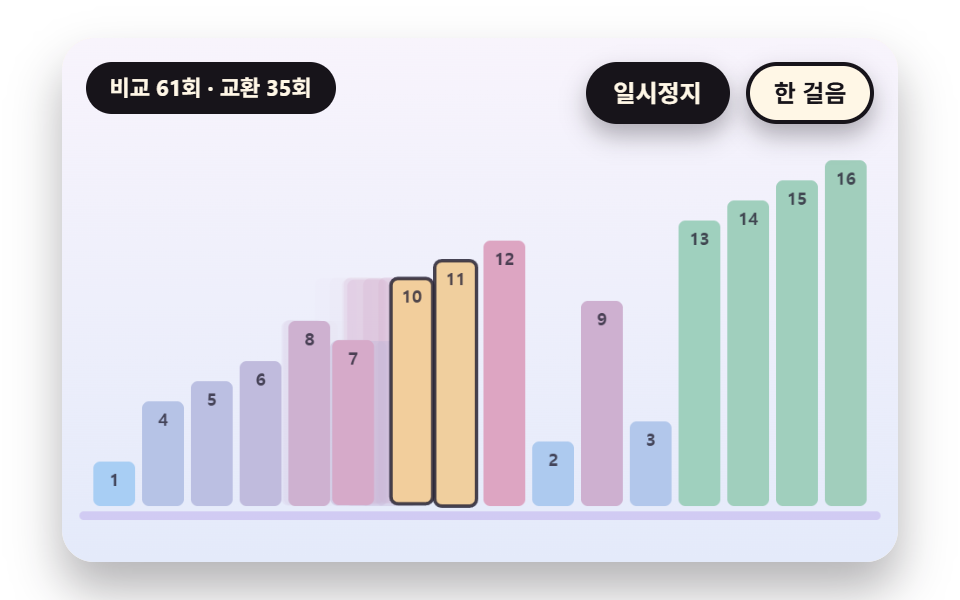 gameSorting Algorithm Visualizer: 9 Sort Scenes
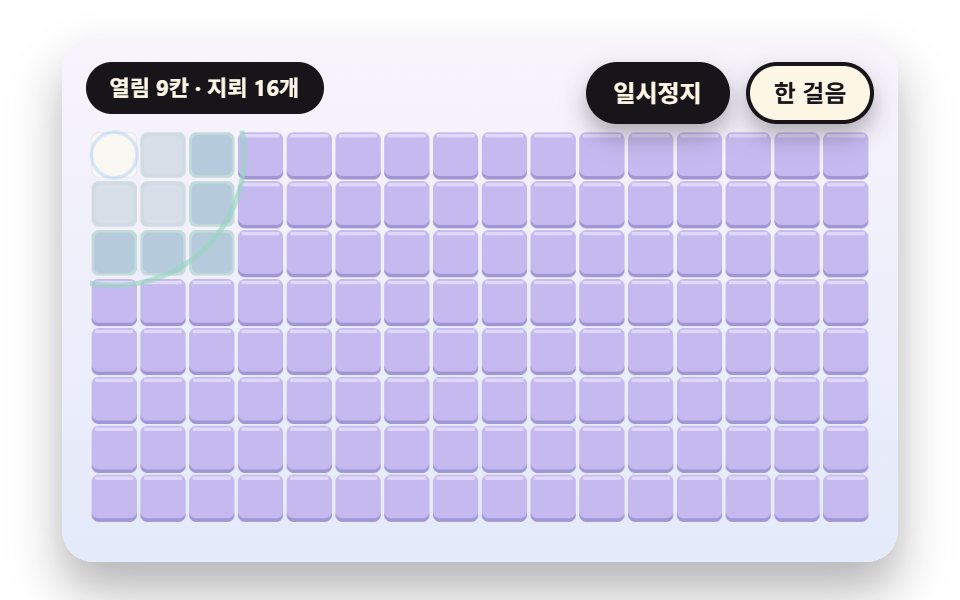 gameMinesweeper JavaScript: 9 Minefield Scenes
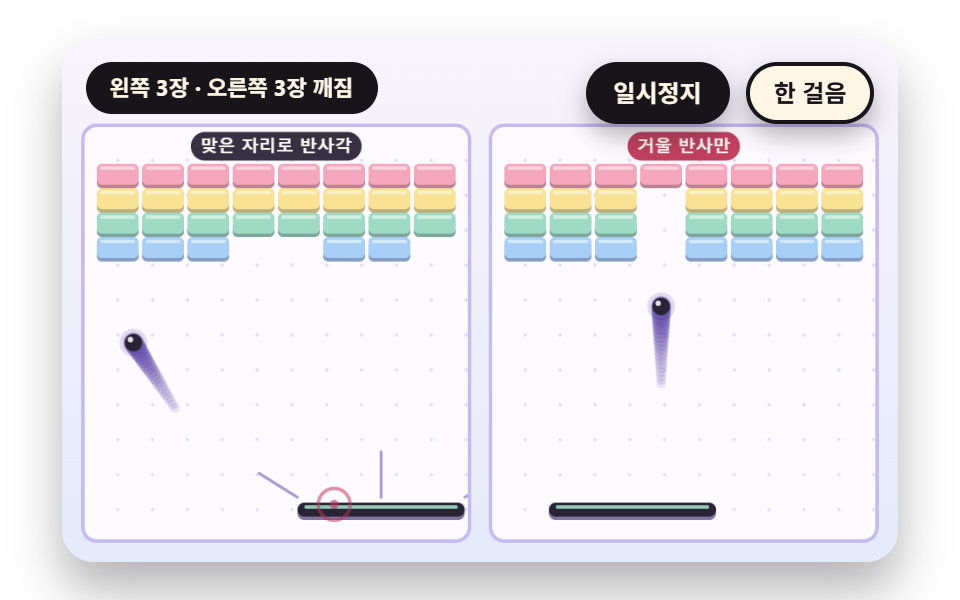 gameBrick Breaker Game: 9 Canvas Scenes
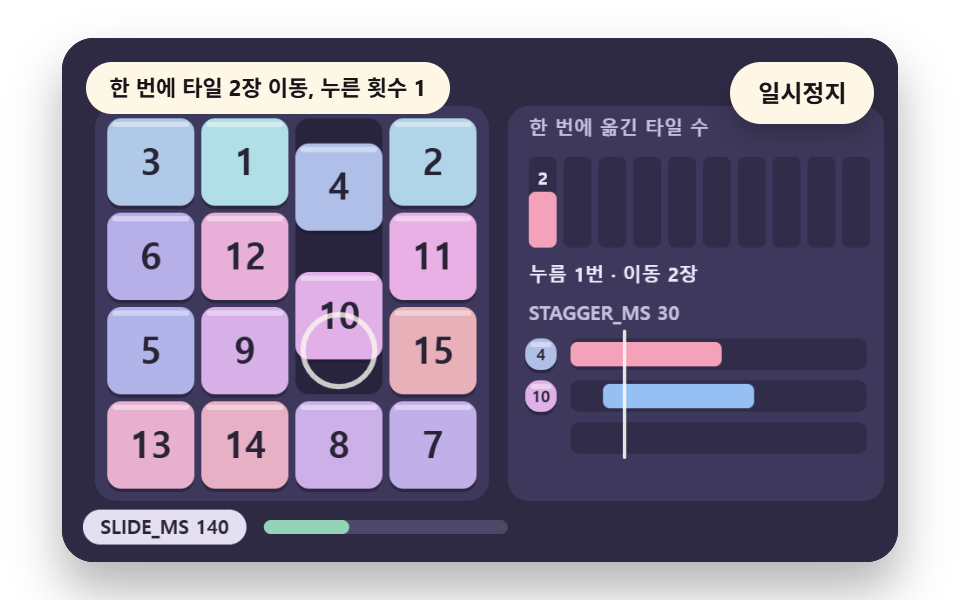 gameSliding Puzzle: 9 Canvas Scenes, Parity to Search
 gameWalking Animation Cycle: 9 Calculated Scenes
 gameTetris JavaScript: Build It in 9 Canvas Steps
 gameSpin Wheel: 9 Canvas Roulettes, Flick to Stop