Sliding Puzzle: 9 Canvas Scenes, Parity to Search
Why are some sliding puzzle boards unsolvable? 02 counts flipped pairs to sort them, 05 raises a Manhattan distance bound to find a shortest solve, and 07
A Sliding Puzzle Is Not a Game of Shuffling Numbered Tiles Until They Fit but a Calculation Where Boards Split Into Solvable and Unsolvable Under the Rule That a Tile Beside the Blank Swaps With It: Building a Sliding Puzzle Starts by Choosing How to Shuffle and Which Values to Judge By
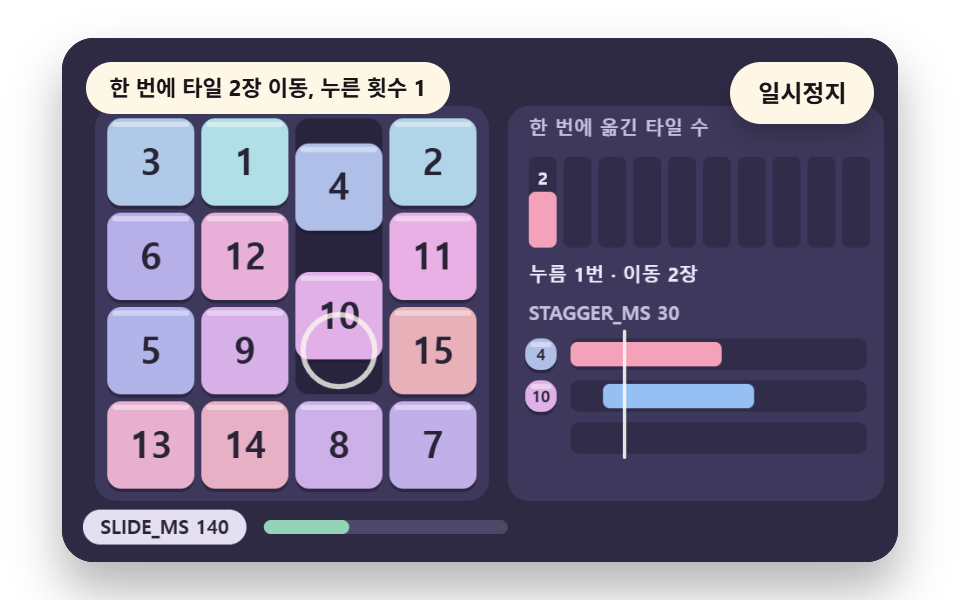 01 sp-row-chain-slide
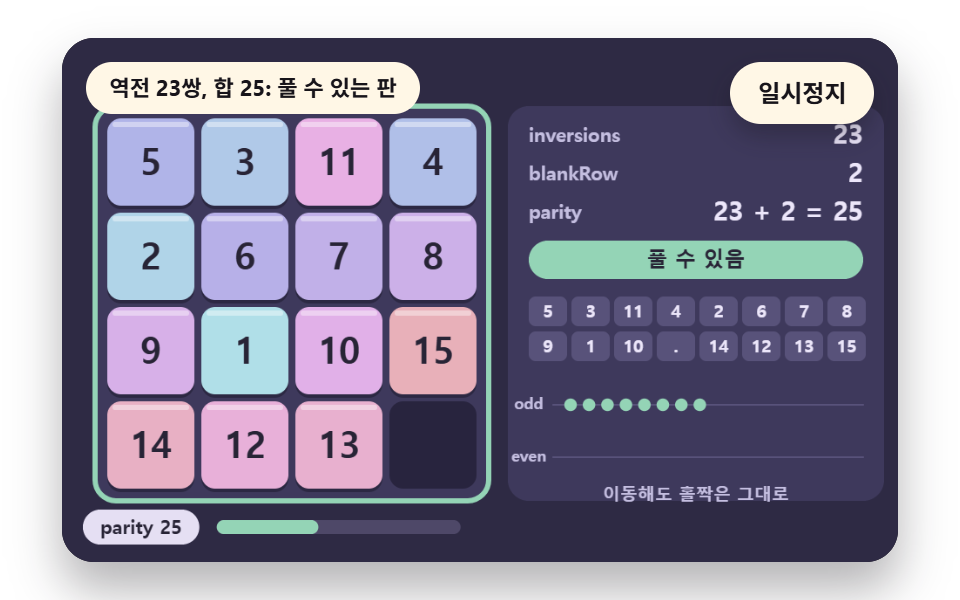 02 sp-parity-solvable-check
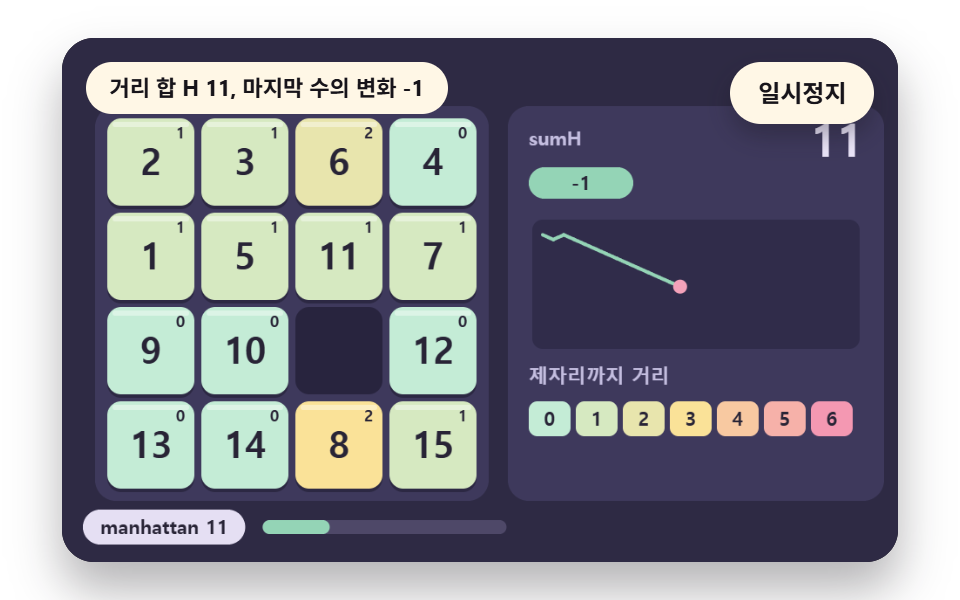 03 sp-manhattan-heat-map
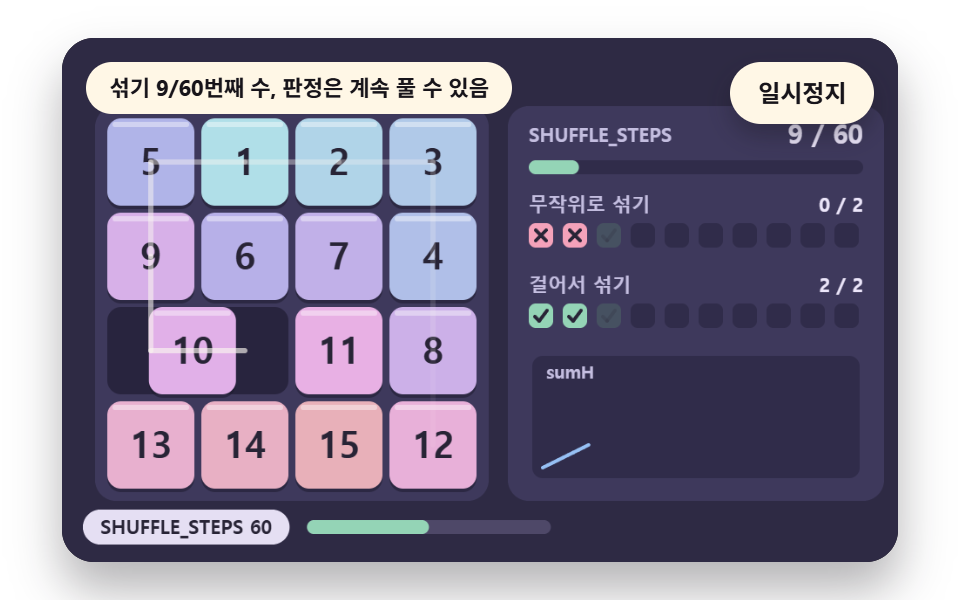 04 sp-legal-walk-shuffle
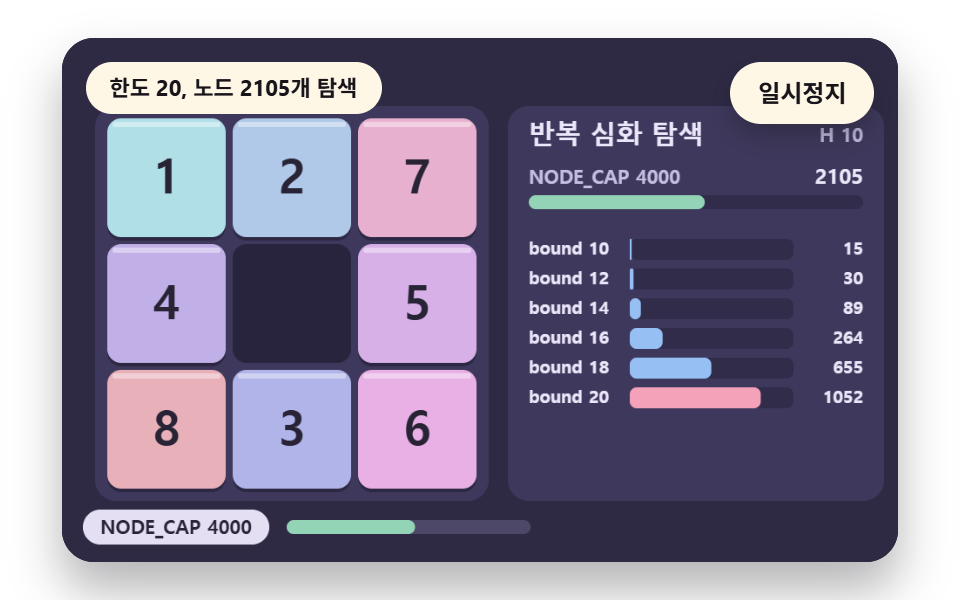 05 sp-ida-star-solve
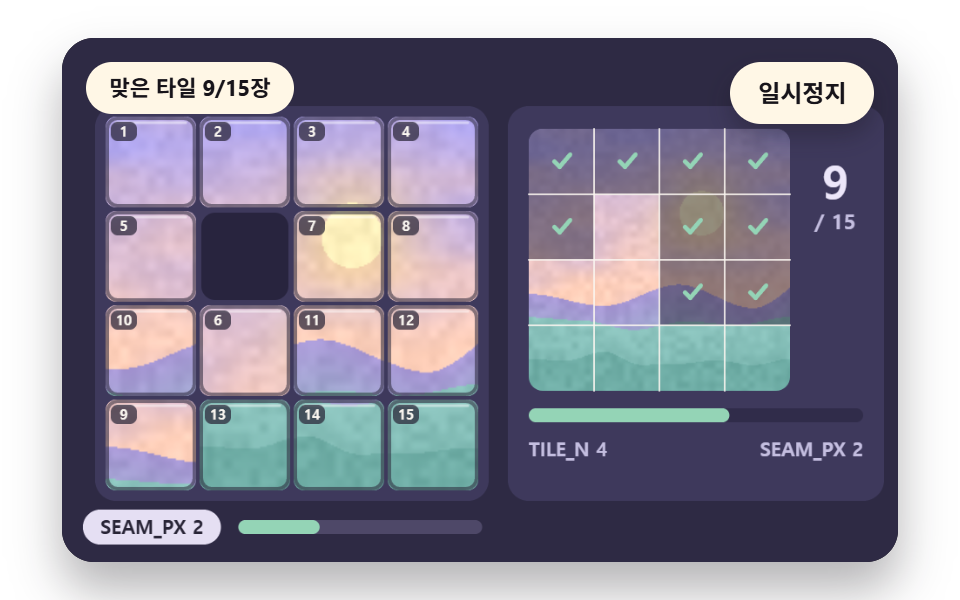 06 sp-image-tile-cut
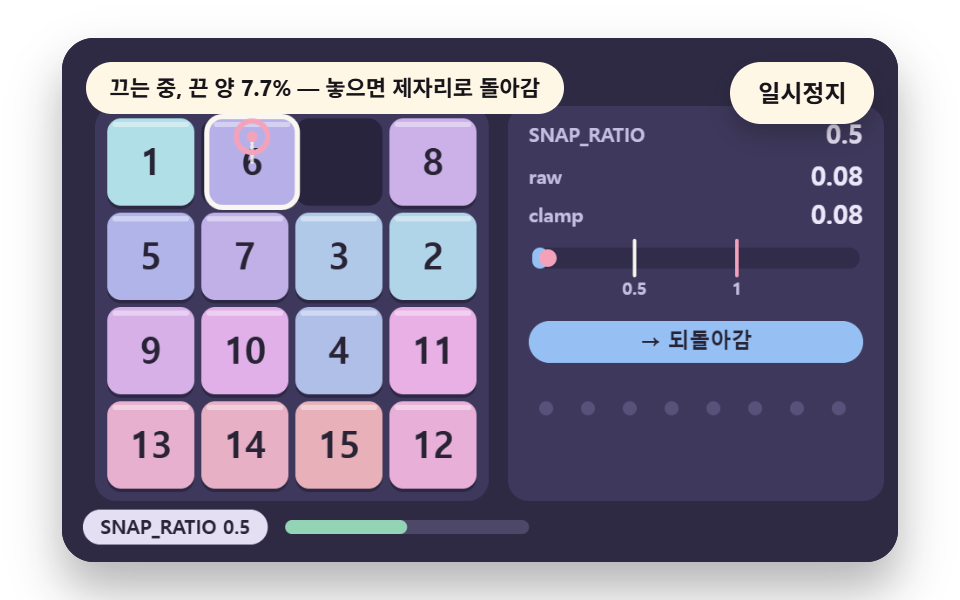 07 sp-drag-clamp-snap
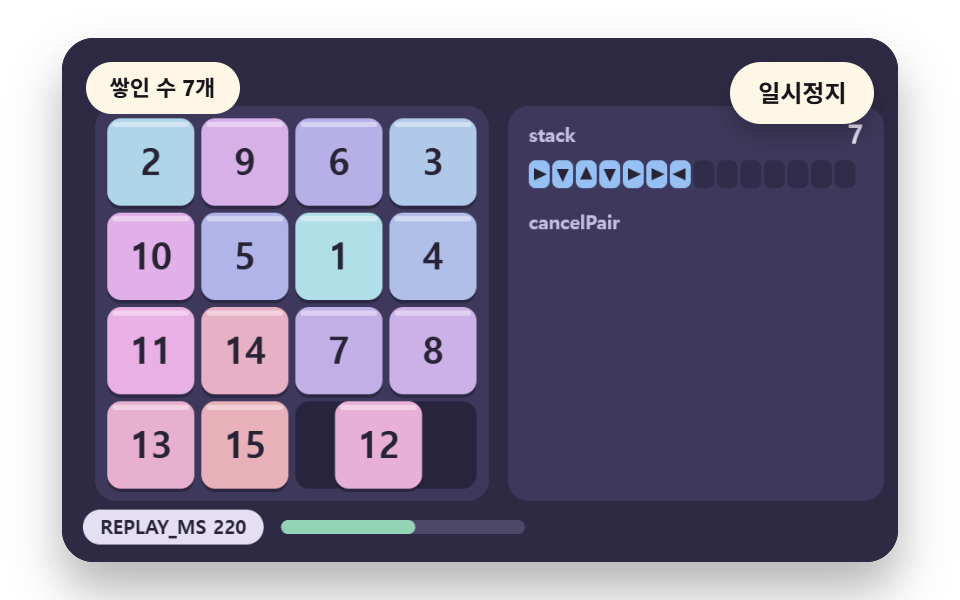 08 sp-undo-replay-cancel
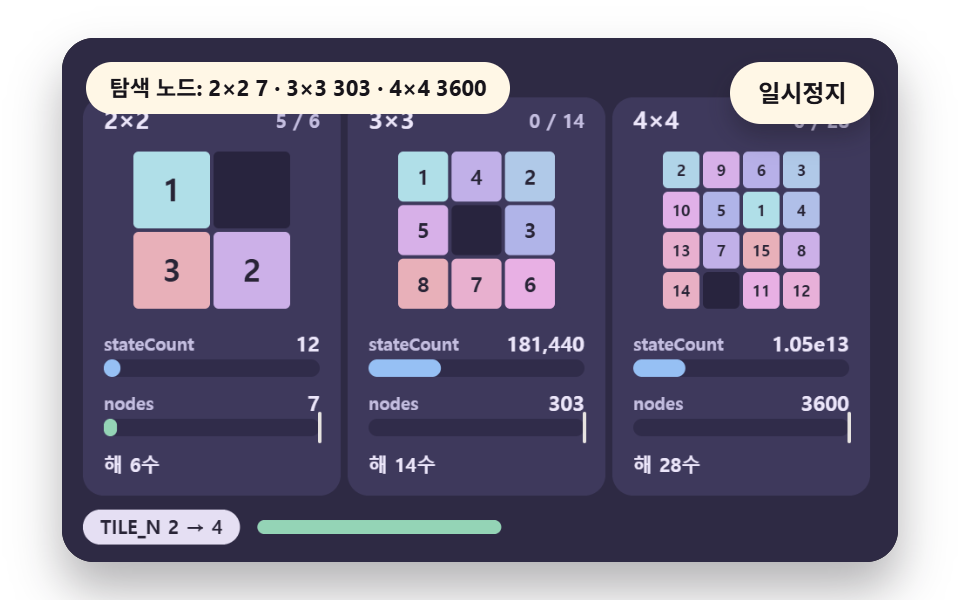 09 sp-size-state-count-ramp
Auto-plays · click a tile to jump to its section · all nine in one zip
- 01 A Row of Tiles Sliding Toward the Blank in a Chain
- 02 Telling Solvable Boards by Counting Flipped Pairs
- 03 A Manhattan Distance Heat Map for Each Tile
- 04 Shuffling by Walking Away From the Finished Board
- 05 An Iterative-Deepening Search That Raises Its Bound to Find a Shortest Solve
- 06 One Picture Cut Into Tiles With Visible Seams
- 07 A Pointer Drag That Snaps Into a Cell on Release
- 08 Undo History and a Solve Replay
- 09 States and Search Nodes Compared by Board Size
The nine scenes share one board array, and each scene differs only in the function that reads it. Once the board is a number array the puzzle is a single state, and pressing or dragging only paints that state. If you want a sliding puzzle maker you can read in one sitting, this is its shape: a state, a few plain functions over it and a canvas that draws the result.
The board state comes from the real puzzle logic only
The bd array changes only through real move functions such as rowChain, walkMoves and idaStar. The screen then paints the changed array at cell coordinates, and no scene draws a faked board beside the logic.
A fixed 1/60 second step and an integer hash
The frame gap is cut at DT_MAX (0.05 s), stacked up and spent in fixed STEP_S (1/60 s) steps. No random number is used: an integer hash hash2(a, b) picks the shuffles and the demo presses, so one seed gives one board and one demo. When the tab hides the loop stops, and on return the stacked time is dropped.
        const order = [];
        for (let k = 0; k < list.length; k += 1) {
            order[list[k]] = k;
        }
        retarget(function (v) {
            const o = order[v];
            return (o ? o : 0) * STAGGER_MS / 1000;
        }, SLIDE_MS / 1000);
        recordPress(list, i);
    }
Sliding Puzzle in JavaScript: 9 Scenes — a Whole Row Slide, a Solvability Check, a Manhattan Distance Heat Map, a Shuffle by Walking, a Shortest-Solve Search, a Picture Tile Cut, a Drag and Snap, an Undo With Solve Replay and a Count of States by Board Size
Area, frames and intensity from the latest render
Each scene was rendered and measured for cumulative area, moving frames out of 23 and mean intensity.
| Scene | Area | Moving frames | Intensity |
|---|---|---|---|
| 01 Row slide | 27.1% | 23/23 | 97.9 |
| 02 Solvability check | 23.4% | 22/23 | 120.5 |
| 03 Manhattan heat map | 18.9% | 23/23 | 154.4 |
| 04 Shuffle by walking | 27.6% | 23/23 | 119.9 |
| 05 Solve search | 26.8% | 22/23 | 126.0 |
| 06 Picture tiles | 32.7% | 21/23 | 106.1 |
| 07 Drag and snap | 12.7% | 19/23 | 110.3 |
| 08 Undo and replay | 14.8% | 21/23 | 153.0 |
| 09 State counts | 12.9% | 21/23 | 143.8 |
Scene 06 covers the most area at 32.7% and 07 the least at 12.7%. Scene 07 also has the fewest moving frames at 19/23, while 01, 03 and 04 reach 23/23 and 03 has the highest mean intensity at 154.4.
01A Row of Tiles Sliding Toward the Blank in a Chain
Press a tile in the same row or column as the blank and each tile between them moves one cell toward the blank, which suits an input where one press moves several tiles. A tile slides for SLIDE_MS (140) ms but starts STAGGER_MS (30) ms after the one before it, and the array swap finishes first, so the board state is settled the instant you press.
<main class="stage">
<div class="vj is-demo" id="vj">
  <div class="vj__pad" data-role="pad" tabindex="0" role="application" aria-label="Sliding puzzle stage: arrow keys move a tile beside the blank, pressing a tile works too, Enter or Space pauses, N takes one step, R restarts">
    <canvas class="vj__canvas" data-role="canvas" width="480" height="300" role="img" aria-label="A 4×4 sliding puzzle board sits on a dark plum background. Pressing a tile in the same row or column as the blank moves every tile between them one cell toward the blank over 140 milliseconds, each starting 30 milliseconds after the last. The right panel shows ten bars of tiles moved per press, the press count and tiles moved total, and for the last press when each tile starts and how long it moves. The gauge below shows the constant name and its current value, and under reduced motion only one board where the tiles swap places at once is drawn"></canvas>
  </div>
  <p class="vj__status" data-role="status" aria-live="off">Sliding puzzle scene</p>
  <div class="vj__ctrl">
    <button class="vj__pause" data-role="pause" type="button" aria-pressed="false">Pause</button>
  </div>
  <p class="vj__done" data-role="done" role="status" aria-live="polite"></p>
</div>
</main>
@use "../../../../site/static/demo-tokens" as *;
@include stage($stage-paper);
.vj {
position: relative;
width: min(92vw, calc(160vh - 12.8vw));
aspect-ratio: 480 / 300;
margin: 0 auto;
border-radius: $r-card;
overflow: hidden;
box-shadow: $shadow-raised;
background: $subject-ink;
}
// 무대 상자 — 눌러서 한 번 깨뜨리는 곳(touch-action: none 은 이 상자에만). 무대 밖 터치는 페이지 스크롤 그대로
.vj__pad {
position: absolute;
inset: 0;
border-radius: inherit;
outline: none;
touch-action: none;
cursor: pointer;
}
// 바깥 .vj 가 넘침을 자르므로 포커스 테두리는 안쪽으로 들인다
.vj__pad:focus-visible {
outline: 3px solid $subject-cream;
outline-offset: -3px;
}
.vj__canvas {
position: absolute;
inset: 0;
display: block;
width: 100%;
height: 100%;
}
.vj__ctrl {
position: absolute;
right: $sp-3;
top: $sp-3;
display: flex;
gap: $sp-2;
}
.vj__pause {
padding: $sp-1 $sp-3;
border: 2px solid $subject-cream;
border-radius: $r-pill;
background: $subject-cream;
color: $subject-ink;
font-family: inherit;
font-weight: 700;
font-size: 12px;
line-height: 1.6;
cursor: pointer;
box-shadow: $shadow-press;
transition: transform $dur-quick $ease-spring;
}
// 스크린리더에만 읽히는 낭독 문장 — 모드가 바뀔 때만 쓴다
.vj__done {
position: absolute;
width: 1px;
height: 1px;
margin: 0;
overflow: hidden;
clip-path: inset(50%);
white-space: nowrap;
}
// 눌린 상태(멈춤) — 바탕과 글자색을 뒤집어 aria-pressed 가 눈에도 보이게
.vj__pause[aria-pressed="true"] {
background: $subject-ink;
color: $subject-cream;
}
.vj__pause:hover {
transform: translateY(-2px);
}
.vj__pause:active {
transform: translateY(1px);
}
.vj__pause:focus-visible {
outline: 3px solid $subject-cream;
outline-offset: 3px;
}
// 상태 줄 — 지금 장면의 수치를 글자로. 화면에만 있고 aria-live 는 늘 off
.vj__status {
position: absolute;
left: $sp-3;
top: $sp-3;
max-width: calc(100% - 100px);
margin: 0;
padding: $sp-1 $sp-3;
border-radius: $r-pill;
background: $subject-cream;
color: $subject-ink;
font-weight: 700;
font-size: 11px;
line-height: 1.6;
white-space: nowrap;
overflow: hidden;
text-overflow: ellipsis;
pointer-events: none;
}
@media (max-width: 340px) {
.vj__pause,
.vj__status { font-size: 10px; padding: 0 $sp-2; }
}
// 움직임 줄이기 — 장면은 스크립트가 글리치 없는 원문 한 장으로 멈춘다. 버튼도 떠오르지 않게
@media (prefers-reduced-motion: reduce) {
.vj__pause { transition: none !important; }
.vj__pause:hover,
.vj__pause:active { transform: none !important; }
}html, body {
margin: 0;
overflow: hidden;
}
.stage {
box-sizing: border-box;
min-height: 100vh;
display: grid;
place-items: center;
margin: 0;
background: #ffffff;
font-family: -apple-system, "Segoe UI", "Noto Sans KR", sans-serif;
padding: clamp(8px, 4vw, 24px);
}
.vj {
position: relative;
width: min(92vw, 160vh - 12.8vw);
aspect-ratio: 480/300;
margin: 0 auto;
border-radius: 16px;
overflow: hidden;
box-shadow: 0 14px 24px rgba(23, 20, 26, 0.32);
background: #17141a;
}
.vj__pad {
position: absolute;
inset: 0;
border-radius: inherit;
outline: none;
touch-action: none;
cursor: pointer;
}
.vj__pad:focus-visible {
outline: 3px solid #fff7e6;
outline-offset: -3px;
}
.vj__canvas {
position: absolute;
inset: 0;
display: block;
width: 100%;
height: 100%;
}
.vj__ctrl {
position: absolute;
right: 12px;
top: 12px;
display: flex;
gap: 8px;
}
.vj__pause {
padding: 4px 12px;
border: 2px solid #fff7e6;
border-radius: 999px;
background: #fff7e6;
color: #17141a;
font-family: inherit;
font-weight: 700;
font-size: 12px;
line-height: 1.6;
cursor: pointer;
box-shadow: 0 6px 12px rgba(23, 20, 26, 0.32);
transition: transform 220ms cubic-bezier(0.2, 0.8, 0.2, 1);
}
.vj__done {
position: absolute;
width: 1px;
height: 1px;
margin: 0;
overflow: hidden;
clip-path: inset(50%);
white-space: nowrap;
}
.vj__pause[aria-pressed=true] {
background: #17141a;
color: #fff7e6;
}
.vj__pause:hover {
transform: translateY(-2px);
}
.vj__pause:active {
transform: translateY(1px);
}
.vj__pause:focus-visible {
outline: 3px solid #fff7e6;
outline-offset: 3px;
}
.vj__status {
position: absolute;
left: 12px;
top: 12px;
max-width: calc(100% - 100px);
margin: 0;
padding: 4px 12px;
border-radius: 999px;
background: #fff7e6;
color: #17141a;
font-weight: 700;
font-size: 11px;
line-height: 1.6;
white-space: nowrap;
overflow: hidden;
text-overflow: ellipsis;
pointer-events: none;
}
@media (max-width: 340px) {
.vj__pause,
.vj__status {
font-size: 10px;
padding: 0 8px;
}
}
@media (prefers-reduced-motion: reduce) {
.vj__pause {
transition: none !important;
}
.vj__pause:hover,
.vj__pause:active {
transform: none !important;
}
}(function () {
const root = document.getElementById("vj");
if (!root) return;
// 무대 좌표 — 캔버스 안 계산은 늘 480×300. 화면에 보이는 크기와 상관없다
const W = 480;
const H = 300;
const TAU = Math.PI * 2;
function clamp(v, lo, hi) { return v < lo ? lo : (v > hi ? hi : v); }
function lerp(a, b, k) { return a + (b - a) * k; }
function easeOut(k) { const u = 1 - clamp(k, 0, 1); return 1 - u * u * u; }
// 파스텔 팔레트 — 바탕은 짙은 자두색, 타일은 연한 색 위에 짙은 잉크 숫자
const INK = [40, 36, 54];
const PAPER = [250, 246, 240];
const ROSE = [244, 162, 186];
const MINT = [148, 212, 182];
const SKY = [150, 192, 244];
const SUN = [250, 218, 146];
const NEU = [236, 230, 250];
const BGC = [46, 42, 68];
const PANEL = [62, 57, 92];
const DIM = [196, 190, 224];
function rgba(c, a) {
return 'rgba(' + Math.round(clamp(c[0], 0, 255)) + ',' + Math.round(clamp(c[1], 0, 255)) + ',' + Math.round(clamp(c[2], 0, 255)) + ',' + clamp(a, 0, 1).toFixed(3) + ')';
}
function hsl(h, s, l) {
const a = s * Math.min(l, 1 - l);
const f = function (n) {
const k = (n + h / 30) % 12;
return l - a * Math.max(-1, Math.min(k - 3, Math.min(9 - k, 1)));
};
return [Math.round(f(0) * 255), Math.round(f(8) * 255), Math.round(f(4) * 255)];
}
// 정수 해시 — 같은 (a, b) 에는 늘 같은 0 이상 1 미만 값. 난수 함수는 쓰지 않는다
function hash2(a, b) {
let h = (Math.imul(a | 0, 374761393) + Math.imul(b | 0, 668265263)) | 0;
h = Math.imul(h ^ (h >>> 13), 1274126177);
h = h ^ (h >>> 16);
return (h >>> 0) / 4294967296;
}
// 2차원 값 잡음 — 정수 격자점마다 해시 값이 있고 그 사이를 부드럽게 잇는다
function noise2(x, y, seed) {
const xi = Math.floor(x);
const yi = Math.floor(y);
const fx = x - xi;
const fy = y - yi;
const ux = fx * fx * (3 - 2 * fx);
const uy = fy * fy * (3 - 2 * fy);
const s = seed * 131;
return lerp(lerp(hash2(xi + s, yi), hash2(xi + 1 + s, yi), ux), lerp(hash2(xi + s, yi + 1), hash2(xi + 1 + s, yi + 1), ux), uy);
}
// 장면 시계(초)·판 반복 번호·시간표 — 시간표는 (시각, 할 일) 목록이고 시각이 지나면 한 번씩 부른다
let sceneT = 0;
let lap = 0;
let script = [];
let evAt = 0;
// 문구 틀의 {a}·{b}·{c} 자리에 값을 끼운다 — 화면 문구는 늘 틀 한 줄이고 로케일 사전이 통째로 바꾼다
function fill(s, a, b, c) {
return s.split('{a}').join(a).split('{b}').join(b === undefined ? '' : b).split('{c}').join(c === undefined ? '' : c);
}
function r1(v) { return String(Math.round(v * 10) / 10); }
function group(v) {
// 천 단위 점 — 로케일 함수에 기대지 않는다
const s = String(Math.round(v));
let o = '';
for (let i = 0; i < s.length; i += 1) {
if (i > 0 && (s.length - i) % 3 === 0) {
o += ',';
}
o += s.charAt(i);
}
return o;
}
// ── 퍼즐 모델 — 판은 번호 배열, 0 은 빈칸, 타일 v 의 제자리는 v-1 번 칸, 빈칸의 제자리는 맨 끝
// 빈칸이 움직이는 방향 d: 0 오른쪽 · 1 왼쪽 · 2 아래 · 3 위. 반대 방향은 d ^ 1
const DX = [1, -1, 0, 0];
const DY = [0, 0, 1, -1];
function solvedBoard(n) {
const b = [];
for (let i = 1; i < n * n; i += 1) {
b.push(i);
}
b.push(0);
return b;
}
function canStep(b, n, d) {
const z = b.indexOf(0);
const c = (z % n) + DX[d];
const r = Math.floor(z / n) + DY[d];
return c >= 0 && c < n && r >= 0 && r < n;
}
function blankStep(b, n, d) {
if (!canStep(b, n, d)) {
return false;
}
const z = b.indexOf(0);
const t = z + DX[d] + DY[d] * n;
b[z] = b[t];
b[t] = 0;
return true;
}
// 역전 — 번호를 한 줄로 늘어놓고 앞 번호가 뒤 번호보다 큰 쌍의 수(빈칸은 세지 않는다)
function inversions(b) {
let c = 0;
for (let i = 0; i < b.length; i += 1) {
for (let j = i + 1; j < b.length; j += 1) {
if (b[i] !== 0 && b[j] !== 0 && b[i] > b[j]) {
c += 1;
}
}
}
return c;
}
// 빈칸이 아래서 몇 번째 줄인지(맨 아래 줄 = 1)
function blankRow(b, n) { return n - Math.floor(b.indexOf(0) / n); }
// 판정 합 — 짝수 폭은 역전 + 빈칸 줄, 홀수 폭은 역전만
function parity(b, n) { return n % 2 === 0 ? inversions(b) + blankRow(b, n) : inversions(b); }
function solvable(b, n) {
return n % 2 === 0 ? parity(b, n) % 2 === 1 : parity(b, n) % 2 === 0;
}
function manhattan(b, n, i) {
const v = b[i];
if (v === 0) {
return 0;
}
const h = v - 1;
return Math.abs((i % n) - (h % n)) + Math.abs(Math.floor(i / n) - Math.floor(h / n));
}
function sumH(b, n) {
let s = 0;
for (let i = 0; i < b.length; i += 1) {
s += manhattan(b, n, i);
}
return s;
}
function placedCount(b) {
let c = 0;
for (let i = 0; i < b.length - 1; i += 1) {
if (b[i] === i + 1) {
c += 1;
}
}
return c;
}
function isSolved(b) { return placedCount(b) === b.length - 1 && b[b.length - 1] === 0; }
// Shuffle by walking — Done 판에서 시작해 빈칸을 steps 번 이웃 칸으로 옮긴다. 방금 온 칸으로 되돌아가는 수는 건너뛰고
// 어느 이웃으로 갈지는 정수 해시로 고른다. 반환은 빈칸이 움직인 방향의 목록
function walkMoves(n, steps, seed) {
const b = solvedBoard(n);
const out = [];
let noBacktrack = -1;
for (let s = 0; s < steps; s += 1) {
const opts = [];
for (let d = 0; d < 4; d += 1) {
if (d !== noBacktrack && canStep(b, n, d)) {
opts.push(d);
}
}
const d = opts[Math.floor(hash2(s, seed) * opts.length)];
blankStep(b, n, d);
out.push(d);
noBacktrack = d ^ 1;
}
return out;
}
function applyMoves(b, n, ms) {
for (let i = 0; i < ms.length; i += 1) {
blankStep(b, n, ms[i]);
}
}
function reverseMoves(ms) {
const o = [];
for (let i = ms.length - 1; i >= 0; i -= 1) {
o.push(ms[i] ^ 1);
}
return o;
}
// 줄째 밀기 — 누른 칸 i 가 빈칸과 같은 줄이면 사이 타일이 모두 한 칸씩 빈칸 쪽으로. 배열 교환으로 먼저 정하고
// 옮겨진 타일 번호를 빈칸에 가까운 순서로 돌려준다
    function rowChain(b, n, i) {
        const z = b.indexOf(0);
        if (i === z) {
            return [];
        }
        let step = 0;
        if (Math.floor(i / n) === Math.floor(z / n)) {
            step = i > z ? 1 : -1;
        }
        else if (i % n === z % n) {
            step = i > z ? n : -n;
        }
        else {
            return [];
        }
        const moved = [];
        for (let p = z; p !== i; p += step) {
            b[p] = b[p + step];
            moved.push(b[p]);
        }
        b[i] = 0;
        return moved;
    }
function idaStar(start, n, cap) {
const b = start.slice();
const path = [];
let nodes = 0;
let capHit = false;
const INF = 9999;
let z = b.indexOf(0);
function dfs(g, h, bound, last) {
nodes += 1;
if (nodes > cap) {
capHit = true;
return INF;
}
const f = g + h;
if (f > bound) {
return f;
}
if (h === 0) {
return -1;
}
let min = INF;
for (let d = 0; d < 4; d += 1) {
if (last >= 0 && d === (last ^ 1)) {
continue;
}
const c = (z % n) + DX[d];
const r = Math.floor(z / n) + DY[d];
if (c < 0 || c >= n || r < 0 || r >= n) {
continue;
}
const t = z + DX[d] + DY[d] * n;
const v = b[t];
const hv = Math.abs((t % n) - ((v - 1) % n)) + Math.abs(Math.floor(t / n) - Math.floor((v - 1) / n));
const hn = Math.abs((z % n) - ((v - 1) % n)) + Math.abs(Math.floor(z / n) - Math.floor((v - 1) / n));
b[z] = v;
b[t] = 0;
const oz = z;
z = t;
path.push(d);
const res = dfs(g + 1, h - hv + hn, bound, d);
if (res === -1) {
return -1;
}
path.pop();
z = oz;
b[t] = v;
b[z] = 0;
if (capHit) {
return INF;
}
if (res < min) {
min = res;
}
}
return min;
}
let bound = sumH(b, n);
const bounds = [];
const perBound = [];
while (bound < INF) {
const before = nodes;
bounds.push(bound);
const res = dfs(0, sumH(b, n), bound, -1);
perBound.push(nodes - before);
if (res === -1) {
return { path: path.slice(), nodes: nodes, bounds: bounds, perBound: perBound, capHit: false };
}
if (capHit || res >= INF) {
break;
}
bound = res;
}
return { path: [], nodes: nodes, bounds: bounds, perBound: perBound, capHit: capHit };
}
// ── 판 화면 — 타일마다 지금 칸 → 목표 칸 보간. 배열은 먼저 바뀌고 화면이 뒤따른다
const BX = 24;
const BY = 44;
const BSZ = 216;
let bd = [];
let BN = 4;
let CS = 54;
let tl = [];
let dragV = -1;
let dragCx = 0;
let dragCy = 0;
function setBoard(b, n) {
bd = b.slice();
BN = n;
CS = BSZ / n;
tl = [];
dragV = -1;
for (let v = 0; v < n * n; v += 1) {
const i = bd.indexOf(v);
const c = i % n;
const r = Math.floor(i / n);
tl.push({ fx: c, fy: r, tx: c, ty: r, t0: 0, du: 0 });
}
}
let still = false;
function tilePos(v) {
const t = tl[v];
if (v === dragV) {
return [dragCx, dragCy];
}
if (still || t.du <= 0) {
return [t.tx, t.ty];
}
const e = easeOut((sceneT - t.t0) / t.du);
return [lerp(t.fx, t.tx, e), lerp(t.fy, t.ty, e)];
}
// 배열이 바뀐 뒤 타일마다 목표 칸을 다시 읽는다 — 옮겨진 타일만 지금 화면 자리에서 출발한다
function retarget(delayOf, du) {
for (let v = 1; v < BN * BN; v += 1) {
const i = bd.indexOf(v);
const c = i % BN;
const r = Math.floor(i / BN);
const t = tl[v];
if (c !== t.tx || r !== t.ty) {
const p = tilePos(v);
t.fx = p[0];
t.fy = p[1];
t.tx = c;
t.ty = r;
t.t0 = sceneT + delayOf(v);
t.du = du;
}
}
}
function stepBlank(d, du) {
if (!blankStep(bd, BN, d)) {
return false;
}
retarget(function () { return 0; }, du);
return true;
}
function cellAt(x, y) {
const c = Math.floor((x - BX) / CS);
const r = Math.floor((y - BY) / CS);
if (c < 0 || c >= BN || r < 0 || r >= BN) {
return -1;
}
return r * BN + c;
}
// ── 그리기 도구
const canvasEl = root.querySelector('[data-role="canvas"]');
const padEl = root.querySelector('[data-role="pad"]');
const pauseEl = root.querySelector('[data-role="pause"]');
const statusEl = root.querySelector('[data-role="status"]');
const doneEl = root.querySelector('[data-role="done"]');
const ctxRaw = canvasEl ? canvasEl.getContext('2d') : null;
if (!canvasEl || !ctxRaw || !pauseEl || !padEl || !doneEl) {
return;
}
const cv = canvasEl;
const ctx = ctxRaw;
const pauseBtn = pauseEl;
const doneP = doneEl;
const pad = padEl;
// 외부 웹폰트는 부르지 않는다 — 기기에 있는 글꼴 목록만
const UI_FONT = 'system-ui, -apple-system, "Segoe UI", "Noto Sans KR", sans-serif';
let dpr = 1;
function fitCanvas() {
// 배율은 2 에서 자른다 — 계산은 늘 480×300 이고 화면 배율만 이 값
dpr = Math.min(window.devicePixelRatio || 1, 2);
cv.width = Math.round(W * dpr);
cv.height = Math.round(H * dpr);
ctx.setTransform(dpr, 0, 0, dpr, 0, 0);
}
function box(x, y, w, h, r, c, a) {
if (w <= 0.2 || h <= 0.2 || a <= 0) {
return;
}
ctx.beginPath();
ctx.roundRect(x, y, w, h, Math.max(0, Math.min(r, w / 2, h / 2)));
ctx.fillStyle = rgba(c, a);
ctx.fill();
}
function disc(x, y, r, c, a) {
ctx.beginPath();
ctx.arc(x, y, r, 0, TAU);
ctx.fillStyle = rgba(c, a);
ctx.fill();
}
function seg(x1, y1, x2, y2, c, a, w) {
ctx.beginPath();
ctx.moveTo(x1, y1);
ctx.lineTo(x2, y2);
ctx.strokeStyle = rgba(c, a);
ctx.lineWidth = w;
ctx.lineCap = 'round';
ctx.stroke();
}
function text(s, x, y, c, px, weight, align) {
ctx.font = weight + ' ' + px + 'px ' + UI_FONT;
ctx.textAlign = align;
ctx.textBaseline = 'middle';
ctx.fillStyle = rgba(c, 1);
ctx.fillText(s, x, y);
}
function panel(x, y, w, h) { box(x, y, w, h, 12, PANEL, 1); }
// 아래쪽 눈금 — 상수 이름과 지금 값 · 크기 막대
function hud(name, val, frac) {
const label = name + ' ' + val;
ctx.font = '700 11px ' + UI_FONT;
const w = ctx.measureText(label).width + 20;
const x = 12;
const y = H - 30;
box(x, y, w, 20, 10, NEU, 0.96);
text(label, x + w / 2, y + 10.5, INK, 11, 700, 'center');
const mx = x + w + 10;
box(mx, y + 6, 140, 8, 4, [78, 72, 104], 1);
box(mx, y + 6, 140 * clamp(frac, 0, 1), 8, 4, MINT, 1);
}
// 판 바탕 — 받침과 빈 칸 홈
function drawBoardBase() {
const s = CS * BN;
box(BX - 5, BY - 5, s + 10, s + 10, 12, PANEL, 1);
for (let i = 0; i < BN * BN; i += 1) {
box(BX + (i % BN) * CS + 2, BY + Math.floor(i / BN) * CS + 2, CS - 4, CS - 4, 8, [40, 36, 62], 1);
}
}
function tileHue(v, n) {
return hsl(190 + 160 * ((v - 1) / (n * n - 2)), 0.55, 0.8);
}
function paintTile(label, cx, cy, c, cs, ox, oy) {
const s = cs - 4;
const x = ox + cx * cs + 2;
const y = oy + cy * cs + 2;
box(x, y + 2, s, s, 8, [26, 23, 42], 0.5);
box(x, y, s, s, 8, c, 1);
box(x + 3, y + 2, s - 6, 3, 1.5, [255, 255, 255], 0.4);
text(label, x + s / 2, y + s / 2 + 1, INK, Math.max(9, Math.round(cs * 0.38)), 800, 'center');
}
function drawTiles(fillOf) {
for (let v = 1; v < BN * BN; v += 1) {
const p = tilePos(v);
paintTile(String(v), p[0], p[1], fillOf(v), CS, BX, BY);
}
}
// 글자판 없이 배열만 그리는 작은 판 — 비교 장면용
function drawMini(b, n, ox, oy, size) {
const cs = size / n;
box(ox - 3, oy - 3, size + 6, size + 6, 8, PANEL, 1);
for (let i = 0; i < n * n; i += 1) {
const v = b[i];
if (v === 0) {
box(ox + (i % n) * cs + 1, oy + Math.floor(i / n) * cs + 1, cs - 2, cs - 2, 3, [40, 36, 62], 1);
continue;
}
const x = ox + (i % n) * cs + 1;
const y = oy + Math.floor(i / n) * cs + 1;
box(x, y, cs - 2, cs - 2, 3, tileHue(v, n), 1);
if (cs >= 20) {
text(String(v), x + (cs - 2) / 2, y + (cs - 2) / 2 + 1, INK, Math.round(cs * 0.4), 800, 'center');
}
}
}
// ── 상태 줄·낭독 문장
const SPK_PLACE = '{a}x{a} board, {c} of {b} tiles are in place';
const SPK_DONE = '{a}x{a} board complete, all {b} tiles are in place';
function speakBoard() {
const t = BN * BN - 1;
return isSolved(bd) ? fill(SPK_DONE, String(BN), String(t)) : fill(SPK_PLACE, String(BN), String(t), String(placedCount(bd)));
}
let shownStatus = '';
function pushStatus(s) {
if (!statusEl || s === shownStatus) {
return;
}
shownStatus = s;
statusEl.textContent = s;
}
let paused = false;
const reduceQuery = window.matchMedia('(prefers-reduced-motion: reduce)');
// 페이지를 연 채 움직임 줄이기 설정을 바꿔도 change 리스너가 다시 읽는다
still = reduceQuery.matches;
// 자동 시연 표시 — 사람이 처음 손대면 떼고, 그 뒤부터 모드가 바뀔 때만 낭독 문장을 쓴다
let demo = root.classList.contains('is-demo');
const off = new AbortController();
// 사람이 직접 조작하는 중이면 시간표는 멈추고 계산만 흐른다
let manual = false;
function wake() {
if (!demo) {
return;
}
demo = false;
root.classList.remove('is-demo');
}
function takeOver() {
if (manual) {
return;
}
manual = true;
wake();
}
// 낭독 모드 — 완성이면 1000, 손으로 하는 중이면 맞은 타일 수, 자동 시연이면 장면이 정한 단계
function modeBase(sceneMode) {
if (isSolved(bd)) {
return 1000;
}
return manual ? 100 + placedCount(bd) : sceneMode;
}
// 낭독 문장 — 화면 상태 줄(aria-live off)과 따로, 모드가 바뀔 때와 사람이 조작했을 때만 role=status 에 쓴다
let lastMode = -9;
function say() {
doneP.textContent = speakText();
lastMode = still ? -2 : modeId();
}
function advance(dt) {
sceneT += dt;
if (!manual) {
while (evAt < script.length && script[evAt].t <= sceneT) {
const ev = script[evAt];
evAt += 1;
ev.f();
}
if (sceneT >= LAP_S) {
lap += 1;
begin();
return;
}
}
update(dt);
}
function begin() {
sceneT = 0;
evAt = 0;
script = [];
build();
}
// 고정 걸음 + 걸음 수 상한 — 프레임 간격이 흔들려도 같은 계산, 탭이 멈췄다 돌아와도 한 번에 몰리지 않는다
const STEP_S = 1 / 60;
const DT_MAX = 0.05;
let acc = 0;
function showNow() {
draw();
pushStatus(statusText());
if (!demo) {
const m = still ? -2 : modeId();
if (m !== lastMode) {
say();
}
}
}
let rafId = 0;
let lastTs = -1;
function frame(ts) {
if (still || paused) {
rafId = 0;
return;
}
if (lastTs < 0) {
lastTs = ts;
}
const dt = Math.min((ts - lastTs) / 1000, DT_MAX);
lastTs = ts;
acc += dt;
while (acc >= STEP_S) {
advance(STEP_S);
acc -= STEP_S;
}
showNow();
rafId = window.requestAnimationFrame(frame);
}
function startLoop() {
if (rafId) {
return;
}
// 멈췄던 사이의 시간을 첫 프레임 dt 로 넘기지 않는다
lastTs = -1;
acc = 0;
rafId = window.requestAnimationFrame(frame);
}
function stopLoop() {
if (rafId) {
window.cancelAnimationFrame(rafId);
rafId = 0;
}
}
// 움직임 줄이기 — 루프 없이 시간표의 REST_S 초까지를 한 번에 치른 판 한 장. 타일은 보간 없이 바로 제자리
function showRest() {
stopLoop();
lap = 0;
begin();
while (evAt < script.length && script[evAt].t <= REST_S) {
const ev = script[evAt];
evAt += 1;
sceneT = ev.t;
ev.f();
}
sceneT = REST_S;
update(0);
showNow();
}
function play() {
begin();
showNow();
if (!paused) {
startLoop();
}
}
// 사람이 조작한 뒤 — 멈춘 채이거나 움직임 줄이기이면 보간을 건너뛰어 바로 보이게 한다. 조작 직후는 낭독 문장도 쓴다
function afterInput(speak) {
if (paused || still) {
sceneT += 1;
}
update(0);
showNow();
if (speak) {
say();
}
}
function togglePause() {
paused = !paused;
pauseBtn.setAttribute('aria-pressed', paused ? 'true' : 'false');
wake();
if (paused) {
stopLoop();
}
else if (!still) {
startLoop();
}
say();
}
function restart() {
manual = false;
lap = 0;
begin();
update(0);
showNow();
say();
}
// N 한 걸음 — 시간표의 다음 일 하나를 지금 치른다. 시간표가 끝났으면 처음부터 다시 짠 뒤 첫 일
function stepOnce() {
takeOver();
if (evAt >= script.length) {
lap += 1;
begin();
}
if (evAt < script.length) {
const ev = script[evAt];
evAt += 1;
if (sceneT < ev.t) {
sceneT = ev.t;
}
ev.f();
}
afterInput(true);
}
function keyMove(dx, dy) {
// 방향키는 타일이 가는 방향 — 그 타일은 빈칸의 반대쪽에 있다. 빈칸이 가는 방향으로 바꿔 부른다
let d = 0;
for (let k = 0; k < 4; k += 1) {
if (DX[k] === -dx && DY[k] === -dy) {
d = k;
}
}
takeOver();
onDir(d);
afterInput(true);
}
function toCanvas(e) {
const r = cv.getBoundingClientRect();
return [(e.clientX - r.left) * W / r.width, (e.clientY - r.top) * H / r.height];
}
pauseBtn.addEventListener('click', togglePause, { signal: off.signal });
// 키보드 — 무대에 포커스가 있을 때만. 방향키 = 빈칸 이웃 타일 이동, Enter·Space = Pause, N = 한 걸음, R = 처음부터
pad.addEventListener('keydown', function (e) {
if (e.altKey || e.ctrlKey || e.metaKey) {
return;
}
const k = e.key;
if (k === 'Enter' || k === ' ' || k === 'p' || k === 'P') {
e.preventDefault();
togglePause();
}
else if (k === 'r' || k === 'R') {
restart();
}
else if (k === 'n' || k === 'N') {
e.preventDefault();
stepOnce();
}
else if (k === 'ArrowLeft') {
e.preventDefault();
keyMove(-1, 0);
}
else if (k === 'ArrowRight') {
e.preventDefault();
keyMove(1, 0);
}
else if (k === 'ArrowUp') {
e.preventDefault();
keyMove(0, -1);
}
else if (k === 'ArrowDown') {
e.preventDefault();
keyMove(0, 1);
}
else if (keyHook !== null && keyHook(k)) {
e.preventDefault();
takeOver();
afterInput(true);
}
}, { signal: off.signal });
// 포인터 — 마우스·터치·펜을 한 이벤트로. 누르는 순간부터 놓을 때까지 무대가 포인터를 붙잡는다
let ptrDown = false;
// 장면이 방향키·Enter·N·R 밖의 키를 받고 싶을 때 거는 갈고리 — 먹었으면 true
let keyHook = null;
pad.addEventListener('pointerdown', function (e) {
takeOver();
ptrDown = true;
try {
pad.setPointerCapture(e.pointerId);
}
catch (err) {
ptrDown = true;
}
const p = toCanvas(e);
onPtr(0, p[0], p[1]);
afterInput(false);
}, { signal: off.signal });
pad.addEventListener('pointermove', function (e) {
if (!ptrDown) {
return;
}
const p = toCanvas(e);
onPtr(1, p[0], p[1]);
afterInput(false);
}, { signal: off.signal });
function ptrEnd(e) {
if (!ptrDown) {
return;
}
ptrDown = false;
const p = toCanvas(e);
onPtr(2, p[0], p[1]);
afterInput(true);
}
pad.addEventListener('pointerup', ptrEnd, { signal: off.signal });
pad.addEventListener('pointercancel', ptrEnd, { signal: off.signal });
// 탭이 숨으면 멈추고, 돌아오면 시계를 다시 맞춰 시작
document.addEventListener('visibilitychange', function () {
if (document.hidden) {
stopLoop();
}
else if (!paused && !still) {
startLoop();
}
}, { signal: off.signal });
// 설정이 바뀌면 — 켜지면 판 한 장, 꺼지면 다시 움직인다
reduceQuery.addEventListener('change', function () {
still = reduceQuery.matches;
if (still) {
showRest();
}
else {
lap = 0;
play();
}
}, { signal: off.signal });
window.addEventListener('resize', function () {
fitCanvas();
showNow();
}, { signal: off.signal });
// 누른 칸이 빈칸의 이웃이면 그 타일이 들어갈 빈칸의 방향(빈칸 기준), 아니면 -1
function dirOfCell(i) {
const z = bd.indexOf(0);
for (let d = 0; d < 4; d += 1) {
if (canStep(bd, BN, d) && z + DX[d] + DY[d] * BN === i) {
return d;
}
}
return -1;
}
// 01 — 빈칸과 같은 줄·같은 열의 타일을 누르면 사이 타일이 모두 한 칸씩 빈칸 쪽으로 간다. 이동은 배열 교환(rowChain)으로 먼저 정하고, 화면은 SLIDE_MS 보간으로 뒤따르되 시작은 STAGGER_MS 씩 어긋난다
const TILE_N = 4;
const SLIDE_MS = 140;
const STAGGER_MS = 30;
const SHUFFLE_01 = 40;
const LAP_S = 6.4;
const REST_S = 1.6;
const PX = 256;
const PW = 216;
let presses = 0;
let moved = 0;
let hist = [];
let lastMoved = [];
let ringCell = -1;
let ringT = -9;
const SPK_CHAIN = 'In the line just pressed, {a} tiles slid one cell each toward the blank';
function recordPress(list, cell) {
lastMoved = list;
presses += 1;
moved += list.length;
hist.push(list.length);
if (hist.length > 10) {
hist.shift();
}
ringCell = cell;
ringT = sceneT;
}
function press(i) {
const list = rowChain(bd, BN, i);
if (list.length === 0) {
return;
}
const order = [];
for (let k = 0; k < list.length; k += 1) {
order[list[k]] = k;
}
retarget(function (v) {
const o = order[v];
return (o ? o : 0) * STAGGER_MS / 1000;
}, SLIDE_MS / 1000);
recordPress(list, i);
}
// 시연 — 빈칸과 같은 줄·열 타일 중 거리가 2 이상인 칸을 해시로 골라 누른다(없으면 이웃 칸)
function autoPress(k) {
const z = bd.indexOf(0);
const near = [];
const far = [];
for (let i = 0; i < BN * BN; i += 1) {
if (i === z) {
continue;
}
const sameRow = Math.floor(i / BN) === Math.floor(z / BN);
const sameCol = i % BN === z % BN;
if (!sameRow && !sameCol) {
continue;
}
const dist = Math.abs(Math.floor(i / BN) - Math.floor(z / BN)) + Math.abs((i % BN) - (z % BN));
if (dist >= 2) {
far.push(i);
}
else {
near.push(i);
}
}
const pool = far.length > 0 ? far : near;
press(pool[Math.floor(hash2(k, 7 + lap) * pool.length)]);
}
function pressAt(k) {
return function () { autoPress(k); };
}
function build() {
presses = 0;
moved = 0;
hist = [];
lastMoved = [];
ringCell = -1;
const b = solvedBoard(TILE_N);
applyMoves(b, TILE_N, walkMoves(TILE_N, SHUFFLE_01, 3 + lap));
setBoard(b, TILE_N);
for (let k = 0; k < 16; k += 1) {
script.push({ t: 0.25 + k * 0.36, f: pressAt(k) });
}
}
function update(dt) { if (dt < 0) {
return;
} }
function draw() {
ctx.fillStyle = rgba(BGC, 1);
ctx.fillRect(0, 0, W, H);
drawBoardBase();
drawTiles(function (v) { return tileHue(v, BN); });
const rk = (sceneT - ringT) / 0.4;
if (ringCell >= 0 && rk >= 0 && rk < 1) {
const cx = BX + ((ringCell % BN) + 0.5) * CS;
const cy = BY + (Math.floor(ringCell / BN) + 0.5) * CS;
ctx.beginPath();
ctx.arc(cx, cy, lerp(CS * 0.2, CS * 0.75, easeOut(rk)), 0, TAU);
ctx.strokeStyle = rgba(PAPER, 0.9 * (1 - rk));
ctx.lineWidth = 3;
ctx.stroke();
}
const s = CS * BN;
panel(PX, BY - 5, PW, s + 10);
text('Tiles moved per press', PX + 12, BY + 8, DIM, 11, 700, 'left');
// 막대 — 누른 횟수마다 한 줄. 막대 높이는 그 줄에서 밀린 타일 수
for (let i = 0; i < 10; i += 1) {
const x = PX + 12 + i * 20;
box(x, BY + 24, 16, 52, 4, [48, 44, 74], 1);
if (i < hist.length) {
const h = hist[i] * 16;
const hot = i === hist.length - 1;
box(x, BY + 76 - h, 16, h, 4, hot ? ROSE : MINT, 1);
text(String(hist[i]), x + 8, BY + 76 - h - 7, NEU, 10, 700, 'center');
}
}
text(fill('{a} presses, {b} tiles moved', String(presses), String(moved)), PX + 12, BY + 92, NEU, 11, 700, 'left');
// 시차 — 마지막 누름에서 타일마다 언제 출발해 얼마 동안 가는지
text('STAGGER_MS ' + STAGGER_MS, PX + 12, BY + 114, DIM, 11, 700, 'left');
const x0 = PX + 36;
const sc = 0.62;
const el = (sceneT - ringT) * 1000;
for (let k = 0; k < 3; k += 1) {
const y = BY + 128 + k * 24;
box(x0, y, 170, 18, 5, [48, 44, 74], 1);
if (k < lastMoved.length) {
paintTile(String(lastMoved[k]), 0, 0, tileHue(lastMoved[k], BN), 22, PX + 8, y - 2);
const a = k * STAGGER_MS * sc;
box(x0 + a, y + 2, SLIDE_MS * sc, 14, 4, k === 0 ? ROSE : SKY, 1);
}
}
if (lastMoved.length > 0 && el >= 0 && el < 260) {
const px = x0 + el * sc;
seg(px, BY + 124, px, BY + 124 + 3 * 24, PAPER, 0.9, 2);
}
hud('SLIDE_MS', String(SLIDE_MS), SLIDE_MS / 400);
}
function statusText() {
return fill('{a} tiles moved at once, presses so far {b}', String(lastMoved.length), String(presses));
}
function modeId() { return modeBase(Math.min(3, Math.floor(presses / 4))); }
function speakText() {
const m = lastMoved.length > 0 ? fill(SPK_CHAIN, String(lastMoved.length)) + '. ' : '';
return m + speakBoard();
}
function onDir(d) {
const z = bd.indexOf(0);
if (stepBlank(d, SLIDE_MS / 1000)) {
recordPress([bd[z]], bd.indexOf(0));
}
}
function onPtr(kind, x, y) {
if (kind !== 0) {
return;
}
const i = cellAt(x, y);
if (i >= 0) {
press(i);
}
}
fitCanvas();
if (still) {
showRest();
}
else {
play();
}
return function () {
stopLoop();
off.abort();
};
})();// RowChainSlide - 같은 항목 vanilla index.html 의 React 판. 같은 계산을 useEffect 안에서 돌린다
import { useEffect, useRef } from "react";
import styles from "./RowChainSlide.module.scss";
const cx = (s: string): string => s.split(" ").map((n) => styles[n] ?? n).join(" ");
export default function RowChainSlide() {
const rootRef = useRef<HTMLDivElement | null>(null);
useEffect(() => {
const rootEl = rootRef.current;
if (!rootEl) return;
const root: HTMLElement = rootEl;
type RGB = [number, number, number];
// 무대 좌표 — 캔버스 안 계산은 늘 480×300. 화면에 보이는 크기와 상관없다
const W = 480;
const H = 300;
const TAU = Math.PI * 2;
function clamp(v: number, lo: number, hi: number): number { return v < lo ? lo : (v > hi ? hi : v); }
function lerp(a: number, b: number, k: number): number { return a + (b - a) * k; }
function easeOut(k: number): number { const u = 1 - clamp(k, 0, 1); return 1 - u * u * u; }
// 파스텔 팔레트 — 바탕은 짙은 자두색, 타일은 연한 색 위에 짙은 잉크 숫자
const INK: RGB = [40, 36, 54];
const PAPER: RGB = [250, 246, 240];
const ROSE: RGB = [244, 162, 186];
const MINT: RGB = [148, 212, 182];
const SKY: RGB = [150, 192, 244];
const SUN: RGB = [250, 218, 146];
const NEU: RGB = [236, 230, 250];
const BGC: RGB = [46, 42, 68];
const PANEL: RGB = [62, 57, 92];
const DIM: RGB = [196, 190, 224];
function rgba(c: RGB, a: number): string {
return 'rgba(' + Math.round(clamp(c[0], 0, 255)) + ',' + Math.round(clamp(c[1], 0, 255)) + ',' + Math.round(clamp(c[2], 0, 255)) + ',' + clamp(a, 0, 1).toFixed(3) + ')';
}
function hsl(h: number, s: number, l: number): RGB {
const a = s * Math.min(l, 1 - l);
const f = function (n: number): number {
const k = (n + h / 30) % 12;
return l - a * Math.max(-1, Math.min(k - 3, Math.min(9 - k, 1)));
};
return [Math.round(f(0) * 255), Math.round(f(8) * 255), Math.round(f(4) * 255)];
}
// 정수 해시 — 같은 (a, b) 에는 늘 같은 0 이상 1 미만 값. 난수 함수는 쓰지 않는다
function hash2(a: number, b: number): number {
let h = (Math.imul(a | 0, 374761393) + Math.imul(b | 0, 668265263)) | 0;
h = Math.imul(h ^ (h >>> 13), 1274126177);
h = h ^ (h >>> 16);
return (h >>> 0) / 4294967296;
}
// 2차원 값 잡음 — 정수 격자점마다 해시 값이 있고 그 사이를 부드럽게 잇는다
function noise2(x: number, y: number, seed: number): number {
const xi = Math.floor(x);
const yi = Math.floor(y);
const fx = x - xi;
const fy = y - yi;
const ux = fx * fx * (3 - 2 * fx);
const uy = fy * fy * (3 - 2 * fy);
const s = seed * 131;
return lerp(lerp(hash2(xi + s, yi), hash2(xi + 1 + s, yi), ux), lerp(hash2(xi + s, yi + 1), hash2(xi + 1 + s, yi + 1), ux), uy);
}
// 장면 시계(초)·판 반복 번호·시간표 — 시간표는 (시각, 할 일) 목록이고 시각이 지나면 한 번씩 부른다
let sceneT = 0;
let lap = 0;
type Ev = { t: number; f: () => void };
let script: Ev[] = [];
let evAt = 0;
// 문구 틀의 {a}·{b}·{c} 자리에 값을 끼운다 — 화면 문구는 늘 틀 한 줄이고 로케일 사전이 통째로 바꾼다
function fill(s: string, a: string, b?: string, c?: string): string {
return s.split('{a}').join(a).split('{b}').join(b === undefined ? '' : b).split('{c}').join(c === undefined ? '' : c);
}
function r1(v: number): string { return String(Math.round(v * 10) / 10); }
function group(v: number): string {
// 천 단위 점 — 로케일 함수에 기대지 않는다
const s = String(Math.round(v));
let o = '';
for (let i = 0; i < s.length; i += 1) {
if (i > 0 && (s.length - i) % 3 === 0) { o += ','; }
o += s.charAt(i);
}
return o;
}
// ── 퍼즐 모델 — 판은 번호 배열, 0 은 빈칸, 타일 v 의 제자리는 v-1 번 칸, 빈칸의 제자리는 맨 끝
// 빈칸이 움직이는 방향 d: 0 오른쪽 · 1 왼쪽 · 2 아래 · 3 위. 반대 방향은 d ^ 1
const DX = [1, -1, 0, 0];
const DY = [0, 0, 1, -1];
function solvedBoard(n: number): number[] {
const b: number[] = [];
for (let i = 1; i < n * n; i += 1) { b.push(i); }
b.push(0);
return b;
}
function canStep(b: number[], n: number, d: number): boolean {
const z = b.indexOf(0);
const c = (z % n) + DX[d];
const r = Math.floor(z / n) + DY[d];
return c >= 0 && c < n && r >= 0 && r < n;
}
function blankStep(b: number[], n: number, d: number): boolean {
if (!canStep(b, n, d)) { return false; }
const z = b.indexOf(0);
const t = z + DX[d] + DY[d] * n;
b[z] = b[t];
b[t] = 0;
return true;
}
// 역전 — 번호를 한 줄로 늘어놓고 앞 번호가 뒤 번호보다 큰 쌍의 수(빈칸은 세지 않는다)
function inversions(b: number[]): number {
let c = 0;
for (let i = 0; i < b.length; i += 1) {
for (let j = i + 1; j < b.length; j += 1) {
if (b[i] !== 0 && b[j] !== 0 && b[i] > b[j]) { c += 1; }
}
}
return c;
}
// 빈칸이 아래서 몇 번째 줄인지(맨 아래 줄 = 1)
function blankRow(b: number[], n: number): number { return n - Math.floor(b.indexOf(0) / n); }
// 판정 합 — 짝수 폭은 역전 + 빈칸 줄, 홀수 폭은 역전만
function parity(b: number[], n: number): number { return n % 2 === 0 ? inversions(b) + blankRow(b, n) : inversions(b); }
function solvable(b: number[], n: number): boolean {
return n % 2 === 0 ? parity(b, n) % 2 === 1 : parity(b, n) % 2 === 0;
}
function manhattan(b: number[], n: number, i: number): number {
const v = b[i];
if (v === 0) { return 0; }
const h = v - 1;
return Math.abs((i % n) - (h % n)) + Math.abs(Math.floor(i / n) - Math.floor(h / n));
}
function sumH(b: number[], n: number): number {
let s = 0;
for (let i = 0; i < b.length; i += 1) { s += manhattan(b, n, i); }
return s;
}
function placedCount(b: number[]): number {
let c = 0;
for (let i = 0; i < b.length - 1; i += 1) { if (b[i] === i + 1) { c += 1; } }
return c;
}
function isSolved(b: number[]): boolean { return placedCount(b) === b.length - 1 && b[b.length - 1] === 0; }
// 걸어서 섞기 — 완성 판에서 시작해 빈칸을 steps 번 이웃 칸으로 옮긴다. 방금 온 칸으로 되돌아가는 수는 건너뛰고
// 어느 이웃으로 갈지는 정수 해시로 고른다. 반환은 빈칸이 움직인 방향의 목록
function walkMoves(n: number, steps: number, seed: number): number[] {
const b = solvedBoard(n);
const out: number[] = [];
let noBacktrack = -1;
for (let s = 0; s < steps; s += 1) {
const opts: number[] = [];
for (let d = 0; d < 4; d += 1) { if (d !== noBacktrack && canStep(b, n, d)) { opts.push(d); } }
const d = opts[Math.floor(hash2(s, seed) * opts.length)];
blankStep(b, n, d);
out.push(d);
noBacktrack = d ^ 1;
}
return out;
}
function applyMoves(b: number[], n: number, ms: number[]): void {
for (let i = 0; i < ms.length; i += 1) { blankStep(b, n, ms[i]); }
}
function reverseMoves(ms: number[]): number[] {
const o: number[] = [];
for (let i = ms.length - 1; i >= 0; i -= 1) { o.push(ms[i] ^ 1); }
return o;
}
// 줄째 밀기 — 누른 칸 i 가 빈칸과 같은 줄이면 사이 타일이 모두 한 칸씩 빈칸 쪽으로. 배열 교환으로 먼저 정하고
// 옮겨진 타일 번호를 빈칸에 가까운 순서로 돌려준다
function rowChain(b: number[], n: number, i: number): number[] {
const z = b.indexOf(0);
if (i === z) { return []; }
let step = 0;
if (Math.floor(i / n) === Math.floor(z / n)) { step = i > z ? 1 : -1; } else if (i % n === z % n) { step = i > z ? n : -n; } else { return []; }
const moved: number[] = [];
for (let p = z; p !== i; p += step) {
b[p] = b[p + step];
moved.push(b[p]);
}
b[i] = 0;
return moved;
}
// 반복 깊이 탐색 — 맨해튼 거리 합 h 를 길잡이로 깊이 우선 탐색하고, 수와 h 의 합이 한도(bound)를 넘으면 가지를 접는다.
// 한 바퀴가 끝나면 한도를 넘긴 값 중 가장 작은 것으로 올려 다시 돈다. 노드 수가 cap 에 닿으면 멈춘다
type Ida = { path: number[]; nodes: number; bounds: number[]; perBound: number[]; capHit: boolean };
function idaStar(start: number[], n: number, cap: number): Ida {
const b = start.slice();
const path: number[] = [];
let nodes = 0;
let capHit = false;
const INF = 9999;
let z = b.indexOf(0);
function dfs(g: number, h: number, bound: number, last: number): number {
nodes += 1;
if (nodes > cap) { capHit = true; return INF; }
const f = g + h;
if (f > bound) { return f; }
if (h === 0) { return -1; }
let min = INF;
for (let d = 0; d < 4; d += 1) {
if (last >= 0 && d === (last ^ 1)) { continue; }
const c = (z % n) + DX[d];
const r = Math.floor(z / n) + DY[d];
if (c < 0 || c >= n || r < 0 || r >= n) { continue; }
const t = z + DX[d] + DY[d] * n;
const v = b[t];
const hv = Math.abs((t % n) - ((v - 1) % n)) + Math.abs(Math.floor(t / n) - Math.floor((v - 1) / n));
const hn = Math.abs((z % n) - ((v - 1) % n)) + Math.abs(Math.floor(z / n) - Math.floor((v - 1) / n));
b[z] = v;
b[t] = 0;
const oz = z;
z = t;
path.push(d);
const res = dfs(g + 1, h - hv + hn, bound, d);
if (res === -1) { return -1; }
path.pop();
z = oz;
b[t] = v;
b[z] = 0;
if (capHit) { return INF; }
if (res < min) { min = res; }
}
return min;
}
let bound = sumH(b, n);
const bounds: number[] = [];
const perBound: number[] = [];
while (bound < INF) {
const before = nodes;
bounds.push(bound);
const res = dfs(0, sumH(b, n), bound, -1);
perBound.push(nodes - before);
if (res === -1) { return { path: path.slice(), nodes: nodes, bounds: bounds, perBound: perBound, capHit: false }; }
if (capHit || res >= INF) { break; }
bound = res;
}
return { path: [], nodes: nodes, bounds: bounds, perBound: perBound, capHit: capHit };
}
// ── 판 화면 — 타일마다 지금 칸 → 목표 칸 보간. 배열은 먼저 바뀌고 화면이 뒤따른다
const BX = 24;
const BY = 44;
const BSZ = 216;
let bd: number[] = [];
let BN = 4;
let CS = 54;
type Tl = { fx: number; fy: number; tx: number; ty: number; t0: number; du: number };
let tl: Tl[] = [];
let dragV = -1;
let dragCx = 0;
let dragCy = 0;
function setBoard(b: number[], n: number): void {
bd = b.slice();
BN = n;
CS = BSZ / n;
tl = [];
dragV = -1;
for (let v = 0; v < n * n; v += 1) {
const i = bd.indexOf(v);
const c = i % n;
const r = Math.floor(i / n);
tl.push({ fx: c, fy: r, tx: c, ty: r, t0: 0, du: 0 });
}
}
let still = false;
function tilePos(v: number): number[] {
const t = tl[v];
if (v === dragV) { return [dragCx, dragCy]; }
if (still || t.du <= 0) { return [t.tx, t.ty]; }
const e = easeOut((sceneT - t.t0) / t.du);
return [lerp(t.fx, t.tx, e), lerp(t.fy, t.ty, e)];
}
// 배열이 바뀐 뒤 타일마다 목표 칸을 다시 읽는다 — 옮겨진 타일만 지금 화면 자리에서 출발한다
function retarget(delayOf: (v: number) => number, du: number): void {
for (let v = 1; v < BN * BN; v += 1) {
const i = bd.indexOf(v);
const c = i % BN;
const r = Math.floor(i / BN);
const t = tl[v];
if (c !== t.tx || r !== t.ty) {
const p = tilePos(v);
t.fx = p[0];
t.fy = p[1];
t.tx = c;
t.ty = r;
t.t0 = sceneT + delayOf(v);
t.du = du;
}
}
}
function stepBlank(d: number, du: number): boolean {
if (!blankStep(bd, BN, d)) { return false; }
retarget(function (): number { return 0; }, du);
return true;
}
function cellAt(x: number, y: number): number {
const c = Math.floor((x - BX) / CS);
const r = Math.floor((y - BY) / CS);
if (c < 0 || c >= BN || r < 0 || r >= BN) { return -1; }
return r * BN + c;
}
// ── 그리기 도구
const canvasEl = root.querySelector('[data-role="canvas"]') as HTMLCanvasElement | null;
const padEl = root.querySelector('[data-role="pad"]') as HTMLElement | null;
const pauseEl = root.querySelector('[data-role="pause"]') as HTMLButtonElement | null;
const statusEl = root.querySelector('[data-role="status"]') as HTMLElement | null;
const doneEl = root.querySelector('[data-role="done"]') as HTMLElement | null;
const ctxRaw = canvasEl ? canvasEl.getContext('2d') : null;
if (!canvasEl || !ctxRaw || !pauseEl || !padEl || !doneEl) { return; }
const cv: HTMLCanvasElement = canvasEl;
const ctx: CanvasRenderingContext2D = ctxRaw;
const pauseBtn: HTMLButtonElement = pauseEl;
const doneP: HTMLElement = doneEl;
const pad: HTMLElement = padEl;
// 외부 웹폰트는 부르지 않는다 — 기기에 있는 글꼴 목록만
const UI_FONT = 'system-ui, -apple-system, "Segoe UI", "Noto Sans KR", sans-serif';
let dpr = 1;
function fitCanvas(): void {
// 배율은 2 에서 자른다 — 계산은 늘 480×300 이고 화면 배율만 이 값
dpr = Math.min(window.devicePixelRatio || 1, 2);
cv.width = Math.round(W * dpr);
cv.height = Math.round(H * dpr);
ctx.setTransform(dpr, 0, 0, dpr, 0, 0);
}
function box(x: number, y: number, w: number, h: number, r: number, c: RGB, a: number): void {
if (w <= 0.2 || h <= 0.2 || a <= 0) { return; }
ctx.beginPath();
ctx.roundRect(x, y, w, h, Math.max(0, Math.min(r, w / 2, h / 2)));
ctx.fillStyle = rgba(c, a);
ctx.fill();
}
function disc(x: number, y: number, r: number, c: RGB, a: number): void {
ctx.beginPath();
ctx.arc(x, y, r, 0, TAU);
ctx.fillStyle = rgba(c, a);
ctx.fill();
}
function seg(x1: number, y1: number, x2: number, y2: number, c: RGB, a: number, w: number): void {
ctx.beginPath();
ctx.moveTo(x1, y1);
ctx.lineTo(x2, y2);
ctx.strokeStyle = rgba(c, a);
ctx.lineWidth = w;
ctx.lineCap = 'round';
ctx.stroke();
}
function text(s: string, x: number, y: number, c: RGB, px: number, weight: number, align: CanvasTextAlign): void {
ctx.font = weight + ' ' + px + 'px ' + UI_FONT;
ctx.textAlign = align;
ctx.textBaseline = 'middle';
ctx.fillStyle = rgba(c, 1);
ctx.fillText(s, x, y);
}
function panel(x: number, y: number, w: number, h: number): void { box(x, y, w, h, 12, PANEL, 1); }
// 아래쪽 눈금 — 상수 이름과 지금 값 · 크기 막대
function hud(name: string, val: string, frac: number): void {
const label = name + ' ' + val;
ctx.font = '700 11px ' + UI_FONT;
const w = ctx.measureText(label).width + 20;
const x = 12;
const y = H - 30;
box(x, y, w, 20, 10, NEU, 0.96);
text(label, x + w / 2, y + 10.5, INK, 11, 700, 'center');
const mx = x + w + 10;
box(mx, y + 6, 140, 8, 4, [78, 72, 104], 1);
box(mx, y + 6, 140 * clamp(frac, 0, 1), 8, 4, MINT, 1);
}
// 판 바탕 — 받침과 빈 칸 홈
function drawBoardBase(): void {
const s = CS * BN;
box(BX - 5, BY - 5, s + 10, s + 10, 12, PANEL, 1);
for (let i = 0; i < BN * BN; i += 1) {
box(BX + (i % BN) * CS + 2, BY + Math.floor(i / BN) * CS + 2, CS - 4, CS - 4, 8, [40, 36, 62], 1);
}
}
function tileHue(v: number, n: number): RGB {
return hsl(190 + 160 * ((v - 1) / (n * n - 2)), 0.55, 0.8);
}
function paintTile(label: string, cx: number, cy: number, c: RGB, cs: number, ox: number, oy: number): void {
const s = cs - 4;
const x = ox + cx * cs + 2;
const y = oy + cy * cs + 2;
box(x, y + 2, s, s, 8, [26, 23, 42], 0.5);
box(x, y, s, s, 8, c, 1);
box(x + 3, y + 2, s - 6, 3, 1.5, [255, 255, 255], 0.4);
text(label, x + s / 2, y + s / 2 + 1, INK, Math.max(9, Math.round(cs * 0.38)), 800, 'center');
}
function drawTiles(fillOf: (v: number) => RGB): void {
for (let v = 1; v < BN * BN; v += 1) {
const p = tilePos(v);
paintTile(String(v), p[0], p[1], fillOf(v), CS, BX, BY);
}
}
// 글자판 없이 배열만 그리는 작은 판 — 비교 장면용
function drawMini(b: number[], n: number, ox: number, oy: number, size: number): void {
const cs = size / n;
box(ox - 3, oy - 3, size + 6, size + 6, 8, PANEL, 1);
for (let i = 0; i < n * n; i += 1) {
const v = b[i];
if (v === 0) { box(ox + (i % n) * cs + 1, oy + Math.floor(i / n) * cs + 1, cs - 2, cs - 2, 3, [40, 36, 62], 1); continue; }
const x = ox + (i % n) * cs + 1;
const y = oy + Math.floor(i / n) * cs + 1;
box(x, y, cs - 2, cs - 2, 3, tileHue(v, n), 1);
if (cs >= 20) { text(String(v), x + (cs - 2) / 2, y + (cs - 2) / 2 + 1, INK, Math.round(cs * 0.4), 800, 'center'); }
}
}
// ── 상태 줄·낭독 문장
const SPK_PLACE = '{a}×{a} 판, 타일 {b}장 중 {c}장이 제자리에 있다';
const SPK_DONE = '{a}×{a} 판 완성, 타일 {b}장이 모두 제자리에 있다';
function speakBoard(): string {
const t = BN * BN - 1;
return isSolved(bd) ? fill(SPK_DONE, String(BN), String(t)) : fill(SPK_PLACE, String(BN), String(t), String(placedCount(bd)));
}
let shownStatus = '';
function pushStatus(s: string): void {
if (!statusEl || s === shownStatus) { return; }
shownStatus = s;
statusEl.textContent = s;
}
let paused = false;
const reduceQuery = window.matchMedia('(prefers-reduced-motion: reduce)');
// 페이지를 연 채 움직임 줄이기 설정을 바꿔도 change 리스너가 다시 읽는다
still = reduceQuery.matches;
// 자동 시연 표시 — 사람이 처음 손대면 떼고, 그 뒤부터 모드가 바뀔 때만 낭독 문장을 쓴다
let demo = root.classList.contains('is-demo');
const off = new AbortController();
// 사람이 직접 조작하는 중이면 시간표는 멈추고 계산만 흐른다
let manual = false;
function wake(): void {
if (!demo) { return; }
demo = false;
root.classList.remove('is-demo');
}
function takeOver(): void {
if (manual) { return; }
manual = true;
wake();
}
// 낭독 모드 — 완성이면 1000, 손으로 하는 중이면 맞은 타일 수, 자동 시연이면 장면이 정한 단계
function modeBase(sceneMode: number): number {
if (isSolved(bd)) { return 1000; }
return manual ? 100 + placedCount(bd) : sceneMode;
}
// 낭독 문장 — 화면 상태 줄(aria-live off)과 따로, 모드가 바뀔 때와 사람이 조작했을 때만 role=status 에 쓴다
let lastMode = -9;
function say(): void {
doneP.textContent = speakText();
lastMode = still ? -2 : modeId();
}
function advance(dt: number): void {
sceneT += dt;
if (!manual) {
while (evAt < script.length && script[evAt].t <= sceneT) {
const ev = script[evAt];
evAt += 1;
ev.f();
}
if (sceneT >= LAP_S) { lap += 1; begin(); return; }
}
update(dt);
}
function begin(): void {
sceneT = 0;
evAt = 0;
script = [];
build();
}
// 고정 걸음 + 걸음 수 상한 — 프레임 간격이 흔들려도 같은 계산, 탭이 멈췄다 돌아와도 한 번에 몰리지 않는다
const STEP_S = 1 / 60;
const DT_MAX = 0.05;
let acc = 0;
function showNow(): void {
draw();
pushStatus(statusText());
if (!demo) {
const m = still ? -2 : modeId();
if (m !== lastMode) { say(); }
}
}
let rafId = 0;
let lastTs = -1;
function frame(ts: number): void {
if (still || paused) { rafId = 0; return; }
if (lastTs < 0) { lastTs = ts; }
const dt = Math.min((ts - lastTs) / 1000, DT_MAX);
lastTs = ts;
acc += dt;
while (acc >= STEP_S) {
advance(STEP_S);
acc -= STEP_S;
}
showNow();
rafId = window.requestAnimationFrame(frame);
}
function startLoop(): void {
if (rafId) { return; }
// 멈췄던 사이의 시간을 첫 프레임 dt 로 넘기지 않는다
lastTs = -1;
acc = 0;
rafId = window.requestAnimationFrame(frame);
}
function stopLoop(): void {
if (rafId) { window.cancelAnimationFrame(rafId); rafId = 0; }
}
// 움직임 줄이기 — 루프 없이 시간표의 REST_S 초까지를 한 번에 치른 판 한 장. 타일은 보간 없이 바로 제자리
function showRest(): void {
stopLoop();
lap = 0;
begin();
while (evAt < script.length && script[evAt].t <= REST_S) {
const ev = script[evAt];
evAt += 1;
sceneT = ev.t;
ev.f();
}
sceneT = REST_S;
update(0);
showNow();
}
function play(): void {
begin();
showNow();
if (!paused) { startLoop(); }
}
// 사람이 조작한 뒤 — 멈춘 채이거나 움직임 줄이기이면 보간을 건너뛰어 바로 보이게 한다. 조작 직후는 낭독 문장도 쓴다
function afterInput(speak: boolean): void {
if (paused || still) { sceneT += 1; }
update(0);
showNow();
if (speak) { say(); }
}
function togglePause(): void {
paused = !paused;
pauseBtn.setAttribute('aria-pressed', paused ? 'true' : 'false');
wake();
if (paused) { stopLoop(); } else if (!still) { startLoop(); }
say();
}
function restart(): void {
manual = false;
lap = 0;
begin();
update(0);
showNow();
say();
}
// N 한 걸음 — 시간표의 다음 일 하나를 지금 치른다. 시간표가 끝났으면 처음부터 다시 짠 뒤 첫 일
function stepOnce(): void {
takeOver();
if (evAt >= script.length) { lap += 1; begin(); }
if (evAt < script.length) {
const ev = script[evAt];
evAt += 1;
if (sceneT < ev.t) { sceneT = ev.t; }
ev.f();
}
afterInput(true);
}
function keyMove(dx: number, dy: number): void {
// 방향키는 타일이 가는 방향 — 그 타일은 빈칸의 반대쪽에 있다. 빈칸이 가는 방향으로 바꿔 부른다
let d = 0;
for (let k = 0; k < 4; k += 1) { if (DX[k] === -dx && DY[k] === -dy) { d = k; } }
takeOver();
onDir(d);
afterInput(true);
}
function toCanvas(e: PointerEvent): number[] {
const r = cv.getBoundingClientRect();
return [(e.clientX - r.left) * W / r.width, (e.clientY - r.top) * H / r.height];
}
pauseBtn.addEventListener('click', togglePause, { signal: off.signal });
// 키보드 — 무대에 포커스가 있을 때만. 방향키 = 빈칸 이웃 타일 이동, Enter·Space = 일시정지, N = 한 걸음, R = 처음부터
pad.addEventListener('keydown', function (e: KeyboardEvent): void {
if (e.altKey || e.ctrlKey || e.metaKey) { return; }
const k = e.key;
if (k === 'Enter' || k === ' ' || k === 'p' || k === 'P') {
e.preventDefault();
togglePause();
} else if (k === 'r' || k === 'R') {
restart();
} else if (k === 'n' || k === 'N') {
e.preventDefault();
stepOnce();
} else if (k === 'ArrowLeft') {
e.preventDefault();
keyMove(-1, 0);
} else if (k === 'ArrowRight') {
e.preventDefault();
keyMove(1, 0);
} else if (k === 'ArrowUp') {
e.preventDefault();
keyMove(0, -1);
} else if (k === 'ArrowDown') {
e.preventDefault();
keyMove(0, 1);
} else if (keyHook !== null && keyHook(k)) {
e.preventDefault();
takeOver();
afterInput(true);
}
}, { signal: off.signal });
// 포인터 — 마우스·터치·펜을 한 이벤트로. 누르는 순간부터 놓을 때까지 무대가 포인터를 붙잡는다
let ptrDown = false;
// 장면이 방향키·Enter·N·R 밖의 키를 받고 싶을 때 거는 갈고리 — 먹었으면 true
let keyHook: ((k: string) => boolean) | null = null;
pad.addEventListener('pointerdown', function (e: PointerEvent): void {
takeOver();
ptrDown = true;
try { pad.setPointerCapture(e.pointerId); } catch (err) { ptrDown = true; }
const p = toCanvas(e);
onPtr(0, p[0], p[1]);
afterInput(false);
}, { signal: off.signal });
pad.addEventListener('pointermove', function (e: PointerEvent): void {
if (!ptrDown) { return; }
const p = toCanvas(e);
onPtr(1, p[0], p[1]);
afterInput(false);
}, { signal: off.signal });
function ptrEnd(e: PointerEvent): void {
if (!ptrDown) { return; }
ptrDown = false;
const p = toCanvas(e);
onPtr(2, p[0], p[1]);
afterInput(true);
}
pad.addEventListener('pointerup', ptrEnd, { signal: off.signal });
pad.addEventListener('pointercancel', ptrEnd, { signal: off.signal });
// 탭이 숨으면 멈추고, 돌아오면 시계를 다시 맞춰 시작
document.addEventListener('visibilitychange', function (): void {
if (document.hidden) { stopLoop(); } else if (!paused && !still) { startLoop(); }
}, { signal: off.signal });
// 설정이 바뀌면 — 켜지면 판 한 장, 꺼지면 다시 움직인다
reduceQuery.addEventListener('change', function (): void {
still = reduceQuery.matches;
if (still) { showRest(); } else { lap = 0; play(); }
}, { signal: off.signal });
window.addEventListener('resize', function (): void {
fitCanvas();
showNow();
}, { signal: off.signal });
// 누른 칸이 빈칸의 이웃이면 그 타일이 들어갈 빈칸의 방향(빈칸 기준), 아니면 -1
function dirOfCell(i: number): number {
const z = bd.indexOf(0);
for (let d = 0; d < 4; d += 1) { if (canStep(bd, BN, d) && z + DX[d] + DY[d] * BN === i) { return d; } }
return -1;
}
// 01 — 빈칸과 같은 줄·같은 열의 타일을 누르면 사이 타일이 모두 한 칸씩 빈칸 쪽으로 간다. 이동은 배열 교환(rowChain)으로 먼저 정하고, 화면은 SLIDE_MS 보간으로 뒤따르되 시작은 STAGGER_MS 씩 어긋난다
const TILE_N = 4;
const SLIDE_MS = 140;
const STAGGER_MS = 30;
const SHUFFLE_01 = 40;
const LAP_S = 6.4;
const REST_S = 1.6;
const PX = 256;
const PW = 216;
let presses = 0;
let moved = 0;
let hist: number[] = [];
let lastMoved: number[] = [];
let ringCell = -1;
let ringT = -9;
const SPK_CHAIN = '방금 누른 줄에서 타일 {a}장이 한 칸씩 빈칸 쪽으로 밀렸다';
function recordPress(list: number[], cell: number): void {
lastMoved = list;
presses += 1;
moved += list.length;
hist.push(list.length);
if (hist.length > 10) { hist.shift(); }
ringCell = cell;
ringT = sceneT;
}
function press(i: number): void {
const list = rowChain(bd, BN, i);
if (list.length === 0) { return; }
const order: number[] = [];
for (let k = 0; k < list.length; k += 1) { order[list[k]] = k; }
retarget(function (v: number): number {
const o = order[v];
return (o ? o : 0) * STAGGER_MS / 1000;
}, SLIDE_MS / 1000);
recordPress(list, i);
}
// 시연 — 빈칸과 같은 줄·열 타일 중 거리가 2 이상인 칸을 해시로 골라 누른다(없으면 이웃 칸)
function autoPress(k: number): void {
const z = bd.indexOf(0);
const near: number[] = [];
const far: number[] = [];
for (let i = 0; i < BN * BN; i += 1) {
if (i === z) { continue; }
const sameRow = Math.floor(i / BN) === Math.floor(z / BN);
const sameCol = i % BN === z % BN;
if (!sameRow && !sameCol) { continue; }
const dist = Math.abs(Math.floor(i / BN) - Math.floor(z / BN)) + Math.abs((i % BN) - (z % BN));
if (dist >= 2) { far.push(i); } else { near.push(i); }
}
const pool = far.length > 0 ? far : near;
press(pool[Math.floor(hash2(k, 7 + lap) * pool.length)]);
}
function pressAt(k: number): () => void {
return function (): void { autoPress(k); };
}
function build(): void {
presses = 0;
moved = 0;
hist = [];
lastMoved = [];
ringCell = -1;
const b = solvedBoard(TILE_N);
applyMoves(b, TILE_N, walkMoves(TILE_N, SHUFFLE_01, 3 + lap));
setBoard(b, TILE_N);
for (let k = 0; k < 16; k += 1) { script.push({ t: 0.25 + k * 0.36, f: pressAt(k) }); }
}
function update(dt: number): void { if (dt < 0) { return; } }
function draw(): void {
ctx.fillStyle = rgba(BGC, 1);
ctx.fillRect(0, 0, W, H);
drawBoardBase();
drawTiles(function (v: number): RGB { return tileHue(v, BN); });
const rk = (sceneT - ringT) / 0.4;
if (ringCell >= 0 && rk >= 0 && rk < 1) {
const cx = BX + ((ringCell % BN) + 0.5) * CS;
const cy = BY + (Math.floor(ringCell / BN) + 0.5) * CS;
ctx.beginPath();
ctx.arc(cx, cy, lerp(CS * 0.2, CS * 0.75, easeOut(rk)), 0, TAU);
ctx.strokeStyle = rgba(PAPER, 0.9 * (1 - rk));
ctx.lineWidth = 3;
ctx.stroke();
}
const s = CS * BN;
panel(PX, BY - 5, PW, s + 10);
text('한 번에 옮긴 타일 수', PX + 12, BY + 8, DIM, 11, 700, 'left');
// 막대 — 누른 횟수마다 한 줄. 막대 높이는 그 줄에서 밀린 타일 수
for (let i = 0; i < 10; i += 1) {
const x = PX + 12 + i * 20;
box(x, BY + 24, 16, 52, 4, [48, 44, 74], 1);
if (i < hist.length) {
const h = hist[i] * 16;
const hot = i === hist.length - 1;
box(x, BY + 76 - h, 16, h, 4, hot ? ROSE : MINT, 1);
text(String(hist[i]), x + 8, BY + 76 - h - 7, NEU, 10, 700, 'center');
}
}
text(fill('누름 {a}번 · 이동 {b}장', String(presses), String(moved)), PX + 12, BY + 92, NEU, 11, 700, 'left');
// 시차 — 마지막 누름에서 타일마다 언제 출발해 얼마 동안 가는지
text('STAGGER_MS ' + STAGGER_MS, PX + 12, BY + 114, DIM, 11, 700, 'left');
const x0 = PX + 36;
const sc = 0.62;
const el = (sceneT - ringT) * 1000;
for (let k = 0; k < 3; k += 1) {
const y = BY + 128 + k * 24;
box(x0, y, 170, 18, 5, [48, 44, 74], 1);
if (k < lastMoved.length) {
paintTile(String(lastMoved[k]), 0, 0, tileHue(lastMoved[k], BN), 22, PX + 8, y - 2);
const a = k * STAGGER_MS * sc;
box(x0 + a, y + 2, SLIDE_MS * sc, 14, 4, k === 0 ? ROSE : SKY, 1);
}
}
if (lastMoved.length > 0 && el >= 0 && el < 260) {
const px = x0 + el * sc;
seg(px, BY + 124, px, BY + 124 + 3 * 24, PAPER, 0.9, 2);
}
hud('SLIDE_MS', String(SLIDE_MS), SLIDE_MS / 400);
}
function statusText(): string {
return fill('한 번에 타일 {a}장 이동, 누른 횟수 {b}', String(lastMoved.length), String(presses));
}
function modeId(): number { return modeBase(Math.min(3, Math.floor(presses / 4))); }
function speakText(): string {
const m = lastMoved.length > 0 ? fill(SPK_CHAIN, String(lastMoved.length)) + '. ' : '';
return m + speakBoard();
}
function onDir(d: number): void {
const z = bd.indexOf(0);
if (stepBlank(d, SLIDE_MS / 1000)) { recordPress([bd[z]], bd.indexOf(0)); }
}
function onPtr(kind: number, x: number, y: number): void {
if (kind !== 0) { return; }
const i = cellAt(x, y);
if (i >= 0) { press(i); }
}
fitCanvas();
if (still) { showRest(); } else { play(); }
return function (): void {
stopLoop();
off.abort();
};
}, []);
return (
<div className={cx("vj") + " is-demo"} ref={rootRef}>
<div className={cx("vj__pad")} data-role="pad" tabIndex={0} role="application" aria-label={'슬라이딩 퍼즐 시연 무대 — 방향키로 빈칸 옆 타일 이동, 타일 누르기도 가능, Enter 또는 Space 로 일시정지, N 으로 한 걸음, R 로 처음부터'}>
<canvas className={cx("vj__canvas")} data-role="canvas" width={480} height={300} role="img" aria-label={'어두운 자두색 바탕에 4×4 슬라이딩 퍼즐 판이 있다. 빈칸과 같은 줄이나 같은 열의 타일을 누르면 그 사이 타일이 모두 한 칸씩 빈칸 쪽으로 140밀리초 동안 움직이고 시작은 30밀리초씩 어긋나 차례로 따라간다. 오른쪽 패널에는 한 번에 옮긴 타일 수 막대 열 개, 누른 횟수와 옮긴 타일 합계, 마지막 누름의 타일별 출발 시각과 이동 구간이 나온다. 아래 눈금은 상수 이름과 지금 값을 보이고, 움직임 줄이기에서는 타일이 바로 자리를 바꾸는 판 한 장만 그려진다'}></canvas>
</div>
<p className={cx("vj__status")} data-role="status" aria-live="off">{'슬라이딩 퍼즐 장면'}</p>
<div className={cx("vj__ctrl")}>
<button className={cx("vj__pause")} data-role="pause" type="button" aria-pressed="false">{'일시정지'}</button>
</div>
<p className={cx("vj__done")} data-role="done" role="status" aria-live="polite"></p>
</div>
);
}01 · A Row of Tiles Sliding Toward the Blank in a Chain — Measured area 27.141% · moving frames 23/23Original by GODRICH · SCSS and React ship in the zip · See the password
function rowChain(b, n, i) {
const z = b.indexOf(0);
if (i === z) {
return [];
}
let step = 0;
if (Math.floor(i / n) === Math.floor(z / n)) {
step = i > z ? 1 : -1;
}
else if (i % n === z % n) {
step = i > z ? n : -n;
}
else {
return [];
}
const moved = [];
for (let p = z; p !== i; p += step) {
b[p] = b[p + step];
moved.push(b[p]);
}
b[i] = 0;
return moved;
}
rowChain returns the moved tiles in order, that order sets each start time, and a chain of three tiles finishes after SLIDE_MS + 2 × STAGGER_MS = 200 ms.
02Telling Solvable Boards by Counting Flipped Pairs
Lay the tile numbers out in one line and count inversions, the pairs where an earlier number is larger than a later one; on a 4x4 board the layout is solvable only when that count plus the blank's row from the bottom is odd. I checked the rule in Node: breadth-first search from the finished 3x3 board reached 181,440 boards and each one judged solvable, while search from a board with only tiles 1 and 2 swapped reached 181,440 boards and each one judged unsolvable, with no overlap between the two sets.
<main class="stage">
<div class="vj is-demo" id="vj">
  <div class="vj__pad" data-role="pad" tabindex="0" role="application" aria-label="Sliding puzzle stage: arrow keys move a tile beside the blank, pressing a tile works too, Enter or Space pauses, N takes one step, R restarts">
    <canvas class="vj__canvas" data-role="canvas" width="480" height="300" role="img" aria-label="Beside the 4×4 board a panel shows the inversion count, the blank row counted from the bottom and their sum. An odd sum gives a mint board border and Solvable, an even sum a rose border and Unsolvable. Sixteen number chips show the board read as one line, and swapping two tiles turns those two chips rose and flips the verdict. The dot line at the bottom is the sum parity after each move, which a legal move does not change. The gauge below shows the constant name and its current value, and under reduced motion only one board where the tiles swap places at once is drawn"></canvas>
  </div>
  <p class="vj__status" data-role="status" aria-live="off">Sliding puzzle scene</p>
  <div class="vj__ctrl">
    <button class="vj__pause" data-role="pause" type="button" aria-pressed="false">Pause</button>
  </div>
  <p class="vj__done" data-role="done" role="status" aria-live="polite"></p>
</div>
</main>
@use "../../../../site/static/demo-tokens" as *;
@include stage($stage-paper);
.vj {
position: relative;
width: min(92vw, calc(160vh - 12.8vw));
aspect-ratio: 480 / 300;
margin: 0 auto;
border-radius: $r-card;
overflow: hidden;
box-shadow: $shadow-raised;
background: $subject-ink;
}
// 무대 상자 — 눌러서 한 번 깨뜨리는 곳(touch-action: none 은 이 상자에만). 무대 밖 터치는 페이지 스크롤 그대로
.vj__pad {
position: absolute;
inset: 0;
border-radius: inherit;
outline: none;
touch-action: none;
cursor: pointer;
}
// 바깥 .vj 가 넘침을 자르므로 포커스 테두리는 안쪽으로 들인다
.vj__pad:focus-visible {
outline: 3px solid $subject-cream;
outline-offset: -3px;
}
.vj__canvas {
position: absolute;
inset: 0;
display: block;
width: 100%;
height: 100%;
}
.vj__ctrl {
position: absolute;
right: $sp-3;
top: $sp-3;
display: flex;
gap: $sp-2;
}
.vj__pause {
padding: $sp-1 $sp-3;
border: 2px solid $subject-cream;
border-radius: $r-pill;
background: $subject-cream;
color: $subject-ink;
font-family: inherit;
font-weight: 700;
font-size: 12px;
line-height: 1.6;
cursor: pointer;
box-shadow: $shadow-press;
transition: transform $dur-quick $ease-spring;
}
// 스크린리더에만 읽히는 낭독 문장 — 모드가 바뀔 때만 쓴다
.vj__done {
position: absolute;
width: 1px;
height: 1px;
margin: 0;
overflow: hidden;
clip-path: inset(50%);
white-space: nowrap;
}
// 눌린 상태(멈춤) — 바탕과 글자색을 뒤집어 aria-pressed 가 눈에도 보이게
.vj__pause[aria-pressed="true"] {
background: $subject-ink;
color: $subject-cream;
}
.vj__pause:hover {
transform: translateY(-2px);
}
.vj__pause:active {
transform: translateY(1px);
}
.vj__pause:focus-visible {
outline: 3px solid $subject-cream;
outline-offset: 3px;
}
// 상태 줄 — 지금 장면의 수치를 글자로. 화면에만 있고 aria-live 는 늘 off
.vj__status {
position: absolute;
left: $sp-3;
top: $sp-3;
max-width: calc(100% - 100px);
margin: 0;
padding: $sp-1 $sp-3;
border-radius: $r-pill;
background: $subject-cream;
color: $subject-ink;
font-weight: 700;
font-size: 11px;
line-height: 1.6;
white-space: nowrap;
overflow: hidden;
text-overflow: ellipsis;
pointer-events: none;
}
@media (max-width: 340px) {
.vj__pause,
.vj__status { font-size: 10px; padding: 0 $sp-2; }
}
// 움직임 줄이기 — 장면은 스크립트가 글리치 없는 원문 한 장으로 멈춘다. 버튼도 떠오르지 않게
@media (prefers-reduced-motion: reduce) {
.vj__pause { transition: none !important; }
.vj__pause:hover,
.vj__pause:active { transform: none !important; }
}html, body {
margin: 0;
overflow: hidden;
}
.stage {
box-sizing: border-box;
min-height: 100vh;
display: grid;
place-items: center;
margin: 0;
background: #ffffff;
font-family: -apple-system, "Segoe UI", "Noto Sans KR", sans-serif;
padding: clamp(8px, 4vw, 24px);
}
.vj {
position: relative;
width: min(92vw, 160vh - 12.8vw);
aspect-ratio: 480/300;
margin: 0 auto;
border-radius: 16px;
overflow: hidden;
box-shadow: 0 14px 24px rgba(23, 20, 26, 0.32);
background: #17141a;
}
.vj__pad {
position: absolute;
inset: 0;
border-radius: inherit;
outline: none;
touch-action: none;
cursor: pointer;
}
.vj__pad:focus-visible {
outline: 3px solid #fff7e6;
outline-offset: -3px;
}
.vj__canvas {
position: absolute;
inset: 0;
display: block;
width: 100%;
height: 100%;
}
.vj__ctrl {
position: absolute;
right: 12px;
top: 12px;
display: flex;
gap: 8px;
}
.vj__pause {
padding: 4px 12px;
border: 2px solid #fff7e6;
border-radius: 999px;
background: #fff7e6;
color: #17141a;
font-family: inherit;
font-weight: 700;
font-size: 12px;
line-height: 1.6;
cursor: pointer;
box-shadow: 0 6px 12px rgba(23, 20, 26, 0.32);
transition: transform 220ms cubic-bezier(0.2, 0.8, 0.2, 1);
}
.vj__done {
position: absolute;
width: 1px;
height: 1px;
margin: 0;
overflow: hidden;
clip-path: inset(50%);
white-space: nowrap;
}
.vj__pause[aria-pressed=true] {
background: #17141a;
color: #fff7e6;
}
.vj__pause:hover {
transform: translateY(-2px);
}
.vj__pause:active {
transform: translateY(1px);
}
.vj__pause:focus-visible {
outline: 3px solid #fff7e6;
outline-offset: 3px;
}
.vj__status {
position: absolute;
left: 12px;
top: 12px;
max-width: calc(100% - 100px);
margin: 0;
padding: 4px 12px;
border-radius: 999px;
background: #fff7e6;
color: #17141a;
font-weight: 700;
font-size: 11px;
line-height: 1.6;
white-space: nowrap;
overflow: hidden;
text-overflow: ellipsis;
pointer-events: none;
}
@media (max-width: 340px) {
.vj__pause,
.vj__status {
font-size: 10px;
padding: 0 8px;
}
}
@media (prefers-reduced-motion: reduce) {
.vj__pause {
transition: none !important;
}
.vj__pause:hover,
.vj__pause:active {
transform: none !important;
}
}(function () {
const root = document.getElementById("vj");
if (!root) return;
// 무대 좌표 — 캔버스 안 계산은 늘 480×300. 화면에 보이는 크기와 상관없다
const W = 480;
const H = 300;
const TAU = Math.PI * 2;
function clamp(v, lo, hi) { return v < lo ? lo : (v > hi ? hi : v); }
function lerp(a, b, k) { return a + (b - a) * k; }
function easeOut(k) { const u = 1 - clamp(k, 0, 1); return 1 - u * u * u; }
// 파스텔 팔레트 — 바탕은 짙은 자두색, 타일은 연한 색 위에 짙은 잉크 숫자
const INK = [40, 36, 54];
const PAPER = [250, 246, 240];
const ROSE = [244, 162, 186];
const MINT = [148, 212, 182];
const SKY = [150, 192, 244];
const SUN = [250, 218, 146];
const NEU = [236, 230, 250];
const BGC = [46, 42, 68];
const PANEL = [62, 57, 92];
const DIM = [196, 190, 224];
function rgba(c, a) {
return 'rgba(' + Math.round(clamp(c[0], 0, 255)) + ',' + Math.round(clamp(c[1], 0, 255)) + ',' + Math.round(clamp(c[2], 0, 255)) + ',' + clamp(a, 0, 1).toFixed(3) + ')';
}
function hsl(h, s, l) {
const a = s * Math.min(l, 1 - l);
const f = function (n) {
const k = (n + h / 30) % 12;
return l - a * Math.max(-1, Math.min(k - 3, Math.min(9 - k, 1)));
};
return [Math.round(f(0) * 255), Math.round(f(8) * 255), Math.round(f(4) * 255)];
}
// 정수 해시 — 같은 (a, b) 에는 늘 같은 0 이상 1 미만 값. 난수 함수는 쓰지 않는다
function hash2(a, b) {
let h = (Math.imul(a | 0, 374761393) + Math.imul(b | 0, 668265263)) | 0;
h = Math.imul(h ^ (h >>> 13), 1274126177);
h = h ^ (h >>> 16);
return (h >>> 0) / 4294967296;
}
// 2차원 값 잡음 — 정수 격자점마다 해시 값이 있고 그 사이를 부드럽게 잇는다
function noise2(x, y, seed) {
const xi = Math.floor(x);
const yi = Math.floor(y);
const fx = x - xi;
const fy = y - yi;
const ux = fx * fx * (3 - 2 * fx);
const uy = fy * fy * (3 - 2 * fy);
const s = seed * 131;
return lerp(lerp(hash2(xi + s, yi), hash2(xi + 1 + s, yi), ux), lerp(hash2(xi + s, yi + 1), hash2(xi + 1 + s, yi + 1), ux), uy);
}
// 장면 시계(초)·판 반복 번호·시간표 — 시간표는 (시각, 할 일) 목록이고 시각이 지나면 한 번씩 부른다
let sceneT = 0;
let lap = 0;
let script = [];
let evAt = 0;
// 문구 틀의 {a}·{b}·{c} 자리에 값을 끼운다 — 화면 문구는 늘 틀 한 줄이고 로케일 사전이 통째로 바꾼다
function fill(s, a, b, c) {
return s.split('{a}').join(a).split('{b}').join(b === undefined ? '' : b).split('{c}').join(c === undefined ? '' : c);
}
function r1(v) { return String(Math.round(v * 10) / 10); }
function group(v) {
// 천 단위 점 — 로케일 함수에 기대지 않는다
const s = String(Math.round(v));
let o = '';
for (let i = 0; i < s.length; i += 1) {
if (i > 0 && (s.length - i) % 3 === 0) {
o += ',';
}
o += s.charAt(i);
}
return o;
}
// ── 퍼즐 모델 — 판은 번호 배열, 0 은 빈칸, 타일 v 의 제자리는 v-1 번 칸, 빈칸의 제자리는 맨 끝
// 빈칸이 움직이는 방향 d: 0 오른쪽 · 1 왼쪽 · 2 아래 · 3 위. 반대 방향은 d ^ 1
const DX = [1, -1, 0, 0];
const DY = [0, 0, 1, -1];
function solvedBoard(n) {
const b = [];
for (let i = 1; i < n * n; i += 1) {
b.push(i);
}
b.push(0);
return b;
}
function canStep(b, n, d) {
const z = b.indexOf(0);
const c = (z % n) + DX[d];
const r = Math.floor(z / n) + DY[d];
return c >= 0 && c < n && r >= 0 && r < n;
}
function blankStep(b, n, d) {
if (!canStep(b, n, d)) {
return false;
}
const z = b.indexOf(0);
const t = z + DX[d] + DY[d] * n;
b[z] = b[t];
b[t] = 0;
return true;
}
// 역전 — 번호를 한 줄로 늘어놓고 앞 번호가 뒤 번호보다 큰 쌍의 수(빈칸은 세지 않는다)
function inversions(b) {
let c = 0;
for (let i = 0; i < b.length; i += 1) {
for (let j = i + 1; j < b.length; j += 1) {
if (b[i] !== 0 && b[j] !== 0 && b[i] > b[j]) {
c += 1;
}
}
}
return c;
}
// 빈칸이 아래서 몇 번째 줄인지(맨 아래 줄 = 1)
function blankRow(b, n) { return n - Math.floor(b.indexOf(0) / n); }
// 판정 합 — 짝수 폭은 역전 + 빈칸 줄, 홀수 폭은 역전만
function parity(b, n) { return n % 2 === 0 ? inversions(b) + blankRow(b, n) : inversions(b); }
function solvable(b, n) {
return n % 2 === 0 ? parity(b, n) % 2 === 1 : parity(b, n) % 2 === 0;
}
function manhattan(b, n, i) {
const v = b[i];
if (v === 0) {
return 0;
}
const h = v - 1;
return Math.abs((i % n) - (h % n)) + Math.abs(Math.floor(i / n) - Math.floor(h / n));
}
function sumH(b, n) {
let s = 0;
for (let i = 0; i < b.length; i += 1) {
s += manhattan(b, n, i);
}
return s;
}
function placedCount(b) {
let c = 0;
for (let i = 0; i < b.length - 1; i += 1) {
if (b[i] === i + 1) {
c += 1;
}
}
return c;
}
function isSolved(b) { return placedCount(b) === b.length - 1 && b[b.length - 1] === 0; }
// Shuffle by walking — Done 판에서 시작해 빈칸을 steps 번 이웃 칸으로 옮긴다. 방금 온 칸으로 되돌아가는 수는 건너뛰고
// 어느 이웃으로 갈지는 정수 해시로 고른다. 반환은 빈칸이 움직인 방향의 목록
function walkMoves(n, steps, seed) {
const b = solvedBoard(n);
const out = [];
let noBacktrack = -1;
for (let s = 0; s < steps; s += 1) {
const opts = [];
for (let d = 0; d < 4; d += 1) {
if (d !== noBacktrack && canStep(b, n, d)) {
opts.push(d);
}
}
const d = opts[Math.floor(hash2(s, seed) * opts.length)];
blankStep(b, n, d);
out.push(d);
noBacktrack = d ^ 1;
}
return out;
}
function applyMoves(b, n, ms) {
for (let i = 0; i < ms.length; i += 1) {
blankStep(b, n, ms[i]);
}
}
function reverseMoves(ms) {
const o = [];
for (let i = ms.length - 1; i >= 0; i -= 1) {
o.push(ms[i] ^ 1);
}
return o;
}
// 줄째 밀기 — 누른 칸 i 가 빈칸과 같은 줄이면 사이 타일이 모두 한 칸씩 빈칸 쪽으로. 배열 교환으로 먼저 정하고
// 옮겨진 타일 번호를 빈칸에 가까운 순서로 돌려준다
function rowChain(b, n, i) {
const z = b.indexOf(0);
if (i === z) {
return [];
}
let step = 0;
if (Math.floor(i / n) === Math.floor(z / n)) {
step = i > z ? 1 : -1;
}
else if (i % n === z % n) {
step = i > z ? n : -n;
}
else {
return [];
}
const moved = [];
for (let p = z; p !== i; p += step) {
b[p] = b[p + step];
moved.push(b[p]);
}
b[i] = 0;
return moved;
}
function idaStar(start, n, cap) {
const b = start.slice();
const path = [];
let nodes = 0;
let capHit = false;
const INF = 9999;
let z = b.indexOf(0);
function dfs(g, h, bound, last) {
nodes += 1;
if (nodes > cap) {
capHit = true;
return INF;
}
const f = g + h;
if (f > bound) {
return f;
}
if (h === 0) {
return -1;
}
let min = INF;
for (let d = 0; d < 4; d += 1) {
if (last >= 0 && d === (last ^ 1)) {
continue;
}
const c = (z % n) + DX[d];
const r = Math.floor(z / n) + DY[d];
if (c < 0 || c >= n || r < 0 || r >= n) {
continue;
}
const t = z + DX[d] + DY[d] * n;
const v = b[t];
const hv = Math.abs((t % n) - ((v - 1) % n)) + Math.abs(Math.floor(t / n) - Math.floor((v - 1) / n));
const hn = Math.abs((z % n) - ((v - 1) % n)) + Math.abs(Math.floor(z / n) - Math.floor((v - 1) / n));
b[z] = v;
b[t] = 0;
const oz = z;
z = t;
path.push(d);
const res = dfs(g + 1, h - hv + hn, bound, d);
if (res === -1) {
return -1;
}
path.pop();
z = oz;
b[t] = v;
b[z] = 0;
if (capHit) {
return INF;
}
if (res < min) {
min = res;
}
}
return min;
}
let bound = sumH(b, n);
const bounds = [];
const perBound = [];
while (bound < INF) {
const before = nodes;
bounds.push(bound);
const res = dfs(0, sumH(b, n), bound, -1);
perBound.push(nodes - before);
if (res === -1) {
return { path: path.slice(), nodes: nodes, bounds: bounds, perBound: perBound, capHit: false };
}
if (capHit || res >= INF) {
break;
}
bound = res;
}
return { path: [], nodes: nodes, bounds: bounds, perBound: perBound, capHit: capHit };
}
// ── 판 화면 — 타일마다 지금 칸 → 목표 칸 보간. 배열은 먼저 바뀌고 화면이 뒤따른다
const BX = 24;
const BY = 44;
const BSZ = 216;
let bd = [];
let BN = 4;
let CS = 54;
let tl = [];
let dragV = -1;
let dragCx = 0;
let dragCy = 0;
function setBoard(b, n) {
bd = b.slice();
BN = n;
CS = BSZ / n;
tl = [];
dragV = -1;
for (let v = 0; v < n * n; v += 1) {
const i = bd.indexOf(v);
const c = i % n;
const r = Math.floor(i / n);
tl.push({ fx: c, fy: r, tx: c, ty: r, t0: 0, du: 0 });
}
}
let still = false;
function tilePos(v) {
const t = tl[v];
if (v === dragV) {
return [dragCx, dragCy];
}
if (still || t.du <= 0) {
return [t.tx, t.ty];
}
const e = easeOut((sceneT - t.t0) / t.du);
return [lerp(t.fx, t.tx, e), lerp(t.fy, t.ty, e)];
}
// 배열이 바뀐 뒤 타일마다 목표 칸을 다시 읽는다 — 옮겨진 타일만 지금 화면 자리에서 출발한다
function retarget(delayOf, du) {
for (let v = 1; v < BN * BN; v += 1) {
const i = bd.indexOf(v);
const c = i % BN;
const r = Math.floor(i / BN);
const t = tl[v];
if (c !== t.tx || r !== t.ty) {
const p = tilePos(v);
t.fx = p[0];
t.fy = p[1];
t.tx = c;
t.ty = r;
t.t0 = sceneT + delayOf(v);
t.du = du;
}
}
}
function stepBlank(d, du) {
if (!blankStep(bd, BN, d)) {
return false;
}
retarget(function () { return 0; }, du);
return true;
}
function cellAt(x, y) {
const c = Math.floor((x - BX) / CS);
const r = Math.floor((y - BY) / CS);
if (c < 0 || c >= BN || r < 0 || r >= BN) {
return -1;
}
return r * BN + c;
}
// ── 그리기 도구
const canvasEl = root.querySelector('[data-role="canvas"]');
const padEl = root.querySelector('[data-role="pad"]');
const pauseEl = root.querySelector('[data-role="pause"]');
const statusEl = root.querySelector('[data-role="status"]');
const doneEl = root.querySelector('[data-role="done"]');
const ctxRaw = canvasEl ? canvasEl.getContext('2d') : null;
if (!canvasEl || !ctxRaw || !pauseEl || !padEl || !doneEl) {
return;
}
const cv = canvasEl;
const ctx = ctxRaw;
const pauseBtn = pauseEl;
const doneP = doneEl;
const pad = padEl;
// 외부 웹폰트는 부르지 않는다 — 기기에 있는 글꼴 목록만
const UI_FONT = 'system-ui, -apple-system, "Segoe UI", "Noto Sans KR", sans-serif';
let dpr = 1;
function fitCanvas() {
// 배율은 2 에서 자른다 — 계산은 늘 480×300 이고 화면 배율만 이 값
dpr = Math.min(window.devicePixelRatio || 1, 2);
cv.width = Math.round(W * dpr);
cv.height = Math.round(H * dpr);
ctx.setTransform(dpr, 0, 0, dpr, 0, 0);
}
function box(x, y, w, h, r, c, a) {
if (w <= 0.2 || h <= 0.2 || a <= 0) {
return;
}
ctx.beginPath();
ctx.roundRect(x, y, w, h, Math.max(0, Math.min(r, w / 2, h / 2)));
ctx.fillStyle = rgba(c, a);
ctx.fill();
}
function disc(x, y, r, c, a) {
ctx.beginPath();
ctx.arc(x, y, r, 0, TAU);
ctx.fillStyle = rgba(c, a);
ctx.fill();
}
function seg(x1, y1, x2, y2, c, a, w) {
ctx.beginPath();
ctx.moveTo(x1, y1);
ctx.lineTo(x2, y2);
ctx.strokeStyle = rgba(c, a);
ctx.lineWidth = w;
ctx.lineCap = 'round';
ctx.stroke();
}
function text(s, x, y, c, px, weight, align) {
ctx.font = weight + ' ' + px + 'px ' + UI_FONT;
ctx.textAlign = align;
ctx.textBaseline = 'middle';
ctx.fillStyle = rgba(c, 1);
ctx.fillText(s, x, y);
}
function panel(x, y, w, h) { box(x, y, w, h, 12, PANEL, 1); }
// 아래쪽 눈금 — 상수 이름과 지금 값 · 크기 막대
function hud(name, val, frac) {
const label = name + ' ' + val;
ctx.font = '700 11px ' + UI_FONT;
const w = ctx.measureText(label).width + 20;
const x = 12;
const y = H - 30;
box(x, y, w, 20, 10, NEU, 0.96);
text(label, x + w / 2, y + 10.5, INK, 11, 700, 'center');
const mx = x + w + 10;
box(mx, y + 6, 140, 8, 4, [78, 72, 104], 1);
box(mx, y + 6, 140 * clamp(frac, 0, 1), 8, 4, MINT, 1);
}
// 판 바탕 — 받침과 빈 칸 홈
function drawBoardBase() {
const s = CS * BN;
box(BX - 5, BY - 5, s + 10, s + 10, 12, PANEL, 1);
for (let i = 0; i < BN * BN; i += 1) {
box(BX + (i % BN) * CS + 2, BY + Math.floor(i / BN) * CS + 2, CS - 4, CS - 4, 8, [40, 36, 62], 1);
}
}
function tileHue(v, n) {
return hsl(190 + 160 * ((v - 1) / (n * n - 2)), 0.55, 0.8);
}
function paintTile(label, cx, cy, c, cs, ox, oy) {
const s = cs - 4;
const x = ox + cx * cs + 2;
const y = oy + cy * cs + 2;
box(x, y + 2, s, s, 8, [26, 23, 42], 0.5);
box(x, y, s, s, 8, c, 1);
box(x + 3, y + 2, s - 6, 3, 1.5, [255, 255, 255], 0.4);
text(label, x + s / 2, y + s / 2 + 1, INK, Math.max(9, Math.round(cs * 0.38)), 800, 'center');
}
function drawTiles(fillOf) {
for (let v = 1; v < BN * BN; v += 1) {
const p = tilePos(v);
paintTile(String(v), p[0], p[1], fillOf(v), CS, BX, BY);
}
}
// 글자판 없이 배열만 그리는 작은 판 — 비교 장면용
function drawMini(b, n, ox, oy, size) {
const cs = size / n;
box(ox - 3, oy - 3, size + 6, size + 6, 8, PANEL, 1);
for (let i = 0; i < n * n; i += 1) {
const v = b[i];
if (v === 0) {
box(ox + (i % n) * cs + 1, oy + Math.floor(i / n) * cs + 1, cs - 2, cs - 2, 3, [40, 36, 62], 1);
continue;
}
const x = ox + (i % n) * cs + 1;
const y = oy + Math.floor(i / n) * cs + 1;
box(x, y, cs - 2, cs - 2, 3, tileHue(v, n), 1);
if (cs >= 20) {
text(String(v), x + (cs - 2) / 2, y + (cs - 2) / 2 + 1, INK, Math.round(cs * 0.4), 800, 'center');
}
}
}
// ── 상태 줄·낭독 문장
const SPK_PLACE = '{a}x{a} board, {c} of {b} tiles are in place';
const SPK_DONE = '{a}x{a} board complete, all {b} tiles are in place';
function speakBoard() {
const t = BN * BN - 1;
return isSolved(bd) ? fill(SPK_DONE, String(BN), String(t)) : fill(SPK_PLACE, String(BN), String(t), String(placedCount(bd)));
}
let shownStatus = '';
function pushStatus(s) {
if (!statusEl || s === shownStatus) {
return;
}
shownStatus = s;
statusEl.textContent = s;
}
let paused = false;
const reduceQuery = window.matchMedia('(prefers-reduced-motion: reduce)');
// 페이지를 연 채 움직임 줄이기 설정을 바꿔도 change 리스너가 다시 읽는다
still = reduceQuery.matches;
// 자동 시연 표시 — 사람이 처음 손대면 떼고, 그 뒤부터 모드가 바뀔 때만 낭독 문장을 쓴다
let demo = root.classList.contains('is-demo');
const off = new AbortController();
// 사람이 직접 조작하는 중이면 시간표는 멈추고 계산만 흐른다
let manual = false;
function wake() {
if (!demo) {
return;
}
demo = false;
root.classList.remove('is-demo');
}
function takeOver() {
if (manual) {
return;
}
manual = true;
wake();
}
// 낭독 모드 — 완성이면 1000, 손으로 하는 중이면 맞은 타일 수, 자동 시연이면 장면이 정한 단계
function modeBase(sceneMode) {
if (isSolved(bd)) {
return 1000;
}
return manual ? 100 + placedCount(bd) : sceneMode;
}
// 낭독 문장 — 화면 상태 줄(aria-live off)과 따로, 모드가 바뀔 때와 사람이 조작했을 때만 role=status 에 쓴다
let lastMode = -9;
function say() {
doneP.textContent = speakText();
lastMode = still ? -2 : modeId();
}
function advance(dt) {
sceneT += dt;
if (!manual) {
while (evAt < script.length && script[evAt].t <= sceneT) {
const ev = script[evAt];
evAt += 1;
ev.f();
}
if (sceneT >= LAP_S) {
lap += 1;
begin();
return;
}
}
update(dt);
}
function begin() {
sceneT = 0;
evAt = 0;
script = [];
build();
}
// 고정 걸음 + 걸음 수 상한 — 프레임 간격이 흔들려도 같은 계산, 탭이 멈췄다 돌아와도 한 번에 몰리지 않는다
const STEP_S = 1 / 60;
const DT_MAX = 0.05;
let acc = 0;
function showNow() {
draw();
pushStatus(statusText());
if (!demo) {
const m = still ? -2 : modeId();
if (m !== lastMode) {
say();
}
}
}
let rafId = 0;
let lastTs = -1;
function frame(ts) {
if (still || paused) {
rafId = 0;
return;
}
if (lastTs < 0) {
lastTs = ts;
}
const dt = Math.min((ts - lastTs) / 1000, DT_MAX);
lastTs = ts;
acc += dt;
while (acc >= STEP_S) {
advance(STEP_S);
acc -= STEP_S;
}
showNow();
rafId = window.requestAnimationFrame(frame);
}
function startLoop() {
if (rafId) {
return;
}
// 멈췄던 사이의 시간을 첫 프레임 dt 로 넘기지 않는다
lastTs = -1;
acc = 0;
rafId = window.requestAnimationFrame(frame);
}
function stopLoop() {
if (rafId) {
window.cancelAnimationFrame(rafId);
rafId = 0;
}
}
// 움직임 줄이기 — 루프 없이 시간표의 REST_S 초까지를 한 번에 치른 판 한 장. 타일은 보간 없이 바로 제자리
function showRest() {
stopLoop();
lap = 0;
begin();
while (evAt < script.length && script[evAt].t <= REST_S) {
const ev = script[evAt];
evAt += 1;
sceneT = ev.t;
ev.f();
}
sceneT = REST_S;
update(0);
showNow();
}
function play() {
begin();
showNow();
if (!paused) {
startLoop();
}
}
// 사람이 조작한 뒤 — 멈춘 채이거나 움직임 줄이기이면 보간을 건너뛰어 바로 보이게 한다. 조작 직후는 낭독 문장도 쓴다
function afterInput(speak) {
if (paused || still) {
sceneT += 1;
}
update(0);
showNow();
if (speak) {
say();
}
}
function togglePause() {
paused = !paused;
pauseBtn.setAttribute('aria-pressed', paused ? 'true' : 'false');
wake();
if (paused) {
stopLoop();
}
else if (!still) {
startLoop();
}
say();
}
function restart() {
manual = false;
lap = 0;
begin();
update(0);
showNow();
say();
}
// N 한 걸음 — 시간표의 다음 일 하나를 지금 치른다. 시간표가 끝났으면 처음부터 다시 짠 뒤 첫 일
function stepOnce() {
takeOver();
if (evAt >= script.length) {
lap += 1;
begin();
}
if (evAt < script.length) {
const ev = script[evAt];
evAt += 1;
if (sceneT < ev.t) {
sceneT = ev.t;
}
ev.f();
}
afterInput(true);
}
function keyMove(dx, dy) {
// 방향키는 타일이 가는 방향 — 그 타일은 빈칸의 반대쪽에 있다. 빈칸이 가는 방향으로 바꿔 부른다
let d = 0;
for (let k = 0; k < 4; k += 1) {
if (DX[k] === -dx && DY[k] === -dy) {
d = k;
}
}
takeOver();
onDir(d);
afterInput(true);
}
function toCanvas(e) {
const r = cv.getBoundingClientRect();
return [(e.clientX - r.left) * W / r.width, (e.clientY - r.top) * H / r.height];
}
pauseBtn.addEventListener('click', togglePause, { signal: off.signal });
// 키보드 — 무대에 포커스가 있을 때만. 방향키 = 빈칸 이웃 타일 이동, Enter·Space = Pause, N = 한 걸음, R = 처음부터
pad.addEventListener('keydown', function (e) {
if (e.altKey || e.ctrlKey || e.metaKey) {
return;
}
const k = e.key;
if (k === 'Enter' || k === ' ' || k === 'p' || k === 'P') {
e.preventDefault();
togglePause();
}
else if (k === 'r' || k === 'R') {
restart();
}
else if (k === 'n' || k === 'N') {
e.preventDefault();
stepOnce();
}
else if (k === 'ArrowLeft') {
e.preventDefault();
keyMove(-1, 0);
}
else if (k === 'ArrowRight') {
e.preventDefault();
keyMove(1, 0);
}
else if (k === 'ArrowUp') {
e.preventDefault();
keyMove(0, -1);
}
else if (k === 'ArrowDown') {
e.preventDefault();
keyMove(0, 1);
}
else if (keyHook !== null && keyHook(k)) {
e.preventDefault();
takeOver();
afterInput(true);
}
}, { signal: off.signal });
// 포인터 — 마우스·터치·펜을 한 이벤트로. 누르는 순간부터 놓을 때까지 무대가 포인터를 붙잡는다
let ptrDown = false;
// 장면이 방향키·Enter·N·R 밖의 키를 받고 싶을 때 거는 갈고리 — 먹었으면 true
let keyHook = null;
pad.addEventListener('pointerdown', function (e) {
takeOver();
ptrDown = true;
try {
pad.setPointerCapture(e.pointerId);
}
catch (err) {
ptrDown = true;
}
const p = toCanvas(e);
onPtr(0, p[0], p[1]);
afterInput(false);
}, { signal: off.signal });
pad.addEventListener('pointermove', function (e) {
if (!ptrDown) {
return;
}
const p = toCanvas(e);
onPtr(1, p[0], p[1]);
afterInput(false);
}, { signal: off.signal });
function ptrEnd(e) {
if (!ptrDown) {
return;
}
ptrDown = false;
const p = toCanvas(e);
onPtr(2, p[0], p[1]);
afterInput(true);
}
pad.addEventListener('pointerup', ptrEnd, { signal: off.signal });
pad.addEventListener('pointercancel', ptrEnd, { signal: off.signal });
// 탭이 숨으면 멈추고, 돌아오면 시계를 다시 맞춰 시작
document.addEventListener('visibilitychange', function () {
if (document.hidden) {
stopLoop();
}
else if (!paused && !still) {
startLoop();
}
}, { signal: off.signal });
// 설정이 바뀌면 — 켜지면 판 한 장, 꺼지면 다시 움직인다
reduceQuery.addEventListener('change', function () {
still = reduceQuery.matches;
if (still) {
showRest();
}
else {
lap = 0;
play();
}
}, { signal: off.signal });
window.addEventListener('resize', function () {
fitCanvas();
showNow();
}, { signal: off.signal });
// 누른 칸이 빈칸의 이웃이면 그 타일이 들어갈 빈칸의 방향(빈칸 기준), 아니면 -1
function dirOfCell(i) {
const z = bd.indexOf(0);
for (let d = 0; d < 4; d += 1) {
if (canStep(bd, BN, d) && z + DX[d] + DY[d] * BN === i) {
return d;
}
}
return -1;
}
// 02 — 타일 번호를 한 줄로 늘어놓고 역전(앞 번호가 뒤 번호보다 큰 쌍)을 센다. 4×4 판은 역전 + 빈칸 줄(아래서 몇 번째)이 홀수일 때만 풀 수 있다. 합법 이동은 그 홀짝을 바꾸지 못한다
const TILE_N = 4;
const SHUFFLE_02 = 40;
const SLIDE_S = 0.13;
const LAP_S = 5.8;
const REST_S = 2.2;
const PX = 256;
const PW = 216;
let parHist = [];
let swapped = false;
let swapA = 0;
let swapB = 0;
let flashT = -9;
let lastD = -1;
const STAT_OK = '{a} inversions, sum {b}: a solvable board';
const STAT_NO = '{a} inversions, sum {b}: an unsolvable board';
function note() {
parHist.push(parity(bd, BN) % 2);
if (parHist.length > 16) {
parHist.shift();
}
}
// 시연 이동 — 방금 온 칸으로 되돌아가지 않는 방향 중 해시로 하나
function walkOne(k) {
const opts = [];
for (let d = 0; d < 4; d += 1) {
if (d !== (lastD ^ 1) && canStep(bd, BN, d)) {
opts.push(d);
}
}
const d = opts[Math.floor(hash2(k, 21 + lap) * opts.length)];
if (stepBlank(d, SLIDE_S)) {
lastD = d;
note();
}
}
function walkAt(k) {
return function () { walkOne(k); };
}
// 두 타일의 자리만 맞바꾼다 — 합법 이동이 아니라 판을 뜯어 고친 것
function swapTiles() {
const a = 1 + Math.floor(hash2(3, 17 + lap) * 15);
let b = 1 + Math.floor(hash2(4, 17 + lap) * 15);
if (b === a) {
b = a % 15 + 1;
}
const i = bd.indexOf(a);
const j = bd.indexOf(b);
bd[i] = b;
bd[j] = a;
retarget(function () { return 0; }, 0.4);
swapped = true;
swapA = a;
swapB = b;
flashT = sceneT;
note();
}
function build() {
parHist = [];
swapped = false;
swapA = 0;
swapB = 0;
flashT = -9;
lastD = -1;
const b = solvedBoard(TILE_N);
applyMoves(b, TILE_N, walkMoves(TILE_N, SHUFFLE_02, 9 + lap));
setBoard(b, TILE_N);
note();
for (let k = 0; k < 7; k += 1) {
script.push({ t: 0.25 + k * 0.2, f: walkAt(k) });
}
script.push({ t: 1.8, f: swapTiles });
for (let k = 7; k < 15; k += 1) {
script.push({ t: 2.5 + (k - 7) * 0.22, f: walkAt(k) });
}
}
function update(dt) { if (dt < 0) {
return;
} }
function draw() {
ctx.fillStyle = rgba(BGC, 1);
ctx.fillRect(0, 0, W, H);
drawBoardBase();
const ok = solvable(bd, BN);
const fk = (sceneT - flashT) / 1.0;
drawTiles(function (v) { return tileHue(v, BN); });
// 판 테두리 — 풀 수 있으면 민트, 없으면 장미
const s = CS * BN;
ctx.beginPath();
ctx.roundRect(BX - 5, BY - 5, s + 10, s + 10, 12);
ctx.strokeStyle = rgba(ok ? MINT : ROSE, 1);
ctx.lineWidth = 3;
ctx.stroke();
if (swapped && fk >= 0 && fk < 1) {
const ids = [swapA, swapB];
for (let q = 0; q < 2; q += 1) {
const p = tilePos(ids[q]);
ctx.beginPath();
ctx.roundRect(BX + p[0] * CS, BY + p[1] * CS, CS, CS, 10);
ctx.strokeStyle = rgba(PAPER, 1 - fk);
ctx.lineWidth = 3;
ctx.stroke();
}
}
panel(PX, BY - 5, PW, s + 10);
const inv = inversions(bd);
const br = blankRow(bd, BN);
const sum = parity(bd, BN);
text('inversions', PX + 12, BY + 12, DIM, 11, 700, 'left');
text(String(inv), PX + PW - 12, BY + 12, NEU, 15, 800, 'right');
text('blankRow', PX + 12, BY + 34, DIM, 11, 700, 'left');
text(String(br), PX + PW - 12, BY + 34, NEU, 15, 800, 'right');
text('parity', PX + 12, BY + 56, DIM, 11, 700, 'left');
text(inv + ' + ' + br + ' = ' + sum, PX + PW - 12, BY + 56, NEU, 15, 800, 'right');
box(PX + 12, BY + 72, PW - 24, 22, 11, ok ? MINT : ROSE, 1);
text(ok ? 'Solvable' : 'Unsolvable', PX + PW / 2, BY + 83.5, INK, 12, 800, 'center');
// 번호 줄 — 판을 한 줄로 읽은 순서. 맞바꾼 두 타일은 장미 칩
for (let i = 0; i < BN * BN; i += 1) {
const x = PX + 12 + (i % 8) * 24.5;
const y = BY + 104 + Math.floor(i / 8) * 20;
const v = bd[i];
const hot = swapped && (v === swapA || v === swapB);
box(x, y, 22, 17, 4, hot ? ROSE : [88, 82, 122], 1);
text(v === 0 ? '.' : String(v), x + 11, y + 9, hot ? INK : NEU, 10, 800, 'center');
}
// 홀짝 기록 — 이동할 때마다 합의 홀짝. 이동으로는 줄이 한 번도 바뀌지 않는다
const yOdd = BY + 166;
const yEven = BY + 196;
seg(PX + 26, yOdd, PX + PW - 12, yOdd, [88, 82, 122], 1, 1);
seg(PX + 26, yEven, PX + PW - 12, yEven, [88, 82, 122], 1, 1);
text('odd', PX + 12, yOdd, DIM, 9, 700, 'center');
text('even', PX + 12, yEven, DIM, 9, 700, 'center');
for (let i = 0; i < parHist.length; i += 1) {
disc(PX + 36 + i * 10.6, parHist[i] === 1 ? yOdd : yEven, 3.6, parHist[i] === 1 ? MINT : ROSE, 1);
}
text('Moves keep the parity', PX + PW / 2, BY + 218, DIM, 10, 700, 'center');
hud('parity', String(sum), sum / 60);
}
function statusText() {
return fill(solvable(bd, BN) ? STAT_OK : STAT_NO, String(inversions(bd)), String(parity(bd, BN)));
}
function modeId() { return modeBase(swapped ? 1 : 0); }
function speakText() { return statusText() + '. ' + speakBoard(); }
function onDir(d) {
if (stepBlank(d, SLIDE_S)) {
lastD = d;
note();
}
}
function onPtr(kind, x, y) {
if (kind !== 0) {
return;
}
const d = dirOfCell(cellAt(x, y));
if (d >= 0) {
onDir(d);
}
}
fitCanvas();
if (still) {
showRest();
}
else {
play();
}
return function () {
stopLoop();
off.abort();
};
})();// ParitySolvableCheck - 같은 항목 vanilla index.html 의 React 판. 같은 계산을 useEffect 안에서 돌린다
import { useEffect, useRef } from "react";
import styles from "./ParitySolvableCheck.module.scss";
const cx = (s: string): string => s.split(" ").map((n) => styles[n] ?? n).join(" ");
export default function ParitySolvableCheck() {
const rootRef = useRef<HTMLDivElement | null>(null);
useEffect(() => {
const rootEl = rootRef.current;
if (!rootEl) return;
const root: HTMLElement = rootEl;
type RGB = [number, number, number];
// 무대 좌표 — 캔버스 안 계산은 늘 480×300. 화면에 보이는 크기와 상관없다
const W = 480;
const H = 300;
const TAU = Math.PI * 2;
function clamp(v: number, lo: number, hi: number): number { return v < lo ? lo : (v > hi ? hi : v); }
function lerp(a: number, b: number, k: number): number { return a + (b - a) * k; }
function easeOut(k: number): number { const u = 1 - clamp(k, 0, 1); return 1 - u * u * u; }
// 파스텔 팔레트 — 바탕은 짙은 자두색, 타일은 연한 색 위에 짙은 잉크 숫자
const INK: RGB = [40, 36, 54];
const PAPER: RGB = [250, 246, 240];
const ROSE: RGB = [244, 162, 186];
const MINT: RGB = [148, 212, 182];
const SKY: RGB = [150, 192, 244];
const SUN: RGB = [250, 218, 146];
const NEU: RGB = [236, 230, 250];
const BGC: RGB = [46, 42, 68];
const PANEL: RGB = [62, 57, 92];
const DIM: RGB = [196, 190, 224];
function rgba(c: RGB, a: number): string {
return 'rgba(' + Math.round(clamp(c[0], 0, 255)) + ',' + Math.round(clamp(c[1], 0, 255)) + ',' + Math.round(clamp(c[2], 0, 255)) + ',' + clamp(a, 0, 1).toFixed(3) + ')';
}
function hsl(h: number, s: number, l: number): RGB {
const a = s * Math.min(l, 1 - l);
const f = function (n: number): number {
const k = (n + h / 30) % 12;
return l - a * Math.max(-1, Math.min(k - 3, Math.min(9 - k, 1)));
};
return [Math.round(f(0) * 255), Math.round(f(8) * 255), Math.round(f(4) * 255)];
}
// 정수 해시 — 같은 (a, b) 에는 늘 같은 0 이상 1 미만 값. 난수 함수는 쓰지 않는다
function hash2(a: number, b: number): number {
let h = (Math.imul(a | 0, 374761393) + Math.imul(b | 0, 668265263)) | 0;
h = Math.imul(h ^ (h >>> 13), 1274126177);
h = h ^ (h >>> 16);
return (h >>> 0) / 4294967296;
}
// 2차원 값 잡음 — 정수 격자점마다 해시 값이 있고 그 사이를 부드럽게 잇는다
function noise2(x: number, y: number, seed: number): number {
const xi = Math.floor(x);
const yi = Math.floor(y);
const fx = x - xi;
const fy = y - yi;
const ux = fx * fx * (3 - 2 * fx);
const uy = fy * fy * (3 - 2 * fy);
const s = seed * 131;
return lerp(lerp(hash2(xi + s, yi), hash2(xi + 1 + s, yi), ux), lerp(hash2(xi + s, yi + 1), hash2(xi + 1 + s, yi + 1), ux), uy);
}
// 장면 시계(초)·판 반복 번호·시간표 — 시간표는 (시각, 할 일) 목록이고 시각이 지나면 한 번씩 부른다
let sceneT = 0;
let lap = 0;
type Ev = { t: number; f: () => void };
let script: Ev[] = [];
let evAt = 0;
// 문구 틀의 {a}·{b}·{c} 자리에 값을 끼운다 — 화면 문구는 늘 틀 한 줄이고 로케일 사전이 통째로 바꾼다
function fill(s: string, a: string, b?: string, c?: string): string {
return s.split('{a}').join(a).split('{b}').join(b === undefined ? '' : b).split('{c}').join(c === undefined ? '' : c);
}
function r1(v: number): string { return String(Math.round(v * 10) / 10); }
function group(v: number): string {
// 천 단위 점 — 로케일 함수에 기대지 않는다
const s = String(Math.round(v));
let o = '';
for (let i = 0; i < s.length; i += 1) {
if (i > 0 && (s.length - i) % 3 === 0) { o += ','; }
o += s.charAt(i);
}
return o;
}
// ── 퍼즐 모델 — 판은 번호 배열, 0 은 빈칸, 타일 v 의 제자리는 v-1 번 칸, 빈칸의 제자리는 맨 끝
// 빈칸이 움직이는 방향 d: 0 오른쪽 · 1 왼쪽 · 2 아래 · 3 위. 반대 방향은 d ^ 1
const DX = [1, -1, 0, 0];
const DY = [0, 0, 1, -1];
function solvedBoard(n: number): number[] {
const b: number[] = [];
for (let i = 1; i < n * n; i += 1) { b.push(i); }
b.push(0);
return b;
}
function canStep(b: number[], n: number, d: number): boolean {
const z = b.indexOf(0);
const c = (z % n) + DX[d];
const r = Math.floor(z / n) + DY[d];
return c >= 0 && c < n && r >= 0 && r < n;
}
function blankStep(b: number[], n: number, d: number): boolean {
if (!canStep(b, n, d)) { return false; }
const z = b.indexOf(0);
const t = z + DX[d] + DY[d] * n;
b[z] = b[t];
b[t] = 0;
return true;
}
// 역전 — 번호를 한 줄로 늘어놓고 앞 번호가 뒤 번호보다 큰 쌍의 수(빈칸은 세지 않는다)
function inversions(b: number[]): number {
let c = 0;
for (let i = 0; i < b.length; i += 1) {
for (let j = i + 1; j < b.length; j += 1) {
if (b[i] !== 0 && b[j] !== 0 && b[i] > b[j]) { c += 1; }
}
}
return c;
}
// 빈칸이 아래서 몇 번째 줄인지(맨 아래 줄 = 1)
function blankRow(b: number[], n: number): number { return n - Math.floor(b.indexOf(0) / n); }
// 판정 합 — 짝수 폭은 역전 + 빈칸 줄, 홀수 폭은 역전만
function parity(b: number[], n: number): number { return n % 2 === 0 ? inversions(b) + blankRow(b, n) : inversions(b); }
function solvable(b: number[], n: number): boolean {
return n % 2 === 0 ? parity(b, n) % 2 === 1 : parity(b, n) % 2 === 0;
}
function manhattan(b: number[], n: number, i: number): number {
const v = b[i];
if (v === 0) { return 0; }
const h = v - 1;
return Math.abs((i % n) - (h % n)) + Math.abs(Math.floor(i / n) - Math.floor(h / n));
}
function sumH(b: number[], n: number): number {
let s = 0;
for (let i = 0; i < b.length; i += 1) { s += manhattan(b, n, i); }
return s;
}
function placedCount(b: number[]): number {
let c = 0;
for (let i = 0; i < b.length - 1; i += 1) { if (b[i] === i + 1) { c += 1; } }
return c;
}
function isSolved(b: number[]): boolean { return placedCount(b) === b.length - 1 && b[b.length - 1] === 0; }
// 걸어서 섞기 — 완성 판에서 시작해 빈칸을 steps 번 이웃 칸으로 옮긴다. 방금 온 칸으로 되돌아가는 수는 건너뛰고
// 어느 이웃으로 갈지는 정수 해시로 고른다. 반환은 빈칸이 움직인 방향의 목록
function walkMoves(n: number, steps: number, seed: number): number[] {
const b = solvedBoard(n);
const out: number[] = [];
let noBacktrack = -1;
for (let s = 0; s < steps; s += 1) {
const opts: number[] = [];
for (let d = 0; d < 4; d += 1) { if (d !== noBacktrack && canStep(b, n, d)) { opts.push(d); } }
const d = opts[Math.floor(hash2(s, seed) * opts.length)];
blankStep(b, n, d);
out.push(d);
noBacktrack = d ^ 1;
}
return out;
}
function applyMoves(b: number[], n: number, ms: number[]): void {
for (let i = 0; i < ms.length; i += 1) { blankStep(b, n, ms[i]); }
}
function reverseMoves(ms: number[]): number[] {
const o: number[] = [];
for (let i = ms.length - 1; i >= 0; i -= 1) { o.push(ms[i] ^ 1); }
return o;
}
// 줄째 밀기 — 누른 칸 i 가 빈칸과 같은 줄이면 사이 타일이 모두 한 칸씩 빈칸 쪽으로. 배열 교환으로 먼저 정하고
// 옮겨진 타일 번호를 빈칸에 가까운 순서로 돌려준다
function rowChain(b: number[], n: number, i: number): number[] {
const z = b.indexOf(0);
if (i === z) { return []; }
let step = 0;
if (Math.floor(i / n) === Math.floor(z / n)) { step = i > z ? 1 : -1; } else if (i % n === z % n) { step = i > z ? n : -n; } else { return []; }
const moved: number[] = [];
for (let p = z; p !== i; p += step) {
b[p] = b[p + step];
moved.push(b[p]);
}
b[i] = 0;
return moved;
}
// 반복 깊이 탐색 — 맨해튼 거리 합 h 를 길잡이로 깊이 우선 탐색하고, 수와 h 의 합이 한도(bound)를 넘으면 가지를 접는다.
// 한 바퀴가 끝나면 한도를 넘긴 값 중 가장 작은 것으로 올려 다시 돈다. 노드 수가 cap 에 닿으면 멈춘다
type Ida = { path: number[]; nodes: number; bounds: number[]; perBound: number[]; capHit: boolean };
function idaStar(start: number[], n: number, cap: number): Ida {
const b = start.slice();
const path: number[] = [];
let nodes = 0;
let capHit = false;
const INF = 9999;
let z = b.indexOf(0);
function dfs(g: number, h: number, bound: number, last: number): number {
nodes += 1;
if (nodes > cap) { capHit = true; return INF; }
const f = g + h;
if (f > bound) { return f; }
if (h === 0) { return -1; }
let min = INF;
for (let d = 0; d < 4; d += 1) {
if (last >= 0 && d === (last ^ 1)) { continue; }
const c = (z % n) + DX[d];
const r = Math.floor(z / n) + DY[d];
if (c < 0 || c >= n || r < 0 || r >= n) { continue; }
const t = z + DX[d] + DY[d] * n;
const v = b[t];
const hv = Math.abs((t % n) - ((v - 1) % n)) + Math.abs(Math.floor(t / n) - Math.floor((v - 1) / n));
const hn = Math.abs((z % n) - ((v - 1) % n)) + Math.abs(Math.floor(z / n) - Math.floor((v - 1) / n));
b[z] = v;
b[t] = 0;
const oz = z;
z = t;
path.push(d);
const res = dfs(g + 1, h - hv + hn, bound, d);
if (res === -1) { return -1; }
path.pop();
z = oz;
b[t] = v;
b[z] = 0;
if (capHit) { return INF; }
if (res < min) { min = res; }
}
return min;
}
let bound = sumH(b, n);
const bounds: number[] = [];
const perBound: number[] = [];
while (bound < INF) {
const before = nodes;
bounds.push(bound);
const res = dfs(0, sumH(b, n), bound, -1);
perBound.push(nodes - before);
if (res === -1) { return { path: path.slice(), nodes: nodes, bounds: bounds, perBound: perBound, capHit: false }; }
if (capHit || res >= INF) { break; }
bound = res;
}
return { path: [], nodes: nodes, bounds: bounds, perBound: perBound, capHit: capHit };
}
// ── 판 화면 — 타일마다 지금 칸 → 목표 칸 보간. 배열은 먼저 바뀌고 화면이 뒤따른다
const BX = 24;
const BY = 44;
const BSZ = 216;
let bd: number[] = [];
let BN = 4;
let CS = 54;
type Tl = { fx: number; fy: number; tx: number; ty: number; t0: number; du: number };
let tl: Tl[] = [];
let dragV = -1;
let dragCx = 0;
let dragCy = 0;
function setBoard(b: number[], n: number): void {
bd = b.slice();
BN = n;
CS = BSZ / n;
tl = [];
dragV = -1;
for (let v = 0; v < n * n; v += 1) {
const i = bd.indexOf(v);
const c = i % n;
const r = Math.floor(i / n);
tl.push({ fx: c, fy: r, tx: c, ty: r, t0: 0, du: 0 });
}
}
let still = false;
function tilePos(v: number): number[] {
const t = tl[v];
if (v === dragV) { return [dragCx, dragCy]; }
if (still || t.du <= 0) { return [t.tx, t.ty]; }
const e = easeOut((sceneT - t.t0) / t.du);
return [lerp(t.fx, t.tx, e), lerp(t.fy, t.ty, e)];
}
// 배열이 바뀐 뒤 타일마다 목표 칸을 다시 읽는다 — 옮겨진 타일만 지금 화면 자리에서 출발한다
function retarget(delayOf: (v: number) => number, du: number): void {
for (let v = 1; v < BN * BN; v += 1) {
const i = bd.indexOf(v);
const c = i % BN;
const r = Math.floor(i / BN);
const t = tl[v];
if (c !== t.tx || r !== t.ty) {
const p = tilePos(v);
t.fx = p[0];
t.fy = p[1];
t.tx = c;
t.ty = r;
t.t0 = sceneT + delayOf(v);
t.du = du;
}
}
}
function stepBlank(d: number, du: number): boolean {
if (!blankStep(bd, BN, d)) { return false; }
retarget(function (): number { return 0; }, du);
return true;
}
function cellAt(x: number, y: number): number {
const c = Math.floor((x - BX) / CS);
const r = Math.floor((y - BY) / CS);
if (c < 0 || c >= BN || r < 0 || r >= BN) { return -1; }
return r * BN + c;
}
// ── 그리기 도구
const canvasEl = root.querySelector('[data-role="canvas"]') as HTMLCanvasElement | null;
const padEl = root.querySelector('[data-role="pad"]') as HTMLElement | null;
const pauseEl = root.querySelector('[data-role="pause"]') as HTMLButtonElement | null;
const statusEl = root.querySelector('[data-role="status"]') as HTMLElement | null;
const doneEl = root.querySelector('[data-role="done"]') as HTMLElement | null;
const ctxRaw = canvasEl ? canvasEl.getContext('2d') : null;
if (!canvasEl || !ctxRaw || !pauseEl || !padEl || !doneEl) { return; }
const cv: HTMLCanvasElement = canvasEl;
const ctx: CanvasRenderingContext2D = ctxRaw;
const pauseBtn: HTMLButtonElement = pauseEl;
const doneP: HTMLElement = doneEl;
const pad: HTMLElement = padEl;
// 외부 웹폰트는 부르지 않는다 — 기기에 있는 글꼴 목록만
const UI_FONT = 'system-ui, -apple-system, "Segoe UI", "Noto Sans KR", sans-serif';
let dpr = 1;
function fitCanvas(): void {
// 배율은 2 에서 자른다 — 계산은 늘 480×300 이고 화면 배율만 이 값
dpr = Math.min(window.devicePixelRatio || 1, 2);
cv.width = Math.round(W * dpr);
cv.height = Math.round(H * dpr);
ctx.setTransform(dpr, 0, 0, dpr, 0, 0);
}
function box(x: number, y: number, w: number, h: number, r: number, c: RGB, a: number): void {
if (w <= 0.2 || h <= 0.2 || a <= 0) { return; }
ctx.beginPath();
ctx.roundRect(x, y, w, h, Math.max(0, Math.min(r, w / 2, h / 2)));
ctx.fillStyle = rgba(c, a);
ctx.fill();
}
function disc(x: number, y: number, r: number, c: RGB, a: number): void {
ctx.beginPath();
ctx.arc(x, y, r, 0, TAU);
ctx.fillStyle = rgba(c, a);
ctx.fill();
}
function seg(x1: number, y1: number, x2: number, y2: number, c: RGB, a: number, w: number): void {
ctx.beginPath();
ctx.moveTo(x1, y1);
ctx.lineTo(x2, y2);
ctx.strokeStyle = rgba(c, a);
ctx.lineWidth = w;
ctx.lineCap = 'round';
ctx.stroke();
}
function text(s: string, x: number, y: number, c: RGB, px: number, weight: number, align: CanvasTextAlign): void {
ctx.font = weight + ' ' + px + 'px ' + UI_FONT;
ctx.textAlign = align;
ctx.textBaseline = 'middle';
ctx.fillStyle = rgba(c, 1);
ctx.fillText(s, x, y);
}
function panel(x: number, y: number, w: number, h: number): void { box(x, y, w, h, 12, PANEL, 1); }
// 아래쪽 눈금 — 상수 이름과 지금 값 · 크기 막대
function hud(name: string, val: string, frac: number): void {
const label = name + ' ' + val;
ctx.font = '700 11px ' + UI_FONT;
const w = ctx.measureText(label).width + 20;
const x = 12;
const y = H - 30;
box(x, y, w, 20, 10, NEU, 0.96);
text(label, x + w / 2, y + 10.5, INK, 11, 700, 'center');
const mx = x + w + 10;
box(mx, y + 6, 140, 8, 4, [78, 72, 104], 1);
box(mx, y + 6, 140 * clamp(frac, 0, 1), 8, 4, MINT, 1);
}
// 판 바탕 — 받침과 빈 칸 홈
function drawBoardBase(): void {
const s = CS * BN;
box(BX - 5, BY - 5, s + 10, s + 10, 12, PANEL, 1);
for (let i = 0; i < BN * BN; i += 1) {
box(BX + (i % BN) * CS + 2, BY + Math.floor(i / BN) * CS + 2, CS - 4, CS - 4, 8, [40, 36, 62], 1);
}
}
function tileHue(v: number, n: number): RGB {
return hsl(190 + 160 * ((v - 1) / (n * n - 2)), 0.55, 0.8);
}
function paintTile(label: string, cx: number, cy: number, c: RGB, cs: number, ox: number, oy: number): void {
const s = cs - 4;
const x = ox + cx * cs + 2;
const y = oy + cy * cs + 2;
box(x, y + 2, s, s, 8, [26, 23, 42], 0.5);
box(x, y, s, s, 8, c, 1);
box(x + 3, y + 2, s - 6, 3, 1.5, [255, 255, 255], 0.4);
text(label, x + s / 2, y + s / 2 + 1, INK, Math.max(9, Math.round(cs * 0.38)), 800, 'center');
}
function drawTiles(fillOf: (v: number) => RGB): void {
for (let v = 1; v < BN * BN; v += 1) {
const p = tilePos(v);
paintTile(String(v), p[0], p[1], fillOf(v), CS, BX, BY);
}
}
// 글자판 없이 배열만 그리는 작은 판 — 비교 장면용
function drawMini(b: number[], n: number, ox: number, oy: number, size: number): void {
const cs = size / n;
box(ox - 3, oy - 3, size + 6, size + 6, 8, PANEL, 1);
for (let i = 0; i < n * n; i += 1) {
const v = b[i];
if (v === 0) { box(ox + (i % n) * cs + 1, oy + Math.floor(i / n) * cs + 1, cs - 2, cs - 2, 3, [40, 36, 62], 1); continue; }
const x = ox + (i % n) * cs + 1;
const y = oy + Math.floor(i / n) * cs + 1;
box(x, y, cs - 2, cs - 2, 3, tileHue(v, n), 1);
if (cs >= 20) { text(String(v), x + (cs - 2) / 2, y + (cs - 2) / 2 + 1, INK, Math.round(cs * 0.4), 800, 'center'); }
}
}
// ── 상태 줄·낭독 문장
const SPK_PLACE = '{a}×{a} 판, 타일 {b}장 중 {c}장이 제자리에 있다';
const SPK_DONE = '{a}×{a} 판 완성, 타일 {b}장이 모두 제자리에 있다';
function speakBoard(): string {
const t = BN * BN - 1;
return isSolved(bd) ? fill(SPK_DONE, String(BN), String(t)) : fill(SPK_PLACE, String(BN), String(t), String(placedCount(bd)));
}
let shownStatus = '';
function pushStatus(s: string): void {
if (!statusEl || s === shownStatus) { return; }
shownStatus = s;
statusEl.textContent = s;
}
let paused = false;
const reduceQuery = window.matchMedia('(prefers-reduced-motion: reduce)');
// 페이지를 연 채 움직임 줄이기 설정을 바꿔도 change 리스너가 다시 읽는다
still = reduceQuery.matches;
// 자동 시연 표시 — 사람이 처음 손대면 떼고, 그 뒤부터 모드가 바뀔 때만 낭독 문장을 쓴다
let demo = root.classList.contains('is-demo');
const off = new AbortController();
// 사람이 직접 조작하는 중이면 시간표는 멈추고 계산만 흐른다
let manual = false;
function wake(): void {
if (!demo) { return; }
demo = false;
root.classList.remove('is-demo');
}
function takeOver(): void {
if (manual) { return; }
manual = true;
wake();
}
// 낭독 모드 — 완성이면 1000, 손으로 하는 중이면 맞은 타일 수, 자동 시연이면 장면이 정한 단계
function modeBase(sceneMode: number): number {
if (isSolved(bd)) { return 1000; }
return manual ? 100 + placedCount(bd) : sceneMode;
}
// 낭독 문장 — 화면 상태 줄(aria-live off)과 따로, 모드가 바뀔 때와 사람이 조작했을 때만 role=status 에 쓴다
let lastMode = -9;
function say(): void {
doneP.textContent = speakText();
lastMode = still ? -2 : modeId();
}
function advance(dt: number): void {
sceneT += dt;
if (!manual) {
while (evAt < script.length && script[evAt].t <= sceneT) {
const ev = script[evAt];
evAt += 1;
ev.f();
}
if (sceneT >= LAP_S) { lap += 1; begin(); return; }
}
update(dt);
}
function begin(): void {
sceneT = 0;
evAt = 0;
script = [];
build();
}
// 고정 걸음 + 걸음 수 상한 — 프레임 간격이 흔들려도 같은 계산, 탭이 멈췄다 돌아와도 한 번에 몰리지 않는다
const STEP_S = 1 / 60;
const DT_MAX = 0.05;
let acc = 0;
function showNow(): void {
draw();
pushStatus(statusText());
if (!demo) {
const m = still ? -2 : modeId();
if (m !== lastMode) { say(); }
}
}
let rafId = 0;
let lastTs = -1;
function frame(ts: number): void {
if (still || paused) { rafId = 0; return; }
if (lastTs < 0) { lastTs = ts; }
const dt = Math.min((ts - lastTs) / 1000, DT_MAX);
lastTs = ts;
acc += dt;
while (acc >= STEP_S) {
advance(STEP_S);
acc -= STEP_S;
}
showNow();
rafId = window.requestAnimationFrame(frame);
}
function startLoop(): void {
if (rafId) { return; }
// 멈췄던 사이의 시간을 첫 프레임 dt 로 넘기지 않는다
lastTs = -1;
acc = 0;
rafId = window.requestAnimationFrame(frame);
}
function stopLoop(): void {
if (rafId) { window.cancelAnimationFrame(rafId); rafId = 0; }
}
// 움직임 줄이기 — 루프 없이 시간표의 REST_S 초까지를 한 번에 치른 판 한 장. 타일은 보간 없이 바로 제자리
function showRest(): void {
stopLoop();
lap = 0;
begin();
while (evAt < script.length && script[evAt].t <= REST_S) {
const ev = script[evAt];
evAt += 1;
sceneT = ev.t;
ev.f();
}
sceneT = REST_S;
update(0);
showNow();
}
function play(): void {
begin();
showNow();
if (!paused) { startLoop(); }
}
// 사람이 조작한 뒤 — 멈춘 채이거나 움직임 줄이기이면 보간을 건너뛰어 바로 보이게 한다. 조작 직후는 낭독 문장도 쓴다
function afterInput(speak: boolean): void {
if (paused || still) { sceneT += 1; }
update(0);
showNow();
if (speak) { say(); }
}
function togglePause(): void {
paused = !paused;
pauseBtn.setAttribute('aria-pressed', paused ? 'true' : 'false');
wake();
if (paused) { stopLoop(); } else if (!still) { startLoop(); }
say();
}
function restart(): void {
manual = false;
lap = 0;
begin();
update(0);
showNow();
say();
}
// N 한 걸음 — 시간표의 다음 일 하나를 지금 치른다. 시간표가 끝났으면 처음부터 다시 짠 뒤 첫 일
function stepOnce(): void {
takeOver();
if (evAt >= script.length) { lap += 1; begin(); }
if (evAt < script.length) {
const ev = script[evAt];
evAt += 1;
if (sceneT < ev.t) { sceneT = ev.t; }
ev.f();
}
afterInput(true);
}
function keyMove(dx: number, dy: number): void {
// 방향키는 타일이 가는 방향 — 그 타일은 빈칸의 반대쪽에 있다. 빈칸이 가는 방향으로 바꿔 부른다
let d = 0;
for (let k = 0; k < 4; k += 1) { if (DX[k] === -dx && DY[k] === -dy) { d = k; } }
takeOver();
onDir(d);
afterInput(true);
}
function toCanvas(e: PointerEvent): number[] {
const r = cv.getBoundingClientRect();
return [(e.clientX - r.left) * W / r.width, (e.clientY - r.top) * H / r.height];
}
pauseBtn.addEventListener('click', togglePause, { signal: off.signal });
// 키보드 — 무대에 포커스가 있을 때만. 방향키 = 빈칸 이웃 타일 이동, Enter·Space = 일시정지, N = 한 걸음, R = 처음부터
pad.addEventListener('keydown', function (e: KeyboardEvent): void {
if (e.altKey || e.ctrlKey || e.metaKey) { return; }
const k = e.key;
if (k === 'Enter' || k === ' ' || k === 'p' || k === 'P') {
e.preventDefault();
togglePause();
} else if (k === 'r' || k === 'R') {
restart();
} else if (k === 'n' || k === 'N') {
e.preventDefault();
stepOnce();
} else if (k === 'ArrowLeft') {
e.preventDefault();
keyMove(-1, 0);
} else if (k === 'ArrowRight') {
e.preventDefault();
keyMove(1, 0);
} else if (k === 'ArrowUp') {
e.preventDefault();
keyMove(0, -1);
} else if (k === 'ArrowDown') {
e.preventDefault();
keyMove(0, 1);
} else if (keyHook !== null && keyHook(k)) {
e.preventDefault();
takeOver();
afterInput(true);
}
}, { signal: off.signal });
// 포인터 — 마우스·터치·펜을 한 이벤트로. 누르는 순간부터 놓을 때까지 무대가 포인터를 붙잡는다
let ptrDown = false;
// 장면이 방향키·Enter·N·R 밖의 키를 받고 싶을 때 거는 갈고리 — 먹었으면 true
let keyHook: ((k: string) => boolean) | null = null;
pad.addEventListener('pointerdown', function (e: PointerEvent): void {
takeOver();
ptrDown = true;
try { pad.setPointerCapture(e.pointerId); } catch (err) { ptrDown = true; }
const p = toCanvas(e);
onPtr(0, p[0], p[1]);
afterInput(false);
}, { signal: off.signal });
pad.addEventListener('pointermove', function (e: PointerEvent): void {
if (!ptrDown) { return; }
const p = toCanvas(e);
onPtr(1, p[0], p[1]);
afterInput(false);
}, { signal: off.signal });
function ptrEnd(e: PointerEvent): void {
if (!ptrDown) { return; }
ptrDown = false;
const p = toCanvas(e);
onPtr(2, p[0], p[1]);
afterInput(true);
}
pad.addEventListener('pointerup', ptrEnd, { signal: off.signal });
pad.addEventListener('pointercancel', ptrEnd, { signal: off.signal });
// 탭이 숨으면 멈추고, 돌아오면 시계를 다시 맞춰 시작
document.addEventListener('visibilitychange', function (): void {
if (document.hidden) { stopLoop(); } else if (!paused && !still) { startLoop(); }
}, { signal: off.signal });
// 설정이 바뀌면 — 켜지면 판 한 장, 꺼지면 다시 움직인다
reduceQuery.addEventListener('change', function (): void {
still = reduceQuery.matches;
if (still) { showRest(); } else { lap = 0; play(); }
}, { signal: off.signal });
window.addEventListener('resize', function (): void {
fitCanvas();
showNow();
}, { signal: off.signal });
// 누른 칸이 빈칸의 이웃이면 그 타일이 들어갈 빈칸의 방향(빈칸 기준), 아니면 -1
function dirOfCell(i: number): number {
const z = bd.indexOf(0);
for (let d = 0; d < 4; d += 1) { if (canStep(bd, BN, d) && z + DX[d] + DY[d] * BN === i) { return d; } }
return -1;
}
// 02 — 타일 번호를 한 줄로 늘어놓고 역전(앞 번호가 뒤 번호보다 큰 쌍)을 센다. 4×4 판은 역전 + 빈칸 줄(아래서 몇 번째)이 홀수일 때만 풀 수 있다. 합법 이동은 그 홀짝을 바꾸지 못한다
const TILE_N = 4;
const SHUFFLE_02 = 40;
const SLIDE_S = 0.13;
const LAP_S = 5.8;
const REST_S = 2.2;
const PX = 256;
const PW = 216;
let parHist: number[] = [];
let swapped = false;
let swapA = 0;
let swapB = 0;
let flashT = -9;
let lastD = -1;
const STAT_OK = '역전 {a}쌍, 합 {b}: 풀 수 있는 판';
const STAT_NO = '역전 {a}쌍, 합 {b}: 풀 수 없는 판';
function note(): void {
parHist.push(parity(bd, BN) % 2);
if (parHist.length > 16) { parHist.shift(); }
}
// 시연 이동 — 방금 온 칸으로 되돌아가지 않는 방향 중 해시로 하나
function walkOne(k: number): void {
const opts: number[] = [];
for (let d = 0; d < 4; d += 1) { if (d !== (lastD ^ 1) && canStep(bd, BN, d)) { opts.push(d); } }
const d = opts[Math.floor(hash2(k, 21 + lap) * opts.length)];
if (stepBlank(d, SLIDE_S)) { lastD = d; note(); }
}
function walkAt(k: number): () => void {
return function (): void { walkOne(k); };
}
// 두 타일의 자리만 맞바꾼다 — 합법 이동이 아니라 판을 뜯어 고친 것
function swapTiles(): void {
const a = 1 + Math.floor(hash2(3, 17 + lap) * 15);
let b = 1 + Math.floor(hash2(4, 17 + lap) * 15);
if (b === a) { b = a % 15 + 1; }
const i = bd.indexOf(a);
const j = bd.indexOf(b);
bd[i] = b;
bd[j] = a;
retarget(function (): number { return 0; }, 0.4);
swapped = true;
swapA = a;
swapB = b;
flashT = sceneT;
note();
}
function build(): void {
parHist = [];
swapped = false;
swapA = 0;
swapB = 0;
flashT = -9;
lastD = -1;
const b = solvedBoard(TILE_N);
applyMoves(b, TILE_N, walkMoves(TILE_N, SHUFFLE_02, 9 + lap));
setBoard(b, TILE_N);
note();
for (let k = 0; k < 7; k += 1) { script.push({ t: 0.25 + k * 0.2, f: walkAt(k) }); }
script.push({ t: 1.8, f: swapTiles });
for (let k = 7; k < 15; k += 1) { script.push({ t: 2.5 + (k - 7) * 0.22, f: walkAt(k) }); }
}
function update(dt: number): void { if (dt < 0) { return; } }
function draw(): void {
ctx.fillStyle = rgba(BGC, 1);
ctx.fillRect(0, 0, W, H);
drawBoardBase();
const ok = solvable(bd, BN);
const fk = (sceneT - flashT) / 1.0;
drawTiles(function (v: number): RGB { return tileHue(v, BN); });
// 판 테두리 — 풀 수 있으면 민트, 없으면 장미
const s = CS * BN;
ctx.beginPath();
ctx.roundRect(BX - 5, BY - 5, s + 10, s + 10, 12);
ctx.strokeStyle = rgba(ok ? MINT : ROSE, 1);
ctx.lineWidth = 3;
ctx.stroke();
if (swapped && fk >= 0 && fk < 1) {
const ids = [swapA, swapB];
for (let q = 0; q < 2; q += 1) {
const p = tilePos(ids[q]);
ctx.beginPath();
ctx.roundRect(BX + p[0] * CS, BY + p[1] * CS, CS, CS, 10);
ctx.strokeStyle = rgba(PAPER, 1 - fk);
ctx.lineWidth = 3;
ctx.stroke();
}
}
panel(PX, BY - 5, PW, s + 10);
const inv = inversions(bd);
const br = blankRow(bd, BN);
const sum = parity(bd, BN);
text('inversions', PX + 12, BY + 12, DIM, 11, 700, 'left');
text(String(inv), PX + PW - 12, BY + 12, NEU, 15, 800, 'right');
text('blankRow', PX + 12, BY + 34, DIM, 11, 700, 'left');
text(String(br), PX + PW - 12, BY + 34, NEU, 15, 800, 'right');
text('parity', PX + 12, BY + 56, DIM, 11, 700, 'left');
text(inv + ' + ' + br + ' = ' + sum, PX + PW - 12, BY + 56, NEU, 15, 800, 'right');
box(PX + 12, BY + 72, PW - 24, 22, 11, ok ? MINT : ROSE, 1);
text(ok ? '풀 수 있음' : '풀 수 없음', PX + PW / 2, BY + 83.5, INK, 12, 800, 'center');
// 번호 줄 — 판을 한 줄로 읽은 순서. 맞바꾼 두 타일은 장미 칩
for (let i = 0; i < BN * BN; i += 1) {
const x = PX + 12 + (i % 8) * 24.5;
const y = BY + 104 + Math.floor(i / 8) * 20;
const v = bd[i];
const hot = swapped && (v === swapA || v === swapB);
box(x, y, 22, 17, 4, hot ? ROSE : [88, 82, 122], 1);
text(v === 0 ? '.' : String(v), x + 11, y + 9, hot ? INK : NEU, 10, 800, 'center');
}
// 홀짝 기록 — 이동할 때마다 합의 홀짝. 이동으로는 줄이 한 번도 바뀌지 않는다
const yOdd = BY + 166;
const yEven = BY + 196;
seg(PX + 26, yOdd, PX + PW - 12, yOdd, [88, 82, 122], 1, 1);
seg(PX + 26, yEven, PX + PW - 12, yEven, [88, 82, 122], 1, 1);
text('odd', PX + 12, yOdd, DIM, 9, 700, 'center');
text('even', PX + 12, yEven, DIM, 9, 700, 'center');
for (let i = 0; i < parHist.length; i += 1) {
disc(PX + 36 + i * 10.6, parHist[i] === 1 ? yOdd : yEven, 3.6, parHist[i] === 1 ? MINT : ROSE, 1);
}
text('이동해도 홀짝은 그대로', PX + PW / 2, BY + 218, DIM, 10, 700, 'center');
hud('parity', String(sum), sum / 60);
}
function statusText(): string {
return fill(solvable(bd, BN) ? STAT_OK : STAT_NO, String(inversions(bd)), String(parity(bd, BN)));
}
function modeId(): number { return modeBase(swapped ? 1 : 0); }
function speakText(): string { return statusText() + '. ' + speakBoard(); }
function onDir(d: number): void {
if (stepBlank(d, SLIDE_S)) { lastD = d; note(); }
}
function onPtr(kind: number, x: number, y: number): void {
if (kind !== 0) { return; }
const d = dirOfCell(cellAt(x, y));
if (d >= 0) { onDir(d); }
}
fitCanvas();
if (still) { showRest(); } else { play(); }
return function (): void {
stopLoop();
off.abort();
};
}, []);
return (
<div className={cx("vj") + " is-demo"} ref={rootRef}>
<div className={cx("vj__pad")} data-role="pad" tabIndex={0} role="application" aria-label={'슬라이딩 퍼즐 시연 무대 — 방향키로 빈칸 옆 타일 이동, 타일 누르기도 가능, Enter 또는 Space 로 일시정지, N 으로 한 걸음, R 로 처음부터'}>
<canvas className={cx("vj__canvas")} data-role="canvas" width={480} height={300} role="img" aria-label={'4×4 판 옆 패널에 역전의 수, 아래서 센 빈칸 줄, 둘의 합이 나온다. 합이 홀수이면 판 테두리가 민트색이고 풀 수 있음, 짝수이면 장미색이고 풀 수 없음이라고 적힌다. 판을 한 줄로 읽은 번호 칩 열여섯 개가 있고, 두 타일을 맞바꾸면 그 두 칩이 장미색이 되며 판정이 뒤집힌다. 맨 아래 점 줄은 이동할 때마다의 합의 홀짝으로, 합법 이동에서는 한 번도 바뀌지 않는다. 아래 눈금은 상수 이름과 지금 값을 보이고, 움직임 줄이기에서는 타일이 바로 자리를 바꾸는 판 한 장만 그려진다'}></canvas>
</div>
<p className={cx("vj__status")} data-role="status" aria-live="off">{'슬라이딩 퍼즐 장면'}</p>
<div className={cx("vj__ctrl")}>
<button className={cx("vj__pause")} data-role="pause" type="button" aria-pressed="false">{'일시정지'}</button>
</div>
<p className={cx("vj__done")} data-role="done" role="status" aria-live="polite"></p>
</div>
);
}02 · Telling Solvable Boards by Counting Flipped Pairs — Measured area 23.449% · moving frames 22/23Original by GODRICH · SCSS and React ship in the zip · See the password
    function inversions(b) {
        let c = 0;
        for (let i = 0; i < b.length; i += 1) {
            for (let j = i + 1; j < b.length; j += 1) {
                if (b[i] !== 0 && b[j] !== 0 && b[i] > b[j]) {
                    c += 1;
                }
            }
        }
        return c;
    }
    // which row the blank is on, counted from the bottom (bottom row = 1)
    function blankRow(b, n) { return n - Math.floor(b.indexOf(0) / n); }
    // the judging sum: inversions + blank row for an even width, inversions only for an odd width
    function parity(b, n) { return n % 2 === 0 ? inversions(b) + blankRow(b, n) : inversions(b); }
    function solvable(b, n) {
        return n % 2 === 0 ? parity(b, n) % 2 === 1 : parity(b, n) % 2 === 0;
    }
In the first demo board the start has 27 inversions and a blank row of 2, a sum of 29 (odd, solvable), and swapping tiles 5 and 9 at 1.8 s moves the sum to 32 (even) and the next 8 moves carry it through 34, 36 and 40 with the parity staying even.
03A Manhattan Distance Heat Map for Each Tile
For each tile the Manhattan distance, the columns plus the rows between its current cell and its home cell, sets how deep its color is, so the tile farthest from home reads at a glance. heatColor blends from pale mint at 0 through yellow at 3 to rose at 6 and above, and the sum H over the board is printed as a number too.
<main class="stage">
<div class="vj is-demo" id="vj">
  <div class="vj__pad" data-role="pad" tabindex="0" role="application" aria-label="Sliding puzzle stage: arrow keys move a tile beside the blank, pressing a tile works too, Enter or Space pauses, N takes one step, R restarts">
    <canvas class="vj__canvas" data-role="canvas" width="480" height="300" role="img" aria-label="The tiles of the 4×4 board are painted from pale mint through yellow to rose by their distance to home, with that distance number in the corner of each tile. The right panel shows a big distance sum H, the change from the last move as plus 1 or minus 1, a line chart of H rising and falling with each move, and a colour legend for distances 0 to 6; when H reaches 0 it says Done. The gauge below shows the constant name and its current value, and under reduced motion only one board where the tiles swap places at once is drawn"></canvas>
  </div>
  <p class="vj__status" data-role="status" aria-live="off">Sliding puzzle scene</p>
  <div class="vj__ctrl">
    <button class="vj__pause" data-role="pause" type="button" aria-pressed="false">Pause</button>
  </div>
  <p class="vj__done" data-role="done" role="status" aria-live="polite"></p>
</div>
</main>
@use "../../../../site/static/demo-tokens" as *;
@include stage($stage-paper);
.vj {
position: relative;
width: min(92vw, calc(160vh - 12.8vw));
aspect-ratio: 480 / 300;
margin: 0 auto;
border-radius: $r-card;
overflow: hidden;
box-shadow: $shadow-raised;
background: $subject-ink;
}
// 무대 상자 — 눌러서 한 번 깨뜨리는 곳(touch-action: none 은 이 상자에만). 무대 밖 터치는 페이지 스크롤 그대로
.vj__pad {
position: absolute;
inset: 0;
border-radius: inherit;
outline: none;
touch-action: none;
cursor: pointer;
}
// 바깥 .vj 가 넘침을 자르므로 포커스 테두리는 안쪽으로 들인다
.vj__pad:focus-visible {
outline: 3px solid $subject-cream;
outline-offset: -3px;
}
.vj__canvas {
position: absolute;
inset: 0;
display: block;
width: 100%;
height: 100%;
}
.vj__ctrl {
position: absolute;
right: $sp-3;
top: $sp-3;
display: flex;
gap: $sp-2;
}
.vj__pause {
padding: $sp-1 $sp-3;
border: 2px solid $subject-cream;
border-radius: $r-pill;
background: $subject-cream;
color: $subject-ink;
font-family: inherit;
font-weight: 700;
font-size: 12px;
line-height: 1.6;
cursor: pointer;
box-shadow: $shadow-press;
transition: transform $dur-quick $ease-spring;
}
// 스크린리더에만 읽히는 낭독 문장 — 모드가 바뀔 때만 쓴다
.vj__done {
position: absolute;
width: 1px;
height: 1px;
margin: 0;
overflow: hidden;
clip-path: inset(50%);
white-space: nowrap;
}
// 눌린 상태(멈춤) — 바탕과 글자색을 뒤집어 aria-pressed 가 눈에도 보이게
.vj__pause[aria-pressed="true"] {
background: $subject-ink;
color: $subject-cream;
}
.vj__pause:hover {
transform: translateY(-2px);
}
.vj__pause:active {
transform: translateY(1px);
}
.vj__pause:focus-visible {
outline: 3px solid $subject-cream;
outline-offset: 3px;
}
// 상태 줄 — 지금 장면의 수치를 글자로. 화면에만 있고 aria-live 는 늘 off
.vj__status {
position: absolute;
left: $sp-3;
top: $sp-3;
max-width: calc(100% - 100px);
margin: 0;
padding: $sp-1 $sp-3;
border-radius: $r-pill;
background: $subject-cream;
color: $subject-ink;
font-weight: 700;
font-size: 11px;
line-height: 1.6;
white-space: nowrap;
overflow: hidden;
text-overflow: ellipsis;
pointer-events: none;
}
@media (max-width: 340px) {
.vj__pause,
.vj__status { font-size: 10px; padding: 0 $sp-2; }
}
// 움직임 줄이기 — 장면은 스크립트가 글리치 없는 원문 한 장으로 멈춘다. 버튼도 떠오르지 않게
@media (prefers-reduced-motion: reduce) {
.vj__pause { transition: none !important; }
.vj__pause:hover,
.vj__pause:active { transform: none !important; }
}html, body {
margin: 0;
overflow: hidden;
}
.stage {
box-sizing: border-box;
min-height: 100vh;
display: grid;
place-items: center;
margin: 0;
background: #ffffff;
font-family: -apple-system, "Segoe UI", "Noto Sans KR", sans-serif;
padding: clamp(8px, 4vw, 24px);
}
.vj {
position: relative;
width: min(92vw, 160vh - 12.8vw);
aspect-ratio: 480/300;
margin: 0 auto;
border-radius: 16px;
overflow: hidden;
box-shadow: 0 14px 24px rgba(23, 20, 26, 0.32);
background: #17141a;
}
.vj__pad {
position: absolute;
inset: 0;
border-radius: inherit;
outline: none;
touch-action: none;
cursor: pointer;
}
.vj__pad:focus-visible {
outline: 3px solid #fff7e6;
outline-offset: -3px;
}
.vj__canvas {
position: absolute;
inset: 0;
display: block;
width: 100%;
height: 100%;
}
.vj__ctrl {
position: absolute;
right: 12px;
top: 12px;
display: flex;
gap: 8px;
}
.vj__pause {
padding: 4px 12px;
border: 2px solid #fff7e6;
border-radius: 999px;
background: #fff7e6;
color: #17141a;
font-family: inherit;
font-weight: 700;
font-size: 12px;
line-height: 1.6;
cursor: pointer;
box-shadow: 0 6px 12px rgba(23, 20, 26, 0.32);
transition: transform 220ms cubic-bezier(0.2, 0.8, 0.2, 1);
}
.vj__done {
position: absolute;
width: 1px;
height: 1px;
margin: 0;
overflow: hidden;
clip-path: inset(50%);
white-space: nowrap;
}
.vj__pause[aria-pressed=true] {
background: #17141a;
color: #fff7e6;
}
.vj__pause:hover {
transform: translateY(-2px);
}
.vj__pause:active {
transform: translateY(1px);
}
.vj__pause:focus-visible {
outline: 3px solid #fff7e6;
outline-offset: 3px;
}
.vj__status {
position: absolute;
left: 12px;
top: 12px;
max-width: calc(100% - 100px);
margin: 0;
padding: 4px 12px;
border-radius: 999px;
background: #fff7e6;
color: #17141a;
font-weight: 700;
font-size: 11px;
line-height: 1.6;
white-space: nowrap;
overflow: hidden;
text-overflow: ellipsis;
pointer-events: none;
}
@media (max-width: 340px) {
.vj__pause,
.vj__status {
font-size: 10px;
padding: 0 8px;
}
}
@media (prefers-reduced-motion: reduce) {
.vj__pause {
transition: none !important;
}
.vj__pause:hover,
.vj__pause:active {
transform: none !important;
}
}(function () {
const root = document.getElementById("vj");
if (!root) return;
// 무대 좌표 — 캔버스 안 계산은 늘 480×300. 화면에 보이는 크기와 상관없다
const W = 480;
const H = 300;
const TAU = Math.PI * 2;
function clamp(v, lo, hi) { return v < lo ? lo : (v > hi ? hi : v); }
function lerp(a, b, k) { return a + (b - a) * k; }
function easeOut(k) { const u = 1 - clamp(k, 0, 1); return 1 - u * u * u; }
// 파스텔 팔레트 — 바탕은 짙은 자두색, 타일은 연한 색 위에 짙은 잉크 숫자
const INK = [40, 36, 54];
const PAPER = [250, 246, 240];
const ROSE = [244, 162, 186];
const MINT = [148, 212, 182];
const SKY = [150, 192, 244];
const SUN = [250, 218, 146];
const NEU = [236, 230, 250];
const BGC = [46, 42, 68];
const PANEL = [62, 57, 92];
const DIM = [196, 190, 224];
function rgba(c, a) {
return 'rgba(' + Math.round(clamp(c[0], 0, 255)) + ',' + Math.round(clamp(c[1], 0, 255)) + ',' + Math.round(clamp(c[2], 0, 255)) + ',' + clamp(a, 0, 1).toFixed(3) + ')';
}
function hsl(h, s, l) {
const a = s * Math.min(l, 1 - l);
const f = function (n) {
const k = (n + h / 30) % 12;
return l - a * Math.max(-1, Math.min(k - 3, Math.min(9 - k, 1)));
};
return [Math.round(f(0) * 255), Math.round(f(8) * 255), Math.round(f(4) * 255)];
}
// 정수 해시 — 같은 (a, b) 에는 늘 같은 0 이상 1 미만 값. 난수 함수는 쓰지 않는다
function hash2(a, b) {
let h = (Math.imul(a | 0, 374761393) + Math.imul(b | 0, 668265263)) | 0;
h = Math.imul(h ^ (h >>> 13), 1274126177);
h = h ^ (h >>> 16);
return (h >>> 0) / 4294967296;
}
// 2차원 값 잡음 — 정수 격자점마다 해시 값이 있고 그 사이를 부드럽게 잇는다
function noise2(x, y, seed) {
const xi = Math.floor(x);
const yi = Math.floor(y);
const fx = x - xi;
const fy = y - yi;
const ux = fx * fx * (3 - 2 * fx);
const uy = fy * fy * (3 - 2 * fy);
const s = seed * 131;
return lerp(lerp(hash2(xi + s, yi), hash2(xi + 1 + s, yi), ux), lerp(hash2(xi + s, yi + 1), hash2(xi + 1 + s, yi + 1), ux), uy);
}
// 장면 시계(초)·판 반복 번호·시간표 — 시간표는 (시각, 할 일) 목록이고 시각이 지나면 한 번씩 부른다
let sceneT = 0;
let lap = 0;
let script = [];
let evAt = 0;
// 문구 틀의 {a}·{b}·{c} 자리에 값을 끼운다 — 화면 문구는 늘 틀 한 줄이고 로케일 사전이 통째로 바꾼다
function fill(s, a, b, c) {
return s.split('{a}').join(a).split('{b}').join(b === undefined ? '' : b).split('{c}').join(c === undefined ? '' : c);
}
function r1(v) { return String(Math.round(v * 10) / 10); }
function group(v) {
// 천 단위 점 — 로케일 함수에 기대지 않는다
const s = String(Math.round(v));
let o = '';
for (let i = 0; i < s.length; i += 1) {
if (i > 0 && (s.length - i) % 3 === 0) {
o += ',';
}
o += s.charAt(i);
}
return o;
}
// ── 퍼즐 모델 — 판은 번호 배열, 0 은 빈칸, 타일 v 의 제자리는 v-1 번 칸, 빈칸의 제자리는 맨 끝
// 빈칸이 움직이는 방향 d: 0 오른쪽 · 1 왼쪽 · 2 아래 · 3 위. 반대 방향은 d ^ 1
const DX = [1, -1, 0, 0];
const DY = [0, 0, 1, -1];
function solvedBoard(n) {
const b = [];
for (let i = 1; i < n * n; i += 1) {
b.push(i);
}
b.push(0);
return b;
}
function canStep(b, n, d) {
const z = b.indexOf(0);
const c = (z % n) + DX[d];
const r = Math.floor(z / n) + DY[d];
return c >= 0 && c < n && r >= 0 && r < n;
}
function blankStep(b, n, d) {
if (!canStep(b, n, d)) {
return false;
}
const z = b.indexOf(0);
const t = z + DX[d] + DY[d] * n;
b[z] = b[t];
b[t] = 0;
return true;
}
// 역전 — 번호를 한 줄로 늘어놓고 앞 번호가 뒤 번호보다 큰 쌍의 수(빈칸은 세지 않는다)
function inversions(b) {
let c = 0;
for (let i = 0; i < b.length; i += 1) {
for (let j = i + 1; j < b.length; j += 1) {
if (b[i] !== 0 && b[j] !== 0 && b[i] > b[j]) {
c += 1;
}
}
}
return c;
}
// 빈칸이 아래서 몇 번째 줄인지(맨 아래 줄 = 1)
function blankRow(b, n) { return n - Math.floor(b.indexOf(0) / n); }
// 판정 합 — 짝수 폭은 역전 + 빈칸 줄, 홀수 폭은 역전만
function parity(b, n) { return n % 2 === 0 ? inversions(b) + blankRow(b, n) : inversions(b); }
function solvable(b, n) {
return n % 2 === 0 ? parity(b, n) % 2 === 1 : parity(b, n) % 2 === 0;
}
    function manhattan(b, n, i) {
        const v = b[i];
        if (v === 0) {
            return 0;
        }
        const h = v - 1;
        return Math.abs((i % n) - (h % n)) + Math.abs(Math.floor(i / n) - Math.floor(h / n));
    }
function sumH(b, n) {
let s = 0;
for (let i = 0; i < b.length; i += 1) {
s += manhattan(b, n, i);
}
return s;
}
function placedCount(b) {
let c = 0;
for (let i = 0; i < b.length - 1; i += 1) {
if (b[i] === i + 1) {
c += 1;
}
}
return c;
}
function isSolved(b) { return placedCount(b) === b.length - 1 && b[b.length - 1] === 0; }
// Shuffle by walking — Done 판에서 시작해 빈칸을 steps 번 이웃 칸으로 옮긴다. 방금 온 칸으로 되돌아가는 수는 건너뛰고
// 어느 이웃으로 갈지는 정수 해시로 고른다. 반환은 빈칸이 움직인 방향의 목록
function walkMoves(n, steps, seed) {
const b = solvedBoard(n);
const out = [];
let noBacktrack = -1;
for (let s = 0; s < steps; s += 1) {
const opts = [];
for (let d = 0; d < 4; d += 1) {
if (d !== noBacktrack && canStep(b, n, d)) {
opts.push(d);
}
}
const d = opts[Math.floor(hash2(s, seed) * opts.length)];
blankStep(b, n, d);
out.push(d);
noBacktrack = d ^ 1;
}
return out;
}
function applyMoves(b, n, ms) {
for (let i = 0; i < ms.length; i += 1) {
blankStep(b, n, ms[i]);
}
}
function reverseMoves(ms) {
const o = [];
for (let i = ms.length - 1; i >= 0; i -= 1) {
o.push(ms[i] ^ 1);
}
return o;
}
// 줄째 밀기 — 누른 칸 i 가 빈칸과 같은 줄이면 사이 타일이 모두 한 칸씩 빈칸 쪽으로. 배열 교환으로 먼저 정하고
// 옮겨진 타일 번호를 빈칸에 가까운 순서로 돌려준다
function rowChain(b, n, i) {
const z = b.indexOf(0);
if (i === z) {
return [];
}
let step = 0;
if (Math.floor(i / n) === Math.floor(z / n)) {
step = i > z ? 1 : -1;
}
else if (i % n === z % n) {
step = i > z ? n : -n;
}
else {
return [];
}
const moved = [];
for (let p = z; p !== i; p += step) {
b[p] = b[p + step];
moved.push(b[p]);
}
b[i] = 0;
return moved;
}
function idaStar(start, n, cap) {
const b = start.slice();
const path = [];
let nodes = 0;
let capHit = false;
const INF = 9999;
let z = b.indexOf(0);
function dfs(g, h, bound, last) {
nodes += 1;
if (nodes > cap) {
capHit = true;
return INF;
}
const f = g + h;
if (f > bound) {
return f;
}
if (h === 0) {
return -1;
}
let min = INF;
for (let d = 0; d < 4; d += 1) {
if (last >= 0 && d === (last ^ 1)) {
continue;
}
const c = (z % n) + DX[d];
const r = Math.floor(z / n) + DY[d];
if (c < 0 || c >= n || r < 0 || r >= n) {
continue;
}
const t = z + DX[d] + DY[d] * n;
const v = b[t];
const hv = Math.abs((t % n) - ((v - 1) % n)) + Math.abs(Math.floor(t / n) - Math.floor((v - 1) / n));
const hn = Math.abs((z % n) - ((v - 1) % n)) + Math.abs(Math.floor(z / n) - Math.floor((v - 1) / n));
b[z] = v;
b[t] = 0;
const oz = z;
z = t;
path.push(d);
const res = dfs(g + 1, h - hv + hn, bound, d);
if (res === -1) {
return -1;
}
path.pop();
z = oz;
b[t] = v;
b[z] = 0;
if (capHit) {
return INF;
}
if (res < min) {
min = res;
}
}
return min;
}
let bound = sumH(b, n);
const bounds = [];
const perBound = [];
while (bound < INF) {
const before = nodes;
bounds.push(bound);
const res = dfs(0, sumH(b, n), bound, -1);
perBound.push(nodes - before);
if (res === -1) {
return { path: path.slice(), nodes: nodes, bounds: bounds, perBound: perBound, capHit: false };
}
if (capHit || res >= INF) {
break;
}
bound = res;
}
return { path: [], nodes: nodes, bounds: bounds, perBound: perBound, capHit: capHit };
}
// ── 판 화면 — 타일마다 지금 칸 → 목표 칸 보간. 배열은 먼저 바뀌고 화면이 뒤따른다
const BX = 24;
const BY = 44;
const BSZ = 216;
let bd = [];
let BN = 4;
let CS = 54;
let tl = [];
let dragV = -1;
let dragCx = 0;
let dragCy = 0;
function setBoard(b, n) {
bd = b.slice();
BN = n;
CS = BSZ / n;
tl = [];
dragV = -1;
for (let v = 0; v < n * n; v += 1) {
const i = bd.indexOf(v);
const c = i % n;
const r = Math.floor(i / n);
tl.push({ fx: c, fy: r, tx: c, ty: r, t0: 0, du: 0 });
}
}
let still = false;
function tilePos(v) {
const t = tl[v];
if (v === dragV) {
return [dragCx, dragCy];
}
if (still || t.du <= 0) {
return [t.tx, t.ty];
}
const e = easeOut((sceneT - t.t0) / t.du);
return [lerp(t.fx, t.tx, e), lerp(t.fy, t.ty, e)];
}
// 배열이 바뀐 뒤 타일마다 목표 칸을 다시 읽는다 — 옮겨진 타일만 지금 화면 자리에서 출발한다
function retarget(delayOf, du) {
for (let v = 1; v < BN * BN; v += 1) {
const i = bd.indexOf(v);
const c = i % BN;
const r = Math.floor(i / BN);
const t = tl[v];
if (c !== t.tx || r !== t.ty) {
const p = tilePos(v);
t.fx = p[0];
t.fy = p[1];
t.tx = c;
t.ty = r;
t.t0 = sceneT + delayOf(v);
t.du = du;
}
}
}
function stepBlank(d, du) {
if (!blankStep(bd, BN, d)) {
return false;
}
retarget(function () { return 0; }, du);
return true;
}
function cellAt(x, y) {
const c = Math.floor((x - BX) / CS);
const r = Math.floor((y - BY) / CS);
if (c < 0 || c >= BN || r < 0 || r >= BN) {
return -1;
}
return r * BN + c;
}
// ── 그리기 도구
const canvasEl = root.querySelector('[data-role="canvas"]');
const padEl = root.querySelector('[data-role="pad"]');
const pauseEl = root.querySelector('[data-role="pause"]');
const statusEl = root.querySelector('[data-role="status"]');
const doneEl = root.querySelector('[data-role="done"]');
const ctxRaw = canvasEl ? canvasEl.getContext('2d') : null;
if (!canvasEl || !ctxRaw || !pauseEl || !padEl || !doneEl) {
return;
}
const cv = canvasEl;
const ctx = ctxRaw;
const pauseBtn = pauseEl;
const doneP = doneEl;
const pad = padEl;
// 외부 웹폰트는 부르지 않는다 — 기기에 있는 글꼴 목록만
const UI_FONT = 'system-ui, -apple-system, "Segoe UI", "Noto Sans KR", sans-serif';
let dpr = 1;
function fitCanvas() {
// 배율은 2 에서 자른다 — 계산은 늘 480×300 이고 화면 배율만 이 값
dpr = Math.min(window.devicePixelRatio || 1, 2);
cv.width = Math.round(W * dpr);
cv.height = Math.round(H * dpr);
ctx.setTransform(dpr, 0, 0, dpr, 0, 0);
}
function box(x, y, w, h, r, c, a) {
if (w <= 0.2 || h <= 0.2 || a <= 0) {
return;
}
ctx.beginPath();
ctx.roundRect(x, y, w, h, Math.max(0, Math.min(r, w / 2, h / 2)));
ctx.fillStyle = rgba(c, a);
ctx.fill();
}
function disc(x, y, r, c, a) {
ctx.beginPath();
ctx.arc(x, y, r, 0, TAU);
ctx.fillStyle = rgba(c, a);
ctx.fill();
}
function seg(x1, y1, x2, y2, c, a, w) {
ctx.beginPath();
ctx.moveTo(x1, y1);
ctx.lineTo(x2, y2);
ctx.strokeStyle = rgba(c, a);
ctx.lineWidth = w;
ctx.lineCap = 'round';
ctx.stroke();
}
function text(s, x, y, c, px, weight, align) {
ctx.font = weight + ' ' + px + 'px ' + UI_FONT;
ctx.textAlign = align;
ctx.textBaseline = 'middle';
ctx.fillStyle = rgba(c, 1);
ctx.fillText(s, x, y);
}
function panel(x, y, w, h) { box(x, y, w, h, 12, PANEL, 1); }
// 아래쪽 눈금 — 상수 이름과 지금 값 · 크기 막대
function hud(name, val, frac) {
const label = name + ' ' + val;
ctx.font = '700 11px ' + UI_FONT;
const w = ctx.measureText(label).width + 20;
const x = 12;
const y = H - 30;
box(x, y, w, 20, 10, NEU, 0.96);
text(label, x + w / 2, y + 10.5, INK, 11, 700, 'center');
const mx = x + w + 10;
box(mx, y + 6, 140, 8, 4, [78, 72, 104], 1);
box(mx, y + 6, 140 * clamp(frac, 0, 1), 8, 4, MINT, 1);
}
// 판 바탕 — 받침과 빈 칸 홈
function drawBoardBase() {
const s = CS * BN;
box(BX - 5, BY - 5, s + 10, s + 10, 12, PANEL, 1);
for (let i = 0; i < BN * BN; i += 1) {
box(BX + (i % BN) * CS + 2, BY + Math.floor(i / BN) * CS + 2, CS - 4, CS - 4, 8, [40, 36, 62], 1);
}
}
function tileHue(v, n) {
return hsl(190 + 160 * ((v - 1) / (n * n - 2)), 0.55, 0.8);
}
function paintTile(label, cx, cy, c, cs, ox, oy) {
const s = cs - 4;
const x = ox + cx * cs + 2;
const y = oy + cy * cs + 2;
box(x, y + 2, s, s, 8, [26, 23, 42], 0.5);
box(x, y, s, s, 8, c, 1);
box(x + 3, y + 2, s - 6, 3, 1.5, [255, 255, 255], 0.4);
text(label, x + s / 2, y + s / 2 + 1, INK, Math.max(9, Math.round(cs * 0.38)), 800, 'center');
}
function drawTiles(fillOf) {
for (let v = 1; v < BN * BN; v += 1) {
const p = tilePos(v);
paintTile(String(v), p[0], p[1], fillOf(v), CS, BX, BY);
}
}
// 글자판 없이 배열만 그리는 작은 판 — 비교 장면용
function drawMini(b, n, ox, oy, size) {
const cs = size / n;
box(ox - 3, oy - 3, size + 6, size + 6, 8, PANEL, 1);
for (let i = 0; i < n * n; i += 1) {
const v = b[i];
if (v === 0) {
box(ox + (i % n) * cs + 1, oy + Math.floor(i / n) * cs + 1, cs - 2, cs - 2, 3, [40, 36, 62], 1);
continue;
}
const x = ox + (i % n) * cs + 1;
const y = oy + Math.floor(i / n) * cs + 1;
box(x, y, cs - 2, cs - 2, 3, tileHue(v, n), 1);
if (cs >= 20) {
text(String(v), x + (cs - 2) / 2, y + (cs - 2) / 2 + 1, INK, Math.round(cs * 0.4), 800, 'center');
}
}
}
// ── 상태 줄·낭독 문장
const SPK_PLACE = '{a}x{a} board, {c} of {b} tiles are in place';
const SPK_DONE = '{a}x{a} board complete, all {b} tiles are in place';
function speakBoard() {
const t = BN * BN - 1;
return isSolved(bd) ? fill(SPK_DONE, String(BN), String(t)) : fill(SPK_PLACE, String(BN), String(t), String(placedCount(bd)));
}
let shownStatus = '';
function pushStatus(s) {
if (!statusEl || s === shownStatus) {
return;
}
shownStatus = s;
statusEl.textContent = s;
}
let paused = false;
const reduceQuery = window.matchMedia('(prefers-reduced-motion: reduce)');
// 페이지를 연 채 움직임 줄이기 설정을 바꿔도 change 리스너가 다시 읽는다
still = reduceQuery.matches;
// 자동 시연 표시 — 사람이 처음 손대면 떼고, 그 뒤부터 모드가 바뀔 때만 낭독 문장을 쓴다
let demo = root.classList.contains('is-demo');
const off = new AbortController();
// 사람이 직접 조작하는 중이면 시간표는 멈추고 계산만 흐른다
let manual = false;
function wake() {
if (!demo) {
return;
}
demo = false;
root.classList.remove('is-demo');
}
function takeOver() {
if (manual) {
return;
}
manual = true;
wake();
}
// 낭독 모드 — 완성이면 1000, 손으로 하는 중이면 맞은 타일 수, 자동 시연이면 장면이 정한 단계
function modeBase(sceneMode) {
if (isSolved(bd)) {
return 1000;
}
return manual ? 100 + placedCount(bd) : sceneMode;
}
// 낭독 문장 — 화면 상태 줄(aria-live off)과 따로, 모드가 바뀔 때와 사람이 조작했을 때만 role=status 에 쓴다
let lastMode = -9;
function say() {
doneP.textContent = speakText();
lastMode = still ? -2 : modeId();
}
function advance(dt) {
sceneT += dt;
if (!manual) {
while (evAt < script.length && script[evAt].t <= sceneT) {
const ev = script[evAt];
evAt += 1;
ev.f();
}
if (sceneT >= LAP_S) {
lap += 1;
begin();
return;
}
}
update(dt);
}
function begin() {
sceneT = 0;
evAt = 0;
script = [];
build();
}
// 고정 걸음 + 걸음 수 상한 — 프레임 간격이 흔들려도 같은 계산, 탭이 멈췄다 돌아와도 한 번에 몰리지 않는다
const STEP_S = 1 / 60;
const DT_MAX = 0.05;
let acc = 0;
function showNow() {
draw();
pushStatus(statusText());
if (!demo) {
const m = still ? -2 : modeId();
if (m !== lastMode) {
say();
}
}
}
let rafId = 0;
let lastTs = -1;
function frame(ts) {
if (still || paused) {
rafId = 0;
return;
}
if (lastTs < 0) {
lastTs = ts;
}
const dt = Math.min((ts - lastTs) / 1000, DT_MAX);
lastTs = ts;
acc += dt;
while (acc >= STEP_S) {
advance(STEP_S);
acc -= STEP_S;
}
showNow();
rafId = window.requestAnimationFrame(frame);
}
function startLoop() {
if (rafId) {
return;
}
// 멈췄던 사이의 시간을 첫 프레임 dt 로 넘기지 않는다
lastTs = -1;
acc = 0;
rafId = window.requestAnimationFrame(frame);
}
function stopLoop() {
if (rafId) {
window.cancelAnimationFrame(rafId);
rafId = 0;
}
}
// 움직임 줄이기 — 루프 없이 시간표의 REST_S 초까지를 한 번에 치른 판 한 장. 타일은 보간 없이 바로 제자리
function showRest() {
stopLoop();
lap = 0;
begin();
while (evAt < script.length && script[evAt].t <= REST_S) {
const ev = script[evAt];
evAt += 1;
sceneT = ev.t;
ev.f();
}
sceneT = REST_S;
update(0);
showNow();
}
function play() {
begin();
showNow();
if (!paused) {
startLoop();
}
}
// 사람이 조작한 뒤 — 멈춘 채이거나 움직임 줄이기이면 보간을 건너뛰어 바로 보이게 한다. 조작 직후는 낭독 문장도 쓴다
function afterInput(speak) {
if (paused || still) {
sceneT += 1;
}
update(0);
showNow();
if (speak) {
say();
}
}
function togglePause() {
paused = !paused;
pauseBtn.setAttribute('aria-pressed', paused ? 'true' : 'false');
wake();
if (paused) {
stopLoop();
}
else if (!still) {
startLoop();
}
say();
}
function restart() {
manual = false;
lap = 0;
begin();
update(0);
showNow();
say();
}
// N 한 걸음 — 시간표의 다음 일 하나를 지금 치른다. 시간표가 끝났으면 처음부터 다시 짠 뒤 첫 일
function stepOnce() {
takeOver();
if (evAt >= script.length) {
lap += 1;
begin();
}
if (evAt < script.length) {
const ev = script[evAt];
evAt += 1;
if (sceneT < ev.t) {
sceneT = ev.t;
}
ev.f();
}
afterInput(true);
}
function keyMove(dx, dy) {
// 방향키는 타일이 가는 방향 — 그 타일은 빈칸의 반대쪽에 있다. 빈칸이 가는 방향으로 바꿔 부른다
let d = 0;
for (let k = 0; k < 4; k += 1) {
if (DX[k] === -dx && DY[k] === -dy) {
d = k;
}
}
takeOver();
onDir(d);
afterInput(true);
}
function toCanvas(e) {
const r = cv.getBoundingClientRect();
return [(e.clientX - r.left) * W / r.width, (e.clientY - r.top) * H / r.height];
}
pauseBtn.addEventListener('click', togglePause, { signal: off.signal });
// 키보드 — 무대에 포커스가 있을 때만. 방향키 = 빈칸 이웃 타일 이동, Enter·Space = Pause, N = 한 걸음, R = 처음부터
pad.addEventListener('keydown', function (e) {
if (e.altKey || e.ctrlKey || e.metaKey) {
return;
}
const k = e.key;
if (k === 'Enter' || k === ' ' || k === 'p' || k === 'P') {
e.preventDefault();
togglePause();
}
else if (k === 'r' || k === 'R') {
restart();
}
else if (k === 'n' || k === 'N') {
e.preventDefault();
stepOnce();
}
else if (k === 'ArrowLeft') {
e.preventDefault();
keyMove(-1, 0);
}
else if (k === 'ArrowRight') {
e.preventDefault();
keyMove(1, 0);
}
else if (k === 'ArrowUp') {
e.preventDefault();
keyMove(0, -1);
}
else if (k === 'ArrowDown') {
e.preventDefault();
keyMove(0, 1);
}
else if (keyHook !== null && keyHook(k)) {
e.preventDefault();
takeOver();
afterInput(true);
}
}, { signal: off.signal });
// 포인터 — 마우스·터치·펜을 한 이벤트로. 누르는 순간부터 놓을 때까지 무대가 포인터를 붙잡는다
let ptrDown = false;
// 장면이 방향키·Enter·N·R 밖의 키를 받고 싶을 때 거는 갈고리 — 먹었으면 true
let keyHook = null;
pad.addEventListener('pointerdown', function (e) {
takeOver();
ptrDown = true;
try {
pad.setPointerCapture(e.pointerId);
}
catch (err) {
ptrDown = true;
}
const p = toCanvas(e);
onPtr(0, p[0], p[1]);
afterInput(false);
}, { signal: off.signal });
pad.addEventListener('pointermove', function (e) {
if (!ptrDown) {
return;
}
const p = toCanvas(e);
onPtr(1, p[0], p[1]);
afterInput(false);
}, { signal: off.signal });
function ptrEnd(e) {
if (!ptrDown) {
return;
}
ptrDown = false;
const p = toCanvas(e);
onPtr(2, p[0], p[1]);
afterInput(true);
}
pad.addEventListener('pointerup', ptrEnd, { signal: off.signal });
pad.addEventListener('pointercancel', ptrEnd, { signal: off.signal });
// 탭이 숨으면 멈추고, 돌아오면 시계를 다시 맞춰 시작
document.addEventListener('visibilitychange', function () {
if (document.hidden) {
stopLoop();
}
else if (!paused && !still) {
startLoop();
}
}, { signal: off.signal });
// 설정이 바뀌면 — 켜지면 판 한 장, 꺼지면 다시 움직인다
reduceQuery.addEventListener('change', function () {
still = reduceQuery.matches;
if (still) {
showRest();
}
else {
lap = 0;
play();
}
}, { signal: off.signal });
window.addEventListener('resize', function () {
fitCanvas();
showNow();
}, { signal: off.signal });
// 누른 칸이 빈칸의 이웃이면 그 타일이 들어갈 빈칸의 방향(빈칸 기준), 아니면 -1
function dirOfCell(i) {
const z = bd.indexOf(0);
for (let d = 0; d < 4; d += 1) {
if (canStep(bd, BN, d) && z + DX[d] + DY[d] * BN === i) {
return d;
}
}
return -1;
}
// 03 — 타일마다 지금 칸과 제자리 칸의 가로·세로 칸 수를 더한 맨해튼 거리를 색의 진하기로 칠한다. 판 전체 합(sumH)은 숫자와 꺾은선으로 같이 보이고 한 수마다 1 만 오르내린다
const TILE_N = 4;
const SHUFFLE_03 = 30;
const SEEDS_03 = [7, 6, 12, 18];
const SLIDE_S = 0.12;
const MOVE_GAP = 0.14;
const LAP_S = 6.6;
const REST_S = 2.6;
const PX = 256;
const PW = 216;
let hHist = [];
let lastDelta = 0;
let hTop = 8;
const STAT_H = 'Distance sum H {a}, change from the last move {b}';
const SPK_H = 'The distance sum H is {a}';
function noteH() {
const h = sumH(bd, BN);
if (hHist.length > 0) {
lastDelta = h - hHist[hHist.length - 1];
}
hHist.push(h);
}
function moveAt(d) {
return function () {
if (stepBlank(d, SLIDE_S)) {
noteH();
}
};
}
function build() {
hHist = [];
lastDelta = 0;
const ms = walkMoves(TILE_N, SHUFFLE_03, SEEDS_03[lap % SEEDS_03.length]);
const b = solvedBoard(TILE_N);
applyMoves(b, TILE_N, ms);
const found = idaStar(b, TILE_N, 60000);
const path = found.path.length > 0 ? found.path : reverseMoves(ms);
// 꺾은선의 세로 범위 — 길을 한 번 미리 걸어 H 의 최댓값을 잰다
const probe = b.slice();
hTop = sumH(probe, TILE_N);
for (let k = 0; k < path.length; k += 1) {
blankStep(probe, TILE_N, path[k]);
hTop = Math.max(hTop, sumH(probe, TILE_N));
}
hTop += 1;
setBoard(b, TILE_N);
noteH();
for (let k = 0; k < path.length; k += 1) {
script.push({ t: 0.3 + k * MOVE_GAP, f: moveAt(path[k]) });
}
}
function update(dt) { if (dt < 0) {
return;
} }
// 거리 0 은 연한 민트, 중간은 노랑, 멀수록 장미 — 숫자 글자는 늘 잉크색이라 어느 칸에서도 대비가 충분하다
function heatColor(d) {
const t = clamp(d / 6, 0, 1);
const lo = [196, 236, 214];
const mid = [250, 226, 152];
const hi = [244, 152, 178];
const a = t < 0.5 ? lo : mid;
const b = t < 0.5 ? mid : hi;
const k = t < 0.5 ? t * 2 : (t - 0.5) * 2;
return [lerp(a[0], b[0], k), lerp(a[1], b[1], k), lerp(a[2], b[2], k)];
}
function draw() {
ctx.fillStyle = rgba(BGC, 1);
ctx.fillRect(0, 0, W, H);
drawBoardBase();
// 색은 화면에 보이는 자리에서 제자리까지의 거리(소수) — 타일이 미끄러지는 동안 색도 같이 연속으로 변한다
drawTiles(function (v) {
const p = tilePos(v);
const hx = (v - 1) % BN;
const hy = Math.floor((v - 1) / BN);
return heatColor(Math.abs(p[0] - hx) + Math.abs(p[1] - hy));
});
for (let v = 1; v < BN * BN; v += 1) {
const p = tilePos(v);
const i = bd.indexOf(v);
text(String(manhattan(bd, BN, i)), BX + p[0] * CS + CS - 10, BY + p[1] * CS + 11, INK, 9, 800, 'center');
}
const s = CS * BN;
panel(PX, BY - 5, PW, s + 10);
const h = sumH(bd, BN);
text('sumH', PX + 12, BY + 14, DIM, 11, 700, 'left');
text(String(h), PX + PW - 12, BY + 16, NEU, 26, 800, 'right');
const dl = hHist.length > 1 ? lastDelta : 0;
box(PX + 12, BY + 30, 60, 18, 9, dl > 0 ? ROSE : (dl < 0 ? MINT : [88, 82, 122]), 1);
text((dl > 0 ? '+' : '') + dl, PX + 42, BY + 39.5, dl === 0 ? NEU : INK, 11, 800, 'center');
if (h === 0) {
box(PX + 84, BY + 30, 56, 18, 9, MINT, 1);
text('Done', PX + 112, BY + 39.5, INK, 11, 800, 'center');
}
// 꺾은선 — 한 수마다 한 칸씩 오른쪽. 세로는 합 H
const cx = PX + 14;
const cy = BY + 60;
const cw = PW - 28;
const ch = 74;
box(cx, cy, cw, ch, 6, [48, 44, 74], 1);
const top = hTop;
const nx = 30;
for (let i = 1; i < hHist.length; i += 1) {
seg(cx + 6 + (i - 1) * (cw - 12) / (nx - 1), cy + ch - 6 - hHist[i - 1] / top * (ch - 12), cx + 6 + i * (cw - 12) / (nx - 1), cy + ch - 6 - hHist[i] / top * (ch - 12), MINT, 1, 2);
}
if (hHist.length > 0) {
const li = hHist.length - 1;
disc(cx + 6 + li * (cw - 12) / (nx - 1), cy + ch - 6 - hHist[li] / top * (ch - 12), 4, ROSE, 1);
}
// 범례 — 거리 0 부터 6 까지
text('Distance to home', PX + 12, BY + 150, DIM, 11, 700, 'left');
for (let d = 0; d <= 6; d += 1) {
const x = PX + 12 + d * 27;
box(x, BY + 164, 24, 20, 5, heatColor(d), 1);
text(String(d), x + 12, BY + 174.5, INK, 11, 800, 'center');
}
hud('manhattan', String(h), h / 40);
}
function statusText() {
const dl = hHist.length > 1 ? lastDelta : 0;
return fill(STAT_H, String(sumH(bd, BN)), (dl > 0 ? '+' : '') + dl);
}
function modeId() { return modeBase(Math.floor(sumH(bd, BN) / 6)); }
function speakText() { return fill(SPK_H, String(sumH(bd, BN))) + '. ' + speakBoard(); }
function onDir(d) {
if (stepBlank(d, SLIDE_S)) {
noteH();
}
}
function onPtr(kind, x, y) {
if (kind !== 0) {
return;
}
const d = dirOfCell(cellAt(x, y));
if (d >= 0) {
onDir(d);
}
}
fitCanvas();
if (still) {
showRest();
}
else {
play();
}
return function () {
stopLoop();
off.abort();
};
})();// ManhattanHeatMap - 같은 항목 vanilla index.html 의 React 판. 같은 계산을 useEffect 안에서 돌린다
import { useEffect, useRef } from "react";
import styles from "./ManhattanHeatMap.module.scss";
const cx = (s: string): string => s.split(" ").map((n) => styles[n] ?? n).join(" ");
export default function ManhattanHeatMap() {
const rootRef = useRef<HTMLDivElement | null>(null);
useEffect(() => {
const rootEl = rootRef.current;
if (!rootEl) return;
const root: HTMLElement = rootEl;
type RGB = [number, number, number];
// 무대 좌표 — 캔버스 안 계산은 늘 480×300. 화면에 보이는 크기와 상관없다
const W = 480;
const H = 300;
const TAU = Math.PI * 2;
function clamp(v: number, lo: number, hi: number): number { return v < lo ? lo : (v > hi ? hi : v); }
function lerp(a: number, b: number, k: number): number { return a + (b - a) * k; }
function easeOut(k: number): number { const u = 1 - clamp(k, 0, 1); return 1 - u * u * u; }
// 파스텔 팔레트 — 바탕은 짙은 자두색, 타일은 연한 색 위에 짙은 잉크 숫자
const INK: RGB = [40, 36, 54];
const PAPER: RGB = [250, 246, 240];
const ROSE: RGB = [244, 162, 186];
const MINT: RGB = [148, 212, 182];
const SKY: RGB = [150, 192, 244];
const SUN: RGB = [250, 218, 146];
const NEU: RGB = [236, 230, 250];
const BGC: RGB = [46, 42, 68];
const PANEL: RGB = [62, 57, 92];
const DIM: RGB = [196, 190, 224];
function rgba(c: RGB, a: number): string {
return 'rgba(' + Math.round(clamp(c[0], 0, 255)) + ',' + Math.round(clamp(c[1], 0, 255)) + ',' + Math.round(clamp(c[2], 0, 255)) + ',' + clamp(a, 0, 1).toFixed(3) + ')';
}
function hsl(h: number, s: number, l: number): RGB {
const a = s * Math.min(l, 1 - l);
const f = function (n: number): number {
const k = (n + h / 30) % 12;
return l - a * Math.max(-1, Math.min(k - 3, Math.min(9 - k, 1)));
};
return [Math.round(f(0) * 255), Math.round(f(8) * 255), Math.round(f(4) * 255)];
}
// 정수 해시 — 같은 (a, b) 에는 늘 같은 0 이상 1 미만 값. 난수 함수는 쓰지 않는다
function hash2(a: number, b: number): number {
let h = (Math.imul(a | 0, 374761393) + Math.imul(b | 0, 668265263)) | 0;
h = Math.imul(h ^ (h >>> 13), 1274126177);
h = h ^ (h >>> 16);
return (h >>> 0) / 4294967296;
}
// 2차원 값 잡음 — 정수 격자점마다 해시 값이 있고 그 사이를 부드럽게 잇는다
function noise2(x: number, y: number, seed: number): number {
const xi = Math.floor(x);
const yi = Math.floor(y);
const fx = x - xi;
const fy = y - yi;
const ux = fx * fx * (3 - 2 * fx);
const uy = fy * fy * (3 - 2 * fy);
const s = seed * 131;
return lerp(lerp(hash2(xi + s, yi), hash2(xi + 1 + s, yi), ux), lerp(hash2(xi + s, yi + 1), hash2(xi + 1 + s, yi + 1), ux), uy);
}
// 장면 시계(초)·판 반복 번호·시간표 — 시간표는 (시각, 할 일) 목록이고 시각이 지나면 한 번씩 부른다
let sceneT = 0;
let lap = 0;
type Ev = { t: number; f: () => void };
let script: Ev[] = [];
let evAt = 0;
// 문구 틀의 {a}·{b}·{c} 자리에 값을 끼운다 — 화면 문구는 늘 틀 한 줄이고 로케일 사전이 통째로 바꾼다
function fill(s: string, a: string, b?: string, c?: string): string {
return s.split('{a}').join(a).split('{b}').join(b === undefined ? '' : b).split('{c}').join(c === undefined ? '' : c);
}
function r1(v: number): string { return String(Math.round(v * 10) / 10); }
function group(v: number): string {
// 천 단위 점 — 로케일 함수에 기대지 않는다
const s = String(Math.round(v));
let o = '';
for (let i = 0; i < s.length; i += 1) {
if (i > 0 && (s.length - i) % 3 === 0) { o += ','; }
o += s.charAt(i);
}
return o;
}
// ── 퍼즐 모델 — 판은 번호 배열, 0 은 빈칸, 타일 v 의 제자리는 v-1 번 칸, 빈칸의 제자리는 맨 끝
// 빈칸이 움직이는 방향 d: 0 오른쪽 · 1 왼쪽 · 2 아래 · 3 위. 반대 방향은 d ^ 1
const DX = [1, -1, 0, 0];
const DY = [0, 0, 1, -1];
function solvedBoard(n: number): number[] {
const b: number[] = [];
for (let i = 1; i < n * n; i += 1) { b.push(i); }
b.push(0);
return b;
}
function canStep(b: number[], n: number, d: number): boolean {
const z = b.indexOf(0);
const c = (z % n) + DX[d];
const r = Math.floor(z / n) + DY[d];
return c >= 0 && c < n && r >= 0 && r < n;
}
function blankStep(b: number[], n: number, d: number): boolean {
if (!canStep(b, n, d)) { return false; }
const z = b.indexOf(0);
const t = z + DX[d] + DY[d] * n;
b[z] = b[t];
b[t] = 0;
return true;
}
// 역전 — 번호를 한 줄로 늘어놓고 앞 번호가 뒤 번호보다 큰 쌍의 수(빈칸은 세지 않는다)
function inversions(b: number[]): number {
let c = 0;
for (let i = 0; i < b.length; i += 1) {
for (let j = i + 1; j < b.length; j += 1) {
if (b[i] !== 0 && b[j] !== 0 && b[i] > b[j]) { c += 1; }
}
}
return c;
}
// 빈칸이 아래서 몇 번째 줄인지(맨 아래 줄 = 1)
function blankRow(b: number[], n: number): number { return n - Math.floor(b.indexOf(0) / n); }
// 판정 합 — 짝수 폭은 역전 + 빈칸 줄, 홀수 폭은 역전만
function parity(b: number[], n: number): number { return n % 2 === 0 ? inversions(b) + blankRow(b, n) : inversions(b); }
function solvable(b: number[], n: number): boolean {
return n % 2 === 0 ? parity(b, n) % 2 === 1 : parity(b, n) % 2 === 0;
}
function manhattan(b: number[], n: number, i: number): number {
const v = b[i];
if (v === 0) { return 0; }
const h = v - 1;
return Math.abs((i % n) - (h % n)) + Math.abs(Math.floor(i / n) - Math.floor(h / n));
}
function sumH(b: number[], n: number): number {
let s = 0;
for (let i = 0; i < b.length; i += 1) { s += manhattan(b, n, i); }
return s;
}
function placedCount(b: number[]): number {
let c = 0;
for (let i = 0; i < b.length - 1; i += 1) { if (b[i] === i + 1) { c += 1; } }
return c;
}
function isSolved(b: number[]): boolean { return placedCount(b) === b.length - 1 && b[b.length - 1] === 0; }
// 걸어서 섞기 — 완성 판에서 시작해 빈칸을 steps 번 이웃 칸으로 옮긴다. 방금 온 칸으로 되돌아가는 수는 건너뛰고
// 어느 이웃으로 갈지는 정수 해시로 고른다. 반환은 빈칸이 움직인 방향의 목록
function walkMoves(n: number, steps: number, seed: number): number[] {
const b = solvedBoard(n);
const out: number[] = [];
let noBacktrack = -1;
for (let s = 0; s < steps; s += 1) {
const opts: number[] = [];
for (let d = 0; d < 4; d += 1) { if (d !== noBacktrack && canStep(b, n, d)) { opts.push(d); } }
const d = opts[Math.floor(hash2(s, seed) * opts.length)];
blankStep(b, n, d);
out.push(d);
noBacktrack = d ^ 1;
}
return out;
}
function applyMoves(b: number[], n: number, ms: number[]): void {
for (let i = 0; i < ms.length; i += 1) { blankStep(b, n, ms[i]); }
}
function reverseMoves(ms: number[]): number[] {
const o: number[] = [];
for (let i = ms.length - 1; i >= 0; i -= 1) { o.push(ms[i] ^ 1); }
return o;
}
// 줄째 밀기 — 누른 칸 i 가 빈칸과 같은 줄이면 사이 타일이 모두 한 칸씩 빈칸 쪽으로. 배열 교환으로 먼저 정하고
// 옮겨진 타일 번호를 빈칸에 가까운 순서로 돌려준다
function rowChain(b: number[], n: number, i: number): number[] {
const z = b.indexOf(0);
if (i === z) { return []; }
let step = 0;
if (Math.floor(i / n) === Math.floor(z / n)) { step = i > z ? 1 : -1; } else if (i % n === z % n) { step = i > z ? n : -n; } else { return []; }
const moved: number[] = [];
for (let p = z; p !== i; p += step) {
b[p] = b[p + step];
moved.push(b[p]);
}
b[i] = 0;
return moved;
}
// 반복 깊이 탐색 — 맨해튼 거리 합 h 를 길잡이로 깊이 우선 탐색하고, 수와 h 의 합이 한도(bound)를 넘으면 가지를 접는다.
// 한 바퀴가 끝나면 한도를 넘긴 값 중 가장 작은 것으로 올려 다시 돈다. 노드 수가 cap 에 닿으면 멈춘다
type Ida = { path: number[]; nodes: number; bounds: number[]; perBound: number[]; capHit: boolean };
function idaStar(start: number[], n: number, cap: number): Ida {
const b = start.slice();
const path: number[] = [];
let nodes = 0;
let capHit = false;
const INF = 9999;
let z = b.indexOf(0);
function dfs(g: number, h: number, bound: number, last: number): number {
nodes += 1;
if (nodes > cap) { capHit = true; return INF; }
const f = g + h;
if (f > bound) { return f; }
if (h === 0) { return -1; }
let min = INF;
for (let d = 0; d < 4; d += 1) {
if (last >= 0 && d === (last ^ 1)) { continue; }
const c = (z % n) + DX[d];
const r = Math.floor(z / n) + DY[d];
if (c < 0 || c >= n || r < 0 || r >= n) { continue; }
const t = z + DX[d] + DY[d] * n;
const v = b[t];
const hv = Math.abs((t % n) - ((v - 1) % n)) + Math.abs(Math.floor(t / n) - Math.floor((v - 1) / n));
const hn = Math.abs((z % n) - ((v - 1) % n)) + Math.abs(Math.floor(z / n) - Math.floor((v - 1) / n));
b[z] = v;
b[t] = 0;
const oz = z;
z = t;
path.push(d);
const res = dfs(g + 1, h - hv + hn, bound, d);
if (res === -1) { return -1; }
path.pop();
z = oz;
b[t] = v;
b[z] = 0;
if (capHit) { return INF; }
if (res < min) { min = res; }
}
return min;
}
let bound = sumH(b, n);
const bounds: number[] = [];
const perBound: number[] = [];
while (bound < INF) {
const before = nodes;
bounds.push(bound);
const res = dfs(0, sumH(b, n), bound, -1);
perBound.push(nodes - before);
if (res === -1) { return { path: path.slice(), nodes: nodes, bounds: bounds, perBound: perBound, capHit: false }; }
if (capHit || res >= INF) { break; }
bound = res;
}
return { path: [], nodes: nodes, bounds: bounds, perBound: perBound, capHit: capHit };
}
// ── 판 화면 — 타일마다 지금 칸 → 목표 칸 보간. 배열은 먼저 바뀌고 화면이 뒤따른다
const BX = 24;
const BY = 44;
const BSZ = 216;
let bd: number[] = [];
let BN = 4;
let CS = 54;
type Tl = { fx: number; fy: number; tx: number; ty: number; t0: number; du: number };
let tl: Tl[] = [];
let dragV = -1;
let dragCx = 0;
let dragCy = 0;
function setBoard(b: number[], n: number): void {
bd = b.slice();
BN = n;
CS = BSZ / n;
tl = [];
dragV = -1;
for (let v = 0; v < n * n; v += 1) {
const i = bd.indexOf(v);
const c = i % n;
const r = Math.floor(i / n);
tl.push({ fx: c, fy: r, tx: c, ty: r, t0: 0, du: 0 });
}
}
let still = false;
function tilePos(v: number): number[] {
const t = tl[v];
if (v === dragV) { return [dragCx, dragCy]; }
if (still || t.du <= 0) { return [t.tx, t.ty]; }
const e = easeOut((sceneT - t.t0) / t.du);
return [lerp(t.fx, t.tx, e), lerp(t.fy, t.ty, e)];
}
// 배열이 바뀐 뒤 타일마다 목표 칸을 다시 읽는다 — 옮겨진 타일만 지금 화면 자리에서 출발한다
function retarget(delayOf: (v: number) => number, du: number): void {
for (let v = 1; v < BN * BN; v += 1) {
const i = bd.indexOf(v);
const c = i % BN;
const r = Math.floor(i / BN);
const t = tl[v];
if (c !== t.tx || r !== t.ty) {
const p = tilePos(v);
t.fx = p[0];
t.fy = p[1];
t.tx = c;
t.ty = r;
t.t0 = sceneT + delayOf(v);
t.du = du;
}
}
}
function stepBlank(d: number, du: number): boolean {
if (!blankStep(bd, BN, d)) { return false; }
retarget(function (): number { return 0; }, du);
return true;
}
function cellAt(x: number, y: number): number {
const c = Math.floor((x - BX) / CS);
const r = Math.floor((y - BY) / CS);
if (c < 0 || c >= BN || r < 0 || r >= BN) { return -1; }
return r * BN + c;
}
// ── 그리기 도구
const canvasEl = root.querySelector('[data-role="canvas"]') as HTMLCanvasElement | null;
const padEl = root.querySelector('[data-role="pad"]') as HTMLElement | null;
const pauseEl = root.querySelector('[data-role="pause"]') as HTMLButtonElement | null;
const statusEl = root.querySelector('[data-role="status"]') as HTMLElement | null;
const doneEl = root.querySelector('[data-role="done"]') as HTMLElement | null;
const ctxRaw = canvasEl ? canvasEl.getContext('2d') : null;
if (!canvasEl || !ctxRaw || !pauseEl || !padEl || !doneEl) { return; }
const cv: HTMLCanvasElement = canvasEl;
const ctx: CanvasRenderingContext2D = ctxRaw;
const pauseBtn: HTMLButtonElement = pauseEl;
const doneP: HTMLElement = doneEl;
const pad: HTMLElement = padEl;
// 외부 웹폰트는 부르지 않는다 — 기기에 있는 글꼴 목록만
const UI_FONT = 'system-ui, -apple-system, "Segoe UI", "Noto Sans KR", sans-serif';
let dpr = 1;
function fitCanvas(): void {
// 배율은 2 에서 자른다 — 계산은 늘 480×300 이고 화면 배율만 이 값
dpr = Math.min(window.devicePixelRatio || 1, 2);
cv.width = Math.round(W * dpr);
cv.height = Math.round(H * dpr);
ctx.setTransform(dpr, 0, 0, dpr, 0, 0);
}
function box(x: number, y: number, w: number, h: number, r: number, c: RGB, a: number): void {
if (w <= 0.2 || h <= 0.2 || a <= 0) { return; }
ctx.beginPath();
ctx.roundRect(x, y, w, h, Math.max(0, Math.min(r, w / 2, h / 2)));
ctx.fillStyle = rgba(c, a);
ctx.fill();
}
function disc(x: number, y: number, r: number, c: RGB, a: number): void {
ctx.beginPath();
ctx.arc(x, y, r, 0, TAU);
ctx.fillStyle = rgba(c, a);
ctx.fill();
}
function seg(x1: number, y1: number, x2: number, y2: number, c: RGB, a: number, w: number): void {
ctx.beginPath();
ctx.moveTo(x1, y1);
ctx.lineTo(x2, y2);
ctx.strokeStyle = rgba(c, a);
ctx.lineWidth = w;
ctx.lineCap = 'round';
ctx.stroke();
}
function text(s: string, x: number, y: number, c: RGB, px: number, weight: number, align: CanvasTextAlign): void {
ctx.font = weight + ' ' + px + 'px ' + UI_FONT;
ctx.textAlign = align;
ctx.textBaseline = 'middle';
ctx.fillStyle = rgba(c, 1);
ctx.fillText(s, x, y);
}
function panel(x: number, y: number, w: number, h: number): void { box(x, y, w, h, 12, PANEL, 1); }
// 아래쪽 눈금 — 상수 이름과 지금 값 · 크기 막대
function hud(name: string, val: string, frac: number): void {
const label = name + ' ' + val;
ctx.font = '700 11px ' + UI_FONT;
const w = ctx.measureText(label).width + 20;
const x = 12;
const y = H - 30;
box(x, y, w, 20, 10, NEU, 0.96);
text(label, x + w / 2, y + 10.5, INK, 11, 700, 'center');
const mx = x + w + 10;
box(mx, y + 6, 140, 8, 4, [78, 72, 104], 1);
box(mx, y + 6, 140 * clamp(frac, 0, 1), 8, 4, MINT, 1);
}
// 판 바탕 — 받침과 빈 칸 홈
function drawBoardBase(): void {
const s = CS * BN;
box(BX - 5, BY - 5, s + 10, s + 10, 12, PANEL, 1);
for (let i = 0; i < BN * BN; i += 1) {
box(BX + (i % BN) * CS + 2, BY + Math.floor(i / BN) * CS + 2, CS - 4, CS - 4, 8, [40, 36, 62], 1);
}
}
function tileHue(v: number, n: number): RGB {
return hsl(190 + 160 * ((v - 1) / (n * n - 2)), 0.55, 0.8);
}
function paintTile(label: string, cx: number, cy: number, c: RGB, cs: number, ox: number, oy: number): void {
const s = cs - 4;
const x = ox + cx * cs + 2;
const y = oy + cy * cs + 2;
box(x, y + 2, s, s, 8, [26, 23, 42], 0.5);
box(x, y, s, s, 8, c, 1);
box(x + 3, y + 2, s - 6, 3, 1.5, [255, 255, 255], 0.4);
text(label, x + s / 2, y + s / 2 + 1, INK, Math.max(9, Math.round(cs * 0.38)), 800, 'center');
}
function drawTiles(fillOf: (v: number) => RGB): void {
for (let v = 1; v < BN * BN; v += 1) {
const p = tilePos(v);
paintTile(String(v), p[0], p[1], fillOf(v), CS, BX, BY);
}
}
// 글자판 없이 배열만 그리는 작은 판 — 비교 장면용
function drawMini(b: number[], n: number, ox: number, oy: number, size: number): void {
const cs = size / n;
box(ox - 3, oy - 3, size + 6, size + 6, 8, PANEL, 1);
for (let i = 0; i < n * n; i += 1) {
const v = b[i];
if (v === 0) { box(ox + (i % n) * cs + 1, oy + Math.floor(i / n) * cs + 1, cs - 2, cs - 2, 3, [40, 36, 62], 1); continue; }
const x = ox + (i % n) * cs + 1;
const y = oy + Math.floor(i / n) * cs + 1;
box(x, y, cs - 2, cs - 2, 3, tileHue(v, n), 1);
if (cs >= 20) { text(String(v), x + (cs - 2) / 2, y + (cs - 2) / 2 + 1, INK, Math.round(cs * 0.4), 800, 'center'); }
}
}
// ── 상태 줄·낭독 문장
const SPK_PLACE = '{a}×{a} 판, 타일 {b}장 중 {c}장이 제자리에 있다';
const SPK_DONE = '{a}×{a} 판 완성, 타일 {b}장이 모두 제자리에 있다';
function speakBoard(): string {
const t = BN * BN - 1;
return isSolved(bd) ? fill(SPK_DONE, String(BN), String(t)) : fill(SPK_PLACE, String(BN), String(t), String(placedCount(bd)));
}
let shownStatus = '';
function pushStatus(s: string): void {
if (!statusEl || s === shownStatus) { return; }
shownStatus = s;
statusEl.textContent = s;
}
let paused = false;
const reduceQuery = window.matchMedia('(prefers-reduced-motion: reduce)');
// 페이지를 연 채 움직임 줄이기 설정을 바꿔도 change 리스너가 다시 읽는다
still = reduceQuery.matches;
// 자동 시연 표시 — 사람이 처음 손대면 떼고, 그 뒤부터 모드가 바뀔 때만 낭독 문장을 쓴다
let demo = root.classList.contains('is-demo');
const off = new AbortController();
// 사람이 직접 조작하는 중이면 시간표는 멈추고 계산만 흐른다
let manual = false;
function wake(): void {
if (!demo) { return; }
demo = false;
root.classList.remove('is-demo');
}
function takeOver(): void {
if (manual) { return; }
manual = true;
wake();
}
// 낭독 모드 — 완성이면 1000, 손으로 하는 중이면 맞은 타일 수, 자동 시연이면 장면이 정한 단계
function modeBase(sceneMode: number): number {
if (isSolved(bd)) { return 1000; }
return manual ? 100 + placedCount(bd) : sceneMode;
}
// 낭독 문장 — 화면 상태 줄(aria-live off)과 따로, 모드가 바뀔 때와 사람이 조작했을 때만 role=status 에 쓴다
let lastMode = -9;
function say(): void {
doneP.textContent = speakText();
lastMode = still ? -2 : modeId();
}
function advance(dt: number): void {
sceneT += dt;
if (!manual) {
while (evAt < script.length && script[evAt].t <= sceneT) {
const ev = script[evAt];
evAt += 1;
ev.f();
}
if (sceneT >= LAP_S) { lap += 1; begin(); return; }
}
update(dt);
}
function begin(): void {
sceneT = 0;
evAt = 0;
script = [];
build();
}
// 고정 걸음 + 걸음 수 상한 — 프레임 간격이 흔들려도 같은 계산, 탭이 멈췄다 돌아와도 한 번에 몰리지 않는다
const STEP_S = 1 / 60;
const DT_MAX = 0.05;
let acc = 0;
function showNow(): void {
draw();
pushStatus(statusText());
if (!demo) {
const m = still ? -2 : modeId();
if (m !== lastMode) { say(); }
}
}
let rafId = 0;
let lastTs = -1;
function frame(ts: number): void {
if (still || paused) { rafId = 0; return; }
if (lastTs < 0) { lastTs = ts; }
const dt = Math.min((ts - lastTs) / 1000, DT_MAX);
lastTs = ts;
acc += dt;
while (acc >= STEP_S) {
advance(STEP_S);
acc -= STEP_S;
}
showNow();
rafId = window.requestAnimationFrame(frame);
}
function startLoop(): void {
if (rafId) { return; }
// 멈췄던 사이의 시간을 첫 프레임 dt 로 넘기지 않는다
lastTs = -1;
acc = 0;
rafId = window.requestAnimationFrame(frame);
}
function stopLoop(): void {
if (rafId) { window.cancelAnimationFrame(rafId); rafId = 0; }
}
// 움직임 줄이기 — 루프 없이 시간표의 REST_S 초까지를 한 번에 치른 판 한 장. 타일은 보간 없이 바로 제자리
function showRest(): void {
stopLoop();
lap = 0;
begin();
while (evAt < script.length && script[evAt].t <= REST_S) {
const ev = script[evAt];
evAt += 1;
sceneT = ev.t;
ev.f();
}
sceneT = REST_S;
update(0);
showNow();
}
function play(): void {
begin();
showNow();
if (!paused) { startLoop(); }
}
// 사람이 조작한 뒤 — 멈춘 채이거나 움직임 줄이기이면 보간을 건너뛰어 바로 보이게 한다. 조작 직후는 낭독 문장도 쓴다
function afterInput(speak: boolean): void {
if (paused || still) { sceneT += 1; }
update(0);
showNow();
if (speak) { say(); }
}
function togglePause(): void {
paused = !paused;
pauseBtn.setAttribute('aria-pressed', paused ? 'true' : 'false');
wake();
if (paused) { stopLoop(); } else if (!still) { startLoop(); }
say();
}
function restart(): void {
manual = false;
lap = 0;
begin();
update(0);
showNow();
say();
}
// N 한 걸음 — 시간표의 다음 일 하나를 지금 치른다. 시간표가 끝났으면 처음부터 다시 짠 뒤 첫 일
function stepOnce(): void {
takeOver();
if (evAt >= script.length) { lap += 1; begin(); }
if (evAt < script.length) {
const ev = script[evAt];
evAt += 1;
if (sceneT < ev.t) { sceneT = ev.t; }
ev.f();
}
afterInput(true);
}
function keyMove(dx: number, dy: number): void {
// 방향키는 타일이 가는 방향 — 그 타일은 빈칸의 반대쪽에 있다. 빈칸이 가는 방향으로 바꿔 부른다
let d = 0;
for (let k = 0; k < 4; k += 1) { if (DX[k] === -dx && DY[k] === -dy) { d = k; } }
takeOver();
onDir(d);
afterInput(true);
}
function toCanvas(e: PointerEvent): number[] {
const r = cv.getBoundingClientRect();
return [(e.clientX - r.left) * W / r.width, (e.clientY - r.top) * H / r.height];
}
pauseBtn.addEventListener('click', togglePause, { signal: off.signal });
// 키보드 — 무대에 포커스가 있을 때만. 방향키 = 빈칸 이웃 타일 이동, Enter·Space = 일시정지, N = 한 걸음, R = 처음부터
pad.addEventListener('keydown', function (e: KeyboardEvent): void {
if (e.altKey || e.ctrlKey || e.metaKey) { return; }
const k = e.key;
if (k === 'Enter' || k === ' ' || k === 'p' || k === 'P') {
e.preventDefault();
togglePause();
} else if (k === 'r' || k === 'R') {
restart();
} else if (k === 'n' || k === 'N') {
e.preventDefault();
stepOnce();
} else if (k === 'ArrowLeft') {
e.preventDefault();
keyMove(-1, 0);
} else if (k === 'ArrowRight') {
e.preventDefault();
keyMove(1, 0);
} else if (k === 'ArrowUp') {
e.preventDefault();
keyMove(0, -1);
} else if (k === 'ArrowDown') {
e.preventDefault();
keyMove(0, 1);
} else if (keyHook !== null && keyHook(k)) {
e.preventDefault();
takeOver();
afterInput(true);
}
}, { signal: off.signal });
// 포인터 — 마우스·터치·펜을 한 이벤트로. 누르는 순간부터 놓을 때까지 무대가 포인터를 붙잡는다
let ptrDown = false;
// 장면이 방향키·Enter·N·R 밖의 키를 받고 싶을 때 거는 갈고리 — 먹었으면 true
let keyHook: ((k: string) => boolean) | null = null;
pad.addEventListener('pointerdown', function (e: PointerEvent): void {
takeOver();
ptrDown = true;
try { pad.setPointerCapture(e.pointerId); } catch (err) { ptrDown = true; }
const p = toCanvas(e);
onPtr(0, p[0], p[1]);
afterInput(false);
}, { signal: off.signal });
pad.addEventListener('pointermove', function (e: PointerEvent): void {
if (!ptrDown) { return; }
const p = toCanvas(e);
onPtr(1, p[0], p[1]);
afterInput(false);
}, { signal: off.signal });
function ptrEnd(e: PointerEvent): void {
if (!ptrDown) { return; }
ptrDown = false;
const p = toCanvas(e);
onPtr(2, p[0], p[1]);
afterInput(true);
}
pad.addEventListener('pointerup', ptrEnd, { signal: off.signal });
pad.addEventListener('pointercancel', ptrEnd, { signal: off.signal });
// 탭이 숨으면 멈추고, 돌아오면 시계를 다시 맞춰 시작
document.addEventListener('visibilitychange', function (): void {
if (document.hidden) { stopLoop(); } else if (!paused && !still) { startLoop(); }
}, { signal: off.signal });
// 설정이 바뀌면 — 켜지면 판 한 장, 꺼지면 다시 움직인다
reduceQuery.addEventListener('change', function (): void {
still = reduceQuery.matches;
if (still) { showRest(); } else { lap = 0; play(); }
}, { signal: off.signal });
window.addEventListener('resize', function (): void {
fitCanvas();
showNow();
}, { signal: off.signal });
// 누른 칸이 빈칸의 이웃이면 그 타일이 들어갈 빈칸의 방향(빈칸 기준), 아니면 -1
function dirOfCell(i: number): number {
const z = bd.indexOf(0);
for (let d = 0; d < 4; d += 1) { if (canStep(bd, BN, d) && z + DX[d] + DY[d] * BN === i) { return d; } }
return -1;
}
// 03 — 타일마다 지금 칸과 제자리 칸의 가로·세로 칸 수를 더한 맨해튼 거리를 색의 진하기로 칠한다. 판 전체 합(sumH)은 숫자와 꺾은선으로 같이 보이고 한 수마다 1 만 오르내린다
const TILE_N = 4;
const SHUFFLE_03 = 30;
const SEEDS_03 = [7, 6, 12, 18];
const SLIDE_S = 0.12;
const MOVE_GAP = 0.14;
const LAP_S = 6.6;
const REST_S = 2.6;
const PX = 256;
const PW = 216;
let hHist: number[] = [];
let lastDelta = 0;
let hTop = 8;
const STAT_H = '거리 합 H {a}, 마지막 수의 변화 {b}';
const SPK_H = '거리 합 H 는 {a}';
function noteH(): void {
const h = sumH(bd, BN);
if (hHist.length > 0) { lastDelta = h - hHist[hHist.length - 1]; }
hHist.push(h);
}
function moveAt(d: number): () => void {
return function (): void {
if (stepBlank(d, SLIDE_S)) { noteH(); }
};
}
function build(): void {
hHist = [];
lastDelta = 0;
const ms = walkMoves(TILE_N, SHUFFLE_03, SEEDS_03[lap % SEEDS_03.length]);
const b = solvedBoard(TILE_N);
applyMoves(b, TILE_N, ms);
const found = idaStar(b, TILE_N, 60000);
const path = found.path.length > 0 ? found.path : reverseMoves(ms);
// 꺾은선의 세로 범위 — 길을 한 번 미리 걸어 H 의 최댓값을 잰다
const probe = b.slice();
hTop = sumH(probe, TILE_N);
for (let k = 0; k < path.length; k += 1) {
blankStep(probe, TILE_N, path[k]);
hTop = Math.max(hTop, sumH(probe, TILE_N));
}
hTop += 1;
setBoard(b, TILE_N);
noteH();
for (let k = 0; k < path.length; k += 1) { script.push({ t: 0.3 + k * MOVE_GAP, f: moveAt(path[k]) }); }
}
function update(dt: number): void { if (dt < 0) { return; } }
// 거리 0 은 연한 민트, 중간은 노랑, 멀수록 장미 — 숫자 글자는 늘 잉크색이라 어느 칸에서도 대비가 충분하다
function heatColor(d: number): RGB {
const t = clamp(d / 6, 0, 1);
const lo: RGB = [196, 236, 214];
const mid: RGB = [250, 226, 152];
const hi: RGB = [244, 152, 178];
const a = t < 0.5 ? lo : mid;
const b = t < 0.5 ? mid : hi;
const k = t < 0.5 ? t * 2 : (t - 0.5) * 2;
return [lerp(a[0], b[0], k), lerp(a[1], b[1], k), lerp(a[2], b[2], k)];
}
function draw(): void {
ctx.fillStyle = rgba(BGC, 1);
ctx.fillRect(0, 0, W, H);
drawBoardBase();
// 색은 화면에 보이는 자리에서 제자리까지의 거리(소수) — 타일이 미끄러지는 동안 색도 같이 연속으로 변한다
drawTiles(function (v: number): RGB {
const p = tilePos(v);
const hx = (v - 1) % BN;
const hy = Math.floor((v - 1) / BN);
return heatColor(Math.abs(p[0] - hx) + Math.abs(p[1] - hy));
});
for (let v = 1; v < BN * BN; v += 1) {
const p = tilePos(v);
const i = bd.indexOf(v);
text(String(manhattan(bd, BN, i)), BX + p[0] * CS + CS - 10, BY + p[1] * CS + 11, INK, 9, 800, 'center');
}
const s = CS * BN;
panel(PX, BY - 5, PW, s + 10);
const h = sumH(bd, BN);
text('sumH', PX + 12, BY + 14, DIM, 11, 700, 'left');
text(String(h), PX + PW - 12, BY + 16, NEU, 26, 800, 'right');
const dl = hHist.length > 1 ? lastDelta : 0;
box(PX + 12, BY + 30, 60, 18, 9, dl > 0 ? ROSE : (dl < 0 ? MINT : [88, 82, 122]), 1);
text((dl > 0 ? '+' : '') + dl, PX + 42, BY + 39.5, dl === 0 ? NEU : INK, 11, 800, 'center');
if (h === 0) {
box(PX + 84, BY + 30, 56, 18, 9, MINT, 1);
text('완성', PX + 112, BY + 39.5, INK, 11, 800, 'center');
}
// 꺾은선 — 한 수마다 한 칸씩 오른쪽. 세로는 합 H
const cx = PX + 14;
const cy = BY + 60;
const cw = PW - 28;
const ch = 74;
box(cx, cy, cw, ch, 6, [48, 44, 74], 1);
const top = hTop;
const nx = 30;
for (let i = 1; i < hHist.length; i += 1) {
seg(cx + 6 + (i - 1) * (cw - 12) / (nx - 1), cy + ch - 6 - hHist[i - 1] / top * (ch - 12),
cx + 6 + i * (cw - 12) / (nx - 1), cy + ch - 6 - hHist[i] / top * (ch - 12), MINT, 1, 2);
}
if (hHist.length > 0) {
const li = hHist.length - 1;
disc(cx + 6 + li * (cw - 12) / (nx - 1), cy + ch - 6 - hHist[li] / top * (ch - 12), 4, ROSE, 1);
}
// 범례 — 거리 0 부터 6 까지
text('제자리까지 거리', PX + 12, BY + 150, DIM, 11, 700, 'left');
for (let d = 0; d <= 6; d += 1) {
const x = PX + 12 + d * 27;
box(x, BY + 164, 24, 20, 5, heatColor(d), 1);
text(String(d), x + 12, BY + 174.5, INK, 11, 800, 'center');
}
hud('manhattan', String(h), h / 40);
}
function statusText(): string {
const dl = hHist.length > 1 ? lastDelta : 0;
return fill(STAT_H, String(sumH(bd, BN)), (dl > 0 ? '+' : '') + dl);
}
function modeId(): number { return modeBase(Math.floor(sumH(bd, BN) / 6)); }
function speakText(): string { return fill(SPK_H, String(sumH(bd, BN))) + '. ' + speakBoard(); }
function onDir(d: number): void {
if (stepBlank(d, SLIDE_S)) { noteH(); }
}
function onPtr(kind: number, x: number, y: number): void {
if (kind !== 0) { return; }
const d = dirOfCell(cellAt(x, y));
if (d >= 0) { onDir(d); }
}
fitCanvas();
if (still) { showRest(); } else { play(); }
return function (): void {
stopLoop();
off.abort();
};
}, []);
return (
<div className={cx("vj") + " is-demo"} ref={rootRef}>
<div className={cx("vj__pad")} data-role="pad" tabIndex={0} role="application" aria-label={'슬라이딩 퍼즐 시연 무대 — 방향키로 빈칸 옆 타일 이동, 타일 누르기도 가능, Enter 또는 Space 로 일시정지, N 으로 한 걸음, R 로 처음부터'}>
<canvas className={cx("vj__canvas")} data-role="canvas" width={480} height={300} role="img" aria-label={'4×4 판의 타일이 제자리까지의 거리에 따라 연한 민트에서 노랑, 장미색으로 칠해지고 타일 모서리에 그 거리 숫자가 적힌다. 오른쪽 패널에는 거리 합 H 의 큰 숫자, 마지막 수의 변화 플러스 1 또는 마이너스 1, 수마다 H 가 오르내리는 꺾은선, 거리 0 부터 6 까지의 색 범례가 있고 H 가 0 이 되면 완성이라고 적힌다. 아래 눈금은 상수 이름과 지금 값을 보이고, 움직임 줄이기에서는 타일이 바로 자리를 바꾸는 판 한 장만 그려진다'}></canvas>
</div>
<p className={cx("vj__status")} data-role="status" aria-live="off">{'슬라이딩 퍼즐 장면'}</p>
<div className={cx("vj__ctrl")}>
<button className={cx("vj__pause")} data-role="pause" type="button" aria-pressed="false">{'일시정지'}</button>
</div>
<p className={cx("vj__done")} data-role="done" role="status" aria-live="polite"></p>
</div>
);
}03 · A Manhattan Distance Heat Map for Each Tile — Measured area 18.897% · moving frames 23/23Original by GODRICH · SCSS and React ship in the zip · See the password
function manhattan(b, n, i) {
const v = b[i];
if (v === 0) {
return 0;
}
const h = v - 1;
return Math.abs((i % n) - (h % n)) + Math.abs(Math.floor(i / n) - Math.floor(h / n));
}
On the four boards each move changes H by 1 and the end is 0; the seed 7 board starts at H 22 and solves in 26 moves over 700 nodes (2 moves up, 24 down), while the seed 18 board is the shortest at H 18, 20 moves and 236 nodes.
04Shuffling by Walking Away From the Finished Board
From the finished board the blank steps to a neighbor SHUFFLE_STEPS (60) times, so the result was reached by legal moves and the 02 check calls it solvable. A step straight back to the cell it just came from is skipped, and an integer hash picks which neighbor to take.
<main class="stage">
<div class="vj is-demo" id="vj">
  <div class="vj__pad" data-role="pad" tabindex="0" role="application" aria-label="Sliding puzzle stage: arrow keys move a tile beside the blank, pressing a tile works too, Enter or Space pauses, N takes one step, R restarts">
    <canvas class="vj__canvas" data-role="canvas" width="480" height="300" role="img" aria-label="From the finished 4×4 board the blank walks to a neighbor 60 times and shuffles the tiles. It does not step straight back, and the path the blank has taken stays as a white line. The right panel shows a step progress bar, how many of ten randomly scattered layouts are solvable and how many of ten walked boards are solvable, drawn as checks and crosses, and a line chart of the distance sum H at each step. The gauge below shows the constant name and its current value, and under reduced motion only one board where the tiles swap places at once is drawn"></canvas>
  </div>
  <p class="vj__status" data-role="status" aria-live="off">Sliding puzzle scene</p>
  <div class="vj__ctrl">
    <button class="vj__pause" data-role="pause" type="button" aria-pressed="false">Pause</button>
  </div>
  <p class="vj__done" data-role="done" role="status" aria-live="polite"></p>
</div>
</main>
@use "../../../../site/static/demo-tokens" as *;
@include stage($stage-paper);
.vj {
position: relative;
width: min(92vw, calc(160vh - 12.8vw));
aspect-ratio: 480 / 300;
margin: 0 auto;
border-radius: $r-card;
overflow: hidden;
box-shadow: $shadow-raised;
background: $subject-ink;
}
// 무대 상자 — 눌러서 한 번 깨뜨리는 곳(touch-action: none 은 이 상자에만). 무대 밖 터치는 페이지 스크롤 그대로
.vj__pad {
position: absolute;
inset: 0;
border-radius: inherit;
outline: none;
touch-action: none;
cursor: pointer;
}
// 바깥 .vj 가 넘침을 자르므로 포커스 테두리는 안쪽으로 들인다
.vj__pad:focus-visible {
outline: 3px solid $subject-cream;
outline-offset: -3px;
}
.vj__canvas {
position: absolute;
inset: 0;
display: block;
width: 100%;
height: 100%;
}
.vj__ctrl {
position: absolute;
right: $sp-3;
top: $sp-3;
display: flex;
gap: $sp-2;
}
.vj__pause {
padding: $sp-1 $sp-3;
border: 2px solid $subject-cream;
border-radius: $r-pill;
background: $subject-cream;
color: $subject-ink;
font-family: inherit;
font-weight: 700;
font-size: 12px;
line-height: 1.6;
cursor: pointer;
box-shadow: $shadow-press;
transition: transform $dur-quick $ease-spring;
}
// 스크린리더에만 읽히는 낭독 문장 — 모드가 바뀔 때만 쓴다
.vj__done {
position: absolute;
width: 1px;
height: 1px;
margin: 0;
overflow: hidden;
clip-path: inset(50%);
white-space: nowrap;
}
// 눌린 상태(멈춤) — 바탕과 글자색을 뒤집어 aria-pressed 가 눈에도 보이게
.vj__pause[aria-pressed="true"] {
background: $subject-ink;
color: $subject-cream;
}
.vj__pause:hover {
transform: translateY(-2px);
}
.vj__pause:active {
transform: translateY(1px);
}
.vj__pause:focus-visible {
outline: 3px solid $subject-cream;
outline-offset: 3px;
}
// 상태 줄 — 지금 장면의 수치를 글자로. 화면에만 있고 aria-live 는 늘 off
.vj__status {
position: absolute;
left: $sp-3;
top: $sp-3;
max-width: calc(100% - 100px);
margin: 0;
padding: $sp-1 $sp-3;
border-radius: $r-pill;
background: $subject-cream;
color: $subject-ink;
font-weight: 700;
font-size: 11px;
line-height: 1.6;
white-space: nowrap;
overflow: hidden;
text-overflow: ellipsis;
pointer-events: none;
}
@media (max-width: 340px) {
.vj__pause,
.vj__status { font-size: 10px; padding: 0 $sp-2; }
}
// 움직임 줄이기 — 장면은 스크립트가 글리치 없는 원문 한 장으로 멈춘다. 버튼도 떠오르지 않게
@media (prefers-reduced-motion: reduce) {
.vj__pause { transition: none !important; }
.vj__pause:hover,
.vj__pause:active { transform: none !important; }
}html, body {
margin: 0;
overflow: hidden;
}
.stage {
box-sizing: border-box;
min-height: 100vh;
display: grid;
place-items: center;
margin: 0;
background: #ffffff;
font-family: -apple-system, "Segoe UI", "Noto Sans KR", sans-serif;
padding: clamp(8px, 4vw, 24px);
}
.vj {
position: relative;
width: min(92vw, 160vh - 12.8vw);
aspect-ratio: 480/300;
margin: 0 auto;
border-radius: 16px;
overflow: hidden;
box-shadow: 0 14px 24px rgba(23, 20, 26, 0.32);
background: #17141a;
}
.vj__pad {
position: absolute;
inset: 0;
border-radius: inherit;
outline: none;
touch-action: none;
cursor: pointer;
}
.vj__pad:focus-visible {
outline: 3px solid #fff7e6;
outline-offset: -3px;
}
.vj__canvas {
position: absolute;
inset: 0;
display: block;
width: 100%;
height: 100%;
}
.vj__ctrl {
position: absolute;
right: 12px;
top: 12px;
display: flex;
gap: 8px;
}
.vj__pause {
padding: 4px 12px;
border: 2px solid #fff7e6;
border-radius: 999px;
background: #fff7e6;
color: #17141a;
font-family: inherit;
font-weight: 700;
font-size: 12px;
line-height: 1.6;
cursor: pointer;
box-shadow: 0 6px 12px rgba(23, 20, 26, 0.32);
transition: transform 220ms cubic-bezier(0.2, 0.8, 0.2, 1);
}
.vj__done {
position: absolute;
width: 1px;
height: 1px;
margin: 0;
overflow: hidden;
clip-path: inset(50%);
white-space: nowrap;
}
.vj__pause[aria-pressed=true] {
background: #17141a;
color: #fff7e6;
}
.vj__pause:hover {
transform: translateY(-2px);
}
.vj__pause:active {
transform: translateY(1px);
}
.vj__pause:focus-visible {
outline: 3px solid #fff7e6;
outline-offset: 3px;
}
.vj__status {
position: absolute;
left: 12px;
top: 12px;
max-width: calc(100% - 100px);
margin: 0;
padding: 4px 12px;
border-radius: 999px;
background: #fff7e6;
color: #17141a;
font-weight: 700;
font-size: 11px;
line-height: 1.6;
white-space: nowrap;
overflow: hidden;
text-overflow: ellipsis;
pointer-events: none;
}
@media (max-width: 340px) {
.vj__pause,
.vj__status {
font-size: 10px;
padding: 0 8px;
}
}
@media (prefers-reduced-motion: reduce) {
.vj__pause {
transition: none !important;
}
.vj__pause:hover,
.vj__pause:active {
transform: none !important;
}
}(function () {
const root = document.getElementById("vj");
if (!root) return;
// 무대 좌표 — 캔버스 안 계산은 늘 480×300. 화면에 보이는 크기와 상관없다
const W = 480;
const H = 300;
const TAU = Math.PI * 2;
function clamp(v, lo, hi) { return v < lo ? lo : (v > hi ? hi : v); }
function lerp(a, b, k) { return a + (b - a) * k; }
function easeOut(k) { const u = 1 - clamp(k, 0, 1); return 1 - u * u * u; }
// 파스텔 팔레트 — 바탕은 짙은 자두색, 타일은 연한 색 위에 짙은 잉크 숫자
const INK = [40, 36, 54];
const PAPER = [250, 246, 240];
const ROSE = [244, 162, 186];
const MINT = [148, 212, 182];
const SKY = [150, 192, 244];
const SUN = [250, 218, 146];
const NEU = [236, 230, 250];
const BGC = [46, 42, 68];
const PANEL = [62, 57, 92];
const DIM = [196, 190, 224];
function rgba(c, a) {
return 'rgba(' + Math.round(clamp(c[0], 0, 255)) + ',' + Math.round(clamp(c[1], 0, 255)) + ',' + Math.round(clamp(c[2], 0, 255)) + ',' + clamp(a, 0, 1).toFixed(3) + ')';
}
function hsl(h, s, l) {
const a = s * Math.min(l, 1 - l);
const f = function (n) {
const k = (n + h / 30) % 12;
return l - a * Math.max(-1, Math.min(k - 3, Math.min(9 - k, 1)));
};
return [Math.round(f(0) * 255), Math.round(f(8) * 255), Math.round(f(4) * 255)];
}
// 정수 해시 — 같은 (a, b) 에는 늘 같은 0 이상 1 미만 값. 난수 함수는 쓰지 않는다
function hash2(a, b) {
let h = (Math.imul(a | 0, 374761393) + Math.imul(b | 0, 668265263)) | 0;
h = Math.imul(h ^ (h >>> 13), 1274126177);
h = h ^ (h >>> 16);
return (h >>> 0) / 4294967296;
}
// 2차원 값 잡음 — 정수 격자점마다 해시 값이 있고 그 사이를 부드럽게 잇는다
function noise2(x, y, seed) {
const xi = Math.floor(x);
const yi = Math.floor(y);
const fx = x - xi;
const fy = y - yi;
const ux = fx * fx * (3 - 2 * fx);
const uy = fy * fy * (3 - 2 * fy);
const s = seed * 131;
return lerp(lerp(hash2(xi + s, yi), hash2(xi + 1 + s, yi), ux), lerp(hash2(xi + s, yi + 1), hash2(xi + 1 + s, yi + 1), ux), uy);
}
// 장면 시계(초)·판 반복 번호·시간표 — 시간표는 (시각, 할 일) 목록이고 시각이 지나면 한 번씩 부른다
let sceneT = 0;
let lap = 0;
let script = [];
let evAt = 0;
// 문구 틀의 {a}·{b}·{c} 자리에 값을 끼운다 — 화면 문구는 늘 틀 한 줄이고 로케일 사전이 통째로 바꾼다
function fill(s, a, b, c) {
return s.split('{a}').join(a).split('{b}').join(b === undefined ? '' : b).split('{c}').join(c === undefined ? '' : c);
}
function r1(v) { return String(Math.round(v * 10) / 10); }
function group(v) {
// 천 단위 점 — 로케일 함수에 기대지 않는다
const s = String(Math.round(v));
let o = '';
for (let i = 0; i < s.length; i += 1) {
if (i > 0 && (s.length - i) % 3 === 0) {
o += ',';
}
o += s.charAt(i);
}
return o;
}
// ── 퍼즐 모델 — 판은 번호 배열, 0 은 빈칸, 타일 v 의 제자리는 v-1 번 칸, 빈칸의 제자리는 맨 끝
// 빈칸이 움직이는 방향 d: 0 오른쪽 · 1 왼쪽 · 2 아래 · 3 위. 반대 방향은 d ^ 1
const DX = [1, -1, 0, 0];
const DY = [0, 0, 1, -1];
function solvedBoard(n) {
const b = [];
for (let i = 1; i < n * n; i += 1) {
b.push(i);
}
b.push(0);
return b;
}
function canStep(b, n, d) {
const z = b.indexOf(0);
const c = (z % n) + DX[d];
const r = Math.floor(z / n) + DY[d];
return c >= 0 && c < n && r >= 0 && r < n;
}
function blankStep(b, n, d) {
if (!canStep(b, n, d)) {
return false;
}
const z = b.indexOf(0);
const t = z + DX[d] + DY[d] * n;
b[z] = b[t];
b[t] = 0;
return true;
}
// 역전 — 번호를 한 줄로 늘어놓고 앞 번호가 뒤 번호보다 큰 쌍의 수(빈칸은 세지 않는다)
function inversions(b) {
let c = 0;
for (let i = 0; i < b.length; i += 1) {
for (let j = i + 1; j < b.length; j += 1) {
if (b[i] !== 0 && b[j] !== 0 && b[i] > b[j]) {
c += 1;
}
}
}
return c;
}
// 빈칸이 아래서 몇 번째 줄인지(맨 아래 줄 = 1)
function blankRow(b, n) { return n - Math.floor(b.indexOf(0) / n); }
// 판정 합 — 짝수 폭은 역전 + 빈칸 줄, 홀수 폭은 역전만
function parity(b, n) { return n % 2 === 0 ? inversions(b) + blankRow(b, n) : inversions(b); }
function solvable(b, n) {
return n % 2 === 0 ? parity(b, n) % 2 === 1 : parity(b, n) % 2 === 0;
}
function manhattan(b, n, i) {
const v = b[i];
if (v === 0) {
return 0;
}
const h = v - 1;
return Math.abs((i % n) - (h % n)) + Math.abs(Math.floor(i / n) - Math.floor(h / n));
}
function sumH(b, n) {
let s = 0;
for (let i = 0; i < b.length; i += 1) {
s += manhattan(b, n, i);
}
return s;
}
function placedCount(b) {
let c = 0;
for (let i = 0; i < b.length - 1; i += 1) {
if (b[i] === i + 1) {
c += 1;
}
}
return c;
}
function isSolved(b) { return placedCount(b) === b.length - 1 && b[b.length - 1] === 0; }
// Shuffle by walking — Done 판에서 시작해 빈칸을 steps 번 이웃 칸으로 옮긴다. 방금 온 칸으로 되돌아가는 수는 건너뛰고
// 어느 이웃으로 갈지는 정수 해시로 고른다. 반환은 빈칸이 움직인 방향의 목록
    function walkMoves(n, steps, seed) {
        const b = solvedBoard(n);
        const out = [];
        let noBacktrack = -1;
        for (let s = 0; s < steps; s += 1) {
            const opts = [];
            for (let d = 0; d < 4; d += 1) {
                if (d !== noBacktrack && canStep(b, n, d)) {
                    opts.push(d);
                }
            }
            const d = opts[Math.floor(hash2(s, seed) * opts.length)];
            blankStep(b, n, d);
            out.push(d);
            noBacktrack = d ^ 1;
        }
        return out;
    }
function applyMoves(b, n, ms) {
for (let i = 0; i < ms.length; i += 1) {
blankStep(b, n, ms[i]);
}
}
function reverseMoves(ms) {
const o = [];
for (let i = ms.length - 1; i >= 0; i -= 1) {
o.push(ms[i] ^ 1);
}
return o;
}
// 줄째 밀기 — 누른 칸 i 가 빈칸과 같은 줄이면 사이 타일이 모두 한 칸씩 빈칸 쪽으로. 배열 교환으로 먼저 정하고
// 옮겨진 타일 번호를 빈칸에 가까운 순서로 돌려준다
function rowChain(b, n, i) {
const z = b.indexOf(0);
if (i === z) {
return [];
}
let step = 0;
if (Math.floor(i / n) === Math.floor(z / n)) {
step = i > z ? 1 : -1;
}
else if (i % n === z % n) {
step = i > z ? n : -n;
}
else {
return [];
}
const moved = [];
for (let p = z; p !== i; p += step) {
b[p] = b[p + step];
moved.push(b[p]);
}
b[i] = 0;
return moved;
}
function idaStar(start, n, cap) {
const b = start.slice();
const path = [];
let nodes = 0;
let capHit = false;
const INF = 9999;
let z = b.indexOf(0);
function dfs(g, h, bound, last) {
nodes += 1;
if (nodes > cap) {
capHit = true;
return INF;
}
const f = g + h;
if (f > bound) {
return f;
}
if (h === 0) {
return -1;
}
let min = INF;
for (let d = 0; d < 4; d += 1) {
if (last >= 0 && d === (last ^ 1)) {
continue;
}
const c = (z % n) + DX[d];
const r = Math.floor(z / n) + DY[d];
if (c < 0 || c >= n || r < 0 || r >= n) {
continue;
}
const t = z + DX[d] + DY[d] * n;
const v = b[t];
const hv = Math.abs((t % n) - ((v - 1) % n)) + Math.abs(Math.floor(t / n) - Math.floor((v - 1) / n));
const hn = Math.abs((z % n) - ((v - 1) % n)) + Math.abs(Math.floor(z / n) - Math.floor((v - 1) / n));
b[z] = v;
b[t] = 0;
const oz = z;
z = t;
path.push(d);
const res = dfs(g + 1, h - hv + hn, bound, d);
if (res === -1) {
return -1;
}
path.pop();
z = oz;
b[t] = v;
b[z] = 0;
if (capHit) {
return INF;
}
if (res < min) {
min = res;
}
}
return min;
}
let bound = sumH(b, n);
const bounds = [];
const perBound = [];
while (bound < INF) {
const before = nodes;
bounds.push(bound);
const res = dfs(0, sumH(b, n), bound, -1);
perBound.push(nodes - before);
if (res === -1) {
return { path: path.slice(), nodes: nodes, bounds: bounds, perBound: perBound, capHit: false };
}
if (capHit || res >= INF) {
break;
}
bound = res;
}
return { path: [], nodes: nodes, bounds: bounds, perBound: perBound, capHit: capHit };
}
// ── 판 화면 — 타일마다 지금 칸 → 목표 칸 보간. 배열은 먼저 바뀌고 화면이 뒤따른다
const BX = 24;
const BY = 44;
const BSZ = 216;
let bd = [];
let BN = 4;
let CS = 54;
let tl = [];
let dragV = -1;
let dragCx = 0;
let dragCy = 0;
function setBoard(b, n) {
bd = b.slice();
BN = n;
CS = BSZ / n;
tl = [];
dragV = -1;
for (let v = 0; v < n * n; v += 1) {
const i = bd.indexOf(v);
const c = i % n;
const r = Math.floor(i / n);
tl.push({ fx: c, fy: r, tx: c, ty: r, t0: 0, du: 0 });
}
}
let still = false;
function tilePos(v) {
const t = tl[v];
if (v === dragV) {
return [dragCx, dragCy];
}
if (still || t.du <= 0) {
return [t.tx, t.ty];
}
const e = easeOut((sceneT - t.t0) / t.du);
return [lerp(t.fx, t.tx, e), lerp(t.fy, t.ty, e)];
}
// 배열이 바뀐 뒤 타일마다 목표 칸을 다시 읽는다 — 옮겨진 타일만 지금 화면 자리에서 출발한다
function retarget(delayOf, du) {
for (let v = 1; v < BN * BN; v += 1) {
const i = bd.indexOf(v);
const c = i % BN;
const r = Math.floor(i / BN);
const t = tl[v];
if (c !== t.tx || r !== t.ty) {
const p = tilePos(v);
t.fx = p[0];
t.fy = p[1];
t.tx = c;
t.ty = r;
t.t0 = sceneT + delayOf(v);
t.du = du;
}
}
}
function stepBlank(d, du) {
if (!blankStep(bd, BN, d)) {
return false;
}
retarget(function () { return 0; }, du);
return true;
}
function cellAt(x, y) {
const c = Math.floor((x - BX) / CS);
const r = Math.floor((y - BY) / CS);
if (c < 0 || c >= BN || r < 0 || r >= BN) {
return -1;
}
return r * BN + c;
}
// ── 그리기 도구
const canvasEl = root.querySelector('[data-role="canvas"]');
const padEl = root.querySelector('[data-role="pad"]');
const pauseEl = root.querySelector('[data-role="pause"]');
const statusEl = root.querySelector('[data-role="status"]');
const doneEl = root.querySelector('[data-role="done"]');
const ctxRaw = canvasEl ? canvasEl.getContext('2d') : null;
if (!canvasEl || !ctxRaw || !pauseEl || !padEl || !doneEl) {
return;
}
const cv = canvasEl;
const ctx = ctxRaw;
const pauseBtn = pauseEl;
const doneP = doneEl;
const pad = padEl;
// 외부 웹폰트는 부르지 않는다 — 기기에 있는 글꼴 목록만
const UI_FONT = 'system-ui, -apple-system, "Segoe UI", "Noto Sans KR", sans-serif';
let dpr = 1;
function fitCanvas() {
// 배율은 2 에서 자른다 — 계산은 늘 480×300 이고 화면 배율만 이 값
dpr = Math.min(window.devicePixelRatio || 1, 2);
cv.width = Math.round(W * dpr);
cv.height = Math.round(H * dpr);
ctx.setTransform(dpr, 0, 0, dpr, 0, 0);
}
function box(x, y, w, h, r, c, a) {
if (w <= 0.2 || h <= 0.2 || a <= 0) {
return;
}
ctx.beginPath();
ctx.roundRect(x, y, w, h, Math.max(0, Math.min(r, w / 2, h / 2)));
ctx.fillStyle = rgba(c, a);
ctx.fill();
}
function disc(x, y, r, c, a) {
ctx.beginPath();
ctx.arc(x, y, r, 0, TAU);
ctx.fillStyle = rgba(c, a);
ctx.fill();
}
function seg(x1, y1, x2, y2, c, a, w) {
ctx.beginPath();
ctx.moveTo(x1, y1);
ctx.lineTo(x2, y2);
ctx.strokeStyle = rgba(c, a);
ctx.lineWidth = w;
ctx.lineCap = 'round';
ctx.stroke();
}
function text(s, x, y, c, px, weight, align) {
ctx.font = weight + ' ' + px + 'px ' + UI_FONT;
ctx.textAlign = align;
ctx.textBaseline = 'middle';
ctx.fillStyle = rgba(c, 1);
ctx.fillText(s, x, y);
}
function panel(x, y, w, h) { box(x, y, w, h, 12, PANEL, 1); }
// 아래쪽 눈금 — 상수 이름과 지금 값 · 크기 막대
function hud(name, val, frac) {
const label = name + ' ' + val;
ctx.font = '700 11px ' + UI_FONT;
const w = ctx.measureText(label).width + 20;
const x = 12;
const y = H - 30;
box(x, y, w, 20, 10, NEU, 0.96);
text(label, x + w / 2, y + 10.5, INK, 11, 700, 'center');
const mx = x + w + 10;
box(mx, y + 6, 140, 8, 4, [78, 72, 104], 1);
box(mx, y + 6, 140 * clamp(frac, 0, 1), 8, 4, MINT, 1);
}
// 판 바탕 — 받침과 빈 칸 홈
function drawBoardBase() {
const s = CS * BN;
box(BX - 5, BY - 5, s + 10, s + 10, 12, PANEL, 1);
for (let i = 0; i < BN * BN; i += 1) {
box(BX + (i % BN) * CS + 2, BY + Math.floor(i / BN) * CS + 2, CS - 4, CS - 4, 8, [40, 36, 62], 1);
}
}
function tileHue(v, n) {
return hsl(190 + 160 * ((v - 1) / (n * n - 2)), 0.55, 0.8);
}
function paintTile(label, cx, cy, c, cs, ox, oy) {
const s = cs - 4;
const x = ox + cx * cs + 2;
const y = oy + cy * cs + 2;
box(x, y + 2, s, s, 8, [26, 23, 42], 0.5);
box(x, y, s, s, 8, c, 1);
box(x + 3, y + 2, s - 6, 3, 1.5, [255, 255, 255], 0.4);
text(label, x + s / 2, y + s / 2 + 1, INK, Math.max(9, Math.round(cs * 0.38)), 800, 'center');
}
function drawTiles(fillOf) {
for (let v = 1; v < BN * BN; v += 1) {
const p = tilePos(v);
paintTile(String(v), p[0], p[1], fillOf(v), CS, BX, BY);
}
}
// 글자판 없이 배열만 그리는 작은 판 — 비교 장면용
function drawMini(b, n, ox, oy, size) {
const cs = size / n;
box(ox - 3, oy - 3, size + 6, size + 6, 8, PANEL, 1);
for (let i = 0; i < n * n; i += 1) {
const v = b[i];
if (v === 0) {
box(ox + (i % n) * cs + 1, oy + Math.floor(i / n) * cs + 1, cs - 2, cs - 2, 3, [40, 36, 62], 1);
continue;
}
const x = ox + (i % n) * cs + 1;
const y = oy + Math.floor(i / n) * cs + 1;
box(x, y, cs - 2, cs - 2, 3, tileHue(v, n), 1);
if (cs >= 20) {
text(String(v), x + (cs - 2) / 2, y + (cs - 2) / 2 + 1, INK, Math.round(cs * 0.4), 800, 'center');
}
}
}
// ── 상태 줄·낭독 문장
const SPK_PLACE = '{a}x{a} board, {c} of {b} tiles are in place';
const SPK_DONE = '{a}x{a} board complete, all {b} tiles are in place';
function speakBoard() {
const t = BN * BN - 1;
return isSolved(bd) ? fill(SPK_DONE, String(BN), String(t)) : fill(SPK_PLACE, String(BN), String(t), String(placedCount(bd)));
}
let shownStatus = '';
function pushStatus(s) {
if (!statusEl || s === shownStatus) {
return;
}
shownStatus = s;
statusEl.textContent = s;
}
let paused = false;
const reduceQuery = window.matchMedia('(prefers-reduced-motion: reduce)');
// 페이지를 연 채 움직임 줄이기 설정을 바꿔도 change 리스너가 다시 읽는다
still = reduceQuery.matches;
// 자동 시연 표시 — 사람이 처음 손대면 떼고, 그 뒤부터 모드가 바뀔 때만 낭독 문장을 쓴다
let demo = root.classList.contains('is-demo');
const off = new AbortController();
// 사람이 직접 조작하는 중이면 시간표는 멈추고 계산만 흐른다
let manual = false;
function wake() {
if (!demo) {
return;
}
demo = false;
root.classList.remove('is-demo');
}
function takeOver() {
if (manual) {
return;
}
manual = true;
wake();
}
// 낭독 모드 — 완성이면 1000, 손으로 하는 중이면 맞은 타일 수, 자동 시연이면 장면이 정한 단계
function modeBase(sceneMode) {
if (isSolved(bd)) {
return 1000;
}
return manual ? 100 + placedCount(bd) : sceneMode;
}
// 낭독 문장 — 화면 상태 줄(aria-live off)과 따로, 모드가 바뀔 때와 사람이 조작했을 때만 role=status 에 쓴다
let lastMode = -9;
function say() {
doneP.textContent = speakText();
lastMode = still ? -2 : modeId();
}
function advance(dt) {
sceneT += dt;
if (!manual) {
while (evAt < script.length && script[evAt].t <= sceneT) {
const ev = script[evAt];
evAt += 1;
ev.f();
}
if (sceneT >= LAP_S) {
lap += 1;
begin();
return;
}
}
update(dt);
}
function begin() {
sceneT = 0;
evAt = 0;
script = [];
build();
}
// 고정 걸음 + 걸음 수 상한 — 프레임 간격이 흔들려도 같은 계산, 탭이 멈췄다 돌아와도 한 번에 몰리지 않는다
const STEP_S = 1 / 60;
const DT_MAX = 0.05;
let acc = 0;
function showNow() {
draw();
pushStatus(statusText());
if (!demo) {
const m = still ? -2 : modeId();
if (m !== lastMode) {
say();
}
}
}
let rafId = 0;
let lastTs = -1;
function frame(ts) {
if (still || paused) {
rafId = 0;
return;
}
if (lastTs < 0) {
lastTs = ts;
}
const dt = Math.min((ts - lastTs) / 1000, DT_MAX);
lastTs = ts;
acc += dt;
while (acc >= STEP_S) {
advance(STEP_S);
acc -= STEP_S;
}
showNow();
rafId = window.requestAnimationFrame(frame);
}
function startLoop() {
if (rafId) {
return;
}
// 멈췄던 사이의 시간을 첫 프레임 dt 로 넘기지 않는다
lastTs = -1;
acc = 0;
rafId = window.requestAnimationFrame(frame);
}
function stopLoop() {
if (rafId) {
window.cancelAnimationFrame(rafId);
rafId = 0;
}
}
// 움직임 줄이기 — 루프 없이 시간표의 REST_S 초까지를 한 번에 치른 판 한 장. 타일은 보간 없이 바로 제자리
function showRest() {
stopLoop();
lap = 0;
begin();
while (evAt < script.length && script[evAt].t <= REST_S) {
const ev = script[evAt];
evAt += 1;
sceneT = ev.t;
ev.f();
}
sceneT = REST_S;
update(0);
showNow();
}
function play() {
begin();
showNow();
if (!paused) {
startLoop();
}
}
// 사람이 조작한 뒤 — 멈춘 채이거나 움직임 줄이기이면 보간을 건너뛰어 바로 보이게 한다. 조작 직후는 낭독 문장도 쓴다
function afterInput(speak) {
if (paused || still) {
sceneT += 1;
}
update(0);
showNow();
if (speak) {
say();
}
}
function togglePause() {
paused = !paused;
pauseBtn.setAttribute('aria-pressed', paused ? 'true' : 'false');
wake();
if (paused) {
stopLoop();
}
else if (!still) {
startLoop();
}
say();
}
function restart() {
manual = false;
lap = 0;
begin();
update(0);
showNow();
say();
}
// N 한 걸음 — 시간표의 다음 일 하나를 지금 치른다. 시간표가 끝났으면 처음부터 다시 짠 뒤 첫 일
function stepOnce() {
takeOver();
if (evAt >= script.length) {
lap += 1;
begin();
}
if (evAt < script.length) {
const ev = script[evAt];
evAt += 1;
if (sceneT < ev.t) {
sceneT = ev.t;
}
ev.f();
}
afterInput(true);
}
function keyMove(dx, dy) {
// 방향키는 타일이 가는 방향 — 그 타일은 빈칸의 반대쪽에 있다. 빈칸이 가는 방향으로 바꿔 부른다
let d = 0;
for (let k = 0; k < 4; k += 1) {
if (DX[k] === -dx && DY[k] === -dy) {
d = k;
}
}
takeOver();
onDir(d);
afterInput(true);
}
function toCanvas(e) {
const r = cv.getBoundingClientRect();
return [(e.clientX - r.left) * W / r.width, (e.clientY - r.top) * H / r.height];
}
pauseBtn.addEventListener('click', togglePause, { signal: off.signal });
// 키보드 — 무대에 포커스가 있을 때만. 방향키 = 빈칸 이웃 타일 이동, Enter·Space = Pause, N = 한 걸음, R = 처음부터
pad.addEventListener('keydown', function (e) {
if (e.altKey || e.ctrlKey || e.metaKey) {
return;
}
const k = e.key;
if (k === 'Enter' || k === ' ' || k === 'p' || k === 'P') {
e.preventDefault();
togglePause();
}
else if (k === 'r' || k === 'R') {
restart();
}
else if (k === 'n' || k === 'N') {
e.preventDefault();
stepOnce();
}
else if (k === 'ArrowLeft') {
e.preventDefault();
keyMove(-1, 0);
}
else if (k === 'ArrowRight') {
e.preventDefault();
keyMove(1, 0);
}
else if (k === 'ArrowUp') {
e.preventDefault();
keyMove(0, -1);
}
else if (k === 'ArrowDown') {
e.preventDefault();
keyMove(0, 1);
}
else if (keyHook !== null && keyHook(k)) {
e.preventDefault();
takeOver();
afterInput(true);
}
}, { signal: off.signal });
// 포인터 — 마우스·터치·펜을 한 이벤트로. 누르는 순간부터 놓을 때까지 무대가 포인터를 붙잡는다
let ptrDown = false;
// 장면이 방향키·Enter·N·R 밖의 키를 받고 싶을 때 거는 갈고리 — 먹었으면 true
let keyHook = null;
pad.addEventListener('pointerdown', function (e) {
takeOver();
ptrDown = true;
try {
pad.setPointerCapture(e.pointerId);
}
catch (err) {
ptrDown = true;
}
const p = toCanvas(e);
onPtr(0, p[0], p[1]);
afterInput(false);
}, { signal: off.signal });
pad.addEventListener('pointermove', function (e) {
if (!ptrDown) {
return;
}
const p = toCanvas(e);
onPtr(1, p[0], p[1]);
afterInput(false);
}, { signal: off.signal });
function ptrEnd(e) {
if (!ptrDown) {
return;
}
ptrDown = false;
const p = toCanvas(e);
onPtr(2, p[0], p[1]);
afterInput(true);
}
pad.addEventListener('pointerup', ptrEnd, { signal: off.signal });
pad.addEventListener('pointercancel', ptrEnd, { signal: off.signal });
// 탭이 숨으면 멈추고, 돌아오면 시계를 다시 맞춰 시작
document.addEventListener('visibilitychange', function () {
if (document.hidden) {
stopLoop();
}
else if (!paused && !still) {
startLoop();
}
}, { signal: off.signal });
// 설정이 바뀌면 — 켜지면 판 한 장, 꺼지면 다시 움직인다
reduceQuery.addEventListener('change', function () {
still = reduceQuery.matches;
if (still) {
showRest();
}
else {
lap = 0;
play();
}
}, { signal: off.signal });
window.addEventListener('resize', function () {
fitCanvas();
showNow();
}, { signal: off.signal });
// 누른 칸이 빈칸의 이웃이면 그 타일이 들어갈 빈칸의 방향(빈칸 기준), 아니면 -1
function dirOfCell(i) {
const z = bd.indexOf(0);
for (let d = 0; d < 4; d += 1) {
if (canStep(bd, BN, d) && z + DX[d] + DY[d] * BN === i) {
return d;
}
}
return -1;
}
// 04 — Done 판에서 시작해 빈칸을 SHUFFLE_STEPS 번 이웃 칸으로 옮긴다. 방금 온 칸으로 되돌아가는 수는 건너뛰고(noBacktrack) 어느 이웃으로 갈지는 정수 해시로 고른다. 규칙대로 걸어 나온 판은 풀 수 있다
const TILE_N = 4;
const SHUFFLE_STEPS = 60;
const SLIDE_S = 0.07;
const STEP_GAP = 0.05;
const SAMPLES = 10;
const LAP_S = 6.4;
const REST_S = 2.4;
const PX = 256;
const PW = 216;
let walkList = [];
let stepNo = 0;
let blankPath = [];
let hs = [];
let randOk = [];
let walkOk = [];
const STAT_WALK = 'Shuffle move {a} of {b}, the check keeps saying solvable';
function randomLayout(t) {
// 0 ~ 15 를 해시로 뒤섞는 무작위 배치 — 합법 이동으로 만든 판이 아니다
const b = [];
for (let i = 0; i < TILE_N * TILE_N; i += 1) {
b.push(i);
}
for (let i = b.length - 1; i > 0; i -= 1) {
const j = Math.floor(hash2(i, 100 + t * 7 + lap * 31) * (i + 1));
const x = b[i];
b[i] = b[j];
b[j] = x;
}
return b;
}
function build() {
stepNo = 0;
blankPath = [];
hs = [];
walkList = walkMoves(TILE_N, SHUFFLE_STEPS, 41 + lap);
setBoard(solvedBoard(TILE_N), TILE_N);
blankPath.push(bd.indexOf(0));
hs.push(0);
randOk = [];
walkOk = [];
for (let t = 0; t < SAMPLES; t += 1) {
randOk.push(solvable(randomLayout(t), TILE_N));
const w = solvedBoard(TILE_N);
applyMoves(w, TILE_N, walkMoves(TILE_N, SHUFFLE_STEPS, 200 + t + lap * 17));
walkOk.push(solvable(w, TILE_N));
}
for (let k = 0; k < SHUFFLE_STEPS; k += 1) {
script.push({ t: 0.2 + k * STEP_GAP, f: stepAt(k) });
}
}
function stepAt(k) {
return function () {
if (stepBlank(walkList[k], SLIDE_S)) {
stepNo += 1;
blankPath.push(bd.indexOf(0));
hs.push(sumH(bd, BN));
}
};
}
function update(dt) { if (dt < 0) {
return;
} }
function mark(x, y, ok, a) {
box(x, y, 14, 14, 4, ok ? MINT : ROSE, a);
if (ok) {
seg(x + 3.5, y + 7.5, x + 6, y + 10, INK, a, 2);
seg(x + 6, y + 10, x + 10.5, y + 4, INK, a, 2);
}
else {
seg(x + 4, y + 4, x + 10, y + 10, INK, a, 2);
seg(x + 10, y + 4, x + 4, y + 10, INK, a, 2);
}
}
function draw() {
ctx.fillStyle = rgba(BGC, 1);
ctx.fillRect(0, 0, W, H);
drawBoardBase();
drawTiles(function (v) { return tileHue(v, BN); });
// 빈칸이 걸어간 길 — 최근 14칸. 오래된 칸일수록 옅다
const from = Math.max(0, blankPath.length - 14);
for (let i = from + 1; i < blankPath.length; i += 1) {
const a = (i - from) / 14;
const p0 = blankPath[i - 1];
const p1 = blankPath[i];
seg(BX + ((p0 % BN) + 0.5) * CS, BY + (Math.floor(p0 / BN) + 0.5) * CS, BX + ((p1 % BN) + 0.5) * CS, BY + (Math.floor(p1 / BN) + 0.5) * CS, PAPER, a, 3);
}
const s = CS * BN;
panel(PX, BY - 5, PW, s + 10);
text('SHUFFLE_STEPS', PX + 12, BY + 12, DIM, 11, 700, 'left');
text(stepNo + ' / ' + SHUFFLE_STEPS, PX + PW - 12, BY + 12, NEU, 15, 800, 'right');
box(PX + 12, BY + 26, PW - 24, 8, 4, [48, 44, 74], 1);
box(PX + 12, BY + 26, (PW - 24) * stepNo / SHUFFLE_STEPS, 8, 4, MINT, 1);
// 두 줄 비교 — 위는 해시로 뒤섞은 배치, 아래는 걸어서 섞은 판. 칸마다 02번 판정을 돌린 결과
const reveal = Math.floor((sceneT - 0.3) * 7);
let rc = 0;
let wc = 0;
for (let t = 0; t < SAMPLES; t += 1) {
if (t < reveal) {
if (randOk[t]) {
rc += 1;
}
if (walkOk[t]) {
wc += 1;
}
}
}
text('Random placement', PX + 12, BY + 52, DIM, 11, 700, 'left');
text(rc + ' / ' + Math.max(0, Math.min(reveal, SAMPLES)), PX + PW - 12, BY + 52, NEU, 11, 800, 'right');
text('Shuffle by walking', PX + 12, BY + 98, DIM, 11, 700, 'left');
text(wc + ' / ' + Math.max(0, Math.min(reveal, SAMPLES)), PX + PW - 12, BY + 98, NEU, 11, 800, 'right');
for (let t = 0; t < SAMPLES; t += 1) {
const x = PX + 12 + t * 19.5;
const shown = clamp((sceneT - 0.3) * 7 - t, 0, 1);
box(x, BY + 62, 14, 14, 4, [48, 44, 74], 1);
box(x, BY + 108, 14, 14, 4, [48, 44, 74], 1);
if (shown > 0) {
mark(x, BY + 62, randOk[t], shown);
mark(x, BY + 108, walkOk[t], shown);
}
}
// 걸음마다 거리 합 H — 걸을수록 Done 판에서 멀어졌다 가까워졌다 한다
const cx = PX + 14;
const cy = BY + 138;
const cw = PW - 28;
const ch = 70;
box(cx, cy, cw, ch, 6, [48, 44, 74], 1);
for (let i = 1; i < Math.min(hs.length, SHUFFLE_STEPS + 1); i += 1) {
seg(cx + 6 + (i - 1) * (cw - 12) / SHUFFLE_STEPS, cy + ch - 6 - hs[i - 1] / 40 * (ch - 12), cx + 6 + i * (cw - 12) / SHUFFLE_STEPS, cy + ch - 6 - hs[i] / 40 * (ch - 12), SKY, 1, 2);
}
text('sumH', cx + 8, cy + 10, DIM, 10, 700, 'left');
hud('SHUFFLE_STEPS', String(SHUFFLE_STEPS), SHUFFLE_STEPS / 120);
}
function statusText() { return fill(STAT_WALK, String(stepNo), String(SHUFFLE_STEPS)); }
function modeId() { return modeBase(stepNo >= SHUFFLE_STEPS ? 1 : 0); }
function speakText() { return statusText() + '. ' + speakBoard(); }
function onDir(d) {
if (stepBlank(d, SLIDE_S)) {
blankPath.push(bd.indexOf(0));
hs.push(sumH(bd, BN));
}
}
function onPtr(kind, x, y) {
if (kind !== 0) {
return;
}
const d = dirOfCell(cellAt(x, y));
if (d >= 0) {
onDir(d);
}
}
fitCanvas();
if (still) {
showRest();
}
else {
play();
}
return function () {
stopLoop();
off.abort();
};
})();// LegalWalkShuffle - 같은 항목 vanilla index.html 의 React 판. 같은 계산을 useEffect 안에서 돌린다
import { useEffect, useRef } from "react";
import styles from "./LegalWalkShuffle.module.scss";
const cx = (s: string): string => s.split(" ").map((n) => styles[n] ?? n).join(" ");
export default function LegalWalkShuffle() {
const rootRef = useRef<HTMLDivElement | null>(null);
useEffect(() => {
const rootEl = rootRef.current;
if (!rootEl) return;
const root: HTMLElement = rootEl;
type RGB = [number, number, number];
// 무대 좌표 — 캔버스 안 계산은 늘 480×300. 화면에 보이는 크기와 상관없다
const W = 480;
const H = 300;
const TAU = Math.PI * 2;
function clamp(v: number, lo: number, hi: number): number { return v < lo ? lo : (v > hi ? hi : v); }
function lerp(a: number, b: number, k: number): number { return a + (b - a) * k; }
function easeOut(k: number): number { const u = 1 - clamp(k, 0, 1); return 1 - u * u * u; }
// 파스텔 팔레트 — 바탕은 짙은 자두색, 타일은 연한 색 위에 짙은 잉크 숫자
const INK: RGB = [40, 36, 54];
const PAPER: RGB = [250, 246, 240];
const ROSE: RGB = [244, 162, 186];
const MINT: RGB = [148, 212, 182];
const SKY: RGB = [150, 192, 244];
const SUN: RGB = [250, 218, 146];
const NEU: RGB = [236, 230, 250];
const BGC: RGB = [46, 42, 68];
const PANEL: RGB = [62, 57, 92];
const DIM: RGB = [196, 190, 224];
function rgba(c: RGB, a: number): string {
return 'rgba(' + Math.round(clamp(c[0], 0, 255)) + ',' + Math.round(clamp(c[1], 0, 255)) + ',' + Math.round(clamp(c[2], 0, 255)) + ',' + clamp(a, 0, 1).toFixed(3) + ')';
}
function hsl(h: number, s: number, l: number): RGB {
const a = s * Math.min(l, 1 - l);
const f = function (n: number): number {
const k = (n + h / 30) % 12;
return l - a * Math.max(-1, Math.min(k - 3, Math.min(9 - k, 1)));
};
return [Math.round(f(0) * 255), Math.round(f(8) * 255), Math.round(f(4) * 255)];
}
// 정수 해시 — 같은 (a, b) 에는 늘 같은 0 이상 1 미만 값. 난수 함수는 쓰지 않는다
function hash2(a: number, b: number): number {
let h = (Math.imul(a | 0, 374761393) + Math.imul(b | 0, 668265263)) | 0;
h = Math.imul(h ^ (h >>> 13), 1274126177);
h = h ^ (h >>> 16);
return (h >>> 0) / 4294967296;
}
// 2차원 값 잡음 — 정수 격자점마다 해시 값이 있고 그 사이를 부드럽게 잇는다
function noise2(x: number, y: number, seed: number): number {
const xi = Math.floor(x);
const yi = Math.floor(y);
const fx = x - xi;
const fy = y - yi;
const ux = fx * fx * (3 - 2 * fx);
const uy = fy * fy * (3 - 2 * fy);
const s = seed * 131;
return lerp(lerp(hash2(xi + s, yi), hash2(xi + 1 + s, yi), ux), lerp(hash2(xi + s, yi + 1), hash2(xi + 1 + s, yi + 1), ux), uy);
}
// 장면 시계(초)·판 반복 번호·시간표 — 시간표는 (시각, 할 일) 목록이고 시각이 지나면 한 번씩 부른다
let sceneT = 0;
let lap = 0;
type Ev = { t: number; f: () => void };
let script: Ev[] = [];
let evAt = 0;
// 문구 틀의 {a}·{b}·{c} 자리에 값을 끼운다 — 화면 문구는 늘 틀 한 줄이고 로케일 사전이 통째로 바꾼다
function fill(s: string, a: string, b?: string, c?: string): string {
return s.split('{a}').join(a).split('{b}').join(b === undefined ? '' : b).split('{c}').join(c === undefined ? '' : c);
}
function r1(v: number): string { return String(Math.round(v * 10) / 10); }
function group(v: number): string {
// 천 단위 점 — 로케일 함수에 기대지 않는다
const s = String(Math.round(v));
let o = '';
for (let i = 0; i < s.length; i += 1) {
if (i > 0 && (s.length - i) % 3 === 0) { o += ','; }
o += s.charAt(i);
}
return o;
}
// ── 퍼즐 모델 — 판은 번호 배열, 0 은 빈칸, 타일 v 의 제자리는 v-1 번 칸, 빈칸의 제자리는 맨 끝
// 빈칸이 움직이는 방향 d: 0 오른쪽 · 1 왼쪽 · 2 아래 · 3 위. 반대 방향은 d ^ 1
const DX = [1, -1, 0, 0];
const DY = [0, 0, 1, -1];
function solvedBoard(n: number): number[] {
const b: number[] = [];
for (let i = 1; i < n * n; i += 1) { b.push(i); }
b.push(0);
return b;
}
function canStep(b: number[], n: number, d: number): boolean {
const z = b.indexOf(0);
const c = (z % n) + DX[d];
const r = Math.floor(z / n) + DY[d];
return c >= 0 && c < n && r >= 0 && r < n;
}
function blankStep(b: number[], n: number, d: number): boolean {
if (!canStep(b, n, d)) { return false; }
const z = b.indexOf(0);
const t = z + DX[d] + DY[d] * n;
b[z] = b[t];
b[t] = 0;
return true;
}
// 역전 — 번호를 한 줄로 늘어놓고 앞 번호가 뒤 번호보다 큰 쌍의 수(빈칸은 세지 않는다)
function inversions(b: number[]): number {
let c = 0;
for (let i = 0; i < b.length; i += 1) {
for (let j = i + 1; j < b.length; j += 1) {
if (b[i] !== 0 && b[j] !== 0 && b[i] > b[j]) { c += 1; }
}
}
return c;
}
// 빈칸이 아래서 몇 번째 줄인지(맨 아래 줄 = 1)
function blankRow(b: number[], n: number): number { return n - Math.floor(b.indexOf(0) / n); }
// 판정 합 — 짝수 폭은 역전 + 빈칸 줄, 홀수 폭은 역전만
function parity(b: number[], n: number): number { return n % 2 === 0 ? inversions(b) + blankRow(b, n) : inversions(b); }
function solvable(b: number[], n: number): boolean {
return n % 2 === 0 ? parity(b, n) % 2 === 1 : parity(b, n) % 2 === 0;
}
function manhattan(b: number[], n: number, i: number): number {
const v = b[i];
if (v === 0) { return 0; }
const h = v - 1;
return Math.abs((i % n) - (h % n)) + Math.abs(Math.floor(i / n) - Math.floor(h / n));
}
function sumH(b: number[], n: number): number {
let s = 0;
for (let i = 0; i < b.length; i += 1) { s += manhattan(b, n, i); }
return s;
}
function placedCount(b: number[]): number {
let c = 0;
for (let i = 0; i < b.length - 1; i += 1) { if (b[i] === i + 1) { c += 1; } }
return c;
}
function isSolved(b: number[]): boolean { return placedCount(b) === b.length - 1 && b[b.length - 1] === 0; }
// 걸어서 섞기 — 완성 판에서 시작해 빈칸을 steps 번 이웃 칸으로 옮긴다. 방금 온 칸으로 되돌아가는 수는 건너뛰고
// 어느 이웃으로 갈지는 정수 해시로 고른다. 반환은 빈칸이 움직인 방향의 목록
function walkMoves(n: number, steps: number, seed: number): number[] {
const b = solvedBoard(n);
const out: number[] = [];
let noBacktrack = -1;
for (let s = 0; s < steps; s += 1) {
const opts: number[] = [];
for (let d = 0; d < 4; d += 1) { if (d !== noBacktrack && canStep(b, n, d)) { opts.push(d); } }
const d = opts[Math.floor(hash2(s, seed) * opts.length)];
blankStep(b, n, d);
out.push(d);
noBacktrack = d ^ 1;
}
return out;
}
function applyMoves(b: number[], n: number, ms: number[]): void {
for (let i = 0; i < ms.length; i += 1) { blankStep(b, n, ms[i]); }
}
function reverseMoves(ms: number[]): number[] {
const o: number[] = [];
for (let i = ms.length - 1; i >= 0; i -= 1) { o.push(ms[i] ^ 1); }
return o;
}
// 줄째 밀기 — 누른 칸 i 가 빈칸과 같은 줄이면 사이 타일이 모두 한 칸씩 빈칸 쪽으로. 배열 교환으로 먼저 정하고
// 옮겨진 타일 번호를 빈칸에 가까운 순서로 돌려준다
function rowChain(b: number[], n: number, i: number): number[] {
const z = b.indexOf(0);
if (i === z) { return []; }
let step = 0;
if (Math.floor(i / n) === Math.floor(z / n)) { step = i > z ? 1 : -1; } else if (i % n === z % n) { step = i > z ? n : -n; } else { return []; }
const moved: number[] = [];
for (let p = z; p !== i; p += step) {
b[p] = b[p + step];
moved.push(b[p]);
}
b[i] = 0;
return moved;
}
// 반복 깊이 탐색 — 맨해튼 거리 합 h 를 길잡이로 깊이 우선 탐색하고, 수와 h 의 합이 한도(bound)를 넘으면 가지를 접는다.
// 한 바퀴가 끝나면 한도를 넘긴 값 중 가장 작은 것으로 올려 다시 돈다. 노드 수가 cap 에 닿으면 멈춘다
type Ida = { path: number[]; nodes: number; bounds: number[]; perBound: number[]; capHit: boolean };
function idaStar(start: number[], n: number, cap: number): Ida {
const b = start.slice();
const path: number[] = [];
let nodes = 0;
let capHit = false;
const INF = 9999;
let z = b.indexOf(0);
function dfs(g: number, h: number, bound: number, last: number): number {
nodes += 1;
if (nodes > cap) { capHit = true; return INF; }
const f = g + h;
if (f > bound) { return f; }
if (h === 0) { return -1; }
let min = INF;
for (let d = 0; d < 4; d += 1) {
if (last >= 0 && d === (last ^ 1)) { continue; }
const c = (z % n) + DX[d];
const r = Math.floor(z / n) + DY[d];
if (c < 0 || c >= n || r < 0 || r >= n) { continue; }
const t = z + DX[d] + DY[d] * n;
const v = b[t];
const hv = Math.abs((t % n) - ((v - 1) % n)) + Math.abs(Math.floor(t / n) - Math.floor((v - 1) / n));
const hn = Math.abs((z % n) - ((v - 1) % n)) + Math.abs(Math.floor(z / n) - Math.floor((v - 1) / n));
b[z] = v;
b[t] = 0;
const oz = z;
z = t;
path.push(d);
const res = dfs(g + 1, h - hv + hn, bound, d);
if (res === -1) { return -1; }
path.pop();
z = oz;
b[t] = v;
b[z] = 0;
if (capHit) { return INF; }
if (res < min) { min = res; }
}
return min;
}
let bound = sumH(b, n);
const bounds: number[] = [];
const perBound: number[] = [];
while (bound < INF) {
const before = nodes;
bounds.push(bound);
const res = dfs(0, sumH(b, n), bound, -1);
perBound.push(nodes - before);
if (res === -1) { return { path: path.slice(), nodes: nodes, bounds: bounds, perBound: perBound, capHit: false }; }
if (capHit || res >= INF) { break; }
bound = res;
}
return { path: [], nodes: nodes, bounds: bounds, perBound: perBound, capHit: capHit };
}
// ── 판 화면 — 타일마다 지금 칸 → 목표 칸 보간. 배열은 먼저 바뀌고 화면이 뒤따른다
const BX = 24;
const BY = 44;
const BSZ = 216;
let bd: number[] = [];
let BN = 4;
let CS = 54;
type Tl = { fx: number; fy: number; tx: number; ty: number; t0: number; du: number };
let tl: Tl[] = [];
let dragV = -1;
let dragCx = 0;
let dragCy = 0;
function setBoard(b: number[], n: number): void {
bd = b.slice();
BN = n;
CS = BSZ / n;
tl = [];
dragV = -1;
for (let v = 0; v < n * n; v += 1) {
const i = bd.indexOf(v);
const c = i % n;
const r = Math.floor(i / n);
tl.push({ fx: c, fy: r, tx: c, ty: r, t0: 0, du: 0 });
}
}
let still = false;
function tilePos(v: number): number[] {
const t = tl[v];
if (v === dragV) { return [dragCx, dragCy]; }
if (still || t.du <= 0) { return [t.tx, t.ty]; }
const e = easeOut((sceneT - t.t0) / t.du);
return [lerp(t.fx, t.tx, e), lerp(t.fy, t.ty, e)];
}
// 배열이 바뀐 뒤 타일마다 목표 칸을 다시 읽는다 — 옮겨진 타일만 지금 화면 자리에서 출발한다
function retarget(delayOf: (v: number) => number, du: number): void {
for (let v = 1; v < BN * BN; v += 1) {
const i = bd.indexOf(v);
const c = i % BN;
const r = Math.floor(i / BN);
const t = tl[v];
if (c !== t.tx || r !== t.ty) {
const p = tilePos(v);
t.fx = p[0];
t.fy = p[1];
t.tx = c;
t.ty = r;
t.t0 = sceneT + delayOf(v);
t.du = du;
}
}
}
function stepBlank(d: number, du: number): boolean {
if (!blankStep(bd, BN, d)) { return false; }
retarget(function (): number { return 0; }, du);
return true;
}
function cellAt(x: number, y: number): number {
const c = Math.floor((x - BX) / CS);
const r = Math.floor((y - BY) / CS);
if (c < 0 || c >= BN || r < 0 || r >= BN) { return -1; }
return r * BN + c;
}
// ── 그리기 도구
const canvasEl = root.querySelector('[data-role="canvas"]') as HTMLCanvasElement | null;
const padEl = root.querySelector('[data-role="pad"]') as HTMLElement | null;
const pauseEl = root.querySelector('[data-role="pause"]') as HTMLButtonElement | null;
const statusEl = root.querySelector('[data-role="status"]') as HTMLElement | null;
const doneEl = root.querySelector('[data-role="done"]') as HTMLElement | null;
const ctxRaw = canvasEl ? canvasEl.getContext('2d') : null;
if (!canvasEl || !ctxRaw || !pauseEl || !padEl || !doneEl) { return; }
const cv: HTMLCanvasElement = canvasEl;
const ctx: CanvasRenderingContext2D = ctxRaw;
const pauseBtn: HTMLButtonElement = pauseEl;
const doneP: HTMLElement = doneEl;
const pad: HTMLElement = padEl;
// 외부 웹폰트는 부르지 않는다 — 기기에 있는 글꼴 목록만
const UI_FONT = 'system-ui, -apple-system, "Segoe UI", "Noto Sans KR", sans-serif';
let dpr = 1;
function fitCanvas(): void {
// 배율은 2 에서 자른다 — 계산은 늘 480×300 이고 화면 배율만 이 값
dpr = Math.min(window.devicePixelRatio || 1, 2);
cv.width = Math.round(W * dpr);
cv.height = Math.round(H * dpr);
ctx.setTransform(dpr, 0, 0, dpr, 0, 0);
}
function box(x: number, y: number, w: number, h: number, r: number, c: RGB, a: number): void {
if (w <= 0.2 || h <= 0.2 || a <= 0) { return; }
ctx.beginPath();
ctx.roundRect(x, y, w, h, Math.max(0, Math.min(r, w / 2, h / 2)));
ctx.fillStyle = rgba(c, a);
ctx.fill();
}
function disc(x: number, y: number, r: number, c: RGB, a: number): void {
ctx.beginPath();
ctx.arc(x, y, r, 0, TAU);
ctx.fillStyle = rgba(c, a);
ctx.fill();
}
function seg(x1: number, y1: number, x2: number, y2: number, c: RGB, a: number, w: number): void {
ctx.beginPath();
ctx.moveTo(x1, y1);
ctx.lineTo(x2, y2);
ctx.strokeStyle = rgba(c, a);
ctx.lineWidth = w;
ctx.lineCap = 'round';
ctx.stroke();
}
function text(s: string, x: number, y: number, c: RGB, px: number, weight: number, align: CanvasTextAlign): void {
ctx.font = weight + ' ' + px + 'px ' + UI_FONT;
ctx.textAlign = align;
ctx.textBaseline = 'middle';
ctx.fillStyle = rgba(c, 1);
ctx.fillText(s, x, y);
}
function panel(x: number, y: number, w: number, h: number): void { box(x, y, w, h, 12, PANEL, 1); }
// 아래쪽 눈금 — 상수 이름과 지금 값 · 크기 막대
function hud(name: string, val: string, frac: number): void {
const label = name + ' ' + val;
ctx.font = '700 11px ' + UI_FONT;
const w = ctx.measureText(label).width + 20;
const x = 12;
const y = H - 30;
box(x, y, w, 20, 10, NEU, 0.96);
text(label, x + w / 2, y + 10.5, INK, 11, 700, 'center');
const mx = x + w + 10;
box(mx, y + 6, 140, 8, 4, [78, 72, 104], 1);
box(mx, y + 6, 140 * clamp(frac, 0, 1), 8, 4, MINT, 1);
}
// 판 바탕 — 받침과 빈 칸 홈
function drawBoardBase(): void {
const s = CS * BN;
box(BX - 5, BY - 5, s + 10, s + 10, 12, PANEL, 1);
for (let i = 0; i < BN * BN; i += 1) {
box(BX + (i % BN) * CS + 2, BY + Math.floor(i / BN) * CS + 2, CS - 4, CS - 4, 8, [40, 36, 62], 1);
}
}
function tileHue(v: number, n: number): RGB {
return hsl(190 + 160 * ((v - 1) / (n * n - 2)), 0.55, 0.8);
}
function paintTile(label: string, cx: number, cy: number, c: RGB, cs: number, ox: number, oy: number): void {
const s = cs - 4;
const x = ox + cx * cs + 2;
const y = oy + cy * cs + 2;
box(x, y + 2, s, s, 8, [26, 23, 42], 0.5);
box(x, y, s, s, 8, c, 1);
box(x + 3, y + 2, s - 6, 3, 1.5, [255, 255, 255], 0.4);
text(label, x + s / 2, y + s / 2 + 1, INK, Math.max(9, Math.round(cs * 0.38)), 800, 'center');
}
function drawTiles(fillOf: (v: number) => RGB): void {
for (let v = 1; v < BN * BN; v += 1) {
const p = tilePos(v);
paintTile(String(v), p[0], p[1], fillOf(v), CS, BX, BY);
}
}
// 글자판 없이 배열만 그리는 작은 판 — 비교 장면용
function drawMini(b: number[], n: number, ox: number, oy: number, size: number): void {
const cs = size / n;
box(ox - 3, oy - 3, size + 6, size + 6, 8, PANEL, 1);
for (let i = 0; i < n * n; i += 1) {
const v = b[i];
if (v === 0) { box(ox + (i % n) * cs + 1, oy + Math.floor(i / n) * cs + 1, cs - 2, cs - 2, 3, [40, 36, 62], 1); continue; }
const x = ox + (i % n) * cs + 1;
const y = oy + Math.floor(i / n) * cs + 1;
box(x, y, cs - 2, cs - 2, 3, tileHue(v, n), 1);
if (cs >= 20) { text(String(v), x + (cs - 2) / 2, y + (cs - 2) / 2 + 1, INK, Math.round(cs * 0.4), 800, 'center'); }
}
}
// ── 상태 줄·낭독 문장
const SPK_PLACE = '{a}×{a} 판, 타일 {b}장 중 {c}장이 제자리에 있다';
const SPK_DONE = '{a}×{a} 판 완성, 타일 {b}장이 모두 제자리에 있다';
function speakBoard(): string {
const t = BN * BN - 1;
return isSolved(bd) ? fill(SPK_DONE, String(BN), String(t)) : fill(SPK_PLACE, String(BN), String(t), String(placedCount(bd)));
}
let shownStatus = '';
function pushStatus(s: string): void {
if (!statusEl || s === shownStatus) { return; }
shownStatus = s;
statusEl.textContent = s;
}
let paused = false;
const reduceQuery = window.matchMedia('(prefers-reduced-motion: reduce)');
// 페이지를 연 채 움직임 줄이기 설정을 바꿔도 change 리스너가 다시 읽는다
still = reduceQuery.matches;
// 자동 시연 표시 — 사람이 처음 손대면 떼고, 그 뒤부터 모드가 바뀔 때만 낭독 문장을 쓴다
let demo = root.classList.contains('is-demo');
const off = new AbortController();
// 사람이 직접 조작하는 중이면 시간표는 멈추고 계산만 흐른다
let manual = false;
function wake(): void {
if (!demo) { return; }
demo = false;
root.classList.remove('is-demo');
}
function takeOver(): void {
if (manual) { return; }
manual = true;
wake();
}
// 낭독 모드 — 완성이면 1000, 손으로 하는 중이면 맞은 타일 수, 자동 시연이면 장면이 정한 단계
function modeBase(sceneMode: number): number {
if (isSolved(bd)) { return 1000; }
return manual ? 100 + placedCount(bd) : sceneMode;
}
// 낭독 문장 — 화면 상태 줄(aria-live off)과 따로, 모드가 바뀔 때와 사람이 조작했을 때만 role=status 에 쓴다
let lastMode = -9;
function say(): void {
doneP.textContent = speakText();
lastMode = still ? -2 : modeId();
}
function advance(dt: number): void {
sceneT += dt;
if (!manual) {
while (evAt < script.length && script[evAt].t <= sceneT) {
const ev = script[evAt];
evAt += 1;
ev.f();
}
if (sceneT >= LAP_S) { lap += 1; begin(); return; }
}
update(dt);
}
function begin(): void {
sceneT = 0;
evAt = 0;
script = [];
build();
}
// 고정 걸음 + 걸음 수 상한 — 프레임 간격이 흔들려도 같은 계산, 탭이 멈췄다 돌아와도 한 번에 몰리지 않는다
const STEP_S = 1 / 60;
const DT_MAX = 0.05;
let acc = 0;
function showNow(): void {
draw();
pushStatus(statusText());
if (!demo) {
const m = still ? -2 : modeId();
if (m !== lastMode) { say(); }
}
}
let rafId = 0;
let lastTs = -1;
function frame(ts: number): void {
if (still || paused) { rafId = 0; return; }
if (lastTs < 0) { lastTs = ts; }
const dt = Math.min((ts - lastTs) / 1000, DT_MAX);
lastTs = ts;
acc += dt;
while (acc >= STEP_S) {
advance(STEP_S);
acc -= STEP_S;
}
showNow();
rafId = window.requestAnimationFrame(frame);
}
function startLoop(): void {
if (rafId) { return; }
// 멈췄던 사이의 시간을 첫 프레임 dt 로 넘기지 않는다
lastTs = -1;
acc = 0;
rafId = window.requestAnimationFrame(frame);
}
function stopLoop(): void {
if (rafId) { window.cancelAnimationFrame(rafId); rafId = 0; }
}
// 움직임 줄이기 — 루프 없이 시간표의 REST_S 초까지를 한 번에 치른 판 한 장. 타일은 보간 없이 바로 제자리
function showRest(): void {
stopLoop();
lap = 0;
begin();
while (evAt < script.length && script[evAt].t <= REST_S) {
const ev = script[evAt];
evAt += 1;
sceneT = ev.t;
ev.f();
}
sceneT = REST_S;
update(0);
showNow();
}
function play(): void {
begin();
showNow();
if (!paused) { startLoop(); }
}
// 사람이 조작한 뒤 — 멈춘 채이거나 움직임 줄이기이면 보간을 건너뛰어 바로 보이게 한다. 조작 직후는 낭독 문장도 쓴다
function afterInput(speak: boolean): void {
if (paused || still) { sceneT += 1; }
update(0);
showNow();
if (speak) { say(); }
}
function togglePause(): void {
paused = !paused;
pauseBtn.setAttribute('aria-pressed', paused ? 'true' : 'false');
wake();
if (paused) { stopLoop(); } else if (!still) { startLoop(); }
say();
}
function restart(): void {
manual = false;
lap = 0;
begin();
update(0);
showNow();
say();
}
// N 한 걸음 — 시간표의 다음 일 하나를 지금 치른다. 시간표가 끝났으면 처음부터 다시 짠 뒤 첫 일
function stepOnce(): void {
takeOver();
if (evAt >= script.length) { lap += 1; begin(); }
if (evAt < script.length) {
const ev = script[evAt];
evAt += 1;
if (sceneT < ev.t) { sceneT = ev.t; }
ev.f();
}
afterInput(true);
}
function keyMove(dx: number, dy: number): void {
// 방향키는 타일이 가는 방향 — 그 타일은 빈칸의 반대쪽에 있다. 빈칸이 가는 방향으로 바꿔 부른다
let d = 0;
for (let k = 0; k < 4; k += 1) { if (DX[k] === -dx && DY[k] === -dy) { d = k; } }
takeOver();
onDir(d);
afterInput(true);
}
function toCanvas(e: PointerEvent): number[] {
const r = cv.getBoundingClientRect();
return [(e.clientX - r.left) * W / r.width, (e.clientY - r.top) * H / r.height];
}
pauseBtn.addEventListener('click', togglePause, { signal: off.signal });
// 키보드 — 무대에 포커스가 있을 때만. 방향키 = 빈칸 이웃 타일 이동, Enter·Space = 일시정지, N = 한 걸음, R = 처음부터
pad.addEventListener('keydown', function (e: KeyboardEvent): void {
if (e.altKey || e.ctrlKey || e.metaKey) { return; }
const k = e.key;
if (k === 'Enter' || k === ' ' || k === 'p' || k === 'P') {
e.preventDefault();
togglePause();
} else if (k === 'r' || k === 'R') {
restart();
} else if (k === 'n' || k === 'N') {
e.preventDefault();
stepOnce();
} else if (k === 'ArrowLeft') {
e.preventDefault();
keyMove(-1, 0);
} else if (k === 'ArrowRight') {
e.preventDefault();
keyMove(1, 0);
} else if (k === 'ArrowUp') {
e.preventDefault();
keyMove(0, -1);
} else if (k === 'ArrowDown') {
e.preventDefault();
keyMove(0, 1);
} else if (keyHook !== null && keyHook(k)) {
e.preventDefault();
takeOver();
afterInput(true);
}
}, { signal: off.signal });
// 포인터 — 마우스·터치·펜을 한 이벤트로. 누르는 순간부터 놓을 때까지 무대가 포인터를 붙잡는다
let ptrDown = false;
// 장면이 방향키·Enter·N·R 밖의 키를 받고 싶을 때 거는 갈고리 — 먹었으면 true
let keyHook: ((k: string) => boolean) | null = null;
pad.addEventListener('pointerdown', function (e: PointerEvent): void {
takeOver();
ptrDown = true;
try { pad.setPointerCapture(e.pointerId); } catch (err) { ptrDown = true; }
const p = toCanvas(e);
onPtr(0, p[0], p[1]);
afterInput(false);
}, { signal: off.signal });
pad.addEventListener('pointermove', function (e: PointerEvent): void {
if (!ptrDown) { return; }
const p = toCanvas(e);
onPtr(1, p[0], p[1]);
afterInput(false);
}, { signal: off.signal });
function ptrEnd(e: PointerEvent): void {
if (!ptrDown) { return; }
ptrDown = false;
const p = toCanvas(e);
onPtr(2, p[0], p[1]);
afterInput(true);
}
pad.addEventListener('pointerup', ptrEnd, { signal: off.signal });
pad.addEventListener('pointercancel', ptrEnd, { signal: off.signal });
// 탭이 숨으면 멈추고, 돌아오면 시계를 다시 맞춰 시작
document.addEventListener('visibilitychange', function (): void {
if (document.hidden) { stopLoop(); } else if (!paused && !still) { startLoop(); }
}, { signal: off.signal });
// 설정이 바뀌면 — 켜지면 판 한 장, 꺼지면 다시 움직인다
reduceQuery.addEventListener('change', function (): void {
still = reduceQuery.matches;
if (still) { showRest(); } else { lap = 0; play(); }
}, { signal: off.signal });
window.addEventListener('resize', function (): void {
fitCanvas();
showNow();
}, { signal: off.signal });
// 누른 칸이 빈칸의 이웃이면 그 타일이 들어갈 빈칸의 방향(빈칸 기준), 아니면 -1
function dirOfCell(i: number): number {
const z = bd.indexOf(0);
for (let d = 0; d < 4; d += 1) { if (canStep(bd, BN, d) && z + DX[d] + DY[d] * BN === i) { return d; } }
return -1;
}
// 04 — 완성 판에서 시작해 빈칸을 SHUFFLE_STEPS 번 이웃 칸으로 옮긴다. 방금 온 칸으로 되돌아가는 수는 건너뛰고(noBacktrack) 어느 이웃으로 갈지는 정수 해시로 고른다. 규칙대로 걸어 나온 판은 풀 수 있다
const TILE_N = 4;
const SHUFFLE_STEPS = 60;
const SLIDE_S = 0.07;
const STEP_GAP = 0.05;
const SAMPLES = 10;
const LAP_S = 6.4;
const REST_S = 2.4;
const PX = 256;
const PW = 216;
let walkList: number[] = [];
let stepNo = 0;
let blankPath: number[] = [];
let hs: number[] = [];
let randOk: boolean[] = [];
let walkOk: boolean[] = [];
const STAT_WALK = '섞기 {a}/{b}번째 수, 판정은 계속 풀 수 있음';
function randomLayout(t: number): number[] {
// 0 ~ 15 를 해시로 뒤섞는 무작위 배치 — 합법 이동으로 만든 판이 아니다
const b: number[] = [];
for (let i = 0; i < TILE_N * TILE_N; i += 1) { b.push(i); }
for (let i = b.length - 1; i > 0; i -= 1) {
const j = Math.floor(hash2(i, 100 + t * 7 + lap * 31) * (i + 1));
const x = b[i];
b[i] = b[j];
b[j] = x;
}
return b;
}
function build(): void {
stepNo = 0;
blankPath = [];
hs = [];
walkList = walkMoves(TILE_N, SHUFFLE_STEPS, 41 + lap);
setBoard(solvedBoard(TILE_N), TILE_N);
blankPath.push(bd.indexOf(0));
hs.push(0);
randOk = [];
walkOk = [];
for (let t = 0; t < SAMPLES; t += 1) {
randOk.push(solvable(randomLayout(t), TILE_N));
const w = solvedBoard(TILE_N);
applyMoves(w, TILE_N, walkMoves(TILE_N, SHUFFLE_STEPS, 200 + t + lap * 17));
walkOk.push(solvable(w, TILE_N));
}
for (let k = 0; k < SHUFFLE_STEPS; k += 1) { script.push({ t: 0.2 + k * STEP_GAP, f: stepAt(k) }); }
}
function stepAt(k: number): () => void {
return function (): void {
if (stepBlank(walkList[k], SLIDE_S)) {
stepNo += 1;
blankPath.push(bd.indexOf(0));
hs.push(sumH(bd, BN));
}
};
}
function update(dt: number): void { if (dt < 0) { return; } }
function mark(x: number, y: number, ok: boolean, a: number): void {
box(x, y, 14, 14, 4, ok ? MINT : ROSE, a);
if (ok) {
seg(x + 3.5, y + 7.5, x + 6, y + 10, INK, a, 2);
seg(x + 6, y + 10, x + 10.5, y + 4, INK, a, 2);
} else {
seg(x + 4, y + 4, x + 10, y + 10, INK, a, 2);
seg(x + 10, y + 4, x + 4, y + 10, INK, a, 2);
}
}
function draw(): void {
ctx.fillStyle = rgba(BGC, 1);
ctx.fillRect(0, 0, W, H);
drawBoardBase();
drawTiles(function (v: number): RGB { return tileHue(v, BN); });
// 빈칸이 걸어간 길 — 최근 14칸. 오래된 칸일수록 옅다
const from = Math.max(0, blankPath.length - 14);
for (let i = from + 1; i < blankPath.length; i += 1) {
const a = (i - from) / 14;
const p0 = blankPath[i - 1];
const p1 = blankPath[i];
seg(BX + ((p0 % BN) + 0.5) * CS, BY + (Math.floor(p0 / BN) + 0.5) * CS,
BX + ((p1 % BN) + 0.5) * CS, BY + (Math.floor(p1 / BN) + 0.5) * CS, PAPER, a, 3);
}
const s = CS * BN;
panel(PX, BY - 5, PW, s + 10);
text('SHUFFLE_STEPS', PX + 12, BY + 12, DIM, 11, 700, 'left');
text(stepNo + ' / ' + SHUFFLE_STEPS, PX + PW - 12, BY + 12, NEU, 15, 800, 'right');
box(PX + 12, BY + 26, PW - 24, 8, 4, [48, 44, 74], 1);
box(PX + 12, BY + 26, (PW - 24) * stepNo / SHUFFLE_STEPS, 8, 4, MINT, 1);
// 두 줄 비교 — 위는 해시로 뒤섞은 배치, 아래는 걸어서 섞은 판. 칸마다 02번 판정을 돌린 결과
const reveal = Math.floor((sceneT - 0.3) * 7);
let rc = 0;
let wc = 0;
for (let t = 0; t < SAMPLES; t += 1) {
if (t < reveal) {
if (randOk[t]) { rc += 1; }
if (walkOk[t]) { wc += 1; }
}
}
text('무작위로 섞기', PX + 12, BY + 52, DIM, 11, 700, 'left');
text(rc + ' / ' + Math.max(0, Math.min(reveal, SAMPLES)), PX + PW - 12, BY + 52, NEU, 11, 800, 'right');
text('걸어서 섞기', PX + 12, BY + 98, DIM, 11, 700, 'left');
text(wc + ' / ' + Math.max(0, Math.min(reveal, SAMPLES)), PX + PW - 12, BY + 98, NEU, 11, 800, 'right');
for (let t = 0; t < SAMPLES; t += 1) {
const x = PX + 12 + t * 19.5;
const shown = clamp((sceneT - 0.3) * 7 - t, 0, 1);
box(x, BY + 62, 14, 14, 4, [48, 44, 74], 1);
box(x, BY + 108, 14, 14, 4, [48, 44, 74], 1);
if (shown > 0) {
mark(x, BY + 62, randOk[t], shown);
mark(x, BY + 108, walkOk[t], shown);
}
}
// 걸음마다 거리 합 H — 걸을수록 완성 판에서 멀어졌다 가까워졌다 한다
const cx = PX + 14;
const cy = BY + 138;
const cw = PW - 28;
const ch = 70;
box(cx, cy, cw, ch, 6, [48, 44, 74], 1);
for (let i = 1; i < Math.min(hs.length, SHUFFLE_STEPS + 1); i += 1) {
seg(cx + 6 + (i - 1) * (cw - 12) / SHUFFLE_STEPS, cy + ch - 6 - hs[i - 1] / 40 * (ch - 12),
cx + 6 + i * (cw - 12) / SHUFFLE_STEPS, cy + ch - 6 - hs[i] / 40 * (ch - 12), SKY, 1, 2);
}
text('sumH', cx + 8, cy + 10, DIM, 10, 700, 'left');
hud('SHUFFLE_STEPS', String(SHUFFLE_STEPS), SHUFFLE_STEPS / 120);
}
function statusText(): string { return fill(STAT_WALK, String(stepNo), String(SHUFFLE_STEPS)); }
function modeId(): number { return modeBase(stepNo >= SHUFFLE_STEPS ? 1 : 0); }
function speakText(): string { return statusText() + '. ' + speakBoard(); }
function onDir(d: number): void {
if (stepBlank(d, SLIDE_S)) {
blankPath.push(bd.indexOf(0));
hs.push(sumH(bd, BN));
}
}
function onPtr(kind: number, x: number, y: number): void {
if (kind !== 0) { return; }
const d = dirOfCell(cellAt(x, y));
if (d >= 0) { onDir(d); }
}
fitCanvas();
if (still) { showRest(); } else { play(); }
return function (): void {
stopLoop();
off.abort();
};
}, []);
return (
<div className={cx("vj") + " is-demo"} ref={rootRef}>
<div className={cx("vj__pad")} data-role="pad" tabIndex={0} role="application" aria-label={'슬라이딩 퍼즐 시연 무대 — 방향키로 빈칸 옆 타일 이동, 타일 누르기도 가능, Enter 또는 Space 로 일시정지, N 으로 한 걸음, R 로 처음부터'}>
<canvas className={cx("vj__canvas")} data-role="canvas" width={480} height={300} role="img" aria-label={'완성된 4×4 판에서 빈칸이 이웃 칸으로 60번 걸어 나가며 타일을 섞는다. 방금 온 칸으로 되돌아가지 않고 빈칸이 지난 길이 흰 선으로 남는다. 오른쪽 패널에는 걸음 수 진행 막대, 해시로 뒤섞은 배치 열 칸 중 풀 수 있는 판 수와 걸어서 섞은 판 열 칸 중 풀 수 있는 판 수가 체크와 가위표로 나오고, 걸음마다 거리 합 H 의 꺾은선이 그려진다. 아래 눈금은 상수 이름과 지금 값을 보이고, 움직임 줄이기에서는 타일이 바로 자리를 바꾸는 판 한 장만 그려진다'}></canvas>
</div>
<p className={cx("vj__status")} data-role="status" aria-live="off">{'슬라이딩 퍼즐 장면'}</p>
<div className={cx("vj__ctrl")}>
<button className={cx("vj__pause")} data-role="pause" type="button" aria-pressed="false">{'일시정지'}</button>
</div>
<p className={cx("vj__done")} data-role="done" role="status" aria-live="polite"></p>
</div>
);
}04 · Shuffling by Walking Away From the Finished Board — Measured area 27.604% · moving frames 23/23Original by GODRICH · SCSS and React ship in the zip · See the password
function walkMoves(n, steps, seed) {
const b = solvedBoard(n);
const out = [];
let noBacktrack = -1;
for (let s = 0; s < steps; s += 1) {
const opts = [];
for (let d = 0; d < 4; d += 1) {
if (d !== noBacktrack && canStep(b, n, d)) {
opts.push(d);
}
}
const d = opts[Math.floor(hash2(s, seed) * opts.length)];
blankStep(b, n, d);
out.push(d);
noBacktrack = d ^ 1;
}
return out;
}
With seed 41 the check says solvable at 60 of 60 steps, H climbs by 1 per step over the first 10 steps and ends at 30 with 0 tiles in place, while only 490 of 1,000 hash-random layouts (49.0%) were solvable.
05An Iterative-Deepening Search That Raises Its Bound to Find a Shortest Solve
The search goes depth first guided by the Manhattan sum H, folds a branch when the moves so far plus H pass the bound, then raises the bound one step and goes again, and it shows that it stopped when the node count passes NODE_CAP (4000).
<main class="stage">
<div class="vj is-demo" id="vj">
  <div class="vj__pad" data-role="pad" tabindex="0" role="application" aria-label="Sliding puzzle stage: arrow keys move a tile beside the blank, pressing a tile works too, Enter or Space pauses, N takes one step, R restarts">
    <canvas class="vj__canvas" data-role="canvas" width="480" height="300" role="img" aria-label="On a shuffled 3×3 board an iterative-deepening search raises its Manhattan distance bound one step at a time. The right panel shows a bar and node count per bound and a gauge of how much of the NODE_CAP 4000 the total uses, and once it finds a solve it replays the moves on the board one by one. At the end the same search on a 4×4 board reaches 4000 nodes and is shown as stopped. The gauge below shows the constant name and its current value, and under reduced motion only one board where the tiles swap places at once is drawn"></canvas>
  </div>
  <p class="vj__status" data-role="status" aria-live="off">Sliding puzzle scene</p>
  <div class="vj__ctrl">
    <button class="vj__pause" data-role="pause" type="button" aria-pressed="false">Pause</button>
  </div>
  <p class="vj__done" data-role="done" role="status" aria-live="polite"></p>
</div>
</main>
@use "../../../../site/static/demo-tokens" as *;
@include stage($stage-paper);
.vj {
position: relative;
width: min(92vw, calc(160vh - 12.8vw));
aspect-ratio: 480 / 300;
margin: 0 auto;
border-radius: $r-card;
overflow: hidden;
box-shadow: $shadow-raised;
background: $subject-ink;
}
// 무대 상자 — 눌러서 한 번 깨뜨리는 곳(touch-action: none 은 이 상자에만). 무대 밖 터치는 페이지 스크롤 그대로
.vj__pad {
position: absolute;
inset: 0;
border-radius: inherit;
outline: none;
touch-action: none;
cursor: pointer;
}
// 바깥 .vj 가 넘침을 자르므로 포커스 테두리는 안쪽으로 들인다
.vj__pad:focus-visible {
outline: 3px solid $subject-cream;
outline-offset: -3px;
}
.vj__canvas {
position: absolute;
inset: 0;
display: block;
width: 100%;
height: 100%;
}
.vj__ctrl {
position: absolute;
right: $sp-3;
top: $sp-3;
display: flex;
gap: $sp-2;
}
.vj__pause {
padding: $sp-1 $sp-3;
border: 2px solid $subject-cream;
border-radius: $r-pill;
background: $subject-cream;
color: $subject-ink;
font-family: inherit;
font-weight: 700;
font-size: 12px;
line-height: 1.6;
cursor: pointer;
box-shadow: $shadow-press;
transition: transform $dur-quick $ease-spring;
}
// 스크린리더에만 읽히는 낭독 문장 — 모드가 바뀔 때만 쓴다
.vj__done {
position: absolute;
width: 1px;
height: 1px;
margin: 0;
overflow: hidden;
clip-path: inset(50%);
white-space: nowrap;
}
// 눌린 상태(멈춤) — 바탕과 글자색을 뒤집어 aria-pressed 가 눈에도 보이게
.vj__pause[aria-pressed="true"] {
background: $subject-ink;
color: $subject-cream;
}
.vj__pause:hover {
transform: translateY(-2px);
}
.vj__pause:active {
transform: translateY(1px);
}
.vj__pause:focus-visible {
outline: 3px solid $subject-cream;
outline-offset: 3px;
}
// 상태 줄 — 지금 장면의 수치를 글자로. 화면에만 있고 aria-live 는 늘 off
.vj__status {
position: absolute;
left: $sp-3;
top: $sp-3;
max-width: calc(100% - 100px);
margin: 0;
padding: $sp-1 $sp-3;
border-radius: $r-pill;
background: $subject-cream;
color: $subject-ink;
font-weight: 700;
font-size: 11px;
line-height: 1.6;
white-space: nowrap;
overflow: hidden;
text-overflow: ellipsis;
pointer-events: none;
}
@media (max-width: 340px) {
.vj__pause,
.vj__status { font-size: 10px; padding: 0 $sp-2; }
}
// 움직임 줄이기 — 장면은 스크립트가 글리치 없는 원문 한 장으로 멈춘다. 버튼도 떠오르지 않게
@media (prefers-reduced-motion: reduce) {
.vj__pause { transition: none !important; }
.vj__pause:hover,
.vj__pause:active { transform: none !important; }
}html, body {
margin: 0;
overflow: hidden;
}
.stage {
box-sizing: border-box;
min-height: 100vh;
display: grid;
place-items: center;
margin: 0;
background: #ffffff;
font-family: -apple-system, "Segoe UI", "Noto Sans KR", sans-serif;
padding: clamp(8px, 4vw, 24px);
}
.vj {
position: relative;
width: min(92vw, 160vh - 12.8vw);
aspect-ratio: 480/300;
margin: 0 auto;
border-radius: 16px;
overflow: hidden;
box-shadow: 0 14px 24px rgba(23, 20, 26, 0.32);
background: #17141a;
}
.vj__pad {
position: absolute;
inset: 0;
border-radius: inherit;
outline: none;
touch-action: none;
cursor: pointer;
}
.vj__pad:focus-visible {
outline: 3px solid #fff7e6;
outline-offset: -3px;
}
.vj__canvas {
position: absolute;
inset: 0;
display: block;
width: 100%;
height: 100%;
}
.vj__ctrl {
position: absolute;
right: 12px;
top: 12px;
display: flex;
gap: 8px;
}
.vj__pause {
padding: 4px 12px;
border: 2px solid #fff7e6;
border-radius: 999px;
background: #fff7e6;
color: #17141a;
font-family: inherit;
font-weight: 700;
font-size: 12px;
line-height: 1.6;
cursor: pointer;
box-shadow: 0 6px 12px rgba(23, 20, 26, 0.32);
transition: transform 220ms cubic-bezier(0.2, 0.8, 0.2, 1);
}
.vj__done {
position: absolute;
width: 1px;
height: 1px;
margin: 0;
overflow: hidden;
clip-path: inset(50%);
white-space: nowrap;
}
.vj__pause[aria-pressed=true] {
background: #17141a;
color: #fff7e6;
}
.vj__pause:hover {
transform: translateY(-2px);
}
.vj__pause:active {
transform: translateY(1px);
}
.vj__pause:focus-visible {
outline: 3px solid #fff7e6;
outline-offset: 3px;
}
.vj__status {
position: absolute;
left: 12px;
top: 12px;
max-width: calc(100% - 100px);
margin: 0;
padding: 4px 12px;
border-radius: 999px;
background: #fff7e6;
color: #17141a;
font-weight: 700;
font-size: 11px;
line-height: 1.6;
white-space: nowrap;
overflow: hidden;
text-overflow: ellipsis;
pointer-events: none;
}
@media (max-width: 340px) {
.vj__pause,
.vj__status {
font-size: 10px;
padding: 0 8px;
}
}
@media (prefers-reduced-motion: reduce) {
.vj__pause {
transition: none !important;
}
.vj__pause:hover,
.vj__pause:active {
transform: none !important;
}
}(function () {
const root = document.getElementById("vj");
if (!root) return;
// 무대 좌표 — 캔버스 안 계산은 늘 480×300. 화면에 보이는 크기와 상관없다
const W = 480;
const H = 300;
const TAU = Math.PI * 2;
function clamp(v, lo, hi) { return v < lo ? lo : (v > hi ? hi : v); }
function lerp(a, b, k) { return a + (b - a) * k; }
function easeOut(k) { const u = 1 - clamp(k, 0, 1); return 1 - u * u * u; }
// 파스텔 팔레트 — 바탕은 짙은 자두색, 타일은 연한 색 위에 짙은 잉크 숫자
const INK = [40, 36, 54];
const PAPER = [250, 246, 240];
const ROSE = [244, 162, 186];
const MINT = [148, 212, 182];
const SKY = [150, 192, 244];
const SUN = [250, 218, 146];
const NEU = [236, 230, 250];
const BGC = [46, 42, 68];
const PANEL = [62, 57, 92];
const DIM = [196, 190, 224];
function rgba(c, a) {
return 'rgba(' + Math.round(clamp(c[0], 0, 255)) + ',' + Math.round(clamp(c[1], 0, 255)) + ',' + Math.round(clamp(c[2], 0, 255)) + ',' + clamp(a, 0, 1).toFixed(3) + ')';
}
function hsl(h, s, l) {
const a = s * Math.min(l, 1 - l);
const f = function (n) {
const k = (n + h / 30) % 12;
return l - a * Math.max(-1, Math.min(k - 3, Math.min(9 - k, 1)));
};
return [Math.round(f(0) * 255), Math.round(f(8) * 255), Math.round(f(4) * 255)];
}
// 정수 해시 — 같은 (a, b) 에는 늘 같은 0 이상 1 미만 값. 난수 함수는 쓰지 않는다
function hash2(a, b) {
let h = (Math.imul(a | 0, 374761393) + Math.imul(b | 0, 668265263)) | 0;
h = Math.imul(h ^ (h >>> 13), 1274126177);
h = h ^ (h >>> 16);
return (h >>> 0) / 4294967296;
}
// 2차원 값 잡음 — 정수 격자점마다 해시 값이 있고 그 사이를 부드럽게 잇는다
function noise2(x, y, seed) {
const xi = Math.floor(x);
const yi = Math.floor(y);
const fx = x - xi;
const fy = y - yi;
const ux = fx * fx * (3 - 2 * fx);
const uy = fy * fy * (3 - 2 * fy);
const s = seed * 131;
return lerp(lerp(hash2(xi + s, yi), hash2(xi + 1 + s, yi), ux), lerp(hash2(xi + s, yi + 1), hash2(xi + 1 + s, yi + 1), ux), uy);
}
// 장면 시계(초)·판 반복 번호·시간표 — 시간표는 (시각, 할 일) 목록이고 시각이 지나면 한 번씩 부른다
let sceneT = 0;
let lap = 0;
let script = [];
let evAt = 0;
// 문구 틀의 {a}·{b}·{c} 자리에 값을 끼운다 — 화면 문구는 늘 틀 한 줄이고 로케일 사전이 통째로 바꾼다
function fill(s, a, b, c) {
return s.split('{a}').join(a).split('{b}').join(b === undefined ? '' : b).split('{c}').join(c === undefined ? '' : c);
}
function r1(v) { return String(Math.round(v * 10) / 10); }
function group(v) {
// 천 단위 점 — 로케일 함수에 기대지 않는다
const s = String(Math.round(v));
let o = '';
for (let i = 0; i < s.length; i += 1) {
if (i > 0 && (s.length - i) % 3 === 0) {
o += ',';
}
o += s.charAt(i);
}
return o;
}
// ── 퍼즐 모델 — 판은 번호 배열, 0 은 빈칸, 타일 v 의 제자리는 v-1 번 칸, 빈칸의 제자리는 맨 끝
// 빈칸이 움직이는 방향 d: 0 오른쪽 · 1 왼쪽 · 2 아래 · 3 위. 반대 방향은 d ^ 1
const DX = [1, -1, 0, 0];
const DY = [0, 0, 1, -1];
function solvedBoard(n) {
const b = [];
for (let i = 1; i < n * n; i += 1) {
b.push(i);
}
b.push(0);
return b;
}
function canStep(b, n, d) {
const z = b.indexOf(0);
const c = (z % n) + DX[d];
const r = Math.floor(z / n) + DY[d];
return c >= 0 && c < n && r >= 0 && r < n;
}
function blankStep(b, n, d) {
if (!canStep(b, n, d)) {
return false;
}
const z = b.indexOf(0);
const t = z + DX[d] + DY[d] * n;
b[z] = b[t];
b[t] = 0;
return true;
}
// 역전 — 번호를 한 줄로 늘어놓고 앞 번호가 뒤 번호보다 큰 쌍의 수(빈칸은 세지 않는다)
function inversions(b) {
let c = 0;
for (let i = 0; i < b.length; i += 1) {
for (let j = i + 1; j < b.length; j += 1) {
if (b[i] !== 0 && b[j] !== 0 && b[i] > b[j]) {
c += 1;
}
}
}
return c;
}
// 빈칸이 아래서 몇 번째 줄인지(맨 아래 줄 = 1)
function blankRow(b, n) { return n - Math.floor(b.indexOf(0) / n); }
// 판정 합 — 짝수 폭은 역전 + 빈칸 줄, 홀수 폭은 역전만
function parity(b, n) { return n % 2 === 0 ? inversions(b) + blankRow(b, n) : inversions(b); }
function solvable(b, n) {
return n % 2 === 0 ? parity(b, n) % 2 === 1 : parity(b, n) % 2 === 0;
}
function manhattan(b, n, i) {
const v = b[i];
if (v === 0) {
return 0;
}
const h = v - 1;
return Math.abs((i % n) - (h % n)) + Math.abs(Math.floor(i / n) - Math.floor(h / n));
}
function sumH(b, n) {
let s = 0;
for (let i = 0; i < b.length; i += 1) {
s += manhattan(b, n, i);
}
return s;
}
function placedCount(b) {
let c = 0;
for (let i = 0; i < b.length - 1; i += 1) {
if (b[i] === i + 1) {
c += 1;
}
}
return c;
}
function isSolved(b) { return placedCount(b) === b.length - 1 && b[b.length - 1] === 0; }
// Shuffle by walking — Done 판에서 시작해 빈칸을 steps 번 이웃 칸으로 옮긴다. 방금 온 칸으로 되돌아가는 수는 건너뛰고
// 어느 이웃으로 갈지는 정수 해시로 고른다. 반환은 빈칸이 움직인 방향의 목록
function walkMoves(n, steps, seed) {
const b = solvedBoard(n);
const out = [];
let noBacktrack = -1;
for (let s = 0; s < steps; s += 1) {
const opts = [];
for (let d = 0; d < 4; d += 1) {
if (d !== noBacktrack && canStep(b, n, d)) {
opts.push(d);
}
}
const d = opts[Math.floor(hash2(s, seed) * opts.length)];
blankStep(b, n, d);
out.push(d);
noBacktrack = d ^ 1;
}
return out;
}
function applyMoves(b, n, ms) {
for (let i = 0; i < ms.length; i += 1) {
blankStep(b, n, ms[i]);
}
}
function reverseMoves(ms) {
const o = [];
for (let i = ms.length - 1; i >= 0; i -= 1) {
o.push(ms[i] ^ 1);
}
return o;
}
// 줄째 밀기 — 누른 칸 i 가 빈칸과 같은 줄이면 사이 타일이 모두 한 칸씩 빈칸 쪽으로. 배열 교환으로 먼저 정하고
// 옮겨진 타일 번호를 빈칸에 가까운 순서로 돌려준다
function rowChain(b, n, i) {
const z = b.indexOf(0);
if (i === z) {
return [];
}
let step = 0;
if (Math.floor(i / n) === Math.floor(z / n)) {
step = i > z ? 1 : -1;
}
else if (i % n === z % n) {
step = i > z ? n : -n;
}
else {
return [];
}
const moved = [];
for (let p = z; p !== i; p += step) {
b[p] = b[p + step];
moved.push(b[p]);
}
b[i] = 0;
return moved;
}
function idaStar(start, n, cap) {
const b = start.slice();
const path = [];
let nodes = 0;
let capHit = false;
const INF = 9999;
let z = b.indexOf(0);
        function dfs(g, h, bound, last) {
            nodes += 1;
            if (nodes > cap) {
                capHit = true;
                return INF;
            }
            const f = g + h;
            if (f > bound) {
                return f;
            }
            if (h === 0) {
                return -1;
            }
            let min = INF;
            for (let d = 0; d < 4; d += 1) {
                if (last >= 0 && d === (last ^ 1)) {
                    continue;
                }
const c = (z % n) + DX[d];
const r = Math.floor(z / n) + DY[d];
if (c < 0 || c >= n || r < 0 || r >= n) {
continue;
}
const t = z + DX[d] + DY[d] * n;
const v = b[t];
const hv = Math.abs((t % n) - ((v - 1) % n)) + Math.abs(Math.floor(t / n) - Math.floor((v - 1) / n));
const hn = Math.abs((z % n) - ((v - 1) % n)) + Math.abs(Math.floor(z / n) - Math.floor((v - 1) / n));
b[z] = v;
b[t] = 0;
const oz = z;
z = t;
path.push(d);
const res = dfs(g + 1, h - hv + hn, bound, d);
if (res === -1) {
return -1;
}
path.pop();
z = oz;
b[t] = v;
b[z] = 0;
if (capHit) {
return INF;
}
if (res < min) {
min = res;
}
}
return min;
}
let bound = sumH(b, n);
const bounds = [];
const perBound = [];
while (bound < INF) {
const before = nodes;
bounds.push(bound);
const res = dfs(0, sumH(b, n), bound, -1);
perBound.push(nodes - before);
if (res === -1) {
return { path: path.slice(), nodes: nodes, bounds: bounds, perBound: perBound, capHit: false };
}
if (capHit || res >= INF) {
break;
}
bound = res;
}
return { path: [], nodes: nodes, bounds: bounds, perBound: perBound, capHit: capHit };
}
// ── 판 화면 — 타일마다 지금 칸 → 목표 칸 보간. 배열은 먼저 바뀌고 화면이 뒤따른다
const BX = 24;
const BY = 44;
const BSZ = 216;
let bd = [];
let BN = 4;
let CS = 54;
let tl = [];
let dragV = -1;
let dragCx = 0;
let dragCy = 0;
function setBoard(b, n) {
bd = b.slice();
BN = n;
CS = BSZ / n;
tl = [];
dragV = -1;
for (let v = 0; v < n * n; v += 1) {
const i = bd.indexOf(v);
const c = i % n;
const r = Math.floor(i / n);
tl.push({ fx: c, fy: r, tx: c, ty: r, t0: 0, du: 0 });
}
}
let still = false;
function tilePos(v) {
const t = tl[v];
if (v === dragV) {
return [dragCx, dragCy];
}
if (still || t.du <= 0) {
return [t.tx, t.ty];
}
const e = easeOut((sceneT - t.t0) / t.du);
return [lerp(t.fx, t.tx, e), lerp(t.fy, t.ty, e)];
}
// 배열이 바뀐 뒤 타일마다 목표 칸을 다시 읽는다 — 옮겨진 타일만 지금 화면 자리에서 출발한다
function retarget(delayOf, du) {
for (let v = 1; v < BN * BN; v += 1) {
const i = bd.indexOf(v);
const c = i % BN;
const r = Math.floor(i / BN);
const t = tl[v];
if (c !== t.tx || r !== t.ty) {
const p = tilePos(v);
t.fx = p[0];
t.fy = p[1];
t.tx = c;
t.ty = r;
t.t0 = sceneT + delayOf(v);
t.du = du;
}
}
}
function stepBlank(d, du) {
if (!blankStep(bd, BN, d)) {
return false;
}
retarget(function () { return 0; }, du);
return true;
}
function cellAt(x, y) {
const c = Math.floor((x - BX) / CS);
const r = Math.floor((y - BY) / CS);
if (c < 0 || c >= BN || r < 0 || r >= BN) {
return -1;
}
return r * BN + c;
}
// ── 그리기 도구
const canvasEl = root.querySelector('[data-role="canvas"]');
const padEl = root.querySelector('[data-role="pad"]');
const pauseEl = root.querySelector('[data-role="pause"]');
const statusEl = root.querySelector('[data-role="status"]');
const doneEl = root.querySelector('[data-role="done"]');
const ctxRaw = canvasEl ? canvasEl.getContext('2d') : null;
if (!canvasEl || !ctxRaw || !pauseEl || !padEl || !doneEl) {
return;
}
const cv = canvasEl;
const ctx = ctxRaw;
const pauseBtn = pauseEl;
const doneP = doneEl;
const pad = padEl;
// 외부 웹폰트는 부르지 않는다 — 기기에 있는 글꼴 목록만
const UI_FONT = 'system-ui, -apple-system, "Segoe UI", "Noto Sans KR", sans-serif';
let dpr = 1;
function fitCanvas() {
// 배율은 2 에서 자른다 — 계산은 늘 480×300 이고 화면 배율만 이 값
dpr = Math.min(window.devicePixelRatio || 1, 2);
cv.width = Math.round(W * dpr);
cv.height = Math.round(H * dpr);
ctx.setTransform(dpr, 0, 0, dpr, 0, 0);
}
function box(x, y, w, h, r, c, a) {
if (w <= 0.2 || h <= 0.2 || a <= 0) {
return;
}
ctx.beginPath();
ctx.roundRect(x, y, w, h, Math.max(0, Math.min(r, w / 2, h / 2)));
ctx.fillStyle = rgba(c, a);
ctx.fill();
}
function disc(x, y, r, c, a) {
ctx.beginPath();
ctx.arc(x, y, r, 0, TAU);
ctx.fillStyle = rgba(c, a);
ctx.fill();
}
function seg(x1, y1, x2, y2, c, a, w) {
ctx.beginPath();
ctx.moveTo(x1, y1);
ctx.lineTo(x2, y2);
ctx.strokeStyle = rgba(c, a);
ctx.lineWidth = w;
ctx.lineCap = 'round';
ctx.stroke();
}
function text(s, x, y, c, px, weight, align) {
ctx.font = weight + ' ' + px + 'px ' + UI_FONT;
ctx.textAlign = align;
ctx.textBaseline = 'middle';
ctx.fillStyle = rgba(c, 1);
ctx.fillText(s, x, y);
}
function panel(x, y, w, h) { box(x, y, w, h, 12, PANEL, 1); }
// 아래쪽 눈금 — 상수 이름과 지금 값 · 크기 막대
function hud(name, val, frac) {
const label = name + ' ' + val;
ctx.font = '700 11px ' + UI_FONT;
const w = ctx.measureText(label).width + 20;
const x = 12;
const y = H - 30;
box(x, y, w, 20, 10, NEU, 0.96);
text(label, x + w / 2, y + 10.5, INK, 11, 700, 'center');
const mx = x + w + 10;
box(mx, y + 6, 140, 8, 4, [78, 72, 104], 1);
box(mx, y + 6, 140 * clamp(frac, 0, 1), 8, 4, MINT, 1);
}
// 판 바탕 — 받침과 빈 칸 홈
function drawBoardBase() {
const s = CS * BN;
box(BX - 5, BY - 5, s + 10, s + 10, 12, PANEL, 1);
for (let i = 0; i < BN * BN; i += 1) {
box(BX + (i % BN) * CS + 2, BY + Math.floor(i / BN) * CS + 2, CS - 4, CS - 4, 8, [40, 36, 62], 1);
}
}
function tileHue(v, n) {
return hsl(190 + 160 * ((v - 1) / (n * n - 2)), 0.55, 0.8);
}
function paintTile(label, cx, cy, c, cs, ox, oy) {
const s = cs - 4;
const x = ox + cx * cs + 2;
const y = oy + cy * cs + 2;
box(x, y + 2, s, s, 8, [26, 23, 42], 0.5);
box(x, y, s, s, 8, c, 1);
box(x + 3, y + 2, s - 6, 3, 1.5, [255, 255, 255], 0.4);
text(label, x + s / 2, y + s / 2 + 1, INK, Math.max(9, Math.round(cs * 0.38)), 800, 'center');
}
function drawTiles(fillOf) {
for (let v = 1; v < BN * BN; v += 1) {
const p = tilePos(v);
paintTile(String(v), p[0], p[1], fillOf(v), CS, BX, BY);
}
}
// 글자판 없이 배열만 그리는 작은 판 — 비교 장면용
function drawMini(b, n, ox, oy, size) {
const cs = size / n;
box(ox - 3, oy - 3, size + 6, size + 6, 8, PANEL, 1);
for (let i = 0; i < n * n; i += 1) {
const v = b[i];
if (v === 0) {
box(ox + (i % n) * cs + 1, oy + Math.floor(i / n) * cs + 1, cs - 2, cs - 2, 3, [40, 36, 62], 1);
continue;
}
const x = ox + (i % n) * cs + 1;
const y = oy + Math.floor(i / n) * cs + 1;
box(x, y, cs - 2, cs - 2, 3, tileHue(v, n), 1);
if (cs >= 20) {
text(String(v), x + (cs - 2) / 2, y + (cs - 2) / 2 + 1, INK, Math.round(cs * 0.4), 800, 'center');
}
}
}
// ── 상태 줄·낭독 문장
const SPK_PLACE = '{a}x{a} board, {c} of {b} tiles are in place';
const SPK_DONE = '{a}x{a} board complete, all {b} tiles are in place';
function speakBoard() {
const t = BN * BN - 1;
return isSolved(bd) ? fill(SPK_DONE, String(BN), String(t)) : fill(SPK_PLACE, String(BN), String(t), String(placedCount(bd)));
}
let shownStatus = '';
function pushStatus(s) {
if (!statusEl || s === shownStatus) {
return;
}
shownStatus = s;
statusEl.textContent = s;
}
let paused = false;
const reduceQuery = window.matchMedia('(prefers-reduced-motion: reduce)');
// 페이지를 연 채 움직임 줄이기 설정을 바꿔도 change 리스너가 다시 읽는다
still = reduceQuery.matches;
// 자동 시연 표시 — 사람이 처음 손대면 떼고, 그 뒤부터 모드가 바뀔 때만 낭독 문장을 쓴다
let demo = root.classList.contains('is-demo');
const off = new AbortController();
// 사람이 직접 조작하는 중이면 시간표는 멈추고 계산만 흐른다
let manual = false;
function wake() {
if (!demo) {
return;
}
demo = false;
root.classList.remove('is-demo');
}
function takeOver() {
if (manual) {
return;
}
manual = true;
wake();
}
// 낭독 모드 — 완성이면 1000, 손으로 하는 중이면 맞은 타일 수, 자동 시연이면 장면이 정한 단계
function modeBase(sceneMode) {
if (isSolved(bd)) {
return 1000;
}
return manual ? 100 + placedCount(bd) : sceneMode;
}
// 낭독 문장 — 화면 상태 줄(aria-live off)과 따로, 모드가 바뀔 때와 사람이 조작했을 때만 role=status 에 쓴다
let lastMode = -9;
function say() {
doneP.textContent = speakText();
lastMode = still ? -2 : modeId();
}
function advance(dt) {
sceneT += dt;
if (!manual) {
while (evAt < script.length && script[evAt].t <= sceneT) {
const ev = script[evAt];
evAt += 1;
ev.f();
}
if (sceneT >= LAP_S) {
lap += 1;
begin();
return;
}
}
update(dt);
}
function begin() {
sceneT = 0;
evAt = 0;
script = [];
build();
}
// 고정 걸음 + 걸음 수 상한 — 프레임 간격이 흔들려도 같은 계산, 탭이 멈췄다 돌아와도 한 번에 몰리지 않는다
const STEP_S = 1 / 60;
const DT_MAX = 0.05;
let acc = 0;
function showNow() {
draw();
pushStatus(statusText());
if (!demo) {
const m = still ? -2 : modeId();
if (m !== lastMode) {
say();
}
}
}
let rafId = 0;
let lastTs = -1;
function frame(ts) {
if (still || paused) {
rafId = 0;
return;
}
if (lastTs < 0) {
lastTs = ts;
}
const dt = Math.min((ts - lastTs) / 1000, DT_MAX);
lastTs = ts;
acc += dt;
while (acc >= STEP_S) {
advance(STEP_S);
acc -= STEP_S;
}
showNow();
rafId = window.requestAnimationFrame(frame);
}
function startLoop() {
if (rafId) {
return;
}
// 멈췄던 사이의 시간을 첫 프레임 dt 로 넘기지 않는다
lastTs = -1;
acc = 0;
rafId = window.requestAnimationFrame(frame);
}
function stopLoop() {
if (rafId) {
window.cancelAnimationFrame(rafId);
rafId = 0;
}
}
// 움직임 줄이기 — 루프 없이 시간표의 REST_S 초까지를 한 번에 치른 판 한 장. 타일은 보간 없이 바로 제자리
function showRest() {
stopLoop();
lap = 0;
begin();
while (evAt < script.length && script[evAt].t <= REST_S) {
const ev = script[evAt];
evAt += 1;
sceneT = ev.t;
ev.f();
}
sceneT = REST_S;
update(0);
showNow();
}
function play() {
begin();
showNow();
if (!paused) {
startLoop();
}
}
// 사람이 조작한 뒤 — 멈춘 채이거나 움직임 줄이기이면 보간을 건너뛰어 바로 보이게 한다. 조작 직후는 낭독 문장도 쓴다
function afterInput(speak) {
if (paused || still) {
sceneT += 1;
}
update(0);
showNow();
if (speak) {
say();
}
}
function togglePause() {
paused = !paused;
pauseBtn.setAttribute('aria-pressed', paused ? 'true' : 'false');
wake();
if (paused) {
stopLoop();
}
else if (!still) {
startLoop();
}
say();
}
function restart() {
manual = false;
lap = 0;
begin();
update(0);
showNow();
say();
}
// N 한 걸음 — 시간표의 다음 일 하나를 지금 치른다. 시간표가 끝났으면 처음부터 다시 짠 뒤 첫 일
function stepOnce() {
takeOver();
if (evAt >= script.length) {
lap += 1;
begin();
}
if (evAt < script.length) {
const ev = script[evAt];
evAt += 1;
if (sceneT < ev.t) {
sceneT = ev.t;
}
ev.f();
}
afterInput(true);
}
function keyMove(dx, dy) {
// 방향키는 타일이 가는 방향 — 그 타일은 빈칸의 반대쪽에 있다. 빈칸이 가는 방향으로 바꿔 부른다
let d = 0;
for (let k = 0; k < 4; k += 1) {
if (DX[k] === -dx && DY[k] === -dy) {
d = k;
}
}
takeOver();
onDir(d);
afterInput(true);
}
function toCanvas(e) {
const r = cv.getBoundingClientRect();
return [(e.clientX - r.left) * W / r.width, (e.clientY - r.top) * H / r.height];
}
pauseBtn.addEventListener('click', togglePause, { signal: off.signal });
// 키보드 — 무대에 포커스가 있을 때만. 방향키 = 빈칸 이웃 타일 이동, Enter·Space = Pause, N = 한 걸음, R = 처음부터
pad.addEventListener('keydown', function (e) {
if (e.altKey || e.ctrlKey || e.metaKey) {
return;
}
const k = e.key;
if (k === 'Enter' || k === ' ' || k === 'p' || k === 'P') {
e.preventDefault();
togglePause();
}
else if (k === 'r' || k === 'R') {
restart();
}
else if (k === 'n' || k === 'N') {
e.preventDefault();
stepOnce();
}
else if (k === 'ArrowLeft') {
e.preventDefault();
keyMove(-1, 0);
}
else if (k === 'ArrowRight') {
e.preventDefault();
keyMove(1, 0);
}
else if (k === 'ArrowUp') {
e.preventDefault();
keyMove(0, -1);
}
else if (k === 'ArrowDown') {
e.preventDefault();
keyMove(0, 1);
}
else if (keyHook !== null && keyHook(k)) {
e.preventDefault();
takeOver();
afterInput(true);
}
}, { signal: off.signal });
// 포인터 — 마우스·터치·펜을 한 이벤트로. 누르는 순간부터 놓을 때까지 무대가 포인터를 붙잡는다
let ptrDown = false;
// 장면이 방향키·Enter·N·R 밖의 키를 받고 싶을 때 거는 갈고리 — 먹었으면 true
let keyHook = null;
pad.addEventListener('pointerdown', function (e) {
takeOver();
ptrDown = true;
try {
pad.setPointerCapture(e.pointerId);
}
catch (err) {
ptrDown = true;
}
const p = toCanvas(e);
onPtr(0, p[0], p[1]);
afterInput(false);
}, { signal: off.signal });
pad.addEventListener('pointermove', function (e) {
if (!ptrDown) {
return;
}
const p = toCanvas(e);
onPtr(1, p[0], p[1]);
afterInput(false);
}, { signal: off.signal });
function ptrEnd(e) {
if (!ptrDown) {
return;
}
ptrDown = false;
const p = toCanvas(e);
onPtr(2, p[0], p[1]);
afterInput(true);
}
pad.addEventListener('pointerup', ptrEnd, { signal: off.signal });
pad.addEventListener('pointercancel', ptrEnd, { signal: off.signal });
// 탭이 숨으면 멈추고, 돌아오면 시계를 다시 맞춰 시작
document.addEventListener('visibilitychange', function () {
if (document.hidden) {
stopLoop();
}
else if (!paused && !still) {
startLoop();
}
}, { signal: off.signal });
// 설정이 바뀌면 — 켜지면 판 한 장, 꺼지면 다시 움직인다
reduceQuery.addEventListener('change', function () {
still = reduceQuery.matches;
if (still) {
showRest();
}
else {
lap = 0;
play();
}
}, { signal: off.signal });
window.addEventListener('resize', function () {
fitCanvas();
showNow();
}, { signal: off.signal });
// 누른 칸이 빈칸의 이웃이면 그 타일이 들어갈 빈칸의 방향(빈칸 기준), 아니면 -1
function dirOfCell(i) {
const z = bd.indexOf(0);
for (let d = 0; d < 4; d += 1) {
if (canStep(bd, BN, d) && z + DX[d] + DY[d] * BN === i) {
return d;
}
}
return -1;
}
// 05 — 맨해튼 거리 합 H 를 길잡이로 깊이 우선 탐색을 하되, 수와 H 의 합이 한도(bound)를 넘으면 가지를 접고 한도를 한 단계씩 올려 다시 돈다(Iterative-deepening search). 노드 수가 NODE_CAP 에 닿으면 멈춘다고 표시하고, 해를 찾으면 찾은 수를 판에서 한 수씩 재생한다
const NODE_CAP = 4000;
const SEEDS_05 = [24, 2, 17, 5];
const SEEDS_4X4 = [5, 1, 8, 6];
const SHUFFLE_05 = 30;
const SHUFFLE_4X4 = 60;
const MOVE_GAP = 0.12;
const SEARCH_S = 1.5;
const LAP_S = 8.2;
const REST_S = 2.6;
const PX = 256;
const PW = 216;
let res = { path: [], nodes: 0, bounds: [], perBound: [], capHit: false };
let res4 = { path: [], nodes: 0, bounds: [], perBound: [], capHit: false };
let h0 = 0;
let h04 = 0;
let t0 = 0.3;
let replayAt = 0;
let fourAt = 0;
let doneMoves = 0;
const STAT_SEARCH = 'Bound {a}, {b} nodes searched';
const STAT_REPLAY = 'Replaying move {a} of {b} found';
const STAT_CAP = 'The 4×4 board stopped at {a} nodes';
const SPK_FOUND = 'Iterative-deepening search: {a} nodes, a solve {b} moves long';
function phaseNow() { return BN === 4 ? 3 : (sceneT < replayAt ? 1 : 2); }
function toFour() {
const b = solvedBoard(4);
applyMoves(b, 4, walkMoves(4, SHUFFLE_4X4, SEEDS_4X4[lap % SEEDS_4X4.length]));
res4 = idaStar(b, 4, NODE_CAP);
h04 = sumH(b, 4);
setBoard(b, 4);
t0 = sceneT + 0.2;
}
function moveAt(d) {
return function () {
if (stepBlank(d, 0.1)) {
doneMoves += 1;
}
};
}
function build() {
const b = solvedBoard(3);
applyMoves(b, 3, walkMoves(3, SHUFFLE_05, SEEDS_05[lap % SEEDS_05.length]));
res = idaStar(b, 3, NODE_CAP);
h0 = sumH(b, 3);
setBoard(b, 3);
t0 = 0.3;
doneMoves = 0;
replayAt = t0 + SEARCH_S + 0.1;
for (let k = 0; k < res.path.length; k += 1) {
script.push({ t: replayAt + k * MOVE_GAP, f: moveAt(res.path[k]) });
}
fourAt = replayAt + res.path.length * MOVE_GAP + 0.6;
script.push({ t: fourAt, f: toFour });
}
function update(dt) { if (dt < 0) {
return;
} }
function shownNodes(r) {
return clamp((sceneT - t0) / SEARCH_S, 0, 1) * Math.min(r.nodes, NODE_CAP);
}
function currentBound(r, shown) {
let cum = 0;
for (let i = 0; i < r.bounds.length; i += 1) {
cum += r.perBound[i];
if (shown < cum) {
return r.bounds[i];
}
}
return r.bounds.length > 0 ? r.bounds[r.bounds.length - 1] : 0;
}
function draw() {
ctx.fillStyle = rgba(BGC, 1);
ctx.fillRect(0, 0, W, H);
drawBoardBase();
drawTiles(function (v) { return tileHue(v, BN); });
const ph = phaseNow();
const r = ph === 3 ? res4 : res;
const shown = shownNodes(r);
const s = CS * BN;
panel(PX, BY - 5, PW, s + 10);
text('Iterative-deepening search', PX + 12, BY + 12, NEU, 15, 800, 'left');
text('H ' + (ph === 3 ? h04 : h0), PX + PW - 12, BY + 12, DIM, 11, 700, 'right');
// 노드 눈금 — 지금까지 센 노드 수가 NODE_CAP 의 얼마인지
text('NODE_CAP ' + NODE_CAP, PX + 12, BY + 36, DIM, 11, 700, 'left');
text(String(Math.round(shown)), PX + PW - 12, BY + 36, NEU, 12, 800, 'right');
box(PX + 12, BY + 46, PW - 24, 8, 4, [48, 44, 74], 1);
box(PX + 12, BY + 46, (PW - 24) * clamp(shown / NODE_CAP, 0, 1), 8, 4, r.capHit && shown >= Math.min(r.nodes, NODE_CAP) - 1 ? ROSE : MINT, 1);
// 한도별 줄 — 한도마다 센 노드 수
let maxPer = 1;
for (let i = 0; i < r.perBound.length; i += 1) {
maxPer = Math.max(maxPer, r.perBound[i]);
}
let cum = 0;
for (let i = 0; i < Math.min(r.bounds.length, 7); i += 1) {
const y = BY + 70 + i * 17;
const got = clamp(shown - cum, 0, r.perBound[i]);
cum += r.perBound[i];
text('bound ' + r.bounds[i], PX + 12, y + 7, got > 0 ? NEU : DIM, 10, 700, 'left');
box(PX + 70, y + 1, 94, 12, 4, [48, 44, 74], 1);
box(PX + 70, y + 1, 94 * got / maxPer, 12, 4, i === r.bounds.length - 1 && !r.capHit ? ROSE : SKY, 1);
if (got > 0) {
text(String(Math.round(got)), PX + PW - 12, y + 7, NEU, 10, 800, 'right');
}
}
// 결과 — 해를 찾았으면 길이와 재생 진행, 못 찾고 멈췄으면 멈춤 표시
const done = sceneT - t0 >= SEARCH_S;
if (ph === 3) {
if (done) {
box(PX + 12, BY + 192, PW - 24, 22, 11, ROSE, 1);
text('NODE_CAP reached, stopped', PX + PW / 2, BY + 203.5, INK, 11, 800, 'center');
}
}
else if (done) {
text(fill('Solve {a} moves, {b} nodes', String(res.path.length), String(res.nodes)), PX + 12, BY + 192, NEU, 11, 700, 'left');
box(PX + 12, BY + 202, PW - 24, 8, 4, [48, 44, 74], 1);
box(PX + 12, BY + 202, (PW - 24) * doneMoves / Math.max(1, res.path.length), 8, 4, MINT, 1);
}
hud('NODE_CAP', String(NODE_CAP), shown / NODE_CAP);
}
function statusText() {
const ph = phaseNow();
if (ph === 3) {
return fill(STAT_CAP, String(Math.round(Math.min(res4.nodes, NODE_CAP))));
}
const shown = shownNodes(res);
if (sceneT - t0 < SEARCH_S) {
return fill(STAT_SEARCH, String(currentBound(res, shown)), String(Math.round(shown)));
}
return fill(STAT_REPLAY, String(doneMoves), String(res.path.length));
}
function modeId() { return modeBase(phaseNow()); }
function speakText() {
const head = phaseNow() === 3 ? fill(STAT_CAP, String(Math.round(Math.min(res4.nodes, NODE_CAP)))) : fill(SPK_FOUND, String(res.nodes), String(res.path.length));
return head + '. ' + speakBoard();
}
function onDir(d) { stepBlank(d, 0.1); }
function onPtr(kind, x, y) {
if (kind !== 0) {
return;
}
const d = dirOfCell(cellAt(x, y));
if (d >= 0) {
onDir(d);
}
}
fitCanvas();
if (still) {
showRest();
}
else {
play();
}
return function () {
stopLoop();
off.abort();
};
})();// IdaStarSolve - 같은 항목 vanilla index.html 의 React 판. 같은 계산을 useEffect 안에서 돌린다
import { useEffect, useRef } from "react";
import styles from "./IdaStarSolve.module.scss";
const cx = (s: string): string => s.split(" ").map((n) => styles[n] ?? n).join(" ");
export default function IdaStarSolve() {
const rootRef = useRef<HTMLDivElement | null>(null);
useEffect(() => {
const rootEl = rootRef.current;
if (!rootEl) return;
const root: HTMLElement = rootEl;
type RGB = [number, number, number];
// 무대 좌표 — 캔버스 안 계산은 늘 480×300. 화면에 보이는 크기와 상관없다
const W = 480;
const H = 300;
const TAU = Math.PI * 2;
function clamp(v: number, lo: number, hi: number): number { return v < lo ? lo : (v > hi ? hi : v); }
function lerp(a: number, b: number, k: number): number { return a + (b - a) * k; }
function easeOut(k: number): number { const u = 1 - clamp(k, 0, 1); return 1 - u * u * u; }
// 파스텔 팔레트 — 바탕은 짙은 자두색, 타일은 연한 색 위에 짙은 잉크 숫자
const INK: RGB = [40, 36, 54];
const PAPER: RGB = [250, 246, 240];
const ROSE: RGB = [244, 162, 186];
const MINT: RGB = [148, 212, 182];
const SKY: RGB = [150, 192, 244];
const SUN: RGB = [250, 218, 146];
const NEU: RGB = [236, 230, 250];
const BGC: RGB = [46, 42, 68];
const PANEL: RGB = [62, 57, 92];
const DIM: RGB = [196, 190, 224];
function rgba(c: RGB, a: number): string {
return 'rgba(' + Math.round(clamp(c[0], 0, 255)) + ',' + Math.round(clamp(c[1], 0, 255)) + ',' + Math.round(clamp(c[2], 0, 255)) + ',' + clamp(a, 0, 1).toFixed(3) + ')';
}
function hsl(h: number, s: number, l: number): RGB {
const a = s * Math.min(l, 1 - l);
const f = function (n: number): number {
const k = (n + h / 30) % 12;
return l - a * Math.max(-1, Math.min(k - 3, Math.min(9 - k, 1)));
};
return [Math.round(f(0) * 255), Math.round(f(8) * 255), Math.round(f(4) * 255)];
}
// 정수 해시 — 같은 (a, b) 에는 늘 같은 0 이상 1 미만 값. 난수 함수는 쓰지 않는다
function hash2(a: number, b: number): number {
let h = (Math.imul(a | 0, 374761393) + Math.imul(b | 0, 668265263)) | 0;
h = Math.imul(h ^ (h >>> 13), 1274126177);
h = h ^ (h >>> 16);
return (h >>> 0) / 4294967296;
}
// 2차원 값 잡음 — 정수 격자점마다 해시 값이 있고 그 사이를 부드럽게 잇는다
function noise2(x: number, y: number, seed: number): number {
const xi = Math.floor(x);
const yi = Math.floor(y);
const fx = x - xi;
const fy = y - yi;
const ux = fx * fx * (3 - 2 * fx);
const uy = fy * fy * (3 - 2 * fy);
const s = seed * 131;
return lerp(lerp(hash2(xi + s, yi), hash2(xi + 1 + s, yi), ux), lerp(hash2(xi + s, yi + 1), hash2(xi + 1 + s, yi + 1), ux), uy);
}
// 장면 시계(초)·판 반복 번호·시간표 — 시간표는 (시각, 할 일) 목록이고 시각이 지나면 한 번씩 부른다
let sceneT = 0;
let lap = 0;
type Ev = { t: number; f: () => void };
let script: Ev[] = [];
let evAt = 0;
// 문구 틀의 {a}·{b}·{c} 자리에 값을 끼운다 — 화면 문구는 늘 틀 한 줄이고 로케일 사전이 통째로 바꾼다
function fill(s: string, a: string, b?: string, c?: string): string {
return s.split('{a}').join(a).split('{b}').join(b === undefined ? '' : b).split('{c}').join(c === undefined ? '' : c);
}
function r1(v: number): string { return String(Math.round(v * 10) / 10); }
function group(v: number): string {
// 천 단위 점 — 로케일 함수에 기대지 않는다
const s = String(Math.round(v));
let o = '';
for (let i = 0; i < s.length; i += 1) {
if (i > 0 && (s.length - i) % 3 === 0) { o += ','; }
o += s.charAt(i);
}
return o;
}
// ── 퍼즐 모델 — 판은 번호 배열, 0 은 빈칸, 타일 v 의 제자리는 v-1 번 칸, 빈칸의 제자리는 맨 끝
// 빈칸이 움직이는 방향 d: 0 오른쪽 · 1 왼쪽 · 2 아래 · 3 위. 반대 방향은 d ^ 1
const DX = [1, -1, 0, 0];
const DY = [0, 0, 1, -1];
function solvedBoard(n: number): number[] {
const b: number[] = [];
for (let i = 1; i < n * n; i += 1) { b.push(i); }
b.push(0);
return b;
}
function canStep(b: number[], n: number, d: number): boolean {
const z = b.indexOf(0);
const c = (z % n) + DX[d];
const r = Math.floor(z / n) + DY[d];
return c >= 0 && c < n && r >= 0 && r < n;
}
function blankStep(b: number[], n: number, d: number): boolean {
if (!canStep(b, n, d)) { return false; }
const z = b.indexOf(0);
const t = z + DX[d] + DY[d] * n;
b[z] = b[t];
b[t] = 0;
return true;
}
// 역전 — 번호를 한 줄로 늘어놓고 앞 번호가 뒤 번호보다 큰 쌍의 수(빈칸은 세지 않는다)
function inversions(b: number[]): number {
let c = 0;
for (let i = 0; i < b.length; i += 1) {
for (let j = i + 1; j < b.length; j += 1) {
if (b[i] !== 0 && b[j] !== 0 && b[i] > b[j]) { c += 1; }
}
}
return c;
}
// 빈칸이 아래서 몇 번째 줄인지(맨 아래 줄 = 1)
function blankRow(b: number[], n: number): number { return n - Math.floor(b.indexOf(0) / n); }
// 판정 합 — 짝수 폭은 역전 + 빈칸 줄, 홀수 폭은 역전만
function parity(b: number[], n: number): number { return n % 2 === 0 ? inversions(b) + blankRow(b, n) : inversions(b); }
function solvable(b: number[], n: number): boolean {
return n % 2 === 0 ? parity(b, n) % 2 === 1 : parity(b, n) % 2 === 0;
}
function manhattan(b: number[], n: number, i: number): number {
const v = b[i];
if (v === 0) { return 0; }
const h = v - 1;
return Math.abs((i % n) - (h % n)) + Math.abs(Math.floor(i / n) - Math.floor(h / n));
}
function sumH(b: number[], n: number): number {
let s = 0;
for (let i = 0; i < b.length; i += 1) { s += manhattan(b, n, i); }
return s;
}
function placedCount(b: number[]): number {
let c = 0;
for (let i = 0; i < b.length - 1; i += 1) { if (b[i] === i + 1) { c += 1; } }
return c;
}
function isSolved(b: number[]): boolean { return placedCount(b) === b.length - 1 && b[b.length - 1] === 0; }
// 걸어서 섞기 — 완성 판에서 시작해 빈칸을 steps 번 이웃 칸으로 옮긴다. 방금 온 칸으로 되돌아가는 수는 건너뛰고
// 어느 이웃으로 갈지는 정수 해시로 고른다. 반환은 빈칸이 움직인 방향의 목록
function walkMoves(n: number, steps: number, seed: number): number[] {
const b = solvedBoard(n);
const out: number[] = [];
let noBacktrack = -1;
for (let s = 0; s < steps; s += 1) {
const opts: number[] = [];
for (let d = 0; d < 4; d += 1) { if (d !== noBacktrack && canStep(b, n, d)) { opts.push(d); } }
const d = opts[Math.floor(hash2(s, seed) * opts.length)];
blankStep(b, n, d);
out.push(d);
noBacktrack = d ^ 1;
}
return out;
}
function applyMoves(b: number[], n: number, ms: number[]): void {
for (let i = 0; i < ms.length; i += 1) { blankStep(b, n, ms[i]); }
}
function reverseMoves(ms: number[]): number[] {
const o: number[] = [];
for (let i = ms.length - 1; i >= 0; i -= 1) { o.push(ms[i] ^ 1); }
return o;
}
// 줄째 밀기 — 누른 칸 i 가 빈칸과 같은 줄이면 사이 타일이 모두 한 칸씩 빈칸 쪽으로. 배열 교환으로 먼저 정하고
// 옮겨진 타일 번호를 빈칸에 가까운 순서로 돌려준다
function rowChain(b: number[], n: number, i: number): number[] {
const z = b.indexOf(0);
if (i === z) { return []; }
let step = 0;
if (Math.floor(i / n) === Math.floor(z / n)) { step = i > z ? 1 : -1; } else if (i % n === z % n) { step = i > z ? n : -n; } else { return []; }
const moved: number[] = [];
for (let p = z; p !== i; p += step) {
b[p] = b[p + step];
moved.push(b[p]);
}
b[i] = 0;
return moved;
}
// 반복 깊이 탐색 — 맨해튼 거리 합 h 를 길잡이로 깊이 우선 탐색하고, 수와 h 의 합이 한도(bound)를 넘으면 가지를 접는다.
// 한 바퀴가 끝나면 한도를 넘긴 값 중 가장 작은 것으로 올려 다시 돈다. 노드 수가 cap 에 닿으면 멈춘다
type Ida = { path: number[]; nodes: number; bounds: number[]; perBound: number[]; capHit: boolean };
function idaStar(start: number[], n: number, cap: number): Ida {
const b = start.slice();
const path: number[] = [];
let nodes = 0;
let capHit = false;
const INF = 9999;
let z = b.indexOf(0);
function dfs(g: number, h: number, bound: number, last: number): number {
nodes += 1;
if (nodes > cap) { capHit = true; return INF; }
const f = g + h;
if (f > bound) { return f; }
if (h === 0) { return -1; }
let min = INF;
for (let d = 0; d < 4; d += 1) {
if (last >= 0 && d === (last ^ 1)) { continue; }
const c = (z % n) + DX[d];
const r = Math.floor(z / n) + DY[d];
if (c < 0 || c >= n || r < 0 || r >= n) { continue; }
const t = z + DX[d] + DY[d] * n;
const v = b[t];
const hv = Math.abs((t % n) - ((v - 1) % n)) + Math.abs(Math.floor(t / n) - Math.floor((v - 1) / n));
const hn = Math.abs((z % n) - ((v - 1) % n)) + Math.abs(Math.floor(z / n) - Math.floor((v - 1) / n));
b[z] = v;
b[t] = 0;
const oz = z;
z = t;
path.push(d);
const res = dfs(g + 1, h - hv + hn, bound, d);
if (res === -1) { return -1; }
path.pop();
z = oz;
b[t] = v;
b[z] = 0;
if (capHit) { return INF; }
if (res < min) { min = res; }
}
return min;
}
let bound = sumH(b, n);
const bounds: number[] = [];
const perBound: number[] = [];
while (bound < INF) {
const before = nodes;
bounds.push(bound);
const res = dfs(0, sumH(b, n), bound, -1);
perBound.push(nodes - before);
if (res === -1) { return { path: path.slice(), nodes: nodes, bounds: bounds, perBound: perBound, capHit: false }; }
if (capHit || res >= INF) { break; }
bound = res;
}
return { path: [], nodes: nodes, bounds: bounds, perBound: perBound, capHit: capHit };
}
// ── 판 화면 — 타일마다 지금 칸 → 목표 칸 보간. 배열은 먼저 바뀌고 화면이 뒤따른다
const BX = 24;
const BY = 44;
const BSZ = 216;
let bd: number[] = [];
let BN = 4;
let CS = 54;
type Tl = { fx: number; fy: number; tx: number; ty: number; t0: number; du: number };
let tl: Tl[] = [];
let dragV = -1;
let dragCx = 0;
let dragCy = 0;
function setBoard(b: number[], n: number): void {
bd = b.slice();
BN = n;
CS = BSZ / n;
tl = [];
dragV = -1;
for (let v = 0; v < n * n; v += 1) {
const i = bd.indexOf(v);
const c = i % n;
const r = Math.floor(i / n);
tl.push({ fx: c, fy: r, tx: c, ty: r, t0: 0, du: 0 });
}
}
let still = false;
function tilePos(v: number): number[] {
const t = tl[v];
if (v === dragV) { return [dragCx, dragCy]; }
if (still || t.du <= 0) { return [t.tx, t.ty]; }
const e = easeOut((sceneT - t.t0) / t.du);
return [lerp(t.fx, t.tx, e), lerp(t.fy, t.ty, e)];
}
// 배열이 바뀐 뒤 타일마다 목표 칸을 다시 읽는다 — 옮겨진 타일만 지금 화면 자리에서 출발한다
function retarget(delayOf: (v: number) => number, du: number): void {
for (let v = 1; v < BN * BN; v += 1) {
const i = bd.indexOf(v);
const c = i % BN;
const r = Math.floor(i / BN);
const t = tl[v];
if (c !== t.tx || r !== t.ty) {
const p = tilePos(v);
t.fx = p[0];
t.fy = p[1];
t.tx = c;
t.ty = r;
t.t0 = sceneT + delayOf(v);
t.du = du;
}
}
}
function stepBlank(d: number, du: number): boolean {
if (!blankStep(bd, BN, d)) { return false; }
retarget(function (): number { return 0; }, du);
return true;
}
function cellAt(x: number, y: number): number {
const c = Math.floor((x - BX) / CS);
const r = Math.floor((y - BY) / CS);
if (c < 0 || c >= BN || r < 0 || r >= BN) { return -1; }
return r * BN + c;
}
// ── 그리기 도구
const canvasEl = root.querySelector('[data-role="canvas"]') as HTMLCanvasElement | null;
const padEl = root.querySelector('[data-role="pad"]') as HTMLElement | null;
const pauseEl = root.querySelector('[data-role="pause"]') as HTMLButtonElement | null;
const statusEl = root.querySelector('[data-role="status"]') as HTMLElement | null;
const doneEl = root.querySelector('[data-role="done"]') as HTMLElement | null;
const ctxRaw = canvasEl ? canvasEl.getContext('2d') : null;
if (!canvasEl || !ctxRaw || !pauseEl || !padEl || !doneEl) { return; }
const cv: HTMLCanvasElement = canvasEl;
const ctx: CanvasRenderingContext2D = ctxRaw;
const pauseBtn: HTMLButtonElement = pauseEl;
const doneP: HTMLElement = doneEl;
const pad: HTMLElement = padEl;
// 외부 웹폰트는 부르지 않는다 — 기기에 있는 글꼴 목록만
const UI_FONT = 'system-ui, -apple-system, "Segoe UI", "Noto Sans KR", sans-serif';
let dpr = 1;
function fitCanvas(): void {
// 배율은 2 에서 자른다 — 계산은 늘 480×300 이고 화면 배율만 이 값
dpr = Math.min(window.devicePixelRatio || 1, 2);
cv.width = Math.round(W * dpr);
cv.height = Math.round(H * dpr);
ctx.setTransform(dpr, 0, 0, dpr, 0, 0);
}
function box(x: number, y: number, w: number, h: number, r: number, c: RGB, a: number): void {
if (w <= 0.2 || h <= 0.2 || a <= 0) { return; }
ctx.beginPath();
ctx.roundRect(x, y, w, h, Math.max(0, Math.min(r, w / 2, h / 2)));
ctx.fillStyle = rgba(c, a);
ctx.fill();
}
function disc(x: number, y: number, r: number, c: RGB, a: number): void {
ctx.beginPath();
ctx.arc(x, y, r, 0, TAU);
ctx.fillStyle = rgba(c, a);
ctx.fill();
}
function seg(x1: number, y1: number, x2: number, y2: number, c: RGB, a: number, w: number): void {
ctx.beginPath();
ctx.moveTo(x1, y1);
ctx.lineTo(x2, y2);
ctx.strokeStyle = rgba(c, a);
ctx.lineWidth = w;
ctx.lineCap = 'round';
ctx.stroke();
}
function text(s: string, x: number, y: number, c: RGB, px: number, weight: number, align: CanvasTextAlign): void {
ctx.font = weight + ' ' + px + 'px ' + UI_FONT;
ctx.textAlign = align;
ctx.textBaseline = 'middle';
ctx.fillStyle = rgba(c, 1);
ctx.fillText(s, x, y);
}
function panel(x: number, y: number, w: number, h: number): void { box(x, y, w, h, 12, PANEL, 1); }
// 아래쪽 눈금 — 상수 이름과 지금 값 · 크기 막대
function hud(name: string, val: string, frac: number): void {
const label = name + ' ' + val;
ctx.font = '700 11px ' + UI_FONT;
const w = ctx.measureText(label).width + 20;
const x = 12;
const y = H - 30;
box(x, y, w, 20, 10, NEU, 0.96);
text(label, x + w / 2, y + 10.5, INK, 11, 700, 'center');
const mx = x + w + 10;
box(mx, y + 6, 140, 8, 4, [78, 72, 104], 1);
box(mx, y + 6, 140 * clamp(frac, 0, 1), 8, 4, MINT, 1);
}
// 판 바탕 — 받침과 빈 칸 홈
function drawBoardBase(): void {
const s = CS * BN;
box(BX - 5, BY - 5, s + 10, s + 10, 12, PANEL, 1);
for (let i = 0; i < BN * BN; i += 1) {
box(BX + (i % BN) * CS + 2, BY + Math.floor(i / BN) * CS + 2, CS - 4, CS - 4, 8, [40, 36, 62], 1);
}
}
function tileHue(v: number, n: number): RGB {
return hsl(190 + 160 * ((v - 1) / (n * n - 2)), 0.55, 0.8);
}
function paintTile(label: string, cx: number, cy: number, c: RGB, cs: number, ox: number, oy: number): void {
const s = cs - 4;
const x = ox + cx * cs + 2;
const y = oy + cy * cs + 2;
box(x, y + 2, s, s, 8, [26, 23, 42], 0.5);
box(x, y, s, s, 8, c, 1);
box(x + 3, y + 2, s - 6, 3, 1.5, [255, 255, 255], 0.4);
text(label, x + s / 2, y + s / 2 + 1, INK, Math.max(9, Math.round(cs * 0.38)), 800, 'center');
}
function drawTiles(fillOf: (v: number) => RGB): void {
for (let v = 1; v < BN * BN; v += 1) {
const p = tilePos(v);
paintTile(String(v), p[0], p[1], fillOf(v), CS, BX, BY);
}
}
// 글자판 없이 배열만 그리는 작은 판 — 비교 장면용
function drawMini(b: number[], n: number, ox: number, oy: number, size: number): void {
const cs = size / n;
box(ox - 3, oy - 3, size + 6, size + 6, 8, PANEL, 1);
for (let i = 0; i < n * n; i += 1) {
const v = b[i];
if (v === 0) { box(ox + (i % n) * cs + 1, oy + Math.floor(i / n) * cs + 1, cs - 2, cs - 2, 3, [40, 36, 62], 1); continue; }
const x = ox + (i % n) * cs + 1;
const y = oy + Math.floor(i / n) * cs + 1;
box(x, y, cs - 2, cs - 2, 3, tileHue(v, n), 1);
if (cs >= 20) { text(String(v), x + (cs - 2) / 2, y + (cs - 2) / 2 + 1, INK, Math.round(cs * 0.4), 800, 'center'); }
}
}
// ── 상태 줄·낭독 문장
const SPK_PLACE = '{a}×{a} 판, 타일 {b}장 중 {c}장이 제자리에 있다';
const SPK_DONE = '{a}×{a} 판 완성, 타일 {b}장이 모두 제자리에 있다';
function speakBoard(): string {
const t = BN * BN - 1;
return isSolved(bd) ? fill(SPK_DONE, String(BN), String(t)) : fill(SPK_PLACE, String(BN), String(t), String(placedCount(bd)));
}
let shownStatus = '';
function pushStatus(s: string): void {
if (!statusEl || s === shownStatus) { return; }
shownStatus = s;
statusEl.textContent = s;
}
let paused = false;
const reduceQuery = window.matchMedia('(prefers-reduced-motion: reduce)');
// 페이지를 연 채 움직임 줄이기 설정을 바꿔도 change 리스너가 다시 읽는다
still = reduceQuery.matches;
// 자동 시연 표시 — 사람이 처음 손대면 떼고, 그 뒤부터 모드가 바뀔 때만 낭독 문장을 쓴다
let demo = root.classList.contains('is-demo');
const off = new AbortController();
// 사람이 직접 조작하는 중이면 시간표는 멈추고 계산만 흐른다
let manual = false;
function wake(): void {
if (!demo) { return; }
demo = false;
root.classList.remove('is-demo');
}
function takeOver(): void {
if (manual) { return; }
manual = true;
wake();
}
// 낭독 모드 — 완성이면 1000, 손으로 하는 중이면 맞은 타일 수, 자동 시연이면 장면이 정한 단계
function modeBase(sceneMode: number): number {
if (isSolved(bd)) { return 1000; }
return manual ? 100 + placedCount(bd) : sceneMode;
}
// 낭독 문장 — 화면 상태 줄(aria-live off)과 따로, 모드가 바뀔 때와 사람이 조작했을 때만 role=status 에 쓴다
let lastMode = -9;
function say(): void {
doneP.textContent = speakText();
lastMode = still ? -2 : modeId();
}
function advance(dt: number): void {
sceneT += dt;
if (!manual) {
while (evAt < script.length && script[evAt].t <= sceneT) {
const ev = script[evAt];
evAt += 1;
ev.f();
}
if (sceneT >= LAP_S) { lap += 1; begin(); return; }
}
update(dt);
}
function begin(): void {
sceneT = 0;
evAt = 0;
script = [];
build();
}
// 고정 걸음 + 걸음 수 상한 — 프레임 간격이 흔들려도 같은 계산, 탭이 멈췄다 돌아와도 한 번에 몰리지 않는다
const STEP_S = 1 / 60;
const DT_MAX = 0.05;
let acc = 0;
function showNow(): void {
draw();
pushStatus(statusText());
if (!demo) {
const m = still ? -2 : modeId();
if (m !== lastMode) { say(); }
}
}
let rafId = 0;
let lastTs = -1;
function frame(ts: number): void {
if (still || paused) { rafId = 0; return; }
if (lastTs < 0) { lastTs = ts; }
const dt = Math.min((ts - lastTs) / 1000, DT_MAX);
lastTs = ts;
acc += dt;
while (acc >= STEP_S) {
advance(STEP_S);
acc -= STEP_S;
}
showNow();
rafId = window.requestAnimationFrame(frame);
}
function startLoop(): void {
if (rafId) { return; }
// 멈췄던 사이의 시간을 첫 프레임 dt 로 넘기지 않는다
lastTs = -1;
acc = 0;
rafId = window.requestAnimationFrame(frame);
}
function stopLoop(): void {
if (rafId) { window.cancelAnimationFrame(rafId); rafId = 0; }
}
// 움직임 줄이기 — 루프 없이 시간표의 REST_S 초까지를 한 번에 치른 판 한 장. 타일은 보간 없이 바로 제자리
function showRest(): void {
stopLoop();
lap = 0;
begin();
while (evAt < script.length && script[evAt].t <= REST_S) {
const ev = script[evAt];
evAt += 1;
sceneT = ev.t;
ev.f();
}
sceneT = REST_S;
update(0);
showNow();
}
function play(): void {
begin();
showNow();
if (!paused) { startLoop(); }
}
// 사람이 조작한 뒤 — 멈춘 채이거나 움직임 줄이기이면 보간을 건너뛰어 바로 보이게 한다. 조작 직후는 낭독 문장도 쓴다
function afterInput(speak: boolean): void {
if (paused || still) { sceneT += 1; }
update(0);
showNow();
if (speak) { say(); }
}
function togglePause(): void {
paused = !paused;
pauseBtn.setAttribute('aria-pressed', paused ? 'true' : 'false');
wake();
if (paused) { stopLoop(); } else if (!still) { startLoop(); }
say();
}
function restart(): void {
manual = false;
lap = 0;
begin();
update(0);
showNow();
say();
}
// N 한 걸음 — 시간표의 다음 일 하나를 지금 치른다. 시간표가 끝났으면 처음부터 다시 짠 뒤 첫 일
function stepOnce(): void {
takeOver();
if (evAt >= script.length) { lap += 1; begin(); }
if (evAt < script.length) {
const ev = script[evAt];
evAt += 1;
if (sceneT < ev.t) { sceneT = ev.t; }
ev.f();
}
afterInput(true);
}
function keyMove(dx: number, dy: number): void {
// 방향키는 타일이 가는 방향 — 그 타일은 빈칸의 반대쪽에 있다. 빈칸이 가는 방향으로 바꿔 부른다
let d = 0;
for (let k = 0; k < 4; k += 1) { if (DX[k] === -dx && DY[k] === -dy) { d = k; } }
takeOver();
onDir(d);
afterInput(true);
}
function toCanvas(e: PointerEvent): number[] {
const r = cv.getBoundingClientRect();
return [(e.clientX - r.left) * W / r.width, (e.clientY - r.top) * H / r.height];
}
pauseBtn.addEventListener('click', togglePause, { signal: off.signal });
// 키보드 — 무대에 포커스가 있을 때만. 방향키 = 빈칸 이웃 타일 이동, Enter·Space = 일시정지, N = 한 걸음, R = 처음부터
pad.addEventListener('keydown', function (e: KeyboardEvent): void {
if (e.altKey || e.ctrlKey || e.metaKey) { return; }
const k = e.key;
if (k === 'Enter' || k === ' ' || k === 'p' || k === 'P') {
e.preventDefault();
togglePause();
} else if (k === 'r' || k === 'R') {
restart();
} else if (k === 'n' || k === 'N') {
e.preventDefault();
stepOnce();
} else if (k === 'ArrowLeft') {
e.preventDefault();
keyMove(-1, 0);
} else if (k === 'ArrowRight') {
e.preventDefault();
keyMove(1, 0);
} else if (k === 'ArrowUp') {
e.preventDefault();
keyMove(0, -1);
} else if (k === 'ArrowDown') {
e.preventDefault();
keyMove(0, 1);
} else if (keyHook !== null && keyHook(k)) {
e.preventDefault();
takeOver();
afterInput(true);
}
}, { signal: off.signal });
// 포인터 — 마우스·터치·펜을 한 이벤트로. 누르는 순간부터 놓을 때까지 무대가 포인터를 붙잡는다
let ptrDown = false;
// 장면이 방향키·Enter·N·R 밖의 키를 받고 싶을 때 거는 갈고리 — 먹었으면 true
let keyHook: ((k: string) => boolean) | null = null;
pad.addEventListener('pointerdown', function (e: PointerEvent): void {
takeOver();
ptrDown = true;
try { pad.setPointerCapture(e.pointerId); } catch (err) { ptrDown = true; }
const p = toCanvas(e);
onPtr(0, p[0], p[1]);
afterInput(false);
}, { signal: off.signal });
pad.addEventListener('pointermove', function (e: PointerEvent): void {
if (!ptrDown) { return; }
const p = toCanvas(e);
onPtr(1, p[0], p[1]);
afterInput(false);
}, { signal: off.signal });
function ptrEnd(e: PointerEvent): void {
if (!ptrDown) { return; }
ptrDown = false;
const p = toCanvas(e);
onPtr(2, p[0], p[1]);
afterInput(true);
}
pad.addEventListener('pointerup', ptrEnd, { signal: off.signal });
pad.addEventListener('pointercancel', ptrEnd, { signal: off.signal });
// 탭이 숨으면 멈추고, 돌아오면 시계를 다시 맞춰 시작
document.addEventListener('visibilitychange', function (): void {
if (document.hidden) { stopLoop(); } else if (!paused && !still) { startLoop(); }
}, { signal: off.signal });
// 설정이 바뀌면 — 켜지면 판 한 장, 꺼지면 다시 움직인다
reduceQuery.addEventListener('change', function (): void {
still = reduceQuery.matches;
if (still) { showRest(); } else { lap = 0; play(); }
}, { signal: off.signal });
window.addEventListener('resize', function (): void {
fitCanvas();
showNow();
}, { signal: off.signal });
// 누른 칸이 빈칸의 이웃이면 그 타일이 들어갈 빈칸의 방향(빈칸 기준), 아니면 -1
function dirOfCell(i: number): number {
const z = bd.indexOf(0);
for (let d = 0; d < 4; d += 1) { if (canStep(bd, BN, d) && z + DX[d] + DY[d] * BN === i) { return d; } }
return -1;
}
// 05 — 맨해튼 거리 합 H 를 길잡이로 깊이 우선 탐색을 하되, 수와 H 의 합이 한도(bound)를 넘으면 가지를 접고 한도를 한 단계씩 올려 다시 돈다(반복 심화 탐색). 노드 수가 NODE_CAP 에 닿으면 멈춘다고 표시하고, 해를 찾으면 찾은 수를 판에서 한 수씩 재생한다
const NODE_CAP = 4000;
const SEEDS_05 = [24, 2, 17, 5];
const SEEDS_4X4 = [5, 1, 8, 6];
const SHUFFLE_05 = 30;
const SHUFFLE_4X4 = 60;
const MOVE_GAP = 0.12;
const SEARCH_S = 1.5;
const LAP_S = 8.2;
const REST_S = 2.6;
const PX = 256;
const PW = 216;
let res: Ida = { path: [], nodes: 0, bounds: [], perBound: [], capHit: false };
let res4: Ida = { path: [], nodes: 0, bounds: [], perBound: [], capHit: false };
let h0 = 0;
let h04 = 0;
let t0 = 0.3;
let replayAt = 0;
let fourAt = 0;
let doneMoves = 0;
const STAT_SEARCH = '한도 {a}, 노드 {b}개 탐색';
const STAT_REPLAY = '찾은 수 {a}/{b} 재생 중';
const STAT_CAP = '4×4 판은 노드 {a}개에서 멈춤';
const SPK_FOUND = '반복 심화 탐색: 노드 {a}개, 해 길이 {b}수';
function phaseNow(): number { return BN === 4 ? 3 : (sceneT < replayAt ? 1 : 2); }
function toFour(): void {
const b = solvedBoard(4);
applyMoves(b, 4, walkMoves(4, SHUFFLE_4X4, SEEDS_4X4[lap % SEEDS_4X4.length]));
res4 = idaStar(b, 4, NODE_CAP);
h04 = sumH(b, 4);
setBoard(b, 4);
t0 = sceneT + 0.2;
}
function moveAt(d: number): () => void {
return function (): void {
if (stepBlank(d, 0.1)) { doneMoves += 1; }
};
}
function build(): void {
const b = solvedBoard(3);
applyMoves(b, 3, walkMoves(3, SHUFFLE_05, SEEDS_05[lap % SEEDS_05.length]));
res = idaStar(b, 3, NODE_CAP);
h0 = sumH(b, 3);
setBoard(b, 3);
t0 = 0.3;
doneMoves = 0;
replayAt = t0 + SEARCH_S + 0.1;
for (let k = 0; k < res.path.length; k += 1) { script.push({ t: replayAt + k * MOVE_GAP, f: moveAt(res.path[k]) }); }
fourAt = replayAt + res.path.length * MOVE_GAP + 0.6;
script.push({ t: fourAt, f: toFour });
}
function update(dt: number): void { if (dt < 0) { return; } }
function shownNodes(r: Ida): number {
return clamp((sceneT - t0) / SEARCH_S, 0, 1) * Math.min(r.nodes, NODE_CAP);
}
function currentBound(r: Ida, shown: number): number {
let cum = 0;
for (let i = 0; i < r.bounds.length; i += 1) {
cum += r.perBound[i];
if (shown < cum) { return r.bounds[i]; }
}
return r.bounds.length > 0 ? r.bounds[r.bounds.length - 1] : 0;
}
function draw(): void {
ctx.fillStyle = rgba(BGC, 1);
ctx.fillRect(0, 0, W, H);
drawBoardBase();
drawTiles(function (v: number): RGB { return tileHue(v, BN); });
const ph = phaseNow();
const r = ph === 3 ? res4 : res;
const shown = shownNodes(r);
const s = CS * BN;
panel(PX, BY - 5, PW, s + 10);
text('반복 심화 탐색', PX + 12, BY + 12, NEU, 15, 800, 'left');
text('H ' + (ph === 3 ? h04 : h0), PX + PW - 12, BY + 12, DIM, 11, 700, 'right');
// 노드 눈금 — 지금까지 센 노드 수가 NODE_CAP 의 얼마인지
text('NODE_CAP ' + NODE_CAP, PX + 12, BY + 36, DIM, 11, 700, 'left');
text(String(Math.round(shown)), PX + PW - 12, BY + 36, NEU, 12, 800, 'right');
box(PX + 12, BY + 46, PW - 24, 8, 4, [48, 44, 74], 1);
box(PX + 12, BY + 46, (PW - 24) * clamp(shown / NODE_CAP, 0, 1), 8, 4, r.capHit && shown >= Math.min(r.nodes, NODE_CAP) - 1 ? ROSE : MINT, 1);
// 한도별 줄 — 한도마다 센 노드 수
let maxPer = 1;
for (let i = 0; i < r.perBound.length; i += 1) { maxPer = Math.max(maxPer, r.perBound[i]); }
let cum = 0;
for (let i = 0; i < Math.min(r.bounds.length, 7); i += 1) {
const y = BY + 70 + i * 17;
const got = clamp(shown - cum, 0, r.perBound[i]);
cum += r.perBound[i];
text('bound ' + r.bounds[i], PX + 12, y + 7, got > 0 ? NEU : DIM, 10, 700, 'left');
box(PX + 70, y + 1, 94, 12, 4, [48, 44, 74], 1);
box(PX + 70, y + 1, 94 * got / maxPer, 12, 4, i === r.bounds.length - 1 && !r.capHit ? ROSE : SKY, 1);
if (got > 0) { text(String(Math.round(got)), PX + PW - 12, y + 7, NEU, 10, 800, 'right'); }
}
// 결과 — 해를 찾았으면 길이와 재생 진행, 못 찾고 멈췄으면 멈춤 표시
const done = sceneT - t0 >= SEARCH_S;
if (ph === 3) {
if (done) {
box(PX + 12, BY + 192, PW - 24, 22, 11, ROSE, 1);
text('NODE_CAP 도달, 멈춤', PX + PW / 2, BY + 203.5, INK, 11, 800, 'center');
}
} else if (done) {
text(fill('해 길이 {a}수, 노드 {b}개', String(res.path.length), String(res.nodes)), PX + 12, BY + 192, NEU, 11, 700, 'left');
box(PX + 12, BY + 202, PW - 24, 8, 4, [48, 44, 74], 1);
box(PX + 12, BY + 202, (PW - 24) * doneMoves / Math.max(1, res.path.length), 8, 4, MINT, 1);
}
hud('NODE_CAP', String(NODE_CAP), shown / NODE_CAP);
}
function statusText(): string {
const ph = phaseNow();
if (ph === 3) { return fill(STAT_CAP, String(Math.round(Math.min(res4.nodes, NODE_CAP)))); }
const shown = shownNodes(res);
if (sceneT - t0 < SEARCH_S) { return fill(STAT_SEARCH, String(currentBound(res, shown)), String(Math.round(shown))); }
return fill(STAT_REPLAY, String(doneMoves), String(res.path.length));
}
function modeId(): number { return modeBase(phaseNow()); }
function speakText(): string {
const head = phaseNow() === 3 ? fill(STAT_CAP, String(Math.round(Math.min(res4.nodes, NODE_CAP)))) : fill(SPK_FOUND, String(res.nodes), String(res.path.length));
return head + '. ' + speakBoard();
}
function onDir(d: number): void { stepBlank(d, 0.1); }
function onPtr(kind: number, x: number, y: number): void {
if (kind !== 0) { return; }
const d = dirOfCell(cellAt(x, y));
if (d >= 0) { onDir(d); }
}
fitCanvas();
if (still) { showRest(); } else { play(); }
return function (): void {
stopLoop();
off.abort();
};
}, []);
return (
<div className={cx("vj") + " is-demo"} ref={rootRef}>
<div className={cx("vj__pad")} data-role="pad" tabIndex={0} role="application" aria-label={'슬라이딩 퍼즐 시연 무대 — 방향키로 빈칸 옆 타일 이동, 타일 누르기도 가능, Enter 또는 Space 로 일시정지, N 으로 한 걸음, R 로 처음부터'}>
<canvas className={cx("vj__canvas")} data-role="canvas" width={480} height={300} role="img" aria-label={'섞인 3×3 판에서 반복 심화 탐색이 맨해튼 거리 한도를 하나씩 올리며 돈다. 오른쪽 패널에 한도별 막대와 노드 수, 노드 총합이 NODE_CAP 4000 칸 중 얼마인지 보이는 눈금이 있고, 해를 찾으면 찾은 수를 판에서 한 수씩 재생한다. 마지막에는 4×4 판에서 같은 탐색이 노드 4000개에 닿아 멈췄다고 표시한다. 아래 눈금은 상수 이름과 지금 값을 보이고, 움직임 줄이기에서는 타일이 바로 자리를 바꾸는 판 한 장만 그려진다'}></canvas>
</div>
<p className={cx("vj__status")} data-role="status" aria-live="off">{'슬라이딩 퍼즐 장면'}</p>
<div className={cx("vj__ctrl")}>
<button className={cx("vj__pause")} data-role="pause" type="button" aria-pressed="false">{'일시정지'}</button>
</div>
<p className={cx("vj__done")} data-role="done" role="status" aria-live="polite"></p>
</div>
);
}05 · An Iterative-Deepening Search That Raises Its Bound to Find a Shortest Solve — Measured area 26.812% · moving frames 22/23Original by GODRICH · SCSS and React ship in the zip · See the password
function dfs(g, h, bound, last) {
nodes += 1;
if (nodes > cap) {
capHit = true;
return INF;
}
const f = g + h;
if (f > bound) {
return f;
}
if (h === 0) {
return -1;
}
let min = INF;
for (let d = 0; d < 4; d += 1) {
if (last >= 0 && d === (last ^ 1)) {
continue;
}
Needing little memory, it makes a fair classroom example of an iterative-deepening search: the four 3x3 boards took H 10 to 18, solves of 20 to 26 moves and 1,429 to 2,800 nodes, and the seed 2 board took 3, 8, 57, 313, 1,261 and 1,158 nodes at bounds 14 to 24. On the four 4x4 boards the same search reached NODE_CAP each time, and the screen shows the count as min(nodes, NODE_CAP).
06One Picture Cut Into Tiles With Visible Seams
A noise gradient of sunset sky, sun and hills is painted on a canvas once, cut into TILE_N (4) by TILE_N cells and copied onto the tiles with drawImage, which gives a puzzle solved by picture instead of numbers. The last cell stays empty, and each tile gets a dark SEAM_PX (2) edge plus a highlight along the top.
<main class="stage">
<div class="vj is-demo" id="vj">
  <div class="vj__pad" data-role="pad" tabindex="0" role="application" aria-label="Sliding puzzle stage: arrow keys move a tile beside the blank, pressing a tile works too, Enter or Space pauses, N takes one step, R restarts">
    <canvas class="vj__canvas" data-role="canvas" width="480" height="300" role="img" aria-label="One picture of a noise-drawn sunset landscape is cut into 4×4 tiles and shuffled, with the last cell left empty. Each tile has a dark 2 pixel edge and a highlight along its top, and a number in its corner. The right panel shows the original picture with the tiles that are in place marked on a grid, and when all fit the cut lines fade and the picture joins into one. The gauge below shows the constant name and its current value, and under reduced motion only one board where the tiles swap places at once is drawn"></canvas>
  </div>
  <p class="vj__status" data-role="status" aria-live="off">Sliding puzzle scene</p>
  <div class="vj__ctrl">
    <button class="vj__pause" data-role="pause" type="button" aria-pressed="false">Pause</button>
  </div>
  <p class="vj__done" data-role="done" role="status" aria-live="polite"></p>
</div>
</main>
@use "../../../../site/static/demo-tokens" as *;
@include stage($stage-paper);
.vj {
position: relative;
width: min(92vw, calc(160vh - 12.8vw));
aspect-ratio: 480 / 300;
margin: 0 auto;
border-radius: $r-card;
overflow: hidden;
box-shadow: $shadow-raised;
background: $subject-ink;
}
// 무대 상자 — 눌러서 한 번 깨뜨리는 곳(touch-action: none 은 이 상자에만). 무대 밖 터치는 페이지 스크롤 그대로
.vj__pad {
position: absolute;
inset: 0;
border-radius: inherit;
outline: none;
touch-action: none;
cursor: pointer;
}
// 바깥 .vj 가 넘침을 자르므로 포커스 테두리는 안쪽으로 들인다
.vj__pad:focus-visible {
outline: 3px solid $subject-cream;
outline-offset: -3px;
}
.vj__canvas {
position: absolute;
inset: 0;
display: block;
width: 100%;
height: 100%;
}
.vj__ctrl {
position: absolute;
right: $sp-3;
top: $sp-3;
display: flex;
gap: $sp-2;
}
.vj__pause {
padding: $sp-1 $sp-3;
border: 2px solid $subject-cream;
border-radius: $r-pill;
background: $subject-cream;
color: $subject-ink;
font-family: inherit;
font-weight: 700;
font-size: 12px;
line-height: 1.6;
cursor: pointer;
box-shadow: $shadow-press;
transition: transform $dur-quick $ease-spring;
}
// 스크린리더에만 읽히는 낭독 문장 — 모드가 바뀔 때만 쓴다
.vj__done {
position: absolute;
width: 1px;
height: 1px;
margin: 0;
overflow: hidden;
clip-path: inset(50%);
white-space: nowrap;
}
// 눌린 상태(멈춤) — 바탕과 글자색을 뒤집어 aria-pressed 가 눈에도 보이게
.vj__pause[aria-pressed="true"] {
background: $subject-ink;
color: $subject-cream;
}
.vj__pause:hover {
transform: translateY(-2px);
}
.vj__pause:active {
transform: translateY(1px);
}
.vj__pause:focus-visible {
outline: 3px solid $subject-cream;
outline-offset: 3px;
}
// 상태 줄 — 지금 장면의 수치를 글자로. 화면에만 있고 aria-live 는 늘 off
.vj__status {
position: absolute;
left: $sp-3;
top: $sp-3;
max-width: calc(100% - 100px);
margin: 0;
padding: $sp-1 $sp-3;
border-radius: $r-pill;
background: $subject-cream;
color: $subject-ink;
font-weight: 700;
font-size: 11px;
line-height: 1.6;
white-space: nowrap;
overflow: hidden;
text-overflow: ellipsis;
pointer-events: none;
}
@media (max-width: 340px) {
.vj__pause,
.vj__status { font-size: 10px; padding: 0 $sp-2; }
}
// 움직임 줄이기 — 장면은 스크립트가 글리치 없는 원문 한 장으로 멈춘다. 버튼도 떠오르지 않게
@media (prefers-reduced-motion: reduce) {
.vj__pause { transition: none !important; }
.vj__pause:hover,
.vj__pause:active { transform: none !important; }
}html, body {
margin: 0;
overflow: hidden;
}
.stage {
box-sizing: border-box;
min-height: 100vh;
display: grid;
place-items: center;
margin: 0;
background: #ffffff;
font-family: -apple-system, "Segoe UI", "Noto Sans KR", sans-serif;
padding: clamp(8px, 4vw, 24px);
}
.vj {
position: relative;
width: min(92vw, 160vh - 12.8vw);
aspect-ratio: 480/300;
margin: 0 auto;
border-radius: 16px;
overflow: hidden;
box-shadow: 0 14px 24px rgba(23, 20, 26, 0.32);
background: #17141a;
}
.vj__pad {
position: absolute;
inset: 0;
border-radius: inherit;
outline: none;
touch-action: none;
cursor: pointer;
}
.vj__pad:focus-visible {
outline: 3px solid #fff7e6;
outline-offset: -3px;
}
.vj__canvas {
position: absolute;
inset: 0;
display: block;
width: 100%;
height: 100%;
}
.vj__ctrl {
position: absolute;
right: 12px;
top: 12px;
display: flex;
gap: 8px;
}
.vj__pause {
padding: 4px 12px;
border: 2px solid #fff7e6;
border-radius: 999px;
background: #fff7e6;
color: #17141a;
font-family: inherit;
font-weight: 700;
font-size: 12px;
line-height: 1.6;
cursor: pointer;
box-shadow: 0 6px 12px rgba(23, 20, 26, 0.32);
transition: transform 220ms cubic-bezier(0.2, 0.8, 0.2, 1);
}
.vj__done {
position: absolute;
width: 1px;
height: 1px;
margin: 0;
overflow: hidden;
clip-path: inset(50%);
white-space: nowrap;
}
.vj__pause[aria-pressed=true] {
background: #17141a;
color: #fff7e6;
}
.vj__pause:hover {
transform: translateY(-2px);
}
.vj__pause:active {
transform: translateY(1px);
}
.vj__pause:focus-visible {
outline: 3px solid #fff7e6;
outline-offset: 3px;
}
.vj__status {
position: absolute;
left: 12px;
top: 12px;
max-width: calc(100% - 100px);
margin: 0;
padding: 4px 12px;
border-radius: 999px;
background: #fff7e6;
color: #17141a;
font-weight: 700;
font-size: 11px;
line-height: 1.6;
white-space: nowrap;
overflow: hidden;
text-overflow: ellipsis;
pointer-events: none;
}
@media (max-width: 340px) {
.vj__pause,
.vj__status {
font-size: 10px;
padding: 0 8px;
}
}
@media (prefers-reduced-motion: reduce) {
.vj__pause {
transition: none !important;
}
.vj__pause:hover,
.vj__pause:active {
transform: none !important;
}
}(function () {
const root = document.getElementById("vj");
if (!root) return;
// 무대 좌표 — 캔버스 안 계산은 늘 480×300. 화면에 보이는 크기와 상관없다
const W = 480;
const H = 300;
const TAU = Math.PI * 2;
function clamp(v, lo, hi) { return v < lo ? lo : (v > hi ? hi : v); }
function lerp(a, b, k) { return a + (b - a) * k; }
function easeOut(k) { const u = 1 - clamp(k, 0, 1); return 1 - u * u * u; }
// 파스텔 팔레트 — 바탕은 짙은 자두색, 타일은 연한 색 위에 짙은 잉크 숫자
const INK = [40, 36, 54];
const PAPER = [250, 246, 240];
const ROSE = [244, 162, 186];
const MINT = [148, 212, 182];
const SKY = [150, 192, 244];
const SUN = [250, 218, 146];
const NEU = [236, 230, 250];
const BGC = [46, 42, 68];
const PANEL = [62, 57, 92];
const DIM = [196, 190, 224];
function rgba(c, a) {
return 'rgba(' + Math.round(clamp(c[0], 0, 255)) + ',' + Math.round(clamp(c[1], 0, 255)) + ',' + Math.round(clamp(c[2], 0, 255)) + ',' + clamp(a, 0, 1).toFixed(3) + ')';
}
function hsl(h, s, l) {
const a = s * Math.min(l, 1 - l);
const f = function (n) {
const k = (n + h / 30) % 12;
return l - a * Math.max(-1, Math.min(k - 3, Math.min(9 - k, 1)));
};
return [Math.round(f(0) * 255), Math.round(f(8) * 255), Math.round(f(4) * 255)];
}
// 정수 해시 — 같은 (a, b) 에는 늘 같은 0 이상 1 미만 값. 난수 함수는 쓰지 않는다
function hash2(a, b) {
let h = (Math.imul(a | 0, 374761393) + Math.imul(b | 0, 668265263)) | 0;
h = Math.imul(h ^ (h >>> 13), 1274126177);
h = h ^ (h >>> 16);
return (h >>> 0) / 4294967296;
}
// 2차원 값 잡음 — 정수 격자점마다 해시 값이 있고 그 사이를 부드럽게 잇는다
function noise2(x, y, seed) {
const xi = Math.floor(x);
const yi = Math.floor(y);
const fx = x - xi;
const fy = y - yi;
const ux = fx * fx * (3 - 2 * fx);
const uy = fy * fy * (3 - 2 * fy);
const s = seed * 131;
return lerp(lerp(hash2(xi + s, yi), hash2(xi + 1 + s, yi), ux), lerp(hash2(xi + s, yi + 1), hash2(xi + 1 + s, yi + 1), ux), uy);
}
// 장면 시계(초)·판 반복 번호·시간표 — 시간표는 (시각, 할 일) 목록이고 시각이 지나면 한 번씩 부른다
let sceneT = 0;
let lap = 0;
let script = [];
let evAt = 0;
// 문구 틀의 {a}·{b}·{c} 자리에 값을 끼운다 — 화면 문구는 늘 틀 한 줄이고 로케일 사전이 통째로 바꾼다
function fill(s, a, b, c) {
return s.split('{a}').join(a).split('{b}').join(b === undefined ? '' : b).split('{c}').join(c === undefined ? '' : c);
}
function r1(v) { return String(Math.round(v * 10) / 10); }
function group(v) {
// 천 단위 점 — 로케일 함수에 기대지 않는다
const s = String(Math.round(v));
let o = '';
for (let i = 0; i < s.length; i += 1) {
if (i > 0 && (s.length - i) % 3 === 0) {
o += ',';
}
o += s.charAt(i);
}
return o;
}
// ── 퍼즐 모델 — 판은 번호 배열, 0 은 빈칸, 타일 v 의 제자리는 v-1 번 칸, 빈칸의 제자리는 맨 끝
// 빈칸이 움직이는 방향 d: 0 오른쪽 · 1 왼쪽 · 2 아래 · 3 위. 반대 방향은 d ^ 1
const DX = [1, -1, 0, 0];
const DY = [0, 0, 1, -1];
function solvedBoard(n) {
const b = [];
for (let i = 1; i < n * n; i += 1) {
b.push(i);
}
b.push(0);
return b;
}
function canStep(b, n, d) {
const z = b.indexOf(0);
const c = (z % n) + DX[d];
const r = Math.floor(z / n) + DY[d];
return c >= 0 && c < n && r >= 0 && r < n;
}
function blankStep(b, n, d) {
if (!canStep(b, n, d)) {
return false;
}
const z = b.indexOf(0);
const t = z + DX[d] + DY[d] * n;
b[z] = b[t];
b[t] = 0;
return true;
}
// 역전 — 번호를 한 줄로 늘어놓고 앞 번호가 뒤 번호보다 큰 쌍의 수(빈칸은 세지 않는다)
function inversions(b) {
let c = 0;
for (let i = 0; i < b.length; i += 1) {
for (let j = i + 1; j < b.length; j += 1) {
if (b[i] !== 0 && b[j] !== 0 && b[i] > b[j]) {
c += 1;
}
}
}
return c;
}
// 빈칸이 아래서 몇 번째 줄인지(맨 아래 줄 = 1)
function blankRow(b, n) { return n - Math.floor(b.indexOf(0) / n); }
// 판정 합 — 짝수 폭은 역전 + 빈칸 줄, 홀수 폭은 역전만
function parity(b, n) { return n % 2 === 0 ? inversions(b) + blankRow(b, n) : inversions(b); }
function solvable(b, n) {
return n % 2 === 0 ? parity(b, n) % 2 === 1 : parity(b, n) % 2 === 0;
}
function manhattan(b, n, i) {
const v = b[i];
if (v === 0) {
return 0;
}
const h = v - 1;
return Math.abs((i % n) - (h % n)) + Math.abs(Math.floor(i / n) - Math.floor(h / n));
}
function sumH(b, n) {
let s = 0;
for (let i = 0; i < b.length; i += 1) {
s += manhattan(b, n, i);
}
return s;
}
function placedCount(b) {
let c = 0;
for (let i = 0; i < b.length - 1; i += 1) {
if (b[i] === i + 1) {
c += 1;
}
}
return c;
}
function isSolved(b) { return placedCount(b) === b.length - 1 && b[b.length - 1] === 0; }
// Shuffle by walking — Done 판에서 시작해 빈칸을 steps 번 이웃 칸으로 옮긴다. 방금 온 칸으로 되돌아가는 수는 건너뛰고
// 어느 이웃으로 갈지는 정수 해시로 고른다. 반환은 빈칸이 움직인 방향의 목록
function walkMoves(n, steps, seed) {
const b = solvedBoard(n);
const out = [];
let noBacktrack = -1;
for (let s = 0; s < steps; s += 1) {
const opts = [];
for (let d = 0; d < 4; d += 1) {
if (d !== noBacktrack && canStep(b, n, d)) {
opts.push(d);
}
}
const d = opts[Math.floor(hash2(s, seed) * opts.length)];
blankStep(b, n, d);
out.push(d);
noBacktrack = d ^ 1;
}
return out;
}
function applyMoves(b, n, ms) {
for (let i = 0; i < ms.length; i += 1) {
blankStep(b, n, ms[i]);
}
}
function reverseMoves(ms) {
const o = [];
for (let i = ms.length - 1; i >= 0; i -= 1) {
o.push(ms[i] ^ 1);
}
return o;
}
// 줄째 밀기 — 누른 칸 i 가 빈칸과 같은 줄이면 사이 타일이 모두 한 칸씩 빈칸 쪽으로. 배열 교환으로 먼저 정하고
// 옮겨진 타일 번호를 빈칸에 가까운 순서로 돌려준다
function rowChain(b, n, i) {
const z = b.indexOf(0);
if (i === z) {
return [];
}
let step = 0;
if (Math.floor(i / n) === Math.floor(z / n)) {
step = i > z ? 1 : -1;
}
else if (i % n === z % n) {
step = i > z ? n : -n;
}
else {
return [];
}
const moved = [];
for (let p = z; p !== i; p += step) {
b[p] = b[p + step];
moved.push(b[p]);
}
b[i] = 0;
return moved;
}
function idaStar(start, n, cap) {
const b = start.slice();
const path = [];
let nodes = 0;
let capHit = false;
const INF = 9999;
let z = b.indexOf(0);
function dfs(g, h, bound, last) {
nodes += 1;
if (nodes > cap) {
capHit = true;
return INF;
}
const f = g + h;
if (f > bound) {
return f;
}
if (h === 0) {
return -1;
}
let min = INF;
for (let d = 0; d < 4; d += 1) {
if (last >= 0 && d === (last ^ 1)) {
continue;
}
const c = (z % n) + DX[d];
const r = Math.floor(z / n) + DY[d];
if (c < 0 || c >= n || r < 0 || r >= n) {
continue;
}
const t = z + DX[d] + DY[d] * n;
const v = b[t];
const hv = Math.abs((t % n) - ((v - 1) % n)) + Math.abs(Math.floor(t / n) - Math.floor((v - 1) / n));
const hn = Math.abs((z % n) - ((v - 1) % n)) + Math.abs(Math.floor(z / n) - Math.floor((v - 1) / n));
b[z] = v;
b[t] = 0;
const oz = z;
z = t;
path.push(d);
const res = dfs(g + 1, h - hv + hn, bound, d);
if (res === -1) {
return -1;
}
path.pop();
z = oz;
b[t] = v;
b[z] = 0;
if (capHit) {
return INF;
}
if (res < min) {
min = res;
}
}
return min;
}
let bound = sumH(b, n);
const bounds = [];
const perBound = [];
while (bound < INF) {
const before = nodes;
bounds.push(bound);
const res = dfs(0, sumH(b, n), bound, -1);
perBound.push(nodes - before);
if (res === -1) {
return { path: path.slice(), nodes: nodes, bounds: bounds, perBound: perBound, capHit: false };
}
if (capHit || res >= INF) {
break;
}
bound = res;
}
return { path: [], nodes: nodes, bounds: bounds, perBound: perBound, capHit: capHit };
}
// ── 판 화면 — 타일마다 지금 칸 → 목표 칸 보간. 배열은 먼저 바뀌고 화면이 뒤따른다
const BX = 24;
const BY = 44;
const BSZ = 216;
let bd = [];
let BN = 4;
let CS = 54;
let tl = [];
let dragV = -1;
let dragCx = 0;
let dragCy = 0;
function setBoard(b, n) {
bd = b.slice();
BN = n;
CS = BSZ / n;
tl = [];
dragV = -1;
for (let v = 0; v < n * n; v += 1) {
const i = bd.indexOf(v);
const c = i % n;
const r = Math.floor(i / n);
tl.push({ fx: c, fy: r, tx: c, ty: r, t0: 0, du: 0 });
}
}
let still = false;
function tilePos(v) {
const t = tl[v];
if (v === dragV) {
return [dragCx, dragCy];
}
if (still || t.du <= 0) {
return [t.tx, t.ty];
}
const e = easeOut((sceneT - t.t0) / t.du);
return [lerp(t.fx, t.tx, e), lerp(t.fy, t.ty, e)];
}
// 배열이 바뀐 뒤 타일마다 목표 칸을 다시 읽는다 — 옮겨진 타일만 지금 화면 자리에서 출발한다
function retarget(delayOf, du) {
for (let v = 1; v < BN * BN; v += 1) {
const i = bd.indexOf(v);
const c = i % BN;
const r = Math.floor(i / BN);
const t = tl[v];
if (c !== t.tx || r !== t.ty) {
const p = tilePos(v);
t.fx = p[0];
t.fy = p[1];
t.tx = c;
t.ty = r;
t.t0 = sceneT + delayOf(v);
t.du = du;
}
}
}
function stepBlank(d, du) {
if (!blankStep(bd, BN, d)) {
return false;
}
retarget(function () { return 0; }, du);
return true;
}
function cellAt(x, y) {
const c = Math.floor((x - BX) / CS);
const r = Math.floor((y - BY) / CS);
if (c < 0 || c >= BN || r < 0 || r >= BN) {
return -1;
}
return r * BN + c;
}
// ── 그리기 도구
const canvasEl = root.querySelector('[data-role="canvas"]');
const padEl = root.querySelector('[data-role="pad"]');
const pauseEl = root.querySelector('[data-role="pause"]');
const statusEl = root.querySelector('[data-role="status"]');
const doneEl = root.querySelector('[data-role="done"]');
const ctxRaw = canvasEl ? canvasEl.getContext('2d') : null;
if (!canvasEl || !ctxRaw || !pauseEl || !padEl || !doneEl) {
return;
}
const cv = canvasEl;
const ctx = ctxRaw;
const pauseBtn = pauseEl;
const doneP = doneEl;
const pad = padEl;
// 외부 웹폰트는 부르지 않는다 — 기기에 있는 글꼴 목록만
const UI_FONT = 'system-ui, -apple-system, "Segoe UI", "Noto Sans KR", sans-serif';
let dpr = 1;
function fitCanvas() {
// 배율은 2 에서 자른다 — 계산은 늘 480×300 이고 화면 배율만 이 값
dpr = Math.min(window.devicePixelRatio || 1, 2);
cv.width = Math.round(W * dpr);
cv.height = Math.round(H * dpr);
ctx.setTransform(dpr, 0, 0, dpr, 0, 0);
}
function box(x, y, w, h, r, c, a) {
if (w <= 0.2 || h <= 0.2 || a <= 0) {
return;
}
ctx.beginPath();
ctx.roundRect(x, y, w, h, Math.max(0, Math.min(r, w / 2, h / 2)));
ctx.fillStyle = rgba(c, a);
ctx.fill();
}
function disc(x, y, r, c, a) {
ctx.beginPath();
ctx.arc(x, y, r, 0, TAU);
ctx.fillStyle = rgba(c, a);
ctx.fill();
}
function seg(x1, y1, x2, y2, c, a, w) {
ctx.beginPath();
ctx.moveTo(x1, y1);
ctx.lineTo(x2, y2);
ctx.strokeStyle = rgba(c, a);
ctx.lineWidth = w;
ctx.lineCap = 'round';
ctx.stroke();
}
function text(s, x, y, c, px, weight, align) {
ctx.font = weight + ' ' + px + 'px ' + UI_FONT;
ctx.textAlign = align;
ctx.textBaseline = 'middle';
ctx.fillStyle = rgba(c, 1);
ctx.fillText(s, x, y);
}
function panel(x, y, w, h) { box(x, y, w, h, 12, PANEL, 1); }
// 아래쪽 눈금 — 상수 이름과 지금 값 · 크기 막대
function hud(name, val, frac) {
const label = name + ' ' + val;
ctx.font = '700 11px ' + UI_FONT;
const w = ctx.measureText(label).width + 20;
const x = 12;
const y = H - 30;
box(x, y, w, 20, 10, NEU, 0.96);
text(label, x + w / 2, y + 10.5, INK, 11, 700, 'center');
const mx = x + w + 10;
box(mx, y + 6, 140, 8, 4, [78, 72, 104], 1);
box(mx, y + 6, 140 * clamp(frac, 0, 1), 8, 4, MINT, 1);
}
// 판 바탕 — 받침과 빈 칸 홈
function drawBoardBase() {
const s = CS * BN;
box(BX - 5, BY - 5, s + 10, s + 10, 12, PANEL, 1);
for (let i = 0; i < BN * BN; i += 1) {
box(BX + (i % BN) * CS + 2, BY + Math.floor(i / BN) * CS + 2, CS - 4, CS - 4, 8, [40, 36, 62], 1);
}
}
function tileHue(v, n) {
return hsl(190 + 160 * ((v - 1) / (n * n - 2)), 0.55, 0.8);
}
function paintTile(label, cx, cy, c, cs, ox, oy) {
const s = cs - 4;
const x = ox + cx * cs + 2;
const y = oy + cy * cs + 2;
box(x, y + 2, s, s, 8, [26, 23, 42], 0.5);
box(x, y, s, s, 8, c, 1);
box(x + 3, y + 2, s - 6, 3, 1.5, [255, 255, 255], 0.4);
text(label, x + s / 2, y + s / 2 + 1, INK, Math.max(9, Math.round(cs * 0.38)), 800, 'center');
}
function drawTiles(fillOf) {
for (let v = 1; v < BN * BN; v += 1) {
const p = tilePos(v);
paintTile(String(v), p[0], p[1], fillOf(v), CS, BX, BY);
}
}
// 글자판 없이 배열만 그리는 작은 판 — 비교 장면용
function drawMini(b, n, ox, oy, size) {
const cs = size / n;
box(ox - 3, oy - 3, size + 6, size + 6, 8, PANEL, 1);
for (let i = 0; i < n * n; i += 1) {
const v = b[i];
if (v === 0) {
box(ox + (i % n) * cs + 1, oy + Math.floor(i / n) * cs + 1, cs - 2, cs - 2, 3, [40, 36, 62], 1);
continue;
}
const x = ox + (i % n) * cs + 1;
const y = oy + Math.floor(i / n) * cs + 1;
box(x, y, cs - 2, cs - 2, 3, tileHue(v, n), 1);
if (cs >= 20) {
text(String(v), x + (cs - 2) / 2, y + (cs - 2) / 2 + 1, INK, Math.round(cs * 0.4), 800, 'center');
}
}
}
// ── 상태 줄·낭독 문장
const SPK_PLACE = '{a}x{a} board, {c} of {b} tiles are in place';
const SPK_DONE = '{a}x{a} board complete, all {b} tiles are in place';
function speakBoard() {
const t = BN * BN - 1;
return isSolved(bd) ? fill(SPK_DONE, String(BN), String(t)) : fill(SPK_PLACE, String(BN), String(t), String(placedCount(bd)));
}
let shownStatus = '';
function pushStatus(s) {
if (!statusEl || s === shownStatus) {
return;
}
shownStatus = s;
statusEl.textContent = s;
}
let paused = false;
const reduceQuery = window.matchMedia('(prefers-reduced-motion: reduce)');
// 페이지를 연 채 움직임 줄이기 설정을 바꿔도 change 리스너가 다시 읽는다
still = reduceQuery.matches;
// 자동 시연 표시 — 사람이 처음 손대면 떼고, 그 뒤부터 모드가 바뀔 때만 낭독 문장을 쓴다
let demo = root.classList.contains('is-demo');
const off = new AbortController();
// 사람이 직접 조작하는 중이면 시간표는 멈추고 계산만 흐른다
let manual = false;
function wake() {
if (!demo) {
return;
}
demo = false;
root.classList.remove('is-demo');
}
function takeOver() {
if (manual) {
return;
}
manual = true;
wake();
}
// 낭독 모드 — 완성이면 1000, 손으로 하는 중이면 맞은 타일 수, 자동 시연이면 장면이 정한 단계
function modeBase(sceneMode) {
if (isSolved(bd)) {
return 1000;
}
return manual ? 100 + placedCount(bd) : sceneMode;
}
// 낭독 문장 — 화면 상태 줄(aria-live off)과 따로, 모드가 바뀔 때와 사람이 조작했을 때만 role=status 에 쓴다
let lastMode = -9;
function say() {
doneP.textContent = speakText();
lastMode = still ? -2 : modeId();
}
function advance(dt) {
sceneT += dt;
if (!manual) {
while (evAt < script.length && script[evAt].t <= sceneT) {
const ev = script[evAt];
evAt += 1;
ev.f();
}
if (sceneT >= LAP_S) {
lap += 1;
begin();
return;
}
}
update(dt);
}
function begin() {
sceneT = 0;
evAt = 0;
script = [];
build();
}
// 고정 걸음 + 걸음 수 상한 — 프레임 간격이 흔들려도 같은 계산, 탭이 멈췄다 돌아와도 한 번에 몰리지 않는다
const STEP_S = 1 / 60;
const DT_MAX = 0.05;
let acc = 0;
function showNow() {
draw();
pushStatus(statusText());
if (!demo) {
const m = still ? -2 : modeId();
if (m !== lastMode) {
say();
}
}
}
let rafId = 0;
let lastTs = -1;
function frame(ts) {
if (still || paused) {
rafId = 0;
return;
}
if (lastTs < 0) {
lastTs = ts;
}
const dt = Math.min((ts - lastTs) / 1000, DT_MAX);
lastTs = ts;
acc += dt;
while (acc >= STEP_S) {
advance(STEP_S);
acc -= STEP_S;
}
showNow();
rafId = window.requestAnimationFrame(frame);
}
function startLoop() {
if (rafId) {
return;
}
// 멈췄던 사이의 시간을 첫 프레임 dt 로 넘기지 않는다
lastTs = -1;
acc = 0;
rafId = window.requestAnimationFrame(frame);
}
function stopLoop() {
if (rafId) {
window.cancelAnimationFrame(rafId);
rafId = 0;
}
}
// 움직임 줄이기 — 루프 없이 시간표의 REST_S 초까지를 한 번에 치른 판 한 장. 타일은 보간 없이 바로 제자리
function showRest() {
stopLoop();
lap = 0;
begin();
while (evAt < script.length && script[evAt].t <= REST_S) {
const ev = script[evAt];
evAt += 1;
sceneT = ev.t;
ev.f();
}
sceneT = REST_S;
update(0);
showNow();
}
function play() {
begin();
showNow();
if (!paused) {
startLoop();
}
}
// 사람이 조작한 뒤 — 멈춘 채이거나 움직임 줄이기이면 보간을 건너뛰어 바로 보이게 한다. 조작 직후는 낭독 문장도 쓴다
function afterInput(speak) {
if (paused || still) {
sceneT += 1;
}
update(0);
showNow();
if (speak) {
say();
}
}
function togglePause() {
paused = !paused;
pauseBtn.setAttribute('aria-pressed', paused ? 'true' : 'false');
wake();
if (paused) {
stopLoop();
}
else if (!still) {
startLoop();
}
say();
}
function restart() {
manual = false;
lap = 0;
begin();
update(0);
showNow();
say();
}
// N 한 걸음 — 시간표의 다음 일 하나를 지금 치른다. 시간표가 끝났으면 처음부터 다시 짠 뒤 첫 일
function stepOnce() {
takeOver();
if (evAt >= script.length) {
lap += 1;
begin();
}
if (evAt < script.length) {
const ev = script[evAt];
evAt += 1;
if (sceneT < ev.t) {
sceneT = ev.t;
}
ev.f();
}
afterInput(true);
}
function keyMove(dx, dy) {
// 방향키는 타일이 가는 방향 — 그 타일은 빈칸의 반대쪽에 있다. 빈칸이 가는 방향으로 바꿔 부른다
let d = 0;
for (let k = 0; k < 4; k += 1) {
if (DX[k] === -dx && DY[k] === -dy) {
d = k;
}
}
takeOver();
onDir(d);
afterInput(true);
}
function toCanvas(e) {
const r = cv.getBoundingClientRect();
return [(e.clientX - r.left) * W / r.width, (e.clientY - r.top) * H / r.height];
}
pauseBtn.addEventListener('click', togglePause, { signal: off.signal });
// 키보드 — 무대에 포커스가 있을 때만. 방향키 = 빈칸 이웃 타일 이동, Enter·Space = Pause, N = 한 걸음, R = 처음부터
pad.addEventListener('keydown', function (e) {
if (e.altKey || e.ctrlKey || e.metaKey) {
return;
}
const k = e.key;
if (k === 'Enter' || k === ' ' || k === 'p' || k === 'P') {
e.preventDefault();
togglePause();
}
else if (k === 'r' || k === 'R') {
restart();
}
else if (k === 'n' || k === 'N') {
e.preventDefault();
stepOnce();
}
else if (k === 'ArrowLeft') {
e.preventDefault();
keyMove(-1, 0);
}
else if (k === 'ArrowRight') {
e.preventDefault();
keyMove(1, 0);
}
else if (k === 'ArrowUp') {
e.preventDefault();
keyMove(0, -1);
}
else if (k === 'ArrowDown') {
e.preventDefault();
keyMove(0, 1);
}
else if (keyHook !== null && keyHook(k)) {
e.preventDefault();
takeOver();
afterInput(true);
}
}, { signal: off.signal });
// 포인터 — 마우스·터치·펜을 한 이벤트로. 누르는 순간부터 놓을 때까지 무대가 포인터를 붙잡는다
let ptrDown = false;
// 장면이 방향키·Enter·N·R 밖의 키를 받고 싶을 때 거는 갈고리 — 먹었으면 true
let keyHook = null;
pad.addEventListener('pointerdown', function (e) {
takeOver();
ptrDown = true;
try {
pad.setPointerCapture(e.pointerId);
}
catch (err) {
ptrDown = true;
}
const p = toCanvas(e);
onPtr(0, p[0], p[1]);
afterInput(false);
}, { signal: off.signal });
pad.addEventListener('pointermove', function (e) {
if (!ptrDown) {
return;
}
const p = toCanvas(e);
onPtr(1, p[0], p[1]);
afterInput(false);
}, { signal: off.signal });
function ptrEnd(e) {
if (!ptrDown) {
return;
}
ptrDown = false;
const p = toCanvas(e);
onPtr(2, p[0], p[1]);
afterInput(true);
}
pad.addEventListener('pointerup', ptrEnd, { signal: off.signal });
pad.addEventListener('pointercancel', ptrEnd, { signal: off.signal });
// 탭이 숨으면 멈추고, 돌아오면 시계를 다시 맞춰 시작
document.addEventListener('visibilitychange', function () {
if (document.hidden) {
stopLoop();
}
else if (!paused && !still) {
startLoop();
}
}, { signal: off.signal });
// 설정이 바뀌면 — 켜지면 판 한 장, 꺼지면 다시 움직인다
reduceQuery.addEventListener('change', function () {
still = reduceQuery.matches;
if (still) {
showRest();
}
else {
lap = 0;
play();
}
}, { signal: off.signal });
window.addEventListener('resize', function () {
fitCanvas();
showNow();
}, { signal: off.signal });
// 누른 칸이 빈칸의 이웃이면 그 타일이 들어갈 빈칸의 방향(빈칸 기준), 아니면 -1
function dirOfCell(i) {
const z = bd.indexOf(0);
for (let d = 0; d < 4; d += 1) {
if (canStep(bd, BN, d) && z + DX[d] + DY[d] * BN === i) {
return d;
}
}
return -1;
}
// 06 — 노이즈로 그린 그림 한 장을 먼저 만들고 TILE_N×TILE_N 칸으로 잘라(tileCut) drawImage 로 타일에 옮긴다. 마지막 칸은 비워 두고 타일마다 SEAM_PX 의 어두운 가장자리와 위쪽 하이라이트를 얹는다
const TILE_N = 4;
const SEAM_PX = 2;
const SHUFFLE_06 = 16;
const SEED_06 = 11;
const MOVE_GAP = 0.14;
const LAP_S = 6.6;
const REST_S = 2.4;
const PX = 256;
const PW = 216;
const picCv = document.createElement('canvas');
picCv.width = BSZ;
picCv.height = BSZ;
const picRaw = picCv.getContext('2d');
if (!picRaw) {
return;
}
const picCtx = picRaw;
let doneT = -1;
const STAT_PLACED = 'Tiles in place {a} of {b}';
function mixc(a, b, k) {
const t = clamp(k, 0, 1);
return [lerp(a[0], b[0], t), lerp(a[1], b[1], t), lerp(a[2], b[2], t)];
}
// 그림 — 복숭아색 노을 하늘, 해, 값 잡음으로 굴곡을 준 겹겹의 언덕. 외부 이미지는 쓰지 않는다
function paintPicture(seed) {
const img = picCtx.createImageData(BSZ, BSZ);
const d = img.data;
const skyTop = [176, 166, 238];
const skyLow = [255, 208, 186];
const hill1 = [168, 152, 214];
const hill2 = [140, 196, 190];
const hill3 = [104, 168, 160];
for (let y = 0; y < BSZ; y += 1) {
for (let x = 0; x < BSZ; x += 1) {
const u = x / BSZ;
const v = y / BSZ;
let c = mixc(skyTop, skyLow, v * 1.5 + (noise2(u * 5, v * 12, seed) - 0.5) * 0.35);
const dx = u - 0.66;
const dy = v - 0.32;
const rr = Math.sqrt(dx * dx + dy * dy);
c = mixc(c, SUN, Math.exp(-rr * rr * 38) * 0.75);
if (rr < 0.085) {
c = mixc(c, [255, 244, 190], 0.9);
}
const r1 = 0.6 + (noise2(u * 3.5, 0.5, seed + 1) - 0.5) * 0.3;
const r2 = 0.74 + (noise2(u * 5, 2.5, seed + 2) - 0.5) * 0.24;
const r3 = 0.88 + (noise2(u * 7, 4.5, seed + 3) - 0.5) * 0.16;
const grain = (noise2(u * 40, v * 40, seed + 4) - 0.5) * 18;
if (v > r3) {
c = mixc(hill3, hill2, 0.2);
}
else if (v > r2) {
c = mixc(hill2, hill3, (v - r2) * 2.2);
}
else if (v > r1) {
c = mixc(hill1, hill2, (v - r1) * 2.2);
}
const o = (y * BSZ + x) * 4;
d[o] = clamp(c[0] + grain, 0, 255);
d[o + 1] = clamp(c[1] + grain, 0, 255);
d[o + 2] = clamp(c[2] + grain, 0, 255);
d[o + 3] = 255;
}
}
picCtx.putImageData(img, 0, 0);
}
paintPicture(SEED_06);
function moveAt(d) {
return function () { stepBlank(d, 0.12); };
}
function build() {
doneT = -1;
const ms = walkMoves(TILE_N, SHUFFLE_06, 5 + lap);
const b = solvedBoard(TILE_N);
applyMoves(b, TILE_N, ms);
setBoard(b, TILE_N);
// 풀이 — 섞은 길을 거꾸로 되걷는다
const back = reverseMoves(ms);
for (let k = 0; k < back.length; k += 1) {
script.push({ t: 0.25 + k * MOVE_GAP, f: moveAt(back[k]) });
}
}
function update(dt) {
if (dt < 0) {
return;
}
if (isSolved(bd)) {
if (doneT < 0) {
doneT = sceneT;
}
}
else {
doneT = -1;
}
}
// 타일 한 장 — 그림의 제자리 조각을 drawImage 로 옮기고 심과 하이라이트를 얹는다. wk 가 커지면 심이 옅어진다
    function tileCut(v, px, py, wk) {
        const hc = (v - 1) % BN;
        const hr = Math.floor((v - 1) / BN);
        const sz = BSZ / BN;
        const x = BX + px * CS + 1;
        const y = BY + py * CS + 1;
        const s = CS - 2;
        ctx.save();
        ctx.beginPath();
        ctx.roundRect(x, y, s, s, lerp(6, 0, wk));
        ctx.clip();
        ctx.drawImage(picCv, hc * sz, hr * sz, sz, sz, x, y, s, s);
        ctx.restore();
ctx.beginPath();
ctx.roundRect(x + SEAM_PX / 2, y + SEAM_PX / 2, s - SEAM_PX, s - SEAM_PX, lerp(6, 0, wk));
ctx.strokeStyle = rgba(INK, 0.55 * (1 - wk));
ctx.lineWidth = SEAM_PX;
ctx.stroke();
seg(x + 6, y + SEAM_PX + 1.5, x + s - 6, y + SEAM_PX + 1.5, [255, 255, 255], 0.45 * (1 - wk), 1.5);
box(x + 3, y + 3, 15, 11, 4, INK, 0.72 * (1 - wk));
text(String(v), x + 10.5, y + 9, PAPER, 8, 800, 'center');
}
function draw() {
ctx.fillStyle = rgba(BGC, 1);
ctx.fillRect(0, 0, W, H);
drawBoardBase();
const wk = doneT >= 0 ? clamp((sceneT - doneT) / 0.6, 0, 1) : 0;
for (let v = 1; v < BN * BN; v += 1) {
const p = tilePos(v);
tileCut(v, p[0], p[1], wk);
}
// Done — 비어 있던 마지막 칸이 채워지며 그림이 한 장으로 이어진다
if (wk > 0) {
const sz = BSZ / BN;
const x = BX + (BN - 1) * CS + 1;
const y = BY + (BN - 1) * CS + 1;
ctx.save();
ctx.globalAlpha = wk;
ctx.drawImage(picCv, (BN - 1) * sz, (BN - 1) * sz, sz, sz, x, y, CS - 2, CS - 2);
ctx.restore();
}
const s = CS * BN;
panel(PX, BY - 5, PW, s + 10);
const tx = PX + 12;
const ty = BY + 8;
const ts = 150;
ctx.save();
ctx.beginPath();
ctx.roundRect(tx, ty, ts, ts, 8);
ctx.clip();
ctx.drawImage(picCv, 0, 0, BSZ, BSZ, tx, ty, ts, ts);
for (let i = 0; i < BN * BN - 1; i += 1) {
if (bd[i] === i + 1) {
ctx.fillStyle = rgba(INK, 0.5);
ctx.fillRect(tx + (i % BN) * ts / BN, ty + Math.floor(i / BN) * ts / BN, ts / BN, ts / BN);
}
}
ctx.restore();
for (let i = 1; i < BN; i += 1) {
seg(tx + i * ts / BN, ty, tx + i * ts / BN, ty + ts, PAPER, 0.85, 1);
seg(tx, ty + i * ts / BN, tx + ts, ty + i * ts / BN, PAPER, 0.85, 1);
}
for (let i = 0; i < BN * BN - 1; i += 1) {
if (bd[i] === i + 1) {
const cx = tx + ((i % BN) + 0.5) * ts / BN;
const cy = ty + (Math.floor(i / BN) + 0.5) * ts / BN;
seg(cx - 4, cy, cx - 1, cy + 3, MINT, 1, 2.5);
seg(cx - 1, cy + 3, cx + 5, cy - 4, MINT, 1, 2.5);
}
}
const placed = placedCount(bd);
text(String(placed), PX + 188, BY + 40, NEU, 26, 800, 'center');
text('/ ' + (BN * BN - 1), PX + 188, BY + 62, DIM, 12, 700, 'center');
box(PX + 12, BY + 168, PW - 24, 8, 4, [48, 44, 74], 1);
box(PX + 12, BY + 168, (PW - 24) * placed / (BN * BN - 1), 8, 4, MINT, 1);
text('TILE_N ' + TILE_N, PX + 12, BY + 192, DIM, 11, 700, 'left');
text('SEAM_PX ' + SEAM_PX, PX + PW - 12, BY + 192, DIM, 11, 700, 'right');
hud('SEAM_PX', String(SEAM_PX), SEAM_PX / 6);
}
function statusText() { return fill(STAT_PLACED, String(placedCount(bd)), String(BN * BN - 1)); }
function modeId() { return modeBase(0); }
function speakText() { return speakBoard(); }
function onDir(d) { stepBlank(d, 0.12); }
function onPtr(kind, x, y) {
if (kind !== 0) {
return;
}
const d = dirOfCell(cellAt(x, y));
if (d >= 0) {
onDir(d);
}
}
fitCanvas();
if (still) {
showRest();
}
else {
play();
}
return function () {
stopLoop();
off.abort();
};
})();// ImageTileCut - 같은 항목 vanilla index.html 의 React 판. 같은 계산을 useEffect 안에서 돌린다
import { useEffect, useRef } from "react";
import styles from "./ImageTileCut.module.scss";
const cx = (s: string): string => s.split(" ").map((n) => styles[n] ?? n).join(" ");
export default function ImageTileCut() {
const rootRef = useRef<HTMLDivElement | null>(null);
useEffect(() => {
const rootEl = rootRef.current;
if (!rootEl) return;
const root: HTMLElement = rootEl;
type RGB = [number, number, number];
// 무대 좌표 — 캔버스 안 계산은 늘 480×300. 화면에 보이는 크기와 상관없다
const W = 480;
const H = 300;
const TAU = Math.PI * 2;
function clamp(v: number, lo: number, hi: number): number { return v < lo ? lo : (v > hi ? hi : v); }
function lerp(a: number, b: number, k: number): number { return a + (b - a) * k; }
function easeOut(k: number): number { const u = 1 - clamp(k, 0, 1); return 1 - u * u * u; }
// 파스텔 팔레트 — 바탕은 짙은 자두색, 타일은 연한 색 위에 짙은 잉크 숫자
const INK: RGB = [40, 36, 54];
const PAPER: RGB = [250, 246, 240];
const ROSE: RGB = [244, 162, 186];
const MINT: RGB = [148, 212, 182];
const SKY: RGB = [150, 192, 244];
const SUN: RGB = [250, 218, 146];
const NEU: RGB = [236, 230, 250];
const BGC: RGB = [46, 42, 68];
const PANEL: RGB = [62, 57, 92];
const DIM: RGB = [196, 190, 224];
function rgba(c: RGB, a: number): string {
return 'rgba(' + Math.round(clamp(c[0], 0, 255)) + ',' + Math.round(clamp(c[1], 0, 255)) + ',' + Math.round(clamp(c[2], 0, 255)) + ',' + clamp(a, 0, 1).toFixed(3) + ')';
}
function hsl(h: number, s: number, l: number): RGB {
const a = s * Math.min(l, 1 - l);
const f = function (n: number): number {
const k = (n + h / 30) % 12;
return l - a * Math.max(-1, Math.min(k - 3, Math.min(9 - k, 1)));
};
return [Math.round(f(0) * 255), Math.round(f(8) * 255), Math.round(f(4) * 255)];
}
// 정수 해시 — 같은 (a, b) 에는 늘 같은 0 이상 1 미만 값. 난수 함수는 쓰지 않는다
function hash2(a: number, b: number): number {
let h = (Math.imul(a | 0, 374761393) + Math.imul(b | 0, 668265263)) | 0;
h = Math.imul(h ^ (h >>> 13), 1274126177);
h = h ^ (h >>> 16);
return (h >>> 0) / 4294967296;
}
// 2차원 값 잡음 — 정수 격자점마다 해시 값이 있고 그 사이를 부드럽게 잇는다
function noise2(x: number, y: number, seed: number): number {
const xi = Math.floor(x);
const yi = Math.floor(y);
const fx = x - xi;
const fy = y - yi;
const ux = fx * fx * (3 - 2 * fx);
const uy = fy * fy * (3 - 2 * fy);
const s = seed * 131;
return lerp(lerp(hash2(xi + s, yi), hash2(xi + 1 + s, yi), ux), lerp(hash2(xi + s, yi + 1), hash2(xi + 1 + s, yi + 1), ux), uy);
}
// 장면 시계(초)·판 반복 번호·시간표 — 시간표는 (시각, 할 일) 목록이고 시각이 지나면 한 번씩 부른다
let sceneT = 0;
let lap = 0;
type Ev = { t: number; f: () => void };
let script: Ev[] = [];
let evAt = 0;
// 문구 틀의 {a}·{b}·{c} 자리에 값을 끼운다 — 화면 문구는 늘 틀 한 줄이고 로케일 사전이 통째로 바꾼다
function fill(s: string, a: string, b?: string, c?: string): string {
return s.split('{a}').join(a).split('{b}').join(b === undefined ? '' : b).split('{c}').join(c === undefined ? '' : c);
}
function r1(v: number): string { return String(Math.round(v * 10) / 10); }
function group(v: number): string {
// 천 단위 점 — 로케일 함수에 기대지 않는다
const s = String(Math.round(v));
let o = '';
for (let i = 0; i < s.length; i += 1) {
if (i > 0 && (s.length - i) % 3 === 0) { o += ','; }
o += s.charAt(i);
}
return o;
}
// ── 퍼즐 모델 — 판은 번호 배열, 0 은 빈칸, 타일 v 의 제자리는 v-1 번 칸, 빈칸의 제자리는 맨 끝
// 빈칸이 움직이는 방향 d: 0 오른쪽 · 1 왼쪽 · 2 아래 · 3 위. 반대 방향은 d ^ 1
const DX = [1, -1, 0, 0];
const DY = [0, 0, 1, -1];
function solvedBoard(n: number): number[] {
const b: number[] = [];
for (let i = 1; i < n * n; i += 1) { b.push(i); }
b.push(0);
return b;
}
function canStep(b: number[], n: number, d: number): boolean {
const z = b.indexOf(0);
const c = (z % n) + DX[d];
const r = Math.floor(z / n) + DY[d];
return c >= 0 && c < n && r >= 0 && r < n;
}
function blankStep(b: number[], n: number, d: number): boolean {
if (!canStep(b, n, d)) { return false; }
const z = b.indexOf(0);
const t = z + DX[d] + DY[d] * n;
b[z] = b[t];
b[t] = 0;
return true;
}
// 역전 — 번호를 한 줄로 늘어놓고 앞 번호가 뒤 번호보다 큰 쌍의 수(빈칸은 세지 않는다)
function inversions(b: number[]): number {
let c = 0;
for (let i = 0; i < b.length; i += 1) {
for (let j = i + 1; j < b.length; j += 1) {
if (b[i] !== 0 && b[j] !== 0 && b[i] > b[j]) { c += 1; }
}
}
return c;
}
// 빈칸이 아래서 몇 번째 줄인지(맨 아래 줄 = 1)
function blankRow(b: number[], n: number): number { return n - Math.floor(b.indexOf(0) / n); }
// 판정 합 — 짝수 폭은 역전 + 빈칸 줄, 홀수 폭은 역전만
function parity(b: number[], n: number): number { return n % 2 === 0 ? inversions(b) + blankRow(b, n) : inversions(b); }
function solvable(b: number[], n: number): boolean {
return n % 2 === 0 ? parity(b, n) % 2 === 1 : parity(b, n) % 2 === 0;
}
function manhattan(b: number[], n: number, i: number): number {
const v = b[i];
if (v === 0) { return 0; }
const h = v - 1;
return Math.abs((i % n) - (h % n)) + Math.abs(Math.floor(i / n) - Math.floor(h / n));
}
function sumH(b: number[], n: number): number {
let s = 0;
for (let i = 0; i < b.length; i += 1) { s += manhattan(b, n, i); }
return s;
}
function placedCount(b: number[]): number {
let c = 0;
for (let i = 0; i < b.length - 1; i += 1) { if (b[i] === i + 1) { c += 1; } }
return c;
}
function isSolved(b: number[]): boolean { return placedCount(b) === b.length - 1 && b[b.length - 1] === 0; }
// 걸어서 섞기 — 완성 판에서 시작해 빈칸을 steps 번 이웃 칸으로 옮긴다. 방금 온 칸으로 되돌아가는 수는 건너뛰고
// 어느 이웃으로 갈지는 정수 해시로 고른다. 반환은 빈칸이 움직인 방향의 목록
function walkMoves(n: number, steps: number, seed: number): number[] {
const b = solvedBoard(n);
const out: number[] = [];
let noBacktrack = -1;
for (let s = 0; s < steps; s += 1) {
const opts: number[] = [];
for (let d = 0; d < 4; d += 1) { if (d !== noBacktrack && canStep(b, n, d)) { opts.push(d); } }
const d = opts[Math.floor(hash2(s, seed) * opts.length)];
blankStep(b, n, d);
out.push(d);
noBacktrack = d ^ 1;
}
return out;
}
function applyMoves(b: number[], n: number, ms: number[]): void {
for (let i = 0; i < ms.length; i += 1) { blankStep(b, n, ms[i]); }
}
function reverseMoves(ms: number[]): number[] {
const o: number[] = [];
for (let i = ms.length - 1; i >= 0; i -= 1) { o.push(ms[i] ^ 1); }
return o;
}
// 줄째 밀기 — 누른 칸 i 가 빈칸과 같은 줄이면 사이 타일이 모두 한 칸씩 빈칸 쪽으로. 배열 교환으로 먼저 정하고
// 옮겨진 타일 번호를 빈칸에 가까운 순서로 돌려준다
function rowChain(b: number[], n: number, i: number): number[] {
const z = b.indexOf(0);
if (i === z) { return []; }
let step = 0;
if (Math.floor(i / n) === Math.floor(z / n)) { step = i > z ? 1 : -1; } else if (i % n === z % n) { step = i > z ? n : -n; } else { return []; }
const moved: number[] = [];
for (let p = z; p !== i; p += step) {
b[p] = b[p + step];
moved.push(b[p]);
}
b[i] = 0;
return moved;
}
// 반복 깊이 탐색 — 맨해튼 거리 합 h 를 길잡이로 깊이 우선 탐색하고, 수와 h 의 합이 한도(bound)를 넘으면 가지를 접는다.
// 한 바퀴가 끝나면 한도를 넘긴 값 중 가장 작은 것으로 올려 다시 돈다. 노드 수가 cap 에 닿으면 멈춘다
type Ida = { path: number[]; nodes: number; bounds: number[]; perBound: number[]; capHit: boolean };
function idaStar(start: number[], n: number, cap: number): Ida {
const b = start.slice();
const path: number[] = [];
let nodes = 0;
let capHit = false;
const INF = 9999;
let z = b.indexOf(0);
function dfs(g: number, h: number, bound: number, last: number): number {
nodes += 1;
if (nodes > cap) { capHit = true; return INF; }
const f = g + h;
if (f > bound) { return f; }
if (h === 0) { return -1; }
let min = INF;
for (let d = 0; d < 4; d += 1) {
if (last >= 0 && d === (last ^ 1)) { continue; }
const c = (z % n) + DX[d];
const r = Math.floor(z / n) + DY[d];
if (c < 0 || c >= n || r < 0 || r >= n) { continue; }
const t = z + DX[d] + DY[d] * n;
const v = b[t];
const hv = Math.abs((t % n) - ((v - 1) % n)) + Math.abs(Math.floor(t / n) - Math.floor((v - 1) / n));
const hn = Math.abs((z % n) - ((v - 1) % n)) + Math.abs(Math.floor(z / n) - Math.floor((v - 1) / n));
b[z] = v;
b[t] = 0;
const oz = z;
z = t;
path.push(d);
const res = dfs(g + 1, h - hv + hn, bound, d);
if (res === -1) { return -1; }
path.pop();
z = oz;
b[t] = v;
b[z] = 0;
if (capHit) { return INF; }
if (res < min) { min = res; }
}
return min;
}
let bound = sumH(b, n);
const bounds: number[] = [];
const perBound: number[] = [];
while (bound < INF) {
const before = nodes;
bounds.push(bound);
const res = dfs(0, sumH(b, n), bound, -1);
perBound.push(nodes - before);
if (res === -1) { return { path: path.slice(), nodes: nodes, bounds: bounds, perBound: perBound, capHit: false }; }
if (capHit || res >= INF) { break; }
bound = res;
}
return { path: [], nodes: nodes, bounds: bounds, perBound: perBound, capHit: capHit };
}
// ── 판 화면 — 타일마다 지금 칸 → 목표 칸 보간. 배열은 먼저 바뀌고 화면이 뒤따른다
const BX = 24;
const BY = 44;
const BSZ = 216;
let bd: number[] = [];
let BN = 4;
let CS = 54;
type Tl = { fx: number; fy: number; tx: number; ty: number; t0: number; du: number };
let tl: Tl[] = [];
let dragV = -1;
let dragCx = 0;
let dragCy = 0;
function setBoard(b: number[], n: number): void {
bd = b.slice();
BN = n;
CS = BSZ / n;
tl = [];
dragV = -1;
for (let v = 0; v < n * n; v += 1) {
const i = bd.indexOf(v);
const c = i % n;
const r = Math.floor(i / n);
tl.push({ fx: c, fy: r, tx: c, ty: r, t0: 0, du: 0 });
}
}
let still = false;
function tilePos(v: number): number[] {
const t = tl[v];
if (v === dragV) { return [dragCx, dragCy]; }
if (still || t.du <= 0) { return [t.tx, t.ty]; }
const e = easeOut((sceneT - t.t0) / t.du);
return [lerp(t.fx, t.tx, e), lerp(t.fy, t.ty, e)];
}
// 배열이 바뀐 뒤 타일마다 목표 칸을 다시 읽는다 — 옮겨진 타일만 지금 화면 자리에서 출발한다
function retarget(delayOf: (v: number) => number, du: number): void {
for (let v = 1; v < BN * BN; v += 1) {
const i = bd.indexOf(v);
const c = i % BN;
const r = Math.floor(i / BN);
const t = tl[v];
if (c !== t.tx || r !== t.ty) {
const p = tilePos(v);
t.fx = p[0];
t.fy = p[1];
t.tx = c;
t.ty = r;
t.t0 = sceneT + delayOf(v);
t.du = du;
}
}
}
function stepBlank(d: number, du: number): boolean {
if (!blankStep(bd, BN, d)) { return false; }
retarget(function (): number { return 0; }, du);
return true;
}
function cellAt(x: number, y: number): number {
const c = Math.floor((x - BX) / CS);
const r = Math.floor((y - BY) / CS);
if (c < 0 || c >= BN || r < 0 || r >= BN) { return -1; }
return r * BN + c;
}
// ── 그리기 도구
const canvasEl = root.querySelector('[data-role="canvas"]') as HTMLCanvasElement | null;
const padEl = root.querySelector('[data-role="pad"]') as HTMLElement | null;
const pauseEl = root.querySelector('[data-role="pause"]') as HTMLButtonElement | null;
const statusEl = root.querySelector('[data-role="status"]') as HTMLElement | null;
const doneEl = root.querySelector('[data-role="done"]') as HTMLElement | null;
const ctxRaw = canvasEl ? canvasEl.getContext('2d') : null;
if (!canvasEl || !ctxRaw || !pauseEl || !padEl || !doneEl) { return; }
const cv: HTMLCanvasElement = canvasEl;
const ctx: CanvasRenderingContext2D = ctxRaw;
const pauseBtn: HTMLButtonElement = pauseEl;
const doneP: HTMLElement = doneEl;
const pad: HTMLElement = padEl;
// 외부 웹폰트는 부르지 않는다 — 기기에 있는 글꼴 목록만
const UI_FONT = 'system-ui, -apple-system, "Segoe UI", "Noto Sans KR", sans-serif';
let dpr = 1;
function fitCanvas(): void {
// 배율은 2 에서 자른다 — 계산은 늘 480×300 이고 화면 배율만 이 값
dpr = Math.min(window.devicePixelRatio || 1, 2);
cv.width = Math.round(W * dpr);
cv.height = Math.round(H * dpr);
ctx.setTransform(dpr, 0, 0, dpr, 0, 0);
}
function box(x: number, y: number, w: number, h: number, r: number, c: RGB, a: number): void {
if (w <= 0.2 || h <= 0.2 || a <= 0) { return; }
ctx.beginPath();
ctx.roundRect(x, y, w, h, Math.max(0, Math.min(r, w / 2, h / 2)));
ctx.fillStyle = rgba(c, a);
ctx.fill();
}
function disc(x: number, y: number, r: number, c: RGB, a: number): void {
ctx.beginPath();
ctx.arc(x, y, r, 0, TAU);
ctx.fillStyle = rgba(c, a);
ctx.fill();
}
function seg(x1: number, y1: number, x2: number, y2: number, c: RGB, a: number, w: number): void {
ctx.beginPath();
ctx.moveTo(x1, y1);
ctx.lineTo(x2, y2);
ctx.strokeStyle = rgba(c, a);
ctx.lineWidth = w;
ctx.lineCap = 'round';
ctx.stroke();
}
function text(s: string, x: number, y: number, c: RGB, px: number, weight: number, align: CanvasTextAlign): void {
ctx.font = weight + ' ' + px + 'px ' + UI_FONT;
ctx.textAlign = align;
ctx.textBaseline = 'middle';
ctx.fillStyle = rgba(c, 1);
ctx.fillText(s, x, y);
}
function panel(x: number, y: number, w: number, h: number): void { box(x, y, w, h, 12, PANEL, 1); }
// 아래쪽 눈금 — 상수 이름과 지금 값 · 크기 막대
function hud(name: string, val: string, frac: number): void {
const label = name + ' ' + val;
ctx.font = '700 11px ' + UI_FONT;
const w = ctx.measureText(label).width + 20;
const x = 12;
const y = H - 30;
box(x, y, w, 20, 10, NEU, 0.96);
text(label, x + w / 2, y + 10.5, INK, 11, 700, 'center');
const mx = x + w + 10;
box(mx, y + 6, 140, 8, 4, [78, 72, 104], 1);
box(mx, y + 6, 140 * clamp(frac, 0, 1), 8, 4, MINT, 1);
}
// 판 바탕 — 받침과 빈 칸 홈
function drawBoardBase(): void {
const s = CS * BN;
box(BX - 5, BY - 5, s + 10, s + 10, 12, PANEL, 1);
for (let i = 0; i < BN * BN; i += 1) {
box(BX + (i % BN) * CS + 2, BY + Math.floor(i / BN) * CS + 2, CS - 4, CS - 4, 8, [40, 36, 62], 1);
}
}
function tileHue(v: number, n: number): RGB {
return hsl(190 + 160 * ((v - 1) / (n * n - 2)), 0.55, 0.8);
}
function paintTile(label: string, cx: number, cy: number, c: RGB, cs: number, ox: number, oy: number): void {
const s = cs - 4;
const x = ox + cx * cs + 2;
const y = oy + cy * cs + 2;
box(x, y + 2, s, s, 8, [26, 23, 42], 0.5);
box(x, y, s, s, 8, c, 1);
box(x + 3, y + 2, s - 6, 3, 1.5, [255, 255, 255], 0.4);
text(label, x + s / 2, y + s / 2 + 1, INK, Math.max(9, Math.round(cs * 0.38)), 800, 'center');
}
function drawTiles(fillOf: (v: number) => RGB): void {
for (let v = 1; v < BN * BN; v += 1) {
const p = tilePos(v);
paintTile(String(v), p[0], p[1], fillOf(v), CS, BX, BY);
}
}
// 글자판 없이 배열만 그리는 작은 판 — 비교 장면용
function drawMini(b: number[], n: number, ox: number, oy: number, size: number): void {
const cs = size / n;
box(ox - 3, oy - 3, size + 6, size + 6, 8, PANEL, 1);
for (let i = 0; i < n * n; i += 1) {
const v = b[i];
if (v === 0) { box(ox + (i % n) * cs + 1, oy + Math.floor(i / n) * cs + 1, cs - 2, cs - 2, 3, [40, 36, 62], 1); continue; }
const x = ox + (i % n) * cs + 1;
const y = oy + Math.floor(i / n) * cs + 1;
box(x, y, cs - 2, cs - 2, 3, tileHue(v, n), 1);
if (cs >= 20) { text(String(v), x + (cs - 2) / 2, y + (cs - 2) / 2 + 1, INK, Math.round(cs * 0.4), 800, 'center'); }
}
}
// ── 상태 줄·낭독 문장
const SPK_PLACE = '{a}×{a} 판, 타일 {b}장 중 {c}장이 제자리에 있다';
const SPK_DONE = '{a}×{a} 판 완성, 타일 {b}장이 모두 제자리에 있다';
function speakBoard(): string {
const t = BN * BN - 1;
return isSolved(bd) ? fill(SPK_DONE, String(BN), String(t)) : fill(SPK_PLACE, String(BN), String(t), String(placedCount(bd)));
}
let shownStatus = '';
function pushStatus(s: string): void {
if (!statusEl || s === shownStatus) { return; }
shownStatus = s;
statusEl.textContent = s;
}
let paused = false;
const reduceQuery = window.matchMedia('(prefers-reduced-motion: reduce)');
// 페이지를 연 채 움직임 줄이기 설정을 바꿔도 change 리스너가 다시 읽는다
still = reduceQuery.matches;
// 자동 시연 표시 — 사람이 처음 손대면 떼고, 그 뒤부터 모드가 바뀔 때만 낭독 문장을 쓴다
let demo = root.classList.contains('is-demo');
const off = new AbortController();
// 사람이 직접 조작하는 중이면 시간표는 멈추고 계산만 흐른다
let manual = false;
function wake(): void {
if (!demo) { return; }
demo = false;
root.classList.remove('is-demo');
}
function takeOver(): void {
if (manual) { return; }
manual = true;
wake();
}
// 낭독 모드 — 완성이면 1000, 손으로 하는 중이면 맞은 타일 수, 자동 시연이면 장면이 정한 단계
function modeBase(sceneMode: number): number {
if (isSolved(bd)) { return 1000; }
return manual ? 100 + placedCount(bd) : sceneMode;
}
// 낭독 문장 — 화면 상태 줄(aria-live off)과 따로, 모드가 바뀔 때와 사람이 조작했을 때만 role=status 에 쓴다
let lastMode = -9;
function say(): void {
doneP.textContent = speakText();
lastMode = still ? -2 : modeId();
}
function advance(dt: number): void {
sceneT += dt;
if (!manual) {
while (evAt < script.length && script[evAt].t <= sceneT) {
const ev = script[evAt];
evAt += 1;
ev.f();
}
if (sceneT >= LAP_S) { lap += 1; begin(); return; }
}
update(dt);
}
function begin(): void {
sceneT = 0;
evAt = 0;
script = [];
build();
}
// 고정 걸음 + 걸음 수 상한 — 프레임 간격이 흔들려도 같은 계산, 탭이 멈췄다 돌아와도 한 번에 몰리지 않는다
const STEP_S = 1 / 60;
const DT_MAX = 0.05;
let acc = 0;
function showNow(): void {
draw();
pushStatus(statusText());
if (!demo) {
const m = still ? -2 : modeId();
if (m !== lastMode) { say(); }
}
}
let rafId = 0;
let lastTs = -1;
function frame(ts: number): void {
if (still || paused) { rafId = 0; return; }
if (lastTs < 0) { lastTs = ts; }
const dt = Math.min((ts - lastTs) / 1000, DT_MAX);
lastTs = ts;
acc += dt;
while (acc >= STEP_S) {
advance(STEP_S);
acc -= STEP_S;
}
showNow();
rafId = window.requestAnimationFrame(frame);
}
function startLoop(): void {
if (rafId) { return; }
// 멈췄던 사이의 시간을 첫 프레임 dt 로 넘기지 않는다
lastTs = -1;
acc = 0;
rafId = window.requestAnimationFrame(frame);
}
function stopLoop(): void {
if (rafId) { window.cancelAnimationFrame(rafId); rafId = 0; }
}
// 움직임 줄이기 — 루프 없이 시간표의 REST_S 초까지를 한 번에 치른 판 한 장. 타일은 보간 없이 바로 제자리
function showRest(): void {
stopLoop();
lap = 0;
begin();
while (evAt < script.length && script[evAt].t <= REST_S) {
const ev = script[evAt];
evAt += 1;
sceneT = ev.t;
ev.f();
}
sceneT = REST_S;
update(0);
showNow();
}
function play(): void {
begin();
showNow();
if (!paused) { startLoop(); }
}
// 사람이 조작한 뒤 — 멈춘 채이거나 움직임 줄이기이면 보간을 건너뛰어 바로 보이게 한다. 조작 직후는 낭독 문장도 쓴다
function afterInput(speak: boolean): void {
if (paused || still) { sceneT += 1; }
update(0);
showNow();
if (speak) { say(); }
}
function togglePause(): void {
paused = !paused;
pauseBtn.setAttribute('aria-pressed', paused ? 'true' : 'false');
wake();
if (paused) { stopLoop(); } else if (!still) { startLoop(); }
say();
}
function restart(): void {
manual = false;
lap = 0;
begin();
update(0);
showNow();
say();
}
// N 한 걸음 — 시간표의 다음 일 하나를 지금 치른다. 시간표가 끝났으면 처음부터 다시 짠 뒤 첫 일
function stepOnce(): void {
takeOver();
if (evAt >= script.length) { lap += 1; begin(); }
if (evAt < script.length) {
const ev = script[evAt];
evAt += 1;
if (sceneT < ev.t) { sceneT = ev.t; }
ev.f();
}
afterInput(true);
}
function keyMove(dx: number, dy: number): void {
// 방향키는 타일이 가는 방향 — 그 타일은 빈칸의 반대쪽에 있다. 빈칸이 가는 방향으로 바꿔 부른다
let d = 0;
for (let k = 0; k < 4; k += 1) { if (DX[k] === -dx && DY[k] === -dy) { d = k; } }
takeOver();
onDir(d);
afterInput(true);
}
function toCanvas(e: PointerEvent): number[] {
const r = cv.getBoundingClientRect();
return [(e.clientX - r.left) * W / r.width, (e.clientY - r.top) * H / r.height];
}
pauseBtn.addEventListener('click', togglePause, { signal: off.signal });
// 키보드 — 무대에 포커스가 있을 때만. 방향키 = 빈칸 이웃 타일 이동, Enter·Space = 일시정지, N = 한 걸음, R = 처음부터
pad.addEventListener('keydown', function (e: KeyboardEvent): void {
if (e.altKey || e.ctrlKey || e.metaKey) { return; }
const k = e.key;
if (k === 'Enter' || k === ' ' || k === 'p' || k === 'P') {
e.preventDefault();
togglePause();
} else if (k === 'r' || k === 'R') {
restart();
} else if (k === 'n' || k === 'N') {
e.preventDefault();
stepOnce();
} else if (k === 'ArrowLeft') {
e.preventDefault();
keyMove(-1, 0);
} else if (k === 'ArrowRight') {
e.preventDefault();
keyMove(1, 0);
} else if (k === 'ArrowUp') {
e.preventDefault();
keyMove(0, -1);
} else if (k === 'ArrowDown') {
e.preventDefault();
keyMove(0, 1);
} else if (keyHook !== null && keyHook(k)) {
e.preventDefault();
takeOver();
afterInput(true);
}
}, { signal: off.signal });
// 포인터 — 마우스·터치·펜을 한 이벤트로. 누르는 순간부터 놓을 때까지 무대가 포인터를 붙잡는다
let ptrDown = false;
// 장면이 방향키·Enter·N·R 밖의 키를 받고 싶을 때 거는 갈고리 — 먹었으면 true
let keyHook: ((k: string) => boolean) | null = null;
pad.addEventListener('pointerdown', function (e: PointerEvent): void {
takeOver();
ptrDown = true;
try { pad.setPointerCapture(e.pointerId); } catch (err) { ptrDown = true; }
const p = toCanvas(e);
onPtr(0, p[0], p[1]);
afterInput(false);
}, { signal: off.signal });
pad.addEventListener('pointermove', function (e: PointerEvent): void {
if (!ptrDown) { return; }
const p = toCanvas(e);
onPtr(1, p[0], p[1]);
afterInput(false);
}, { signal: off.signal });
function ptrEnd(e: PointerEvent): void {
if (!ptrDown) { return; }
ptrDown = false;
const p = toCanvas(e);
onPtr(2, p[0], p[1]);
afterInput(true);
}
pad.addEventListener('pointerup', ptrEnd, { signal: off.signal });
pad.addEventListener('pointercancel', ptrEnd, { signal: off.signal });
// 탭이 숨으면 멈추고, 돌아오면 시계를 다시 맞춰 시작
document.addEventListener('visibilitychange', function (): void {
if (document.hidden) { stopLoop(); } else if (!paused && !still) { startLoop(); }
}, { signal: off.signal });
// 설정이 바뀌면 — 켜지면 판 한 장, 꺼지면 다시 움직인다
reduceQuery.addEventListener('change', function (): void {
still = reduceQuery.matches;
if (still) { showRest(); } else { lap = 0; play(); }
}, { signal: off.signal });
window.addEventListener('resize', function (): void {
fitCanvas();
showNow();
}, { signal: off.signal });
// 누른 칸이 빈칸의 이웃이면 그 타일이 들어갈 빈칸의 방향(빈칸 기준), 아니면 -1
function dirOfCell(i: number): number {
const z = bd.indexOf(0);
for (let d = 0; d < 4; d += 1) { if (canStep(bd, BN, d) && z + DX[d] + DY[d] * BN === i) { return d; } }
return -1;
}
// 06 — 노이즈로 그린 그림 한 장을 먼저 만들고 TILE_N×TILE_N 칸으로 잘라(tileCut) drawImage 로 타일에 옮긴다. 마지막 칸은 비워 두고 타일마다 SEAM_PX 의 어두운 가장자리와 위쪽 하이라이트를 얹는다
const TILE_N = 4;
const SEAM_PX = 2;
const SHUFFLE_06 = 16;
const SEED_06 = 11;
const MOVE_GAP = 0.14;
const LAP_S = 6.6;
const REST_S = 2.4;
const PX = 256;
const PW = 216;
const picCv: HTMLCanvasElement = document.createElement('canvas');
picCv.width = BSZ;
picCv.height = BSZ;
const picRaw = picCv.getContext('2d');
if (!picRaw) { return; }
const picCtx: CanvasRenderingContext2D = picRaw;
let doneT = -1;
const STAT_PLACED = '맞은 타일 {a}/{b}장';
function mixc(a: RGB, b: RGB, k: number): RGB {
const t = clamp(k, 0, 1);
return [lerp(a[0], b[0], t), lerp(a[1], b[1], t), lerp(a[2], b[2], t)];
}
// 그림 — 복숭아색 노을 하늘, 해, 값 잡음으로 굴곡을 준 겹겹의 언덕. 외부 이미지는 쓰지 않는다
function paintPicture(seed: number): void {
const img = picCtx.createImageData(BSZ, BSZ);
const d = img.data;
const skyTop: RGB = [176, 166, 238];
const skyLow: RGB = [255, 208, 186];
const hill1: RGB = [168, 152, 214];
const hill2: RGB = [140, 196, 190];
const hill3: RGB = [104, 168, 160];
for (let y = 0; y < BSZ; y += 1) {
for (let x = 0; x < BSZ; x += 1) {
const u = x / BSZ;
const v = y / BSZ;
let c = mixc(skyTop, skyLow, v * 1.5 + (noise2(u * 5, v * 12, seed) - 0.5) * 0.35);
const dx = u - 0.66;
const dy = v - 0.32;
const rr = Math.sqrt(dx * dx + dy * dy);
c = mixc(c, SUN, Math.exp(-rr * rr * 38) * 0.75);
if (rr < 0.085) { c = mixc(c, [255, 244, 190], 0.9); }
const r1 = 0.6 + (noise2(u * 3.5, 0.5, seed + 1) - 0.5) * 0.3;
const r2 = 0.74 + (noise2(u * 5, 2.5, seed + 2) - 0.5) * 0.24;
const r3 = 0.88 + (noise2(u * 7, 4.5, seed + 3) - 0.5) * 0.16;
const grain = (noise2(u * 40, v * 40, seed + 4) - 0.5) * 18;
if (v > r3) { c = mixc(hill3, hill2, 0.2); } else if (v > r2) { c = mixc(hill2, hill3, (v - r2) * 2.2); } else if (v > r1) { c = mixc(hill1, hill2, (v - r1) * 2.2); }
const o = (y * BSZ + x) * 4;
d[o] = clamp(c[0] + grain, 0, 255);
d[o + 1] = clamp(c[1] + grain, 0, 255);
d[o + 2] = clamp(c[2] + grain, 0, 255);
d[o + 3] = 255;
}
}
picCtx.putImageData(img, 0, 0);
}
paintPicture(SEED_06);
function moveAt(d: number): () => void {
return function (): void { stepBlank(d, 0.12); };
}
function build(): void {
doneT = -1;
const ms = walkMoves(TILE_N, SHUFFLE_06, 5 + lap);
const b = solvedBoard(TILE_N);
applyMoves(b, TILE_N, ms);
setBoard(b, TILE_N);
// 풀이 — 섞은 길을 거꾸로 되걷는다
const back = reverseMoves(ms);
for (let k = 0; k < back.length; k += 1) { script.push({ t: 0.25 + k * MOVE_GAP, f: moveAt(back[k]) }); }
}
function update(dt: number): void {
if (dt < 0) { return; }
if (isSolved(bd)) { if (doneT < 0) { doneT = sceneT; } } else { doneT = -1; }
}
// 타일 한 장 — 그림의 제자리 조각을 drawImage 로 옮기고 심과 하이라이트를 얹는다. wk 가 커지면 심이 옅어진다
function tileCut(v: number, px: number, py: number, wk: number): void {
const hc = (v - 1) % BN;
const hr = Math.floor((v - 1) / BN);
const sz = BSZ / BN;
const x = BX + px * CS + 1;
const y = BY + py * CS + 1;
const s = CS - 2;
ctx.save();
ctx.beginPath();
ctx.roundRect(x, y, s, s, lerp(6, 0, wk));
ctx.clip();
ctx.drawImage(picCv, hc * sz, hr * sz, sz, sz, x, y, s, s);
ctx.restore();
ctx.beginPath();
ctx.roundRect(x + SEAM_PX / 2, y + SEAM_PX / 2, s - SEAM_PX, s - SEAM_PX, lerp(6, 0, wk));
ctx.strokeStyle = rgba(INK, 0.55 * (1 - wk));
ctx.lineWidth = SEAM_PX;
ctx.stroke();
seg(x + 6, y + SEAM_PX + 1.5, x + s - 6, y + SEAM_PX + 1.5, [255, 255, 255], 0.45 * (1 - wk), 1.5);
box(x + 3, y + 3, 15, 11, 4, INK, 0.72 * (1 - wk));
text(String(v), x + 10.5, y + 9, PAPER, 8, 800, 'center');
}
function draw(): void {
ctx.fillStyle = rgba(BGC, 1);
ctx.fillRect(0, 0, W, H);
drawBoardBase();
const wk = doneT >= 0 ? clamp((sceneT - doneT) / 0.6, 0, 1) : 0;
for (let v = 1; v < BN * BN; v += 1) {
const p = tilePos(v);
tileCut(v, p[0], p[1], wk);
}
// 완성 — 비어 있던 마지막 칸이 채워지며 그림이 한 장으로 이어진다
if (wk > 0) {
const sz = BSZ / BN;
const x = BX + (BN - 1) * CS + 1;
const y = BY + (BN - 1) * CS + 1;
ctx.save();
ctx.globalAlpha = wk;
ctx.drawImage(picCv, (BN - 1) * sz, (BN - 1) * sz, sz, sz, x, y, CS - 2, CS - 2);
ctx.restore();
}
const s = CS * BN;
panel(PX, BY - 5, PW, s + 10);
const tx = PX + 12;
const ty = BY + 8;
const ts = 150;
ctx.save();
ctx.beginPath();
ctx.roundRect(tx, ty, ts, ts, 8);
ctx.clip();
ctx.drawImage(picCv, 0, 0, BSZ, BSZ, tx, ty, ts, ts);
for (let i = 0; i < BN * BN - 1; i += 1) {
if (bd[i] === i + 1) {
ctx.fillStyle = rgba(INK, 0.5);
ctx.fillRect(tx + (i % BN) * ts / BN, ty + Math.floor(i / BN) * ts / BN, ts / BN, ts / BN);
}
}
ctx.restore();
for (let i = 1; i < BN; i += 1) {
seg(tx + i * ts / BN, ty, tx + i * ts / BN, ty + ts, PAPER, 0.85, 1);
seg(tx, ty + i * ts / BN, tx + ts, ty + i * ts / BN, PAPER, 0.85, 1);
}
for (let i = 0; i < BN * BN - 1; i += 1) {
if (bd[i] === i + 1) {
const cx = tx + ((i % BN) + 0.5) * ts / BN;
const cy = ty + (Math.floor(i / BN) + 0.5) * ts / BN;
seg(cx - 4, cy, cx - 1, cy + 3, MINT, 1, 2.5);
seg(cx - 1, cy + 3, cx + 5, cy - 4, MINT, 1, 2.5);
}
}
const placed = placedCount(bd);
text(String(placed), PX + 188, BY + 40, NEU, 26, 800, 'center');
text('/ ' + (BN * BN - 1), PX + 188, BY + 62, DIM, 12, 700, 'center');
box(PX + 12, BY + 168, PW - 24, 8, 4, [48, 44, 74], 1);
box(PX + 12, BY + 168, (PW - 24) * placed / (BN * BN - 1), 8, 4, MINT, 1);
text('TILE_N ' + TILE_N, PX + 12, BY + 192, DIM, 11, 700, 'left');
text('SEAM_PX ' + SEAM_PX, PX + PW - 12, BY + 192, DIM, 11, 700, 'right');
hud('SEAM_PX', String(SEAM_PX), SEAM_PX / 6);
}
function statusText(): string { return fill(STAT_PLACED, String(placedCount(bd)), String(BN * BN - 1)); }
function modeId(): number { return modeBase(0); }
function speakText(): string { return speakBoard(); }
function onDir(d: number): void { stepBlank(d, 0.12); }
function onPtr(kind: number, x: number, y: number): void {
if (kind !== 0) { return; }
const d = dirOfCell(cellAt(x, y));
if (d >= 0) { onDir(d); }
}
fitCanvas();
if (still) { showRest(); } else { play(); }
return function (): void {
stopLoop();
off.abort();
};
}, []);
return (
<div className={cx("vj") + " is-demo"} ref={rootRef}>
<div className={cx("vj__pad")} data-role="pad" tabIndex={0} role="application" aria-label={'슬라이딩 퍼즐 시연 무대 — 방향키로 빈칸 옆 타일 이동, 타일 누르기도 가능, Enter 또는 Space 로 일시정지, N 으로 한 걸음, R 로 처음부터'}>
<canvas className={cx("vj__canvas")} data-role="canvas" width={480} height={300} role="img" aria-label={'노이즈로 그린 노을 풍경 그림 한 장이 4×4 타일로 잘려 섞여 있고 마지막 칸은 비어 있다. 타일마다 어두운 2픽셀 가장자리와 위쪽 하이라이트가 있고 모서리에 번호가 적힌다. 오른쪽 패널에는 원래 그림과 제자리에 온 타일이 표시된 격자가 있고, 모두 맞으면 잘린 선이 사라지며 그림이 한 장으로 이어진다. 아래 눈금은 상수 이름과 지금 값을 보이고, 움직임 줄이기에서는 타일이 바로 자리를 바꾸는 판 한 장만 그려진다'}></canvas>
</div>
<p className={cx("vj__status")} data-role="status" aria-live="off">{'슬라이딩 퍼즐 장면'}</p>
<div className={cx("vj__ctrl")}>
<button className={cx("vj__pause")} data-role="pause" type="button" aria-pressed="false">{'일시정지'}</button>
</div>
<p className={cx("vj__done")} data-role="done" role="status" aria-live="polite"></p>
</div>
);
}06 · One Picture Cut Into Tiles With Visible Seams — Measured area 32.667% · moving frames 21/23Original by GODRICH · SCSS and React ship in the zip · See the password
function tileCut(v, px, py, wk) {
const hc = (v - 1) % BN;
const hr = Math.floor((v - 1) / BN);
const sz = BSZ / BN;
const x = BX + px * CS + 1;
const y = BY + py * CS + 1;
const s = CS - 2;
ctx.save();
ctx.beginPath();
ctx.roundRect(x, y, s, s, lerp(6, 0, wk));
ctx.clip();
ctx.drawImage(picCv, hc * sz, hr * sz, sz, sz, x, y, s, s);
ctx.restore();
As you place tiles the picture appears and the seams fade over 0.6 s after completion; a 216x216 picture cut at 54px gives 15 tiles, a 16-move solve and completion at 2.37 s, and the cut is the source-to-destination copy that the MDN drawImage page describes.
07A Pointer Drag That Snaps Into a Cell on Release
Press and drag a tile and it follows only along the axis toward the blank, clamped to one cell width. On release it settles into the blank if the offset passes SNAP_RATIO (0.5) and returns to its cell if not.
<main class="stage">
<div class="vj is-demo" id="vj">
  <div class="vj__pad" data-role="pad" tabindex="0" role="application" aria-label="Sliding puzzle stage: drag a tile and let go, arrow keys move a tile beside the blank, Enter or Space pauses, N takes one step, R restarts">
    <canvas class="vj__canvas" data-role="canvas" width="480" height="300" role="img" aria-label="On the 4×4 board a pointer ring drags a tile beside the blank. The tile follows only along the axis toward the blank and is clamped at one cell width, and a dotted line joins the pointer to the tile. The ruler on the right shows the dragged amount from 0 to 1 with a mark at SNAP_RATIO 0.5: past the mark on release it snaps into the blank, short of it the tile returns. Recent results pile up as dots. The gauge below shows the constant name and its current value, and under reduced motion only one board where the tiles swap places at once is drawn"></canvas>
  </div>
  <p class="vj__status" data-role="status" aria-live="off">Sliding puzzle scene</p>
  <div class="vj__ctrl">
    <button class="vj__pause" data-role="pause" type="button" aria-pressed="false">Pause</button>
  </div>
  <p class="vj__done" data-role="done" role="status" aria-live="polite"></p>
</div>
</main>
@use "../../../../site/static/demo-tokens" as *;
@include stage($stage-paper);
.vj {
position: relative;
width: min(92vw, calc(160vh - 12.8vw));
aspect-ratio: 480 / 300;
margin: 0 auto;
border-radius: $r-card;
overflow: hidden;
box-shadow: $shadow-raised;
background: $subject-ink;
}
// 무대 상자 — 눌러서 한 번 깨뜨리는 곳(touch-action: none 은 이 상자에만). 무대 밖 터치는 페이지 스크롤 그대로
.vj__pad {
position: absolute;
inset: 0;
border-radius: inherit;
outline: none;
touch-action: none;
cursor: pointer;
}
// 바깥 .vj 가 넘침을 자르므로 포커스 테두리는 안쪽으로 들인다
.vj__pad:focus-visible {
outline: 3px solid $subject-cream;
outline-offset: -3px;
}
.vj__canvas {
position: absolute;
inset: 0;
display: block;
width: 100%;
height: 100%;
}
.vj__ctrl {
position: absolute;
right: $sp-3;
top: $sp-3;
display: flex;
gap: $sp-2;
}
.vj__pause {
padding: $sp-1 $sp-3;
border: 2px solid $subject-cream;
border-radius: $r-pill;
background: $subject-cream;
color: $subject-ink;
font-family: inherit;
font-weight: 700;
font-size: 12px;
line-height: 1.6;
cursor: pointer;
box-shadow: $shadow-press;
transition: transform $dur-quick $ease-spring;
}
// 스크린리더에만 읽히는 낭독 문장 — 모드가 바뀔 때만 쓴다
.vj__done {
position: absolute;
width: 1px;
height: 1px;
margin: 0;
overflow: hidden;
clip-path: inset(50%);
white-space: nowrap;
}
// 눌린 상태(멈춤) — 바탕과 글자색을 뒤집어 aria-pressed 가 눈에도 보이게
.vj__pause[aria-pressed="true"] {
background: $subject-ink;
color: $subject-cream;
}
.vj__pause:hover {
transform: translateY(-2px);
}
.vj__pause:active {
transform: translateY(1px);
}
.vj__pause:focus-visible {
outline: 3px solid $subject-cream;
outline-offset: 3px;
}
// 상태 줄 — 지금 장면의 수치를 글자로. 화면에만 있고 aria-live 는 늘 off
.vj__status {
position: absolute;
left: $sp-3;
top: $sp-3;
max-width: calc(100% - 100px);
margin: 0;
padding: $sp-1 $sp-3;
border-radius: $r-pill;
background: $subject-cream;
color: $subject-ink;
font-weight: 700;
font-size: 11px;
line-height: 1.6;
white-space: nowrap;
overflow: hidden;
text-overflow: ellipsis;
pointer-events: none;
}
@media (max-width: 340px) {
.vj__pause,
.vj__status { font-size: 10px; padding: 0 $sp-2; }
}
// 움직임 줄이기 — 장면은 스크립트가 글리치 없는 원문 한 장으로 멈춘다. 버튼도 떠오르지 않게
@media (prefers-reduced-motion: reduce) {
.vj__pause { transition: none !important; }
.vj__pause:hover,
.vj__pause:active { transform: none !important; }
}html, body {
margin: 0;
overflow: hidden;
}
.stage {
box-sizing: border-box;
min-height: 100vh;
display: grid;
place-items: center;
margin: 0;
background: #ffffff;
font-family: -apple-system, "Segoe UI", "Noto Sans KR", sans-serif;
padding: clamp(8px, 4vw, 24px);
}
.vj {
position: relative;
width: min(92vw, 160vh - 12.8vw);
aspect-ratio: 480/300;
margin: 0 auto;
border-radius: 16px;
overflow: hidden;
box-shadow: 0 14px 24px rgba(23, 20, 26, 0.32);
background: #17141a;
}
.vj__pad {
position: absolute;
inset: 0;
border-radius: inherit;
outline: none;
touch-action: none;
cursor: pointer;
}
.vj__pad:focus-visible {
outline: 3px solid #fff7e6;
outline-offset: -3px;
}
.vj__canvas {
position: absolute;
inset: 0;
display: block;
width: 100%;
height: 100%;
}
.vj__ctrl {
position: absolute;
right: 12px;
top: 12px;
display: flex;
gap: 8px;
}
.vj__pause {
padding: 4px 12px;
border: 2px solid #fff7e6;
border-radius: 999px;
background: #fff7e6;
color: #17141a;
font-family: inherit;
font-weight: 700;
font-size: 12px;
line-height: 1.6;
cursor: pointer;
box-shadow: 0 6px 12px rgba(23, 20, 26, 0.32);
transition: transform 220ms cubic-bezier(0.2, 0.8, 0.2, 1);
}
.vj__done {
position: absolute;
width: 1px;
height: 1px;
margin: 0;
overflow: hidden;
clip-path: inset(50%);
white-space: nowrap;
}
.vj__pause[aria-pressed=true] {
background: #17141a;
color: #fff7e6;
}
.vj__pause:hover {
transform: translateY(-2px);
}
.vj__pause:active {
transform: translateY(1px);
}
.vj__pause:focus-visible {
outline: 3px solid #fff7e6;
outline-offset: 3px;
}
.vj__status {
position: absolute;
left: 12px;
top: 12px;
max-width: calc(100% - 100px);
margin: 0;
padding: 4px 12px;
border-radius: 999px;
background: #fff7e6;
color: #17141a;
font-weight: 700;
font-size: 11px;
line-height: 1.6;
white-space: nowrap;
overflow: hidden;
text-overflow: ellipsis;
pointer-events: none;
}
@media (max-width: 340px) {
.vj__pause,
.vj__status {
font-size: 10px;
padding: 0 8px;
}
}
@media (prefers-reduced-motion: reduce) {
.vj__pause {
transition: none !important;
}
.vj__pause:hover,
.vj__pause:active {
transform: none !important;
}
}(function () {
const root = document.getElementById("vj");
if (!root) return;
// 무대 좌표 — 캔버스 안 계산은 늘 480×300. 화면에 보이는 크기와 상관없다
const W = 480;
const H = 300;
const TAU = Math.PI * 2;
function clamp(v, lo, hi) { return v < lo ? lo : (v > hi ? hi : v); }
function lerp(a, b, k) { return a + (b - a) * k; }
function easeOut(k) { const u = 1 - clamp(k, 0, 1); return 1 - u * u * u; }
// 파스텔 팔레트 — 바탕은 짙은 자두색, 타일은 연한 색 위에 짙은 잉크 숫자
const INK = [40, 36, 54];
const PAPER = [250, 246, 240];
const ROSE = [244, 162, 186];
const MINT = [148, 212, 182];
const SKY = [150, 192, 244];
const SUN = [250, 218, 146];
const NEU = [236, 230, 250];
const BGC = [46, 42, 68];
const PANEL = [62, 57, 92];
const DIM = [196, 190, 224];
function rgba(c, a) {
return 'rgba(' + Math.round(clamp(c[0], 0, 255)) + ',' + Math.round(clamp(c[1], 0, 255)) + ',' + Math.round(clamp(c[2], 0, 255)) + ',' + clamp(a, 0, 1).toFixed(3) + ')';
}
function hsl(h, s, l) {
const a = s * Math.min(l, 1 - l);
const f = function (n) {
const k = (n + h / 30) % 12;
return l - a * Math.max(-1, Math.min(k - 3, Math.min(9 - k, 1)));
};
return [Math.round(f(0) * 255), Math.round(f(8) * 255), Math.round(f(4) * 255)];
}
// 정수 해시 — 같은 (a, b) 에는 늘 같은 0 이상 1 미만 값. 난수 함수는 쓰지 않는다
function hash2(a, b) {
let h = (Math.imul(a | 0, 374761393) + Math.imul(b | 0, 668265263)) | 0;
h = Math.imul(h ^ (h >>> 13), 1274126177);
h = h ^ (h >>> 16);
return (h >>> 0) / 4294967296;
}
// 2차원 값 잡음 — 정수 격자점마다 해시 값이 있고 그 사이를 부드럽게 잇는다
function noise2(x, y, seed) {
const xi = Math.floor(x);
const yi = Math.floor(y);
const fx = x - xi;
const fy = y - yi;
const ux = fx * fx * (3 - 2 * fx);
const uy = fy * fy * (3 - 2 * fy);
const s = seed * 131;
return lerp(lerp(hash2(xi + s, yi), hash2(xi + 1 + s, yi), ux), lerp(hash2(xi + s, yi + 1), hash2(xi + 1 + s, yi + 1), ux), uy);
}
// 장면 시계(초)·판 반복 번호·시간표 — 시간표는 (시각, 할 일) 목록이고 시각이 지나면 한 번씩 부른다
let sceneT = 0;
let lap = 0;
let script = [];
let evAt = 0;
// 문구 틀의 {a}·{b}·{c} 자리에 값을 끼운다 — 화면 문구는 늘 틀 한 줄이고 로케일 사전이 통째로 바꾼다
function fill(s, a, b, c) {
return s.split('{a}').join(a).split('{b}').join(b === undefined ? '' : b).split('{c}').join(c === undefined ? '' : c);
}
function r1(v) { return String(Math.round(v * 10) / 10); }
function group(v) {
// 천 단위 점 — 로케일 함수에 기대지 않는다
const s = String(Math.round(v));
let o = '';
for (let i = 0; i < s.length; i += 1) {
if (i > 0 && (s.length - i) % 3 === 0) {
o += ',';
}
o += s.charAt(i);
}
return o;
}
// ── 퍼즐 모델 — 판은 번호 배열, 0 은 빈칸, 타일 v 의 제자리는 v-1 번 칸, 빈칸의 제자리는 맨 끝
// 빈칸이 움직이는 방향 d: 0 오른쪽 · 1 왼쪽 · 2 아래 · 3 위. 반대 방향은 d ^ 1
const DX = [1, -1, 0, 0];
const DY = [0, 0, 1, -1];
function solvedBoard(n) {
const b = [];
for (let i = 1; i < n * n; i += 1) {
b.push(i);
}
b.push(0);
return b;
}
function canStep(b, n, d) {
const z = b.indexOf(0);
const c = (z % n) + DX[d];
const r = Math.floor(z / n) + DY[d];
return c >= 0 && c < n && r >= 0 && r < n;
}
function blankStep(b, n, d) {
if (!canStep(b, n, d)) {
return false;
}
const z = b.indexOf(0);
const t = z + DX[d] + DY[d] * n;
b[z] = b[t];
b[t] = 0;
return true;
}
// 역전 — 번호를 한 줄로 늘어놓고 앞 번호가 뒤 번호보다 큰 쌍의 수(빈칸은 세지 않는다)
function inversions(b) {
let c = 0;
for (let i = 0; i < b.length; i += 1) {
for (let j = i + 1; j < b.length; j += 1) {
if (b[i] !== 0 && b[j] !== 0 && b[i] > b[j]) {
c += 1;
}
}
}
return c;
}
// 빈칸이 아래서 몇 번째 줄인지(맨 아래 줄 = 1)
function blankRow(b, n) { return n - Math.floor(b.indexOf(0) / n); }
// 판정 합 — 짝수 폭은 역전 + 빈칸 줄, 홀수 폭은 역전만
function parity(b, n) { return n % 2 === 0 ? inversions(b) + blankRow(b, n) : inversions(b); }
function solvable(b, n) {
return n % 2 === 0 ? parity(b, n) % 2 === 1 : parity(b, n) % 2 === 0;
}
function manhattan(b, n, i) {
const v = b[i];
if (v === 0) {
return 0;
}
const h = v - 1;
return Math.abs((i % n) - (h % n)) + Math.abs(Math.floor(i / n) - Math.floor(h / n));
}
function sumH(b, n) {
let s = 0;
for (let i = 0; i < b.length; i += 1) {
s += manhattan(b, n, i);
}
return s;
}
function placedCount(b) {
let c = 0;
for (let i = 0; i < b.length - 1; i += 1) {
if (b[i] === i + 1) {
c += 1;
}
}
return c;
}
function isSolved(b) { return placedCount(b) === b.length - 1 && b[b.length - 1] === 0; }
// Shuffle by walking — Done 판에서 시작해 빈칸을 steps 번 이웃 칸으로 옮긴다. 방금 온 칸으로 되돌아가는 수는 건너뛰고
// 어느 이웃으로 갈지는 정수 해시로 고른다. 반환은 빈칸이 움직인 방향의 목록
function walkMoves(n, steps, seed) {
const b = solvedBoard(n);
const out = [];
let noBacktrack = -1;
for (let s = 0; s < steps; s += 1) {
const opts = [];
for (let d = 0; d < 4; d += 1) {
if (d !== noBacktrack && canStep(b, n, d)) {
opts.push(d);
}
}
const d = opts[Math.floor(hash2(s, seed) * opts.length)];
blankStep(b, n, d);
out.push(d);
noBacktrack = d ^ 1;
}
return out;
}
function applyMoves(b, n, ms) {
for (let i = 0; i < ms.length; i += 1) {
blankStep(b, n, ms[i]);
}
}
function reverseMoves(ms) {
const o = [];
for (let i = ms.length - 1; i >= 0; i -= 1) {
o.push(ms[i] ^ 1);
}
return o;
}
// 줄째 밀기 — 누른 칸 i 가 빈칸과 같은 줄이면 사이 타일이 모두 한 칸씩 빈칸 쪽으로. 배열 교환으로 먼저 정하고
// 옮겨진 타일 번호를 빈칸에 가까운 순서로 돌려준다
function rowChain(b, n, i) {
const z = b.indexOf(0);
if (i === z) {
return [];
}
let step = 0;
if (Math.floor(i / n) === Math.floor(z / n)) {
step = i > z ? 1 : -1;
}
else if (i % n === z % n) {
step = i > z ? n : -n;
}
else {
return [];
}
const moved = [];
for (let p = z; p !== i; p += step) {
b[p] = b[p + step];
moved.push(b[p]);
}
b[i] = 0;
return moved;
}
function idaStar(start, n, cap) {
const b = start.slice();
const path = [];
let nodes = 0;
let capHit = false;
const INF = 9999;
let z = b.indexOf(0);
function dfs(g, h, bound, last) {
nodes += 1;
if (nodes > cap) {
capHit = true;
return INF;
}
const f = g + h;
if (f > bound) {
return f;
}
if (h === 0) {
return -1;
}
let min = INF;
for (let d = 0; d < 4; d += 1) {
if (last >= 0 && d === (last ^ 1)) {
continue;
}
const c = (z % n) + DX[d];
const r = Math.floor(z / n) + DY[d];
if (c < 0 || c >= n || r < 0 || r >= n) {
continue;
}
const t = z + DX[d] + DY[d] * n;
const v = b[t];
const hv = Math.abs((t % n) - ((v - 1) % n)) + Math.abs(Math.floor(t / n) - Math.floor((v - 1) / n));
const hn = Math.abs((z % n) - ((v - 1) % n)) + Math.abs(Math.floor(z / n) - Math.floor((v - 1) / n));
b[z] = v;
b[t] = 0;
const oz = z;
z = t;
path.push(d);
const res = dfs(g + 1, h - hv + hn, bound, d);
if (res === -1) {
return -1;
}
path.pop();
z = oz;
b[t] = v;
b[z] = 0;
if (capHit) {
return INF;
}
if (res < min) {
min = res;
}
}
return min;
}
let bound = sumH(b, n);
const bounds = [];
const perBound = [];
while (bound < INF) {
const before = nodes;
bounds.push(bound);
const res = dfs(0, sumH(b, n), bound, -1);
perBound.push(nodes - before);
if (res === -1) {
return { path: path.slice(), nodes: nodes, bounds: bounds, perBound: perBound, capHit: false };
}
if (capHit || res >= INF) {
break;
}
bound = res;
}
return { path: [], nodes: nodes, bounds: bounds, perBound: perBound, capHit: capHit };
}
// ── 판 화면 — 타일마다 지금 칸 → 목표 칸 보간. 배열은 먼저 바뀌고 화면이 뒤따른다
const BX = 24;
const BY = 44;
const BSZ = 216;
let bd = [];
let BN = 4;
let CS = 54;
let tl = [];
let dragV = -1;
let dragCx = 0;
let dragCy = 0;
function setBoard(b, n) {
bd = b.slice();
BN = n;
CS = BSZ / n;
tl = [];
dragV = -1;
for (let v = 0; v < n * n; v += 1) {
const i = bd.indexOf(v);
const c = i % n;
const r = Math.floor(i / n);
tl.push({ fx: c, fy: r, tx: c, ty: r, t0: 0, du: 0 });
}
}
let still = false;
function tilePos(v) {
const t = tl[v];
if (v === dragV) {
return [dragCx, dragCy];
}
if (still || t.du <= 0) {
return [t.tx, t.ty];
}
const e = easeOut((sceneT - t.t0) / t.du);
return [lerp(t.fx, t.tx, e), lerp(t.fy, t.ty, e)];
}
// 배열이 바뀐 뒤 타일마다 목표 칸을 다시 읽는다 — 옮겨진 타일만 지금 화면 자리에서 출발한다
function retarget(delayOf, du) {
for (let v = 1; v < BN * BN; v += 1) {
const i = bd.indexOf(v);
const c = i % BN;
const r = Math.floor(i / BN);
const t = tl[v];
if (c !== t.tx || r !== t.ty) {
const p = tilePos(v);
t.fx = p[0];
t.fy = p[1];
t.tx = c;
t.ty = r;
t.t0 = sceneT + delayOf(v);
t.du = du;
}
}
}
function stepBlank(d, du) {
if (!blankStep(bd, BN, d)) {
return false;
}
retarget(function () { return 0; }, du);
return true;
}
function cellAt(x, y) {
const c = Math.floor((x - BX) / CS);
const r = Math.floor((y - BY) / CS);
if (c < 0 || c >= BN || r < 0 || r >= BN) {
return -1;
}
return r * BN + c;
}
// ── 그리기 도구
const canvasEl = root.querySelector('[data-role="canvas"]');
const padEl = root.querySelector('[data-role="pad"]');
const pauseEl = root.querySelector('[data-role="pause"]');
const statusEl = root.querySelector('[data-role="status"]');
const doneEl = root.querySelector('[data-role="done"]');
const ctxRaw = canvasEl ? canvasEl.getContext('2d') : null;
if (!canvasEl || !ctxRaw || !pauseEl || !padEl || !doneEl) {
return;
}
const cv = canvasEl;
const ctx = ctxRaw;
const pauseBtn = pauseEl;
const doneP = doneEl;
const pad = padEl;
// 외부 웹폰트는 부르지 않는다 — 기기에 있는 글꼴 목록만
const UI_FONT = 'system-ui, -apple-system, "Segoe UI", "Noto Sans KR", sans-serif';
let dpr = 1;
function fitCanvas() {
// 배율은 2 에서 자른다 — 계산은 늘 480×300 이고 화면 배율만 이 값
dpr = Math.min(window.devicePixelRatio || 1, 2);
cv.width = Math.round(W * dpr);
cv.height = Math.round(H * dpr);
ctx.setTransform(dpr, 0, 0, dpr, 0, 0);
}
function box(x, y, w, h, r, c, a) {
if (w <= 0.2 || h <= 0.2 || a <= 0) {
return;
}
ctx.beginPath();
ctx.roundRect(x, y, w, h, Math.max(0, Math.min(r, w / 2, h / 2)));
ctx.fillStyle = rgba(c, a);
ctx.fill();
}
function disc(x, y, r, c, a) {
ctx.beginPath();
ctx.arc(x, y, r, 0, TAU);
ctx.fillStyle = rgba(c, a);
ctx.fill();
}
function seg(x1, y1, x2, y2, c, a, w) {
ctx.beginPath();
ctx.moveTo(x1, y1);
ctx.lineTo(x2, y2);
ctx.strokeStyle = rgba(c, a);
ctx.lineWidth = w;
ctx.lineCap = 'round';
ctx.stroke();
}
function text(s, x, y, c, px, weight, align) {
ctx.font = weight + ' ' + px + 'px ' + UI_FONT;
ctx.textAlign = align;
ctx.textBaseline = 'middle';
ctx.fillStyle = rgba(c, 1);
ctx.fillText(s, x, y);
}
function panel(x, y, w, h) { box(x, y, w, h, 12, PANEL, 1); }
// 아래쪽 눈금 — 상수 이름과 지금 값 · 크기 막대
function hud(name, val, frac) {
const label = name + ' ' + val;
ctx.font = '700 11px ' + UI_FONT;
const w = ctx.measureText(label).width + 20;
const x = 12;
const y = H - 30;
box(x, y, w, 20, 10, NEU, 0.96);
text(label, x + w / 2, y + 10.5, INK, 11, 700, 'center');
const mx = x + w + 10;
box(mx, y + 6, 140, 8, 4, [78, 72, 104], 1);
box(mx, y + 6, 140 * clamp(frac, 0, 1), 8, 4, MINT, 1);
}
// 판 바탕 — 받침과 빈 칸 홈
function drawBoardBase() {
const s = CS * BN;
box(BX - 5, BY - 5, s + 10, s + 10, 12, PANEL, 1);
for (let i = 0; i < BN * BN; i += 1) {
box(BX + (i % BN) * CS + 2, BY + Math.floor(i / BN) * CS + 2, CS - 4, CS - 4, 8, [40, 36, 62], 1);
}
}
function tileHue(v, n) {
return hsl(190 + 160 * ((v - 1) / (n * n - 2)), 0.55, 0.8);
}
function paintTile(label, cx, cy, c, cs, ox, oy) {
const s = cs - 4;
const x = ox + cx * cs + 2;
const y = oy + cy * cs + 2;
box(x, y + 2, s, s, 8, [26, 23, 42], 0.5);
box(x, y, s, s, 8, c, 1);
box(x + 3, y + 2, s - 6, 3, 1.5, [255, 255, 255], 0.4);
text(label, x + s / 2, y + s / 2 + 1, INK, Math.max(9, Math.round(cs * 0.38)), 800, 'center');
}
function drawTiles(fillOf) {
for (let v = 1; v < BN * BN; v += 1) {
const p = tilePos(v);
paintTile(String(v), p[0], p[1], fillOf(v), CS, BX, BY);
}
}
// 글자판 없이 배열만 그리는 작은 판 — 비교 장면용
function drawMini(b, n, ox, oy, size) {
const cs = size / n;
box(ox - 3, oy - 3, size + 6, size + 6, 8, PANEL, 1);
for (let i = 0; i < n * n; i += 1) {
const v = b[i];
if (v === 0) {
box(ox + (i % n) * cs + 1, oy + Math.floor(i / n) * cs + 1, cs - 2, cs - 2, 3, [40, 36, 62], 1);
continue;
}
const x = ox + (i % n) * cs + 1;
const y = oy + Math.floor(i / n) * cs + 1;
box(x, y, cs - 2, cs - 2, 3, tileHue(v, n), 1);
if (cs >= 20) {
text(String(v), x + (cs - 2) / 2, y + (cs - 2) / 2 + 1, INK, Math.round(cs * 0.4), 800, 'center');
}
}
}
// ── 상태 줄·낭독 문장
const SPK_PLACE = '{a}x{a} board, {c} of {b} tiles are in place';
const SPK_DONE = '{a}x{a} board complete, all {b} tiles are in place';
function speakBoard() {
const t = BN * BN - 1;
return isSolved(bd) ? fill(SPK_DONE, String(BN), String(t)) : fill(SPK_PLACE, String(BN), String(t), String(placedCount(bd)));
}
let shownStatus = '';
function pushStatus(s) {
if (!statusEl || s === shownStatus) {
return;
}
shownStatus = s;
statusEl.textContent = s;
}
let paused = false;
const reduceQuery = window.matchMedia('(prefers-reduced-motion: reduce)');
// 페이지를 연 채 움직임 줄이기 설정을 바꿔도 change 리스너가 다시 읽는다
still = reduceQuery.matches;
// 자동 시연 표시 — 사람이 처음 손대면 떼고, 그 뒤부터 모드가 바뀔 때만 낭독 문장을 쓴다
let demo = root.classList.contains('is-demo');
const off = new AbortController();
// 사람이 직접 조작하는 중이면 시간표는 멈추고 계산만 흐른다
let manual = false;
function wake() {
if (!demo) {
return;
}
demo = false;
root.classList.remove('is-demo');
}
function takeOver() {
if (manual) {
return;
}
manual = true;
wake();
}
// 낭독 모드 — 완성이면 1000, 손으로 하는 중이면 맞은 타일 수, 자동 시연이면 장면이 정한 단계
function modeBase(sceneMode) {
if (isSolved(bd)) {
return 1000;
}
return manual ? 100 + placedCount(bd) : sceneMode;
}
// 낭독 문장 — 화면 상태 줄(aria-live off)과 따로, 모드가 바뀔 때와 사람이 조작했을 때만 role=status 에 쓴다
let lastMode = -9;
function say() {
doneP.textContent = speakText();
lastMode = still ? -2 : modeId();
}
function advance(dt) {
sceneT += dt;
if (!manual) {
while (evAt < script.length && script[evAt].t <= sceneT) {
const ev = script[evAt];
evAt += 1;
ev.f();
}
if (sceneT >= LAP_S) {
lap += 1;
begin();
return;
}
}
update(dt);
}
function begin() {
sceneT = 0;
evAt = 0;
script = [];
build();
}
// 고정 걸음 + 걸음 수 상한 — 프레임 간격이 흔들려도 같은 계산, 탭이 멈췄다 돌아와도 한 번에 몰리지 않는다
const STEP_S = 1 / 60;
const DT_MAX = 0.05;
let acc = 0;
function showNow() {
draw();
pushStatus(statusText());
if (!demo) {
const m = still ? -2 : modeId();
if (m !== lastMode) {
say();
}
}
}
let rafId = 0;
let lastTs = -1;
function frame(ts) {
if (still || paused) {
rafId = 0;
return;
}
if (lastTs < 0) {
lastTs = ts;
}
const dt = Math.min((ts - lastTs) / 1000, DT_MAX);
lastTs = ts;
acc += dt;
while (acc >= STEP_S) {
advance(STEP_S);
acc -= STEP_S;
}
showNow();
rafId = window.requestAnimationFrame(frame);
}
function startLoop() {
if (rafId) {
return;
}
// 멈췄던 사이의 시간을 첫 프레임 dt 로 넘기지 않는다
lastTs = -1;
acc = 0;
rafId = window.requestAnimationFrame(frame);
}
function stopLoop() {
if (rafId) {
window.cancelAnimationFrame(rafId);
rafId = 0;
}
}
// 움직임 줄이기 — 루프 없이 시간표의 REST_S 초까지를 한 번에 치른 판 한 장. 타일은 보간 없이 바로 제자리
function showRest() {
stopLoop();
lap = 0;
begin();
while (evAt < script.length && script[evAt].t <= REST_S) {
const ev = script[evAt];
evAt += 1;
sceneT = ev.t;
ev.f();
}
sceneT = REST_S;
update(0);
showNow();
}
function play() {
begin();
showNow();
if (!paused) {
startLoop();
}
}
// 사람이 조작한 뒤 — 멈춘 채이거나 움직임 줄이기이면 보간을 건너뛰어 바로 보이게 한다. 조작 직후는 낭독 문장도 쓴다
function afterInput(speak) {
if (paused || still) {
sceneT += 1;
}
update(0);
showNow();
if (speak) {
say();
}
}
function togglePause() {
paused = !paused;
pauseBtn.setAttribute('aria-pressed', paused ? 'true' : 'false');
wake();
if (paused) {
stopLoop();
}
else if (!still) {
startLoop();
}
say();
}
function restart() {
manual = false;
lap = 0;
begin();
update(0);
showNow();
say();
}
// N 한 걸음 — 시간표의 다음 일 하나를 지금 치른다. 시간표가 끝났으면 처음부터 다시 짠 뒤 첫 일
function stepOnce() {
takeOver();
if (evAt >= script.length) {
lap += 1;
begin();
}
if (evAt < script.length) {
const ev = script[evAt];
evAt += 1;
if (sceneT < ev.t) {
sceneT = ev.t;
}
ev.f();
}
afterInput(true);
}
function keyMove(dx, dy) {
// 방향키는 타일이 가는 방향 — 그 타일은 빈칸의 반대쪽에 있다. 빈칸이 가는 방향으로 바꿔 부른다
let d = 0;
for (let k = 0; k < 4; k += 1) {
if (DX[k] === -dx && DY[k] === -dy) {
d = k;
}
}
takeOver();
onDir(d);
afterInput(true);
}
function toCanvas(e) {
const r = cv.getBoundingClientRect();
return [(e.clientX - r.left) * W / r.width, (e.clientY - r.top) * H / r.height];
}
pauseBtn.addEventListener('click', togglePause, { signal: off.signal });
// 키보드 — 무대에 포커스가 있을 때만. 방향키 = 빈칸 이웃 타일 이동, Enter·Space = Pause, N = 한 걸음, R = 처음부터
pad.addEventListener('keydown', function (e) {
if (e.altKey || e.ctrlKey || e.metaKey) {
return;
}
const k = e.key;
if (k === 'Enter' || k === ' ' || k === 'p' || k === 'P') {
e.preventDefault();
togglePause();
}
else if (k === 'r' || k === 'R') {
restart();
}
else if (k === 'n' || k === 'N') {
e.preventDefault();
stepOnce();
}
else if (k === 'ArrowLeft') {
e.preventDefault();
keyMove(-1, 0);
}
else if (k === 'ArrowRight') {
e.preventDefault();
keyMove(1, 0);
}
else if (k === 'ArrowUp') {
e.preventDefault();
keyMove(0, -1);
}
else if (k === 'ArrowDown') {
e.preventDefault();
keyMove(0, 1);
}
else if (keyHook !== null && keyHook(k)) {
e.preventDefault();
takeOver();
afterInput(true);
}
}, { signal: off.signal });
// 포인터 — 마우스·터치·펜을 한 이벤트로. 누르는 순간부터 놓을 때까지 무대가 포인터를 붙잡는다
let ptrDown = false;
// 장면이 방향키·Enter·N·R 밖의 키를 받고 싶을 때 거는 갈고리 — 먹었으면 true
let keyHook = null;
pad.addEventListener('pointerdown', function (e) {
takeOver();
ptrDown = true;
try {
pad.setPointerCapture(e.pointerId);
}
catch (err) {
ptrDown = true;
}
const p = toCanvas(e);
onPtr(0, p[0], p[1]);
afterInput(false);
}, { signal: off.signal });
pad.addEventListener('pointermove', function (e) {
if (!ptrDown) {
return;
}
const p = toCanvas(e);
onPtr(1, p[0], p[1]);
afterInput(false);
}, { signal: off.signal });
function ptrEnd(e) {
if (!ptrDown) {
return;
}
ptrDown = false;
const p = toCanvas(e);
onPtr(2, p[0], p[1]);
afterInput(true);
}
pad.addEventListener('pointerup', ptrEnd, { signal: off.signal });
pad.addEventListener('pointercancel', ptrEnd, { signal: off.signal });
// 탭이 숨으면 멈추고, 돌아오면 시계를 다시 맞춰 시작
document.addEventListener('visibilitychange', function () {
if (document.hidden) {
stopLoop();
}
else if (!paused && !still) {
startLoop();
}
}, { signal: off.signal });
// 설정이 바뀌면 — 켜지면 판 한 장, 꺼지면 다시 움직인다
reduceQuery.addEventListener('change', function () {
still = reduceQuery.matches;
if (still) {
showRest();
}
else {
lap = 0;
play();
}
}, { signal: off.signal });
window.addEventListener('resize', function () {
fitCanvas();
showNow();
}, { signal: off.signal });
// 누른 칸이 빈칸의 이웃이면 그 타일이 들어갈 빈칸의 방향(빈칸 기준), 아니면 -1
function dirOfCell(i) {
const z = bd.indexOf(0);
for (let d = 0; d < 4; d += 1) {
if (canStep(bd, BN, d) && z + DX[d] + DY[d] * BN === i) {
return d;
}
}
return -1;
}
// 07 — 타일을 누르고 끌면 빈칸 방향의 한 축으로만 따라오고 한 칸 폭을 넘지 못하게 자른다(clamp). 놓을 때 이동량이 SNAP_RATIO 이상이면 빈칸으로 들어가고 못 미치면 제자리로 돌아온다. 포인터 이벤트 하나로 마우스와 터치가 같이 된다
const TILE_N = 4;
const SNAP_RATIO = 0.5;
const RAW_MAX = 1.6;
const SETTLE_S = 0.14;
const DRAG_S = 0.36;
const HOLD_S = 0.12;
const CYCLE_S = 0.78;
const RAWS = [0.85, 0.3, 1.45, 0.62, 0.42, 1.2, 0.7, 0.25];
const SHUFFLE_07 = 24;
const LAP_S = 6.6;
const REST_S = 2.4;
const PX = 256;
const PW = 216;
let dragging = false;
let dragCell = -1;
let axX = 0;
let axY = 0;
let startX = 0;
let startY = 0;
let ptrX = 0;
let ptrY = 0;
let rawK = 0;
let lastRaw = -1;
let results = [];
let au = { on: false, cell: -1, raw: 0, wob: 0, t0: 0 };
const STAT_NONE = 'Drag a tile beside the blank and let go';
const STAT_DRAG_SNAP = 'Dragging, dragged {a} of a cell: on release it snaps into the blank';
const STAT_DRAG_BACK = 'Dragging, dragged {a} of a cell: on release it returns';
const STAT_IDLE_SNAP = 'Last release at {a}: it snapped into the blank';
const STAT_IDLE_BACK = 'Last release at {a}: it went back';
const SPK_SNAP = 'The tile was dragged {a} of a cell width and snapped into the blank';
const SPK_BACK = 'The tile was dragged only {a} of a cell width and went back';
const V_SNAP = 'Snap';
const V_BACK = 'Return';
function clampK() { return clamp(rawK, 0, 1); }
function dragBegin(i, x, y) {
const d = dirOfCell(i);
if (d < 0 || dragging) {
return;
}
const z = bd.indexOf(0);
dragging = true;
dragCell = i;
dragV = bd[i];
axX = (z % BN) - (i % BN);
axY = Math.floor(z / BN) - Math.floor(i / BN);
startX = x;
startY = y;
ptrX = x;
ptrY = y;
rawK = 0;
dragCx = i % BN;
dragCy = Math.floor(i / BN);
}
// 포인터가 어디에 있든 타일은 빈칸 방향 축으로 투영한 양만큼, 0 ~ 1 칸 안에서만 따라온다
    function dragMove(x, y) {
        if (!dragging) {
            return;
        }
        ptrX = x;
        ptrY = y;
        rawK = ((x - startX) * axX + (y - startY) * axY) / CS;
        const k = clampK();
        dragCx = (dragCell % BN) + axX * k;
        dragCy = Math.floor(dragCell / BN) + axY * k;
    }
function dragEnd() {
if (!dragging) {
return;
}
dragging = false;
const v = dragV;
const k = clampK();
const fx = dragCx;
const fy = dragCy;
const ox = dragCell % BN;
const oy = Math.floor(dragCell / BN);
dragV = -1;
const t = tl[v];
// 놓는 순간 타일이 있던 자리(끌린 자리)를 출발점으로 삼는다
t.tx = fx;
t.ty = fy;
t.du = 0;
const snap = k >= SNAP_RATIO;
if (snap) {
blankStep(bd, BN, dirOfCell(dragCell));
retarget(function () { return 0; }, SETTLE_S);
}
else {
t.fx = fx;
t.fy = fy;
t.tx = ox;
t.ty = oy;
t.t0 = sceneT;
t.du = SETTLE_S;
}
lastRaw = rawK;
results.push(snap);
if (results.length > 8) {
results.shift();
}
}
function finishAuto() {
if (!au.on) {
return;
}
const c = tileCenter(au.cell);
dragMove(c[0] + axX * au.raw * CS, c[1] + axY * au.raw * CS);
dragEnd();
au.on = false;
}
function tileCenter(i) {
return [BX + ((i % BN) + 0.5) * CS, BY + (Math.floor(i / BN) + 0.5) * CS];
}
// 시연 — 빈칸의 이웃 중 하나를 해시로 골라 RAWS[k] 칸만큼 끌었다 놓는다. 옆으로도 흔들지만 축 밖 움직임은 잘려 나간다
function autoStart(k) {
finishAuto();
const z = bd.indexOf(0);
const nbs = [];
for (let d = 0; d < 4; d += 1) {
if (canStep(bd, BN, d)) {
nbs.push(z + DX[d] + DY[d] * BN);
}
}
const cell = nbs[Math.floor(hash2(k, 31 + lap) * nbs.length)];
const c = tileCenter(cell);
dragBegin(cell, c[0], c[1]);
au = { on: true, cell: cell, raw: RAWS[k % RAWS.length], wob: 0.35 * (hash2(k, 5) < 0.5 ? -1 : 1), t0: sceneT };
}
function autoAt(k) {
return function () { autoStart(k); };
}
function build() {
dragging = false;
dragV = -1;
au = { on: false, cell: -1, raw: 0, wob: 0, t0: 0 };
results = [];
lastRaw = -1;
rawK = 0;
const b = solvedBoard(TILE_N);
applyMoves(b, TILE_N, walkMoves(TILE_N, SHUFFLE_07, 13 + lap));
setBoard(b, TILE_N);
for (let k = 0; k < 8; k += 1) {
script.push({ t: 0.3 + k * CYCLE_S, f: autoAt(k) });
}
}
function update(dt) {
if (dt < 0 || !au.on) {
return;
}
const u = (sceneT - au.t0) / DRAG_S;
if (u >= 1 + HOLD_S / DRAG_S) {
finishAuto();
return;
}
const e = u < 1 ? (u < 0 ? 0 : u * u * (3 - 2 * u)) : 1;
const c = tileCenter(au.cell);
const px = -axY;
const py = axX;
const lat = au.wob * CS * Math.sin(clamp(u, 0, 1) * Math.PI * 1.5);
dragMove(c[0] + axX * au.raw * e * CS + px * lat, c[1] + axY * au.raw * e * CS + py * lat);
}
function draw() {
ctx.fillStyle = rgba(BGC, 1);
ctx.fillRect(0, 0, W, H);
drawBoardBase();
drawTiles(function (v) { return tileHue(v, BN); });
if (dragging) {
const p = tilePos(dragV);
const x = BX + p[0] * CS;
const y = BY + p[1] * CS;
ctx.beginPath();
ctx.roundRect(x + 1, y + 1, CS - 2, CS - 2, 9);
ctx.strokeStyle = rgba(PAPER, 1);
ctx.lineWidth = 3;
ctx.stroke();
// 포인터와 타일 중심을 잇는 점선 — 축 밖으로 벗어난 만큼이 잘려 나간 몫
const cx = x + CS / 2;
const cy = y + CS / 2;
const n = 8;
for (let i = 0; i < n; i += 2) {
seg(lerp(cx, ptrX, i / n), lerp(cy, ptrY, i / n), lerp(cx, ptrX, (i + 1) / n), lerp(cy, ptrY, (i + 1) / n), PAPER, 0.8, 2);
}
ctx.beginPath();
ctx.arc(ptrX, ptrY, 9, 0, TAU);
ctx.strokeStyle = rgba(ROSE, 1);
ctx.lineWidth = 3;
ctx.stroke();
disc(ptrX, ptrY, 3, ROSE, 1);
}
const s = CS * BN;
panel(PX, BY - 5, PW, s + 10);
const shownRaw = dragging ? rawK : (lastRaw >= 0 ? lastRaw : 0);
const shownK = clamp(shownRaw, 0, 1);
text('SNAP_RATIO', PX + 12, BY + 12, DIM, 11, 700, 'left');
text(String(SNAP_RATIO), PX + PW - 12, BY + 12, NEU, 15, 800, 'right');
text('raw', PX + 12, BY + 36, DIM, 11, 700, 'left');
text(String(Math.round(shownRaw * 100) / 100), PX + PW - 12, BY + 36, NEU, 15, 800, 'right');
text('clamp', PX + 12, BY + 58, DIM, 11, 700, 'left');
text(String(Math.round(shownK * 100) / 100), PX + PW - 12, BY + 58, NEU, 15, 800, 'right');
// 눈금 — 0 ~ RAW_MAX 칸. 1 칸 선에서 잘리고 SNAP_RATIO 위치에 붙는 기준 표시
const rx = PX + 14;
const rw = PW - 28;
const ry = BY + 76;
box(rx, ry, rw, 12, 6, [48, 44, 74], 1);
box(rx, ry, rw * shownK / RAW_MAX, 12, 6, shownK >= SNAP_RATIO ? MINT : SKY, 1);
seg(rx + rw * SNAP_RATIO / RAW_MAX, ry - 4, rx + rw * SNAP_RATIO / RAW_MAX, ry + 16, PAPER, 1, 2);
seg(rx + rw / RAW_MAX, ry - 4, rx + rw / RAW_MAX, ry + 16, ROSE, 1, 2);
text('0.5', rx + rw * SNAP_RATIO / RAW_MAX, ry + 24, DIM, 10, 700, 'center');
text('1', rx + rw / RAW_MAX, ry + 24, DIM, 10, 700, 'center');
if (dragging || lastRaw >= 0) {
disc(rx + rw * clamp(shownRaw, 0, RAW_MAX) / RAW_MAX, ry + 6, 5, ROSE, 1);
}
const okNow = shownK >= SNAP_RATIO;
box(PX + 12, BY + 118, PW - 24, 24, 12, lastRaw < 0 && !dragging ? [88, 82, 122] : (okNow ? MINT : SKY), 1);
text(lastRaw < 0 && !dragging ? '-' : (dragging ? '→ ' : '') + (okNow ? V_SNAP : V_BACK), PX + PW / 2, BY + 130, lastRaw < 0 && !dragging ? NEU : INK, 12, 800, 'center');
// 최근 놓은 결과 여덟 개 — 채운 점은 Snap, 빈 고리는 Return
for (let i = 0; i < 8; i += 1) {
const x = PX + 22 + i * 24;
if (i < results.length) {
if (results[i]) {
disc(x, BY + 168, 8, MINT, 1);
}
else {
ctx.beginPath();
ctx.arc(x, BY + 168, 7, 0, TAU);
ctx.strokeStyle = rgba(SKY, 1);
ctx.lineWidth = 3;
ctx.stroke();
}
}
else {
disc(x, BY + 168, 4, [88, 82, 122], 1);
}
}
hud('SNAP_RATIO', String(SNAP_RATIO), SNAP_RATIO);
}
function statusText() {
if (dragging) {
return fill(clampK() >= SNAP_RATIO ? STAT_DRAG_SNAP : STAT_DRAG_BACK, r1(clampK() * 100) + '%');
}
if (lastRaw < 0) {
return STAT_NONE;
}
const k = clamp(lastRaw, 0, 1);
return fill(k >= SNAP_RATIO ? STAT_IDLE_SNAP : STAT_IDLE_BACK, r1(k * 100) + '%');
}
function modeId() { return modeBase(0); }
function speakText() {
if (lastRaw < 0) {
return speakBoard();
}
const k = clamp(lastRaw, 0, 1);
return fill(k >= SNAP_RATIO ? SPK_SNAP : SPK_BACK, r1(k * 100) + '%') + '. ' + speakBoard();
}
function onDir(d) { stepBlank(d, SETTLE_S); }
function onPtr(kind, x, y) {
if (kind === 0) {
if (au.on) {
finishAuto();
}
dragBegin(cellAt(x, y), x, y);
}
else if (kind === 1) {
dragMove(x, y);
}
else {
dragEnd();
}
}
fitCanvas();
if (still) {
showRest();
}
else {
play();
}
return function () {
stopLoop();
off.abort();
};
})();// DragClampSnap - 같은 항목 vanilla index.html 의 React 판. 같은 계산을 useEffect 안에서 돌린다
import { useEffect, useRef } from "react";
import styles from "./DragClampSnap.module.scss";
const cx = (s: string): string => s.split(" ").map((n) => styles[n] ?? n).join(" ");
export default function DragClampSnap() {
const rootRef = useRef<HTMLDivElement | null>(null);
useEffect(() => {
const rootEl = rootRef.current;
if (!rootEl) return;
const root: HTMLElement = rootEl;
type RGB = [number, number, number];
// 무대 좌표 — 캔버스 안 계산은 늘 480×300. 화면에 보이는 크기와 상관없다
const W = 480;
const H = 300;
const TAU = Math.PI * 2;
function clamp(v: number, lo: number, hi: number): number { return v < lo ? lo : (v > hi ? hi : v); }
function lerp(a: number, b: number, k: number): number { return a + (b - a) * k; }
function easeOut(k: number): number { const u = 1 - clamp(k, 0, 1); return 1 - u * u * u; }
// 파스텔 팔레트 — 바탕은 짙은 자두색, 타일은 연한 색 위에 짙은 잉크 숫자
const INK: RGB = [40, 36, 54];
const PAPER: RGB = [250, 246, 240];
const ROSE: RGB = [244, 162, 186];
const MINT: RGB = [148, 212, 182];
const SKY: RGB = [150, 192, 244];
const SUN: RGB = [250, 218, 146];
const NEU: RGB = [236, 230, 250];
const BGC: RGB = [46, 42, 68];
const PANEL: RGB = [62, 57, 92];
const DIM: RGB = [196, 190, 224];
function rgba(c: RGB, a: number): string {
return 'rgba(' + Math.round(clamp(c[0], 0, 255)) + ',' + Math.round(clamp(c[1], 0, 255)) + ',' + Math.round(clamp(c[2], 0, 255)) + ',' + clamp(a, 0, 1).toFixed(3) + ')';
}
function hsl(h: number, s: number, l: number): RGB {
const a = s * Math.min(l, 1 - l);
const f = function (n: number): number {
const k = (n + h / 30) % 12;
return l - a * Math.max(-1, Math.min(k - 3, Math.min(9 - k, 1)));
};
return [Math.round(f(0) * 255), Math.round(f(8) * 255), Math.round(f(4) * 255)];
}
// 정수 해시 — 같은 (a, b) 에는 늘 같은 0 이상 1 미만 값. 난수 함수는 쓰지 않는다
function hash2(a: number, b: number): number {
let h = (Math.imul(a | 0, 374761393) + Math.imul(b | 0, 668265263)) | 0;
h = Math.imul(h ^ (h >>> 13), 1274126177);
h = h ^ (h >>> 16);
return (h >>> 0) / 4294967296;
}
// 2차원 값 잡음 — 정수 격자점마다 해시 값이 있고 그 사이를 부드럽게 잇는다
function noise2(x: number, y: number, seed: number): number {
const xi = Math.floor(x);
const yi = Math.floor(y);
const fx = x - xi;
const fy = y - yi;
const ux = fx * fx * (3 - 2 * fx);
const uy = fy * fy * (3 - 2 * fy);
const s = seed * 131;
return lerp(lerp(hash2(xi + s, yi), hash2(xi + 1 + s, yi), ux), lerp(hash2(xi + s, yi + 1), hash2(xi + 1 + s, yi + 1), ux), uy);
}
// 장면 시계(초)·판 반복 번호·시간표 — 시간표는 (시각, 할 일) 목록이고 시각이 지나면 한 번씩 부른다
let sceneT = 0;
let lap = 0;
type Ev = { t: number; f: () => void };
let script: Ev[] = [];
let evAt = 0;
// 문구 틀의 {a}·{b}·{c} 자리에 값을 끼운다 — 화면 문구는 늘 틀 한 줄이고 로케일 사전이 통째로 바꾼다
function fill(s: string, a: string, b?: string, c?: string): string {
return s.split('{a}').join(a).split('{b}').join(b === undefined ? '' : b).split('{c}').join(c === undefined ? '' : c);
}
function r1(v: number): string { return String(Math.round(v * 10) / 10); }
function group(v: number): string {
// 천 단위 점 — 로케일 함수에 기대지 않는다
const s = String(Math.round(v));
let o = '';
for (let i = 0; i < s.length; i += 1) {
if (i > 0 && (s.length - i) % 3 === 0) { o += ','; }
o += s.charAt(i);
}
return o;
}
// ── 퍼즐 모델 — 판은 번호 배열, 0 은 빈칸, 타일 v 의 제자리는 v-1 번 칸, 빈칸의 제자리는 맨 끝
// 빈칸이 움직이는 방향 d: 0 오른쪽 · 1 왼쪽 · 2 아래 · 3 위. 반대 방향은 d ^ 1
const DX = [1, -1, 0, 0];
const DY = [0, 0, 1, -1];
function solvedBoard(n: number): number[] {
const b: number[] = [];
for (let i = 1; i < n * n; i += 1) { b.push(i); }
b.push(0);
return b;
}
function canStep(b: number[], n: number, d: number): boolean {
const z = b.indexOf(0);
const c = (z % n) + DX[d];
const r = Math.floor(z / n) + DY[d];
return c >= 0 && c < n && r >= 0 && r < n;
}
function blankStep(b: number[], n: number, d: number): boolean {
if (!canStep(b, n, d)) { return false; }
const z = b.indexOf(0);
const t = z + DX[d] + DY[d] * n;
b[z] = b[t];
b[t] = 0;
return true;
}
// 역전 — 번호를 한 줄로 늘어놓고 앞 번호가 뒤 번호보다 큰 쌍의 수(빈칸은 세지 않는다)
function inversions(b: number[]): number {
let c = 0;
for (let i = 0; i < b.length; i += 1) {
for (let j = i + 1; j < b.length; j += 1) {
if (b[i] !== 0 && b[j] !== 0 && b[i] > b[j]) { c += 1; }
}
}
return c;
}
// 빈칸이 아래서 몇 번째 줄인지(맨 아래 줄 = 1)
function blankRow(b: number[], n: number): number { return n - Math.floor(b.indexOf(0) / n); }
// 판정 합 — 짝수 폭은 역전 + 빈칸 줄, 홀수 폭은 역전만
function parity(b: number[], n: number): number { return n % 2 === 0 ? inversions(b) + blankRow(b, n) : inversions(b); }
function solvable(b: number[], n: number): boolean {
return n % 2 === 0 ? parity(b, n) % 2 === 1 : parity(b, n) % 2 === 0;
}
function manhattan(b: number[], n: number, i: number): number {
const v = b[i];
if (v === 0) { return 0; }
const h = v - 1;
return Math.abs((i % n) - (h % n)) + Math.abs(Math.floor(i / n) - Math.floor(h / n));
}
function sumH(b: number[], n: number): number {
let s = 0;
for (let i = 0; i < b.length; i += 1) { s += manhattan(b, n, i); }
return s;
}
function placedCount(b: number[]): number {
let c = 0;
for (let i = 0; i < b.length - 1; i += 1) { if (b[i] === i + 1) { c += 1; } }
return c;
}
function isSolved(b: number[]): boolean { return placedCount(b) === b.length - 1 && b[b.length - 1] === 0; }
// 걸어서 섞기 — 완성 판에서 시작해 빈칸을 steps 번 이웃 칸으로 옮긴다. 방금 온 칸으로 되돌아가는 수는 건너뛰고
// 어느 이웃으로 갈지는 정수 해시로 고른다. 반환은 빈칸이 움직인 방향의 목록
function walkMoves(n: number, steps: number, seed: number): number[] {
const b = solvedBoard(n);
const out: number[] = [];
let noBacktrack = -1;
for (let s = 0; s < steps; s += 1) {
const opts: number[] = [];
for (let d = 0; d < 4; d += 1) { if (d !== noBacktrack && canStep(b, n, d)) { opts.push(d); } }
const d = opts[Math.floor(hash2(s, seed) * opts.length)];
blankStep(b, n, d);
out.push(d);
noBacktrack = d ^ 1;
}
return out;
}
function applyMoves(b: number[], n: number, ms: number[]): void {
for (let i = 0; i < ms.length; i += 1) { blankStep(b, n, ms[i]); }
}
function reverseMoves(ms: number[]): number[] {
const o: number[] = [];
for (let i = ms.length - 1; i >= 0; i -= 1) { o.push(ms[i] ^ 1); }
return o;
}
// 줄째 밀기 — 누른 칸 i 가 빈칸과 같은 줄이면 사이 타일이 모두 한 칸씩 빈칸 쪽으로. 배열 교환으로 먼저 정하고
// 옮겨진 타일 번호를 빈칸에 가까운 순서로 돌려준다
function rowChain(b: number[], n: number, i: number): number[] {
const z = b.indexOf(0);
if (i === z) { return []; }
let step = 0;
if (Math.floor(i / n) === Math.floor(z / n)) { step = i > z ? 1 : -1; } else if (i % n === z % n) { step = i > z ? n : -n; } else { return []; }
const moved: number[] = [];
for (let p = z; p !== i; p += step) {
b[p] = b[p + step];
moved.push(b[p]);
}
b[i] = 0;
return moved;
}
// 반복 깊이 탐색 — 맨해튼 거리 합 h 를 길잡이로 깊이 우선 탐색하고, 수와 h 의 합이 한도(bound)를 넘으면 가지를 접는다.
// 한 바퀴가 끝나면 한도를 넘긴 값 중 가장 작은 것으로 올려 다시 돈다. 노드 수가 cap 에 닿으면 멈춘다
type Ida = { path: number[]; nodes: number; bounds: number[]; perBound: number[]; capHit: boolean };
function idaStar(start: number[], n: number, cap: number): Ida {
const b = start.slice();
const path: number[] = [];
let nodes = 0;
let capHit = false;
const INF = 9999;
let z = b.indexOf(0);
function dfs(g: number, h: number, bound: number, last: number): number {
nodes += 1;
if (nodes > cap) { capHit = true; return INF; }
const f = g + h;
if (f > bound) { return f; }
if (h === 0) { return -1; }
let min = INF;
for (let d = 0; d < 4; d += 1) {
if (last >= 0 && d === (last ^ 1)) { continue; }
const c = (z % n) + DX[d];
const r = Math.floor(z / n) + DY[d];
if (c < 0 || c >= n || r < 0 || r >= n) { continue; }
const t = z + DX[d] + DY[d] * n;
const v = b[t];
const hv = Math.abs((t % n) - ((v - 1) % n)) + Math.abs(Math.floor(t / n) - Math.floor((v - 1) / n));
const hn = Math.abs((z % n) - ((v - 1) % n)) + Math.abs(Math.floor(z / n) - Math.floor((v - 1) / n));
b[z] = v;
b[t] = 0;
const oz = z;
z = t;
path.push(d);
const res = dfs(g + 1, h - hv + hn, bound, d);
if (res === -1) { return -1; }
path.pop();
z = oz;
b[t] = v;
b[z] = 0;
if (capHit) { return INF; }
if (res < min) { min = res; }
}
return min;
}
let bound = sumH(b, n);
const bounds: number[] = [];
const perBound: number[] = [];
while (bound < INF) {
const before = nodes;
bounds.push(bound);
const res = dfs(0, sumH(b, n), bound, -1);
perBound.push(nodes - before);
if (res === -1) { return { path: path.slice(), nodes: nodes, bounds: bounds, perBound: perBound, capHit: false }; }
if (capHit || res >= INF) { break; }
bound = res;
}
return { path: [], nodes: nodes, bounds: bounds, perBound: perBound, capHit: capHit };
}
// ── 판 화면 — 타일마다 지금 칸 → 목표 칸 보간. 배열은 먼저 바뀌고 화면이 뒤따른다
const BX = 24;
const BY = 44;
const BSZ = 216;
let bd: number[] = [];
let BN = 4;
let CS = 54;
type Tl = { fx: number; fy: number; tx: number; ty: number; t0: number; du: number };
let tl: Tl[] = [];
let dragV = -1;
let dragCx = 0;
let dragCy = 0;
function setBoard(b: number[], n: number): void {
bd = b.slice();
BN = n;
CS = BSZ / n;
tl = [];
dragV = -1;
for (let v = 0; v < n * n; v += 1) {
const i = bd.indexOf(v);
const c = i % n;
const r = Math.floor(i / n);
tl.push({ fx: c, fy: r, tx: c, ty: r, t0: 0, du: 0 });
}
}
let still = false;
function tilePos(v: number): number[] {
const t = tl[v];
if (v === dragV) { return [dragCx, dragCy]; }
if (still || t.du <= 0) { return [t.tx, t.ty]; }
const e = easeOut((sceneT - t.t0) / t.du);
return [lerp(t.fx, t.tx, e), lerp(t.fy, t.ty, e)];
}
// 배열이 바뀐 뒤 타일마다 목표 칸을 다시 읽는다 — 옮겨진 타일만 지금 화면 자리에서 출발한다
function retarget(delayOf: (v: number) => number, du: number): void {
for (let v = 1; v < BN * BN; v += 1) {
const i = bd.indexOf(v);
const c = i % BN;
const r = Math.floor(i / BN);
const t = tl[v];
if (c !== t.tx || r !== t.ty) {
const p = tilePos(v);
t.fx = p[0];
t.fy = p[1];
t.tx = c;
t.ty = r;
t.t0 = sceneT + delayOf(v);
t.du = du;
}
}
}
function stepBlank(d: number, du: number): boolean {
if (!blankStep(bd, BN, d)) { return false; }
retarget(function (): number { return 0; }, du);
return true;
}
function cellAt(x: number, y: number): number {
const c = Math.floor((x - BX) / CS);
const r = Math.floor((y - BY) / CS);
if (c < 0 || c >= BN || r < 0 || r >= BN) { return -1; }
return r * BN + c;
}
// ── 그리기 도구
const canvasEl = root.querySelector('[data-role="canvas"]') as HTMLCanvasElement | null;
const padEl = root.querySelector('[data-role="pad"]') as HTMLElement | null;
const pauseEl = root.querySelector('[data-role="pause"]') as HTMLButtonElement | null;
const statusEl = root.querySelector('[data-role="status"]') as HTMLElement | null;
const doneEl = root.querySelector('[data-role="done"]') as HTMLElement | null;
const ctxRaw = canvasEl ? canvasEl.getContext('2d') : null;
if (!canvasEl || !ctxRaw || !pauseEl || !padEl || !doneEl) { return; }
const cv: HTMLCanvasElement = canvasEl;
const ctx: CanvasRenderingContext2D = ctxRaw;
const pauseBtn: HTMLButtonElement = pauseEl;
const doneP: HTMLElement = doneEl;
const pad: HTMLElement = padEl;
// 외부 웹폰트는 부르지 않는다 — 기기에 있는 글꼴 목록만
const UI_FONT = 'system-ui, -apple-system, "Segoe UI", "Noto Sans KR", sans-serif';
let dpr = 1;
function fitCanvas(): void {
// 배율은 2 에서 자른다 — 계산은 늘 480×300 이고 화면 배율만 이 값
dpr = Math.min(window.devicePixelRatio || 1, 2);
cv.width = Math.round(W * dpr);
cv.height = Math.round(H * dpr);
ctx.setTransform(dpr, 0, 0, dpr, 0, 0);
}
function box(x: number, y: number, w: number, h: number, r: number, c: RGB, a: number): void {
if (w <= 0.2 || h <= 0.2 || a <= 0) { return; }
ctx.beginPath();
ctx.roundRect(x, y, w, h, Math.max(0, Math.min(r, w / 2, h / 2)));
ctx.fillStyle = rgba(c, a);
ctx.fill();
}
function disc(x: number, y: number, r: number, c: RGB, a: number): void {
ctx.beginPath();
ctx.arc(x, y, r, 0, TAU);
ctx.fillStyle = rgba(c, a);
ctx.fill();
}
function seg(x1: number, y1: number, x2: number, y2: number, c: RGB, a: number, w: number): void {
ctx.beginPath();
ctx.moveTo(x1, y1);
ctx.lineTo(x2, y2);
ctx.strokeStyle = rgba(c, a);
ctx.lineWidth = w;
ctx.lineCap = 'round';
ctx.stroke();
}
function text(s: string, x: number, y: number, c: RGB, px: number, weight: number, align: CanvasTextAlign): void {
ctx.font = weight + ' ' + px + 'px ' + UI_FONT;
ctx.textAlign = align;
ctx.textBaseline = 'middle';
ctx.fillStyle = rgba(c, 1);
ctx.fillText(s, x, y);
}
function panel(x: number, y: number, w: number, h: number): void { box(x, y, w, h, 12, PANEL, 1); }
// 아래쪽 눈금 — 상수 이름과 지금 값 · 크기 막대
function hud(name: string, val: string, frac: number): void {
const label = name + ' ' + val;
ctx.font = '700 11px ' + UI_FONT;
const w = ctx.measureText(label).width + 20;
const x = 12;
const y = H - 30;
box(x, y, w, 20, 10, NEU, 0.96);
text(label, x + w / 2, y + 10.5, INK, 11, 700, 'center');
const mx = x + w + 10;
box(mx, y + 6, 140, 8, 4, [78, 72, 104], 1);
box(mx, y + 6, 140 * clamp(frac, 0, 1), 8, 4, MINT, 1);
}
// 판 바탕 — 받침과 빈 칸 홈
function drawBoardBase(): void {
const s = CS * BN;
box(BX - 5, BY - 5, s + 10, s + 10, 12, PANEL, 1);
for (let i = 0; i < BN * BN; i += 1) {
box(BX + (i % BN) * CS + 2, BY + Math.floor(i / BN) * CS + 2, CS - 4, CS - 4, 8, [40, 36, 62], 1);
}
}
function tileHue(v: number, n: number): RGB {
return hsl(190 + 160 * ((v - 1) / (n * n - 2)), 0.55, 0.8);
}
function paintTile(label: string, cx: number, cy: number, c: RGB, cs: number, ox: number, oy: number): void {
const s = cs - 4;
const x = ox + cx * cs + 2;
const y = oy + cy * cs + 2;
box(x, y + 2, s, s, 8, [26, 23, 42], 0.5);
box(x, y, s, s, 8, c, 1);
box(x + 3, y + 2, s - 6, 3, 1.5, [255, 255, 255], 0.4);
text(label, x + s / 2, y + s / 2 + 1, INK, Math.max(9, Math.round(cs * 0.38)), 800, 'center');
}
function drawTiles(fillOf: (v: number) => RGB): void {
for (let v = 1; v < BN * BN; v += 1) {
const p = tilePos(v);
paintTile(String(v), p[0], p[1], fillOf(v), CS, BX, BY);
}
}
// 글자판 없이 배열만 그리는 작은 판 — 비교 장면용
function drawMini(b: number[], n: number, ox: number, oy: number, size: number): void {
const cs = size / n;
box(ox - 3, oy - 3, size + 6, size + 6, 8, PANEL, 1);
for (let i = 0; i < n * n; i += 1) {
const v = b[i];
if (v === 0) { box(ox + (i % n) * cs + 1, oy + Math.floor(i / n) * cs + 1, cs - 2, cs - 2, 3, [40, 36, 62], 1); continue; }
const x = ox + (i % n) * cs + 1;
const y = oy + Math.floor(i / n) * cs + 1;
box(x, y, cs - 2, cs - 2, 3, tileHue(v, n), 1);
if (cs >= 20) { text(String(v), x + (cs - 2) / 2, y + (cs - 2) / 2 + 1, INK, Math.round(cs * 0.4), 800, 'center'); }
}
}
// ── 상태 줄·낭독 문장
const SPK_PLACE = '{a}×{a} 판, 타일 {b}장 중 {c}장이 제자리에 있다';
const SPK_DONE = '{a}×{a} 판 완성, 타일 {b}장이 모두 제자리에 있다';
function speakBoard(): string {
const t = BN * BN - 1;
return isSolved(bd) ? fill(SPK_DONE, String(BN), String(t)) : fill(SPK_PLACE, String(BN), String(t), String(placedCount(bd)));
}
let shownStatus = '';
function pushStatus(s: string): void {
if (!statusEl || s === shownStatus) { return; }
shownStatus = s;
statusEl.textContent = s;
}
let paused = false;
const reduceQuery = window.matchMedia('(prefers-reduced-motion: reduce)');
// 페이지를 연 채 움직임 줄이기 설정을 바꿔도 change 리스너가 다시 읽는다
still = reduceQuery.matches;
// 자동 시연 표시 — 사람이 처음 손대면 떼고, 그 뒤부터 모드가 바뀔 때만 낭독 문장을 쓴다
let demo = root.classList.contains('is-demo');
const off = new AbortController();
// 사람이 직접 조작하는 중이면 시간표는 멈추고 계산만 흐른다
let manual = false;
function wake(): void {
if (!demo) { return; }
demo = false;
root.classList.remove('is-demo');
}
function takeOver(): void {
if (manual) { return; }
manual = true;
wake();
}
// 낭독 모드 — 완성이면 1000, 손으로 하는 중이면 맞은 타일 수, 자동 시연이면 장면이 정한 단계
function modeBase(sceneMode: number): number {
if (isSolved(bd)) { return 1000; }
return manual ? 100 + placedCount(bd) : sceneMode;
}
// 낭독 문장 — 화면 상태 줄(aria-live off)과 따로, 모드가 바뀔 때와 사람이 조작했을 때만 role=status 에 쓴다
let lastMode = -9;
function say(): void {
doneP.textContent = speakText();
lastMode = still ? -2 : modeId();
}
function advance(dt: number): void {
sceneT += dt;
if (!manual) {
while (evAt < script.length && script[evAt].t <= sceneT) {
const ev = script[evAt];
evAt += 1;
ev.f();
}
if (sceneT >= LAP_S) { lap += 1; begin(); return; }
}
update(dt);
}
function begin(): void {
sceneT = 0;
evAt = 0;
script = [];
build();
}
// 고정 걸음 + 걸음 수 상한 — 프레임 간격이 흔들려도 같은 계산, 탭이 멈췄다 돌아와도 한 번에 몰리지 않는다
const STEP_S = 1 / 60;
const DT_MAX = 0.05;
let acc = 0;
function showNow(): void {
draw();
pushStatus(statusText());
if (!demo) {
const m = still ? -2 : modeId();
if (m !== lastMode) { say(); }
}
}
let rafId = 0;
let lastTs = -1;
function frame(ts: number): void {
if (still || paused) { rafId = 0; return; }
if (lastTs < 0) { lastTs = ts; }
const dt = Math.min((ts - lastTs) / 1000, DT_MAX);
lastTs = ts;
acc += dt;
while (acc >= STEP_S) {
advance(STEP_S);
acc -= STEP_S;
}
showNow();
rafId = window.requestAnimationFrame(frame);
}
function startLoop(): void {
if (rafId) { return; }
// 멈췄던 사이의 시간을 첫 프레임 dt 로 넘기지 않는다
lastTs = -1;
acc = 0;
rafId = window.requestAnimationFrame(frame);
}
function stopLoop(): void {
if (rafId) { window.cancelAnimationFrame(rafId); rafId = 0; }
}
// 움직임 줄이기 — 루프 없이 시간표의 REST_S 초까지를 한 번에 치른 판 한 장. 타일은 보간 없이 바로 제자리
function showRest(): void {
stopLoop();
lap = 0;
begin();
while (evAt < script.length && script[evAt].t <= REST_S) {
const ev = script[evAt];
evAt += 1;
sceneT = ev.t;
ev.f();
}
sceneT = REST_S;
update(0);
showNow();
}
function play(): void {
begin();
showNow();
if (!paused) { startLoop(); }
}
// 사람이 조작한 뒤 — 멈춘 채이거나 움직임 줄이기이면 보간을 건너뛰어 바로 보이게 한다. 조작 직후는 낭독 문장도 쓴다
function afterInput(speak: boolean): void {
if (paused || still) { sceneT += 1; }
update(0);
showNow();
if (speak) { say(); }
}
function togglePause(): void {
paused = !paused;
pauseBtn.setAttribute('aria-pressed', paused ? 'true' : 'false');
wake();
if (paused) { stopLoop(); } else if (!still) { startLoop(); }
say();
}
function restart(): void {
manual = false;
lap = 0;
begin();
update(0);
showNow();
say();
}
// N 한 걸음 — 시간표의 다음 일 하나를 지금 치른다. 시간표가 끝났으면 처음부터 다시 짠 뒤 첫 일
function stepOnce(): void {
takeOver();
if (evAt >= script.length) { lap += 1; begin(); }
if (evAt < script.length) {
const ev = script[evAt];
evAt += 1;
if (sceneT < ev.t) { sceneT = ev.t; }
ev.f();
}
afterInput(true);
}
function keyMove(dx: number, dy: number): void {
// 방향키는 타일이 가는 방향 — 그 타일은 빈칸의 반대쪽에 있다. 빈칸이 가는 방향으로 바꿔 부른다
let d = 0;
for (let k = 0; k < 4; k += 1) { if (DX[k] === -dx && DY[k] === -dy) { d = k; } }
takeOver();
onDir(d);
afterInput(true);
}
function toCanvas(e: PointerEvent): number[] {
const r = cv.getBoundingClientRect();
return [(e.clientX - r.left) * W / r.width, (e.clientY - r.top) * H / r.height];
}
pauseBtn.addEventListener('click', togglePause, { signal: off.signal });
// 키보드 — 무대에 포커스가 있을 때만. 방향키 = 빈칸 이웃 타일 이동, Enter·Space = 일시정지, N = 한 걸음, R = 처음부터
pad.addEventListener('keydown', function (e: KeyboardEvent): void {
if (e.altKey || e.ctrlKey || e.metaKey) { return; }
const k = e.key;
if (k === 'Enter' || k === ' ' || k === 'p' || k === 'P') {
e.preventDefault();
togglePause();
} else if (k === 'r' || k === 'R') {
restart();
} else if (k === 'n' || k === 'N') {
e.preventDefault();
stepOnce();
} else if (k === 'ArrowLeft') {
e.preventDefault();
keyMove(-1, 0);
} else if (k === 'ArrowRight') {
e.preventDefault();
keyMove(1, 0);
} else if (k === 'ArrowUp') {
e.preventDefault();
keyMove(0, -1);
} else if (k === 'ArrowDown') {
e.preventDefault();
keyMove(0, 1);
} else if (keyHook !== null && keyHook(k)) {
e.preventDefault();
takeOver();
afterInput(true);
}
}, { signal: off.signal });
// 포인터 — 마우스·터치·펜을 한 이벤트로. 누르는 순간부터 놓을 때까지 무대가 포인터를 붙잡는다
let ptrDown = false;
// 장면이 방향키·Enter·N·R 밖의 키를 받고 싶을 때 거는 갈고리 — 먹었으면 true
let keyHook: ((k: string) => boolean) | null = null;
pad.addEventListener('pointerdown', function (e: PointerEvent): void {
takeOver();
ptrDown = true;
try { pad.setPointerCapture(e.pointerId); } catch (err) { ptrDown = true; }
const p = toCanvas(e);
onPtr(0, p[0], p[1]);
afterInput(false);
}, { signal: off.signal });
pad.addEventListener('pointermove', function (e: PointerEvent): void {
if (!ptrDown) { return; }
const p = toCanvas(e);
onPtr(1, p[0], p[1]);
afterInput(false);
}, { signal: off.signal });
function ptrEnd(e: PointerEvent): void {
if (!ptrDown) { return; }
ptrDown = false;
const p = toCanvas(e);
onPtr(2, p[0], p[1]);
afterInput(true);
}
pad.addEventListener('pointerup', ptrEnd, { signal: off.signal });
pad.addEventListener('pointercancel', ptrEnd, { signal: off.signal });
// 탭이 숨으면 멈추고, 돌아오면 시계를 다시 맞춰 시작
document.addEventListener('visibilitychange', function (): void {
if (document.hidden) { stopLoop(); } else if (!paused && !still) { startLoop(); }
}, { signal: off.signal });
// 설정이 바뀌면 — 켜지면 판 한 장, 꺼지면 다시 움직인다
reduceQuery.addEventListener('change', function (): void {
still = reduceQuery.matches;
if (still) { showRest(); } else { lap = 0; play(); }
}, { signal: off.signal });
window.addEventListener('resize', function (): void {
fitCanvas();
showNow();
}, { signal: off.signal });
// 누른 칸이 빈칸의 이웃이면 그 타일이 들어갈 빈칸의 방향(빈칸 기준), 아니면 -1
function dirOfCell(i: number): number {
const z = bd.indexOf(0);
for (let d = 0; d < 4; d += 1) { if (canStep(bd, BN, d) && z + DX[d] + DY[d] * BN === i) { return d; } }
return -1;
}
// 07 — 타일을 누르고 끌면 빈칸 방향의 한 축으로만 따라오고 한 칸 폭을 넘지 못하게 자른다(clamp). 놓을 때 이동량이 SNAP_RATIO 이상이면 빈칸으로 들어가고 못 미치면 제자리로 돌아온다. 포인터 이벤트 하나로 마우스와 터치가 같이 된다
const TILE_N = 4;
const SNAP_RATIO = 0.5;
const RAW_MAX = 1.6;
const SETTLE_S = 0.14;
const DRAG_S = 0.36;
const HOLD_S = 0.12;
const CYCLE_S = 0.78;
const RAWS = [0.85, 0.3, 1.45, 0.62, 0.42, 1.2, 0.7, 0.25];
const SHUFFLE_07 = 24;
const LAP_S = 6.6;
const REST_S = 2.4;
const PX = 256;
const PW = 216;
let dragging = false;
let dragCell = -1;
let axX = 0;
let axY = 0;
let startX = 0;
let startY = 0;
let ptrX = 0;
let ptrY = 0;
let rawK = 0;
let lastRaw = -1;
let results: boolean[] = [];
type Au = { on: boolean; cell: number; raw: number; wob: number; t0: number };
let au: Au = { on: false, cell: -1, raw: 0, wob: 0, t0: 0 };
const STAT_NONE = '빈칸 옆 타일을 끌어서 놓는다';
const STAT_DRAG_SNAP = '끄는 중, 끈 양 {a} — 놓으면 빈칸에 붙음';
const STAT_DRAG_BACK = '끄는 중, 끈 양 {a} — 놓으면 제자리로 돌아감';
const STAT_IDLE_SNAP = '마지막에 놓은 양 {a} — 빈칸에 붙었음';
const STAT_IDLE_BACK = '마지막에 놓은 양 {a} — 제자리로 돌아왔음';
const SPK_SNAP = '타일이 한 칸 폭의 {a} 만큼 끌려 가 빈칸에 붙었다';
const SPK_BACK = '타일이 한 칸 폭의 {a} 만 끌려 제자리로 돌아왔다';
const V_SNAP = '붙음';
const V_BACK = '되돌아감';
function clampK(): number { return clamp(rawK, 0, 1); }
function dragBegin(i: number, x: number, y: number): void {
const d = dirOfCell(i);
if (d < 0 || dragging) { return; }
const z = bd.indexOf(0);
dragging = true;
dragCell = i;
dragV = bd[i];
axX = (z % BN) - (i % BN);
axY = Math.floor(z / BN) - Math.floor(i / BN);
startX = x;
startY = y;
ptrX = x;
ptrY = y;
rawK = 0;
dragCx = i % BN;
dragCy = Math.floor(i / BN);
}
// 포인터가 어디에 있든 타일은 빈칸 방향 축으로 투영한 양만큼, 0 ~ 1 칸 안에서만 따라온다
function dragMove(x: number, y: number): void {
if (!dragging) { return; }
ptrX = x;
ptrY = y;
rawK = ((x - startX) * axX + (y - startY) * axY) / CS;
const k = clampK();
dragCx = (dragCell % BN) + axX * k;
dragCy = Math.floor(dragCell / BN) + axY * k;
}
function dragEnd(): void {
if (!dragging) { return; }
dragging = false;
const v = dragV;
const k = clampK();
const fx = dragCx;
const fy = dragCy;
const ox = dragCell % BN;
const oy = Math.floor(dragCell / BN);
dragV = -1;
const t = tl[v];
// 놓는 순간 타일이 있던 자리(끌린 자리)를 출발점으로 삼는다
t.tx = fx;
t.ty = fy;
t.du = 0;
const snap = k >= SNAP_RATIO;
if (snap) {
blankStep(bd, BN, dirOfCell(dragCell));
retarget(function (): number { return 0; }, SETTLE_S);
} else {
t.fx = fx;
t.fy = fy;
t.tx = ox;
t.ty = oy;
t.t0 = sceneT;
t.du = SETTLE_S;
}
lastRaw = rawK;
results.push(snap);
if (results.length > 8) { results.shift(); }
}
function finishAuto(): void {
if (!au.on) { return; }
const c = tileCenter(au.cell);
dragMove(c[0] + axX * au.raw * CS, c[1] + axY * au.raw * CS);
dragEnd();
au.on = false;
}
function tileCenter(i: number): number[] {
return [BX + ((i % BN) + 0.5) * CS, BY + (Math.floor(i / BN) + 0.5) * CS];
}
// 시연 — 빈칸의 이웃 중 하나를 해시로 골라 RAWS[k] 칸만큼 끌었다 놓는다. 옆으로도 흔들지만 축 밖 움직임은 잘려 나간다
function autoStart(k: number): void {
finishAuto();
const z = bd.indexOf(0);
const nbs: number[] = [];
for (let d = 0; d < 4; d += 1) { if (canStep(bd, BN, d)) { nbs.push(z + DX[d] + DY[d] * BN); } }
const cell = nbs[Math.floor(hash2(k, 31 + lap) * nbs.length)];
const c = tileCenter(cell);
dragBegin(cell, c[0], c[1]);
au = { on: true, cell: cell, raw: RAWS[k % RAWS.length], wob: 0.35 * (hash2(k, 5) < 0.5 ? -1 : 1), t0: sceneT };
}
function autoAt(k: number): () => void {
return function (): void { autoStart(k); };
}
function build(): void {
dragging = false;
dragV = -1;
au = { on: false, cell: -1, raw: 0, wob: 0, t0: 0 };
results = [];
lastRaw = -1;
rawK = 0;
const b = solvedBoard(TILE_N);
applyMoves(b, TILE_N, walkMoves(TILE_N, SHUFFLE_07, 13 + lap));
setBoard(b, TILE_N);
for (let k = 0; k < 8; k += 1) { script.push({ t: 0.3 + k * CYCLE_S, f: autoAt(k) }); }
}
function update(dt: number): void {
if (dt < 0 || !au.on) { return; }
const u = (sceneT - au.t0) / DRAG_S;
if (u >= 1 + HOLD_S / DRAG_S) {
finishAuto();
return;
}
const e = u < 1 ? (u < 0 ? 0 : u * u * (3 - 2 * u)) : 1;
const c = tileCenter(au.cell);
const px = -axY;
const py = axX;
const lat = au.wob * CS * Math.sin(clamp(u, 0, 1) * Math.PI * 1.5);
dragMove(c[0] + axX * au.raw * e * CS + px * lat, c[1] + axY * au.raw * e * CS + py * lat);
}
function draw(): void {
ctx.fillStyle = rgba(BGC, 1);
ctx.fillRect(0, 0, W, H);
drawBoardBase();
drawTiles(function (v: number): RGB { return tileHue(v, BN); });
if (dragging) {
const p = tilePos(dragV);
const x = BX + p[0] * CS;
const y = BY + p[1] * CS;
ctx.beginPath();
ctx.roundRect(x + 1, y + 1, CS - 2, CS - 2, 9);
ctx.strokeStyle = rgba(PAPER, 1);
ctx.lineWidth = 3;
ctx.stroke();
// 포인터와 타일 중심을 잇는 점선 — 축 밖으로 벗어난 만큼이 잘려 나간 몫
const cx = x + CS / 2;
const cy = y + CS / 2;
const n = 8;
for (let i = 0; i < n; i += 2) {
seg(lerp(cx, ptrX, i / n), lerp(cy, ptrY, i / n), lerp(cx, ptrX, (i + 1) / n), lerp(cy, ptrY, (i + 1) / n), PAPER, 0.8, 2);
}
ctx.beginPath();
ctx.arc(ptrX, ptrY, 9, 0, TAU);
ctx.strokeStyle = rgba(ROSE, 1);
ctx.lineWidth = 3;
ctx.stroke();
disc(ptrX, ptrY, 3, ROSE, 1);
}
const s = CS * BN;
panel(PX, BY - 5, PW, s + 10);
const shownRaw = dragging ? rawK : (lastRaw >= 0 ? lastRaw : 0);
const shownK = clamp(shownRaw, 0, 1);
text('SNAP_RATIO', PX + 12, BY + 12, DIM, 11, 700, 'left');
text(String(SNAP_RATIO), PX + PW - 12, BY + 12, NEU, 15, 800, 'right');
text('raw', PX + 12, BY + 36, DIM, 11, 700, 'left');
text(String(Math.round(shownRaw * 100) / 100), PX + PW - 12, BY + 36, NEU, 15, 800, 'right');
text('clamp', PX + 12, BY + 58, DIM, 11, 700, 'left');
text(String(Math.round(shownK * 100) / 100), PX + PW - 12, BY + 58, NEU, 15, 800, 'right');
// 눈금 — 0 ~ RAW_MAX 칸. 1 칸 선에서 잘리고 SNAP_RATIO 위치에 붙는 기준 표시
const rx = PX + 14;
const rw = PW - 28;
const ry = BY + 76;
box(rx, ry, rw, 12, 6, [48, 44, 74], 1);
box(rx, ry, rw * shownK / RAW_MAX, 12, 6, shownK >= SNAP_RATIO ? MINT : SKY, 1);
seg(rx + rw * SNAP_RATIO / RAW_MAX, ry - 4, rx + rw * SNAP_RATIO / RAW_MAX, ry + 16, PAPER, 1, 2);
seg(rx + rw / RAW_MAX, ry - 4, rx + rw / RAW_MAX, ry + 16, ROSE, 1, 2);
text('0.5', rx + rw * SNAP_RATIO / RAW_MAX, ry + 24, DIM, 10, 700, 'center');
text('1', rx + rw / RAW_MAX, ry + 24, DIM, 10, 700, 'center');
if (dragging || lastRaw >= 0) { disc(rx + rw * clamp(shownRaw, 0, RAW_MAX) / RAW_MAX, ry + 6, 5, ROSE, 1); }
const okNow = shownK >= SNAP_RATIO;
box(PX + 12, BY + 118, PW - 24, 24, 12, lastRaw < 0 && !dragging ? [88, 82, 122] : (okNow ? MINT : SKY), 1);
text(lastRaw < 0 && !dragging ? '-' : (dragging ? '→ ' : '') + (okNow ? V_SNAP : V_BACK), PX + PW / 2, BY + 130, lastRaw < 0 && !dragging ? NEU : INK, 12, 800, 'center');
// 최근 놓은 결과 여덟 개 — 채운 점은 붙음, 빈 고리는 되돌아감
for (let i = 0; i < 8; i += 1) {
const x = PX + 22 + i * 24;
if (i < results.length) {
if (results[i]) { disc(x, BY + 168, 8, MINT, 1); } else {
ctx.beginPath();
ctx.arc(x, BY + 168, 7, 0, TAU);
ctx.strokeStyle = rgba(SKY, 1);
ctx.lineWidth = 3;
ctx.stroke();
}
} else { disc(x, BY + 168, 4, [88, 82, 122], 1); }
}
hud('SNAP_RATIO', String(SNAP_RATIO), SNAP_RATIO);
}
function statusText(): string {
if (dragging) { return fill(clampK() >= SNAP_RATIO ? STAT_DRAG_SNAP : STAT_DRAG_BACK, r1(clampK() * 100) + '%'); }
if (lastRaw < 0) { return STAT_NONE; }
const k = clamp(lastRaw, 0, 1);
return fill(k >= SNAP_RATIO ? STAT_IDLE_SNAP : STAT_IDLE_BACK, r1(k * 100) + '%');
}
function modeId(): number { return modeBase(0); }
function speakText(): string {
if (lastRaw < 0) { return speakBoard(); }
const k = clamp(lastRaw, 0, 1);
return fill(k >= SNAP_RATIO ? SPK_SNAP : SPK_BACK, r1(k * 100) + '%') + '. ' + speakBoard();
}
function onDir(d: number): void { stepBlank(d, SETTLE_S); }
function onPtr(kind: number, x: number, y: number): void {
if (kind === 0) {
if (au.on) { finishAuto(); }
dragBegin(cellAt(x, y), x, y);
} else if (kind === 1) {
dragMove(x, y);
} else {
dragEnd();
}
}
fitCanvas();
if (still) { showRest(); } else { play(); }
return function (): void {
stopLoop();
off.abort();
};
}, []);
return (
<div className={cx("vj") + " is-demo"} ref={rootRef}>
<div className={cx("vj__pad")} data-role="pad" tabIndex={0} role="application" aria-label={'슬라이딩 퍼즐 시연 무대 — 타일을 끌어서 놓기, 방향키로 빈칸 옆 타일 이동, Enter 또는 Space 로 일시정지, N 으로 한 걸음, R 로 처음부터'}>
<canvas className={cx("vj__canvas")} data-role="canvas" width={480} height={300} role="img" aria-label={'4×4 판에서 포인터 고리가 빈칸 옆 타일을 끈다. 타일은 빈칸 방향의 한 축으로만 따라오고 한 칸 폭에서 잘리며, 포인터와 타일을 잇는 점선이 보인다. 오른쪽 눈금은 끈 양을 0 부터 1 까지 보이고 SNAP_RATIO 0.5 위치에 표시가 있어, 놓을 때 표시를 넘으면 빈칸에 붙고 못 미치면 제자리로 돌아온다. 최근 놓은 결과는 점으로 쌓인다. 아래 눈금은 상수 이름과 지금 값을 보이고, 움직임 줄이기에서는 타일이 바로 자리를 바꾸는 판 한 장만 그려진다'}></canvas>
</div>
<p className={cx("vj__status")} data-role="status" aria-live="off">{'슬라이딩 퍼즐 장면'}</p>
<div className={cx("vj__ctrl")}>
<button className={cx("vj__pause")} data-role="pause" type="button" aria-pressed="false">{'일시정지'}</button>
</div>
<p className={cx("vj__done")} data-role="done" role="status" aria-live="polite"></p>
</div>
);
}07 · A Pointer Drag That Snaps Into a Cell on Release — Measured area 12.728% · moving frames 19/23Original by GODRICH · SCSS and React ship in the zip · See the password
function dragMove(x, y) {
if (!dragging) {
return;
}
ptrX = x;
ptrY = y;
rawK = ((x - startX) * axX + (y - startY) * axY) / CS;
const k = clampK();
dragCx = (dragCell % BN) + axX * k;
dragCy = Math.floor(dragCell / BN) + axY * k;
}
One pointer path serves mouse and touch, as the MDN Pointer events page lays out; eight drags gave 5 snaps and 3 returns, with 0.85, 0.62 and 0.7 cells snapping, 0.3, 0.42 and 0.25 returning, and 1.45 and 1.2 clamped to 1.00 before they snap.
08Undo History and a Solve Replay
Moves are pushed on a stack and each undo pops one, so a slip is taken back one move at a time. For a replay, two opposite moves sitting side by side are both erased to shorten the line, then the moves show one by one every REPLAY_MS (220) ms with the shortened count and the original count written as numbers.
<main class="stage">
<div class="vj is-demo" id="vj">
  <div class="vj__pad" data-role="pad" tabindex="0" role="application" aria-label="Sliding puzzle stage: arrow keys move a tile beside the blank, pressing a tile works too, Enter or Space pauses, N takes one step, R restarts">
    <canvas class="vj__canvas" data-role="canvas" width="480" height="300" role="img" aria-label="On the 4×4 board each move pressed piles up as a direction arrow chip in the right panel, and an undo removes a chip at a time while the board steps back one move. Then neighboring chips of opposite direction fade and are erased, the move count shortened from the original is shown as numbers, and the board returns to the start and replays only the shortened moves at 220 millisecond steps to check it reaches the same board. The gauge below shows the constant name and its current value, and under reduced motion only one board where the tiles swap places at once is drawn"></canvas>
  </div>
  <p class="vj__status" data-role="status" aria-live="off">Sliding puzzle scene</p>
  <div class="vj__ctrl">
    <button class="vj__pause" data-role="pause" type="button" aria-pressed="false">Pause</button>
  </div>
  <p class="vj__done" data-role="done" role="status" aria-live="polite"></p>
</div>
</main>
@use "../../../../site/static/demo-tokens" as *;
@include stage($stage-paper);
.vj {
position: relative;
width: min(92vw, calc(160vh - 12.8vw));
aspect-ratio: 480 / 300;
margin: 0 auto;
border-radius: $r-card;
overflow: hidden;
box-shadow: $shadow-raised;
background: $subject-ink;
}
// 무대 상자 — 눌러서 한 번 깨뜨리는 곳(touch-action: none 은 이 상자에만). 무대 밖 터치는 페이지 스크롤 그대로
.vj__pad {
position: absolute;
inset: 0;
border-radius: inherit;
outline: none;
touch-action: none;
cursor: pointer;
}
// 바깥 .vj 가 넘침을 자르므로 포커스 테두리는 안쪽으로 들인다
.vj__pad:focus-visible {
outline: 3px solid $subject-cream;
outline-offset: -3px;
}
.vj__canvas {
position: absolute;
inset: 0;
display: block;
width: 100%;
height: 100%;
}
.vj__ctrl {
position: absolute;
right: $sp-3;
top: $sp-3;
display: flex;
gap: $sp-2;
}
.vj__pause {
padding: $sp-1 $sp-3;
border: 2px solid $subject-cream;
border-radius: $r-pill;
background: $subject-cream;
color: $subject-ink;
font-family: inherit;
font-weight: 700;
font-size: 12px;
line-height: 1.6;
cursor: pointer;
box-shadow: $shadow-press;
transition: transform $dur-quick $ease-spring;
}
// 스크린리더에만 읽히는 낭독 문장 — 모드가 바뀔 때만 쓴다
.vj__done {
position: absolute;
width: 1px;
height: 1px;
margin: 0;
overflow: hidden;
clip-path: inset(50%);
white-space: nowrap;
}
// 눌린 상태(멈춤) — 바탕과 글자색을 뒤집어 aria-pressed 가 눈에도 보이게
.vj__pause[aria-pressed="true"] {
background: $subject-ink;
color: $subject-cream;
}
.vj__pause:hover {
transform: translateY(-2px);
}
.vj__pause:active {
transform: translateY(1px);
}
.vj__pause:focus-visible {
outline: 3px solid $subject-cream;
outline-offset: 3px;
}
// 상태 줄 — 지금 장면의 수치를 글자로. 화면에만 있고 aria-live 는 늘 off
.vj__status {
position: absolute;
left: $sp-3;
top: $sp-3;
max-width: calc(100% - 100px);
margin: 0;
padding: $sp-1 $sp-3;
border-radius: $r-pill;
background: $subject-cream;
color: $subject-ink;
font-weight: 700;
font-size: 11px;
line-height: 1.6;
white-space: nowrap;
overflow: hidden;
text-overflow: ellipsis;
pointer-events: none;
}
@media (max-width: 340px) {
.vj__pause,
.vj__status { font-size: 10px; padding: 0 $sp-2; }
}
// 움직임 줄이기 — 장면은 스크립트가 글리치 없는 원문 한 장으로 멈춘다. 버튼도 떠오르지 않게
@media (prefers-reduced-motion: reduce) {
.vj__pause { transition: none !important; }
.vj__pause:hover,
.vj__pause:active { transform: none !important; }
}html, body {
margin: 0;
overflow: hidden;
}
.stage {
box-sizing: border-box;
min-height: 100vh;
display: grid;
place-items: center;
margin: 0;
background: #ffffff;
font-family: -apple-system, "Segoe UI", "Noto Sans KR", sans-serif;
padding: clamp(8px, 4vw, 24px);
}
.vj {
position: relative;
width: min(92vw, 160vh - 12.8vw);
aspect-ratio: 480/300;
margin: 0 auto;
border-radius: 16px;
overflow: hidden;
box-shadow: 0 14px 24px rgba(23, 20, 26, 0.32);
background: #17141a;
}
.vj__pad {
position: absolute;
inset: 0;
border-radius: inherit;
outline: none;
touch-action: none;
cursor: pointer;
}
.vj__pad:focus-visible {
outline: 3px solid #fff7e6;
outline-offset: -3px;
}
.vj__canvas {
position: absolute;
inset: 0;
display: block;
width: 100%;
height: 100%;
}
.vj__ctrl {
position: absolute;
right: 12px;
top: 12px;
display: flex;
gap: 8px;
}
.vj__pause {
padding: 4px 12px;
border: 2px solid #fff7e6;
border-radius: 999px;
background: #fff7e6;
color: #17141a;
font-family: inherit;
font-weight: 700;
font-size: 12px;
line-height: 1.6;
cursor: pointer;
box-shadow: 0 6px 12px rgba(23, 20, 26, 0.32);
transition: transform 220ms cubic-bezier(0.2, 0.8, 0.2, 1);
}
.vj__done {
position: absolute;
width: 1px;
height: 1px;
margin: 0;
overflow: hidden;
clip-path: inset(50%);
white-space: nowrap;
}
.vj__pause[aria-pressed=true] {
background: #17141a;
color: #fff7e6;
}
.vj__pause:hover {
transform: translateY(-2px);
}
.vj__pause:active {
transform: translateY(1px);
}
.vj__pause:focus-visible {
outline: 3px solid #fff7e6;
outline-offset: 3px;
}
.vj__status {
position: absolute;
left: 12px;
top: 12px;
max-width: calc(100% - 100px);
margin: 0;
padding: 4px 12px;
border-radius: 999px;
background: #fff7e6;
color: #17141a;
font-weight: 700;
font-size: 11px;
line-height: 1.6;
white-space: nowrap;
overflow: hidden;
text-overflow: ellipsis;
pointer-events: none;
}
@media (max-width: 340px) {
.vj__pause,
.vj__status {
font-size: 10px;
padding: 0 8px;
}
}
@media (prefers-reduced-motion: reduce) {
.vj__pause {
transition: none !important;
}
.vj__pause:hover,
.vj__pause:active {
transform: none !important;
}
}(function () {
const root = document.getElementById("vj");
if (!root) return;
// 무대 좌표 — 캔버스 안 계산은 늘 480×300. 화면에 보이는 크기와 상관없다
const W = 480;
const H = 300;
const TAU = Math.PI * 2;
function clamp(v, lo, hi) { return v < lo ? lo : (v > hi ? hi : v); }
function lerp(a, b, k) { return a + (b - a) * k; }
function easeOut(k) { const u = 1 - clamp(k, 0, 1); return 1 - u * u * u; }
// 파스텔 팔레트 — 바탕은 짙은 자두색, 타일은 연한 색 위에 짙은 잉크 숫자
const INK = [40, 36, 54];
const PAPER = [250, 246, 240];
const ROSE = [244, 162, 186];
const MINT = [148, 212, 182];
const SKY = [150, 192, 244];
const SUN = [250, 218, 146];
const NEU = [236, 230, 250];
const BGC = [46, 42, 68];
const PANEL = [62, 57, 92];
const DIM = [196, 190, 224];
function rgba(c, a) {
return 'rgba(' + Math.round(clamp(c[0], 0, 255)) + ',' + Math.round(clamp(c[1], 0, 255)) + ',' + Math.round(clamp(c[2], 0, 255)) + ',' + clamp(a, 0, 1).toFixed(3) + ')';
}
function hsl(h, s, l) {
const a = s * Math.min(l, 1 - l);
const f = function (n) {
const k = (n + h / 30) % 12;
return l - a * Math.max(-1, Math.min(k - 3, Math.min(9 - k, 1)));
};
return [Math.round(f(0) * 255), Math.round(f(8) * 255), Math.round(f(4) * 255)];
}
// 정수 해시 — 같은 (a, b) 에는 늘 같은 0 이상 1 미만 값. 난수 함수는 쓰지 않는다
function hash2(a, b) {
let h = (Math.imul(a | 0, 374761393) + Math.imul(b | 0, 668265263)) | 0;
h = Math.imul(h ^ (h >>> 13), 1274126177);
h = h ^ (h >>> 16);
return (h >>> 0) / 4294967296;
}
// 2차원 값 잡음 — 정수 격자점마다 해시 값이 있고 그 사이를 부드럽게 잇는다
function noise2(x, y, seed) {
const xi = Math.floor(x);
const yi = Math.floor(y);
const fx = x - xi;
const fy = y - yi;
const ux = fx * fx * (3 - 2 * fx);
const uy = fy * fy * (3 - 2 * fy);
const s = seed * 131;
return lerp(lerp(hash2(xi + s, yi), hash2(xi + 1 + s, yi), ux), lerp(hash2(xi + s, yi + 1), hash2(xi + 1 + s, yi + 1), ux), uy);
}
// 장면 시계(초)·판 반복 번호·시간표 — 시간표는 (시각, 할 일) 목록이고 시각이 지나면 한 번씩 부른다
let sceneT = 0;
let lap = 0;
let script = [];
let evAt = 0;
// 문구 틀의 {a}·{b}·{c} 자리에 값을 끼운다 — 화면 문구는 늘 틀 한 줄이고 로케일 사전이 통째로 바꾼다
function fill(s, a, b, c) {
return s.split('{a}').join(a).split('{b}').join(b === undefined ? '' : b).split('{c}').join(c === undefined ? '' : c);
}
function r1(v) { return String(Math.round(v * 10) / 10); }
function group(v) {
// 천 단위 점 — 로케일 함수에 기대지 않는다
const s = String(Math.round(v));
let o = '';
for (let i = 0; i < s.length; i += 1) {
if (i > 0 && (s.length - i) % 3 === 0) {
o += ',';
}
o += s.charAt(i);
}
return o;
}
// ── 퍼즐 모델 — 판은 번호 배열, 0 은 빈칸, 타일 v 의 제자리는 v-1 번 칸, 빈칸의 제자리는 맨 끝
// 빈칸이 움직이는 방향 d: 0 오른쪽 · 1 왼쪽 · 2 아래 · 3 위. 반대 방향은 d ^ 1
const DX = [1, -1, 0, 0];
const DY = [0, 0, 1, -1];
function solvedBoard(n) {
const b = [];
for (let i = 1; i < n * n; i += 1) {
b.push(i);
}
b.push(0);
return b;
}
function canStep(b, n, d) {
const z = b.indexOf(0);
const c = (z % n) + DX[d];
const r = Math.floor(z / n) + DY[d];
return c >= 0 && c < n && r >= 0 && r < n;
}
function blankStep(b, n, d) {
if (!canStep(b, n, d)) {
return false;
}
const z = b.indexOf(0);
const t = z + DX[d] + DY[d] * n;
b[z] = b[t];
b[t] = 0;
return true;
}
// 역전 — 번호를 한 줄로 늘어놓고 앞 번호가 뒤 번호보다 큰 쌍의 수(빈칸은 세지 않는다)
function inversions(b) {
let c = 0;
for (let i = 0; i < b.length; i += 1) {
for (let j = i + 1; j < b.length; j += 1) {
if (b[i] !== 0 && b[j] !== 0 && b[i] > b[j]) {
c += 1;
}
}
}
return c;
}
// 빈칸이 아래서 몇 번째 줄인지(맨 아래 줄 = 1)
function blankRow(b, n) { return n - Math.floor(b.indexOf(0) / n); }
// 판정 합 — 짝수 폭은 역전 + 빈칸 줄, 홀수 폭은 역전만
function parity(b, n) { return n % 2 === 0 ? inversions(b) + blankRow(b, n) : inversions(b); }
function solvable(b, n) {
return n % 2 === 0 ? parity(b, n) % 2 === 1 : parity(b, n) % 2 === 0;
}
function manhattan(b, n, i) {
const v = b[i];
if (v === 0) {
return 0;
}
const h = v - 1;
return Math.abs((i % n) - (h % n)) + Math.abs(Math.floor(i / n) - Math.floor(h / n));
}
function sumH(b, n) {
let s = 0;
for (let i = 0; i < b.length; i += 1) {
s += manhattan(b, n, i);
}
return s;
}
function placedCount(b) {
let c = 0;
for (let i = 0; i < b.length - 1; i += 1) {
if (b[i] === i + 1) {
c += 1;
}
}
return c;
}
function isSolved(b) { return placedCount(b) === b.length - 1 && b[b.length - 1] === 0; }
// Shuffle by walking — Done 판에서 시작해 빈칸을 steps 번 이웃 칸으로 옮긴다. 방금 온 칸으로 되돌아가는 수는 건너뛰고
// 어느 이웃으로 갈지는 정수 해시로 고른다. 반환은 빈칸이 움직인 방향의 목록
function walkMoves(n, steps, seed) {
const b = solvedBoard(n);
const out = [];
let noBacktrack = -1;
for (let s = 0; s < steps; s += 1) {
const opts = [];
for (let d = 0; d < 4; d += 1) {
if (d !== noBacktrack && canStep(b, n, d)) {
opts.push(d);
}
}
const d = opts[Math.floor(hash2(s, seed) * opts.length)];
blankStep(b, n, d);
out.push(d);
noBacktrack = d ^ 1;
}
return out;
}
function applyMoves(b, n, ms) {
for (let i = 0; i < ms.length; i += 1) {
blankStep(b, n, ms[i]);
}
}
function reverseMoves(ms) {
const o = [];
for (let i = ms.length - 1; i >= 0; i -= 1) {
o.push(ms[i] ^ 1);
}
return o;
}
// 줄째 밀기 — 누른 칸 i 가 빈칸과 같은 줄이면 사이 타일이 모두 한 칸씩 빈칸 쪽으로. 배열 교환으로 먼저 정하고
// 옮겨진 타일 번호를 빈칸에 가까운 순서로 돌려준다
function rowChain(b, n, i) {
const z = b.indexOf(0);
if (i === z) {
return [];
}
let step = 0;
if (Math.floor(i / n) === Math.floor(z / n)) {
step = i > z ? 1 : -1;
}
else if (i % n === z % n) {
step = i > z ? n : -n;
}
else {
return [];
}
const moved = [];
for (let p = z; p !== i; p += step) {
b[p] = b[p + step];
moved.push(b[p]);
}
b[i] = 0;
return moved;
}
function idaStar(start, n, cap) {
const b = start.slice();
const path = [];
let nodes = 0;
let capHit = false;
const INF = 9999;
let z = b.indexOf(0);
function dfs(g, h, bound, last) {
nodes += 1;
if (nodes > cap) {
capHit = true;
return INF;
}
const f = g + h;
if (f > bound) {
return f;
}
if (h === 0) {
return -1;
}
let min = INF;
for (let d = 0; d < 4; d += 1) {
if (last >= 0 && d === (last ^ 1)) {
continue;
}
const c = (z % n) + DX[d];
const r = Math.floor(z / n) + DY[d];
if (c < 0 || c >= n || r < 0 || r >= n) {
continue;
}
const t = z + DX[d] + DY[d] * n;
const v = b[t];
const hv = Math.abs((t % n) - ((v - 1) % n)) + Math.abs(Math.floor(t / n) - Math.floor((v - 1) / n));
const hn = Math.abs((z % n) - ((v - 1) % n)) + Math.abs(Math.floor(z / n) - Math.floor((v - 1) / n));
b[z] = v;
b[t] = 0;
const oz = z;
z = t;
path.push(d);
const res = dfs(g + 1, h - hv + hn, bound, d);
if (res === -1) {
return -1;
}
path.pop();
z = oz;
b[t] = v;
b[z] = 0;
if (capHit) {
return INF;
}
if (res < min) {
min = res;
}
}
return min;
}
let bound = sumH(b, n);
const bounds = [];
const perBound = [];
while (bound < INF) {
const before = nodes;
bounds.push(bound);
const res = dfs(0, sumH(b, n), bound, -1);
perBound.push(nodes - before);
if (res === -1) {
return { path: path.slice(), nodes: nodes, bounds: bounds, perBound: perBound, capHit: false };
}
if (capHit || res >= INF) {
break;
}
bound = res;
}
return { path: [], nodes: nodes, bounds: bounds, perBound: perBound, capHit: capHit };
}
// ── 판 화면 — 타일마다 지금 칸 → 목표 칸 보간. 배열은 먼저 바뀌고 화면이 뒤따른다
const BX = 24;
const BY = 44;
const BSZ = 216;
let bd = [];
let BN = 4;
let CS = 54;
let tl = [];
let dragV = -1;
let dragCx = 0;
let dragCy = 0;
function setBoard(b, n) {
bd = b.slice();
BN = n;
CS = BSZ / n;
tl = [];
dragV = -1;
for (let v = 0; v < n * n; v += 1) {
const i = bd.indexOf(v);
const c = i % n;
const r = Math.floor(i / n);
tl.push({ fx: c, fy: r, tx: c, ty: r, t0: 0, du: 0 });
}
}
let still = false;
function tilePos(v) {
const t = tl[v];
if (v === dragV) {
return [dragCx, dragCy];
}
if (still || t.du <= 0) {
return [t.tx, t.ty];
}
const e = easeOut((sceneT - t.t0) / t.du);
return [lerp(t.fx, t.tx, e), lerp(t.fy, t.ty, e)];
}
// 배열이 바뀐 뒤 타일마다 목표 칸을 다시 읽는다 — 옮겨진 타일만 지금 화면 자리에서 출발한다
function retarget(delayOf, du) {
for (let v = 1; v < BN * BN; v += 1) {
const i = bd.indexOf(v);
const c = i % BN;
const r = Math.floor(i / BN);
const t = tl[v];
if (c !== t.tx || r !== t.ty) {
const p = tilePos(v);
t.fx = p[0];
t.fy = p[1];
t.tx = c;
t.ty = r;
t.t0 = sceneT + delayOf(v);
t.du = du;
}
}
}
function stepBlank(d, du) {
if (!blankStep(bd, BN, d)) {
return false;
}
retarget(function () { return 0; }, du);
return true;
}
function cellAt(x, y) {
const c = Math.floor((x - BX) / CS);
const r = Math.floor((y - BY) / CS);
if (c < 0 || c >= BN || r < 0 || r >= BN) {
return -1;
}
return r * BN + c;
}
// ── 그리기 도구
const canvasEl = root.querySelector('[data-role="canvas"]');
const padEl = root.querySelector('[data-role="pad"]');
const pauseEl = root.querySelector('[data-role="pause"]');
const statusEl = root.querySelector('[data-role="status"]');
const doneEl = root.querySelector('[data-role="done"]');
const ctxRaw = canvasEl ? canvasEl.getContext('2d') : null;
if (!canvasEl || !ctxRaw || !pauseEl || !padEl || !doneEl) {
return;
}
const cv = canvasEl;
const ctx = ctxRaw;
const pauseBtn = pauseEl;
const doneP = doneEl;
const pad = padEl;
// 외부 웹폰트는 부르지 않는다 — 기기에 있는 글꼴 목록만
const UI_FONT = 'system-ui, -apple-system, "Segoe UI", "Noto Sans KR", sans-serif';
let dpr = 1;
function fitCanvas() {
// 배율은 2 에서 자른다 — 계산은 늘 480×300 이고 화면 배율만 이 값
dpr = Math.min(window.devicePixelRatio || 1, 2);
cv.width = Math.round(W * dpr);
cv.height = Math.round(H * dpr);
ctx.setTransform(dpr, 0, 0, dpr, 0, 0);
}
function box(x, y, w, h, r, c, a) {
if (w <= 0.2 || h <= 0.2 || a <= 0) {
return;
}
ctx.beginPath();
ctx.roundRect(x, y, w, h, Math.max(0, Math.min(r, w / 2, h / 2)));
ctx.fillStyle = rgba(c, a);
ctx.fill();
}
function disc(x, y, r, c, a) {
ctx.beginPath();
ctx.arc(x, y, r, 0, TAU);
ctx.fillStyle = rgba(c, a);
ctx.fill();
}
function seg(x1, y1, x2, y2, c, a, w) {
ctx.beginPath();
ctx.moveTo(x1, y1);
ctx.lineTo(x2, y2);
ctx.strokeStyle = rgba(c, a);
ctx.lineWidth = w;
ctx.lineCap = 'round';
ctx.stroke();
}
function text(s, x, y, c, px, weight, align) {
ctx.font = weight + ' ' + px + 'px ' + UI_FONT;
ctx.textAlign = align;
ctx.textBaseline = 'middle';
ctx.fillStyle = rgba(c, 1);
ctx.fillText(s, x, y);
}
function panel(x, y, w, h) { box(x, y, w, h, 12, PANEL, 1); }
// 아래쪽 눈금 — 상수 이름과 지금 값 · 크기 막대
function hud(name, val, frac) {
const label = name + ' ' + val;
ctx.font = '700 11px ' + UI_FONT;
const w = ctx.measureText(label).width + 20;
const x = 12;
const y = H - 30;
box(x, y, w, 20, 10, NEU, 0.96);
text(label, x + w / 2, y + 10.5, INK, 11, 700, 'center');
const mx = x + w + 10;
box(mx, y + 6, 140, 8, 4, [78, 72, 104], 1);
box(mx, y + 6, 140 * clamp(frac, 0, 1), 8, 4, MINT, 1);
}
// 판 바탕 — 받침과 빈 칸 홈
function drawBoardBase() {
const s = CS * BN;
box(BX - 5, BY - 5, s + 10, s + 10, 12, PANEL, 1);
for (let i = 0; i < BN * BN; i += 1) {
box(BX + (i % BN) * CS + 2, BY + Math.floor(i / BN) * CS + 2, CS - 4, CS - 4, 8, [40, 36, 62], 1);
}
}
function tileHue(v, n) {
return hsl(190 + 160 * ((v - 1) / (n * n - 2)), 0.55, 0.8);
}
function paintTile(label, cx, cy, c, cs, ox, oy) {
const s = cs - 4;
const x = ox + cx * cs + 2;
const y = oy + cy * cs + 2;
box(x, y + 2, s, s, 8, [26, 23, 42], 0.5);
box(x, y, s, s, 8, c, 1);
box(x + 3, y + 2, s - 6, 3, 1.5, [255, 255, 255], 0.4);
text(label, x + s / 2, y + s / 2 + 1, INK, Math.max(9, Math.round(cs * 0.38)), 800, 'center');
}
function drawTiles(fillOf) {
for (let v = 1; v < BN * BN; v += 1) {
const p = tilePos(v);
paintTile(String(v), p[0], p[1], fillOf(v), CS, BX, BY);
}
}
// 글자판 없이 배열만 그리는 작은 판 — 비교 장면용
function drawMini(b, n, ox, oy, size) {
const cs = size / n;
box(ox - 3, oy - 3, size + 6, size + 6, 8, PANEL, 1);
for (let i = 0; i < n * n; i += 1) {
const v = b[i];
if (v === 0) {
box(ox + (i % n) * cs + 1, oy + Math.floor(i / n) * cs + 1, cs - 2, cs - 2, 3, [40, 36, 62], 1);
continue;
}
const x = ox + (i % n) * cs + 1;
const y = oy + Math.floor(i / n) * cs + 1;
box(x, y, cs - 2, cs - 2, 3, tileHue(v, n), 1);
if (cs >= 20) {
text(String(v), x + (cs - 2) / 2, y + (cs - 2) / 2 + 1, INK, Math.round(cs * 0.4), 800, 'center');
}
}
}
// ── 상태 줄·낭독 문장
const SPK_PLACE = '{a}x{a} board, {c} of {b} tiles are in place';
const SPK_DONE = '{a}x{a} board complete, all {b} tiles are in place';
function speakBoard() {
const t = BN * BN - 1;
return isSolved(bd) ? fill(SPK_DONE, String(BN), String(t)) : fill(SPK_PLACE, String(BN), String(t), String(placedCount(bd)));
}
let shownStatus = '';
function pushStatus(s) {
if (!statusEl || s === shownStatus) {
return;
}
shownStatus = s;
statusEl.textContent = s;
}
let paused = false;
const reduceQuery = window.matchMedia('(prefers-reduced-motion: reduce)');
// 페이지를 연 채 움직임 줄이기 설정을 바꿔도 change 리스너가 다시 읽는다
still = reduceQuery.matches;
// 자동 시연 표시 — 사람이 처음 손대면 떼고, 그 뒤부터 모드가 바뀔 때만 낭독 문장을 쓴다
let demo = root.classList.contains('is-demo');
const off = new AbortController();
// 사람이 직접 조작하는 중이면 시간표는 멈추고 계산만 흐른다
let manual = false;
function wake() {
if (!demo) {
return;
}
demo = false;
root.classList.remove('is-demo');
}
function takeOver() {
if (manual) {
return;
}
manual = true;
wake();
}
// 낭독 모드 — 완성이면 1000, 손으로 하는 중이면 맞은 타일 수, 자동 시연이면 장면이 정한 단계
function modeBase(sceneMode) {
if (isSolved(bd)) {
return 1000;
}
return manual ? 100 + placedCount(bd) : sceneMode;
}
// 낭독 문장 — 화면 상태 줄(aria-live off)과 따로, 모드가 바뀔 때와 사람이 조작했을 때만 role=status 에 쓴다
let lastMode = -9;
function say() {
doneP.textContent = speakText();
lastMode = still ? -2 : modeId();
}
function advance(dt) {
sceneT += dt;
if (!manual) {
while (evAt < script.length && script[evAt].t <= sceneT) {
const ev = script[evAt];
evAt += 1;
ev.f();
}
if (sceneT >= LAP_S) {
lap += 1;
begin();
return;
}
}
update(dt);
}
function begin() {
sceneT = 0;
evAt = 0;
script = [];
build();
}
// 고정 걸음 + 걸음 수 상한 — 프레임 간격이 흔들려도 같은 계산, 탭이 멈췄다 돌아와도 한 번에 몰리지 않는다
const STEP_S = 1 / 60;
const DT_MAX = 0.05;
let acc = 0;
function showNow() {
draw();
pushStatus(statusText());
if (!demo) {
const m = still ? -2 : modeId();
if (m !== lastMode) {
say();
}
}
}
let rafId = 0;
let lastTs = -1;
function frame(ts) {
if (still || paused) {
rafId = 0;
return;
}
if (lastTs < 0) {
lastTs = ts;
}
const dt = Math.min((ts - lastTs) / 1000, DT_MAX);
lastTs = ts;
acc += dt;
while (acc >= STEP_S) {
advance(STEP_S);
acc -= STEP_S;
}
showNow();
rafId = window.requestAnimationFrame(frame);
}
function startLoop() {
if (rafId) {
return;
}
// 멈췄던 사이의 시간을 첫 프레임 dt 로 넘기지 않는다
lastTs = -1;
acc = 0;
rafId = window.requestAnimationFrame(frame);
}
function stopLoop() {
if (rafId) {
window.cancelAnimationFrame(rafId);
rafId = 0;
}
}
// 움직임 줄이기 — 루프 없이 시간표의 REST_S 초까지를 한 번에 치른 판 한 장. 타일은 보간 없이 바로 제자리
function showRest() {
stopLoop();
lap = 0;
begin();
while (evAt < script.length && script[evAt].t <= REST_S) {
const ev = script[evAt];
evAt += 1;
sceneT = ev.t;
ev.f();
}
sceneT = REST_S;
update(0);
showNow();
}
function play() {
begin();
showNow();
if (!paused) {
startLoop();
}
}
// 사람이 조작한 뒤 — 멈춘 채이거나 움직임 줄이기이면 보간을 건너뛰어 바로 보이게 한다. 조작 직후는 낭독 문장도 쓴다
function afterInput(speak) {
if (paused || still) {
sceneT += 1;
}
update(0);
showNow();
if (speak) {
say();
}
}
function togglePause() {
paused = !paused;
pauseBtn.setAttribute('aria-pressed', paused ? 'true' : 'false');
wake();
if (paused) {
stopLoop();
}
else if (!still) {
startLoop();
}
say();
}
function restart() {
manual = false;
lap = 0;
begin();
update(0);
showNow();
say();
}
// N 한 걸음 — 시간표의 다음 일 하나를 지금 치른다. 시간표가 끝났으면 처음부터 다시 짠 뒤 첫 일
function stepOnce() {
takeOver();
if (evAt >= script.length) {
lap += 1;
begin();
}
if (evAt < script.length) {
const ev = script[evAt];
evAt += 1;
if (sceneT < ev.t) {
sceneT = ev.t;
}
ev.f();
}
afterInput(true);
}
function keyMove(dx, dy) {
// 방향키는 타일이 가는 방향 — 그 타일은 빈칸의 반대쪽에 있다. 빈칸이 가는 방향으로 바꿔 부른다
let d = 0;
for (let k = 0; k < 4; k += 1) {
if (DX[k] === -dx && DY[k] === -dy) {
d = k;
}
}
takeOver();
onDir(d);
afterInput(true);
}
function toCanvas(e) {
const r = cv.getBoundingClientRect();
return [(e.clientX - r.left) * W / r.width, (e.clientY - r.top) * H / r.height];
}
pauseBtn.addEventListener('click', togglePause, { signal: off.signal });
// 키보드 — 무대에 포커스가 있을 때만. 방향키 = 빈칸 이웃 타일 이동, Enter·Space = Pause, N = 한 걸음, R = 처음부터
pad.addEventListener('keydown', function (e) {
if (e.altKey || e.ctrlKey || e.metaKey) {
return;
}
const k = e.key;
if (k === 'Enter' || k === ' ' || k === 'p' || k === 'P') {
e.preventDefault();
togglePause();
}
else if (k === 'r' || k === 'R') {
restart();
}
else if (k === 'n' || k === 'N') {
e.preventDefault();
stepOnce();
}
else if (k === 'ArrowLeft') {
e.preventDefault();
keyMove(-1, 0);
}
else if (k === 'ArrowRight') {
e.preventDefault();
keyMove(1, 0);
}
else if (k === 'ArrowUp') {
e.preventDefault();
keyMove(0, -1);
}
else if (k === 'ArrowDown') {
e.preventDefault();
keyMove(0, 1);
}
else if (keyHook !== null && keyHook(k)) {
e.preventDefault();
takeOver();
afterInput(true);
}
}, { signal: off.signal });
// 포인터 — 마우스·터치·펜을 한 이벤트로. 누르는 순간부터 놓을 때까지 무대가 포인터를 붙잡는다
let ptrDown = false;
// 장면이 방향키·Enter·N·R 밖의 키를 받고 싶을 때 거는 갈고리 — 먹었으면 true
let keyHook = null;
pad.addEventListener('pointerdown', function (e) {
takeOver();
ptrDown = true;
try {
pad.setPointerCapture(e.pointerId);
}
catch (err) {
ptrDown = true;
}
const p = toCanvas(e);
onPtr(0, p[0], p[1]);
afterInput(false);
}, { signal: off.signal });
pad.addEventListener('pointermove', function (e) {
if (!ptrDown) {
return;
}
const p = toCanvas(e);
onPtr(1, p[0], p[1]);
afterInput(false);
}, { signal: off.signal });
function ptrEnd(e) {
if (!ptrDown) {
return;
}
ptrDown = false;
const p = toCanvas(e);
onPtr(2, p[0], p[1]);
afterInput(true);
}
pad.addEventListener('pointerup', ptrEnd, { signal: off.signal });
pad.addEventListener('pointercancel', ptrEnd, { signal: off.signal });
// 탭이 숨으면 멈추고, 돌아오면 시계를 다시 맞춰 시작
document.addEventListener('visibilitychange', function () {
if (document.hidden) {
stopLoop();
}
else if (!paused && !still) {
startLoop();
}
}, { signal: off.signal });
// 설정이 바뀌면 — 켜지면 판 한 장, 꺼지면 다시 움직인다
reduceQuery.addEventListener('change', function () {
still = reduceQuery.matches;
if (still) {
showRest();
}
else {
lap = 0;
play();
}
}, { signal: off.signal });
window.addEventListener('resize', function () {
fitCanvas();
showNow();
}, { signal: off.signal });
// 누른 칸이 빈칸의 이웃이면 그 타일이 들어갈 빈칸의 방향(빈칸 기준), 아니면 -1
function dirOfCell(i) {
const z = bd.indexOf(0);
for (let d = 0; d < 4; d += 1) {
if (canStep(bd, BN, d) && z + DX[d] + DY[d] * BN === i) {
return d;
}
}
return -1;
}
// 08 — 누른 수를 스택에 쌓아 되돌리기(U·Z·Backspace) 한 번에 한 수씩 뺀다. 풀이를 재생할 때는 서로 반대 방향인 수가 이웃해 있으면 둘을 지워(cancelPair) 길이를 줄인 뒤 REPLAY_MS 간격으로 한 수씩 보인다. 줄인 수와 원래 수는 숫자로 같이 적힌다
const TILE_N = 4;
const REPLAY_MS = 220;
const PRESS_GAP = 0.13;
const SHUFFLE_08 = 24;
const PLAN_LEN = 14;
const SEEDS_08 = [18, 19, 20, 21];
const LAP_S = 7.6;
const REST_S = 3.6;
const PX = 256;
const PW = 216;
let origin = [];
let stack = [];
let reduced = [];
let marks = [];
let phase = 0;
let replayIdx = 0;
let targetB = [];
let same = false;
const STAT_STACK = '{a} moves on the stack';
const STAT_CUT = 'Original {a} moves to {b} after cancelling';
const STAT_PLAY = 'Replaying shortened move {a} of {b}';
const SPK_CUT = 'Erasing opposite neighbors cut {a} moves down to {b}';
const SPK_SAME = 'The board replayed from the shortened moves matches the original';
// 서로 반대 방향(d 와 d ^ 1)인 수가 이웃하면 둘을 지운다. 스택에 쌓으며 훑으면 겹쳐 지워지는 쌍까지 걸러진다
    function cancelPair(ms) {
        const out = [];
        for (let i = 0; i < ms.length; i += 1) {
            if (out.length > 0 && out[out.length - 1] === (ms[i] ^ 1)) {
                out.pop();
            }
            else {
                out.push(ms[i]);
            }
        }
        return out;
    }
// 어느 수가 지워졌는지 — 인덱스 스택으로 같은 훑기를 한 번 더
function cancelMarks(ms) {
const gone = [];
const idx = [];
for (let i = 0; i < ms.length; i += 1) {
gone.push(false);
if (idx.length > 0 && ms[idx[idx.length - 1]] === (ms[i] ^ 1)) {
gone[idx.pop()] = true;
gone[i] = true;
}
else {
idx.push(i);
}
}
return gone;
}
// 계획 — 평소엔 되돌아가지 않고 해시가 정한 확률로만 일부러 되돌아가는 수를 넣어 왕복이 생기게 한 14수(시작 판은 그대로 두고 복사본에서 합법인 수만 고른다)
function planMoves(seed) {
const b = origin.slice();
const out = [];
for (let k = 0; k < PLAN_LEN; k += 1) {
const last = out.length > 0 ? out[out.length - 1] : -1;
const opts = [];
for (let d = 0; d < 4; d += 1) {
if (d !== (last ^ 1) && canStep(b, TILE_N, d)) {
opts.push(d);
}
}
let d = opts[Math.floor(hash2(k, seed) * opts.length)];
if (last >= 0 && hash2(k, seed + 77) < 0.22 && canStep(b, TILE_N, last ^ 1)) {
d = last ^ 1;
}
blankStep(b, TILE_N, d);
out.push(d);
}
return out;
}
function press(d) {
if (stepBlank(d, 0.1)) {
stack.push(d);
}
}
function undoOne() {
if (stack.length === 0) {
return;
}
const d = stack.pop();
stepBlank(d ^ 1, 0.1);
}
function pressAt(d) { return function () { press(d); }; }
function showCut() {
phase = 2;
targetB = bd.slice();
reduced = cancelPair(stack);
marks = cancelMarks(stack);
}
function startReplay() {
phase = 3;
replayIdx = 0;
same = false;
setBoard(origin, TILE_N);
}
function playAt(k) {
return function () {
stepBlank(reduced[k], 0.15);
replayIdx = k + 1;
if (replayIdx === reduced.length) {
same = true;
for (let i = 0; i < bd.length; i += 1) {
if (bd[i] !== targetB[i]) {
same = false;
}
}
}
};
}
function build() {
phase = 0;
replayIdx = 0;
same = false;
stack = [];
reduced = [];
marks = [];
targetB = [];
origin = solvedBoard(TILE_N);
applyMoves(origin, TILE_N, walkMoves(TILE_N, SHUFFLE_08, 8 + lap));
setBoard(origin, TILE_N);
const plan = planMoves(SEEDS_08[lap % SEEDS_08.length]);
for (let k = 0; k < plan.length; k += 1) {
script.push({ t: 0.25 + k * PRESS_GAP, f: pressAt(plan[k]) });
}
for (let j = 0; j < 3; j += 1) {
script.push({ t: 2.25 + j * 0.28, f: function () { phase = 1; undoOne(); } });
}
script.push({ t: 3.3, f: showCut });
// 재생 길이는 줄인 수에 달려 있어 시간표는 지금 줄인 길이를 같은 방식으로 미리 잰다
const probe = plan.slice(0, plan.length - 3);
const rl = cancelPair(probe).length;
script.push({ t: 4.1, f: startReplay });
for (let k = 0; k < rl; k += 1) {
script.push({ t: 4.3 + k * REPLAY_MS / 1000, f: playAt(k) });
}
}
function update(dt) { if (dt < 0) {
return;
} }
function arrow(d, cx, cy, c, a) {
const dx = DX[d];
const dy = DY[d];
const px = -dy;
const py = dx;
ctx.beginPath();
ctx.moveTo(cx + dx * 4.5, cy + dy * 4.5);
ctx.lineTo(cx - dx * 3 + px * 3.5, cy - dy * 3 + py * 3.5);
ctx.lineTo(cx - dx * 3 - px * 3.5, cy - dy * 3 - py * 3.5);
ctx.closePath();
ctx.fillStyle = rgba(c, a);
ctx.fill();
}
function chipRow(ms, y, gone, hot) {
for (let i = 0; i < PLAN_LEN; i += 1) {
const x = PX + 12 + i * 13.5;
box(x, y, 12, 16, 4, [48, 44, 74], 1);
if (i < ms.length) {
const dead = gone !== null && gone[i];
const cur = i === hot;
const done = hot >= 0 && i < hot;
box(x, y, 12, 16, 4, dead ? [88, 82, 122] : (cur ? ROSE : (done ? MINT : SKY)), 1);
arrow(ms[i], x + 6, y + 8, dead ? [150, 144, 180] : INK, 1);
if (dead) {
seg(x + 2, y + 14, x + 10, y + 2, ROSE, 1, 1.5);
}
}
}
}
function draw() {
ctx.fillStyle = rgba(BGC, 1);
ctx.fillRect(0, 0, W, H);
drawBoardBase();
drawTiles(function (v) { return tileHue(v, BN); });
const s = CS * BN;
panel(PX, BY - 5, PW, s + 10);
text('stack', PX + 12, BY + 12, DIM, 11, 700, 'left');
text(String(stack.length), PX + PW - 12, BY + 12, NEU, 15, 800, 'right');
chipRow(stack, BY + 26, phase >= 2 ? marks : null, -1);
text('cancelPair', PX + 12, BY + 62, DIM, 11, 700, 'left');
if (phase >= 2) {
text(stack.length + ' → ' + reduced.length, PX + PW - 12, BY + 62, NEU, 15, 800, 'right');
chipRow(reduced, BY + 74, null, phase === 3 ? replayIdx : -1);
text('REPLAY_MS ' + REPLAY_MS, PX + 12, BY + 104, DIM, 11, 700, 'left');
}
// 두 판 비교 — 원래 수를 다 쌓은 판(왼쪽)과 줄인 수로 재생한 판(오른쪽)
if (phase >= 2) {
text('Original', PX + 12, BY + 126, DIM, 10, 700, 'left');
text('Shortened', PX + PW - 12, BY + 126, DIM, 10, 700, 'right');
drawMini(targetB, BN, PX + 22, BY + 140, 64);
drawMini(bd, BN, PX + PW - 86, BY + 140, 64);
const eq = phase === 3 && same;
text(eq ? '=' : '?', PX + PW / 2, BY + 172, eq ? MINT : DIM, 20, 800, 'center');
}
hud('REPLAY_MS', String(REPLAY_MS), REPLAY_MS / 400);
}
function statusText() {
if (phase === 3) {
return fill(STAT_PLAY, String(replayIdx), String(reduced.length));
}
if (phase === 2) {
return fill(STAT_CUT, String(stack.length), String(reduced.length));
}
return fill(STAT_STACK, String(stack.length));
}
function modeId() { return modeBase(phase); }
function speakText() {
if (phase >= 2) {
return fill(SPK_CUT, String(stack.length), String(reduced.length)) + (same ? '. ' + SPK_SAME : '') + '. ' + speakBoard();
}
return fill(STAT_STACK, String(stack.length)) + '. ' + speakBoard();
}
function onDir(d) { press(d); }
function onPtr(kind, x, y) {
if (kind !== 0) {
return;
}
const d = dirOfCell(cellAt(x, y));
if (d >= 0) {
onDir(d);
}
}
keyHook = function (k) {
if (k === 'u' || k === 'U' || k === 'z' || k === 'Z' || k === 'Backspace') {
undoOne();
return true;
}
return false;
};
fitCanvas();
if (still) {
showRest();
}
else {
play();
}
return function () {
stopLoop();
off.abort();
};
})();// UndoReplayCancel - 같은 항목 vanilla index.html 의 React 판. 같은 계산을 useEffect 안에서 돌린다
import { useEffect, useRef } from "react";
import styles from "./UndoReplayCancel.module.scss";
const cx = (s: string): string => s.split(" ").map((n) => styles[n] ?? n).join(" ");
export default function UndoReplayCancel() {
const rootRef = useRef<HTMLDivElement | null>(null);
useEffect(() => {
const rootEl = rootRef.current;
if (!rootEl) return;
const root: HTMLElement = rootEl;
type RGB = [number, number, number];
// 무대 좌표 — 캔버스 안 계산은 늘 480×300. 화면에 보이는 크기와 상관없다
const W = 480;
const H = 300;
const TAU = Math.PI * 2;
function clamp(v: number, lo: number, hi: number): number { return v < lo ? lo : (v > hi ? hi : v); }
function lerp(a: number, b: number, k: number): number { return a + (b - a) * k; }
function easeOut(k: number): number { const u = 1 - clamp(k, 0, 1); return 1 - u * u * u; }
// 파스텔 팔레트 — 바탕은 짙은 자두색, 타일은 연한 색 위에 짙은 잉크 숫자
const INK: RGB = [40, 36, 54];
const PAPER: RGB = [250, 246, 240];
const ROSE: RGB = [244, 162, 186];
const MINT: RGB = [148, 212, 182];
const SKY: RGB = [150, 192, 244];
const SUN: RGB = [250, 218, 146];
const NEU: RGB = [236, 230, 250];
const BGC: RGB = [46, 42, 68];
const PANEL: RGB = [62, 57, 92];
const DIM: RGB = [196, 190, 224];
function rgba(c: RGB, a: number): string {
return 'rgba(' + Math.round(clamp(c[0], 0, 255)) + ',' + Math.round(clamp(c[1], 0, 255)) + ',' + Math.round(clamp(c[2], 0, 255)) + ',' + clamp(a, 0, 1).toFixed(3) + ')';
}
function hsl(h: number, s: number, l: number): RGB {
const a = s * Math.min(l, 1 - l);
const f = function (n: number): number {
const k = (n + h / 30) % 12;
return l - a * Math.max(-1, Math.min(k - 3, Math.min(9 - k, 1)));
};
return [Math.round(f(0) * 255), Math.round(f(8) * 255), Math.round(f(4) * 255)];
}
// 정수 해시 — 같은 (a, b) 에는 늘 같은 0 이상 1 미만 값. 난수 함수는 쓰지 않는다
function hash2(a: number, b: number): number {
let h = (Math.imul(a | 0, 374761393) + Math.imul(b | 0, 668265263)) | 0;
h = Math.imul(h ^ (h >>> 13), 1274126177);
h = h ^ (h >>> 16);
return (h >>> 0) / 4294967296;
}
// 2차원 값 잡음 — 정수 격자점마다 해시 값이 있고 그 사이를 부드럽게 잇는다
function noise2(x: number, y: number, seed: number): number {
const xi = Math.floor(x);
const yi = Math.floor(y);
const fx = x - xi;
const fy = y - yi;
const ux = fx * fx * (3 - 2 * fx);
const uy = fy * fy * (3 - 2 * fy);
const s = seed * 131;
return lerp(lerp(hash2(xi + s, yi), hash2(xi + 1 + s, yi), ux), lerp(hash2(xi + s, yi + 1), hash2(xi + 1 + s, yi + 1), ux), uy);
}
// 장면 시계(초)·판 반복 번호·시간표 — 시간표는 (시각, 할 일) 목록이고 시각이 지나면 한 번씩 부른다
let sceneT = 0;
let lap = 0;
type Ev = { t: number; f: () => void };
let script: Ev[] = [];
let evAt = 0;
// 문구 틀의 {a}·{b}·{c} 자리에 값을 끼운다 — 화면 문구는 늘 틀 한 줄이고 로케일 사전이 통째로 바꾼다
function fill(s: string, a: string, b?: string, c?: string): string {
return s.split('{a}').join(a).split('{b}').join(b === undefined ? '' : b).split('{c}').join(c === undefined ? '' : c);
}
function r1(v: number): string { return String(Math.round(v * 10) / 10); }
function group(v: number): string {
// 천 단위 점 — 로케일 함수에 기대지 않는다
const s = String(Math.round(v));
let o = '';
for (let i = 0; i < s.length; i += 1) {
if (i > 0 && (s.length - i) % 3 === 0) { o += ','; }
o += s.charAt(i);
}
return o;
}
// ── 퍼즐 모델 — 판은 번호 배열, 0 은 빈칸, 타일 v 의 제자리는 v-1 번 칸, 빈칸의 제자리는 맨 끝
// 빈칸이 움직이는 방향 d: 0 오른쪽 · 1 왼쪽 · 2 아래 · 3 위. 반대 방향은 d ^ 1
const DX = [1, -1, 0, 0];
const DY = [0, 0, 1, -1];
function solvedBoard(n: number): number[] {
const b: number[] = [];
for (let i = 1; i < n * n; i += 1) { b.push(i); }
b.push(0);
return b;
}
function canStep(b: number[], n: number, d: number): boolean {
const z = b.indexOf(0);
const c = (z % n) + DX[d];
const r = Math.floor(z / n) + DY[d];
return c >= 0 && c < n && r >= 0 && r < n;
}
function blankStep(b: number[], n: number, d: number): boolean {
if (!canStep(b, n, d)) { return false; }
const z = b.indexOf(0);
const t = z + DX[d] + DY[d] * n;
b[z] = b[t];
b[t] = 0;
return true;
}
// 역전 — 번호를 한 줄로 늘어놓고 앞 번호가 뒤 번호보다 큰 쌍의 수(빈칸은 세지 않는다)
function inversions(b: number[]): number {
let c = 0;
for (let i = 0; i < b.length; i += 1) {
for (let j = i + 1; j < b.length; j += 1) {
if (b[i] !== 0 && b[j] !== 0 && b[i] > b[j]) { c += 1; }
}
}
return c;
}
// 빈칸이 아래서 몇 번째 줄인지(맨 아래 줄 = 1)
function blankRow(b: number[], n: number): number { return n - Math.floor(b.indexOf(0) / n); }
// 판정 합 — 짝수 폭은 역전 + 빈칸 줄, 홀수 폭은 역전만
function parity(b: number[], n: number): number { return n % 2 === 0 ? inversions(b) + blankRow(b, n) : inversions(b); }
function solvable(b: number[], n: number): boolean {
return n % 2 === 0 ? parity(b, n) % 2 === 1 : parity(b, n) % 2 === 0;
}
function manhattan(b: number[], n: number, i: number): number {
const v = b[i];
if (v === 0) { return 0; }
const h = v - 1;
return Math.abs((i % n) - (h % n)) + Math.abs(Math.floor(i / n) - Math.floor(h / n));
}
function sumH(b: number[], n: number): number {
let s = 0;
for (let i = 0; i < b.length; i += 1) { s += manhattan(b, n, i); }
return s;
}
function placedCount(b: number[]): number {
let c = 0;
for (let i = 0; i < b.length - 1; i += 1) { if (b[i] === i + 1) { c += 1; } }
return c;
}
function isSolved(b: number[]): boolean { return placedCount(b) === b.length - 1 && b[b.length - 1] === 0; }
// 걸어서 섞기 — 완성 판에서 시작해 빈칸을 steps 번 이웃 칸으로 옮긴다. 방금 온 칸으로 되돌아가는 수는 건너뛰고
// 어느 이웃으로 갈지는 정수 해시로 고른다. 반환은 빈칸이 움직인 방향의 목록
function walkMoves(n: number, steps: number, seed: number): number[] {
const b = solvedBoard(n);
const out: number[] = [];
let noBacktrack = -1;
for (let s = 0; s < steps; s += 1) {
const opts: number[] = [];
for (let d = 0; d < 4; d += 1) { if (d !== noBacktrack && canStep(b, n, d)) { opts.push(d); } }
const d = opts[Math.floor(hash2(s, seed) * opts.length)];
blankStep(b, n, d);
out.push(d);
noBacktrack = d ^ 1;
}
return out;
}
function applyMoves(b: number[], n: number, ms: number[]): void {
for (let i = 0; i < ms.length; i += 1) { blankStep(b, n, ms[i]); }
}
function reverseMoves(ms: number[]): number[] {
const o: number[] = [];
for (let i = ms.length - 1; i >= 0; i -= 1) { o.push(ms[i] ^ 1); }
return o;
}
// 줄째 밀기 — 누른 칸 i 가 빈칸과 같은 줄이면 사이 타일이 모두 한 칸씩 빈칸 쪽으로. 배열 교환으로 먼저 정하고
// 옮겨진 타일 번호를 빈칸에 가까운 순서로 돌려준다
function rowChain(b: number[], n: number, i: number): number[] {
const z = b.indexOf(0);
if (i === z) { return []; }
let step = 0;
if (Math.floor(i / n) === Math.floor(z / n)) { step = i > z ? 1 : -1; } else if (i % n === z % n) { step = i > z ? n : -n; } else { return []; }
const moved: number[] = [];
for (let p = z; p !== i; p += step) {
b[p] = b[p + step];
moved.push(b[p]);
}
b[i] = 0;
return moved;
}
// 반복 깊이 탐색 — 맨해튼 거리 합 h 를 길잡이로 깊이 우선 탐색하고, 수와 h 의 합이 한도(bound)를 넘으면 가지를 접는다.
// 한 바퀴가 끝나면 한도를 넘긴 값 중 가장 작은 것으로 올려 다시 돈다. 노드 수가 cap 에 닿으면 멈춘다
type Ida = { path: number[]; nodes: number; bounds: number[]; perBound: number[]; capHit: boolean };
function idaStar(start: number[], n: number, cap: number): Ida {
const b = start.slice();
const path: number[] = [];
let nodes = 0;
let capHit = false;
const INF = 9999;
let z = b.indexOf(0);
function dfs(g: number, h: number, bound: number, last: number): number {
nodes += 1;
if (nodes > cap) { capHit = true; return INF; }
const f = g + h;
if (f > bound) { return f; }
if (h === 0) { return -1; }
let min = INF;
for (let d = 0; d < 4; d += 1) {
if (last >= 0 && d === (last ^ 1)) { continue; }
const c = (z % n) + DX[d];
const r = Math.floor(z / n) + DY[d];
if (c < 0 || c >= n || r < 0 || r >= n) { continue; }
const t = z + DX[d] + DY[d] * n;
const v = b[t];
const hv = Math.abs((t % n) - ((v - 1) % n)) + Math.abs(Math.floor(t / n) - Math.floor((v - 1) / n));
const hn = Math.abs((z % n) - ((v - 1) % n)) + Math.abs(Math.floor(z / n) - Math.floor((v - 1) / n));
b[z] = v;
b[t] = 0;
const oz = z;
z = t;
path.push(d);
const res = dfs(g + 1, h - hv + hn, bound, d);
if (res === -1) { return -1; }
path.pop();
z = oz;
b[t] = v;
b[z] = 0;
if (capHit) { return INF; }
if (res < min) { min = res; }
}
return min;
}
let bound = sumH(b, n);
const bounds: number[] = [];
const perBound: number[] = [];
while (bound < INF) {
const before = nodes;
bounds.push(bound);
const res = dfs(0, sumH(b, n), bound, -1);
perBound.push(nodes - before);
if (res === -1) { return { path: path.slice(), nodes: nodes, bounds: bounds, perBound: perBound, capHit: false }; }
if (capHit || res >= INF) { break; }
bound = res;
}
return { path: [], nodes: nodes, bounds: bounds, perBound: perBound, capHit: capHit };
}
// ── 판 화면 — 타일마다 지금 칸 → 목표 칸 보간. 배열은 먼저 바뀌고 화면이 뒤따른다
const BX = 24;
const BY = 44;
const BSZ = 216;
let bd: number[] = [];
let BN = 4;
let CS = 54;
type Tl = { fx: number; fy: number; tx: number; ty: number; t0: number; du: number };
let tl: Tl[] = [];
let dragV = -1;
let dragCx = 0;
let dragCy = 0;
function setBoard(b: number[], n: number): void {
bd = b.slice();
BN = n;
CS = BSZ / n;
tl = [];
dragV = -1;
for (let v = 0; v < n * n; v += 1) {
const i = bd.indexOf(v);
const c = i % n;
const r = Math.floor(i / n);
tl.push({ fx: c, fy: r, tx: c, ty: r, t0: 0, du: 0 });
}
}
let still = false;
function tilePos(v: number): number[] {
const t = tl[v];
if (v === dragV) { return [dragCx, dragCy]; }
if (still || t.du <= 0) { return [t.tx, t.ty]; }
const e = easeOut((sceneT - t.t0) / t.du);
return [lerp(t.fx, t.tx, e), lerp(t.fy, t.ty, e)];
}
// 배열이 바뀐 뒤 타일마다 목표 칸을 다시 읽는다 — 옮겨진 타일만 지금 화면 자리에서 출발한다
function retarget(delayOf: (v: number) => number, du: number): void {
for (let v = 1; v < BN * BN; v += 1) {
const i = bd.indexOf(v);
const c = i % BN;
const r = Math.floor(i / BN);
const t = tl[v];
if (c !== t.tx || r !== t.ty) {
const p = tilePos(v);
t.fx = p[0];
t.fy = p[1];
t.tx = c;
t.ty = r;
t.t0 = sceneT + delayOf(v);
t.du = du;
}
}
}
function stepBlank(d: number, du: number): boolean {
if (!blankStep(bd, BN, d)) { return false; }
retarget(function (): number { return 0; }, du);
return true;
}
function cellAt(x: number, y: number): number {
const c = Math.floor((x - BX) / CS);
const r = Math.floor((y - BY) / CS);
if (c < 0 || c >= BN || r < 0 || r >= BN) { return -1; }
return r * BN + c;
}
// ── 그리기 도구
const canvasEl = root.querySelector('[data-role="canvas"]') as HTMLCanvasElement | null;
const padEl = root.querySelector('[data-role="pad"]') as HTMLElement | null;
const pauseEl = root.querySelector('[data-role="pause"]') as HTMLButtonElement | null;
const statusEl = root.querySelector('[data-role="status"]') as HTMLElement | null;
const doneEl = root.querySelector('[data-role="done"]') as HTMLElement | null;
const ctxRaw = canvasEl ? canvasEl.getContext('2d') : null;
if (!canvasEl || !ctxRaw || !pauseEl || !padEl || !doneEl) { return; }
const cv: HTMLCanvasElement = canvasEl;
const ctx: CanvasRenderingContext2D = ctxRaw;
const pauseBtn: HTMLButtonElement = pauseEl;
const doneP: HTMLElement = doneEl;
const pad: HTMLElement = padEl;
// 외부 웹폰트는 부르지 않는다 — 기기에 있는 글꼴 목록만
const UI_FONT = 'system-ui, -apple-system, "Segoe UI", "Noto Sans KR", sans-serif';
let dpr = 1;
function fitCanvas(): void {
// 배율은 2 에서 자른다 — 계산은 늘 480×300 이고 화면 배율만 이 값
dpr = Math.min(window.devicePixelRatio || 1, 2);
cv.width = Math.round(W * dpr);
cv.height = Math.round(H * dpr);
ctx.setTransform(dpr, 0, 0, dpr, 0, 0);
}
function box(x: number, y: number, w: number, h: number, r: number, c: RGB, a: number): void {
if (w <= 0.2 || h <= 0.2 || a <= 0) { return; }
ctx.beginPath();
ctx.roundRect(x, y, w, h, Math.max(0, Math.min(r, w / 2, h / 2)));
ctx.fillStyle = rgba(c, a);
ctx.fill();
}
function disc(x: number, y: number, r: number, c: RGB, a: number): void {
ctx.beginPath();
ctx.arc(x, y, r, 0, TAU);
ctx.fillStyle = rgba(c, a);
ctx.fill();
}
function seg(x1: number, y1: number, x2: number, y2: number, c: RGB, a: number, w: number): void {
ctx.beginPath();
ctx.moveTo(x1, y1);
ctx.lineTo(x2, y2);
ctx.strokeStyle = rgba(c, a);
ctx.lineWidth = w;
ctx.lineCap = 'round';
ctx.stroke();
}
function text(s: string, x: number, y: number, c: RGB, px: number, weight: number, align: CanvasTextAlign): void {
ctx.font = weight + ' ' + px + 'px ' + UI_FONT;
ctx.textAlign = align;
ctx.textBaseline = 'middle';
ctx.fillStyle = rgba(c, 1);
ctx.fillText(s, x, y);
}
function panel(x: number, y: number, w: number, h: number): void { box(x, y, w, h, 12, PANEL, 1); }
// 아래쪽 눈금 — 상수 이름과 지금 값 · 크기 막대
function hud(name: string, val: string, frac: number): void {
const label = name + ' ' + val;
ctx.font = '700 11px ' + UI_FONT;
const w = ctx.measureText(label).width + 20;
const x = 12;
const y = H - 30;
box(x, y, w, 20, 10, NEU, 0.96);
text(label, x + w / 2, y + 10.5, INK, 11, 700, 'center');
const mx = x + w + 10;
box(mx, y + 6, 140, 8, 4, [78, 72, 104], 1);
box(mx, y + 6, 140 * clamp(frac, 0, 1), 8, 4, MINT, 1);
}
// 판 바탕 — 받침과 빈 칸 홈
function drawBoardBase(): void {
const s = CS * BN;
box(BX - 5, BY - 5, s + 10, s + 10, 12, PANEL, 1);
for (let i = 0; i < BN * BN; i += 1) {
box(BX + (i % BN) * CS + 2, BY + Math.floor(i / BN) * CS + 2, CS - 4, CS - 4, 8, [40, 36, 62], 1);
}
}
function tileHue(v: number, n: number): RGB {
return hsl(190 + 160 * ((v - 1) / (n * n - 2)), 0.55, 0.8);
}
function paintTile(label: string, cx: number, cy: number, c: RGB, cs: number, ox: number, oy: number): void {
const s = cs - 4;
const x = ox + cx * cs + 2;
const y = oy + cy * cs + 2;
box(x, y + 2, s, s, 8, [26, 23, 42], 0.5);
box(x, y, s, s, 8, c, 1);
box(x + 3, y + 2, s - 6, 3, 1.5, [255, 255, 255], 0.4);
text(label, x + s / 2, y + s / 2 + 1, INK, Math.max(9, Math.round(cs * 0.38)), 800, 'center');
}
function drawTiles(fillOf: (v: number) => RGB): void {
for (let v = 1; v < BN * BN; v += 1) {
const p = tilePos(v);
paintTile(String(v), p[0], p[1], fillOf(v), CS, BX, BY);
}
}
// 글자판 없이 배열만 그리는 작은 판 — 비교 장면용
function drawMini(b: number[], n: number, ox: number, oy: number, size: number): void {
const cs = size / n;
box(ox - 3, oy - 3, size + 6, size + 6, 8, PANEL, 1);
for (let i = 0; i < n * n; i += 1) {
const v = b[i];
if (v === 0) { box(ox + (i % n) * cs + 1, oy + Math.floor(i / n) * cs + 1, cs - 2, cs - 2, 3, [40, 36, 62], 1); continue; }
const x = ox + (i % n) * cs + 1;
const y = oy + Math.floor(i / n) * cs + 1;
box(x, y, cs - 2, cs - 2, 3, tileHue(v, n), 1);
if (cs >= 20) { text(String(v), x + (cs - 2) / 2, y + (cs - 2) / 2 + 1, INK, Math.round(cs * 0.4), 800, 'center'); }
}
}
// ── 상태 줄·낭독 문장
const SPK_PLACE = '{a}×{a} 판, 타일 {b}장 중 {c}장이 제자리에 있다';
const SPK_DONE = '{a}×{a} 판 완성, 타일 {b}장이 모두 제자리에 있다';
function speakBoard(): string {
const t = BN * BN - 1;
return isSolved(bd) ? fill(SPK_DONE, String(BN), String(t)) : fill(SPK_PLACE, String(BN), String(t), String(placedCount(bd)));
}
let shownStatus = '';
function pushStatus(s: string): void {
if (!statusEl || s === shownStatus) { return; }
shownStatus = s;
statusEl.textContent = s;
}
let paused = false;
const reduceQuery = window.matchMedia('(prefers-reduced-motion: reduce)');
// 페이지를 연 채 움직임 줄이기 설정을 바꿔도 change 리스너가 다시 읽는다
still = reduceQuery.matches;
// 자동 시연 표시 — 사람이 처음 손대면 떼고, 그 뒤부터 모드가 바뀔 때만 낭독 문장을 쓴다
let demo = root.classList.contains('is-demo');
const off = new AbortController();
// 사람이 직접 조작하는 중이면 시간표는 멈추고 계산만 흐른다
let manual = false;
function wake(): void {
if (!demo) { return; }
demo = false;
root.classList.remove('is-demo');
}
function takeOver(): void {
if (manual) { return; }
manual = true;
wake();
}
// 낭독 모드 — 완성이면 1000, 손으로 하는 중이면 맞은 타일 수, 자동 시연이면 장면이 정한 단계
function modeBase(sceneMode: number): number {
if (isSolved(bd)) { return 1000; }
return manual ? 100 + placedCount(bd) : sceneMode;
}
// 낭독 문장 — 화면 상태 줄(aria-live off)과 따로, 모드가 바뀔 때와 사람이 조작했을 때만 role=status 에 쓴다
let lastMode = -9;
function say(): void {
doneP.textContent = speakText();
lastMode = still ? -2 : modeId();
}
function advance(dt: number): void {
sceneT += dt;
if (!manual) {
while (evAt < script.length && script[evAt].t <= sceneT) {
const ev = script[evAt];
evAt += 1;
ev.f();
}
if (sceneT >= LAP_S) { lap += 1; begin(); return; }
}
update(dt);
}
function begin(): void {
sceneT = 0;
evAt = 0;
script = [];
build();
}
// 고정 걸음 + 걸음 수 상한 — 프레임 간격이 흔들려도 같은 계산, 탭이 멈췄다 돌아와도 한 번에 몰리지 않는다
const STEP_S = 1 / 60;
const DT_MAX = 0.05;
let acc = 0;
function showNow(): void {
draw();
pushStatus(statusText());
if (!demo) {
const m = still ? -2 : modeId();
if (m !== lastMode) { say(); }
}
}
let rafId = 0;
let lastTs = -1;
function frame(ts: number): void {
if (still || paused) { rafId = 0; return; }
if (lastTs < 0) { lastTs = ts; }
const dt = Math.min((ts - lastTs) / 1000, DT_MAX);
lastTs = ts;
acc += dt;
while (acc >= STEP_S) {
advance(STEP_S);
acc -= STEP_S;
}
showNow();
rafId = window.requestAnimationFrame(frame);
}
function startLoop(): void {
if (rafId) { return; }
// 멈췄던 사이의 시간을 첫 프레임 dt 로 넘기지 않는다
lastTs = -1;
acc = 0;
rafId = window.requestAnimationFrame(frame);
}
function stopLoop(): void {
if (rafId) { window.cancelAnimationFrame(rafId); rafId = 0; }
}
// 움직임 줄이기 — 루프 없이 시간표의 REST_S 초까지를 한 번에 치른 판 한 장. 타일은 보간 없이 바로 제자리
function showRest(): void {
stopLoop();
lap = 0;
begin();
while (evAt < script.length && script[evAt].t <= REST_S) {
const ev = script[evAt];
evAt += 1;
sceneT = ev.t;
ev.f();
}
sceneT = REST_S;
update(0);
showNow();
}
function play(): void {
begin();
showNow();
if (!paused) { startLoop(); }
}
// 사람이 조작한 뒤 — 멈춘 채이거나 움직임 줄이기이면 보간을 건너뛰어 바로 보이게 한다. 조작 직후는 낭독 문장도 쓴다
function afterInput(speak: boolean): void {
if (paused || still) { sceneT += 1; }
update(0);
showNow();
if (speak) { say(); }
}
function togglePause(): void {
paused = !paused;
pauseBtn.setAttribute('aria-pressed', paused ? 'true' : 'false');
wake();
if (paused) { stopLoop(); } else if (!still) { startLoop(); }
say();
}
function restart(): void {
manual = false;
lap = 0;
begin();
update(0);
showNow();
say();
}
// N 한 걸음 — 시간표의 다음 일 하나를 지금 치른다. 시간표가 끝났으면 처음부터 다시 짠 뒤 첫 일
function stepOnce(): void {
takeOver();
if (evAt >= script.length) { lap += 1; begin(); }
if (evAt < script.length) {
const ev = script[evAt];
evAt += 1;
if (sceneT < ev.t) { sceneT = ev.t; }
ev.f();
}
afterInput(true);
}
function keyMove(dx: number, dy: number): void {
// 방향키는 타일이 가는 방향 — 그 타일은 빈칸의 반대쪽에 있다. 빈칸이 가는 방향으로 바꿔 부른다
let d = 0;
for (let k = 0; k < 4; k += 1) { if (DX[k] === -dx && DY[k] === -dy) { d = k; } }
takeOver();
onDir(d);
afterInput(true);
}
function toCanvas(e: PointerEvent): number[] {
const r = cv.getBoundingClientRect();
return [(e.clientX - r.left) * W / r.width, (e.clientY - r.top) * H / r.height];
}
pauseBtn.addEventListener('click', togglePause, { signal: off.signal });
// 키보드 — 무대에 포커스가 있을 때만. 방향키 = 빈칸 이웃 타일 이동, Enter·Space = 일시정지, N = 한 걸음, R = 처음부터
pad.addEventListener('keydown', function (e: KeyboardEvent): void {
if (e.altKey || e.ctrlKey || e.metaKey) { return; }
const k = e.key;
if (k === 'Enter' || k === ' ' || k === 'p' || k === 'P') {
e.preventDefault();
togglePause();
} else if (k === 'r' || k === 'R') {
restart();
} else if (k === 'n' || k === 'N') {
e.preventDefault();
stepOnce();
} else if (k === 'ArrowLeft') {
e.preventDefault();
keyMove(-1, 0);
} else if (k === 'ArrowRight') {
e.preventDefault();
keyMove(1, 0);
} else if (k === 'ArrowUp') {
e.preventDefault();
keyMove(0, -1);
} else if (k === 'ArrowDown') {
e.preventDefault();
keyMove(0, 1);
} else if (keyHook !== null && keyHook(k)) {
e.preventDefault();
takeOver();
afterInput(true);
}
}, { signal: off.signal });
// 포인터 — 마우스·터치·펜을 한 이벤트로. 누르는 순간부터 놓을 때까지 무대가 포인터를 붙잡는다
let ptrDown = false;
// 장면이 방향키·Enter·N·R 밖의 키를 받고 싶을 때 거는 갈고리 — 먹었으면 true
let keyHook: ((k: string) => boolean) | null = null;
pad.addEventListener('pointerdown', function (e: PointerEvent): void {
takeOver();
ptrDown = true;
try { pad.setPointerCapture(e.pointerId); } catch (err) { ptrDown = true; }
const p = toCanvas(e);
onPtr(0, p[0], p[1]);
afterInput(false);
}, { signal: off.signal });
pad.addEventListener('pointermove', function (e: PointerEvent): void {
if (!ptrDown) { return; }
const p = toCanvas(e);
onPtr(1, p[0], p[1]);
afterInput(false);
}, { signal: off.signal });
function ptrEnd(e: PointerEvent): void {
if (!ptrDown) { return; }
ptrDown = false;
const p = toCanvas(e);
onPtr(2, p[0], p[1]);
afterInput(true);
}
pad.addEventListener('pointerup', ptrEnd, { signal: off.signal });
pad.addEventListener('pointercancel', ptrEnd, { signal: off.signal });
// 탭이 숨으면 멈추고, 돌아오면 시계를 다시 맞춰 시작
document.addEventListener('visibilitychange', function (): void {
if (document.hidden) { stopLoop(); } else if (!paused && !still) { startLoop(); }
}, { signal: off.signal });
// 설정이 바뀌면 — 켜지면 판 한 장, 꺼지면 다시 움직인다
reduceQuery.addEventListener('change', function (): void {
still = reduceQuery.matches;
if (still) { showRest(); } else { lap = 0; play(); }
}, { signal: off.signal });
window.addEventListener('resize', function (): void {
fitCanvas();
showNow();
}, { signal: off.signal });
// 누른 칸이 빈칸의 이웃이면 그 타일이 들어갈 빈칸의 방향(빈칸 기준), 아니면 -1
function dirOfCell(i: number): number {
const z = bd.indexOf(0);
for (let d = 0; d < 4; d += 1) { if (canStep(bd, BN, d) && z + DX[d] + DY[d] * BN === i) { return d; } }
return -1;
}
// 08 — 누른 수를 스택에 쌓아 되돌리기(U·Z·Backspace) 한 번에 한 수씩 뺀다. 풀이를 재생할 때는 서로 반대 방향인 수가 이웃해 있으면 둘을 지워(cancelPair) 길이를 줄인 뒤 REPLAY_MS 간격으로 한 수씩 보인다. 줄인 수와 원래 수는 숫자로 같이 적힌다
const TILE_N = 4;
const REPLAY_MS = 220;
const PRESS_GAP = 0.13;
const SHUFFLE_08 = 24;
const PLAN_LEN = 14;
const SEEDS_08 = [18, 19, 20, 21];
const LAP_S = 7.6;
const REST_S = 3.6;
const PX = 256;
const PW = 216;
let origin: number[] = [];
let stack: number[] = [];
let reduced: number[] = [];
let marks: boolean[] = [];
let phase = 0;
let replayIdx = 0;
let targetB: number[] = [];
let same = false;
const STAT_STACK = '쌓인 수 {a}개';
const STAT_CUT = '원래 {a}수 → 줄인 {b}수';
const STAT_PLAY = '줄인 수 재생 {a}/{b}';
const SPK_CUT = '반대 방향 이웃 수를 지워 {a}수가 {b}수로 줄었다';
const SPK_SAME = '줄인 수로 재생한 판이 원래 판과 같다';
// 서로 반대 방향(d 와 d ^ 1)인 수가 이웃하면 둘을 지운다. 스택에 쌓으며 훑으면 겹쳐 지워지는 쌍까지 걸러진다
function cancelPair(ms: number[]): number[] {
const out: number[] = [];
for (let i = 0; i < ms.length; i += 1) {
if (out.length > 0 && out[out.length - 1] === (ms[i] ^ 1)) { out.pop(); } else { out.push(ms[i]); }
}
return out;
}
// 어느 수가 지워졌는지 — 인덱스 스택으로 같은 훑기를 한 번 더
function cancelMarks(ms: number[]): boolean[] {
const gone: boolean[] = [];
const idx: number[] = [];
for (let i = 0; i < ms.length; i += 1) {
gone.push(false);
if (idx.length > 0 && ms[idx[idx.length - 1]] === (ms[i] ^ 1)) {
gone[idx.pop() as number] = true;
gone[i] = true;
} else { idx.push(i); }
}
return gone;
}
// 계획 — 평소엔 되돌아가지 않고 해시가 정한 확률로만 일부러 되돌아가는 수를 넣어 왕복이 생기게 한 14수(시작 판은 그대로 두고 복사본에서 합법인 수만 고른다)
function planMoves(seed: number): number[] {
const b = origin.slice();
const out: number[] = [];
for (let k = 0; k < PLAN_LEN; k += 1) {
const last = out.length > 0 ? out[out.length - 1] : -1;
const opts: number[] = [];
for (let d = 0; d < 4; d += 1) { if (d !== (last ^ 1) && canStep(b, TILE_N, d)) { opts.push(d); } }
let d = opts[Math.floor(hash2(k, seed) * opts.length)];
if (last >= 0 && hash2(k, seed + 77) < 0.22 && canStep(b, TILE_N, last ^ 1)) { d = last ^ 1; }
blankStep(b, TILE_N, d);
out.push(d);
}
return out;
}
function press(d: number): void {
if (stepBlank(d, 0.1)) { stack.push(d); }
}
function undoOne(): void {
if (stack.length === 0) { return; }
const d = stack.pop() as number;
stepBlank(d ^ 1, 0.1);
}
function pressAt(d: number): () => void { return function (): void { press(d); }; }
function showCut(): void {
phase = 2;
targetB = bd.slice();
reduced = cancelPair(stack);
marks = cancelMarks(stack);
}
function startReplay(): void {
phase = 3;
replayIdx = 0;
same = false;
setBoard(origin, TILE_N);
}
function playAt(k: number): () => void {
return function (): void {
stepBlank(reduced[k], 0.15);
replayIdx = k + 1;
if (replayIdx === reduced.length) {
same = true;
for (let i = 0; i < bd.length; i += 1) { if (bd[i] !== targetB[i]) { same = false; } }
}
};
}
function build(): void {
phase = 0;
replayIdx = 0;
same = false;
stack = [];
reduced = [];
marks = [];
targetB = [];
origin = solvedBoard(TILE_N);
applyMoves(origin, TILE_N, walkMoves(TILE_N, SHUFFLE_08, 8 + lap));
setBoard(origin, TILE_N);
const plan = planMoves(SEEDS_08[lap % SEEDS_08.length]);
for (let k = 0; k < plan.length; k += 1) { script.push({ t: 0.25 + k * PRESS_GAP, f: pressAt(plan[k]) }); }
for (let j = 0; j < 3; j += 1) { script.push({ t: 2.25 + j * 0.28, f: function (): void { phase = 1; undoOne(); } }); }
script.push({ t: 3.3, f: showCut });
// 재생 길이는 줄인 수에 달려 있어 시간표는 지금 줄인 길이를 같은 방식으로 미리 잰다
const probe = plan.slice(0, plan.length - 3);
const rl = cancelPair(probe).length;
script.push({ t: 4.1, f: startReplay });
for (let k = 0; k < rl; k += 1) { script.push({ t: 4.3 + k * REPLAY_MS / 1000, f: playAt(k) }); }
}
function update(dt: number): void { if (dt < 0) { return; } }
function arrow(d: number, cx: number, cy: number, c: RGB, a: number): void {
const dx = DX[d];
const dy = DY[d];
const px = -dy;
const py = dx;
ctx.beginPath();
ctx.moveTo(cx + dx * 4.5, cy + dy * 4.5);
ctx.lineTo(cx - dx * 3 + px * 3.5, cy - dy * 3 + py * 3.5);
ctx.lineTo(cx - dx * 3 - px * 3.5, cy - dy * 3 - py * 3.5);
ctx.closePath();
ctx.fillStyle = rgba(c, a);
ctx.fill();
}
function chipRow(ms: number[], y: number, gone: boolean[] | null, hot: number): void {
for (let i = 0; i < PLAN_LEN; i += 1) {
const x = PX + 12 + i * 13.5;
box(x, y, 12, 16, 4, [48, 44, 74], 1);
if (i < ms.length) {
const dead = gone !== null && gone[i];
const cur = i === hot;
const done = hot >= 0 && i < hot;
box(x, y, 12, 16, 4, dead ? [88, 82, 122] : (cur ? ROSE : (done ? MINT : SKY)), 1);
arrow(ms[i], x + 6, y + 8, dead ? [150, 144, 180] : INK, 1);
if (dead) { seg(x + 2, y + 14, x + 10, y + 2, ROSE, 1, 1.5); }
}
}
}
function draw(): void {
ctx.fillStyle = rgba(BGC, 1);
ctx.fillRect(0, 0, W, H);
drawBoardBase();
drawTiles(function (v: number): RGB { return tileHue(v, BN); });
const s = CS * BN;
panel(PX, BY - 5, PW, s + 10);
text('stack', PX + 12, BY + 12, DIM, 11, 700, 'left');
text(String(stack.length), PX + PW - 12, BY + 12, NEU, 15, 800, 'right');
chipRow(stack, BY + 26, phase >= 2 ? marks : null, -1);
text('cancelPair', PX + 12, BY + 62, DIM, 11, 700, 'left');
if (phase >= 2) {
text(stack.length + ' → ' + reduced.length, PX + PW - 12, BY + 62, NEU, 15, 800, 'right');
chipRow(reduced, BY + 74, null, phase === 3 ? replayIdx : -1);
text('REPLAY_MS ' + REPLAY_MS, PX + 12, BY + 104, DIM, 11, 700, 'left');
}
// 두 판 비교 — 원래 수를 다 쌓은 판(왼쪽)과 줄인 수로 재생한 판(오른쪽)
if (phase >= 2) {
text('원래 수열', PX + 12, BY + 126, DIM, 10, 700, 'left');
text('줄인 수열', PX + PW - 12, BY + 126, DIM, 10, 700, 'right');
drawMini(targetB, BN, PX + 22, BY + 140, 64);
drawMini(bd, BN, PX + PW - 86, BY + 140, 64);
const eq = phase === 3 && same;
text(eq ? '=' : '?', PX + PW / 2, BY + 172, eq ? MINT : DIM, 20, 800, 'center');
}
hud('REPLAY_MS', String(REPLAY_MS), REPLAY_MS / 400);
}
function statusText(): string {
if (phase === 3) { return fill(STAT_PLAY, String(replayIdx), String(reduced.length)); }
if (phase === 2) { return fill(STAT_CUT, String(stack.length), String(reduced.length)); }
return fill(STAT_STACK, String(stack.length));
}
function modeId(): number { return modeBase(phase); }
function speakText(): string {
if (phase >= 2) { return fill(SPK_CUT, String(stack.length), String(reduced.length)) + (same ? '. ' + SPK_SAME : '') + '. ' + speakBoard(); }
return fill(STAT_STACK, String(stack.length)) + '. ' + speakBoard();
}
function onDir(d: number): void { press(d); }
function onPtr(kind: number, x: number, y: number): void {
if (kind !== 0) { return; }
const d = dirOfCell(cellAt(x, y));
if (d >= 0) { onDir(d); }
}
keyHook = function (k: string): boolean {
if (k === 'u' || k === 'U' || k === 'z' || k === 'Z' || k === 'Backspace') {
undoOne();
return true;
}
return false;
};
fitCanvas();
if (still) { showRest(); } else { play(); }
return function (): void {
stopLoop();
off.abort();
};
}, []);
return (
<div className={cx("vj") + " is-demo"} ref={rootRef}>
<div className={cx("vj__pad")} data-role="pad" tabIndex={0} role="application" aria-label={'슬라이딩 퍼즐 시연 무대 — 방향키로 빈칸 옆 타일 이동, 타일 누르기도 가능, Enter 또는 Space 로 일시정지, N 으로 한 걸음, R 로 처음부터'}>
<canvas className={cx("vj__canvas")} data-role="canvas" width={480} height={300} role="img" aria-label={'4×4 판에서 누른 수가 오른쪽 패널의 칩 줄에 방향 화살표로 쌓이고, 되돌리기를 하면 칩이 하나씩 빠지며 판이 한 수씩 돌아간다. 이어서 서로 반대 방향인 이웃 칩 쌍이 흐려지며 지워져 원래 수에서 줄인 수가 숫자로 나오고, 처음 판으로 돌아가 줄인 수만 220밀리초 간격으로 재생해 같은 판에 닿는지 확인한다. 아래 눈금은 상수 이름과 지금 값을 보이고, 움직임 줄이기에서는 타일이 바로 자리를 바꾸는 판 한 장만 그려진다'}></canvas>
</div>
<p className={cx("vj__status")} data-role="status" aria-live="off">{'슬라이딩 퍼즐 장면'}</p>
<div className={cx("vj__ctrl")}>
<button className={cx("vj__pause")} data-role="pause" type="button" aria-pressed="false">{'일시정지'}</button>
</div>
<p className={cx("vj__done")} data-role="done" role="status" aria-live="polite"></p>
</div>
);
}08 · Undo History and a Solve Replay — Measured area 14.764% · moving frames 21/23Original by GODRICH · SCSS and React ship in the zip · See the password
function cancelPair(ms) {
const out = [];
for (let i = 0; i < ms.length; i += 1) {
if (out.length > 0 && out[out.length - 1] === (ms[i] ^ 1)) {
out.pop();
}
else {
out.push(ms[i]);
}
}
return out;
}
On four boards, 14 pressed moves minus 3 undos left 11 on the stack, the shortened counts were 5, 7, 7 and 3 (pairs erased 3, 2, 2 and 4), and replaying only the shortened line gave the same board as stacking the 11 moves, cell by cell; the first replay took 5 moves × 220 ms = 1.1 s.
09States and Search Nodes Compared by Board Size
The count of possible layouts for 2x2, 3x3 and 4x4 boards is worked out at the solvable half, which is the factorial of n×n divided by 2, and drawn as log-scale bars, with the node count from the 05 search on the same shuffle seed beside it.
<main class="stage">
<div class="vj is-demo" id="vj">
  <div class="vj__pad" data-role="pad" tabindex="0" role="application" aria-label="Sliding puzzle stage: arrow keys move a tile beside the blank, pressing a tile works too, Enter or Space pauses, N takes one step, R restarts">
    <canvas class="vj__canvas" data-role="canvas" width="480" height="300" role="img" aria-label="Three boards, 2×2, 3×3 and 4×4, sit side by side and each is solved at once by the moves a search found from the same shuffle seed. Under each board are a log-scale bar for the number of solvable layouts (12, 181,440 and about 10 trillion) and a bar for the node count of the 05 search, with a stop mark when the nodes reach 4000. The layout bar jumps sharply with every step up in board size. The gauge below shows the constant name and its current value, and under reduced motion only one board where the tiles swap places at once is drawn"></canvas>
  </div>
  <p class="vj__status" data-role="status" aria-live="off">Sliding puzzle scene</p>
  <div class="vj__ctrl">
    <button class="vj__pause" data-role="pause" type="button" aria-pressed="false">Pause</button>
  </div>
  <p class="vj__done" data-role="done" role="status" aria-live="polite"></p>
</div>
</main>
@use "../../../../site/static/demo-tokens" as *;
@include stage($stage-paper);
.vj {
position: relative;
width: min(92vw, calc(160vh - 12.8vw));
aspect-ratio: 480 / 300;
margin: 0 auto;
border-radius: $r-card;
overflow: hidden;
box-shadow: $shadow-raised;
background: $subject-ink;
}
// 무대 상자 — 눌러서 한 번 깨뜨리는 곳(touch-action: none 은 이 상자에만). 무대 밖 터치는 페이지 스크롤 그대로
.vj__pad {
position: absolute;
inset: 0;
border-radius: inherit;
outline: none;
touch-action: none;
cursor: pointer;
}
// 바깥 .vj 가 넘침을 자르므로 포커스 테두리는 안쪽으로 들인다
.vj__pad:focus-visible {
outline: 3px solid $subject-cream;
outline-offset: -3px;
}
.vj__canvas {
position: absolute;
inset: 0;
display: block;
width: 100%;
height: 100%;
}
.vj__ctrl {
position: absolute;
right: $sp-3;
top: $sp-3;
display: flex;
gap: $sp-2;
}
.vj__pause {
padding: $sp-1 $sp-3;
border: 2px solid $subject-cream;
border-radius: $r-pill;
background: $subject-cream;
color: $subject-ink;
font-family: inherit;
font-weight: 700;
font-size: 12px;
line-height: 1.6;
cursor: pointer;
box-shadow: $shadow-press;
transition: transform $dur-quick $ease-spring;
}
// 스크린리더에만 읽히는 낭독 문장 — 모드가 바뀔 때만 쓴다
.vj__done {
position: absolute;
width: 1px;
height: 1px;
margin: 0;
overflow: hidden;
clip-path: inset(50%);
white-space: nowrap;
}
// 눌린 상태(멈춤) — 바탕과 글자색을 뒤집어 aria-pressed 가 눈에도 보이게
.vj__pause[aria-pressed="true"] {
background: $subject-ink;
color: $subject-cream;
}
.vj__pause:hover {
transform: translateY(-2px);
}
.vj__pause:active {
transform: translateY(1px);
}
.vj__pause:focus-visible {
outline: 3px solid $subject-cream;
outline-offset: 3px;
}
// 상태 줄 — 지금 장면의 수치를 글자로. 화면에만 있고 aria-live 는 늘 off
.vj__status {
position: absolute;
left: $sp-3;
top: $sp-3;
max-width: calc(100% - 100px);
margin: 0;
padding: $sp-1 $sp-3;
border-radius: $r-pill;
background: $subject-cream;
color: $subject-ink;
font-weight: 700;
font-size: 11px;
line-height: 1.6;
white-space: nowrap;
overflow: hidden;
text-overflow: ellipsis;
pointer-events: none;
}
@media (max-width: 340px) {
.vj__pause,
.vj__status { font-size: 10px; padding: 0 $sp-2; }
}
// 움직임 줄이기 — 장면은 스크립트가 글리치 없는 원문 한 장으로 멈춘다. 버튼도 떠오르지 않게
@media (prefers-reduced-motion: reduce) {
.vj__pause { transition: none !important; }
.vj__pause:hover,
.vj__pause:active { transform: none !important; }
}html, body {
margin: 0;
overflow: hidden;
}
.stage {
box-sizing: border-box;
min-height: 100vh;
display: grid;
place-items: center;
margin: 0;
background: #ffffff;
font-family: -apple-system, "Segoe UI", "Noto Sans KR", sans-serif;
padding: clamp(8px, 4vw, 24px);
}
.vj {
position: relative;
width: min(92vw, 160vh - 12.8vw);
aspect-ratio: 480/300;
margin: 0 auto;
border-radius: 16px;
overflow: hidden;
box-shadow: 0 14px 24px rgba(23, 20, 26, 0.32);
background: #17141a;
}
.vj__pad {
position: absolute;
inset: 0;
border-radius: inherit;
outline: none;
touch-action: none;
cursor: pointer;
}
.vj__pad:focus-visible {
outline: 3px solid #fff7e6;
outline-offset: -3px;
}
.vj__canvas {
position: absolute;
inset: 0;
display: block;
width: 100%;
height: 100%;
}
.vj__ctrl {
position: absolute;
right: 12px;
top: 12px;
display: flex;
gap: 8px;
}
.vj__pause {
padding: 4px 12px;
border: 2px solid #fff7e6;
border-radius: 999px;
background: #fff7e6;
color: #17141a;
font-family: inherit;
font-weight: 700;
font-size: 12px;
line-height: 1.6;
cursor: pointer;
box-shadow: 0 6px 12px rgba(23, 20, 26, 0.32);
transition: transform 220ms cubic-bezier(0.2, 0.8, 0.2, 1);
}
.vj__done {
position: absolute;
width: 1px;
height: 1px;
margin: 0;
overflow: hidden;
clip-path: inset(50%);
white-space: nowrap;
}
.vj__pause[aria-pressed=true] {
background: #17141a;
color: #fff7e6;
}
.vj__pause:hover {
transform: translateY(-2px);
}
.vj__pause:active {
transform: translateY(1px);
}
.vj__pause:focus-visible {
outline: 3px solid #fff7e6;
outline-offset: 3px;
}
.vj__status {
position: absolute;
left: 12px;
top: 12px;
max-width: calc(100% - 100px);
margin: 0;
padding: 4px 12px;
border-radius: 999px;
background: #fff7e6;
color: #17141a;
font-weight: 700;
font-size: 11px;
line-height: 1.6;
white-space: nowrap;
overflow: hidden;
text-overflow: ellipsis;
pointer-events: none;
}
@media (max-width: 340px) {
.vj__pause,
.vj__status {
font-size: 10px;
padding: 0 8px;
}
}
@media (prefers-reduced-motion: reduce) {
.vj__pause {
transition: none !important;
}
.vj__pause:hover,
.vj__pause:active {
transform: none !important;
}
}(function () {
const root = document.getElementById("vj");
if (!root) return;
// 무대 좌표 — 캔버스 안 계산은 늘 480×300. 화면에 보이는 크기와 상관없다
const W = 480;
const H = 300;
const TAU = Math.PI * 2;
function clamp(v, lo, hi) { return v < lo ? lo : (v > hi ? hi : v); }
function lerp(a, b, k) { return a + (b - a) * k; }
function easeOut(k) { const u = 1 - clamp(k, 0, 1); return 1 - u * u * u; }
// 파스텔 팔레트 — 바탕은 짙은 자두색, 타일은 연한 색 위에 짙은 잉크 숫자
const INK = [40, 36, 54];
const PAPER = [250, 246, 240];
const ROSE = [244, 162, 186];
const MINT = [148, 212, 182];
const SKY = [150, 192, 244];
const SUN = [250, 218, 146];
const NEU = [236, 230, 250];
const BGC = [46, 42, 68];
const PANEL = [62, 57, 92];
const DIM = [196, 190, 224];
function rgba(c, a) {
return 'rgba(' + Math.round(clamp(c[0], 0, 255)) + ',' + Math.round(clamp(c[1], 0, 255)) + ',' + Math.round(clamp(c[2], 0, 255)) + ',' + clamp(a, 0, 1).toFixed(3) + ')';
}
function hsl(h, s, l) {
const a = s * Math.min(l, 1 - l);
const f = function (n) {
const k = (n + h / 30) % 12;
return l - a * Math.max(-1, Math.min(k - 3, Math.min(9 - k, 1)));
};
return [Math.round(f(0) * 255), Math.round(f(8) * 255), Math.round(f(4) * 255)];
}
// 정수 해시 — 같은 (a, b) 에는 늘 같은 0 이상 1 미만 값. 난수 함수는 쓰지 않는다
function hash2(a, b) {
let h = (Math.imul(a | 0, 374761393) + Math.imul(b | 0, 668265263)) | 0;
h = Math.imul(h ^ (h >>> 13), 1274126177);
h = h ^ (h >>> 16);
return (h >>> 0) / 4294967296;
}
// 2차원 값 잡음 — 정수 격자점마다 해시 값이 있고 그 사이를 부드럽게 잇는다
function noise2(x, y, seed) {
const xi = Math.floor(x);
const yi = Math.floor(y);
const fx = x - xi;
const fy = y - yi;
const ux = fx * fx * (3 - 2 * fx);
const uy = fy * fy * (3 - 2 * fy);
const s = seed * 131;
return lerp(lerp(hash2(xi + s, yi), hash2(xi + 1 + s, yi), ux), lerp(hash2(xi + s, yi + 1), hash2(xi + 1 + s, yi + 1), ux), uy);
}
// 장면 시계(초)·판 반복 번호·시간표 — 시간표는 (시각, 할 일) 목록이고 시각이 지나면 한 번씩 부른다
let sceneT = 0;
let lap = 0;
let script = [];
let evAt = 0;
// 문구 틀의 {a}·{b}·{c} 자리에 값을 끼운다 — 화면 문구는 늘 틀 한 줄이고 로케일 사전이 통째로 바꾼다
function fill(s, a, b, c) {
return s.split('{a}').join(a).split('{b}').join(b === undefined ? '' : b).split('{c}').join(c === undefined ? '' : c);
}
function r1(v) { return String(Math.round(v * 10) / 10); }
function group(v) {
// 천 단위 점 — 로케일 함수에 기대지 않는다
const s = String(Math.round(v));
let o = '';
for (let i = 0; i < s.length; i += 1) {
if (i > 0 && (s.length - i) % 3 === 0) {
o += ',';
}
o += s.charAt(i);
}
return o;
}
// ── 퍼즐 모델 — 판은 번호 배열, 0 은 빈칸, 타일 v 의 제자리는 v-1 번 칸, 빈칸의 제자리는 맨 끝
// 빈칸이 움직이는 방향 d: 0 오른쪽 · 1 왼쪽 · 2 아래 · 3 위. 반대 방향은 d ^ 1
const DX = [1, -1, 0, 0];
const DY = [0, 0, 1, -1];
function solvedBoard(n) {
const b = [];
for (let i = 1; i < n * n; i += 1) {
b.push(i);
}
b.push(0);
return b;
}
function canStep(b, n, d) {
const z = b.indexOf(0);
const c = (z % n) + DX[d];
const r = Math.floor(z / n) + DY[d];
return c >= 0 && c < n && r >= 0 && r < n;
}
function blankStep(b, n, d) {
if (!canStep(b, n, d)) {
return false;
}
const z = b.indexOf(0);
const t = z + DX[d] + DY[d] * n;
b[z] = b[t];
b[t] = 0;
return true;
}
// 역전 — 번호를 한 줄로 늘어놓고 앞 번호가 뒤 번호보다 큰 쌍의 수(빈칸은 세지 않는다)
function inversions(b) {
let c = 0;
for (let i = 0; i < b.length; i += 1) {
for (let j = i + 1; j < b.length; j += 1) {
if (b[i] !== 0 && b[j] !== 0 && b[i] > b[j]) {
c += 1;
}
}
}
return c;
}
// 빈칸이 아래서 몇 번째 줄인지(맨 아래 줄 = 1)
function blankRow(b, n) { return n - Math.floor(b.indexOf(0) / n); }
// 판정 합 — 짝수 폭은 역전 + 빈칸 줄, 홀수 폭은 역전만
function parity(b, n) { return n % 2 === 0 ? inversions(b) + blankRow(b, n) : inversions(b); }
function solvable(b, n) {
return n % 2 === 0 ? parity(b, n) % 2 === 1 : parity(b, n) % 2 === 0;
}
function manhattan(b, n, i) {
const v = b[i];
if (v === 0) {
return 0;
}
const h = v - 1;
return Math.abs((i % n) - (h % n)) + Math.abs(Math.floor(i / n) - Math.floor(h / n));
}
function sumH(b, n) {
let s = 0;
for (let i = 0; i < b.length; i += 1) {
s += manhattan(b, n, i);
}
return s;
}
function placedCount(b) {
let c = 0;
for (let i = 0; i < b.length - 1; i += 1) {
if (b[i] === i + 1) {
c += 1;
}
}
return c;
}
function isSolved(b) { return placedCount(b) === b.length - 1 && b[b.length - 1] === 0; }
// Shuffle by walking — Done 판에서 시작해 빈칸을 steps 번 이웃 칸으로 옮긴다. 방금 온 칸으로 되돌아가는 수는 건너뛰고
// 어느 이웃으로 갈지는 정수 해시로 고른다. 반환은 빈칸이 움직인 방향의 목록
function walkMoves(n, steps, seed) {
const b = solvedBoard(n);
const out = [];
let noBacktrack = -1;
for (let s = 0; s < steps; s += 1) {
const opts = [];
for (let d = 0; d < 4; d += 1) {
if (d !== noBacktrack && canStep(b, n, d)) {
opts.push(d);
}
}
const d = opts[Math.floor(hash2(s, seed) * opts.length)];
blankStep(b, n, d);
out.push(d);
noBacktrack = d ^ 1;
}
return out;
}
function applyMoves(b, n, ms) {
for (let i = 0; i < ms.length; i += 1) {
blankStep(b, n, ms[i]);
}
}
function reverseMoves(ms) {
const o = [];
for (let i = ms.length - 1; i >= 0; i -= 1) {
o.push(ms[i] ^ 1);
}
return o;
}
// 줄째 밀기 — 누른 칸 i 가 빈칸과 같은 줄이면 사이 타일이 모두 한 칸씩 빈칸 쪽으로. 배열 교환으로 먼저 정하고
// 옮겨진 타일 번호를 빈칸에 가까운 순서로 돌려준다
function rowChain(b, n, i) {
const z = b.indexOf(0);
if (i === z) {
return [];
}
let step = 0;
if (Math.floor(i / n) === Math.floor(z / n)) {
step = i > z ? 1 : -1;
}
else if (i % n === z % n) {
step = i > z ? n : -n;
}
else {
return [];
}
const moved = [];
for (let p = z; p !== i; p += step) {
b[p] = b[p + step];
moved.push(b[p]);
}
b[i] = 0;
return moved;
}
function idaStar(start, n, cap) {
const b = start.slice();
const path = [];
let nodes = 0;
let capHit = false;
const INF = 9999;
let z = b.indexOf(0);
function dfs(g, h, bound, last) {
nodes += 1;
if (nodes > cap) {
capHit = true;
return INF;
}
const f = g + h;
if (f > bound) {
return f;
}
if (h === 0) {
return -1;
}
let min = INF;
for (let d = 0; d < 4; d += 1) {
if (last >= 0 && d === (last ^ 1)) {
continue;
}
const c = (z % n) + DX[d];
const r = Math.floor(z / n) + DY[d];
if (c < 0 || c >= n || r < 0 || r >= n) {
continue;
}
const t = z + DX[d] + DY[d] * n;
const v = b[t];
const hv = Math.abs((t % n) - ((v - 1) % n)) + Math.abs(Math.floor(t / n) - Math.floor((v - 1) / n));
const hn = Math.abs((z % n) - ((v - 1) % n)) + Math.abs(Math.floor(z / n) - Math.floor((v - 1) / n));
b[z] = v;
b[t] = 0;
const oz = z;
z = t;
path.push(d);
const res = dfs(g + 1, h - hv + hn, bound, d);
if (res === -1) {
return -1;
}
path.pop();
z = oz;
b[t] = v;
b[z] = 0;
if (capHit) {
return INF;
}
if (res < min) {
min = res;
}
}
return min;
}
let bound = sumH(b, n);
const bounds = [];
const perBound = [];
while (bound < INF) {
const before = nodes;
bounds.push(bound);
const res = dfs(0, sumH(b, n), bound, -1);
perBound.push(nodes - before);
if (res === -1) {
return { path: path.slice(), nodes: nodes, bounds: bounds, perBound: perBound, capHit: false };
}
if (capHit || res >= INF) {
break;
}
bound = res;
}
return { path: [], nodes: nodes, bounds: bounds, perBound: perBound, capHit: capHit };
}
// ── 판 화면 — 타일마다 지금 칸 → 목표 칸 보간. 배열은 먼저 바뀌고 화면이 뒤따른다
const BX = 24;
const BY = 44;
const BSZ = 216;
let bd = [];
let BN = 4;
let CS = 54;
let tl = [];
let dragV = -1;
let dragCx = 0;
let dragCy = 0;
function setBoard(b, n) {
bd = b.slice();
BN = n;
CS = BSZ / n;
tl = [];
dragV = -1;
for (let v = 0; v < n * n; v += 1) {
const i = bd.indexOf(v);
const c = i % n;
const r = Math.floor(i / n);
tl.push({ fx: c, fy: r, tx: c, ty: r, t0: 0, du: 0 });
}
}
let still = false;
function tilePos(v) {
const t = tl[v];
if (v === dragV) {
return [dragCx, dragCy];
}
if (still || t.du <= 0) {
return [t.tx, t.ty];
}
const e = easeOut((sceneT - t.t0) / t.du);
return [lerp(t.fx, t.tx, e), lerp(t.fy, t.ty, e)];
}
// 배열이 바뀐 뒤 타일마다 목표 칸을 다시 읽는다 — 옮겨진 타일만 지금 화면 자리에서 출발한다
function retarget(delayOf, du) {
for (let v = 1; v < BN * BN; v += 1) {
const i = bd.indexOf(v);
const c = i % BN;
const r = Math.floor(i / BN);
const t = tl[v];
if (c !== t.tx || r !== t.ty) {
const p = tilePos(v);
t.fx = p[0];
t.fy = p[1];
t.tx = c;
t.ty = r;
t.t0 = sceneT + delayOf(v);
t.du = du;
}
}
}
function stepBlank(d, du) {
if (!blankStep(bd, BN, d)) {
return false;
}
retarget(function () { return 0; }, du);
return true;
}
function cellAt(x, y) {
const c = Math.floor((x - BX) / CS);
const r = Math.floor((y - BY) / CS);
if (c < 0 || c >= BN || r < 0 || r >= BN) {
return -1;
}
return r * BN + c;
}
// ── 그리기 도구
const canvasEl = root.querySelector('[data-role="canvas"]');
const padEl = root.querySelector('[data-role="pad"]');
const pauseEl = root.querySelector('[data-role="pause"]');
const statusEl = root.querySelector('[data-role="status"]');
const doneEl = root.querySelector('[data-role="done"]');
const ctxRaw = canvasEl ? canvasEl.getContext('2d') : null;
if (!canvasEl || !ctxRaw || !pauseEl || !padEl || !doneEl) {
return;
}
const cv = canvasEl;
const ctx = ctxRaw;
const pauseBtn = pauseEl;
const doneP = doneEl;
const pad = padEl;
// 외부 웹폰트는 부르지 않는다 — 기기에 있는 글꼴 목록만
const UI_FONT = 'system-ui, -apple-system, "Segoe UI", "Noto Sans KR", sans-serif';
let dpr = 1;
function fitCanvas() {
// 배율은 2 에서 자른다 — 계산은 늘 480×300 이고 화면 배율만 이 값
dpr = Math.min(window.devicePixelRatio || 1, 2);
cv.width = Math.round(W * dpr);
cv.height = Math.round(H * dpr);
ctx.setTransform(dpr, 0, 0, dpr, 0, 0);
}
function box(x, y, w, h, r, c, a) {
if (w <= 0.2 || h <= 0.2 || a <= 0) {
return;
}
ctx.beginPath();
ctx.roundRect(x, y, w, h, Math.max(0, Math.min(r, w / 2, h / 2)));
ctx.fillStyle = rgba(c, a);
ctx.fill();
}
function disc(x, y, r, c, a) {
ctx.beginPath();
ctx.arc(x, y, r, 0, TAU);
ctx.fillStyle = rgba(c, a);
ctx.fill();
}
function seg(x1, y1, x2, y2, c, a, w) {
ctx.beginPath();
ctx.moveTo(x1, y1);
ctx.lineTo(x2, y2);
ctx.strokeStyle = rgba(c, a);
ctx.lineWidth = w;
ctx.lineCap = 'round';
ctx.stroke();
}
function text(s, x, y, c, px, weight, align) {
ctx.font = weight + ' ' + px + 'px ' + UI_FONT;
ctx.textAlign = align;
ctx.textBaseline = 'middle';
ctx.fillStyle = rgba(c, 1);
ctx.fillText(s, x, y);
}
function panel(x, y, w, h) { box(x, y, w, h, 12, PANEL, 1); }
// 아래쪽 눈금 — 상수 이름과 지금 값 · 크기 막대
function hud(name, val, frac) {
const label = name + ' ' + val;
ctx.font = '700 11px ' + UI_FONT;
const w = ctx.measureText(label).width + 20;
const x = 12;
const y = H - 30;
box(x, y, w, 20, 10, NEU, 0.96);
text(label, x + w / 2, y + 10.5, INK, 11, 700, 'center');
const mx = x + w + 10;
box(mx, y + 6, 140, 8, 4, [78, 72, 104], 1);
box(mx, y + 6, 140 * clamp(frac, 0, 1), 8, 4, MINT, 1);
}
// 판 바탕 — 받침과 빈 칸 홈
function drawBoardBase() {
const s = CS * BN;
box(BX - 5, BY - 5, s + 10, s + 10, 12, PANEL, 1);
for (let i = 0; i < BN * BN; i += 1) {
box(BX + (i % BN) * CS + 2, BY + Math.floor(i / BN) * CS + 2, CS - 4, CS - 4, 8, [40, 36, 62], 1);
}
}
function tileHue(v, n) {
return hsl(190 + 160 * ((v - 1) / (n * n - 2)), 0.55, 0.8);
}
function paintTile(label, cx, cy, c, cs, ox, oy) {
const s = cs - 4;
const x = ox + cx * cs + 2;
const y = oy + cy * cs + 2;
box(x, y + 2, s, s, 8, [26, 23, 42], 0.5);
box(x, y, s, s, 8, c, 1);
box(x + 3, y + 2, s - 6, 3, 1.5, [255, 255, 255], 0.4);
text(label, x + s / 2, y + s / 2 + 1, INK, Math.max(9, Math.round(cs * 0.38)), 800, 'center');
}
function drawTiles(fillOf) {
for (let v = 1; v < BN * BN; v += 1) {
const p = tilePos(v);
paintTile(String(v), p[0], p[1], fillOf(v), CS, BX, BY);
}
}
// 글자판 없이 배열만 그리는 작은 판 — 비교 장면용
function drawMini(b, n, ox, oy, size) {
const cs = size / n;
box(ox - 3, oy - 3, size + 6, size + 6, 8, PANEL, 1);
for (let i = 0; i < n * n; i += 1) {
const v = b[i];
if (v === 0) {
box(ox + (i % n) * cs + 1, oy + Math.floor(i / n) * cs + 1, cs - 2, cs - 2, 3, [40, 36, 62], 1);
continue;
}
const x = ox + (i % n) * cs + 1;
const y = oy + Math.floor(i / n) * cs + 1;
box(x, y, cs - 2, cs - 2, 3, tileHue(v, n), 1);
if (cs >= 20) {
text(String(v), x + (cs - 2) / 2, y + (cs - 2) / 2 + 1, INK, Math.round(cs * 0.4), 800, 'center');
}
}
}
// ── 상태 줄·낭독 문장
const SPK_PLACE = '{a}x{a} board, {c} of {b} tiles are in place';
const SPK_DONE = '{a}x{a} board complete, all {b} tiles are in place';
function speakBoard() {
const t = BN * BN - 1;
return isSolved(bd) ? fill(SPK_DONE, String(BN), String(t)) : fill(SPK_PLACE, String(BN), String(t), String(placedCount(bd)));
}
let shownStatus = '';
function pushStatus(s) {
if (!statusEl || s === shownStatus) {
return;
}
shownStatus = s;
statusEl.textContent = s;
}
let paused = false;
const reduceQuery = window.matchMedia('(prefers-reduced-motion: reduce)');
// 페이지를 연 채 움직임 줄이기 설정을 바꿔도 change 리스너가 다시 읽는다
still = reduceQuery.matches;
// 자동 시연 표시 — 사람이 처음 손대면 떼고, 그 뒤부터 모드가 바뀔 때만 낭독 문장을 쓴다
let demo = root.classList.contains('is-demo');
const off = new AbortController();
// 사람이 직접 조작하는 중이면 시간표는 멈추고 계산만 흐른다
let manual = false;
function wake() {
if (!demo) {
return;
}
demo = false;
root.classList.remove('is-demo');
}
function takeOver() {
if (manual) {
return;
}
manual = true;
wake();
}
// 낭독 모드 — 완성이면 1000, 손으로 하는 중이면 맞은 타일 수, 자동 시연이면 장면이 정한 단계
function modeBase(sceneMode) {
if (isSolved(bd)) {
return 1000;
}
return manual ? 100 + placedCount(bd) : sceneMode;
}
// 낭독 문장 — 화면 상태 줄(aria-live off)과 따로, 모드가 바뀔 때와 사람이 조작했을 때만 role=status 에 쓴다
let lastMode = -9;
function say() {
doneP.textContent = speakText();
lastMode = still ? -2 : modeId();
}
function advance(dt) {
sceneT += dt;
if (!manual) {
while (evAt < script.length && script[evAt].t <= sceneT) {
const ev = script[evAt];
evAt += 1;
ev.f();
}
if (sceneT >= LAP_S) {
lap += 1;
begin();
return;
}
}
update(dt);
}
function begin() {
sceneT = 0;
evAt = 0;
script = [];
build();
}
// 고정 걸음 + 걸음 수 상한 — 프레임 간격이 흔들려도 같은 계산, 탭이 멈췄다 돌아와도 한 번에 몰리지 않는다
const STEP_S = 1 / 60;
const DT_MAX = 0.05;
let acc = 0;
function showNow() {
draw();
pushStatus(statusText());
if (!demo) {
const m = still ? -2 : modeId();
if (m !== lastMode) {
say();
}
}
}
let rafId = 0;
let lastTs = -1;
function frame(ts) {
if (still || paused) {
rafId = 0;
return;
}
if (lastTs < 0) {
lastTs = ts;
}
const dt = Math.min((ts - lastTs) / 1000, DT_MAX);
lastTs = ts;
acc += dt;
while (acc >= STEP_S) {
advance(STEP_S);
acc -= STEP_S;
}
showNow();
rafId = window.requestAnimationFrame(frame);
}
function startLoop() {
if (rafId) {
return;
}
// 멈췄던 사이의 시간을 첫 프레임 dt 로 넘기지 않는다
lastTs = -1;
acc = 0;
rafId = window.requestAnimationFrame(frame);
}
function stopLoop() {
if (rafId) {
window.cancelAnimationFrame(rafId);
rafId = 0;
}
}
// 움직임 줄이기 — 루프 없이 시간표의 REST_S 초까지를 한 번에 치른 판 한 장. 타일은 보간 없이 바로 제자리
function showRest() {
stopLoop();
lap = 0;
begin();
while (evAt < script.length && script[evAt].t <= REST_S) {
const ev = script[evAt];
evAt += 1;
sceneT = ev.t;
ev.f();
}
sceneT = REST_S;
update(0);
showNow();
}
function play() {
begin();
showNow();
if (!paused) {
startLoop();
}
}
// 사람이 조작한 뒤 — 멈춘 채이거나 움직임 줄이기이면 보간을 건너뛰어 바로 보이게 한다. 조작 직후는 낭독 문장도 쓴다
function afterInput(speak) {
if (paused || still) {
sceneT += 1;
}
update(0);
showNow();
if (speak) {
say();
}
}
function togglePause() {
paused = !paused;
pauseBtn.setAttribute('aria-pressed', paused ? 'true' : 'false');
wake();
if (paused) {
stopLoop();
}
else if (!still) {
startLoop();
}
say();
}
function restart() {
manual = false;
lap = 0;
begin();
update(0);
showNow();
say();
}
// N 한 걸음 — 시간표의 다음 일 하나를 지금 치른다. 시간표가 끝났으면 처음부터 다시 짠 뒤 첫 일
function stepOnce() {
takeOver();
if (evAt >= script.length) {
lap += 1;
begin();
}
if (evAt < script.length) {
const ev = script[evAt];
evAt += 1;
if (sceneT < ev.t) {
sceneT = ev.t;
}
ev.f();
}
afterInput(true);
}
function keyMove(dx, dy) {
// 방향키는 타일이 가는 방향 — 그 타일은 빈칸의 반대쪽에 있다. 빈칸이 가는 방향으로 바꿔 부른다
let d = 0;
for (let k = 0; k < 4; k += 1) {
if (DX[k] === -dx && DY[k] === -dy) {
d = k;
}
}
takeOver();
onDir(d);
afterInput(true);
}
function toCanvas(e) {
const r = cv.getBoundingClientRect();
return [(e.clientX - r.left) * W / r.width, (e.clientY - r.top) * H / r.height];
}
pauseBtn.addEventListener('click', togglePause, { signal: off.signal });
// 키보드 — 무대에 포커스가 있을 때만. 방향키 = 빈칸 이웃 타일 이동, Enter·Space = Pause, N = 한 걸음, R = 처음부터
pad.addEventListener('keydown', function (e) {
if (e.altKey || e.ctrlKey || e.metaKey) {
return;
}
const k = e.key;
if (k === 'Enter' || k === ' ' || k === 'p' || k === 'P') {
e.preventDefault();
togglePause();
}
else if (k === 'r' || k === 'R') {
restart();
}
else if (k === 'n' || k === 'N') {
e.preventDefault();
stepOnce();
}
else if (k === 'ArrowLeft') {
e.preventDefault();
keyMove(-1, 0);
}
else if (k === 'ArrowRight') {
e.preventDefault();
keyMove(1, 0);
}
else if (k === 'ArrowUp') {
e.preventDefault();
keyMove(0, -1);
}
else if (k === 'ArrowDown') {
e.preventDefault();
keyMove(0, 1);
}
else if (keyHook !== null && keyHook(k)) {
e.preventDefault();
takeOver();
afterInput(true);
}
}, { signal: off.signal });
// 포인터 — 마우스·터치·펜을 한 이벤트로. 누르는 순간부터 놓을 때까지 무대가 포인터를 붙잡는다
let ptrDown = false;
// 장면이 방향키·Enter·N·R 밖의 키를 받고 싶을 때 거는 갈고리 — 먹었으면 true
let keyHook = null;
pad.addEventListener('pointerdown', function (e) {
takeOver();
ptrDown = true;
try {
pad.setPointerCapture(e.pointerId);
}
catch (err) {
ptrDown = true;
}
const p = toCanvas(e);
onPtr(0, p[0], p[1]);
afterInput(false);
}, { signal: off.signal });
pad.addEventListener('pointermove', function (e) {
if (!ptrDown) {
return;
}
const p = toCanvas(e);
onPtr(1, p[0], p[1]);
afterInput(false);
}, { signal: off.signal });
function ptrEnd(e) {
if (!ptrDown) {
return;
}
ptrDown = false;
const p = toCanvas(e);
onPtr(2, p[0], p[1]);
afterInput(true);
}
pad.addEventListener('pointerup', ptrEnd, { signal: off.signal });
pad.addEventListener('pointercancel', ptrEnd, { signal: off.signal });
// 탭이 숨으면 멈추고, 돌아오면 시계를 다시 맞춰 시작
document.addEventListener('visibilitychange', function () {
if (document.hidden) {
stopLoop();
}
else if (!paused && !still) {
startLoop();
}
}, { signal: off.signal });
// 설정이 바뀌면 — 켜지면 판 한 장, 꺼지면 다시 움직인다
reduceQuery.addEventListener('change', function () {
still = reduceQuery.matches;
if (still) {
showRest();
}
else {
lap = 0;
play();
}
}, { signal: off.signal });
window.addEventListener('resize', function () {
fitCanvas();
showNow();
}, { signal: off.signal });
// 누른 칸이 빈칸의 이웃이면 그 타일이 들어갈 빈칸의 방향(빈칸 기준), 아니면 -1
function dirOfCell(i) {
const z = bd.indexOf(0);
for (let d = 0; d < 4; d += 1) {
if (canStep(bd, BN, d) && z + DX[d] + DY[d] * BN === i) {
return d;
}
}
return -1;
}
// 09 — 2×2·3×3·4×4 판에서 풀 수 있는 배치 수(stateCount = 칸 수 계승의 절반)를 로그 눈금 막대(logBar)로 보이고, 같은 섞기 씨앗으로 05번 탐색을 돌려 나온 노드 수를 옆에 둔다
const TILE_N = 4;
const NODE_CAP = 4000;
const SIZES = [2, 3, 4];
const SEEDS_09 = [8, 6, 7];
const SHUFFLE_09 = 30;
const MOVE_GAP = 0.14;
const LAP_S = 6.6;
const REST_S = 2.6;
const COLW = 148;
let mini = [];
let found = [];
let startH = [];
let stepAt = [0, 0, 0];
const STAT_NODES = 'Search nodes: 2×2 {a}, 3×3 {b}, 4×4 {c}';
const SPK_SIZES = 'Solvable layouts: 12 on 2×2, 181,440 on 3×3 and about 10 trillion on 4×4';
// 풀 수 있는 배치 수 — 칸 수(n×n) 계승의 절반. 16 계승까지는 배정밀도로 정확하다
function stateCount(n) {
let f = 1;
for (let i = 2; i <= n * n; i += 1) {
f *= i;
}
return f / 2;
}
// 로그 눈금 막대 — 값의 상용로그를 상한 로그로 나눈 0 ~ 1
function logBar(v, top) {
return clamp(Math.log10(Math.max(1, v)) / Math.log10(top), 0, 1);
}
function fmtBig(v) {
if (v < 1000000) {
return group(v);
}
const e = Math.floor(Math.log10(v));
return (v / Math.pow(10, e)).toFixed(2) + 'e' + e;
}
function nodeText(i) {
return found[i].capHit ? NODE_CAP + '+' : String(found[i].nodes);
}
function moveMini(c, k) {
return function () {
const d = found[c].path[k];
if (c === 2) {
stepBlank(d, 0.1);
}
else {
blankStep(mini[c], SIZES[c], d);
}
stepAt[c] = k + 1;
};
}
function build() {
mini = [];
found = [];
startH = [];
stepAt = [0, 0, 0];
const seed = SEEDS_09[lap % SEEDS_09.length];
for (let c = 0; c < 3; c += 1) {
const n = SIZES[c];
const b = solvedBoard(n);
applyMoves(b, n, walkMoves(n, SHUFFLE_09, seed));
found.push(idaStar(b, n, NODE_CAP));
startH.push(sumH(b, n));
mini.push(b.slice());
}
// 4×4 판은 방향키·누르기와 같은 판(bd)을 쓴다
setBoard(mini[2], 4);
for (let c = 0; c < 3; c += 1) {
for (let k = 0; k < found[c].path.length; k += 1) {
script.push({ t: 0.4 + k * MOVE_GAP, f: moveMini(c, k) });
}
}
}
function update(dt) { if (dt < 0) {
return;
} }
function draw() {
ctx.fillStyle = rgba(BGC, 1);
ctx.fillRect(0, 0, W, H);
for (let c = 0; c < 3; c += 1) {
const n = SIZES[c];
const x0 = 12 + c * (COLW + 4);
const y0 = 34;
panel(x0, y0, COLW, 228);
text(n + '×' + n, x0 + 12, y0 + 14, NEU, 14, 800, 'left');
const total = found[c].path.length;
text(found[c].capHit ? '-' : stepAt[c] + ' / ' + total, x0 + COLW - 12, y0 + 14, DIM, 11, 700, 'right');
const size = 92;
drawMini(c === 2 ? bd : mini[c], n, x0 + (COLW - size) / 2, y0 + 30, size);
const g1 = easeOut((sceneT - (0.3 + c * 0.3)) / 0.7);
const sc = stateCount(n);
text('stateCount', x0 + 12, y0 + 142, DIM, 10, 700, 'left');
text(fmtBig(sc), x0 + COLW - 12, y0 + 142, NEU, 12, 800, 'right');
box(x0 + 12, y0 + 150, COLW - 24, 10, 5, [48, 44, 74], 1);
box(x0 + 12, y0 + 150, (COLW - 24) * logBar(sc, 1e14) * g1, 10, 5, SKY, 1);
const g2 = easeOut((sceneT - (0.9 + c * 0.3)) / 0.7);
text('nodes', x0 + 12, y0 + 176, DIM, 10, 700, 'left');
text(nodeText(c), x0 + COLW - 12, y0 + 176, found[c].capHit ? ROSE : NEU, 12, 800, 'right');
box(x0 + 12, y0 + 184, COLW - 24, 10, 5, [48, 44, 74], 1);
box(x0 + 12, y0 + 184, (COLW - 24) * logBar(Math.min(found[c].nodes, NODE_CAP), NODE_CAP) * g2, 10, 5, found[c].capHit ? ROSE : MINT, 1);
seg(x0 + COLW - 12, y0 + 181, x0 + COLW - 12, y0 + 197, PAPER, 0.9, 2);
if (found[c].capHit) {
box(x0 + 12, y0 + 202, COLW - 24, 18, 9, ROSE, g2);
text('NODE_CAP stop', x0 + COLW / 2, y0 + 211.5, INK, 10, 800, 'center');
}
else {
text(fill('Solve {a}', String(total)), x0 + 12, y0 + 211, NEU, 11, 700, 'left');
}
}
hud('TILE_N', '2 → 4', 1);
}
function statusText() { return fill(STAT_NODES, nodeText(0), nodeText(1), nodeText(2)); }
function modeId() { return modeBase(sceneT > 2 ? 1 : 0); }
function speakText() { return SPK_SIZES + '. ' + statusText() + '. ' + speakBoard(); }
function onDir(d) { stepBlank(d, 0.1); }
function onPtr(kind, x, y) {
if (kind !== 0) {
return;
}
const size = 92;
const ox = 12 + 2 * (COLW + 4) + (COLW - size) / 2;
const oy = 34 + 30;
const c = Math.floor((x - ox) / (size / 4));
const r = Math.floor((y - oy) / (size / 4));
if (c < 0 || c > 3 || r < 0 || r > 3) {
return;
}
const d = dirOfCell(r * 4 + c);
if (d >= 0) {
onDir(d);
}
}
fitCanvas();
if (still) {
showRest();
}
else {
play();
}
return function () {
stopLoop();
off.abort();
};
})();// SizeStateCountRamp - 같은 항목 vanilla index.html 의 React 판. 같은 계산을 useEffect 안에서 돌린다
import { useEffect, useRef } from "react";
import styles from "./SizeStateCountRamp.module.scss";
const cx = (s: string): string => s.split(" ").map((n) => styles[n] ?? n).join(" ");
export default function SizeStateCountRamp() {
const rootRef = useRef<HTMLDivElement | null>(null);
useEffect(() => {
const rootEl = rootRef.current;
if (!rootEl) return;
const root: HTMLElement = rootEl;
type RGB = [number, number, number];
// 무대 좌표 — 캔버스 안 계산은 늘 480×300. 화면에 보이는 크기와 상관없다
const W = 480;
const H = 300;
const TAU = Math.PI * 2;
function clamp(v: number, lo: number, hi: number): number { return v < lo ? lo : (v > hi ? hi : v); }
function lerp(a: number, b: number, k: number): number { return a + (b - a) * k; }
function easeOut(k: number): number { const u = 1 - clamp(k, 0, 1); return 1 - u * u * u; }
// 파스텔 팔레트 — 바탕은 짙은 자두색, 타일은 연한 색 위에 짙은 잉크 숫자
const INK: RGB = [40, 36, 54];
const PAPER: RGB = [250, 246, 240];
const ROSE: RGB = [244, 162, 186];
const MINT: RGB = [148, 212, 182];
const SKY: RGB = [150, 192, 244];
const SUN: RGB = [250, 218, 146];
const NEU: RGB = [236, 230, 250];
const BGC: RGB = [46, 42, 68];
const PANEL: RGB = [62, 57, 92];
const DIM: RGB = [196, 190, 224];
function rgba(c: RGB, a: number): string {
return 'rgba(' + Math.round(clamp(c[0], 0, 255)) + ',' + Math.round(clamp(c[1], 0, 255)) + ',' + Math.round(clamp(c[2], 0, 255)) + ',' + clamp(a, 0, 1).toFixed(3) + ')';
}
function hsl(h: number, s: number, l: number): RGB {
const a = s * Math.min(l, 1 - l);
const f = function (n: number): number {
const k = (n + h / 30) % 12;
return l - a * Math.max(-1, Math.min(k - 3, Math.min(9 - k, 1)));
};
return [Math.round(f(0) * 255), Math.round(f(8) * 255), Math.round(f(4) * 255)];
}
// 정수 해시 — 같은 (a, b) 에는 늘 같은 0 이상 1 미만 값. 난수 함수는 쓰지 않는다
function hash2(a: number, b: number): number {
let h = (Math.imul(a | 0, 374761393) + Math.imul(b | 0, 668265263)) | 0;
h = Math.imul(h ^ (h >>> 13), 1274126177);
h = h ^ (h >>> 16);
return (h >>> 0) / 4294967296;
}
// 2차원 값 잡음 — 정수 격자점마다 해시 값이 있고 그 사이를 부드럽게 잇는다
function noise2(x: number, y: number, seed: number): number {
const xi = Math.floor(x);
const yi = Math.floor(y);
const fx = x - xi;
const fy = y - yi;
const ux = fx * fx * (3 - 2 * fx);
const uy = fy * fy * (3 - 2 * fy);
const s = seed * 131;
return lerp(lerp(hash2(xi + s, yi), hash2(xi + 1 + s, yi), ux), lerp(hash2(xi + s, yi + 1), hash2(xi + 1 + s, yi + 1), ux), uy);
}
// 장면 시계(초)·판 반복 번호·시간표 — 시간표는 (시각, 할 일) 목록이고 시각이 지나면 한 번씩 부른다
let sceneT = 0;
let lap = 0;
type Ev = { t: number; f: () => void };
let script: Ev[] = [];
let evAt = 0;
// 문구 틀의 {a}·{b}·{c} 자리에 값을 끼운다 — 화면 문구는 늘 틀 한 줄이고 로케일 사전이 통째로 바꾼다
function fill(s: string, a: string, b?: string, c?: string): string {
return s.split('{a}').join(a).split('{b}').join(b === undefined ? '' : b).split('{c}').join(c === undefined ? '' : c);
}
function r1(v: number): string { return String(Math.round(v * 10) / 10); }
function group(v: number): string {
// 천 단위 점 — 로케일 함수에 기대지 않는다
const s = String(Math.round(v));
let o = '';
for (let i = 0; i < s.length; i += 1) {
if (i > 0 && (s.length - i) % 3 === 0) { o += ','; }
o += s.charAt(i);
}
return o;
}
// ── 퍼즐 모델 — 판은 번호 배열, 0 은 빈칸, 타일 v 의 제자리는 v-1 번 칸, 빈칸의 제자리는 맨 끝
// 빈칸이 움직이는 방향 d: 0 오른쪽 · 1 왼쪽 · 2 아래 · 3 위. 반대 방향은 d ^ 1
const DX = [1, -1, 0, 0];
const DY = [0, 0, 1, -1];
function solvedBoard(n: number): number[] {
const b: number[] = [];
for (let i = 1; i < n * n; i += 1) { b.push(i); }
b.push(0);
return b;
}
function canStep(b: number[], n: number, d: number): boolean {
const z = b.indexOf(0);
const c = (z % n) + DX[d];
const r = Math.floor(z / n) + DY[d];
return c >= 0 && c < n && r >= 0 && r < n;
}
function blankStep(b: number[], n: number, d: number): boolean {
if (!canStep(b, n, d)) { return false; }
const z = b.indexOf(0);
const t = z + DX[d] + DY[d] * n;
b[z] = b[t];
b[t] = 0;
return true;
}
// 역전 — 번호를 한 줄로 늘어놓고 앞 번호가 뒤 번호보다 큰 쌍의 수(빈칸은 세지 않는다)
function inversions(b: number[]): number {
let c = 0;
for (let i = 0; i < b.length; i += 1) {
for (let j = i + 1; j < b.length; j += 1) {
if (b[i] !== 0 && b[j] !== 0 && b[i] > b[j]) { c += 1; }
}
}
return c;
}
// 빈칸이 아래서 몇 번째 줄인지(맨 아래 줄 = 1)
function blankRow(b: number[], n: number): number { return n - Math.floor(b.indexOf(0) / n); }
// 판정 합 — 짝수 폭은 역전 + 빈칸 줄, 홀수 폭은 역전만
function parity(b: number[], n: number): number { return n % 2 === 0 ? inversions(b) + blankRow(b, n) : inversions(b); }
function solvable(b: number[], n: number): boolean {
return n % 2 === 0 ? parity(b, n) % 2 === 1 : parity(b, n) % 2 === 0;
}
function manhattan(b: number[], n: number, i: number): number {
const v = b[i];
if (v === 0) { return 0; }
const h = v - 1;
return Math.abs((i % n) - (h % n)) + Math.abs(Math.floor(i / n) - Math.floor(h / n));
}
function sumH(b: number[], n: number): number {
let s = 0;
for (let i = 0; i < b.length; i += 1) { s += manhattan(b, n, i); }
return s;
}
function placedCount(b: number[]): number {
let c = 0;
for (let i = 0; i < b.length - 1; i += 1) { if (b[i] === i + 1) { c += 1; } }
return c;
}
function isSolved(b: number[]): boolean { return placedCount(b) === b.length - 1 && b[b.length - 1] === 0; }
// 걸어서 섞기 — 완성 판에서 시작해 빈칸을 steps 번 이웃 칸으로 옮긴다. 방금 온 칸으로 되돌아가는 수는 건너뛰고
// 어느 이웃으로 갈지는 정수 해시로 고른다. 반환은 빈칸이 움직인 방향의 목록
function walkMoves(n: number, steps: number, seed: number): number[] {
const b = solvedBoard(n);
const out: number[] = [];
let noBacktrack = -1;
for (let s = 0; s < steps; s += 1) {
const opts: number[] = [];
for (let d = 0; d < 4; d += 1) { if (d !== noBacktrack && canStep(b, n, d)) { opts.push(d); } }
const d = opts[Math.floor(hash2(s, seed) * opts.length)];
blankStep(b, n, d);
out.push(d);
noBacktrack = d ^ 1;
}
return out;
}
function applyMoves(b: number[], n: number, ms: number[]): void {
for (let i = 0; i < ms.length; i += 1) { blankStep(b, n, ms[i]); }
}
function reverseMoves(ms: number[]): number[] {
const o: number[] = [];
for (let i = ms.length - 1; i >= 0; i -= 1) { o.push(ms[i] ^ 1); }
return o;
}
// 줄째 밀기 — 누른 칸 i 가 빈칸과 같은 줄이면 사이 타일이 모두 한 칸씩 빈칸 쪽으로. 배열 교환으로 먼저 정하고
// 옮겨진 타일 번호를 빈칸에 가까운 순서로 돌려준다
function rowChain(b: number[], n: number, i: number): number[] {
const z = b.indexOf(0);
if (i === z) { return []; }
let step = 0;
if (Math.floor(i / n) === Math.floor(z / n)) { step = i > z ? 1 : -1; } else if (i % n === z % n) { step = i > z ? n : -n; } else { return []; }
const moved: number[] = [];
for (let p = z; p !== i; p += step) {
b[p] = b[p + step];
moved.push(b[p]);
}
b[i] = 0;
return moved;
}
// 반복 깊이 탐색 — 맨해튼 거리 합 h 를 길잡이로 깊이 우선 탐색하고, 수와 h 의 합이 한도(bound)를 넘으면 가지를 접는다.
// 한 바퀴가 끝나면 한도를 넘긴 값 중 가장 작은 것으로 올려 다시 돈다. 노드 수가 cap 에 닿으면 멈춘다
type Ida = { path: number[]; nodes: number; bounds: number[]; perBound: number[]; capHit: boolean };
function idaStar(start: number[], n: number, cap: number): Ida {
const b = start.slice();
const path: number[] = [];
let nodes = 0;
let capHit = false;
const INF = 9999;
let z = b.indexOf(0);
function dfs(g: number, h: number, bound: number, last: number): number {
nodes += 1;
if (nodes > cap) { capHit = true; return INF; }
const f = g + h;
if (f > bound) { return f; }
if (h === 0) { return -1; }
let min = INF;
for (let d = 0; d < 4; d += 1) {
if (last >= 0 && d === (last ^ 1)) { continue; }
const c = (z % n) + DX[d];
const r = Math.floor(z / n) + DY[d];
if (c < 0 || c >= n || r < 0 || r >= n) { continue; }
const t = z + DX[d] + DY[d] * n;
const v = b[t];
const hv = Math.abs((t % n) - ((v - 1) % n)) + Math.abs(Math.floor(t / n) - Math.floor((v - 1) / n));
const hn = Math.abs((z % n) - ((v - 1) % n)) + Math.abs(Math.floor(z / n) - Math.floor((v - 1) / n));
b[z] = v;
b[t] = 0;
const oz = z;
z = t;
path.push(d);
const res = dfs(g + 1, h - hv + hn, bound, d);
if (res === -1) { return -1; }
path.pop();
z = oz;
b[t] = v;
b[z] = 0;
if (capHit) { return INF; }
if (res < min) { min = res; }
}
return min;
}
let bound = sumH(b, n);
const bounds: number[] = [];
const perBound: number[] = [];
while (bound < INF) {
const before = nodes;
bounds.push(bound);
const res = dfs(0, sumH(b, n), bound, -1);
perBound.push(nodes - before);
if (res === -1) { return { path: path.slice(), nodes: nodes, bounds: bounds, perBound: perBound, capHit: false }; }
if (capHit || res >= INF) { break; }
bound = res;
}
return { path: [], nodes: nodes, bounds: bounds, perBound: perBound, capHit: capHit };
}
// ── 판 화면 — 타일마다 지금 칸 → 목표 칸 보간. 배열은 먼저 바뀌고 화면이 뒤따른다
const BX = 24;
const BY = 44;
const BSZ = 216;
let bd: number[] = [];
let BN = 4;
let CS = 54;
type Tl = { fx: number; fy: number; tx: number; ty: number; t0: number; du: number };
let tl: Tl[] = [];
let dragV = -1;
let dragCx = 0;
let dragCy = 0;
function setBoard(b: number[], n: number): void {
bd = b.slice();
BN = n;
CS = BSZ / n;
tl = [];
dragV = -1;
for (let v = 0; v < n * n; v += 1) {
const i = bd.indexOf(v);
const c = i % n;
const r = Math.floor(i / n);
tl.push({ fx: c, fy: r, tx: c, ty: r, t0: 0, du: 0 });
}
}
let still = false;
function tilePos(v: number): number[] {
const t = tl[v];
if (v === dragV) { return [dragCx, dragCy]; }
if (still || t.du <= 0) { return [t.tx, t.ty]; }
const e = easeOut((sceneT - t.t0) / t.du);
return [lerp(t.fx, t.tx, e), lerp(t.fy, t.ty, e)];
}
// 배열이 바뀐 뒤 타일마다 목표 칸을 다시 읽는다 — 옮겨진 타일만 지금 화면 자리에서 출발한다
function retarget(delayOf: (v: number) => number, du: number): void {
for (let v = 1; v < BN * BN; v += 1) {
const i = bd.indexOf(v);
const c = i % BN;
const r = Math.floor(i / BN);
const t = tl[v];
if (c !== t.tx || r !== t.ty) {
const p = tilePos(v);
t.fx = p[0];
t.fy = p[1];
t.tx = c;
t.ty = r;
t.t0 = sceneT + delayOf(v);
t.du = du;
}
}
}
function stepBlank(d: number, du: number): boolean {
if (!blankStep(bd, BN, d)) { return false; }
retarget(function (): number { return 0; }, du);
return true;
}
function cellAt(x: number, y: number): number {
const c = Math.floor((x - BX) / CS);
const r = Math.floor((y - BY) / CS);
if (c < 0 || c >= BN || r < 0 || r >= BN) { return -1; }
return r * BN + c;
}
// ── 그리기 도구
const canvasEl = root.querySelector('[data-role="canvas"]') as HTMLCanvasElement | null;
const padEl = root.querySelector('[data-role="pad"]') as HTMLElement | null;
const pauseEl = root.querySelector('[data-role="pause"]') as HTMLButtonElement | null;
const statusEl = root.querySelector('[data-role="status"]') as HTMLElement | null;
const doneEl = root.querySelector('[data-role="done"]') as HTMLElement | null;
const ctxRaw = canvasEl ? canvasEl.getContext('2d') : null;
if (!canvasEl || !ctxRaw || !pauseEl || !padEl || !doneEl) { return; }
const cv: HTMLCanvasElement = canvasEl;
const ctx: CanvasRenderingContext2D = ctxRaw;
const pauseBtn: HTMLButtonElement = pauseEl;
const doneP: HTMLElement = doneEl;
const pad: HTMLElement = padEl;
// 외부 웹폰트는 부르지 않는다 — 기기에 있는 글꼴 목록만
const UI_FONT = 'system-ui, -apple-system, "Segoe UI", "Noto Sans KR", sans-serif';
let dpr = 1;
function fitCanvas(): void {
// 배율은 2 에서 자른다 — 계산은 늘 480×300 이고 화면 배율만 이 값
dpr = Math.min(window.devicePixelRatio || 1, 2);
cv.width = Math.round(W * dpr);
cv.height = Math.round(H * dpr);
ctx.setTransform(dpr, 0, 0, dpr, 0, 0);
}
function box(x: number, y: number, w: number, h: number, r: number, c: RGB, a: number): void {
if (w <= 0.2 || h <= 0.2 || a <= 0) { return; }
ctx.beginPath();
ctx.roundRect(x, y, w, h, Math.max(0, Math.min(r, w / 2, h / 2)));
ctx.fillStyle = rgba(c, a);
ctx.fill();
}
function disc(x: number, y: number, r: number, c: RGB, a: number): void {
ctx.beginPath();
ctx.arc(x, y, r, 0, TAU);
ctx.fillStyle = rgba(c, a);
ctx.fill();
}
function seg(x1: number, y1: number, x2: number, y2: number, c: RGB, a: number, w: number): void {
ctx.beginPath();
ctx.moveTo(x1, y1);
ctx.lineTo(x2, y2);
ctx.strokeStyle = rgba(c, a);
ctx.lineWidth = w;
ctx.lineCap = 'round';
ctx.stroke();
}
function text(s: string, x: number, y: number, c: RGB, px: number, weight: number, align: CanvasTextAlign): void {
ctx.font = weight + ' ' + px + 'px ' + UI_FONT;
ctx.textAlign = align;
ctx.textBaseline = 'middle';
ctx.fillStyle = rgba(c, 1);
ctx.fillText(s, x, y);
}
function panel(x: number, y: number, w: number, h: number): void { box(x, y, w, h, 12, PANEL, 1); }
// 아래쪽 눈금 — 상수 이름과 지금 값 · 크기 막대
function hud(name: string, val: string, frac: number): void {
const label = name + ' ' + val;
ctx.font = '700 11px ' + UI_FONT;
const w = ctx.measureText(label).width + 20;
const x = 12;
const y = H - 30;
box(x, y, w, 20, 10, NEU, 0.96);
text(label, x + w / 2, y + 10.5, INK, 11, 700, 'center');
const mx = x + w + 10;
box(mx, y + 6, 140, 8, 4, [78, 72, 104], 1);
box(mx, y + 6, 140 * clamp(frac, 0, 1), 8, 4, MINT, 1);
}
// 판 바탕 — 받침과 빈 칸 홈
function drawBoardBase(): void {
const s = CS * BN;
box(BX - 5, BY - 5, s + 10, s + 10, 12, PANEL, 1);
for (let i = 0; i < BN * BN; i += 1) {
box(BX + (i % BN) * CS + 2, BY + Math.floor(i / BN) * CS + 2, CS - 4, CS - 4, 8, [40, 36, 62], 1);
}
}
function tileHue(v: number, n: number): RGB {
return hsl(190 + 160 * ((v - 1) / (n * n - 2)), 0.55, 0.8);
}
function paintTile(label: string, cx: number, cy: number, c: RGB, cs: number, ox: number, oy: number): void {
const s = cs - 4;
const x = ox + cx * cs + 2;
const y = oy + cy * cs + 2;
box(x, y + 2, s, s, 8, [26, 23, 42], 0.5);
box(x, y, s, s, 8, c, 1);
box(x + 3, y + 2, s - 6, 3, 1.5, [255, 255, 255], 0.4);
text(label, x + s / 2, y + s / 2 + 1, INK, Math.max(9, Math.round(cs * 0.38)), 800, 'center');
}
function drawTiles(fillOf: (v: number) => RGB): void {
for (let v = 1; v < BN * BN; v += 1) {
const p = tilePos(v);
paintTile(String(v), p[0], p[1], fillOf(v), CS, BX, BY);
}
}
// 글자판 없이 배열만 그리는 작은 판 — 비교 장면용
function drawMini(b: number[], n: number, ox: number, oy: number, size: number): void {
const cs = size / n;
box(ox - 3, oy - 3, size + 6, size + 6, 8, PANEL, 1);
for (let i = 0; i < n * n; i += 1) {
const v = b[i];
if (v === 0) { box(ox + (i % n) * cs + 1, oy + Math.floor(i / n) * cs + 1, cs - 2, cs - 2, 3, [40, 36, 62], 1); continue; }
const x = ox + (i % n) * cs + 1;
const y = oy + Math.floor(i / n) * cs + 1;
box(x, y, cs - 2, cs - 2, 3, tileHue(v, n), 1);
if (cs >= 20) { text(String(v), x + (cs - 2) / 2, y + (cs - 2) / 2 + 1, INK, Math.round(cs * 0.4), 800, 'center'); }
}
}
// ── 상태 줄·낭독 문장
const SPK_PLACE = '{a}×{a} 판, 타일 {b}장 중 {c}장이 제자리에 있다';
const SPK_DONE = '{a}×{a} 판 완성, 타일 {b}장이 모두 제자리에 있다';
function speakBoard(): string {
const t = BN * BN - 1;
return isSolved(bd) ? fill(SPK_DONE, String(BN), String(t)) : fill(SPK_PLACE, String(BN), String(t), String(placedCount(bd)));
}
let shownStatus = '';
function pushStatus(s: string): void {
if (!statusEl || s === shownStatus) { return; }
shownStatus = s;
statusEl.textContent = s;
}
let paused = false;
const reduceQuery = window.matchMedia('(prefers-reduced-motion: reduce)');
// 페이지를 연 채 움직임 줄이기 설정을 바꿔도 change 리스너가 다시 읽는다
still = reduceQuery.matches;
// 자동 시연 표시 — 사람이 처음 손대면 떼고, 그 뒤부터 모드가 바뀔 때만 낭독 문장을 쓴다
let demo = root.classList.contains('is-demo');
const off = new AbortController();
// 사람이 직접 조작하는 중이면 시간표는 멈추고 계산만 흐른다
let manual = false;
function wake(): void {
if (!demo) { return; }
demo = false;
root.classList.remove('is-demo');
}
function takeOver(): void {
if (manual) { return; }
manual = true;
wake();
}
// 낭독 모드 — 완성이면 1000, 손으로 하는 중이면 맞은 타일 수, 자동 시연이면 장면이 정한 단계
function modeBase(sceneMode: number): number {
if (isSolved(bd)) { return 1000; }
return manual ? 100 + placedCount(bd) : sceneMode;
}
// 낭독 문장 — 화면 상태 줄(aria-live off)과 따로, 모드가 바뀔 때와 사람이 조작했을 때만 role=status 에 쓴다
let lastMode = -9;
function say(): void {
doneP.textContent = speakText();
lastMode = still ? -2 : modeId();
}
function advance(dt: number): void {
sceneT += dt;
if (!manual) {
while (evAt < script.length && script[evAt].t <= sceneT) {
const ev = script[evAt];
evAt += 1;
ev.f();
}
if (sceneT >= LAP_S) { lap += 1; begin(); return; }
}
update(dt);
}
function begin(): void {
sceneT = 0;
evAt = 0;
script = [];
build();
}
// 고정 걸음 + 걸음 수 상한 — 프레임 간격이 흔들려도 같은 계산, 탭이 멈췄다 돌아와도 한 번에 몰리지 않는다
const STEP_S = 1 / 60;
const DT_MAX = 0.05;
let acc = 0;
function showNow(): void {
draw();
pushStatus(statusText());
if (!demo) {
const m = still ? -2 : modeId();
if (m !== lastMode) { say(); }
}
}
let rafId = 0;
let lastTs = -1;
function frame(ts: number): void {
if (still || paused) { rafId = 0; return; }
if (lastTs < 0) { lastTs = ts; }
const dt = Math.min((ts - lastTs) / 1000, DT_MAX);
lastTs = ts;
acc += dt;
while (acc >= STEP_S) {
advance(STEP_S);
acc -= STEP_S;
}
showNow();
rafId = window.requestAnimationFrame(frame);
}
function startLoop(): void {
if (rafId) { return; }
// 멈췄던 사이의 시간을 첫 프레임 dt 로 넘기지 않는다
lastTs = -1;
acc = 0;
rafId = window.requestAnimationFrame(frame);
}
function stopLoop(): void {
if (rafId) { window.cancelAnimationFrame(rafId); rafId = 0; }
}
// 움직임 줄이기 — 루프 없이 시간표의 REST_S 초까지를 한 번에 치른 판 한 장. 타일은 보간 없이 바로 제자리
function showRest(): void {
stopLoop();
lap = 0;
begin();
while (evAt < script.length && script[evAt].t <= REST_S) {
const ev = script[evAt];
evAt += 1;
sceneT = ev.t;
ev.f();
}
sceneT = REST_S;
update(0);
showNow();
}
function play(): void {
begin();
showNow();
if (!paused) { startLoop(); }
}
// 사람이 조작한 뒤 — 멈춘 채이거나 움직임 줄이기이면 보간을 건너뛰어 바로 보이게 한다. 조작 직후는 낭독 문장도 쓴다
function afterInput(speak: boolean): void {
if (paused || still) { sceneT += 1; }
update(0);
showNow();
if (speak) { say(); }
}
function togglePause(): void {
paused = !paused;
pauseBtn.setAttribute('aria-pressed', paused ? 'true' : 'false');
wake();
if (paused) { stopLoop(); } else if (!still) { startLoop(); }
say();
}
function restart(): void {
manual = false;
lap = 0;
begin();
update(0);
showNow();
say();
}
// N 한 걸음 — 시간표의 다음 일 하나를 지금 치른다. 시간표가 끝났으면 처음부터 다시 짠 뒤 첫 일
function stepOnce(): void {
takeOver();
if (evAt >= script.length) { lap += 1; begin(); }
if (evAt < script.length) {
const ev = script[evAt];
evAt += 1;
if (sceneT < ev.t) { sceneT = ev.t; }
ev.f();
}
afterInput(true);
}
function keyMove(dx: number, dy: number): void {
// 방향키는 타일이 가는 방향 — 그 타일은 빈칸의 반대쪽에 있다. 빈칸이 가는 방향으로 바꿔 부른다
let d = 0;
for (let k = 0; k < 4; k += 1) { if (DX[k] === -dx && DY[k] === -dy) { d = k; } }
takeOver();
onDir(d);
afterInput(true);
}
function toCanvas(e: PointerEvent): number[] {
const r = cv.getBoundingClientRect();
return [(e.clientX - r.left) * W / r.width, (e.clientY - r.top) * H / r.height];
}
pauseBtn.addEventListener('click', togglePause, { signal: off.signal });
// 키보드 — 무대에 포커스가 있을 때만. 방향키 = 빈칸 이웃 타일 이동, Enter·Space = 일시정지, N = 한 걸음, R = 처음부터
pad.addEventListener('keydown', function (e: KeyboardEvent): void {
if (e.altKey || e.ctrlKey || e.metaKey) { return; }
const k = e.key;
if (k === 'Enter' || k === ' ' || k === 'p' || k === 'P') {
e.preventDefault();
togglePause();
} else if (k === 'r' || k === 'R') {
restart();
} else if (k === 'n' || k === 'N') {
e.preventDefault();
stepOnce();
} else if (k === 'ArrowLeft') {
e.preventDefault();
keyMove(-1, 0);
} else if (k === 'ArrowRight') {
e.preventDefault();
keyMove(1, 0);
} else if (k === 'ArrowUp') {
e.preventDefault();
keyMove(0, -1);
} else if (k === 'ArrowDown') {
e.preventDefault();
keyMove(0, 1);
} else if (keyHook !== null && keyHook(k)) {
e.preventDefault();
takeOver();
afterInput(true);
}
}, { signal: off.signal });
// 포인터 — 마우스·터치·펜을 한 이벤트로. 누르는 순간부터 놓을 때까지 무대가 포인터를 붙잡는다
let ptrDown = false;
// 장면이 방향키·Enter·N·R 밖의 키를 받고 싶을 때 거는 갈고리 — 먹었으면 true
let keyHook: ((k: string) => boolean) | null = null;
pad.addEventListener('pointerdown', function (e: PointerEvent): void {
takeOver();
ptrDown = true;
try { pad.setPointerCapture(e.pointerId); } catch (err) { ptrDown = true; }
const p = toCanvas(e);
onPtr(0, p[0], p[1]);
afterInput(false);
}, { signal: off.signal });
pad.addEventListener('pointermove', function (e: PointerEvent): void {
if (!ptrDown) { return; }
const p = toCanvas(e);
onPtr(1, p[0], p[1]);
afterInput(false);
}, { signal: off.signal });
function ptrEnd(e: PointerEvent): void {
if (!ptrDown) { return; }
ptrDown = false;
const p = toCanvas(e);
onPtr(2, p[0], p[1]);
afterInput(true);
}
pad.addEventListener('pointerup', ptrEnd, { signal: off.signal });
pad.addEventListener('pointercancel', ptrEnd, { signal: off.signal });
// 탭이 숨으면 멈추고, 돌아오면 시계를 다시 맞춰 시작
document.addEventListener('visibilitychange', function (): void {
if (document.hidden) { stopLoop(); } else if (!paused && !still) { startLoop(); }
}, { signal: off.signal });
// 설정이 바뀌면 — 켜지면 판 한 장, 꺼지면 다시 움직인다
reduceQuery.addEventListener('change', function (): void {
still = reduceQuery.matches;
if (still) { showRest(); } else { lap = 0; play(); }
}, { signal: off.signal });
window.addEventListener('resize', function (): void {
fitCanvas();
showNow();
}, { signal: off.signal });
// 누른 칸이 빈칸의 이웃이면 그 타일이 들어갈 빈칸의 방향(빈칸 기준), 아니면 -1
function dirOfCell(i: number): number {
const z = bd.indexOf(0);
for (let d = 0; d < 4; d += 1) { if (canStep(bd, BN, d) && z + DX[d] + DY[d] * BN === i) { return d; } }
return -1;
}
// 09 — 2×2·3×3·4×4 판에서 풀 수 있는 배치 수(stateCount = 칸 수 계승의 절반)를 로그 눈금 막대(logBar)로 보이고, 같은 섞기 씨앗으로 05번 탐색을 돌려 나온 노드 수를 옆에 둔다
const TILE_N = 4;
const NODE_CAP = 4000;
const SIZES = [2, 3, 4];
const SEEDS_09 = [8, 6, 7];
const SHUFFLE_09 = 30;
const MOVE_GAP = 0.14;
const LAP_S = 6.6;
const REST_S = 2.6;
const COLW = 148;
let mini: number[][] = [];
let found: Ida[] = [];
let startH: number[] = [];
let stepAt: number[] = [0, 0, 0];
const STAT_NODES = '탐색 노드: 2×2 {a} · 3×3 {b} · 4×4 {c}';
const SPK_SIZES = '풀 수 있는 배치는 2×2 가 12개, 3×3 이 181,440개, 4×4 가 약 10조개';
// 풀 수 있는 배치 수 — 칸 수(n×n) 계승의 절반. 16 계승까지는 배정밀도로 정확하다
function stateCount(n: number): number {
let f = 1;
for (let i = 2; i <= n * n; i += 1) { f *= i; }
return f / 2;
}
// 로그 눈금 막대 — 값의 상용로그를 상한 로그로 나눈 0 ~ 1
function logBar(v: number, top: number): number {
return clamp(Math.log10(Math.max(1, v)) / Math.log10(top), 0, 1);
}
function fmtBig(v: number): string {
if (v < 1000000) { return group(v); }
const e = Math.floor(Math.log10(v));
return (v / Math.pow(10, e)).toFixed(2) + 'e' + e;
}
function nodeText(i: number): string {
return found[i].capHit ? NODE_CAP + '+' : String(found[i].nodes);
}
function moveMini(c: number, k: number): () => void {
return function (): void {
const d = found[c].path[k];
if (c === 2) { stepBlank(d, 0.1); } else { blankStep(mini[c], SIZES[c], d); }
stepAt[c] = k + 1;
};
}
function build(): void {
mini = [];
found = [];
startH = [];
stepAt = [0, 0, 0];
const seed = SEEDS_09[lap % SEEDS_09.length];
for (let c = 0; c < 3; c += 1) {
const n = SIZES[c];
const b = solvedBoard(n);
applyMoves(b, n, walkMoves(n, SHUFFLE_09, seed));
found.push(idaStar(b, n, NODE_CAP));
startH.push(sumH(b, n));
mini.push(b.slice());
}
// 4×4 판은 방향키·누르기와 같은 판(bd)을 쓴다
setBoard(mini[2], 4);
for (let c = 0; c < 3; c += 1) {
for (let k = 0; k < found[c].path.length; k += 1) { script.push({ t: 0.4 + k * MOVE_GAP, f: moveMini(c, k) }); }
}
}
function update(dt: number): void { if (dt < 0) { return; } }
function draw(): void {
ctx.fillStyle = rgba(BGC, 1);
ctx.fillRect(0, 0, W, H);
for (let c = 0; c < 3; c += 1) {
const n = SIZES[c];
const x0 = 12 + c * (COLW + 4);
const y0 = 34;
panel(x0, y0, COLW, 228);
text(n + '×' + n, x0 + 12, y0 + 14, NEU, 14, 800, 'left');
const total = found[c].path.length;
text(found[c].capHit ? '-' : stepAt[c] + ' / ' + total, x0 + COLW - 12, y0 + 14, DIM, 11, 700, 'right');
const size = 92;
drawMini(c === 2 ? bd : mini[c], n, x0 + (COLW - size) / 2, y0 + 30, size);
const g1 = easeOut((sceneT - (0.3 + c * 0.3)) / 0.7);
const sc = stateCount(n);
text('stateCount', x0 + 12, y0 + 142, DIM, 10, 700, 'left');
text(fmtBig(sc), x0 + COLW - 12, y0 + 142, NEU, 12, 800, 'right');
box(x0 + 12, y0 + 150, COLW - 24, 10, 5, [48, 44, 74], 1);
box(x0 + 12, y0 + 150, (COLW - 24) * logBar(sc, 1e14) * g1, 10, 5, SKY, 1);
const g2 = easeOut((sceneT - (0.9 + c * 0.3)) / 0.7);
text('nodes', x0 + 12, y0 + 176, DIM, 10, 700, 'left');
text(nodeText(c), x0 + COLW - 12, y0 + 176, found[c].capHit ? ROSE : NEU, 12, 800, 'right');
box(x0 + 12, y0 + 184, COLW - 24, 10, 5, [48, 44, 74], 1);
box(x0 + 12, y0 + 184, (COLW - 24) * logBar(Math.min(found[c].nodes, NODE_CAP), NODE_CAP) * g2, 10, 5, found[c].capHit ? ROSE : MINT, 1);
seg(x0 + COLW - 12, y0 + 181, x0 + COLW - 12, y0 + 197, PAPER, 0.9, 2);
if (found[c].capHit) {
box(x0 + 12, y0 + 202, COLW - 24, 18, 9, ROSE, g2);
text('NODE_CAP 멈춤', x0 + COLW / 2, y0 + 211.5, INK, 10, 800, 'center');
} else {
text(fill('해 {a}수', String(total)), x0 + 12, y0 + 211, NEU, 11, 700, 'left');
}
}
hud('TILE_N', '2 → 4', 1);
}
function statusText(): string { return fill(STAT_NODES, nodeText(0), nodeText(1), nodeText(2)); }
function modeId(): number { return modeBase(sceneT > 2 ? 1 : 0); }
function speakText(): string { return SPK_SIZES + '. ' + statusText() + '. ' + speakBoard(); }
function onDir(d: number): void { stepBlank(d, 0.1); }
function onPtr(kind: number, x: number, y: number): void {
if (kind !== 0) { return; }
const size = 92;
const ox = 12 + 2 * (COLW + 4) + (COLW - size) / 2;
const oy = 34 + 30;
const c = Math.floor((x - ox) / (size / 4));
const r = Math.floor((y - oy) / (size / 4));
if (c < 0 || c > 3 || r < 0 || r > 3) { return; }
const d = dirOfCell(r * 4 + c);
if (d >= 0) { onDir(d); }
}
fitCanvas();
if (still) { showRest(); } else { play(); }
return function (): void {
stopLoop();
off.abort();
};
}, []);
return (
<div className={cx("vj") + " is-demo"} ref={rootRef}>
<div className={cx("vj__pad")} data-role="pad" tabIndex={0} role="application" aria-label={'슬라이딩 퍼즐 시연 무대 — 방향키로 빈칸 옆 타일 이동, 타일 누르기도 가능, Enter 또는 Space 로 일시정지, N 으로 한 걸음, R 로 처음부터'}>
<canvas className={cx("vj__canvas")} data-role="canvas" width={480} height={300} role="img" aria-label={'2×2, 3×3, 4×4 세 판이 가로로 나란히 있고 같은 섞기 씨앗으로 섞인 판을 탐색이 찾은 수로 동시에 풀어 간다. 판 아래에는 풀 수 있는 배치 수(12, 181,440, 약 10조)를 로그 눈금으로 그린 막대와 05번 탐색의 노드 수 막대가 있고, 노드가 4000에 닿으면 멈춤 표시가 붙는다. 판이 한 칸 커질 때마다 배치 수 막대가 크게 뛴다. 아래 눈금은 상수 이름과 지금 값을 보이고, 움직임 줄이기에서는 타일이 바로 자리를 바꾸는 판 한 장만 그려진다'}></canvas>
</div>
<p className={cx("vj__status")} data-role="status" aria-live="off">{'슬라이딩 퍼즐 장면'}</p>
<div className={cx("vj__ctrl")}>
<button className={cx("vj__pause")} data-role="pause" type="button" aria-pressed="false">{'일시정지'}</button>
</div>
<p className={cx("vj__done")} data-role="done" role="status" aria-live="polite"></p>
</div>
);
}09 · States and Search Nodes Compared by Board Size — Measured area 12.89% · moving frames 21/23Original by GODRICH · SCSS and React ship in the zip · See the password
    function stateCount(n) {
        let f = 1;
        for (let i = 2; i <= n * n; i += 1) {
            f *= i;
        }
        return f / 2;
    }
    // log-scale bar: the base-10 log of the value over the log of the top, 0 to 1
    function logBar(v, top) {
        return clamp(Math.log10(Math.max(1, v)) / Math.log10(top), 0, 1);
    }
That makes 12, 181,440 and about 1.05e13 layouts, a jump of 15,120 times and then about 57.7 million times, and with seed 8 the nodes are 7 (a 6-move solve), 303 (14 moves) and 3,600 (28 moves), so the search grows with the board. It is a gauge for how difficulty jumps when you pick a board size.
When You Build a Sliding Puzzle in Code, How Many Values Decide One Tile Move?
The board array and the blank direction are the whole state
The board is one number array bd (0 is the blank and tile v belongs at cell v-1), and the blank direction d is one of four: 0 right, 1 left, 2 down, 3 up, with the opposite direction written d ^ 1. One move is no more than a swap of two cells in that array.
| Value | Meaning | Changed by |
|---|---|---|
bd |
board state (0 is the blank) | rowChain, blankStep, walkMoves |
d |
direction the blank moves | arrow keys, drag, search |
| H | sum of Manhattan distances | manhattan, sumH (03, 05) |
Several calculations come off the same board
inversions reads the judgment, manhattan reads the distance and walkMoves builds the shuffle, all from the same bd, so a board from one scene can be checked with the functions of another. H is one number that shows how far the whole board sits from home, and it falls as tiles settle.
Keep the Board as a Number Array, Pick a Tile Beside the Blank, Swap Their Places and Move the Result to Cell Coordinates to Draw: the Order in Which One Sliding Puzzle Move Is Handled
The array comes first and the screen follows
A press or a drag swaps the array first, and the tile on screen follows to its target cell by SLIDE_MS or SETTLE_S interpolation. Pressing again in mid-slide is safe because the state is already settled, and 06 moves its picture pieces with drawImage in the same order.
The bound steps up through the search
The 05 search starts its bound at H and, after each failed pass, raises it to the smallest value that was cut off. Nodes per bound pile into perBound and are drawn as rows, so you can read how much the search swells with each step up.
Putting It on a Real Screen Like a Sliding Puzzle Game: Building Without a Library, Touch and Mouse Input and When the Shuffle Runs
Building without a library
A 2D canvas is enough. The scenes use no library, WebGL or CDN, and each file holds the calculation functions and the scene demo together.
Touch and mouse input
Scene 07 handles the drag with pointerdown, pointermove, pointerup and pointercancel plus setPointerCapture, and the stage box carries touch-action: none so the page does not scroll along with a drag. The other scenes call the same array functions from the arrow keys and tile presses.
When the shuffle runs
Walking the blank with walkMoves before you show the board leaves no room for an unsolvable one. For a board you already received, run solvable before drawing it.
How this differs from the neighbors
The jigsaw puzzle post covers piece shapes and merging neighbors, while this post covers the swap rule with the blank and the solvability check. To see a grid rule solved by search, the maze generator post builds on a similar calculation frame.
Where a Sliding Puzzle Breaks: a Trap of Random Shuffles That Leave an Unsolvable Board, a Search so Deep That the Screen Freezes and a Dragged Tile That Hangs Between Cells on Release
A random shuffle leaves a board that cannot be solved
Mix the array at random and roughly half the boards can be solved: 490 of 1,000 hash-random layouts were, and 2,508 of 5,000 in the Node check. To filter them, run the 02 check before drawing, or shuffle by legal moves only as 04 does, because a board with two tiles swapped does not get its parity back no matter how many moves follow.
A search without a bound freezes the screen
On a 4x4 board the node count outgrows a small cap fast: with the cap raised to 300,000, seed 5 solved in 28 moves after 16,899 nodes and the other three boards did not finish. NODE_CAP (4000) prevents the freeze by stopping and showing that the cap was reached. In a real service, set the cap much higher or run the search in a web worker.
A dragged tile hangs between cells
If the drag is not clamped to one cell width, the tile overlaps its neighbor and it is unclear which cell it should land in on release. clampK cuts the offset to 0 to 1 cells and SNAP_RATIO decides snap or return in one step, so a tile cannot stay between cells.
The full source of the nine scenes and the editable files sit in the zip card below, and the password that opens it is mvvxprjw.
Change the Board Size, the Slide Time and the Shuffle Steps and How Much Does the Feel Shift? TILE_N, SLIDE_MS and SHUFFLE_STEPS Compared
| Name | Changed value | Feel |
|---|---|---|
| A bigger board | 06 TILE_N 4 → 5 | The tiles grow from 15 to 24 and each shrinks from 54px to 43.2px, so the picture is cut finer with more seams, while lowering it gives a few big pieces. The solve stays 16 moves and completion stays at 2.37 s. |
| A slower slide | 01 SLIDE_MS 140 → 400 | A three-tile chain takes 460 ms instead of 200 ms while the 30 ms STAGGER_MS offset stays the same, so tiles following in turn blur into one block, and shortening it makes the offset stand out. |
| Fewer shuffle steps | 04 SHUFFLE_STEPS 60 → 12 | H drops from 30 to 12 (tiles in place from 0 to 3), so the solve gets shorter, while raising it mixes the board more. Over seeds 41 to 60 the mean H is 10.6 at 12 steps, 24.7 at 60 and 38.4 at 300. |
The three values do not interact: TILE_N changes only the piece count and size, SLIDE_MS only the on-screen interpolation and SHUFFLE_STEPS only how mixed the board is. Change one at a time to see which value moved the feel.
One Static Board Under Reduced Motion: Accessibility Through a Sentence for the Scene and the Current Count of Tiles in Place
Arrow keys move the tile and U takes it back
The stage box of each scene is role="application" with tabindex 0, so it takes focus. The arrow keys move the tile going that direction, Enter, Space and P pause, N takes one step of the timetable and R restarts. In 08, U, Z and Backspace take back one move, and in 07 you drag the tile and release it.
Reading out only when the mode changes
The on-screen status line is aria-live="off", so it is not read while the demo runs. A hidden role="status" paragraph gets speakText() with the scene name and the count of tiles in place, but only right after you touch the board and when the mode changes, so the auto demo does not chatter.
Reduced motion and a hidden tab
With prefers-reduced-motion on, no loop runs and one board at the timetable's rest time is drawn, so tiles sit on their target cells with no interpolation and afterInput() redraws right after an input. A hidden tab stops the loop and the stacked time is dropped on return, which follows the MDN prefers-reduced-motion page.
    // stop while the tab is hidden and restart with a fresh clock on return so the hidden seconds do not land in one frame
    document.addEventListener('visibilitychange', function () {
        if (document.hidden) {
            stopLoop();
        }
        else if (!paused && !still) {
            startLoop();
        }
    }, { signal: off.signal });
    // when the setting changes: one still scene when it turns on, moving again when it turns off
    reduceQuery.addEventListener('change', function () {
        still = reduceQuery.matches;
        if (still) {
            showRest();
        }
        else {
            lap = 0;
            play();
        }
    }, { signal: off.signal });
Sliding Puzzle FAQ: How to Solve a Sliding Puzzle, Why Some Boards Cannot Be Solved and What You Need Before Putting It on the Web
How does a sliding puzzle solver find a shortest solve
It reads the Manhattan sum H from 03 as a guide and runs the 05 iterative-deepening search, raising the bound until a solve fits. On the 3x3 boards that took 1,429 to 2,800 nodes, and the screen prints the node count for each bound.
Why can some boards not be solved
Swapping two tiles flips the parity of the inversion count, which moves the board to the unsolvable side. Legal moves leave that parity alone: over 20,000 legal moves on a 4x4 board it changed 0 times, so about half of the random layouts cannot be finished.
What do you need before putting it on the web
One set of static files is enough. The canvas multiplies devicePixelRatio by at most 2 and there are no external fonts or server calls, so a plain static host will serve it. The frame loop is built on the MDN requestAnimationFrame entry.
You might also like
 game9 Bouncing Ball Animation Patterns With Physics
 gameDouble Pendulum Simulation: 9 Chaos Scenes
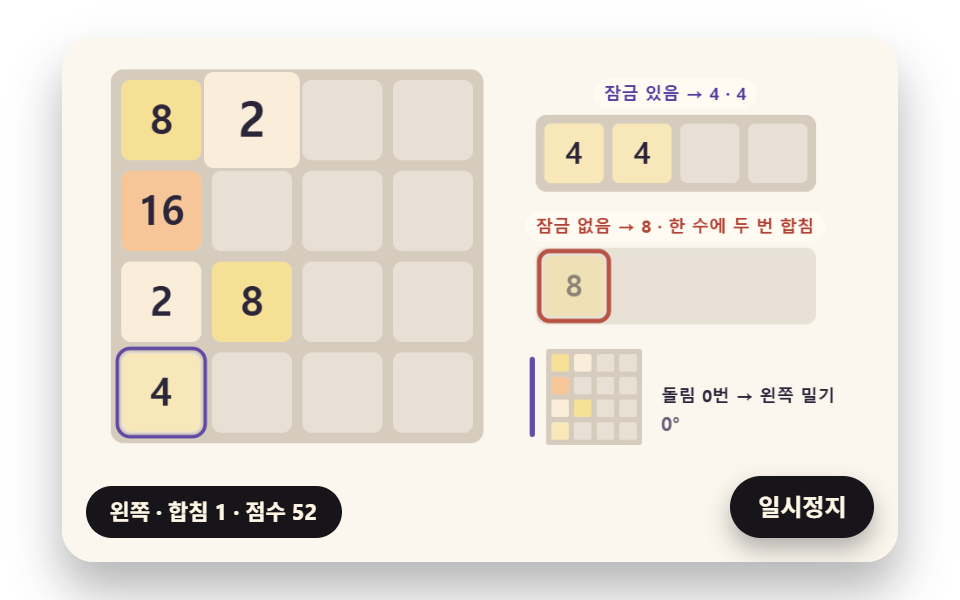 game2048 Game JavaScript: 9 Boards from Merges to AI
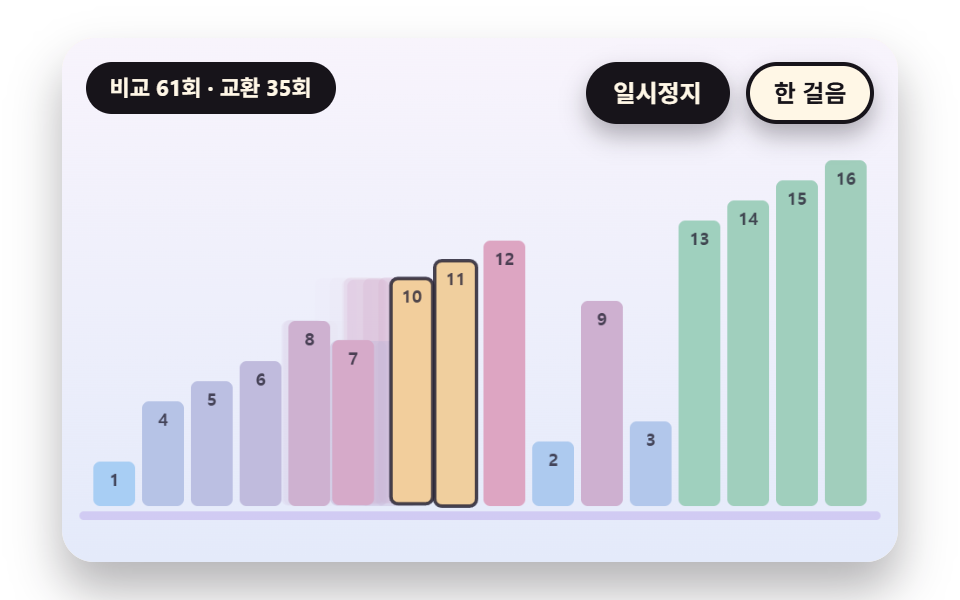 gameSorting Algorithm Visualizer: 9 Sort Scenes
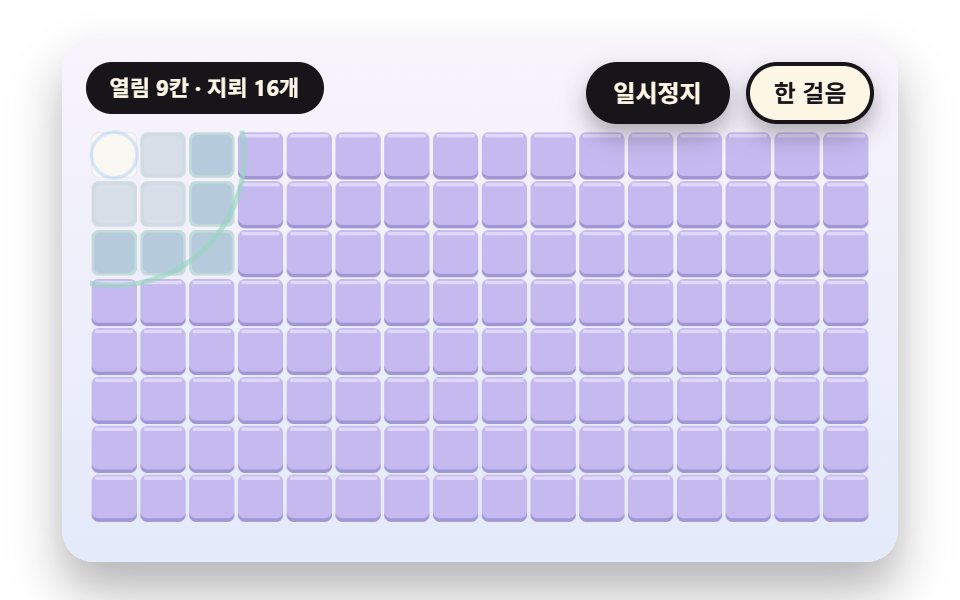 gameMinesweeper JavaScript: 9 Minefield Scenes
 gameBrick Breaker Game: 9 Canvas Scenes
 gameWalking Animation Cycle: 9 Calculated Scenes
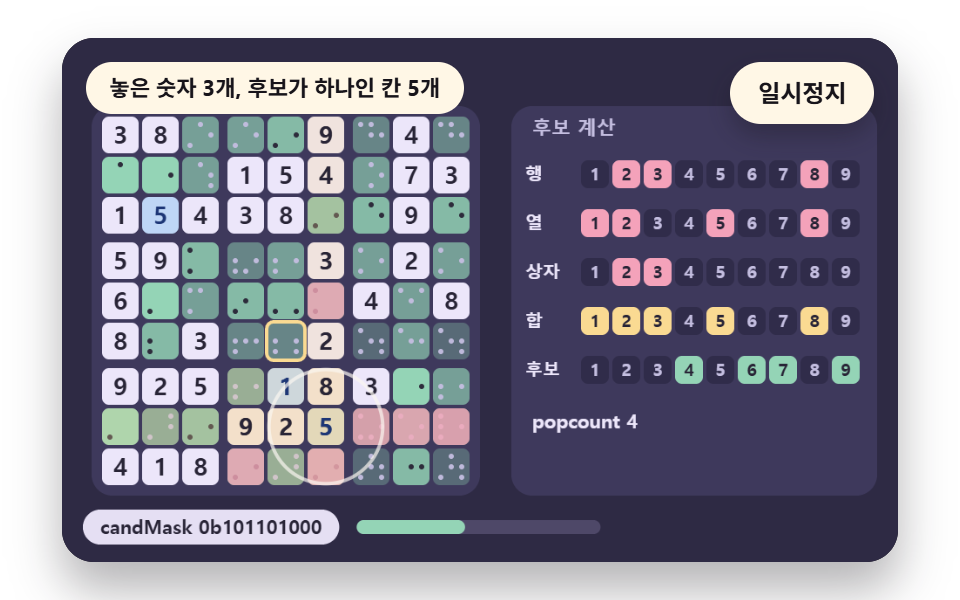 gameSudoku: 9 Scenes, Candidates to Unique Boards
 gameTetris JavaScript: Build It in 9 Canvas Steps
 gameSpin Wheel: 9 Canvas Roulettes, Flick to Stop