Coin Flip: 9 Canvas Toss Scenes
How does a coin flip pick a side? 03 multiplies airtime by spin rate and reads the parity of half turns, 05 draws a ratio narrowing toward half, and 08 bounces
A Coin Flip Is Reading an Angle, Not Picking a Side: a Coin Flip Simulator Starts by Letting One Rotation Angle Decide Both the Shape and the Face
 01 sc-coin-axis-spin-ellipse-flip
 02 sc-coin-rim-thickness-shade-ring
 03 sc-coin-toss-arc-spin-parity
 04 sc-coin-edge-stand-tilt-window
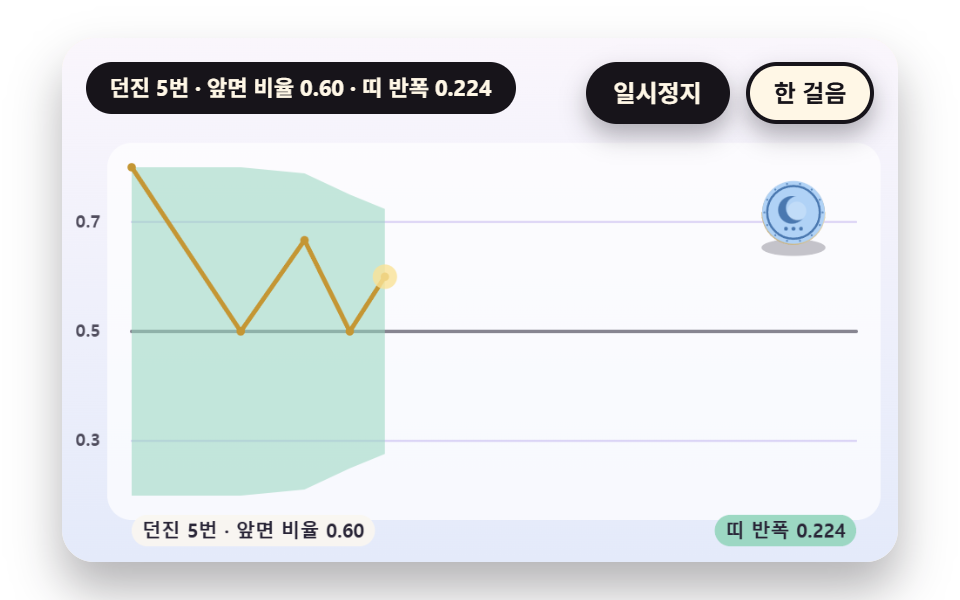 05 sc-coin-tally-ratio-converge
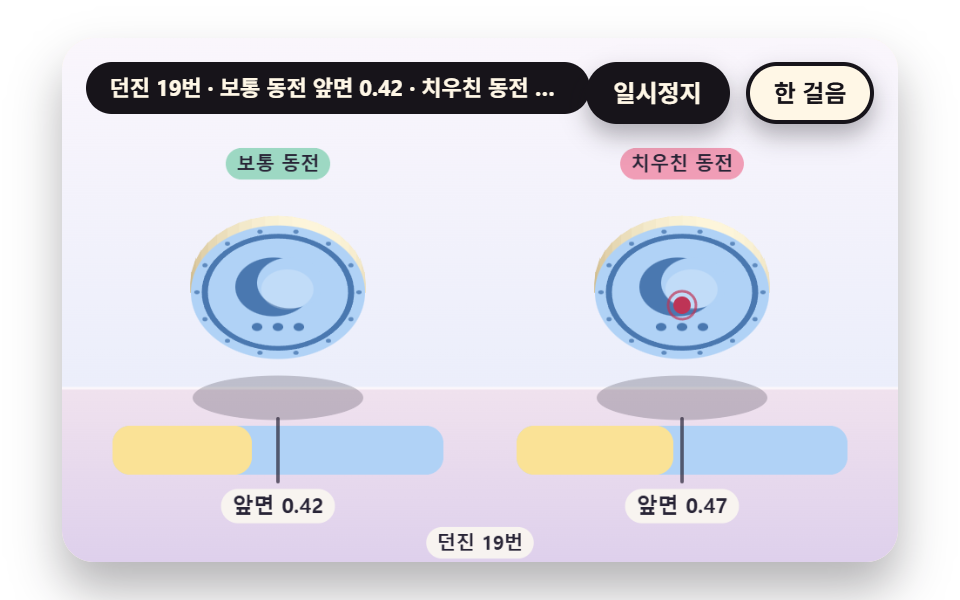 06 sc-coin-weighted-center-shift
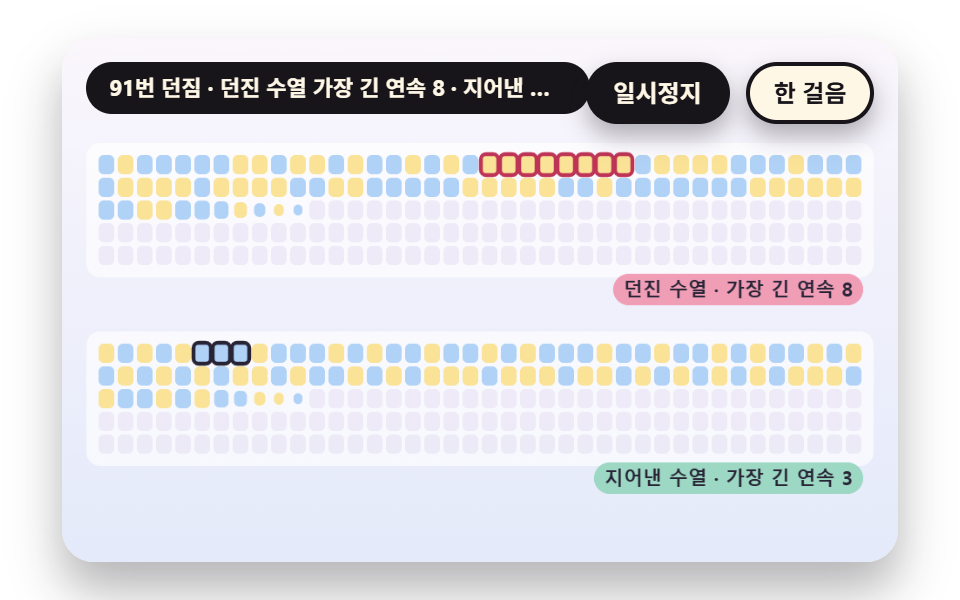 07 sc-coin-streak-run-strip
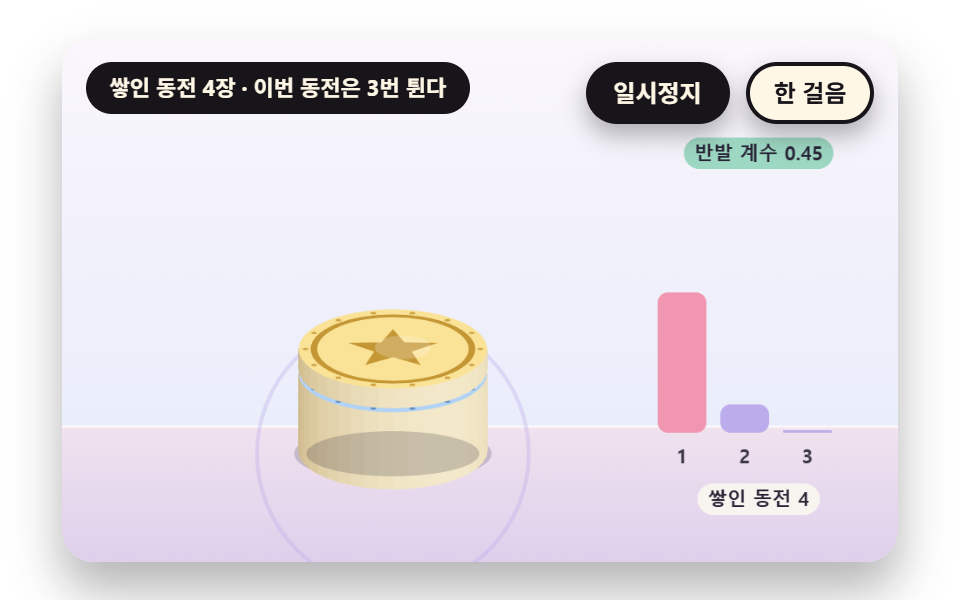 08 sc-coin-stack-drop-bounce-chain
 09 sc-coin-hero-decision-table
Auto-plays · click a tile to jump to its section · all nine in one zip
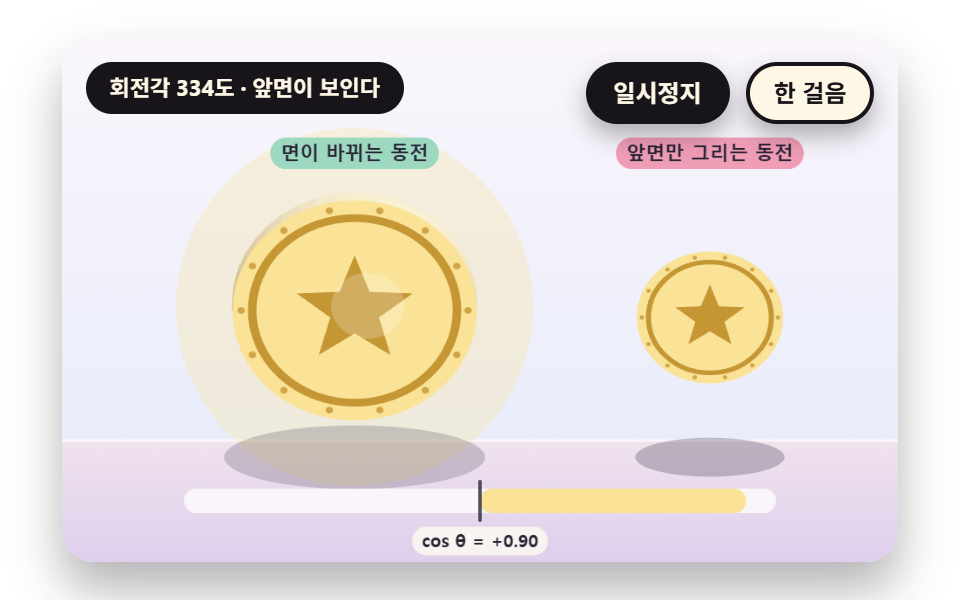
- 01 A Coin That Squashes Flat and Flips Faces Around a Horizontal Axis
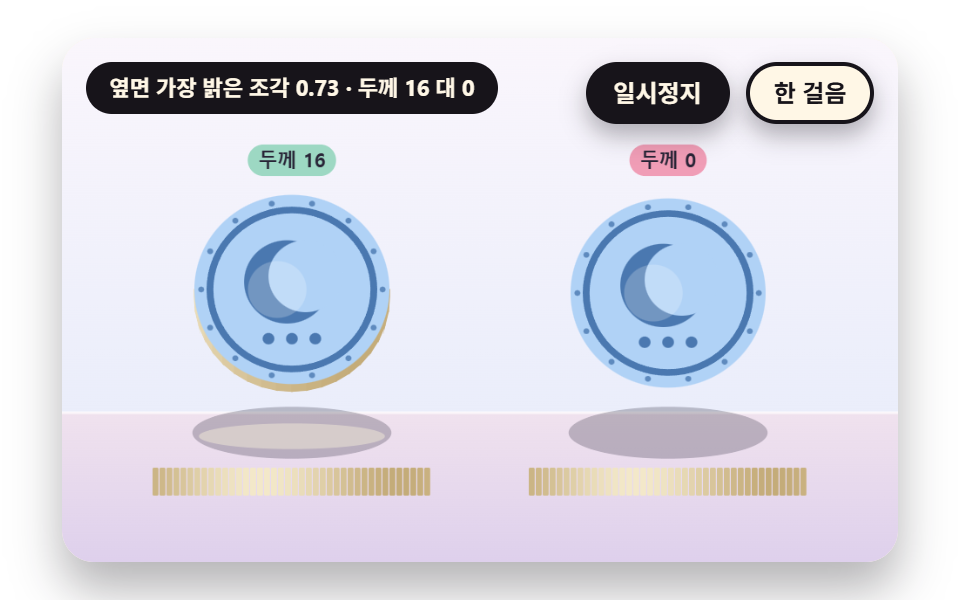
- 02 A Metal Rim Painted From Edge Thickness and Light Direction
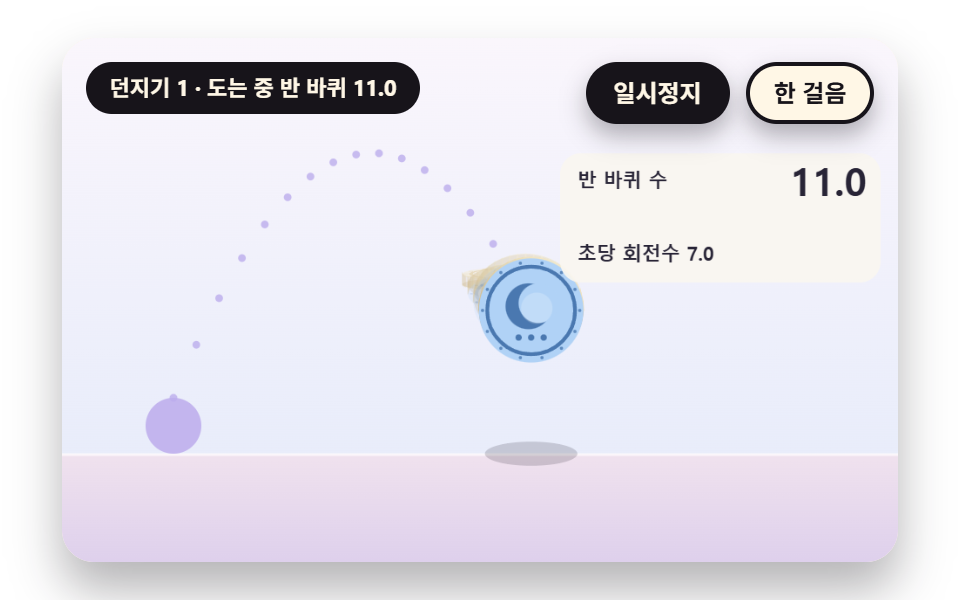
- 03 A Parabolic Toss That Reads the Face From Airtime Times Spin Rate
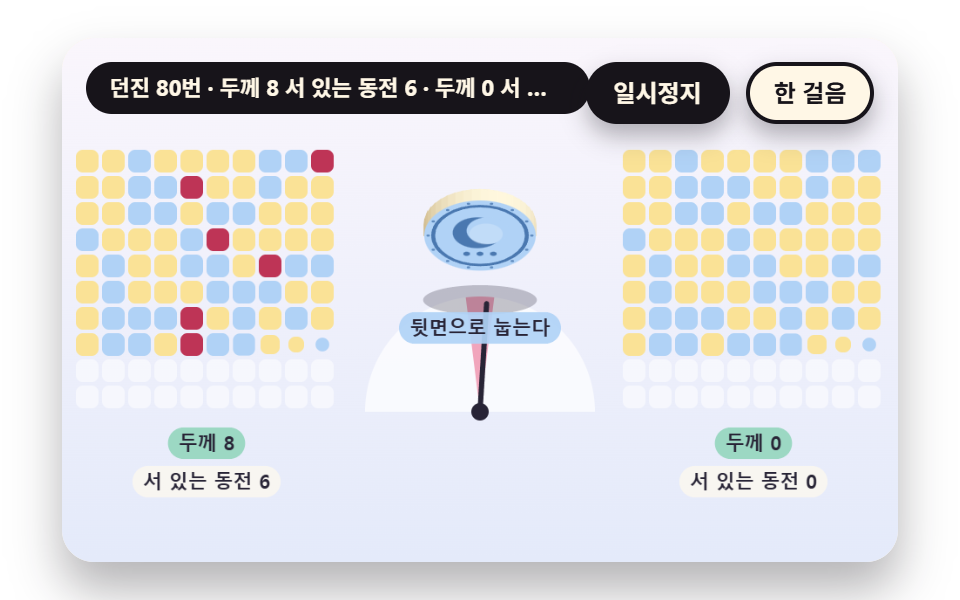
- 04 An Edge Landing Through the Very Narrow Window Thickness Opens
- 05 A Narrowing Band as the Heads Ratio Settles Toward Half With More Tosses
- 06 A Weighted Coin Whose Ratio Leans Toward One Face
- 07 A Run Strip Whose Length Grows While the Same Face Repeats
- 08 A Chain of Bounces as a Coin Drops Onto a Stack
- 09 A Table Hero That Tosses to Decide Between Two Choices
The nine scenes follow one rule. How flat the coin looks comes from the cosine of an angle θ, the visible face comes from the sign of that cosine, and a toss result comes only from the parity of the half turn count. The one random source is a linear congruential generator, seeded(), so the same seed gives the same result, and the source has 0 calls to Math.random, Date or fetch. That makes this coin flip simulator a calculation you can watch, and it is not a tool that judges whether a real coin is fair.
The order runs from one coin to a tally. 01 and 02 cover the shape and the rim light, 03 and 04 cover the toss and the edge landing, 05, 06 and 07 cover the ratio, the offset and the runs that thrown results build up, and 08 and 09 cover a bounce on a stack and a decision between two choices.
Coin Flip: 9 Scenes — a 3D Face Swap That Squashes Flat, a Metal Rim Painted by Light, a Parabolic Toss Read From Half Turns, a Narrow Edge Landing, a Tally Band That Settles to Half, a Weighted Coin, a Run Strip That Grows, a Bounce on a Stack and a Two Choice Decision Hero
What nine renders measured for area and motion
| Scene | Cumulative area | Moving frames | Mean intensity |
|---|---|---|---|
| 01 Axis spin | 24.5% | 23/23 | 63.7 |
| 02 Rim light | 13.8% | 23/23 | 65.5 |
| 03 Toss | 17.1% | 23/23 | 48.5 |
| 04 Edge stand | 18.1% | 23/23 | 85.6 |
| 05 Converging band | 19.1% | 23/23 | 78.3 |
| 06 Weighted coin | 11.4% | 23/23 | 93.9 |
| 07 Run strip | 18.3% | 23/23 | 59.7 |
| 08 Bounce | 15.8% | 23/23 | 69.1 |
| 09 Decision hero | 20.3% | 23/23 | 64.0 |
01 covers the most area at 24.5% because its coin is the largest, and 06 covers the least at 11.4% yet has the highest mean intensity at 93.9. All nine scenes moved in 23/23 frames, so no stretch of the render sat still.
01A Coin That Squashes Flat and Flips Faces Around a Horizontal Axis
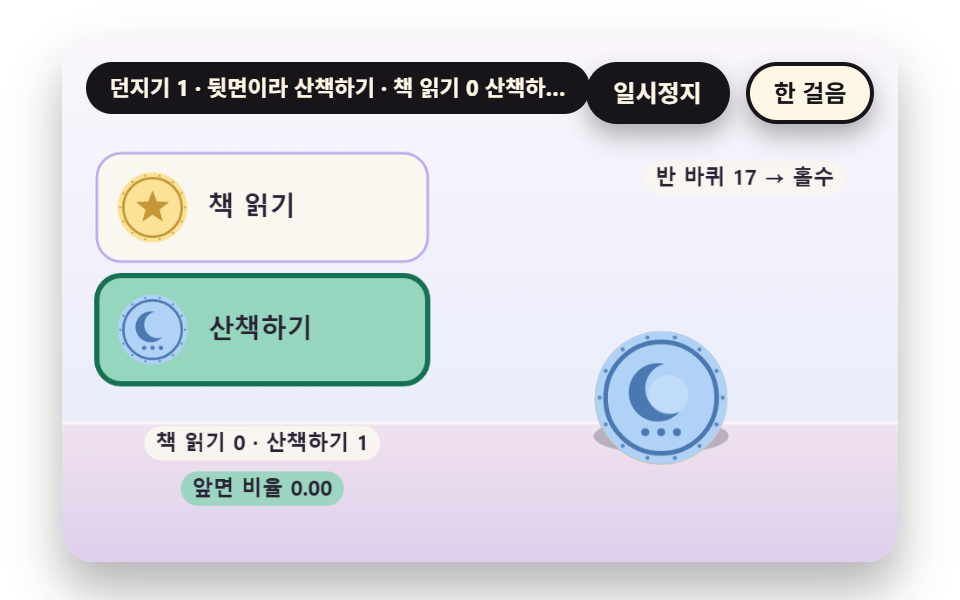
A coin is a disc whose width stays fixed, so at the angle θ from ANGLE() only the vertical diameter shrinks, by a factor of COS_SQUASH, and once the angle passes 90 degrees and the cosine turns negative the front and back marks swap. The small coin on the right squashes the same way but keeps drawing the front mark, which makes the swap stand out by contrast. One turn takes 1.50 seconds at OMEGA 4.2 radians per second, and the first swap lands near 0.30 seconds.
<main class="stage">
<div class="vj is-demo" id="vj">
  <div class="vj__pad" data-role="pad" tabindex="0" role="application" aria-label="Coin flip stage: Enter, Space or a click tosses, P pauses, N steps once, R restarts">
    <canvas class="vj__canvas" data-role="canvas" width="480" height="300" role="img" aria-label="Two coins turning around a horizontal axis. The left coin squashes its vertical diameter by a factor of cos as the angle changes, and the moment the angle passes 90 degrees and cos goes negative the gold front mark and the sky blue back mark swap. The right coin does not swap and keeps drawing the front mark. The scale below shows the cos value"></canvas>
  </div>
  <p class="vj__status" data-role="status" aria-live="off">Coin flip demo</p>
  <div class="vj__ctrl">
    <button class="vj__pause" data-role="pause" type="button" aria-pressed="false">Pause</button>
    <button class="vj__step" data-role="step" type="button">Step</button>
  </div>
  <p class="vj__done" data-role="done" role="status" aria-live="polite"></p>
</div>
</main>
@use "../../../../site/static/demo-tokens" as *;
@include stage($stage-paper);
.vj {
position: relative;
width: min(92vw, calc(160vh - 12.8vw));
aspect-ratio: 480 / 300;
margin: 0 auto;
border-radius: $r-card;
overflow: hidden;
box-shadow: $shadow-raised;
background: $subject-cream;
}
// 무대 상자 — 누르면 던진다. 키보드 포커스도 여기서 받는다(touch-action: none 은 이 상자에만). 무대 밖 터치는 페이지 스크롤 그대로
.vj__pad {
position: absolute;
inset: 0;
border-radius: inherit;
outline: none;
touch-action: none;
cursor: pointer;
}
// 바깥 .vj 가 넘침을 자르므로 포커스 테두리는 안쪽으로 들인다
.vj__pad:focus-visible {
outline: 3px solid $subject-ink;
outline-offset: -3px;
}
.vj__canvas {
position: absolute;
inset: 0;
display: block;
width: 100%;
height: 100%;
}
.vj__ctrl {
position: absolute;
right: $sp-3;
top: $sp-3;
display: flex;
gap: $sp-2;
}
.vj__pause,
.vj__step {
padding: $sp-1 $sp-3;
border: 2px solid $subject-ink;
border-radius: $r-pill;
background: $subject-ink;
color: $subject-cream;
font-family: inherit;
font-weight: 700;
font-size: 12px;
line-height: 1.6;
cursor: pointer;
box-shadow: $shadow-press;
transition: transform $dur-quick $ease-spring;
}
.vj__step {
background: $subject-cream;
color: $subject-ink;
}
// 스크린리더에만 읽히는 완료 알림
.vj__done {
position: absolute;
width: 1px;
height: 1px;
margin: 0;
overflow: hidden;
clip-path: inset(50%);
white-space: nowrap;
}
// 눌린 상태(멈춤) — 바탕과 글자색을 뒤집어 aria-pressed 가 눈에도 보이게
.vj__pause[aria-pressed="true"] {
background: $subject-cream;
color: $subject-ink;
}
.vj__pause:hover,
.vj__step:hover {
transform: translateY(-2px);
}
.vj__pause:active,
.vj__step:active {
transform: translateY(1px);
}
.vj__pause:focus-visible,
.vj__step:focus-visible {
outline: 3px solid $subject-ink;
outline-offset: 3px;
}
// 상태 줄 — 지금 장면의 수치를 글자로. 시연 중에는 aria-live off, 사람이 처음 손대면 polite
.vj__status {
position: absolute;
left: $sp-3;
top: $sp-3;
max-width: calc(100% - 190px);
margin: 0;
padding: $sp-1 $sp-3;
border-radius: $r-pill;
background: $subject-ink;
color: $subject-cream;
font-weight: 700;
font-size: 11px;
line-height: 1.6;
white-space: nowrap;
overflow: hidden;
text-overflow: ellipsis;
pointer-events: none;
}
@media (max-width: 340px) {
.vj__pause,
.vj__step,
.vj__status { font-size: 10px; padding: 0 $sp-2; }
}
// 움직임 줄이기 — 장면은 스크립트가 정지 장면 한 장으로 멈춘다. 버튼도 떠오르지 않게
@media (prefers-reduced-motion: reduce) {
.vj__pause,
.vj__step { transition: none !important; }
.vj__pause:hover,
.vj__pause:active,
.vj__step:hover,
.vj__step:active { transform: none !important; }
}html, body {
margin: 0;
overflow: hidden;
}
.stage {
box-sizing: border-box;
min-height: 100vh;
display: grid;
place-items: center;
margin: 0;
background: #ffffff;
font-family: -apple-system, "Segoe UI", "Noto Sans KR", sans-serif;
padding: clamp(8px, 4vw, 24px);
}
.vj {
position: relative;
width: min(92vw, 160vh - 12.8vw);
aspect-ratio: 480/300;
margin: 0 auto;
border-radius: 16px;
overflow: hidden;
box-shadow: 0 14px 24px rgba(23, 20, 26, 0.32);
background: #fff7e6;
}
.vj__pad {
position: absolute;
inset: 0;
border-radius: inherit;
outline: none;
touch-action: none;
cursor: pointer;
}
.vj__pad:focus-visible {
outline: 3px solid #17141a;
outline-offset: -3px;
}
.vj__canvas {
position: absolute;
inset: 0;
display: block;
width: 100%;
height: 100%;
}
.vj__ctrl {
position: absolute;
right: 12px;
top: 12px;
display: flex;
gap: 8px;
}
.vj__pause,
.vj__step {
padding: 4px 12px;
border: 2px solid #17141a;
border-radius: 999px;
background: #17141a;
color: #fff7e6;
font-family: inherit;
font-weight: 700;
font-size: 12px;
line-height: 1.6;
cursor: pointer;
box-shadow: 0 6px 12px rgba(23, 20, 26, 0.32);
transition: transform 220ms cubic-bezier(0.2, 0.8, 0.2, 1);
}
.vj__step {
background: #fff7e6;
color: #17141a;
}
.vj__done {
position: absolute;
width: 1px;
height: 1px;
margin: 0;
overflow: hidden;
clip-path: inset(50%);
white-space: nowrap;
}
.vj__pause[aria-pressed=true] {
background: #fff7e6;
color: #17141a;
}
.vj__pause:hover,
.vj__step:hover {
transform: translateY(-2px);
}
.vj__pause:active,
.vj__step:active {
transform: translateY(1px);
}
.vj__pause:focus-visible,
.vj__step:focus-visible {
outline: 3px solid #17141a;
outline-offset: 3px;
}
.vj__status {
position: absolute;
left: 12px;
top: 12px;
max-width: calc(100% - 190px);
margin: 0;
padding: 4px 12px;
border-radius: 999px;
background: #17141a;
color: #fff7e6;
font-weight: 700;
font-size: 11px;
line-height: 1.6;
white-space: nowrap;
overflow: hidden;
text-overflow: ellipsis;
pointer-events: none;
}
@media (max-width: 340px) {
.vj__pause,
.vj__step,
.vj__status {
font-size: 10px;
padding: 0 8px;
}
}
@media (prefers-reduced-motion: reduce) {
.vj__pause,
.vj__step {
transition: none !important;
}
.vj__pause:hover,
.vj__pause:active,
.vj__step:hover,
.vj__step:active {
transform: none !important;
}
}(function () {
const root = document.getElementById("vj");
if (!root) return;
// 무대 좌표 — 캔버스 안 계산은 늘 480×300. 화면에 보이는 크기와 상관없다
const W = 480;
const H = 300;
const PI = Math.PI;
const TAU = Math.PI * 2;
function clamp(v, lo, hi) { return v < lo ? lo : (v > hi ? hi : v); }
function lerp(a, b, k) { return a + (b - a) * k; }
function ease(x) { const c = clamp(x, 0, 1); return c * c * (3 - 2 * c); }
// 시드 고정 난수 — 선형 합동 생성기(곱 1664525, 더함 1013904223). 같은 시드면 같은 수열
function seeded(seed) {
let s = (seed >>> 0) || 1;
return function () {
s = (Math.imul(s, 1664525) + 1013904223) >>> 0;
return s / 4294967296;
};
}
// 파스텔 팔레트 — 앞면은 금빛, 뒷면은 하늘빛, 치우침·경고는 분홍
const BG_TOP = [250, 246, 252];
const BG_BOT = [228, 234, 250];
const TABLE_TOP = [240, 226, 238];
const TABLE_BOT = [222, 208, 236];
const GOLD = [250, 226, 150];
const GOLD_DEEP = [196, 150, 52];
const SKY = [176, 210, 246];
const SKY_DEEP = [74, 120, 176];
const RIM_LO = [184, 156, 100];
const RIM_HI = [255, 248, 222];
const ROSE = [240, 150, 176];
const ROSE_DEEP = [190, 52, 86];
const MINT = [150, 214, 190];
const MINT_DEEP = [22, 112, 82];
const LAV = [188, 172, 236];
const INK = [40, 36, 54];
const PAPER = [250, 246, 240];
function mix(a, b, k) { return [lerp(a[0], b[0], k), lerp(a[1], b[1], k), lerp(a[2], b[2], k)]; }
function rgba(c, a) {
return 'rgba(' + Math.round(clamp(c[0], 0, 255)) + ',' + Math.round(clamp(c[1], 0, 255)) + ',' + Math.round(clamp(c[2], 0, 255)) + ',' + clamp(a, 0, 1).toFixed(3) + ')';
}
// 장면 시계(초)·판 반복 번호·시간표 — 시간표는 (시각, 할 일) 목록이고 시각이 지나면 한 번씩 부른다
let sceneT = 0;
let lap = 0;
let script = [];
let evAt = 0;
function tossHalf(k, t) { return k.h0 + k.hr * clamp(t - k.t0, 0, k.T); }
function landHalf(k) { return k.h0 + k.hr * k.T; }
function tossXY(k, t) {
const u = clamp((t - k.t0) / k.T, 0, 1);
return [lerp(k.x0, k.x1, u), lerp(k.y0, k.y1, u) - 4 * k.peak * u * (1 - u)];
}
// 착지한 뒤 — 가장 가까운 평평한 각(Half turns 반올림)으로 감쇠 진동하며 눕는다
function halfAt(k, t) {
const q = t - (k.t0 + k.T);
if (q <= 0) {
return tossHalf(k, t);
}
const hl = landHalf(k);
const hf = Math.round(hl);
return hf + (hl - hf) * Math.exp(-9 * q) * Math.cos(26 * q);
}
function hopLift(k, t) {
const q = t - (k.t0 + k.T);
return q <= 0 ? 0 : 12 * Math.exp(-7 * q) * Math.abs(Math.sin(15 * q));
}
// 위로 온 면 — 반 바퀴 수를 반올림해 짝수면 던지기 전 면(0), 홀수면 반대 면(1)
function upFace(h) { return Math.abs(Math.round(h)) % 2; }
// 원하는 면이 나오도록 반 바퀴 수를 고른다 — even + 면 번호, 소수 부분은 ±0.2 안에서 흔든다
function halfFor(face, rng, minPairs) {
return 2 * (minPairs + Math.floor(rng() * 3)) + face + (rng() - 0.5) * 0.4;
}
// 같은 수열에서 Heads(0)과 Tails(1) — 값이 p 보다 작으면 Heads
function outcomes(seed, n, p) {
const rng = seeded(seed);
const out = [];
for (let i = 0; i < n; i += 1) {
out.push(rng() < p ? 0 : 1);
}
return out;
}
// 가장 긴 연속 길이
function longestRun(seq) {
let best = 0;
let cur = 0;
for (let i = 0; i < seq.length; i += 1) {
cur = (i > 0 && seq[i] === seq[i - 1]) ? cur + 1 : 1;
if (cur > best) {
best = cur;
}
}
return best;
}
const canvasEl = root.querySelector('[data-role="canvas"]');
const padEl = root.querySelector('[data-role="pad"]');
const pauseEl = root.querySelector('[data-role="pause"]');
const statusEl = root.querySelector('[data-role="status"]');
const stepEl = root.querySelector('[data-role="step"]');
const doneEl = root.querySelector('[data-role="done"]');
const ctxRaw = canvasEl ? canvasEl.getContext('2d') : null;
if (!canvasEl || !ctxRaw || !pauseEl || !padEl || !stepEl || !doneEl) {
return;
}
const cv = canvasEl;
const ctx = ctxRaw;
const pauseBtn = pauseEl;
const stepBtn = stepEl;
const doneP = doneEl;
const pad = padEl;
// 외부 웹폰트는 부르지 않는다 — 기기에 있는 글꼴 목록만
const FONT_STACK = 'system-ui, -apple-system, "Segoe UI", "Noto Sans KR", sans-serif';
let dpr = 1;
function fitCanvas() {
// 배율은 2 에서 자른다 — 배율 3 기기에서 화소가 2.25배로 늘지 않게
dpr = Math.min(window.devicePixelRatio || 1, 2);
cv.width = Math.round(W * dpr);
cv.height = Math.round(H * dpr);
ctx.setTransform(dpr, 0, 0, dpr, 0, 0);
}
function skyFill(top, bot) {
const g = ctx.createLinearGradient(0, 0, 0, H);
g.addColorStop(0, rgba(top, 1));
g.addColorStop(1, rgba(bot, 1));
ctx.fillStyle = g;
ctx.fillRect(0, 0, W, H);
}
function disc(x, y, r, c, a) {
if (r <= 0.2 || a <= 0) {
return;
}
ctx.beginPath();
ctx.arc(x, y, r, 0, TAU);
ctx.fillStyle = rgba(c, a);
ctx.fill();
}
function ring(x, y, r, width, c, a) {
if (r <= 0.2 || a <= 0) {
return;
}
ctx.beginPath();
ctx.arc(x, y, r, 0, TAU);
ctx.lineWidth = width;
ctx.strokeStyle = rgba(c, a);
ctx.stroke();
}
function oval(x, y, rx, ry, c, a) {
if (rx <= 0.2 || ry <= 0.1 || a <= 0) {
return;
}
ctx.beginPath();
ctx.ellipse(x, y, rx, ry, 0, 0, TAU);
ctx.fillStyle = rgba(c, a);
ctx.fill();
}
function seg(x1, y1, x2, y2, width, c, a) {
if (a <= 0) {
return;
}
ctx.beginPath();
ctx.moveTo(x1, y1);
ctx.lineTo(x2, y2);
ctx.lineWidth = width;
ctx.lineCap = 'round';
ctx.strokeStyle = rgba(c, a);
ctx.stroke();
}
function box(x, y, w, h, r, c, a) {
if (w <= 0.2 || h <= 0.2 || a <= 0) {
return;
}
ctx.beginPath();
ctx.roundRect(x, y, w, h, Math.max(0, Math.min(r, w / 2, h / 2)));
ctx.fillStyle = rgba(c, a);
ctx.fill();
}
function outline(x, y, w, h, r, width, c, a) {
if (w <= 0.2 || h <= 0.2 || a <= 0) {
return;
}
ctx.beginPath();
ctx.roundRect(x, y, w, h, Math.max(0, Math.min(r, w / 2, h / 2)));
ctx.lineWidth = width;
ctx.strokeStyle = rgba(c, a);
ctx.stroke();
}
function text(s, x, y, c, a, px, weight, align) {
ctx.font = weight + ' ' + px + 'px ' + FONT_STACK;
ctx.textAlign = align;
ctx.textBaseline = 'middle';
ctx.fillStyle = rgba(c, a);
ctx.fillText(s, x, y);
}
// 글자 이름표 — 바탕 알약 위에 글자
function tag(s, x, y, bg, fg, px, align) {
ctx.font = '700 ' + px + 'px ' + FONT_STACK;
const w = ctx.measureText(s).width + px * 1.1;
const left = align === 'center' ? x - w / 2 : (align === 'right' ? x - w : x);
box(left, y - px * 0.82, w, px * 1.64, px * 0.82, bg, 0.92);
text(s, left + w / 2, y + 0.5, fg, 1, px, 700, 'center');
}
// 탁자 — 위쪽 가장자리 높이 y 부터 아래까지
function tableBack(y) {
const g = ctx.createLinearGradient(0, y, 0, H);
g.addColorStop(0, rgba(TABLE_TOP, 1));
g.addColorStop(1, rgba(TABLE_BOT, 1));
ctx.fillStyle = g;
ctx.fillRect(0, y, W, H - y);
seg(0, y + 0.5, W, y + 0.5, 1.5, [255, 255, 255], 0.7);
}
// ── 동전 그리기 ───────────────────────────────────────────
// 동전은 원판이다. 가로축으로 th 만큼 돌면 위쪽 원판은 세로 반지름이 R·|cos th| 인 타원으로 보이고,
// cos th 의 부호가 음수가 되는 순간 보이는 면이 바뀐다(앞/뒤 판정은 법선의 부호 하나).
// 옆면은 둘레를 RIM_N 조각으로 나눠, 조각 법선과 빛 방향(lx, ly, lz)의 내적으로 밝기를 정한다
const RIM_N = 40;
function faceArt(face, R, a) {
const base = face === 0 ? GOLD : SKY;
const deep = face === 0 ? GOLD_DEEP : SKY_DEEP;
disc(0, 0, R, base, a);
ring(0, 0, R * 0.84, R * 0.07, deep, a);
for (let k = 0; k < 14; k += 1) {
disc(Math.cos(k * TAU / 14) * R * 0.93, Math.sin(k * TAU / 14) * R * 0.93, R * 0.03, deep, a * 0.8);
}
if (face === 0) {
// 별 — 바깥 반지름 0.5R, 안쪽 0.2R
ctx.beginPath();
for (let k = 0; k < 10; k += 1) {
const rr = (k % 2 === 0 ? 0.5 : 0.21) * R;
const an = -PI / 2 + k * PI / 5;
if (k === 0) {
ctx.moveTo(Math.cos(an) * rr, Math.sin(an) * rr);
}
else {
ctx.lineTo(Math.cos(an) * rr, Math.sin(an) * rr);
}
}
ctx.closePath();
ctx.fillStyle = rgba(deep, a);
ctx.fill();
}
else {
// 초승달과 점 세 개
disc(-R * 0.05, -R * 0.08, R * 0.44, deep, a);
disc(R * 0.14, -R * 0.14, R * 0.38, base, a);
for (let k = 0; k < 3; k += 1) {
disc((k - 1) * R * 0.24, R * 0.52, R * 0.06, deep, a);
}
}
}
function coinShadow(cx, gy, R, lift, a) {
const k = clamp(lift / 260, 0, 0.75);
oval(cx, gy, R * (1.02 - k * 0.5), R * (1.02 - k * 0.5) * 0.26, INK, a * 0.26 * (1 - k));
}
function drawCoin(cx, cy, R, th, thick, lx, ly, lz, a, startFace) {
const c = Math.cos(th);
const s = Math.sin(th);
const sg = c >= 0 ? 1 : -1;
const ac = Math.max(Math.abs(c), 0.012);
const half = thick / 2;
const near = -sg * s * half;
const far = -near;
const nearFace = sg > 0 ? startFace : 1 - startFace;
if (thick > 0) {
oval(cx, cy + far, R, R * ac, RIM_LO, a);
for (let k = 0; k < RIM_N; k += 1) {
const p0 = k * TAU / RIM_N;
const p1 = (k + 1) * TAU / RIM_N;
const pm = (p0 + p1) / 2;
if (Math.sin(pm) * s <= 0) {
continue;
}
const dot = Math.cos(pm) * lx + Math.sin(pm) * c * ly + Math.sin(pm) * s * lz;
const col = mix(RIM_LO, RIM_HI, clamp(0.5 + 0.5 * dot, 0, 1));
const x0 = cx + R * Math.cos(p0);
const x1 = cx + R * Math.cos(p1);
const y0 = R * Math.sin(p0) * c;
const y1 = R * Math.sin(p1) * c;
ctx.beginPath();
ctx.moveTo(x0, cy + near + y0);
ctx.lineTo(x1, cy + near + y1);
ctx.lineTo(x1, cy + far + y1);
ctx.lineTo(x0, cy + far + y0);
ctx.closePath();
ctx.fillStyle = rgba(col, a);
ctx.fill();
ctx.lineWidth = 0.8;
ctx.strokeStyle = rgba(col, a);
ctx.stroke();
}
}
ctx.save();
ctx.translate(cx, cy + near);
ctx.scale(1, ac);
faceArt(nearFace, R, a);
// 빛 쪽으로 쏠린 윤기
disc(lx * R * 0.3, -ly * R * 0.3 - R * 0.18, R * 0.3, [255, 255, 255], 0.22 * a);
ctx.restore();
}
// 서 있는 동전 — 가장자리가 위를 향해 옆에서 본 모습(너비 2R, 높이 thick)
function drawEdge(cx, cy, R, thick, a) {
const g = ctx.createLinearGradient(0, cy - thick / 2, 0, cy + thick / 2);
g.addColorStop(0, rgba(RIM_HI, a));
g.addColorStop(1, rgba(RIM_LO, a));
ctx.fillStyle = g;
ctx.beginPath();
ctx.roundRect(cx - R, cy - thick / 2, R * 2, thick, Math.min(thick / 2, 4));
ctx.fill();
}
// ── 공통 틀 ───────────────────────────────────────────────
let shownStatus = '';
function pushStatus(s) {
if (!statusEl || s === shownStatus) {
return;
}
shownStatus = s;
statusEl.textContent = s;
}
let paused = false;
const reduceQuery = window.matchMedia('(prefers-reduced-motion: reduce)');
// 페이지를 연 채 움직임 줄이기 설정을 바꿔도 change 리스너가 다시 읽는다
let still = reduceQuery.matches;
// 자동 시연 표시 — 사람이 처음 손대면 떼고 상태 줄을 polite 로 켠다
let demo = root.classList.contains('is-demo');
const off = new AbortController();
function wake() {
if (!demo) {
return;
}
demo = false;
root.classList.remove('is-demo');
if (statusEl) {
statusEl.setAttribute('aria-live', 'polite');
}
}
// 한 판 시연이 끝났음을 스크린리더에 한 번만 알린다 — 판이 되풀이돼도 다시 읽지 않는다
let doneSaid = false;
function checkDone() {
if (!doneSaid && sceneT >= RESULT_S) {
doneSaid = true;
doneP.textContent = statusText();
}
}
function advance(dt) {
sceneT += dt;
while (evAt < script.length && script[evAt].t <= sceneT) {
const ev = script[evAt];
evAt += 1;
ev.f();
}
if (sceneT >= LAP_S) {
lap += 1;
begin();
return;
}
update(dt);
}
// 첫 판은 START_S 만큼 앞서 시작한다 — 동전이 이미 돌고 있는 장면에서 보인다
function runTo(t) {
while (sceneT < t - 1e-6) {
advance(Math.min(1 / 30, t - sceneT));
}
}
function begin() {
sceneT = 0;
evAt = 0;
script = [];
build();
if (lap === 0 && !still) {
runTo(START_S);
}
}
const DT_MAX = 0.05;
function showNow() {
draw();
pushStatus(statusText());
checkDone();
}
let rafId = 0;
let lastTs = -1;
function frame(ts) {
if (still || paused) {
rafId = 0;
return;
}
if (lastTs < 0) {
lastTs = ts;
}
const dt = Math.min((ts - lastTs) / 1000, DT_MAX);
lastTs = ts;
if (dt > 0) {
advance(dt);
}
showNow();
rafId = window.requestAnimationFrame(frame);
}
function startLoop() {
if (rafId) {
return;
}
// 멈췄던 사이의 시간을 첫 프레임 dt 로 넘기지 않는다
lastTs = -1;
rafId = window.requestAnimationFrame(frame);
}
function stopLoop() {
if (rafId) {
window.cancelAnimationFrame(rafId);
rafId = 0;
}
}
// 움직임 줄이기 — 루프 없이 던진 결과 한 장. 회전 없이 결과 면이 나온 장면에서 멈춘다
function showRest() {
stopLoop();
sceneT = 0;
evAt = 0;
script = [];
build();
runTo(REST_S);
doneSaid = false;
showNow();
}
function play() {
begin();
showNow();
if (!paused) {
startLoop();
}
}
function togglePause() {
paused = !paused;
pauseBtn.setAttribute('aria-pressed', paused ? 'true' : 'false');
wake();
if (paused) {
stopLoop();
}
else if (!still) {
startLoop();
}
}
// 던지기 — 새 수열로 처음부터 다시. 움직임 줄이기에서는 새 결과 한 장
function restart() {
lap += 1;
doneSaid = false;
if (still) {
showRest();
return;
}
begin();
showNow();
if (!paused) {
startLoop();
}
}
// Step — 멈춘 채 시간표의 다음 일 하나까지 시계를 보낸다. 더 부를 일이 없으면 다음 던지기를 연다
function stepOnce() {
wake();
if (!paused) {
paused = true;
pauseBtn.setAttribute('aria-pressed', 'true');
stopLoop();
}
if (evAt >= script.length) {
restart();
return;
}
runTo(script[evAt].t + 0.05);
showNow();
}
pauseBtn.addEventListener('click', togglePause, { signal: off.signal });
stepBtn.addEventListener('click', stepOnce, { signal: off.signal });
// 키보드 — 무대에 포커스가 있을 때만. Enter·Space 는 던지기, P 는 Pause, N 은 Step, R 은 다시
pad.addEventListener('keydown', function (e) {
if (e.altKey || e.ctrlKey || e.metaKey) {
return;
}
const k = e.key;
if (k === 'Enter' || k === ' ') {
e.preventDefault();
wake();
restart();
}
else if (k === 'p' || k === 'P') {
togglePause();
}
else if (k === 'n' || k === 'N') {
stepOnce();
}
else if (k === 'r' || k === 'R') {
wake();
restart();
}
}, { signal: off.signal });
// 마우스·터치 — 무대를 누르면 던진다
pad.addEventListener('click', function () {
wake();
restart();
}, { signal: off.signal });
// 탭이 숨으면 멈추고, 돌아오면 시계를 다시 맞춰 시작 — 숨은 동안의 몇 초가 한 프레임에 몰리지 않게
document.addEventListener('visibilitychange', function () {
if (document.hidden) {
stopLoop();
}
else if (!paused && !still) {
startLoop();
}
}, { signal: off.signal });
// 설정이 바뀌면 — 켜지면 결과 한 장, 꺼지면 다시 움직인다
reduceQuery.addEventListener('change', function () {
still = reduceQuery.matches;
if (still) {
showRest();
}
else {
lap = 0;
play();
}
}, { signal: off.signal });
window.addEventListener('resize', function () {
fitCanvas();
showNow();
}, { signal: off.signal });
// ── 01 가로축을 돌며 납작해졌다 뒤집히는 3D 앞뒤 전환 ─────────────────────────
// 회전각 ANGLE 하나가 모양(세로 지름 R·cos)과 면(cos 의 부호)을 함께 정한다
const OMEGA = 4.2;
const COIN_R = 70;
const THICK_PX = 9;
const LAP_S = 9.6;
const START_S = 0.0;
const REST_S = 0.0;
const RESULT_S = 8.8;
let angle0 = 0.3;
let omegaNow = OMEGA;
function build() {
angle0 = 0.3 + lap * 0.7;
// 던질 때마다 속도가 조금씩 달라진다
omegaNow = OMEGA * (1 + 0.12 * (lap % 3));
}
function update(dt) { if (dt < 0) {
return;
} }
// 움직임 줄이기에서는 회전 없이 Heads 정면 한 장
function ANGLE() { return still ? 0 : angle0 + omegaNow * sceneT; }
function faceName(n) { return n === 0 ? 'Heads' : 'Tails'; }
function draw() {
skyFill(BG_TOP, BG_BOT);
tableBack(230);
const th = ANGLE();
const COS_SQUASH = Math.cos(th);
const cx = 168;
const cy = 154;
// 동전 둘레 후광 — 세로로 얼마나 펴졌는지(|cos|)에 비례해 퍼진다
disc(cx, cy, COIN_R * (1.15 + 0.35 * Math.abs(COS_SQUASH)), COS_SQUASH >= 0 ? GOLD : SKY, 0.34 * Math.abs(COS_SQUASH));
oval(cx, 240, COIN_R * (0.8 + 0.3 * Math.abs(COS_SQUASH)), COIN_R * 0.26, INK, 0.2);
drawCoin(cx, cy, COIN_R, th, THICK_PX, 0.36, -0.46, 0.81, 1, 0);
// 오른쪽 대비판 — 면을 바꾸지 않고 늘 Heads 무늬만 그린다. 가장 좁을 때도 무늬가 그대로라 어색하다
const sx = 372;
const sy = 160;
const sr = 42;
coinShadow(sx, 240, sr, 0, 1);
ctx.save();
ctx.translate(sx, sy);
ctx.scale(1, Math.max(Math.abs(COS_SQUASH), 0.012));
faceArt(0, sr, 1);
ctx.restore();
tag('Coin that swaps faces', cx, 66, MINT, INK, 11, 'center');
tag('Coin that only draws heads', sx, 66, ROSE, INK, 11, 'center');
// cos 눈금 — 가운데가 0, 오른쪽이 Heads(양수), 왼쪽이 Tails(음수)
const gx0 = 70;
const gw = 340;
box(gx0, 258, gw, 14, 7, [255, 255, 255], 0.75);
const mid = gx0 + gw / 2;
const fw = (gw / 2) * COS_SQUASH;
box(Math.min(mid, mid + fw), 258, Math.abs(fw), 14, 7, COS_SQUASH >= 0 ? GOLD : SKY, 1);
seg(mid, 254, mid, 276, 2, INK, 0.8);
tag('cos θ = {v}'.replace('{v}', (COS_SQUASH >= 0 ? '+' : '') + COS_SQUASH.toFixed(2)), mid, 288, PAPER, INK, 10, 'center');
}
function statusText() {
const th = ANGLE();
const deg = Math.round(((th * 180 / PI) % 360 + 360) % 360);
return 'Angle {a} degrees - {f} is showing'.replace('{a}', String(deg)).replace('{f}', faceName(Math.cos(th) >= 0 ? 0 : 1));
}
fitCanvas();
if (still) {
showRest();
}
else {
play();
}
return function () {
stopLoop();
off.abort();
};
})();// AxisSpinEllipseFlip - 같은 항목 vanilla index.html 의 React 판. 같은 계산을 useEffect 안에서 돌린다
import { useEffect, useRef } from "react";
import styles from "./AxisSpinEllipseFlip.module.scss";
const cx = (s: string): string => s.split(" ").map((n) => styles[n] ?? n).join(" ");
export default function AxisSpinEllipseFlip() {
const rootRef = useRef<HTMLDivElement | null>(null);
useEffect(() => {
const rootEl = rootRef.current;
if (!rootEl) return;
const root: HTMLElement = rootEl;
type RGB = [number, number, number];
type RGBA = [number, number, number, number];
// 무대 좌표 — 캔버스 안 계산은 늘 480×300. 화면에 보이는 크기와 상관없다
const W = 480;
const H = 300;
const PI = Math.PI;
const TAU = Math.PI * 2;
function clamp(v: number, lo: number, hi: number): number { return v < lo ? lo : (v > hi ? hi : v); }
function lerp(a: number, b: number, k: number): number { return a + (b - a) * k; }
function ease(x: number): number { const c = clamp(x, 0, 1); return c * c * (3 - 2 * c); }
// 시드 고정 난수 — 선형 합동 생성기(곱 1664525, 더함 1013904223). 같은 시드면 같은 수열
function seeded(seed: number): () => number {
let s = (seed >>> 0) || 1;
return function (): number {
s = (Math.imul(s, 1664525) + 1013904223) >>> 0;
return s / 4294967296;
};
}
// 파스텔 팔레트 — 앞면은 금빛, 뒷면은 하늘빛, 치우침·경고는 분홍
const BG_TOP: RGB = [250, 246, 252];
const BG_BOT: RGB = [228, 234, 250];
const TABLE_TOP: RGB = [240, 226, 238];
const TABLE_BOT: RGB = [222, 208, 236];
const GOLD: RGB = [250, 226, 150];
const GOLD_DEEP: RGB = [196, 150, 52];
const SKY: RGB = [176, 210, 246];
const SKY_DEEP: RGB = [74, 120, 176];
const RIM_LO: RGB = [184, 156, 100];
const RIM_HI: RGB = [255, 248, 222];
const ROSE: RGB = [240, 150, 176];
const ROSE_DEEP: RGB = [190, 52, 86];
const MINT: RGB = [150, 214, 190];
const MINT_DEEP: RGB = [22, 112, 82];
const LAV: RGB = [188, 172, 236];
const INK: RGB = [40, 36, 54];
const PAPER: RGB = [250, 246, 240];
function mix(a: RGB, b: RGB, k: number): RGB { return [lerp(a[0], b[0], k), lerp(a[1], b[1], k), lerp(a[2], b[2], k)]; }
function rgba(c: RGB, a: number): string {
return 'rgba(' + Math.round(clamp(c[0], 0, 255)) + ',' + Math.round(clamp(c[1], 0, 255)) + ',' + Math.round(clamp(c[2], 0, 255)) + ',' + clamp(a, 0, 1).toFixed(3) + ')';
}
// 장면 시계(초)·판 반복 번호·시간표 — 시간표는 (시각, 할 일) 목록이고 시각이 지나면 한 번씩 부른다
let sceneT = 0;
let lap = 0;
type Ev = { t: number; f: () => void };
let script: Ev[] = [];
let evAt = 0;
// ── 던지기 물리 ───────────────────────────────────────────
// 한 번의 던지기: 출발 (x0, y0) → 도착 (x1, y1), 체공 T 초, 꼭대기 peak 픽셀, 초당 반 바퀴 수 hr, 시작 반 바퀴 수 h0.
// 위치는 포물선(중력만), 각도는 반 바퀴 수 × π — 체공 중 회전 속도는 일정하다
type Toss = { t0: number; T: number; x0: number; y0: number; x1: number; y1: number; peak: number; hr: number; h0: number };
function tossHalf(k: Toss, t: number): number { return k.h0 + k.hr * clamp(t - k.t0, 0, k.T); }
function landHalf(k: Toss): number { return k.h0 + k.hr * k.T; }
function tossXY(k: Toss, t: number): [number, number] {
const u = clamp((t - k.t0) / k.T, 0, 1);
return [lerp(k.x0, k.x1, u), lerp(k.y0, k.y1, u) - 4 * k.peak * u * (1 - u)];
}
// 착지한 뒤 — 가장 가까운 평평한 각(반 바퀴 수 반올림)으로 감쇠 진동하며 눕는다
function halfAt(k: Toss, t: number): number {
const q = t - (k.t0 + k.T);
if (q <= 0) { return tossHalf(k, t); }
const hl = landHalf(k);
const hf = Math.round(hl);
return hf + (hl - hf) * Math.exp(-9 * q) * Math.cos(26 * q);
}
function hopLift(k: Toss, t: number): number {
const q = t - (k.t0 + k.T);
return q <= 0 ? 0 : 12 * Math.exp(-7 * q) * Math.abs(Math.sin(15 * q));
}
// 위로 온 면 — 반 바퀴 수를 반올림해 짝수면 던지기 전 면(0), 홀수면 반대 면(1)
function upFace(h: number): number { return Math.abs(Math.round(h)) % 2; }
// 원하는 면이 나오도록 반 바퀴 수를 고른다 — 짝수 + 면 번호, 소수 부분은 ±0.2 안에서 흔든다
function halfFor(face: number, rng: () => number, minPairs: number): number {
return 2 * (minPairs + Math.floor(rng() * 3)) + face + (rng() - 0.5) * 0.4;
}
// 같은 수열에서 앞면(0)과 뒷면(1) — 값이 p 보다 작으면 앞면
function outcomes(seed: number, n: number, p: number): number[] {
const rng = seeded(seed);
const out: number[] = [];
for (let i = 0; i < n; i += 1) { out.push(rng() < p ? 0 : 1); }
return out;
}
// 가장 긴 연속 길이
function longestRun(seq: number[]): number {
let best = 0;
let cur = 0;
for (let i = 0; i < seq.length; i += 1) {
cur = (i > 0 && seq[i] === seq[i - 1]) ? cur + 1 : 1;
if (cur > best) { best = cur; }
}
return best;
}
const canvasEl = root.querySelector('[data-role="canvas"]') as HTMLCanvasElement | null;
const padEl = root.querySelector('[data-role="pad"]') as HTMLElement | null;
const pauseEl = root.querySelector('[data-role="pause"]') as HTMLButtonElement | null;
const statusEl = root.querySelector('[data-role="status"]') as HTMLElement | null;
const stepEl = root.querySelector('[data-role="step"]') as HTMLButtonElement | null;
const doneEl = root.querySelector('[data-role="done"]') as HTMLElement | null;
const ctxRaw = canvasEl ? canvasEl.getContext('2d') : null;
if (!canvasEl || !ctxRaw || !pauseEl || !padEl || !stepEl || !doneEl) { return; }
const cv: HTMLCanvasElement = canvasEl;
const ctx: CanvasRenderingContext2D = ctxRaw;
const pauseBtn: HTMLButtonElement = pauseEl;
const stepBtn: HTMLButtonElement = stepEl;
const doneP: HTMLElement = doneEl;
const pad: HTMLElement = padEl;
// 외부 웹폰트는 부르지 않는다 — 기기에 있는 글꼴 목록만
const FONT_STACK = 'system-ui, -apple-system, "Segoe UI", "Noto Sans KR", sans-serif';
let dpr = 1;
function fitCanvas(): void {
// 배율은 2 에서 자른다 — 배율 3 기기에서 화소가 2.25배로 늘지 않게
dpr = Math.min(window.devicePixelRatio || 1, 2);
cv.width = Math.round(W * dpr);
cv.height = Math.round(H * dpr);
ctx.setTransform(dpr, 0, 0, dpr, 0, 0);
}
function skyFill(top: RGB, bot: RGB): void {
const g = ctx.createLinearGradient(0, 0, 0, H);
g.addColorStop(0, rgba(top, 1));
g.addColorStop(1, rgba(bot, 1));
ctx.fillStyle = g;
ctx.fillRect(0, 0, W, H);
}
function disc(x: number, y: number, r: number, c: RGB, a: number): void {
if (r <= 0.2 || a <= 0) { return; }
ctx.beginPath();
ctx.arc(x, y, r, 0, TAU);
ctx.fillStyle = rgba(c, a);
ctx.fill();
}
function ring(x: number, y: number, r: number, width: number, c: RGB, a: number): void {
if (r <= 0.2 || a <= 0) { return; }
ctx.beginPath();
ctx.arc(x, y, r, 0, TAU);
ctx.lineWidth = width;
ctx.strokeStyle = rgba(c, a);
ctx.stroke();
}
function oval(x: number, y: number, rx: number, ry: number, c: RGB, a: number): void {
if (rx <= 0.2 || ry <= 0.1 || a <= 0) { return; }
ctx.beginPath();
ctx.ellipse(x, y, rx, ry, 0, 0, TAU);
ctx.fillStyle = rgba(c, a);
ctx.fill();
}
function seg(x1: number, y1: number, x2: number, y2: number, width: number, c: RGB, a: number): void {
if (a <= 0) { return; }
ctx.beginPath();
ctx.moveTo(x1, y1);
ctx.lineTo(x2, y2);
ctx.lineWidth = width;
ctx.lineCap = 'round';
ctx.strokeStyle = rgba(c, a);
ctx.stroke();
}
function box(x: number, y: number, w: number, h: number, r: number, c: RGB, a: number): void {
if (w <= 0.2 || h <= 0.2 || a <= 0) { return; }
ctx.beginPath();
ctx.roundRect(x, y, w, h, Math.max(0, Math.min(r, w / 2, h / 2)));
ctx.fillStyle = rgba(c, a);
ctx.fill();
}
function outline(x: number, y: number, w: number, h: number, r: number, width: number, c: RGB, a: number): void {
if (w <= 0.2 || h <= 0.2 || a <= 0) { return; }
ctx.beginPath();
ctx.roundRect(x, y, w, h, Math.max(0, Math.min(r, w / 2, h / 2)));
ctx.lineWidth = width;
ctx.strokeStyle = rgba(c, a);
ctx.stroke();
}
function text(s: string, x: number, y: number, c: RGB, a: number, px: number, weight: number, align: CanvasTextAlign): void {
ctx.font = weight + ' ' + px + 'px ' + FONT_STACK;
ctx.textAlign = align;
ctx.textBaseline = 'middle';
ctx.fillStyle = rgba(c, a);
ctx.fillText(s, x, y);
}
// 글자 이름표 — 바탕 알약 위에 글자
function tag(s: string, x: number, y: number, bg: RGB, fg: RGB, px: number, align: CanvasTextAlign): void {
ctx.font = '700 ' + px + 'px ' + FONT_STACK;
const w = ctx.measureText(s).width + px * 1.1;
const left = align === 'center' ? x - w / 2 : (align === 'right' ? x - w : x);
box(left, y - px * 0.82, w, px * 1.64, px * 0.82, bg, 0.92);
text(s, left + w / 2, y + 0.5, fg, 1, px, 700, 'center');
}
// 탁자 — 위쪽 가장자리 높이 y 부터 아래까지
function tableBack(y: number): void {
const g = ctx.createLinearGradient(0, y, 0, H);
g.addColorStop(0, rgba(TABLE_TOP, 1));
g.addColorStop(1, rgba(TABLE_BOT, 1));
ctx.fillStyle = g;
ctx.fillRect(0, y, W, H - y);
seg(0, y + 0.5, W, y + 0.5, 1.5, [255, 255, 255], 0.7);
}
// ── 동전 그리기 ───────────────────────────────────────────
// 동전은 원판이다. 가로축으로 th 만큼 돌면 위쪽 원판은 세로 반지름이 R·|cos th| 인 타원으로 보이고,
// cos th 의 부호가 음수가 되는 순간 보이는 면이 바뀐다(앞/뒤 판정은 법선의 부호 하나).
// 옆면은 둘레를 RIM_N 조각으로 나눠, 조각 법선과 빛 방향(lx, ly, lz)의 내적으로 밝기를 정한다
const RIM_N = 40;
function faceArt(face: number, R: number, a: number): void {
const base = face === 0 ? GOLD : SKY;
const deep = face === 0 ? GOLD_DEEP : SKY_DEEP;
disc(0, 0, R, base, a);
ring(0, 0, R * 0.84, R * 0.07, deep, a);
for (let k = 0; k < 14; k += 1) {
disc(Math.cos(k * TAU / 14) * R * 0.93, Math.sin(k * TAU / 14) * R * 0.93, R * 0.03, deep, a * 0.8);
}
if (face === 0) {
// 별 — 바깥 반지름 0.5R, 안쪽 0.2R
ctx.beginPath();
for (let k = 0; k < 10; k += 1) {
const rr = (k % 2 === 0 ? 0.5 : 0.21) * R;
const an = -PI / 2 + k * PI / 5;
if (k === 0) { ctx.moveTo(Math.cos(an) * rr, Math.sin(an) * rr); } else { ctx.lineTo(Math.cos(an) * rr, Math.sin(an) * rr); }
}
ctx.closePath();
ctx.fillStyle = rgba(deep, a);
ctx.fill();
} else {
// 초승달과 점 세 개
disc(-R * 0.05, -R * 0.08, R * 0.44, deep, a);
disc(R * 0.14, -R * 0.14, R * 0.38, base, a);
for (let k = 0; k < 3; k += 1) { disc((k - 1) * R * 0.24, R * 0.52, R * 0.06, deep, a); }
}
}
function coinShadow(cx: number, gy: number, R: number, lift: number, a: number): void {
const k = clamp(lift / 260, 0, 0.75);
oval(cx, gy, R * (1.02 - k * 0.5), R * (1.02 - k * 0.5) * 0.26, INK, a * 0.26 * (1 - k));
}
function drawCoin(cx: number, cy: number, R: number, th: number, thick: number, lx: number, ly: number, lz: number, a: number, startFace: number): void {
const c = Math.cos(th);
const s = Math.sin(th);
const sg = c >= 0 ? 1 : -1;
const ac = Math.max(Math.abs(c), 0.012);
const half = thick / 2;
const near = -sg * s * half;
const far = -near;
const nearFace = sg > 0 ? startFace : 1 - startFace;
if (thick > 0) {
oval(cx, cy + far, R, R * ac, RIM_LO, a);
for (let k = 0; k < RIM_N; k += 1) {
const p0 = k * TAU / RIM_N;
const p1 = (k + 1) * TAU / RIM_N;
const pm = (p0 + p1) / 2;
if (Math.sin(pm) * s <= 0) { continue; }
const dot = Math.cos(pm) * lx + Math.sin(pm) * c * ly + Math.sin(pm) * s * lz;
const col = mix(RIM_LO, RIM_HI, clamp(0.5 + 0.5 * dot, 0, 1));
const x0 = cx + R * Math.cos(p0);
const x1 = cx + R * Math.cos(p1);
const y0 = R * Math.sin(p0) * c;
const y1 = R * Math.sin(p1) * c;
ctx.beginPath();
ctx.moveTo(x0, cy + near + y0);
ctx.lineTo(x1, cy + near + y1);
ctx.lineTo(x1, cy + far + y1);
ctx.lineTo(x0, cy + far + y0);
ctx.closePath();
ctx.fillStyle = rgba(col, a);
ctx.fill();
ctx.lineWidth = 0.8;
ctx.strokeStyle = rgba(col, a);
ctx.stroke();
}
}
ctx.save();
ctx.translate(cx, cy + near);
ctx.scale(1, ac);
faceArt(nearFace, R, a);
// 빛 쪽으로 쏠린 윤기
disc(lx * R * 0.3, -ly * R * 0.3 - R * 0.18, R * 0.3, [255, 255, 255], 0.22 * a);
ctx.restore();
}
// 서 있는 동전 — 가장자리가 위를 향해 옆에서 본 모습(너비 2R, 높이 thick)
function drawEdge(cx: number, cy: number, R: number, thick: number, a: number): void {
const g = ctx.createLinearGradient(0, cy - thick / 2, 0, cy + thick / 2);
g.addColorStop(0, rgba(RIM_HI, a));
g.addColorStop(1, rgba(RIM_LO, a));
ctx.fillStyle = g;
ctx.beginPath();
ctx.roundRect(cx - R, cy - thick / 2, R * 2, thick, Math.min(thick / 2, 4));
ctx.fill();
}
// ── 공통 틀 ───────────────────────────────────────────────
let shownStatus = '';
function pushStatus(s: string): void {
if (!statusEl || s === shownStatus) { return; }
shownStatus = s;
statusEl.textContent = s;
}
let paused = false;
const reduceQuery = window.matchMedia('(prefers-reduced-motion: reduce)');
// 페이지를 연 채 움직임 줄이기 설정을 바꿔도 change 리스너가 다시 읽는다
let still = reduceQuery.matches;
// 자동 시연 표시 — 사람이 처음 손대면 떼고 상태 줄을 polite 로 켠다
let demo = root.classList.contains('is-demo');
const off = new AbortController();
function wake(): void {
if (!demo) { return; }
demo = false;
root.classList.remove('is-demo');
if (statusEl) { statusEl.setAttribute('aria-live', 'polite'); }
}
// 한 판 시연이 끝났음을 스크린리더에 한 번만 알린다 — 판이 되풀이돼도 다시 읽지 않는다
let doneSaid = false;
function checkDone(): void {
if (!doneSaid && sceneT >= RESULT_S) {
doneSaid = true;
doneP.textContent = statusText();
}
}
function advance(dt: number): void {
sceneT += dt;
while (evAt < script.length && script[evAt].t <= sceneT) {
const ev = script[evAt];
evAt += 1;
ev.f();
}
if (sceneT >= LAP_S) { lap += 1; begin(); return; }
update(dt);
}
// 첫 판은 START_S 만큼 앞서 시작한다 — 동전이 이미 돌고 있는 장면에서 보인다
function runTo(t: number): void {
while (sceneT < t - 1e-6) { advance(Math.min(1 / 30, t - sceneT)); }
}
function begin(): void {
sceneT = 0;
evAt = 0;
script = [];
build();
if (lap === 0 && !still) { runTo(START_S); }
}
const DT_MAX = 0.05;
function showNow(): void {
draw();
pushStatus(statusText());
checkDone();
}
let rafId = 0;
let lastTs = -1;
function frame(ts: number): void {
if (still || paused) { rafId = 0; return; }
if (lastTs < 0) { lastTs = ts; }
const dt = Math.min((ts - lastTs) / 1000, DT_MAX);
lastTs = ts;
if (dt > 0) { advance(dt); }
showNow();
rafId = window.requestAnimationFrame(frame);
}
function startLoop(): void {
if (rafId) { return; }
// 멈췄던 사이의 시간을 첫 프레임 dt 로 넘기지 않는다
lastTs = -1;
rafId = window.requestAnimationFrame(frame);
}
function stopLoop(): void {
if (rafId) { window.cancelAnimationFrame(rafId); rafId = 0; }
}
// 움직임 줄이기 — 루프 없이 던진 결과 한 장. 회전 없이 결과 면이 나온 장면에서 멈춘다
function showRest(): void {
stopLoop();
sceneT = 0;
evAt = 0;
script = [];
build();
runTo(REST_S);
doneSaid = false;
showNow();
}
function play(): void {
begin();
showNow();
if (!paused) { startLoop(); }
}
function togglePause(): void {
paused = !paused;
pauseBtn.setAttribute('aria-pressed', paused ? 'true' : 'false');
wake();
if (paused) { stopLoop(); } else if (!still) { startLoop(); }
}
// 던지기 — 새 수열로 처음부터 다시. 움직임 줄이기에서는 새 결과 한 장
function restart(): void {
lap += 1;
doneSaid = false;
if (still) { showRest(); return; }
begin();
showNow();
if (!paused) { startLoop(); }
}
// 한 걸음 — 멈춘 채 시간표의 다음 일 하나까지 시계를 보낸다. 더 부를 일이 없으면 다음 던지기를 연다
function stepOnce(): void {
wake();
if (!paused) {
paused = true;
pauseBtn.setAttribute('aria-pressed', 'true');
stopLoop();
}
if (evAt >= script.length) {
restart();
return;
}
runTo(script[evAt].t + 0.05);
showNow();
}
pauseBtn.addEventListener('click', togglePause, { signal: off.signal });
stepBtn.addEventListener('click', stepOnce, { signal: off.signal });
// 키보드 — 무대에 포커스가 있을 때만. Enter·Space 는 던지기, P 는 일시정지, N 은 한 걸음, R 은 다시
pad.addEventListener('keydown', function (e: KeyboardEvent): void {
if (e.altKey || e.ctrlKey || e.metaKey) { return; }
const k = e.key;
if (k === 'Enter' || k === ' ') {
e.preventDefault();
wake();
restart();
} else if (k === 'p' || k === 'P') {
togglePause();
} else if (k === 'n' || k === 'N') {
stepOnce();
} else if (k === 'r' || k === 'R') {
wake();
restart();
}
}, { signal: off.signal });
// 마우스·터치 — 무대를 누르면 던진다
pad.addEventListener('click', function (): void {
wake();
restart();
}, { signal: off.signal });
// 탭이 숨으면 멈추고, 돌아오면 시계를 다시 맞춰 시작 — 숨은 동안의 몇 초가 한 프레임에 몰리지 않게
document.addEventListener('visibilitychange', function (): void {
if (document.hidden) { stopLoop(); } else if (!paused && !still) { startLoop(); }
}, { signal: off.signal });
// 설정이 바뀌면 — 켜지면 결과 한 장, 꺼지면 다시 움직인다
reduceQuery.addEventListener('change', function (): void {
still = reduceQuery.matches;
if (still) { showRest(); } else { lap = 0; play(); }
}, { signal: off.signal });
window.addEventListener('resize', function (): void {
fitCanvas();
showNow();
}, { signal: off.signal });
// ── 01 가로축을 돌며 납작해졌다 뒤집히는 3D 앞뒤 전환 ─────────────────────────
// 회전각 ANGLE 하나가 모양(세로 지름 R·cos)과 면(cos 의 부호)을 함께 정한다
const OMEGA = 4.2;
const COIN_R = 70;
const THICK_PX = 9;
const LAP_S = 9.6;
const START_S = 0.0;
const REST_S = 0.0;
const RESULT_S = 8.8;
let angle0 = 0.3;
let omegaNow = OMEGA;
function build(): void {
angle0 = 0.3 + lap * 0.7;
// 던질 때마다 속도가 조금씩 달라진다
omegaNow = OMEGA * (1 + 0.12 * (lap % 3));
}
function update(dt: number): void { if (dt < 0) { return; } }
// 움직임 줄이기에서는 회전 없이 앞면 정면 한 장
function ANGLE(): number { return still ? 0 : angle0 + omegaNow * sceneT; }
function faceName(n: number): string { return n === 0 ? '앞면' : '뒷면'; }
function draw(): void {
skyFill(BG_TOP, BG_BOT);
tableBack(230);
const th = ANGLE();
const COS_SQUASH = Math.cos(th);
const cx = 168;
const cy = 154;
// 동전 둘레 후광 — 세로로 얼마나 펴졌는지(|cos|)에 비례해 퍼진다
disc(cx, cy, COIN_R * (1.15 + 0.35 * Math.abs(COS_SQUASH)), COS_SQUASH >= 0 ? GOLD : SKY, 0.34 * Math.abs(COS_SQUASH));
oval(cx, 240, COIN_R * (0.8 + 0.3 * Math.abs(COS_SQUASH)), COIN_R * 0.26, INK, 0.2);
drawCoin(cx, cy, COIN_R, th, THICK_PX, 0.36, -0.46, 0.81, 1, 0);
// 오른쪽 대비판 — 면을 바꾸지 않고 늘 앞면 무늬만 그린다. 가장 좁을 때도 무늬가 그대로라 어색하다
const sx = 372;
const sy = 160;
const sr = 42;
coinShadow(sx, 240, sr, 0, 1);
ctx.save();
ctx.translate(sx, sy);
ctx.scale(1, Math.max(Math.abs(COS_SQUASH), 0.012));
faceArt(0, sr, 1);
ctx.restore();
tag('면이 바뀌는 동전', cx, 66, MINT, INK, 11, 'center');
tag('앞면만 그리는 동전', sx, 66, ROSE, INK, 11, 'center');
// cos 눈금 — 가운데가 0, 오른쪽이 앞면(양수), 왼쪽이 뒷면(음수)
const gx0 = 70;
const gw = 340;
box(gx0, 258, gw, 14, 7, [255, 255, 255], 0.75);
const mid = gx0 + gw / 2;
const fw = (gw / 2) * COS_SQUASH;
box(Math.min(mid, mid + fw), 258, Math.abs(fw), 14, 7, COS_SQUASH >= 0 ? GOLD : SKY, 1);
seg(mid, 254, mid, 276, 2, INK, 0.8);
tag('cos θ = {v}'.replace('{v}', (COS_SQUASH >= 0 ? '+' : '') + COS_SQUASH.toFixed(2)), mid, 288, PAPER, INK, 10, 'center');
}
function statusText(): string {
const th = ANGLE();
const deg = Math.round(((th * 180 / PI) % 360 + 360) % 360);
return '회전각 {a}도 · {f}이 보인다'.replace('{a}', String(deg)).replace('{f}', faceName(Math.cos(th) >= 0 ? 0 : 1));
}
fitCanvas();
if (still) { showRest(); } else { play(); }
return function (): void {
stopLoop();
off.abort();
};
}, []);
return (
<div className={cx("vj") + " is-demo"} ref={rootRef}>
<div className={cx("vj__pad")} data-role="pad" tabIndex={0} role="application" aria-label={'동전 던지기 시연 무대 — Enter 나 Space 나 클릭으로 던지기, P 로 일시정지, N 으로 한 걸음, R 로 다시'}>
<canvas className={cx("vj__canvas")} data-role="canvas" width={480} height={300} role="img" aria-label={'가로축으로 도는 동전 두 개. 왼쪽 동전은 회전각에 따라 세로 지름이 cos 배로 줄었다가 각이 90도를 지나 cos 가 음수가 되는 순간 앞면 금빛 무늬와 뒷면 하늘빛 무늬가 바뀌어 그려지고, 오른쪽 동전은 면을 바꾸지 않고 앞면 무늬만 그린다. 아래 눈금이 cos 값을 보여 준다'}></canvas>
</div>
<p className={cx("vj__status")} data-role="status" aria-live="off">{'동전 던지기 시연'}</p>
<div className={cx("vj__ctrl")}>
<button className={cx("vj__pause")} data-role="pause" type="button" aria-pressed="false">{'일시정지'}</button>
<button className={cx("vj__step")} data-role="step" type="button">{'한 걸음'}</button>
</div>
<p className={cx("vj__done")} data-role="done" role="status" aria-live="polite"></p>
</div>
);
}01 · A Coin That Squashes Flat and Flips Faces Around a Horizontal Axis — Measured area 24.478% · moving frames 23/23Original by GODRICH · SCSS and React ship in the zip · See the password
    function ANGLE() { return still ? 0 : angle0 + omegaNow * sceneT; }
    function faceName(n) { return n === 0 ? 'Heads' : 'Tails'; }
    function draw() {
        skyFill(BG_TOP, BG_BOT);
        tableBack(230);
        const th = ANGLE();
        const COS_SQUASH = Math.cos(th);
        const cx = 168;
        const cy = 154;
        // halo around the coin - spreads in proportion to how far it is opened vertically (|cos|)
        disc(cx, cy, COIN_R * (1.15 + 0.35 * Math.abs(COS_SQUASH)), COS_SQUASH >= 0 ? GOLD : SKY, 0.34 * Math.abs(COS_SQUASH));
        oval(cx, 240, COIN_R * (0.8 + 0.3 * Math.abs(COS_SQUASH)), COIN_R * 0.26, INK, 0.2);
        drawCoin(cx, cy, COIN_R, th, THICK_PX, 0.36, -0.46, 0.81, 1, 0);
02A Metal Rim Painted From Edge Thickness and Light Direction
Tilt the coin and a rim band shows between the two discs; the rim is split into RIM_N 40 pieces, and each piece takes its brightness from dotLight, the dot product of the piece normal and the light direction. As the coin turns the bright pieces slide to one side, and the 40 cell scale below paints the values of the same function. The coin on the right has thickness 0, so it has no rim pieces and looks paper thin.
<main class="stage">
<div class="vj is-demo" id="vj">
  <div class="vj__pad" data-role="pad" tabindex="0" role="application" aria-label="Coin flip stage: Enter, Space or a click tosses, P pauses, N steps once, R restarts">
    <canvas class="vj__canvas" data-role="canvas" width="480" height="300" role="img" aria-label="A coin with rim thickness 16 and a coin with thickness 0 turn at the same angle. The rim is split into 40 pieces and each piece is shaded by the dot product of its normal and the light direction, so as they turn the bright pieces slide sideways and the thickness 0 coin looks paper thin. The strip under each coin shows the brightness of the 40 pieces"></canvas>
  </div>
  <p class="vj__status" data-role="status" aria-live="off">Coin flip demo</p>
  <div class="vj__ctrl">
    <button class="vj__pause" data-role="pause" type="button" aria-pressed="false">Pause</button>
    <button class="vj__step" data-role="step" type="button">Step</button>
  </div>
  <p class="vj__done" data-role="done" role="status" aria-live="polite"></p>
</div>
</main>
@use "../../../../site/static/demo-tokens" as *;
@include stage($stage-paper);
.vj {
position: relative;
width: min(92vw, calc(160vh - 12.8vw));
aspect-ratio: 480 / 300;
margin: 0 auto;
border-radius: $r-card;
overflow: hidden;
box-shadow: $shadow-raised;
background: $subject-cream;
}
// 무대 상자 — 누르면 던진다. 키보드 포커스도 여기서 받는다(touch-action: none 은 이 상자에만). 무대 밖 터치는 페이지 스크롤 그대로
.vj__pad {
position: absolute;
inset: 0;
border-radius: inherit;
outline: none;
touch-action: none;
cursor: pointer;
}
// 바깥 .vj 가 넘침을 자르므로 포커스 테두리는 안쪽으로 들인다
.vj__pad:focus-visible {
outline: 3px solid $subject-ink;
outline-offset: -3px;
}
.vj__canvas {
position: absolute;
inset: 0;
display: block;
width: 100%;
height: 100%;
}
.vj__ctrl {
position: absolute;
right: $sp-3;
top: $sp-3;
display: flex;
gap: $sp-2;
}
.vj__pause,
.vj__step {
padding: $sp-1 $sp-3;
border: 2px solid $subject-ink;
border-radius: $r-pill;
background: $subject-ink;
color: $subject-cream;
font-family: inherit;
font-weight: 700;
font-size: 12px;
line-height: 1.6;
cursor: pointer;
box-shadow: $shadow-press;
transition: transform $dur-quick $ease-spring;
}
.vj__step {
background: $subject-cream;
color: $subject-ink;
}
// 스크린리더에만 읽히는 완료 알림
.vj__done {
position: absolute;
width: 1px;
height: 1px;
margin: 0;
overflow: hidden;
clip-path: inset(50%);
white-space: nowrap;
}
// 눌린 상태(멈춤) — 바탕과 글자색을 뒤집어 aria-pressed 가 눈에도 보이게
.vj__pause[aria-pressed="true"] {
background: $subject-cream;
color: $subject-ink;
}
.vj__pause:hover,
.vj__step:hover {
transform: translateY(-2px);
}
.vj__pause:active,
.vj__step:active {
transform: translateY(1px);
}
.vj__pause:focus-visible,
.vj__step:focus-visible {
outline: 3px solid $subject-ink;
outline-offset: 3px;
}
// 상태 줄 — 지금 장면의 수치를 글자로. 시연 중에는 aria-live off, 사람이 처음 손대면 polite
.vj__status {
position: absolute;
left: $sp-3;
top: $sp-3;
max-width: calc(100% - 190px);
margin: 0;
padding: $sp-1 $sp-3;
border-radius: $r-pill;
background: $subject-ink;
color: $subject-cream;
font-weight: 700;
font-size: 11px;
line-height: 1.6;
white-space: nowrap;
overflow: hidden;
text-overflow: ellipsis;
pointer-events: none;
}
@media (max-width: 340px) {
.vj__pause,
.vj__step,
.vj__status { font-size: 10px; padding: 0 $sp-2; }
}
// 움직임 줄이기 — 장면은 스크립트가 정지 장면 한 장으로 멈춘다. 버튼도 떠오르지 않게
@media (prefers-reduced-motion: reduce) {
.vj__pause,
.vj__step { transition: none !important; }
.vj__pause:hover,
.vj__pause:active,
.vj__step:hover,
.vj__step:active { transform: none !important; }
}html, body {
margin: 0;
overflow: hidden;
}
.stage {
box-sizing: border-box;
min-height: 100vh;
display: grid;
place-items: center;
margin: 0;
background: #ffffff;
font-family: -apple-system, "Segoe UI", "Noto Sans KR", sans-serif;
padding: clamp(8px, 4vw, 24px);
}
.vj {
position: relative;
width: min(92vw, 160vh - 12.8vw);
aspect-ratio: 480/300;
margin: 0 auto;
border-radius: 16px;
overflow: hidden;
box-shadow: 0 14px 24px rgba(23, 20, 26, 0.32);
background: #fff7e6;
}
.vj__pad {
position: absolute;
inset: 0;
border-radius: inherit;
outline: none;
touch-action: none;
cursor: pointer;
}
.vj__pad:focus-visible {
outline: 3px solid #17141a;
outline-offset: -3px;
}
.vj__canvas {
position: absolute;
inset: 0;
display: block;
width: 100%;
height: 100%;
}
.vj__ctrl {
position: absolute;
right: 12px;
top: 12px;
display: flex;
gap: 8px;
}
.vj__pause,
.vj__step {
padding: 4px 12px;
border: 2px solid #17141a;
border-radius: 999px;
background: #17141a;
color: #fff7e6;
font-family: inherit;
font-weight: 700;
font-size: 12px;
line-height: 1.6;
cursor: pointer;
box-shadow: 0 6px 12px rgba(23, 20, 26, 0.32);
transition: transform 220ms cubic-bezier(0.2, 0.8, 0.2, 1);
}
.vj__step {
background: #fff7e6;
color: #17141a;
}
.vj__done {
position: absolute;
width: 1px;
height: 1px;
margin: 0;
overflow: hidden;
clip-path: inset(50%);
white-space: nowrap;
}
.vj__pause[aria-pressed=true] {
background: #fff7e6;
color: #17141a;
}
.vj__pause:hover,
.vj__step:hover {
transform: translateY(-2px);
}
.vj__pause:active,
.vj__step:active {
transform: translateY(1px);
}
.vj__pause:focus-visible,
.vj__step:focus-visible {
outline: 3px solid #17141a;
outline-offset: 3px;
}
.vj__status {
position: absolute;
left: 12px;
top: 12px;
max-width: calc(100% - 190px);
margin: 0;
padding: 4px 12px;
border-radius: 999px;
background: #17141a;
color: #fff7e6;
font-weight: 700;
font-size: 11px;
line-height: 1.6;
white-space: nowrap;
overflow: hidden;
text-overflow: ellipsis;
pointer-events: none;
}
@media (max-width: 340px) {
.vj__pause,
.vj__step,
.vj__status {
font-size: 10px;
padding: 0 8px;
}
}
@media (prefers-reduced-motion: reduce) {
.vj__pause,
.vj__step {
transition: none !important;
}
.vj__pause:hover,
.vj__pause:active,
.vj__step:hover,
.vj__step:active {
transform: none !important;
}
}(function () {
const root = document.getElementById("vj");
if (!root) return;
// 무대 좌표 — 캔버스 안 계산은 늘 480×300. 화면에 보이는 크기와 상관없다
const W = 480;
const H = 300;
const PI = Math.PI;
const TAU = Math.PI * 2;
function clamp(v, lo, hi) { return v < lo ? lo : (v > hi ? hi : v); }
function lerp(a, b, k) { return a + (b - a) * k; }
function ease(x) { const c = clamp(x, 0, 1); return c * c * (3 - 2 * c); }
// 시드 고정 난수 — 선형 합동 생성기(곱 1664525, 더함 1013904223). 같은 시드면 같은 수열
function seeded(seed) {
let s = (seed >>> 0) || 1;
return function () {
s = (Math.imul(s, 1664525) + 1013904223) >>> 0;
return s / 4294967296;
};
}
// 파스텔 팔레트 — 앞면은 금빛, 뒷면은 하늘빛, 치우침·경고는 분홍
const BG_TOP = [250, 246, 252];
const BG_BOT = [228, 234, 250];
const TABLE_TOP = [240, 226, 238];
const TABLE_BOT = [222, 208, 236];
const GOLD = [250, 226, 150];
const GOLD_DEEP = [196, 150, 52];
const SKY = [176, 210, 246];
const SKY_DEEP = [74, 120, 176];
const RIM_LO = [184, 156, 100];
const RIM_HI = [255, 248, 222];
const ROSE = [240, 150, 176];
const ROSE_DEEP = [190, 52, 86];
const MINT = [150, 214, 190];
const MINT_DEEP = [22, 112, 82];
const LAV = [188, 172, 236];
const INK = [40, 36, 54];
const PAPER = [250, 246, 240];
function mix(a, b, k) { return [lerp(a[0], b[0], k), lerp(a[1], b[1], k), lerp(a[2], b[2], k)]; }
function rgba(c, a) {
return 'rgba(' + Math.round(clamp(c[0], 0, 255)) + ',' + Math.round(clamp(c[1], 0, 255)) + ',' + Math.round(clamp(c[2], 0, 255)) + ',' + clamp(a, 0, 1).toFixed(3) + ')';
}
// 장면 시계(초)·판 반복 번호·시간표 — 시간표는 (시각, 할 일) 목록이고 시각이 지나면 한 번씩 부른다
let sceneT = 0;
let lap = 0;
let script = [];
let evAt = 0;
function tossHalf(k, t) { return k.h0 + k.hr * clamp(t - k.t0, 0, k.T); }
function landHalf(k) { return k.h0 + k.hr * k.T; }
function tossXY(k, t) {
const u = clamp((t - k.t0) / k.T, 0, 1);
return [lerp(k.x0, k.x1, u), lerp(k.y0, k.y1, u) - 4 * k.peak * u * (1 - u)];
}
// 착지한 뒤 — 가장 가까운 평평한 각(Half turns 반올림)으로 감쇠 진동하며 눕는다
function halfAt(k, t) {
const q = t - (k.t0 + k.T);
if (q <= 0) {
return tossHalf(k, t);
}
const hl = landHalf(k);
const hf = Math.round(hl);
return hf + (hl - hf) * Math.exp(-9 * q) * Math.cos(26 * q);
}
function hopLift(k, t) {
const q = t - (k.t0 + k.T);
return q <= 0 ? 0 : 12 * Math.exp(-7 * q) * Math.abs(Math.sin(15 * q));
}
// 위로 온 면 — 반 바퀴 수를 반올림해 짝수면 던지기 전 면(0), 홀수면 반대 면(1)
function upFace(h) { return Math.abs(Math.round(h)) % 2; }
// 원하는 면이 나오도록 반 바퀴 수를 고른다 — even + 면 번호, 소수 부분은 ±0.2 안에서 흔든다
function halfFor(face, rng, minPairs) {
return 2 * (minPairs + Math.floor(rng() * 3)) + face + (rng() - 0.5) * 0.4;
}
// 같은 수열에서 Heads(0)과 Tails(1) — 값이 p 보다 작으면 Heads
function outcomes(seed, n, p) {
const rng = seeded(seed);
const out = [];
for (let i = 0; i < n; i += 1) {
out.push(rng() < p ? 0 : 1);
}
return out;
}
// 가장 긴 연속 길이
function longestRun(seq) {
let best = 0;
let cur = 0;
for (let i = 0; i < seq.length; i += 1) {
cur = (i > 0 && seq[i] === seq[i - 1]) ? cur + 1 : 1;
if (cur > best) {
best = cur;
}
}
return best;
}
const canvasEl = root.querySelector('[data-role="canvas"]');
const padEl = root.querySelector('[data-role="pad"]');
const pauseEl = root.querySelector('[data-role="pause"]');
const statusEl = root.querySelector('[data-role="status"]');
const stepEl = root.querySelector('[data-role="step"]');
const doneEl = root.querySelector('[data-role="done"]');
const ctxRaw = canvasEl ? canvasEl.getContext('2d') : null;
if (!canvasEl || !ctxRaw || !pauseEl || !padEl || !stepEl || !doneEl) {
return;
}
const cv = canvasEl;
const ctx = ctxRaw;
const pauseBtn = pauseEl;
const stepBtn = stepEl;
const doneP = doneEl;
const pad = padEl;
// 외부 웹폰트는 부르지 않는다 — 기기에 있는 글꼴 목록만
const FONT_STACK = 'system-ui, -apple-system, "Segoe UI", "Noto Sans KR", sans-serif';
let dpr = 1;
function fitCanvas() {
// 배율은 2 에서 자른다 — 배율 3 기기에서 화소가 2.25배로 늘지 않게
dpr = Math.min(window.devicePixelRatio || 1, 2);
cv.width = Math.round(W * dpr);
cv.height = Math.round(H * dpr);
ctx.setTransform(dpr, 0, 0, dpr, 0, 0);
}
function skyFill(top, bot) {
const g = ctx.createLinearGradient(0, 0, 0, H);
g.addColorStop(0, rgba(top, 1));
g.addColorStop(1, rgba(bot, 1));
ctx.fillStyle = g;
ctx.fillRect(0, 0, W, H);
}
function disc(x, y, r, c, a) {
if (r <= 0.2 || a <= 0) {
return;
}
ctx.beginPath();
ctx.arc(x, y, r, 0, TAU);
ctx.fillStyle = rgba(c, a);
ctx.fill();
}
function ring(x, y, r, width, c, a) {
if (r <= 0.2 || a <= 0) {
return;
}
ctx.beginPath();
ctx.arc(x, y, r, 0, TAU);
ctx.lineWidth = width;
ctx.strokeStyle = rgba(c, a);
ctx.stroke();
}
function oval(x, y, rx, ry, c, a) {
if (rx <= 0.2 || ry <= 0.1 || a <= 0) {
return;
}
ctx.beginPath();
ctx.ellipse(x, y, rx, ry, 0, 0, TAU);
ctx.fillStyle = rgba(c, a);
ctx.fill();
}
function seg(x1, y1, x2, y2, width, c, a) {
if (a <= 0) {
return;
}
ctx.beginPath();
ctx.moveTo(x1, y1);
ctx.lineTo(x2, y2);
ctx.lineWidth = width;
ctx.lineCap = 'round';
ctx.strokeStyle = rgba(c, a);
ctx.stroke();
}
function box(x, y, w, h, r, c, a) {
if (w <= 0.2 || h <= 0.2 || a <= 0) {
return;
}
ctx.beginPath();
ctx.roundRect(x, y, w, h, Math.max(0, Math.min(r, w / 2, h / 2)));
ctx.fillStyle = rgba(c, a);
ctx.fill();
}
function outline(x, y, w, h, r, width, c, a) {
if (w <= 0.2 || h <= 0.2 || a <= 0) {
return;
}
ctx.beginPath();
ctx.roundRect(x, y, w, h, Math.max(0, Math.min(r, w / 2, h / 2)));
ctx.lineWidth = width;
ctx.strokeStyle = rgba(c, a);
ctx.stroke();
}
function text(s, x, y, c, a, px, weight, align) {
ctx.font = weight + ' ' + px + 'px ' + FONT_STACK;
ctx.textAlign = align;
ctx.textBaseline = 'middle';
ctx.fillStyle = rgba(c, a);
ctx.fillText(s, x, y);
}
// 글자 이름표 — 바탕 알약 위에 글자
function tag(s, x, y, bg, fg, px, align) {
ctx.font = '700 ' + px + 'px ' + FONT_STACK;
const w = ctx.measureText(s).width + px * 1.1;
const left = align === 'center' ? x - w / 2 : (align === 'right' ? x - w : x);
box(left, y - px * 0.82, w, px * 1.64, px * 0.82, bg, 0.92);
text(s, left + w / 2, y + 0.5, fg, 1, px, 700, 'center');
}
// 탁자 — 위쪽 가장자리 높이 y 부터 아래까지
function tableBack(y) {
const g = ctx.createLinearGradient(0, y, 0, H);
g.addColorStop(0, rgba(TABLE_TOP, 1));
g.addColorStop(1, rgba(TABLE_BOT, 1));
ctx.fillStyle = g;
ctx.fillRect(0, y, W, H - y);
seg(0, y + 0.5, W, y + 0.5, 1.5, [255, 255, 255], 0.7);
}
// ── 동전 그리기 ───────────────────────────────────────────
// 동전은 원판이다. 가로축으로 th 만큼 돌면 위쪽 원판은 세로 반지름이 R·|cos th| 인 타원으로 보이고,
// cos th 의 부호가 음수가 되는 순간 보이는 면이 바뀐다(앞/뒤 판정은 법선의 부호 하나).
// 옆면은 둘레를 RIM_N 조각으로 나눠, 조각 법선과 빛 방향(lx, ly, lz)의 내적으로 밝기를 정한다
const RIM_N = 40;
function faceArt(face, R, a) {
const base = face === 0 ? GOLD : SKY;
const deep = face === 0 ? GOLD_DEEP : SKY_DEEP;
disc(0, 0, R, base, a);
ring(0, 0, R * 0.84, R * 0.07, deep, a);
for (let k = 0; k < 14; k += 1) {
disc(Math.cos(k * TAU / 14) * R * 0.93, Math.sin(k * TAU / 14) * R * 0.93, R * 0.03, deep, a * 0.8);
}
if (face === 0) {
// 별 — 바깥 반지름 0.5R, 안쪽 0.2R
ctx.beginPath();
for (let k = 0; k < 10; k += 1) {
const rr = (k % 2 === 0 ? 0.5 : 0.21) * R;
const an = -PI / 2 + k * PI / 5;
if (k === 0) {
ctx.moveTo(Math.cos(an) * rr, Math.sin(an) * rr);
}
else {
ctx.lineTo(Math.cos(an) * rr, Math.sin(an) * rr);
}
}
ctx.closePath();
ctx.fillStyle = rgba(deep, a);
ctx.fill();
}
else {
// 초승달과 점 세 개
disc(-R * 0.05, -R * 0.08, R * 0.44, deep, a);
disc(R * 0.14, -R * 0.14, R * 0.38, base, a);
for (let k = 0; k < 3; k += 1) {
disc((k - 1) * R * 0.24, R * 0.52, R * 0.06, deep, a);
}
}
}
function coinShadow(cx, gy, R, lift, a) {
const k = clamp(lift / 260, 0, 0.75);
oval(cx, gy, R * (1.02 - k * 0.5), R * (1.02 - k * 0.5) * 0.26, INK, a * 0.26 * (1 - k));
}
function drawCoin(cx, cy, R, th, thick, lx, ly, lz, a, startFace) {
const c = Math.cos(th);
const s = Math.sin(th);
const sg = c >= 0 ? 1 : -1;
const ac = Math.max(Math.abs(c), 0.012);
const half = thick / 2;
const near = -sg * s * half;
const far = -near;
const nearFace = sg > 0 ? startFace : 1 - startFace;
if (thick > 0) {
oval(cx, cy + far, R, R * ac, RIM_LO, a);
for (let k = 0; k < RIM_N; k += 1) {
const p0 = k * TAU / RIM_N;
const p1 = (k + 1) * TAU / RIM_N;
const pm = (p0 + p1) / 2;
if (Math.sin(pm) * s <= 0) {
continue;
}
const dot = Math.cos(pm) * lx + Math.sin(pm) * c * ly + Math.sin(pm) * s * lz;
const col = mix(RIM_LO, RIM_HI, clamp(0.5 + 0.5 * dot, 0, 1));
const x0 = cx + R * Math.cos(p0);
const x1 = cx + R * Math.cos(p1);
const y0 = R * Math.sin(p0) * c;
const y1 = R * Math.sin(p1) * c;
ctx.beginPath();
ctx.moveTo(x0, cy + near + y0);
ctx.lineTo(x1, cy + near + y1);
ctx.lineTo(x1, cy + far + y1);
ctx.lineTo(x0, cy + far + y0);
ctx.closePath();
ctx.fillStyle = rgba(col, a);
ctx.fill();
ctx.lineWidth = 0.8;
ctx.strokeStyle = rgba(col, a);
ctx.stroke();
}
}
ctx.save();
ctx.translate(cx, cy + near);
ctx.scale(1, ac);
faceArt(nearFace, R, a);
// 빛 쪽으로 쏠린 윤기
disc(lx * R * 0.3, -ly * R * 0.3 - R * 0.18, R * 0.3, [255, 255, 255], 0.22 * a);
ctx.restore();
}
// 서 있는 동전 — 가장자리가 위를 향해 옆에서 본 모습(너비 2R, 높이 thick)
function drawEdge(cx, cy, R, thick, a) {
const g = ctx.createLinearGradient(0, cy - thick / 2, 0, cy + thick / 2);
g.addColorStop(0, rgba(RIM_HI, a));
g.addColorStop(1, rgba(RIM_LO, a));
ctx.fillStyle = g;
ctx.beginPath();
ctx.roundRect(cx - R, cy - thick / 2, R * 2, thick, Math.min(thick / 2, 4));
ctx.fill();
}
// ── 공통 틀 ───────────────────────────────────────────────
let shownStatus = '';
function pushStatus(s) {
if (!statusEl || s === shownStatus) {
return;
}
shownStatus = s;
statusEl.textContent = s;
}
let paused = false;
const reduceQuery = window.matchMedia('(prefers-reduced-motion: reduce)');
// 페이지를 연 채 움직임 줄이기 설정을 바꿔도 change 리스너가 다시 읽는다
let still = reduceQuery.matches;
// 자동 시연 표시 — 사람이 처음 손대면 떼고 상태 줄을 polite 로 켠다
let demo = root.classList.contains('is-demo');
const off = new AbortController();
function wake() {
if (!demo) {
return;
}
demo = false;
root.classList.remove('is-demo');
if (statusEl) {
statusEl.setAttribute('aria-live', 'polite');
}
}
// 한 판 시연이 끝났음을 스크린리더에 한 번만 알린다 — 판이 되풀이돼도 다시 읽지 않는다
let doneSaid = false;
function checkDone() {
if (!doneSaid && sceneT >= RESULT_S) {
doneSaid = true;
doneP.textContent = statusText();
}
}
function advance(dt) {
sceneT += dt;
while (evAt < script.length && script[evAt].t <= sceneT) {
const ev = script[evAt];
evAt += 1;
ev.f();
}
if (sceneT >= LAP_S) {
lap += 1;
begin();
return;
}
update(dt);
}
// 첫 판은 START_S 만큼 앞서 시작한다 — 동전이 이미 돌고 있는 장면에서 보인다
function runTo(t) {
while (sceneT < t - 1e-6) {
advance(Math.min(1 / 30, t - sceneT));
}
}
function begin() {
sceneT = 0;
evAt = 0;
script = [];
build();
if (lap === 0 && !still) {
runTo(START_S);
}
}
const DT_MAX = 0.05;
function showNow() {
draw();
pushStatus(statusText());
checkDone();
}
let rafId = 0;
let lastTs = -1;
function frame(ts) {
if (still || paused) {
rafId = 0;
return;
}
if (lastTs < 0) {
lastTs = ts;
}
const dt = Math.min((ts - lastTs) / 1000, DT_MAX);
lastTs = ts;
if (dt > 0) {
advance(dt);
}
showNow();
rafId = window.requestAnimationFrame(frame);
}
function startLoop() {
if (rafId) {
return;
}
// 멈췄던 사이의 시간을 첫 프레임 dt 로 넘기지 않는다
lastTs = -1;
rafId = window.requestAnimationFrame(frame);
}
function stopLoop() {
if (rafId) {
window.cancelAnimationFrame(rafId);
rafId = 0;
}
}
// 움직임 줄이기 — 루프 없이 던진 결과 한 장. 회전 없이 결과 면이 나온 장면에서 멈춘다
function showRest() {
stopLoop();
sceneT = 0;
evAt = 0;
script = [];
build();
runTo(REST_S);
doneSaid = false;
showNow();
}
function play() {
begin();
showNow();
if (!paused) {
startLoop();
}
}
function togglePause() {
paused = !paused;
pauseBtn.setAttribute('aria-pressed', paused ? 'true' : 'false');
wake();
if (paused) {
stopLoop();
}
else if (!still) {
startLoop();
}
}
// 던지기 — 새 수열로 처음부터 다시. 움직임 줄이기에서는 새 결과 한 장
function restart() {
lap += 1;
doneSaid = false;
if (still) {
showRest();
return;
}
begin();
showNow();
if (!paused) {
startLoop();
}
}
// Step — 멈춘 채 시간표의 다음 일 하나까지 시계를 보낸다. 더 부를 일이 없으면 다음 던지기를 연다
function stepOnce() {
wake();
if (!paused) {
paused = true;
pauseBtn.setAttribute('aria-pressed', 'true');
stopLoop();
}
if (evAt >= script.length) {
restart();
return;
}
runTo(script[evAt].t + 0.05);
showNow();
}
pauseBtn.addEventListener('click', togglePause, { signal: off.signal });
stepBtn.addEventListener('click', stepOnce, { signal: off.signal });
// 키보드 — 무대에 포커스가 있을 때만. Enter·Space 는 던지기, P 는 Pause, N 은 Step, R 은 다시
pad.addEventListener('keydown', function (e) {
if (e.altKey || e.ctrlKey || e.metaKey) {
return;
}
const k = e.key;
if (k === 'Enter' || k === ' ') {
e.preventDefault();
wake();
restart();
}
else if (k === 'p' || k === 'P') {
togglePause();
}
else if (k === 'n' || k === 'N') {
stepOnce();
}
else if (k === 'r' || k === 'R') {
wake();
restart();
}
}, { signal: off.signal });
// 마우스·터치 — 무대를 누르면 던진다
pad.addEventListener('click', function () {
wake();
restart();
}, { signal: off.signal });
// 탭이 숨으면 멈추고, 돌아오면 시계를 다시 맞춰 시작 — 숨은 동안의 몇 초가 한 프레임에 몰리지 않게
document.addEventListener('visibilitychange', function () {
if (document.hidden) {
stopLoop();
}
else if (!paused && !still) {
startLoop();
}
}, { signal: off.signal });
// 설정이 바뀌면 — 켜지면 결과 한 장, 꺼지면 다시 움직인다
reduceQuery.addEventListener('change', function () {
still = reduceQuery.matches;
if (still) {
showRest();
}
else {
lap = 0;
play();
}
}, { signal: off.signal });
window.addEventListener('resize', function () {
fitCanvas();
showNow();
}, { signal: off.signal });
// ── 02 옆면 두께와 빛 방향으로 칠하는 금속 가장자리 ─────────────────────────────
// 옆면 둘레를 RIM_N 조각으로 나눠 조각마다 (법선 · 빛 방향) 으로 밝기를 정한다
const OMEGA2 = 2.3;
const THICK_RIM = 16;
const COIN_R = 56;
const LIGHT = [-0.5, -0.6, 0.62];
const LAP_S = 9.6;
const START_S = 0.0;
const REST_S = 0.0;
const RESULT_S = 8.8;
let angle0 = 0.6;
function build() { angle0 = 0.6 + lap * 0.9; }
function update(dt) { if (dt < 0) {
return;
} }
function theta() { return still ? 1.15 : angle0 + OMEGA2 * sceneT; }
function lightLen() { return Math.hypot(LIGHT[0], LIGHT[1], LIGHT[2]); }
// 조각 하나의 밝기 — 조각 법선과 빛 방향의 내적을 0 에서 1 로
function dotLight(pm, th) {
const n = lightLen();
const d = (Math.cos(pm) * LIGHT[0] + Math.sin(pm) * Math.cos(th) * LIGHT[1] + Math.sin(pm) * Math.sin(th) * LIGHT[2]) / n;
return clamp(0.5 + 0.5 * d, 0, 1);
}
function draw() {
skyFill(BG_TOP, BG_BOT);
tableBack(214);
const th = theta();
const n = lightLen();
const lx = LIGHT[0] / n;
const ly = LIGHT[1] / n;
const lz = LIGHT[2] / n;
const xs = [132, 348];
const thick = [THICK_RIM, 0];
for (let k = 0; k < 2; k += 1) {
const cx = xs[k];
coinShadow(cx, 226, COIN_R, 0, 1);
// 옆면 반짝임이 탁자에 번진 자국 — 보이는 조각의 가장 밝은 값에 비례
let best = 0;
for (let j = 0; j < RIM_N; j += 1) {
const pm = (j + 0.5) * TAU / RIM_N;
if (Math.sin(pm) * Math.sin(th) > 0) {
best = Math.max(best, dotLight(pm, th));
}
}
if (thick[k] > 0) {
oval(cx, 228, COIN_R * 1.3 * best, 10 * best, [255, 248, 222], 0.55 * best);
}
drawCoin(cx, 146, COIN_R, th, thick[k], lx, ly, lz, 1, 0);
// 조각 밝기 띠 — 40 조각의 내적 값을 그대로 칠한 눈금
for (let j = 0; j < RIM_N; j += 1) {
const pm = (j + 0.5) * TAU / RIM_N;
const v = dotLight(pm, th);
const col = mix(RIM_LO, RIM_HI, v);
box(cx - 80 + j * 4, 246, 3.4, 16, 1, col, 1);
}
}
tag('Thickness {t}'.replace('{t}', String(THICK_RIM)), xs[0], 70, MINT, INK, 11, 'center');
tag('Thickness 0', xs[1], 70, ROSE, INK, 11, 'center');
}
function statusText() {
const th = theta();
let best = 0;
for (let j = 0; j < RIM_N; j += 1) {
const pm = (j + 0.5) * TAU / RIM_N;
if (Math.sin(pm) * Math.sin(th) > 0) {
best = Math.max(best, dotLight(pm, th));
}
}
return 'Brightest rim piece {v} - thickness {t} vs 0'.replace('{v}', best.toFixed(2)).replace('{t}', String(THICK_RIM));
}
fitCanvas();
if (still) {
showRest();
}
else {
play();
}
return function () {
stopLoop();
off.abort();
};
})();// RimThicknessShadeRing - 같은 항목 vanilla index.html 의 React 판. 같은 계산을 useEffect 안에서 돌린다
import { useEffect, useRef } from "react";
import styles from "./RimThicknessShadeRing.module.scss";
const cx = (s: string): string => s.split(" ").map((n) => styles[n] ?? n).join(" ");
export default function RimThicknessShadeRing() {
const rootRef = useRef<HTMLDivElement | null>(null);
useEffect(() => {
const rootEl = rootRef.current;
if (!rootEl) return;
const root: HTMLElement = rootEl;
type RGB = [number, number, number];
type RGBA = [number, number, number, number];
// 무대 좌표 — 캔버스 안 계산은 늘 480×300. 화면에 보이는 크기와 상관없다
const W = 480;
const H = 300;
const PI = Math.PI;
const TAU = Math.PI * 2;
function clamp(v: number, lo: number, hi: number): number { return v < lo ? lo : (v > hi ? hi : v); }
function lerp(a: number, b: number, k: number): number { return a + (b - a) * k; }
function ease(x: number): number { const c = clamp(x, 0, 1); return c * c * (3 - 2 * c); }
// 시드 고정 난수 — 선형 합동 생성기(곱 1664525, 더함 1013904223). 같은 시드면 같은 수열
function seeded(seed: number): () => number {
let s = (seed >>> 0) || 1;
return function (): number {
s = (Math.imul(s, 1664525) + 1013904223) >>> 0;
return s / 4294967296;
};
}
// 파스텔 팔레트 — 앞면은 금빛, 뒷면은 하늘빛, 치우침·경고는 분홍
const BG_TOP: RGB = [250, 246, 252];
const BG_BOT: RGB = [228, 234, 250];
const TABLE_TOP: RGB = [240, 226, 238];
const TABLE_BOT: RGB = [222, 208, 236];
const GOLD: RGB = [250, 226, 150];
const GOLD_DEEP: RGB = [196, 150, 52];
const SKY: RGB = [176, 210, 246];
const SKY_DEEP: RGB = [74, 120, 176];
const RIM_LO: RGB = [184, 156, 100];
const RIM_HI: RGB = [255, 248, 222];
const ROSE: RGB = [240, 150, 176];
const ROSE_DEEP: RGB = [190, 52, 86];
const MINT: RGB = [150, 214, 190];
const MINT_DEEP: RGB = [22, 112, 82];
const LAV: RGB = [188, 172, 236];
const INK: RGB = [40, 36, 54];
const PAPER: RGB = [250, 246, 240];
function mix(a: RGB, b: RGB, k: number): RGB { return [lerp(a[0], b[0], k), lerp(a[1], b[1], k), lerp(a[2], b[2], k)]; }
function rgba(c: RGB, a: number): string {
return 'rgba(' + Math.round(clamp(c[0], 0, 255)) + ',' + Math.round(clamp(c[1], 0, 255)) + ',' + Math.round(clamp(c[2], 0, 255)) + ',' + clamp(a, 0, 1).toFixed(3) + ')';
}
// 장면 시계(초)·판 반복 번호·시간표 — 시간표는 (시각, 할 일) 목록이고 시각이 지나면 한 번씩 부른다
let sceneT = 0;
let lap = 0;
type Ev = { t: number; f: () => void };
let script: Ev[] = [];
let evAt = 0;
// ── 던지기 물리 ───────────────────────────────────────────
// 한 번의 던지기: 출발 (x0, y0) → 도착 (x1, y1), 체공 T 초, 꼭대기 peak 픽셀, 초당 반 바퀴 수 hr, 시작 반 바퀴 수 h0.
// 위치는 포물선(중력만), 각도는 반 바퀴 수 × π — 체공 중 회전 속도는 일정하다
type Toss = { t0: number; T: number; x0: number; y0: number; x1: number; y1: number; peak: number; hr: number; h0: number };
function tossHalf(k: Toss, t: number): number { return k.h0 + k.hr * clamp(t - k.t0, 0, k.T); }
function landHalf(k: Toss): number { return k.h0 + k.hr * k.T; }
function tossXY(k: Toss, t: number): [number, number] {
const u = clamp((t - k.t0) / k.T, 0, 1);
return [lerp(k.x0, k.x1, u), lerp(k.y0, k.y1, u) - 4 * k.peak * u * (1 - u)];
}
// 착지한 뒤 — 가장 가까운 평평한 각(반 바퀴 수 반올림)으로 감쇠 진동하며 눕는다
function halfAt(k: Toss, t: number): number {
const q = t - (k.t0 + k.T);
if (q <= 0) { return tossHalf(k, t); }
const hl = landHalf(k);
const hf = Math.round(hl);
return hf + (hl - hf) * Math.exp(-9 * q) * Math.cos(26 * q);
}
function hopLift(k: Toss, t: number): number {
const q = t - (k.t0 + k.T);
return q <= 0 ? 0 : 12 * Math.exp(-7 * q) * Math.abs(Math.sin(15 * q));
}
// 위로 온 면 — 반 바퀴 수를 반올림해 짝수면 던지기 전 면(0), 홀수면 반대 면(1)
function upFace(h: number): number { return Math.abs(Math.round(h)) % 2; }
// 원하는 면이 나오도록 반 바퀴 수를 고른다 — 짝수 + 면 번호, 소수 부분은 ±0.2 안에서 흔든다
function halfFor(face: number, rng: () => number, minPairs: number): number {
return 2 * (minPairs + Math.floor(rng() * 3)) + face + (rng() - 0.5) * 0.4;
}
// 같은 수열에서 앞면(0)과 뒷면(1) — 값이 p 보다 작으면 앞면
function outcomes(seed: number, n: number, p: number): number[] {
const rng = seeded(seed);
const out: number[] = [];
for (let i = 0; i < n; i += 1) { out.push(rng() < p ? 0 : 1); }
return out;
}
// 가장 긴 연속 길이
function longestRun(seq: number[]): number {
let best = 0;
let cur = 0;
for (let i = 0; i < seq.length; i += 1) {
cur = (i > 0 && seq[i] === seq[i - 1]) ? cur + 1 : 1;
if (cur > best) { best = cur; }
}
return best;
}
const canvasEl = root.querySelector('[data-role="canvas"]') as HTMLCanvasElement | null;
const padEl = root.querySelector('[data-role="pad"]') as HTMLElement | null;
const pauseEl = root.querySelector('[data-role="pause"]') as HTMLButtonElement | null;
const statusEl = root.querySelector('[data-role="status"]') as HTMLElement | null;
const stepEl = root.querySelector('[data-role="step"]') as HTMLButtonElement | null;
const doneEl = root.querySelector('[data-role="done"]') as HTMLElement | null;
const ctxRaw = canvasEl ? canvasEl.getContext('2d') : null;
if (!canvasEl || !ctxRaw || !pauseEl || !padEl || !stepEl || !doneEl) { return; }
const cv: HTMLCanvasElement = canvasEl;
const ctx: CanvasRenderingContext2D = ctxRaw;
const pauseBtn: HTMLButtonElement = pauseEl;
const stepBtn: HTMLButtonElement = stepEl;
const doneP: HTMLElement = doneEl;
const pad: HTMLElement = padEl;
// 외부 웹폰트는 부르지 않는다 — 기기에 있는 글꼴 목록만
const FONT_STACK = 'system-ui, -apple-system, "Segoe UI", "Noto Sans KR", sans-serif';
let dpr = 1;
function fitCanvas(): void {
// 배율은 2 에서 자른다 — 배율 3 기기에서 화소가 2.25배로 늘지 않게
dpr = Math.min(window.devicePixelRatio || 1, 2);
cv.width = Math.round(W * dpr);
cv.height = Math.round(H * dpr);
ctx.setTransform(dpr, 0, 0, dpr, 0, 0);
}
function skyFill(top: RGB, bot: RGB): void {
const g = ctx.createLinearGradient(0, 0, 0, H);
g.addColorStop(0, rgba(top, 1));
g.addColorStop(1, rgba(bot, 1));
ctx.fillStyle = g;
ctx.fillRect(0, 0, W, H);
}
function disc(x: number, y: number, r: number, c: RGB, a: number): void {
if (r <= 0.2 || a <= 0) { return; }
ctx.beginPath();
ctx.arc(x, y, r, 0, TAU);
ctx.fillStyle = rgba(c, a);
ctx.fill();
}
function ring(x: number, y: number, r: number, width: number, c: RGB, a: number): void {
if (r <= 0.2 || a <= 0) { return; }
ctx.beginPath();
ctx.arc(x, y, r, 0, TAU);
ctx.lineWidth = width;
ctx.strokeStyle = rgba(c, a);
ctx.stroke();
}
function oval(x: number, y: number, rx: number, ry: number, c: RGB, a: number): void {
if (rx <= 0.2 || ry <= 0.1 || a <= 0) { return; }
ctx.beginPath();
ctx.ellipse(x, y, rx, ry, 0, 0, TAU);
ctx.fillStyle = rgba(c, a);
ctx.fill();
}
function seg(x1: number, y1: number, x2: number, y2: number, width: number, c: RGB, a: number): void {
if (a <= 0) { return; }
ctx.beginPath();
ctx.moveTo(x1, y1);
ctx.lineTo(x2, y2);
ctx.lineWidth = width;
ctx.lineCap = 'round';
ctx.strokeStyle = rgba(c, a);
ctx.stroke();
}
function box(x: number, y: number, w: number, h: number, r: number, c: RGB, a: number): void {
if (w <= 0.2 || h <= 0.2 || a <= 0) { return; }
ctx.beginPath();
ctx.roundRect(x, y, w, h, Math.max(0, Math.min(r, w / 2, h / 2)));
ctx.fillStyle = rgba(c, a);
ctx.fill();
}
function outline(x: number, y: number, w: number, h: number, r: number, width: number, c: RGB, a: number): void {
if (w <= 0.2 || h <= 0.2 || a <= 0) { return; }
ctx.beginPath();
ctx.roundRect(x, y, w, h, Math.max(0, Math.min(r, w / 2, h / 2)));
ctx.lineWidth = width;
ctx.strokeStyle = rgba(c, a);
ctx.stroke();
}
function text(s: string, x: number, y: number, c: RGB, a: number, px: number, weight: number, align: CanvasTextAlign): void {
ctx.font = weight + ' ' + px + 'px ' + FONT_STACK;
ctx.textAlign = align;
ctx.textBaseline = 'middle';
ctx.fillStyle = rgba(c, a);
ctx.fillText(s, x, y);
}
// 글자 이름표 — 바탕 알약 위에 글자
function tag(s: string, x: number, y: number, bg: RGB, fg: RGB, px: number, align: CanvasTextAlign): void {
ctx.font = '700 ' + px + 'px ' + FONT_STACK;
const w = ctx.measureText(s).width + px * 1.1;
const left = align === 'center' ? x - w / 2 : (align === 'right' ? x - w : x);
box(left, y - px * 0.82, w, px * 1.64, px * 0.82, bg, 0.92);
text(s, left + w / 2, y + 0.5, fg, 1, px, 700, 'center');
}
// 탁자 — 위쪽 가장자리 높이 y 부터 아래까지
function tableBack(y: number): void {
const g = ctx.createLinearGradient(0, y, 0, H);
g.addColorStop(0, rgba(TABLE_TOP, 1));
g.addColorStop(1, rgba(TABLE_BOT, 1));
ctx.fillStyle = g;
ctx.fillRect(0, y, W, H - y);
seg(0, y + 0.5, W, y + 0.5, 1.5, [255, 255, 255], 0.7);
}
// ── 동전 그리기 ───────────────────────────────────────────
// 동전은 원판이다. 가로축으로 th 만큼 돌면 위쪽 원판은 세로 반지름이 R·|cos th| 인 타원으로 보이고,
// cos th 의 부호가 음수가 되는 순간 보이는 면이 바뀐다(앞/뒤 판정은 법선의 부호 하나).
// 옆면은 둘레를 RIM_N 조각으로 나눠, 조각 법선과 빛 방향(lx, ly, lz)의 내적으로 밝기를 정한다
const RIM_N = 40;
function faceArt(face: number, R: number, a: number): void {
const base = face === 0 ? GOLD : SKY;
const deep = face === 0 ? GOLD_DEEP : SKY_DEEP;
disc(0, 0, R, base, a);
ring(0, 0, R * 0.84, R * 0.07, deep, a);
for (let k = 0; k < 14; k += 1) {
disc(Math.cos(k * TAU / 14) * R * 0.93, Math.sin(k * TAU / 14) * R * 0.93, R * 0.03, deep, a * 0.8);
}
if (face === 0) {
// 별 — 바깥 반지름 0.5R, 안쪽 0.2R
ctx.beginPath();
for (let k = 0; k < 10; k += 1) {
const rr = (k % 2 === 0 ? 0.5 : 0.21) * R;
const an = -PI / 2 + k * PI / 5;
if (k === 0) { ctx.moveTo(Math.cos(an) * rr, Math.sin(an) * rr); } else { ctx.lineTo(Math.cos(an) * rr, Math.sin(an) * rr); }
}
ctx.closePath();
ctx.fillStyle = rgba(deep, a);
ctx.fill();
} else {
// 초승달과 점 세 개
disc(-R * 0.05, -R * 0.08, R * 0.44, deep, a);
disc(R * 0.14, -R * 0.14, R * 0.38, base, a);
for (let k = 0; k < 3; k += 1) { disc((k - 1) * R * 0.24, R * 0.52, R * 0.06, deep, a); }
}
}
function coinShadow(cx: number, gy: number, R: number, lift: number, a: number): void {
const k = clamp(lift / 260, 0, 0.75);
oval(cx, gy, R * (1.02 - k * 0.5), R * (1.02 - k * 0.5) * 0.26, INK, a * 0.26 * (1 - k));
}
function drawCoin(cx: number, cy: number, R: number, th: number, thick: number, lx: number, ly: number, lz: number, a: number, startFace: number): void {
const c = Math.cos(th);
const s = Math.sin(th);
const sg = c >= 0 ? 1 : -1;
const ac = Math.max(Math.abs(c), 0.012);
const half = thick / 2;
const near = -sg * s * half;
const far = -near;
const nearFace = sg > 0 ? startFace : 1 - startFace;
if (thick > 0) {
oval(cx, cy + far, R, R * ac, RIM_LO, a);
for (let k = 0; k < RIM_N; k += 1) {
const p0 = k * TAU / RIM_N;
const p1 = (k + 1) * TAU / RIM_N;
const pm = (p0 + p1) / 2;
if (Math.sin(pm) * s <= 0) { continue; }
const dot = Math.cos(pm) * lx + Math.sin(pm) * c * ly + Math.sin(pm) * s * lz;
const col = mix(RIM_LO, RIM_HI, clamp(0.5 + 0.5 * dot, 0, 1));
const x0 = cx + R * Math.cos(p0);
const x1 = cx + R * Math.cos(p1);
const y0 = R * Math.sin(p0) * c;
const y1 = R * Math.sin(p1) * c;
ctx.beginPath();
ctx.moveTo(x0, cy + near + y0);
ctx.lineTo(x1, cy + near + y1);
ctx.lineTo(x1, cy + far + y1);
ctx.lineTo(x0, cy + far + y0);
ctx.closePath();
ctx.fillStyle = rgba(col, a);
ctx.fill();
ctx.lineWidth = 0.8;
ctx.strokeStyle = rgba(col, a);
ctx.stroke();
}
}
ctx.save();
ctx.translate(cx, cy + near);
ctx.scale(1, ac);
faceArt(nearFace, R, a);
// 빛 쪽으로 쏠린 윤기
disc(lx * R * 0.3, -ly * R * 0.3 - R * 0.18, R * 0.3, [255, 255, 255], 0.22 * a);
ctx.restore();
}
// 서 있는 동전 — 가장자리가 위를 향해 옆에서 본 모습(너비 2R, 높이 thick)
function drawEdge(cx: number, cy: number, R: number, thick: number, a: number): void {
const g = ctx.createLinearGradient(0, cy - thick / 2, 0, cy + thick / 2);
g.addColorStop(0, rgba(RIM_HI, a));
g.addColorStop(1, rgba(RIM_LO, a));
ctx.fillStyle = g;
ctx.beginPath();
ctx.roundRect(cx - R, cy - thick / 2, R * 2, thick, Math.min(thick / 2, 4));
ctx.fill();
}
// ── 공통 틀 ───────────────────────────────────────────────
let shownStatus = '';
function pushStatus(s: string): void {
if (!statusEl || s === shownStatus) { return; }
shownStatus = s;
statusEl.textContent = s;
}
let paused = false;
const reduceQuery = window.matchMedia('(prefers-reduced-motion: reduce)');
// 페이지를 연 채 움직임 줄이기 설정을 바꿔도 change 리스너가 다시 읽는다
let still = reduceQuery.matches;
// 자동 시연 표시 — 사람이 처음 손대면 떼고 상태 줄을 polite 로 켠다
let demo = root.classList.contains('is-demo');
const off = new AbortController();
function wake(): void {
if (!demo) { return; }
demo = false;
root.classList.remove('is-demo');
if (statusEl) { statusEl.setAttribute('aria-live', 'polite'); }
}
// 한 판 시연이 끝났음을 스크린리더에 한 번만 알린다 — 판이 되풀이돼도 다시 읽지 않는다
let doneSaid = false;
function checkDone(): void {
if (!doneSaid && sceneT >= RESULT_S) {
doneSaid = true;
doneP.textContent = statusText();
}
}
function advance(dt: number): void {
sceneT += dt;
while (evAt < script.length && script[evAt].t <= sceneT) {
const ev = script[evAt];
evAt += 1;
ev.f();
}
if (sceneT >= LAP_S) { lap += 1; begin(); return; }
update(dt);
}
// 첫 판은 START_S 만큼 앞서 시작한다 — 동전이 이미 돌고 있는 장면에서 보인다
function runTo(t: number): void {
while (sceneT < t - 1e-6) { advance(Math.min(1 / 30, t - sceneT)); }
}
function begin(): void {
sceneT = 0;
evAt = 0;
script = [];
build();
if (lap === 0 && !still) { runTo(START_S); }
}
const DT_MAX = 0.05;
function showNow(): void {
draw();
pushStatus(statusText());
checkDone();
}
let rafId = 0;
let lastTs = -1;
function frame(ts: number): void {
if (still || paused) { rafId = 0; return; }
if (lastTs < 0) { lastTs = ts; }
const dt = Math.min((ts - lastTs) / 1000, DT_MAX);
lastTs = ts;
if (dt > 0) { advance(dt); }
showNow();
rafId = window.requestAnimationFrame(frame);
}
function startLoop(): void {
if (rafId) { return; }
// 멈췄던 사이의 시간을 첫 프레임 dt 로 넘기지 않는다
lastTs = -1;
rafId = window.requestAnimationFrame(frame);
}
function stopLoop(): void {
if (rafId) { window.cancelAnimationFrame(rafId); rafId = 0; }
}
// 움직임 줄이기 — 루프 없이 던진 결과 한 장. 회전 없이 결과 면이 나온 장면에서 멈춘다
function showRest(): void {
stopLoop();
sceneT = 0;
evAt = 0;
script = [];
build();
runTo(REST_S);
doneSaid = false;
showNow();
}
function play(): void {
begin();
showNow();
if (!paused) { startLoop(); }
}
function togglePause(): void {
paused = !paused;
pauseBtn.setAttribute('aria-pressed', paused ? 'true' : 'false');
wake();
if (paused) { stopLoop(); } else if (!still) { startLoop(); }
}
// 던지기 — 새 수열로 처음부터 다시. 움직임 줄이기에서는 새 결과 한 장
function restart(): void {
lap += 1;
doneSaid = false;
if (still) { showRest(); return; }
begin();
showNow();
if (!paused) { startLoop(); }
}
// 한 걸음 — 멈춘 채 시간표의 다음 일 하나까지 시계를 보낸다. 더 부를 일이 없으면 다음 던지기를 연다
function stepOnce(): void {
wake();
if (!paused) {
paused = true;
pauseBtn.setAttribute('aria-pressed', 'true');
stopLoop();
}
if (evAt >= script.length) {
restart();
return;
}
runTo(script[evAt].t + 0.05);
showNow();
}
pauseBtn.addEventListener('click', togglePause, { signal: off.signal });
stepBtn.addEventListener('click', stepOnce, { signal: off.signal });
// 키보드 — 무대에 포커스가 있을 때만. Enter·Space 는 던지기, P 는 일시정지, N 은 한 걸음, R 은 다시
pad.addEventListener('keydown', function (e: KeyboardEvent): void {
if (e.altKey || e.ctrlKey || e.metaKey) { return; }
const k = e.key;
if (k === 'Enter' || k === ' ') {
e.preventDefault();
wake();
restart();
} else if (k === 'p' || k === 'P') {
togglePause();
} else if (k === 'n' || k === 'N') {
stepOnce();
} else if (k === 'r' || k === 'R') {
wake();
restart();
}
}, { signal: off.signal });
// 마우스·터치 — 무대를 누르면 던진다
pad.addEventListener('click', function (): void {
wake();
restart();
}, { signal: off.signal });
// 탭이 숨으면 멈추고, 돌아오면 시계를 다시 맞춰 시작 — 숨은 동안의 몇 초가 한 프레임에 몰리지 않게
document.addEventListener('visibilitychange', function (): void {
if (document.hidden) { stopLoop(); } else if (!paused && !still) { startLoop(); }
}, { signal: off.signal });
// 설정이 바뀌면 — 켜지면 결과 한 장, 꺼지면 다시 움직인다
reduceQuery.addEventListener('change', function (): void {
still = reduceQuery.matches;
if (still) { showRest(); } else { lap = 0; play(); }
}, { signal: off.signal });
window.addEventListener('resize', function (): void {
fitCanvas();
showNow();
}, { signal: off.signal });
// ── 02 옆면 두께와 빛 방향으로 칠하는 금속 가장자리 ─────────────────────────────
// 옆면 둘레를 RIM_N 조각으로 나눠 조각마다 (법선 · 빛 방향) 으로 밝기를 정한다
const OMEGA2 = 2.3;
const THICK_RIM = 16;
const COIN_R = 56;
const LIGHT: number[] = [-0.5, -0.6, 0.62];
const LAP_S = 9.6;
const START_S = 0.0;
const REST_S = 0.0;
const RESULT_S = 8.8;
let angle0 = 0.6;
function build(): void { angle0 = 0.6 + lap * 0.9; }
function update(dt: number): void { if (dt < 0) { return; } }
function theta(): number { return still ? 1.15 : angle0 + OMEGA2 * sceneT; }
function lightLen(): number { return Math.hypot(LIGHT[0], LIGHT[1], LIGHT[2]); }
// 조각 하나의 밝기 — 조각 법선과 빛 방향의 내적을 0 에서 1 로
function dotLight(pm: number, th: number): number {
const n = lightLen();
const d = (Math.cos(pm) * LIGHT[0] + Math.sin(pm) * Math.cos(th) * LIGHT[1] + Math.sin(pm) * Math.sin(th) * LIGHT[2]) / n;
return clamp(0.5 + 0.5 * d, 0, 1);
}
function draw(): void {
skyFill(BG_TOP, BG_BOT);
tableBack(214);
const th = theta();
const n = lightLen();
const lx = LIGHT[0] / n;
const ly = LIGHT[1] / n;
const lz = LIGHT[2] / n;
const xs = [132, 348];
const thick = [THICK_RIM, 0];
for (let k = 0; k < 2; k += 1) {
const cx = xs[k];
coinShadow(cx, 226, COIN_R, 0, 1);
// 옆면 반짝임이 탁자에 번진 자국 — 보이는 조각의 가장 밝은 값에 비례
let best = 0;
for (let j = 0; j < RIM_N; j += 1) {
const pm = (j + 0.5) * TAU / RIM_N;
if (Math.sin(pm) * Math.sin(th) > 0) { best = Math.max(best, dotLight(pm, th)); }
}
if (thick[k] > 0) { oval(cx, 228, COIN_R * 1.3 * best, 10 * best, [255, 248, 222], 0.55 * best); }
drawCoin(cx, 146, COIN_R, th, thick[k], lx, ly, lz, 1, 0);
// 조각 밝기 띠 — 40 조각의 내적 값을 그대로 칠한 눈금
for (let j = 0; j < RIM_N; j += 1) {
const pm = (j + 0.5) * TAU / RIM_N;
const v = dotLight(pm, th);
const col = mix(RIM_LO, RIM_HI, v);
box(cx - 80 + j * 4, 246, 3.4, 16, 1, col, 1);
}
}
tag('두께 {t}'.replace('{t}', String(THICK_RIM)), xs[0], 70, MINT, INK, 11, 'center');
tag('두께 0', xs[1], 70, ROSE, INK, 11, 'center');
}
function statusText(): string {
const th = theta();
let best = 0;
for (let j = 0; j < RIM_N; j += 1) {
const pm = (j + 0.5) * TAU / RIM_N;
if (Math.sin(pm) * Math.sin(th) > 0) { best = Math.max(best, dotLight(pm, th)); }
}
return '옆면 가장 밝은 조각 {v} · 두께 {t} 대 0'.replace('{v}', best.toFixed(2)).replace('{t}', String(THICK_RIM));
}
fitCanvas();
if (still) { showRest(); } else { play(); }
return function (): void {
stopLoop();
off.abort();
};
}, []);
return (
<div className={cx("vj") + " is-demo"} ref={rootRef}>
<div className={cx("vj__pad")} data-role="pad" tabIndex={0} role="application" aria-label={'동전 던지기 시연 무대 — Enter 나 Space 나 클릭으로 던지기, P 로 일시정지, N 으로 한 걸음, R 로 다시'}>
<canvas className={cx("vj__canvas")} data-role="canvas" width={480} height={300} role="img" aria-label={'옆면 두께 16 인 동전과 두께 0 인 동전이 같은 각도로 돈다. 옆면은 40 조각으로 나뉘어 조각 법선과 빛 방향의 내적으로 밝기가 정해지고, 돌수록 밝은 조각이 옆으로 흘러 지나가며 두께 0 인 동전은 종이처럼 얇게 보인다. 동전 아래 띠가 40 조각의 밝기를 그대로 보여 준다'}></canvas>
</div>
<p className={cx("vj__status")} data-role="status" aria-live="off">{'동전 던지기 시연'}</p>
<div className={cx("vj__ctrl")}>
<button className={cx("vj__pause")} data-role="pause" type="button" aria-pressed="false">{'일시정지'}</button>
<button className={cx("vj__step")} data-role="step" type="button">{'한 걸음'}</button>
</div>
<p className={cx("vj__done")} data-role="done" role="status" aria-live="polite"></p>
</div>
);
}02 · A Metal Rim Painted From Edge Thickness and Light Direction — Measured area 13.775% · moving frames 23/23Original by GODRICH · SCSS and React ship in the zip · See the password
    function lightLen() { return Math.hypot(LIGHT[0], LIGHT[1], LIGHT[2]); }
    // brightness of one piece - the dot product of its normal and the light direction, mapped from 0 to 1
    function dotLight(pm, th) {
        const n = lightLen();
        const d = (Math.cos(pm) * LIGHT[0] + Math.sin(pm) * Math.cos(th) * LIGHT[1] + Math.sin(pm) * Math.sin(th) * LIGHT[2]) / n;
        return clamp(0.5 + 0.5 * d, 0, 1);
    }
03A Parabolic Toss That Reads the Face From Airtime Times Spin Rate
The coin leaves the hand on a parabola ruled only by gravity, and AIR_T 0.9 seconds times hr, the half turns per second (2 * spinOf(k)), gives halfTurns. On landing Math.round rounds it, and an even count leaves the starting face up while an odd count shows the other. The first toss makes 12.6 half turns, rounds to 13 and lands tails, the second makes 13.68, rounds to 14 and lands heads, and the third makes 14.76, rounds to 15 and lands tails.
<main class="stage">
<div class="vj is-demo" id="vj">
  <div class="vj__pad" data-role="pad" tabindex="0" role="application" aria-label="Coin flip stage: Enter, Space or a click tosses, P pauses, N steps once, R restarts">
    <canvas class="vj__canvas" data-role="canvas" width="480" height="300" role="img" aria-label="A coin thrown from a hand flies on a parabola spinning at 7 turns per second, and on landing the half turn count is rounded: even reads as heads, odd as tails. The spin rises by 0.6 per throw, so over three throws the result goes tails, heads, tails"></canvas>
  </div>
  <p class="vj__status" data-role="status" aria-live="off">Coin flip demo</p>
  <div class="vj__ctrl">
    <button class="vj__pause" data-role="pause" type="button" aria-pressed="false">Pause</button>
    <button class="vj__step" data-role="step" type="button">Step</button>
  </div>
  <p class="vj__done" data-role="done" role="status" aria-live="polite"></p>
</div>
</main>
@use "../../../../site/static/demo-tokens" as *;
@include stage($stage-paper);
.vj {
position: relative;
width: min(92vw, calc(160vh - 12.8vw));
aspect-ratio: 480 / 300;
margin: 0 auto;
border-radius: $r-card;
overflow: hidden;
box-shadow: $shadow-raised;
background: $subject-cream;
}
// 무대 상자 — 누르면 던진다. 키보드 포커스도 여기서 받는다(touch-action: none 은 이 상자에만). 무대 밖 터치는 페이지 스크롤 그대로
.vj__pad {
position: absolute;
inset: 0;
border-radius: inherit;
outline: none;
touch-action: none;
cursor: pointer;
}
// 바깥 .vj 가 넘침을 자르므로 포커스 테두리는 안쪽으로 들인다
.vj__pad:focus-visible {
outline: 3px solid $subject-ink;
outline-offset: -3px;
}
.vj__canvas {
position: absolute;
inset: 0;
display: block;
width: 100%;
height: 100%;
}
.vj__ctrl {
position: absolute;
right: $sp-3;
top: $sp-3;
display: flex;
gap: $sp-2;
}
.vj__pause,
.vj__step {
padding: $sp-1 $sp-3;
border: 2px solid $subject-ink;
border-radius: $r-pill;
background: $subject-ink;
color: $subject-cream;
font-family: inherit;
font-weight: 700;
font-size: 12px;
line-height: 1.6;
cursor: pointer;
box-shadow: $shadow-press;
transition: transform $dur-quick $ease-spring;
}
.vj__step {
background: $subject-cream;
color: $subject-ink;
}
// 스크린리더에만 읽히는 완료 알림
.vj__done {
position: absolute;
width: 1px;
height: 1px;
margin: 0;
overflow: hidden;
clip-path: inset(50%);
white-space: nowrap;
}
// 눌린 상태(멈춤) — 바탕과 글자색을 뒤집어 aria-pressed 가 눈에도 보이게
.vj__pause[aria-pressed="true"] {
background: $subject-cream;
color: $subject-ink;
}
.vj__pause:hover,
.vj__step:hover {
transform: translateY(-2px);
}
.vj__pause:active,
.vj__step:active {
transform: translateY(1px);
}
.vj__pause:focus-visible,
.vj__step:focus-visible {
outline: 3px solid $subject-ink;
outline-offset: 3px;
}
// 상태 줄 — 지금 장면의 수치를 글자로. 시연 중에는 aria-live off, 사람이 처음 손대면 polite
.vj__status {
position: absolute;
left: $sp-3;
top: $sp-3;
max-width: calc(100% - 190px);
margin: 0;
padding: $sp-1 $sp-3;
border-radius: $r-pill;
background: $subject-ink;
color: $subject-cream;
font-weight: 700;
font-size: 11px;
line-height: 1.6;
white-space: nowrap;
overflow: hidden;
text-overflow: ellipsis;
pointer-events: none;
}
@media (max-width: 340px) {
.vj__pause,
.vj__step,
.vj__status { font-size: 10px; padding: 0 $sp-2; }
}
// 움직임 줄이기 — 장면은 스크립트가 정지 장면 한 장으로 멈춘다. 버튼도 떠오르지 않게
@media (prefers-reduced-motion: reduce) {
.vj__pause,
.vj__step { transition: none !important; }
.vj__pause:hover,
.vj__pause:active,
.vj__step:hover,
.vj__step:active { transform: none !important; }
}html, body {
margin: 0;
overflow: hidden;
}
.stage {
box-sizing: border-box;
min-height: 100vh;
display: grid;
place-items: center;
margin: 0;
background: #ffffff;
font-family: -apple-system, "Segoe UI", "Noto Sans KR", sans-serif;
padding: clamp(8px, 4vw, 24px);
}
.vj {
position: relative;
width: min(92vw, 160vh - 12.8vw);
aspect-ratio: 480/300;
margin: 0 auto;
border-radius: 16px;
overflow: hidden;
box-shadow: 0 14px 24px rgba(23, 20, 26, 0.32);
background: #fff7e6;
}
.vj__pad {
position: absolute;
inset: 0;
border-radius: inherit;
outline: none;
touch-action: none;
cursor: pointer;
}
.vj__pad:focus-visible {
outline: 3px solid #17141a;
outline-offset: -3px;
}
.vj__canvas {
position: absolute;
inset: 0;
display: block;
width: 100%;
height: 100%;
}
.vj__ctrl {
position: absolute;
right: 12px;
top: 12px;
display: flex;
gap: 8px;
}
.vj__pause,
.vj__step {
padding: 4px 12px;
border: 2px solid #17141a;
border-radius: 999px;
background: #17141a;
color: #fff7e6;
font-family: inherit;
font-weight: 700;
font-size: 12px;
line-height: 1.6;
cursor: pointer;
box-shadow: 0 6px 12px rgba(23, 20, 26, 0.32);
transition: transform 220ms cubic-bezier(0.2, 0.8, 0.2, 1);
}
.vj__step {
background: #fff7e6;
color: #17141a;
}
.vj__done {
position: absolute;
width: 1px;
height: 1px;
margin: 0;
overflow: hidden;
clip-path: inset(50%);
white-space: nowrap;
}
.vj__pause[aria-pressed=true] {
background: #fff7e6;
color: #17141a;
}
.vj__pause:hover,
.vj__step:hover {
transform: translateY(-2px);
}
.vj__pause:active,
.vj__step:active {
transform: translateY(1px);
}
.vj__pause:focus-visible,
.vj__step:focus-visible {
outline: 3px solid #17141a;
outline-offset: 3px;
}
.vj__status {
position: absolute;
left: 12px;
top: 12px;
max-width: calc(100% - 190px);
margin: 0;
padding: 4px 12px;
border-radius: 999px;
background: #17141a;
color: #fff7e6;
font-weight: 700;
font-size: 11px;
line-height: 1.6;
white-space: nowrap;
overflow: hidden;
text-overflow: ellipsis;
pointer-events: none;
}
@media (max-width: 340px) {
.vj__pause,
.vj__step,
.vj__status {
font-size: 10px;
padding: 0 8px;
}
}
@media (prefers-reduced-motion: reduce) {
.vj__pause,
.vj__step {
transition: none !important;
}
.vj__pause:hover,
.vj__pause:active,
.vj__step:hover,
.vj__step:active {
transform: none !important;
}
}(function () {
const root = document.getElementById("vj");
if (!root) return;
// 무대 좌표 — 캔버스 안 계산은 늘 480×300. 화면에 보이는 크기와 상관없다
const W = 480;
const H = 300;
const PI = Math.PI;
const TAU = Math.PI * 2;
function clamp(v, lo, hi) { return v < lo ? lo : (v > hi ? hi : v); }
function lerp(a, b, k) { return a + (b - a) * k; }
function ease(x) { const c = clamp(x, 0, 1); return c * c * (3 - 2 * c); }
// 시드 고정 난수 — 선형 합동 생성기(곱 1664525, 더함 1013904223). 같은 시드면 같은 수열
function seeded(seed) {
let s = (seed >>> 0) || 1;
return function () {
s = (Math.imul(s, 1664525) + 1013904223) >>> 0;
return s / 4294967296;
};
}
// 파스텔 팔레트 — 앞면은 금빛, 뒷면은 하늘빛, 치우침·경고는 분홍
const BG_TOP = [250, 246, 252];
const BG_BOT = [228, 234, 250];
const TABLE_TOP = [240, 226, 238];
const TABLE_BOT = [222, 208, 236];
const GOLD = [250, 226, 150];
const GOLD_DEEP = [196, 150, 52];
const SKY = [176, 210, 246];
const SKY_DEEP = [74, 120, 176];
const RIM_LO = [184, 156, 100];
const RIM_HI = [255, 248, 222];
const ROSE = [240, 150, 176];
const ROSE_DEEP = [190, 52, 86];
const MINT = [150, 214, 190];
const MINT_DEEP = [22, 112, 82];
const LAV = [188, 172, 236];
const INK = [40, 36, 54];
const PAPER = [250, 246, 240];
function mix(a, b, k) { return [lerp(a[0], b[0], k), lerp(a[1], b[1], k), lerp(a[2], b[2], k)]; }
function rgba(c, a) {
return 'rgba(' + Math.round(clamp(c[0], 0, 255)) + ',' + Math.round(clamp(c[1], 0, 255)) + ',' + Math.round(clamp(c[2], 0, 255)) + ',' + clamp(a, 0, 1).toFixed(3) + ')';
}
// 장면 시계(초)·판 반복 번호·시간표 — 시간표는 (시각, 할 일) 목록이고 시각이 지나면 한 번씩 부른다
let sceneT = 0;
let lap = 0;
let script = [];
let evAt = 0;
function tossHalf(k, t) { return k.h0 + k.hr * clamp(t - k.t0, 0, k.T); }
function landHalf(k) { return k.h0 + k.hr * k.T; }
function tossXY(k, t) {
const u = clamp((t - k.t0) / k.T, 0, 1);
return [lerp(k.x0, k.x1, u), lerp(k.y0, k.y1, u) - 4 * k.peak * u * (1 - u)];
}
// 착지한 뒤 — 가장 가까운 평평한 각(Half turns 반올림)으로 감쇠 진동하며 눕는다
function halfAt(k, t) {
const q = t - (k.t0 + k.T);
if (q <= 0) {
return tossHalf(k, t);
}
const hl = landHalf(k);
const hf = Math.round(hl);
return hf + (hl - hf) * Math.exp(-9 * q) * Math.cos(26 * q);
}
function hopLift(k, t) {
const q = t - (k.t0 + k.T);
return q <= 0 ? 0 : 12 * Math.exp(-7 * q) * Math.abs(Math.sin(15 * q));
}
// 위로 온 면 — 반 바퀴 수를 반올림해 짝수면 던지기 전 면(0), 홀수면 반대 면(1)
function upFace(h) { return Math.abs(Math.round(h)) % 2; }
// 원하는 면이 나오도록 반 바퀴 수를 고른다 — even + 면 번호, 소수 부분은 ±0.2 안에서 흔든다
function halfFor(face, rng, minPairs) {
return 2 * (minPairs + Math.floor(rng() * 3)) + face + (rng() - 0.5) * 0.4;
}
// 같은 수열에서 Heads(0)과 Tails(1) — 값이 p 보다 작으면 Heads
function outcomes(seed, n, p) {
const rng = seeded(seed);
const out = [];
for (let i = 0; i < n; i += 1) {
out.push(rng() < p ? 0 : 1);
}
return out;
}
// 가장 긴 연속 길이
function longestRun(seq) {
let best = 0;
let cur = 0;
for (let i = 0; i < seq.length; i += 1) {
cur = (i > 0 && seq[i] === seq[i - 1]) ? cur + 1 : 1;
if (cur > best) {
best = cur;
}
}
return best;
}
const canvasEl = root.querySelector('[data-role="canvas"]');
const padEl = root.querySelector('[data-role="pad"]');
const pauseEl = root.querySelector('[data-role="pause"]');
const statusEl = root.querySelector('[data-role="status"]');
const stepEl = root.querySelector('[data-role="step"]');
const doneEl = root.querySelector('[data-role="done"]');
const ctxRaw = canvasEl ? canvasEl.getContext('2d') : null;
if (!canvasEl || !ctxRaw || !pauseEl || !padEl || !stepEl || !doneEl) {
return;
}
const cv = canvasEl;
const ctx = ctxRaw;
const pauseBtn = pauseEl;
const stepBtn = stepEl;
const doneP = doneEl;
const pad = padEl;
// 외부 웹폰트는 부르지 않는다 — 기기에 있는 글꼴 목록만
const FONT_STACK = 'system-ui, -apple-system, "Segoe UI", "Noto Sans KR", sans-serif';
let dpr = 1;
function fitCanvas() {
// 배율은 2 에서 자른다 — 배율 3 기기에서 화소가 2.25배로 늘지 않게
dpr = Math.min(window.devicePixelRatio || 1, 2);
cv.width = Math.round(W * dpr);
cv.height = Math.round(H * dpr);
ctx.setTransform(dpr, 0, 0, dpr, 0, 0);
}
function skyFill(top, bot) {
const g = ctx.createLinearGradient(0, 0, 0, H);
g.addColorStop(0, rgba(top, 1));
g.addColorStop(1, rgba(bot, 1));
ctx.fillStyle = g;
ctx.fillRect(0, 0, W, H);
}
function disc(x, y, r, c, a) {
if (r <= 0.2 || a <= 0) {
return;
}
ctx.beginPath();
ctx.arc(x, y, r, 0, TAU);
ctx.fillStyle = rgba(c, a);
ctx.fill();
}
function ring(x, y, r, width, c, a) {
if (r <= 0.2 || a <= 0) {
return;
}
ctx.beginPath();
ctx.arc(x, y, r, 0, TAU);
ctx.lineWidth = width;
ctx.strokeStyle = rgba(c, a);
ctx.stroke();
}
function oval(x, y, rx, ry, c, a) {
if (rx <= 0.2 || ry <= 0.1 || a <= 0) {
return;
}
ctx.beginPath();
ctx.ellipse(x, y, rx, ry, 0, 0, TAU);
ctx.fillStyle = rgba(c, a);
ctx.fill();
}
function seg(x1, y1, x2, y2, width, c, a) {
if (a <= 0) {
return;
}
ctx.beginPath();
ctx.moveTo(x1, y1);
ctx.lineTo(x2, y2);
ctx.lineWidth = width;
ctx.lineCap = 'round';
ctx.strokeStyle = rgba(c, a);
ctx.stroke();
}
function box(x, y, w, h, r, c, a) {
if (w <= 0.2 || h <= 0.2 || a <= 0) {
return;
}
ctx.beginPath();
ctx.roundRect(x, y, w, h, Math.max(0, Math.min(r, w / 2, h / 2)));
ctx.fillStyle = rgba(c, a);
ctx.fill();
}
function outline(x, y, w, h, r, width, c, a) {
if (w <= 0.2 || h <= 0.2 || a <= 0) {
return;
}
ctx.beginPath();
ctx.roundRect(x, y, w, h, Math.max(0, Math.min(r, w / 2, h / 2)));
ctx.lineWidth = width;
ctx.strokeStyle = rgba(c, a);
ctx.stroke();
}
function text(s, x, y, c, a, px, weight, align) {
ctx.font = weight + ' ' + px + 'px ' + FONT_STACK;
ctx.textAlign = align;
ctx.textBaseline = 'middle';
ctx.fillStyle = rgba(c, a);
ctx.fillText(s, x, y);
}
// 글자 이름표 — 바탕 알약 위에 글자
function tag(s, x, y, bg, fg, px, align) {
ctx.font = '700 ' + px + 'px ' + FONT_STACK;
const w = ctx.measureText(s).width + px * 1.1;
const left = align === 'center' ? x - w / 2 : (align === 'right' ? x - w : x);
box(left, y - px * 0.82, w, px * 1.64, px * 0.82, bg, 0.92);
text(s, left + w / 2, y + 0.5, fg, 1, px, 700, 'center');
}
// 탁자 — 위쪽 가장자리 높이 y 부터 아래까지
function tableBack(y) {
const g = ctx.createLinearGradient(0, y, 0, H);
g.addColorStop(0, rgba(TABLE_TOP, 1));
g.addColorStop(1, rgba(TABLE_BOT, 1));
ctx.fillStyle = g;
ctx.fillRect(0, y, W, H - y);
seg(0, y + 0.5, W, y + 0.5, 1.5, [255, 255, 255], 0.7);
}
// ── 동전 그리기 ───────────────────────────────────────────
// 동전은 원판이다. 가로축으로 th 만큼 돌면 위쪽 원판은 세로 반지름이 R·|cos th| 인 타원으로 보이고,
// cos th 의 부호가 음수가 되는 순간 보이는 면이 바뀐다(앞/뒤 판정은 법선의 부호 하나).
// 옆면은 둘레를 RIM_N 조각으로 나눠, 조각 법선과 빛 방향(lx, ly, lz)의 내적으로 밝기를 정한다
const RIM_N = 40;
function faceArt(face, R, a) {
const base = face === 0 ? GOLD : SKY;
const deep = face === 0 ? GOLD_DEEP : SKY_DEEP;
disc(0, 0, R, base, a);
ring(0, 0, R * 0.84, R * 0.07, deep, a);
for (let k = 0; k < 14; k += 1) {
disc(Math.cos(k * TAU / 14) * R * 0.93, Math.sin(k * TAU / 14) * R * 0.93, R * 0.03, deep, a * 0.8);
}
if (face === 0) {
// 별 — 바깥 반지름 0.5R, 안쪽 0.2R
ctx.beginPath();
for (let k = 0; k < 10; k += 1) {
const rr = (k % 2 === 0 ? 0.5 : 0.21) * R;
const an = -PI / 2 + k * PI / 5;
if (k === 0) {
ctx.moveTo(Math.cos(an) * rr, Math.sin(an) * rr);
}
else {
ctx.lineTo(Math.cos(an) * rr, Math.sin(an) * rr);
}
}
ctx.closePath();
ctx.fillStyle = rgba(deep, a);
ctx.fill();
}
else {
// 초승달과 점 세 개
disc(-R * 0.05, -R * 0.08, R * 0.44, deep, a);
disc(R * 0.14, -R * 0.14, R * 0.38, base, a);
for (let k = 0; k < 3; k += 1) {
disc((k - 1) * R * 0.24, R * 0.52, R * 0.06, deep, a);
}
}
}
function coinShadow(cx, gy, R, lift, a) {
const k = clamp(lift / 260, 0, 0.75);
oval(cx, gy, R * (1.02 - k * 0.5), R * (1.02 - k * 0.5) * 0.26, INK, a * 0.26 * (1 - k));
}
function drawCoin(cx, cy, R, th, thick, lx, ly, lz, a, startFace) {
const c = Math.cos(th);
const s = Math.sin(th);
const sg = c >= 0 ? 1 : -1;
const ac = Math.max(Math.abs(c), 0.012);
const half = thick / 2;
const near = -sg * s * half;
const far = -near;
const nearFace = sg > 0 ? startFace : 1 - startFace;
if (thick > 0) {
oval(cx, cy + far, R, R * ac, RIM_LO, a);
for (let k = 0; k < RIM_N; k += 1) {
const p0 = k * TAU / RIM_N;
const p1 = (k + 1) * TAU / RIM_N;
const pm = (p0 + p1) / 2;
if (Math.sin(pm) * s <= 0) {
continue;
}
const dot = Math.cos(pm) * lx + Math.sin(pm) * c * ly + Math.sin(pm) * s * lz;
const col = mix(RIM_LO, RIM_HI, clamp(0.5 + 0.5 * dot, 0, 1));
const x0 = cx + R * Math.cos(p0);
const x1 = cx + R * Math.cos(p1);
const y0 = R * Math.sin(p0) * c;
const y1 = R * Math.sin(p1) * c;
ctx.beginPath();
ctx.moveTo(x0, cy + near + y0);
ctx.lineTo(x1, cy + near + y1);
ctx.lineTo(x1, cy + far + y1);
ctx.lineTo(x0, cy + far + y0);
ctx.closePath();
ctx.fillStyle = rgba(col, a);
ctx.fill();
ctx.lineWidth = 0.8;
ctx.strokeStyle = rgba(col, a);
ctx.stroke();
}
}
ctx.save();
ctx.translate(cx, cy + near);
ctx.scale(1, ac);
faceArt(nearFace, R, a);
// 빛 쪽으로 쏠린 윤기
disc(lx * R * 0.3, -ly * R * 0.3 - R * 0.18, R * 0.3, [255, 255, 255], 0.22 * a);
ctx.restore();
}
// 서 있는 동전 — 가장자리가 위를 향해 옆에서 본 모습(너비 2R, 높이 thick)
function drawEdge(cx, cy, R, thick, a) {
const g = ctx.createLinearGradient(0, cy - thick / 2, 0, cy + thick / 2);
g.addColorStop(0, rgba(RIM_HI, a));
g.addColorStop(1, rgba(RIM_LO, a));
ctx.fillStyle = g;
ctx.beginPath();
ctx.roundRect(cx - R, cy - thick / 2, R * 2, thick, Math.min(thick / 2, 4));
ctx.fill();
}
// ── 공통 틀 ───────────────────────────────────────────────
let shownStatus = '';
function pushStatus(s) {
if (!statusEl || s === shownStatus) {
return;
}
shownStatus = s;
statusEl.textContent = s;
}
let paused = false;
const reduceQuery = window.matchMedia('(prefers-reduced-motion: reduce)');
// 페이지를 연 채 움직임 줄이기 설정을 바꿔도 change 리스너가 다시 읽는다
let still = reduceQuery.matches;
// 자동 시연 표시 — 사람이 처음 손대면 떼고 상태 줄을 polite 로 켠다
let demo = root.classList.contains('is-demo');
const off = new AbortController();
function wake() {
if (!demo) {
return;
}
demo = false;
root.classList.remove('is-demo');
if (statusEl) {
statusEl.setAttribute('aria-live', 'polite');
}
}
// 한 판 시연이 끝났음을 스크린리더에 한 번만 알린다 — 판이 되풀이돼도 다시 읽지 않는다
let doneSaid = false;
function checkDone() {
if (!doneSaid && sceneT >= RESULT_S) {
doneSaid = true;
doneP.textContent = statusText();
}
}
function advance(dt) {
sceneT += dt;
while (evAt < script.length && script[evAt].t <= sceneT) {
const ev = script[evAt];
evAt += 1;
ev.f();
}
if (sceneT >= LAP_S) {
lap += 1;
begin();
return;
}
update(dt);
}
// 첫 판은 START_S 만큼 앞서 시작한다 — 동전이 이미 돌고 있는 장면에서 보인다
function runTo(t) {
while (sceneT < t - 1e-6) {
advance(Math.min(1 / 30, t - sceneT));
}
}
function begin() {
sceneT = 0;
evAt = 0;
script = [];
build();
if (lap === 0 && !still) {
runTo(START_S);
}
}
const DT_MAX = 0.05;
function showNow() {
draw();
pushStatus(statusText());
checkDone();
}
let rafId = 0;
let lastTs = -1;
function frame(ts) {
if (still || paused) {
rafId = 0;
return;
}
if (lastTs < 0) {
lastTs = ts;
}
const dt = Math.min((ts - lastTs) / 1000, DT_MAX);
lastTs = ts;
if (dt > 0) {
advance(dt);
}
showNow();
rafId = window.requestAnimationFrame(frame);
}
function startLoop() {
if (rafId) {
return;
}
// 멈췄던 사이의 시간을 첫 프레임 dt 로 넘기지 않는다
lastTs = -1;
rafId = window.requestAnimationFrame(frame);
}
function stopLoop() {
if (rafId) {
window.cancelAnimationFrame(rafId);
rafId = 0;
}
}
// 움직임 줄이기 — 루프 없이 던진 결과 한 장. 회전 없이 결과 면이 나온 장면에서 멈춘다
function showRest() {
stopLoop();
sceneT = 0;
evAt = 0;
script = [];
build();
runTo(REST_S);
doneSaid = false;
showNow();
}
function play() {
begin();
showNow();
if (!paused) {
startLoop();
}
}
function togglePause() {
paused = !paused;
pauseBtn.setAttribute('aria-pressed', paused ? 'true' : 'false');
wake();
if (paused) {
stopLoop();
}
else if (!still) {
startLoop();
}
}
// 던지기 — 새 수열로 처음부터 다시. 움직임 줄이기에서는 새 결과 한 장
function restart() {
lap += 1;
doneSaid = false;
if (still) {
showRest();
return;
}
begin();
showNow();
if (!paused) {
startLoop();
}
}
// Step — 멈춘 채 시간표의 다음 일 하나까지 시계를 보낸다. 더 부를 일이 없으면 다음 던지기를 연다
function stepOnce() {
wake();
if (!paused) {
paused = true;
pauseBtn.setAttribute('aria-pressed', 'true');
stopLoop();
}
if (evAt >= script.length) {
restart();
return;
}
runTo(script[evAt].t + 0.05);
showNow();
}
pauseBtn.addEventListener('click', togglePause, { signal: off.signal });
stepBtn.addEventListener('click', stepOnce, { signal: off.signal });
// 키보드 — 무대에 포커스가 있을 때만. Enter·Space 는 던지기, P 는 Pause, N 은 Step, R 은 다시
pad.addEventListener('keydown', function (e) {
if (e.altKey || e.ctrlKey || e.metaKey) {
return;
}
const k = e.key;
if (k === 'Enter' || k === ' ') {
e.preventDefault();
wake();
restart();
}
else if (k === 'p' || k === 'P') {
togglePause();
}
else if (k === 'n' || k === 'N') {
stepOnce();
}
else if (k === 'r' || k === 'R') {
wake();
restart();
}
}, { signal: off.signal });
// 마우스·터치 — 무대를 누르면 던진다
pad.addEventListener('click', function () {
wake();
restart();
}, { signal: off.signal });
// 탭이 숨으면 멈추고, 돌아오면 시계를 다시 맞춰 시작 — 숨은 동안의 몇 초가 한 프레임에 몰리지 않게
document.addEventListener('visibilitychange', function () {
if (document.hidden) {
stopLoop();
}
else if (!paused && !still) {
startLoop();
}
}, { signal: off.signal });
// 설정이 바뀌면 — 켜지면 결과 한 장, 꺼지면 다시 움직인다
reduceQuery.addEventListener('change', function () {
still = reduceQuery.matches;
if (still) {
showRest();
}
else {
lap = 0;
play();
}
}, { signal: off.signal });
window.addEventListener('resize', function () {
fitCanvas();
showNow();
}, { signal: off.signal });
// ── 03 체공 시간에 회전 속도를 곱해 반 바퀴 수로 면을 읽는 포물선 던지기 ─────────────
// Half turns = 체공 시간(AIR_T) × 초당 회전수(SPIN_RATE) × 2. 반올림한 수가 짝수면 던지기 전 면, 홀수면 반대 면
const AIR_T = 0.9;
const SPIN_RATE = 7;
// 던질 때마다 초당 회전수를 이만큼 올린다
const SPIN_STEP = 0.6;
const PEAK = 150;
const TOSS_GAP = 3.4;
const GROUND_Y = 226;
const LAP_S = 10.4;
const START_S = 0.0;
const REST_S = 1.9;
const RESULT_S = 1.8;
let tosses = [];
function spinOf(k) { return SPIN_RATE + SPIN_STEP * k; }
function build() {
tosses = [];
for (let k = 0; k < 3; k += 1) {
const t0 = 0.2 + TOSS_GAP * k;
tosses.push({ t0: t0, T: AIR_T, x0: 64, y0: 206, x1: 300 + 34 * k, y1: GROUND_Y, peak: PEAK, hr: 2 * spinOf(k), h0: 0 });
}
}
function update(dt) { if (dt < 0) {
return;
} }
// 지금 보이는 던지기 — 시각이 이미 지난 마지막 것
function curK() {
let k = 0;
for (let i = 0; i < tosses.length; i += 1) {
if (sceneT >= tosses[i].t0) {
k = i;
}
}
return k;
}
function faceName(n) { return n === 0 ? 'Heads' : 'Tails'; }
function halfTurns(k) { return tosses[k].hr * AIR_T; }
function drawToss(k, t) {
const p = tossXY(k, t);
const h = halfAt(k, t);
const lift = hopLift(k, t);
const th = PI * h;
const groundLift = GROUND_Y - p[1] + lift;
// 지나온 자리 — 포물선 위 점선
const tt = clamp(t - k.t0, 0, k.T);
for (let i = 0; i < 18; i += 1) {
const tq = k.t0 + (k.T * i) / 18;
if (tq > k.t0 + tt) {
break;
}
const q = tossXY(k, tq);
disc(q[0], q[1], 2.2, LAV, 0.8);
}
if (t < k.t0) {
return;
}
coinShadow(p[0], GROUND_Y + 12, 30, groundLift, 1);
// 빠르게 도는 동안의 잔상 — 지난 몇 걸음의 각도에 흐린 동전
if (t - k.t0 < k.T) {
for (let g = 3; g >= 1; g -= 1) {
const tg = t - g * 0.012;
drawCoin(tossXY(k, tg)[0], tossXY(k, tg)[1], 30, PI * halfAt(k, tg), 6, 0.36, -0.46, 0.81, 0.22, 0);
}
}
drawCoin(p[0], p[1] - lift, 30, th, 6, 0.36, -0.46, 0.81, 1, 0);
}
function draw() {
skyFill(BG_TOP, BG_BOT);
tableBack(GROUND_Y + 12);
// 손 자리
disc(64, 222, 16, LAV, 0.85);
const k = curK();
for (let i = 0; i < k; i += 1) {
// 앞선 던지기의 착지 자리는 흐리게 남긴다
const e = tosses[i];
drawCoin(e.x1, e.y1, 30, PI * Math.round(landHalf(e)), 6, 0.36, -0.46, 0.81, 0.35, 0);
}
drawToss(tosses[k], sceneT);
// Half turns 판독 — 던지는 동안 숫자가 오르고, 착지하면 반올림해 면을 말한다
const e = tosses[k];
const live = tossHalf(e, sceneT);
const landed = sceneT >= e.t0 + e.T;
box(286, 66, 184, 74, 12, PAPER, 0.9);
text('Half turns', 296, 82, INK, 1, 11, 700, 'left');
text(live.toFixed(1), 462, 84, INK, 1, 22, 800, 'right');
if (landed) {
const r = Math.round(landHalf(e));
const verdict = 'Half turns {r} - {p} to {f}'.replace('{r}', String(r)).replace('{p}', r % 2 === 0 ? 'even' : 'odd').replace('{f}', faceName(upFace(r)));
tag(verdict, 462, 124, upFace(r) === 0 ? GOLD : SKY, INK, 12, 'right');
}
else {
text('Turns per second {s}'.replace('{s}', spinOf(k).toFixed(1)), 296, 124, INK, 1, 11, 700, 'left');
}
}
function statusText() {
const k = curK();
const e = tosses[k];
if (sceneT >= e.t0 + e.T) {
const r = Math.round(landHalf(e));
return 'Toss {n} - half turns {h} rounded to {r} - {p} to {f}'.replace('{n}', String(k + 1)).replace('{h}', halfTurns(k).toFixed(1)).replace('{r}', String(r)).replace('{p}', r % 2 === 0 ? 'even' : 'odd').replace('{f}', faceName(upFace(r)));
}
return 'Toss {n} - spinning at half turn {h}'.replace('{n}', String(k + 1)).replace('{h}', tossHalf(e, sceneT).toFixed(1));
}
fitCanvas();
if (still) {
showRest();
}
else {
play();
}
return function () {
stopLoop();
off.abort();
};
})();// TossArcSpinParity - 같은 항목 vanilla index.html 의 React 판. 같은 계산을 useEffect 안에서 돌린다
import { useEffect, useRef } from "react";
import styles from "./TossArcSpinParity.module.scss";
const cx = (s: string): string => s.split(" ").map((n) => styles[n] ?? n).join(" ");
export default function TossArcSpinParity() {
const rootRef = useRef<HTMLDivElement | null>(null);
useEffect(() => {
const rootEl = rootRef.current;
if (!rootEl) return;
const root: HTMLElement = rootEl;
type RGB = [number, number, number];
type RGBA = [number, number, number, number];
// 무대 좌표 — 캔버스 안 계산은 늘 480×300. 화면에 보이는 크기와 상관없다
const W = 480;
const H = 300;
const PI = Math.PI;
const TAU = Math.PI * 2;
function clamp(v: number, lo: number, hi: number): number { return v < lo ? lo : (v > hi ? hi : v); }
function lerp(a: number, b: number, k: number): number { return a + (b - a) * k; }
function ease(x: number): number { const c = clamp(x, 0, 1); return c * c * (3 - 2 * c); }
// 시드 고정 난수 — 선형 합동 생성기(곱 1664525, 더함 1013904223). 같은 시드면 같은 수열
function seeded(seed: number): () => number {
let s = (seed >>> 0) || 1;
return function (): number {
s = (Math.imul(s, 1664525) + 1013904223) >>> 0;
return s / 4294967296;
};
}
// 파스텔 팔레트 — 앞면은 금빛, 뒷면은 하늘빛, 치우침·경고는 분홍
const BG_TOP: RGB = [250, 246, 252];
const BG_BOT: RGB = [228, 234, 250];
const TABLE_TOP: RGB = [240, 226, 238];
const TABLE_BOT: RGB = [222, 208, 236];
const GOLD: RGB = [250, 226, 150];
const GOLD_DEEP: RGB = [196, 150, 52];
const SKY: RGB = [176, 210, 246];
const SKY_DEEP: RGB = [74, 120, 176];
const RIM_LO: RGB = [184, 156, 100];
const RIM_HI: RGB = [255, 248, 222];
const ROSE: RGB = [240, 150, 176];
const ROSE_DEEP: RGB = [190, 52, 86];
const MINT: RGB = [150, 214, 190];
const MINT_DEEP: RGB = [22, 112, 82];
const LAV: RGB = [188, 172, 236];
const INK: RGB = [40, 36, 54];
const PAPER: RGB = [250, 246, 240];
function mix(a: RGB, b: RGB, k: number): RGB { return [lerp(a[0], b[0], k), lerp(a[1], b[1], k), lerp(a[2], b[2], k)]; }
function rgba(c: RGB, a: number): string {
return 'rgba(' + Math.round(clamp(c[0], 0, 255)) + ',' + Math.round(clamp(c[1], 0, 255)) + ',' + Math.round(clamp(c[2], 0, 255)) + ',' + clamp(a, 0, 1).toFixed(3) + ')';
}
// 장면 시계(초)·판 반복 번호·시간표 — 시간표는 (시각, 할 일) 목록이고 시각이 지나면 한 번씩 부른다
let sceneT = 0;
let lap = 0;
type Ev = { t: number; f: () => void };
let script: Ev[] = [];
let evAt = 0;
// ── 던지기 물리 ───────────────────────────────────────────
// 한 번의 던지기: 출발 (x0, y0) → 도착 (x1, y1), 체공 T 초, 꼭대기 peak 픽셀, 초당 반 바퀴 수 hr, 시작 반 바퀴 수 h0.
// 위치는 포물선(중력만), 각도는 반 바퀴 수 × π — 체공 중 회전 속도는 일정하다
type Toss = { t0: number; T: number; x0: number; y0: number; x1: number; y1: number; peak: number; hr: number; h0: number };
function tossHalf(k: Toss, t: number): number { return k.h0 + k.hr * clamp(t - k.t0, 0, k.T); }
function landHalf(k: Toss): number { return k.h0 + k.hr * k.T; }
function tossXY(k: Toss, t: number): [number, number] {
const u = clamp((t - k.t0) / k.T, 0, 1);
return [lerp(k.x0, k.x1, u), lerp(k.y0, k.y1, u) - 4 * k.peak * u * (1 - u)];
}
// 착지한 뒤 — 가장 가까운 평평한 각(반 바퀴 수 반올림)으로 감쇠 진동하며 눕는다
function halfAt(k: Toss, t: number): number {
const q = t - (k.t0 + k.T);
if (q <= 0) { return tossHalf(k, t); }
const hl = landHalf(k);
const hf = Math.round(hl);
return hf + (hl - hf) * Math.exp(-9 * q) * Math.cos(26 * q);
}
function hopLift(k: Toss, t: number): number {
const q = t - (k.t0 + k.T);
return q <= 0 ? 0 : 12 * Math.exp(-7 * q) * Math.abs(Math.sin(15 * q));
}
// 위로 온 면 — 반 바퀴 수를 반올림해 짝수면 던지기 전 면(0), 홀수면 반대 면(1)
function upFace(h: number): number { return Math.abs(Math.round(h)) % 2; }
// 원하는 면이 나오도록 반 바퀴 수를 고른다 — 짝수 + 면 번호, 소수 부분은 ±0.2 안에서 흔든다
function halfFor(face: number, rng: () => number, minPairs: number): number {
return 2 * (minPairs + Math.floor(rng() * 3)) + face + (rng() - 0.5) * 0.4;
}
// 같은 수열에서 앞면(0)과 뒷면(1) — 값이 p 보다 작으면 앞면
function outcomes(seed: number, n: number, p: number): number[] {
const rng = seeded(seed);
const out: number[] = [];
for (let i = 0; i < n; i += 1) { out.push(rng() < p ? 0 : 1); }
return out;
}
// 가장 긴 연속 길이
function longestRun(seq: number[]): number {
let best = 0;
let cur = 0;
for (let i = 0; i < seq.length; i += 1) {
cur = (i > 0 && seq[i] === seq[i - 1]) ? cur + 1 : 1;
if (cur > best) { best = cur; }
}
return best;
}
const canvasEl = root.querySelector('[data-role="canvas"]') as HTMLCanvasElement | null;
const padEl = root.querySelector('[data-role="pad"]') as HTMLElement | null;
const pauseEl = root.querySelector('[data-role="pause"]') as HTMLButtonElement | null;
const statusEl = root.querySelector('[data-role="status"]') as HTMLElement | null;
const stepEl = root.querySelector('[data-role="step"]') as HTMLButtonElement | null;
const doneEl = root.querySelector('[data-role="done"]') as HTMLElement | null;
const ctxRaw = canvasEl ? canvasEl.getContext('2d') : null;
if (!canvasEl || !ctxRaw || !pauseEl || !padEl || !stepEl || !doneEl) { return; }
const cv: HTMLCanvasElement = canvasEl;
const ctx: CanvasRenderingContext2D = ctxRaw;
const pauseBtn: HTMLButtonElement = pauseEl;
const stepBtn: HTMLButtonElement = stepEl;
const doneP: HTMLElement = doneEl;
const pad: HTMLElement = padEl;
// 외부 웹폰트는 부르지 않는다 — 기기에 있는 글꼴 목록만
const FONT_STACK = 'system-ui, -apple-system, "Segoe UI", "Noto Sans KR", sans-serif';
let dpr = 1;
function fitCanvas(): void {
// 배율은 2 에서 자른다 — 배율 3 기기에서 화소가 2.25배로 늘지 않게
dpr = Math.min(window.devicePixelRatio || 1, 2);
cv.width = Math.round(W * dpr);
cv.height = Math.round(H * dpr);
ctx.setTransform(dpr, 0, 0, dpr, 0, 0);
}
function skyFill(top: RGB, bot: RGB): void {
const g = ctx.createLinearGradient(0, 0, 0, H);
g.addColorStop(0, rgba(top, 1));
g.addColorStop(1, rgba(bot, 1));
ctx.fillStyle = g;
ctx.fillRect(0, 0, W, H);
}
function disc(x: number, y: number, r: number, c: RGB, a: number): void {
if (r <= 0.2 || a <= 0) { return; }
ctx.beginPath();
ctx.arc(x, y, r, 0, TAU);
ctx.fillStyle = rgba(c, a);
ctx.fill();
}
function ring(x: number, y: number, r: number, width: number, c: RGB, a: number): void {
if (r <= 0.2 || a <= 0) { return; }
ctx.beginPath();
ctx.arc(x, y, r, 0, TAU);
ctx.lineWidth = width;
ctx.strokeStyle = rgba(c, a);
ctx.stroke();
}
function oval(x: number, y: number, rx: number, ry: number, c: RGB, a: number): void {
if (rx <= 0.2 || ry <= 0.1 || a <= 0) { return; }
ctx.beginPath();
ctx.ellipse(x, y, rx, ry, 0, 0, TAU);
ctx.fillStyle = rgba(c, a);
ctx.fill();
}
function seg(x1: number, y1: number, x2: number, y2: number, width: number, c: RGB, a: number): void {
if (a <= 0) { return; }
ctx.beginPath();
ctx.moveTo(x1, y1);
ctx.lineTo(x2, y2);
ctx.lineWidth = width;
ctx.lineCap = 'round';
ctx.strokeStyle = rgba(c, a);
ctx.stroke();
}
function box(x: number, y: number, w: number, h: number, r: number, c: RGB, a: number): void {
if (w <= 0.2 || h <= 0.2 || a <= 0) { return; }
ctx.beginPath();
ctx.roundRect(x, y, w, h, Math.max(0, Math.min(r, w / 2, h / 2)));
ctx.fillStyle = rgba(c, a);
ctx.fill();
}
function outline(x: number, y: number, w: number, h: number, r: number, width: number, c: RGB, a: number): void {
if (w <= 0.2 || h <= 0.2 || a <= 0) { return; }
ctx.beginPath();
ctx.roundRect(x, y, w, h, Math.max(0, Math.min(r, w / 2, h / 2)));
ctx.lineWidth = width;
ctx.strokeStyle = rgba(c, a);
ctx.stroke();
}
function text(s: string, x: number, y: number, c: RGB, a: number, px: number, weight: number, align: CanvasTextAlign): void {
ctx.font = weight + ' ' + px + 'px ' + FONT_STACK;
ctx.textAlign = align;
ctx.textBaseline = 'middle';
ctx.fillStyle = rgba(c, a);
ctx.fillText(s, x, y);
}
// 글자 이름표 — 바탕 알약 위에 글자
function tag(s: string, x: number, y: number, bg: RGB, fg: RGB, px: number, align: CanvasTextAlign): void {
ctx.font = '700 ' + px + 'px ' + FONT_STACK;
const w = ctx.measureText(s).width + px * 1.1;
const left = align === 'center' ? x - w / 2 : (align === 'right' ? x - w : x);
box(left, y - px * 0.82, w, px * 1.64, px * 0.82, bg, 0.92);
text(s, left + w / 2, y + 0.5, fg, 1, px, 700, 'center');
}
// 탁자 — 위쪽 가장자리 높이 y 부터 아래까지
function tableBack(y: number): void {
const g = ctx.createLinearGradient(0, y, 0, H);
g.addColorStop(0, rgba(TABLE_TOP, 1));
g.addColorStop(1, rgba(TABLE_BOT, 1));
ctx.fillStyle = g;
ctx.fillRect(0, y, W, H - y);
seg(0, y + 0.5, W, y + 0.5, 1.5, [255, 255, 255], 0.7);
}
// ── 동전 그리기 ───────────────────────────────────────────
// 동전은 원판이다. 가로축으로 th 만큼 돌면 위쪽 원판은 세로 반지름이 R·|cos th| 인 타원으로 보이고,
// cos th 의 부호가 음수가 되는 순간 보이는 면이 바뀐다(앞/뒤 판정은 법선의 부호 하나).
// 옆면은 둘레를 RIM_N 조각으로 나눠, 조각 법선과 빛 방향(lx, ly, lz)의 내적으로 밝기를 정한다
const RIM_N = 40;
function faceArt(face: number, R: number, a: number): void {
const base = face === 0 ? GOLD : SKY;
const deep = face === 0 ? GOLD_DEEP : SKY_DEEP;
disc(0, 0, R, base, a);
ring(0, 0, R * 0.84, R * 0.07, deep, a);
for (let k = 0; k < 14; k += 1) {
disc(Math.cos(k * TAU / 14) * R * 0.93, Math.sin(k * TAU / 14) * R * 0.93, R * 0.03, deep, a * 0.8);
}
if (face === 0) {
// 별 — 바깥 반지름 0.5R, 안쪽 0.2R
ctx.beginPath();
for (let k = 0; k < 10; k += 1) {
const rr = (k % 2 === 0 ? 0.5 : 0.21) * R;
const an = -PI / 2 + k * PI / 5;
if (k === 0) { ctx.moveTo(Math.cos(an) * rr, Math.sin(an) * rr); } else { ctx.lineTo(Math.cos(an) * rr, Math.sin(an) * rr); }
}
ctx.closePath();
ctx.fillStyle = rgba(deep, a);
ctx.fill();
} else {
// 초승달과 점 세 개
disc(-R * 0.05, -R * 0.08, R * 0.44, deep, a);
disc(R * 0.14, -R * 0.14, R * 0.38, base, a);
for (let k = 0; k < 3; k += 1) { disc((k - 1) * R * 0.24, R * 0.52, R * 0.06, deep, a); }
}
}
function coinShadow(cx: number, gy: number, R: number, lift: number, a: number): void {
const k = clamp(lift / 260, 0, 0.75);
oval(cx, gy, R * (1.02 - k * 0.5), R * (1.02 - k * 0.5) * 0.26, INK, a * 0.26 * (1 - k));
}
function drawCoin(cx: number, cy: number, R: number, th: number, thick: number, lx: number, ly: number, lz: number, a: number, startFace: number): void {
const c = Math.cos(th);
const s = Math.sin(th);
const sg = c >= 0 ? 1 : -1;
const ac = Math.max(Math.abs(c), 0.012);
const half = thick / 2;
const near = -sg * s * half;
const far = -near;
const nearFace = sg > 0 ? startFace : 1 - startFace;
if (thick > 0) {
oval(cx, cy + far, R, R * ac, RIM_LO, a);
for (let k = 0; k < RIM_N; k += 1) {
const p0 = k * TAU / RIM_N;
const p1 = (k + 1) * TAU / RIM_N;
const pm = (p0 + p1) / 2;
if (Math.sin(pm) * s <= 0) { continue; }
const dot = Math.cos(pm) * lx + Math.sin(pm) * c * ly + Math.sin(pm) * s * lz;
const col = mix(RIM_LO, RIM_HI, clamp(0.5 + 0.5 * dot, 0, 1));
const x0 = cx + R * Math.cos(p0);
const x1 = cx + R * Math.cos(p1);
const y0 = R * Math.sin(p0) * c;
const y1 = R * Math.sin(p1) * c;
ctx.beginPath();
ctx.moveTo(x0, cy + near + y0);
ctx.lineTo(x1, cy + near + y1);
ctx.lineTo(x1, cy + far + y1);
ctx.lineTo(x0, cy + far + y0);
ctx.closePath();
ctx.fillStyle = rgba(col, a);
ctx.fill();
ctx.lineWidth = 0.8;
ctx.strokeStyle = rgba(col, a);
ctx.stroke();
}
}
ctx.save();
ctx.translate(cx, cy + near);
ctx.scale(1, ac);
faceArt(nearFace, R, a);
// 빛 쪽으로 쏠린 윤기
disc(lx * R * 0.3, -ly * R * 0.3 - R * 0.18, R * 0.3, [255, 255, 255], 0.22 * a);
ctx.restore();
}
// 서 있는 동전 — 가장자리가 위를 향해 옆에서 본 모습(너비 2R, 높이 thick)
function drawEdge(cx: number, cy: number, R: number, thick: number, a: number): void {
const g = ctx.createLinearGradient(0, cy - thick / 2, 0, cy + thick / 2);
g.addColorStop(0, rgba(RIM_HI, a));
g.addColorStop(1, rgba(RIM_LO, a));
ctx.fillStyle = g;
ctx.beginPath();
ctx.roundRect(cx - R, cy - thick / 2, R * 2, thick, Math.min(thick / 2, 4));
ctx.fill();
}
// ── 공통 틀 ───────────────────────────────────────────────
let shownStatus = '';
function pushStatus(s: string): void {
if (!statusEl || s === shownStatus) { return; }
shownStatus = s;
statusEl.textContent = s;
}
let paused = false;
const reduceQuery = window.matchMedia('(prefers-reduced-motion: reduce)');
// 페이지를 연 채 움직임 줄이기 설정을 바꿔도 change 리스너가 다시 읽는다
let still = reduceQuery.matches;
// 자동 시연 표시 — 사람이 처음 손대면 떼고 상태 줄을 polite 로 켠다
let demo = root.classList.contains('is-demo');
const off = new AbortController();
function wake(): void {
if (!demo) { return; }
demo = false;
root.classList.remove('is-demo');
if (statusEl) { statusEl.setAttribute('aria-live', 'polite'); }
}
// 한 판 시연이 끝났음을 스크린리더에 한 번만 알린다 — 판이 되풀이돼도 다시 읽지 않는다
let doneSaid = false;
function checkDone(): void {
if (!doneSaid && sceneT >= RESULT_S) {
doneSaid = true;
doneP.textContent = statusText();
}
}
function advance(dt: number): void {
sceneT += dt;
while (evAt < script.length && script[evAt].t <= sceneT) {
const ev = script[evAt];
evAt += 1;
ev.f();
}
if (sceneT >= LAP_S) { lap += 1; begin(); return; }
update(dt);
}
// 첫 판은 START_S 만큼 앞서 시작한다 — 동전이 이미 돌고 있는 장면에서 보인다
function runTo(t: number): void {
while (sceneT < t - 1e-6) { advance(Math.min(1 / 30, t - sceneT)); }
}
function begin(): void {
sceneT = 0;
evAt = 0;
script = [];
build();
if (lap === 0 && !still) { runTo(START_S); }
}
const DT_MAX = 0.05;
function showNow(): void {
draw();
pushStatus(statusText());
checkDone();
}
let rafId = 0;
let lastTs = -1;
function frame(ts: number): void {
if (still || paused) { rafId = 0; return; }
if (lastTs < 0) { lastTs = ts; }
const dt = Math.min((ts - lastTs) / 1000, DT_MAX);
lastTs = ts;
if (dt > 0) { advance(dt); }
showNow();
rafId = window.requestAnimationFrame(frame);
}
function startLoop(): void {
if (rafId) { return; }
// 멈췄던 사이의 시간을 첫 프레임 dt 로 넘기지 않는다
lastTs = -1;
rafId = window.requestAnimationFrame(frame);
}
function stopLoop(): void {
if (rafId) { window.cancelAnimationFrame(rafId); rafId = 0; }
}
// 움직임 줄이기 — 루프 없이 던진 결과 한 장. 회전 없이 결과 면이 나온 장면에서 멈춘다
function showRest(): void {
stopLoop();
sceneT = 0;
evAt = 0;
script = [];
build();
runTo(REST_S);
doneSaid = false;
showNow();
}
function play(): void {
begin();
showNow();
if (!paused) { startLoop(); }
}
function togglePause(): void {
paused = !paused;
pauseBtn.setAttribute('aria-pressed', paused ? 'true' : 'false');
wake();
if (paused) { stopLoop(); } else if (!still) { startLoop(); }
}
// 던지기 — 새 수열로 처음부터 다시. 움직임 줄이기에서는 새 결과 한 장
function restart(): void {
lap += 1;
doneSaid = false;
if (still) { showRest(); return; }
begin();
showNow();
if (!paused) { startLoop(); }
}
// 한 걸음 — 멈춘 채 시간표의 다음 일 하나까지 시계를 보낸다. 더 부를 일이 없으면 다음 던지기를 연다
function stepOnce(): void {
wake();
if (!paused) {
paused = true;
pauseBtn.setAttribute('aria-pressed', 'true');
stopLoop();
}
if (evAt >= script.length) {
restart();
return;
}
runTo(script[evAt].t + 0.05);
showNow();
}
pauseBtn.addEventListener('click', togglePause, { signal: off.signal });
stepBtn.addEventListener('click', stepOnce, { signal: off.signal });
// 키보드 — 무대에 포커스가 있을 때만. Enter·Space 는 던지기, P 는 일시정지, N 은 한 걸음, R 은 다시
pad.addEventListener('keydown', function (e: KeyboardEvent): void {
if (e.altKey || e.ctrlKey || e.metaKey) { return; }
const k = e.key;
if (k === 'Enter' || k === ' ') {
e.preventDefault();
wake();
restart();
} else if (k === 'p' || k === 'P') {
togglePause();
} else if (k === 'n' || k === 'N') {
stepOnce();
} else if (k === 'r' || k === 'R') {
wake();
restart();
}
}, { signal: off.signal });
// 마우스·터치 — 무대를 누르면 던진다
pad.addEventListener('click', function (): void {
wake();
restart();
}, { signal: off.signal });
// 탭이 숨으면 멈추고, 돌아오면 시계를 다시 맞춰 시작 — 숨은 동안의 몇 초가 한 프레임에 몰리지 않게
document.addEventListener('visibilitychange', function (): void {
if (document.hidden) { stopLoop(); } else if (!paused && !still) { startLoop(); }
}, { signal: off.signal });
// 설정이 바뀌면 — 켜지면 결과 한 장, 꺼지면 다시 움직인다
reduceQuery.addEventListener('change', function (): void {
still = reduceQuery.matches;
if (still) { showRest(); } else { lap = 0; play(); }
}, { signal: off.signal });
window.addEventListener('resize', function (): void {
fitCanvas();
showNow();
}, { signal: off.signal });
// ── 03 체공 시간에 회전 속도를 곱해 반 바퀴 수로 면을 읽는 포물선 던지기 ─────────────
// 반 바퀴 수 = 체공 시간(AIR_T) × 초당 회전수(SPIN_RATE) × 2. 반올림한 수가 짝수면 던지기 전 면, 홀수면 반대 면
const AIR_T = 0.9;
const SPIN_RATE = 7;
// 던질 때마다 초당 회전수를 이만큼 올린다
const SPIN_STEP = 0.6;
const PEAK = 150;
const TOSS_GAP = 3.4;
const GROUND_Y = 226;
const LAP_S = 10.4;
const START_S = 0.0;
const REST_S = 1.9;
const RESULT_S = 1.8;
let tosses: Toss[] = [];
function spinOf(k: number): number { return SPIN_RATE + SPIN_STEP * k; }
function build(): void {
tosses = [];
for (let k = 0; k < 3; k += 1) {
const t0 = 0.2 + TOSS_GAP * k;
tosses.push({ t0: t0, T: AIR_T, x0: 64, y0: 206, x1: 300 + 34 * k, y1: GROUND_Y, peak: PEAK, hr: 2 * spinOf(k), h0: 0 });
}
}
function update(dt: number): void { if (dt < 0) { return; } }
// 지금 보이는 던지기 — 시각이 이미 지난 마지막 것
function curK(): number {
let k = 0;
for (let i = 0; i < tosses.length; i += 1) { if (sceneT >= tosses[i].t0) { k = i; } }
return k;
}
function faceName(n: number): string { return n === 0 ? '앞면' : '뒷면'; }
function halfTurns(k: number): number { return tosses[k].hr * AIR_T; }
function drawToss(k: Toss, t: number): void {
const p = tossXY(k, t);
const h = halfAt(k, t);
const lift = hopLift(k, t);
const th = PI * h;
const groundLift = GROUND_Y - p[1] + lift;
// 지나온 자리 — 포물선 위 점선
const tt = clamp(t - k.t0, 0, k.T);
for (let i = 0; i < 18; i += 1) {
const tq = k.t0 + (k.T * i) / 18;
if (tq > k.t0 + tt) { break; }
const q = tossXY(k, tq);
disc(q[0], q[1], 2.2, LAV, 0.8);
}
if (t < k.t0) { return; }
coinShadow(p[0], GROUND_Y + 12, 30, groundLift, 1);
// 빠르게 도는 동안의 잔상 — 지난 몇 걸음의 각도에 흐린 동전
if (t - k.t0 < k.T) {
for (let g = 3; g >= 1; g -= 1) {
const tg = t - g * 0.012;
drawCoin(tossXY(k, tg)[0], tossXY(k, tg)[1], 30, PI * halfAt(k, tg), 6, 0.36, -0.46, 0.81, 0.22, 0);
}
}
drawCoin(p[0], p[1] - lift, 30, th, 6, 0.36, -0.46, 0.81, 1, 0);
}
function draw(): void {
skyFill(BG_TOP, BG_BOT);
tableBack(GROUND_Y + 12);
// 손 자리
disc(64, 222, 16, LAV, 0.85);
const k = curK();
for (let i = 0; i < k; i += 1) {
// 앞선 던지기의 착지 자리는 흐리게 남긴다
const e = tosses[i];
drawCoin(e.x1, e.y1, 30, PI * Math.round(landHalf(e)), 6, 0.36, -0.46, 0.81, 0.35, 0);
}
drawToss(tosses[k], sceneT);
// 반 바퀴 수 판독 — 던지는 동안 숫자가 오르고, 착지하면 반올림해 면을 말한다
const e = tosses[k];
const live = tossHalf(e, sceneT);
const landed = sceneT >= e.t0 + e.T;
box(286, 66, 184, 74, 12, PAPER, 0.9);
text('반 바퀴 수', 296, 82, INK, 1, 11, 700, 'left');
text(live.toFixed(1), 462, 84, INK, 1, 22, 800, 'right');
if (landed) {
const r = Math.round(landHalf(e));
const verdict = '반 바퀴 {r} · {p} → {f}'.replace('{r}', String(r)).replace('{p}', r % 2 === 0 ? '짝수' : '홀수').replace('{f}', faceName(upFace(r)));
tag(verdict, 462, 124, upFace(r) === 0 ? GOLD : SKY, INK, 12, 'right');
} else {
text('초당 회전수 {s}'.replace('{s}', spinOf(k).toFixed(1)), 296, 124, INK, 1, 11, 700, 'left');
}
}
function statusText(): string {
const k = curK();
const e = tosses[k];
if (sceneT >= e.t0 + e.T) {
const r = Math.round(landHalf(e));
return '던지기 {n} · 반 바퀴 {h} 반올림 {r} · {p} → {f}'.replace('{n}', String(k + 1)).replace('{h}', halfTurns(k).toFixed(1)).replace('{r}', String(r)).replace('{p}', r % 2 === 0 ? '짝수' : '홀수').replace('{f}', faceName(upFace(r)));
}
return '던지기 {n} · 도는 중 반 바퀴 {h}'.replace('{n}', String(k + 1)).replace('{h}', tossHalf(e, sceneT).toFixed(1));
}
fitCanvas();
if (still) { showRest(); } else { play(); }
return function (): void {
stopLoop();
off.abort();
};
}, []);
return (
<div className={cx("vj") + " is-demo"} ref={rootRef}>
<div className={cx("vj__pad")} data-role="pad" tabIndex={0} role="application" aria-label={'동전 던지기 시연 무대 — Enter 나 Space 나 클릭으로 던지기, P 로 일시정지, N 으로 한 걸음, R 로 다시'}>
<canvas className={cx("vj__canvas")} data-role="canvas" width={480} height={300} role="img" aria-label={'손에서 던져진 동전이 포물선을 그리며 날면서 초당 회전수 7 로 돌고, 착지하면 반 바퀴 수를 반올림해 짝수면 앞면 홀수면 뒷면으로 읽는다. 던질 때마다 초당 회전수가 0.6 씩 올라 세 번 던지는 동안 결과 면이 뒷면 앞면 뒷면으로 바뀐다'}></canvas>
</div>
<p className={cx("vj__status")} data-role="status" aria-live="off">{'동전 던지기 시연'}</p>
<div className={cx("vj__ctrl")}>
<button className={cx("vj__pause")} data-role="pause" type="button" aria-pressed="false">{'일시정지'}</button>
<button className={cx("vj__step")} data-role="step" type="button">{'한 걸음'}</button>
</div>
<p className={cx("vj__done")} data-role="done" role="status" aria-live="polite"></p>
</div>
);
}03 · A Parabolic Toss That Reads the Face From Airtime Times Spin Rate — Measured area 17.137% · moving frames 23/23Original by GODRICH · SCSS and React ship in the zip · See the password
        // half turn readout - the number climbs during the toss, and on landing it is rounded and names the face
        const e = tosses[k];
        const live = tossHalf(e, sceneT);
        const landed = sceneT >= e.t0 + e.T;
        box(286, 66, 184, 74, 12, PAPER, 0.9);
        text('Half turns', 296, 82, INK, 1, 11, 700, 'left');
        text(live.toFixed(1), 462, 84, INK, 1, 22, 800, 'right');
        if (landed) {
            const r = Math.round(landHalf(e));
            const verdict = 'Half turns {r} - {p} to {f}'.replace('{r}', String(r)).replace('{p}', r % 2 === 0 ? 'even' : 'odd').replace('{f}', faceName(upFace(r)));
            tag(verdict, 462, 124, upFace(r) === 0 ? GOLD : SKY, INK, 12, 'right');
        }
        else {
            text('Turns per second {s}'.replace('{s}', spinOf(k).toFixed(1)), 296, 124, INK, 1, 11, 700, 'left');
        }
04An Edge Landing Through the Very Narrow Window Thickness Opens
To stand on its rim, the coin has to land inside the narrow window EDGE_WIN(thick), which is the atan of thickness over diameter. Over N_THROWS 100 throws from one fixed sequence a coin of thickness 8 stands 8 times, thickness 16 stands 14 times and thickness 0 does not stand once. At thickness 8 the whole window is 7.9% of a half circle, which is why standing is rare.
<main class="stage">
<div class="vj is-demo" id="vj">
  <div class="vj__pad" data-role="pad" tabindex="0" role="application" aria-label="Coin flip stage: Enter, Space or a click tosses, P pauses, N steps once, R restarts">
    <canvas class="vj__canvas" data-role="canvas" width="480" height="300" role="img" aria-label="The landing tilt of 100 throws from one fixed sequence is stacked on two grids. On the left the coin is 8 thick, so only throws that fall in the narrow window around the upright angle turn pink and stand on the rim. On the right the thickness is 0, there is no window and no coin stands. The half circle gauge needle in the middle points at the tilt of the throw just made"></canvas>
  </div>
  <p class="vj__status" data-role="status" aria-live="off">Coin flip demo</p>
  <div class="vj__ctrl">
    <button class="vj__pause" data-role="pause" type="button" aria-pressed="false">Pause</button>
    <button class="vj__step" data-role="step" type="button">Step</button>
  </div>
  <p class="vj__done" data-role="done" role="status" aria-live="polite"></p>
</div>
</main>
@use "../../../../site/static/demo-tokens" as *;
@include stage($stage-paper);
.vj {
position: relative;
width: min(92vw, calc(160vh - 12.8vw));
aspect-ratio: 480 / 300;
margin: 0 auto;
border-radius: $r-card;
overflow: hidden;
box-shadow: $shadow-raised;
background: $subject-cream;
}
// 무대 상자 — 누르면 던진다. 키보드 포커스도 여기서 받는다(touch-action: none 은 이 상자에만). 무대 밖 터치는 페이지 스크롤 그대로
.vj__pad {
position: absolute;
inset: 0;
border-radius: inherit;
outline: none;
touch-action: none;
cursor: pointer;
}
// 바깥 .vj 가 넘침을 자르므로 포커스 테두리는 안쪽으로 들인다
.vj__pad:focus-visible {
outline: 3px solid $subject-ink;
outline-offset: -3px;
}
.vj__canvas {
position: absolute;
inset: 0;
display: block;
width: 100%;
height: 100%;
}
.vj__ctrl {
position: absolute;
right: $sp-3;
top: $sp-3;
display: flex;
gap: $sp-2;
}
.vj__pause,
.vj__step {
padding: $sp-1 $sp-3;
border: 2px solid $subject-ink;
border-radius: $r-pill;
background: $subject-ink;
color: $subject-cream;
font-family: inherit;
font-weight: 700;
font-size: 12px;
line-height: 1.6;
cursor: pointer;
box-shadow: $shadow-press;
transition: transform $dur-quick $ease-spring;
}
.vj__step {
background: $subject-cream;
color: $subject-ink;
}
// 스크린리더에만 읽히는 완료 알림
.vj__done {
position: absolute;
width: 1px;
height: 1px;
margin: 0;
overflow: hidden;
clip-path: inset(50%);
white-space: nowrap;
}
// 눌린 상태(멈춤) — 바탕과 글자색을 뒤집어 aria-pressed 가 눈에도 보이게
.vj__pause[aria-pressed="true"] {
background: $subject-cream;
color: $subject-ink;
}
.vj__pause:hover,
.vj__step:hover {
transform: translateY(-2px);
}
.vj__pause:active,
.vj__step:active {
transform: translateY(1px);
}
.vj__pause:focus-visible,
.vj__step:focus-visible {
outline: 3px solid $subject-ink;
outline-offset: 3px;
}
// 상태 줄 — 지금 장면의 수치를 글자로. 시연 중에는 aria-live off, 사람이 처음 손대면 polite
.vj__status {
position: absolute;
left: $sp-3;
top: $sp-3;
max-width: calc(100% - 190px);
margin: 0;
padding: $sp-1 $sp-3;
border-radius: $r-pill;
background: $subject-ink;
color: $subject-cream;
font-weight: 700;
font-size: 11px;
line-height: 1.6;
white-space: nowrap;
overflow: hidden;
text-overflow: ellipsis;
pointer-events: none;
}
@media (max-width: 340px) {
.vj__pause,
.vj__step,
.vj__status { font-size: 10px; padding: 0 $sp-2; }
}
// 움직임 줄이기 — 장면은 스크립트가 정지 장면 한 장으로 멈춘다. 버튼도 떠오르지 않게
@media (prefers-reduced-motion: reduce) {
.vj__pause,
.vj__step { transition: none !important; }
.vj__pause:hover,
.vj__pause:active,
.vj__step:hover,
.vj__step:active { transform: none !important; }
}html, body {
margin: 0;
overflow: hidden;
}
.stage {
box-sizing: border-box;
min-height: 100vh;
display: grid;
place-items: center;
margin: 0;
background: #ffffff;
font-family: -apple-system, "Segoe UI", "Noto Sans KR", sans-serif;
padding: clamp(8px, 4vw, 24px);
}
.vj {
position: relative;
width: min(92vw, 160vh - 12.8vw);
aspect-ratio: 480/300;
margin: 0 auto;
border-radius: 16px;
overflow: hidden;
box-shadow: 0 14px 24px rgba(23, 20, 26, 0.32);
background: #fff7e6;
}
.vj__pad {
position: absolute;
inset: 0;
border-radius: inherit;
outline: none;
touch-action: none;
cursor: pointer;
}
.vj__pad:focus-visible {
outline: 3px solid #17141a;
outline-offset: -3px;
}
.vj__canvas {
position: absolute;
inset: 0;
display: block;
width: 100%;
height: 100%;
}
.vj__ctrl {
position: absolute;
right: 12px;
top: 12px;
display: flex;
gap: 8px;
}
.vj__pause,
.vj__step {
padding: 4px 12px;
border: 2px solid #17141a;
border-radius: 999px;
background: #17141a;
color: #fff7e6;
font-family: inherit;
font-weight: 700;
font-size: 12px;
line-height: 1.6;
cursor: pointer;
box-shadow: 0 6px 12px rgba(23, 20, 26, 0.32);
transition: transform 220ms cubic-bezier(0.2, 0.8, 0.2, 1);
}
.vj__step {
background: #fff7e6;
color: #17141a;
}
.vj__done {
position: absolute;
width: 1px;
height: 1px;
margin: 0;
overflow: hidden;
clip-path: inset(50%);
white-space: nowrap;
}
.vj__pause[aria-pressed=true] {
background: #fff7e6;
color: #17141a;
}
.vj__pause:hover,
.vj__step:hover {
transform: translateY(-2px);
}
.vj__pause:active,
.vj__step:active {
transform: translateY(1px);
}
.vj__pause:focus-visible,
.vj__step:focus-visible {
outline: 3px solid #17141a;
outline-offset: 3px;
}
.vj__status {
position: absolute;
left: 12px;
top: 12px;
max-width: calc(100% - 190px);
margin: 0;
padding: 4px 12px;
border-radius: 999px;
background: #17141a;
color: #fff7e6;
font-weight: 700;
font-size: 11px;
line-height: 1.6;
white-space: nowrap;
overflow: hidden;
text-overflow: ellipsis;
pointer-events: none;
}
@media (max-width: 340px) {
.vj__pause,
.vj__step,
.vj__status {
font-size: 10px;
padding: 0 8px;
}
}
@media (prefers-reduced-motion: reduce) {
.vj__pause,
.vj__step {
transition: none !important;
}
.vj__pause:hover,
.vj__pause:active,
.vj__step:hover,
.vj__step:active {
transform: none !important;
}
}(function () {
const root = document.getElementById("vj");
if (!root) return;
// 무대 좌표 — 캔버스 안 계산은 늘 480×300. 화면에 보이는 크기와 상관없다
const W = 480;
const H = 300;
const PI = Math.PI;
const TAU = Math.PI * 2;
function clamp(v, lo, hi) { return v < lo ? lo : (v > hi ? hi : v); }
function lerp(a, b, k) { return a + (b - a) * k; }
function ease(x) { const c = clamp(x, 0, 1); return c * c * (3 - 2 * c); }
// 시드 고정 난수 — 선형 합동 생성기(곱 1664525, 더함 1013904223). 같은 시드면 같은 수열
function seeded(seed) {
let s = (seed >>> 0) || 1;
return function () {
s = (Math.imul(s, 1664525) + 1013904223) >>> 0;
return s / 4294967296;
};
}
// 파스텔 팔레트 — 앞면은 금빛, 뒷면은 하늘빛, 치우침·경고는 분홍
const BG_TOP = [250, 246, 252];
const BG_BOT = [228, 234, 250];
const TABLE_TOP = [240, 226, 238];
const TABLE_BOT = [222, 208, 236];
const GOLD = [250, 226, 150];
const GOLD_DEEP = [196, 150, 52];
const SKY = [176, 210, 246];
const SKY_DEEP = [74, 120, 176];
const RIM_LO = [184, 156, 100];
const RIM_HI = [255, 248, 222];
const ROSE = [240, 150, 176];
const ROSE_DEEP = [190, 52, 86];
const MINT = [150, 214, 190];
const MINT_DEEP = [22, 112, 82];
const LAV = [188, 172, 236];
const INK = [40, 36, 54];
const PAPER = [250, 246, 240];
function mix(a, b, k) { return [lerp(a[0], b[0], k), lerp(a[1], b[1], k), lerp(a[2], b[2], k)]; }
function rgba(c, a) {
return 'rgba(' + Math.round(clamp(c[0], 0, 255)) + ',' + Math.round(clamp(c[1], 0, 255)) + ',' + Math.round(clamp(c[2], 0, 255)) + ',' + clamp(a, 0, 1).toFixed(3) + ')';
}
// 장면 시계(초)·판 반복 번호·시간표 — 시간표는 (시각, 할 일) 목록이고 시각이 지나면 한 번씩 부른다
let sceneT = 0;
let lap = 0;
let script = [];
let evAt = 0;
function tossHalf(k, t) { return k.h0 + k.hr * clamp(t - k.t0, 0, k.T); }
function landHalf(k) { return k.h0 + k.hr * k.T; }
function tossXY(k, t) {
const u = clamp((t - k.t0) / k.T, 0, 1);
return [lerp(k.x0, k.x1, u), lerp(k.y0, k.y1, u) - 4 * k.peak * u * (1 - u)];
}
// 착지한 뒤 — 가장 가까운 평평한 각(Half turns 반올림)으로 감쇠 진동하며 눕는다
function halfAt(k, t) {
const q = t - (k.t0 + k.T);
if (q <= 0) {
return tossHalf(k, t);
}
const hl = landHalf(k);
const hf = Math.round(hl);
return hf + (hl - hf) * Math.exp(-9 * q) * Math.cos(26 * q);
}
function hopLift(k, t) {
const q = t - (k.t0 + k.T);
return q <= 0 ? 0 : 12 * Math.exp(-7 * q) * Math.abs(Math.sin(15 * q));
}
// 위로 온 면 — 반 바퀴 수를 반올림해 짝수면 던지기 전 면(0), 홀수면 반대 면(1)
function upFace(h) { return Math.abs(Math.round(h)) % 2; }
// 원하는 면이 나오도록 반 바퀴 수를 고른다 — even + 면 번호, 소수 부분은 ±0.2 안에서 흔든다
function halfFor(face, rng, minPairs) {
return 2 * (minPairs + Math.floor(rng() * 3)) + face + (rng() - 0.5) * 0.4;
}
// 같은 수열에서 Heads(0)과 Tails(1) — 값이 p 보다 작으면 Heads
function outcomes(seed, n, p) {
const rng = seeded(seed);
const out = [];
for (let i = 0; i < n; i += 1) {
out.push(rng() < p ? 0 : 1);
}
return out;
}
// 가장 긴 연속 길이
function longestRun(seq) {
let best = 0;
let cur = 0;
for (let i = 0; i < seq.length; i += 1) {
cur = (i > 0 && seq[i] === seq[i - 1]) ? cur + 1 : 1;
if (cur > best) {
best = cur;
}
}
return best;
}
const canvasEl = root.querySelector('[data-role="canvas"]');
const padEl = root.querySelector('[data-role="pad"]');
const pauseEl = root.querySelector('[data-role="pause"]');
const statusEl = root.querySelector('[data-role="status"]');
const stepEl = root.querySelector('[data-role="step"]');
const doneEl = root.querySelector('[data-role="done"]');
const ctxRaw = canvasEl ? canvasEl.getContext('2d') : null;
if (!canvasEl || !ctxRaw || !pauseEl || !padEl || !stepEl || !doneEl) {
return;
}
const cv = canvasEl;
const ctx = ctxRaw;
const pauseBtn = pauseEl;
const stepBtn = stepEl;
const doneP = doneEl;
const pad = padEl;
// 외부 웹폰트는 부르지 않는다 — 기기에 있는 글꼴 목록만
const FONT_STACK = 'system-ui, -apple-system, "Segoe UI", "Noto Sans KR", sans-serif';
let dpr = 1;
function fitCanvas() {
// 배율은 2 에서 자른다 — 배율 3 기기에서 화소가 2.25배로 늘지 않게
dpr = Math.min(window.devicePixelRatio || 1, 2);
cv.width = Math.round(W * dpr);
cv.height = Math.round(H * dpr);
ctx.setTransform(dpr, 0, 0, dpr, 0, 0);
}
function skyFill(top, bot) {
const g = ctx.createLinearGradient(0, 0, 0, H);
g.addColorStop(0, rgba(top, 1));
g.addColorStop(1, rgba(bot, 1));
ctx.fillStyle = g;
ctx.fillRect(0, 0, W, H);
}
function disc(x, y, r, c, a) {
if (r <= 0.2 || a <= 0) {
return;
}
ctx.beginPath();
ctx.arc(x, y, r, 0, TAU);
ctx.fillStyle = rgba(c, a);
ctx.fill();
}
function ring(x, y, r, width, c, a) {
if (r <= 0.2 || a <= 0) {
return;
}
ctx.beginPath();
ctx.arc(x, y, r, 0, TAU);
ctx.lineWidth = width;
ctx.strokeStyle = rgba(c, a);
ctx.stroke();
}
function oval(x, y, rx, ry, c, a) {
if (rx <= 0.2 || ry <= 0.1 || a <= 0) {
return;
}
ctx.beginPath();
ctx.ellipse(x, y, rx, ry, 0, 0, TAU);
ctx.fillStyle = rgba(c, a);
ctx.fill();
}
function seg(x1, y1, x2, y2, width, c, a) {
if (a <= 0) {
return;
}
ctx.beginPath();
ctx.moveTo(x1, y1);
ctx.lineTo(x2, y2);
ctx.lineWidth = width;
ctx.lineCap = 'round';
ctx.strokeStyle = rgba(c, a);
ctx.stroke();
}
function box(x, y, w, h, r, c, a) {
if (w <= 0.2 || h <= 0.2 || a <= 0) {
return;
}
ctx.beginPath();
ctx.roundRect(x, y, w, h, Math.max(0, Math.min(r, w / 2, h / 2)));
ctx.fillStyle = rgba(c, a);
ctx.fill();
}
function outline(x, y, w, h, r, width, c, a) {
if (w <= 0.2 || h <= 0.2 || a <= 0) {
return;
}
ctx.beginPath();
ctx.roundRect(x, y, w, h, Math.max(0, Math.min(r, w / 2, h / 2)));
ctx.lineWidth = width;
ctx.strokeStyle = rgba(c, a);
ctx.stroke();
}
function text(s, x, y, c, a, px, weight, align) {
ctx.font = weight + ' ' + px + 'px ' + FONT_STACK;
ctx.textAlign = align;
ctx.textBaseline = 'middle';
ctx.fillStyle = rgba(c, a);
ctx.fillText(s, x, y);
}
// 글자 이름표 — 바탕 알약 위에 글자
function tag(s, x, y, bg, fg, px, align) {
ctx.font = '700 ' + px + 'px ' + FONT_STACK;
const w = ctx.measureText(s).width + px * 1.1;
const left = align === 'center' ? x - w / 2 : (align === 'right' ? x - w : x);
box(left, y - px * 0.82, w, px * 1.64, px * 0.82, bg, 0.92);
text(s, left + w / 2, y + 0.5, fg, 1, px, 700, 'center');
}
// 탁자 — 위쪽 가장자리 높이 y 부터 아래까지
function tableBack(y) {
const g = ctx.createLinearGradient(0, y, 0, H);
g.addColorStop(0, rgba(TABLE_TOP, 1));
g.addColorStop(1, rgba(TABLE_BOT, 1));
ctx.fillStyle = g;
ctx.fillRect(0, y, W, H - y);
seg(0, y + 0.5, W, y + 0.5, 1.5, [255, 255, 255], 0.7);
}
// ── 동전 그리기 ───────────────────────────────────────────
// 동전은 원판이다. 가로축으로 th 만큼 돌면 위쪽 원판은 세로 반지름이 R·|cos th| 인 타원으로 보이고,
// cos th 의 부호가 음수가 되는 순간 보이는 면이 바뀐다(앞/뒤 판정은 법선의 부호 하나).
// 옆면은 둘레를 RIM_N 조각으로 나눠, 조각 법선과 빛 방향(lx, ly, lz)의 내적으로 밝기를 정한다
const RIM_N = 40;
function faceArt(face, R, a) {
const base = face === 0 ? GOLD : SKY;
const deep = face === 0 ? GOLD_DEEP : SKY_DEEP;
disc(0, 0, R, base, a);
ring(0, 0, R * 0.84, R * 0.07, deep, a);
for (let k = 0; k < 14; k += 1) {
disc(Math.cos(k * TAU / 14) * R * 0.93, Math.sin(k * TAU / 14) * R * 0.93, R * 0.03, deep, a * 0.8);
}
if (face === 0) {
// 별 — 바깥 반지름 0.5R, 안쪽 0.2R
ctx.beginPath();
for (let k = 0; k < 10; k += 1) {
const rr = (k % 2 === 0 ? 0.5 : 0.21) * R;
const an = -PI / 2 + k * PI / 5;
if (k === 0) {
ctx.moveTo(Math.cos(an) * rr, Math.sin(an) * rr);
}
else {
ctx.lineTo(Math.cos(an) * rr, Math.sin(an) * rr);
}
}
ctx.closePath();
ctx.fillStyle = rgba(deep, a);
ctx.fill();
}
else {
// 초승달과 점 세 개
disc(-R * 0.05, -R * 0.08, R * 0.44, deep, a);
disc(R * 0.14, -R * 0.14, R * 0.38, base, a);
for (let k = 0; k < 3; k += 1) {
disc((k - 1) * R * 0.24, R * 0.52, R * 0.06, deep, a);
}
}
}
function coinShadow(cx, gy, R, lift, a) {
const k = clamp(lift / 260, 0, 0.75);
oval(cx, gy, R * (1.02 - k * 0.5), R * (1.02 - k * 0.5) * 0.26, INK, a * 0.26 * (1 - k));
}
function drawCoin(cx, cy, R, th, thick, lx, ly, lz, a, startFace) {
const c = Math.cos(th);
const s = Math.sin(th);
const sg = c >= 0 ? 1 : -1;
const ac = Math.max(Math.abs(c), 0.012);
const half = thick / 2;
const near = -sg * s * half;
const far = -near;
const nearFace = sg > 0 ? startFace : 1 - startFace;
if (thick > 0) {
oval(cx, cy + far, R, R * ac, RIM_LO, a);
for (let k = 0; k < RIM_N; k += 1) {
const p0 = k * TAU / RIM_N;
const p1 = (k + 1) * TAU / RIM_N;
const pm = (p0 + p1) / 2;
if (Math.sin(pm) * s <= 0) {
continue;
}
const dot = Math.cos(pm) * lx + Math.sin(pm) * c * ly + Math.sin(pm) * s * lz;
const col = mix(RIM_LO, RIM_HI, clamp(0.5 + 0.5 * dot, 0, 1));
const x0 = cx + R * Math.cos(p0);
const x1 = cx + R * Math.cos(p1);
const y0 = R * Math.sin(p0) * c;
const y1 = R * Math.sin(p1) * c;
ctx.beginPath();
ctx.moveTo(x0, cy + near + y0);
ctx.lineTo(x1, cy + near + y1);
ctx.lineTo(x1, cy + far + y1);
ctx.lineTo(x0, cy + far + y0);
ctx.closePath();
ctx.fillStyle = rgba(col, a);
ctx.fill();
ctx.lineWidth = 0.8;
ctx.strokeStyle = rgba(col, a);
ctx.stroke();
}
}
ctx.save();
ctx.translate(cx, cy + near);
ctx.scale(1, ac);
faceArt(nearFace, R, a);
// 빛 쪽으로 쏠린 윤기
disc(lx * R * 0.3, -ly * R * 0.3 - R * 0.18, R * 0.3, [255, 255, 255], 0.22 * a);
ctx.restore();
}
// 서 있는 동전 — 가장자리가 위를 향해 옆에서 본 모습(너비 2R, 높이 thick)
function drawEdge(cx, cy, R, thick, a) {
const g = ctx.createLinearGradient(0, cy - thick / 2, 0, cy + thick / 2);
g.addColorStop(0, rgba(RIM_HI, a));
g.addColorStop(1, rgba(RIM_LO, a));
ctx.fillStyle = g;
ctx.beginPath();
ctx.roundRect(cx - R, cy - thick / 2, R * 2, thick, Math.min(thick / 2, 4));
ctx.fill();
}
// ── 공통 틀 ───────────────────────────────────────────────
let shownStatus = '';
function pushStatus(s) {
if (!statusEl || s === shownStatus) {
return;
}
shownStatus = s;
statusEl.textContent = s;
}
let paused = false;
const reduceQuery = window.matchMedia('(prefers-reduced-motion: reduce)');
// 페이지를 연 채 움직임 줄이기 설정을 바꿔도 change 리스너가 다시 읽는다
let still = reduceQuery.matches;
// 자동 시연 표시 — 사람이 처음 손대면 떼고 상태 줄을 polite 로 켠다
let demo = root.classList.contains('is-demo');
const off = new AbortController();
function wake() {
if (!demo) {
return;
}
demo = false;
root.classList.remove('is-demo');
if (statusEl) {
statusEl.setAttribute('aria-live', 'polite');
}
}
// 한 판 시연이 끝났음을 스크린리더에 한 번만 알린다 — 판이 되풀이돼도 다시 읽지 않는다
let doneSaid = false;
function checkDone() {
if (!doneSaid && sceneT >= RESULT_S) {
doneSaid = true;
doneP.textContent = statusText();
}
}
function advance(dt) {
sceneT += dt;
while (evAt < script.length && script[evAt].t <= sceneT) {
const ev = script[evAt];
evAt += 1;
ev.f();
}
if (sceneT >= LAP_S) {
lap += 1;
begin();
return;
}
update(dt);
}
// 첫 판은 START_S 만큼 앞서 시작한다 — 동전이 이미 돌고 있는 장면에서 보인다
function runTo(t) {
while (sceneT < t - 1e-6) {
advance(Math.min(1 / 30, t - sceneT));
}
}
function begin() {
sceneT = 0;
evAt = 0;
script = [];
build();
if (lap === 0 && !still) {
runTo(START_S);
}
}
const DT_MAX = 0.05;
function showNow() {
draw();
pushStatus(statusText());
checkDone();
}
let rafId = 0;
let lastTs = -1;
function frame(ts) {
if (still || paused) {
rafId = 0;
return;
}
if (lastTs < 0) {
lastTs = ts;
}
const dt = Math.min((ts - lastTs) / 1000, DT_MAX);
lastTs = ts;
if (dt > 0) {
advance(dt);
}
showNow();
rafId = window.requestAnimationFrame(frame);
}
function startLoop() {
if (rafId) {
return;
}
// 멈췄던 사이의 시간을 첫 프레임 dt 로 넘기지 않는다
lastTs = -1;
rafId = window.requestAnimationFrame(frame);
}
function stopLoop() {
if (rafId) {
window.cancelAnimationFrame(rafId);
rafId = 0;
}
}
// 움직임 줄이기 — 루프 없이 던진 결과 한 장. 회전 없이 결과 면이 나온 장면에서 멈춘다
function showRest() {
stopLoop();
sceneT = 0;
evAt = 0;
script = [];
build();
runTo(REST_S);
doneSaid = false;
showNow();
}
function play() {
begin();
showNow();
if (!paused) {
startLoop();
}
}
function togglePause() {
paused = !paused;
pauseBtn.setAttribute('aria-pressed', paused ? 'true' : 'false');
wake();
if (paused) {
stopLoop();
}
else if (!still) {
startLoop();
}
}
// 던지기 — 새 수열로 처음부터 다시. 움직임 줄이기에서는 새 결과 한 장
function restart() {
lap += 1;
doneSaid = false;
if (still) {
showRest();
return;
}
begin();
showNow();
if (!paused) {
startLoop();
}
}
// Step — 멈춘 채 시간표의 다음 일 하나까지 시계를 보낸다. 더 부를 일이 없으면 다음 던지기를 연다
function stepOnce() {
wake();
if (!paused) {
paused = true;
pauseBtn.setAttribute('aria-pressed', 'true');
stopLoop();
}
if (evAt >= script.length) {
restart();
return;
}
runTo(script[evAt].t + 0.05);
showNow();
}
pauseBtn.addEventListener('click', togglePause, { signal: off.signal });
stepBtn.addEventListener('click', stepOnce, { signal: off.signal });
// 키보드 — 무대에 포커스가 있을 때만. Enter·Space 는 던지기, P 는 Pause, N 은 Step, R 은 다시
pad.addEventListener('keydown', function (e) {
if (e.altKey || e.ctrlKey || e.metaKey) {
return;
}
const k = e.key;
if (k === 'Enter' || k === ' ') {
e.preventDefault();
wake();
restart();
}
else if (k === 'p' || k === 'P') {
togglePause();
}
else if (k === 'n' || k === 'N') {
stepOnce();
}
else if (k === 'r' || k === 'R') {
wake();
restart();
}
}, { signal: off.signal });
// 마우스·터치 — 무대를 누르면 던진다
pad.addEventListener('click', function () {
wake();
restart();
}, { signal: off.signal });
// 탭이 숨으면 멈추고, 돌아오면 시계를 다시 맞춰 시작 — 숨은 동안의 몇 초가 한 프레임에 몰리지 않게
document.addEventListener('visibilitychange', function () {
if (document.hidden) {
stopLoop();
}
else if (!paused && !still) {
startLoop();
}
}, { signal: off.signal });
// 설정이 바뀌면 — 켜지면 결과 한 장, 꺼지면 다시 움직인다
reduceQuery.addEventListener('change', function () {
still = reduceQuery.matches;
if (still) {
showRest();
}
else {
lap = 0;
play();
}
}, { signal: off.signal });
window.addEventListener('resize', function () {
fitCanvas();
showNow();
}, { signal: off.signal });
// ── 04 두께가 만드는 아주 좁은 틈에서 가장자리로 서는 착지 ─────────────────────────
// 착지 기울기 ang 가 세워진 각(π/2) 에서 EDGE_WIN 안이면 서고, 아니면 앞뒤로 쓰러진다. EDGE_WIN = atan(두께 / 지름)
const N_THROWS = 100;
const SEED = 4960;
const DIAM_E = 64;
const THICK_E = 8;
const THROW_GAP = 0.04;
const LAP_S = 8.4;
const START_S = 1.5;
const REST_S = 6.0;
const RESULT_S = 5.8;
// SIM-BEGIN
function EDGE_WIN(thick) { return Math.atan(thick / DIAM_E); }
// 던질 때마다의 착지 기울기(라디안, 0 에서 π) — 같은 약속 수열
function tiltAtLand(seed, n) {
const rng = seeded(seed);
const out = [];
for (let i = 0; i < n; i += 1) {
out.push(rng() * PI);
}
return out;
}
// 0 Heads · 1 Tails · 2 가장자리
function landKind(ang, thick) {
if (thick > 0 && Math.abs(ang - PI / 2) < EDGE_WIN(thick)) {
return 2;
}
return ang < PI / 2 ? 0 : 1;
}
function countEdge(seed, n, thick) {
const a = tiltAtLand(seed, n);
let c = 0;
for (let i = 0; i < n; i += 1) {
if (landKind(a[i], thick) === 2) {
c += 1;
}
}
return c;
}
// SIM-END
let tilts = [];
let shown = 0;
let needle = 0;
function build() {
tilts = tiltAtLand(SEED + lap, N_THROWS);
shown = 0;
needle = PI / 2;
}
function update(dt) {
if (dt < 0) {
return;
}
shown = clamp(Math.floor((sceneT - 0.3) / THROW_GAP) + 1, 0, N_THROWS);
}
function countKind(kind, thick) {
let c = 0;
for (let i = 0; i < shown; i += 1) {
if (landKind(tilts[i], thick) === kind) {
c += 1;
}
}
return c;
}
function grid(x0, thick, label) {
for (let i = 0; i < N_THROWS; i += 1) {
const gx = x0 + (i % 10) * 15;
const gy = 64 + Math.floor(i / 10) * 15;
if (i >= shown) {
box(gx, gy, 13, 13, 4, [255, 255, 255], 0.55);
continue;
}
const kind = landKind(tilts[i], thick);
const col = kind === 0 ? GOLD : (kind === 1 ? SKY : ROSE_DEEP);
const age = clamp((sceneT - (0.3 + i * THROW_GAP)) / 0.15, 0, 1);
const s = 13 * (0.6 + 0.4 * ease(age));
box(gx + (13 - s) / 2, gy + (13 - s) / 2, s, s, 4, col, 1);
}
tag(label, x0 + 75, 232, MINT, INK, 11, 'center');
tag('Standing coins {n}'.replace('{n}', String(countKind(2, thick))), x0 + 75, 254, PAPER, INK, 11, 'center');
}
function draw() {
skyFill(BG_TOP, BG_BOT);
grid(8, THICK_E, 'Thickness {t}'.replace('{t}', String(THICK_E)));
grid(322, 0, 'Thickness 0');
// 가운데 — 지금 던진 착지 기울기 게이지. 장밋빛 부채꼴이 설 수 있는 창
const gx = 240;
const gy = 214;
const rr = 66;
const win = EDGE_WIN(THICK_E);
ctx.beginPath();
ctx.moveTo(gx, gy);
ctx.arc(gx, gy, rr, PI, TAU, false);
ctx.closePath();
ctx.fillStyle = rgba([255, 255, 255], 0.7);
ctx.fill();
ctx.beginPath();
ctx.moveTo(gx, gy);
ctx.arc(gx, gy, rr, -PI / 2 - win, -PI / 2 + win, false);
ctx.closePath();
ctx.fillStyle = rgba(ROSE, 0.85);
ctx.fill();
const cur = shown > 0 ? tilts[shown - 1] : PI / 2;
needle += (cur - needle) * 0.6;
const na = PI + needle;
seg(gx, gy, gx + Math.cos(na) * (rr - 4), gy + Math.sin(na) * (rr - 4), 3, INK, 1);
disc(gx, gy, 5, INK, 1);
// 동전 — 착지 기울기 그대로 돌아선 모습
const kind = shown > 0 ? landKind(cur, THICK_E) : 0;
coinShadow(gx, 150, 32, 0, 1);
if (kind === 2) {
drawEdge(gx, 110, 32, THICK_E, 1);
}
else {
drawCoin(gx, 110, 32, cur, THICK_E, 0.36, -0.46, 0.81, 1, 0);
}
tag(kind === 2 ? 'Stands on the rim' : (kind === 0 ? 'Falls heads up' : 'Falls tails up'), gx, 166, kind === 2 ? ROSE : (kind === 0 ? GOLD : SKY), INK, 11, 'center');
}
function statusText() {
return '{n} tosses - thickness {t} standing coins {a} - thickness 0 standing coins {b}'.replace('{n}', String(shown)).replace('{t}', String(THICK_E)).replace('{a}', String(countKind(2, THICK_E))).replace('{b}', String(countKind(2, 0)));
}
fitCanvas();
if (still) {
showRest();
}
else {
play();
}
return function () {
stopLoop();
off.abort();
};
})();// EdgeStandTiltWindow - 같은 항목 vanilla index.html 의 React 판. 같은 계산을 useEffect 안에서 돌린다
import { useEffect, useRef } from "react";
import styles from "./EdgeStandTiltWindow.module.scss";
const cx = (s: string): string => s.split(" ").map((n) => styles[n] ?? n).join(" ");
export default function EdgeStandTiltWindow() {
const rootRef = useRef<HTMLDivElement | null>(null);
useEffect(() => {
const rootEl = rootRef.current;
if (!rootEl) return;
const root: HTMLElement = rootEl;
type RGB = [number, number, number];
type RGBA = [number, number, number, number];
// 무대 좌표 — 캔버스 안 계산은 늘 480×300. 화면에 보이는 크기와 상관없다
const W = 480;
const H = 300;
const PI = Math.PI;
const TAU = Math.PI * 2;
function clamp(v: number, lo: number, hi: number): number { return v < lo ? lo : (v > hi ? hi : v); }
function lerp(a: number, b: number, k: number): number { return a + (b - a) * k; }
function ease(x: number): number { const c = clamp(x, 0, 1); return c * c * (3 - 2 * c); }
// 시드 고정 난수 — 선형 합동 생성기(곱 1664525, 더함 1013904223). 같은 시드면 같은 수열
function seeded(seed: number): () => number {
let s = (seed >>> 0) || 1;
return function (): number {
s = (Math.imul(s, 1664525) + 1013904223) >>> 0;
return s / 4294967296;
};
}
// 파스텔 팔레트 — 앞면은 금빛, 뒷면은 하늘빛, 치우침·경고는 분홍
const BG_TOP: RGB = [250, 246, 252];
const BG_BOT: RGB = [228, 234, 250];
const TABLE_TOP: RGB = [240, 226, 238];
const TABLE_BOT: RGB = [222, 208, 236];
const GOLD: RGB = [250, 226, 150];
const GOLD_DEEP: RGB = [196, 150, 52];
const SKY: RGB = [176, 210, 246];
const SKY_DEEP: RGB = [74, 120, 176];
const RIM_LO: RGB = [184, 156, 100];
const RIM_HI: RGB = [255, 248, 222];
const ROSE: RGB = [240, 150, 176];
const ROSE_DEEP: RGB = [190, 52, 86];
const MINT: RGB = [150, 214, 190];
const MINT_DEEP: RGB = [22, 112, 82];
const LAV: RGB = [188, 172, 236];
const INK: RGB = [40, 36, 54];
const PAPER: RGB = [250, 246, 240];
function mix(a: RGB, b: RGB, k: number): RGB { return [lerp(a[0], b[0], k), lerp(a[1], b[1], k), lerp(a[2], b[2], k)]; }
function rgba(c: RGB, a: number): string {
return 'rgba(' + Math.round(clamp(c[0], 0, 255)) + ',' + Math.round(clamp(c[1], 0, 255)) + ',' + Math.round(clamp(c[2], 0, 255)) + ',' + clamp(a, 0, 1).toFixed(3) + ')';
}
// 장면 시계(초)·판 반복 번호·시간표 — 시간표는 (시각, 할 일) 목록이고 시각이 지나면 한 번씩 부른다
let sceneT = 0;
let lap = 0;
type Ev = { t: number; f: () => void };
let script: Ev[] = [];
let evAt = 0;
// ── 던지기 물리 ───────────────────────────────────────────
// 한 번의 던지기: 출발 (x0, y0) → 도착 (x1, y1), 체공 T 초, 꼭대기 peak 픽셀, 초당 반 바퀴 수 hr, 시작 반 바퀴 수 h0.
// 위치는 포물선(중력만), 각도는 반 바퀴 수 × π — 체공 중 회전 속도는 일정하다
type Toss = { t0: number; T: number; x0: number; y0: number; x1: number; y1: number; peak: number; hr: number; h0: number };
function tossHalf(k: Toss, t: number): number { return k.h0 + k.hr * clamp(t - k.t0, 0, k.T); }
function landHalf(k: Toss): number { return k.h0 + k.hr * k.T; }
function tossXY(k: Toss, t: number): [number, number] {
const u = clamp((t - k.t0) / k.T, 0, 1);
return [lerp(k.x0, k.x1, u), lerp(k.y0, k.y1, u) - 4 * k.peak * u * (1 - u)];
}
// 착지한 뒤 — 가장 가까운 평평한 각(반 바퀴 수 반올림)으로 감쇠 진동하며 눕는다
function halfAt(k: Toss, t: number): number {
const q = t - (k.t0 + k.T);
if (q <= 0) { return tossHalf(k, t); }
const hl = landHalf(k);
const hf = Math.round(hl);
return hf + (hl - hf) * Math.exp(-9 * q) * Math.cos(26 * q);
}
function hopLift(k: Toss, t: number): number {
const q = t - (k.t0 + k.T);
return q <= 0 ? 0 : 12 * Math.exp(-7 * q) * Math.abs(Math.sin(15 * q));
}
// 위로 온 면 — 반 바퀴 수를 반올림해 짝수면 던지기 전 면(0), 홀수면 반대 면(1)
function upFace(h: number): number { return Math.abs(Math.round(h)) % 2; }
// 원하는 면이 나오도록 반 바퀴 수를 고른다 — 짝수 + 면 번호, 소수 부분은 ±0.2 안에서 흔든다
function halfFor(face: number, rng: () => number, minPairs: number): number {
return 2 * (minPairs + Math.floor(rng() * 3)) + face + (rng() - 0.5) * 0.4;
}
// 같은 수열에서 앞면(0)과 뒷면(1) — 값이 p 보다 작으면 앞면
function outcomes(seed: number, n: number, p: number): number[] {
const rng = seeded(seed);
const out: number[] = [];
for (let i = 0; i < n; i += 1) { out.push(rng() < p ? 0 : 1); }
return out;
}
// 가장 긴 연속 길이
function longestRun(seq: number[]): number {
let best = 0;
let cur = 0;
for (let i = 0; i < seq.length; i += 1) {
cur = (i > 0 && seq[i] === seq[i - 1]) ? cur + 1 : 1;
if (cur > best) { best = cur; }
}
return best;
}
const canvasEl = root.querySelector('[data-role="canvas"]') as HTMLCanvasElement | null;
const padEl = root.querySelector('[data-role="pad"]') as HTMLElement | null;
const pauseEl = root.querySelector('[data-role="pause"]') as HTMLButtonElement | null;
const statusEl = root.querySelector('[data-role="status"]') as HTMLElement | null;
const stepEl = root.querySelector('[data-role="step"]') as HTMLButtonElement | null;
const doneEl = root.querySelector('[data-role="done"]') as HTMLElement | null;
const ctxRaw = canvasEl ? canvasEl.getContext('2d') : null;
if (!canvasEl || !ctxRaw || !pauseEl || !padEl || !stepEl || !doneEl) { return; }
const cv: HTMLCanvasElement = canvasEl;
const ctx: CanvasRenderingContext2D = ctxRaw;
const pauseBtn: HTMLButtonElement = pauseEl;
const stepBtn: HTMLButtonElement = stepEl;
const doneP: HTMLElement = doneEl;
const pad: HTMLElement = padEl;
// 외부 웹폰트는 부르지 않는다 — 기기에 있는 글꼴 목록만
const FONT_STACK = 'system-ui, -apple-system, "Segoe UI", "Noto Sans KR", sans-serif';
let dpr = 1;
function fitCanvas(): void {
// 배율은 2 에서 자른다 — 배율 3 기기에서 화소가 2.25배로 늘지 않게
dpr = Math.min(window.devicePixelRatio || 1, 2);
cv.width = Math.round(W * dpr);
cv.height = Math.round(H * dpr);
ctx.setTransform(dpr, 0, 0, dpr, 0, 0);
}
function skyFill(top: RGB, bot: RGB): void {
const g = ctx.createLinearGradient(0, 0, 0, H);
g.addColorStop(0, rgba(top, 1));
g.addColorStop(1, rgba(bot, 1));
ctx.fillStyle = g;
ctx.fillRect(0, 0, W, H);
}
function disc(x: number, y: number, r: number, c: RGB, a: number): void {
if (r <= 0.2 || a <= 0) { return; }
ctx.beginPath();
ctx.arc(x, y, r, 0, TAU);
ctx.fillStyle = rgba(c, a);
ctx.fill();
}
function ring(x: number, y: number, r: number, width: number, c: RGB, a: number): void {
if (r <= 0.2 || a <= 0) { return; }
ctx.beginPath();
ctx.arc(x, y, r, 0, TAU);
ctx.lineWidth = width;
ctx.strokeStyle = rgba(c, a);
ctx.stroke();
}
function oval(x: number, y: number, rx: number, ry: number, c: RGB, a: number): void {
if (rx <= 0.2 || ry <= 0.1 || a <= 0) { return; }
ctx.beginPath();
ctx.ellipse(x, y, rx, ry, 0, 0, TAU);
ctx.fillStyle = rgba(c, a);
ctx.fill();
}
function seg(x1: number, y1: number, x2: number, y2: number, width: number, c: RGB, a: number): void {
if (a <= 0) { return; }
ctx.beginPath();
ctx.moveTo(x1, y1);
ctx.lineTo(x2, y2);
ctx.lineWidth = width;
ctx.lineCap = 'round';
ctx.strokeStyle = rgba(c, a);
ctx.stroke();
}
function box(x: number, y: number, w: number, h: number, r: number, c: RGB, a: number): void {
if (w <= 0.2 || h <= 0.2 || a <= 0) { return; }
ctx.beginPath();
ctx.roundRect(x, y, w, h, Math.max(0, Math.min(r, w / 2, h / 2)));
ctx.fillStyle = rgba(c, a);
ctx.fill();
}
function outline(x: number, y: number, w: number, h: number, r: number, width: number, c: RGB, a: number): void {
if (w <= 0.2 || h <= 0.2 || a <= 0) { return; }
ctx.beginPath();
ctx.roundRect(x, y, w, h, Math.max(0, Math.min(r, w / 2, h / 2)));
ctx.lineWidth = width;
ctx.strokeStyle = rgba(c, a);
ctx.stroke();
}
function text(s: string, x: number, y: number, c: RGB, a: number, px: number, weight: number, align: CanvasTextAlign): void {
ctx.font = weight + ' ' + px + 'px ' + FONT_STACK;
ctx.textAlign = align;
ctx.textBaseline = 'middle';
ctx.fillStyle = rgba(c, a);
ctx.fillText(s, x, y);
}
// 글자 이름표 — 바탕 알약 위에 글자
function tag(s: string, x: number, y: number, bg: RGB, fg: RGB, px: number, align: CanvasTextAlign): void {
ctx.font = '700 ' + px + 'px ' + FONT_STACK;
const w = ctx.measureText(s).width + px * 1.1;
const left = align === 'center' ? x - w / 2 : (align === 'right' ? x - w : x);
box(left, y - px * 0.82, w, px * 1.64, px * 0.82, bg, 0.92);
text(s, left + w / 2, y + 0.5, fg, 1, px, 700, 'center');
}
// 탁자 — 위쪽 가장자리 높이 y 부터 아래까지
function tableBack(y: number): void {
const g = ctx.createLinearGradient(0, y, 0, H);
g.addColorStop(0, rgba(TABLE_TOP, 1));
g.addColorStop(1, rgba(TABLE_BOT, 1));
ctx.fillStyle = g;
ctx.fillRect(0, y, W, H - y);
seg(0, y + 0.5, W, y + 0.5, 1.5, [255, 255, 255], 0.7);
}
// ── 동전 그리기 ───────────────────────────────────────────
// 동전은 원판이다. 가로축으로 th 만큼 돌면 위쪽 원판은 세로 반지름이 R·|cos th| 인 타원으로 보이고,
// cos th 의 부호가 음수가 되는 순간 보이는 면이 바뀐다(앞/뒤 판정은 법선의 부호 하나).
// 옆면은 둘레를 RIM_N 조각으로 나눠, 조각 법선과 빛 방향(lx, ly, lz)의 내적으로 밝기를 정한다
const RIM_N = 40;
function faceArt(face: number, R: number, a: number): void {
const base = face === 0 ? GOLD : SKY;
const deep = face === 0 ? GOLD_DEEP : SKY_DEEP;
disc(0, 0, R, base, a);
ring(0, 0, R * 0.84, R * 0.07, deep, a);
for (let k = 0; k < 14; k += 1) {
disc(Math.cos(k * TAU / 14) * R * 0.93, Math.sin(k * TAU / 14) * R * 0.93, R * 0.03, deep, a * 0.8);
}
if (face === 0) {
// 별 — 바깥 반지름 0.5R, 안쪽 0.2R
ctx.beginPath();
for (let k = 0; k < 10; k += 1) {
const rr = (k % 2 === 0 ? 0.5 : 0.21) * R;
const an = -PI / 2 + k * PI / 5;
if (k === 0) { ctx.moveTo(Math.cos(an) * rr, Math.sin(an) * rr); } else { ctx.lineTo(Math.cos(an) * rr, Math.sin(an) * rr); }
}
ctx.closePath();
ctx.fillStyle = rgba(deep, a);
ctx.fill();
} else {
// 초승달과 점 세 개
disc(-R * 0.05, -R * 0.08, R * 0.44, deep, a);
disc(R * 0.14, -R * 0.14, R * 0.38, base, a);
for (let k = 0; k < 3; k += 1) { disc((k - 1) * R * 0.24, R * 0.52, R * 0.06, deep, a); }
}
}
function coinShadow(cx: number, gy: number, R: number, lift: number, a: number): void {
const k = clamp(lift / 260, 0, 0.75);
oval(cx, gy, R * (1.02 - k * 0.5), R * (1.02 - k * 0.5) * 0.26, INK, a * 0.26 * (1 - k));
}
function drawCoin(cx: number, cy: number, R: number, th: number, thick: number, lx: number, ly: number, lz: number, a: number, startFace: number): void {
const c = Math.cos(th);
const s = Math.sin(th);
const sg = c >= 0 ? 1 : -1;
const ac = Math.max(Math.abs(c), 0.012);
const half = thick / 2;
const near = -sg * s * half;
const far = -near;
const nearFace = sg > 0 ? startFace : 1 - startFace;
if (thick > 0) {
oval(cx, cy + far, R, R * ac, RIM_LO, a);
for (let k = 0; k < RIM_N; k += 1) {
const p0 = k * TAU / RIM_N;
const p1 = (k + 1) * TAU / RIM_N;
const pm = (p0 + p1) / 2;
if (Math.sin(pm) * s <= 0) { continue; }
const dot = Math.cos(pm) * lx + Math.sin(pm) * c * ly + Math.sin(pm) * s * lz;
const col = mix(RIM_LO, RIM_HI, clamp(0.5 + 0.5 * dot, 0, 1));
const x0 = cx + R * Math.cos(p0);
const x1 = cx + R * Math.cos(p1);
const y0 = R * Math.sin(p0) * c;
const y1 = R * Math.sin(p1) * c;
ctx.beginPath();
ctx.moveTo(x0, cy + near + y0);
ctx.lineTo(x1, cy + near + y1);
ctx.lineTo(x1, cy + far + y1);
ctx.lineTo(x0, cy + far + y0);
ctx.closePath();
ctx.fillStyle = rgba(col, a);
ctx.fill();
ctx.lineWidth = 0.8;
ctx.strokeStyle = rgba(col, a);
ctx.stroke();
}
}
ctx.save();
ctx.translate(cx, cy + near);
ctx.scale(1, ac);
faceArt(nearFace, R, a);
// 빛 쪽으로 쏠린 윤기
disc(lx * R * 0.3, -ly * R * 0.3 - R * 0.18, R * 0.3, [255, 255, 255], 0.22 * a);
ctx.restore();
}
// 서 있는 동전 — 가장자리가 위를 향해 옆에서 본 모습(너비 2R, 높이 thick)
function drawEdge(cx: number, cy: number, R: number, thick: number, a: number): void {
const g = ctx.createLinearGradient(0, cy - thick / 2, 0, cy + thick / 2);
g.addColorStop(0, rgba(RIM_HI, a));
g.addColorStop(1, rgba(RIM_LO, a));
ctx.fillStyle = g;
ctx.beginPath();
ctx.roundRect(cx - R, cy - thick / 2, R * 2, thick, Math.min(thick / 2, 4));
ctx.fill();
}
// ── 공통 틀 ───────────────────────────────────────────────
let shownStatus = '';
function pushStatus(s: string): void {
if (!statusEl || s === shownStatus) { return; }
shownStatus = s;
statusEl.textContent = s;
}
let paused = false;
const reduceQuery = window.matchMedia('(prefers-reduced-motion: reduce)');
// 페이지를 연 채 움직임 줄이기 설정을 바꿔도 change 리스너가 다시 읽는다
let still = reduceQuery.matches;
// 자동 시연 표시 — 사람이 처음 손대면 떼고 상태 줄을 polite 로 켠다
let demo = root.classList.contains('is-demo');
const off = new AbortController();
function wake(): void {
if (!demo) { return; }
demo = false;
root.classList.remove('is-demo');
if (statusEl) { statusEl.setAttribute('aria-live', 'polite'); }
}
// 한 판 시연이 끝났음을 스크린리더에 한 번만 알린다 — 판이 되풀이돼도 다시 읽지 않는다
let doneSaid = false;
function checkDone(): void {
if (!doneSaid && sceneT >= RESULT_S) {
doneSaid = true;
doneP.textContent = statusText();
}
}
function advance(dt: number): void {
sceneT += dt;
while (evAt < script.length && script[evAt].t <= sceneT) {
const ev = script[evAt];
evAt += 1;
ev.f();
}
if (sceneT >= LAP_S) { lap += 1; begin(); return; }
update(dt);
}
// 첫 판은 START_S 만큼 앞서 시작한다 — 동전이 이미 돌고 있는 장면에서 보인다
function runTo(t: number): void {
while (sceneT < t - 1e-6) { advance(Math.min(1 / 30, t - sceneT)); }
}
function begin(): void {
sceneT = 0;
evAt = 0;
script = [];
build();
if (lap === 0 && !still) { runTo(START_S); }
}
const DT_MAX = 0.05;
function showNow(): void {
draw();
pushStatus(statusText());
checkDone();
}
let rafId = 0;
let lastTs = -1;
function frame(ts: number): void {
if (still || paused) { rafId = 0; return; }
if (lastTs < 0) { lastTs = ts; }
const dt = Math.min((ts - lastTs) / 1000, DT_MAX);
lastTs = ts;
if (dt > 0) { advance(dt); }
showNow();
rafId = window.requestAnimationFrame(frame);
}
function startLoop(): void {
if (rafId) { return; }
// 멈췄던 사이의 시간을 첫 프레임 dt 로 넘기지 않는다
lastTs = -1;
rafId = window.requestAnimationFrame(frame);
}
function stopLoop(): void {
if (rafId) { window.cancelAnimationFrame(rafId); rafId = 0; }
}
// 움직임 줄이기 — 루프 없이 던진 결과 한 장. 회전 없이 결과 면이 나온 장면에서 멈춘다
function showRest(): void {
stopLoop();
sceneT = 0;
evAt = 0;
script = [];
build();
runTo(REST_S);
doneSaid = false;
showNow();
}
function play(): void {
begin();
showNow();
if (!paused) { startLoop(); }
}
function togglePause(): void {
paused = !paused;
pauseBtn.setAttribute('aria-pressed', paused ? 'true' : 'false');
wake();
if (paused) { stopLoop(); } else if (!still) { startLoop(); }
}
// 던지기 — 새 수열로 처음부터 다시. 움직임 줄이기에서는 새 결과 한 장
function restart(): void {
lap += 1;
doneSaid = false;
if (still) { showRest(); return; }
begin();
showNow();
if (!paused) { startLoop(); }
}
// 한 걸음 — 멈춘 채 시간표의 다음 일 하나까지 시계를 보낸다. 더 부를 일이 없으면 다음 던지기를 연다
function stepOnce(): void {
wake();
if (!paused) {
paused = true;
pauseBtn.setAttribute('aria-pressed', 'true');
stopLoop();
}
if (evAt >= script.length) {
restart();
return;
}
runTo(script[evAt].t + 0.05);
showNow();
}
pauseBtn.addEventListener('click', togglePause, { signal: off.signal });
stepBtn.addEventListener('click', stepOnce, { signal: off.signal });
// 키보드 — 무대에 포커스가 있을 때만. Enter·Space 는 던지기, P 는 일시정지, N 은 한 걸음, R 은 다시
pad.addEventListener('keydown', function (e: KeyboardEvent): void {
if (e.altKey || e.ctrlKey || e.metaKey) { return; }
const k = e.key;
if (k === 'Enter' || k === ' ') {
e.preventDefault();
wake();
restart();
} else if (k === 'p' || k === 'P') {
togglePause();
} else if (k === 'n' || k === 'N') {
stepOnce();
} else if (k === 'r' || k === 'R') {
wake();
restart();
}
}, { signal: off.signal });
// 마우스·터치 — 무대를 누르면 던진다
pad.addEventListener('click', function (): void {
wake();
restart();
}, { signal: off.signal });
// 탭이 숨으면 멈추고, 돌아오면 시계를 다시 맞춰 시작 — 숨은 동안의 몇 초가 한 프레임에 몰리지 않게
document.addEventListener('visibilitychange', function (): void {
if (document.hidden) { stopLoop(); } else if (!paused && !still) { startLoop(); }
}, { signal: off.signal });
// 설정이 바뀌면 — 켜지면 결과 한 장, 꺼지면 다시 움직인다
reduceQuery.addEventListener('change', function (): void {
still = reduceQuery.matches;
if (still) { showRest(); } else { lap = 0; play(); }
}, { signal: off.signal });
window.addEventListener('resize', function (): void {
fitCanvas();
showNow();
}, { signal: off.signal });
// ── 04 두께가 만드는 아주 좁은 틈에서 가장자리로 서는 착지 ─────────────────────────
// 착지 기울기 ang 가 세워진 각(π/2) 에서 EDGE_WIN 안이면 서고, 아니면 앞뒤로 쓰러진다. EDGE_WIN = atan(두께 / 지름)
const N_THROWS = 100;
const SEED = 4960;
const DIAM_E = 64;
const THICK_E = 8;
const THROW_GAP = 0.04;
const LAP_S = 8.4;
const START_S = 1.5;
const REST_S = 6.0;
const RESULT_S = 5.8;
// SIM-BEGIN
function EDGE_WIN(thick: number): number { return Math.atan(thick / DIAM_E); }
// 던질 때마다의 착지 기울기(라디안, 0 에서 π) — 같은 약속 수열
function tiltAtLand(seed: number, n: number): number[] {
const rng = seeded(seed);
const out: number[] = [];
for (let i = 0; i < n; i += 1) { out.push(rng() * PI); }
return out;
}
// 0 앞면 · 1 뒷면 · 2 가장자리
function landKind(ang: number, thick: number): number {
if (thick > 0 && Math.abs(ang - PI / 2) < EDGE_WIN(thick)) { return 2; }
return ang < PI / 2 ? 0 : 1;
}
function countEdge(seed: number, n: number, thick: number): number {
const a = tiltAtLand(seed, n);
let c = 0;
for (let i = 0; i < n; i += 1) { if (landKind(a[i], thick) === 2) { c += 1; } }
return c;
}
// SIM-END
let tilts: number[] = [];
let shown = 0;
let needle = 0;
function build(): void {
tilts = tiltAtLand(SEED + lap, N_THROWS);
shown = 0;
needle = PI / 2;
}
function update(dt: number): void {
if (dt < 0) { return; }
shown = clamp(Math.floor((sceneT - 0.3) / THROW_GAP) + 1, 0, N_THROWS);
}
function countKind(kind: number, thick: number): number {
let c = 0;
for (let i = 0; i < shown; i += 1) { if (landKind(tilts[i], thick) === kind) { c += 1; } }
return c;
}
function grid(x0: number, thick: number, label: string): void {
for (let i = 0; i < N_THROWS; i += 1) {
const gx = x0 + (i % 10) * 15;
const gy = 64 + Math.floor(i / 10) * 15;
if (i >= shown) { box(gx, gy, 13, 13, 4, [255, 255, 255], 0.55); continue; }
const kind = landKind(tilts[i], thick);
const col = kind === 0 ? GOLD : (kind === 1 ? SKY : ROSE_DEEP);
const age = clamp((sceneT - (0.3 + i * THROW_GAP)) / 0.15, 0, 1);
const s = 13 * (0.6 + 0.4 * ease(age));
box(gx + (13 - s) / 2, gy + (13 - s) / 2, s, s, 4, col, 1);
}
tag(label, x0 + 75, 232, MINT, INK, 11, 'center');
tag('서 있는 동전 {n}'.replace('{n}', String(countKind(2, thick))), x0 + 75, 254, PAPER, INK, 11, 'center');
}
function draw(): void {
skyFill(BG_TOP, BG_BOT);
grid(8, THICK_E, '두께 {t}'.replace('{t}', String(THICK_E)));
grid(322, 0, '두께 0');
// 가운데 — 지금 던진 착지 기울기 게이지. 장밋빛 부채꼴이 설 수 있는 창
const gx = 240;
const gy = 214;
const rr = 66;
const win = EDGE_WIN(THICK_E);
ctx.beginPath();
ctx.moveTo(gx, gy);
ctx.arc(gx, gy, rr, PI, TAU, false);
ctx.closePath();
ctx.fillStyle = rgba([255, 255, 255], 0.7);
ctx.fill();
ctx.beginPath();
ctx.moveTo(gx, gy);
ctx.arc(gx, gy, rr, -PI / 2 - win, -PI / 2 + win, false);
ctx.closePath();
ctx.fillStyle = rgba(ROSE, 0.85);
ctx.fill();
const cur = shown > 0 ? tilts[shown - 1] : PI / 2;
needle += (cur - needle) * 0.6;
const na = PI + needle;
seg(gx, gy, gx + Math.cos(na) * (rr - 4), gy + Math.sin(na) * (rr - 4), 3, INK, 1);
disc(gx, gy, 5, INK, 1);
// 동전 — 착지 기울기 그대로 돌아선 모습
const kind = shown > 0 ? landKind(cur, THICK_E) : 0;
coinShadow(gx, 150, 32, 0, 1);
if (kind === 2) { drawEdge(gx, 110, 32, THICK_E, 1); } else { drawCoin(gx, 110, 32, cur, THICK_E, 0.36, -0.46, 0.81, 1, 0); }
tag(kind === 2 ? '가장자리로 선다' : (kind === 0 ? '앞면으로 눕는다' : '뒷면으로 눕는다'), gx, 166, kind === 2 ? ROSE : (kind === 0 ? GOLD : SKY), INK, 11, 'center');
}
function statusText(): string {
return '던진 {n}번 · 두께 {t} 서 있는 동전 {a} · 두께 0 서 있는 동전 {b}'.replace('{n}', String(shown)).replace('{t}', String(THICK_E)).replace('{a}', String(countKind(2, THICK_E))).replace('{b}', String(countKind(2, 0)));
}
fitCanvas();
if (still) { showRest(); } else { play(); }
return function (): void {
stopLoop();
off.abort();
};
}, []);
return (
<div className={cx("vj") + " is-demo"} ref={rootRef}>
<div className={cx("vj__pad")} data-role="pad" tabIndex={0} role="application" aria-label={'동전 던지기 시연 무대 — Enter 나 Space 나 클릭으로 던지기, P 로 일시정지, N 으로 한 걸음, R 로 다시'}>
<canvas className={cx("vj__canvas")} data-role="canvas" width={480} height={300} role="img" aria-label={'던지기 100번의 착지 기울기를 같은 수열로 두 칸 모눈에 쌓는다. 왼쪽은 두께 8 동전이라 세워진 각 근처 좁은 창에 든 던지기만 분홍으로 가장자리에 서고, 오른쪽은 두께 0 이라 창이 없어 서는 동전이 없다. 가운데 반원 게이지 바늘이 방금 던진 기울기를 가리킨다'}></canvas>
</div>
<p className={cx("vj__status")} data-role="status" aria-live="off">{'동전 던지기 시연'}</p>
<div className={cx("vj__ctrl")}>
<button className={cx("vj__pause")} data-role="pause" type="button" aria-pressed="false">{'일시정지'}</button>
<button className={cx("vj__step")} data-role="step" type="button">{'한 걸음'}</button>
</div>
<p className={cx("vj__done")} data-role="done" role="status" aria-live="polite"></p>
</div>
);
}04 · An Edge Landing Through the Very Narrow Window Thickness Opens — Measured area 18.149% · moving frames 23/23Original by GODRICH · SCSS and React ship in the zip · See the password
    function EDGE_WIN(thick) { return Math.atan(thick / DIAM_E); }
    // landing tilt of each throw (radians, 0 to π) - the same fixed sequence
    function tiltAtLand(seed, n) {
        const rng = seeded(seed);
        const out = [];
        for (let i = 0; i < n; i += 1) {
            out.push(rng() * PI);
        }
        return out;
    }
    // 0 heads - 1 tails - 2 rim
    function landKind(ang, thick) {
        if (thick > 0 && Math.abs(ang - PI / 2) < EDGE_WIN(thick)) {
            return 2;
        }
        return ang < PI / 2 ? 0 : 1;
    }
05A Narrowing Band as the Heads Ratio Settles Toward Half With More Tosses
Results from a fixed sequence stack one at a time, ratioLine joins the heads ratio into a line, and a band of half width bandHalf(n) = 1/(2√n) is laid around it. The ratio is 0.600 at toss 10, 0.560 at 25, 0.520 at 50 and 0.560 at 100, and outsideCount finds 7 points outside the band within 100 tosses. The horizontal axis is ln n, so the first few tosses spread wide.
<main class="stage">
<div class="vj is-demo" id="vj">
  <div class="vj__pad" data-role="pad" tabindex="0" role="application" aria-label="Coin flip stage: Enter, Space or a click tosses, P pauses, N steps once, R restarts">
    <canvas class="vj__canvas" data-role="canvas" width="480" height="300" role="img" aria-label="The heads ratio is joined into a line up to 100 tosses. The horizontal axis is the logarithm of the toss count, the mint band around it narrows with a half width of 1 over 2 root n, and points that leave the band are marked pink. The small coin at the top flips on every toss"></canvas>
  </div>
  <p class="vj__status" data-role="status" aria-live="off">Coin flip demo</p>
  <div class="vj__ctrl">
    <button class="vj__pause" data-role="pause" type="button" aria-pressed="false">Pause</button>
    <button class="vj__step" data-role="step" type="button">Step</button>
  </div>
  <p class="vj__done" data-role="done" role="status" aria-live="polite"></p>
</div>
</main>
@use "../../../../site/static/demo-tokens" as *;
@include stage($stage-paper);
.vj {
position: relative;
width: min(92vw, calc(160vh - 12.8vw));
aspect-ratio: 480 / 300;
margin: 0 auto;
border-radius: $r-card;
overflow: hidden;
box-shadow: $shadow-raised;
background: $subject-cream;
}
// 무대 상자 — 누르면 던진다. 키보드 포커스도 여기서 받는다(touch-action: none 은 이 상자에만). 무대 밖 터치는 페이지 스크롤 그대로
.vj__pad {
position: absolute;
inset: 0;
border-radius: inherit;
outline: none;
touch-action: none;
cursor: pointer;
}
// 바깥 .vj 가 넘침을 자르므로 포커스 테두리는 안쪽으로 들인다
.vj__pad:focus-visible {
outline: 3px solid $subject-ink;
outline-offset: -3px;
}
.vj__canvas {
position: absolute;
inset: 0;
display: block;
width: 100%;
height: 100%;
}
.vj__ctrl {
position: absolute;
right: $sp-3;
top: $sp-3;
display: flex;
gap: $sp-2;
}
.vj__pause,
.vj__step {
padding: $sp-1 $sp-3;
border: 2px solid $subject-ink;
border-radius: $r-pill;
background: $subject-ink;
color: $subject-cream;
font-family: inherit;
font-weight: 700;
font-size: 12px;
line-height: 1.6;
cursor: pointer;
box-shadow: $shadow-press;
transition: transform $dur-quick $ease-spring;
}
.vj__step {
background: $subject-cream;
color: $subject-ink;
}
// 스크린리더에만 읽히는 완료 알림
.vj__done {
position: absolute;
width: 1px;
height: 1px;
margin: 0;
overflow: hidden;
clip-path: inset(50%);
white-space: nowrap;
}
// 눌린 상태(멈춤) — 바탕과 글자색을 뒤집어 aria-pressed 가 눈에도 보이게
.vj__pause[aria-pressed="true"] {
background: $subject-cream;
color: $subject-ink;
}
.vj__pause:hover,
.vj__step:hover {
transform: translateY(-2px);
}
.vj__pause:active,
.vj__step:active {
transform: translateY(1px);
}
.vj__pause:focus-visible,
.vj__step:focus-visible {
outline: 3px solid $subject-ink;
outline-offset: 3px;
}
// 상태 줄 — 지금 장면의 수치를 글자로. 시연 중에는 aria-live off, 사람이 처음 손대면 polite
.vj__status {
position: absolute;
left: $sp-3;
top: $sp-3;
max-width: calc(100% - 190px);
margin: 0;
padding: $sp-1 $sp-3;
border-radius: $r-pill;
background: $subject-ink;
color: $subject-cream;
font-weight: 700;
font-size: 11px;
line-height: 1.6;
white-space: nowrap;
overflow: hidden;
text-overflow: ellipsis;
pointer-events: none;
}
@media (max-width: 340px) {
.vj__pause,
.vj__step,
.vj__status { font-size: 10px; padding: 0 $sp-2; }
}
// 움직임 줄이기 — 장면은 스크립트가 정지 장면 한 장으로 멈춘다. 버튼도 떠오르지 않게
@media (prefers-reduced-motion: reduce) {
.vj__pause,
.vj__step { transition: none !important; }
.vj__pause:hover,
.vj__pause:active,
.vj__step:hover,
.vj__step:active { transform: none !important; }
}html, body {
margin: 0;
overflow: hidden;
}
.stage {
box-sizing: border-box;
min-height: 100vh;
display: grid;
place-items: center;
margin: 0;
background: #ffffff;
font-family: -apple-system, "Segoe UI", "Noto Sans KR", sans-serif;
padding: clamp(8px, 4vw, 24px);
}
.vj {
position: relative;
width: min(92vw, 160vh - 12.8vw);
aspect-ratio: 480/300;
margin: 0 auto;
border-radius: 16px;
overflow: hidden;
box-shadow: 0 14px 24px rgba(23, 20, 26, 0.32);
background: #fff7e6;
}
.vj__pad {
position: absolute;
inset: 0;
border-radius: inherit;
outline: none;
touch-action: none;
cursor: pointer;
}
.vj__pad:focus-visible {
outline: 3px solid #17141a;
outline-offset: -3px;
}
.vj__canvas {
position: absolute;
inset: 0;
display: block;
width: 100%;
height: 100%;
}
.vj__ctrl {
position: absolute;
right: 12px;
top: 12px;
display: flex;
gap: 8px;
}
.vj__pause,
.vj__step {
padding: 4px 12px;
border: 2px solid #17141a;
border-radius: 999px;
background: #17141a;
color: #fff7e6;
font-family: inherit;
font-weight: 700;
font-size: 12px;
line-height: 1.6;
cursor: pointer;
box-shadow: 0 6px 12px rgba(23, 20, 26, 0.32);
transition: transform 220ms cubic-bezier(0.2, 0.8, 0.2, 1);
}
.vj__step {
background: #fff7e6;
color: #17141a;
}
.vj__done {
position: absolute;
width: 1px;
height: 1px;
margin: 0;
overflow: hidden;
clip-path: inset(50%);
white-space: nowrap;
}
.vj__pause[aria-pressed=true] {
background: #fff7e6;
color: #17141a;
}
.vj__pause:hover,
.vj__step:hover {
transform: translateY(-2px);
}
.vj__pause:active,
.vj__step:active {
transform: translateY(1px);
}
.vj__pause:focus-visible,
.vj__step:focus-visible {
outline: 3px solid #17141a;
outline-offset: 3px;
}
.vj__status {
position: absolute;
left: 12px;
top: 12px;
max-width: calc(100% - 190px);
margin: 0;
padding: 4px 12px;
border-radius: 999px;
background: #17141a;
color: #fff7e6;
font-weight: 700;
font-size: 11px;
line-height: 1.6;
white-space: nowrap;
overflow: hidden;
text-overflow: ellipsis;
pointer-events: none;
}
@media (max-width: 340px) {
.vj__pause,
.vj__step,
.vj__status {
font-size: 10px;
padding: 0 8px;
}
}
@media (prefers-reduced-motion: reduce) {
.vj__pause,
.vj__step {
transition: none !important;
}
.vj__pause:hover,
.vj__pause:active,
.vj__step:hover,
.vj__step:active {
transform: none !important;
}
}(function () {
const root = document.getElementById("vj");
if (!root) return;
// 무대 좌표 — 캔버스 안 계산은 늘 480×300. 화면에 보이는 크기와 상관없다
const W = 480;
const H = 300;
const PI = Math.PI;
const TAU = Math.PI * 2;
function clamp(v, lo, hi) { return v < lo ? lo : (v > hi ? hi : v); }
function lerp(a, b, k) { return a + (b - a) * k; }
function ease(x) { const c = clamp(x, 0, 1); return c * c * (3 - 2 * c); }
// 시드 고정 난수 — 선형 합동 생성기(곱 1664525, 더함 1013904223). 같은 시드면 같은 수열
function seeded(seed) {
let s = (seed >>> 0) || 1;
return function () {
s = (Math.imul(s, 1664525) + 1013904223) >>> 0;
return s / 4294967296;
};
}
// 파스텔 팔레트 — 앞면은 금빛, 뒷면은 하늘빛, 치우침·경고는 분홍
const BG_TOP = [250, 246, 252];
const BG_BOT = [228, 234, 250];
const TABLE_TOP = [240, 226, 238];
const TABLE_BOT = [222, 208, 236];
const GOLD = [250, 226, 150];
const GOLD_DEEP = [196, 150, 52];
const SKY = [176, 210, 246];
const SKY_DEEP = [74, 120, 176];
const RIM_LO = [184, 156, 100];
const RIM_HI = [255, 248, 222];
const ROSE = [240, 150, 176];
const ROSE_DEEP = [190, 52, 86];
const MINT = [150, 214, 190];
const MINT_DEEP = [22, 112, 82];
const LAV = [188, 172, 236];
const INK = [40, 36, 54];
const PAPER = [250, 246, 240];
function mix(a, b, k) { return [lerp(a[0], b[0], k), lerp(a[1], b[1], k), lerp(a[2], b[2], k)]; }
function rgba(c, a) {
return 'rgba(' + Math.round(clamp(c[0], 0, 255)) + ',' + Math.round(clamp(c[1], 0, 255)) + ',' + Math.round(clamp(c[2], 0, 255)) + ',' + clamp(a, 0, 1).toFixed(3) + ')';
}
// 장면 시계(초)·판 반복 번호·시간표 — 시간표는 (시각, 할 일) 목록이고 시각이 지나면 한 번씩 부른다
let sceneT = 0;
let lap = 0;
let script = [];
let evAt = 0;
function tossHalf(k, t) { return k.h0 + k.hr * clamp(t - k.t0, 0, k.T); }
function landHalf(k) { return k.h0 + k.hr * k.T; }
function tossXY(k, t) {
const u = clamp((t - k.t0) / k.T, 0, 1);
return [lerp(k.x0, k.x1, u), lerp(k.y0, k.y1, u) - 4 * k.peak * u * (1 - u)];
}
// 착지한 뒤 — 가장 가까운 평평한 각(Half turns 반올림)으로 감쇠 진동하며 눕는다
function halfAt(k, t) {
const q = t - (k.t0 + k.T);
if (q <= 0) {
return tossHalf(k, t);
}
const hl = landHalf(k);
const hf = Math.round(hl);
return hf + (hl - hf) * Math.exp(-9 * q) * Math.cos(26 * q);
}
function hopLift(k, t) {
const q = t - (k.t0 + k.T);
return q <= 0 ? 0 : 12 * Math.exp(-7 * q) * Math.abs(Math.sin(15 * q));
}
// 위로 온 면 — 반 바퀴 수를 반올림해 짝수면 던지기 전 면(0), 홀수면 반대 면(1)
function upFace(h) { return Math.abs(Math.round(h)) % 2; }
// 원하는 면이 나오도록 반 바퀴 수를 고른다 — even + 면 번호, 소수 부분은 ±0.2 안에서 흔든다
function halfFor(face, rng, minPairs) {
return 2 * (minPairs + Math.floor(rng() * 3)) + face + (rng() - 0.5) * 0.4;
}
// 같은 수열에서 Heads(0)과 Tails(1) — 값이 p 보다 작으면 Heads
function outcomes(seed, n, p) {
const rng = seeded(seed);
const out = [];
for (let i = 0; i < n; i += 1) {
out.push(rng() < p ? 0 : 1);
}
return out;
}
// 가장 긴 연속 길이
function longestRun(seq) {
let best = 0;
let cur = 0;
for (let i = 0; i < seq.length; i += 1) {
cur = (i > 0 && seq[i] === seq[i - 1]) ? cur + 1 : 1;
if (cur > best) {
best = cur;
}
}
return best;
}
const canvasEl = root.querySelector('[data-role="canvas"]');
const padEl = root.querySelector('[data-role="pad"]');
const pauseEl = root.querySelector('[data-role="pause"]');
const statusEl = root.querySelector('[data-role="status"]');
const stepEl = root.querySelector('[data-role="step"]');
const doneEl = root.querySelector('[data-role="done"]');
const ctxRaw = canvasEl ? canvasEl.getContext('2d') : null;
if (!canvasEl || !ctxRaw || !pauseEl || !padEl || !stepEl || !doneEl) {
return;
}
const cv = canvasEl;
const ctx = ctxRaw;
const pauseBtn = pauseEl;
const stepBtn = stepEl;
const doneP = doneEl;
const pad = padEl;
// 외부 웹폰트는 부르지 않는다 — 기기에 있는 글꼴 목록만
const FONT_STACK = 'system-ui, -apple-system, "Segoe UI", "Noto Sans KR", sans-serif';
let dpr = 1;
function fitCanvas() {
// 배율은 2 에서 자른다 — 배율 3 기기에서 화소가 2.25배로 늘지 않게
dpr = Math.min(window.devicePixelRatio || 1, 2);
cv.width = Math.round(W * dpr);
cv.height = Math.round(H * dpr);
ctx.setTransform(dpr, 0, 0, dpr, 0, 0);
}
function skyFill(top, bot) {
const g = ctx.createLinearGradient(0, 0, 0, H);
g.addColorStop(0, rgba(top, 1));
g.addColorStop(1, rgba(bot, 1));
ctx.fillStyle = g;
ctx.fillRect(0, 0, W, H);
}
function disc(x, y, r, c, a) {
if (r <= 0.2 || a <= 0) {
return;
}
ctx.beginPath();
ctx.arc(x, y, r, 0, TAU);
ctx.fillStyle = rgba(c, a);
ctx.fill();
}
function ring(x, y, r, width, c, a) {
if (r <= 0.2 || a <= 0) {
return;
}
ctx.beginPath();
ctx.arc(x, y, r, 0, TAU);
ctx.lineWidth = width;
ctx.strokeStyle = rgba(c, a);
ctx.stroke();
}
function oval(x, y, rx, ry, c, a) {
if (rx <= 0.2 || ry <= 0.1 || a <= 0) {
return;
}
ctx.beginPath();
ctx.ellipse(x, y, rx, ry, 0, 0, TAU);
ctx.fillStyle = rgba(c, a);
ctx.fill();
}
function seg(x1, y1, x2, y2, width, c, a) {
if (a <= 0) {
return;
}
ctx.beginPath();
ctx.moveTo(x1, y1);
ctx.lineTo(x2, y2);
ctx.lineWidth = width;
ctx.lineCap = 'round';
ctx.strokeStyle = rgba(c, a);
ctx.stroke();
}
function box(x, y, w, h, r, c, a) {
if (w <= 0.2 || h <= 0.2 || a <= 0) {
return;
}
ctx.beginPath();
ctx.roundRect(x, y, w, h, Math.max(0, Math.min(r, w / 2, h / 2)));
ctx.fillStyle = rgba(c, a);
ctx.fill();
}
function outline(x, y, w, h, r, width, c, a) {
if (w <= 0.2 || h <= 0.2 || a <= 0) {
return;
}
ctx.beginPath();
ctx.roundRect(x, y, w, h, Math.max(0, Math.min(r, w / 2, h / 2)));
ctx.lineWidth = width;
ctx.strokeStyle = rgba(c, a);
ctx.stroke();
}
function text(s, x, y, c, a, px, weight, align) {
ctx.font = weight + ' ' + px + 'px ' + FONT_STACK;
ctx.textAlign = align;
ctx.textBaseline = 'middle';
ctx.fillStyle = rgba(c, a);
ctx.fillText(s, x, y);
}
// 글자 이름표 — 바탕 알약 위에 글자
function tag(s, x, y, bg, fg, px, align) {
ctx.font = '700 ' + px + 'px ' + FONT_STACK;
const w = ctx.measureText(s).width + px * 1.1;
const left = align === 'center' ? x - w / 2 : (align === 'right' ? x - w : x);
box(left, y - px * 0.82, w, px * 1.64, px * 0.82, bg, 0.92);
text(s, left + w / 2, y + 0.5, fg, 1, px, 700, 'center');
}
// 탁자 — 위쪽 가장자리 높이 y 부터 아래까지
function tableBack(y) {
const g = ctx.createLinearGradient(0, y, 0, H);
g.addColorStop(0, rgba(TABLE_TOP, 1));
g.addColorStop(1, rgba(TABLE_BOT, 1));
ctx.fillStyle = g;
ctx.fillRect(0, y, W, H - y);
seg(0, y + 0.5, W, y + 0.5, 1.5, [255, 255, 255], 0.7);
}
// ── 동전 그리기 ───────────────────────────────────────────
// 동전은 원판이다. 가로축으로 th 만큼 돌면 위쪽 원판은 세로 반지름이 R·|cos th| 인 타원으로 보이고,
// cos th 의 부호가 음수가 되는 순간 보이는 면이 바뀐다(앞/뒤 판정은 법선의 부호 하나).
// 옆면은 둘레를 RIM_N 조각으로 나눠, 조각 법선과 빛 방향(lx, ly, lz)의 내적으로 밝기를 정한다
const RIM_N = 40;
function faceArt(face, R, a) {
const base = face === 0 ? GOLD : SKY;
const deep = face === 0 ? GOLD_DEEP : SKY_DEEP;
disc(0, 0, R, base, a);
ring(0, 0, R * 0.84, R * 0.07, deep, a);
for (let k = 0; k < 14; k += 1) {
disc(Math.cos(k * TAU / 14) * R * 0.93, Math.sin(k * TAU / 14) * R * 0.93, R * 0.03, deep, a * 0.8);
}
if (face === 0) {
// 별 — 바깥 반지름 0.5R, 안쪽 0.2R
ctx.beginPath();
for (let k = 0; k < 10; k += 1) {
const rr = (k % 2 === 0 ? 0.5 : 0.21) * R;
const an = -PI / 2 + k * PI / 5;
if (k === 0) {
ctx.moveTo(Math.cos(an) * rr, Math.sin(an) * rr);
}
else {
ctx.lineTo(Math.cos(an) * rr, Math.sin(an) * rr);
}
}
ctx.closePath();
ctx.fillStyle = rgba(deep, a);
ctx.fill();
}
else {
// 초승달과 점 세 개
disc(-R * 0.05, -R * 0.08, R * 0.44, deep, a);
disc(R * 0.14, -R * 0.14, R * 0.38, base, a);
for (let k = 0; k < 3; k += 1) {
disc((k - 1) * R * 0.24, R * 0.52, R * 0.06, deep, a);
}
}
}
function coinShadow(cx, gy, R, lift, a) {
const k = clamp(lift / 260, 0, 0.75);
oval(cx, gy, R * (1.02 - k * 0.5), R * (1.02 - k * 0.5) * 0.26, INK, a * 0.26 * (1 - k));
}
function drawCoin(cx, cy, R, th, thick, lx, ly, lz, a, startFace) {
const c = Math.cos(th);
const s = Math.sin(th);
const sg = c >= 0 ? 1 : -1;
const ac = Math.max(Math.abs(c), 0.012);
const half = thick / 2;
const near = -sg * s * half;
const far = -near;
const nearFace = sg > 0 ? startFace : 1 - startFace;
if (thick > 0) {
oval(cx, cy + far, R, R * ac, RIM_LO, a);
for (let k = 0; k < RIM_N; k += 1) {
const p0 = k * TAU / RIM_N;
const p1 = (k + 1) * TAU / RIM_N;
const pm = (p0 + p1) / 2;
if (Math.sin(pm) * s <= 0) {
continue;
}
const dot = Math.cos(pm) * lx + Math.sin(pm) * c * ly + Math.sin(pm) * s * lz;
const col = mix(RIM_LO, RIM_HI, clamp(0.5 + 0.5 * dot, 0, 1));
const x0 = cx + R * Math.cos(p0);
const x1 = cx + R * Math.cos(p1);
const y0 = R * Math.sin(p0) * c;
const y1 = R * Math.sin(p1) * c;
ctx.beginPath();
ctx.moveTo(x0, cy + near + y0);
ctx.lineTo(x1, cy + near + y1);
ctx.lineTo(x1, cy + far + y1);
ctx.lineTo(x0, cy + far + y0);
ctx.closePath();
ctx.fillStyle = rgba(col, a);
ctx.fill();
ctx.lineWidth = 0.8;
ctx.strokeStyle = rgba(col, a);
ctx.stroke();
}
}
ctx.save();
ctx.translate(cx, cy + near);
ctx.scale(1, ac);
faceArt(nearFace, R, a);
// 빛 쪽으로 쏠린 윤기
disc(lx * R * 0.3, -ly * R * 0.3 - R * 0.18, R * 0.3, [255, 255, 255], 0.22 * a);
ctx.restore();
}
// 서 있는 동전 — 가장자리가 위를 향해 옆에서 본 모습(너비 2R, 높이 thick)
function drawEdge(cx, cy, R, thick, a) {
const g = ctx.createLinearGradient(0, cy - thick / 2, 0, cy + thick / 2);
g.addColorStop(0, rgba(RIM_HI, a));
g.addColorStop(1, rgba(RIM_LO, a));
ctx.fillStyle = g;
ctx.beginPath();
ctx.roundRect(cx - R, cy - thick / 2, R * 2, thick, Math.min(thick / 2, 4));
ctx.fill();
}
// ── 공통 틀 ───────────────────────────────────────────────
let shownStatus = '';
function pushStatus(s) {
if (!statusEl || s === shownStatus) {
return;
}
shownStatus = s;
statusEl.textContent = s;
}
let paused = false;
const reduceQuery = window.matchMedia('(prefers-reduced-motion: reduce)');
// 페이지를 연 채 움직임 줄이기 설정을 바꿔도 change 리스너가 다시 읽는다
let still = reduceQuery.matches;
// 자동 시연 표시 — 사람이 처음 손대면 떼고 상태 줄을 polite 로 켠다
let demo = root.classList.contains('is-demo');
const off = new AbortController();
function wake() {
if (!demo) {
return;
}
demo = false;
root.classList.remove('is-demo');
if (statusEl) {
statusEl.setAttribute('aria-live', 'polite');
}
}
// 한 판 시연이 끝났음을 스크린리더에 한 번만 알린다 — 판이 되풀이돼도 다시 읽지 않는다
let doneSaid = false;
function checkDone() {
if (!doneSaid && sceneT >= RESULT_S) {
doneSaid = true;
doneP.textContent = statusText();
}
}
function advance(dt) {
sceneT += dt;
while (evAt < script.length && script[evAt].t <= sceneT) {
const ev = script[evAt];
evAt += 1;
ev.f();
}
if (sceneT >= LAP_S) {
lap += 1;
begin();
return;
}
update(dt);
}
// 첫 판은 START_S 만큼 앞서 시작한다 — 동전이 이미 돌고 있는 장면에서 보인다
function runTo(t) {
while (sceneT < t - 1e-6) {
advance(Math.min(1 / 30, t - sceneT));
}
}
function begin() {
sceneT = 0;
evAt = 0;
script = [];
build();
if (lap === 0 && !still) {
runTo(START_S);
}
}
const DT_MAX = 0.05;
function showNow() {
draw();
pushStatus(statusText());
checkDone();
}
let rafId = 0;
let lastTs = -1;
function frame(ts) {
if (still || paused) {
rafId = 0;
return;
}
if (lastTs < 0) {
lastTs = ts;
}
const dt = Math.min((ts - lastTs) / 1000, DT_MAX);
lastTs = ts;
if (dt > 0) {
advance(dt);
}
showNow();
rafId = window.requestAnimationFrame(frame);
}
function startLoop() {
if (rafId) {
return;
}
// 멈췄던 사이의 시간을 첫 프레임 dt 로 넘기지 않는다
lastTs = -1;
rafId = window.requestAnimationFrame(frame);
}
function stopLoop() {
if (rafId) {
window.cancelAnimationFrame(rafId);
rafId = 0;
}
}
// 움직임 줄이기 — 루프 없이 던진 결과 한 장. 회전 없이 결과 면이 나온 장면에서 멈춘다
function showRest() {
stopLoop();
sceneT = 0;
evAt = 0;
script = [];
build();
runTo(REST_S);
doneSaid = false;
showNow();
}
function play() {
begin();
showNow();
if (!paused) {
startLoop();
}
}
function togglePause() {
paused = !paused;
pauseBtn.setAttribute('aria-pressed', paused ? 'true' : 'false');
wake();
if (paused) {
stopLoop();
}
else if (!still) {
startLoop();
}
}
// 던지기 — 새 수열로 처음부터 다시. 움직임 줄이기에서는 새 결과 한 장
function restart() {
lap += 1;
doneSaid = false;
if (still) {
showRest();
return;
}
begin();
showNow();
if (!paused) {
startLoop();
}
}
// Step — 멈춘 채 시간표의 다음 일 하나까지 시계를 보낸다. 더 부를 일이 없으면 다음 던지기를 연다
function stepOnce() {
wake();
if (!paused) {
paused = true;
pauseBtn.setAttribute('aria-pressed', 'true');
stopLoop();
}
if (evAt >= script.length) {
restart();
return;
}
runTo(script[evAt].t + 0.05);
showNow();
}
pauseBtn.addEventListener('click', togglePause, { signal: off.signal });
stepBtn.addEventListener('click', stepOnce, { signal: off.signal });
// 키보드 — 무대에 포커스가 있을 때만. Enter·Space 는 던지기, P 는 Pause, N 은 Step, R 은 다시
pad.addEventListener('keydown', function (e) {
if (e.altKey || e.ctrlKey || e.metaKey) {
return;
}
const k = e.key;
if (k === 'Enter' || k === ' ') {
e.preventDefault();
wake();
restart();
}
else if (k === 'p' || k === 'P') {
togglePause();
}
else if (k === 'n' || k === 'N') {
stepOnce();
}
else if (k === 'r' || k === 'R') {
wake();
restart();
}
}, { signal: off.signal });
// 마우스·터치 — 무대를 누르면 던진다
pad.addEventListener('click', function () {
wake();
restart();
}, { signal: off.signal });
// 탭이 숨으면 멈추고, 돌아오면 시계를 다시 맞춰 시작 — 숨은 동안의 몇 초가 한 프레임에 몰리지 않게
document.addEventListener('visibilitychange', function () {
if (document.hidden) {
stopLoop();
}
else if (!paused && !still) {
startLoop();
}
}, { signal: off.signal });
// 설정이 바뀌면 — 켜지면 결과 한 장, 꺼지면 다시 움직인다
reduceQuery.addEventListener('change', function () {
still = reduceQuery.matches;
if (still) {
showRest();
}
else {
lap = 0;
play();
}
}, { signal: off.signal });
window.addEventListener('resize', function () {
fitCanvas();
showNow();
}, { signal: off.signal });
// ── 05 던진 횟수가 쌓일수록 Heads 비율이 5:5 로 모이는 좁아지는 띠 ─────────────────────
// 같은 수열에서 Heads 비율 ratioLine 을 잇고, 둘레에 반폭 bandHalf = 1 / (2√n) 의 띠를 겹친다. 선 밖으로 나간 점은 분홍
const TOSS_N = 100;
const SEED = 5055;
const TOSS_GAP = 0.07;
const T_START = 0.1;
const LAP_S = 9.6;
const START_S = 0.0;
const REST_S = 8.6;
const RESULT_S = 8.2;
const PX0 = 40;
const PX1 = 456;
const PY0 = 74;
const PY1 = 262;
// SIM-BEGIN
function bandHalf(n) { return 1 / (2 * Math.sqrt(n)); }
// n 번째 던지기까지의 Heads 비율(n = 1 에서 시작)
function ratioLine(seq) {
const out = [];
let heads = 0;
for (let i = 0; i < seq.length; i += 1) {
if (seq[i] === 0) {
heads += 1;
}
out.push(heads / (i + 1));
}
return out;
}
// 띠 밖으로 나간 던지기 번호 수 — n 번째 비율이 0.5 에서 bandHalf(n) 보다 멀면 센다
function outsideCount(seq) {
const r = ratioLine(seq);
let c = 0;
for (let i = 0; i < r.length; i += 1) {
if (Math.abs(r[i] - 0.5) > bandHalf(i + 1) + 1e-9) {
c += 1;
}
}
return c;
}
// SIM-END
let seq = [];
let ratios = [];
function build() {
seq = outcomes(SEED + lap, TOSS_N, 0.5);
ratios = ratioLine(seq);
}
function update(dt) { if (dt < 0) {
return;
} }
function nShown() { return clamp(Math.floor((sceneT - T_START) / TOSS_GAP) + 1, 0, TOSS_N); }
function px(n) { return PX0 + (PX1 - PX0) * Math.log(n) / Math.log(TOSS_N); }
// 세로 범위는 0.2 에서 0.8 — 첫 몇 번의 0 이나 1 은 가장자리에 붙여 그린다
function py(v) { return PY1 - (PY1 - PY0) * (clamp(v, 0.2, 0.8) - 0.2) / 0.6; }
function draw() {
skyFill(BG_TOP, BG_BOT);
box(PX0 - 14, PY0 - 14, PX1 - PX0 + 28, PY1 - PY0 + 28, 14, [255, 255, 255], 0.7);
const n = nShown();
// 눈금 — 0.3, 0.5, 0.7
for (let k = 0; k < 3; k += 1) {
const v = 0.3 + 0.2 * k;
seg(PX0, py(v), PX1, py(v), k === 1 ? 2 : 1, k === 1 ? INK : LAV, k === 1 ? 0.55 : 0.6);
text(v.toFixed(1), PX0 - 18, py(v), INK, 0.8, 10, 700, 'right');
}
if (n >= 1) {
// 띠 — 반폭이 1/(2√n) 로 좁아진다
ctx.beginPath();
for (let i = 1; i <= n; i += 1) {
ctx.lineTo(px(i), py(0.5 + bandHalf(i)));
}
for (let i = n; i >= 1; i -= 1) {
ctx.lineTo(px(i), py(0.5 - bandHalf(i)));
}
ctx.closePath();
ctx.fillStyle = rgba(MINT, 0.55);
ctx.fill();
// 비율 선
ctx.beginPath();
for (let i = 1; i <= n; i += 1) {
if (i === 1) {
ctx.moveTo(px(i), py(ratios[i - 1]));
}
else {
ctx.lineTo(px(i), py(ratios[i - 1]));
}
}
ctx.lineWidth = 2.6;
ctx.lineJoin = 'round';
ctx.strokeStyle = rgba(GOLD_DEEP, 1);
ctx.stroke();
for (let i = 1; i <= n; i += 1) {
const out = Math.abs(ratios[i - 1] - 0.5) > bandHalf(i) + 1e-9;
disc(px(i), py(ratios[i - 1]), out ? 3.6 : 2.4, out ? ROSE_DEEP : GOLD_DEEP, 1);
}
// 끝점 윤기
disc(px(n), py(ratios[n - 1]), 7, GOLD, 0.8);
// 지금 던지는 동전
const lastFace = seq[n - 1];
const prev = n > 1 ? seq[n - 2] : 0;
const u = clamp((sceneT - (T_START + (n - 1) * TOSS_GAP)) / TOSS_GAP, 0, 1);
const h0 = prev;
const h1 = h0 + 2 + (lastFace !== prev ? 1 : 0);
coinShadow(420, 120, 18, 0, 1);
drawCoin(420, 100, 18, PI * (h0 + (h1 - h0) * ease(u)), 5, 0.36, -0.46, 0.81, 1, 0);
tag('{n} tosses - heads ratio {r}'.replace('{n}', String(n)).replace('{r}', ratios[n - 1].toFixed(2)), 40, 282, PAPER, INK, 11, 'left');
tag('Band half width {b}'.replace('{b}', bandHalf(n).toFixed(3)), 456, 282, MINT, INK, 11, 'right');
}
}
function statusText() {
const n = nShown();
if (n < 1) {
return 'Waiting for the toss';
}
return '{n} tosses - heads ratio {r} - band half width {b}'.replace('{n}', String(n)).replace('{r}', ratios[n - 1].toFixed(2)).replace('{b}', bandHalf(n).toFixed(3));
}
fitCanvas();
if (still) {
showRest();
}
else {
play();
}
return function () {
stopLoop();
off.abort();
};
})();// TallyRatioConverge - 같은 항목 vanilla index.html 의 React 판. 같은 계산을 useEffect 안에서 돌린다
import { useEffect, useRef } from "react";
import styles from "./TallyRatioConverge.module.scss";
const cx = (s: string): string => s.split(" ").map((n) => styles[n] ?? n).join(" ");
export default function TallyRatioConverge() {
const rootRef = useRef<HTMLDivElement | null>(null);
useEffect(() => {
const rootEl = rootRef.current;
if (!rootEl) return;
const root: HTMLElement = rootEl;
type RGB = [number, number, number];
type RGBA = [number, number, number, number];
// 무대 좌표 — 캔버스 안 계산은 늘 480×300. 화면에 보이는 크기와 상관없다
const W = 480;
const H = 300;
const PI = Math.PI;
const TAU = Math.PI * 2;
function clamp(v: number, lo: number, hi: number): number { return v < lo ? lo : (v > hi ? hi : v); }
function lerp(a: number, b: number, k: number): number { return a + (b - a) * k; }
function ease(x: number): number { const c = clamp(x, 0, 1); return c * c * (3 - 2 * c); }
// 시드 고정 난수 — 선형 합동 생성기(곱 1664525, 더함 1013904223). 같은 시드면 같은 수열
function seeded(seed: number): () => number {
let s = (seed >>> 0) || 1;
return function (): number {
s = (Math.imul(s, 1664525) + 1013904223) >>> 0;
return s / 4294967296;
};
}
// 파스텔 팔레트 — 앞면은 금빛, 뒷면은 하늘빛, 치우침·경고는 분홍
const BG_TOP: RGB = [250, 246, 252];
const BG_BOT: RGB = [228, 234, 250];
const TABLE_TOP: RGB = [240, 226, 238];
const TABLE_BOT: RGB = [222, 208, 236];
const GOLD: RGB = [250, 226, 150];
const GOLD_DEEP: RGB = [196, 150, 52];
const SKY: RGB = [176, 210, 246];
const SKY_DEEP: RGB = [74, 120, 176];
const RIM_LO: RGB = [184, 156, 100];
const RIM_HI: RGB = [255, 248, 222];
const ROSE: RGB = [240, 150, 176];
const ROSE_DEEP: RGB = [190, 52, 86];
const MINT: RGB = [150, 214, 190];
const MINT_DEEP: RGB = [22, 112, 82];
const LAV: RGB = [188, 172, 236];
const INK: RGB = [40, 36, 54];
const PAPER: RGB = [250, 246, 240];
function mix(a: RGB, b: RGB, k: number): RGB { return [lerp(a[0], b[0], k), lerp(a[1], b[1], k), lerp(a[2], b[2], k)]; }
function rgba(c: RGB, a: number): string {
return 'rgba(' + Math.round(clamp(c[0], 0, 255)) + ',' + Math.round(clamp(c[1], 0, 255)) + ',' + Math.round(clamp(c[2], 0, 255)) + ',' + clamp(a, 0, 1).toFixed(3) + ')';
}
// 장면 시계(초)·판 반복 번호·시간표 — 시간표는 (시각, 할 일) 목록이고 시각이 지나면 한 번씩 부른다
let sceneT = 0;
let lap = 0;
type Ev = { t: number; f: () => void };
let script: Ev[] = [];
let evAt = 0;
// ── 던지기 물리 ───────────────────────────────────────────
// 한 번의 던지기: 출발 (x0, y0) → 도착 (x1, y1), 체공 T 초, 꼭대기 peak 픽셀, 초당 반 바퀴 수 hr, 시작 반 바퀴 수 h0.
// 위치는 포물선(중력만), 각도는 반 바퀴 수 × π — 체공 중 회전 속도는 일정하다
type Toss = { t0: number; T: number; x0: number; y0: number; x1: number; y1: number; peak: number; hr: number; h0: number };
function tossHalf(k: Toss, t: number): number { return k.h0 + k.hr * clamp(t - k.t0, 0, k.T); }
function landHalf(k: Toss): number { return k.h0 + k.hr * k.T; }
function tossXY(k: Toss, t: number): [number, number] {
const u = clamp((t - k.t0) / k.T, 0, 1);
return [lerp(k.x0, k.x1, u), lerp(k.y0, k.y1, u) - 4 * k.peak * u * (1 - u)];
}
// 착지한 뒤 — 가장 가까운 평평한 각(반 바퀴 수 반올림)으로 감쇠 진동하며 눕는다
function halfAt(k: Toss, t: number): number {
const q = t - (k.t0 + k.T);
if (q <= 0) { return tossHalf(k, t); }
const hl = landHalf(k);
const hf = Math.round(hl);
return hf + (hl - hf) * Math.exp(-9 * q) * Math.cos(26 * q);
}
function hopLift(k: Toss, t: number): number {
const q = t - (k.t0 + k.T);
return q <= 0 ? 0 : 12 * Math.exp(-7 * q) * Math.abs(Math.sin(15 * q));
}
// 위로 온 면 — 반 바퀴 수를 반올림해 짝수면 던지기 전 면(0), 홀수면 반대 면(1)
function upFace(h: number): number { return Math.abs(Math.round(h)) % 2; }
// 원하는 면이 나오도록 반 바퀴 수를 고른다 — 짝수 + 면 번호, 소수 부분은 ±0.2 안에서 흔든다
function halfFor(face: number, rng: () => number, minPairs: number): number {
return 2 * (minPairs + Math.floor(rng() * 3)) + face + (rng() - 0.5) * 0.4;
}
// 같은 수열에서 앞면(0)과 뒷면(1) — 값이 p 보다 작으면 앞면
function outcomes(seed: number, n: number, p: number): number[] {
const rng = seeded(seed);
const out: number[] = [];
for (let i = 0; i < n; i += 1) { out.push(rng() < p ? 0 : 1); }
return out;
}
// 가장 긴 연속 길이
function longestRun(seq: number[]): number {
let best = 0;
let cur = 0;
for (let i = 0; i < seq.length; i += 1) {
cur = (i > 0 && seq[i] === seq[i - 1]) ? cur + 1 : 1;
if (cur > best) { best = cur; }
}
return best;
}
const canvasEl = root.querySelector('[data-role="canvas"]') as HTMLCanvasElement | null;
const padEl = root.querySelector('[data-role="pad"]') as HTMLElement | null;
const pauseEl = root.querySelector('[data-role="pause"]') as HTMLButtonElement | null;
const statusEl = root.querySelector('[data-role="status"]') as HTMLElement | null;
const stepEl = root.querySelector('[data-role="step"]') as HTMLButtonElement | null;
const doneEl = root.querySelector('[data-role="done"]') as HTMLElement | null;
const ctxRaw = canvasEl ? canvasEl.getContext('2d') : null;
if (!canvasEl || !ctxRaw || !pauseEl || !padEl || !stepEl || !doneEl) { return; }
const cv: HTMLCanvasElement = canvasEl;
const ctx: CanvasRenderingContext2D = ctxRaw;
const pauseBtn: HTMLButtonElement = pauseEl;
const stepBtn: HTMLButtonElement = stepEl;
const doneP: HTMLElement = doneEl;
const pad: HTMLElement = padEl;
// 외부 웹폰트는 부르지 않는다 — 기기에 있는 글꼴 목록만
const FONT_STACK = 'system-ui, -apple-system, "Segoe UI", "Noto Sans KR", sans-serif';
let dpr = 1;
function fitCanvas(): void {
// 배율은 2 에서 자른다 — 배율 3 기기에서 화소가 2.25배로 늘지 않게
dpr = Math.min(window.devicePixelRatio || 1, 2);
cv.width = Math.round(W * dpr);
cv.height = Math.round(H * dpr);
ctx.setTransform(dpr, 0, 0, dpr, 0, 0);
}
function skyFill(top: RGB, bot: RGB): void {
const g = ctx.createLinearGradient(0, 0, 0, H);
g.addColorStop(0, rgba(top, 1));
g.addColorStop(1, rgba(bot, 1));
ctx.fillStyle = g;
ctx.fillRect(0, 0, W, H);
}
function disc(x: number, y: number, r: number, c: RGB, a: number): void {
if (r <= 0.2 || a <= 0) { return; }
ctx.beginPath();
ctx.arc(x, y, r, 0, TAU);
ctx.fillStyle = rgba(c, a);
ctx.fill();
}
function ring(x: number, y: number, r: number, width: number, c: RGB, a: number): void {
if (r <= 0.2 || a <= 0) { return; }
ctx.beginPath();
ctx.arc(x, y, r, 0, TAU);
ctx.lineWidth = width;
ctx.strokeStyle = rgba(c, a);
ctx.stroke();
}
function oval(x: number, y: number, rx: number, ry: number, c: RGB, a: number): void {
if (rx <= 0.2 || ry <= 0.1 || a <= 0) { return; }
ctx.beginPath();
ctx.ellipse(x, y, rx, ry, 0, 0, TAU);
ctx.fillStyle = rgba(c, a);
ctx.fill();
}
function seg(x1: number, y1: number, x2: number, y2: number, width: number, c: RGB, a: number): void {
if (a <= 0) { return; }
ctx.beginPath();
ctx.moveTo(x1, y1);
ctx.lineTo(x2, y2);
ctx.lineWidth = width;
ctx.lineCap = 'round';
ctx.strokeStyle = rgba(c, a);
ctx.stroke();
}
function box(x: number, y: number, w: number, h: number, r: number, c: RGB, a: number): void {
if (w <= 0.2 || h <= 0.2 || a <= 0) { return; }
ctx.beginPath();
ctx.roundRect(x, y, w, h, Math.max(0, Math.min(r, w / 2, h / 2)));
ctx.fillStyle = rgba(c, a);
ctx.fill();
}
function outline(x: number, y: number, w: number, h: number, r: number, width: number, c: RGB, a: number): void {
if (w <= 0.2 || h <= 0.2 || a <= 0) { return; }
ctx.beginPath();
ctx.roundRect(x, y, w, h, Math.max(0, Math.min(r, w / 2, h / 2)));
ctx.lineWidth = width;
ctx.strokeStyle = rgba(c, a);
ctx.stroke();
}
function text(s: string, x: number, y: number, c: RGB, a: number, px: number, weight: number, align: CanvasTextAlign): void {
ctx.font = weight + ' ' + px + 'px ' + FONT_STACK;
ctx.textAlign = align;
ctx.textBaseline = 'middle';
ctx.fillStyle = rgba(c, a);
ctx.fillText(s, x, y);
}
// 글자 이름표 — 바탕 알약 위에 글자
function tag(s: string, x: number, y: number, bg: RGB, fg: RGB, px: number, align: CanvasTextAlign): void {
ctx.font = '700 ' + px + 'px ' + FONT_STACK;
const w = ctx.measureText(s).width + px * 1.1;
const left = align === 'center' ? x - w / 2 : (align === 'right' ? x - w : x);
box(left, y - px * 0.82, w, px * 1.64, px * 0.82, bg, 0.92);
text(s, left + w / 2, y + 0.5, fg, 1, px, 700, 'center');
}
// 탁자 — 위쪽 가장자리 높이 y 부터 아래까지
function tableBack(y: number): void {
const g = ctx.createLinearGradient(0, y, 0, H);
g.addColorStop(0, rgba(TABLE_TOP, 1));
g.addColorStop(1, rgba(TABLE_BOT, 1));
ctx.fillStyle = g;
ctx.fillRect(0, y, W, H - y);
seg(0, y + 0.5, W, y + 0.5, 1.5, [255, 255, 255], 0.7);
}
// ── 동전 그리기 ───────────────────────────────────────────
// 동전은 원판이다. 가로축으로 th 만큼 돌면 위쪽 원판은 세로 반지름이 R·|cos th| 인 타원으로 보이고,
// cos th 의 부호가 음수가 되는 순간 보이는 면이 바뀐다(앞/뒤 판정은 법선의 부호 하나).
// 옆면은 둘레를 RIM_N 조각으로 나눠, 조각 법선과 빛 방향(lx, ly, lz)의 내적으로 밝기를 정한다
const RIM_N = 40;
function faceArt(face: number, R: number, a: number): void {
const base = face === 0 ? GOLD : SKY;
const deep = face === 0 ? GOLD_DEEP : SKY_DEEP;
disc(0, 0, R, base, a);
ring(0, 0, R * 0.84, R * 0.07, deep, a);
for (let k = 0; k < 14; k += 1) {
disc(Math.cos(k * TAU / 14) * R * 0.93, Math.sin(k * TAU / 14) * R * 0.93, R * 0.03, deep, a * 0.8);
}
if (face === 0) {
// 별 — 바깥 반지름 0.5R, 안쪽 0.2R
ctx.beginPath();
for (let k = 0; k < 10; k += 1) {
const rr = (k % 2 === 0 ? 0.5 : 0.21) * R;
const an = -PI / 2 + k * PI / 5;
if (k === 0) { ctx.moveTo(Math.cos(an) * rr, Math.sin(an) * rr); } else { ctx.lineTo(Math.cos(an) * rr, Math.sin(an) * rr); }
}
ctx.closePath();
ctx.fillStyle = rgba(deep, a);
ctx.fill();
} else {
// 초승달과 점 세 개
disc(-R * 0.05, -R * 0.08, R * 0.44, deep, a);
disc(R * 0.14, -R * 0.14, R * 0.38, base, a);
for (let k = 0; k < 3; k += 1) { disc((k - 1) * R * 0.24, R * 0.52, R * 0.06, deep, a); }
}
}
function coinShadow(cx: number, gy: number, R: number, lift: number, a: number): void {
const k = clamp(lift / 260, 0, 0.75);
oval(cx, gy, R * (1.02 - k * 0.5), R * (1.02 - k * 0.5) * 0.26, INK, a * 0.26 * (1 - k));
}
function drawCoin(cx: number, cy: number, R: number, th: number, thick: number, lx: number, ly: number, lz: number, a: number, startFace: number): void {
const c = Math.cos(th);
const s = Math.sin(th);
const sg = c >= 0 ? 1 : -1;
const ac = Math.max(Math.abs(c), 0.012);
const half = thick / 2;
const near = -sg * s * half;
const far = -near;
const nearFace = sg > 0 ? startFace : 1 - startFace;
if (thick > 0) {
oval(cx, cy + far, R, R * ac, RIM_LO, a);
for (let k = 0; k < RIM_N; k += 1) {
const p0 = k * TAU / RIM_N;
const p1 = (k + 1) * TAU / RIM_N;
const pm = (p0 + p1) / 2;
if (Math.sin(pm) * s <= 0) { continue; }
const dot = Math.cos(pm) * lx + Math.sin(pm) * c * ly + Math.sin(pm) * s * lz;
const col = mix(RIM_LO, RIM_HI, clamp(0.5 + 0.5 * dot, 0, 1));
const x0 = cx + R * Math.cos(p0);
const x1 = cx + R * Math.cos(p1);
const y0 = R * Math.sin(p0) * c;
const y1 = R * Math.sin(p1) * c;
ctx.beginPath();
ctx.moveTo(x0, cy + near + y0);
ctx.lineTo(x1, cy + near + y1);
ctx.lineTo(x1, cy + far + y1);
ctx.lineTo(x0, cy + far + y0);
ctx.closePath();
ctx.fillStyle = rgba(col, a);
ctx.fill();
ctx.lineWidth = 0.8;
ctx.strokeStyle = rgba(col, a);
ctx.stroke();
}
}
ctx.save();
ctx.translate(cx, cy + near);
ctx.scale(1, ac);
faceArt(nearFace, R, a);
// 빛 쪽으로 쏠린 윤기
disc(lx * R * 0.3, -ly * R * 0.3 - R * 0.18, R * 0.3, [255, 255, 255], 0.22 * a);
ctx.restore();
}
// 서 있는 동전 — 가장자리가 위를 향해 옆에서 본 모습(너비 2R, 높이 thick)
function drawEdge(cx: number, cy: number, R: number, thick: number, a: number): void {
const g = ctx.createLinearGradient(0, cy - thick / 2, 0, cy + thick / 2);
g.addColorStop(0, rgba(RIM_HI, a));
g.addColorStop(1, rgba(RIM_LO, a));
ctx.fillStyle = g;
ctx.beginPath();
ctx.roundRect(cx - R, cy - thick / 2, R * 2, thick, Math.min(thick / 2, 4));
ctx.fill();
}
// ── 공통 틀 ───────────────────────────────────────────────
let shownStatus = '';
function pushStatus(s: string): void {
if (!statusEl || s === shownStatus) { return; }
shownStatus = s;
statusEl.textContent = s;
}
let paused = false;
const reduceQuery = window.matchMedia('(prefers-reduced-motion: reduce)');
// 페이지를 연 채 움직임 줄이기 설정을 바꿔도 change 리스너가 다시 읽는다
let still = reduceQuery.matches;
// 자동 시연 표시 — 사람이 처음 손대면 떼고 상태 줄을 polite 로 켠다
let demo = root.classList.contains('is-demo');
const off = new AbortController();
function wake(): void {
if (!demo) { return; }
demo = false;
root.classList.remove('is-demo');
if (statusEl) { statusEl.setAttribute('aria-live', 'polite'); }
}
// 한 판 시연이 끝났음을 스크린리더에 한 번만 알린다 — 판이 되풀이돼도 다시 읽지 않는다
let doneSaid = false;
function checkDone(): void {
if (!doneSaid && sceneT >= RESULT_S) {
doneSaid = true;
doneP.textContent = statusText();
}
}
function advance(dt: number): void {
sceneT += dt;
while (evAt < script.length && script[evAt].t <= sceneT) {
const ev = script[evAt];
evAt += 1;
ev.f();
}
if (sceneT >= LAP_S) { lap += 1; begin(); return; }
update(dt);
}
// 첫 판은 START_S 만큼 앞서 시작한다 — 동전이 이미 돌고 있는 장면에서 보인다
function runTo(t: number): void {
while (sceneT < t - 1e-6) { advance(Math.min(1 / 30, t - sceneT)); }
}
function begin(): void {
sceneT = 0;
evAt = 0;
script = [];
build();
if (lap === 0 && !still) { runTo(START_S); }
}
const DT_MAX = 0.05;
function showNow(): void {
draw();
pushStatus(statusText());
checkDone();
}
let rafId = 0;
let lastTs = -1;
function frame(ts: number): void {
if (still || paused) { rafId = 0; return; }
if (lastTs < 0) { lastTs = ts; }
const dt = Math.min((ts - lastTs) / 1000, DT_MAX);
lastTs = ts;
if (dt > 0) { advance(dt); }
showNow();
rafId = window.requestAnimationFrame(frame);
}
function startLoop(): void {
if (rafId) { return; }
// 멈췄던 사이의 시간을 첫 프레임 dt 로 넘기지 않는다
lastTs = -1;
rafId = window.requestAnimationFrame(frame);
}
function stopLoop(): void {
if (rafId) { window.cancelAnimationFrame(rafId); rafId = 0; }
}
// 움직임 줄이기 — 루프 없이 던진 결과 한 장. 회전 없이 결과 면이 나온 장면에서 멈춘다
function showRest(): void {
stopLoop();
sceneT = 0;
evAt = 0;
script = [];
build();
runTo(REST_S);
doneSaid = false;
showNow();
}
function play(): void {
begin();
showNow();
if (!paused) { startLoop(); }
}
function togglePause(): void {
paused = !paused;
pauseBtn.setAttribute('aria-pressed', paused ? 'true' : 'false');
wake();
if (paused) { stopLoop(); } else if (!still) { startLoop(); }
}
// 던지기 — 새 수열로 처음부터 다시. 움직임 줄이기에서는 새 결과 한 장
function restart(): void {
lap += 1;
doneSaid = false;
if (still) { showRest(); return; }
begin();
showNow();
if (!paused) { startLoop(); }
}
// 한 걸음 — 멈춘 채 시간표의 다음 일 하나까지 시계를 보낸다. 더 부를 일이 없으면 다음 던지기를 연다
function stepOnce(): void {
wake();
if (!paused) {
paused = true;
pauseBtn.setAttribute('aria-pressed', 'true');
stopLoop();
}
if (evAt >= script.length) {
restart();
return;
}
runTo(script[evAt].t + 0.05);
showNow();
}
pauseBtn.addEventListener('click', togglePause, { signal: off.signal });
stepBtn.addEventListener('click', stepOnce, { signal: off.signal });
// 키보드 — 무대에 포커스가 있을 때만. Enter·Space 는 던지기, P 는 일시정지, N 은 한 걸음, R 은 다시
pad.addEventListener('keydown', function (e: KeyboardEvent): void {
if (e.altKey || e.ctrlKey || e.metaKey) { return; }
const k = e.key;
if (k === 'Enter' || k === ' ') {
e.preventDefault();
wake();
restart();
} else if (k === 'p' || k === 'P') {
togglePause();
} else if (k === 'n' || k === 'N') {
stepOnce();
} else if (k === 'r' || k === 'R') {
wake();
restart();
}
}, { signal: off.signal });
// 마우스·터치 — 무대를 누르면 던진다
pad.addEventListener('click', function (): void {
wake();
restart();
}, { signal: off.signal });
// 탭이 숨으면 멈추고, 돌아오면 시계를 다시 맞춰 시작 — 숨은 동안의 몇 초가 한 프레임에 몰리지 않게
document.addEventListener('visibilitychange', function (): void {
if (document.hidden) { stopLoop(); } else if (!paused && !still) { startLoop(); }
}, { signal: off.signal });
// 설정이 바뀌면 — 켜지면 결과 한 장, 꺼지면 다시 움직인다
reduceQuery.addEventListener('change', function (): void {
still = reduceQuery.matches;
if (still) { showRest(); } else { lap = 0; play(); }
}, { signal: off.signal });
window.addEventListener('resize', function (): void {
fitCanvas();
showNow();
}, { signal: off.signal });
// ── 05 던진 횟수가 쌓일수록 앞면 비율이 5:5 로 모이는 좁아지는 띠 ─────────────────────
// 같은 수열에서 앞면 비율 ratioLine 을 잇고, 둘레에 반폭 bandHalf = 1 / (2√n) 의 띠를 겹친다. 선 밖으로 나간 점은 분홍
const TOSS_N = 100;
const SEED = 5055;
const TOSS_GAP = 0.07;
const T_START = 0.1;
const LAP_S = 9.6;
const START_S = 0.0;
const REST_S = 8.6;
const RESULT_S = 8.2;
const PX0 = 40;
const PX1 = 456;
const PY0 = 74;
const PY1 = 262;
// SIM-BEGIN
function bandHalf(n: number): number { return 1 / (2 * Math.sqrt(n)); }
// n 번째 던지기까지의 앞면 비율(n = 1 에서 시작)
function ratioLine(seq: number[]): number[] {
const out: number[] = [];
let heads = 0;
for (let i = 0; i < seq.length; i += 1) {
if (seq[i] === 0) { heads += 1; }
out.push(heads / (i + 1));
}
return out;
}
// 띠 밖으로 나간 던지기 번호 수 — n 번째 비율이 0.5 에서 bandHalf(n) 보다 멀면 센다
function outsideCount(seq: number[]): number {
const r = ratioLine(seq);
let c = 0;
for (let i = 0; i < r.length; i += 1) { if (Math.abs(r[i] - 0.5) > bandHalf(i + 1) + 1e-9) { c += 1; } }
return c;
}
// SIM-END
let seq: number[] = [];
let ratios: number[] = [];
function build(): void {
seq = outcomes(SEED + lap, TOSS_N, 0.5);
ratios = ratioLine(seq);
}
function update(dt: number): void { if (dt < 0) { return; } }
function nShown(): number { return clamp(Math.floor((sceneT - T_START) / TOSS_GAP) + 1, 0, TOSS_N); }
function px(n: number): number { return PX0 + (PX1 - PX0) * Math.log(n) / Math.log(TOSS_N); }
// 세로 범위는 0.2 에서 0.8 — 첫 몇 번의 0 이나 1 은 가장자리에 붙여 그린다
function py(v: number): number { return PY1 - (PY1 - PY0) * (clamp(v, 0.2, 0.8) - 0.2) / 0.6; }
function draw(): void {
skyFill(BG_TOP, BG_BOT);
box(PX0 - 14, PY0 - 14, PX1 - PX0 + 28, PY1 - PY0 + 28, 14, [255, 255, 255], 0.7);
const n = nShown();
// 눈금 — 0.3, 0.5, 0.7
for (let k = 0; k < 3; k += 1) {
const v = 0.3 + 0.2 * k;
seg(PX0, py(v), PX1, py(v), k === 1 ? 2 : 1, k === 1 ? INK : LAV, k === 1 ? 0.55 : 0.6);
text(v.toFixed(1), PX0 - 18, py(v), INK, 0.8, 10, 700, 'right');
}
if (n >= 1) {
// 띠 — 반폭이 1/(2√n) 로 좁아진다
ctx.beginPath();
for (let i = 1; i <= n; i += 1) { ctx.lineTo(px(i), py(0.5 + bandHalf(i))); }
for (let i = n; i >= 1; i -= 1) { ctx.lineTo(px(i), py(0.5 - bandHalf(i))); }
ctx.closePath();
ctx.fillStyle = rgba(MINT, 0.55);
ctx.fill();
// 비율 선
ctx.beginPath();
for (let i = 1; i <= n; i += 1) {
if (i === 1) { ctx.moveTo(px(i), py(ratios[i - 1])); } else { ctx.lineTo(px(i), py(ratios[i - 1])); }
}
ctx.lineWidth = 2.6;
ctx.lineJoin = 'round';
ctx.strokeStyle = rgba(GOLD_DEEP, 1);
ctx.stroke();
for (let i = 1; i <= n; i += 1) {
const out = Math.abs(ratios[i - 1] - 0.5) > bandHalf(i) + 1e-9;
disc(px(i), py(ratios[i - 1]), out ? 3.6 : 2.4, out ? ROSE_DEEP : GOLD_DEEP, 1);
}
// 끝점 윤기
disc(px(n), py(ratios[n - 1]), 7, GOLD, 0.8);
// 지금 던지는 동전
const lastFace = seq[n - 1];
const prev = n > 1 ? seq[n - 2] : 0;
const u = clamp((sceneT - (T_START + (n - 1) * TOSS_GAP)) / TOSS_GAP, 0, 1);
const h0 = prev;
const h1 = h0 + 2 + (lastFace !== prev ? 1 : 0);
coinShadow(420, 120, 18, 0, 1);
drawCoin(420, 100, 18, PI * (h0 + (h1 - h0) * ease(u)), 5, 0.36, -0.46, 0.81, 1, 0);
tag('던진 {n}번 · 앞면 비율 {r}'.replace('{n}', String(n)).replace('{r}', ratios[n - 1].toFixed(2)), 40, 282, PAPER, INK, 11, 'left');
tag('띠 반폭 {b}'.replace('{b}', bandHalf(n).toFixed(3)), 456, 282, MINT, INK, 11, 'right');
}
}
function statusText(): string {
const n = nShown();
if (n < 1) { return '던지기를 기다리는 중'; }
return '던진 {n}번 · 앞면 비율 {r} · 띠 반폭 {b}'.replace('{n}', String(n)).replace('{r}', ratios[n - 1].toFixed(2)).replace('{b}', bandHalf(n).toFixed(3));
}
fitCanvas();
if (still) { showRest(); } else { play(); }
return function (): void {
stopLoop();
off.abort();
};
}, []);
return (
<div className={cx("vj") + " is-demo"} ref={rootRef}>
<div className={cx("vj__pad")} data-role="pad" tabIndex={0} role="application" aria-label={'동전 던지기 시연 무대 — Enter 나 Space 나 클릭으로 던지기, P 로 일시정지, N 으로 한 걸음, R 로 다시'}>
<canvas className={cx("vj__canvas")} data-role="canvas" width={480} height={300} role="img" aria-label={'던진 횟수 100 까지 앞면 비율을 꺾은선으로 잇는다. 가로는 던진 횟수의 로그이고 둘레의 민트색 띠는 반폭 1 나누기 2√n 으로 좁아지며, 띠 밖으로 나간 점은 분홍으로 표시된다. 위쪽 작은 동전이 던질 때마다 뒤집힌다'}></canvas>
</div>
<p className={cx("vj__status")} data-role="status" aria-live="off">{'동전 던지기 시연'}</p>
<div className={cx("vj__ctrl")}>
<button className={cx("vj__pause")} data-role="pause" type="button" aria-pressed="false">{'일시정지'}</button>
<button className={cx("vj__step")} data-role="step" type="button">{'한 걸음'}</button>
</div>
<p className={cx("vj__done")} data-role="done" role="status" aria-live="polite"></p>
</div>
);
}05 · A Narrowing Band as the Heads Ratio Settles Toward Half With More Tosses — Measured area 19.085% · moving frames 23/23Original by GODRICH · SCSS and React ship in the zip · See the password
    function bandHalf(n) { return 1 / (2 * Math.sqrt(n)); }
    // heads ratio up to the n-th toss (starts at n = 1)
    function ratioLine(seq) {
        const out = [];
        let heads = 0;
        for (let i = 0; i < seq.length; i += 1) {
            if (seq[i] === 0) {
                heads += 1;
            }
            out.push(heads / (i + 1));
        }
        return out;
    }
    // count of tosses outside the band - counted when the n-th ratio is farther from 0.5 than bandHalf(n)
    function outsideCount(seq) {
        const r = ratioLine(seq);
        let c = 0;
        for (let i = 0; i < r.length; i += 1) {
            if (Math.abs(r[i] - 0.5) > bandHalf(i + 1) + 1e-9) {
                c += 1;
            }
        }
        return c;
    }
06A Weighted Coin Whose Ratio Leans Toward One Face
Putting extra weight on one face widens the range of landing angles where the heavy face ends up down, and the source's headsP(bias) adds half the offset to 0.5. pairSeq splits a fair coin (u < 0.5) and a weighted coin (u < headsP) from the same number u, so the two coins part ways on the same toss. Over 100 tosses the fair coin lands heads 51 times, and the coin with BIAS_OFFSET 0.10 lands heads 58 times.
<main class="stage">
<div class="vj is-demo" id="vj">
  <div class="vj__pad" data-role="pad" tabindex="0" role="application" aria-label="Coin flip stage: Enter, Space or a click tosses, P pauses, N steps once, R restarts">
    <canvas class="vj__canvas" data-role="canvas" width="480" height="300" role="img" aria-label="A fair coin and a coin with shifted weight are thrown from the same sequence. Both hop and flip every 0.1 seconds, and the bars below pile up the heads and tails shares. The fair coin gathers near 5 to 5 while the weighted coin piles up a higher heads share"></canvas>
  </div>
  <p class="vj__status" data-role="status" aria-live="off">Coin flip demo</p>
  <div class="vj__ctrl">
    <button class="vj__pause" data-role="pause" type="button" aria-pressed="false">Pause</button>
    <button class="vj__step" data-role="step" type="button">Step</button>
  </div>
  <p class="vj__done" data-role="done" role="status" aria-live="polite"></p>
</div>
</main>
@use "../../../../site/static/demo-tokens" as *;
@include stage($stage-paper);
.vj {
position: relative;
width: min(92vw, calc(160vh - 12.8vw));
aspect-ratio: 480 / 300;
margin: 0 auto;
border-radius: $r-card;
overflow: hidden;
box-shadow: $shadow-raised;
background: $subject-cream;
}
// 무대 상자 — 누르면 던진다. 키보드 포커스도 여기서 받는다(touch-action: none 은 이 상자에만). 무대 밖 터치는 페이지 스크롤 그대로
.vj__pad {
position: absolute;
inset: 0;
border-radius: inherit;
outline: none;
touch-action: none;
cursor: pointer;
}
// 바깥 .vj 가 넘침을 자르므로 포커스 테두리는 안쪽으로 들인다
.vj__pad:focus-visible {
outline: 3px solid $subject-ink;
outline-offset: -3px;
}
.vj__canvas {
position: absolute;
inset: 0;
display: block;
width: 100%;
height: 100%;
}
.vj__ctrl {
position: absolute;
right: $sp-3;
top: $sp-3;
display: flex;
gap: $sp-2;
}
.vj__pause,
.vj__step {
padding: $sp-1 $sp-3;
border: 2px solid $subject-ink;
border-radius: $r-pill;
background: $subject-ink;
color: $subject-cream;
font-family: inherit;
font-weight: 700;
font-size: 12px;
line-height: 1.6;
cursor: pointer;
box-shadow: $shadow-press;
transition: transform $dur-quick $ease-spring;
}
.vj__step {
background: $subject-cream;
color: $subject-ink;
}
// 스크린리더에만 읽히는 완료 알림
.vj__done {
position: absolute;
width: 1px;
height: 1px;
margin: 0;
overflow: hidden;
clip-path: inset(50%);
white-space: nowrap;
}
// 눌린 상태(멈춤) — 바탕과 글자색을 뒤집어 aria-pressed 가 눈에도 보이게
.vj__pause[aria-pressed="true"] {
background: $subject-cream;
color: $subject-ink;
}
.vj__pause:hover,
.vj__step:hover {
transform: translateY(-2px);
}
.vj__pause:active,
.vj__step:active {
transform: translateY(1px);
}
.vj__pause:focus-visible,
.vj__step:focus-visible {
outline: 3px solid $subject-ink;
outline-offset: 3px;
}
// 상태 줄 — 지금 장면의 수치를 글자로. 시연 중에는 aria-live off, 사람이 처음 손대면 polite
.vj__status {
position: absolute;
left: $sp-3;
top: $sp-3;
max-width: calc(100% - 190px);
margin: 0;
padding: $sp-1 $sp-3;
border-radius: $r-pill;
background: $subject-ink;
color: $subject-cream;
font-weight: 700;
font-size: 11px;
line-height: 1.6;
white-space: nowrap;
overflow: hidden;
text-overflow: ellipsis;
pointer-events: none;
}
@media (max-width: 340px) {
.vj__pause,
.vj__step,
.vj__status { font-size: 10px; padding: 0 $sp-2; }
}
// 움직임 줄이기 — 장면은 스크립트가 정지 장면 한 장으로 멈춘다. 버튼도 떠오르지 않게
@media (prefers-reduced-motion: reduce) {
.vj__pause,
.vj__step { transition: none !important; }
.vj__pause:hover,
.vj__pause:active,
.vj__step:hover,
.vj__step:active { transform: none !important; }
}html, body {
margin: 0;
overflow: hidden;
}
.stage {
box-sizing: border-box;
min-height: 100vh;
display: grid;
place-items: center;
margin: 0;
background: #ffffff;
font-family: -apple-system, "Segoe UI", "Noto Sans KR", sans-serif;
padding: clamp(8px, 4vw, 24px);
}
.vj {
position: relative;
width: min(92vw, 160vh - 12.8vw);
aspect-ratio: 480/300;
margin: 0 auto;
border-radius: 16px;
overflow: hidden;
box-shadow: 0 14px 24px rgba(23, 20, 26, 0.32);
background: #fff7e6;
}
.vj__pad {
position: absolute;
inset: 0;
border-radius: inherit;
outline: none;
touch-action: none;
cursor: pointer;
}
.vj__pad:focus-visible {
outline: 3px solid #17141a;
outline-offset: -3px;
}
.vj__canvas {
position: absolute;
inset: 0;
display: block;
width: 100%;
height: 100%;
}
.vj__ctrl {
position: absolute;
right: 12px;
top: 12px;
display: flex;
gap: 8px;
}
.vj__pause,
.vj__step {
padding: 4px 12px;
border: 2px solid #17141a;
border-radius: 999px;
background: #17141a;
color: #fff7e6;
font-family: inherit;
font-weight: 700;
font-size: 12px;
line-height: 1.6;
cursor: pointer;
box-shadow: 0 6px 12px rgba(23, 20, 26, 0.32);
transition: transform 220ms cubic-bezier(0.2, 0.8, 0.2, 1);
}
.vj__step {
background: #fff7e6;
color: #17141a;
}
.vj__done {
position: absolute;
width: 1px;
height: 1px;
margin: 0;
overflow: hidden;
clip-path: inset(50%);
white-space: nowrap;
}
.vj__pause[aria-pressed=true] {
background: #fff7e6;
color: #17141a;
}
.vj__pause:hover,
.vj__step:hover {
transform: translateY(-2px);
}
.vj__pause:active,
.vj__step:active {
transform: translateY(1px);
}
.vj__pause:focus-visible,
.vj__step:focus-visible {
outline: 3px solid #17141a;
outline-offset: 3px;
}
.vj__status {
position: absolute;
left: 12px;
top: 12px;
max-width: calc(100% - 190px);
margin: 0;
padding: 4px 12px;
border-radius: 999px;
background: #17141a;
color: #fff7e6;
font-weight: 700;
font-size: 11px;
line-height: 1.6;
white-space: nowrap;
overflow: hidden;
text-overflow: ellipsis;
pointer-events: none;
}
@media (max-width: 340px) {
.vj__pause,
.vj__step,
.vj__status {
font-size: 10px;
padding: 0 8px;
}
}
@media (prefers-reduced-motion: reduce) {
.vj__pause,
.vj__step {
transition: none !important;
}
.vj__pause:hover,
.vj__pause:active,
.vj__step:hover,
.vj__step:active {
transform: none !important;
}
}(function () {
const root = document.getElementById("vj");
if (!root) return;
// 무대 좌표 — 캔버스 안 계산은 늘 480×300. 화면에 보이는 크기와 상관없다
const W = 480;
const H = 300;
const PI = Math.PI;
const TAU = Math.PI * 2;
function clamp(v, lo, hi) { return v < lo ? lo : (v > hi ? hi : v); }
function lerp(a, b, k) { return a + (b - a) * k; }
function ease(x) { const c = clamp(x, 0, 1); return c * c * (3 - 2 * c); }
// 시드 고정 난수 — 선형 합동 생성기(곱 1664525, 더함 1013904223). 같은 시드면 같은 수열
function seeded(seed) {
let s = (seed >>> 0) || 1;
return function () {
s = (Math.imul(s, 1664525) + 1013904223) >>> 0;
return s / 4294967296;
};
}
// 파스텔 팔레트 — 앞면은 금빛, 뒷면은 하늘빛, 치우침·경고는 분홍
const BG_TOP = [250, 246, 252];
const BG_BOT = [228, 234, 250];
const TABLE_TOP = [240, 226, 238];
const TABLE_BOT = [222, 208, 236];
const GOLD = [250, 226, 150];
const GOLD_DEEP = [196, 150, 52];
const SKY = [176, 210, 246];
const SKY_DEEP = [74, 120, 176];
const RIM_LO = [184, 156, 100];
const RIM_HI = [255, 248, 222];
const ROSE = [240, 150, 176];
const ROSE_DEEP = [190, 52, 86];
const MINT = [150, 214, 190];
const MINT_DEEP = [22, 112, 82];
const LAV = [188, 172, 236];
const INK = [40, 36, 54];
const PAPER = [250, 246, 240];
function mix(a, b, k) { return [lerp(a[0], b[0], k), lerp(a[1], b[1], k), lerp(a[2], b[2], k)]; }
function rgba(c, a) {
return 'rgba(' + Math.round(clamp(c[0], 0, 255)) + ',' + Math.round(clamp(c[1], 0, 255)) + ',' + Math.round(clamp(c[2], 0, 255)) + ',' + clamp(a, 0, 1).toFixed(3) + ')';
}
// 장면 시계(초)·판 반복 번호·시간표 — 시간표는 (시각, 할 일) 목록이고 시각이 지나면 한 번씩 부른다
let sceneT = 0;
let lap = 0;
let script = [];
let evAt = 0;
function tossHalf(k, t) { return k.h0 + k.hr * clamp(t - k.t0, 0, k.T); }
function landHalf(k) { return k.h0 + k.hr * k.T; }
function tossXY(k, t) {
const u = clamp((t - k.t0) / k.T, 0, 1);
return [lerp(k.x0, k.x1, u), lerp(k.y0, k.y1, u) - 4 * k.peak * u * (1 - u)];
}
// 착지한 뒤 — 가장 가까운 평평한 각(Half turns 반올림)으로 감쇠 진동하며 눕는다
function halfAt(k, t) {
const q = t - (k.t0 + k.T);
if (q <= 0) {
return tossHalf(k, t);
}
const hl = landHalf(k);
const hf = Math.round(hl);
return hf + (hl - hf) * Math.exp(-9 * q) * Math.cos(26 * q);
}
function hopLift(k, t) {
const q = t - (k.t0 + k.T);
return q <= 0 ? 0 : 12 * Math.exp(-7 * q) * Math.abs(Math.sin(15 * q));
}
// 위로 온 면 — 반 바퀴 수를 반올림해 짝수면 던지기 전 면(0), 홀수면 반대 면(1)
function upFace(h) { return Math.abs(Math.round(h)) % 2; }
// 원하는 면이 나오도록 반 바퀴 수를 고른다 — even + 면 번호, 소수 부분은 ±0.2 안에서 흔든다
function halfFor(face, rng, minPairs) {
return 2 * (minPairs + Math.floor(rng() * 3)) + face + (rng() - 0.5) * 0.4;
}
// 같은 수열에서 Heads(0)과 Tails(1) — 값이 p 보다 작으면 Heads
function outcomes(seed, n, p) {
const rng = seeded(seed);
const out = [];
for (let i = 0; i < n; i += 1) {
out.push(rng() < p ? 0 : 1);
}
return out;
}
// 가장 긴 연속 길이
function longestRun(seq) {
let best = 0;
let cur = 0;
for (let i = 0; i < seq.length; i += 1) {
cur = (i > 0 && seq[i] === seq[i - 1]) ? cur + 1 : 1;
if (cur > best) {
best = cur;
}
}
return best;
}
const canvasEl = root.querySelector('[data-role="canvas"]');
const padEl = root.querySelector('[data-role="pad"]');
const pauseEl = root.querySelector('[data-role="pause"]');
const statusEl = root.querySelector('[data-role="status"]');
const stepEl = root.querySelector('[data-role="step"]');
const doneEl = root.querySelector('[data-role="done"]');
const ctxRaw = canvasEl ? canvasEl.getContext('2d') : null;
if (!canvasEl || !ctxRaw || !pauseEl || !padEl || !stepEl || !doneEl) {
return;
}
const cv = canvasEl;
const ctx = ctxRaw;
const pauseBtn = pauseEl;
const stepBtn = stepEl;
const doneP = doneEl;
const pad = padEl;
// 외부 웹폰트는 부르지 않는다 — 기기에 있는 글꼴 목록만
const FONT_STACK = 'system-ui, -apple-system, "Segoe UI", "Noto Sans KR", sans-serif';
let dpr = 1;
function fitCanvas() {
// 배율은 2 에서 자른다 — 배율 3 기기에서 화소가 2.25배로 늘지 않게
dpr = Math.min(window.devicePixelRatio || 1, 2);
cv.width = Math.round(W * dpr);
cv.height = Math.round(H * dpr);
ctx.setTransform(dpr, 0, 0, dpr, 0, 0);
}
function skyFill(top, bot) {
const g = ctx.createLinearGradient(0, 0, 0, H);
g.addColorStop(0, rgba(top, 1));
g.addColorStop(1, rgba(bot, 1));
ctx.fillStyle = g;
ctx.fillRect(0, 0, W, H);
}
function disc(x, y, r, c, a) {
if (r <= 0.2 || a <= 0) {
return;
}
ctx.beginPath();
ctx.arc(x, y, r, 0, TAU);
ctx.fillStyle = rgba(c, a);
ctx.fill();
}
function ring(x, y, r, width, c, a) {
if (r <= 0.2 || a <= 0) {
return;
}
ctx.beginPath();
ctx.arc(x, y, r, 0, TAU);
ctx.lineWidth = width;
ctx.strokeStyle = rgba(c, a);
ctx.stroke();
}
function oval(x, y, rx, ry, c, a) {
if (rx <= 0.2 || ry <= 0.1 || a <= 0) {
return;
}
ctx.beginPath();
ctx.ellipse(x, y, rx, ry, 0, 0, TAU);
ctx.fillStyle = rgba(c, a);
ctx.fill();
}
function seg(x1, y1, x2, y2, width, c, a) {
if (a <= 0) {
return;
}
ctx.beginPath();
ctx.moveTo(x1, y1);
ctx.lineTo(x2, y2);
ctx.lineWidth = width;
ctx.lineCap = 'round';
ctx.strokeStyle = rgba(c, a);
ctx.stroke();
}
function box(x, y, w, h, r, c, a) {
if (w <= 0.2 || h <= 0.2 || a <= 0) {
return;
}
ctx.beginPath();
ctx.roundRect(x, y, w, h, Math.max(0, Math.min(r, w / 2, h / 2)));
ctx.fillStyle = rgba(c, a);
ctx.fill();
}
function outline(x, y, w, h, r, width, c, a) {
if (w <= 0.2 || h <= 0.2 || a <= 0) {
return;
}
ctx.beginPath();
ctx.roundRect(x, y, w, h, Math.max(0, Math.min(r, w / 2, h / 2)));
ctx.lineWidth = width;
ctx.strokeStyle = rgba(c, a);
ctx.stroke();
}
function text(s, x, y, c, a, px, weight, align) {
ctx.font = weight + ' ' + px + 'px ' + FONT_STACK;
ctx.textAlign = align;
ctx.textBaseline = 'middle';
ctx.fillStyle = rgba(c, a);
ctx.fillText(s, x, y);
}
// 글자 이름표 — 바탕 알약 위에 글자
function tag(s, x, y, bg, fg, px, align) {
ctx.font = '700 ' + px + 'px ' + FONT_STACK;
const w = ctx.measureText(s).width + px * 1.1;
const left = align === 'center' ? x - w / 2 : (align === 'right' ? x - w : x);
box(left, y - px * 0.82, w, px * 1.64, px * 0.82, bg, 0.92);
text(s, left + w / 2, y + 0.5, fg, 1, px, 700, 'center');
}
// 탁자 — 위쪽 가장자리 높이 y 부터 아래까지
function tableBack(y) {
const g = ctx.createLinearGradient(0, y, 0, H);
g.addColorStop(0, rgba(TABLE_TOP, 1));
g.addColorStop(1, rgba(TABLE_BOT, 1));
ctx.fillStyle = g;
ctx.fillRect(0, y, W, H - y);
seg(0, y + 0.5, W, y + 0.5, 1.5, [255, 255, 255], 0.7);
}
// ── 동전 그리기 ───────────────────────────────────────────
// 동전은 원판이다. 가로축으로 th 만큼 돌면 위쪽 원판은 세로 반지름이 R·|cos th| 인 타원으로 보이고,
// cos th 의 부호가 음수가 되는 순간 보이는 면이 바뀐다(앞/뒤 판정은 법선의 부호 하나).
// 옆면은 둘레를 RIM_N 조각으로 나눠, 조각 법선과 빛 방향(lx, ly, lz)의 내적으로 밝기를 정한다
const RIM_N = 40;
function faceArt(face, R, a) {
const base = face === 0 ? GOLD : SKY;
const deep = face === 0 ? GOLD_DEEP : SKY_DEEP;
disc(0, 0, R, base, a);
ring(0, 0, R * 0.84, R * 0.07, deep, a);
for (let k = 0; k < 14; k += 1) {
disc(Math.cos(k * TAU / 14) * R * 0.93, Math.sin(k * TAU / 14) * R * 0.93, R * 0.03, deep, a * 0.8);
}
if (face === 0) {
// 별 — 바깥 반지름 0.5R, 안쪽 0.2R
ctx.beginPath();
for (let k = 0; k < 10; k += 1) {
const rr = (k % 2 === 0 ? 0.5 : 0.21) * R;
const an = -PI / 2 + k * PI / 5;
if (k === 0) {
ctx.moveTo(Math.cos(an) * rr, Math.sin(an) * rr);
}
else {
ctx.lineTo(Math.cos(an) * rr, Math.sin(an) * rr);
}
}
ctx.closePath();
ctx.fillStyle = rgba(deep, a);
ctx.fill();
}
else {
// 초승달과 점 세 개
disc(-R * 0.05, -R * 0.08, R * 0.44, deep, a);
disc(R * 0.14, -R * 0.14, R * 0.38, base, a);
for (let k = 0; k < 3; k += 1) {
disc((k - 1) * R * 0.24, R * 0.52, R * 0.06, deep, a);
}
}
}
function coinShadow(cx, gy, R, lift, a) {
const k = clamp(lift / 260, 0, 0.75);
oval(cx, gy, R * (1.02 - k * 0.5), R * (1.02 - k * 0.5) * 0.26, INK, a * 0.26 * (1 - k));
}
function drawCoin(cx, cy, R, th, thick, lx, ly, lz, a, startFace) {
const c = Math.cos(th);
const s = Math.sin(th);
const sg = c >= 0 ? 1 : -1;
const ac = Math.max(Math.abs(c), 0.012);
const half = thick / 2;
const near = -sg * s * half;
const far = -near;
const nearFace = sg > 0 ? startFace : 1 - startFace;
if (thick > 0) {
oval(cx, cy + far, R, R * ac, RIM_LO, a);
for (let k = 0; k < RIM_N; k += 1) {
const p0 = k * TAU / RIM_N;
const p1 = (k + 1) * TAU / RIM_N;
const pm = (p0 + p1) / 2;
if (Math.sin(pm) * s <= 0) {
continue;
}
const dot = Math.cos(pm) * lx + Math.sin(pm) * c * ly + Math.sin(pm) * s * lz;
const col = mix(RIM_LO, RIM_HI, clamp(0.5 + 0.5 * dot, 0, 1));
const x0 = cx + R * Math.cos(p0);
const x1 = cx + R * Math.cos(p1);
const y0 = R * Math.sin(p0) * c;
const y1 = R * Math.sin(p1) * c;
ctx.beginPath();
ctx.moveTo(x0, cy + near + y0);
ctx.lineTo(x1, cy + near + y1);
ctx.lineTo(x1, cy + far + y1);
ctx.lineTo(x0, cy + far + y0);
ctx.closePath();
ctx.fillStyle = rgba(col, a);
ctx.fill();
ctx.lineWidth = 0.8;
ctx.strokeStyle = rgba(col, a);
ctx.stroke();
}
}
ctx.save();
ctx.translate(cx, cy + near);
ctx.scale(1, ac);
faceArt(nearFace, R, a);
// 빛 쪽으로 쏠린 윤기
disc(lx * R * 0.3, -ly * R * 0.3 - R * 0.18, R * 0.3, [255, 255, 255], 0.22 * a);
ctx.restore();
}
// 서 있는 동전 — 가장자리가 위를 향해 옆에서 본 모습(너비 2R, 높이 thick)
function drawEdge(cx, cy, R, thick, a) {
const g = ctx.createLinearGradient(0, cy - thick / 2, 0, cy + thick / 2);
g.addColorStop(0, rgba(RIM_HI, a));
g.addColorStop(1, rgba(RIM_LO, a));
ctx.fillStyle = g;
ctx.beginPath();
ctx.roundRect(cx - R, cy - thick / 2, R * 2, thick, Math.min(thick / 2, 4));
ctx.fill();
}
// ── 공통 틀 ───────────────────────────────────────────────
let shownStatus = '';
function pushStatus(s) {
if (!statusEl || s === shownStatus) {
return;
}
shownStatus = s;
statusEl.textContent = s;
}
let paused = false;
const reduceQuery = window.matchMedia('(prefers-reduced-motion: reduce)');
// 페이지를 연 채 움직임 줄이기 설정을 바꿔도 change 리스너가 다시 읽는다
let still = reduceQuery.matches;
// 자동 시연 표시 — 사람이 처음 손대면 떼고 상태 줄을 polite 로 켠다
let demo = root.classList.contains('is-demo');
const off = new AbortController();
function wake() {
if (!demo) {
return;
}
demo = false;
root.classList.remove('is-demo');
if (statusEl) {
statusEl.setAttribute('aria-live', 'polite');
}
}
// 한 판 시연이 끝났음을 스크린리더에 한 번만 알린다 — 판이 되풀이돼도 다시 읽지 않는다
let doneSaid = false;
function checkDone() {
if (!doneSaid && sceneT >= RESULT_S) {
doneSaid = true;
doneP.textContent = statusText();
}
}
function advance(dt) {
sceneT += dt;
while (evAt < script.length && script[evAt].t <= sceneT) {
const ev = script[evAt];
evAt += 1;
ev.f();
}
if (sceneT >= LAP_S) {
lap += 1;
begin();
return;
}
update(dt);
}
// 첫 판은 START_S 만큼 앞서 시작한다 — 동전이 이미 돌고 있는 장면에서 보인다
function runTo(t) {
while (sceneT < t - 1e-6) {
advance(Math.min(1 / 30, t - sceneT));
}
}
function begin() {
sceneT = 0;
evAt = 0;
script = [];
build();
if (lap === 0 && !still) {
runTo(START_S);
}
}
const DT_MAX = 0.05;
function showNow() {
draw();
pushStatus(statusText());
checkDone();
}
let rafId = 0;
let lastTs = -1;
function frame(ts) {
if (still || paused) {
rafId = 0;
return;
}
if (lastTs < 0) {
lastTs = ts;
}
const dt = Math.min((ts - lastTs) / 1000, DT_MAX);
lastTs = ts;
if (dt > 0) {
advance(dt);
}
showNow();
rafId = window.requestAnimationFrame(frame);
}
function startLoop() {
if (rafId) {
return;
}
// 멈췄던 사이의 시간을 첫 프레임 dt 로 넘기지 않는다
lastTs = -1;
rafId = window.requestAnimationFrame(frame);
}
function stopLoop() {
if (rafId) {
window.cancelAnimationFrame(rafId);
rafId = 0;
}
}
// 움직임 줄이기 — 루프 없이 던진 결과 한 장. 회전 없이 결과 면이 나온 장면에서 멈춘다
function showRest() {
stopLoop();
sceneT = 0;
evAt = 0;
script = [];
build();
runTo(REST_S);
doneSaid = false;
showNow();
}
function play() {
begin();
showNow();
if (!paused) {
startLoop();
}
}
function togglePause() {
paused = !paused;
pauseBtn.setAttribute('aria-pressed', paused ? 'true' : 'false');
wake();
if (paused) {
stopLoop();
}
else if (!still) {
startLoop();
}
}
// 던지기 — 새 수열로 처음부터 다시. 움직임 줄이기에서는 새 결과 한 장
function restart() {
lap += 1;
doneSaid = false;
if (still) {
showRest();
return;
}
begin();
showNow();
if (!paused) {
startLoop();
}
}
// Step — 멈춘 채 시간표의 다음 일 하나까지 시계를 보낸다. 더 부를 일이 없으면 다음 던지기를 연다
function stepOnce() {
wake();
if (!paused) {
paused = true;
pauseBtn.setAttribute('aria-pressed', 'true');
stopLoop();
}
if (evAt >= script.length) {
restart();
return;
}
runTo(script[evAt].t + 0.05);
showNow();
}
pauseBtn.addEventListener('click', togglePause, { signal: off.signal });
stepBtn.addEventListener('click', stepOnce, { signal: off.signal });
// 키보드 — 무대에 포커스가 있을 때만. Enter·Space 는 던지기, P 는 Pause, N 은 Step, R 은 다시
pad.addEventListener('keydown', function (e) {
if (e.altKey || e.ctrlKey || e.metaKey) {
return;
}
const k = e.key;
if (k === 'Enter' || k === ' ') {
e.preventDefault();
wake();
restart();
}
else if (k === 'p' || k === 'P') {
togglePause();
}
else if (k === 'n' || k === 'N') {
stepOnce();
}
else if (k === 'r' || k === 'R') {
wake();
restart();
}
}, { signal: off.signal });
// 마우스·터치 — 무대를 누르면 던진다
pad.addEventListener('click', function () {
wake();
restart();
}, { signal: off.signal });
// 탭이 숨으면 멈추고, 돌아오면 시계를 다시 맞춰 시작 — 숨은 동안의 몇 초가 한 프레임에 몰리지 않게
document.addEventListener('visibilitychange', function () {
if (document.hidden) {
stopLoop();
}
else if (!paused && !still) {
startLoop();
}
}, { signal: off.signal });
// 설정이 바뀌면 — 켜지면 결과 한 장, 꺼지면 다시 움직인다
reduceQuery.addEventListener('change', function () {
still = reduceQuery.matches;
if (still) {
showRest();
}
else {
lap = 0;
play();
}
}, { signal: off.signal });
window.addEventListener('resize', function () {
fitCanvas();
showNow();
}, { signal: off.signal });
// ── 06 무게중심을 옮긴 동전이 한쪽으로 쏠리는 비율 ─────────────────────────────────
// 같은 수열(값 u)로 두 동전을 던진다. 보통 동전은 u < 0.5 이면 Heads, 치우친 동전은 u < headsP(BIAS_OFFSET) 이면 Heads
const TOSS_N = 100;
const SEED = 6056;
const BIAS_OFFSET = 0.1;
const TOSS_GAP = 0.1;
const T_START = 0.3;
const COIN_R = 50;
const LAP_S = 11.6;
const START_S = 1.9;
const REST_S = 11.0;
const RESULT_S = 10.8;
// SIM-BEGIN
// 치우친 동전의 앞면이 위로 올 확률 — 무거운 뒷면이 아래로 내려앉는 각의 몫이라 5:5 에 쏠림(지름 대비)의 절반을 더한다
function headsP(bias) { return 0.5 + bias * 0.5; }
function pairSeq(seed, n, bias) {
const rng = seeded(seed);
const fair = [];
const heavy = [];
const p = headsP(bias);
for (let i = 0; i < n; i += 1) {
const u = rng();
fair.push(u < 0.5 ? 0 : 1);
heavy.push(u < p ? 0 : 1);
}
return [fair, heavy];
}
function headsOf(seq, n) {
let c = 0;
for (let i = 0; i < n; i += 1) {
if (seq[i] === 0) {
c += 1;
}
}
return c;
}
// SIM-END
let fairSeq = [];
let heavySeq = [];
function build() {
const pr = pairSeq(SEED + lap, TOSS_N, BIAS_OFFSET);
fairSeq = pr[0];
heavySeq = pr[1];
}
function update(dt) { if (dt < 0) {
return;
} }
function nShown() { return clamp(Math.floor((sceneT - T_START) / TOSS_GAP) + 1, 0, TOSS_N); }
// 한 번의 작은 던지기 — 0.1초 안에 위로 튀며 Half turns 짝/홀로 면이 정해진다
function coinHalf(seq, n) {
// n 번째까지 쌓인 Half turns — 던질 때마다 (면이 바뀌면 odd, 같으면 even) 만큼 더한다
let h = 0;
for (let i = 0; i < n; i += 1) {
const prev = i > 0 ? seq[i - 1] : 0;
h += 2 + (seq[i] !== prev ? 1 : 0);
}
return h;
}
function drawOne(cx, seq, weighted, label) {
const n = nShown();
const u = n > 0 ? clamp((sceneT - (T_START + (n - 1) * TOSS_GAP)) / TOSS_GAP, 0, 1) : 1;
const prevN = Math.max(n - 1, 0);
const hBase = coinHalf(seq, prevN);
const hNow = n > 0 ? hBase + (coinHalf(seq, n) - hBase) * ease(u) : 0;
const lift = 14 * Math.sin(PI * u) * (n > 0 && n < TOSS_N + 1 ? 1 : 0);
coinShadow(cx, 206, COIN_R, lift * 3, 1);
drawCoin(cx, 150 - lift, COIN_R, PI * hNow, 8, 0.36, -0.46, 0.81, 1, 0);
if (weighted) {
// 무게중심 — 지름의 BIAS_OFFSET 배만큼 한쪽으로 쏠린 점
disc(cx, 150 - lift + BIAS_OFFSET * 2 * COIN_R, 5, ROSE_DEEP, 1);
ring(cx, 150 - lift + BIAS_OFFSET * 2 * COIN_R, 8, 1.5, ROSE_DEEP, 0.7);
}
tag(label, cx, 72, weighted ? ROSE : MINT, INK, 11, 'center');
const h = headsOf(seq, n);
const bw = 190;
const bx = cx - bw / 2;
box(bx, 222, bw, 28, 10, SKY, 1);
const hw = n > 0 ? bw * h / n : bw / 2;
box(bx, 222, hw, 28, 10, GOLD, 1);
seg(cx, 218, cx, 254, 2, INK, 0.7);
tag('Heads {r}'.replace('{r}', n > 0 ? (h / n).toFixed(2) : '0.00'), cx, 268, PAPER, INK, 12, 'center');
}
function draw() {
skyFill(BG_TOP, BG_BOT);
tableBack(200);
drawOne(124, fairSeq, false, 'Fair coin');
drawOne(356, heavySeq, true, 'Weighted coin');
const n = nShown();
tag('{n} tosses'.replace('{n}', String(n)), 240, 289, PAPER, INK, 11, 'center');
}
function statusText() {
const n = nShown();
const a = n > 0 ? headsOf(fairSeq, n) / n : 0;
const b = n > 0 ? headsOf(heavySeq, n) / n : 0;
return '{n} tosses - fair coin heads {a} - weighted coin heads {b}'.replace('{n}', String(n)).replace('{a}', a.toFixed(2)).replace('{b}', b.toFixed(2));
}
fitCanvas();
if (still) {
showRest();
}
else {
play();
}
return function () {
stopLoop();
off.abort();
};
})();// WeightedCenterShift - 같은 항목 vanilla index.html 의 React 판. 같은 계산을 useEffect 안에서 돌린다
import { useEffect, useRef } from "react";
import styles from "./WeightedCenterShift.module.scss";
const cx = (s: string): string => s.split(" ").map((n) => styles[n] ?? n).join(" ");
export default function WeightedCenterShift() {
const rootRef = useRef<HTMLDivElement | null>(null);
useEffect(() => {
const rootEl = rootRef.current;
if (!rootEl) return;
const root: HTMLElement = rootEl;
type RGB = [number, number, number];
type RGBA = [number, number, number, number];
// 무대 좌표 — 캔버스 안 계산은 늘 480×300. 화면에 보이는 크기와 상관없다
const W = 480;
const H = 300;
const PI = Math.PI;
const TAU = Math.PI * 2;
function clamp(v: number, lo: number, hi: number): number { return v < lo ? lo : (v > hi ? hi : v); }
function lerp(a: number, b: number, k: number): number { return a + (b - a) * k; }
function ease(x: number): number { const c = clamp(x, 0, 1); return c * c * (3 - 2 * c); }
// 시드 고정 난수 — 선형 합동 생성기(곱 1664525, 더함 1013904223). 같은 시드면 같은 수열
function seeded(seed: number): () => number {
let s = (seed >>> 0) || 1;
return function (): number {
s = (Math.imul(s, 1664525) + 1013904223) >>> 0;
return s / 4294967296;
};
}
// 파스텔 팔레트 — 앞면은 금빛, 뒷면은 하늘빛, 치우침·경고는 분홍
const BG_TOP: RGB = [250, 246, 252];
const BG_BOT: RGB = [228, 234, 250];
const TABLE_TOP: RGB = [240, 226, 238];
const TABLE_BOT: RGB = [222, 208, 236];
const GOLD: RGB = [250, 226, 150];
const GOLD_DEEP: RGB = [196, 150, 52];
const SKY: RGB = [176, 210, 246];
const SKY_DEEP: RGB = [74, 120, 176];
const RIM_LO: RGB = [184, 156, 100];
const RIM_HI: RGB = [255, 248, 222];
const ROSE: RGB = [240, 150, 176];
const ROSE_DEEP: RGB = [190, 52, 86];
const MINT: RGB = [150, 214, 190];
const MINT_DEEP: RGB = [22, 112, 82];
const LAV: RGB = [188, 172, 236];
const INK: RGB = [40, 36, 54];
const PAPER: RGB = [250, 246, 240];
function mix(a: RGB, b: RGB, k: number): RGB { return [lerp(a[0], b[0], k), lerp(a[1], b[1], k), lerp(a[2], b[2], k)]; }
function rgba(c: RGB, a: number): string {
return 'rgba(' + Math.round(clamp(c[0], 0, 255)) + ',' + Math.round(clamp(c[1], 0, 255)) + ',' + Math.round(clamp(c[2], 0, 255)) + ',' + clamp(a, 0, 1).toFixed(3) + ')';
}
// 장면 시계(초)·판 반복 번호·시간표 — 시간표는 (시각, 할 일) 목록이고 시각이 지나면 한 번씩 부른다
let sceneT = 0;
let lap = 0;
type Ev = { t: number; f: () => void };
let script: Ev[] = [];
let evAt = 0;
// ── 던지기 물리 ───────────────────────────────────────────
// 한 번의 던지기: 출발 (x0, y0) → 도착 (x1, y1), 체공 T 초, 꼭대기 peak 픽셀, 초당 반 바퀴 수 hr, 시작 반 바퀴 수 h0.
// 위치는 포물선(중력만), 각도는 반 바퀴 수 × π — 체공 중 회전 속도는 일정하다
type Toss = { t0: number; T: number; x0: number; y0: number; x1: number; y1: number; peak: number; hr: number; h0: number };
function tossHalf(k: Toss, t: number): number { return k.h0 + k.hr * clamp(t - k.t0, 0, k.T); }
function landHalf(k: Toss): number { return k.h0 + k.hr * k.T; }
function tossXY(k: Toss, t: number): [number, number] {
const u = clamp((t - k.t0) / k.T, 0, 1);
return [lerp(k.x0, k.x1, u), lerp(k.y0, k.y1, u) - 4 * k.peak * u * (1 - u)];
}
// 착지한 뒤 — 가장 가까운 평평한 각(반 바퀴 수 반올림)으로 감쇠 진동하며 눕는다
function halfAt(k: Toss, t: number): number {
const q = t - (k.t0 + k.T);
if (q <= 0) { return tossHalf(k, t); }
const hl = landHalf(k);
const hf = Math.round(hl);
return hf + (hl - hf) * Math.exp(-9 * q) * Math.cos(26 * q);
}
function hopLift(k: Toss, t: number): number {
const q = t - (k.t0 + k.T);
return q <= 0 ? 0 : 12 * Math.exp(-7 * q) * Math.abs(Math.sin(15 * q));
}
// 위로 온 면 — 반 바퀴 수를 반올림해 짝수면 던지기 전 면(0), 홀수면 반대 면(1)
function upFace(h: number): number { return Math.abs(Math.round(h)) % 2; }
// 원하는 면이 나오도록 반 바퀴 수를 고른다 — 짝수 + 면 번호, 소수 부분은 ±0.2 안에서 흔든다
function halfFor(face: number, rng: () => number, minPairs: number): number {
return 2 * (minPairs + Math.floor(rng() * 3)) + face + (rng() - 0.5) * 0.4;
}
// 같은 수열에서 앞면(0)과 뒷면(1) — 값이 p 보다 작으면 앞면
function outcomes(seed: number, n: number, p: number): number[] {
const rng = seeded(seed);
const out: number[] = [];
for (let i = 0; i < n; i += 1) { out.push(rng() < p ? 0 : 1); }
return out;
}
// 가장 긴 연속 길이
function longestRun(seq: number[]): number {
let best = 0;
let cur = 0;
for (let i = 0; i < seq.length; i += 1) {
cur = (i > 0 && seq[i] === seq[i - 1]) ? cur + 1 : 1;
if (cur > best) { best = cur; }
}
return best;
}
const canvasEl = root.querySelector('[data-role="canvas"]') as HTMLCanvasElement | null;
const padEl = root.querySelector('[data-role="pad"]') as HTMLElement | null;
const pauseEl = root.querySelector('[data-role="pause"]') as HTMLButtonElement | null;
const statusEl = root.querySelector('[data-role="status"]') as HTMLElement | null;
const stepEl = root.querySelector('[data-role="step"]') as HTMLButtonElement | null;
const doneEl = root.querySelector('[data-role="done"]') as HTMLElement | null;
const ctxRaw = canvasEl ? canvasEl.getContext('2d') : null;
if (!canvasEl || !ctxRaw || !pauseEl || !padEl || !stepEl || !doneEl) { return; }
const cv: HTMLCanvasElement = canvasEl;
const ctx: CanvasRenderingContext2D = ctxRaw;
const pauseBtn: HTMLButtonElement = pauseEl;
const stepBtn: HTMLButtonElement = stepEl;
const doneP: HTMLElement = doneEl;
const pad: HTMLElement = padEl;
// 외부 웹폰트는 부르지 않는다 — 기기에 있는 글꼴 목록만
const FONT_STACK = 'system-ui, -apple-system, "Segoe UI", "Noto Sans KR", sans-serif';
let dpr = 1;
function fitCanvas(): void {
// 배율은 2 에서 자른다 — 배율 3 기기에서 화소가 2.25배로 늘지 않게
dpr = Math.min(window.devicePixelRatio || 1, 2);
cv.width = Math.round(W * dpr);
cv.height = Math.round(H * dpr);
ctx.setTransform(dpr, 0, 0, dpr, 0, 0);
}
function skyFill(top: RGB, bot: RGB): void {
const g = ctx.createLinearGradient(0, 0, 0, H);
g.addColorStop(0, rgba(top, 1));
g.addColorStop(1, rgba(bot, 1));
ctx.fillStyle = g;
ctx.fillRect(0, 0, W, H);
}
function disc(x: number, y: number, r: number, c: RGB, a: number): void {
if (r <= 0.2 || a <= 0) { return; }
ctx.beginPath();
ctx.arc(x, y, r, 0, TAU);
ctx.fillStyle = rgba(c, a);
ctx.fill();
}
function ring(x: number, y: number, r: number, width: number, c: RGB, a: number): void {
if (r <= 0.2 || a <= 0) { return; }
ctx.beginPath();
ctx.arc(x, y, r, 0, TAU);
ctx.lineWidth = width;
ctx.strokeStyle = rgba(c, a);
ctx.stroke();
}
function oval(x: number, y: number, rx: number, ry: number, c: RGB, a: number): void {
if (rx <= 0.2 || ry <= 0.1 || a <= 0) { return; }
ctx.beginPath();
ctx.ellipse(x, y, rx, ry, 0, 0, TAU);
ctx.fillStyle = rgba(c, a);
ctx.fill();
}
function seg(x1: number, y1: number, x2: number, y2: number, width: number, c: RGB, a: number): void {
if (a <= 0) { return; }
ctx.beginPath();
ctx.moveTo(x1, y1);
ctx.lineTo(x2, y2);
ctx.lineWidth = width;
ctx.lineCap = 'round';
ctx.strokeStyle = rgba(c, a);
ctx.stroke();
}
function box(x: number, y: number, w: number, h: number, r: number, c: RGB, a: number): void {
if (w <= 0.2 || h <= 0.2 || a <= 0) { return; }
ctx.beginPath();
ctx.roundRect(x, y, w, h, Math.max(0, Math.min(r, w / 2, h / 2)));
ctx.fillStyle = rgba(c, a);
ctx.fill();
}
function outline(x: number, y: number, w: number, h: number, r: number, width: number, c: RGB, a: number): void {
if (w <= 0.2 || h <= 0.2 || a <= 0) { return; }
ctx.beginPath();
ctx.roundRect(x, y, w, h, Math.max(0, Math.min(r, w / 2, h / 2)));
ctx.lineWidth = width;
ctx.strokeStyle = rgba(c, a);
ctx.stroke();
}
function text(s: string, x: number, y: number, c: RGB, a: number, px: number, weight: number, align: CanvasTextAlign): void {
ctx.font = weight + ' ' + px + 'px ' + FONT_STACK;
ctx.textAlign = align;
ctx.textBaseline = 'middle';
ctx.fillStyle = rgba(c, a);
ctx.fillText(s, x, y);
}
// 글자 이름표 — 바탕 알약 위에 글자
function tag(s: string, x: number, y: number, bg: RGB, fg: RGB, px: number, align: CanvasTextAlign): void {
ctx.font = '700 ' + px + 'px ' + FONT_STACK;
const w = ctx.measureText(s).width + px * 1.1;
const left = align === 'center' ? x - w / 2 : (align === 'right' ? x - w : x);
box(left, y - px * 0.82, w, px * 1.64, px * 0.82, bg, 0.92);
text(s, left + w / 2, y + 0.5, fg, 1, px, 700, 'center');
}
// 탁자 — 위쪽 가장자리 높이 y 부터 아래까지
function tableBack(y: number): void {
const g = ctx.createLinearGradient(0, y, 0, H);
g.addColorStop(0, rgba(TABLE_TOP, 1));
g.addColorStop(1, rgba(TABLE_BOT, 1));
ctx.fillStyle = g;
ctx.fillRect(0, y, W, H - y);
seg(0, y + 0.5, W, y + 0.5, 1.5, [255, 255, 255], 0.7);
}
// ── 동전 그리기 ───────────────────────────────────────────
// 동전은 원판이다. 가로축으로 th 만큼 돌면 위쪽 원판은 세로 반지름이 R·|cos th| 인 타원으로 보이고,
// cos th 의 부호가 음수가 되는 순간 보이는 면이 바뀐다(앞/뒤 판정은 법선의 부호 하나).
// 옆면은 둘레를 RIM_N 조각으로 나눠, 조각 법선과 빛 방향(lx, ly, lz)의 내적으로 밝기를 정한다
const RIM_N = 40;
function faceArt(face: number, R: number, a: number): void {
const base = face === 0 ? GOLD : SKY;
const deep = face === 0 ? GOLD_DEEP : SKY_DEEP;
disc(0, 0, R, base, a);
ring(0, 0, R * 0.84, R * 0.07, deep, a);
for (let k = 0; k < 14; k += 1) {
disc(Math.cos(k * TAU / 14) * R * 0.93, Math.sin(k * TAU / 14) * R * 0.93, R * 0.03, deep, a * 0.8);
}
if (face === 0) {
// 별 — 바깥 반지름 0.5R, 안쪽 0.2R
ctx.beginPath();
for (let k = 0; k < 10; k += 1) {
const rr = (k % 2 === 0 ? 0.5 : 0.21) * R;
const an = -PI / 2 + k * PI / 5;
if (k === 0) { ctx.moveTo(Math.cos(an) * rr, Math.sin(an) * rr); } else { ctx.lineTo(Math.cos(an) * rr, Math.sin(an) * rr); }
}
ctx.closePath();
ctx.fillStyle = rgba(deep, a);
ctx.fill();
} else {
// 초승달과 점 세 개
disc(-R * 0.05, -R * 0.08, R * 0.44, deep, a);
disc(R * 0.14, -R * 0.14, R * 0.38, base, a);
for (let k = 0; k < 3; k += 1) { disc((k - 1) * R * 0.24, R * 0.52, R * 0.06, deep, a); }
}
}
function coinShadow(cx: number, gy: number, R: number, lift: number, a: number): void {
const k = clamp(lift / 260, 0, 0.75);
oval(cx, gy, R * (1.02 - k * 0.5), R * (1.02 - k * 0.5) * 0.26, INK, a * 0.26 * (1 - k));
}
function drawCoin(cx: number, cy: number, R: number, th: number, thick: number, lx: number, ly: number, lz: number, a: number, startFace: number): void {
const c = Math.cos(th);
const s = Math.sin(th);
const sg = c >= 0 ? 1 : -1;
const ac = Math.max(Math.abs(c), 0.012);
const half = thick / 2;
const near = -sg * s * half;
const far = -near;
const nearFace = sg > 0 ? startFace : 1 - startFace;
if (thick > 0) {
oval(cx, cy + far, R, R * ac, RIM_LO, a);
for (let k = 0; k < RIM_N; k += 1) {
const p0 = k * TAU / RIM_N;
const p1 = (k + 1) * TAU / RIM_N;
const pm = (p0 + p1) / 2;
if (Math.sin(pm) * s <= 0) { continue; }
const dot = Math.cos(pm) * lx + Math.sin(pm) * c * ly + Math.sin(pm) * s * lz;
const col = mix(RIM_LO, RIM_HI, clamp(0.5 + 0.5 * dot, 0, 1));
const x0 = cx + R * Math.cos(p0);
const x1 = cx + R * Math.cos(p1);
const y0 = R * Math.sin(p0) * c;
const y1 = R * Math.sin(p1) * c;
ctx.beginPath();
ctx.moveTo(x0, cy + near + y0);
ctx.lineTo(x1, cy + near + y1);
ctx.lineTo(x1, cy + far + y1);
ctx.lineTo(x0, cy + far + y0);
ctx.closePath();
ctx.fillStyle = rgba(col, a);
ctx.fill();
ctx.lineWidth = 0.8;
ctx.strokeStyle = rgba(col, a);
ctx.stroke();
}
}
ctx.save();
ctx.translate(cx, cy + near);
ctx.scale(1, ac);
faceArt(nearFace, R, a);
// 빛 쪽으로 쏠린 윤기
disc(lx * R * 0.3, -ly * R * 0.3 - R * 0.18, R * 0.3, [255, 255, 255], 0.22 * a);
ctx.restore();
}
// 서 있는 동전 — 가장자리가 위를 향해 옆에서 본 모습(너비 2R, 높이 thick)
function drawEdge(cx: number, cy: number, R: number, thick: number, a: number): void {
const g = ctx.createLinearGradient(0, cy - thick / 2, 0, cy + thick / 2);
g.addColorStop(0, rgba(RIM_HI, a));
g.addColorStop(1, rgba(RIM_LO, a));
ctx.fillStyle = g;
ctx.beginPath();
ctx.roundRect(cx - R, cy - thick / 2, R * 2, thick, Math.min(thick / 2, 4));
ctx.fill();
}
// ── 공통 틀 ───────────────────────────────────────────────
let shownStatus = '';
function pushStatus(s: string): void {
if (!statusEl || s === shownStatus) { return; }
shownStatus = s;
statusEl.textContent = s;
}
let paused = false;
const reduceQuery = window.matchMedia('(prefers-reduced-motion: reduce)');
// 페이지를 연 채 움직임 줄이기 설정을 바꿔도 change 리스너가 다시 읽는다
let still = reduceQuery.matches;
// 자동 시연 표시 — 사람이 처음 손대면 떼고 상태 줄을 polite 로 켠다
let demo = root.classList.contains('is-demo');
const off = new AbortController();
function wake(): void {
if (!demo) { return; }
demo = false;
root.classList.remove('is-demo');
if (statusEl) { statusEl.setAttribute('aria-live', 'polite'); }
}
// 한 판 시연이 끝났음을 스크린리더에 한 번만 알린다 — 판이 되풀이돼도 다시 읽지 않는다
let doneSaid = false;
function checkDone(): void {
if (!doneSaid && sceneT >= RESULT_S) {
doneSaid = true;
doneP.textContent = statusText();
}
}
function advance(dt: number): void {
sceneT += dt;
while (evAt < script.length && script[evAt].t <= sceneT) {
const ev = script[evAt];
evAt += 1;
ev.f();
}
if (sceneT >= LAP_S) { lap += 1; begin(); return; }
update(dt);
}
// 첫 판은 START_S 만큼 앞서 시작한다 — 동전이 이미 돌고 있는 장면에서 보인다
function runTo(t: number): void {
while (sceneT < t - 1e-6) { advance(Math.min(1 / 30, t - sceneT)); }
}
function begin(): void {
sceneT = 0;
evAt = 0;
script = [];
build();
if (lap === 0 && !still) { runTo(START_S); }
}
const DT_MAX = 0.05;
function showNow(): void {
draw();
pushStatus(statusText());
checkDone();
}
let rafId = 0;
let lastTs = -1;
function frame(ts: number): void {
if (still || paused) { rafId = 0; return; }
if (lastTs < 0) { lastTs = ts; }
const dt = Math.min((ts - lastTs) / 1000, DT_MAX);
lastTs = ts;
if (dt > 0) { advance(dt); }
showNow();
rafId = window.requestAnimationFrame(frame);
}
function startLoop(): void {
if (rafId) { return; }
// 멈췄던 사이의 시간을 첫 프레임 dt 로 넘기지 않는다
lastTs = -1;
rafId = window.requestAnimationFrame(frame);
}
function stopLoop(): void {
if (rafId) { window.cancelAnimationFrame(rafId); rafId = 0; }
}
// 움직임 줄이기 — 루프 없이 던진 결과 한 장. 회전 없이 결과 면이 나온 장면에서 멈춘다
function showRest(): void {
stopLoop();
sceneT = 0;
evAt = 0;
script = [];
build();
runTo(REST_S);
doneSaid = false;
showNow();
}
function play(): void {
begin();
showNow();
if (!paused) { startLoop(); }
}
function togglePause(): void {
paused = !paused;
pauseBtn.setAttribute('aria-pressed', paused ? 'true' : 'false');
wake();
if (paused) { stopLoop(); } else if (!still) { startLoop(); }
}
// 던지기 — 새 수열로 처음부터 다시. 움직임 줄이기에서는 새 결과 한 장
function restart(): void {
lap += 1;
doneSaid = false;
if (still) { showRest(); return; }
begin();
showNow();
if (!paused) { startLoop(); }
}
// 한 걸음 — 멈춘 채 시간표의 다음 일 하나까지 시계를 보낸다. 더 부를 일이 없으면 다음 던지기를 연다
function stepOnce(): void {
wake();
if (!paused) {
paused = true;
pauseBtn.setAttribute('aria-pressed', 'true');
stopLoop();
}
if (evAt >= script.length) {
restart();
return;
}
runTo(script[evAt].t + 0.05);
showNow();
}
pauseBtn.addEventListener('click', togglePause, { signal: off.signal });
stepBtn.addEventListener('click', stepOnce, { signal: off.signal });
// 키보드 — 무대에 포커스가 있을 때만. Enter·Space 는 던지기, P 는 일시정지, N 은 한 걸음, R 은 다시
pad.addEventListener('keydown', function (e: KeyboardEvent): void {
if (e.altKey || e.ctrlKey || e.metaKey) { return; }
const k = e.key;
if (k === 'Enter' || k === ' ') {
e.preventDefault();
wake();
restart();
} else if (k === 'p' || k === 'P') {
togglePause();
} else if (k === 'n' || k === 'N') {
stepOnce();
} else if (k === 'r' || k === 'R') {
wake();
restart();
}
}, { signal: off.signal });
// 마우스·터치 — 무대를 누르면 던진다
pad.addEventListener('click', function (): void {
wake();
restart();
}, { signal: off.signal });
// 탭이 숨으면 멈추고, 돌아오면 시계를 다시 맞춰 시작 — 숨은 동안의 몇 초가 한 프레임에 몰리지 않게
document.addEventListener('visibilitychange', function (): void {
if (document.hidden) { stopLoop(); } else if (!paused && !still) { startLoop(); }
}, { signal: off.signal });
// 설정이 바뀌면 — 켜지면 결과 한 장, 꺼지면 다시 움직인다
reduceQuery.addEventListener('change', function (): void {
still = reduceQuery.matches;
if (still) { showRest(); } else { lap = 0; play(); }
}, { signal: off.signal });
window.addEventListener('resize', function (): void {
fitCanvas();
showNow();
}, { signal: off.signal });
// ── 06 무게중심을 옮긴 동전이 한쪽으로 쏠리는 비율 ─────────────────────────────────
// 같은 수열(값 u)로 두 동전을 던진다. 보통 동전은 u < 0.5 이면 앞면, 치우친 동전은 u < headsP(BIAS_OFFSET) 이면 앞면
const TOSS_N = 100;
const SEED = 6056;
const BIAS_OFFSET = 0.1;
const TOSS_GAP = 0.1;
const T_START = 0.3;
const COIN_R = 50;
const LAP_S = 11.6;
const START_S = 1.9;
const REST_S = 11.0;
const RESULT_S = 10.8;
// SIM-BEGIN
// 치우친 동전의 앞면이 위로 올 확률 — 무거운 뒷면이 아래로 내려앉는 각의 몫이라 5:5 에 쏠림(지름 대비)의 절반을 더한다
function headsP(bias: number): number { return 0.5 + bias * 0.5; }
function pairSeq(seed: number, n: number, bias: number): number[][] {
const rng = seeded(seed);
const fair: number[] = [];
const heavy: number[] = [];
const p = headsP(bias);
for (let i = 0; i < n; i += 1) {
const u = rng();
fair.push(u < 0.5 ? 0 : 1);
heavy.push(u < p ? 0 : 1);
}
return [fair, heavy];
}
function headsOf(seq: number[], n: number): number {
let c = 0;
for (let i = 0; i < n; i += 1) { if (seq[i] === 0) { c += 1; } }
return c;
}
// SIM-END
let fairSeq: number[] = [];
let heavySeq: number[] = [];
function build(): void {
const pr = pairSeq(SEED + lap, TOSS_N, BIAS_OFFSET);
fairSeq = pr[0];
heavySeq = pr[1];
}
function update(dt: number): void { if (dt < 0) { return; } }
function nShown(): number { return clamp(Math.floor((sceneT - T_START) / TOSS_GAP) + 1, 0, TOSS_N); }
// 한 번의 작은 던지기 — 0.1초 안에 위로 튀며 반 바퀴 수 짝/홀로 면이 정해진다
function coinHalf(seq: number[], n: number): number {
// n 번째까지 쌓인 반 바퀴 수 — 던질 때마다 (면이 바뀌면 홀수, 같으면 짝수) 만큼 더한다
let h = 0;
for (let i = 0; i < n; i += 1) {
const prev = i > 0 ? seq[i - 1] : 0;
h += 2 + (seq[i] !== prev ? 1 : 0);
}
return h;
}
function drawOne(cx: number, seq: number[], weighted: boolean, label: string): void {
const n = nShown();
const u = n > 0 ? clamp((sceneT - (T_START + (n - 1) * TOSS_GAP)) / TOSS_GAP, 0, 1) : 1;
const prevN = Math.max(n - 1, 0);
const hBase = coinHalf(seq, prevN);
const hNow = n > 0 ? hBase + (coinHalf(seq, n) - hBase) * ease(u) : 0;
const lift = 14 * Math.sin(PI * u) * (n > 0 && n < TOSS_N + 1 ? 1 : 0);
coinShadow(cx, 206, COIN_R, lift * 3, 1);
drawCoin(cx, 150 - lift, COIN_R, PI * hNow, 8, 0.36, -0.46, 0.81, 1, 0);
if (weighted) {
// 무게중심 — 지름의 BIAS_OFFSET 배만큼 한쪽으로 쏠린 점
disc(cx, 150 - lift + BIAS_OFFSET * 2 * COIN_R, 5, ROSE_DEEP, 1);
ring(cx, 150 - lift + BIAS_OFFSET * 2 * COIN_R, 8, 1.5, ROSE_DEEP, 0.7);
}
tag(label, cx, 72, weighted ? ROSE : MINT, INK, 11, 'center');
const h = headsOf(seq, n);
const bw = 190;
const bx = cx - bw / 2;
box(bx, 222, bw, 28, 10, SKY, 1);
const hw = n > 0 ? bw * h / n : bw / 2;
box(bx, 222, hw, 28, 10, GOLD, 1);
seg(cx, 218, cx, 254, 2, INK, 0.7);
tag('앞면 {r}'.replace('{r}', n > 0 ? (h / n).toFixed(2) : '0.00'), cx, 268, PAPER, INK, 12, 'center');
}
function draw(): void {
skyFill(BG_TOP, BG_BOT);
tableBack(200);
drawOne(124, fairSeq, false, '보통 동전');
drawOne(356, heavySeq, true, '치우친 동전');
const n = nShown();
tag('던진 {n}번'.replace('{n}', String(n)), 240, 289, PAPER, INK, 11, 'center');
}
function statusText(): string {
const n = nShown();
const a = n > 0 ? headsOf(fairSeq, n) / n : 0;
const b = n > 0 ? headsOf(heavySeq, n) / n : 0;
return '던진 {n}번 · 보통 동전 앞면 {a} · 치우친 동전 앞면 {b}'.replace('{n}', String(n)).replace('{a}', a.toFixed(2)).replace('{b}', b.toFixed(2));
}
fitCanvas();
if (still) { showRest(); } else { play(); }
return function (): void {
stopLoop();
off.abort();
};
}, []);
return (
<div className={cx("vj") + " is-demo"} ref={rootRef}>
<div className={cx("vj__pad")} data-role="pad" tabIndex={0} role="application" aria-label={'동전 던지기 시연 무대 — Enter 나 Space 나 클릭으로 던지기, P 로 일시정지, N 으로 한 걸음, R 로 다시'}>
<canvas className={cx("vj__canvas")} data-role="canvas" width={480} height={300} role="img" aria-label={'같은 수열로 던지는 보통 동전과 무게중심이 쏠린 동전. 두 동전이 0.1초마다 튀며 뒤집히고 아래 띠가 앞면과 뒷면 몫을 쌓는다. 보통 동전은 5 대 5 근처에 모이고 치우친 동전은 앞면 쪽 몫이 더 높게 쌓인다'}></canvas>
</div>
<p className={cx("vj__status")} data-role="status" aria-live="off">{'동전 던지기 시연'}</p>
<div className={cx("vj__ctrl")}>
<button className={cx("vj__pause")} data-role="pause" type="button" aria-pressed="false">{'일시정지'}</button>
<button className={cx("vj__step")} data-role="step" type="button">{'한 걸음'}</button>
</div>
<p className={cx("vj__done")} data-role="done" role="status" aria-live="polite"></p>
</div>
);
}06 · A Weighted Coin Whose Ratio Leans Toward One Face — Measured area 11.394% · moving frames 23/23Original by GODRICH · SCSS and React ship in the zip · See the password
    // probability that the weighted coin lands heads up - the share of angles where the heavy tails side settles down, so half the offset (relative to the diameter) is added to 0.5
    function headsP(bias) { return 0.5 + bias * 0.5; }
    function pairSeq(seed, n, bias) {
        const rng = seeded(seed);
        const fair = [];
        const heavy = [];
        const p = headsP(bias);
        for (let i = 0; i < n; i += 1) {
            const u = rng();
            fair.push(u < 0.5 ? 0 : 1);
            heavy.push(u < p ? 0 : 1);
        }
        return [fair, heavy];
    }
07A Run Strip Whose Length Grows While the Same Face Repeats
Each toss paints one cell of a horizontal strip, cellRun counts the run length that ends at every cell, and the longest run gets a thick outline. In this 200 toss sequence the longest run is 8 cells, while the handMade sequence repeats a face with 30% probability and flips it at the third repeat, so it stays at 3 cells or fewer. Heads counts are 95 for the thrown sequence and 92 for the handmade one, so counting heads alone does not tell them apart.
<main class="stage">
<div class="vj is-demo" id="vj">
  <div class="vj__pad" data-role="pad" tabindex="0" role="application" aria-label="Coin flip stage: Enter, Space or a click tosses, P pauses, N steps once, R restarts">
    <canvas class="vj__canvas" data-role="canvas" width="480" height="300" role="img" aria-label="A thrown sequence of 200 cells and a hand made sequence of 200 cells are painted cell by cell in gold for heads and sky blue for tails, and the longest run gets a thick outline. The thrown sequence grows long runs while the hand made one stays at three cells or fewer"></canvas>
  </div>
  <p class="vj__status" data-role="status" aria-live="off">Coin flip demo</p>
  <div class="vj__ctrl">
    <button class="vj__pause" data-role="pause" type="button" aria-pressed="false">Pause</button>
    <button class="vj__step" data-role="step" type="button">Step</button>
  </div>
  <p class="vj__done" data-role="done" role="status" aria-live="polite"></p>
</div>
</main>
@use "../../../../site/static/demo-tokens" as *;
@include stage($stage-paper);
.vj {
position: relative;
width: min(92vw, calc(160vh - 12.8vw));
aspect-ratio: 480 / 300;
margin: 0 auto;
border-radius: $r-card;
overflow: hidden;
box-shadow: $shadow-raised;
background: $subject-cream;
}
// 무대 상자 — 누르면 던진다. 키보드 포커스도 여기서 받는다(touch-action: none 은 이 상자에만). 무대 밖 터치는 페이지 스크롤 그대로
.vj__pad {
position: absolute;
inset: 0;
border-radius: inherit;
outline: none;
touch-action: none;
cursor: pointer;
}
// 바깥 .vj 가 넘침을 자르므로 포커스 테두리는 안쪽으로 들인다
.vj__pad:focus-visible {
outline: 3px solid $subject-ink;
outline-offset: -3px;
}
.vj__canvas {
position: absolute;
inset: 0;
display: block;
width: 100%;
height: 100%;
}
.vj__ctrl {
position: absolute;
right: $sp-3;
top: $sp-3;
display: flex;
gap: $sp-2;
}
.vj__pause,
.vj__step {
padding: $sp-1 $sp-3;
border: 2px solid $subject-ink;
border-radius: $r-pill;
background: $subject-ink;
color: $subject-cream;
font-family: inherit;
font-weight: 700;
font-size: 12px;
line-height: 1.6;
cursor: pointer;
box-shadow: $shadow-press;
transition: transform $dur-quick $ease-spring;
}
.vj__step {
background: $subject-cream;
color: $subject-ink;
}
// 스크린리더에만 읽히는 완료 알림
.vj__done {
position: absolute;
width: 1px;
height: 1px;
margin: 0;
overflow: hidden;
clip-path: inset(50%);
white-space: nowrap;
}
// 눌린 상태(멈춤) — 바탕과 글자색을 뒤집어 aria-pressed 가 눈에도 보이게
.vj__pause[aria-pressed="true"] {
background: $subject-cream;
color: $subject-ink;
}
.vj__pause:hover,
.vj__step:hover {
transform: translateY(-2px);
}
.vj__pause:active,
.vj__step:active {
transform: translateY(1px);
}
.vj__pause:focus-visible,
.vj__step:focus-visible {
outline: 3px solid $subject-ink;
outline-offset: 3px;
}
// 상태 줄 — 지금 장면의 수치를 글자로. 시연 중에는 aria-live off, 사람이 처음 손대면 polite
.vj__status {
position: absolute;
left: $sp-3;
top: $sp-3;
max-width: calc(100% - 190px);
margin: 0;
padding: $sp-1 $sp-3;
border-radius: $r-pill;
background: $subject-ink;
color: $subject-cream;
font-weight: 700;
font-size: 11px;
line-height: 1.6;
white-space: nowrap;
overflow: hidden;
text-overflow: ellipsis;
pointer-events: none;
}
@media (max-width: 340px) {
.vj__pause,
.vj__step,
.vj__status { font-size: 10px; padding: 0 $sp-2; }
}
// 움직임 줄이기 — 장면은 스크립트가 정지 장면 한 장으로 멈춘다. 버튼도 떠오르지 않게
@media (prefers-reduced-motion: reduce) {
.vj__pause,
.vj__step { transition: none !important; }
.vj__pause:hover,
.vj__pause:active,
.vj__step:hover,
.vj__step:active { transform: none !important; }
}html, body {
margin: 0;
overflow: hidden;
}
.stage {
box-sizing: border-box;
min-height: 100vh;
display: grid;
place-items: center;
margin: 0;
background: #ffffff;
font-family: -apple-system, "Segoe UI", "Noto Sans KR", sans-serif;
padding: clamp(8px, 4vw, 24px);
}
.vj {
position: relative;
width: min(92vw, 160vh - 12.8vw);
aspect-ratio: 480/300;
margin: 0 auto;
border-radius: 16px;
overflow: hidden;
box-shadow: 0 14px 24px rgba(23, 20, 26, 0.32);
background: #fff7e6;
}
.vj__pad {
position: absolute;
inset: 0;
border-radius: inherit;
outline: none;
touch-action: none;
cursor: pointer;
}
.vj__pad:focus-visible {
outline: 3px solid #17141a;
outline-offset: -3px;
}
.vj__canvas {
position: absolute;
inset: 0;
display: block;
width: 100%;
height: 100%;
}
.vj__ctrl {
position: absolute;
right: 12px;
top: 12px;
display: flex;
gap: 8px;
}
.vj__pause,
.vj__step {
padding: 4px 12px;
border: 2px solid #17141a;
border-radius: 999px;
background: #17141a;
color: #fff7e6;
font-family: inherit;
font-weight: 700;
font-size: 12px;
line-height: 1.6;
cursor: pointer;
box-shadow: 0 6px 12px rgba(23, 20, 26, 0.32);
transition: transform 220ms cubic-bezier(0.2, 0.8, 0.2, 1);
}
.vj__step {
background: #fff7e6;
color: #17141a;
}
.vj__done {
position: absolute;
width: 1px;
height: 1px;
margin: 0;
overflow: hidden;
clip-path: inset(50%);
white-space: nowrap;
}
.vj__pause[aria-pressed=true] {
background: #fff7e6;
color: #17141a;
}
.vj__pause:hover,
.vj__step:hover {
transform: translateY(-2px);
}
.vj__pause:active,
.vj__step:active {
transform: translateY(1px);
}
.vj__pause:focus-visible,
.vj__step:focus-visible {
outline: 3px solid #17141a;
outline-offset: 3px;
}
.vj__status {
position: absolute;
left: 12px;
top: 12px;
max-width: calc(100% - 190px);
margin: 0;
padding: 4px 12px;
border-radius: 999px;
background: #17141a;
color: #fff7e6;
font-weight: 700;
font-size: 11px;
line-height: 1.6;
white-space: nowrap;
overflow: hidden;
text-overflow: ellipsis;
pointer-events: none;
}
@media (max-width: 340px) {
.vj__pause,
.vj__step,
.vj__status {
font-size: 10px;
padding: 0 8px;
}
}
@media (prefers-reduced-motion: reduce) {
.vj__pause,
.vj__step {
transition: none !important;
}
.vj__pause:hover,
.vj__pause:active,
.vj__step:hover,
.vj__step:active {
transform: none !important;
}
}(function () {
const root = document.getElementById("vj");
if (!root) return;
// 무대 좌표 — 캔버스 안 계산은 늘 480×300. 화면에 보이는 크기와 상관없다
const W = 480;
const H = 300;
const PI = Math.PI;
const TAU = Math.PI * 2;
function clamp(v, lo, hi) { return v < lo ? lo : (v > hi ? hi : v); }
function lerp(a, b, k) { return a + (b - a) * k; }
function ease(x) { const c = clamp(x, 0, 1); return c * c * (3 - 2 * c); }
// 시드 고정 난수 — 선형 합동 생성기(곱 1664525, 더함 1013904223). 같은 시드면 같은 수열
function seeded(seed) {
let s = (seed >>> 0) || 1;
return function () {
s = (Math.imul(s, 1664525) + 1013904223) >>> 0;
return s / 4294967296;
};
}
// 파스텔 팔레트 — 앞면은 금빛, 뒷면은 하늘빛, 치우침·경고는 분홍
const BG_TOP = [250, 246, 252];
const BG_BOT = [228, 234, 250];
const TABLE_TOP = [240, 226, 238];
const TABLE_BOT = [222, 208, 236];
const GOLD = [250, 226, 150];
const GOLD_DEEP = [196, 150, 52];
const SKY = [176, 210, 246];
const SKY_DEEP = [74, 120, 176];
const RIM_LO = [184, 156, 100];
const RIM_HI = [255, 248, 222];
const ROSE = [240, 150, 176];
const ROSE_DEEP = [190, 52, 86];
const MINT = [150, 214, 190];
const MINT_DEEP = [22, 112, 82];
const LAV = [188, 172, 236];
const INK = [40, 36, 54];
const PAPER = [250, 246, 240];
function mix(a, b, k) { return [lerp(a[0], b[0], k), lerp(a[1], b[1], k), lerp(a[2], b[2], k)]; }
function rgba(c, a) {
return 'rgba(' + Math.round(clamp(c[0], 0, 255)) + ',' + Math.round(clamp(c[1], 0, 255)) + ',' + Math.round(clamp(c[2], 0, 255)) + ',' + clamp(a, 0, 1).toFixed(3) + ')';
}
// 장면 시계(초)·판 반복 번호·시간표 — 시간표는 (시각, 할 일) 목록이고 시각이 지나면 한 번씩 부른다
let sceneT = 0;
let lap = 0;
let script = [];
let evAt = 0;
function tossHalf(k, t) { return k.h0 + k.hr * clamp(t - k.t0, 0, k.T); }
function landHalf(k) { return k.h0 + k.hr * k.T; }
function tossXY(k, t) {
const u = clamp((t - k.t0) / k.T, 0, 1);
return [lerp(k.x0, k.x1, u), lerp(k.y0, k.y1, u) - 4 * k.peak * u * (1 - u)];
}
// 착지한 뒤 — 가장 가까운 평평한 각(Half turns 반올림)으로 감쇠 진동하며 눕는다
function halfAt(k, t) {
const q = t - (k.t0 + k.T);
if (q <= 0) {
return tossHalf(k, t);
}
const hl = landHalf(k);
const hf = Math.round(hl);
return hf + (hl - hf) * Math.exp(-9 * q) * Math.cos(26 * q);
}
function hopLift(k, t) {
const q = t - (k.t0 + k.T);
return q <= 0 ? 0 : 12 * Math.exp(-7 * q) * Math.abs(Math.sin(15 * q));
}
// 위로 온 면 — 반 바퀴 수를 반올림해 짝수면 던지기 전 면(0), 홀수면 반대 면(1)
function upFace(h) { return Math.abs(Math.round(h)) % 2; }
// 원하는 면이 나오도록 반 바퀴 수를 고른다 — even + 면 번호, 소수 부분은 ±0.2 안에서 흔든다
function halfFor(face, rng, minPairs) {
return 2 * (minPairs + Math.floor(rng() * 3)) + face + (rng() - 0.5) * 0.4;
}
// 같은 수열에서 Heads(0)과 Tails(1) — 값이 p 보다 작으면 Heads
function outcomes(seed, n, p) {
const rng = seeded(seed);
const out = [];
for (let i = 0; i < n; i += 1) {
out.push(rng() < p ? 0 : 1);
}
return out;
}
// 가장 긴 연속 길이
function longestRun(seq) {
let best = 0;
let cur = 0;
for (let i = 0; i < seq.length; i += 1) {
cur = (i > 0 && seq[i] === seq[i - 1]) ? cur + 1 : 1;
if (cur > best) {
best = cur;
}
}
return best;
}
const canvasEl = root.querySelector('[data-role="canvas"]');
const padEl = root.querySelector('[data-role="pad"]');
const pauseEl = root.querySelector('[data-role="pause"]');
const statusEl = root.querySelector('[data-role="status"]');
const stepEl = root.querySelector('[data-role="step"]');
const doneEl = root.querySelector('[data-role="done"]');
const ctxRaw = canvasEl ? canvasEl.getContext('2d') : null;
if (!canvasEl || !ctxRaw || !pauseEl || !padEl || !stepEl || !doneEl) {
return;
}
const cv = canvasEl;
const ctx = ctxRaw;
const pauseBtn = pauseEl;
const stepBtn = stepEl;
const doneP = doneEl;
const pad = padEl;
// 외부 웹폰트는 부르지 않는다 — 기기에 있는 글꼴 목록만
const FONT_STACK = 'system-ui, -apple-system, "Segoe UI", "Noto Sans KR", sans-serif';
let dpr = 1;
function fitCanvas() {
// 배율은 2 에서 자른다 — 배율 3 기기에서 화소가 2.25배로 늘지 않게
dpr = Math.min(window.devicePixelRatio || 1, 2);
cv.width = Math.round(W * dpr);
cv.height = Math.round(H * dpr);
ctx.setTransform(dpr, 0, 0, dpr, 0, 0);
}
function skyFill(top, bot) {
const g = ctx.createLinearGradient(0, 0, 0, H);
g.addColorStop(0, rgba(top, 1));
g.addColorStop(1, rgba(bot, 1));
ctx.fillStyle = g;
ctx.fillRect(0, 0, W, H);
}
function disc(x, y, r, c, a) {
if (r <= 0.2 || a <= 0) {
return;
}
ctx.beginPath();
ctx.arc(x, y, r, 0, TAU);
ctx.fillStyle = rgba(c, a);
ctx.fill();
}
function ring(x, y, r, width, c, a) {
if (r <= 0.2 || a <= 0) {
return;
}
ctx.beginPath();
ctx.arc(x, y, r, 0, TAU);
ctx.lineWidth = width;
ctx.strokeStyle = rgba(c, a);
ctx.stroke();
}
function oval(x, y, rx, ry, c, a) {
if (rx <= 0.2 || ry <= 0.1 || a <= 0) {
return;
}
ctx.beginPath();
ctx.ellipse(x, y, rx, ry, 0, 0, TAU);
ctx.fillStyle = rgba(c, a);
ctx.fill();
}
function seg(x1, y1, x2, y2, width, c, a) {
if (a <= 0) {
return;
}
ctx.beginPath();
ctx.moveTo(x1, y1);
ctx.lineTo(x2, y2);
ctx.lineWidth = width;
ctx.lineCap = 'round';
ctx.strokeStyle = rgba(c, a);
ctx.stroke();
}
function box(x, y, w, h, r, c, a) {
if (w <= 0.2 || h <= 0.2 || a <= 0) {
return;
}
ctx.beginPath();
ctx.roundRect(x, y, w, h, Math.max(0, Math.min(r, w / 2, h / 2)));
ctx.fillStyle = rgba(c, a);
ctx.fill();
}
function outline(x, y, w, h, r, width, c, a) {
if (w <= 0.2 || h <= 0.2 || a <= 0) {
return;
}
ctx.beginPath();
ctx.roundRect(x, y, w, h, Math.max(0, Math.min(r, w / 2, h / 2)));
ctx.lineWidth = width;
ctx.strokeStyle = rgba(c, a);
ctx.stroke();
}
function text(s, x, y, c, a, px, weight, align) {
ctx.font = weight + ' ' + px + 'px ' + FONT_STACK;
ctx.textAlign = align;
ctx.textBaseline = 'middle';
ctx.fillStyle = rgba(c, a);
ctx.fillText(s, x, y);
}
// 글자 이름표 — 바탕 알약 위에 글자
function tag(s, x, y, bg, fg, px, align) {
ctx.font = '700 ' + px + 'px ' + FONT_STACK;
const w = ctx.measureText(s).width + px * 1.1;
const left = align === 'center' ? x - w / 2 : (align === 'right' ? x - w : x);
box(left, y - px * 0.82, w, px * 1.64, px * 0.82, bg, 0.92);
text(s, left + w / 2, y + 0.5, fg, 1, px, 700, 'center');
}
// 탁자 — 위쪽 가장자리 높이 y 부터 아래까지
function tableBack(y) {
const g = ctx.createLinearGradient(0, y, 0, H);
g.addColorStop(0, rgba(TABLE_TOP, 1));
g.addColorStop(1, rgba(TABLE_BOT, 1));
ctx.fillStyle = g;
ctx.fillRect(0, y, W, H - y);
seg(0, y + 0.5, W, y + 0.5, 1.5, [255, 255, 255], 0.7);
}
// ── 동전 그리기 ───────────────────────────────────────────
// 동전은 원판이다. 가로축으로 th 만큼 돌면 위쪽 원판은 세로 반지름이 R·|cos th| 인 타원으로 보이고,
// cos th 의 부호가 음수가 되는 순간 보이는 면이 바뀐다(앞/뒤 판정은 법선의 부호 하나).
// 옆면은 둘레를 RIM_N 조각으로 나눠, 조각 법선과 빛 방향(lx, ly, lz)의 내적으로 밝기를 정한다
const RIM_N = 40;
function faceArt(face, R, a) {
const base = face === 0 ? GOLD : SKY;
const deep = face === 0 ? GOLD_DEEP : SKY_DEEP;
disc(0, 0, R, base, a);
ring(0, 0, R * 0.84, R * 0.07, deep, a);
for (let k = 0; k < 14; k += 1) {
disc(Math.cos(k * TAU / 14) * R * 0.93, Math.sin(k * TAU / 14) * R * 0.93, R * 0.03, deep, a * 0.8);
}
if (face === 0) {
// 별 — 바깥 반지름 0.5R, 안쪽 0.2R
ctx.beginPath();
for (let k = 0; k < 10; k += 1) {
const rr = (k % 2 === 0 ? 0.5 : 0.21) * R;
const an = -PI / 2 + k * PI / 5;
if (k === 0) {
ctx.moveTo(Math.cos(an) * rr, Math.sin(an) * rr);
}
else {
ctx.lineTo(Math.cos(an) * rr, Math.sin(an) * rr);
}
}
ctx.closePath();
ctx.fillStyle = rgba(deep, a);
ctx.fill();
}
else {
// 초승달과 점 세 개
disc(-R * 0.05, -R * 0.08, R * 0.44, deep, a);
disc(R * 0.14, -R * 0.14, R * 0.38, base, a);
for (let k = 0; k < 3; k += 1) {
disc((k - 1) * R * 0.24, R * 0.52, R * 0.06, deep, a);
}
}
}
function coinShadow(cx, gy, R, lift, a) {
const k = clamp(lift / 260, 0, 0.75);
oval(cx, gy, R * (1.02 - k * 0.5), R * (1.02 - k * 0.5) * 0.26, INK, a * 0.26 * (1 - k));
}
function drawCoin(cx, cy, R, th, thick, lx, ly, lz, a, startFace) {
const c = Math.cos(th);
const s = Math.sin(th);
const sg = c >= 0 ? 1 : -1;
const ac = Math.max(Math.abs(c), 0.012);
const half = thick / 2;
const near = -sg * s * half;
const far = -near;
const nearFace = sg > 0 ? startFace : 1 - startFace;
if (thick > 0) {
oval(cx, cy + far, R, R * ac, RIM_LO, a);
for (let k = 0; k < RIM_N; k += 1) {
const p0 = k * TAU / RIM_N;
const p1 = (k + 1) * TAU / RIM_N;
const pm = (p0 + p1) / 2;
if (Math.sin(pm) * s <= 0) {
continue;
}
const dot = Math.cos(pm) * lx + Math.sin(pm) * c * ly + Math.sin(pm) * s * lz;
const col = mix(RIM_LO, RIM_HI, clamp(0.5 + 0.5 * dot, 0, 1));
const x0 = cx + R * Math.cos(p0);
const x1 = cx + R * Math.cos(p1);
const y0 = R * Math.sin(p0) * c;
const y1 = R * Math.sin(p1) * c;
ctx.beginPath();
ctx.moveTo(x0, cy + near + y0);
ctx.lineTo(x1, cy + near + y1);
ctx.lineTo(x1, cy + far + y1);
ctx.lineTo(x0, cy + far + y0);
ctx.closePath();
ctx.fillStyle = rgba(col, a);
ctx.fill();
ctx.lineWidth = 0.8;
ctx.strokeStyle = rgba(col, a);
ctx.stroke();
}
}
ctx.save();
ctx.translate(cx, cy + near);
ctx.scale(1, ac);
faceArt(nearFace, R, a);
// 빛 쪽으로 쏠린 윤기
disc(lx * R * 0.3, -ly * R * 0.3 - R * 0.18, R * 0.3, [255, 255, 255], 0.22 * a);
ctx.restore();
}
// 서 있는 동전 — 가장자리가 위를 향해 옆에서 본 모습(너비 2R, 높이 thick)
function drawEdge(cx, cy, R, thick, a) {
const g = ctx.createLinearGradient(0, cy - thick / 2, 0, cy + thick / 2);
g.addColorStop(0, rgba(RIM_HI, a));
g.addColorStop(1, rgba(RIM_LO, a));
ctx.fillStyle = g;
ctx.beginPath();
ctx.roundRect(cx - R, cy - thick / 2, R * 2, thick, Math.min(thick / 2, 4));
ctx.fill();
}
// ── 공통 틀 ───────────────────────────────────────────────
let shownStatus = '';
function pushStatus(s) {
if (!statusEl || s === shownStatus) {
return;
}
shownStatus = s;
statusEl.textContent = s;
}
let paused = false;
const reduceQuery = window.matchMedia('(prefers-reduced-motion: reduce)');
// 페이지를 연 채 움직임 줄이기 설정을 바꿔도 change 리스너가 다시 읽는다
let still = reduceQuery.matches;
// 자동 시연 표시 — 사람이 처음 손대면 떼고 상태 줄을 polite 로 켠다
let demo = root.classList.contains('is-demo');
const off = new AbortController();
function wake() {
if (!demo) {
return;
}
demo = false;
root.classList.remove('is-demo');
if (statusEl) {
statusEl.setAttribute('aria-live', 'polite');
}
}
// 한 판 시연이 끝났음을 스크린리더에 한 번만 알린다 — 판이 되풀이돼도 다시 읽지 않는다
let doneSaid = false;
function checkDone() {
if (!doneSaid && sceneT >= RESULT_S) {
doneSaid = true;
doneP.textContent = statusText();
}
}
function advance(dt) {
sceneT += dt;
while (evAt < script.length && script[evAt].t <= sceneT) {
const ev = script[evAt];
evAt += 1;
ev.f();
}
if (sceneT >= LAP_S) {
lap += 1;
begin();
return;
}
update(dt);
}
// 첫 판은 START_S 만큼 앞서 시작한다 — 동전이 이미 돌고 있는 장면에서 보인다
function runTo(t) {
while (sceneT < t - 1e-6) {
advance(Math.min(1 / 30, t - sceneT));
}
}
function begin() {
sceneT = 0;
evAt = 0;
script = [];
build();
if (lap === 0 && !still) {
runTo(START_S);
}
}
const DT_MAX = 0.05;
function showNow() {
draw();
pushStatus(statusText());
checkDone();
}
let rafId = 0;
let lastTs = -1;
function frame(ts) {
if (still || paused) {
rafId = 0;
return;
}
if (lastTs < 0) {
lastTs = ts;
}
const dt = Math.min((ts - lastTs) / 1000, DT_MAX);
lastTs = ts;
if (dt > 0) {
advance(dt);
}
showNow();
rafId = window.requestAnimationFrame(frame);
}
function startLoop() {
if (rafId) {
return;
}
// 멈췄던 사이의 시간을 첫 프레임 dt 로 넘기지 않는다
lastTs = -1;
rafId = window.requestAnimationFrame(frame);
}
function stopLoop() {
if (rafId) {
window.cancelAnimationFrame(rafId);
rafId = 0;
}
}
// 움직임 줄이기 — 루프 없이 던진 결과 한 장. 회전 없이 결과 면이 나온 장면에서 멈춘다
function showRest() {
stopLoop();
sceneT = 0;
evAt = 0;
script = [];
build();
runTo(REST_S);
doneSaid = false;
showNow();
}
function play() {
begin();
showNow();
if (!paused) {
startLoop();
}
}
function togglePause() {
paused = !paused;
pauseBtn.setAttribute('aria-pressed', paused ? 'true' : 'false');
wake();
if (paused) {
stopLoop();
}
else if (!still) {
startLoop();
}
}
// 던지기 — 새 수열로 처음부터 다시. 움직임 줄이기에서는 새 결과 한 장
function restart() {
lap += 1;
doneSaid = false;
if (still) {
showRest();
return;
}
begin();
showNow();
if (!paused) {
startLoop();
}
}
// Step — 멈춘 채 시간표의 다음 일 하나까지 시계를 보낸다. 더 부를 일이 없으면 다음 던지기를 연다
function stepOnce() {
wake();
if (!paused) {
paused = true;
pauseBtn.setAttribute('aria-pressed', 'true');
stopLoop();
}
if (evAt >= script.length) {
restart();
return;
}
runTo(script[evAt].t + 0.05);
showNow();
}
pauseBtn.addEventListener('click', togglePause, { signal: off.signal });
stepBtn.addEventListener('click', stepOnce, { signal: off.signal });
// 키보드 — 무대에 포커스가 있을 때만. Enter·Space 는 던지기, P 는 Pause, N 은 Step, R 은 다시
pad.addEventListener('keydown', function (e) {
if (e.altKey || e.ctrlKey || e.metaKey) {
return;
}
const k = e.key;
if (k === 'Enter' || k === ' ') {
e.preventDefault();
wake();
restart();
}
else if (k === 'p' || k === 'P') {
togglePause();
}
else if (k === 'n' || k === 'N') {
stepOnce();
}
else if (k === 'r' || k === 'R') {
wake();
restart();
}
}, { signal: off.signal });
// 마우스·터치 — 무대를 누르면 던진다
pad.addEventListener('click', function () {
wake();
restart();
}, { signal: off.signal });
// 탭이 숨으면 멈추고, 돌아오면 시계를 다시 맞춰 시작 — 숨은 동안의 몇 초가 한 프레임에 몰리지 않게
document.addEventListener('visibilitychange', function () {
if (document.hidden) {
stopLoop();
}
else if (!paused && !still) {
startLoop();
}
}, { signal: off.signal });
// 설정이 바뀌면 — 켜지면 결과 한 장, 꺼지면 다시 움직인다
reduceQuery.addEventListener('change', function () {
still = reduceQuery.matches;
if (still) {
showRest();
}
else {
lap = 0;
play();
}
}, { signal: off.signal });
window.addEventListener('resize', function () {
fitCanvas();
showNow();
}, { signal: off.signal });
// ── 07 같은 면이 이어질 때 길이가 자라는 연속 띠 ───────────────────────────────────
// 던진 결과를 칸 하나씩 띠에 칠한다. 같은 면이 이어지는 구간의 길이 cellRun 을 세고 가장 긴 연속(RUN_MAX)에 굵은 테두리를 두른다.
// 아래 띠는 같은 길이로 사람이 손으로 지어낸 수열 — 같은 면을 세 칸 넘게 잇지 않는다
const STRIP_N = 200;
const SEED = 7003;
const CELL_GAP = 0.018;
const T_START = 0.25;
const COLS = 40;
const CW = 11;
const CH = 13;
const LAP_S = 9.0;
const START_S = 1.0;
const REST_S = 5.6;
const RESULT_S = 5.4;
// SIM-BEGIN
// 칸마다 그 칸에서 끝나는 연속 길이
function cellRun(seq) {
const out = [];
for (let i = 0; i < seq.length; i += 1) {
out.push(i > 0 && seq[i] === seq[i - 1] ? out[i - 1] + 1 : 1);
}
return out;
}
// 가장 긴 연속의 끝 칸 번호(앞쪽 우선)
function runEnd(seq, upto) {
const r = cellRun(seq);
let best = -1;
let bl = 0;
for (let i = 0; i < upto; i += 1) {
if (r[i] > bl) {
bl = r[i];
best = i;
}
}
return best;
}
// 사람이 지어낸 수열 — 앞 칸과 같은 면을 고를 확률은 30% 이고, 이미 세 칸 이어졌으면 반드시 바꾼다
function handMade(seed, n) {
const rng = seeded(seed);
const out = [];
let run = 0;
for (let i = 0; i < n; i += 1) {
const prev = i > 0 ? out[i - 1] : 1;
let next = rng() < 0.3 ? prev : 1 - prev;
if (i > 0 && next === prev && run >= 3) {
next = 1 - prev;
}
run = (i > 0 && next === prev) ? run + 1 : 1;
out.push(next);
}
return out;
}
// SIM-END
let real = [];
let human = [];
function build() {
real = outcomes(SEED + lap, STRIP_N, 0.5);
human = handMade(SEED + 77 + lap, STRIP_N);
}
function update(dt) { if (dt < 0) {
return;
} }
function nShown() { return clamp(Math.floor((sceneT - T_START) / CELL_GAP) + 1, 0, STRIP_N); }
function cellXY(i, y0) { return [20 + (i % COLS) * CW, y0 + Math.floor(i / COLS) * CH]; }
function strip(seq, y0, outlineRun, label, labelBg) {
const n = nShown();
const runs = cellRun(seq);
box(14, y0 - 6, COLS * CW + 12, 5 * CH + 12, 8, [255, 255, 255], 0.65);
for (let i = 0; i < STRIP_N; i += 1) {
const p = cellXY(i, y0);
if (i >= n) {
box(p[0] + 1, p[1] + 1, CW - 2, CH - 2, 3, [235, 230, 245], 0.8);
continue;
}
const age = clamp((sceneT - (T_START + i * CELL_GAP)) / 0.12, 0, 1);
const s = 0.55 + 0.45 * ease(age);
box(p[0] + 1 + (CW - 2) * (1 - s) / 2, p[1] + 1 + (CH - 2) * (1 - s) / 2, (CW - 2) * s, (CH - 2) * s, 3, seq[i] === 0 ? GOLD : SKY, 1);
}
// 가장 긴 연속 — 지금까지 칠한 칸 안에서 굵은 테두리
const e = runEnd(seq, n);
if (e >= 0) {
const len = runs[e];
for (let j = e - len + 1; j <= e; j += 1) {
const p = cellXY(j, y0);
outline(p[0] + 0.5, p[1] + 0.5, CW - 1, CH - 1, 3, 2.2, outlineRun ? ROSE_DEEP : INK, 1);
}
tag(label.replace('{m}', String(len)), 20 + COLS * CW, y0 + 5 * CH + 13, labelBg, INK, 11, 'right');
}
}
function statusText() {
const n = nShown();
const re = runEnd(real, n);
const he = runEnd(human, n);
return '{n} tosses - thrown sequence longest run {a} - hand made sequence {b}'.replace('{n}', String(n)).replace('{a}', String(re >= 0 ? cellRun(real)[re] : 0)).replace('{b}', String(he >= 0 ? cellRun(human)[he] : 0));
}
function draw() {
skyFill(BG_TOP, BG_BOT);
strip(real, 66, true, 'Thrown sequence - longest run {m}', ROSE);
strip(human, 174, false, 'Hand made sequence - longest run {m}', MINT);
}
fitCanvas();
if (still) {
showRest();
}
else {
play();
}
return function () {
stopLoop();
off.abort();
};
})();// StreakRunStrip - 같은 항목 vanilla index.html 의 React 판. 같은 계산을 useEffect 안에서 돌린다
import { useEffect, useRef } from "react";
import styles from "./StreakRunStrip.module.scss";
const cx = (s: string): string => s.split(" ").map((n) => styles[n] ?? n).join(" ");
export default function StreakRunStrip() {
const rootRef = useRef<HTMLDivElement | null>(null);
useEffect(() => {
const rootEl = rootRef.current;
if (!rootEl) return;
const root: HTMLElement = rootEl;
type RGB = [number, number, number];
type RGBA = [number, number, number, number];
// 무대 좌표 — 캔버스 안 계산은 늘 480×300. 화면에 보이는 크기와 상관없다
const W = 480;
const H = 300;
const PI = Math.PI;
const TAU = Math.PI * 2;
function clamp(v: number, lo: number, hi: number): number { return v < lo ? lo : (v > hi ? hi : v); }
function lerp(a: number, b: number, k: number): number { return a + (b - a) * k; }
function ease(x: number): number { const c = clamp(x, 0, 1); return c * c * (3 - 2 * c); }
// 시드 고정 난수 — 선형 합동 생성기(곱 1664525, 더함 1013904223). 같은 시드면 같은 수열
function seeded(seed: number): () => number {
let s = (seed >>> 0) || 1;
return function (): number {
s = (Math.imul(s, 1664525) + 1013904223) >>> 0;
return s / 4294967296;
};
}
// 파스텔 팔레트 — 앞면은 금빛, 뒷면은 하늘빛, 치우침·경고는 분홍
const BG_TOP: RGB = [250, 246, 252];
const BG_BOT: RGB = [228, 234, 250];
const TABLE_TOP: RGB = [240, 226, 238];
const TABLE_BOT: RGB = [222, 208, 236];
const GOLD: RGB = [250, 226, 150];
const GOLD_DEEP: RGB = [196, 150, 52];
const SKY: RGB = [176, 210, 246];
const SKY_DEEP: RGB = [74, 120, 176];
const RIM_LO: RGB = [184, 156, 100];
const RIM_HI: RGB = [255, 248, 222];
const ROSE: RGB = [240, 150, 176];
const ROSE_DEEP: RGB = [190, 52, 86];
const MINT: RGB = [150, 214, 190];
const MINT_DEEP: RGB = [22, 112, 82];
const LAV: RGB = [188, 172, 236];
const INK: RGB = [40, 36, 54];
const PAPER: RGB = [250, 246, 240];
function mix(a: RGB, b: RGB, k: number): RGB { return [lerp(a[0], b[0], k), lerp(a[1], b[1], k), lerp(a[2], b[2], k)]; }
function rgba(c: RGB, a: number): string {
return 'rgba(' + Math.round(clamp(c[0], 0, 255)) + ',' + Math.round(clamp(c[1], 0, 255)) + ',' + Math.round(clamp(c[2], 0, 255)) + ',' + clamp(a, 0, 1).toFixed(3) + ')';
}
// 장면 시계(초)·판 반복 번호·시간표 — 시간표는 (시각, 할 일) 목록이고 시각이 지나면 한 번씩 부른다
let sceneT = 0;
let lap = 0;
type Ev = { t: number; f: () => void };
let script: Ev[] = [];
let evAt = 0;
// ── 던지기 물리 ───────────────────────────────────────────
// 한 번의 던지기: 출발 (x0, y0) → 도착 (x1, y1), 체공 T 초, 꼭대기 peak 픽셀, 초당 반 바퀴 수 hr, 시작 반 바퀴 수 h0.
// 위치는 포물선(중력만), 각도는 반 바퀴 수 × π — 체공 중 회전 속도는 일정하다
type Toss = { t0: number; T: number; x0: number; y0: number; x1: number; y1: number; peak: number; hr: number; h0: number };
function tossHalf(k: Toss, t: number): number { return k.h0 + k.hr * clamp(t - k.t0, 0, k.T); }
function landHalf(k: Toss): number { return k.h0 + k.hr * k.T; }
function tossXY(k: Toss, t: number): [number, number] {
const u = clamp((t - k.t0) / k.T, 0, 1);
return [lerp(k.x0, k.x1, u), lerp(k.y0, k.y1, u) - 4 * k.peak * u * (1 - u)];
}
// 착지한 뒤 — 가장 가까운 평평한 각(반 바퀴 수 반올림)으로 감쇠 진동하며 눕는다
function halfAt(k: Toss, t: number): number {
const q = t - (k.t0 + k.T);
if (q <= 0) { return tossHalf(k, t); }
const hl = landHalf(k);
const hf = Math.round(hl);
return hf + (hl - hf) * Math.exp(-9 * q) * Math.cos(26 * q);
}
function hopLift(k: Toss, t: number): number {
const q = t - (k.t0 + k.T);
return q <= 0 ? 0 : 12 * Math.exp(-7 * q) * Math.abs(Math.sin(15 * q));
}
// 위로 온 면 — 반 바퀴 수를 반올림해 짝수면 던지기 전 면(0), 홀수면 반대 면(1)
function upFace(h: number): number { return Math.abs(Math.round(h)) % 2; }
// 원하는 면이 나오도록 반 바퀴 수를 고른다 — 짝수 + 면 번호, 소수 부분은 ±0.2 안에서 흔든다
function halfFor(face: number, rng: () => number, minPairs: number): number {
return 2 * (minPairs + Math.floor(rng() * 3)) + face + (rng() - 0.5) * 0.4;
}
// 같은 수열에서 앞면(0)과 뒷면(1) — 값이 p 보다 작으면 앞면
function outcomes(seed: number, n: number, p: number): number[] {
const rng = seeded(seed);
const out: number[] = [];
for (let i = 0; i < n; i += 1) { out.push(rng() < p ? 0 : 1); }
return out;
}
// 가장 긴 연속 길이
function longestRun(seq: number[]): number {
let best = 0;
let cur = 0;
for (let i = 0; i < seq.length; i += 1) {
cur = (i > 0 && seq[i] === seq[i - 1]) ? cur + 1 : 1;
if (cur > best) { best = cur; }
}
return best;
}
const canvasEl = root.querySelector('[data-role="canvas"]') as HTMLCanvasElement | null;
const padEl = root.querySelector('[data-role="pad"]') as HTMLElement | null;
const pauseEl = root.querySelector('[data-role="pause"]') as HTMLButtonElement | null;
const statusEl = root.querySelector('[data-role="status"]') as HTMLElement | null;
const stepEl = root.querySelector('[data-role="step"]') as HTMLButtonElement | null;
const doneEl = root.querySelector('[data-role="done"]') as HTMLElement | null;
const ctxRaw = canvasEl ? canvasEl.getContext('2d') : null;
if (!canvasEl || !ctxRaw || !pauseEl || !padEl || !stepEl || !doneEl) { return; }
const cv: HTMLCanvasElement = canvasEl;
const ctx: CanvasRenderingContext2D = ctxRaw;
const pauseBtn: HTMLButtonElement = pauseEl;
const stepBtn: HTMLButtonElement = stepEl;
const doneP: HTMLElement = doneEl;
const pad: HTMLElement = padEl;
// 외부 웹폰트는 부르지 않는다 — 기기에 있는 글꼴 목록만
const FONT_STACK = 'system-ui, -apple-system, "Segoe UI", "Noto Sans KR", sans-serif';
let dpr = 1;
function fitCanvas(): void {
// 배율은 2 에서 자른다 — 배율 3 기기에서 화소가 2.25배로 늘지 않게
dpr = Math.min(window.devicePixelRatio || 1, 2);
cv.width = Math.round(W * dpr);
cv.height = Math.round(H * dpr);
ctx.setTransform(dpr, 0, 0, dpr, 0, 0);
}
function skyFill(top: RGB, bot: RGB): void {
const g = ctx.createLinearGradient(0, 0, 0, H);
g.addColorStop(0, rgba(top, 1));
g.addColorStop(1, rgba(bot, 1));
ctx.fillStyle = g;
ctx.fillRect(0, 0, W, H);
}
function disc(x: number, y: number, r: number, c: RGB, a: number): void {
if (r <= 0.2 || a <= 0) { return; }
ctx.beginPath();
ctx.arc(x, y, r, 0, TAU);
ctx.fillStyle = rgba(c, a);
ctx.fill();
}
function ring(x: number, y: number, r: number, width: number, c: RGB, a: number): void {
if (r <= 0.2 || a <= 0) { return; }
ctx.beginPath();
ctx.arc(x, y, r, 0, TAU);
ctx.lineWidth = width;
ctx.strokeStyle = rgba(c, a);
ctx.stroke();
}
function oval(x: number, y: number, rx: number, ry: number, c: RGB, a: number): void {
if (rx <= 0.2 || ry <= 0.1 || a <= 0) { return; }
ctx.beginPath();
ctx.ellipse(x, y, rx, ry, 0, 0, TAU);
ctx.fillStyle = rgba(c, a);
ctx.fill();
}
function seg(x1: number, y1: number, x2: number, y2: number, width: number, c: RGB, a: number): void {
if (a <= 0) { return; }
ctx.beginPath();
ctx.moveTo(x1, y1);
ctx.lineTo(x2, y2);
ctx.lineWidth = width;
ctx.lineCap = 'round';
ctx.strokeStyle = rgba(c, a);
ctx.stroke();
}
function box(x: number, y: number, w: number, h: number, r: number, c: RGB, a: number): void {
if (w <= 0.2 || h <= 0.2 || a <= 0) { return; }
ctx.beginPath();
ctx.roundRect(x, y, w, h, Math.max(0, Math.min(r, w / 2, h / 2)));
ctx.fillStyle = rgba(c, a);
ctx.fill();
}
function outline(x: number, y: number, w: number, h: number, r: number, width: number, c: RGB, a: number): void {
if (w <= 0.2 || h <= 0.2 || a <= 0) { return; }
ctx.beginPath();
ctx.roundRect(x, y, w, h, Math.max(0, Math.min(r, w / 2, h / 2)));
ctx.lineWidth = width;
ctx.strokeStyle = rgba(c, a);
ctx.stroke();
}
function text(s: string, x: number, y: number, c: RGB, a: number, px: number, weight: number, align: CanvasTextAlign): void {
ctx.font = weight + ' ' + px + 'px ' + FONT_STACK;
ctx.textAlign = align;
ctx.textBaseline = 'middle';
ctx.fillStyle = rgba(c, a);
ctx.fillText(s, x, y);
}
// 글자 이름표 — 바탕 알약 위에 글자
function tag(s: string, x: number, y: number, bg: RGB, fg: RGB, px: number, align: CanvasTextAlign): void {
ctx.font = '700 ' + px + 'px ' + FONT_STACK;
const w = ctx.measureText(s).width + px * 1.1;
const left = align === 'center' ? x - w / 2 : (align === 'right' ? x - w : x);
box(left, y - px * 0.82, w, px * 1.64, px * 0.82, bg, 0.92);
text(s, left + w / 2, y + 0.5, fg, 1, px, 700, 'center');
}
// 탁자 — 위쪽 가장자리 높이 y 부터 아래까지
function tableBack(y: number): void {
const g = ctx.createLinearGradient(0, y, 0, H);
g.addColorStop(0, rgba(TABLE_TOP, 1));
g.addColorStop(1, rgba(TABLE_BOT, 1));
ctx.fillStyle = g;
ctx.fillRect(0, y, W, H - y);
seg(0, y + 0.5, W, y + 0.5, 1.5, [255, 255, 255], 0.7);
}
// ── 동전 그리기 ───────────────────────────────────────────
// 동전은 원판이다. 가로축으로 th 만큼 돌면 위쪽 원판은 세로 반지름이 R·|cos th| 인 타원으로 보이고,
// cos th 의 부호가 음수가 되는 순간 보이는 면이 바뀐다(앞/뒤 판정은 법선의 부호 하나).
// 옆면은 둘레를 RIM_N 조각으로 나눠, 조각 법선과 빛 방향(lx, ly, lz)의 내적으로 밝기를 정한다
const RIM_N = 40;
function faceArt(face: number, R: number, a: number): void {
const base = face === 0 ? GOLD : SKY;
const deep = face === 0 ? GOLD_DEEP : SKY_DEEP;
disc(0, 0, R, base, a);
ring(0, 0, R * 0.84, R * 0.07, deep, a);
for (let k = 0; k < 14; k += 1) {
disc(Math.cos(k * TAU / 14) * R * 0.93, Math.sin(k * TAU / 14) * R * 0.93, R * 0.03, deep, a * 0.8);
}
if (face === 0) {
// 별 — 바깥 반지름 0.5R, 안쪽 0.2R
ctx.beginPath();
for (let k = 0; k < 10; k += 1) {
const rr = (k % 2 === 0 ? 0.5 : 0.21) * R;
const an = -PI / 2 + k * PI / 5;
if (k === 0) { ctx.moveTo(Math.cos(an) * rr, Math.sin(an) * rr); } else { ctx.lineTo(Math.cos(an) * rr, Math.sin(an) * rr); }
}
ctx.closePath();
ctx.fillStyle = rgba(deep, a);
ctx.fill();
} else {
// 초승달과 점 세 개
disc(-R * 0.05, -R * 0.08, R * 0.44, deep, a);
disc(R * 0.14, -R * 0.14, R * 0.38, base, a);
for (let k = 0; k < 3; k += 1) { disc((k - 1) * R * 0.24, R * 0.52, R * 0.06, deep, a); }
}
}
function coinShadow(cx: number, gy: number, R: number, lift: number, a: number): void {
const k = clamp(lift / 260, 0, 0.75);
oval(cx, gy, R * (1.02 - k * 0.5), R * (1.02 - k * 0.5) * 0.26, INK, a * 0.26 * (1 - k));
}
function drawCoin(cx: number, cy: number, R: number, th: number, thick: number, lx: number, ly: number, lz: number, a: number, startFace: number): void {
const c = Math.cos(th);
const s = Math.sin(th);
const sg = c >= 0 ? 1 : -1;
const ac = Math.max(Math.abs(c), 0.012);
const half = thick / 2;
const near = -sg * s * half;
const far = -near;
const nearFace = sg > 0 ? startFace : 1 - startFace;
if (thick > 0) {
oval(cx, cy + far, R, R * ac, RIM_LO, a);
for (let k = 0; k < RIM_N; k += 1) {
const p0 = k * TAU / RIM_N;
const p1 = (k + 1) * TAU / RIM_N;
const pm = (p0 + p1) / 2;
if (Math.sin(pm) * s <= 0) { continue; }
const dot = Math.cos(pm) * lx + Math.sin(pm) * c * ly + Math.sin(pm) * s * lz;
const col = mix(RIM_LO, RIM_HI, clamp(0.5 + 0.5 * dot, 0, 1));
const x0 = cx + R * Math.cos(p0);
const x1 = cx + R * Math.cos(p1);
const y0 = R * Math.sin(p0) * c;
const y1 = R * Math.sin(p1) * c;
ctx.beginPath();
ctx.moveTo(x0, cy + near + y0);
ctx.lineTo(x1, cy + near + y1);
ctx.lineTo(x1, cy + far + y1);
ctx.lineTo(x0, cy + far + y0);
ctx.closePath();
ctx.fillStyle = rgba(col, a);
ctx.fill();
ctx.lineWidth = 0.8;
ctx.strokeStyle = rgba(col, a);
ctx.stroke();
}
}
ctx.save();
ctx.translate(cx, cy + near);
ctx.scale(1, ac);
faceArt(nearFace, R, a);
// 빛 쪽으로 쏠린 윤기
disc(lx * R * 0.3, -ly * R * 0.3 - R * 0.18, R * 0.3, [255, 255, 255], 0.22 * a);
ctx.restore();
}
// 서 있는 동전 — 가장자리가 위를 향해 옆에서 본 모습(너비 2R, 높이 thick)
function drawEdge(cx: number, cy: number, R: number, thick: number, a: number): void {
const g = ctx.createLinearGradient(0, cy - thick / 2, 0, cy + thick / 2);
g.addColorStop(0, rgba(RIM_HI, a));
g.addColorStop(1, rgba(RIM_LO, a));
ctx.fillStyle = g;
ctx.beginPath();
ctx.roundRect(cx - R, cy - thick / 2, R * 2, thick, Math.min(thick / 2, 4));
ctx.fill();
}
// ── 공통 틀 ───────────────────────────────────────────────
let shownStatus = '';
function pushStatus(s: string): void {
if (!statusEl || s === shownStatus) { return; }
shownStatus = s;
statusEl.textContent = s;
}
let paused = false;
const reduceQuery = window.matchMedia('(prefers-reduced-motion: reduce)');
// 페이지를 연 채 움직임 줄이기 설정을 바꿔도 change 리스너가 다시 읽는다
let still = reduceQuery.matches;
// 자동 시연 표시 — 사람이 처음 손대면 떼고 상태 줄을 polite 로 켠다
let demo = root.classList.contains('is-demo');
const off = new AbortController();
function wake(): void {
if (!demo) { return; }
demo = false;
root.classList.remove('is-demo');
if (statusEl) { statusEl.setAttribute('aria-live', 'polite'); }
}
// 한 판 시연이 끝났음을 스크린리더에 한 번만 알린다 — 판이 되풀이돼도 다시 읽지 않는다
let doneSaid = false;
function checkDone(): void {
if (!doneSaid && sceneT >= RESULT_S) {
doneSaid = true;
doneP.textContent = statusText();
}
}
function advance(dt: number): void {
sceneT += dt;
while (evAt < script.length && script[evAt].t <= sceneT) {
const ev = script[evAt];
evAt += 1;
ev.f();
}
if (sceneT >= LAP_S) { lap += 1; begin(); return; }
update(dt);
}
// 첫 판은 START_S 만큼 앞서 시작한다 — 동전이 이미 돌고 있는 장면에서 보인다
function runTo(t: number): void {
while (sceneT < t - 1e-6) { advance(Math.min(1 / 30, t - sceneT)); }
}
function begin(): void {
sceneT = 0;
evAt = 0;
script = [];
build();
if (lap === 0 && !still) { runTo(START_S); }
}
const DT_MAX = 0.05;
function showNow(): void {
draw();
pushStatus(statusText());
checkDone();
}
let rafId = 0;
let lastTs = -1;
function frame(ts: number): void {
if (still || paused) { rafId = 0; return; }
if (lastTs < 0) { lastTs = ts; }
const dt = Math.min((ts - lastTs) / 1000, DT_MAX);
lastTs = ts;
if (dt > 0) { advance(dt); }
showNow();
rafId = window.requestAnimationFrame(frame);
}
function startLoop(): void {
if (rafId) { return; }
// 멈췄던 사이의 시간을 첫 프레임 dt 로 넘기지 않는다
lastTs = -1;
rafId = window.requestAnimationFrame(frame);
}
function stopLoop(): void {
if (rafId) { window.cancelAnimationFrame(rafId); rafId = 0; }
}
// 움직임 줄이기 — 루프 없이 던진 결과 한 장. 회전 없이 결과 면이 나온 장면에서 멈춘다
function showRest(): void {
stopLoop();
sceneT = 0;
evAt = 0;
script = [];
build();
runTo(REST_S);
doneSaid = false;
showNow();
}
function play(): void {
begin();
showNow();
if (!paused) { startLoop(); }
}
function togglePause(): void {
paused = !paused;
pauseBtn.setAttribute('aria-pressed', paused ? 'true' : 'false');
wake();
if (paused) { stopLoop(); } else if (!still) { startLoop(); }
}
// 던지기 — 새 수열로 처음부터 다시. 움직임 줄이기에서는 새 결과 한 장
function restart(): void {
lap += 1;
doneSaid = false;
if (still) { showRest(); return; }
begin();
showNow();
if (!paused) { startLoop(); }
}
// 한 걸음 — 멈춘 채 시간표의 다음 일 하나까지 시계를 보낸다. 더 부를 일이 없으면 다음 던지기를 연다
function stepOnce(): void {
wake();
if (!paused) {
paused = true;
pauseBtn.setAttribute('aria-pressed', 'true');
stopLoop();
}
if (evAt >= script.length) {
restart();
return;
}
runTo(script[evAt].t + 0.05);
showNow();
}
pauseBtn.addEventListener('click', togglePause, { signal: off.signal });
stepBtn.addEventListener('click', stepOnce, { signal: off.signal });
// 키보드 — 무대에 포커스가 있을 때만. Enter·Space 는 던지기, P 는 일시정지, N 은 한 걸음, R 은 다시
pad.addEventListener('keydown', function (e: KeyboardEvent): void {
if (e.altKey || e.ctrlKey || e.metaKey) { return; }
const k = e.key;
if (k === 'Enter' || k === ' ') {
e.preventDefault();
wake();
restart();
} else if (k === 'p' || k === 'P') {
togglePause();
} else if (k === 'n' || k === 'N') {
stepOnce();
} else if (k === 'r' || k === 'R') {
wake();
restart();
}
}, { signal: off.signal });
// 마우스·터치 — 무대를 누르면 던진다
pad.addEventListener('click', function (): void {
wake();
restart();
}, { signal: off.signal });
// 탭이 숨으면 멈추고, 돌아오면 시계를 다시 맞춰 시작 — 숨은 동안의 몇 초가 한 프레임에 몰리지 않게
document.addEventListener('visibilitychange', function (): void {
if (document.hidden) { stopLoop(); } else if (!paused && !still) { startLoop(); }
}, { signal: off.signal });
// 설정이 바뀌면 — 켜지면 결과 한 장, 꺼지면 다시 움직인다
reduceQuery.addEventListener('change', function (): void {
still = reduceQuery.matches;
if (still) { showRest(); } else { lap = 0; play(); }
}, { signal: off.signal });
window.addEventListener('resize', function (): void {
fitCanvas();
showNow();
}, { signal: off.signal });
// ── 07 같은 면이 이어질 때 길이가 자라는 연속 띠 ───────────────────────────────────
// 던진 결과를 칸 하나씩 띠에 칠한다. 같은 면이 이어지는 구간의 길이 cellRun 을 세고 가장 긴 연속(RUN_MAX)에 굵은 테두리를 두른다.
// 아래 띠는 같은 길이로 사람이 손으로 지어낸 수열 — 같은 면을 세 칸 넘게 잇지 않는다
const STRIP_N = 200;
const SEED = 7003;
const CELL_GAP = 0.018;
const T_START = 0.25;
const COLS = 40;
const CW = 11;
const CH = 13;
const LAP_S = 9.0;
const START_S = 1.0;
const REST_S = 5.6;
const RESULT_S = 5.4;
// SIM-BEGIN
// 칸마다 그 칸에서 끝나는 연속 길이
function cellRun(seq: number[]): number[] {
const out: number[] = [];
for (let i = 0; i < seq.length; i += 1) { out.push(i > 0 && seq[i] === seq[i - 1] ? out[i - 1] + 1 : 1); }
return out;
}
// 가장 긴 연속의 끝 칸 번호(앞쪽 우선)
function runEnd(seq: number[], upto: number): number {
const r = cellRun(seq);
let best = -1;
let bl = 0;
for (let i = 0; i < upto; i += 1) { if (r[i] > bl) { bl = r[i]; best = i; } }
return best;
}
// 사람이 지어낸 수열 — 앞 칸과 같은 면을 고를 확률은 30% 이고, 이미 세 칸 이어졌으면 반드시 바꾼다
function handMade(seed: number, n: number): number[] {
const rng = seeded(seed);
const out: number[] = [];
let run = 0;
for (let i = 0; i < n; i += 1) {
const prev = i > 0 ? out[i - 1] : 1;
let next = rng() < 0.3 ? prev : 1 - prev;
if (i > 0 && next === prev && run >= 3) { next = 1 - prev; }
run = (i > 0 && next === prev) ? run + 1 : 1;
out.push(next);
}
return out;
}
// SIM-END
let real: number[] = [];
let human: number[] = [];
function build(): void {
real = outcomes(SEED + lap, STRIP_N, 0.5);
human = handMade(SEED + 77 + lap, STRIP_N);
}
function update(dt: number): void { if (dt < 0) { return; } }
function nShown(): number { return clamp(Math.floor((sceneT - T_START) / CELL_GAP) + 1, 0, STRIP_N); }
function cellXY(i: number, y0: number): number[] { return [20 + (i % COLS) * CW, y0 + Math.floor(i / COLS) * CH]; }
function strip(seq: number[], y0: number, outlineRun: boolean, label: string, labelBg: RGB): void {
const n = nShown();
const runs = cellRun(seq);
box(14, y0 - 6, COLS * CW + 12, 5 * CH + 12, 8, [255, 255, 255], 0.65);
for (let i = 0; i < STRIP_N; i += 1) {
const p = cellXY(i, y0);
if (i >= n) { box(p[0] + 1, p[1] + 1, CW - 2, CH - 2, 3, [235, 230, 245], 0.8); continue; }
const age = clamp((sceneT - (T_START + i * CELL_GAP)) / 0.12, 0, 1);
const s = 0.55 + 0.45 * ease(age);
box(p[0] + 1 + (CW - 2) * (1 - s) / 2, p[1] + 1 + (CH - 2) * (1 - s) / 2, (CW - 2) * s, (CH - 2) * s, 3, seq[i] === 0 ? GOLD : SKY, 1);
}
// 가장 긴 연속 — 지금까지 칠한 칸 안에서 굵은 테두리
const e = runEnd(seq, n);
if (e >= 0) {
const len = runs[e];
for (let j = e - len + 1; j <= e; j += 1) {
const p = cellXY(j, y0);
outline(p[0] + 0.5, p[1] + 0.5, CW - 1, CH - 1, 3, 2.2, outlineRun ? ROSE_DEEP : INK, 1);
}
tag(label.replace('{m}', String(len)), 20 + COLS * CW, y0 + 5 * CH + 13, labelBg, INK, 11, 'right');
}
}
function statusText(): string {
const n = nShown();
const re = runEnd(real, n);
const he = runEnd(human, n);
return '{n}번 던짐 · 던진 수열 가장 긴 연속 {a} · 지어낸 수열 {b}'.replace('{n}', String(n)).replace('{a}', String(re >= 0 ? cellRun(real)[re] : 0)).replace('{b}', String(he >= 0 ? cellRun(human)[he] : 0));
}
function draw(): void {
skyFill(BG_TOP, BG_BOT);
strip(real, 66, true, '던진 수열 · 가장 긴 연속 {m}', ROSE);
strip(human, 174, false, '지어낸 수열 · 가장 긴 연속 {m}', MINT);
}
fitCanvas();
if (still) { showRest(); } else { play(); }
return function (): void {
stopLoop();
off.abort();
};
}, []);
return (
<div className={cx("vj") + " is-demo"} ref={rootRef}>
<div className={cx("vj__pad")} data-role="pad" tabIndex={0} role="application" aria-label={'동전 던지기 시연 무대 — Enter 나 Space 나 클릭으로 던지기, P 로 일시정지, N 으로 한 걸음, R 로 다시'}>
<canvas className={cx("vj__canvas")} data-role="canvas" width={480} height={300} role="img" aria-label={'던진 수열 200칸과 사람이 지어낸 수열 200칸이 칸마다 금빛 앞면과 하늘빛 뒷면으로 칠해지고 가장 긴 연속에 굵은 테두리가 둘러진다. 던진 수열은 연속이 길게 자라고 지어낸 수열은 세 칸을 넘기지 않는다'}></canvas>
</div>
<p className={cx("vj__status")} data-role="status" aria-live="off">{'동전 던지기 시연'}</p>
<div className={cx("vj__ctrl")}>
<button className={cx("vj__pause")} data-role="pause" type="button" aria-pressed="false">{'일시정지'}</button>
<button className={cx("vj__step")} data-role="step" type="button">{'한 걸음'}</button>
</div>
<p className={cx("vj__done")} data-role="done" role="status" aria-live="polite"></p>
</div>
);
}07 · A Run Strip Whose Length Grows While the Same Face Repeats — Measured area 18.313% · moving frames 23/23Original by GODRICH · SCSS and React ship in the zip · See the password
    // run length that ends at each cell
    function cellRun(seq) {
        const out = [];
        for (let i = 0; i < seq.length; i += 1) {
            out.push(i > 0 && seq[i] === seq[i - 1] ? out[i - 1] + 1 : 1);
        }
        return out;
    }
    // index of the cell where the longest run ends (earlier one wins)
    function runEnd(seq, upto) {
        const r = cellRun(seq);
        let best = -1;
        let bl = 0;
        for (let i = 0; i < upto; i += 1) {
            if (r[i] > bl) {
                bl = r[i];
                best = i;
            }
        }
        return best;
    }
08A Chain of Bounces as a Coin Drops Onto a Stack
A coin dropped on a stack gets its hop heights from hopPeaks, which takes the first landing speed from the fall distance and multiplies it by REST_E 0.45 on each hop until the speed falls under HOP_MIN 30. With 3, 4 and 5 coins stacked the fall distances are 127.7, 116.7 and 105.7 px, and the first hop heights are 25.8, 23.6 and 21.4 px. The coin hops 3 times (25.8, 5.2 and 1.1 px), and at 3 coins the hops add up to 0.614 seconds.
<main class="stage">
<div class="vj is-demo" id="vj">
  <div class="vj__pad" data-role="pad" tabindex="0" role="application" aria-label="Coin flip stage: Enter, Space or a click tosses, P pauses, N steps once, R restarts">
    <canvas class="vj__canvas" data-role="canvas" width="480" height="300" role="img" aria-label="A coin falls onto a stack of coins and rebounds with a restitution of 0.45. Each hop is lower than the last, so it bounces a few times and lies flat, while the bars on the right show the hop heights and the stack grows by one coin each time"></canvas>
  </div>
  <p class="vj__status" data-role="status" aria-live="off">Coin flip demo</p>
  <div class="vj__ctrl">
    <button class="vj__pause" data-role="pause" type="button" aria-pressed="false">Pause</button>
    <button class="vj__step" data-role="step" type="button">Step</button>
  </div>
  <p class="vj__done" data-role="done" role="status" aria-live="polite"></p>
</div>
</main>
@use "../../../../site/static/demo-tokens" as *;
@include stage($stage-paper);
.vj {
position: relative;
width: min(92vw, calc(160vh - 12.8vw));
aspect-ratio: 480 / 300;
margin: 0 auto;
border-radius: $r-card;
overflow: hidden;
box-shadow: $shadow-raised;
background: $subject-cream;
}
// 무대 상자 — 누르면 던진다. 키보드 포커스도 여기서 받는다(touch-action: none 은 이 상자에만). 무대 밖 터치는 페이지 스크롤 그대로
.vj__pad {
position: absolute;
inset: 0;
border-radius: inherit;
outline: none;
touch-action: none;
cursor: pointer;
}
// 바깥 .vj 가 넘침을 자르므로 포커스 테두리는 안쪽으로 들인다
.vj__pad:focus-visible {
outline: 3px solid $subject-ink;
outline-offset: -3px;
}
.vj__canvas {
position: absolute;
inset: 0;
display: block;
width: 100%;
height: 100%;
}
.vj__ctrl {
position: absolute;
right: $sp-3;
top: $sp-3;
display: flex;
gap: $sp-2;
}
.vj__pause,
.vj__step {
padding: $sp-1 $sp-3;
border: 2px solid $subject-ink;
border-radius: $r-pill;
background: $subject-ink;
color: $subject-cream;
font-family: inherit;
font-weight: 700;
font-size: 12px;
line-height: 1.6;
cursor: pointer;
box-shadow: $shadow-press;
transition: transform $dur-quick $ease-spring;
}
.vj__step {
background: $subject-cream;
color: $subject-ink;
}
// 스크린리더에만 읽히는 완료 알림
.vj__done {
position: absolute;
width: 1px;
height: 1px;
margin: 0;
overflow: hidden;
clip-path: inset(50%);
white-space: nowrap;
}
// 눌린 상태(멈춤) — 바탕과 글자색을 뒤집어 aria-pressed 가 눈에도 보이게
.vj__pause[aria-pressed="true"] {
background: $subject-cream;
color: $subject-ink;
}
.vj__pause:hover,
.vj__step:hover {
transform: translateY(-2px);
}
.vj__pause:active,
.vj__step:active {
transform: translateY(1px);
}
.vj__pause:focus-visible,
.vj__step:focus-visible {
outline: 3px solid $subject-ink;
outline-offset: 3px;
}
// 상태 줄 — 지금 장면의 수치를 글자로. 시연 중에는 aria-live off, 사람이 처음 손대면 polite
.vj__status {
position: absolute;
left: $sp-3;
top: $sp-3;
max-width: calc(100% - 190px);
margin: 0;
padding: $sp-1 $sp-3;
border-radius: $r-pill;
background: $subject-ink;
color: $subject-cream;
font-weight: 700;
font-size: 11px;
line-height: 1.6;
white-space: nowrap;
overflow: hidden;
text-overflow: ellipsis;
pointer-events: none;
}
@media (max-width: 340px) {
.vj__pause,
.vj__step,
.vj__status { font-size: 10px; padding: 0 $sp-2; }
}
// 움직임 줄이기 — 장면은 스크립트가 정지 장면 한 장으로 멈춘다. 버튼도 떠오르지 않게
@media (prefers-reduced-motion: reduce) {
.vj__pause,
.vj__step { transition: none !important; }
.vj__pause:hover,
.vj__pause:active,
.vj__step:hover,
.vj__step:active { transform: none !important; }
}html, body {
margin: 0;
overflow: hidden;
}
.stage {
box-sizing: border-box;
min-height: 100vh;
display: grid;
place-items: center;
margin: 0;
background: #ffffff;
font-family: -apple-system, "Segoe UI", "Noto Sans KR", sans-serif;
padding: clamp(8px, 4vw, 24px);
}
.vj {
position: relative;
width: min(92vw, 160vh - 12.8vw);
aspect-ratio: 480/300;
margin: 0 auto;
border-radius: 16px;
overflow: hidden;
box-shadow: 0 14px 24px rgba(23, 20, 26, 0.32);
background: #fff7e6;
}
.vj__pad {
position: absolute;
inset: 0;
border-radius: inherit;
outline: none;
touch-action: none;
cursor: pointer;
}
.vj__pad:focus-visible {
outline: 3px solid #17141a;
outline-offset: -3px;
}
.vj__canvas {
position: absolute;
inset: 0;
display: block;
width: 100%;
height: 100%;
}
.vj__ctrl {
position: absolute;
right: 12px;
top: 12px;
display: flex;
gap: 8px;
}
.vj__pause,
.vj__step {
padding: 4px 12px;
border: 2px solid #17141a;
border-radius: 999px;
background: #17141a;
color: #fff7e6;
font-family: inherit;
font-weight: 700;
font-size: 12px;
line-height: 1.6;
cursor: pointer;
box-shadow: 0 6px 12px rgba(23, 20, 26, 0.32);
transition: transform 220ms cubic-bezier(0.2, 0.8, 0.2, 1);
}
.vj__step {
background: #fff7e6;
color: #17141a;
}
.vj__done {
position: absolute;
width: 1px;
height: 1px;
margin: 0;
overflow: hidden;
clip-path: inset(50%);
white-space: nowrap;
}
.vj__pause[aria-pressed=true] {
background: #fff7e6;
color: #17141a;
}
.vj__pause:hover,
.vj__step:hover {
transform: translateY(-2px);
}
.vj__pause:active,
.vj__step:active {
transform: translateY(1px);
}
.vj__pause:focus-visible,
.vj__step:focus-visible {
outline: 3px solid #17141a;
outline-offset: 3px;
}
.vj__status {
position: absolute;
left: 12px;
top: 12px;
max-width: calc(100% - 190px);
margin: 0;
padding: 4px 12px;
border-radius: 999px;
background: #17141a;
color: #fff7e6;
font-weight: 700;
font-size: 11px;
line-height: 1.6;
white-space: nowrap;
overflow: hidden;
text-overflow: ellipsis;
pointer-events: none;
}
@media (max-width: 340px) {
.vj__pause,
.vj__step,
.vj__status {
font-size: 10px;
padding: 0 8px;
}
}
@media (prefers-reduced-motion: reduce) {
.vj__pause,
.vj__step {
transition: none !important;
}
.vj__pause:hover,
.vj__pause:active,
.vj__step:hover,
.vj__step:active {
transform: none !important;
}
}(function () {
const root = document.getElementById("vj");
if (!root) return;
// 무대 좌표 — 캔버스 안 계산은 늘 480×300. 화면에 보이는 크기와 상관없다
const W = 480;
const H = 300;
const PI = Math.PI;
const TAU = Math.PI * 2;
function clamp(v, lo, hi) { return v < lo ? lo : (v > hi ? hi : v); }
function lerp(a, b, k) { return a + (b - a) * k; }
function ease(x) { const c = clamp(x, 0, 1); return c * c * (3 - 2 * c); }
// 시드 고정 난수 — 선형 합동 생성기(곱 1664525, 더함 1013904223). 같은 시드면 같은 수열
function seeded(seed) {
let s = (seed >>> 0) || 1;
return function () {
s = (Math.imul(s, 1664525) + 1013904223) >>> 0;
return s / 4294967296;
};
}
// 파스텔 팔레트 — 앞면은 금빛, 뒷면은 하늘빛, 치우침·경고는 분홍
const BG_TOP = [250, 246, 252];
const BG_BOT = [228, 234, 250];
const TABLE_TOP = [240, 226, 238];
const TABLE_BOT = [222, 208, 236];
const GOLD = [250, 226, 150];
const GOLD_DEEP = [196, 150, 52];
const SKY = [176, 210, 246];
const SKY_DEEP = [74, 120, 176];
const RIM_LO = [184, 156, 100];
const RIM_HI = [255, 248, 222];
const ROSE = [240, 150, 176];
const ROSE_DEEP = [190, 52, 86];
const MINT = [150, 214, 190];
const MINT_DEEP = [22, 112, 82];
const LAV = [188, 172, 236];
const INK = [40, 36, 54];
const PAPER = [250, 246, 240];
function mix(a, b, k) { return [lerp(a[0], b[0], k), lerp(a[1], b[1], k), lerp(a[2], b[2], k)]; }
function rgba(c, a) {
return 'rgba(' + Math.round(clamp(c[0], 0, 255)) + ',' + Math.round(clamp(c[1], 0, 255)) + ',' + Math.round(clamp(c[2], 0, 255)) + ',' + clamp(a, 0, 1).toFixed(3) + ')';
}
// 장면 시계(초)·판 반복 번호·시간표 — 시간표는 (시각, 할 일) 목록이고 시각이 지나면 한 번씩 부른다
let sceneT = 0;
let lap = 0;
let script = [];
let evAt = 0;
function tossHalf(k, t) { return k.h0 + k.hr * clamp(t - k.t0, 0, k.T); }
function landHalf(k) { return k.h0 + k.hr * k.T; }
function tossXY(k, t) {
const u = clamp((t - k.t0) / k.T, 0, 1);
return [lerp(k.x0, k.x1, u), lerp(k.y0, k.y1, u) - 4 * k.peak * u * (1 - u)];
}
// 착지한 뒤 — 가장 가까운 평평한 각(Half turns 반올림)으로 감쇠 진동하며 눕는다
function halfAt(k, t) {
const q = t - (k.t0 + k.T);
if (q <= 0) {
return tossHalf(k, t);
}
const hl = landHalf(k);
const hf = Math.round(hl);
return hf + (hl - hf) * Math.exp(-9 * q) * Math.cos(26 * q);
}
function hopLift(k, t) {
const q = t - (k.t0 + k.T);
return q <= 0 ? 0 : 12 * Math.exp(-7 * q) * Math.abs(Math.sin(15 * q));
}
// 위로 온 면 — 반 바퀴 수를 반올림해 짝수면 던지기 전 면(0), 홀수면 반대 면(1)
function upFace(h) { return Math.abs(Math.round(h)) % 2; }
// 원하는 면이 나오도록 반 바퀴 수를 고른다 — even + 면 번호, 소수 부분은 ±0.2 안에서 흔든다
function halfFor(face, rng, minPairs) {
return 2 * (minPairs + Math.floor(rng() * 3)) + face + (rng() - 0.5) * 0.4;
}
// 같은 수열에서 Heads(0)과 Tails(1) — 값이 p 보다 작으면 Heads
function outcomes(seed, n, p) {
const rng = seeded(seed);
const out = [];
for (let i = 0; i < n; i += 1) {
out.push(rng() < p ? 0 : 1);
}
return out;
}
// 가장 긴 연속 길이
function longestRun(seq) {
let best = 0;
let cur = 0;
for (let i = 0; i < seq.length; i += 1) {
cur = (i > 0 && seq[i] === seq[i - 1]) ? cur + 1 : 1;
if (cur > best) {
best = cur;
}
}
return best;
}
const canvasEl = root.querySelector('[data-role="canvas"]');
const padEl = root.querySelector('[data-role="pad"]');
const pauseEl = root.querySelector('[data-role="pause"]');
const statusEl = root.querySelector('[data-role="status"]');
const stepEl = root.querySelector('[data-role="step"]');
const doneEl = root.querySelector('[data-role="done"]');
const ctxRaw = canvasEl ? canvasEl.getContext('2d') : null;
if (!canvasEl || !ctxRaw || !pauseEl || !padEl || !stepEl || !doneEl) {
return;
}
const cv = canvasEl;
const ctx = ctxRaw;
const pauseBtn = pauseEl;
const stepBtn = stepEl;
const doneP = doneEl;
const pad = padEl;
// 외부 웹폰트는 부르지 않는다 — 기기에 있는 글꼴 목록만
const FONT_STACK = 'system-ui, -apple-system, "Segoe UI", "Noto Sans KR", sans-serif';
let dpr = 1;
function fitCanvas() {
// 배율은 2 에서 자른다 — 배율 3 기기에서 화소가 2.25배로 늘지 않게
dpr = Math.min(window.devicePixelRatio || 1, 2);
cv.width = Math.round(W * dpr);
cv.height = Math.round(H * dpr);
ctx.setTransform(dpr, 0, 0, dpr, 0, 0);
}
function skyFill(top, bot) {
const g = ctx.createLinearGradient(0, 0, 0, H);
g.addColorStop(0, rgba(top, 1));
g.addColorStop(1, rgba(bot, 1));
ctx.fillStyle = g;
ctx.fillRect(0, 0, W, H);
}
function disc(x, y, r, c, a) {
if (r <= 0.2 || a <= 0) {
return;
}
ctx.beginPath();
ctx.arc(x, y, r, 0, TAU);
ctx.fillStyle = rgba(c, a);
ctx.fill();
}
function ring(x, y, r, width, c, a) {
if (r <= 0.2 || a <= 0) {
return;
}
ctx.beginPath();
ctx.arc(x, y, r, 0, TAU);
ctx.lineWidth = width;
ctx.strokeStyle = rgba(c, a);
ctx.stroke();
}
function oval(x, y, rx, ry, c, a) {
if (rx <= 0.2 || ry <= 0.1 || a <= 0) {
return;
}
ctx.beginPath();
ctx.ellipse(x, y, rx, ry, 0, 0, TAU);
ctx.fillStyle = rgba(c, a);
ctx.fill();
}
function seg(x1, y1, x2, y2, width, c, a) {
if (a <= 0) {
return;
}
ctx.beginPath();
ctx.moveTo(x1, y1);
ctx.lineTo(x2, y2);
ctx.lineWidth = width;
ctx.lineCap = 'round';
ctx.strokeStyle = rgba(c, a);
ctx.stroke();
}
function box(x, y, w, h, r, c, a) {
if (w <= 0.2 || h <= 0.2 || a <= 0) {
return;
}
ctx.beginPath();
ctx.roundRect(x, y, w, h, Math.max(0, Math.min(r, w / 2, h / 2)));
ctx.fillStyle = rgba(c, a);
ctx.fill();
}
function outline(x, y, w, h, r, width, c, a) {
if (w <= 0.2 || h <= 0.2 || a <= 0) {
return;
}
ctx.beginPath();
ctx.roundRect(x, y, w, h, Math.max(0, Math.min(r, w / 2, h / 2)));
ctx.lineWidth = width;
ctx.strokeStyle = rgba(c, a);
ctx.stroke();
}
function text(s, x, y, c, a, px, weight, align) {
ctx.font = weight + ' ' + px + 'px ' + FONT_STACK;
ctx.textAlign = align;
ctx.textBaseline = 'middle';
ctx.fillStyle = rgba(c, a);
ctx.fillText(s, x, y);
}
// 글자 이름표 — 바탕 알약 위에 글자
function tag(s, x, y, bg, fg, px, align) {
ctx.font = '700 ' + px + 'px ' + FONT_STACK;
const w = ctx.measureText(s).width + px * 1.1;
const left = align === 'center' ? x - w / 2 : (align === 'right' ? x - w : x);
box(left, y - px * 0.82, w, px * 1.64, px * 0.82, bg, 0.92);
text(s, left + w / 2, y + 0.5, fg, 1, px, 700, 'center');
}
// 탁자 — 위쪽 가장자리 높이 y 부터 아래까지
function tableBack(y) {
const g = ctx.createLinearGradient(0, y, 0, H);
g.addColorStop(0, rgba(TABLE_TOP, 1));
g.addColorStop(1, rgba(TABLE_BOT, 1));
ctx.fillStyle = g;
ctx.fillRect(0, y, W, H - y);
seg(0, y + 0.5, W, y + 0.5, 1.5, [255, 255, 255], 0.7);
}
// ── 동전 그리기 ───────────────────────────────────────────
// 동전은 원판이다. 가로축으로 th 만큼 돌면 위쪽 원판은 세로 반지름이 R·|cos th| 인 타원으로 보이고,
// cos th 의 부호가 음수가 되는 순간 보이는 면이 바뀐다(앞/뒤 판정은 법선의 부호 하나).
// 옆면은 둘레를 RIM_N 조각으로 나눠, 조각 법선과 빛 방향(lx, ly, lz)의 내적으로 밝기를 정한다
const RIM_N = 40;
function faceArt(face, R, a) {
const base = face === 0 ? GOLD : SKY;
const deep = face === 0 ? GOLD_DEEP : SKY_DEEP;
disc(0, 0, R, base, a);
ring(0, 0, R * 0.84, R * 0.07, deep, a);
for (let k = 0; k < 14; k += 1) {
disc(Math.cos(k * TAU / 14) * R * 0.93, Math.sin(k * TAU / 14) * R * 0.93, R * 0.03, deep, a * 0.8);
}
if (face === 0) {
// 별 — 바깥 반지름 0.5R, 안쪽 0.2R
ctx.beginPath();
for (let k = 0; k < 10; k += 1) {
const rr = (k % 2 === 0 ? 0.5 : 0.21) * R;
const an = -PI / 2 + k * PI / 5;
if (k === 0) {
ctx.moveTo(Math.cos(an) * rr, Math.sin(an) * rr);
}
else {
ctx.lineTo(Math.cos(an) * rr, Math.sin(an) * rr);
}
}
ctx.closePath();
ctx.fillStyle = rgba(deep, a);
ctx.fill();
}
else {
// 초승달과 점 세 개
disc(-R * 0.05, -R * 0.08, R * 0.44, deep, a);
disc(R * 0.14, -R * 0.14, R * 0.38, base, a);
for (let k = 0; k < 3; k += 1) {
disc((k - 1) * R * 0.24, R * 0.52, R * 0.06, deep, a);
}
}
}
function coinShadow(cx, gy, R, lift, a) {
const k = clamp(lift / 260, 0, 0.75);
oval(cx, gy, R * (1.02 - k * 0.5), R * (1.02 - k * 0.5) * 0.26, INK, a * 0.26 * (1 - k));
}
function drawCoin(cx, cy, R, th, thick, lx, ly, lz, a, startFace) {
const c = Math.cos(th);
const s = Math.sin(th);
const sg = c >= 0 ? 1 : -1;
const ac = Math.max(Math.abs(c), 0.012);
const half = thick / 2;
const near = -sg * s * half;
const far = -near;
const nearFace = sg > 0 ? startFace : 1 - startFace;
if (thick > 0) {
oval(cx, cy + far, R, R * ac, RIM_LO, a);
for (let k = 0; k < RIM_N; k += 1) {
const p0 = k * TAU / RIM_N;
const p1 = (k + 1) * TAU / RIM_N;
const pm = (p0 + p1) / 2;
if (Math.sin(pm) * s <= 0) {
continue;
}
const dot = Math.cos(pm) * lx + Math.sin(pm) * c * ly + Math.sin(pm) * s * lz;
const col = mix(RIM_LO, RIM_HI, clamp(0.5 + 0.5 * dot, 0, 1));
const x0 = cx + R * Math.cos(p0);
const x1 = cx + R * Math.cos(p1);
const y0 = R * Math.sin(p0) * c;
const y1 = R * Math.sin(p1) * c;
ctx.beginPath();
ctx.moveTo(x0, cy + near + y0);
ctx.lineTo(x1, cy + near + y1);
ctx.lineTo(x1, cy + far + y1);
ctx.lineTo(x0, cy + far + y0);
ctx.closePath();
ctx.fillStyle = rgba(col, a);
ctx.fill();
ctx.lineWidth = 0.8;
ctx.strokeStyle = rgba(col, a);
ctx.stroke();
}
}
ctx.save();
ctx.translate(cx, cy + near);
ctx.scale(1, ac);
faceArt(nearFace, R, a);
// 빛 쪽으로 쏠린 윤기
disc(lx * R * 0.3, -ly * R * 0.3 - R * 0.18, R * 0.3, [255, 255, 255], 0.22 * a);
ctx.restore();
}
// 서 있는 동전 — 가장자리가 위를 향해 옆에서 본 모습(너비 2R, 높이 thick)
function drawEdge(cx, cy, R, thick, a) {
const g = ctx.createLinearGradient(0, cy - thick / 2, 0, cy + thick / 2);
g.addColorStop(0, rgba(RIM_HI, a));
g.addColorStop(1, rgba(RIM_LO, a));
ctx.fillStyle = g;
ctx.beginPath();
ctx.roundRect(cx - R, cy - thick / 2, R * 2, thick, Math.min(thick / 2, 4));
ctx.fill();
}
// ── 공통 틀 ───────────────────────────────────────────────
let shownStatus = '';
function pushStatus(s) {
if (!statusEl || s === shownStatus) {
return;
}
shownStatus = s;
statusEl.textContent = s;
}
let paused = false;
const reduceQuery = window.matchMedia('(prefers-reduced-motion: reduce)');
// 페이지를 연 채 움직임 줄이기 설정을 바꿔도 change 리스너가 다시 읽는다
let still = reduceQuery.matches;
// 자동 시연 표시 — 사람이 처음 손대면 떼고 상태 줄을 polite 로 켠다
let demo = root.classList.contains('is-demo');
const off = new AbortController();
function wake() {
if (!demo) {
return;
}
demo = false;
root.classList.remove('is-demo');
if (statusEl) {
statusEl.setAttribute('aria-live', 'polite');
}
}
// 한 판 시연이 끝났음을 스크린리더에 한 번만 알린다 — 판이 되풀이돼도 다시 읽지 않는다
let doneSaid = false;
function checkDone() {
if (!doneSaid && sceneT >= RESULT_S) {
doneSaid = true;
doneP.textContent = statusText();
}
}
function advance(dt) {
sceneT += dt;
while (evAt < script.length && script[evAt].t <= sceneT) {
const ev = script[evAt];
evAt += 1;
ev.f();
}
if (sceneT >= LAP_S) {
lap += 1;
begin();
return;
}
update(dt);
}
// 첫 판은 START_S 만큼 앞서 시작한다 — 동전이 이미 돌고 있는 장면에서 보인다
function runTo(t) {
while (sceneT < t - 1e-6) {
advance(Math.min(1 / 30, t - sceneT));
}
}
function begin() {
sceneT = 0;
evAt = 0;
script = [];
build();
if (lap === 0 && !still) {
runTo(START_S);
}
}
const DT_MAX = 0.05;
function showNow() {
draw();
pushStatus(statusText());
checkDone();
}
let rafId = 0;
let lastTs = -1;
function frame(ts) {
if (still || paused) {
rafId = 0;
return;
}
if (lastTs < 0) {
lastTs = ts;
}
const dt = Math.min((ts - lastTs) / 1000, DT_MAX);
lastTs = ts;
if (dt > 0) {
advance(dt);
}
showNow();
rafId = window.requestAnimationFrame(frame);
}
function startLoop() {
if (rafId) {
return;
}
// 멈췄던 사이의 시간을 첫 프레임 dt 로 넘기지 않는다
lastTs = -1;
rafId = window.requestAnimationFrame(frame);
}
function stopLoop() {
if (rafId) {
window.cancelAnimationFrame(rafId);
rafId = 0;
}
}
// 움직임 줄이기 — 루프 없이 던진 결과 한 장. 회전 없이 결과 면이 나온 장면에서 멈춘다
function showRest() {
stopLoop();
sceneT = 0;
evAt = 0;
script = [];
build();
runTo(REST_S);
doneSaid = false;
showNow();
}
function play() {
begin();
showNow();
if (!paused) {
startLoop();
}
}
function togglePause() {
paused = !paused;
pauseBtn.setAttribute('aria-pressed', paused ? 'true' : 'false');
wake();
if (paused) {
stopLoop();
}
else if (!still) {
startLoop();
}
}
// 던지기 — 새 수열로 처음부터 다시. 움직임 줄이기에서는 새 결과 한 장
function restart() {
lap += 1;
doneSaid = false;
if (still) {
showRest();
return;
}
begin();
showNow();
if (!paused) {
startLoop();
}
}
// Step — 멈춘 채 시간표의 다음 일 하나까지 시계를 보낸다. 더 부를 일이 없으면 다음 던지기를 연다
function stepOnce() {
wake();
if (!paused) {
paused = true;
pauseBtn.setAttribute('aria-pressed', 'true');
stopLoop();
}
if (evAt >= script.length) {
restart();
return;
}
runTo(script[evAt].t + 0.05);
showNow();
}
pauseBtn.addEventListener('click', togglePause, { signal: off.signal });
stepBtn.addEventListener('click', stepOnce, { signal: off.signal });
// 키보드 — 무대에 포커스가 있을 때만. Enter·Space 는 던지기, P 는 Pause, N 은 Step, R 은 다시
pad.addEventListener('keydown', function (e) {
if (e.altKey || e.ctrlKey || e.metaKey) {
return;
}
const k = e.key;
if (k === 'Enter' || k === ' ') {
e.preventDefault();
wake();
restart();
}
else if (k === 'p' || k === 'P') {
togglePause();
}
else if (k === 'n' || k === 'N') {
stepOnce();
}
else if (k === 'r' || k === 'R') {
wake();
restart();
}
}, { signal: off.signal });
// 마우스·터치 — 무대를 누르면 던진다
pad.addEventListener('click', function () {
wake();
restart();
}, { signal: off.signal });
// 탭이 숨으면 멈추고, 돌아오면 시계를 다시 맞춰 시작 — 숨은 동안의 몇 초가 한 프레임에 몰리지 않게
document.addEventListener('visibilitychange', function () {
if (document.hidden) {
stopLoop();
}
else if (!paused && !still) {
startLoop();
}
}, { signal: off.signal });
// 설정이 바뀌면 — 켜지면 결과 한 장, 꺼지면 다시 움직인다
reduceQuery.addEventListener('change', function () {
still = reduceQuery.matches;
if (still) {
showRest();
}
else {
lap = 0;
play();
}
}, { signal: off.signal });
window.addEventListener('resize', function () {
fitCanvas();
showNow();
}, { signal: off.signal });
// ── 08 쌓인 동전 위로 떨어져 튕기는 연쇄 ─────────────────────────────────────────────
// 떨어진 동전은 더미 맨 위에서 반발 계수 REST_E 만큼 속도를 지켜 튀어 오른다. 튈 때마다 높이가 REST_E 의 제곱으로 줄고,
// 속도가 HOP_MIN 밑이면 눕는다. 더미가 한 장 늘면 착지 높이가 화면에서 THICK_S × sin(TH_FLAT) 만큼 올라간다
const REST_E = 0.45;
const GRAV = 1500;
const HOP_MIN = 30;
const COIN_R = 54;
const THICK_S = 12;
const TH_FLAT = PI / 2 - 0.42;
const TABLE_Y = 236;
const START_Y = 70;
const STACK0 = 3;
const DROP_GAP = 1.0;
const COIN_X = 190;
const LAP_S = 4.6;
const START_S = 0.0;
const REST_S = 3.6;
const RESULT_S = 3.5;
// SIM-BEGIN
// 한 번의 낙하 — 떨어진 거리 d 에서 첫 착지 속도와 튄 높이들
function hopPeaks(d, e) {
const out = [];
let v = Math.sqrt(2 * GRAV * d) * e;
while (v >= HOP_MIN) {
out.push(v * v / (2 * GRAV));
v *= e;
}
return out;
}
// 착지 뒤 q 초 때의 튄 높이
function hopY(d, e, q) {
let v = Math.sqrt(2 * GRAV * d) * e;
let t = q;
while (v >= HOP_MIN) {
const dur = 2 * v / GRAV;
if (t < dur) {
return v * t - GRAV * t * t / 2;
}
t -= dur;
v *= e;
}
return 0;
}
function hopTotal(d, e) {
let v = Math.sqrt(2 * GRAV * d) * e;
let s = 0;
while (v >= HOP_MIN) {
s += 2 * v / GRAV;
v *= e;
}
return s;
}
let drops = [];
let stack0 = STACK0;
function topY(level) { return TABLE_Y - (level + 0.5) * THICK_S * Math.sin(TH_FLAT); }
function build() {
stack0 = STACK0 + (lap % 3);
drops = [];
for (let k = 0; k < 3; k += 1) {
const lv = stack0 + k;
const d = topY(lv) - START_Y;
const t0 = 0.1 + DROP_GAP * k;
const ti = t0 + Math.sqrt(2 * d / GRAV);
drops.push({ t0: t0, level: lv, d: d, tImp: ti, tEnd: ti + hopTotal(d, REST_E) });
}
}
function update(dt) { if (dt < 0) {
return;
} }
function doneCount() {
let c = 0;
for (let i = 0; i < drops.length; i += 1) {
if (sceneT >= drops[i].tEnd) {
c += 1;
}
}
return c;
}
function curDrop() {
for (let i = 0; i < drops.length; i += 1) {
if (sceneT < drops[i].tEnd) {
return i;
}
}
return -1;
}
function stackCoin(k) {
drawCoin(COIN_X, topY(k), COIN_R, TH_FLAT, THICK_S, 0.36, -0.46, 0.81, 1, k % 2);
}
function draw() {
skyFill(BG_TOP, BG_BOT);
tableBack(TABLE_Y - 14);
const n = stack0 + doneCount();
oval(COIN_X, TABLE_Y + 2, COIN_R * 1.05, COIN_R * 0.3, INK, 0.2);
for (let k = 0; k < n; k += 1) {
stackCoin(k);
}
const ci = curDrop();
if (ci >= 0 && sceneT >= drops[ci].t0) {
const dr = drops[ci];
let y = START_Y;
let th = TH_FLAT;
if (sceneT < dr.tImp) {
const q = sceneT - dr.t0;
y = START_Y + GRAV * q * q / 2;
th = TH_FLAT - 9 * (dr.tImp - sceneT);
}
else {
const q = sceneT - dr.tImp;
y = topY(dr.level) - hopY(dr.d, REST_E, q);
th = TH_FLAT + 0.16 * Math.exp(-6 * q) * Math.sin(30 * q);
// 부딪힌 자리에서 퍼지는 물결
ring(COIN_X, TABLE_Y + 2, COIN_R * (0.9 + q * 1.4), 2.2, LAV, 0.8 * Math.max(0, 1 - q / 0.7));
// 튄 높이 막대 — 이 동전이 튄 높이들(첫 튐이 가장 높다)
const peaks = hopPeaks(dr.d, REST_E);
for (let j = 0; j < peaks.length; j += 1) {
const h = peaks[j] * 3.4;
const fill = clamp((q - j * 0.16) / 0.16, 0, 1);
box(342 + j * 36, 226 - h * fill, 28, h * fill, 6, j === 0 ? ROSE : LAV, 1);
text(String(j + 1), 356 + j * 36, 240, INK, 0.9, 11, 700, 'center');
}
}
const lift = TABLE_Y - y;
coinShadow(COIN_X, TABLE_Y + 2, COIN_R, lift, 1);
drawCoin(COIN_X, y, COIN_R, th, THICK_S, 0.36, -0.46, 0.81, 1, n % 2);
}
tag('Restitution {e}'.replace('{e}', REST_E.toFixed(2)), 400, 66, MINT, INK, 11, 'center');
tag('Stacked coins {n}'.replace('{n}', String(n)), 400, 264, PAPER, INK, 11, 'center');
}
function statusText() {
const ci = curDrop();
const n = stack0 + doneCount();
if (ci < 0) {
return '{n} coins stacked - all lying flat'.replace('{n}', String(n));
}
const dr = drops[ci];
const hops = hopPeaks(dr.d, REST_E).length;
return '{n} coins stacked - this coin hops {h} times'.replace('{n}', String(n)).replace('{h}', String(hops));
}
fitCanvas();
if (still) {
showRest();
}
else {
play();
}
return function () {
stopLoop();
off.abort();
};
})();// StackDropBounceChain - 같은 항목 vanilla index.html 의 React 판. 같은 계산을 useEffect 안에서 돌린다
import { useEffect, useRef } from "react";
import styles from "./StackDropBounceChain.module.scss";
const cx = (s: string): string => s.split(" ").map((n) => styles[n] ?? n).join(" ");
export default function StackDropBounceChain() {
const rootRef = useRef<HTMLDivElement | null>(null);
useEffect(() => {
const rootEl = rootRef.current;
if (!rootEl) return;
const root: HTMLElement = rootEl;
type RGB = [number, number, number];
type RGBA = [number, number, number, number];
// 무대 좌표 — 캔버스 안 계산은 늘 480×300. 화면에 보이는 크기와 상관없다
const W = 480;
const H = 300;
const PI = Math.PI;
const TAU = Math.PI * 2;
function clamp(v: number, lo: number, hi: number): number { return v < lo ? lo : (v > hi ? hi : v); }
function lerp(a: number, b: number, k: number): number { return a + (b - a) * k; }
function ease(x: number): number { const c = clamp(x, 0, 1); return c * c * (3 - 2 * c); }
// 시드 고정 난수 — 선형 합동 생성기(곱 1664525, 더함 1013904223). 같은 시드면 같은 수열
function seeded(seed: number): () => number {
let s = (seed >>> 0) || 1;
return function (): number {
s = (Math.imul(s, 1664525) + 1013904223) >>> 0;
return s / 4294967296;
};
}
// 파스텔 팔레트 — 앞면은 금빛, 뒷면은 하늘빛, 치우침·경고는 분홍
const BG_TOP: RGB = [250, 246, 252];
const BG_BOT: RGB = [228, 234, 250];
const TABLE_TOP: RGB = [240, 226, 238];
const TABLE_BOT: RGB = [222, 208, 236];
const GOLD: RGB = [250, 226, 150];
const GOLD_DEEP: RGB = [196, 150, 52];
const SKY: RGB = [176, 210, 246];
const SKY_DEEP: RGB = [74, 120, 176];
const RIM_LO: RGB = [184, 156, 100];
const RIM_HI: RGB = [255, 248, 222];
const ROSE: RGB = [240, 150, 176];
const ROSE_DEEP: RGB = [190, 52, 86];
const MINT: RGB = [150, 214, 190];
const MINT_DEEP: RGB = [22, 112, 82];
const LAV: RGB = [188, 172, 236];
const INK: RGB = [40, 36, 54];
const PAPER: RGB = [250, 246, 240];
function mix(a: RGB, b: RGB, k: number): RGB { return [lerp(a[0], b[0], k), lerp(a[1], b[1], k), lerp(a[2], b[2], k)]; }
function rgba(c: RGB, a: number): string {
return 'rgba(' + Math.round(clamp(c[0], 0, 255)) + ',' + Math.round(clamp(c[1], 0, 255)) + ',' + Math.round(clamp(c[2], 0, 255)) + ',' + clamp(a, 0, 1).toFixed(3) + ')';
}
// 장면 시계(초)·판 반복 번호·시간표 — 시간표는 (시각, 할 일) 목록이고 시각이 지나면 한 번씩 부른다
let sceneT = 0;
let lap = 0;
type Ev = { t: number; f: () => void };
let script: Ev[] = [];
let evAt = 0;
// ── 던지기 물리 ───────────────────────────────────────────
// 한 번의 던지기: 출발 (x0, y0) → 도착 (x1, y1), 체공 T 초, 꼭대기 peak 픽셀, 초당 반 바퀴 수 hr, 시작 반 바퀴 수 h0.
// 위치는 포물선(중력만), 각도는 반 바퀴 수 × π — 체공 중 회전 속도는 일정하다
type Toss = { t0: number; T: number; x0: number; y0: number; x1: number; y1: number; peak: number; hr: number; h0: number };
function tossHalf(k: Toss, t: number): number { return k.h0 + k.hr * clamp(t - k.t0, 0, k.T); }
function landHalf(k: Toss): number { return k.h0 + k.hr * k.T; }
function tossXY(k: Toss, t: number): [number, number] {
const u = clamp((t - k.t0) / k.T, 0, 1);
return [lerp(k.x0, k.x1, u), lerp(k.y0, k.y1, u) - 4 * k.peak * u * (1 - u)];
}
// 착지한 뒤 — 가장 가까운 평평한 각(반 바퀴 수 반올림)으로 감쇠 진동하며 눕는다
function halfAt(k: Toss, t: number): number {
const q = t - (k.t0 + k.T);
if (q <= 0) { return tossHalf(k, t); }
const hl = landHalf(k);
const hf = Math.round(hl);
return hf + (hl - hf) * Math.exp(-9 * q) * Math.cos(26 * q);
}
function hopLift(k: Toss, t: number): number {
const q = t - (k.t0 + k.T);
return q <= 0 ? 0 : 12 * Math.exp(-7 * q) * Math.abs(Math.sin(15 * q));
}
// 위로 온 면 — 반 바퀴 수를 반올림해 짝수면 던지기 전 면(0), 홀수면 반대 면(1)
function upFace(h: number): number { return Math.abs(Math.round(h)) % 2; }
// 원하는 면이 나오도록 반 바퀴 수를 고른다 — 짝수 + 면 번호, 소수 부분은 ±0.2 안에서 흔든다
function halfFor(face: number, rng: () => number, minPairs: number): number {
return 2 * (minPairs + Math.floor(rng() * 3)) + face + (rng() - 0.5) * 0.4;
}
// 같은 수열에서 앞면(0)과 뒷면(1) — 값이 p 보다 작으면 앞면
function outcomes(seed: number, n: number, p: number): number[] {
const rng = seeded(seed);
const out: number[] = [];
for (let i = 0; i < n; i += 1) { out.push(rng() < p ? 0 : 1); }
return out;
}
// 가장 긴 연속 길이
function longestRun(seq: number[]): number {
let best = 0;
let cur = 0;
for (let i = 0; i < seq.length; i += 1) {
cur = (i > 0 && seq[i] === seq[i - 1]) ? cur + 1 : 1;
if (cur > best) { best = cur; }
}
return best;
}
const canvasEl = root.querySelector('[data-role="canvas"]') as HTMLCanvasElement | null;
const padEl = root.querySelector('[data-role="pad"]') as HTMLElement | null;
const pauseEl = root.querySelector('[data-role="pause"]') as HTMLButtonElement | null;
const statusEl = root.querySelector('[data-role="status"]') as HTMLElement | null;
const stepEl = root.querySelector('[data-role="step"]') as HTMLButtonElement | null;
const doneEl = root.querySelector('[data-role="done"]') as HTMLElement | null;
const ctxRaw = canvasEl ? canvasEl.getContext('2d') : null;
if (!canvasEl || !ctxRaw || !pauseEl || !padEl || !stepEl || !doneEl) { return; }
const cv: HTMLCanvasElement = canvasEl;
const ctx: CanvasRenderingContext2D = ctxRaw;
const pauseBtn: HTMLButtonElement = pauseEl;
const stepBtn: HTMLButtonElement = stepEl;
const doneP: HTMLElement = doneEl;
const pad: HTMLElement = padEl;
// 외부 웹폰트는 부르지 않는다 — 기기에 있는 글꼴 목록만
const FONT_STACK = 'system-ui, -apple-system, "Segoe UI", "Noto Sans KR", sans-serif';
let dpr = 1;
function fitCanvas(): void {
// 배율은 2 에서 자른다 — 배율 3 기기에서 화소가 2.25배로 늘지 않게
dpr = Math.min(window.devicePixelRatio || 1, 2);
cv.width = Math.round(W * dpr);
cv.height = Math.round(H * dpr);
ctx.setTransform(dpr, 0, 0, dpr, 0, 0);
}
function skyFill(top: RGB, bot: RGB): void {
const g = ctx.createLinearGradient(0, 0, 0, H);
g.addColorStop(0, rgba(top, 1));
g.addColorStop(1, rgba(bot, 1));
ctx.fillStyle = g;
ctx.fillRect(0, 0, W, H);
}
function disc(x: number, y: number, r: number, c: RGB, a: number): void {
if (r <= 0.2 || a <= 0) { return; }
ctx.beginPath();
ctx.arc(x, y, r, 0, TAU);
ctx.fillStyle = rgba(c, a);
ctx.fill();
}
function ring(x: number, y: number, r: number, width: number, c: RGB, a: number): void {
if (r <= 0.2 || a <= 0) { return; }
ctx.beginPath();
ctx.arc(x, y, r, 0, TAU);
ctx.lineWidth = width;
ctx.strokeStyle = rgba(c, a);
ctx.stroke();
}
function oval(x: number, y: number, rx: number, ry: number, c: RGB, a: number): void {
if (rx <= 0.2 || ry <= 0.1 || a <= 0) { return; }
ctx.beginPath();
ctx.ellipse(x, y, rx, ry, 0, 0, TAU);
ctx.fillStyle = rgba(c, a);
ctx.fill();
}
function seg(x1: number, y1: number, x2: number, y2: number, width: number, c: RGB, a: number): void {
if (a <= 0) { return; }
ctx.beginPath();
ctx.moveTo(x1, y1);
ctx.lineTo(x2, y2);
ctx.lineWidth = width;
ctx.lineCap = 'round';
ctx.strokeStyle = rgba(c, a);
ctx.stroke();
}
function box(x: number, y: number, w: number, h: number, r: number, c: RGB, a: number): void {
if (w <= 0.2 || h <= 0.2 || a <= 0) { return; }
ctx.beginPath();
ctx.roundRect(x, y, w, h, Math.max(0, Math.min(r, w / 2, h / 2)));
ctx.fillStyle = rgba(c, a);
ctx.fill();
}
function outline(x: number, y: number, w: number, h: number, r: number, width: number, c: RGB, a: number): void {
if (w <= 0.2 || h <= 0.2 || a <= 0) { return; }
ctx.beginPath();
ctx.roundRect(x, y, w, h, Math.max(0, Math.min(r, w / 2, h / 2)));
ctx.lineWidth = width;
ctx.strokeStyle = rgba(c, a);
ctx.stroke();
}
function text(s: string, x: number, y: number, c: RGB, a: number, px: number, weight: number, align: CanvasTextAlign): void {
ctx.font = weight + ' ' + px + 'px ' + FONT_STACK;
ctx.textAlign = align;
ctx.textBaseline = 'middle';
ctx.fillStyle = rgba(c, a);
ctx.fillText(s, x, y);
}
// 글자 이름표 — 바탕 알약 위에 글자
function tag(s: string, x: number, y: number, bg: RGB, fg: RGB, px: number, align: CanvasTextAlign): void {
ctx.font = '700 ' + px + 'px ' + FONT_STACK;
const w = ctx.measureText(s).width + px * 1.1;
const left = align === 'center' ? x - w / 2 : (align === 'right' ? x - w : x);
box(left, y - px * 0.82, w, px * 1.64, px * 0.82, bg, 0.92);
text(s, left + w / 2, y + 0.5, fg, 1, px, 700, 'center');
}
// 탁자 — 위쪽 가장자리 높이 y 부터 아래까지
function tableBack(y: number): void {
const g = ctx.createLinearGradient(0, y, 0, H);
g.addColorStop(0, rgba(TABLE_TOP, 1));
g.addColorStop(1, rgba(TABLE_BOT, 1));
ctx.fillStyle = g;
ctx.fillRect(0, y, W, H - y);
seg(0, y + 0.5, W, y + 0.5, 1.5, [255, 255, 255], 0.7);
}
// ── 동전 그리기 ───────────────────────────────────────────
// 동전은 원판이다. 가로축으로 th 만큼 돌면 위쪽 원판은 세로 반지름이 R·|cos th| 인 타원으로 보이고,
// cos th 의 부호가 음수가 되는 순간 보이는 면이 바뀐다(앞/뒤 판정은 법선의 부호 하나).
// 옆면은 둘레를 RIM_N 조각으로 나눠, 조각 법선과 빛 방향(lx, ly, lz)의 내적으로 밝기를 정한다
const RIM_N = 40;
function faceArt(face: number, R: number, a: number): void {
const base = face === 0 ? GOLD : SKY;
const deep = face === 0 ? GOLD_DEEP : SKY_DEEP;
disc(0, 0, R, base, a);
ring(0, 0, R * 0.84, R * 0.07, deep, a);
for (let k = 0; k < 14; k += 1) {
disc(Math.cos(k * TAU / 14) * R * 0.93, Math.sin(k * TAU / 14) * R * 0.93, R * 0.03, deep, a * 0.8);
}
if (face === 0) {
// 별 — 바깥 반지름 0.5R, 안쪽 0.2R
ctx.beginPath();
for (let k = 0; k < 10; k += 1) {
const rr = (k % 2 === 0 ? 0.5 : 0.21) * R;
const an = -PI / 2 + k * PI / 5;
if (k === 0) { ctx.moveTo(Math.cos(an) * rr, Math.sin(an) * rr); } else { ctx.lineTo(Math.cos(an) * rr, Math.sin(an) * rr); }
}
ctx.closePath();
ctx.fillStyle = rgba(deep, a);
ctx.fill();
} else {
// 초승달과 점 세 개
disc(-R * 0.05, -R * 0.08, R * 0.44, deep, a);
disc(R * 0.14, -R * 0.14, R * 0.38, base, a);
for (let k = 0; k < 3; k += 1) { disc((k - 1) * R * 0.24, R * 0.52, R * 0.06, deep, a); }
}
}
function coinShadow(cx: number, gy: number, R: number, lift: number, a: number): void {
const k = clamp(lift / 260, 0, 0.75);
oval(cx, gy, R * (1.02 - k * 0.5), R * (1.02 - k * 0.5) * 0.26, INK, a * 0.26 * (1 - k));
}
function drawCoin(cx: number, cy: number, R: number, th: number, thick: number, lx: number, ly: number, lz: number, a: number, startFace: number): void {
const c = Math.cos(th);
const s = Math.sin(th);
const sg = c >= 0 ? 1 : -1;
const ac = Math.max(Math.abs(c), 0.012);
const half = thick / 2;
const near = -sg * s * half;
const far = -near;
const nearFace = sg > 0 ? startFace : 1 - startFace;
if (thick > 0) {
oval(cx, cy + far, R, R * ac, RIM_LO, a);
for (let k = 0; k < RIM_N; k += 1) {
const p0 = k * TAU / RIM_N;
const p1 = (k + 1) * TAU / RIM_N;
const pm = (p0 + p1) / 2;
if (Math.sin(pm) * s <= 0) { continue; }
const dot = Math.cos(pm) * lx + Math.sin(pm) * c * ly + Math.sin(pm) * s * lz;
const col = mix(RIM_LO, RIM_HI, clamp(0.5 + 0.5 * dot, 0, 1));
const x0 = cx + R * Math.cos(p0);
const x1 = cx + R * Math.cos(p1);
const y0 = R * Math.sin(p0) * c;
const y1 = R * Math.sin(p1) * c;
ctx.beginPath();
ctx.moveTo(x0, cy + near + y0);
ctx.lineTo(x1, cy + near + y1);
ctx.lineTo(x1, cy + far + y1);
ctx.lineTo(x0, cy + far + y0);
ctx.closePath();
ctx.fillStyle = rgba(col, a);
ctx.fill();
ctx.lineWidth = 0.8;
ctx.strokeStyle = rgba(col, a);
ctx.stroke();
}
}
ctx.save();
ctx.translate(cx, cy + near);
ctx.scale(1, ac);
faceArt(nearFace, R, a);
// 빛 쪽으로 쏠린 윤기
disc(lx * R * 0.3, -ly * R * 0.3 - R * 0.18, R * 0.3, [255, 255, 255], 0.22 * a);
ctx.restore();
}
// 서 있는 동전 — 가장자리가 위를 향해 옆에서 본 모습(너비 2R, 높이 thick)
function drawEdge(cx: number, cy: number, R: number, thick: number, a: number): void {
const g = ctx.createLinearGradient(0, cy - thick / 2, 0, cy + thick / 2);
g.addColorStop(0, rgba(RIM_HI, a));
g.addColorStop(1, rgba(RIM_LO, a));
ctx.fillStyle = g;
ctx.beginPath();
ctx.roundRect(cx - R, cy - thick / 2, R * 2, thick, Math.min(thick / 2, 4));
ctx.fill();
}
// ── 공통 틀 ───────────────────────────────────────────────
let shownStatus = '';
function pushStatus(s: string): void {
if (!statusEl || s === shownStatus) { return; }
shownStatus = s;
statusEl.textContent = s;
}
let paused = false;
const reduceQuery = window.matchMedia('(prefers-reduced-motion: reduce)');
// 페이지를 연 채 움직임 줄이기 설정을 바꿔도 change 리스너가 다시 읽는다
let still = reduceQuery.matches;
// 자동 시연 표시 — 사람이 처음 손대면 떼고 상태 줄을 polite 로 켠다
let demo = root.classList.contains('is-demo');
const off = new AbortController();
function wake(): void {
if (!demo) { return; }
demo = false;
root.classList.remove('is-demo');
if (statusEl) { statusEl.setAttribute('aria-live', 'polite'); }
}
// 한 판 시연이 끝났음을 스크린리더에 한 번만 알린다 — 판이 되풀이돼도 다시 읽지 않는다
let doneSaid = false;
function checkDone(): void {
if (!doneSaid && sceneT >= RESULT_S) {
doneSaid = true;
doneP.textContent = statusText();
}
}
function advance(dt: number): void {
sceneT += dt;
while (evAt < script.length && script[evAt].t <= sceneT) {
const ev = script[evAt];
evAt += 1;
ev.f();
}
if (sceneT >= LAP_S) { lap += 1; begin(); return; }
update(dt);
}
// 첫 판은 START_S 만큼 앞서 시작한다 — 동전이 이미 돌고 있는 장면에서 보인다
function runTo(t: number): void {
while (sceneT < t - 1e-6) { advance(Math.min(1 / 30, t - sceneT)); }
}
function begin(): void {
sceneT = 0;
evAt = 0;
script = [];
build();
if (lap === 0 && !still) { runTo(START_S); }
}
const DT_MAX = 0.05;
function showNow(): void {
draw();
pushStatus(statusText());
checkDone();
}
let rafId = 0;
let lastTs = -1;
function frame(ts: number): void {
if (still || paused) { rafId = 0; return; }
if (lastTs < 0) { lastTs = ts; }
const dt = Math.min((ts - lastTs) / 1000, DT_MAX);
lastTs = ts;
if (dt > 0) { advance(dt); }
showNow();
rafId = window.requestAnimationFrame(frame);
}
function startLoop(): void {
if (rafId) { return; }
// 멈췄던 사이의 시간을 첫 프레임 dt 로 넘기지 않는다
lastTs = -1;
rafId = window.requestAnimationFrame(frame);
}
function stopLoop(): void {
if (rafId) { window.cancelAnimationFrame(rafId); rafId = 0; }
}
// 움직임 줄이기 — 루프 없이 던진 결과 한 장. 회전 없이 결과 면이 나온 장면에서 멈춘다
function showRest(): void {
stopLoop();
sceneT = 0;
evAt = 0;
script = [];
build();
runTo(REST_S);
doneSaid = false;
showNow();
}
function play(): void {
begin();
showNow();
if (!paused) { startLoop(); }
}
function togglePause(): void {
paused = !paused;
pauseBtn.setAttribute('aria-pressed', paused ? 'true' : 'false');
wake();
if (paused) { stopLoop(); } else if (!still) { startLoop(); }
}
// 던지기 — 새 수열로 처음부터 다시. 움직임 줄이기에서는 새 결과 한 장
function restart(): void {
lap += 1;
doneSaid = false;
if (still) { showRest(); return; }
begin();
showNow();
if (!paused) { startLoop(); }
}
// 한 걸음 — 멈춘 채 시간표의 다음 일 하나까지 시계를 보낸다. 더 부를 일이 없으면 다음 던지기를 연다
function stepOnce(): void {
wake();
if (!paused) {
paused = true;
pauseBtn.setAttribute('aria-pressed', 'true');
stopLoop();
}
if (evAt >= script.length) {
restart();
return;
}
runTo(script[evAt].t + 0.05);
showNow();
}
pauseBtn.addEventListener('click', togglePause, { signal: off.signal });
stepBtn.addEventListener('click', stepOnce, { signal: off.signal });
// 키보드 — 무대에 포커스가 있을 때만. Enter·Space 는 던지기, P 는 일시정지, N 은 한 걸음, R 은 다시
pad.addEventListener('keydown', function (e: KeyboardEvent): void {
if (e.altKey || e.ctrlKey || e.metaKey) { return; }
const k = e.key;
if (k === 'Enter' || k === ' ') {
e.preventDefault();
wake();
restart();
} else if (k === 'p' || k === 'P') {
togglePause();
} else if (k === 'n' || k === 'N') {
stepOnce();
} else if (k === 'r' || k === 'R') {
wake();
restart();
}
}, { signal: off.signal });
// 마우스·터치 — 무대를 누르면 던진다
pad.addEventListener('click', function (): void {
wake();
restart();
}, { signal: off.signal });
// 탭이 숨으면 멈추고, 돌아오면 시계를 다시 맞춰 시작 — 숨은 동안의 몇 초가 한 프레임에 몰리지 않게
document.addEventListener('visibilitychange', function (): void {
if (document.hidden) { stopLoop(); } else if (!paused && !still) { startLoop(); }
}, { signal: off.signal });
// 설정이 바뀌면 — 켜지면 결과 한 장, 꺼지면 다시 움직인다
reduceQuery.addEventListener('change', function (): void {
still = reduceQuery.matches;
if (still) { showRest(); } else { lap = 0; play(); }
}, { signal: off.signal });
window.addEventListener('resize', function (): void {
fitCanvas();
showNow();
}, { signal: off.signal });
// ── 08 쌓인 동전 위로 떨어져 튕기는 연쇄 ─────────────────────────────────────────────
// 떨어진 동전은 더미 맨 위에서 반발 계수 REST_E 만큼 속도를 지켜 튀어 오른다. 튈 때마다 높이가 REST_E 의 제곱으로 줄고,
// 속도가 HOP_MIN 밑이면 눕는다. 더미가 한 장 늘면 착지 높이가 화면에서 THICK_S × sin(TH_FLAT) 만큼 올라간다
const REST_E = 0.45;
const GRAV = 1500;
const HOP_MIN = 30;
const COIN_R = 54;
const THICK_S = 12;
const TH_FLAT = PI / 2 - 0.42;
const TABLE_Y = 236;
const START_Y = 70;
const STACK0 = 3;
const DROP_GAP = 1.0;
const COIN_X = 190;
const LAP_S = 4.6;
const START_S = 0.0;
const REST_S = 3.6;
const RESULT_S = 3.5;
// SIM-BEGIN
// 한 번의 낙하 — 떨어진 거리 d 에서 첫 착지 속도와 튄 높이들
function hopPeaks(d: number, e: number): number[] {
const out: number[] = [];
let v = Math.sqrt(2 * GRAV * d) * e;
while (v >= HOP_MIN) {
out.push(v * v / (2 * GRAV));
v *= e;
}
return out;
}
// 착지 뒤 q 초 때의 튄 높이
function hopY(d: number, e: number, q: number): number {
let v = Math.sqrt(2 * GRAV * d) * e;
let t = q;
while (v >= HOP_MIN) {
const dur = 2 * v / GRAV;
if (t < dur) { return v * t - GRAV * t * t / 2; }
t -= dur;
v *= e;
}
return 0;
}
function hopTotal(d: number, e: number): number {
let v = Math.sqrt(2 * GRAV * d) * e;
let s = 0;
while (v >= HOP_MIN) { s += 2 * v / GRAV; v *= e; }
return s;
}
// SIM-END
type Drop = { t0: number; level: number; d: number; tImp: number; tEnd: number };
let drops: Drop[] = [];
let stack0 = STACK0;
function topY(level: number): number { return TABLE_Y - (level + 0.5) * THICK_S * Math.sin(TH_FLAT); }
function build(): void {
stack0 = STACK0 + (lap % 3);
drops = [];
for (let k = 0; k < 3; k += 1) {
const lv = stack0 + k;
const d = topY(lv) - START_Y;
const t0 = 0.1 + DROP_GAP * k;
const ti = t0 + Math.sqrt(2 * d / GRAV);
drops.push({ t0: t0, level: lv, d: d, tImp: ti, tEnd: ti + hopTotal(d, REST_E) });
}
}
function update(dt: number): void { if (dt < 0) { return; } }
function doneCount(): number {
let c = 0;
for (let i = 0; i < drops.length; i += 1) { if (sceneT >= drops[i].tEnd) { c += 1; } }
return c;
}
function curDrop(): number {
for (let i = 0; i < drops.length; i += 1) { if (sceneT < drops[i].tEnd) { return i; } }
return -1;
}
function stackCoin(k: number): void {
drawCoin(COIN_X, topY(k), COIN_R, TH_FLAT, THICK_S, 0.36, -0.46, 0.81, 1, k % 2);
}
function draw(): void {
skyFill(BG_TOP, BG_BOT);
tableBack(TABLE_Y - 14);
const n = stack0 + doneCount();
oval(COIN_X, TABLE_Y + 2, COIN_R * 1.05, COIN_R * 0.3, INK, 0.2);
for (let k = 0; k < n; k += 1) { stackCoin(k); }
const ci = curDrop();
if (ci >= 0 && sceneT >= drops[ci].t0) {
const dr = drops[ci];
let y = START_Y;
let th = TH_FLAT;
if (sceneT < dr.tImp) {
const q = sceneT - dr.t0;
y = START_Y + GRAV * q * q / 2;
th = TH_FLAT - 9 * (dr.tImp - sceneT);
} else {
const q = sceneT - dr.tImp;
y = topY(dr.level) - hopY(dr.d, REST_E, q);
th = TH_FLAT + 0.16 * Math.exp(-6 * q) * Math.sin(30 * q);
// 부딪힌 자리에서 퍼지는 물결
ring(COIN_X, TABLE_Y + 2, COIN_R * (0.9 + q * 1.4), 2.2, LAV, 0.8 * Math.max(0, 1 - q / 0.7));
// 튄 높이 막대 — 이 동전이 튄 높이들(첫 튐이 가장 높다)
const peaks = hopPeaks(dr.d, REST_E);
for (let j = 0; j < peaks.length; j += 1) {
const h = peaks[j] * 3.4;
const fill = clamp((q - j * 0.16) / 0.16, 0, 1);
box(342 + j * 36, 226 - h * fill, 28, h * fill, 6, j === 0 ? ROSE : LAV, 1);
text(String(j + 1), 356 + j * 36, 240, INK, 0.9, 11, 700, 'center');
}
}
const lift = TABLE_Y - y;
coinShadow(COIN_X, TABLE_Y + 2, COIN_R, lift, 1);
drawCoin(COIN_X, y, COIN_R, th, THICK_S, 0.36, -0.46, 0.81, 1, n % 2);
}
tag('반발 계수 {e}'.replace('{e}', REST_E.toFixed(2)), 400, 66, MINT, INK, 11, 'center');
tag('쌓인 동전 {n}'.replace('{n}', String(n)), 400, 264, PAPER, INK, 11, 'center');
}
function statusText(): string {
const ci = curDrop();
const n = stack0 + doneCount();
if (ci < 0) { return '쌓인 동전 {n}장 · 모두 눕혔다'.replace('{n}', String(n)); }
const dr = drops[ci];
const hops = hopPeaks(dr.d, REST_E).length;
return '쌓인 동전 {n}장 · 이번 동전은 {h}번 튄다'.replace('{n}', String(n)).replace('{h}', String(hops));
}
fitCanvas();
if (still) { showRest(); } else { play(); }
return function (): void {
stopLoop();
off.abort();
};
}, []);
return (
<div className={cx("vj") + " is-demo"} ref={rootRef}>
<div className={cx("vj__pad")} data-role="pad" tabIndex={0} role="application" aria-label={'동전 던지기 시연 무대 — Enter 나 Space 나 클릭으로 던지기, P 로 일시정지, N 으로 한 걸음, R 로 다시'}>
<canvas className={cx("vj__canvas")} data-role="canvas" width={480} height={300} role="img" aria-label={'쌓인 동전 더미 위로 동전이 떨어져 반발 계수 0.45 로 튀어 오른다. 튈 때마다 높이가 줄어 몇 번 통통거리다 눕고, 오른쪽 막대가 튄 높이를 보이며 더미가 한 장씩 늘어난다'}></canvas>
</div>
<p className={cx("vj__status")} data-role="status" aria-live="off">{'동전 던지기 시연'}</p>
<div className={cx("vj__ctrl")}>
<button className={cx("vj__pause")} data-role="pause" type="button" aria-pressed="false">{'일시정지'}</button>
<button className={cx("vj__step")} data-role="step" type="button">{'한 걸음'}</button>
</div>
<p className={cx("vj__done")} data-role="done" role="status" aria-live="polite"></p>
</div>
);
}08 · A Chain of Bounces as a Coin Drops Onto a Stack — Measured area 15.761% · moving frames 23/23Original by GODRICH · SCSS and React ship in the zip · See the password
    // one drop - the first landing speed from the fall distance d, and the hop heights
    function hopPeaks(d, e) {
        const out = [];
        let v = Math.sqrt(2 * GRAV * d) * e;
        while (v >= HOP_MIN) {
            out.push(v * v / (2 * GRAV));
            v *= e;
        }
        return out;
    }
09A Table Hero That Tosses to Decide Between Two Choices
Two choices sit on the left of the table, and when the coin lands, the parity of the half turn count made by halfFor sets the face and the matching choice lights up. The first round's four tosses are tails, tails, heads and tails, because 17.15, 13.11, 15.98 and 17.09 half turns round to 17, 13, 16 and 17, which piles up 1 for reading and 3 for walking. tally(face) counts 0.25 seconds after landing.
<main class="stage">
<div class="vj is-demo" id="vj">
  <div class="vj__pad" data-role="pad" tabindex="0" role="application" aria-label="Coin flip stage: Enter, Space or a click tosses, P pauses, N steps once, R restarts">
    <canvas class="vj__canvas" data-role="canvas" width="480" height="300" role="img" aria-label="Two choices sit on a table, reading and walking. A coin flies on a parabola, and when it lands the choice that matches the face on top lights up while the count for each choice and the heads ratio pile up below"></canvas>
  </div>
  <p class="vj__status" data-role="status" aria-live="off">Coin flip demo</p>
  <div class="vj__ctrl">
    <button class="vj__pause" data-role="pause" type="button" aria-pressed="false">Pause</button>
    <button class="vj__step" data-role="step" type="button">Step</button>
  </div>
  <p class="vj__done" data-role="done" role="status" aria-live="polite"></p>
</div>
</main>
@use "../../../../site/static/demo-tokens" as *;
@include stage($stage-paper);
.vj {
position: relative;
width: min(92vw, calc(160vh - 12.8vw));
aspect-ratio: 480 / 300;
margin: 0 auto;
border-radius: $r-card;
overflow: hidden;
box-shadow: $shadow-raised;
background: $subject-cream;
}
// 무대 상자 — 누르면 던진다. 키보드 포커스도 여기서 받는다(touch-action: none 은 이 상자에만). 무대 밖 터치는 페이지 스크롤 그대로
.vj__pad {
position: absolute;
inset: 0;
border-radius: inherit;
outline: none;
touch-action: none;
cursor: pointer;
}
// 바깥 .vj 가 넘침을 자르므로 포커스 테두리는 안쪽으로 들인다
.vj__pad:focus-visible {
outline: 3px solid $subject-ink;
outline-offset: -3px;
}
.vj__canvas {
position: absolute;
inset: 0;
display: block;
width: 100%;
height: 100%;
}
.vj__ctrl {
position: absolute;
right: $sp-3;
top: $sp-3;
display: flex;
gap: $sp-2;
}
.vj__pause,
.vj__step {
padding: $sp-1 $sp-3;
border: 2px solid $subject-ink;
border-radius: $r-pill;
background: $subject-ink;
color: $subject-cream;
font-family: inherit;
font-weight: 700;
font-size: 12px;
line-height: 1.6;
cursor: pointer;
box-shadow: $shadow-press;
transition: transform $dur-quick $ease-spring;
}
.vj__step {
background: $subject-cream;
color: $subject-ink;
}
// 스크린리더에만 읽히는 완료 알림
.vj__done {
position: absolute;
width: 1px;
height: 1px;
margin: 0;
overflow: hidden;
clip-path: inset(50%);
white-space: nowrap;
}
// 눌린 상태(멈춤) — 바탕과 글자색을 뒤집어 aria-pressed 가 눈에도 보이게
.vj__pause[aria-pressed="true"] {
background: $subject-cream;
color: $subject-ink;
}
.vj__pause:hover,
.vj__step:hover {
transform: translateY(-2px);
}
.vj__pause:active,
.vj__step:active {
transform: translateY(1px);
}
.vj__pause:focus-visible,
.vj__step:focus-visible {
outline: 3px solid $subject-ink;
outline-offset: 3px;
}
// 상태 줄 — 지금 장면의 수치를 글자로. 시연 중에는 aria-live off, 사람이 처음 손대면 polite
.vj__status {
position: absolute;
left: $sp-3;
top: $sp-3;
max-width: calc(100% - 190px);
margin: 0;
padding: $sp-1 $sp-3;
border-radius: $r-pill;
background: $subject-ink;
color: $subject-cream;
font-weight: 700;
font-size: 11px;
line-height: 1.6;
white-space: nowrap;
overflow: hidden;
text-overflow: ellipsis;
pointer-events: none;
}
@media (max-width: 340px) {
.vj__pause,
.vj__step,
.vj__status { font-size: 10px; padding: 0 $sp-2; }
}
// 움직임 줄이기 — 장면은 스크립트가 정지 장면 한 장으로 멈춘다. 버튼도 떠오르지 않게
@media (prefers-reduced-motion: reduce) {
.vj__pause,
.vj__step { transition: none !important; }
.vj__pause:hover,
.vj__pause:active,
.vj__step:hover,
.vj__step:active { transform: none !important; }
}html, body {
margin: 0;
overflow: hidden;
}
.stage {
box-sizing: border-box;
min-height: 100vh;
display: grid;
place-items: center;
margin: 0;
background: #ffffff;
font-family: -apple-system, "Segoe UI", "Noto Sans KR", sans-serif;
padding: clamp(8px, 4vw, 24px);
}
.vj {
position: relative;
width: min(92vw, 160vh - 12.8vw);
aspect-ratio: 480/300;
margin: 0 auto;
border-radius: 16px;
overflow: hidden;
box-shadow: 0 14px 24px rgba(23, 20, 26, 0.32);
background: #fff7e6;
}
.vj__pad {
position: absolute;
inset: 0;
border-radius: inherit;
outline: none;
touch-action: none;
cursor: pointer;
}
.vj__pad:focus-visible {
outline: 3px solid #17141a;
outline-offset: -3px;
}
.vj__canvas {
position: absolute;
inset: 0;
display: block;
width: 100%;
height: 100%;
}
.vj__ctrl {
position: absolute;
right: 12px;
top: 12px;
display: flex;
gap: 8px;
}
.vj__pause,
.vj__step {
padding: 4px 12px;
border: 2px solid #17141a;
border-radius: 999px;
background: #17141a;
color: #fff7e6;
font-family: inherit;
font-weight: 700;
font-size: 12px;
line-height: 1.6;
cursor: pointer;
box-shadow: 0 6px 12px rgba(23, 20, 26, 0.32);
transition: transform 220ms cubic-bezier(0.2, 0.8, 0.2, 1);
}
.vj__step {
background: #fff7e6;
color: #17141a;
}
.vj__done {
position: absolute;
width: 1px;
height: 1px;
margin: 0;
overflow: hidden;
clip-path: inset(50%);
white-space: nowrap;
}
.vj__pause[aria-pressed=true] {
background: #fff7e6;
color: #17141a;
}
.vj__pause:hover,
.vj__step:hover {
transform: translateY(-2px);
}
.vj__pause:active,
.vj__step:active {
transform: translateY(1px);
}
.vj__pause:focus-visible,
.vj__step:focus-visible {
outline: 3px solid #17141a;
outline-offset: 3px;
}
.vj__status {
position: absolute;
left: 12px;
top: 12px;
max-width: calc(100% - 190px);
margin: 0;
padding: 4px 12px;
border-radius: 999px;
background: #17141a;
color: #fff7e6;
font-weight: 700;
font-size: 11px;
line-height: 1.6;
white-space: nowrap;
overflow: hidden;
text-overflow: ellipsis;
pointer-events: none;
}
@media (max-width: 340px) {
.vj__pause,
.vj__step,
.vj__status {
font-size: 10px;
padding: 0 8px;
}
}
@media (prefers-reduced-motion: reduce) {
.vj__pause,
.vj__step {
transition: none !important;
}
.vj__pause:hover,
.vj__pause:active,
.vj__step:hover,
.vj__step:active {
transform: none !important;
}
}(function () {
const root = document.getElementById("vj");
if (!root) return;
// 무대 좌표 — 캔버스 안 계산은 늘 480×300. 화면에 보이는 크기와 상관없다
const W = 480;
const H = 300;
const PI = Math.PI;
const TAU = Math.PI * 2;
function clamp(v, lo, hi) { return v < lo ? lo : (v > hi ? hi : v); }
function lerp(a, b, k) { return a + (b - a) * k; }
function ease(x) { const c = clamp(x, 0, 1); return c * c * (3 - 2 * c); }
// 시드 고정 난수 — 선형 합동 생성기(곱 1664525, 더함 1013904223). 같은 시드면 같은 수열
function seeded(seed) {
let s = (seed >>> 0) || 1;
return function () {
s = (Math.imul(s, 1664525) + 1013904223) >>> 0;
return s / 4294967296;
};
}
// 파스텔 팔레트 — 앞면은 금빛, 뒷면은 하늘빛, 치우침·경고는 분홍
const BG_TOP = [250, 246, 252];
const BG_BOT = [228, 234, 250];
const TABLE_TOP = [240, 226, 238];
const TABLE_BOT = [222, 208, 236];
const GOLD = [250, 226, 150];
const GOLD_DEEP = [196, 150, 52];
const SKY = [176, 210, 246];
const SKY_DEEP = [74, 120, 176];
const RIM_LO = [184, 156, 100];
const RIM_HI = [255, 248, 222];
const ROSE = [240, 150, 176];
const ROSE_DEEP = [190, 52, 86];
const MINT = [150, 214, 190];
const MINT_DEEP = [22, 112, 82];
const LAV = [188, 172, 236];
const INK = [40, 36, 54];
const PAPER = [250, 246, 240];
function mix(a, b, k) { return [lerp(a[0], b[0], k), lerp(a[1], b[1], k), lerp(a[2], b[2], k)]; }
function rgba(c, a) {
return 'rgba(' + Math.round(clamp(c[0], 0, 255)) + ',' + Math.round(clamp(c[1], 0, 255)) + ',' + Math.round(clamp(c[2], 0, 255)) + ',' + clamp(a, 0, 1).toFixed(3) + ')';
}
// 장면 시계(초)·판 반복 번호·시간표 — 시간표는 (시각, 할 일) 목록이고 시각이 지나면 한 번씩 부른다
let sceneT = 0;
let lap = 0;
let script = [];
let evAt = 0;
function tossHalf(k, t) { return k.h0 + k.hr * clamp(t - k.t0, 0, k.T); }
function landHalf(k) { return k.h0 + k.hr * k.T; }
function tossXY(k, t) {
const u = clamp((t - k.t0) / k.T, 0, 1);
return [lerp(k.x0, k.x1, u), lerp(k.y0, k.y1, u) - 4 * k.peak * u * (1 - u)];
}
// 착지한 뒤 — 가장 가까운 평평한 각(Half turns 반올림)으로 감쇠 진동하며 눕는다
function halfAt(k, t) {
const q = t - (k.t0 + k.T);
if (q <= 0) {
return tossHalf(k, t);
}
const hl = landHalf(k);
const hf = Math.round(hl);
return hf + (hl - hf) * Math.exp(-9 * q) * Math.cos(26 * q);
}
function hopLift(k, t) {
const q = t - (k.t0 + k.T);
return q <= 0 ? 0 : 12 * Math.exp(-7 * q) * Math.abs(Math.sin(15 * q));
}
// 위로 온 면 — 반 바퀴 수를 반올림해 짝수면 던지기 전 면(0), 홀수면 반대 면(1)
function upFace(h) { return Math.abs(Math.round(h)) % 2; }
// 원하는 면이 나오도록 반 바퀴 수를 고른다 — even + 면 번호, 소수 부분은 ±0.2 안에서 흔든다
function halfFor(face, rng, minPairs) {
return 2 * (minPairs + Math.floor(rng() * 3)) + face + (rng() - 0.5) * 0.4;
}
// 같은 수열에서 Heads(0)과 Tails(1) — 값이 p 보다 작으면 Heads
function outcomes(seed, n, p) {
const rng = seeded(seed);
const out = [];
for (let i = 0; i < n; i += 1) {
out.push(rng() < p ? 0 : 1);
}
return out;
}
// 가장 긴 연속 길이
function longestRun(seq) {
let best = 0;
let cur = 0;
for (let i = 0; i < seq.length; i += 1) {
cur = (i > 0 && seq[i] === seq[i - 1]) ? cur + 1 : 1;
if (cur > best) {
best = cur;
}
}
return best;
}
const canvasEl = root.querySelector('[data-role="canvas"]');
const padEl = root.querySelector('[data-role="pad"]');
const pauseEl = root.querySelector('[data-role="pause"]');
const statusEl = root.querySelector('[data-role="status"]');
const stepEl = root.querySelector('[data-role="step"]');
const doneEl = root.querySelector('[data-role="done"]');
const ctxRaw = canvasEl ? canvasEl.getContext('2d') : null;
if (!canvasEl || !ctxRaw || !pauseEl || !padEl || !stepEl || !doneEl) {
return;
}
const cv = canvasEl;
const ctx = ctxRaw;
const pauseBtn = pauseEl;
const stepBtn = stepEl;
const doneP = doneEl;
const pad = padEl;
// 외부 웹폰트는 부르지 않는다 — 기기에 있는 글꼴 목록만
const FONT_STACK = 'system-ui, -apple-system, "Segoe UI", "Noto Sans KR", sans-serif';
let dpr = 1;
function fitCanvas() {
// 배율은 2 에서 자른다 — 배율 3 기기에서 화소가 2.25배로 늘지 않게
dpr = Math.min(window.devicePixelRatio || 1, 2);
cv.width = Math.round(W * dpr);
cv.height = Math.round(H * dpr);
ctx.setTransform(dpr, 0, 0, dpr, 0, 0);
}
function skyFill(top, bot) {
const g = ctx.createLinearGradient(0, 0, 0, H);
g.addColorStop(0, rgba(top, 1));
g.addColorStop(1, rgba(bot, 1));
ctx.fillStyle = g;
ctx.fillRect(0, 0, W, H);
}
function disc(x, y, r, c, a) {
if (r <= 0.2 || a <= 0) {
return;
}
ctx.beginPath();
ctx.arc(x, y, r, 0, TAU);
ctx.fillStyle = rgba(c, a);
ctx.fill();
}
function ring(x, y, r, width, c, a) {
if (r <= 0.2 || a <= 0) {
return;
}
ctx.beginPath();
ctx.arc(x, y, r, 0, TAU);
ctx.lineWidth = width;
ctx.strokeStyle = rgba(c, a);
ctx.stroke();
}
function oval(x, y, rx, ry, c, a) {
if (rx <= 0.2 || ry <= 0.1 || a <= 0) {
return;
}
ctx.beginPath();
ctx.ellipse(x, y, rx, ry, 0, 0, TAU);
ctx.fillStyle = rgba(c, a);
ctx.fill();
}
function seg(x1, y1, x2, y2, width, c, a) {
if (a <= 0) {
return;
}
ctx.beginPath();
ctx.moveTo(x1, y1);
ctx.lineTo(x2, y2);
ctx.lineWidth = width;
ctx.lineCap = 'round';
ctx.strokeStyle = rgba(c, a);
ctx.stroke();
}
function box(x, y, w, h, r, c, a) {
if (w <= 0.2 || h <= 0.2 || a <= 0) {
return;
}
ctx.beginPath();
ctx.roundRect(x, y, w, h, Math.max(0, Math.min(r, w / 2, h / 2)));
ctx.fillStyle = rgba(c, a);
ctx.fill();
}
function outline(x, y, w, h, r, width, c, a) {
if (w <= 0.2 || h <= 0.2 || a <= 0) {
return;
}
ctx.beginPath();
ctx.roundRect(x, y, w, h, Math.max(0, Math.min(r, w / 2, h / 2)));
ctx.lineWidth = width;
ctx.strokeStyle = rgba(c, a);
ctx.stroke();
}
function text(s, x, y, c, a, px, weight, align) {
ctx.font = weight + ' ' + px + 'px ' + FONT_STACK;
ctx.textAlign = align;
ctx.textBaseline = 'middle';
ctx.fillStyle = rgba(c, a);
ctx.fillText(s, x, y);
}
// 글자 이름표 — 바탕 알약 위에 글자
function tag(s, x, y, bg, fg, px, align) {
ctx.font = '700 ' + px + 'px ' + FONT_STACK;
const w = ctx.measureText(s).width + px * 1.1;
const left = align === 'center' ? x - w / 2 : (align === 'right' ? x - w : x);
box(left, y - px * 0.82, w, px * 1.64, px * 0.82, bg, 0.92);
text(s, left + w / 2, y + 0.5, fg, 1, px, 700, 'center');
}
// 탁자 — 위쪽 가장자리 높이 y 부터 아래까지
function tableBack(y) {
const g = ctx.createLinearGradient(0, y, 0, H);
g.addColorStop(0, rgba(TABLE_TOP, 1));
g.addColorStop(1, rgba(TABLE_BOT, 1));
ctx.fillStyle = g;
ctx.fillRect(0, y, W, H - y);
seg(0, y + 0.5, W, y + 0.5, 1.5, [255, 255, 255], 0.7);
}
// ── 동전 그리기 ───────────────────────────────────────────
// 동전은 원판이다. 가로축으로 th 만큼 돌면 위쪽 원판은 세로 반지름이 R·|cos th| 인 타원으로 보이고,
// cos th 의 부호가 음수가 되는 순간 보이는 면이 바뀐다(앞/뒤 판정은 법선의 부호 하나).
// 옆면은 둘레를 RIM_N 조각으로 나눠, 조각 법선과 빛 방향(lx, ly, lz)의 내적으로 밝기를 정한다
const RIM_N = 40;
function faceArt(face, R, a) {
const base = face === 0 ? GOLD : SKY;
const deep = face === 0 ? GOLD_DEEP : SKY_DEEP;
disc(0, 0, R, base, a);
ring(0, 0, R * 0.84, R * 0.07, deep, a);
for (let k = 0; k < 14; k += 1) {
disc(Math.cos(k * TAU / 14) * R * 0.93, Math.sin(k * TAU / 14) * R * 0.93, R * 0.03, deep, a * 0.8);
}
if (face === 0) {
// 별 — 바깥 반지름 0.5R, 안쪽 0.2R
ctx.beginPath();
for (let k = 0; k < 10; k += 1) {
const rr = (k % 2 === 0 ? 0.5 : 0.21) * R;
const an = -PI / 2 + k * PI / 5;
if (k === 0) {
ctx.moveTo(Math.cos(an) * rr, Math.sin(an) * rr);
}
else {
ctx.lineTo(Math.cos(an) * rr, Math.sin(an) * rr);
}
}
ctx.closePath();
ctx.fillStyle = rgba(deep, a);
ctx.fill();
}
else {
// 초승달과 점 세 개
disc(-R * 0.05, -R * 0.08, R * 0.44, deep, a);
disc(R * 0.14, -R * 0.14, R * 0.38, base, a);
for (let k = 0; k < 3; k += 1) {
disc((k - 1) * R * 0.24, R * 0.52, R * 0.06, deep, a);
}
}
}
function coinShadow(cx, gy, R, lift, a) {
const k = clamp(lift / 260, 0, 0.75);
oval(cx, gy, R * (1.02 - k * 0.5), R * (1.02 - k * 0.5) * 0.26, INK, a * 0.26 * (1 - k));
}
function drawCoin(cx, cy, R, th, thick, lx, ly, lz, a, startFace) {
const c = Math.cos(th);
const s = Math.sin(th);
const sg = c >= 0 ? 1 : -1;
const ac = Math.max(Math.abs(c), 0.012);
const half = thick / 2;
const near = -sg * s * half;
const far = -near;
const nearFace = sg > 0 ? startFace : 1 - startFace;
if (thick > 0) {
oval(cx, cy + far, R, R * ac, RIM_LO, a);
for (let k = 0; k < RIM_N; k += 1) {
const p0 = k * TAU / RIM_N;
const p1 = (k + 1) * TAU / RIM_N;
const pm = (p0 + p1) / 2;
if (Math.sin(pm) * s <= 0) {
continue;
}
const dot = Math.cos(pm) * lx + Math.sin(pm) * c * ly + Math.sin(pm) * s * lz;
const col = mix(RIM_LO, RIM_HI, clamp(0.5 + 0.5 * dot, 0, 1));
const x0 = cx + R * Math.cos(p0);
const x1 = cx + R * Math.cos(p1);
const y0 = R * Math.sin(p0) * c;
const y1 = R * Math.sin(p1) * c;
ctx.beginPath();
ctx.moveTo(x0, cy + near + y0);
ctx.lineTo(x1, cy + near + y1);
ctx.lineTo(x1, cy + far + y1);
ctx.lineTo(x0, cy + far + y0);
ctx.closePath();
ctx.fillStyle = rgba(col, a);
ctx.fill();
ctx.lineWidth = 0.8;
ctx.strokeStyle = rgba(col, a);
ctx.stroke();
}
}
ctx.save();
ctx.translate(cx, cy + near);
ctx.scale(1, ac);
faceArt(nearFace, R, a);
// 빛 쪽으로 쏠린 윤기
disc(lx * R * 0.3, -ly * R * 0.3 - R * 0.18, R * 0.3, [255, 255, 255], 0.22 * a);
ctx.restore();
}
// 서 있는 동전 — 가장자리가 위를 향해 옆에서 본 모습(너비 2R, 높이 thick)
function drawEdge(cx, cy, R, thick, a) {
const g = ctx.createLinearGradient(0, cy - thick / 2, 0, cy + thick / 2);
g.addColorStop(0, rgba(RIM_HI, a));
g.addColorStop(1, rgba(RIM_LO, a));
ctx.fillStyle = g;
ctx.beginPath();
ctx.roundRect(cx - R, cy - thick / 2, R * 2, thick, Math.min(thick / 2, 4));
ctx.fill();
}
// ── 공통 틀 ───────────────────────────────────────────────
let shownStatus = '';
function pushStatus(s) {
if (!statusEl || s === shownStatus) {
return;
}
shownStatus = s;
statusEl.textContent = s;
}
let paused = false;
const reduceQuery = window.matchMedia('(prefers-reduced-motion: reduce)');
// 페이지를 연 채 움직임 줄이기 설정을 바꿔도 change 리스너가 다시 읽는다
let still = reduceQuery.matches;
// 자동 시연 표시 — 사람이 처음 손대면 떼고 상태 줄을 polite 로 켠다
let demo = root.classList.contains('is-demo');
const off = new AbortController();
function wake() {
if (!demo) {
return;
}
demo = false;
root.classList.remove('is-demo');
if (statusEl) {
statusEl.setAttribute('aria-live', 'polite');
}
}
// 한 판 시연이 끝났음을 스크린리더에 한 번만 알린다 — 판이 되풀이돼도 다시 읽지 않는다
let doneSaid = false;
function checkDone() {
if (!doneSaid && sceneT >= RESULT_S) {
doneSaid = true;
doneP.textContent = statusText();
}
}
function advance(dt) {
sceneT += dt;
while (evAt < script.length && script[evAt].t <= sceneT) {
const ev = script[evAt];
evAt += 1;
ev.f();
}
if (sceneT >= LAP_S) {
lap += 1;
begin();
return;
}
update(dt);
}
// 첫 판은 START_S 만큼 앞서 시작한다 — 동전이 이미 돌고 있는 장면에서 보인다
function runTo(t) {
while (sceneT < t - 1e-6) {
advance(Math.min(1 / 30, t - sceneT));
}
}
function begin() {
sceneT = 0;
evAt = 0;
script = [];
build();
if (lap === 0 && !still) {
runTo(START_S);
}
}
const DT_MAX = 0.05;
function showNow() {
draw();
pushStatus(statusText());
checkDone();
}
let rafId = 0;
let lastTs = -1;
function frame(ts) {
if (still || paused) {
rafId = 0;
return;
}
if (lastTs < 0) {
lastTs = ts;
}
const dt = Math.min((ts - lastTs) / 1000, DT_MAX);
lastTs = ts;
if (dt > 0) {
advance(dt);
}
showNow();
rafId = window.requestAnimationFrame(frame);
}
function startLoop() {
if (rafId) {
return;
}
// 멈췄던 사이의 시간을 첫 프레임 dt 로 넘기지 않는다
lastTs = -1;
rafId = window.requestAnimationFrame(frame);
}
function stopLoop() {
if (rafId) {
window.cancelAnimationFrame(rafId);
rafId = 0;
}
}
// 움직임 줄이기 — 루프 없이 던진 결과 한 장. 회전 없이 결과 면이 나온 장면에서 멈춘다
function showRest() {
stopLoop();
sceneT = 0;
evAt = 0;
script = [];
build();
runTo(REST_S);
doneSaid = false;
showNow();
}
function play() {
begin();
showNow();
if (!paused) {
startLoop();
}
}
function togglePause() {
paused = !paused;
pauseBtn.setAttribute('aria-pressed', paused ? 'true' : 'false');
wake();
if (paused) {
stopLoop();
}
else if (!still) {
startLoop();
}
}
// 던지기 — 새 수열로 처음부터 다시. 움직임 줄이기에서는 새 결과 한 장
function restart() {
lap += 1;
doneSaid = false;
if (still) {
showRest();
return;
}
begin();
showNow();
if (!paused) {
startLoop();
}
}
// Step — 멈춘 채 시간표의 다음 일 하나까지 시계를 보낸다. 더 부를 일이 없으면 다음 던지기를 연다
function stepOnce() {
wake();
if (!paused) {
paused = true;
pauseBtn.setAttribute('aria-pressed', 'true');
stopLoop();
}
if (evAt >= script.length) {
restart();
return;
}
runTo(script[evAt].t + 0.05);
showNow();
}
pauseBtn.addEventListener('click', togglePause, { signal: off.signal });
stepBtn.addEventListener('click', stepOnce, { signal: off.signal });
// 키보드 — 무대에 포커스가 있을 때만. Enter·Space 는 던지기, P 는 Pause, N 은 Step, R 은 다시
pad.addEventListener('keydown', function (e) {
if (e.altKey || e.ctrlKey || e.metaKey) {
return;
}
const k = e.key;
if (k === 'Enter' || k === ' ') {
e.preventDefault();
wake();
restart();
}
else if (k === 'p' || k === 'P') {
togglePause();
}
else if (k === 'n' || k === 'N') {
stepOnce();
}
else if (k === 'r' || k === 'R') {
wake();
restart();
}
}, { signal: off.signal });
// 마우스·터치 — 무대를 누르면 던진다
pad.addEventListener('click', function () {
wake();
restart();
}, { signal: off.signal });
// 탭이 숨으면 멈추고, 돌아오면 시계를 다시 맞춰 시작 — 숨은 동안의 몇 초가 한 프레임에 몰리지 않게
document.addEventListener('visibilitychange', function () {
if (document.hidden) {
stopLoop();
}
else if (!paused && !still) {
startLoop();
}
}, { signal: off.signal });
// 설정이 바뀌면 — 켜지면 결과 한 장, 꺼지면 다시 움직인다
reduceQuery.addEventListener('change', function () {
still = reduceQuery.matches;
if (still) {
showRest();
}
else {
lap = 0;
play();
}
}, { signal: off.signal });
window.addEventListener('resize', function () {
fitCanvas();
showNow();
}, { signal: off.signal });
// ── 09 두 선택지를 걸고 던지는 탁자 결정 히어로 ─────────────────────────────────────
// 탁자 위에 선택지 둘. 동전이 날아 착지하면 위로 온 면(Half turns 짝수면 Heads, 홀수면 Tails)에 맞는 선택지가 밝아지고 tally 가 쌓인다
const SEED = 9001;
const AIR_T = 1.0;
const TOSS_GAP = 2.2;
const TOSS_COUNT = 4;
const GROUND_Y = 206;
const LAP_S = 9.4;
const START_S = 0.0;
const REST_S = 1.9;
const RESULT_S = 1.8;
let tosses = [];
let faces = [];
    function build() {
        const rng = seeded(SEED + lap * 31);
        tosses = [];
        faces = [];
        for (let k = 0; k < TOSS_COUNT; k += 1) {
            const f = rng() < 0.5 ? 0 : 1;
            faces.push(f);
            const h = halfFor(f, rng, 6);
            tosses.push({ t0: 0.2 + TOSS_GAP * k, T: AIR_T, x0: 262, y0: 214, x1: 344 + (k % 2) * 36, y1: GROUND_Y, peak: 120, hr: h / AIR_T, h0: 0 });
        }
    }
function update(dt) { if (dt < 0) {
return;
} }
function landedCount() {
let c = 0;
for (let i = 0; i < tosses.length; i += 1) {
if (sceneT >= tosses[i].t0 + tosses[i].T + 0.25) {
c += 1;
}
}
return c;
}
function tally(face) {
const n = landedCount();
let c = 0;
for (let i = 0; i < n; i += 1) {
if (upFace(landHalf(tosses[i])) === face) {
c += 1;
}
}
return c;
}
function curK() {
let k = 0;
for (let i = 0; i < tosses.length; i += 1) {
if (sceneT >= tosses[i].t0) {
k = i;
}
}
return k;
}
function card(y, face, label, lit) {
box(20, y, 190, 62, 14, lit ? MINT : PAPER, 1);
outline(20, y, 190, 62, 14, lit ? 3 : 1.5, lit ? MINT_DEEP : LAV, 1);
ctx.save();
ctx.translate(52, y + 31);
faceArt(face, 20, 1);
ctx.restore();
text(label, 84, y + 31, INK, 1, 15, 800, 'left');
}
function draw() {
skyFill(BG_TOP, BG_BOT);
tableBack(GROUND_Y + 14);
const k = curK();
const e = tosses[k];
const landed = sceneT >= e.t0 + e.T + 0.1;
const up = upFace(landHalf(e));
card(66, 0, 'Read a book', landed && up === 0);
card(136, 1, 'Take a walk', landed && up === 1);
// 던진 동전
const p = tossXY(e, sceneT);
const lift = hopLift(e, sceneT);
coinShadow(p[0], GROUND_Y + 22, 38, GROUND_Y - p[1] + lift, 1);
if (sceneT >= e.t0 - 0.1) {
drawCoin(p[0], p[1] - lift, 38, PI * halfAt(e, sceneT), 7, 0.36, -0.46, 0.81, 1, 0);
}
const live = tossHalf(e, sceneT);
tag(landed ? 'Half turns {h} - {p}'.replace('{h}', String(Math.round(landHalf(e)))).replace('{p}', Math.round(landHalf(e)) % 2 === 0 ? 'even' : 'odd') : 'Half turns {h}'.replace('{h}', live.toFixed(1)), 392, 80, PAPER, INK, 12, 'center');
const a = tally(0);
const b = tally(1);
tag('Read {a} - Walk {b}'.replace('{a}', String(a)).replace('{b}', String(b)), 115, 232, PAPER, INK, 12, 'center');
const n = a + b;
tag('Heads ratio {r}'.replace('{r}', n > 0 ? (a / n).toFixed(2) : '0.00'), 115, 258, MINT, INK, 12, 'center');
}
function statusText() {
const k = curK();
const e = tosses[k];
const a = tally(0);
const b = tally(1);
if (sceneT >= e.t0 + e.T + 0.1) {
return 'Toss {n} - {f} - Read {a} Walk {b}'.replace('{n}', String(k + 1)).replace('{f}', upFace(landHalf(e)) === 0 ? 'heads so reading' : 'tails so walking').replace('{a}', String(a)).replace('{b}', String(b));
}
return 'Toss {n} - spinning - Read {a} Walk {b}'.replace('{n}', String(k + 1)).replace('{a}', String(a)).replace('{b}', String(b));
}
fitCanvas();
if (still) {
showRest();
}
else {
play();
}
return function () {
stopLoop();
off.abort();
};
})();// HeroDecisionTable - 같은 항목 vanilla index.html 의 React 판. 같은 계산을 useEffect 안에서 돌린다
import { useEffect, useRef } from "react";
import styles from "./HeroDecisionTable.module.scss";
const cx = (s: string): string => s.split(" ").map((n) => styles[n] ?? n).join(" ");
export default function HeroDecisionTable() {
const rootRef = useRef<HTMLDivElement | null>(null);
useEffect(() => {
const rootEl = rootRef.current;
if (!rootEl) return;
const root: HTMLElement = rootEl;
type RGB = [number, number, number];
type RGBA = [number, number, number, number];
// 무대 좌표 — 캔버스 안 계산은 늘 480×300. 화면에 보이는 크기와 상관없다
const W = 480;
const H = 300;
const PI = Math.PI;
const TAU = Math.PI * 2;
function clamp(v: number, lo: number, hi: number): number { return v < lo ? lo : (v > hi ? hi : v); }
function lerp(a: number, b: number, k: number): number { return a + (b - a) * k; }
function ease(x: number): number { const c = clamp(x, 0, 1); return c * c * (3 - 2 * c); }
// 시드 고정 난수 — 선형 합동 생성기(곱 1664525, 더함 1013904223). 같은 시드면 같은 수열
function seeded(seed: number): () => number {
let s = (seed >>> 0) || 1;
return function (): number {
s = (Math.imul(s, 1664525) + 1013904223) >>> 0;
return s / 4294967296;
};
}
// 파스텔 팔레트 — 앞면은 금빛, 뒷면은 하늘빛, 치우침·경고는 분홍
const BG_TOP: RGB = [250, 246, 252];
const BG_BOT: RGB = [228, 234, 250];
const TABLE_TOP: RGB = [240, 226, 238];
const TABLE_BOT: RGB = [222, 208, 236];
const GOLD: RGB = [250, 226, 150];
const GOLD_DEEP: RGB = [196, 150, 52];
const SKY: RGB = [176, 210, 246];
const SKY_DEEP: RGB = [74, 120, 176];
const RIM_LO: RGB = [184, 156, 100];
const RIM_HI: RGB = [255, 248, 222];
const ROSE: RGB = [240, 150, 176];
const ROSE_DEEP: RGB = [190, 52, 86];
const MINT: RGB = [150, 214, 190];
const MINT_DEEP: RGB = [22, 112, 82];
const LAV: RGB = [188, 172, 236];
const INK: RGB = [40, 36, 54];
const PAPER: RGB = [250, 246, 240];
function mix(a: RGB, b: RGB, k: number): RGB { return [lerp(a[0], b[0], k), lerp(a[1], b[1], k), lerp(a[2], b[2], k)]; }
function rgba(c: RGB, a: number): string {
return 'rgba(' + Math.round(clamp(c[0], 0, 255)) + ',' + Math.round(clamp(c[1], 0, 255)) + ',' + Math.round(clamp(c[2], 0, 255)) + ',' + clamp(a, 0, 1).toFixed(3) + ')';
}
// 장면 시계(초)·판 반복 번호·시간표 — 시간표는 (시각, 할 일) 목록이고 시각이 지나면 한 번씩 부른다
let sceneT = 0;
let lap = 0;
type Ev = { t: number; f: () => void };
let script: Ev[] = [];
let evAt = 0;
// ── 던지기 물리 ───────────────────────────────────────────
// 한 번의 던지기: 출발 (x0, y0) → 도착 (x1, y1), 체공 T 초, 꼭대기 peak 픽셀, 초당 반 바퀴 수 hr, 시작 반 바퀴 수 h0.
// 위치는 포물선(중력만), 각도는 반 바퀴 수 × π — 체공 중 회전 속도는 일정하다
type Toss = { t0: number; T: number; x0: number; y0: number; x1: number; y1: number; peak: number; hr: number; h0: number };
function tossHalf(k: Toss, t: number): number { return k.h0 + k.hr * clamp(t - k.t0, 0, k.T); }
function landHalf(k: Toss): number { return k.h0 + k.hr * k.T; }
function tossXY(k: Toss, t: number): [number, number] {
const u = clamp((t - k.t0) / k.T, 0, 1);
return [lerp(k.x0, k.x1, u), lerp(k.y0, k.y1, u) - 4 * k.peak * u * (1 - u)];
}
// 착지한 뒤 — 가장 가까운 평평한 각(반 바퀴 수 반올림)으로 감쇠 진동하며 눕는다
function halfAt(k: Toss, t: number): number {
const q = t - (k.t0 + k.T);
if (q <= 0) { return tossHalf(k, t); }
const hl = landHalf(k);
const hf = Math.round(hl);
return hf + (hl - hf) * Math.exp(-9 * q) * Math.cos(26 * q);
}
function hopLift(k: Toss, t: number): number {
const q = t - (k.t0 + k.T);
return q <= 0 ? 0 : 12 * Math.exp(-7 * q) * Math.abs(Math.sin(15 * q));
}
// 위로 온 면 — 반 바퀴 수를 반올림해 짝수면 던지기 전 면(0), 홀수면 반대 면(1)
function upFace(h: number): number { return Math.abs(Math.round(h)) % 2; }
// 원하는 면이 나오도록 반 바퀴 수를 고른다 — 짝수 + 면 번호, 소수 부분은 ±0.2 안에서 흔든다
function halfFor(face: number, rng: () => number, minPairs: number): number {
return 2 * (minPairs + Math.floor(rng() * 3)) + face + (rng() - 0.5) * 0.4;
}
// 같은 수열에서 앞면(0)과 뒷면(1) — 값이 p 보다 작으면 앞면
function outcomes(seed: number, n: number, p: number): number[] {
const rng = seeded(seed);
const out: number[] = [];
for (let i = 0; i < n; i += 1) { out.push(rng() < p ? 0 : 1); }
return out;
}
// 가장 긴 연속 길이
function longestRun(seq: number[]): number {
let best = 0;
let cur = 0;
for (let i = 0; i < seq.length; i += 1) {
cur = (i > 0 && seq[i] === seq[i - 1]) ? cur + 1 : 1;
if (cur > best) { best = cur; }
}
return best;
}
const canvasEl = root.querySelector('[data-role="canvas"]') as HTMLCanvasElement | null;
const padEl = root.querySelector('[data-role="pad"]') as HTMLElement | null;
const pauseEl = root.querySelector('[data-role="pause"]') as HTMLButtonElement | null;
const statusEl = root.querySelector('[data-role="status"]') as HTMLElement | null;
const stepEl = root.querySelector('[data-role="step"]') as HTMLButtonElement | null;
const doneEl = root.querySelector('[data-role="done"]') as HTMLElement | null;
const ctxRaw = canvasEl ? canvasEl.getContext('2d') : null;
if (!canvasEl || !ctxRaw || !pauseEl || !padEl || !stepEl || !doneEl) { return; }
const cv: HTMLCanvasElement = canvasEl;
const ctx: CanvasRenderingContext2D = ctxRaw;
const pauseBtn: HTMLButtonElement = pauseEl;
const stepBtn: HTMLButtonElement = stepEl;
const doneP: HTMLElement = doneEl;
const pad: HTMLElement = padEl;
// 외부 웹폰트는 부르지 않는다 — 기기에 있는 글꼴 목록만
const FONT_STACK = 'system-ui, -apple-system, "Segoe UI", "Noto Sans KR", sans-serif';
let dpr = 1;
function fitCanvas(): void {
// 배율은 2 에서 자른다 — 배율 3 기기에서 화소가 2.25배로 늘지 않게
dpr = Math.min(window.devicePixelRatio || 1, 2);
cv.width = Math.round(W * dpr);
cv.height = Math.round(H * dpr);
ctx.setTransform(dpr, 0, 0, dpr, 0, 0);
}
function skyFill(top: RGB, bot: RGB): void {
const g = ctx.createLinearGradient(0, 0, 0, H);
g.addColorStop(0, rgba(top, 1));
g.addColorStop(1, rgba(bot, 1));
ctx.fillStyle = g;
ctx.fillRect(0, 0, W, H);
}
function disc(x: number, y: number, r: number, c: RGB, a: number): void {
if (r <= 0.2 || a <= 0) { return; }
ctx.beginPath();
ctx.arc(x, y, r, 0, TAU);
ctx.fillStyle = rgba(c, a);
ctx.fill();
}
function ring(x: number, y: number, r: number, width: number, c: RGB, a: number): void {
if (r <= 0.2 || a <= 0) { return; }
ctx.beginPath();
ctx.arc(x, y, r, 0, TAU);
ctx.lineWidth = width;
ctx.strokeStyle = rgba(c, a);
ctx.stroke();
}
function oval(x: number, y: number, rx: number, ry: number, c: RGB, a: number): void {
if (rx <= 0.2 || ry <= 0.1 || a <= 0) { return; }
ctx.beginPath();
ctx.ellipse(x, y, rx, ry, 0, 0, TAU);
ctx.fillStyle = rgba(c, a);
ctx.fill();
}
function seg(x1: number, y1: number, x2: number, y2: number, width: number, c: RGB, a: number): void {
if (a <= 0) { return; }
ctx.beginPath();
ctx.moveTo(x1, y1);
ctx.lineTo(x2, y2);
ctx.lineWidth = width;
ctx.lineCap = 'round';
ctx.strokeStyle = rgba(c, a);
ctx.stroke();
}
function box(x: number, y: number, w: number, h: number, r: number, c: RGB, a: number): void {
if (w <= 0.2 || h <= 0.2 || a <= 0) { return; }
ctx.beginPath();
ctx.roundRect(x, y, w, h, Math.max(0, Math.min(r, w / 2, h / 2)));
ctx.fillStyle = rgba(c, a);
ctx.fill();
}
function outline(x: number, y: number, w: number, h: number, r: number, width: number, c: RGB, a: number): void {
if (w <= 0.2 || h <= 0.2 || a <= 0) { return; }
ctx.beginPath();
ctx.roundRect(x, y, w, h, Math.max(0, Math.min(r, w / 2, h / 2)));
ctx.lineWidth = width;
ctx.strokeStyle = rgba(c, a);
ctx.stroke();
}
function text(s: string, x: number, y: number, c: RGB, a: number, px: number, weight: number, align: CanvasTextAlign): void {
ctx.font = weight + ' ' + px + 'px ' + FONT_STACK;
ctx.textAlign = align;
ctx.textBaseline = 'middle';
ctx.fillStyle = rgba(c, a);
ctx.fillText(s, x, y);
}
// 글자 이름표 — 바탕 알약 위에 글자
function tag(s: string, x: number, y: number, bg: RGB, fg: RGB, px: number, align: CanvasTextAlign): void {
ctx.font = '700 ' + px + 'px ' + FONT_STACK;
const w = ctx.measureText(s).width + px * 1.1;
const left = align === 'center' ? x - w / 2 : (align === 'right' ? x - w : x);
box(left, y - px * 0.82, w, px * 1.64, px * 0.82, bg, 0.92);
text(s, left + w / 2, y + 0.5, fg, 1, px, 700, 'center');
}
// 탁자 — 위쪽 가장자리 높이 y 부터 아래까지
function tableBack(y: number): void {
const g = ctx.createLinearGradient(0, y, 0, H);
g.addColorStop(0, rgba(TABLE_TOP, 1));
g.addColorStop(1, rgba(TABLE_BOT, 1));
ctx.fillStyle = g;
ctx.fillRect(0, y, W, H - y);
seg(0, y + 0.5, W, y + 0.5, 1.5, [255, 255, 255], 0.7);
}
// ── 동전 그리기 ───────────────────────────────────────────
// 동전은 원판이다. 가로축으로 th 만큼 돌면 위쪽 원판은 세로 반지름이 R·|cos th| 인 타원으로 보이고,
// cos th 의 부호가 음수가 되는 순간 보이는 면이 바뀐다(앞/뒤 판정은 법선의 부호 하나).
// 옆면은 둘레를 RIM_N 조각으로 나눠, 조각 법선과 빛 방향(lx, ly, lz)의 내적으로 밝기를 정한다
const RIM_N = 40;
function faceArt(face: number, R: number, a: number): void {
const base = face === 0 ? GOLD : SKY;
const deep = face === 0 ? GOLD_DEEP : SKY_DEEP;
disc(0, 0, R, base, a);
ring(0, 0, R * 0.84, R * 0.07, deep, a);
for (let k = 0; k < 14; k += 1) {
disc(Math.cos(k * TAU / 14) * R * 0.93, Math.sin(k * TAU / 14) * R * 0.93, R * 0.03, deep, a * 0.8);
}
if (face === 0) {
// 별 — 바깥 반지름 0.5R, 안쪽 0.2R
ctx.beginPath();
for (let k = 0; k < 10; k += 1) {
const rr = (k % 2 === 0 ? 0.5 : 0.21) * R;
const an = -PI / 2 + k * PI / 5;
if (k === 0) { ctx.moveTo(Math.cos(an) * rr, Math.sin(an) * rr); } else { ctx.lineTo(Math.cos(an) * rr, Math.sin(an) * rr); }
}
ctx.closePath();
ctx.fillStyle = rgba(deep, a);
ctx.fill();
} else {
// 초승달과 점 세 개
disc(-R * 0.05, -R * 0.08, R * 0.44, deep, a);
disc(R * 0.14, -R * 0.14, R * 0.38, base, a);
for (let k = 0; k < 3; k += 1) { disc((k - 1) * R * 0.24, R * 0.52, R * 0.06, deep, a); }
}
}
function coinShadow(cx: number, gy: number, R: number, lift: number, a: number): void {
const k = clamp(lift / 260, 0, 0.75);
oval(cx, gy, R * (1.02 - k * 0.5), R * (1.02 - k * 0.5) * 0.26, INK, a * 0.26 * (1 - k));
}
function drawCoin(cx: number, cy: number, R: number, th: number, thick: number, lx: number, ly: number, lz: number, a: number, startFace: number): void {
const c = Math.cos(th);
const s = Math.sin(th);
const sg = c >= 0 ? 1 : -1;
const ac = Math.max(Math.abs(c), 0.012);
const half = thick / 2;
const near = -sg * s * half;
const far = -near;
const nearFace = sg > 0 ? startFace : 1 - startFace;
if (thick > 0) {
oval(cx, cy + far, R, R * ac, RIM_LO, a);
for (let k = 0; k < RIM_N; k += 1) {
const p0 = k * TAU / RIM_N;
const p1 = (k + 1) * TAU / RIM_N;
const pm = (p0 + p1) / 2;
if (Math.sin(pm) * s <= 0) { continue; }
const dot = Math.cos(pm) * lx + Math.sin(pm) * c * ly + Math.sin(pm) * s * lz;
const col = mix(RIM_LO, RIM_HI, clamp(0.5 + 0.5 * dot, 0, 1));
const x0 = cx + R * Math.cos(p0);
const x1 = cx + R * Math.cos(p1);
const y0 = R * Math.sin(p0) * c;
const y1 = R * Math.sin(p1) * c;
ctx.beginPath();
ctx.moveTo(x0, cy + near + y0);
ctx.lineTo(x1, cy + near + y1);
ctx.lineTo(x1, cy + far + y1);
ctx.lineTo(x0, cy + far + y0);
ctx.closePath();
ctx.fillStyle = rgba(col, a);
ctx.fill();
ctx.lineWidth = 0.8;
ctx.strokeStyle = rgba(col, a);
ctx.stroke();
}
}
ctx.save();
ctx.translate(cx, cy + near);
ctx.scale(1, ac);
faceArt(nearFace, R, a);
// 빛 쪽으로 쏠린 윤기
disc(lx * R * 0.3, -ly * R * 0.3 - R * 0.18, R * 0.3, [255, 255, 255], 0.22 * a);
ctx.restore();
}
// 서 있는 동전 — 가장자리가 위를 향해 옆에서 본 모습(너비 2R, 높이 thick)
function drawEdge(cx: number, cy: number, R: number, thick: number, a: number): void {
const g = ctx.createLinearGradient(0, cy - thick / 2, 0, cy + thick / 2);
g.addColorStop(0, rgba(RIM_HI, a));
g.addColorStop(1, rgba(RIM_LO, a));
ctx.fillStyle = g;
ctx.beginPath();
ctx.roundRect(cx - R, cy - thick / 2, R * 2, thick, Math.min(thick / 2, 4));
ctx.fill();
}
// ── 공통 틀 ───────────────────────────────────────────────
let shownStatus = '';
function pushStatus(s: string): void {
if (!statusEl || s === shownStatus) { return; }
shownStatus = s;
statusEl.textContent = s;
}
let paused = false;
const reduceQuery = window.matchMedia('(prefers-reduced-motion: reduce)');
// 페이지를 연 채 움직임 줄이기 설정을 바꿔도 change 리스너가 다시 읽는다
let still = reduceQuery.matches;
// 자동 시연 표시 — 사람이 처음 손대면 떼고 상태 줄을 polite 로 켠다
let demo = root.classList.contains('is-demo');
const off = new AbortController();
function wake(): void {
if (!demo) { return; }
demo = false;
root.classList.remove('is-demo');
if (statusEl) { statusEl.setAttribute('aria-live', 'polite'); }
}
// 한 판 시연이 끝났음을 스크린리더에 한 번만 알린다 — 판이 되풀이돼도 다시 읽지 않는다
let doneSaid = false;
function checkDone(): void {
if (!doneSaid && sceneT >= RESULT_S) {
doneSaid = true;
doneP.textContent = statusText();
}
}
function advance(dt: number): void {
sceneT += dt;
while (evAt < script.length && script[evAt].t <= sceneT) {
const ev = script[evAt];
evAt += 1;
ev.f();
}
if (sceneT >= LAP_S) { lap += 1; begin(); return; }
update(dt);
}
// 첫 판은 START_S 만큼 앞서 시작한다 — 동전이 이미 돌고 있는 장면에서 보인다
function runTo(t: number): void {
while (sceneT < t - 1e-6) { advance(Math.min(1 / 30, t - sceneT)); }
}
function begin(): void {
sceneT = 0;
evAt = 0;
script = [];
build();
if (lap === 0 && !still) { runTo(START_S); }
}
const DT_MAX = 0.05;
function showNow(): void {
draw();
pushStatus(statusText());
checkDone();
}
let rafId = 0;
let lastTs = -1;
function frame(ts: number): void {
if (still || paused) { rafId = 0; return; }
if (lastTs < 0) { lastTs = ts; }
const dt = Math.min((ts - lastTs) / 1000, DT_MAX);
lastTs = ts;
if (dt > 0) { advance(dt); }
showNow();
rafId = window.requestAnimationFrame(frame);
}
function startLoop(): void {
if (rafId) { return; }
// 멈췄던 사이의 시간을 첫 프레임 dt 로 넘기지 않는다
lastTs = -1;
rafId = window.requestAnimationFrame(frame);
}
function stopLoop(): void {
if (rafId) { window.cancelAnimationFrame(rafId); rafId = 0; }
}
// 움직임 줄이기 — 루프 없이 던진 결과 한 장. 회전 없이 결과 면이 나온 장면에서 멈춘다
function showRest(): void {
stopLoop();
sceneT = 0;
evAt = 0;
script = [];
build();
runTo(REST_S);
doneSaid = false;
showNow();
}
function play(): void {
begin();
showNow();
if (!paused) { startLoop(); }
}
function togglePause(): void {
paused = !paused;
pauseBtn.setAttribute('aria-pressed', paused ? 'true' : 'false');
wake();
if (paused) { stopLoop(); } else if (!still) { startLoop(); }
}
// 던지기 — 새 수열로 처음부터 다시. 움직임 줄이기에서는 새 결과 한 장
function restart(): void {
lap += 1;
doneSaid = false;
if (still) { showRest(); return; }
begin();
showNow();
if (!paused) { startLoop(); }
}
// 한 걸음 — 멈춘 채 시간표의 다음 일 하나까지 시계를 보낸다. 더 부를 일이 없으면 다음 던지기를 연다
function stepOnce(): void {
wake();
if (!paused) {
paused = true;
pauseBtn.setAttribute('aria-pressed', 'true');
stopLoop();
}
if (evAt >= script.length) {
restart();
return;
}
runTo(script[evAt].t + 0.05);
showNow();
}
pauseBtn.addEventListener('click', togglePause, { signal: off.signal });
stepBtn.addEventListener('click', stepOnce, { signal: off.signal });
// 키보드 — 무대에 포커스가 있을 때만. Enter·Space 는 던지기, P 는 일시정지, N 은 한 걸음, R 은 다시
pad.addEventListener('keydown', function (e: KeyboardEvent): void {
if (e.altKey || e.ctrlKey || e.metaKey) { return; }
const k = e.key;
if (k === 'Enter' || k === ' ') {
e.preventDefault();
wake();
restart();
} else if (k === 'p' || k === 'P') {
togglePause();
} else if (k === 'n' || k === 'N') {
stepOnce();
} else if (k === 'r' || k === 'R') {
wake();
restart();
}
}, { signal: off.signal });
// 마우스·터치 — 무대를 누르면 던진다
pad.addEventListener('click', function (): void {
wake();
restart();
}, { signal: off.signal });
// 탭이 숨으면 멈추고, 돌아오면 시계를 다시 맞춰 시작 — 숨은 동안의 몇 초가 한 프레임에 몰리지 않게
document.addEventListener('visibilitychange', function (): void {
if (document.hidden) { stopLoop(); } else if (!paused && !still) { startLoop(); }
}, { signal: off.signal });
// 설정이 바뀌면 — 켜지면 결과 한 장, 꺼지면 다시 움직인다
reduceQuery.addEventListener('change', function (): void {
still = reduceQuery.matches;
if (still) { showRest(); } else { lap = 0; play(); }
}, { signal: off.signal });
window.addEventListener('resize', function (): void {
fitCanvas();
showNow();
}, { signal: off.signal });
// ── 09 두 선택지를 걸고 던지는 탁자 결정 히어로 ─────────────────────────────────────
// 탁자 위에 선택지 둘. 동전이 날아 착지하면 위로 온 면(반 바퀴 수 짝수면 앞면, 홀수면 뒷면)에 맞는 선택지가 밝아지고 tally 가 쌓인다
const SEED = 9001;
const AIR_T = 1.0;
const TOSS_GAP = 2.2;
const TOSS_COUNT = 4;
const GROUND_Y = 206;
const LAP_S = 9.4;
const START_S = 0.0;
const REST_S = 1.9;
const RESULT_S = 1.8;
let tosses: Toss[] = [];
let faces: number[] = [];
function build(): void {
const rng = seeded(SEED + lap * 31);
tosses = [];
faces = [];
for (let k = 0; k < TOSS_COUNT; k += 1) {
const f = rng() < 0.5 ? 0 : 1;
faces.push(f);
const h = halfFor(f, rng, 6);
tosses.push({ t0: 0.2 + TOSS_GAP * k, T: AIR_T, x0: 262, y0: 214, x1: 344 + (k % 2) * 36, y1: GROUND_Y, peak: 120, hr: h / AIR_T, h0: 0 });
}
}
function update(dt: number): void { if (dt < 0) { return; } }
function landedCount(): number {
let c = 0;
for (let i = 0; i < tosses.length; i += 1) { if (sceneT >= tosses[i].t0 + tosses[i].T + 0.25) { c += 1; } }
return c;
}
function tally(face: number): number {
const n = landedCount();
let c = 0;
for (let i = 0; i < n; i += 1) { if (upFace(landHalf(tosses[i])) === face) { c += 1; } }
return c;
}
function curK(): number {
let k = 0;
for (let i = 0; i < tosses.length; i += 1) { if (sceneT >= tosses[i].t0) { k = i; } }
return k;
}
function card(y: number, face: number, label: string, lit: boolean): void {
box(20, y, 190, 62, 14, lit ? MINT : PAPER, 1);
outline(20, y, 190, 62, 14, lit ? 3 : 1.5, lit ? MINT_DEEP : LAV, 1);
ctx.save();
ctx.translate(52, y + 31);
faceArt(face, 20, 1);
ctx.restore();
text(label, 84, y + 31, INK, 1, 15, 800, 'left');
}
function draw(): void {
skyFill(BG_TOP, BG_BOT);
tableBack(GROUND_Y + 14);
const k = curK();
const e = tosses[k];
const landed = sceneT >= e.t0 + e.T + 0.1;
const up = upFace(landHalf(e));
card(66, 0, '책 읽기', landed && up === 0);
card(136, 1, '산책하기', landed && up === 1);
// 던진 동전
const p = tossXY(e, sceneT);
const lift = hopLift(e, sceneT);
coinShadow(p[0], GROUND_Y + 22, 38, GROUND_Y - p[1] + lift, 1);
if (sceneT >= e.t0 - 0.1) { drawCoin(p[0], p[1] - lift, 38, PI * halfAt(e, sceneT), 7, 0.36, -0.46, 0.81, 1, 0); }
const live = tossHalf(e, sceneT);
tag(landed ? '반 바퀴 {h} → {p}'.replace('{h}', String(Math.round(landHalf(e)))).replace('{p}', Math.round(landHalf(e)) % 2 === 0 ? '짝수' : '홀수') : '반 바퀴 {h}'.replace('{h}', live.toFixed(1)), 392, 80, PAPER, INK, 12, 'center');
const a = tally(0);
const b = tally(1);
tag('책 읽기 {a} · 산책하기 {b}'.replace('{a}', String(a)).replace('{b}', String(b)), 115, 232, PAPER, INK, 12, 'center');
const n = a + b;
tag('앞면 비율 {r}'.replace('{r}', n > 0 ? (a / n).toFixed(2) : '0.00'), 115, 258, MINT, INK, 12, 'center');
}
function statusText(): string {
const k = curK();
const e = tosses[k];
const a = tally(0);
const b = tally(1);
if (sceneT >= e.t0 + e.T + 0.1) {
return '던지기 {n} · {f} · 책 읽기 {a} 산책하기 {b}'.replace('{n}', String(k + 1)).replace('{f}', upFace(landHalf(e)) === 0 ? '앞면이라 책 읽기' : '뒷면이라 산책하기').replace('{a}', String(a)).replace('{b}', String(b));
}
return '던지기 {n} · 도는 중 · 책 읽기 {a} 산책하기 {b}'.replace('{n}', String(k + 1)).replace('{a}', String(a)).replace('{b}', String(b));
}
fitCanvas();
if (still) { showRest(); } else { play(); }
return function (): void {
stopLoop();
off.abort();
};
}, []);
return (
<div className={cx("vj") + " is-demo"} ref={rootRef}>
<div className={cx("vj__pad")} data-role="pad" tabIndex={0} role="application" aria-label={'동전 던지기 시연 무대 — Enter 나 Space 나 클릭으로 던지기, P 로 일시정지, N 으로 한 걸음, R 로 다시'}>
<canvas className={cx("vj__canvas")} data-role="canvas" width={480} height={300} role="img" aria-label={'탁자 위에 선택지 둘, 책 읽기와 산책하기. 동전이 포물선으로 날아 착지하면 위로 온 면에 맞는 선택지가 밝아지고 아래에 선택지별 횟수와 앞면 비율이 쌓인다'}></canvas>
</div>
<p className={cx("vj__status")} data-role="status" aria-live="off">{'동전 던지기 시연'}</p>
<div className={cx("vj__ctrl")}>
<button className={cx("vj__pause")} data-role="pause" type="button" aria-pressed="false">{'일시정지'}</button>
<button className={cx("vj__step")} data-role="step" type="button">{'한 걸음'}</button>
</div>
<p className={cx("vj__done")} data-role="done" role="status" aria-live="polite"></p>
</div>
);
}09 · A Table Hero That Tosses to Decide Between Two Choices — Measured area 20.299% · moving frames 23/23Original by GODRICH · SCSS and React ship in the zip · See the password
function build() {
const rng = seeded(SEED + lap * 31);
tosses = [];
faces = [];
for (let k = 0; k < TOSS_COUNT; k += 1) {
const f = rng() < 0.5 ? 0 : 1;
faces.push(f);
const h = halfFor(f, rng, 6);
tosses.push({ t0: 0.2 + TOSS_GAP * k, T: AIR_T, x0: 262, y0: 214, x1: 344 + (k % 2) * 36, y1: GROUND_Y, peak: 120, hr: h / AIR_T, h0: 0 });
}
}
When You Write Coin Flip Code, How Many Values Move the Coin?
Four inputs draw one coin
drawCoin has ten parameters, and four of them, the rotation angle th, the thickness thick, the light direction lx·ly·lz and the start face startFace, decide the shape and the face. The top disc is an ellipse with vertical radius R·|cos th|, and a positive cos th draws the start face while a negative one draws the opposite face. The rim paints only those of its 40 pieces where sin(pm) * s is positive.
    function drawCoin(cx, cy, R, th, thick, lx, ly, lz, a, startFace) {
        const c = Math.cos(th);
        const s = Math.sin(th);
        const sg = c >= 0 ? 1 : -1;
        const ac = Math.max(Math.abs(c), 0.012);
        const half = thick / 2;
        const near = -sg * s * half;
        const far = -near;
        const nearFace = sg > 0 ? startFace : 1 - startFace;
        if (thick > 0) {
| Value | Meaning |
|---|---|
th |
Rotation angle. The shape and the face both come from it |
thick |
Rim thickness. At 0 there are no rim pieces |
lx·ly·lz |
Light direction, used in each piece's dot product |
startFace |
The face shown at angle 0, where 0 is heads |
Putting it on a first screen
As a javascript coin flip animation on a first screen, the two choice cards of 09 turn into a decision helper. Swap the card text and it can pick between lunch menus or a speaking order, and the face calculation sits in two functions, halfFor and upFace. Here the parity of half turns splits two faces, whereas the dice roll article reads the top face of a cube with a rotation matrix.
Using it in a probability lesson
In a lesson the band of 05 comes first. Change the toss count from 100 to 400 and the band narrows to half its width, and 06 puts two coins side by side on the same sequence so students can see how much the offset shows in the ratio. 07 can become a task where students tell a handmade sequence from a thrown one by finding the longest run.
Set the Throw Strength, Find the Airtime, Read the Landing Angle From the Rotation Count and Decide the Face That Ends Up On Top: the Order in Which One Coin Flip Is Computed
The order of one toss
First a Toss object gets the start point, the end point, the airtime T, the peak height peak and the half turns per second hr. tossXY places the coin on a parabola, tossHalf grows the angle in proportion to time, and after landing halfAt lays the coin down with a damped oscillation toward the nearest whole half turn. Last, upFace reads the parity of the rounded half turn count to pick the face on top.
    function tossXY(k, t) {
        const u = clamp((t - k.t0) / k.T, 0, 1);
        return [lerp(k.x0, k.x1, u), lerp(k.y0, k.y1, u) - 4 * k.peak * u * (1 - u)];
    }
    // after landing - settles with a damped oscillation to the nearest flat angle (the rounded half turn count)
    function halfAt(k, t) {
        const q = t - (k.t0 + k.T);
        if (q <= 0) {
            return tossHalf(k, t);
        }
        const hl = landHalf(k);
        const hf = Math.round(hl);
        return hf + (hl - hf) * Math.exp(-9 * q) * Math.cos(26 * q);
    }
    function hopLift(k, t) {
        const q = t - (k.t0 + k.T);
        return q <= 0 ? 0 : 12 * Math.exp(-7 * q) * Math.abs(Math.sin(15 * q));
    }
    // face on top - round the half turn count, even keeps the face before the toss (0), odd gives the opposite face (1)
    function upFace(h) { return Math.abs(Math.round(h)) % 2; }
The seed changes when a round repeats
After LAP_S seconds lap goes up by 1 and build() makes new tosses and a new sequence, and 04, 05, 06 and 07 switch to the seed SEED + lap. That seed is why the demo does not repeat one result, and a person who tosses with Enter, Space or a click makes restart() raise lap and open a new round. The first round starts START_S seconds ahead, so 04, 06 and 07 already look filled when they open.
Where a Coin Flip Breaks: a Coin Whose Mark Stays the Same After the Face Changes, a Verdict That Wobbles at the Half Turn Boundary and a Zero Thickness Coin That Cannot Stand on Its Edge
A coin whose mark stays the same after the face changes
In 01 the right coin applies only scale(1, |cos θ|) and draws faceArt(0, sr, 1), the front mark, on every frame, so even at its narrowest no back appears and it reads as a flat sticker. Without the one line that ties the swap to the sign of cos θ, the coin turns into a folding picture.
        // contrast version on the right - does not swap faces and draws only the front mark, so even at the narrowest point the mark stays the same and looks wrong
        const sx = 372;
        const sy = 160;
        const sr = 42;
        coinShadow(sx, 240, sr, 0, 1);
        ctx.save();
        ctx.translate(sx, sy);
        ctx.scale(1, Math.max(Math.abs(COS_SQUASH), 0.012));
        faceArt(0, sr, 1);
        ctx.restore();
A verdict that wobbles at the half turn boundary
The rounding boundary is where the fractional part of the half turn count is 0.5. The first toss of 03 is 12.6, only 0.1 above the boundary 12.5, so raising SPIN_RATE from 7 to 8 alone gives 14.4 and changes the face. In 09, halfFor shakes a whole number of half turns by only ±0.2, which keeps each value at least 0.3 from the boundary, so that verdict does not wobble.
A zero thickness coin cannot stand on its edge
landKind in 04 judges the rim only when thick > 0, and EDGE_WIN(0) is also 0, so there is no window. That is why the thickness 0 coin on the right grid does not stand in 100 throws, while thickness 8 stands 8 times on the same sequence. To make it stand more often, shrink the diameter or thicken the coin to widen the window.
The finished source of all nine coin scenes and the React files are in the zip below, and the password for unzipping it is jfztqwgh.
Change the Toss Count, the Weight Offset and the Spin Rate and How Much Does the Result Ratio Shift? Count, Offset and Speed Compared
| Name | Changed value | Feel |
|---|---|---|
| More tosses | 05 TOSS_N 100 → 400 |
The band half width 1/(2√n) halves from 0.050 to 0.025, and the heads ratio of the seed 5055 sequence settles from 0.560 at toss 100 (0.060 off half, outside the band) to 0.4925 at toss 400 (0.0075 off, inside it). Points outside the band are counted cumulatively, so they grow from 7 to 25 |
| More off-center weight | 06 BIAS_OFFSET 0.10 → 0.25 |
headsP rises from 0.55 to 0.625, so the heads in the 100 tosses of the seed 6056 sequence grow from 58 to 66 while the fair coin stays at 51 |
| Faster spin | 03 SPIN_RATE 7 → 8 |
Over 0.9 seconds of airtime the first toss goes from 12.6 to 14.4 half turns, the rounded count changes from 13 (odd) to 14 (even), and the face on top flips from tails to heads |
Before you change a value
The three values live in different scenes, so changing one value in one scene keeps the comparison clean. 05 and 06 have fixed seeds, so the same value gives the same numbers, and the SPIN_RATE of 03 climbs by SPIN_STEP 0.6 on each toss, so only the first toss is a fair baseline. The 400 toss figures come from running the same seed in Node, and to see them on screen LAP_S, RESULT_S and REST_S have to grow too, because one round draws only up to toss 136 and toss 400 would arrive at 28.03 seconds.
One Result Frame Under Reduced Motion: Accessibility Through the Outcome Read as a Sentence and a Keyboard Toss
Enter and Space toss, and P, N and R drive the stage
Every stage box is role="application", and its aria-label lists the controls. Enter, Space and a click toss again with a new seed, P pauses and R restarts from the beginning. N is not a one frame step in these scenes: the timetable script is empty, so stepOnce falls through to restart(), which opens the first scene of the next toss and holds it paused. The canvas is role="img" and its aria-label describes the scene in a sentence.
    pad.addEventListener('keydown', function (e) {
        if (e.altKey || e.ctrlKey || e.metaKey) {
            return;
        }
        const k = e.key;
        if (k === 'Enter' || k === ' ') {
            e.preventDefault();
            wake();
            restart();
        }
        else if (k === 'p' || k === 'P') {
            togglePause();
        }
        else if (k === 'n' || k === 'N') {
            stepOnce();
        }
        else if (k === 'r' || k === 'R') {
            wake();
            restart();
        }
    }, { signal: off.signal });
The status line stays quiet during the demo
The status line is aria-live="off" while the demo runs, so no sentences pour out while the coin spins, and the moment a person first touches the stage wake() switches it to polite. The result sentence of a round goes into the data-role="done" paragraph of a role="status" region once, at the RESULT_S second each scene sets, and restart() clears doneSaid so the next round announces its result again.
    // tell the screen reader once that a round has ended - it is not read again when the round repeats
    let doneSaid = false;
    function checkDone() {
        if (!doneSaid && sceneT >= RESULT_S) {
            doneSaid = true;
            doneP.textContent = statusText();
        }
    }
Reduced motion and a hidden tab
With prefers-reduced-motion on there is no loop: showRest runs the timetable up to REST_S seconds and draws one result frame. 01 and 02 fix the angle without rotation (01 shows the front face head on, 02 uses θ = 1.15), 03 and 09 stop on the scene where the first toss has landed, and 04, 05, 06, 07 and 08 stop on the piled up result. REST_S is 1.9 seconds for 03 and 09, 3.6 for 08, 5.6 for 07, 6.0 for 04, 8.6 for 05 and 11.0 for 06, and when the tab hides the loop stops and the first frame after return drops its time step.
    function showRest() {
        stopLoop();
        sceneT = 0;
        evAt = 0;
        script = [];
        build();
        runTo(REST_S);
        doneSaid = false;
        showNow();
    }
Text is dark ink (40, 36, 54), and its contrast against the pill backgrounds is 11.7 for gold, 9.6 for sky, 9.1 for mint, 6.9 for pink and 14.0 for paper, each to 1.
Coin Flip FAQ: Building Without a Library, Whether the Coin Flip Odds Are Really Half and What You Need When You Build It Yourself Instead of Using a Coin Flip Generator
Does this prove the coin flip odds are really half?
No. 05 shows one fixed sequence from seed 5055 closing in from 0.560 at toss 100 to 0.4925 at toss 400, which explains the shape of convergence, and it runs no test of whether a real coin is fair.
Do I need a library to build a coin flip?
No. Everything is drawn with canvas 2D, the sources of all nine scenes have 0 libraries, 0 WebGL and 0 CDN, and with 0 calls to Math.random the same seed gives the same result.
What do I add to use this as a coin flip generator for a draw?
The part that takes a fresh seed every time. This demo hard codes its seeds so the show repeats, so a real draw needs code that sets the seed to a value users cannot edit, and this article does not build that part.
For references, the ellipse page, the requestAnimationFrame page, the basic animations tutorial and the prefers-reduced-motion page cover the canvas and the setting. For a turning body see the spinning top article, and for a wheel that spins to a stop see the roulette article.
You might also like
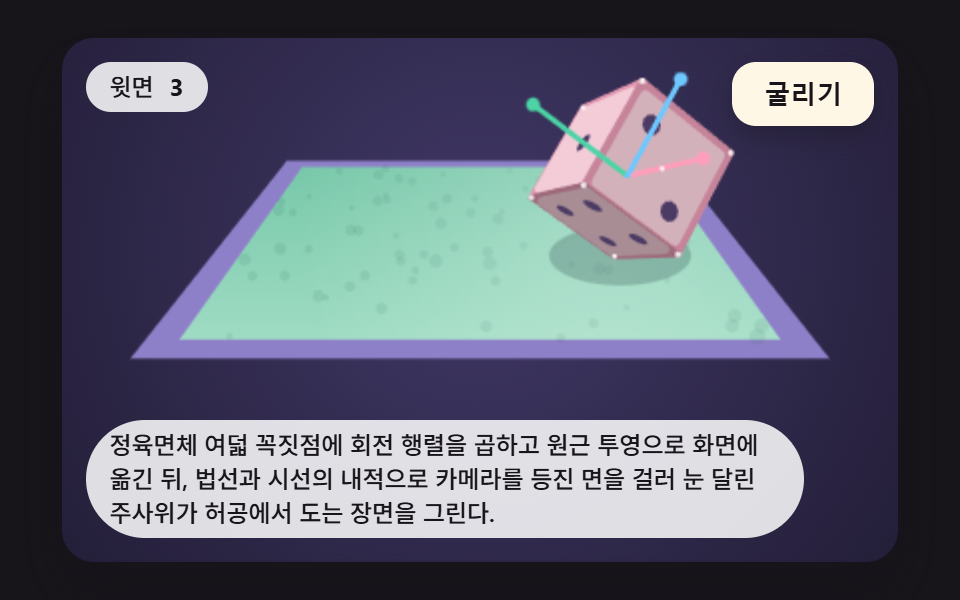 InteractionsDice Roll Animation: 9 Scenes with Top-Face Math
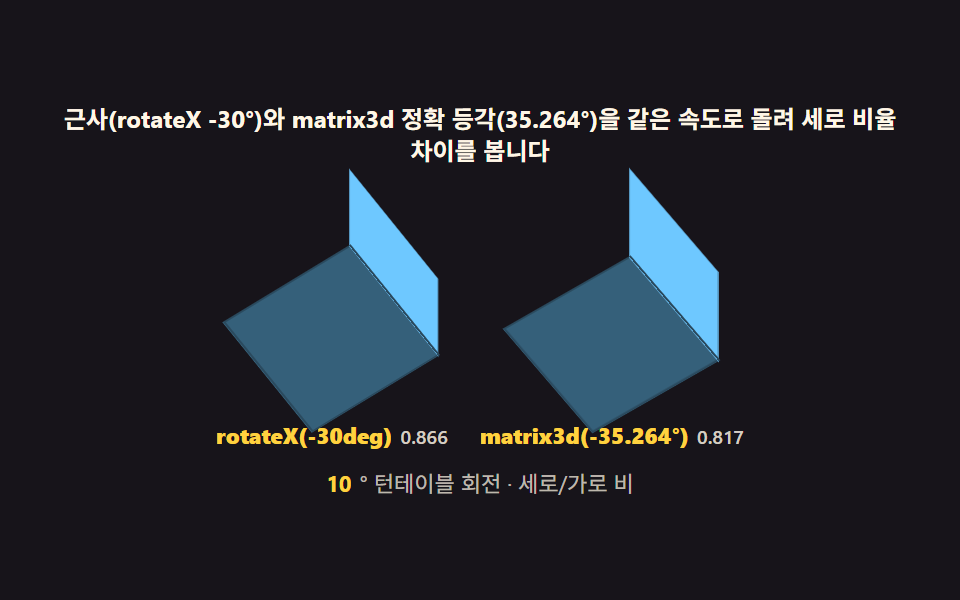 InteractionsIsometric CSS: 9 True-Projection 3D Dioramas
 Interactions9 CSS 3D Background Animation Depth Layers
 InteractionsBubble Animation CSS: 9 Soap-Film Scenes That Pop
 InteractionsCursor Follow Animation: 9 Procedural Creatures
 InteractionsFerrofluid Simulation: 9 Canvas Scenes with Spikes
 Interactions3D Hover Effect CSS: 9 Pointer-Following Scenes
 InteractionsMouse Follow Effect CSS — 9 Cursor Chasers
 Interactionscss 3d transform Scenes: 9 Pointer Miniatures
 Creative UISpirograph Generator: 9 Gear-Ratio Curve Patterns